Optimizing Your MCP Desktop for Peak Performance
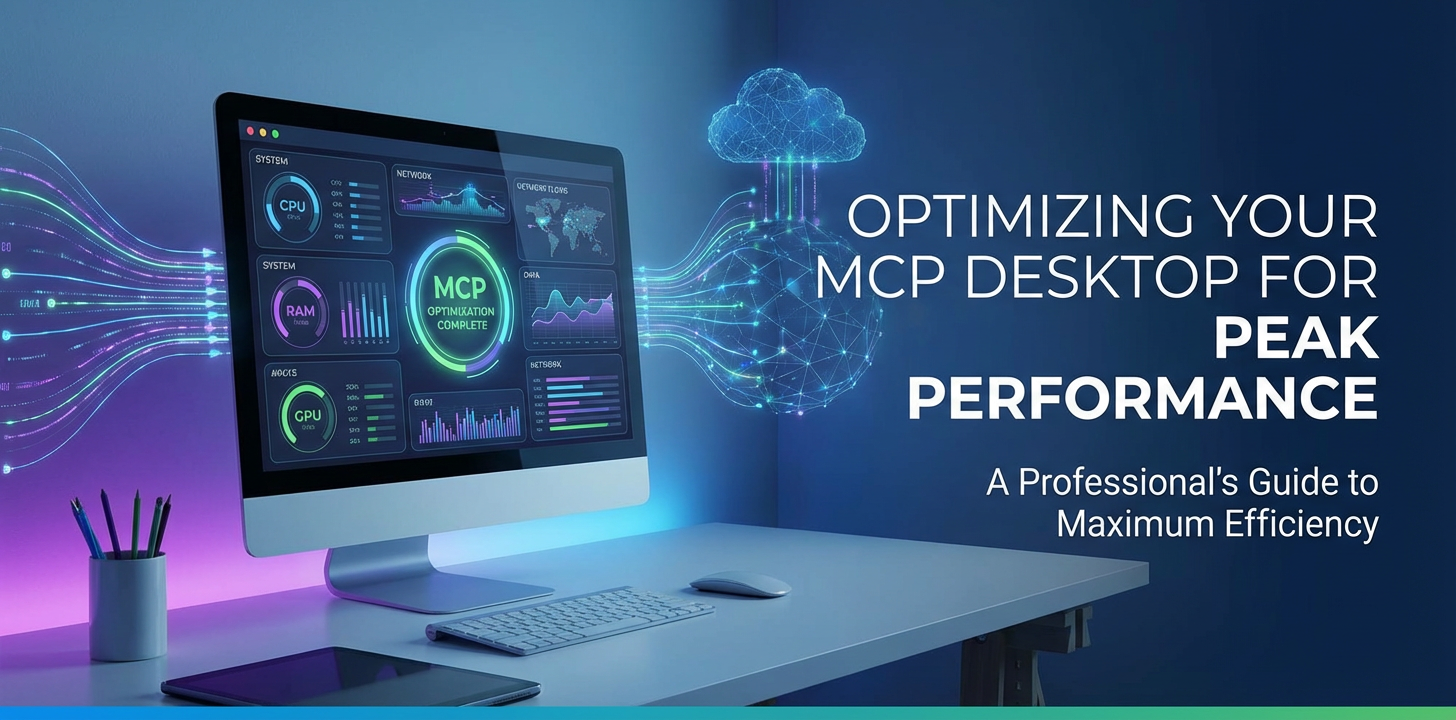


In the rapidly evolving landscape of data science, artificial intelligence, and complex simulations, the performance of your computing environment is not merely a convenience; it is a critical determinant of productivity, accuracy, and innovation. For users heavily reliant on their MCP Desktop – a sophisticated computing setup designed to leverage the Model Context Protocol – understanding and implementing meticulous optimization strategies is paramount. The Model Context Protocol (MCP) forms the backbone of these powerful systems, orchestrating the management of intricate computational models, their associated data contexts, and the dynamic allocation of system resources. Achieving peak performance on your MCP Desktop is about more than just fast hardware; it involves a holistic approach that encompasses hardware selection, operating system fine-tuning, application-specific configurations, and intelligent workflow management. This extensive guide will delve into every facet of optimization, ensuring your mcp-powered workstation operates at its zenith, empowering you to push the boundaries of your research and development.
The Foundation: Understanding Your MCP Desktop and the Model Context Protocol
Before embarking on an optimization journey, it’s essential to fully grasp what an MCP Desktop entails and the fundamental role of the Model Context Protocol. Imagine your MCP Desktop as a specialized cockpit for interacting with, developing, and deploying complex models—be they machine learning algorithms, statistical analyses, simulation engines, or intricate data processing pipelines. Unlike a generic workstation, an MCP Desktop is architected with a keen focus on workloads that demand significant computational muscle, vast memory resources, and often, accelerated processing capabilities. Its primary purpose is to provide a stable, efficient, and responsive environment for tasks that inherently involve model instantiation, context switching, and continuous data feeding.
At the heart of this system lies the Model Context Protocol (MCP). This protocol is not merely a communication standard; it's an architectural paradigm that dictates how models interact with data, how their execution contexts are managed, and how system resources are dynamically allocated and deallocated. Think of the mcp as a sophisticated conductor for an orchestra of models and data streams. It ensures that when you load a particular model, all its dependencies, required data subsets, and environmental variables are seamlessly brought into its context, providing an isolated yet resource-optimized environment for execution. This intelligent context management prevents conflicts between different models, optimizes memory footprint by loading only what's necessary, and facilitates rapid switching between diverse tasks. For instance, if you're working on a natural language processing model and then switch to a computer vision task, the MCP Desktop, guided by the Model Context Protocol, efficiently unloads the NLP context and loads the vision context, minimizing overhead and maximizing responsiveness. The efficacy of the Model Context Protocol directly correlates with the overall performance and stability of your MCP Desktop, making its underlying implementation and your interaction with it critical areas for optimization.
The "why" of optimization for an MCP Desktop is clear: in fields where milliseconds can translate into significant gains in iteration speed or accuracy, sluggish performance means lost time, delayed insights, and potentially, compromised results. An optimized system allows for faster model training, quicker inference, seamless data visualization, and an overall smoother user experience, transforming a frustrating bottleneck into a powerful accelerator for innovation.
Part 1: Hardware Foundations for Uncompromising MCP Desktop Performance
The bedrock of any high-performance computing system is its hardware. For an MCP Desktop designed to leverage the Model Context Protocol, judicious selection and configuration of components are non-negotiable. Each piece of hardware plays a crucial role in the overall symphony of performance, and neglecting any one can create a bottleneck that cripples the entire system, regardless of how powerful other components might be.
Central Processing Unit (CPU): The Brain of Your Operation
The CPU is the primary processing unit, responsible for executing instructions, managing operating system processes, and handling the core logic of your applications. For an MCP Desktop, the demands on the CPU are multifaceted.
- Core Count and Threading: Modern CPUs feature multiple cores, each capable of handling independent processing threads. For many machine learning algorithms, data processing tasks, and parallel simulations inherent in the Model Context Protocol, a higher core count is directly beneficial. Tasks that can be broken down into parallel sub-tasks will scale almost linearly with the number of available cores. Intel's Hyper-Threading and AMD's Simultaneous Multithreading (SMT) technologies further enhance this by allowing each physical core to handle two threads concurrently, improving resource utilization. Aim for CPUs with at least 8-16 cores for serious MCP Desktop work, with higher counts (e.g., 24, 32, or even 64 cores in workstation-grade CPUs) providing substantial gains for highly parallelizable workloads.
- Clock Speed: Measured in gigahertz (GHz), clock speed dictates how many instruction cycles a single core can execute per second. While core count matters for parallelism, single-threaded performance (driven by clock speed and architectural efficiency) is crucial for tasks that cannot be easily parallelized, such as certain pre-processing steps, sequential parts of algorithms, or general system responsiveness. A good balance between high core count and high boost clock speeds is ideal for a versatile MCP Desktop.
- Cache Size: CPU caches (L1, L2, L3) are small, extremely fast memory banks integrated directly into the CPU, storing frequently accessed data and instructions. A larger and more efficient cache reduces the need for the CPU to access slower main system RAM, significantly accelerating data access and processing. For memory-intensive model contexts managed by the mcp, substantial cache sizes can dramatically improve performance.
- Architecture: Different CPU architectures (e.g., Intel's Core i9/Xeon, AMD's Ryzen/Threadripper) have varying strengths. Workstation-grade CPUs like AMD Threadripper or Intel Xeon often offer higher core counts, larger caches, more PCIe lanes (for connecting multiple GPUs or NVMe drives), and support for ECC RAM, making them particularly suitable for demanding MCP Desktop environments. Research benchmarks specific to your typical workloads to select the optimal architecture.
Random Access Memory (RAM): The Workbench for Models and Data
RAM is where your CPU stores currently active programs, data, and model contexts for quick access. For an MCP Desktop leveraging the Model Context Protocol, generous amounts of fast RAM are absolutely critical.
- Quantity: Large datasets, complex models, and multiple concurrently running model contexts (as managed by the mcp) consume vast amounts of RAM. Insufficient RAM forces the system to rely on slower storage (swapping to disk), leading to a drastic performance hit. Aim for a minimum of 64GB of RAM for serious work, with 128GB, 256GB, or even 512GB being common in high-end MCP Desktop builds. It’s always better to have more RAM than you think you need, especially when dealing with in-memory databases, large language models, or extensive simulations.
- Speed (MHz) and Latency (CL): Faster RAM (higher MHz) and lower latency (lower CAS Latency, or CL) reduce the time it takes for the CPU to access data, directly impacting performance. While the difference might be subtle for basic tasks, for computationally intensive workloads and rapid context switching within the Model Context Protocol, faster RAM can provide noticeable gains. DDR4-3200 or DDR4-3600 with good timings (e.g., CL16) are excellent starting points, with DDR5 offering even higher speeds for newer platforms.
- ECC RAM: Error-Correcting Code (ECC) RAM can detect and correct memory errors. While more expensive and typically found on workstation/server platforms, ECC RAM is invaluable for tasks where data integrity is paramount, such as scientific simulations, financial modeling, or long-running training sessions on your MCP Desktop. It prevents silent data corruption that could lead to inaccurate results or system crashes.
Graphics Processing Unit (GPU): The Accelerator for Parallel Tasks
For many modern MCP Desktop applications, especially those involving machine learning, deep learning, computer vision, and scientific computing, the GPU is not just for rendering graphics; it's a powerful parallel processing powerhouse.
- VRAM (Video RAM): This is the dedicated memory on the GPU itself. For large models (e.g., large language models, high-resolution image processing), high VRAM capacity is essential. Inadequate VRAM will either prevent a model from loading or force it to swap data to slower system RAM, negating the GPU's acceleration benefits. Aim for GPUs with at least 12GB, 16GB, 24GB, or even 48GB+ of VRAM, depending on your specific workloads.
- CUDA Cores / Stream Processors / Tensor Cores: These are the parallel processing units within the GPU. NVIDIA's CUDA cores are widely adopted in AI/ML, while AMD's Stream Processors serve a similar function. NVIDIA's Tensor Cores, found in their RTX and professional GPUs, are specifically designed to accelerate matrix operations, which are fundamental to deep learning, offering massive performance gains for these specific tasks.
- GPU Architecture: The generation of the GPU (e.g., NVIDIA Ampere, Ada Lovelace, Hopper, AMD RDNA) dictates its overall performance, efficiency, and feature set. Newer generations typically offer significant improvements in processing power per watt and introduce new acceleration technologies.
- Multi-GPU Configurations: For extremely demanding workloads, an MCP Desktop can benefit from multiple GPUs. This requires a motherboard with sufficient PCIe slots and a robust power supply. However, not all software or algorithms can efficiently utilize multiple GPUs, so verify compatibility and scaling before investing. The Model Context Protocol might facilitate load balancing across available GPUs, but its effectiveness depends on the application's implementation.
Storage: The Gatekeeper of Your Data and Models
Storage performance is often overlooked but profoundly impacts loading times, saving times, and the overall responsiveness of your MCP Desktop.
- NVMe SSDs: Non-Volatile Memory Express (NVMe) Solid-State Drives (SSDs) connected via the PCIe interface offer vastly superior speeds compared to traditional SATA SSDs or Hard Disk Drives (HDDs). They are critical for rapid OS boot times, quick application launches, and, most importantly, fast loading of large datasets and models from storage into RAM or VRAM. For an MCP Desktop, NVMe is the absolute minimum standard for your primary drive and ideally for any drives storing active datasets or frequently accessed models. PCIe Gen4 NVMe drives offer even higher speeds, with PCIe Gen5 pushing the boundaries further.
- SATA SSDs: While slower than NVMe, SATA SSDs are still significantly faster than HDDs and can be a cost-effective solution for secondary storage of less frequently accessed data or for scratch space.
- Hard Disk Drives (HDDs): HDDs offer the lowest cost per gigabyte and are suitable for archival storage of very large, infrequently accessed datasets or backups. They should never be used for the operating system, applications, or active data on an MCP Desktop due to their abysmal read/write speeds compared to SSDs.
- RAID Configurations: For enhanced performance (RAID 0 striping) or data redundancy (RAID 1 mirroring, RAID 5, RAID 6), RAID arrays can be implemented. RAID 0 with multiple NVMe drives can offer astounding read/write speeds, ideal for I/O-intensive workloads, though it comes with increased risk of data loss if one drive fails.
- Storage Hierarchy: A common optimized setup for an MCP Desktop is a primary high-capacity NVMe drive for the OS, applications, and actively used models/data, complemented by one or more secondary NVMe drives for larger active datasets, and potentially an HDD array or network-attached storage (NAS) for archival or shared data. The Model Context Protocol will heavily rely on fast storage for efficient context loading and saving.
Motherboard and Chipset: The Central Nervous System
The motherboard connects all your components and facilitates communication between them. Its chipset governs the features and capabilities of the system.
- PCIe Lanes: Ensure the motherboard has enough PCIe lanes and slots to accommodate your desired number of GPUs (at x16 or x8 speeds, ideally), NVMe drives, and other expansion cards. Workstation chipsets typically offer more lanes than consumer chipsets.
- RAM Slots and Support: Verify support for your chosen RAM type (DDR4/DDR5), capacity, and speed.
- VRM Quality: The Voltage Regulator Module (VRM) supplies power to the CPU. High-quality VRMs are crucial for stable power delivery, especially during sustained high loads on an MCP Desktop, preventing throttling and ensuring system stability.
- Connectivity: Adequate USB ports (especially USB 3.x/4.0/Thunderbolt), high-speed Ethernet (2.5GbE, 10GbE), and Wi-Fi 6E/7 are important for peripheral connectivity and high-speed data transfer.
Power Supply Unit (PSU): The Unsung Hero
The PSU delivers power to all components. An underpowered or low-quality PSU can lead to instability, component damage, and performance throttling.
- Wattage: Calculate the total power draw of all your components (especially CPU and multiple GPUs) and choose a PSU with sufficient headroom (e.g., 20-30% above peak estimated draw) to ensure stable power delivery. For high-end MCP Desktop builds with multiple GPUs, PSUs of 1000W, 1200W, or even 1600W are common.
- Efficiency Rating: An 80 PLUS Gold, Platinum, or Titanium rated PSU operates more efficiently, wasting less power as heat and potentially saving on electricity bills.
- Modular Cabling: Modular PSUs allow you to connect only the cables you need, improving airflow and cable management within the case.
Cooling Systems: Keeping Temperatures in Check
High performance generates heat. Excessive heat leads to thermal throttling, where components automatically reduce their speed to prevent damage, drastically impacting performance.
- CPU Cooling: High-end CPUs require robust cooling. Large air coolers (e.g., Noctua NH-D15, be quiet! Dark Rock Pro 4) are effective and reliable. All-in-One (AIO) liquid coolers offer superior cooling capacity for extremely powerful CPUs and better aesthetics. Custom liquid cooling loops provide the best thermal performance but require expertise and maintenance.
- Case Airflow: A well-designed case with ample airflow and strategically placed fans is crucial for dissipating heat from all components, including GPUs, NVMe drives, and VRMs.
- GPU Cooling: Most GPUs come with adequate cooling, but in multi-GPU setups or poorly ventilated cases, temperatures can soar. Ensure sufficient space between GPUs and good case airflow.
- Thermal Paste: High-quality thermal paste applied correctly between the CPU (and sometimes GPU) and its cooler can significantly improve heat transfer.
By meticulously selecting and configuring these hardware components, you establish a formidable foundation for your MCP Desktop, ready to tackle the most demanding tasks orchestrated by the Model Context Protocol.
Part 2: Operating System and Software Environment Optimization
Even with the most powerful hardware, a poorly configured operating system and software environment can squander performance. Optimizing this layer ensures that your hardware's capabilities are fully realized, and the Model Context Protocol can operate without unnecessary overhead.
Operating System Choice and Configuration
The choice of OS significantly impacts your MCP Desktop experience and performance.
- Linux Distributions (Ubuntu, Fedora, CentOS): Often the preferred choice for data scientists and AI/ML engineers due to their open-source nature, robust command-line tools, extensive support for development libraries (CUDA, cuDNN, TensorFlow, PyTorch), and superior resource management capabilities. Linux typically incurs less overhead than Windows.
- Kernel Tuning: Advanced users can fine-tune kernel parameters (e.g.,
sysctlsettings for memory management, I/O schedulers) for specific workloads. - Minimal Installation: Install only essential components to reduce background processes.
- Swap Space: Configure swap space appropriately. While ample RAM reduces reliance on swap, a correctly sized swap file (e.g., 1-2x RAM for 64GB+, or use swapiness to prevent aggressive swapping) is a good fallback.
- Kernel Tuning: Advanced users can fine-tune kernel parameters (e.g.,
- Windows (Pro/Workstation): Offers broad software compatibility and a familiar user interface. Windows 10/11 Pro or Workstation editions provide features like support for larger RAM capacities and professional features.
- Disable Unnecessary Services/Apps: Many default Windows services and pre-installed apps run in the background, consuming CPU and RAM. Disable Cortana, OneDrive sync, Xbox Game Bar, telemetry, and other non-essential services.
- Game Mode: While designed for gaming, it can prioritize active applications, potentially benefiting the primary mcp workload.
- Power Plan: Always set to "High Performance" to prevent the CPU from downclocking under load.
- macOS: Excellent for user experience and integration with Apple's ecosystem, particularly for M-series chip users who benefit from unified memory architecture and powerful neural engines. However, software compatibility for certain niche AI/ML libraries can sometimes be an issue compared to Linux. Optimization largely revolves around efficient use of its native toolchain.
Driver Management: The Bridge to Hardware Efficiency
Drivers are software components that allow your operating system to communicate with your hardware. Outdated or incorrect drivers are a common cause of performance issues and instability on an MCP Desktop.
- GPU Drivers: This is paramount. For NVIDIA GPUs, always install the latest "Studio Driver" or "Game Ready Driver" if it includes optimizations for your specific AI/ML frameworks (check release notes). For AMD GPUs, use the latest "Pro" drivers where available. Keeping GPU drivers up-to-date ensures access to performance improvements, bug fixes, and support for newer CUDA/OpenCL versions, critical for the acceleration relied upon by the Model Context Protocol.
- Chipset Drivers: Keep your motherboard chipset drivers updated to ensure optimal communication between the CPU, RAM, PCIe lanes, and storage controllers.
- NVMe Drivers: Some NVMe drives benefit from manufacturer-specific drivers that can outperform generic OS drivers. Check your drive manufacturer's website.
Background Processes and Services
Every running process consumes CPU cycles, RAM, and I/O bandwidth. Minimize unnecessary background activity on your MCP Desktop.
- Task Manager (Windows) /
top,htop(Linux): Regularly monitor running processes. Identify and disable or uninstall applications and services that are not essential for your work. This includes chat applications, cloud sync clients (unless actively needed), and unnecessary startup programs. - Startup Programs: Configure your OS to load only essential applications at startup.
- Antivirus Software: While necessary for security, some antivirus programs can be resource-intensive. Choose a lightweight solution or configure it to run scans during off-peak hours.
Virtual Memory / Swap File Configuration
Virtual memory (or swap space on Linux) acts as an overflow for RAM, using a portion of your storage drive.
- Placement: If you must use a swap file, place it on the fastest available NVMe SSD, not on an HDD.
- Sizing: For systems with 64GB+ RAM, a swap file size equal to 0.5-1x RAM can be a safe buffer, but aggressive swapping should be avoided by ensuring sufficient physical RAM.
- Swappiness (Linux): The
swappinesskernel parameter (0-100) controls how aggressively the system swaps. A lower value (e.g., 10 or 20) makes the system prefer keeping data in RAM longer, often beneficial for mcp workloads.
Power Settings (Windows) / CPU Governor (Linux)
Ensure your CPU and other components are running at full power when needed.
- Windows Power Plan: Set to "High Performance" or "Ultimate Performance" (if available) to prevent the CPU from downclocking.
- Linux CPU Governor: Set the CPU governor to
performanceto ensure the CPU always runs at its highest frequency. (e.g.,cpupower frequency-set -g performance).
Disk Cleanup and Maintenance
Maintain the health and efficiency of your storage drives.
- Disk Cleanup: Regularly delete temporary files, old system files, and browser caches.
- TRIM (SSDs): Ensure TRIM is enabled and functioning for your SSDs. TRIM helps the OS tell the SSD which data blocks are no longer in use, allowing the SSD to reclaim space for optimal performance. Modern operating systems typically manage this automatically.
- Defragmentation (HDDs only): Never defragment an SSD. For any HDDs you might still use for archival, occasional defragmentation can improve performance.
Network Optimization
For MCP Desktop environments that rely on external data sources, cloud services, or distributed computing, network performance is critical.
- High-Bandwidth Connection: Utilize a high-speed internet connection.
- Wired Ethernet: Always prefer wired Ethernet (Gigabit, 2.5GbE, 10GbE) over Wi-Fi for stability and speed, especially for large data transfers.
- DNS Resolution: Configure fast DNS servers (e.g., Cloudflare 1.1.1.1, Google 8.8.8.8) to speed up domain lookups.
- Firewall Rules: Ensure your firewall isn't unnecessarily blocking or slowing down critical network traffic required by your Model Context Protocol applications.
By carefully tuning your operating system and its underlying software environment, you create a lean, mean, processing machine that allows your MCP Desktop to deliver its full potential, ensuring the Model Context Protocol functions with minimal impedance.
Part 3: Optimizing the Model Context Protocol (MCP) Environment Itself
Beyond the general system configuration, the specific settings and practices within your MCP Desktop application and how it manages the Model Context Protocol are crucial for peak performance. This layer of optimization is where you directly influence how models are loaded, data is handled, and resources are allocated.
MCP Software Configuration and Application Settings
The MCP Desktop application likely offers various configuration options that can significantly impact performance.
- Resource Allocation Limits: Many advanced applications allow you to specify how much CPU, RAM, or GPU memory they can utilize. Setting these judiciously prevents one model context from monopolizing resources, potentially starving other essential system processes or even other active model contexts managed by the mcp.
- Caching Mechanisms: Configure the MCP Desktop's internal caching. This could involve caching frequently accessed model layers, intermediate data results, or pre-processed features. An effective cache can dramatically reduce re-computation and I/O operations, making context switching and iterative development much faster.
- Logging Level: Reduce verbose logging to only essential information during production or performance-critical runs. Excessive logging can consume CPU cycles and I/O bandwidth.
- GUI vs. Headless Mode: If your MCP Desktop application supports it, running core model computations in a headless (non-GUI) mode can free up significant GPU and CPU resources that would otherwise be used for rendering the user interface.
- Plugin/Extension Management: Disable any unnecessary plugins or extensions within your MCP Desktop environment. Each one adds overhead.
Efficient Data Management for the Model Context Protocol
Data is the fuel for your models. How you manage, access, and process it directly influences the efficiency of the mcp.
- Data Locality: Store active datasets on the fastest available local storage (NVMe SSDs). Network storage introduces latency, and HDDs are simply too slow. The Model Context Protocol needs immediate access to data for efficient context switching and model inference.
- Data Pre-processing and Feature Engineering:
- Offline Pre-processing: Wherever possible, perform data cleaning, normalization, tokenization, and feature engineering offline and save the processed data. This prevents redundant computation during model training or inference, which can be a significant time sink.
- Data Formats: Use efficient data formats like Parquet, ORC, HDF5, or highly optimized binary formats. These are often faster to load and process than CSV or JSON, especially for large datasets.
- Data Compression: Judiciously compress data. While it saves storage space and network bandwidth, decompression adds a CPU overhead. Balance these factors based on your specific workflow.
- Streaming vs. Batch Loading: For very large datasets that cannot fit entirely in RAM, implement efficient data streaming or batch loading strategies. The Model Context Protocol should be able to request data in manageable chunks, ensuring a continuous flow without overwhelming memory.
- Data Pruning/Sampling: For initial exploration or hyperparameter tuning, consider working with smaller, representative samples of your data to accelerate iteration times. Once optimal parameters are found, you can scale up to the full dataset.
Model Lifecycle Management and Optimization
The way models are loaded, used, and unloaded by the Model Context Protocol is critical.
- Model Caching: If your MCP Desktop frequently switches between a set of common models, implement a mechanism to keep them in memory (or GPU VRAM) for faster access, rather than loading them from disk every time.
- Model Quantization and Pruning: For deployment or inference, consider optimizing models through techniques like quantization (reducing the precision of model weights, e.g., from float32 to float16 or int8) or pruning (removing redundant connections/neurons). This reduces model size, VRAM footprint, and speeds up inference, often with minimal impact on accuracy.
- Model Versioning: Maintain clear versioning for your models and associated data. This aids reproducibility and ensures that the Model Context Protocol always loads the correct version.
- On-Demand Model Loading: Only load models when they are actively needed by a specific context. The mcp should be intelligent enough to manage this to conserve resources.
Resource Allocation and Parallelization
Maximizing the utilization of your CPU and GPU resources is key.
- Thread/Process Management: Configure your MCP Desktop application to optimally utilize available CPU cores for multi-threaded tasks. Libraries like OpenMP, MKL (Intel Math Kernel Library), and BLIS can significantly accelerate numerical computations.
- GPU Parallelization Frameworks: Ensure your applications are correctly configured to leverage CUDA (NVIDIA) or ROCm (AMD) for GPU acceleration.
- Batch Size Optimization: For deep learning, experiment with different batch sizes. A larger batch size can improve GPU utilization and throughput, but consumes more VRAM and might require more memory to store gradients during training. Find the optimal balance for your GPU's VRAM capacity.
- Mixed Precision Training: Utilize mixed-precision training (e.g., FP16 for computations, FP32 for weight storage) on compatible GPUs (those with Tensor Cores) to speed up training and reduce VRAM usage.
- Containerization (Docker, Podman): Containerizing your MCP Desktop environment provides numerous benefits. It encapsulates all dependencies (libraries, frameworks, specific Python versions) into a portable image, ensuring consistency and reproducibility across different machines or even different projects on the same machine. This prevents "dependency hell" and ensures that the Model Context Protocol runs in a predictable, isolated environment. It also simplifies resource isolation and management.
Integrating External AI Services and APIs with APIPark
In a dynamic MCP Desktop environment, it's common to integrate with external AI models or services. These could be third-party APIs for specific tasks (like advanced NLP, image recognition, or specialized data analysis) or even internal models deployed as services. Managing these integrations efficiently is crucial for performance, security, and scalability. This is where an intelligent API gateway comes into play.
For instance, if your MCP Desktop workflow involves invoking a variety of external AI services, potentially from different providers, managing their authentication, ensuring consistent invocation formats, and tracking usage can become complex and resource-intensive. This is precisely where a platform like APIPark offers immense value. As an open-source AI gateway and API management platform, APIPark simplifies the integration and deployment of AI and REST services. It provides a unified management system for over 100 AI models, standardizing the request data format across all of them. This means your MCP Desktop application can interact with diverse AI services through a single, consistent interface, without needing to rewrite code for each new model or provider. APIPark allows you to encapsulate custom prompts with AI models into new, specialized REST APIs (e.g., a sentiment analysis API tailored to your domain), which can then be seamlessly called by your mcp environment. This approach offloads complex API management tasks, improves security through centralized access control and detailed logging, and ensures that your MCP Desktop can efficiently leverage external capabilities without bogging down its local resources with integration complexities. APIPark’s robust performance, rivaling Nginx, ensures that these external API calls are handled with minimal latency, maintaining the peak performance of your overall MCP Desktop ecosystem.
APIPark is a high-performance AI gateway that allows you to securely access the most comprehensive LLM APIs globally on the APIPark platform, including OpenAI, Anthropic, Mistral, Llama2, Google Gemini, and more.Try APIPark now! 👇👇👇
Part 4: Advanced Optimization Techniques and Best Practices
To truly extract every ounce of performance from your MCP Desktop, a deeper dive into advanced techniques and consistent best practices is essential. These methods move beyond basic configuration and delve into the nuances of profiling, workflow design, and continuous improvement.
Profiling and Benchmarking: Unmasking Bottlenecks
You can't optimize what you don't measure. Profiling and benchmarking are indispensable for identifying specific performance bottlenecks within your MCP Desktop applications and workflows.
- CPU Profiling: Use tools like
perf(Linux),oprofile(Linux),VTune Amplifier(Intel), orAMD uProfto analyze CPU usage. These tools can pinpoint which functions or lines of code consume the most CPU time, allowing you to target optimization efforts precisely. For Python-based workflows,cProfileorline_profilercan be invaluable. - GPU Profiling: NVIDIA's
nvprofandNsight Systems/Computeare powerful tools for analyzing GPU utilization, kernel execution times, memory transfers, and identifying bottlenecks in your CUDA workloads. AMD offers similar tools in their ROCm ecosystem. These profilers can reveal whether your GPU is saturated, underutilized, or spending too much time waiting for data. - Memory Profiling: Tools like
Valgrind(Linux) withMassifor Python'smemory_profilerhelp identify memory leaks, excessive memory allocation, and inefficient data structures that can lead to out-of-memory errors or frequent swapping, hindering the Model Context Protocol. - I/O Profiling: Monitor disk read/write speeds using tools like
iostat(Linux) or Windows Resource Monitor. Identify if your MCP Desktop is bottlenecked by slow data loading or saving operations. - Benchmarking: Establish baseline performance metrics for your critical workloads. Run your models, data processing pipelines, or simulations under controlled conditions and record key metrics like execution time, throughput, and resource utilization. Regularly re-benchmark after making changes to quantitatively assess the impact of your optimizations.
Code Optimization for Custom Models and Scripts
If you're developing custom models or data processing scripts for your MCP Desktop, code efficiency is paramount.
- Efficient Algorithms and Data Structures: Choose algorithms that scale well with increasing data size and use data structures optimized for your access patterns (e.g., hash maps for fast lookups, arrays for sequential access).
- Vectorization and Broadcasting: Leverage libraries like NumPy (for Python) for vectorized operations instead of explicit loops. Vectorized code runs much faster because it utilizes optimized C/Fortran implementations and can take advantage of SIMD (Single Instruction, Multiple Data) instructions on modern CPUs.
- Just-In-Time (JIT) Compilers: For Python, tools like Numba can compile critical sections of Python code to highly optimized machine code at runtime, offering significant speedups, especially for numerical computations.
- Parallel Programming: Where applicable, use multi-threading (
threadingmodule in Python) or multi-processing (multiprocessingmodule) to parallelize CPU-bound tasks. For GPU tasks, use appropriate parallel programming frameworks (CUDA/OpenCL). - Minimize Data Copies: Excessive data copying between CPU and GPU memory, or within system RAM, can introduce significant overhead. Optimize your code to minimize these transfers.
Regular Maintenance Routines
Consistent maintenance prevents performance degradation over time on your MCP Desktop.
- Software Updates: Regularly update your operating system, drivers, development libraries, and the MCP Desktop application itself. Updates often include performance enhancements, bug fixes, and security patches.
- Disk Health Checks: Periodically check the health of your SSDs using SMART data reporting tools. Replace failing drives proactively.
- Physical Cleaning: Dust accumulation inside your computer case can impede airflow and lead to higher temperatures, causing thermal throttling. Regularly clean out dust from fans, heatsinks, and vents.
- Cable Management: Proper cable management not only improves aesthetics but also ensures unobstructed airflow within the case, contributing to better cooling.
Backup and Recovery Strategies
While not directly a performance optimization, a robust backup strategy prevents catastrophic data loss and minimizes downtime, which is crucial for maintaining productivity on your MCP Desktop.
- Regular Backups: Implement a schedule for backing up critical data, model weights, and configuration files. Use a 3-2-1 backup strategy (3 copies of data, on 2 different media, with 1 offsite).
- Version Control: Use Git for versioning all your code, scripts, and model configurations. This allows you to revert to previous working states easily and collaborate effectively.
Understanding Usage Patterns and Workflow Tailoring
No single optimization strategy fits all. Tailor your approach based on how you primarily use your MCP Desktop and the demands of the Model Context Protocol.
- CPU-Bound Workloads: If your tasks are predominantly CPU-bound (e.g., complex statistical modeling, symbolic AI, non-accelerated data processing), prioritize CPU core count, clock speed, RAM quantity, and fast storage.
- GPU-Bound Workloads: For deep learning, large-scale simulations, or scientific computing, prioritize GPU VRAM, CUDA/Tensor Cores, and PCIe bandwidth.
- Memory-Bound Workloads: If your models or datasets barely fit into RAM/VRAM, focus on maximizing RAM/VRAM capacity, speed, and efficient data loading strategies.
- I/O-Bound Workloads: For tasks involving frequent reading and writing of large files (e.g., working with massive databases, raw video processing), invest heavily in NVMe storage, potentially in a RAID 0 configuration, and optimize data formats.
By adopting these advanced techniques and weaving best practices into your daily routine, your MCP Desktop will not only achieve peak performance but sustain it, ensuring that the Model Context Protocol consistently operates at its maximum potential.
Part 5: Future-Proofing Your MCP Desktop
The world of computing, especially in the realm of AI and data science, is in perpetual motion. What is cutting-edge today can become obsolete tomorrow. To ensure your investment in an MCP Desktop continues to deliver peak performance for years to come, strategic planning for future upgrades and staying abreast of technological advancements is crucial.
Strategic Upgrade Paths
Building an MCP Desktop with an eye towards future upgrades means choosing components that offer a reasonable upgrade path without requiring a complete system overhaul.
- Motherboard Selection: Opt for a motherboard with sufficient PCIe slots, M.2 NVMe slots, and RAM slots to accommodate future expansion. For instance, a motherboard supporting DDR5 RAM and PCIe Gen5 will offer a longer lifespan for component upgrades than one limited to older standards. Ensure the socket type (e.g., AM5 for AMD, LGA1700 for Intel) is from a platform that promises future CPU compatibility for at least one or two more generations. This allows for incremental CPU upgrades without replacing the entire motherboard and RAM.
- Power Supply Unit (PSU) Capacity: When initially selecting a PSU, choose one with a higher wattage than your current needs. This provides headroom for future GPU upgrades (which often consume more power) or adding more storage drives without needing to replace the PSU prematurely.
- Case Size and Cooling Compatibility: Select a case that offers ample internal space and support for larger CPU coolers, multiple GPUs, and additional fans or liquid cooling radiators. Good airflow and expandability are key to maintaining thermal performance as you upgrade.
- Modular Storage Approach: Start with a high-capacity primary NVMe, but ensure there are additional M.2 slots for adding more NVMe drives down the line, or SATA ports for expanding with SSDs/HDDs. This allows you to grow your storage capacity and speed as your data demands increase.
- RAM Expansion: Populate your motherboard with RAM modules in a way that leaves room for future expansion. For example, if your motherboard has four RAM slots and you start with 64GB, use two 32GB modules rather than four 16GB modules, leaving two slots open for future addition of another 64GB or more.
Staying Current with Technology
Continuous learning and adaptation are vital for maintaining the edge with your MCP Desktop.
- Monitor Hardware Developments: Keep an eye on new generations of CPUs, GPUs, and storage technologies. New architectures often bring significant performance-per-watt improvements, new features (like dedicated AI accelerators), and higher capacities that could substantially benefit your Model Context Protocol workloads.
- Software and Framework Updates: Stay updated with the latest versions of your operating system, development frameworks (TensorFlow, PyTorch, Scikit-learn), and the MCP Desktop application itself. These updates frequently contain performance optimizations, new features, and bug fixes that directly contribute to peak performance.
- Driver Releases: Regularly check for new GPU and chipset driver releases. These often include critical performance enhancements, especially for specific AI models or computational tasks.
- Community Engagement: Participate in relevant online forums, communities, and conferences for data science, AI, and your specific MCP Desktop application. This is an excellent way to learn about new optimization techniques, tools, and best practices from peers and experts. Sharing knowledge and troubleshooting tips within the community can be invaluable.
- Embrace New Paradigms: As the landscape evolves, new computational paradigms or protocols might emerge. Being open to integrating these into your workflow or upgrading your mcp environment to support them will ensure your system remains at the forefront of innovation. This adaptability is what keeps your MCP Desktop from becoming a static, quickly outdated tool.
By thoughtfully planning for upgrades and actively engaging with technological advancements, you can ensure that your MCP Desktop remains a powerful, efficient, and relevant instrument, consistently delivering peak performance for all your endeavors leveraging the Model Context Protocol.
Conclusion: A Continuous Pursuit of Perfection
Optimizing your MCP Desktop for peak performance is not a one-time task but a continuous journey. It requires a deep understanding of how hardware, software, and the ingenious Model Context Protocol interoperate. From the foundational choices of CPU, RAM, GPU, and storage, through the meticulous tuning of your operating system and the nuanced configuration of your MCP Desktop application, every layer presents an opportunity for refinement. We've explored how a robust hardware setup creates the capacity, how an optimized software environment provides the efficiency, and how fine-tuning the Model Context Protocol itself orchestrates the entire computational symphony.
By systematically addressing potential bottlenecks, leveraging advanced profiling tools, and adhering to best practices like efficient data management, regular maintenance, and strategic future-proofing, you transform your MCP Desktop from a mere collection of components into a finely-tuned instrument of innovation. The ability to seamlessly switch between complex model contexts, process vast datasets with speed, and accelerate sophisticated algorithms ensures that your creative and analytical pursuits are unhindered by computational limitations.
Ultimately, an optimized MCP Desktop is more than just faster; it empowers you to iterate quicker, experiment more freely, achieve higher accuracy, and bring your most ambitious projects to fruition with unparalleled efficiency. Embrace this continuous pursuit of perfection, and your mcp-powered workstation will remain a powerhouse at the cutting edge of data science and artificial intelligence.
Comparison of Storage Types for MCP Desktop
| Feature | Hard Disk Drive (HDD) | SATA Solid State Drive (SSD) | NVMe Solid State Drive (SSD) (PCIe Gen3) | NVMe Solid State Drive (SSD) (PCIe Gen4/Gen5) |
|---|---|---|---|---|
| Interface | SATA III | SATA III | PCIe 3.0 x4 | PCIe 4.0 x4 / PCIe 5.0 x4 |
| Form Factor | 3.5", 2.5" | 2.5", M.2, mSATA | M.2 | M.2 |
| Sequential Read | 80-160 MB/s | 500-550 MB/s | Up to 3,500 MB/s | Up to 7,000 MB/s (Gen4) / 14,000 MB/s (Gen5) |
| Sequential Write | 80-160 MB/s | 450-520 MB/s | Up to 3,000 MB/s | Up to 6,000 MB/s (Gen4) / 12,000 MB/s (Gen5) |
| Random I/O (IOPS) | ~100-200 IOPS | ~80,000-100,000 IOPS | ~300,000-600,000 IOPS | ~600,000-1,000,000+ IOPS |
| Latency | High (~5-15 ms) | Medium (~0.1-0.2 ms) | Low (~0.02-0.03 ms) | Very Low (~0.01-0.02 ms) |
| Cost/GB | Lowest | Medium-Low | Medium | Medium-High / Highest |
| Best Use Case | Archival storage, large cold data, backups | General computing, secondary storage for less critical data | Primary OS drive, active datasets, frequently loaded models | MCP Desktop primary drive, critical active datasets, large LLMs |
| Recommendation for MCP Desktop | Avoid for active data. Only for cold storage/backups. | Acceptable for secondary storage. | Essential minimum for OS, applications, and active data. | Highly Recommended for ultimate performance and large datasets. |
Frequently Asked Questions (FAQs)
Q1: What is an MCP Desktop, and why is performance optimization so critical for it?
An MCP Desktop is a specialized workstation designed to manage and execute complex computational models, often leveraging a framework like the Model Context Protocol. It's commonly used in data science, AI development, and advanced simulations. Performance optimization is critical because these tasks are inherently resource-intensive. Achieving peak performance means faster model training and inference, quicker data processing, seamless context switching, and ultimately, accelerated research and development. In these fields, even small delays can significantly impact productivity and the speed of scientific discovery.
Q2: How does the Model Context Protocol (MCP) influence optimization strategies?
The Model Context Protocol is fundamental to how an MCP Desktop operates, by orchestrating the loading, execution, and resource allocation for different computational models and their associated data. Optimization strategies must account for the MCP's needs: ensuring fast RAM and storage for quick context loading, efficient CPU/GPU utilization for model execution, and proper software configuration to allow the MCP to manage resources dynamically without bottlenecks. Techniques like efficient data caching, model pruning, and robust resource allocation settings directly enhance the MCP's ability to maintain a responsive and high-performance environment.
Q3: What are the most impactful hardware upgrades for boosting MCP Desktop performance?
For an MCP Desktop, the most impactful hardware upgrades typically involve: 1. GPU: Upgrading to a GPU with more VRAM and processing units (CUDA/Tensor Cores) dramatically accelerates deep learning and parallel computing tasks. 2. RAM: Increasing RAM quantity (e.g., to 128GB or 256GB) and speed reduces reliance on slower disk swapping, which is crucial for large models and datasets. 3. NVMe SSDs: Switching to or upgrading faster NVMe SSDs (especially PCIe Gen4/Gen5) significantly reduces model and data loading times, improving overall system responsiveness. 4. CPU: A CPU with a higher core count and robust single-threaded performance enhances overall processing capability for a variety of tasks managed by the mcp.
Q4: Besides hardware, what software-related optimizations can I implement to improve my MCP Desktop's speed?
Software optimization is equally vital. Key strategies include: * Operating System Tuning: Using a lightweight OS (like Linux), disabling unnecessary background services and startup programs, and setting power plans to "High Performance." * Driver Updates: Keeping GPU, chipset, and NVMe drivers current for optimal hardware communication. * Application-Specific Settings: Configuring your MCP Desktop software to use optimal resource limits, enabling internal caching mechanisms, and reducing verbose logging. * Data Management: Implementing efficient data pre-processing, using optimized data formats, and ensuring data locality on fast storage. * Code Optimization: For custom scripts, leveraging vectorized operations, JIT compilers, and parallel programming techniques.
Q5: How can API management platforms like APIPark benefit an MCP Desktop workflow?
While an MCP Desktop excels at local model execution, many workflows involve integrating external AI services or deploying models as APIs. API management platforms like APIPark streamline this by providing a unified gateway for integrating and managing diverse AI and REST services. This means your MCP Desktop can seamlessly consume external AI capabilities (e.g., specialized NLP models, image recognition APIs) through a standardized interface, without bogging down local resources with complex integration logic. APIPark handles authentication, request formatting, and usage tracking, enhancing security, simplifying development, and ensuring that your mcp environment can efficiently leverage both local and cloud-based AI resources for a truly hybrid and high-performing workflow.
🚀You can securely and efficiently call the OpenAI API on APIPark in just two steps:
Step 1: Deploy the APIPark AI gateway in 5 minutes.
APIPark is developed based on Golang, offering strong product performance and low development and maintenance costs. You can deploy APIPark with a single command line.
curl -sSO https://download.apipark.com/install/quick-start.sh; bash quick-start.sh

In my experience, you can see the successful deployment interface within 5 to 10 minutes. Then, you can log in to APIPark using your account.

Step 2: Call the OpenAI API.