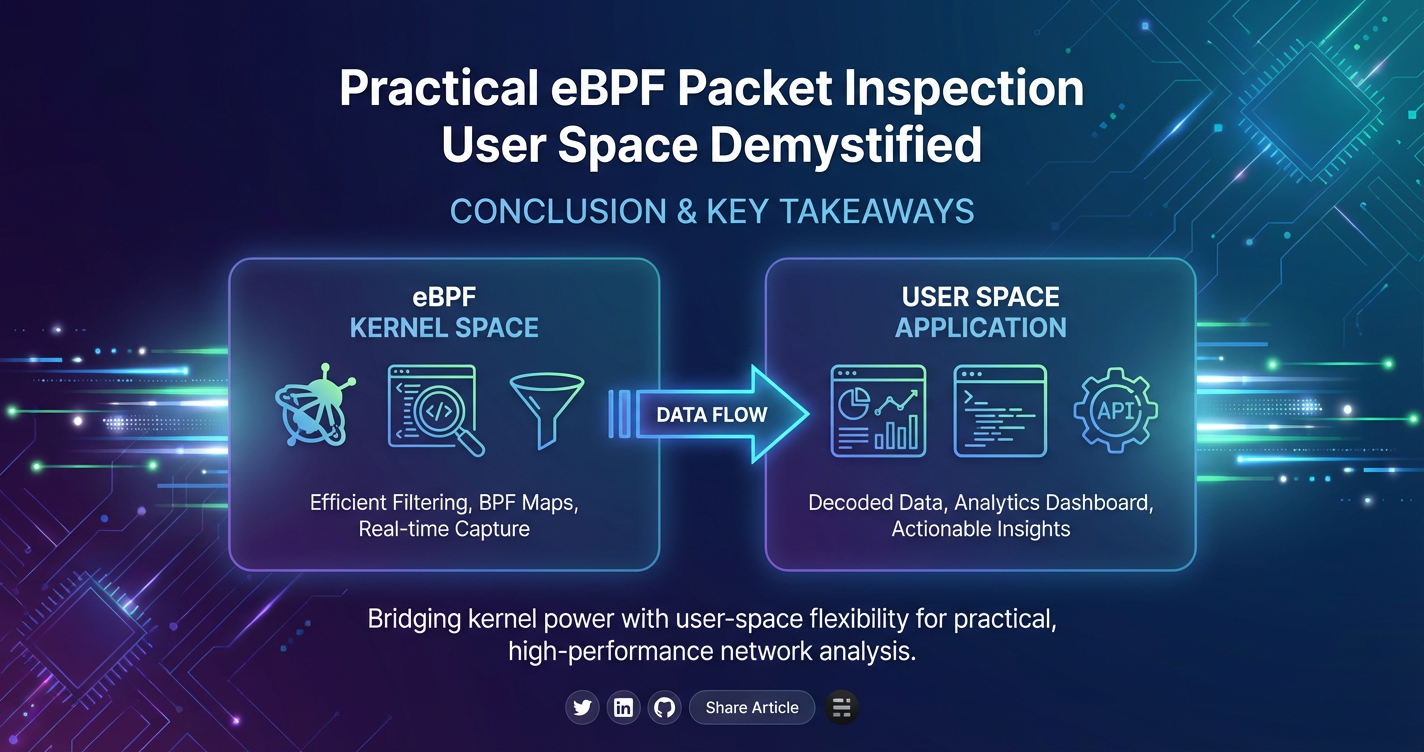
Practical eBPF Packet Inspection User Space Demystified


1. The Unseen Depths of Network Traffic: An Introduction to Kernel-Level Insight
In the vast and intricate landscape of modern computing, the network stands as the central nervous system, carrying the lifeblood of data between applications, services, and users. From microservices communicating within a Kubernetes cluster to global api calls traversing continents, every interaction relies on the efficient and secure movement of packets. For network engineers, system administrators, security analysts, and developers building robust distributed systems, gaining granular visibility into this packet flow is not merely beneficial; it is absolutely critical. Traditional methods of packet inspection, while foundational, often present significant limitations. Tools like tcpdump provide invaluable insights, but operate at a user-space level, requiring packets to traverse the entire network stack and often involve costly copying of data from kernel to user space, incurring substantial CPU overhead and introducing latency, especially in high-throughput environments. Furthermore, deeply embedded issues within the kernel’s networking fabric or the earliest stages of packet processing often remain opaque to these user-space utilities.
The challenge intensifies when dealing with modern infrastructures characterized by high-speed networks, ephemeral containers, and a relentless demand for performance. Security threats lurk in the shadows, performance bottlenecks emerge unexpectedly, and the need for dynamic traffic management becomes paramount. Relying solely on traditional approaches can lead to missed anomalies, delayed incident response, and suboptimal system performance. Imagine trying to secure an api gateway handling millions of requests per second with tools that introduce significant overhead or cannot see the complete picture of traffic before it reaches the application layer. This is precisely where the groundbreaking capabilities of eBPF (extended Berkeley Packet Filter) enter the scene, offering a revolutionary paradigm for observing, filtering, and manipulating network packets directly within the kernel, with unprecedented efficiency and flexibility.
eBPF transforms the Linux kernel into a programmable data plane, allowing developers to execute custom code safely and efficiently at various hook points throughout the kernel's execution path, including deep within the networking stack. This is a profound shift from the traditional model where kernel modifications required recompiling the kernel or loading potentially unstable kernel modules. With eBPF, lightweight, event-driven programs can be loaded, updated, and unloaded dynamically, providing a level of control and introspection previously unimaginable without significant system disruption. This article aims to demystify the practical aspects of eBPF packet inspection, specifically focusing on how these powerful kernel-side programs communicate with and are controlled by user-space applications. We will explore the architecture, the mechanisms of interaction, the development tools, and real-world applications that leverage this powerful synergy, ultimately empowering you to unlock deeper insights and exert finer control over your network traffic, even for the most demanding api and gateway infrastructures. By understanding this intricate dance between kernel and user space, practitioners can build next-generation monitoring, security, and networking solutions that redefine what's possible in a high-performance environment.
2. eBPF: A Paradigm Shift in Kernel Programmability and Observability
To truly appreciate the power of eBPF for packet inspection, it's essential to understand its fundamental nature and how it represents a significant evolution in kernel interaction. eBPF is not merely a tool; it's an in-kernel virtual machine that allows arbitrary (but safe) programs to be run in response to various kernel or user-space events. Born from the original Berkeley Packet Filter (BPF) which was designed solely for packet filtering (as seen in tcpdump), eBPF has expanded its scope dramatically, becoming a general-purpose, event-driven execution engine within the Linux kernel. This expansion is why it's referred to as "extended" BPF.
2.1 What is eBPF? A Deeper Look at its Core Architecture
At its heart, eBPF functions as a small, sandboxed virtual machine living inside the Linux kernel. Developers write programs in a restricted C dialect, which is then compiled into eBPF bytecode using LLVM/Clang. This bytecode is then loaded into the kernel via the bpf() system call. Before execution, every eBPF program undergoes a rigorous verification process by the kernel's eBPF verifier. This verifier ensures that the program is safe to run – meaning it won't crash the kernel, loop indefinitely, access invalid memory, or exploit kernel vulnerabilities. Once verified, the eBPF bytecode is often Just-In-Time (JIT) compiled into native machine code, providing near-native execution speed. This combination of safety and performance is what makes eBPF so revolutionary.
The core architectural components of eBPF include:
- eBPF Programs: These are the actual snippets of code that get executed. They are event-driven, meaning they are triggered by specific events (e.g., a network packet arriving, a system call being made, a function being called). There are various
program typestailored for different kernel hook points and functionalities, such asBPF_PROG_TYPE_XDPfor high-performance packet processing orBPF_PROG_TYPE_KPROBEfor kernel function tracing. - eBPF Maps: These are versatile in-kernel data structures that serve as the primary mechanism for stateful communication. They enable eBPF programs to store and retrieve data, share state between different eBPF programs, and, crucially for our discussion, facilitate data exchange between eBPF programs in the kernel and user-space applications. Maps are generic key-value stores with various types (hash maps, array maps, perf buffers, ring buffers, LPM tries) each optimized for specific access patterns and use cases.
- eBPF Helpers: To interact with the kernel environment, eBPF programs rely on a set of predefined
helper functionsprovided by the kernel. These helpers allow eBPF programs to perform tasks like reading kernel memory, getting current time, generating random numbers, interacting with maps, manipulating packet data, and performing other restricted kernel operations. The verifier ensures that only approved helper functions are called and with correct arguments. - eBPF Verifier: The cornerstone of eBPF's security model. Before any eBPF program can run, the verifier performs a static analysis of its bytecode. It checks for memory safety (no out-of-bounds access), termination guarantees (no infinite loops), stack usage, and appropriate helper function calls. This strict validation ensures the kernel's stability and security, mitigating the risks traditionally associated with loading custom kernel code.
- JIT Compiler: For maximum performance, the eBPF bytecode, once verified, is translated by a Just-In-Time (JIT) compiler into the host architecture's native machine code. This eliminates the overhead of interpreting bytecode, allowing eBPF programs to run with efficiency comparable to compiled kernel modules, but with the added safety guarantees of the verifier.
2.2 How eBPF Differs: A Leap Beyond Traditional Methods
The distinction between eBPF and older methods of interacting with the kernel is profound and highlights its advantages:
- Compared to Kernel Modules: Traditionally, extending kernel functionality meant writing and loading kernel modules. While powerful, kernel modules run at the highest privilege level, have unrestricted access to kernel memory, and can easily introduce bugs that crash the entire system (a "kernel panic"). Debugging them is notoriously difficult, and they are tightly coupled to specific kernel versions, requiring recompilation with every kernel update. eBPF, in contrast, is safe, sandboxed, version-agnostic (to a large extent, thanks to
BTF– BPF Type Format), and much easier to debug and deploy without system downtime. - Compared to System Calls: System calls provide a well-defined
apifor user-space programs to request services from the kernel. While safe, they are relatively high-level and fixed in their functionality. eBPF offers a mechanism to program custom functionality directly within the kernel, acting as an extensible layer on top of or alongside existing kernel logic, allowing for highly specific and optimized operations that would be impossible or inefficient with standard system calls alone. - Compared to Traditional Network Tools (
tcpdump,iptables): Tools liketcpdumprely on the original BPF filter language (classic BPF or cBPF) to select packets, but then copy the matching packets to user space for further analysis. This user-space copying is a significant performance bottleneck for high-volume traffic.iptablesprovides static rule-based packet filtering and NAT capabilities. eBPF, particularly with XDP, can process packets at the absolute earliest point in the network stack, before they even allocate ansk_buff(socket buffer) and begin traversing the full kernel network path. This allows for extremely high-performance filtering, redirection, or modification in-place within the kernel, avoiding costly user-space context switches and data copying, making it ideal for high-throughputapi gatewayscenarios or DDoS mitigation.
2.3 Use Cases Beyond Networking: A Versatile Technology
While our focus is on packet inspection, it's worth noting that eBPF's versatility extends far beyond networking, underscoring its importance as a foundational technology for modern Linux systems:
- Tracing and Observability: eBPF programs can attach to
kprobes(kernel function entry/exit points),uprobes(user-space function entry/exit points), andtracepoints(stable kernel instrumentation points) to collect detailed performance metrics, debug elusive issues, and gain deep insights into application and kernel behavior without modifying source code or recompiling. This is invaluable for understanding the performance characteristics of anapiservice or identifying bottlenecks in a complex microservices architecture. - Security: eBPF can implement custom security policies, such as mandatory access control, system call filtering (e.g.,
seccomp), and network policy enforcement. By intercepting events at a fundamental level, eBPF can detect and mitigate threats earlier and more efficiently than traditional security agents, which often operate in user space. For anapi gateway, this translates to advanced, kernel-level protection against common attacks, ensuring the integrity and availability ofapiendpoints. - Performance Monitoring: Beyond tracing, eBPF can measure CPU usage, memory allocation, disk I/O, and other system resources with minimal overhead. It enables precise profiling and bottleneck identification in critical applications.
In essence, eBPF provides a safe, efficient, and dynamic way to extend the Linux kernel's functionality, offering an unparalleled platform for observing, securing, and optimizing complex systems, particularly those that are network-intensive like advanced api gateway deployments. Its ability to marry kernel-level performance with user-space flexibility is what makes it a game-changer.
3. The Anatomy of Packet Inspection with eBPF: Diving into the Network Stack
Packet inspection is the art and science of examining the contents of data packets as they traverse a network. With eBPF, this process is elevated to an unprecedented level of control and efficiency, allowing for surgical precision in how packets are processed within the Linux kernel. Understanding where eBPF programs hook into the network stack and the types of operations they can perform is fundamental to leveraging its power.
3.1 Where eBPF Hooks into the Network Stack: Strategic Placement
The Linux network stack is a multi-layered marvel, and eBPF offers various strategic hook points, each with unique characteristics and advantages. The choice of hook point depends heavily on the desired operation, performance requirements, and the specific stage of packet processing one wishes to intercept.
- XDP (eXpress Data Path): The Earliest Frontier XDP is arguably the most powerful eBPF hook for high-performance packet processing. It operates at the absolute earliest point of the network stack, directly in the network driver's receive path, even before the packet is encapsulated into an
sk_buff(socket buffer) structure that typically represents a packet in the kernel. This "pre-stack" execution offers several critical advantages:- Extreme Performance: By avoiding the overhead of
sk_buffallocation, cache misses, and traversal of the full network stack, XDP can process packets at line rate, close to the hardware speed. - DDoS Mitigation: XDP is ideal for implementing high-volume DDoS mitigation by dropping malicious traffic very early, saving significant CPU cycles.
- Load Balancing: High-performance Layer 3/4 load balancing can be achieved with XDP by redirecting packets to different CPU cores or virtual machines.
- Minimal Overhead: Operations are performed on the raw packet data (
xdp_mdcontext), minimizing memory copying and processing overhead. - Actions: XDP programs can perform actions like
XDP_DROP(discard packet),XDP_PASS(allow packet to proceed up the stack),XDP_TX(reflect packet back out the same interface),XDP_REDIRECT(send packet out a different interface or to another CPU), andXDP_ABORTED(signal an error).
- Extreme Performance: By avoiding the overhead of
- TC (Traffic Control) Ingress/Egress: Post-Stack Integration TC hooks (
BPF_PROG_TYPE_SCHED_CLSandBPF_PROG_TYPE_SCHED_ACT) operate later in the network stack compared to XDP, specifically within the kernel's traffic control subsystem. This means packets have already been represented assk_buffstructures.- Context Richness: TC programs have access to a richer context within the
sk_buffstructure, including metadata that might be added by earlier layers of the kernel network stack. - Granular Control: Ideal for fine-grained packet classification, shaping, policing, and sophisticated firewalling that requires more kernel context than XDP provides.
- Bi-directional: Available on both ingress (incoming) and egress (outgoing) paths.
- Integration with TC Features: Can integrate seamlessly with existing traffic control disciplines and queuing mechanisms.
- Actions: TC programs can perform actions like
TC_ACT_OK(pass),TC_ACT_SHOT(drop),TC_ACT_REDIRECT(to another interface or virtual device), andTC_ACT_PIPE(pass to next TC filter).
- Context Richness: TC programs have access to a richer context within the
- Socket Filters: Application-Specific Visibility eBPF programs of type
BPF_PROG_TYPE_SOCKET_FILTERcan be attached to individual sockets. This allows for filtering or processing traffic specifically destined for or originating from a particular application or process.- Application-Specific: Provides granular control over traffic relevant to a specific application, without affecting global network policies.
- Legacy Integration: This is the direct eBPF successor to classic BPF (cBPF) used by
tcpdumpand other tools. - Use Cases: Filtering specific
apitraffic for a user-spaceapi gatewayor collecting statistics on an application's network usage. Theapi gatewayitself can be instrumented at the socket level to gain deep insights into the traffic patterns and potential anomalies affecting its exposedapis.
- Other Hooks (kprobes, uprobes, tracepoints): Contextual Packet Inspection While not directly within the network stack for raw packet processing, other eBPF hook types can provide invaluable context for packet inspection. For example,
kprobesattached to kernel functions responsible for packet processing (e.g.,ip_rcv,tcp_v4_rcv) can reveal details about how the kernel is handling specific packets after initial reception. Similarly,uprobescan be attached to user-space network libraries or application logic (e.g., within anapi gatewayprocess) to correlate kernel-level packet events with application-level processing, providing an end-to-end view.
3.2 Data Structures for Packet Handling: The Context Carriers
eBPF programs interact with packets through specific data structures passed as arguments to the eBPF program:
xdp_md(XDP Metadata): For XDP programs, this minimal structure provides pointers to the start and end of the packet data, along with metadata like the interface index. It's designed for efficiency, offering direct access to raw packet bytes.sk_buff(Socket Buffer): For TC and socket filter programs, the packet is encapsulated within ansk_buffstructure. This is a much richer data structure containing not just the packet data but also extensive metadata about the packet, such as destination cache entries, routing information, timestamps, and various flags. Accessing this richer context is slightly less performant than XDP's direct approach but offers more complete information for complex decisions.
3.3 Program Types for Packet Inspection: Choosing the Right Tool
The specific type of eBPF program dictates where it can be attached and what kind of context it receives:
BPF_PROG_TYPE_XDP: As discussed, for high-performance, early-stage packet processing.BPF_PROG_TYPE_SCHED_CLS(Classifier): Used with TC for ingress/egress packet classification and actions.BPF_PROG_TYPE_SCHED_ACT(Action): Also used with TC, often chained after a classifier, to perform more complex actions.BPF_PROG_TYPE_SOCKET_FILTER: For attaching to individual sockets, filtering traffic at the application interface.
3.4 Basic Packet Processing Logic in eBPF: A Glimpse into the Code
Regardless of the hook point, the fundamental logic within an eBPF packet inspection program often follows a similar pattern:
- Context Access: Retrieve the pointer to the packet data and its length from the input context (
xdp_mdorsk_buff). - Header Parsing: Safely access and parse the various network headers (Ethernet, IP, TCP/UDP). This involves careful bounds checking to prevent out-of-bounds memory access, which the eBPF verifier strictly enforces. Helper functions like
bpf_skb_load_bytesor direct pointer arithmetic with bounds checks are used. ```c // Example: Parsing Ethernet and IP headers in an XDP program void data_end = (void )(long)ctx->data_end; void data = (void )(long)ctx->data;struct ethhdr eth = data; if (data + sizeof(eth) > data_end) return XDP_PASS; // Bounds checkif (bpf_ntohs(eth->h_proto) != ETH_P_IP) return XDP_PASS; // Only care about IPstruct iphdr iph = data + sizeof(eth); if (data + sizeof(eth) + sizeof(iph) > data_end) return XDP_PASS; // Bounds check// Now 'iph' points to the IP header. // ... further parsing for TCP/UDP based on iph->protocol`` 3. **Filtering Criteria:** Apply logic based on parsed header fields. This could involve checking source/destination IP addresses, port numbers, protocol types (TCP, UDP, ICMP), or even deeper packet contents if necessary. 4. **Actions:** Based on the filtering criteria, perform an action. For XDP, this might beXDP_DROPfor a malicious packet orXDP_PASSfor legitimate traffic. For TC, it could beTC_ACT_SHOTto drop orTC_ACT_OK` to continue.
eBPF's ability to operate directly on packet data at these critical junctions within the kernel provides an unparalleled capability to build highly efficient and intelligent network processing solutions. For systems like an api gateway, where every millisecond and every packet counts, this direct kernel-level manipulation and observation capability is a game-changer, enabling real-time threat detection, advanced load balancing, and precise traffic management that far surpasses what user-space solutions alone can achieve.
4. Bridging Kernel and User Space: The Communication Highway for eBPF
While eBPF programs operate with high efficiency and privilege inside the kernel, they are inherently limited in their scope. They cannot perform complex operations like disk I/O, interact with external services, or manage large, dynamic datasets. This is where the symbiotic relationship with user-space applications becomes absolutely crucial. User space provides the intelligence, the persistence, the visualization, and the dynamic control plane, while eBPF in the kernel provides the raw, high-performance data collection and manipulation engine. The bridge connecting these two worlds is primarily facilitated by eBPF maps and the bpf() system call.
4.1 The Necessity of User Space Interaction: Why It's Indispensable
Imagine an eBPF program silently dropping DDoS packets at XDP layer or counting TCP connections for specific api endpoints. Without a user-space component, this information would remain trapped within the kernel, invisible and unactionable to system administrators and applications. User space fills this gap by providing:
- Rich Processing and Analysis: User-space applications can aggregate, filter, correlate, and analyze the raw data exported from eBPF programs. They can apply complex algorithms, integrate with machine learning models, and derive actionable insights that are beyond the capabilities of the kernel-side eBPF VM.
- Storage and Persistence: While eBPF maps can store temporary state, user-space applications can write data to disk, send it to databases, or forward it to logging and monitoring systems for long-term storage and historical analysis. This is essential for auditing, compliance, and post-mortem investigations of
apitraffic patterns. - Visualization and User Interfaces: Presenting complex network statistics, performance metrics, or security alerts in an understandable format requires graphical user interfaces or command-line tools that reside in user space.
- Control Plane and Dynamic Configuration: User-space applications can act as a control plane, dynamically updating eBPF map entries to modify filter rules, adjust thresholds, or change program behavior without reloading the eBPF program itself. This allows for real-time policy adjustments, which is vital for dynamic environments like an
api gatewaythat needs to adapt to changing traffic conditions or security threats. - External Integration: User-space programs can integrate with cloud APIs, orchestration systems (Kubernetes), security information and event management (SIEM) systems, or other operational tools, enriching the eBPF data with external context or triggering automated responses.
4.2 eBPF Maps: The Primary Communication Channel
eBPF maps are highly optimized, generic key-value stores that reside in kernel memory. They are managed by the kernel but can be accessed by both eBPF programs (kernel side) and user-space applications. Their versatility is key to eBPF's power. Let's delve into the most common types relevant for packet inspection:
- Hash Maps (
BPF_MAP_TYPE_HASH):- Description: General-purpose, flexible key-value stores. Keys and values can be arbitrary byte sequences of a fixed size.
- Use Cases: Storing flow statistics (e.g.,
(source_ip, destination_port)as key,(packet_count, byte_count)as value), tracking connection states, maintaining dynamic blocklists (e.g., for maliciousapicallers). - User Space Interaction: User-space applications can iterate over hash map entries, retrieve specific values, or insert/update/delete entries, enabling a dynamic control plane for eBPF programs.
- Array Maps (
BPF_MAP_TYPE_ARRAY):- Description: Simple, fixed-size arrays where the key is an integer index (0 to
max_entries - 1). Very fast access due to direct indexing. - Use Cases: Counters for specific events (e.g., per-CPU counters), storing configuration parameters indexed by an
enum. - User Space Interaction: User space can read and write values at specific indices.
- Description: Simple, fixed-size arrays where the key is an integer index (0 to
- Perf Buffer Maps (
BPF_MAP_TYPE_PERF_EVENT_ARRAY):- Description: These maps are designed for high-throughput, asynchronous event export from the kernel to user space. They are essentially ring buffers, often one per CPU, where eBPF programs can write events, and user space consumes them.
- Use Cases: Exporting sampled packet headers for deep analysis, logging connection attempts, reporting security alerts (e.g., detecting an unusually high number of failed
api gatewayauthentication attempts), or capturing specific network events that require detailed recording. - User Space Interaction: User-space applications
mmap(memory map) these buffers and read events as they are produced by eBPF programs, often using polling orepollfor efficiency. This is a one-way communication channel (kernel to user).
- Ring Buffer Maps (
BPF_MAP_TYPE_RINGBUF- newer):- Description: A more modern and flexible alternative to perf buffers, offering a single, global ring buffer that can be shared across CPUs, simplifying consumption from user space. It also provides better handling of variable-sized data.
- Use Cases: Similar to perf buffers, but with improved ergonomics for event collection, especially when events might originate from different CPUs and need to be processed in a coordinated manner by user space.
- User Space Interaction:
mmapand consume events, similar to perf buffers, but with simplified management.
- LPM Trie Maps (
BPF_MAP_TYPE_LPM_TRIE):- Description: Longest Prefix Match trie. Optimized for efficient IP route lookups, allowing for fast matching of IP addresses against CIDR blocks.
- Use Cases: Implementing sophisticated routing tables, access control lists (ACLs) based on IP subnets, or geographical blocking for an
api gateway. - User Space Interaction: User space can populate and update the trie with IP prefixes and their associated values (e.g., action codes).
Here's a comparison of key eBPF Map types:
| Map Type | Primary Use Case | Direction of Data Flow | Access Pattern | User Space Interaction Example | Notes |
|---|---|---|---|---|---|
BPF_MAP_TYPE_HASH |
Stateful data storage, statistics, lookups | Bi-directional | Key-value | Read/write specific entries, iterate all entries | Flexible, good for dynamic data |
BPF_MAP_TYPE_ARRAY |
Counters, fixed-size configurations | Bi-directional | Index-based | Read/write entries at specific indices | Very fast, fixed size |
BPF_MAP_TYPE_PERF_EVENT_ARRAY |
High-throughput event export | Kernel -> User | Asynchronous ring buffer | mmap and consume events, often per-CPU |
Requires careful management of per-CPU buffers |
BPF_MAP_TYPE_RINGBUF |
High-throughput event export (modern) | Kernel -> User | Asynchronous ring buffer | mmap and consume events from a global buffer |
Simpler consumption, single global buffer |
BPF_MAP_TYPE_LPM_TRIE |
IP prefix matching, routing | Mostly Bi-directional | Longest Prefix Match | Populate with CIDR blocks, query for matching prefixes | Ideal for network policy, routing, IP-based ACLs |
4.3 Illustrative Scenarios of Kernel-User Space Synergy
- Collecting Packet Counts per Flow:
- eBPF Program (Kernel): Attached to XDP or TC ingress. Parses Ethernet, IP, TCP/UDP headers. Extracts source/destination IP and port (the "flow key"). Uses a
BPF_MAP_TYPE_HASHwhere the key is the flow identifier and the value is a structure containingpacket_countandbyte_count. Increments these counters for each packet belonging to a flow. - User-Space Program: Periodically reads all entries from the hash map. Aggregates and displays the flow statistics (e.g., top talkers, busiest
apiendpoints). Can also reset counters in the map.
- eBPF Program (Kernel): Attached to XDP or TC ingress. Parses Ethernet, IP, TCP/UDP headers. Extracts source/destination IP and port (the "flow key"). Uses a
- Exporting Sampled Packet Data for Deep Analysis:
- eBPF Program (Kernel): Attached to XDP. Upon encountering a packet matching certain criteria (e.g., a specific
apiport, or every Nth packet), it copies relevant header bytes (or even a small portion of the payload) into aBPF_MAP_TYPE_PERF_EVENT_ARRAYorBPF_MAP_TYPE_RINGBUF. - User-Space Program:
mmaps the perf/ring buffer. Continuously monitors for new events. When an event arrives, it processes the exported packet data, reconstructs headers, performs protocol analysis (e.g., parsing HTTPapirequests), or forwards the data to a network intrusion detection system (NIDS) for deeper inspection.
- eBPF Program (Kernel): Attached to XDP. Upon encountering a packet matching certain criteria (e.g., a specific
- User Space Control Plane to Dynamically Update eBPF Filtering Rules:
- eBPF Program (Kernel): Attached to XDP or TC. It attempts to look up a packet's characteristics (e.g., source IP) in a
BPF_MAP_TYPE_HASHorBPF_MAP_TYPE_LPM_TRIE. The value associated with the key would be an "action code" (e.g.,DROP,ALLOW,REDIRECT). If a match is found, it performs the specified action; otherwise, it defaults toXDP_PASS. - User-Space Program: Provides a command-line interface or a web
apifor administrators. When an administrator wants to block a specific IP address (e.g., an attacker targeting anapi gateway), the user-space program writes an entry into the eBPF hash map, with the attacker's IP as the key andDROPas the value. The eBPF program immediately starts dropping packets from that IP. This allows for real-timeapi gatewaysecurity rule updates without downtime.
- eBPF Program (Kernel): Attached to XDP or TC. It attempts to look up a packet's characteristics (e.g., source IP) in a
4.4 The bpf() System Call: The Core User-Space Interface
The bpf() system call is the single entry point for user-space applications to interact with the eBPF subsystem in the kernel. It's a powerful and versatile system call that can perform various operations depending on the cmd argument, including:
- Loading eBPF programs: Compiling C code to eBPF bytecode is done in user space (e.g., with Clang/LLVM). The
bpf()system call withBPF_PROG_LOADcommand is then used to load this bytecode into the kernel. - Creating, looking up, and manipulating eBPF maps: User space uses
BPF_MAP_CREATEto create maps,BPF_MAP_LOOKUP_ELEM,BPF_MAP_UPDATE_ELEM,BPF_MAP_DELETE_ELEMto interact with map entries, andBPF_MAP_GET_NEXT_KEYfor iteration. - Attaching eBPF programs: Once a program is loaded, user space needs to attach it to a specific kernel hook point (e.g., a network interface for XDP, a traffic control qdisc for TC, or a syscall entry point for kprobes). This is done using commands like
BPF_LINK_CREATE. - Pinning objects to the
bpffs: eBPF objects (programs, maps, links) can be "pinned" to the BPF filesystem (bpffs). This allows them to persist even if the user-space application that loaded them terminates, and allows other user-space applications to access them by path. This is vital for long-running services and persistent configuration.
The seamless, high-performance communication facilitated by eBPF maps and the bpf() system call is the cornerstone of eBPF's utility. It enables a powerful hybrid architecture where the kernel handles high-volume, low-latency tasks, and user space provides the intelligence, management, and long-term perspective. This synergy is particularly impactful in complex network environments, offering unprecedented control and visibility, even extending to sophisticated api gateway implementations.
APIPark is a high-performance AI gateway that allows you to securely access the most comprehensive LLM APIs globally on the APIPark platform, including OpenAI, Anthropic, Mistral, Llama2, Google Gemini, and more.Try APIPark now! 👇👇👇
5. Developing User Space Applications for eBPF Packet Inspection: Tools and Techniques
Building eBPF-powered solutions involves a dual development effort: writing the kernel-side eBPF programs (typically in a C-like syntax) and crafting the user-space applications that load, control, and consume data from these eBPF programs. The user-space component is critical for transforming raw kernel data into actionable insights and for providing a manageable interface to the powerful eBPF logic.
5.1 Programming Languages and Frameworks: Choosing Your Development Stack
The ecosystem for eBPF user-space development has matured rapidly, offering a range of choices depending on development preferences, performance needs, and existing technology stacks.
- C/C++ with
libbpf:- The Traditional and Most Powerful Approach:
libbpfis a C library developed by the Linux kernel community, designed to simplify the interaction with thebpf()system call and manage eBPF programs and maps. It has become the de-facto standard for production-grade eBPF development. - Advantages:
- Direct Control: Offers the most granular control over eBPF object management, memory, and performance optimizations.
- Stability and Efficiency: Backed by the kernel community,
libbpfis highly optimized and stable. - CO-RE (Compile Once – Run Everywhere):
libbpfis central to the CO-RE principle. By leveraging BPF Type Format (BTF) information embedded in the kernel and eBPF programs,libbpfcan perform runtime relocations, allowing eBPF programs compiled against one kernel header version to run on different kernel versions, significantly improving portability. This is a massive leap forward from older methods that required recompilation for every kernel version. - Low Overhead: Written in C, it introduces minimal overhead to your user-space applications.
- Workflow: Developers write eBPF programs in C, compile them to bytecode using
clang/llvm.libbpfhandles the loading, map creation, program attachment, and interaction with perf/ring buffers. - Use Cases: Core infrastructure components, network drivers, high-performance monitoring agents, and security enforcement daemons. For an
api gatewayrequiring custom, high-speed packet filtering or traffic management,libbpfwould be the choice for maximum control and performance.
- The Traditional and Most Powerful Approach:
- Go with
cilium/ebpf(formerlygobpf):- Growing Popularity: The
cilium/ebpflibrary provides idiomatic Go bindings for interacting with the eBPF subsystem. It's widely adopted in cloud-native projects, most notably Cilium itself. - Advantages:
- Type Safety and Concurrency: Go's strong type system and built-in concurrency primitives make it excellent for building robust, scalable user-space agents that consume eBPF events.
- Ease of Deployment: Go compiles to static binaries, simplifying deployment.
- Good Abstraction: Offers a higher-level abstraction than raw
libbpfwhile retaining much of its power. - Active Development: Maintained by the Cilium project, it benefits from significant community support.
- Use Cases: Building eBPF-powered control planes for Kubernetes, network policy engines, observability agents, and high-performance backend services. An
api gatewaycontrol plane could use Go to manage eBPF rules and collect statistics.
- Growing Popularity: The
- Rust with
libbpf-rs:- Safety and Performance: Rust's focus on memory safety and performance makes it a compelling choice for system-level programming.
libbpf-rsprovides safe Rust bindings tolibbpf. - Advantages:
- Guaranteed Memory Safety: Prevents common bugs like null pointer dereferences and data races at compile time.
- Performance: Rust offers C-like performance without the associated safety hazards.
- Growing Ecosystem: The Rust eBPF ecosystem is expanding, with more tooling and libraries becoming available.
- Use Cases: Security-critical components, high-performance network tools where safety is paramount.
- Safety and Performance: Rust's focus on memory safety and performance makes it a compelling choice for system-level programming.
- Python with
bcc(BPF Compiler Collection):- Rapid Prototyping and High-Level Abstractions:
bccis a toolkit that enables rapid development of eBPF programs, particularly for tracing and performance analysis. It dynamically compiles C code to eBPF bytecode and loads it, abstracting away much of the low-levelbpf()system call complexity. - Advantages:
- Ease of Use: Python's simplicity and
bcc's high-level API allow for quick experimentation and script writing. - Powerful On-the-Fly Compilation: Excellent for interactive debugging and dynamic analysis.
- Rich Library:
bcccomes with a large collection of existing eBPF tools for various monitoring tasks.
- Ease of Use: Python's simplicity and
- Disadvantages:
- Performance Overhead: The Python interpreter and its abstractions can introduce overhead, making
bccless suitable for very high-throughput production services where every CPU cycle counts (e.g., anapi gateway's core data plane). - Deployment Complexity: Dependencies on Python and LLVM at runtime can make deployment more complex compared to static binaries.
- Performance Overhead: The Python interpreter and its abstractions can introduce overhead, making
- Use Cases: Ad-hoc debugging, performance analysis scripts, development and testing environments. Not typically used for core production components that require sustained high performance.
- Rapid Prototyping and High-Level Abstractions:
5.2 Tooling Ecosystem: Supporting Your Development Journey
The eBPF ecosystem is supported by a robust set of tools that aid in development, debugging, and deployment:
bpftool: This is the official Linux kernel utility for inspecting and managing eBPF objects (programs, maps, links, and cgroups). It's invaluable for:- Listing loaded eBPF programs and their IDs.
- Dumping eBPF bytecode and disassembled instructions.
- Inspecting map contents.
- Attaching/detaching programs.
- Pinning/unpinning objects to
bpffs. - Gathering statistics about eBPF program execution.
clang/llvm: The standard compilers for translating eBPF C code into eBPF bytecode (.ofiles). They are essential for anylibbpforcilium/ebpfbased workflow. Specificclangflags are used to target the eBPF backend.libbpfwrappers: As mentioned, these libraries (cilium/ebpf,libbpf-rs) abstract away the complexities oflibbpfand thebpf()system call, providing more idiomatic and safer interfaces for their respective languages.- eBPF Loaders/Frameworks: Projects like
Aya(Rust),Kindred(Go), or specialized frameworks withinCiliumorFalcoprovide higher-level abstractions for defining, deploying, and managing eBPF applications.
5.3 Typical User Space Application Architecture for eBPF
A typical user-space application leveraging eBPF for packet inspection will often follow this architectural pattern:
- Initialization:
- Load eBPF Program and Maps: The user-space application uses
libbpf(or its wrappers) to load the pre-compiled eBPF bytecode into the kernel. During this process, it also creates the necessary eBPF maps, which serve as communication channels. - Relocation/CO-RE:
libbpfhandles any necessary CO-RE relocations to ensure the eBPF program is compatible with the running kernel. - Pinning (Optional but Recommended): Maps and programs can be pinned to
bpffsto allow other applications or subsequent runs to easily find and attach to them, and for persistence across application restarts.
- Load eBPF Program and Maps: The user-space application uses
- Attachment:
- The user-space program attaches the loaded eBPF program to its designated kernel hook point (e.g., an XDP program to a network interface, a TC program to a
qdisc, a kprobe to a kernel function). This activates the kernel-side logic.
- The user-space program attaches the loaded eBPF program to its designated kernel hook point (e.g., an XDP program to a network interface, a TC program to a
- Data Consumption (Kernel to User):
- Polling Map Data: For statistics stored in hash or array maps, the user-space application will periodically poll these maps. It might iterate through hash map entries to collect aggregated data (e.g., flow counters) or read specific array indices.
- Consuming Events from Perf/Ring Buffers: For event-driven data (e.g., sampled packets, alerts), the user-space application
mmaps the perf/ring buffers. It then uses mechanisms likepoll()orepoll()to wait for new events. When events are available, it reads them, processes the raw byte data, and then marks the consumed space as free for the kernel. This is often done in a dedicated background goroutine (Go) or thread (C/C++).
- Control Plane (User to Kernel):
- User-space applications can dynamically update the behavior of eBPF programs by writing to eBPF maps. For instance, updating a blocklist map with a new IP address, or changing a configuration parameter in an array map. This provides a flexible and responsive control plane.
- Processing, Storage, and Reporting:
- The collected and processed data is then displayed to the user (CLI, GUI), stored in a database, pushed to a monitoring system (Prometheus, Grafana), or forwarded to a SIEM for security analysis.
- Cleanup:
- When the user-space application terminates, it should ideally detach the eBPF programs and unpin/close the maps (unless persistence is desired).
By carefully designing both the kernel-side eBPF logic and the user-space application that orchestrates it, developers can create incredibly powerful, high-performance, and flexible solutions for packet inspection, network monitoring, and security enforcement, even for complex api gateway environments. This layered approach ensures that the most performance-critical tasks are handled efficiently within the kernel, while the rich features and manageability are provided by user space.
6. Practical Use Cases and Advanced Techniques for eBPF Packet Inspection
The synergy between eBPF programs in the kernel and their user-space counterparts unlocks a myriad of practical applications for packet inspection, ranging from performance monitoring to advanced security. These capabilities are particularly transformative for managing complex network services, including those powered by sophisticated api gateway solutions.
6.1 Network Performance Monitoring: Unveiling the Microscopic Details
eBPF provides unparalleled visibility into network performance, often surpassing traditional monitoring tools by offering kernel-level precision and minimal overhead.
- Real-time Bandwidth Usage: By attaching eBPF programs to XDP or TC ingress/egress, one can accurately count bytes and packets per interface, per IP address, per port, or even per application flow. User-space applications then aggregate this data from hash maps to display real-time bandwidth graphs, identify top talkers, and detect unusual traffic spikes that might indicate an attack or a misconfigured service. For a high-throughput
api gateway, understanding whichapiendpoints are consuming the most bandwidth and experiencing the highest packet rates is crucial for capacity planning and load balancing. - Latency Measurement (TCP RTT from Kernel): eBPF can tap into TCP's state machine to observe Round Trip Time (RTT) measurements directly within the kernel. By attaching to kernel functions that update TCP connection statistics, an eBPF program can extract RTT values, export them via perf buffers, and allow user-space to calculate average RTT, detect latency spikes, and pinpoint network segments or
apiservices experiencing delay. This granular insight can reveal subtle latency issues that significantly impact user experience. - Detecting Microbursts: Traditional monitoring tools often average statistics over seconds, missing short, intense bursts of traffic (microbursts) that can overwhelm network devices or buffer queues, leading to packet drops and latency spikes. eBPF programs, by inspecting every packet at the earliest point (XDP), can precisely count packets over very short intervals (microseconds) and export these counts, allowing user-space to detect and visualize these transient phenomena that might explain intermittent
apiperformance issues. - Connection Tracking and Load Balancing Insights: eBPF can track connection states, including SYN/ACK handshakes, to understand connection establishment rates, identify abandoned connections, or detect connection floods. This data, reported to user space, is invaluable for load balancers (including those integrated within an
api gateway) to make more intelligent routing decisions and ensure optimal resource utilization.
6.2 Security and Threat Detection: A Proactive Kernel-Level Shield
eBPF's ability to operate deep within the kernel with high performance makes it an incredibly powerful tool for network security, often acting as the first line of defense.
- DDoS Mitigation at XDP Layer: As discussed, XDP allows for dropping malicious traffic (e.g., SYN floods, UDP amplification attacks) at the earliest possible point, before the packets even consume significant kernel resources. An eBPF program can maintain a
BPF_MAP_TYPE_HASHof source IPs and their connection rates. If a source IP exceeds a certain rate, the eBPF program adds it to a temporary blocklist map, causing all subsequent packets from that IP to beXDP_DROPped. User-space applications can manage these thresholds, push updates to the blocklist, and alert security teams. This is extremely effective for protecting critical services, including anapi gatewayfrom overwhelming volumetric attacks. - Anomaly Detection (Unusual Port Activity, Connection Patterns): eBPF can monitor for deviations from normal network behavior. For example, detecting unexpected outbound connections from a server (e.g., an
apiservice attempting to connect to an unusual external IP or port), or a sudden surge in failed login attempts to anapi gateway. User-space logic can analyze these events exported by eBPF programs via perf buffers and flag anomalies based on predefined rules or machine learning models. - Application-Specific Firewalling: Traditional firewalls operate at the IP/port level. eBPF can provide more granular control. For instance, an eBPF program can inspect HTTP headers (within TCP packets) at the TC layer to filter requests based on HTTP method, URL path, or user-agent string, effectively creating an application-aware firewall within the kernel. This is particularly useful for protecting specific
apiendpoints or implementing micro-segmentation policies. - Tracing Suspicious Connections: When a security incident occurs, eBPF can be dynamically deployed to trace all packets related to a suspicious connection, logging detailed information (headers, timestamps, small payload snippets) to a perf buffer for forensic analysis in user space.
- Integration with
api gatewayfunctionality: This is where eBPF truly shines for modern infrastructures. Imagine an advancedapi gatewaysuch as APIPark, which is an open-source AI gateway and API management platform designed to help developers and enterprises manage, integrate, and deploy AI and REST services with ease. APIPark could leverage eBPF for unparalleled performance and security. For example:- Advanced Rate Limiting: While APIPark itself offers robust API lifecycle management, including traffic forwarding and load balancing, eBPF could enhance its rate-limiting capabilities by enforcing initial rate limits directly at the XDP or TC layer. This would block excessive
apicalls extremely efficiently at the kernel level, before they even consume resources within the user-spaceapi gatewaylogic. This offloads a significant burden from thegateway's application layer, ensuring thegatewayremains responsive even under heavy load. - Real-time WAF-like Filtering: eBPF programs could perform initial, lightweight Web Application Firewall (WAF) checks by parsing HTTP headers for known attack patterns (e.g., SQL injection signatures, cross-site scripting attempts) directly in the kernel. This acts as an early warning system and can proactively block malicious
apicalls before they reach APIPark's more comprehensive security layers, improving overallapisecurity posture. - Adaptive Security Policies: APIPark's API lifecycle management could dynamically update eBPF maps in the kernel based on observed
apitraffic patterns or threat intelligence. For instance, if APIPark detects a brute-force attack on a specificapiendpoint, its control plane could instruct an eBPF program to temporarily block or rate-limit requests from the offending IP address directly in the kernel, providing an immediate and high-performance response. - Observability for
apitraffic: APIPark's detailedapicall logging and powerful data analysis features could be further enriched by eBPF. Kernel-side eBPF programs could export highly granular metrics on network conditions specific toapitraffic (e.g., latency, packet drops, retransmissions) that might not be visible at the application layer, providing APIPark with a more complete picture for proactive maintenance and issue tracing. By combining APIPark's comprehensive API management with eBPF's kernel-level insights, enterprises can achieve an unprecedented level of control, performance, and security for their AI and RESTapis.
- Advanced Rate Limiting: While APIPark itself offers robust API lifecycle management, including traffic forwarding and load balancing, eBPF could enhance its rate-limiting capabilities by enforcing initial rate limits directly at the XDP or TC layer. This would block excessive
6.3 Load Balancing and Traffic Management: Orchestrating Data Flow
eBPF is revolutionizing how load balancing and traffic management are implemented, moving critical functionality into the kernel for higher performance.
- XDP-based Load Balancing (e.g., Maglev): Large-scale service providers use eBPF at the XDP layer to implement highly efficient Layer 3/4 load balancing. Packets are received, headers are rewritten (e.g., destination IP/MAC for Direct Server Return - DSR), and then redirected to backend servers (or even another virtual interface for containerized services) without traversing the full network stack on the load balancer. This drastically reduces latency and increases throughput compared to user-space load balancers.
- Advanced Routing Decisions: eBPF programs can make intelligent routing decisions based on complex criteria (e.g., source geo-location, application-layer protocol identified through deep packet inspection) to direct traffic to optimal backend services or data centers, providing a flexible and programmable data plane.
6.4 Observability: End-to-End Visibility
eBPF fills critical observability gaps, providing insights into various layers of the stack.
- Per-request Latency Tracking: By correlating network events (packet arrival, TCP handshake completion) with application-level events (request processing start/end,
apiresponse generation) usingkprobesanduprobes, eBPF can provide a true end-to-end latency breakdown for eachapirequest, identifying where time is spent. - Protocol Analysis (HTTP/2, gRPC): While more challenging, eBPF programs can be crafted to understand and parse modern application protocols like HTTP/2 and gRPC (often over
uprobesorkprobesif TLS is terminated in kernel or if inspecting unencrypted internal traffic). This allows for tracing individual requests within these multiplexed protocols, providing deep insights intoapicall behavior. - Tail Latency Analysis: For critical services like an
api gateway, not just average latency but also "tail latency" (p99, p99.9) is crucial. eBPF can capture high-resolution timestamps for events and export them, allowing user-space to build accurate latency histograms and identify outliers, which are often indicative of congestion or performance issues.
6.5 Challenges and Considerations
Despite its immense power, working with eBPF comes with its own set of challenges:
- Kernel Version Compatibility: While CO-RE and BTF have significantly improved portability, some advanced eBPF features or helper functions might still be kernel version-dependent. Careful testing across target kernel versions is often necessary.
- Debugging eBPF Programs: Debugging kernel-side eBPF programs can be challenging due to the sandboxed environment and the verifier's restrictions. Tools like
bpftool prog logandbpftool mapare essential, along with careful use ofbpf_printk(a kernel-side print function for debugging). - Resource Limits: eBPF programs have strict resource limits (e.g., maximum instruction count, stack size, map entries) enforced by the verifier to ensure kernel stability. Complex logic might need to be offloaded to user space or carefully optimized.
- Security Implications of Powerful Kernel Access: While the verifier guarantees safety against kernel crashes, a malicious or poorly designed eBPF program could still be exploited to bypass security policies or leak sensitive information if not carefully designed and reviewed. Proper isolation and access control for loading eBPF programs are critical.
These practical applications underscore eBPF's role as a foundational technology for observing, securing, and optimizing modern networks. Its ability to extract granular information and enforce policies directly at the kernel level provides a distinct advantage, especially for high-performance and critical components like an api gateway.
7. Deep Dive: Building a Simple eBPF Packet Monitor (Conceptual Example)
To solidify our understanding of how eBPF programs in the kernel communicate with user-space applications for packet inspection, let's conceptually walk through building a simple eBPF packet monitor. Our goal is to count TCP packets per source IP address and report these statistics to a user-space application.
7.1 Goal: Count TCP Packets Per Source IP and Report to User Space
We want to observe incoming network traffic on a specific interface. For every TCP packet received, we will identify its source IP address and increment a counter associated with that IP. Periodically, our user-space application will retrieve these counters and display them.
7.2 eBPF Program (Conceptual C Code): The Kernel Component
The eBPF program will be written in a restricted C dialect and compiled to eBPF bytecode. We'll attach it to the XDP hook point for maximum efficiency, but a TC ingress hook would also work, providing a richer sk_buff context if more metadata were needed.
eBPF C Code (tcp_counter_kern.c):
#include <linux/bpf.h>
#include <linux/in.h>
#include <linux/if_ether.h>
#include <linux/ip.h>
#include <linux/tcp.h>

// Essential headers for eBPF helpers and map definitions
#include <bpf/bpf_helpers.h>
#include <bpf/bpf_endian.h> // For bpf_ntohs, bpf_ntohl

// Define a BPF map for storing IP packet counts
// Key: IPv4 source address (u32)
// Value: Packet count (u64)
struct {
    __uint(type, BPF_MAP_TYPE_HASH);
    __uint(max_entries, 1024); // Max 1024 unique IP addresses
    __type(key, __u32);       // Source IP address
    __type(value, __u64);     // Packet count
} ip_packet_counts SEC(".maps");

// Main eBPF program logic for XDP hook
SEC("xdp_tcp_counter")
int xdp_tcp_counter_prog(struct xdp_md *ctx) {
    void *data_end = (void *)(long)ctx->data_end;
    void *data = (void *)(long)ctx->data;

    // 1. Parse Ethernet header
    struct ethhdr *eth = data;
    if (data + sizeof(*eth) > data_end) {
        return XDP_PASS; // Packet too short for Ethernet header
    }

    // Check if it's an IPv4 packet
    if (bpf_ntohs(eth->h_proto) != ETH_P_IP) {
        return XDP_PASS; // Not IPv4, pass it up
    }

    // 2. Parse IP header
    struct iphdr *iph = data + sizeof(*eth);
    if (data + sizeof(*eth) + sizeof(*iph) > data_end) {
        return XDP_PASS; // Packet too short for IP header
    }

    // Check if it's a TCP packet
    if (iph->protocol != IPPROTO_TCP) {
        return XDP_PASS; // Not TCP, pass it up
    }

    // 3. Extract source IP address
    __u32 src_ip = iph->saddr; // Source IP is already in network byte order in 'iph' struct

    // 4. Update the map
    __u64 *count;
    __u64 initial_count = 1;

    // Look up the source IP in the map
    count = bpf_map_lookup_elem(&ip_packet_counts, &src_ip);

    if (count) {
        // IP found, increment the counter
        __sync_fetch_and_add(count, 1); // Atomic increment
    } else {
        // IP not found, add it to the map with count 1
        bpf_map_update_elem(&ip_packet_counts, &src_ip, &initial_count, BPF_ANY);
    }

    return XDP_PASS; // Allow the packet to continue up the network stack
}

char _license[] SEC("license") = "GPL"; // Required for eBPF programs
Explanation of the eBPF Program:
- Headers: Includes standard Linux network headers and
bpf/bpf_helpers.hfor eBPF-specific helper functions.bpf/bpf_endian.hfor byte order conversions. - Map Definition: A
BPF_MAP_TYPE_HASHnamedip_packet_countsis defined. It will store__u32(IPv4 address) as keys and__u64(packet count) as values.max_entriesis set to 1024, limiting the number of unique IPs it can track simultaneously. TheSEC(".maps")attribute tells the compiler this is a map definition. - Program Entry Point:
xdp_tcp_counter_progis the main function, marked withSEC("xdp_tcp_counter")to specify it's an XDP program. It receives anxdp_mdcontext. - Bounds Checking: Critical for eBPF safety. Before accessing any header, the code checks if
data + sizeof(header)exceedsdata_end. If it does, the packet is too short, andXDP_PASSis returned to prevent out-of-bounds access. - Header Parsing:
- It first parses the Ethernet header to confirm it's an IPv4 packet (
ETH_P_IP). - Then, it parses the IP header to confirm it's a TCP packet (
IPPROTO_TCP).
- It first parses the Ethernet header to confirm it's an IPv4 packet (
- Extract Source IP:
iph->saddrdirectly gives the source IPv4 address (in network byte order). - Map Update:
bpf_map_lookup_elemattempts to find thesrc_ipinip_packet_counts.- If found,
__sync_fetch_and_addatomically increments the existing counter. This is crucial for concurrent updates from multiple CPU cores. - If not found,
bpf_map_update_elemadds a new entry with thesrc_ipand an initial count of 1.
- Return
XDP_PASS: The program returnsXDP_PASSto indicate that the packet should continue its journey up the normal kernel network stack after being processed by eBPF. If we wanted to drop packets (e.g., for DDoS mitigation), we'd returnXDP_DROP.
7.3 User Space Program (Conceptual Logic): The Control and Reporting Component
The user-space program will be responsible for loading the eBPF program, attaching it to a network interface, and periodically reading the statistics from the ip_packet_counts map. We'll assume a libbpf-based C program for this, as it's the most common and robust approach.
User Space C Program (tcp_counter_user.c - simplified logic):
#include <stdio.h>
#include <stdlib.h>
#include <string.h>
#include <errno.h>
#include <signal.h>
#include <unistd.h>
#include <arpa/inet.h> // For inet_ntop

#include <bpf/libbpf.h> // libbpf for eBPF interaction
#include <bpf/bpf.h>    // For bpf_map_lookup_elem, etc.

#include "tcp_counter_kern.h" // Generated header from eBPF code (for map definitions)

// For libbpf generated boilerplate
static struct xdp_tcp_counter_bpf *skel;

static volatile bool exiting = false;

static void sig_handler(int sig) {
    exiting = true;
}

int main(int argc, char **argv) {
    if (argc != 2) {
        fprintf(stderr, "Usage: %s <interface_name>\n", argv[0]);
        return 1;
    }
    const char *ifname = argv[1];

    int err;
    int map_fd;
    __u32 prev_ip = 0; // For map iteration

    signal(SIGINT, sig_handler);
    signal(SIGTERM, sig_handler);

    // 1. Load eBPF program and maps
    // This uses libbpf's boilerplate generated from the eBPF C code
    skel = xdp_tcp_counter_bpf__open_and_load();
    if (!skel) {
        fprintf(stderr, "Failed to open and load BPF skeleton\n");
        return 1;
    }

    // 2. Attach eBPF program to XDP hook on specified interface
    // The program is attached to the XDP hook on the specified network interface.
    // XDP_FLAGS_UPDATE_IF_NOEXIST ensures it's attached if not already.
    // XDP_FLAGS_DRV_MODE attempts to load it directly into the NIC driver (most efficient).
    // If DRV_MODE fails, libbpf will try SKB_MODE (generic kernel hook).
    err = xdp_tcp_counter_bpf__attach(skel);
    if (err) {
        fprintf(stderr, "Failed to attach BPF program: %d\n", err);
        goto cleanup;
    }
    printf("Successfully loaded and attached XDP program to %s\n", ifname);

    // Get the file descriptor for the map (needed for direct map access)
    map_fd = bpf_map__fd(skel->maps.ip_packet_counts);
    if (map_fd < 0) {
        fprintf(stderr, "Failed to get map file descriptor: %d\n", map_fd);
        goto cleanup;
    }

    printf("Monitoring TCP packets on interface %s... Press Ctrl+C to exit.\n", ifname);

    while (!exiting) {
        sleep(2); // Report every 2 seconds

        printf("\n--- TCP Packet Counts ---\n");
        __u32 ip_key = 0;
        __u64 count_value;
        char ip_str[INET_ADDRSTRLEN];

        // Iterate through the map
        // bpf_map_get_next_key is used to iterate over hash maps.
        // It takes the previous key and returns the next one.
        // For the first call, prev_key is NULL (or 0 for u32 keys).
        while (bpf_map_get_next_key(map_fd, &prev_ip, &ip_key) == 0) {
            // Look up the value for the current key
            err = bpf_map_lookup_elem(map_fd, &ip_key, &count_value);
            if (err < 0) {
                perror("Failed to lookup map element");
                goto cleanup;
            }

            // Convert IP from network byte order to presentation format
            inet_ntop(AF_INET, &ip_key, ip_str, INET_ADDRSTRLEN);
            printf("  IP: %s, Packets: %llu\n", ip_str, count_value);
            prev_ip = ip_key; // Set current key as previous for next iteration
        }
        prev_ip = 0; // Reset for next full iteration
    }

cleanup:
    // Detach and unload
    if (skel) {
        xdp_tcp_counter_bpf__detach(skel);
        xdp_tcp_counter_bpf__destroy(skel);
    }
    return err < 0 ? 1 : 0;
}
Explanation of the User Space Program:
- Headers: Includes standard C libraries and
libbpf.h,bpf.h. Importantly, it includes a generated header file (tcp_counter_kern.h) whichlibbpfcreates from the eBPF source, providing type definitions for the eBPF maps and programs. libbpfSkeleton:libbpfsimplifies user-space development by generating a "skeleton" (xdp_tcp_counter_bpf) from the eBPF object file. This skeleton abstracts away much of thebpf()system call complexity.- Signal Handler: Catches
Ctrl+Cto ensure a graceful exit and cleanup of eBPF resources. mainFunction Logic:- Open and Load:
xdp_tcp_counter_bpf__open_and_load()uses thelibbpfskeleton to load the eBPF program and create its associated maps in the kernel. This handles theBPF_PROG_LOADandBPF_MAP_CREATEcommands internally. - Attach:
xdp_tcp_counter_bpf__attach(skel)attaches the loaded XDP program to the specified network interface.libbpfhandles determining the best XDP mode (driver or generic). - Get Map FD: It retrieves the file descriptor (
map_fd) for theip_packet_countsmap. This file descriptor is needed for direct interaction with the map. - Polling Loop: Enters a loop that runs until
exitingis true (set by signal handler).sleep(2): Waits for 2 seconds before reporting.- Iterate Map:
bpf_map_get_next_key()is the standardlibbpfway to iterate over hash maps. It takes a pointer to the "previous" key and returns the "next" key. By starting withprev_ip = 0and updating it, we can traverse all entries. - Lookup Element: For each
ip_keyfound,bpf_map_lookup_elem()retrieves its associatedcount_value. - Display: The IP address (converted from network byte order to human-readable string using
inet_ntop) and its packet count are printed.
- Cleanup: On exit,
xdp_tcp_counter_bpf__detach()detaches the program, andxdp_tcp_counter_bpf__destroy()frees resources.
- Open and Load:
7.4 How This Illustrates Kernel-User Space Interaction
This conceptual example demonstrates several key aspects of kernel-user space interaction:
- Kernel as Data Collector: The eBPF program (
xdp_tcp_counter_kern.c) operates entirely within the kernel, efficiently processing every incoming packet at a low level, extracting relevant information (source IP), and atomically updating an in-kernel data structure (the hash map). It does this without copying full packets to user space, incurring minimal overhead. - eBPF Map as Shared Memory: The
ip_packet_countshash map serves as the shared data channel. The kernel-side eBPF program writes to it, and the user-space application reads from it. This is a highly efficient way to transfer aggregated statistics. - User Space as Control and Visualization: The user-space program (
tcp_counter_user.c) acts as the orchestration and presentation layer. It loads and attaches the kernel logic, retrieves the aggregated data, translates it into a human-readable format, and displays it. It could also dynamically modify the eBPF program's behavior (e.g., add IPs to an ignore list in another map). libbpffor Simplification:libbpf(and its generated skeleton) significantly simplifies the complex interactions with thebpf()system call, making it much easier to write robust eBPF applications.
This example, while simple, provides a concrete foundation for understanding how eBPF can be used for practical packet inspection and how to bridge the kernel-user space divide for effective network monitoring and control. For a comprehensive api gateway solution that handles complex api traffic, similar principles would apply, albeit with more sophisticated eBPF programs parsing deeper into protocols and more intricate user-space logic for analysis and policy enforcement.
8. The Future of eBPF and User Space Interaction in Networking
eBPF is not just a passing trend; it represents a fundamental shift in how we interact with and extend the Linux kernel, especially in networking. Its trajectory points towards an increasingly integrated and powerful future, driven by a vibrant open-source community and significant industry adoption. The continuous evolution of eBPF will further empower network engineers and developers to build even more sophisticated and performant solutions, redefining the capabilities of infrastructure components like api gateways.
8.1 Growing Ecosystem: Tools, Libraries, and Use Cases Flourish
The eBPF ecosystem is expanding at an exponential rate. New tools, libraries, and frameworks are constantly emerging, making eBPF more accessible and powerful. Projects like Cilium, Falco, and Tracee are just a few examples of how eBPF is being integrated into production systems for cloud-native networking, security, and observability. This growth is driven by:
- Improved Developer Experience: Libraries like
libbpfand its language-specific wrappers (Go, Rust, Python) are abstracting away much of the low-level complexity, allowing developers to focus on the logic rather than the intricate details of kernel interaction. The CO-RE (Compile Once – Run Everywhere) capability has been a game-changer for portability. - Richer Program Types and Helper Functions: The kernel developers continuously add new eBPF program types and helper functions, extending eBPF's capabilities to new areas of the kernel and enabling more complex in-kernel logic.
- Community Contributions: A thriving open-source community actively contributes to eBPF's development, sharing knowledge, tools, and innovative use cases. This collaborative environment accelerates adoption and innovation.
8.2 Hardware Offloading: Pushing eBPF to the Network Edge
One of the most exciting frontiers for eBPF in networking is hardware offloading. Modern Network Interface Cards (NICs) are becoming increasingly programmable, with dedicated hardware that can execute eBPF programs directly.
- Benefits of Offloading: By offloading eBPF programs (especially XDP programs) to the NIC, packets can be processed and filtered at line rate, literally before they even enter the host CPU. This frees up CPU cycles, reduces latency, and significantly increases throughput, particularly for very high-speed networks (e.g., 100GbE and beyond).
- Use Cases: This enables extremely efficient DDoS mitigation, stateless load balancing, and packet filtering directly at the hardware level, pushing the performance envelope for network appliances and
api gatewayinfrastructure.
8.3 Programmable Data Planes: Combining eBPF with P4
The concept of a programmable data plane is gaining traction, allowing network behavior to be defined and modified in software. eBPF is a key player in this vision.
- eBPF and P4 Synergy: P4 (Programming Protocol-independent Packet Processors) is a high-level language for programming network data planes, often used for smart NICs or network switches. While P4 focuses on defining parser and match-action logic for hardware, eBPF provides the software-based programmable data plane within the Linux kernel. The two technologies can complement each other, with P4 handling ultra-high-speed forwarding decisions in hardware and eBPF providing flexible, context-rich processing for more complex logic or integration with the host operating system. This combined approach could lead to highly adaptable and intelligent network infrastructures.
8.4 Standardization and Evolution: A Stable Yet Dynamic Platform
The Linux kernel community is committed to evolving eBPF while maintaining its stability and security. This involves:
- New Program Types and Hooks: Expect to see eBPF expanded to new areas of the kernel, enabling more granular control and observability in different subsystems.
- Enhanced Helper Functions: More powerful and flexible helper functions will be introduced, allowing eBPF programs to perform more complex tasks safely.
- User-Space API Refinements: The
libbpflibrary and the underlyingbpf()system call API will continue to be refined for better usability and robustness.
8.5 Broader Adoption: From Cloud to Enterprise to Cybersecurity
eBPF's adoption is rapidly spreading beyond the early adopters in the cloud-native space.
- Cloud Providers: Major cloud providers are increasingly leveraging eBPF for their network virtualization, security, and monitoring solutions, benefiting from its efficiency and scalability.
- Enterprise Networking: Enterprises are beginning to integrate eBPF into their network infrastructure for advanced traffic management, security, and detailed observability, moving away from proprietary or less efficient solutions.
- Cybersecurity: eBPF is becoming a fundamental technology for next-generation security products, offering unparalleled visibility into kernel events and the ability to enforce policies with minimal bypass opportunities.
8.6 The Role of API Gateways: Elevating Performance, Security, and Observability
The future of eBPF is particularly bright for advanced api gateway solutions, which sit at the critical juncture of an organization's digital services. API gateways are vital for managing access, securing apis, routing traffic, and providing observability for internal and external services. Leveraging eBPF can significantly enhance these capabilities:
- Unparalleled Performance: By offloading critical packet processing tasks like initial filtering, basic routing, or rate limiting to eBPF programs running at XDP or TC layers, an
api gatewaycan dramatically reduce the overhead on its user-space application logic. This translates to higher throughput, lower latency, and greater resilience under extreme load, making thegatewaymore efficient for managing hundreds of AI models andapis. - Enhanced Security: eBPF allows
api gatewaysto implement robust, kernel-level security policies. This includes sophisticated DDoS mitigation, fine-grained access control based on deep packet inspection (e.g., specific HTTP headers or request body patterns), and real-time anomaly detection that operates before malicious traffic even reaches the application layer. This proactive defense strengthens the security posture of allapis managed by thegateway. - Deep Observability: eBPF provides granular insights into network traffic, connection states, and even application protocol metadata that traditional
api gatewaymetrics might miss. By exporting high-fidelity, low-overhead data to user space,api gatewayscan offer more detailedapicall logging, performance analysis, and proactive issue detection, crucial for maintaining the stability and reliability of complex service architectures.
Consider APIPark, an open-source AI gateway and API management platform. APIPark offers quick integration of 100+ AI models, unified API formats, end-to-end API lifecycle management, and performance rivaling Nginx. While APIPark already provides robust capabilities like detailed API call logging and powerful data analysis in user space, integrating eBPF could elevate its offerings further. For example, APIPark could:
- Utilize eBPF for kernel-side pre-filtering of API requests, ensuring only validated and authorized traffic reaches the main
api gatewaylogic, thereby boosting its already impressive performance to handle even larger-scale traffic. - Implement dynamic security policies at the eBPF layer, allowing APIPark's management plane to instantly deploy rules to block suspicious IP ranges or specific request patterns identified as threats to its AI or REST
apiservices, offering an immediate and high-performance response. - Gather ultra-low-level network metrics using eBPF, feeding into APIPark's data analysis engine for even more precise insights into network health, latency, and packet loss affecting
apicalls, enabling more sophisticated preventive maintenance and troubleshooting.
By embracing eBPF, api gateway solutions like APIPark can continue to innovate, providing increasingly efficient, secure, and observable platforms for managing the intricate web of modern digital services. The combination of an intelligent user-space gateway with a high-performance eBPF kernel-side data plane represents the future of network management and api governance.
9. Conclusion: Empowering Network Engineers and Developers
The journey through the intricate world of eBPF packet inspection, particularly its symbiotic relationship with user-space applications, reveals a transformative technology reshaping how we interact with the Linux kernel. We've seen how eBPF elevates kernel programmability, allowing for safe, high-performance execution of custom code directly within the network stack. This capability directly addresses the inherent limitations of traditional packet inspection methods, offering a paradigm shift from costly user-space copying and static rule sets to dynamic, event-driven processing with minimal overhead.
The core strength of eBPF lies not just in its kernel-side efficiency but equally in its sophisticated mechanisms for communicating with user space. eBPF maps, in their various forms—from hash maps for stateful counters to perf/ring buffers for high-throughput event streaming—serve as the crucial communication highway, enabling the kernel to export invaluable data and user space to exert dynamic control. This architectural separation of concerns ensures that performance-critical tasks are handled with utmost efficiency by the eBPF programs in the kernel, while the heavy lifting of complex analysis, visualization, persistent storage, and policy management is gracefully handled by rich user-space applications built with tools like libbpf and its modern language wrappers.
The practical applications of this kernel-user space synergy are vast and profound. From detailed network performance monitoring that uncovers elusive microbursts and precise latency figures, to advanced security measures that offer kernel-level DDoS mitigation and application-aware firewalling, eBPF empowers engineers with unprecedented visibility and control. Furthermore, its role in modern load balancing, advanced traffic management, and end-to-end observability is rapidly expanding, laying the groundwork for more resilient and performant network infrastructures. The ability for an api gateway to leverage these kernel-level insights is particularly impactful, enabling it to deliver unparalleled performance, security, and rich observability for all managed apis. Solutions like APIPark, an open-source AI gateway and API management platform, stand to benefit immensely from further eBPF integration, allowing them to push the boundaries of what's possible in API governance and traffic management.
While challenges remain, such as debugging complexities and managing kernel version compatibility, the rapidly maturing eBPF ecosystem, coupled with innovative tools and a vibrant community, is continuously addressing these hurdles. The future promises even greater integration, with hardware offloading and synergy with programmable data plane technologies like P4, further solidifying eBPF's position as a cornerstone of modern networking.
Ultimately, eBPF demystifies the kernel, opening up its inner workings to network engineers and developers, empowering them to craft custom solutions that are performant, secure, and profoundly insightful. By understanding and embracing this powerful technology, practitioners can unlock a new realm of possibilities for building, observing, and protecting the next generation of interconnected systems, ensuring that even the most complex api and gateway landscapes operate with optimal efficiency and resilience. The kernel is no longer a black box; it's a programmable canvas awaiting your innovation.
Frequently Asked Questions (FAQ)
1. What is eBPF and how does it differ from traditional kernel modules or tcpdump? eBPF (extended Berkeley Packet Filter) is an in-kernel virtual machine that allows developers to run custom, sandboxed programs directly within the Linux kernel at various event hook points. Unlike traditional kernel modules, eBPF programs are rigorously verified for safety by the kernel, guaranteeing they won't crash the system, and can be loaded/unloaded dynamically without recompiling the kernel. Compared to tcpdump, which uses classic BPF filters to select packets and then copies them to user space for analysis, eBPF (especially with XDP) can process, filter, or even modify packets in-place at the earliest possible point in the network stack, before they traverse the full kernel stack or incur user-space copying overhead, leading to significantly higher performance.
2. Why is user space interaction crucial for eBPF-based packet inspection, given that eBPF runs in the kernel? While eBPF programs excel at high-performance, low-level packet processing within the kernel, they have limitations. They cannot perform complex operations like disk I/O, interact with external services, or manage large, dynamic datasets. User-space applications fill this gap by providing: rich data processing and analysis, long-term storage and persistence, user interfaces for visualization, dynamic control planes to update eBPF rules, and integration with external monitoring or security systems. This synergy allows eBPF to act as the efficient kernel-side data collection and manipulation engine, while user space provides the intelligence, management, and actionable insights.
3. What are eBPF maps, and how do they facilitate communication between kernel and user space? eBPF maps are highly optimized, in-kernel data structures that serve as the primary communication channel between eBPF programs (in the kernel) and user-space applications. They are essentially generic key-value stores. Different map types exist for specific use cases: hash maps for stateful data storage (e.g., flow counters), array maps for indexed access (e.g., configuration arrays), and perf/ring buffers for high-throughput, asynchronous event streaming from the kernel to user space (e.g., sampled packet data or security alerts). User-space applications use the bpf() system call to create, access, and update these maps, enabling bi-directional data exchange and control.
4. How does eBPF enhance the capabilities of an api gateway like APIPark? eBPF can significantly boost an api gateway's performance, security, and observability. For performance, eBPF can offload initial packet filtering, basic rate limiting, or even sophisticated load balancing directly to the kernel's earliest network layers (e.g., XDP), reducing the load on the user-space gateway logic and enabling higher throughput for api traffic. For security, eBPF allows for kernel-level DDoS mitigation, application-aware firewalling (by parsing HTTP headers in the kernel), and real-time anomaly detection, providing a proactive shield for api endpoints. For observability, eBPF can collect highly granular network metrics and packet-level details that complement an api gateway's application-level logging, offering deeper insights for troubleshooting and performance optimization. APIPark, an open-source AI gateway and API management platform, could leverage eBPF to further enhance its robust features for managing AI and REST services, from traffic control to detailed api call analysis.
5. What are some of the key challenges when developing eBPF applications, and how are they being addressed? Key challenges include kernel version compatibility, debugging eBPF programs, and understanding resource limits. Historically, eBPF programs were tightly coupled to kernel versions. This is largely addressed by CO-RE (Compile Once – Run Everywhere) and BTF (BPF Type Format), allowing programs to adapt to different kernel versions at runtime. Debugging is still challenging due to the sandboxed nature, but tools like bpftool prog log and bpf_printk (a kernel-side print helper) assist. Resource limits (instruction count, stack size) are enforced by the verifier for kernel safety, requiring careful program design and optimization, often by offloading complex logic to user space. The growing eBPF ecosystem, with robust libraries like libbpf and extensive documentation, continues to simplify development and address these challenges.
🚀You can securely and efficiently call the OpenAI API on APIPark in just two steps:
Step 1: Deploy the APIPark AI gateway in 5 minutes.
APIPark is developed based on Golang, offering strong product performance and low development and maintenance costs. You can deploy APIPark with a single command line.
curl -sSO https://download.apipark.com/install/quick-start.sh; bash quick-start.sh

In my experience, you can see the successful deployment interface within 5 to 10 minutes. Then, you can log in to APIPark using your account.

Step 2: Call the OpenAI API.