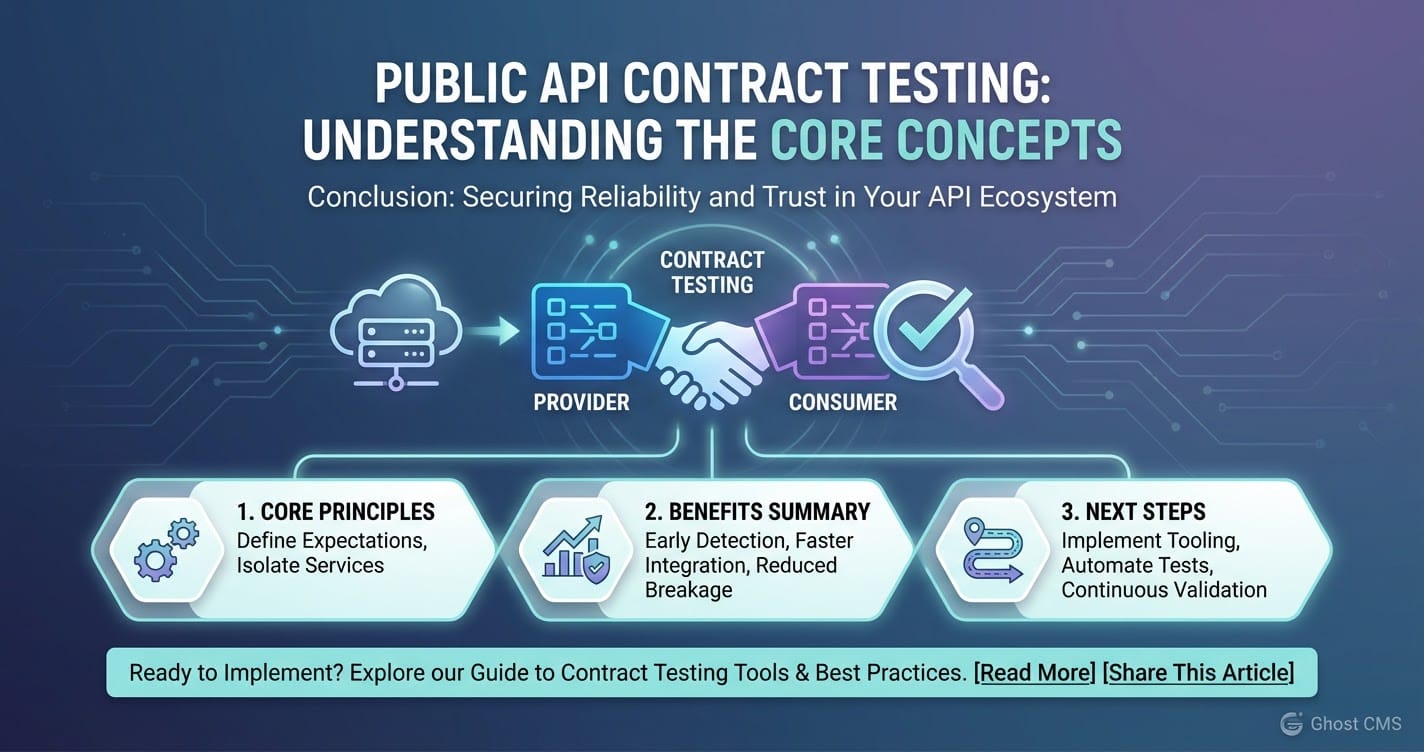
Public API Contract Testing: Understanding the Core Concepts


In the vast, interconnected digital ecosystem of today, Application Programming Interfaces (APIs) serve as the fundamental backbone, enabling diverse software applications to communicate, exchange data, and collaborate seamlessly. From mobile apps fetching real-time data to complex enterprise systems orchestrating intricate business processes, APIs are the silent workhorses driving innovation and efficiency. However, with the proliferation of APIs, particularly public ones exposed to myriad consumers, the challenge of ensuring their reliability, consistency, and long-term maintainability has grown exponentially. This is where the critical discipline of Public API Contract Testing emerges, offering a robust framework to safeguard the integrity of these digital contracts and foster trust between API providers and their consumers.
This comprehensive exploration delves into the core concepts of public API contract testing, unraveling its multifaceted layers, from the fundamental definition of an API contract to the intricate methodologies of consumer-driven contract testing and the pivotal role of specifications like OpenAPI. We will examine why this form of testing is not merely a technical formality but a strategic imperative for any organization committed to building scalable, resilient, and developer-friendly API ecosystems. Moreover, we will address the practicalities of implementation, the challenges encountered, best practices to adopt, and how modern api gateway solutions contribute to contract enforcement and overall API governance.
The Unseen Architect: Understanding the API Contract
At its heart, an API is a set of defined rules that dictate how applications interact. These rules are formalized into what is known as an API contract. Imagine a legal contract between two parties; an API contract serves a similar purpose, but for software components. It's a mutually agreed-upon specification that outlines the expectations of both the API provider (the one offering the service) and the API consumer (the one using the service). This contract is the bedrock upon which reliable integration is built.
Without a clear and stable contract, API integration becomes a precarious tightrope walk, prone to unexpected breaks and time-consuming debugging sessions. A consumer might build their application expecting a certain data format or behavior from an API, only for the provider to subtly change it, leading to application failures. Conversely, a provider might release updates, assuming consumers will adapt, only to discover widespread breakage and dissatisfaction. The API contract aims to eliminate this ambiguity, acting as a single source of truth that defines the interaction's precise nature.
Components of a Comprehensive API Contract
A robust API contract typically encompasses several key components, each detailing a specific aspect of the interaction:
- Endpoints and Operations: This specifies the unique Uniform Resource Locators (URLs) for accessing different
APIresources and the HTTP methods (GET, POST, PUT, DELETE, PATCH) that can be performed on them. For instance,/usersmight be an endpoint, andGET /userswould represent the operation to retrieve a list of users. - Request Structure: This defines what the consumer must send to the
API. It includes:- Headers: Required and optional headers (e.g.,
Content-Type,Authorizationtokens). - Query Parameters: Key-value pairs appended to the URL for filtering, sorting, or pagination.
- Path Parameters: Variables embedded within the URL path to identify specific resources (e.g.,
/users/{id}). - Request Body Schema: For POST, PUT, and PATCH operations, this specifies the expected format and data types of the payload (e.g., JSON schema defining properties, their types, constraints like
minLengthormaximum).
- Headers: Required and optional headers (e.g.,
- Response Structure: This defines what the
APIwill return to the consumer. It includes:- HTTP Status Codes: The standard codes indicating the outcome of the request (e.g., 200 OK, 201 Created, 400 Bad Request, 404 Not Found, 500 Internal Server Error). Each status code might have an associated response body.
- Response Body Schema: Similar to the request body, this specifies the format and data types of the data returned by the
APIfor various successful and error scenarios. - Response Headers: Any specific headers the
APImight return.
- Authentication and Authorization Mechanisms: How consumers prove their identity and obtain permission to access certain resources. This could involve
APIkeys, OAuth 2.0, JSON Web Tokens (JWTs), or other schemes. The contract specifies the required mechanism and how it should be used. - Error Handling: A critical but often overlooked aspect, detailing how the
APIcommunicates errors. This includes specific error codes, messages, and structures for different types of failures (e.g., validation errors, authentication failures, resource not found). A well-defined error contract allows consumers to build robust error recovery logic. - Versioning Strategy: How the
APIevolves over time without breaking existing integrations. This could involve URL versioning (/v1/users), header versioning, or other strategies. The contract should clearly articulate the versioning approach. - Rate Limiting and Throttling: If applicable, the contract might specify limits on how many requests a consumer can make within a certain timeframe to prevent abuse and ensure fair usage.
By documenting these elements meticulously, an API contract serves as the definitive blueprint for interaction, enabling both sides to develop and test their respective systems with confidence.
The Indispensable Role of OpenAPI Specification
In the realm of API contracts, the OpenAPI Specification (formerly known as Swagger Specification) has emerged as the de facto standard for describing, producing, consuming, and visualizing RESTful web services. It provides a language-agnostic, human-readable, and machine-readable interface to REST APIs. Think of OpenAPI as a universal language for API contracts, allowing tools and developers worldwide to understand and work with any API described using it.
What is OpenAPI?
OpenAPI is a specification for machine-readable interface definition files for describing REST APIs. It’s written in YAML or JSON format and defines a standard, programming language-agnostic interface description for HTTP APIs, which allows humans and computers to discover and understand the capabilities of a service without access to source code, documentation, or network traffic inspection. When properly defined, a consumer can understand and interact with the remote service with a minimal amount of implementation logic.
The specification details:
- Available endpoints (
/users,/products, etc.). - Operations supported on each endpoint (GET, POST, PUT, DELETE).
- Operation parameters (query parameters, path parameters, headers, request bodies).
- Authentication methods.
- Contact information, license, terms of use, and other meta-data.
How OpenAPI Becomes the Ultimate API Contract
The power of OpenAPI lies in its dual nature: it's both an excellent human-readable documentation format and a robust machine-readable definition.
- Unambiguous Documentation: For human developers, an
OpenAPIdocument renders into interactive documentation (e.g., using Swagger UI), allowing them to explore endpoints, understand request/response structures, and even try out calls directly from a browser. This clarity significantly reduces the learning curve for newAPIconsumers. - Machine Readability for Automation: More critically, the machine-readable nature of
OpenAPIunlocks a wealth of automation possibilities:- Code Generation: Tools can automatically generate client SDKs (Software Development Kits) in various programming languages directly from the
OpenAPIdefinition. This saves developers immense time and ensures clients are always perfectly aligned with theAPIcontract. - Server Stubs: Similarly, server stubs can be generated for the
APIprovider, providing a starting point for implementation that adheres to the defined contract. - Automated Testing: Test frameworks can leverage the
OpenAPIdefinition to generate basic test cases, validate request and response schemas, and even perform fuzz testing, ensuring theAPI's behavior matches its declared contract. APIGateway Configuration: Manyapi gatewaysolutions can ingestOpenAPIdefinitions to automatically configure routing, validation, and security policies, ensuring incoming requests and outgoing responses conform to the contract.- Design-First Approach:
OpenAPIencourages a "design-first" approach toAPIdevelopment, where the contract is defined and agreed upon before any code is written. This proactive approach helps catch inconsistencies and design flaws early, reducing costly rework.
- Code Generation: Tools can automatically generate client SDKs (Software Development Kits) in various programming languages directly from the
Integrating OpenAPI into CI/CD Pipelines for Contract Validation
For public APIs, maintaining an accurate and up-to-date OpenAPI document is paramount. It should not be a static artifact but an integral part of the development and deployment pipeline.
Integrating OpenAPI validation into a Continuous Integration/Continuous Delivery (CI/CD) pipeline ensures that every code change affecting the API is checked against its OpenAPI definition. This can involve:
- Schema Validation: Tools can verify that the
API's actual responses conform to the schemas defined in theOpenAPIdocument. - Behavioral Validation: Advanced tools can go beyond schema and validate the actual behavior of the
APIagainst examples provided in theOpenAPI(e.g., usingexamplesin the specification). - Linting:
OpenAPIlinters can enforce style guides and best practices for theOpenAPIdocument itself, ensuring consistency and quality.
By automating these checks, developers are immediately notified if a change introduces a deviation from the contract, preventing breaking changes from reaching production and ensuring consumers always have a reliable API to interact with.
Why Contract Testing for Public APIs? The Imperative for Reliability
The interconnected nature of modern software means that public APIs are often consumed by hundreds, thousands, or even millions of external applications. A single breaking change or unexpected behavior can ripple through the ecosystem, causing widespread disruption, user dissatisfaction, and significant financial costs. API contract testing specifically addresses this risk, serving as a critical quality gate.
Ensuring Interoperability and Preventing Breaking Changes
The primary goal of API contract testing is to ensure that the API provider and all its consumers maintain a shared understanding and expectation of how the API behaves.
- For Consumers: It guarantees that the
APIthey rely on will continue to function as expected, without unexpected changes to data formats, error codes, or authentication requirements. This predictability allows consumers to develop their applications with confidence, knowing their integrations are stable. - For Providers: It acts as an early warning system. When a provider intends to make changes to an
API, contract tests can immediately highlight if these changes will break existing consumer expectations. This allows providers to either revert the change, introduce a new version, or communicate clearly with consumers about upcoming changes, mitigating negative impacts.
Facilitating Collaboration and Reducing Integration Risk
Contract testing fosters a collaborative environment by establishing a clear agreement. Instead of each consumer needing to write extensive end-to-end integration tests that touch the actual API (which can be slow, costly, and brittle), they can rely on the contract.
- Faster Development Cycles: Consumers can develop and test their applications against a contract without needing the actual
APIto be fully implemented or even available. Providers can also refactor their internal implementation details without affecting consumers, as long as the public contract remains stable. - Reduced Debugging Time: When an issue arises, contract tests help pinpoint whether the problem lies with the consumer's understanding of the contract or the provider's implementation. This significantly reduces the time spent on blame games and debugging across organizational boundaries.
- Build Trust and Reliability: Consistently delivering a stable and reliable
APIbuilds trust with consumers. This trust is invaluable for fostering adoption, driving innovation, and maintaining a positive reputation in the developer community. A publicAPIthat frequently breaks its contract will quickly lose its user base.
Core Concepts of API Contract Testing: Consumer-Driven vs. Provider-Side
API contract testing isn't a monolithic approach; it encompasses different methodologies tailored to specific needs. The two primary paradigms are Consumer-Driven Contract (CDC) Testing and Provider-Side Contract Verification. Understanding their nuances is crucial for implementing an effective testing strategy.
Consumer-Driven Contract (CDC) Testing
Consumer-Driven Contract testing is a powerful methodology where each consumer of an API explicitly defines its expectations of the API in a "contract." The API provider then verifies that its API implementation adheres to all these consumer-defined contracts. This approach places the consumer's needs at the forefront, ensuring that the API truly serves its users.
How CDC Works:
- Consumer Defines Contract: The
APIconsumer, using a specific contract testing framework (e.g., Pact, Spring Cloud Contract), writes a test that simulates an interaction with theAPI. This test specifies the exact request it will send and the expected response it anticipates from theAPI. This "expected response" essentially forms the contract. - Consumer Generates Pact: The contract testing framework captures this expectation and generates a "Pact file" (or similar contract artifact) which is typically a JSON document. This Pact file represents the consumer's contract.
- Publish Pact: The consumer publishes this Pact file to a "Pact Broker" or a shared repository accessible to the provider.
- Provider Verifies Pact: The
APIprovider retrieves the Pact files from the broker. During its build and test process, the provider uses the contract testing framework to replay the requests specified in the consumer's Pact files against its actualAPIimplementation. It then verifies that itsAPIreturns responses that match the expectations defined by the consumers in their respective Pact files. - Feedback Loop: If the provider's
APIfails to meet any consumer's contract, the provider's build fails, indicating a potential breaking change for that consumer. This provides immediate feedback, allowing the provider to address the issue before deployment.
Benefits of CDC:
- Guaranteed Consumer Compatibility: Directly ensures that the
APImeets the specific needs of its consumers. - Early Detection of Breaking Changes: Providers are alerted to breaking changes as soon as they occur in their development cycle, long before deployment.
- Reduced Need for End-to-End Tests: Since the contract is verified, consumers don't need extensive, fragile, and slow end-to-end integration tests that span multiple services. They can confidently mock the
APIin their own tests. - Independent Development: Both consumer and provider teams can develop and deploy independently, as long as they adhere to the agreed-upon contract.
- Improved Communication: Fosters clearer communication between teams by formalizing expectations.
Drawbacks of CDC:
- Management Overhead: Can become complex with a large number of consumers, as each consumer maintains its own contracts. A Pact Broker helps manage this, but it still requires discipline.
- Initial Setup Cost: Requires upfront effort to set up the frameworks and establish the workflow.
- Contract Proliferation: If not managed well, there can be many similar contracts for slightly different consumer needs, leading to redundancy.
Provider-Side Contract Verification
Provider-side contract verification, often simpler in its initial setup, involves the API provider validating its API implementation against a single, canonical contract defined by the provider itself. This canonical contract is most commonly an OpenAPI (or Swagger) specification.
How Provider-Side Verification Works:
- Provider Defines Canonical Contract: The
APIprovider meticulously defines itsAPI's contract using anOpenAPIspecification (YAML or JSON). This document acts as the definitive source of truth for theAPI's interface. - Provider Implements
API: The provider develops theAPIfunctionality based on thisOpenAPIdefinition. - Provider Verifies Implementation: During the build and test process, the provider uses tools to automatically generate requests based on the
OpenAPIdefinition and sends them to itsAPIimplementation. It then validates the responses received from theAPIagainst the schemas and expectations defined in theOpenAPIdocument. - Schema and Semantic Validation: This verification typically includes:
- Schema Validation: Ensuring that request bodies, response bodies, headers, and query parameters conform to the data types, formats, and constraints specified in the
OpenAPIdefinition. - HTTP Status Code Validation: Checking that the
APIreturns the expected HTTP status codes for various scenarios. - Example Validation: If
OpenAPIexamples are provided, tools can ensure theAPIreturns data consistent with those examples.
- Schema Validation: Ensuring that request bodies, response bodies, headers, and query parameters conform to the data types, formats, and constraints specified in the
Benefits of Provider-Side Verification:
- Single Source of Truth: The
OpenAPIdocument serves as the undisputed contract, simplifying management. - Clear Documentation and Tooling: Leverages the power of
OpenAPIfor documentation, code generation, and broaderAPIgovernance. - Automated Validation: Tools can automate much of the contract verification process, integrating seamlessly into CI/CD.
- Design-First Enforcement: Strongly supports a design-first
APIdevelopment approach, where the contract is defined before implementation. - Lower Overhead for Provider: The provider only needs to worry about its own
OpenAPIdocument, not individual consumer contracts.
Drawbacks of Provider-Side Verification:
- Doesn't Guarantee Consumer Needs: While it ensures the
APImatches its own definition, it doesn't explicitly guarantee that theAPIstill meets the precise, evolving needs of its diverse consumers. A change that conforms to theOpenAPImight still break a specific consumer's integration if that consumer relied on an undocumented or slightly different behavior. - Potential for Drift: If the
OpenAPIdocument isn't meticulously maintained and kept in sync with the actual implementation, it can drift, becoming inaccurate and losing its value. - Less Granular Feedback: It provides feedback on adherence to the overall contract, but less specific feedback on which consumer might be affected by a change.
Choosing the Right Approach (or Both!)
Often, the most robust strategy for public APIs involves a combination of both approaches:
- Provider-Side Verification (with
OpenAPI) forms the foundational layer, ensuring theAPIconsistently delivers what it promises in its public specification. This is essential for overallAPIhealth and automated governance. - Consumer-Driven Contract Testing is then employed for critical or high-stakes integrations with key consumers, offering an extra layer of assurance that specific consumer expectations are continually met. It’s particularly valuable in microservices architectures or when tight coupling with specific external partners exists.
By adopting a hybrid strategy, organizations can balance the benefits of a single, well-defined OpenAPI contract with the granular, consumer-centric validation provided by CDC testing.
APIPark is a high-performance AI gateway that allows you to securely access the most comprehensive LLM APIs globally on the APIPark platform, including OpenAI, Anthropic, Mistral, Llama2, Google Gemini, and more.Try APIPark now! 👇👇👇
Implementing Public API Contract Testing: A Step-by-Step Guide
Implementing API contract testing requires a systematic approach, integrating tools and processes into the existing development and deployment workflows.
1. Defining the Contract: The OpenAPI First
The journey begins with a clear, unambiguous API contract. For public APIs, this almost invariably means an OpenAPI specification.
- Design-First: Embrace a design-first philosophy. Before writing any code, define your
API's endpoints, request/response schemas, authentication, and error handling in anOpenAPIdocument. - Collaborate: Share the
OpenAPIdocument with potential consumers for feedback. This collaborative design phase ensures the contract meets actual user needs and avoids costly redesigns later. - Version Control: Store your
OpenAPIdocument in your version control system (e.g., Git) alongside yourAPI's source code. Treat it as a living document that evolves with yourAPI.
2. Choosing the Right Tools
The ecosystem of API contract testing tools is rich and varied. The choice depends on your specific needs, existing tech stack, and whether you lean towards CDC or provider-side verification.
For Provider-Side OpenAPI Validation:
- Swagger/OpenAPI Codegen: Generates server stubs and client SDKs from
OpenAPIdefinitions, ensuring initial code adheres to the contract. - Spectral (Stoplight): A powerful
OpenAPIlinter and validator that enforces style guides, checks for adherence to theOpenAPIspecification, and can validate theAPI's responses against its definition. - Postman/Newman: Can import
OpenAPIdefinitions to generate collections, allowing for automated tests to validateAPIresponses against the defined schemas. - Dredd: An
APItesting tool that validates if anAPIimplementation is fulfilling itsOpenAPIor API Blueprint contract. It can run against a runningAPIserver. - Prism (Stoplight): An
OpenAPImock server that can simulateAPIresponses based on theOpenAPIdefinition, useful for consumer development. It can also act as a proxy and validate requests/responses against theOpenAPIspec in real-time.
For Consumer-Driven Contract (CDC) Testing:
- Pact: The most popular framework for CDC, supporting a wide range of languages (Java, .NET, Ruby, JavaScript, Go, etc.). It enables consumers to define expectations and providers to verify them. Pact Broker is a crucial component for managing pacts.
- Spring Cloud Contract: Specifically designed for Spring applications, offering similar CDC capabilities within the Spring ecosystem.
3. Setting Up the Testing Environment
Contract tests should be integrated into your development and CI/CD environments.
- Local Development: Developers should be able to run contract tests locally before pushing code, getting immediate feedback on contract adherence.
- CI/CD Pipeline: This is where automation shines. Contract tests must be a mandatory step in your CI/CD pipeline, ideally running on every pull request or commit.
- Dedicated Test Environments: While contract tests aim to reduce reliance on full integration environments, they still need a running
APIinstance (even if it's a locally spun-up instance or a mock server) to verify against.
4. Writing Contract Tests
The specific way you write contract tests will depend on your chosen tools.
Example using OpenAPI for Provider-Side Validation (Conceptual):
Imagine you have an OpenAPI specification for an endpoint GET /users/{id} that expects a User object.
Your test framework might:
- Read the
OpenAPIdefinition. - Identify the
GET /users/{id}operation and its expected200 OKresponse schema. - Generate a valid
{id}(e.g., "123"). - Make an HTTP GET request to
http://localhost:8080/users/123. - Receive the response.
- Validate the response's HTTP status code is 200.
- Validate the response body against the
Userschema defined inOpenAPI, checking data types, required fields, and constraints. - If the
OpenAPIdefines error responses (e.g.,404 Not Found), the test might also simulate a request for a non-existentidand validate the404status and error body schema.
Example for Consumer-Driven Contract Testing (Pact - conceptual):
Consumer Side (e.g., Node.js consumer wanting to get a user):
// Consumer defines the expectation (the contract)
const provider = new Pact({ consumer: 'UserConsumer', provider: 'UserAPI' });

await provider.setup(); // Start mock service

// Define an interaction
await provider.addInteraction({
  state: 'a user with ID 123 exists', // Context for the provider
  uponReceiving: 'a request for user 123',
  withRequest: {
    method: 'GET',
    path: '/users/123',
    headers: { 'Accept': 'application/json' },
  },
  willRespondWith: {
    status: 200,
    headers: { 'Content-Type': 'application/json' },
    body: { id: 123, name: 'Alice', email: 'alice@example.com' }, // The expected response
  },
});

// Consumer's actual code making the call to the mock service
const response = await fetch(`${provider.mockService.baseUrl}/users/123`);
const data = await response.json();

expect(data).toEqual({ id: 123, name: 'Alice', email: 'alice@example.com' });

await provider.verify(); // Verify the interaction happened as expected
await provider.finalize(); // Write the pact file
Provider Side (e.g., Java provider verifying against the consumer's pact):
// Provider configuration to run pact verification tests
@Provider("UserAPI")
@PactFolder("target/pacts") // Location where pact files are downloaded
public class UserApiVerificationTest {

    @TestTemplate
    @ExtendWith(PactVerificationInvocationContextProvider.class)
    void pactVerificationTest(PactVerificationContext context) {
        context.verifyInteraction(); // Replays the consumer's request against the actual API
    }

    @BeforeEach
    void setup(PactVerificationContext context) {
        // Start the actual User API service for verification
        // e.g., context.setTarget(new HttpTestTarget("localhost", 8080));
    }

    @State("a user with ID 123 exists") // Matches the consumer's state
    public void user123Exists() {
        // Ensure that your User API service has a user with ID 123 available
        // e.g., set up test data in the database
    }
}
5. Integrating into CI/CD Pipeline
Automating contract verification is crucial. Your CI/CD pipeline should include steps to:
- Generate/Update
OpenAPI(if applicable): If yourOpenAPIis generated from code, ensure this step runs. - Lint
OpenAPI: RunOpenAPIlinters (e.g., Spectral) to check for specification compliance and style. - Run Provider-Side
OpenAPIValidation: Execute tools like Dredd or custom scripts that validateAPIresponses against theOpenAPIspec. - Publish Pacts (Consumers): Consumer CI pipelines should publish their generated Pact files to a Pact Broker.
- Verify Pacts (Providers): Provider CI pipelines should fetch relevant Pacts from the Broker and run verification tests against their
APIimplementation. - Publish Verification Results: The results of Pact verification can also be published back to the Pact Broker, providing visibility on the compatibility matrix between consumers and providers.
6. Handling Versioning and Evolution
Public APIs are rarely static; they evolve. API contract testing is vital for managing this evolution gracefully.
- Semantic Versioning: Adopt semantic versioning (MAJOR.MINOR.PATCH) for your public APIs. Breaking changes necessitate a MAJOR version increment.
- Backward Compatibility: Strive for backward compatibility for MINOR version updates. Contract tests ensure you don't inadvertently introduce breaking changes.
- Deprecation Strategy: When retiring an endpoint or field, clearly document its deprecation in the
OpenAPIspecification and provide a migration path. Contract tests can help identify consumers still relying on deprecated features. - Blue/Green Deployment: Use deployment strategies that allow
APIproviders to deploy new versions and run contract tests against them in a safe environment before directing live traffic.
Challenges and Best Practices
While highly beneficial, implementing API contract testing comes with its own set of challenges. Adopting best practices can help navigate these complexities effectively.
Challenges
- Keeping Contracts Updated: The most significant challenge is ensuring the
OpenAPIdocument or consumer-defined pacts accurately reflect theAPI's current behavior. Drift between code and contract invalidates the entire testing effort. - Complex Data Structures: Testing
APIs with deeply nested or highly dynamic data structures can make contract definition and validation complex. - Managing Test Data: For provider-side verification, ensuring the
APIunder test has the necessary test data to respond appropriately to contract-defined requests can be tricky. - Asynchronous Operations: Testing
APIs that involve asynchronous callbacks or event streams requires specialized approaches not always directly covered by traditional HTTP contract testing tools. - Performance Implications: Running extensive contract tests as part of every CI/CD pipeline step can add to build times, requiring optimization.
Best Practices
- Treat Contracts as First-Class Citizens: Elevate your
OpenAPIdefinition or consumer pacts to the same level of importance as your source code. Review them, version them, and ensure their accuracy. - Automate Everything: From
OpenAPIgeneration (if applicable) to contract validation in CI/CD, automate every possible step. Manual steps are prone to human error and inconsistency. - Involve Both Consumers and Providers: Foster a culture of collaboration. Providers should share
OpenAPIspecifications early, and consumers should communicate their exact needs (or publish their pacts) clearly. - Focus on Critical Paths First: If starting new, don't try to contract test every single
APIendpoint and field simultaneously. Prioritize the most critical and frequently usedAPIinteractions. - Regularly Review and Update Contracts: Schedule periodic reviews of
OpenAPIdocuments withAPIproduct managers and key consumers to ensure they remain relevant and accurate. - Use Realistic Examples: Populate your
OpenAPIdefinitions with realistic and diverse examples for requests and responses. This makes the documentation clearer and aids in generating more effective tests. - Leverage
APIGateways for Enforcement: Anapi gatewaycan play a crucial role in enforcingAPIcontracts in real-time.
The Role of an API Gateway in Contract Enforcement
An api gateway sits at the entrance to your API ecosystem, acting as a single entry point for all API calls. It is an indispensable component for managing, securing, and scaling public APIs. Beyond routing requests, an api gateway can significantly enhance the effectiveness of API contract testing by enforcing contracts at runtime.
How an API Gateway Contributes to Contract Enforcement
- Schema Validation at the Edge: Many
api gatewaysolutions can directly ingestOpenAPIdefinitions. Before a request even reaches your backend services, theapi gatewaycan validate the incoming request body and parameters against theOpenAPIschema. If the request violates the contract (e.g., missing a required field, wrong data type), theapi gatewaycan immediately reject it with an appropriate error, preventing malformed requests from consuming backend resources. Similarly, it can validate outgoing responses, though this is less common for performance reasons. - Authentication and Authorization Enforcement: The
APIcontract often specifies the required authentication scheme. Theapi gatewayis the ideal place to enforce these rules, validatingAPIkeys, JWTs, or OAuth tokens before forwarding requests. This ensures only authorized consumers, adhering to the contract's security requirements, can access theAPI. - Rate Limiting and Throttling: As part of the
APIcontract, providers might define usage limits. Anapi gatewayeffectively enforces these rate limits, protecting the backend from abuse and ensuring fair access for all consumers, as stipulated in the contract. - Traffic Management and Versioning: An
api gatewayis central to managingAPIversions. It can route requests to different backendAPIversions based on headers, paths, or query parameters, as defined in theAPI's versioning strategy within the contract. This allows for seamlessAPIevolution and backward compatibility. - Monitoring and Logging Contract Violations: By sitting at the
APIentry point, theapi gatewaycan log all requests, including those that violate the contract. This provides invaluable data for identifying problematic consumers, detecting potential attacks, and understanding whereAPIdefinitions might be unclear or misunderstood.
Platforms like APIPark, an open-source AI gateway and API management platform, offer comprehensive solutions that directly contribute to robust API governance and contract enforcement. APIPark, designed to manage, integrate, and deploy AI and REST services, streamlines the entire API lifecycle. For instance, its "End-to-End API Lifecycle Management" feature helps regulate API management processes, including traffic forwarding and versioning of published APIs, which are crucial for maintaining contract integrity across API versions. Moreover, by standardizing API formats for AI invocation and allowing prompt encapsulation into REST APIs, APIPark inherently encourages a structured approach to defining and managing API contracts for AI services, ensuring consistency and predictability. Its capability to enforce "API Resource Access Requires Approval" also aligns with contract-based access control, ensuring only authorized callers who have subscribed and been approved can invoke an API, thereby upholding the terms of the API contract regarding access permissions. This centralized control and validation at the api gateway level significantly enhance the reliability and security of your public API landscape.
Advanced Concepts and Future Trends
The field of API governance and contract testing continues to evolve, driven by increasing complexity and the demand for greater automation and intelligence.
- Schema Registries: In large microservices environments, managing numerous
OpenAPIdefinitions can be challenging. Schema registries (like Confluent Schema Registry for Kafka, but conceptually applicable toAPIschemas) provide a centralized, versioned repository for allAPIcontracts, making them discoverable and ensuring consistency across services. - Formal Verification: Moving beyond mere schema validation, formal verification techniques could mathematically prove that an
APIimplementation adheres to its contract under all possible conditions, potentially leveraging techniques from formal methods in software engineering. - AI-Powered Contract Generation and Testing: As AI capabilities advance, we might see tools that can:
- Automatically infer
OpenAPIspecifications: From existing code or even network traffic, AI could help generate initialOpenAPIdrafts. - Smart Test Case Generation: AI could analyze
OpenAPIdefinitions and historical usage data to generate more intelligent and comprehensive contract tests, identifying edge cases that human testers might miss. - Proactive Contract Monitoring: AI could monitor
APItraffic, detect deviations from the contract in real-time, and flag potential breaking changes before they cause widespread issues. This aligns withAPIPark's focus onAPImanagement and data analysis capabilities, where it analyzes historical call data to display long-term trends and performance changes, which can inherently support proactive maintenance related to contract adherence.
- Automatically infer
- Microservices and
APIMeshes: In architectures dominated by microservices,APImeshes (like Istio or Linkerd) handle inter-service communication. While not directlyAPIgateways in the traditional sense, they can enforce policies and potentially perform light-weight contract validation for internalAPIs, complementing the role of anapi gatewayfor external, public-facingAPIs.
Conclusion
Public API contract testing is not merely a technical checkbox; it is an indispensable strategy for building resilient, scalable, and trustworthy API ecosystems in the digital age. By meticulously defining API contracts, primarily through the power of OpenAPI Specification, and by rigorously testing against these contracts using methodologies like Consumer-Driven Contract testing and provider-side verification, organizations can significantly reduce integration risks, prevent breaking changes, and foster unparalleled confidence among their API consumers.
The strategic deployment of an api gateway further solidifies this defense, offering real-time contract enforcement at the edge of the network. As API landscapes grow in complexity, embracing robust contract testing practices, supported by advanced tooling and intelligent API management platforms such as APIPark, becomes paramount. Ultimately, investing in public API contract testing is an investment in the long-term success, stability, and growth of your digital offerings, ensuring that the promise of seamless interconnection continues to be fulfilled reliably and securely.
Frequently Asked Questions (FAQs)
Q1: What is an API contract and why is it important for public APIs?
An API contract is a formal agreement or specification that defines how an API should behave, including its endpoints, expected request formats, and guaranteed response structures (data types, status codes, error messages). For public APIs, it is critically important because it acts as the primary source of truth for external consumers, ensuring consistent and predictable interactions. Without a clear contract, consumers risk breaking integrations due to unexpected changes, leading to widespread disruptions and erosion of trust. It ensures interoperability, reduces debugging time, and enables independent development between provider and consumer.
Q2: How does OpenAPI Specification relate to API contract testing?
OpenAPI Specification (formerly Swagger Specification) is the industry standard for defining API contracts in a machine-readable and human-readable format (YAML or JSON). It explicitly details API operations, parameters, responses, and authentication methods. In contract testing, OpenAPI serves as the canonical contract against which the API provider validates its implementation. Tools can leverage the OpenAPI definition to generate test cases, validate API responses for schema compliance, and even mock API behavior, making it a foundational element for automating contract verification.
Q3: What is the difference between Consumer-Driven Contract (CDC) testing and Provider-Side Contract verification?
Consumer-Driven Contract (CDC) testing involves each API consumer defining its specific expectations of the API in a "contract" (e.g., using Pact). The API provider then verifies its implementation against all these consumer-defined contracts, ensuring it meets every consumer's precise needs. This approach prioritizes consumer compatibility.
Provider-Side Contract verification, on the other hand, involves the API provider defining a single, canonical contract (typically using OpenAPI) for its API. The provider then tests its API implementation against this single contract to ensure it adheres to its own public specification. This approach focuses on ensuring the API matches its documented definition. Both can be complementary strategies.
Q4: How does an api gateway assist in enforcing API contracts?
An api gateway acts as a crucial enforcement point for API contracts at the edge of your network. It can: 1. Validate Requests: Inspect incoming requests against predefined schemas (often imported from OpenAPI definitions) and reject those that violate the contract before they reach backend services. 2. Enforce Security: Apply authentication and authorization policies specified in the contract. 3. Manage Traffic: Enforce rate limits and handle API versioning based on contract specifications. 4. Log Violations: Record instances where requests or responses deviate from the contract, providing valuable insights for API governance and troubleshooting. Platforms like APIPark exemplify how an AI gateway can centralize and streamline these enforcement mechanisms, including lifecycle management and access controls.
Q5: What are some best practices for implementing public API contract testing effectively?
To implement public API contract testing effectively, consider these best practices: 1. Design-First Approach: Define your API contract (e.g., using OpenAPI) before writing code. 2. Automate Everything: Integrate contract test execution into your CI/CD pipeline for continuous validation. 3. Treat Contracts as Code: Store your OpenAPI definition or consumer pacts in version control alongside your source code. 4. Collaborate Actively: Foster communication between API providers and consumers, especially during contract definition and evolution. 5. Start Small: Begin with critical API paths and gradually expand your contract testing coverage. 6. Regularly Review: Periodically review and update your API contracts to ensure they remain accurate and relevant as your API evolves. 7. Leverage a Hybrid Approach: Combine provider-side OpenAPI validation with consumer-driven contract testing for comprehensive coverage, especially for critical integrations.
🚀You can securely and efficiently call the OpenAI API on APIPark in just two steps:
Step 1: Deploy the APIPark AI gateway in 5 minutes.
APIPark is developed based on Golang, offering strong product performance and low development and maintenance costs. You can deploy APIPark with a single command line.
curl -sSO https://download.apipark.com/install/quick-start.sh; bash quick-start.sh

In my experience, you can see the successful deployment interface within 5 to 10 minutes. Then, you can log in to APIPark using your account.

Step 2: Call the OpenAI API.