Public API Contract Testing: What Does It Really Mean?
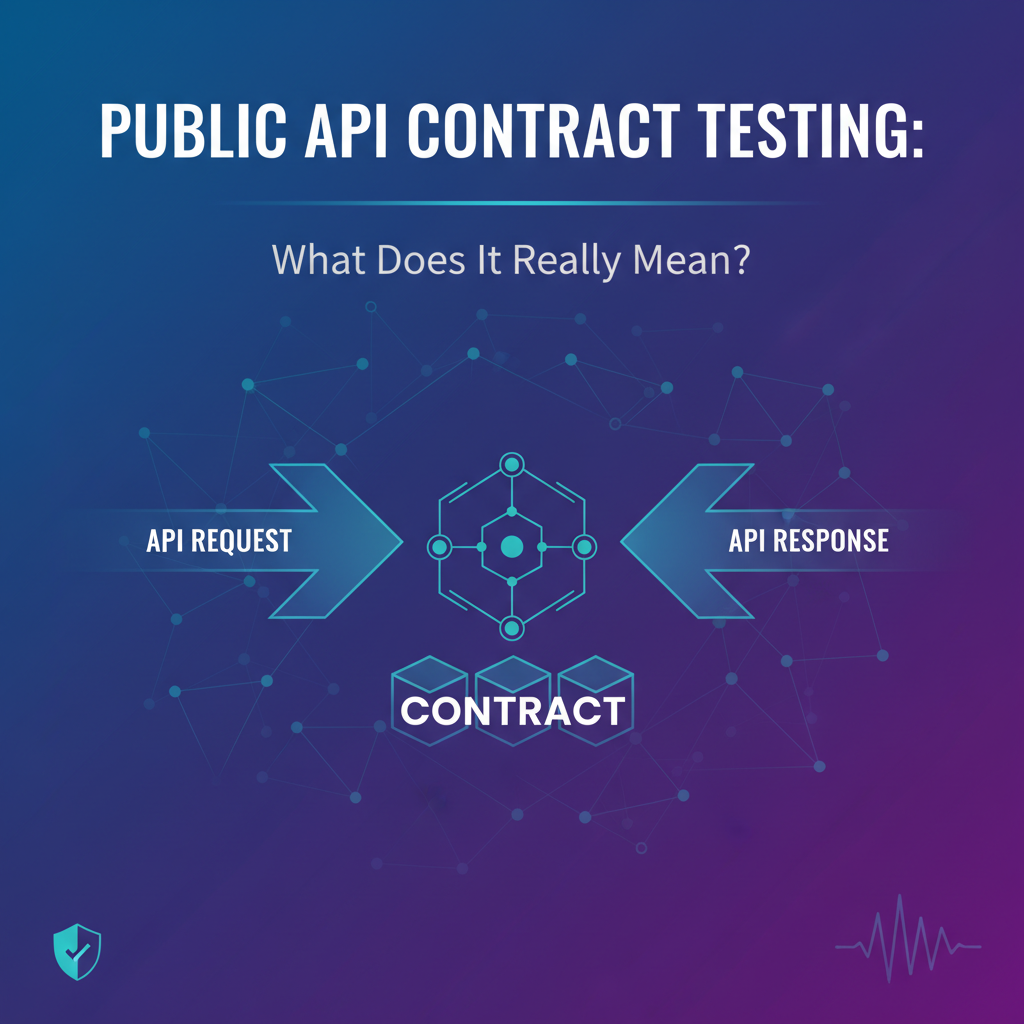


In the rapidly evolving digital landscape, Application Programming Interfaces (APIs) have transitioned from being mere technical connectors to becoming the fundamental building blocks of modern software ecosystems. They empower disparate systems to communicate seamlessly, enabling innovation, fostering partnerships, and driving business growth. From mobile applications to cloud services, microservices architectures, and interconnected IoT devices, the proliferation of APIs, especially public APIs, has fundamentally reshaped how software is designed, developed, and consumed. These public APIs act as the digital storefronts of an organization, exposing functionalities and data to an external world of developers, partners, and even competitors, all of whom rely on these interfaces to build their own products and services.
However, with this immense power and widespread adoption comes a significant challenge: ensuring the reliability, consistency, and predictability of these critical interfaces. The success of a public API hinges entirely on its ability to deliver on the promises it makes to its consumers. These promises are encapsulated within what is known as the API contract. When this contract is unclear, violated, or poorly managed, the ripple effects can be catastrophic, leading to integration nightmares, application failures, frustrated developers, and ultimately, a loss of trust and business. This intricate dance between API providers and consumers, built on the foundation of an implicit or explicit contract, necessitates a robust mechanism to verify adherence. This mechanism is Public API Contract Testing, a critical discipline that, while often discussed, is frequently misunderstood in its true scope and implications. It represents a shift from merely testing the functionality of an API to validating its agreement with its consumers, ensuring that the interface behaves precisely as documented and expected. This article delves deep into the essence of Public API Contract Testing, exploring its meaning, mechanisms, benefits, and its indispensable connection to OpenAPI specifications and effective API Governance.
The Landscape of Public APIs: A Modern Necessity
The digital economy thrives on connectivity, and at the heart of this connectivity are APIs. Public APIs, in particular, have become the conduits through which businesses extend their reach, enable third-party innovation, and create vast, interconnected ecosystems. Consider the myriad services we use daily: social media integrations, payment gateways, mapping services, weather forecasts, or e-commerce platforms. Each of these often leverages public APIs to share data or functionality, allowing developers to build rich, integrated experiences without having to reinvent the wheel. This paradigm fosters an environment of rapid development and specialization, where companies can focus on their core competencies while relying on external services for ancillary functionalities.
The growth of public APIs has been exponential, driven by trends like cloud computing, microservices, and the increasing demand for interoperability. Businesses across every sector are realizing the strategic value of exposing their data and services programmatically. This outward-facing nature, however, introduces a unique set of complexities. Unlike internal APIs, where communication between teams can often resolve discrepancies, public APIs serve a diverse, geographically dispersed audience of developers with varying levels of technical expertise and integration requirements. A breaking change introduced by a public API provider can cascade into widespread failures for countless consumer applications, impacting user experience, revenue, and brand reputation.
The inherent "contract" idea in APIs stems from this provider-consumer relationship. When an API is published, it implicitly or explicitly promises certain behaviors: specific inputs will yield predictable outputs, error codes will signify particular issues, and the overall structure and flow will remain consistent. Without this understanding and adherence, the entire ecosystem collapses into chaos. Yet, the reality is often less than ideal. Documentation can become stale, developers might introduce changes without realizing their breaking nature, or misinterpretations of the contract can lead to integration challenges that consume vast amounts of time and resources. These challenges underscore the critical need for a structured, verifiable approach to ensure that the API's promises are consistently met.
Understanding the Core Concepts of API Contracts
At its heart, an API contract is an agreement between the API provider and the API consumer regarding how the API will behave. It defines the interface's expectations and guarantees, serving as a blueprint for interaction. This contract encompasses several crucial aspects:
- Input Parameters: What data types, formats, and structures are expected in requests (e.g., query parameters, path parameters, request body schema)? Are certain fields mandatory or optional? What are the allowed values or ranges for these parameters?
- Output Structure: What will the API return? This includes the expected HTTP status codes (200 OK, 404 Not Found, 500 Internal Server Error), response headers, and the precise schema of the response body, including data types, field names, and nested structures.
- Behavioral Guarantees: Beyond structure, what actions does the API perform? Does it create a resource, update a record, or retrieve specific data? What are the side effects of calling the API?
- Error Handling: How does the API communicate errors? What are the specific error codes, messages, and structures for different failure scenarios?
- Authentication and Authorization: What security mechanisms are in place, and how should consumers authenticate their requests?
- Protocols and Transport: What communication protocols are used (e.g., HTTP/S, gRPC) and what are the specific transport details?
These elements collectively form the comprehensive contract. Traditionally, these contracts might have existed implicitly, through written documentation, or even solely within the heads of the development team. However, for public APIs, such informal approaches are fraught with peril. Misinterpretations are rampant, documentation can quickly drift out of sync with the actual implementation, and the absence of a machine-readable, enforceable contract leads to ambiguity and integration friction.
This is where formal contracts, particularly those defined using OpenAPI (formerly known as Swagger), become not just beneficial but absolutely essential. OpenAPI is a language-agnostic, human-readable, and machine-readable specification for describing RESTful APIs. It allows developers to define all aspects of an API's interface in a standardized JSON or YAML format. This includes endpoints, operations (GET, POST, PUT, DELETE), parameters (query, header, path, body), request and response payloads, authentication methods, and contact information.
The power of OpenAPI lies in its ability to serve as a single source of truth for an API. By formally defining the contract:
- Clarity and Precision: It eliminates ambiguity. Every aspect of the API's interaction is explicitly defined, leaving little room for misinterpretation by consumers.
- Code Generation: Tools can automatically generate client SDKs in various programming languages directly from an OpenAPI specification, significantly accelerating consumer integration. They can also generate server stubs, mock servers, and interactive documentation.
- Validation and Testing: The machine-readable nature of OpenAPI specifications allows for automated validation and testing. Tools can compare actual API responses against the defined schema, ensuring adherence to the contract.
- Documentation: OpenAPI documents can be rendered into beautiful, interactive API documentation (like Swagger UI), making it easy for developers to explore and understand the API's capabilities without having to write any code.
- Design-First Approach: It promotes a design-first approach to API development, where the contract is defined and agreed upon before implementation begins. This front-loads discussions about usability, consistency, and potential breaking changes, leading to better-designed APIs.
In essence, OpenAPI standardizes the language of API contracts, making them universally understandable and programmatically usable. It transforms the abstract concept of an API agreement into a tangible, verifiable artifact, paving the way for effective Public API Contract Testing. Without a formal, machine-readable contract like an OpenAPI specification, public API contract testing would be significantly more challenging, if not impossible, to automate and enforce consistently across a broad consumer base. The specification becomes the definitive source against which the API's actual behavior is measured.
Demystifying Public API Contract Testing
Public API Contract Testing is a specific type of API testing focused on verifying that an API's actual behavior, particularly that of a public-facing API, strictly adheres to its documented contract. In the context of public APIs, this almost exclusively means validating the API implementation against its formal, published OpenAPI specification. It's about ensuring that the promises made in the OpenAPI document – regarding request formats, response schemas, status codes, and error handling – are consistently upheld by the live API.
To truly grasp its significance, it's crucial to distinguish contract testing from other common API testing methodologies:
- Unit Testing: Focuses on individual components or functions of the code in isolation. It verifies the smallest testable parts of an API's implementation but doesn't test the API's external interface.
- Integration Testing: Verifies the interactions between different modules or services within an application or ecosystem. While it tests how parts fit together, it's often more concerned with the flow of data and functionality across components rather than strict adherence to an external contract.
- End-to-End (E2E) Testing: Simulates a complete user journey through the application, involving multiple services and often the UI. E2E tests are broad and slow, expensive to maintain, and typically catch issues late in the development cycle. They verify overall system functionality but aren't ideal for pinpointing API contract violations efficiently.
- Functional Testing: Verifies that the API performs its intended functions correctly under various conditions. This is closer to contract testing but is broader, potentially covering business logic beyond the explicit interface contract.
- Performance Testing: Focuses on the API's speed, responsiveness, and stability under a specific workload.
Public API Contract Testing zeroes in on the interface itself. It's not about whether the API's internal business logic is correct (that's functional testing), nor is it about whether it integrates successfully with other internal services (that's integration testing). Instead, it's about whether the API looks and behaves to its consumers exactly as its public contract (the OpenAPI spec) dictates.
While the concept of "consumer-driven contract testing" is popular in internal microservices architectures (where consumers define their expectations, and providers ensure their API meets them), for public APIs, the paradigm is typically "provider-driven." The API provider defines the contract (the OpenAPI spec), and the contract tests ensure the provider's implementation adheres to this published specification. This approach is essential for public APIs because providers cannot realistically solicit contracts from every potential external consumer. Instead, they publish a definitive contract, and then it's their responsibility to guarantee compliance.
The benefits of adopting a rigorous Public API Contract Testing strategy are manifold and profound:
- Early Detection of Breaking Changes: This is arguably the most significant benefit. Contract tests run automatically and frequently, typically as part of a Continuous Integration/Continuous Deployment (CI/CD) pipeline. If a developer accidentally alters an endpoint, changes a response schema, or modifies expected behavior in a way that violates the OpenAPI specification, contract tests will fail immediately. This allows issues to be caught and rectified before they are deployed and impact external consumers.
- Increased Confidence in Deployments: Knowing that an API adheres to its contract provides immense confidence to both the provider team and consumers. Providers can deploy updates more frequently and with less risk, while consumers can integrate with greater assurance that the API will behave as expected.
- Faster Feedback Loops: Because contract tests are generally lightweight and run quickly, they provide rapid feedback to developers. This allows for immediate course correction, reducing the time and cost associated with fixing problems later in the development cycle.
- Reduced Integration Headaches for Consumers: When consumers build against an API with a guaranteed contract, their integration efforts are significantly smoother. They spend less time debugging unexpected behaviors and more time building value on top of the API. This dramatically improves the developer experience for external partners.
- Improved API Reliability and Stability: Consistent adherence to the contract results in a more reliable and stable API. This builds trust with consumers and fosters a vibrant ecosystem around the API.
- Clear Communication and Shared Understanding: The OpenAPI specification, backed by contract tests, becomes the undisputed source of truth. It facilitates clear communication within the provider team and between the provider and its consumers, ensuring everyone operates from a shared understanding of the API's interface.
- Enhanced Documentation Accuracy: Since the contract tests validate the API against its OpenAPI specification, it incentivizes keeping the documentation accurate and up-to-date. If the documentation is wrong, the tests will eventually fail, forcing a correction.
Despite these substantial advantages, public API contract testing is not without its challenges. Keeping the OpenAPI contract perfectly synchronized with the actual API implementation is a continuous effort. Managing multiple API versions, especially during migrations or deprecations, adds complexity. Testing dynamic data, where response values change with each call (e.g., timestamps, unique IDs), requires careful test design to ensure schema validation doesn't fail due to volatile data but rather checks its type and format. However, the benefits far outweigh these challenges, making contract testing an indispensable practice for any organization offering public APIs.
The Mechanics of Implementing Public API Contract Testing
Implementing Public API Contract Testing effectively requires a structured approach that centers around the OpenAPI specification as the definitive source of truth. The core idea is to programmatically compare the actual runtime behavior of the API with the expectations laid out in its OpenAPI document.
Specification as the Source of Truth
The journey begins and ends with the OpenAPI specification. It is not merely documentation; it is the executable contract. Every detail – every path, parameter, response code, and schema – must be meticulously defined within this document. For public APIs, it is paramount that this specification is always accurate and up-to-date with the deployed API. Any discrepancy will either lead to false positives (tests pass, but the API is broken) or false negatives (tests fail, but the API is working as intended relative to its code, just not its contract). This emphasizes a "design-first" or "specification-driven development" approach, where the OpenAPI contract is designed, reviewed, and agreed upon before the API implementation begins.
Tools and Frameworks for Contract Testing
A variety of tools and frameworks exist to facilitate public API contract testing:
- Schema Validation Tools: These are fundamental. At their simplest, they validate that JSON or YAML data conforms to a defined schema (e.g., JSON Schema). Many programming languages have libraries for this, allowing custom test scripts to be written.
- Dedicated Contract Testing Frameworks:
- Dredd: A powerful open-source tool that validates an API implementation against its OpenAPI (or API Blueprint) specification. Dredd reads the specification, makes requests to the API based on the examples and schemas defined, and then validates the responses against the expected schemas and status codes. It's particularly well-suited for provider-driven contract testing.
- Postman Collection Runner: While primarily an API development and testing tool, Postman can be used to run a collection of requests that validate against an OpenAPI schema. You can import an OpenAPI spec into Postman, and then write tests within each request to assert response schemas, status codes, and other contract details. It requires more manual test writing compared to Dredd but offers flexibility.
- Swagger/OpenAPI Codegen: Can generate various artifacts, including client SDKs and server stubs. Some tools derived from the OpenAPI ecosystem can also generate basic test cases or validation logic.
- Custom Scripts with HTTP Clients: For simpler scenarios or highly customized validation needs, developers might write their own scripts using HTTP client libraries (e.g.,
requestsin Python,axiosin JavaScript,HttpClientin Java) combined with schema validation libraries. This offers maximum flexibility but requires more effort to maintain. - Commercial API Testing Platforms: Tools like ReadyAPI, Tricentis Tosca, or even advanced features of Postman or Insomnia, often provide robust capabilities for generating tests from OpenAPI specs, executing them, and providing detailed reports.
Test Scenarios and What to Validate
Contract tests should cover every aspect of the API contract defined in the OpenAPI specification:
- Validating Request Formats:
- Headers: Ensure all required headers are present and have the correct format/values.
- Query Parameters: Validate that expected query parameters are handled correctly, including optional vs. mandatory, data types (string, integer, boolean), and allowed enumeration values.
- Path Parameters: Verify that path parameters are correctly parsed and utilized.
- Request Body: Crucially, validate the entire structure of the request body against its defined JSON Schema (or other schema). This includes checking field names, data types, required fields, minimum/maximum lengths, patterns (regex), and nested object structures.
- Validating Response Formats:
- HTTP Status Codes: Assert that the API returns the correct HTTP status code for successful operations (e.g., 200 OK, 201 Created) and for various error conditions (e.g., 400 Bad Request, 401 Unauthorized, 404 Not Found, 422 Unprocessable Entity, 500 Internal Server Error).
- Response Headers: Check for expected headers in the response.
- Response Body: Validate the response payload against its OpenAPI schema. This is a mirror of request body validation but for the output. It ensures the API is not returning unexpected fields, omitting required fields, or using incorrect data types.
- Testing Error Responses and Edge Cases: The OpenAPI spec should define common error scenarios. Contract tests must explicitly trigger these scenarios (e.g., by sending malformed data, invalid authentication credentials, or requests for non-existent resources) and then validate that the API returns the expected error status code and error response body schema.
- Parameterizing Tests: To achieve comprehensive coverage without writing redundant code, tests should be parameterized. For example, a single test for a
GET /users/{id}endpoint could be parameterized to test with a valid ID, an invalid ID, and an ID that doesn't exist, each with its expected outcome as defined in the contract.
Mocking and Stubbing in Contract Testing
While public API provider contract testing focuses on the real API implementation, mocking and stubbing play a role in related contexts.
- For Consumer-Side Contract Testing (Internal Services): Consumers often use mocks or stubs of the provider's API to run their own tests in isolation. The contract generated by the consumer helps to ensure the mock accurately reflects the provider's contract.
- For Early Stage Development (Provider Side): Before the full API implementation is ready, a mock server can be generated directly from the OpenAPI specification. This allows consumers to start integrating immediately, and the provider team can validate their own client implementations against the mock, ensuring it adheres to the designed contract. However, the ultimate provider contract tests must run against the actual implemented API.
Setting Up a Contract Testing Workflow
A typical workflow for public API contract testing looks like this:
- Define OpenAPI Specification: Meticulously craft the OpenAPI document, ensuring it is comprehensive and accurately reflects the desired API behavior. This is often an iterative process.
- Generate Test Cases (Optional but Recommended): Utilize tools (like Dredd or custom scripts) to generate basic test cases directly from the OpenAPI spec. This jumpstarts the testing process and ensures initial coverage.
- Implement Detailed Tests: Enhance the generated tests or write new ones to cover all contract aspects, including edge cases, different input combinations, and error scenarios. Use parameterized tests to maximize coverage.
- Run Tests During Development: Developers should run contract tests frequently on their local machines before committing code. This provides immediate feedback and catches issues early.
- Integrate into CI/CD Pipeline: This is critical. Contract tests must be an obligatory step in the CI/CD pipeline. Any code commit or merge request should trigger the contract tests. If tests fail, the build should fail, preventing non-compliant code from being deployed.
- Report Results: The CI/CD system should generate clear, actionable reports indicating which tests passed, failed, and why. These reports are essential for debugging and demonstrating compliance.
- Version Control: Store the OpenAPI specification and the contract tests in the same version control system as the API code. This ensures they are versioned together and evolve in sync.
By embedding contract testing deeply within the development and deployment lifecycle, organizations can establish a robust safety net, guaranteeing that their public APIs consistently meet their contractual obligations.
The Critical Role of API Governance in Public API Contract Testing
While API contract testing provides the technical mechanism to verify contract adherence, it operates within a broader strategic framework: API Governance. Without effective API Governance, contract testing can quickly become an ad-hoc, inconsistent, and ultimately ineffective endeavor. API Governance refers to the set of policies, standards, processes, and tools that an organization establishes to manage its APIs across their entire lifecycle, from design and development to deployment, operation, and deprecation. It's about bringing order, consistency, and strategic alignment to an organization's API landscape.
For public APIs, robust API Governance is non-negotiable. It dictates how contracts are defined, how changes are managed, how security is enforced, and how API quality is maintained for external consumers. Here's how API Governance underpins and amplifies the effectiveness of public API contract testing:
- Ensuring OpenAPI Specifications are Accurate and Up-to-Date: Governance policies mandate that every public API must have a formal, machine-readable OpenAPI specification. It establishes processes for creating, reviewing, and approving these specifications, often before any code is written (design-first). Furthermore, it enforces procedures to keep the OpenAPI spec synchronized with the actual API implementation. This might involve automated checks, mandatory documentation updates alongside code changes, or even generating the OpenAPI spec directly from code annotations (though a design-first approach with spec validation against code is often preferred for public APIs). Without this governance, the OpenAPI spec becomes stale, and contract tests lose their value, validating against an incorrect source.
- Defining Processes for Contract Changes and Versioning Strategies: API Governance establishes clear rules for how contract changes are proposed, reviewed, communicated, and implemented. This includes defining versioning strategies (e.g., semantic versioning: MAJOR.MINOR.PATCH) and policies for handling breaking versus non-breaking changes. For public APIs, breaking changes must be carefully managed, often involving deprecation periods, clear communication channels, and potentially dual-version support. Contract tests, guided by governance, ensure that these versioning rules are respected and that backward compatibility promises are upheld.
- Mandating Contract Testing as Part of the API Release Process: A key pillar of API Governance is to institutionalize contract testing. It makes contract testing a mandatory gate in the API release pipeline. This means no public API can be deployed or updated without successfully passing its contract tests. This policy ensures consistent quality and adherence to defined standards, preventing non-compliant APIs from ever reaching production. Governance might also define the required coverage level for contract tests or the specific tools to be used.
- Impact on API Discoverability, Consistency, and Reliability: Effective API Governance creates a predictable and trustworthy API ecosystem. When all public APIs adhere to consistent design principles (enforced through governance and validated by contract tests), they become easier for consumers to discover, understand, and integrate with. This consistency, coupled with the reliability guaranteed by contract testing, significantly enhances the developer experience and fosters trust.
- Reducing Ambiguity and Enhancing Trust: By formalizing processes and establishing clear expectations, API Governance reduces ambiguity surrounding API behavior and evolution. When a public API's contract is clear, enforced by automated tests, and managed through robust governance, consumers gain a high degree of trust. They know that the API will behave as documented, and any changes will be communicated and managed predictably. This trust is invaluable for building strong relationships with partners and growing an API ecosystem.
- Establishing a Unified Approach: In larger organizations, multiple teams might be developing public APIs. API Governance ensures that all these teams follow a consistent approach to contract definition, testing, and management, preventing fragmentation and ensuring a unified, high-quality public-facing API portfolio.
In the realm of API Governance, platforms that streamline the entire API lifecycle play an increasingly vital role. These platforms provide the infrastructure and tools necessary to implement and enforce governance policies effectively. For example, consider APIPark, an open-source AI gateway and API management platform. Such platforms are instrumental in translating governance policies into practical, automated workflows. APIPark facilitates end-to-end API lifecycle management, from design and publication to invocation and decommissioning. It helps regulate API management processes, ensuring that OpenAPI specifications are central to the API design, enabling consistent versioning, and standardizing API formats for invocation. By providing features like a unified API format for AI invocation (which standardizes how different AI models are interacted with, essentially enforcing a consistent contract), and capabilities for traffic forwarding, load balancing, and versioning of published APIs, APIPark directly supports the operational aspects of API Governance. A platform that supports quick integration of various models and allows prompt encapsulation into REST API can also contribute to contract consistency by simplifying the exposure of complex functionalities through standardized interfaces. The centralized display of all API services within such a platform also aids in overall API Governance, making it easier for different departments and teams to find, understand, and use API services, aligning with the goal of consistency and discoverability that contract testing seeks to validate. Without such comprehensive governance solutions, even the most diligent contract testing efforts would struggle to achieve widespread adoption and long-term effectiveness across an organization's public API offerings.
APIPark is a high-performance AI gateway that allows you to securely access the most comprehensive LLM APIs globally on the APIPark platform, including OpenAI, Anthropic, Mistral, Llama2, Google Gemini, and more.Try APIPark now! 👇👇👇
Advanced Topics and Best Practices in Public API Contract Testing
Moving beyond the fundamentals, several advanced topics and best practices can further enhance the effectiveness and strategic value of public API contract testing. These considerations help mature the practice, making it more resilient, scalable, and integrated into the broader API strategy.
Versioning Strategies and Contract Evolution
The evolution of public APIs is inevitable. New features are added, existing ones are enhanced, and sometimes, functionalities are deprecated or changed in a way that impacts consumers. Managing this evolution gracefully, especially concerning the API contract, is paramount.
- Semantic Versioning (SemVer): This widely adopted convention (MAJOR.MINOR.PATCH) is highly recommended for public APIs.
- MAJOR version increments denote breaking changes to the API contract (e.g., removing an endpoint, changing a mandatory field, altering a response schema significantly). These changes require consumers to update their integrations.
- MINOR version increments indicate backward-compatible additions or enhancements (e.g., adding a new optional field, introducing a new endpoint). Consumers can typically upgrade without modifying their code.
- PATCH version increments are for backward-compatible bug fixes.
- Backward Compatibility: Strive for backward compatibility whenever possible. If a change is not truly breaking, make it additive. Contract tests are invaluable here, as they can be run against multiple versions of an API to explicitly verify backward compatibility, ensuring that old clients still function as expected with the new API version.
- Handling Breaking Changes Gracefully: When breaking changes are unavoidable, a robust API Governance strategy, supported by contract testing, dictates a clear process:
- Advance Notice: Provide ample warning to consumers, often months in advance.
- Deprecation Policy: Clearly state when old versions will be retired and no longer supported.
- Migration Guides: Offer comprehensive documentation and tools to help consumers migrate to the new API version.
- Temporary Coexistence: For a period, support both the old and new API versions, allowing consumers time to migrate. Contract tests for both versions must run concurrently during this phase.
Tooling Ecosystem Deep Dive
While tools like Dredd and Postman were mentioned, the broader ecosystem offers specialized solutions:
- API Design Tools: Tools like Stoplight Studio, SwaggerHub, or even VS Code extensions for OpenAPI (like Redocly) help in creating, linting, and validating OpenAPI specifications, ensuring they are well-formed and adhere to organizational style guides before testing.
- Mock Servers: Tools such as Prism (from Stoplight), MockServer, or even
json-serverwith OpenAPI extensions, can generate mock API servers directly from an OpenAPI spec. These are crucial for consumer development against an API that isn't yet fully implemented and for validating API design before coding. - Code Generation Tools: Beyond client SDKs, tools like
openapi-generatorcan produce server stubs, documentation, and even basic test frameworks from an OpenAPI specification, further automating the development process. - API Gateways: Modern API gateways often integrate with OpenAPI specifications for routing, policy enforcement, and even schema validation at the gateway level, adding another layer of contract enforcement.
Choosing the right combination of tools depends on the organization's existing tech stack, the complexity of its APIs, and its specific governance requirements.
Automation and CI/CD Integration
The true power of contract testing is unleashed when it's fully automated and integrated into the CI/CD pipeline.
- Triggering Tests: Every push to a feature branch, every pull request, and every merge to the main branch should automatically trigger the contract tests.
- Fast Feedback: Contract tests should be designed to run quickly, providing developers with immediate feedback on contract violations. This prevents issues from festering and becoming harder to fix.
- Gatekeeping: The CI/CD pipeline should be configured to fail the build if contract tests do not pass. This acts as a quality gate, preventing non-compliant API versions from being deployed to staging or production environments.
- Deployment Strategies: Automation can also extend to deploying different API versions or managing deprecation. For example, a canary deployment might involve deploying a new API version to a small subset of traffic while contract tests continue to run against both old and new versions.
Monitoring and Alerting: Post-Deployment Contract Verification
Contract testing shouldn't stop at deployment. Continuous monitoring of public APIs in production environments can detect deviations from the contract that might arise due to environmental factors, unexpected data, or even subtle bugs that slipped through testing.
- Synthetic Monitoring: Tools can periodically call the production API endpoints and validate their responses against the OpenAPI specification.
- Real User Monitoring (RUM) / Log Analysis: While more complex, analyzing production logs for API calls and responses can reveal patterns of contract violations, especially for edge cases that might not be covered by synthetic tests.
- Alerting: Set up alerts to notify relevant teams immediately if any contract violation is detected in production, allowing for swift resolution.
Security Considerations
While not a primary security testing method, contract testing implicitly enhances API security.
- Input Validation: By strictly validating request bodies and parameters against the OpenAPI schema, contract tests help ensure that the API rejects malformed or unexpected input, which can be a vector for injection attacks, buffer overflows, or other vulnerabilities.
- Output Consistency: Validating response schemas helps prevent data leakage by ensuring the API only returns the expected data, not sensitive information that might accidentally be exposed through an altered schema.
- Authentication/Authorization: Contract tests should include scenarios to verify that endpoints properly enforce authentication and authorization rules as defined in the OpenAPI security schemes, rejecting unauthenticated or unauthorized requests with the correct error responses.
Cross-Organizational Collaboration
For public APIs, collaboration extends beyond internal teams to external consumers.
- Sharing Contract Tests: In some cases, providers might share a subset of their contract tests or a robust mock server with their most strategic partners. This allows partners to validate their client implementations against a known-good contract and even catch provider-side breaking changes earlier.
- Developer Portals: Comprehensive developer portals, often powered by platforms like APIPark, serve as the primary hub for API documentation (generated from OpenAPI), SDKs, tutorials, and support channels. These portals are crucial for communicating contract changes and supporting consumers through their integration journey. They represent the public face of the API Governance strategy.
By embracing these advanced topics and best practices, organizations can elevate their public API contract testing from a basic quality assurance step to a strategic differentiator, fostering a robust, reliable, and trustworthy API ecosystem.
Case Studies and Real-World Impact (Conceptual)
The benefits of rigorous public API contract testing, guided by robust API Governance and underpinned by precise OpenAPI specifications, are not merely theoretical. They translate into tangible business advantages across various industries. While specific company names are proprietary, we can illustrate the impact through conceptual examples.
Consider a large Financial Services institution that exposes a suite of public APIs for payments, account management, and market data. Their customers range from fintech startups building innovative payment apps to established financial platforms integrating investment tools. Prior to implementing comprehensive contract testing, this institution often faced challenges:
- Integration Bottlenecks: Fintech partners reported significant delays and debugging efforts when integrating new API versions due to unexpected changes in response schemas or altered error codes that weren't clearly communicated or documented. This led to project delays and strained partnerships.
- Production Incidents: Occasionally, internal changes to the API's underlying implementation would inadvertently break a public contract. These issues would only manifest in production, leading to system outages for partners, costly emergency fixes, and reputational damage.
- Slow Release Cycles: The fear of introducing breaking changes meant API teams were hesitant to release new features, leading to slower innovation and competitive disadvantage.
Upon adopting a strict API Governance framework, mandating OpenAPI specifications for all public APIs, and integrating automated contract testing into their CI/CD pipeline, the institution observed dramatic improvements:
- Reduced Integration Time: Partners found it significantly easier and faster to integrate with new API versions, as they could rely on the OpenAPI specification being the accurate source of truth, enforced by contract tests. Client SDKs generated from the specification worked seamlessly.
- Elimination of Breaking Changes in Production: The automated contract tests acted as an impenetrable shield, catching all contract violations early in the development cycle. This virtually eliminated production incidents caused by unexpected API behavior.
- Accelerated Innovation: With confidence that their changes wouldn't break existing integrations, API teams could release new features and improvements more frequently, driving innovation and maintaining a competitive edge.
- Improved Developer Experience: The developer portal, offering up-to-date OpenAPI documentation and reliable APIs, became a magnet for new partners, fostering a vibrant ecosystem around their services.
Similarly, an E-commerce Platform offering APIs for product catalogs, order management, and shipping integrations to third-party sellers and logistics providers experienced similar transformations. Before contract testing, sellers would frequently complain about discrepancies between documentation and actual API behavior, leading to incorrect product listings or missed order fulfillments. Post-implementation, their APIs became a model of reliability, attracting more sellers and enhancing the overall platform's value proposition. The cost savings from reduced support tickets, quicker debugging, and fewer rollbacks were substantial.
These examples underscore that Public API Contract Testing is not merely a technical exercise; it's a strategic business imperative. It builds a foundation of trust and reliability, which is the bedrock of any successful public API program. By proactively validating the promises made by an API, organizations can foster thriving ecosystems, accelerate their time to market, reduce operational costs, and ultimately deliver superior experiences to their partners and end-users.
Future Trends in API Contract Testing
The landscape of API development and consumption is constantly evolving, and with it, the practices and technologies surrounding API contract testing. Several emerging trends are poised to further refine and enhance this critical discipline.
- AI/ML-Assisted Contract Generation and Validation: The advent of sophisticated AI and Machine Learning models offers intriguing possibilities for API contract testing. Imagine AI assisting in generating comprehensive OpenAPI specifications from natural language descriptions or existing codebases, reducing the manual effort and potential for human error. Furthermore, AI could analyze patterns in API traffic and identify potential contract deviations even before formal tests are run, or suggest missing test cases based on usage patterns and common vulnerabilities. AI could also help in automatically generating mock data that adheres to complex schemas, reducing the burden on developers to craft realistic test data. This integration of AI could significantly enhance the efficiency and intelligence of contract testing.
- Greater Integration with API Gateways and Developer Portals: As highlighted earlier with products like APIPark, the synergy between API management platforms, gateways, and contract testing will only deepen. Future trends will likely see even tighter integration where API gateways can perform real-time contract validation on incoming and outgoing traffic, rejecting requests or responses that deviate from the published OpenAPI specification. Developer portals will become more dynamic, allowing consumers not just to view documentation but also to run pre-defined contract tests against the live API or its mock, gaining immediate feedback on their integration attempts. This brings contract validation closer to both the point of consumption and the point of enforcement.
- The Rise of GraphQL and its Contract Implications: While OpenAPI primarily addresses RESTful APIs, the growing adoption of GraphQL introduces a different paradigm for API contracts. GraphQL inherently has a strong, self-documenting type system (its schema), which acts as its contract. Contract testing for GraphQL involves validating queries and mutations against this schema, ensuring that the API resolver implementations faithfully adhere to the defined types and fields. Tools for GraphQL schema validation, linting, and mock generation are maturing, and contract testing practices will evolve to encompass this alternative API style, ensuring consistency and reliability across diverse API technologies.
- Shift Towards Holistic API Quality Assurance: Contract testing will increasingly be seen not as an isolated activity but as one crucial component within a broader, holistic API Quality Assurance strategy. This involves combining contract testing with performance testing, security testing (e.g., fuzz testing against schemas), accessibility testing (for APIs used in public-facing applications), and reliability engineering. The goal is to move towards a comprehensive "API Quality Score" that aggregates insights from all these testing dimensions, providing a single, digestible metric of API health. This integrated approach ensures that the API is not just functionally correct and contractually compliant but also performant, secure, and resilient.
- Executable Specifications and Living Documentation: The concept of executable specifications, where the OpenAPI document itself can be directly used to generate tests and even part of the API implementation, will become more prevalent. This ensures that the documentation is always "living" and in sync with the code and its behavior. As tools become more sophisticated, they will reduce the impedance mismatch between design, code, documentation, and tests, making the OpenAPI specification a truly central and executable artifact in the API lifecycle.
These trends signify a continuous maturation of the API ecosystem, where reliability, consistency, and trust are paramount. Public API contract testing, supported by advanced tooling and integrated into a robust governance framework, will remain a cornerstone of this evolution, ensuring that the promises made by APIs are always the promises kept.
Conclusion
In an interconnected digital world powered by APIs, the integrity and reliability of public APIs are paramount. They are the conduits of innovation, the enablers of integration, and the very foundation upon which countless applications and services are built. The implicit promise of an API – its contract – must be explicitly defined, meticulously managed, and rigorously verified to foster trust and facilitate seamless collaboration between providers and consumers.
Public API Contract Testing is not merely a best practice; it is an indispensable discipline that sits at the nexus of technical execution and strategic API Governance. It ensures that an API's actual behavior consistently aligns with its published OpenAPI specification, acting as an early warning system against breaking changes and a guarantor of stability. By validating the structure of requests, the format of responses, and the integrity of error handling, contract testing provides a robust safety net, allowing API providers to deploy with confidence and consumers to integrate with ease.
The synergy between OpenAPI specifications, contract testing, and comprehensive API Governance cannot be overstated. OpenAPI provides the standardized, machine-readable language for defining the contract. Contract testing automates the verification process against this contract. And API Governance establishes the overarching policies, processes, and tools – often facilitated by platforms like APIPark – that ensure these practices are consistently applied across the entire API lifecycle. This powerful triumvirate forms the bedrock of a successful public API program, preventing integration headaches, accelerating development cycles, reducing operational risks, and cultivating a vibrant, trustworthy API ecosystem.
As the API landscape continues to evolve with new technologies and increasing complexity, the emphasis on robust contract adherence will only grow. Embracing Public API Contract Testing is not just about writing better tests; it's about building better APIs, fostering stronger partnerships, and ultimately, delivering more reliable and innovative digital experiences to the world. It’s about ensuring that the digital promises we make are promises we can always keep.
API Testing Types Comparison
To better understand the distinct role of Public API Contract Testing, let's compare it with other common API testing methodologies.
| Feature | Unit Testing | Integration Testing | End-to-End Testing | Functional Testing | Performance Testing | Public API Contract Testing |
|---|---|---|---|---|---|---|
| Focus | Individual code components | Interaction between modules | Complete user journey | Business logic & requirements | Speed, scalability, stability | Adherence to defined API contract |
| Scope | Smallest testable unit | Inter-service communication | Full system, UI, external systems | Specific API functionalities | Load, stress, volume | API interface (inputs/outputs) |
| When to Use | Early dev, dev's workstation | Mid-dev, after unit tests | Late-dev, before release | Throughout dev, before release | Before release, capacity planning | Throughout dev, CI/CD, post-deploy |
| Speed | Very fast | Moderate | Slow | Moderate to slow | Varies (can be very long) | Fast |
| Cost to Maintain | Low | Medium | High | Medium | High | Low to Medium |
| Automation | High | High | Moderate | High | High | High |
| Dependencies | Few (mocked) | Internal services, databases | Full system, external services | API implementation | API, infrastructure | OpenAPI spec, API implementation |
| Primary Goal | Verify component logic | Verify service interaction | Verify complete system flow | Verify API meets functional specs | Verify API performance under load | Verify API matches its agreement |
| Detects | Logic errors in small units | Integration bugs, data flow issues | Overall system failures | Functional bugs, requirement mismatches | Bottlenecks, slowdowns, crashes | Breaking changes, schema violations, unexpected behavior |
| Best For Public APIs? | Indirectly beneficial | Limited direct relevance for consumers | Not directly relevant for consumers | Ensures internal functionality | Ensures external performance | Crucial for external reliability & trust |
5 FAQs about Public API Contract Testing
Q1: What is the fundamental difference between Public API Contract Testing and other API testing types like integration testing or functional testing?
A1: The fundamental difference lies in their primary objective and scope. Public API Contract Testing specifically verifies that an API's actual behavior strictly adheres to its publicly documented contract, typically defined by an OpenAPI specification. It focuses on the interface—ensuring that request formats, response schemas, status codes, and error handling are precisely as promised. In contrast, functional testing aims to ensure the API performs its intended business logic correctly, regardless of strict contract adherence. Integration testing validates the interactions between multiple services or components within an application, focusing on the flow, not necessarily the external contract of a single public API. Contract testing is about agreement verification, while functional and integration testing are about behavior verification.
Q2: Why is OpenAPI so critical for effective Public API Contract Testing?
A2: OpenAPI (formerly Swagger) is critical because it provides a standardized, machine-readable language (JSON or YAML) to formally define the API's contract. Without a formal, explicit specification like OpenAPI, the "contract" would be ambiguous, relying on human interpretation of documentation, which can easily drift from the actual implementation. OpenAPI serves as the single source of truth, enabling automated tools to: 1) generate test cases, 2) send requests to the API based on the defined parameters, and 3) automatically validate the API's responses against the expected schemas, status codes, and headers specified in the document. It transforms an informal agreement into an executable, verifiable artifact, making comprehensive and consistent contract testing possible.
Q3: How does Public API Contract Testing help prevent "breaking changes" for consumers?
A3: Public API Contract Testing prevents breaking changes by acting as an automated gatekeeper in the API development and deployment pipeline. Before any new code is deployed, contract tests are run against the API's implementation, comparing its behavior with the published OpenAPI specification. If a developer inadvertently alters an endpoint, changes a required field in a response, modifies a data type, or introduces any other deviation from the contract, the contract tests will immediately fail. This alerts the development team to the breaking change before it ever reaches production, allowing them to fix it or manage its release gracefully (e.g., via versioning and deprecation notices) before external consumers are impacted. This proactive approach significantly reduces integration pain for partners.
Q4: What role does API Governance play in the success of Public API Contract Testing?
A4: API Governance is foundational to the sustained success of Public API Contract Testing. It provides the strategic framework, policies, and processes that ensure contract testing is not just a one-off effort but an integrated, mandatory part of the API lifecycle. Governance mandates the use of OpenAPI specifications, defines standards for their creation and maintenance, establishes versioning strategies for handling contract evolution, and crucially, enforces contract testing as a required step in the CI/CD pipeline for all public APIs. Without strong governance, OpenAPI specifications can become outdated, testing efforts might be inconsistent across teams, and the discipline of contract testing could easily be overlooked, undermining the entire effort to build reliable public APIs. Platforms that support end-to-end API lifecycle management, like APIPark, are instrumental in implementing and enforcing these governance policies.
Q5: Can Public API Contract Testing be used to test API performance or security?
A5: Public API Contract Testing's primary focus is functional correctness against the contract, not performance or comprehensive security. It can indirectly contribute to security by enforcing input/output schemas, which helps prevent certain types of data injection or leakage, and by validating authentication/authorization flows as defined in the contract. However, it is not a substitute for dedicated security testing (e.g., penetration testing, fuzz testing) or performance testing (e.g., load testing, stress testing), which analyze the API's resilience, speed, and vulnerability surface under specific conditions. Contract tests ensure the API behaves as promised, while performance and security tests assess how well and how safely it delivers on those promises under various strains.
🚀You can securely and efficiently call the OpenAI API on APIPark in just two steps:
Step 1: Deploy the APIPark AI gateway in 5 minutes.
APIPark is developed based on Golang, offering strong product performance and low development and maintenance costs. You can deploy APIPark with a single command line.
curl -sSO https://download.apipark.com/install/quick-start.sh; bash quick-start.sh

In my experience, you can see the successful deployment interface within 5 to 10 minutes. Then, you can log in to APIPark using your account.

Step 2: Call the OpenAI API.