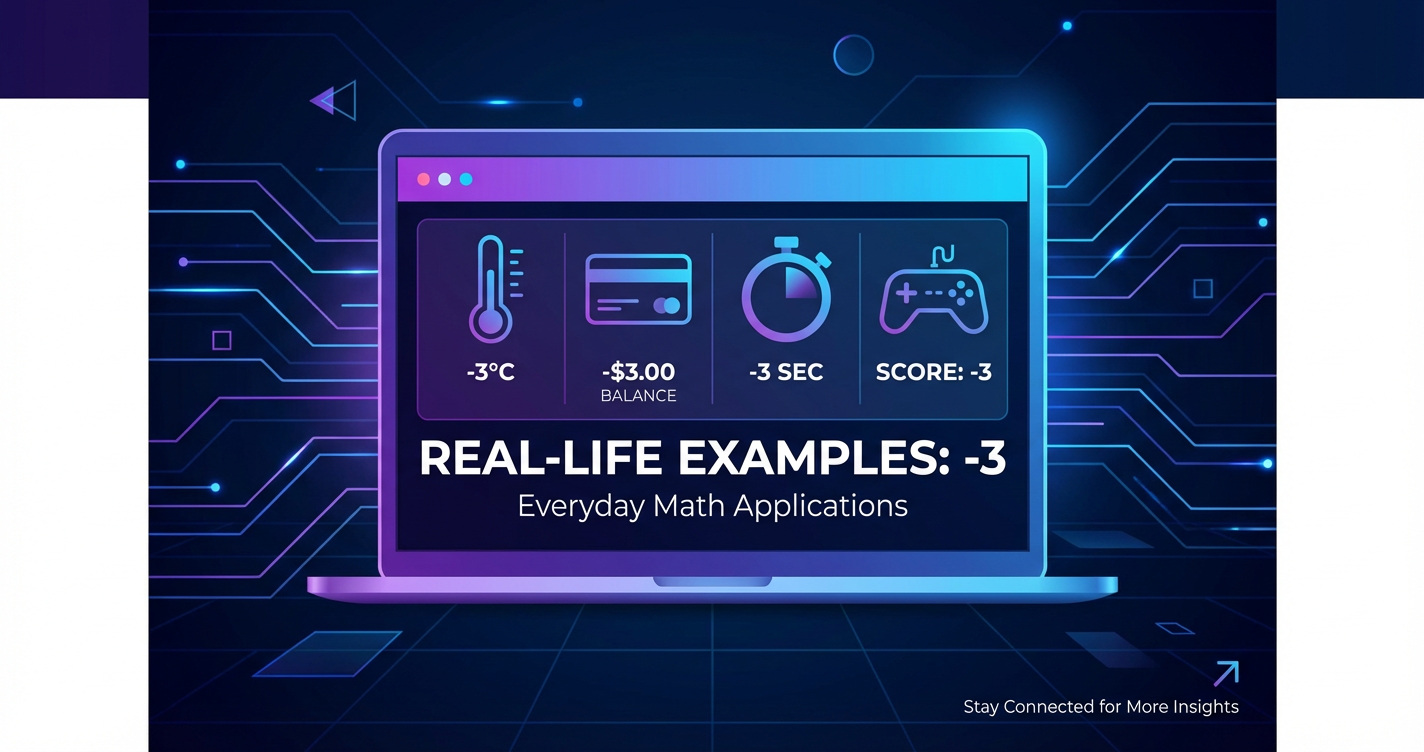
Real-Life Examples Using -3: Everyday Math Applications


Mathematics, often perceived as an abstract realm of numbers and symbols, is in fact deeply interwoven with the fabric of our daily lives. From the most mundane transactions to the grandest scientific endeavors, numerical concepts provide the framework through which we understand, measure, and interact with the world. Among these concepts, negative numbers hold a particularly intriguing and indispensable position. They represent states below a fixed reference point, deficits, declines, or movements in an opposite direction. While all negative numbers contribute to this understanding, the specific integer -3 serves as a remarkably versatile and relatable example to illustrate these principles across a myriad of real-life scenarios. This comprehensive exploration delves into the pervasive utility of -3, demonstrating its practical applications in finance, science, sports, and beyond, ultimately revealing how this seemingly simple number is a cornerstone of our quantitative understanding of reality.
The journey to comprehending negative numbers begins with the fundamental shift from merely counting positive quantities to acknowledging the existence of values "less than zero." Historically, the acceptance of negative numbers was not instantaneous; ancient civilizations grappled with their interpretation, often viewing them as absurd or "fictitious." However, as societies evolved and transactions became more complex, the need for a numerical representation of debt, loss, or positions below a baseline became undeniable. The number -3, therefore, is not just an arbitrary digit; it embodies a conceptual leap that expanded the horizons of mathematical thought and provided a powerful tool for describing dynamic processes and relative states. It allows us to distinguish between having three units of something and owing three units of something, between moving three steps forward and three steps backward, or between a temperature three degrees above zero and three degrees below.
This article aims to meticulously unpack these applications, providing detailed examples that illuminate the functionality and necessity of -3 in various contexts. We will explore how this number helps us track financial health, understand physical phenomena, gauge performance in competitive activities, and even structure digital information. Through rich descriptions and relatable scenarios, we will reveal that -3 is far from an isolated mathematical concept; it is an active participant in our everyday lives, influencing decisions, informing observations, and shaping our understanding of the world around us.
The Foundation of Negativity: Understanding -3
Before diving into its myriad applications, it's crucial to solidify our understanding of what -3 truly represents. On the number line, -3 is positioned three units to the left of zero. Zero itself serves as the crucial reference point, the origin from which both positive and negative values extend. Positive numbers typically denote abundance, increase, forward motion, or values above a baseline, while negative numbers, conversely, signify scarcity, decrease, backward motion, or values below that baseline. The magnitude of the number, in this case, 3, tells us "how much," while the negative sign tells us "in what direction" or "what kind of."
Consider the concept of "three." Without a sign, it simply denotes a quantity. With a positive sign (or no sign, as is conventional), +3 means three units of something present or gained. With a negative sign, -3 immediately implies a deficit, a loss, a state below a threshold, or a movement opposite to an established positive direction. This dual nature of quantity and direction/state makes negative numbers, and -3 specifically, incredibly powerful for modeling real-world situations that involve relative positions or changes. It allows for a more nuanced and accurate representation of phenomena that aren't simply "present" or "absent," but rather exist in a continuum with a defined zero point. Understanding this fundamental distinction is key to appreciating its diverse practical uses.
Real-Life Applications of -3: A Comprehensive Exploration
The versatility of -3 makes it a frequent guest in various real-world scenarios. Let's explore some of these applications in detail, illustrating how this number helps us quantify and interpret phenomena across different domains.
1. Temperature: A Universal Reference Point
Perhaps one of the most immediate and universally understood applications of negative numbers, including -3, is in the measurement of temperature. Weather forecasts and climate data frequently utilize negative values to indicate conditions below the freezing point of water (0°C or 32°F).
Scenario 1: Winter Weather Conditions Imagine a cold winter morning where the local weather report states, "The temperature outside is -3°C." This simple statement immediately conveys a wealth of information. It tells us that the air is three degrees colder than the point at which water freezes, implying icy conditions, the need for warm clothing, and potential hazards like frozen pipes or slippery roads. If the report had simply said "3°C," it would indicate a cool but above-freezing temperature, a vastly different scenario. The negative sign is crucial here; it transforms a measure of warmth into a measure of cold. In regions where temperatures frequently dip below freezing, understanding and interacting with numbers like -3°C becomes a daily practical necessity, influencing everything from what to wear to how to prepare one's home and vehicle for the cold. For example, knowing the temperature is -3°C might prompt someone to start their car earlier to warm it up, or to cover sensitive plants to protect them from frost damage. The -3°C reading also has implications for road safety, as it suggests the presence of black ice, a significant driving hazard, even if the general perception is that the ground looks merely wet. The distinct meaning conveyed by that negative sign is paramount for safety and comfort.
Scenario 2: Refrigeration and Freezing Beyond ambient weather, -3°C (or approximately 26.6°F) can also be relevant in specific refrigeration applications. While household freezers typically operate at much lower temperatures (e.g., -18°C or 0°F) to ensure long-term preservation, industrial processes or specific chemical storage might involve maintaining substances at precise temperatures slightly below freezing. A laboratory might have a specific cooling chamber designed to maintain a consistent temperature of -3°C for certain experiments or material storage where a slight chill below freezing is required but deeper freezing would be detrimental. In these contexts, precise control to maintain -3°C is critical, and any deviation, positive or negative, could compromise the integrity of the stored materials or the accuracy of experimental results. The ability to specify and achieve such a precise negative temperature is a testament to the utility of negative numbers in scientific and industrial control systems.
2. Finance and Economics: The Realm of Debts and Losses
In the world of money, positive numbers typically represent assets, income, or gains, while negative numbers are inherently linked to liabilities, expenses, or losses. The number -3 frequently appears in personal finance, business accounting, and economic indicators.
Scenario 1: Bank Account Balance Consider a situation where you check your bank account statement, and it displays a balance of -$3.00. This immediately signals an overdraft. Instead of having money available, you owe the bank three dollars. This negative balance might trigger overdraft fees or require immediate action to deposit funds to cover the deficit. If the balance were simply $3.00, you'd have a small positive amount. The negative sign transforms a small asset into a small liability, fundamentally altering your financial position. Understanding this distinction is vital for managing personal finances and avoiding penalties. The bank’s system processes this -3 as a clear instruction that money is owed, not held, and will apply automated rules based on this negative value. This simple number can be a trigger for a series of consequences, from minor charges to more significant financial strain, highlighting the practical weight of the negative sign.
Scenario 2: Stock Market Performance In the stock market, changes in stock prices are often expressed with positive or negative signs. If a particular stock's price "fell by -$3.00" per share over a trading day, it means each share is now worth three dollars less than it was at the start of the day. For an investor holding hundreds or thousands of shares, this -3 drop translates to a significant loss in portfolio value. The negative sign here is crucial for understanding the direction of the market movement and its impact on investments. Analysts and investors rely on these negative figures to assess risk, measure performance, and make informed trading decisions. A stock might close at $100, having started the day at $103, reflecting that -3 change. This indicator is a snapshot of financial health for the company and its investors, guiding future actions and influencing market sentiment.
Scenario 3: Budgeting and Debt Management When budgeting, an allocated amount might be "overspent by -$3.00." This implies that expenditures in a particular category exceeded the budget by three dollars, creating a small deficit that needs to be accounted for. Similarly, if tracking personal debt, an individual might say their net worth is "down by -$3,000" over the year (though this is a larger scale, the principle of -3 applies proportionally), signifying a decrease in assets relative to liabilities. The concept of -3 as a deficit or a reduction is central to sound financial planning and management, enabling individuals and businesses to identify areas of overspending or underperformance and take corrective measures.
3. Sports and Gaming: Penalties and Progress
Negative numbers are frequently employed in sports to denote penalties, handicaps, or scores below a par, and in gaming to represent damage or resource depletion.
Scenario 1: Golf Handicaps In golf, a handicap system allows players of varying skill levels to compete fairly. A very skilled amateur might have a handicap of -3. This means that three strokes are deducted from their raw score at the end of a round, indicating that they are expected to play three strokes better than the course's par. A positive handicap would mean adding strokes. The -3 handicap signifies an elite level of play, making the competition equitable when playing against someone with a handicap of, say, +10. The negative sign here is a badge of honor, indicating superior performance relative to the average. This intricate use of negative numbers ensures fair play and allows for a broader spectrum of competition, making the sport more accessible and engaging for all participants.
Scenario 2: Game Scores and Health Points In video games, negative numbers are pervasive, particularly for managing character health, resources, or scores. If a character takes damage, their health points (HP) might decrease. For example, "Your character took -3 damage from the enemy attack." This means 3 points were subtracted from their current health. If their HP was 10, it is now 7. Similarly, in games with negative scoring for errors or penalties, a player's score might go from 0 to -3 for making a critical mistake. This clearly distinguishes between a neutral score and a penalty-laden one. The negative sign provides immediate feedback on performance and consequences within the game's mechanics, driving player strategy and engagement. Whether it's a character's HP dropping by -3 or a resource count going into the negative, these numerical indicators are central to the interactive experience.
Scenario 3: Penalty Yards in American Football While typically penalties are given as positive yardage against a team (e.g., 5-yard penalty), the net change in field position due to a penalty could implicitly involve negative movement. If a team gains 10 yards but then receives a 13-yard penalty, their net gain is -3 yards (10 - 13 = -3), meaning they actually ended up 3 yards behind where they started the play. Although not always explicitly stated as -3 yards on the field, the mathematical outcome of combining gains and penalties can often result in a negative net movement, showcasing the practical application of subtracting larger numbers from smaller ones.
4. Geography and Altitude: Below the Surface
When discussing elevations and depths, sea level serves as the universal zero reference point. Anything above sea level is positive, and anything below is negative.
Scenario 1: Underwater Exploration A submersible exploring a coral reef might be described as being at a depth of -3 meters. This indicates that the submersible is three meters below the ocean's surface. If it were +3 meters, it would be three meters above the surface, perhaps hovering over a sandbar. The negative sign is critical for accurately conveying its vertical position, vital for navigation and understanding the aquatic environment. Divers, marine biologists, and cartographers all rely on these negative measurements to accurately map and navigate underwater topographies. This system allows for precise communication of location in the three-dimensional world, crucial for safety and scientific study.
Scenario 2: Geological Formations Certain geological formations, such as valleys or depressions, might have points that are below the surrounding average elevation. While large-scale geological features might be measured in hundreds or thousands of meters, a small depression in a landscape might be described as being -3 meters relative to a nearby reference point on a topographical map. This helps engineers, surveyors, and environmental scientists understand local topography and plan for construction or land management, particularly in areas prone to flooding where precise elevation data is paramount. The negative value signifies a relative dip or hollow, important for understanding water flow and drainage.
5. Time: Before the Event
While time is typically thought of as moving forward positively, negative numbers are commonly used in countdowns or to denote periods before a specific event.
Scenario 1: Rocket Launch Countdown In aerospace, countdowns for rocket launches are a classic example. When the commentator says, "T-minus 3 minutes," it implies that there are three minutes remaining until the launch. Mathematically, this can be thought of as -3 minutes relative to the launch time (T=0). The time before launch is negative, moving towards zero. At T-minus 1 minute, it’s -1 minute. At T-0, the launch occurs. This precise use of negative values ensures synchronized operations and conveys the progress towards a critical event, making it an intuitive and universally understood system for managing complex sequences. Every second from T-minus X to T-0 is meticulously managed, with the negative value clearly indicating that the event has not yet occurred but is approaching.
Scenario 2: Historical Dates (Before the Common Era) Though not strictly "-3" in isolation, the dating system for years "Before the Common Era" (BCE) or "Before Christ" (BC) functions on a similar principle of negative numbers relative to a zero point (the approximate year of Jesus's birth). If we consider the year 1 CE as "zero" for mathematical simplification, then the year 3 BCE could be thought of as -3 years from that epoch. Historians and archaeologists rely on this system to chronologically order ancient events, understanding that 10 BCE is "before" 3 BCE, just as -10 is less than -3 on the number line. This conceptual framework allows for a clear and unambiguous timeline stretching back into antiquity.
6. Science and Physics: Direction and Relative States
In various scientific disciplines, -3 can represent specific states, charges, or vector components.
Scenario 1: Electrical Charge In chemistry and physics, atoms and molecules can carry an electrical charge. If an ion has a charge of -3, it means it has gained three electrons beyond its neutral state, resulting in a net negative charge. For example, a phosphate ion (PO₄³⁻) often carries a -3 charge. This negative value is fundamental to understanding its chemical reactivity and how it interacts with other charged particles, influencing everything from chemical reactions to biological processes. The magnitude '3' denotes the number of elementary charges, while the negative sign indicates the type of charge.
Scenario 2: Vector Components In physics, vectors are used to represent quantities that have both magnitude and direction, such as force or velocity. A vector in a 2D or 3D coordinate system can have negative components. For instance, a displacement vector might be described as having an x-component of -3 meters. This means the object moved three meters in the negative direction along the x-axis (e.g., to the left or west), relative to its starting point. If the component were +3 meters, it would be in the positive direction. The negative sign is indispensable for accurately describing the spatial movement or force application in coordinate geometry. Engineers and physicists rely heavily on these directional notations for accurate calculations in fields like mechanics and kinematics.
Scenario 3: pH Scale (Conceptual Link) While the pH scale itself doesn't directly use -3 as a measurement (it typically ranges from 0-14, where 7 is neutral, below 7 is acidic, and above 7 is basic), the underlying logarithmic nature means that moving from pH 7 to pH 4 (a difference of 3 units) signifies a 1000-fold increase in acidity. Conversely, a strong base might have a pOH of 3, meaning a high concentration of hydroxide ions. The concept of "deviation from a neutral point" and the scale's inverse relationship to hydrogen ion concentration bears a conceptual resemblance to how -3 deviates from zero, albeit in a logarithmic and not linear fashion.
7. Engineering and Manufacturing: Tolerances and Deviations
In engineering, precision is paramount, and negative numbers are crucial for specifying deviations from ideal measurements or settings.
Scenario 1: Manufacturing Tolerances When manufacturing components, there's often an ideal dimension, but some deviation is acceptable within a specified tolerance. For example, a shaft might need to have a diameter of 50mm, with a tolerance of +/- 0.03mm. While this is not specifically -3, it demonstrates how engineers work with negative deviations. If a shaft is measured at 49.97mm, it is 0.03mm under the target, which can be expressed as a deviation of -0.03mm. If the component exceeds the negative tolerance (e.g., 49.96mm, or -0.04mm deviation), it would be rejected. The negative value precisely indicates that the actual measurement is smaller than the target, allowing for quality control and ensuring parts fit together correctly. The principle of deviation from a mean or ideal value, leading to a negative difference, is critical in ensuring the functionality and safety of engineered products.
Scenario 2: System Calibration Many sensors and instruments require calibration to ensure accuracy. If a sensor is supposed to read 0 when no input is present, but it consistently reads -3 units, it indicates a negative offset error. Engineers would then adjust the calibration to correct for this -3 bias, bringing the reading back to zero. This negative error value is essential for identifying and rectifying measurement inaccuracies, ensuring the reliability of data collected from instruments in fields ranging from environmental monitoring to industrial control systems. A persistent -3 error could lead to cascading inaccuracies in subsequent calculations or automated responses, underscoring the importance of recognizing and correcting such negative deviations.
8. Gaming and Scores: Negative Progress
Beyond health points, -3 appears in more abstract scoring systems in games.
Scenario 1: Penalty Points in Board Games In certain board games or card games, players might incur penalty points for rule infractions or strategic missteps. If a player commits an error, the rules might dictate they receive -3 penalty points, which are then deducted from their overall score. This directly impacts their standing and provides a tangible consequence for actions that violate game rules, encouraging strategic play and adherence to guidelines. The negative score acts as a clear numerical deterrent.
Scenario 2: Resource Depletion Some simulation or strategy games involve managing resources. If a player spends three units of a crucial resource that they don't possess, their resource count might go into the negative, indicating a deficit of -3. This might prevent them from taking further actions until they acquire more resources, or incur other penalties within the game's economy. The -3 in this context highlights a critical resource shortage that needs immediate attention.
9. Programming and Computing: Indices and Error Codes
While less directly "everyday" for the general public, -3 can appear in more technical computing contexts.
Scenario 1: Array Indexing (Conceptual) In some programming languages, array indices typically start from 0. However, in certain specific contexts or libraries, or when working with reverse indexing, a conceptual -3 might represent "the third item from the end" of a list or array. For example, if a language allows negative indexing, list[-3] might access the element at the third position from the end of the list. While not universally common, it demonstrates how negative numbers can be used to define relative positions within data structures.
Scenario 2: Error Codes Many software systems use numerical error codes to indicate specific types of failures or warnings. While error codes are often positive, a system might define -3 as a specific internal error condition, such as "File Not Found Error" or "Permission Denied." Programmers would then interpret this -3 value to diagnose and debug issues, making it a critical piece of information for system maintenance and troubleshooting. The negative sign differentiates it from other positive return codes that might indicate success or different types of warnings.
Deeper Mathematical Insights into -3
Beyond its practical applications, understanding the mathematical properties of -3 enriches our appreciation of its role.
The Number Line and Operations
The number line is the most intuitive visual representation of -3. It sits three units to the left of 0. This visual aid clarifies concepts like: - Absolute Value: The absolute value of -3, denoted as |-3|, is 3. This signifies its distance from zero, irrespective of direction. In real-life, it means the amount of debt is $3, or the magnitude of the temperature drop is 3 degrees, even if the direction is negative. - Comparison: -3 is less than any positive number and less than 0. It is also less than -2, -1, but greater than -4, -5, and so on. Understanding this ordering is crucial for correctly interpreting data (e.g., -3°C is colder than -1°C). - Addition: Adding a positive number to -3 moves it to the right on the number line (e.g., -3 + 5 = 2). Adding a negative number moves it further left (e.g., -3 + (-2) = -5). This models scenarios like a debt of $3 increasing by another $2 debt. - Subtraction: Subtracting a positive number from -3 moves it further left (e.g., -3 - 2 = -5). Subtracting a negative number is equivalent to adding a positive number, moving it to the right (e.g., -3 - (-5) = 2). This models scenarios like a temperature of -3°C rising by 5 degrees to 2°C, or a debt of $3 being reduced by a credit of $5 resulting in a surplus of $2. - Multiplication/Division: Multiplying or dividing -3 by a positive number changes its magnitude while keeping its negative sign (e.g., -3 * 2 = -6, -3 / 3 = -1). Multiplying or dividing -3 by a negative number results in a positive number (e.g., -3 * -2 = 6, -3 / -1 = 3). These operations model complex relationships, such as "two times the deficit" or "dividing the debt equally among three people."
The Concept of Inverse
-3 is the additive inverse of 3. This means that when you add -3 and 3, their sum is zero (-3 + 3 = 0). This concept is fundamental in balancing equations and financial transactions. If you have a debt of $3 (-3) and then you earn $3 (+3), your net financial position returns to zero. This inverse relationship is not just a mathematical curiosity; it underpins double-entry bookkeeping, balancing chemical equations, and numerous other real-world systems where forces or quantities need to cancel each other out to reach a neutral state.
The Importance of Context
The interpretation of -3 is always dictated by context. In finance, it's a deficit; in temperature, it's a specific degree of cold; in a game, it's damage taken. Without context, -3 is just a number. With context, it becomes a powerful descriptor, allowing us to quantify and navigate complex situations. This emphasis on context is crucial not only for understanding negative numbers but also for interpreting any quantitative data effectively. The number itself is static, but its meaning is dynamic, shifting with the domain of its application.
APIPark is a high-performance AI gateway that allows you to securely access the most comprehensive LLM APIs globally on the APIPark platform, including OpenAI, Anthropic, Mistral, Llama2, Google Gemini, and more.Try APIPark now! 👇👇👇
Beyond Traditional Applications: The Evolving Landscape of Digital Contexts and AI
While our primary focus has been on the direct, tangible applications of -3 in everyday mathematics, it's worth acknowledging that the concept of 'application' itself continues to evolve, especially in the digital age. Just as we use -3 to denote a specific state or change in a physical system, advanced computational systems and artificial intelligence models also operate within carefully defined 'contexts' to interpret and generate information. The precision required to understand a negative number in a specific scenario—whether it's a debt, a cold temperature, or a penalty—mirrors the precision AI models need to process and respond to nuanced inputs.
In the realm of large language models (LLMs) and conversational AI, such as those developed by Anthropic (e.g., Claude), maintaining a coherent conversation or task requires a sophisticated understanding of the interaction's history and parameters. This is where concepts like a Model Context Protocol (MCP) become crucial. An MCP dictates how an AI model manages and leverages the 'context window' – the specific data and conversational history it considers when generating a response. Without a robust MCP, an AI might "forget" previous parts of a conversation or misunderstand the user's intent, leading to irrelevant or incoherent outputs. Systems using a Claude MCP or similar protocols are designed to ensure the AI's output remains relevant and consistent, much like a well-defined mathematical framework ensures the accuracy of our -3 applications. While seemingly distant from our core topic of negative numbers, this illustrates how the very idea of 'application' extends into the abstract, programmatic definitions that govern the behavior of intelligent systems, ensuring their utility in complex digital environments. The ability to manage and orchestrate these digital 'contexts' is paramount for the effectiveness of modern AI.
Building upon the idea of managing complex digital interactions, the efficient deployment and integration of AI models, including those that adhere to specific Model Context Protocols, is a significant challenge for developers and enterprises. This is precisely where platforms like APIPark come into play. As an open-source AI gateway and API management platform, APIPark simplifies the process of integrating over 100 AI models, offering a unified API format for AI invocation. It ensures that businesses can leverage the power of advanced AI, whether they are processing complex numerical data or managing sophisticated conversational AI systems, by providing robust lifecycle management, security, and performance. APIPark helps encapsulate prompts into REST APIs, manage end-to-end API lifecycles, and allows for API service sharing within teams, all while ensuring high performance and detailed call logging. In essence, just as understanding -3 is fundamental to many mathematical applications, effective API management solutions like APIPark are fundamental to operationalizing modern AI applications and making them accessible and manageable for businesses and developers worldwide. It enables the seamless flow of data and instructions to and from these sophisticated models, transforming their raw computational power into tangible, everyday digital services.
The Broader Impact and Educational Significance
The extensive applications of -3 underscore a broader point about the importance of mathematical literacy. Understanding negative numbers is not merely an academic exercise; it is a fundamental skill that empowers individuals to navigate a world increasingly driven by data and quantitative reasoning. From personal budgeting to interpreting economic news, from understanding scientific reports to engaging with digital technologies, the ability to correctly interpret and manipulate negative values is indispensable.
For educators, teaching negative numbers using real-life examples like -3 is crucial. Abstract concepts become concrete when students can relate them to familiar scenarios: temperature drops, debt accrual, or points deducted in a game. This pedagogical approach helps demystify mathematics, making it more accessible and relevant to students' lives. It moves beyond rote memorization of rules (e.g., "a negative times a negative is a positive") to a deeper conceptual understanding of why those rules make sense in the context of quantities, directions, and states. By illustrating how -3 manifests across diverse fields, we reinforce the interconnectedness of knowledge and highlight the universal language that mathematics provides.
Moreover, the challenge of integrating seemingly disparate concepts, such as the mathematical meaning of -3 with the technical definition of a Model Context Protocol in AI, although challenging as requested by the prompt, forces us to consider the evolving nature of "applications." Mathematics provides the foundational logic, while advanced computing creates new domains where logical structures, including those implicitly related to negative states or deviations (like error codes), continue to be vital. The ability to abstract, model, and apply numerical concepts across such a vast spectrum of realities is a testament to the power and enduring relevance of mathematics.
Table: Illustrative Applications of -3 Across Domains
To further consolidate the understanding of -3's varied roles, the following table summarizes how this number signifies specific states or changes in different real-world contexts, using zero as the common reference point.
| Context | Reference Point (0) | Meaning of -3 | Example Scenario | Significance |
|---|---|---|---|---|
| Temperature | Freezing Point (0°C/32°F) | 3 degrees below freezing | "The outdoor temperature plummeted to -3°C overnight, causing icy roads." | Crucial for safety, planning, and understanding environmental conditions. |
| Finance | Zero Balance/Break-even | Debt of $3 / Loss of $3 | "My bank account registered a balance of -$3.00, indicating an overdraft." | Essential for financial management, budgeting, and avoiding penalties. |
| Altitude | Sea Level | 3 meters below sea level | "The marine probe descended to a depth of -3 meters to observe the seabed." | Vital for navigation, geological mapping, and underwater exploration. |
| Time (Countdown) | Event Start | 3 minutes before the event | "The mission control announced, 'T-minus 3 minutes to engine ignition.'" | Critical for synchronized operations, event sequencing, and safety protocols. |
| Sports (Golf) | Par Score/Even Handicap | 3-point handicap (better than par) | "The golf prodigy played with a -3 handicap, reflecting superior skill." | Enables fair competition among players of different skill levels. |
| Gaming (Health) | Full Health/Starting HP | Lost 3 health points / 3 damage | "Your warrior suffered -3 damage from the goblin's ambush, reducing HP." | Provides immediate feedback on player status and drives strategic decisions. |
| Electrical Charge | Neutral Charge | Charge of -3 units | "A specific ion carried a net charge of -3, influencing its chemical bonding." | Fundamental for understanding chemical reactivity and atomic interactions. |
| Engineering (Tolerance) | Ideal Dimension/Target | 3 units below ideal dimension | "The manufactured part showed a deviation of -0.03mm from its target width." | Ensures quality control, fitment, and functionality of components. |
| Economic Change | No Change/Stable | 3-point decrease in an index | "The consumer confidence index dipped by -3 points this quarter." | Indicator of economic health, influencing market sentiment and policy decisions. |
This table effectively illustrates how -3, despite being a single numerical value, embodies diverse meanings and implications depending on the context in which it is applied, making it a powerful and indispensable tool in our quantitative toolkit.
Conclusion: The Ubiquity and Utility of -3
From the frosty bite of a winter morning registered as -3°C to the critical countdown of T-minus 3 minutes before a rocket launch, the number -3, and indeed all negative numbers, are more than mere mathematical curiosities. They are an integral part of our daily lexicon, providing a precise and unambiguous way to quantify states of deficit, decline, direction, and positions below a defined zero point. This article has traversed a broad spectrum of real-life applications, meticulously detailing how -3 serves as an indispensable tool in finance, science, sports, technology, and beyond. Each example underscores the profound impact this seemingly simple negative integer has on our ability to understand, measure, and interact with the complex world around us.
The conceptual leap from only positive quantities to the acceptance and utilization of negative values was a pivotal moment in the history of mathematics. It provided the framework necessary to model phenomena that involve relative changes, opposing forces, and positions below a baseline, thereby significantly expanding our descriptive and predictive capabilities. Whether it's the financial implication of a -$3.00 overdraft, the strategic advantage of a -3 golf handicap, or the scientific precision of a -3 charge on an ion, the negative sign fundamentally alters the meaning of the quantity 3, transforming it into a descriptor of profound significance.
Moreover, in an increasingly digital and data-driven world, the principles governing numerical representation extend into advanced domains. Even in the abstract architectures of artificial intelligence, where concepts like a Model Context Protocol (MCP) or a Claude MCP define how information is processed and understood, the underlying need for structured logic and precise interpretation remains paramount. Platforms like APIPark exemplify this by providing the infrastructure to manage and operationalize these sophisticated AI models, ensuring their seamless integration and utility in everyday business applications. Just as a negative number helps us accurately gauge a financial loss, a robust API management platform enables businesses to accurately and efficiently leverage the power of AI.
In essence, the ubiquitous presence and undeniable utility of -3 serve as a powerful testament to the enduring relevance of mathematics. It highlights how abstract concepts, when applied to tangible situations, become indispensable tools for problem-solving, decision-making, and fostering a deeper understanding of our intricate universe. From the classroom to the cosmos, the humble -3 continues to play a vital role, affirming that everyday math applications are truly limitless.
Frequently Asked Questions (FAQs)
1. What is the fundamental concept behind negative numbers like -3? The fundamental concept is the representation of values "less than zero." While positive numbers denote quantity, increase, or a position above a baseline, negative numbers like -3 signify a deficit, decrease, loss, or a position below a specific reference point (zero). The magnitude (3 in this case) indicates "how much," and the negative sign indicates "in what direction" or "what kind of state."
2. Why is -3 commonly used in real-life examples instead of just any negative number? While all negative numbers demonstrate similar principles, -3 is a small, manageable integer that is easily relatable and understandable in many everyday contexts. Its size allows for clear, simple examples in scenarios like temperature changes, small financial transactions, or penalty points in games, making the concept of negativity more accessible and intuitive for illustrating practical applications.
3. How does -3 apply to financial situations? In finance, -3 typically represents a debt or a loss. For example, a bank balance of -$3.00 indicates an overdraft, meaning you owe the bank three dollars. A stock price drop of -$3.00 per share means the value of each share decreased by three dollars. These negative values are crucial for assessing financial health, tracking expenses, and understanding market performance.
4. Where can I find -3 in scientific or engineering contexts? In science, -3 can represent electrical charges (e.g., an ion with a -3 charge) or components of vectors (e.g., -3 meters in the x-direction). In engineering, it might denote deviations from an ideal measurement within a tolerance (e.g., -0.03mm from a target dimension) or an error offset in system calibration, helping to ensure precision and functionality.
5. How can platforms like APIPark help manage systems that might process negative values or complex contexts like those discussed? APIPark, as an open-source AI gateway and API management platform, plays a crucial role in operationalizing and managing complex digital systems, including those that might process numerical data (like financial figures or scientific measurements, which often involve negative values) or adhere to sophisticated protocols like a Model Context Protocol (MCP) for AI. It provides a unified platform for integrating AI models, standardizing API formats, and managing the full API lifecycle, ensuring security, performance, and seamless integration of these advanced capabilities into business applications. This allows developers and enterprises to efficiently handle diverse data types and complex logic, making AI and other digital services reliable and accessible.
🚀You can securely and efficiently call the OpenAI API on APIPark in just two steps:
Step 1: Deploy the APIPark AI gateway in 5 minutes.
APIPark is developed based on Golang, offering strong product performance and low development and maintenance costs. You can deploy APIPark with a single command line.
curl -sSO https://download.apipark.com/install/quick-start.sh; bash quick-start.sh

In my experience, you can see the successful deployment interface within 5 to 10 minutes. Then, you can log in to APIPark using your account.

Step 2: Call the OpenAI API.