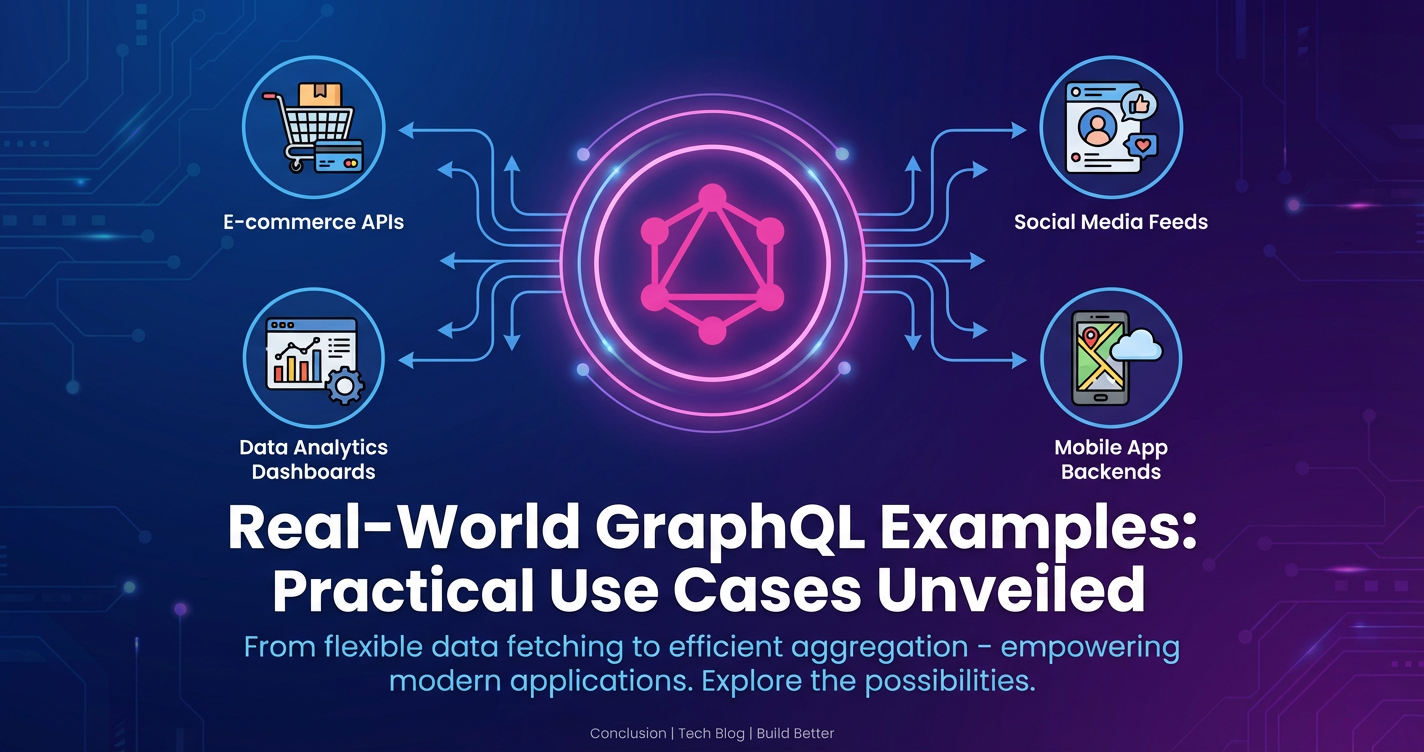
Real-World GraphQL Examples: Practical Use Cases Unveiled


In the vast and ever-evolving landscape of modern software development, the way applications communicate with their data sources stands as a foundational pillar of their success. For decades, Representational State Transfer, or REST, served as the de facto standard for building web APIs, offering a straightforward, resource-oriented approach. However, as applications grew in complexity, demanding more granular control over data, faster development cycles, and efficient fetching from diverse sources, the limitations of REST began to surface, giving rise to new paradigms. This evolution introduced us to GraphQL, a query language for your API, and a server-side runtime for executing queries by using a type system you define for your data.
GraphQL emerged from Facebook in 2012 (and open-sourced in 2015) as a solution to address the challenges of over-fetching (receiving more data than needed) and under-fetching (making multiple requests to gather all necessary data) that plagued complex client applications interacting with RESTful services. Its core philosophy is deceptively simple yet profoundly powerful: the client dictates precisely what data it needs, and the server responds with exactly that data, nothing more, nothing less. This principle has revolutionized how developers conceive, build, and interact with APIs, moving towards a more client-centric and efficient data retrieval model.
This comprehensive exploration aims to strip away the theoretical jargon and delve into the tangible, real-world applications of GraphQL. We will journey through various industries, from the dynamic world of e-commerce to the critical domain of healthcare, uncovering how organizations are leveraging GraphQL to solve complex data fetching problems, streamline development, and deliver superior user experiences. By examining practical use cases, we will unveil the practical power of GraphQL, demonstrating its versatility, scalability, and the profound impact it has on modern application architectures. Prepare to discover how this innovative API technology is not just a trend, but a fundamental shift in how we build the connected applications of tomorrow.
1. The Core Philosophy of GraphQL and Its Advantages
At its heart, GraphQL is more than just a technology; it’s a paradigm shift in how applications interact with data. It proposes a contract between the client and the server, defined by a strongly typed schema, which empowers clients to request exactly what they need and nothing more. This fundamental principle addresses many of the inefficiencies inherent in traditional API architectures, fostering greater flexibility, faster development, and enhanced performance.
1.1 What is GraphQL? A Deep Dive into its Mechanics
GraphQL stands for Graph Query Language, a name that perfectly encapsulates its essence. Unlike REST, which typically exposes multiple endpoints for different resources (e.g., /users, /products, /orders), GraphQL presents a single, unified endpoint. Through this single endpoint, clients can send complex queries to fetch nested data from multiple resources in a single request. This capability is powered by several key components:
- Schema Definition Language (SDL): The backbone of any GraphQL service is its schema, defined using SDL. The schema is a strongly typed blueprint of all the data and operations (queries, mutations, subscriptions) that clients can perform. It dictates the types of data available, their relationships, and how they can be accessed. For instance, you might define a
Usertype with fields likeid,name,email, andposts, wherepostsitself could be a list ofPosttypes. This explicit contract makes APIs self-documenting and enables powerful tooling. - Queries: These are requests from the client to read data. A GraphQL query mirrors the structure of the data it expects back. If a client queries for a
userand specifiesidandname, the server will only return those two fields. This precision is a stark contrast to REST, where aGET /users/{id}endpoint might return the entire user object, regardless of whether the client needs all its fields. - Mutations: While queries are for reading data, mutations are for writing, updating, or deleting data. They are similar in structure to queries but are explicitly designed to indicate side effects. This clear distinction between data retrieval and data modification helps developers reason about data flow and state changes more effectively.
- Subscriptions: These enable real-time communication between the client and the server. Clients can subscribe to specific events or data changes, and the server will push updates to them automatically, typically over WebSockets, as soon as those changes occur. This is invaluable for applications requiring live data feeds, such as chat applications, stock tickers, or notification systems.
- Resolvers: On the server side, for every field defined in the schema, there is a corresponding resolver function. A resolver is responsible for fetching the data for its particular field from the appropriate data source. This could be a database, another REST API, a microservice, or even a static value. This separation of concerns allows the GraphQL server to act as an abstraction layer, consolidating data from various backend systems into a cohesive graph.
The strong type system and the graph-like nature of data representation mean that clients can traverse relationships between different data types effortlessly. Instead of making sequential calls to different REST endpoints (e.g., get user, then get user's posts, then get comments on each post), a single GraphQL query can retrieve all this interconnected information in one go, dramatically reducing latency and improving application responsiveness.
1.2 Overcoming REST's Limitations: Why GraphQL Shines
The rise of GraphQL wasn't an arbitrary whim; it was a response to very real, tangible problems that developers faced with traditional RESTful APIs, especially as client applications became more sophisticated and single-page applications (SPAs) gained dominance. Understanding these pain points highlights why GraphQL has garnered such significant adoption.
One of the most prominent challenges with REST is the issue of over-fetching and under-fetching. When a client makes a request to a REST endpoint, the server typically returns a fixed data structure, often containing fields the client doesn't need (over-fetching). Conversely, if the client needs data from multiple resources, it might have to make several requests to different endpoints (under-fetching), leading to increased network latency and complex client-side data orchestration. Imagine an e-commerce product page: a REST API might require one call for product details, another for reviews, another for related products, and yet another for seller information. Each call adds overhead. GraphQL, with its precise querying capabilities, eliminates both these problems by allowing the client to specify exactly what fields it requires, from potentially multiple related types, in a single request.
Another significant advantage is the single endpoint for multiple resources. A REST API typically exposes dozens, if not hundreds, of endpoints, each corresponding to a specific resource or collection. This can make API discovery and management cumbersome. GraphQL consolidates all data access through a single /graphql endpoint, simplifying client-side configuration and making it easier to route requests. This unified entry point also streamlines the application of common concerns like authentication, rate limiting, and caching at the network edge.
The strongly typed schema is perhaps GraphQL's most powerful differentiator. Unlike REST, where API contracts are often implicitly defined in documentation (which can quickly become outdated) or inferred from example responses, GraphQL's schema is explicit and enforced. This brings several benefits: * Self-documenting APIs: Developers can explore the entire API surface using tools like GraphiQL or GraphQL Playground, which read the schema and provide interactive documentation, autocomplete, and validation. * Compile-time validation: Client-side tools can validate queries against the schema at build time, catching errors before deployment and providing a much smoother developer experience. * Enhanced reliability: The strict type system ensures that both client and server adhere to the defined data contract, reducing the likelihood of unexpected data formats or missing fields.
Furthermore, GraphQL intrinsically supports versionless APIs or, more accurately, APIs that evolve gracefully. In REST, changes to resource structures often necessitate versioning the entire API (e.g., /v1/users, /v2/users), leading to maintenance overhead and client migration challenges. With GraphQL, changes are typically additive; new fields can be added to types without breaking existing clients. Old fields can be deprecated, and clients will simply stop requesting them over time. This forward compatibility significantly eases API evolution and reduces friction for consumers.
Finally, the ability to fetch complex, nested data graphs in a single request leads to reduced network requests. For rich, interactive user interfaces that display data from many interconnected sources, this means fewer round trips to the server, leading to dramatically faster load times and a smoother user experience, particularly on mobile networks or in regions with high latency. This efficiency is critical for modern applications that prioritize responsiveness and user engagement.
In essence, GraphQL empowers clients with unprecedented control over data fetching, leading to more efficient networks, faster development cycles, and a more robust and predictable API ecosystem.
1.3 The Developer Experience Revolution
Beyond its technical merits, GraphQL has fundamentally reshaped the developer experience, fostering more harmonious collaboration between frontend and backend teams and accelerating the pace of innovation. Its design choices inherently lead to a more intuitive and productive workflow.
One of the most celebrated aspects of GraphQL's developer experience is its self-documenting nature, often manifested through interactive tools like GraphiQL or GraphQL Playground. Because the entire API is defined by a rigorous schema, these tools can parse the schema and present a complete, up-to-date documentation interface. Frontend developers can explore available types, fields, and operations, construct queries with autocomplete assistance, and validate them against the live schema – all within their browser or IDE. This eliminates the need for external documentation (which can quickly become stale) and significantly reduces the learning curve for new team members or external consumers. The instant feedback loop provided by these tools accelerates development and debugging, allowing developers to iterate on data requirements much faster.
This clarity and predictability also lead to faster prototyping and iteration. Frontend teams no longer have to wait for backend teams to modify or create new REST endpoints when their data needs change. As long as the data exists in the GraphQL graph, they can formulate new queries to retrieve it. This agility allows frontend developers to move at their own pace, rapidly experimenting with UI designs and data visualizations without being blocked by backend dependencies. The backend team, in turn, can focus on building robust data services and extending the schema, knowing that the client has the flexibility to consume the data as needed.
GraphQL grants frontend autonomy and backend agnosticism. Frontend developers become masters of their data domain, defining the exact data structures their UI components require. This decoupling means the backend can evolve its internal services, databases, or even entirely replace data sources, as long as the GraphQL layer maintains its external contract. The GraphQL server acts as a powerful abstraction, shielding the frontend from the complexities of the underlying backend architecture. This separation of concerns promotes microservice architectures, allowing different teams to own different parts of the graph without tightly coupling their development cycles.
The result is enhanced collaboration between frontend and backend teams. Instead of a back-and-forth negotiation over REST endpoint designs and data payloads, teams can collaborate around the shared GraphQL schema. Changes to the schema are a joint discussion point, ensuring that data availability aligns with UI requirements. This common language and single source of truth for API capabilities streamline communication, reduce misunderstandings, and foster a more efficient and aligned development process. Furthermore, for organizations adopting an AI Gateway like APIPark, this unified approach extends to managing and integrating various AI and REST services, providing a cohesive developer portal that simplifies API lifecycle management and access, thereby amplifying the benefits of a well-governed API ecosystem.
| Feature | RESTful API | GraphQL API |
|---|---|---|
| Data Fetching | Over-fetching/Under-fetching common | Exact data fetching, client specifies needs |
| Endpoints | Multiple endpoints per resource/collection | Single endpoint (e.g., /graphql) |
| Schema/Contract | Implicit (documentation, examples), less strict | Explicit, strongly typed schema (SDL) |
| Versioning | Often requires URL versioning (/v1, /v2) |
Evolves gracefully (additive changes, deprecation) |
| Network Requests | Multiple requests for related data often necessary | Single request for complex nested data |
| Developer Tools | Postman, Insomnia, Swagger UI | GraphiQL, GraphQL Playground, Apollo Studio |
| Real-time | Typically uses WebSockets or SSE outside REST | Built-in Subscriptions |
| Learning Curve | Generally lower initially for simple use cases | Higher initial learning curve due to new concepts |
This table vividly illustrates the core distinctions, emphasizing why GraphQL has become a compelling alternative for modern application development, particularly where data efficiency and developer experience are paramount.
2. E-commerce and Retail - Personalizing the Shopping Experience
The e-commerce and retail sector is a fiercely competitive landscape where user experience, speed, and personalization are paramount. Customers expect dynamic, responsive interfaces that present relevant products, process orders seamlessly, and provide real-time updates. GraphQL is exceptionally well-suited to meet these demands, offering a flexible and efficient way to manage the vast and interconnected data required to power modern online stores.
2.1 Dynamic Product Catalogs and Search
Imagine a sophisticated e-commerce platform with millions of products, each having numerous attributes, images, videos, reviews, pricing tiers, and inventory levels. Traditional REST APIs might require multiple calls to assemble a complete product view: one for basic details, another for high-resolution images, a third for customer reviews, and perhaps a fourth for related products. This waterfall of requests can significantly slow down page load times, directly impacting conversion rates and user satisfaction.
GraphQL addresses this head-on by enabling a single, granular query to retrieve all necessary product information. For example, a query for a specific product could simultaneously fetch its name, description, price, a list of images (with specified sizes), averageRating, the top5Reviews (including author details), and upTo10RelatedProducts (each with their own basic details and price). This not only minimizes network round trips but also allows the client to precisely tailor the data payload to the specific needs of the UI component, whether it's a product listing card, a detailed product page, or a shopping cart item.
Furthermore, search and filtering capabilities in e-commerce are incredibly complex, involving facets, price ranges, brand filters, and sorting options. GraphQL queries can encapsulate these diverse parameters efficiently. A single query can request products matching specific criteria (e.g., category: "Electronics", priceRange: { min: 100, max: 500 }, brand: ["Sony", "Samsung"]), while also requesting metadata about the available facets and their counts. This enables highly dynamic and interactive search experiences, where users can refine their searches instantly without full page reloads.
Personalized recommendations are another area where GraphQL excels. Based on a user's browsing history, purchase patterns, or items currently in their cart, the system can dynamically suggest relevant products. A GraphQL query can fetch a user's recentlyViewedProducts, itemsInCart, and then leverage these to request personalizedRecommendations from a machine learning service, all within one API call. This seamless integration of various data points ensures that users encounter a highly tailored shopping journey, increasing engagement and sales. The flexibility to combine user data with product data and recommendation engine outputs in a single query makes the development of personalized features significantly more agile.
2.2 Order Management and User Accounts
Beyond browsing, the core of any e-commerce operation lies in managing orders and user accounts. These processes involve sensitive and interconnected data that benefits immensely from GraphQL's structured querying capabilities.
For order management, a customer might want to view their purchase history. A GraphQL query can retrieve a list of all orders for a specific user, and for each order, fetch its id, status, orderDate, total amount, and a list of items purchased. For each item, it can further pull its productName, quantity, and unitPrice. If the user wants to track a specific order, the query can also include shippingInformation (tracking number, carrier, estimated delivery) and paymentDetails (masked card type, last 4 digits, billing address). All this complex, nested information can be obtained with a single, precisely crafted query, eliminating the need for multiple REST endpoints like /orders, /orders/{id}/items, /orders/{id}/shipping, etc. This consolidation simplifies client-side logic and reduces the overall number of API calls, leading to a smoother and faster order tracking experience.
Managing shopping carts across devices is another critical use case. A user might add items to their cart on a desktop browser, then wish to complete the purchase on their mobile app. GraphQL's ability to fetch and mutate complex data structures in a unified manner makes this seamless. A mutation can addToCart with productId and quantity, and a query can getCart to retrieve all items (with full product details), subtotal, and shippingOptions. This consistent interaction model ensures that the cart state is always synchronized, regardless of the client device, providing a robust and frictionless user experience.
User profile management benefits from GraphQL's flexibility by allowing clients to update specific fields without sending the entire object. A mutation to updateUserProfile can take arguments like firstName, lastName, email, and shippingAddresses, and the client can choose to update only one or all of these fields. This reduces payload size and avoids the common RESTful pattern of PATCH requests that often require custom handling for partial updates. Moreover, retrieving user preferences, loyalty points, or saved payment methods can be done via a single query, personalizing every interaction.
2.3 Real-time Updates for Inventory and Pricing
In the fast-paced retail environment, inventory levels and pricing are highly dynamic. Products go out of stock, prices fluctuate due to promotions or market changes, and stock might be reserved or released. Providing real-time updates to customers is crucial to prevent frustration (e.g., buying an out-of-stock item) and to capitalize on urgency (e.g., a flash sale ending soon).
GraphQL Subscriptions are tailor-made for these real-time requirements. A client can subscribe to productInventoryUpdates for a specific productId. Whenever the stock level changes, the server pushes the new quantityAvailable directly to the subscribed clients. Similarly, clients can subscribe to productPriceUpdates, receiving immediate notifications when a product's price changes due to a sale, a personalized discount, or a general price adjustment. This ensures that the information displayed to the customer is always current, enhancing trust and preventing checkout abandonment due to stale data.
This capability is particularly vital for high-demand items, limited-time offers, or scenarios where inventory is shared across multiple sales channels (online store, physical stores, marketplaces). By pushing updates instantaneously, e-commerce platforms can maintain data consistency across various storefronts – web, mobile, in-store kiosks – and ensure that customers are always making decisions based on the most accurate information available. The underlying api infrastructure supporting these real-time subscriptions must be robust, scalable, and efficiently managed to handle the constant flow of updates. GraphQL abstracting these real-time mechanisms into simple subscribe operations simplifies client-side implementation dramatically, reducing the complexity often associated with WebSocket management in traditional architectures. This direct, push-based communication significantly elevates the responsiveness and reliability of the e-commerce platform.
3. Social Media and Content Platforms - The Connected Experience
Social media platforms and content-rich applications thrive on interconnected data: users, posts, comments, likes, shares, media, and intricate relationship graphs. The ability to efficiently fetch, combine, and update this vast array of intertwined information is paramount to delivering a seamless and engaging user experience. GraphQL, with its inherent graph-like querying capabilities, is an ideal fit for these complex data ecosystems.
3.1 Building Complex Feeds
The cornerstone of any social media or content platform is the user's feed, an aggregation of various types of content from numerous sources. Building such a feed with traditional REST APIs often involves making multiple requests to different endpoints (e.g., one for friend's posts, another for liked pages' updates, a third for trending topics, and a fourth for advertisements), then stitching all this data together client-side. This process is not only inefficient, leading to slow load times and a choppy user experience, but also complex to manage as the feed logic evolves.
GraphQL revolutionizes this by allowing clients to fetch all components of a complex feed in a single, highly optimized query. For instance, a query for homeFeed could simultaneously request posts from friends, updates from followedPages, and promotedContent, all while specifying the exact fields needed for each item (e.g., author { name, profilePicture }, timestamp, text, media { url, type }, likesCount, commentsCount). This dramatically reduces the number of network requests and the amount of data transferred, resulting in significantly faster feed loading and smoother infinite scrolling.
Beyond basic content, the feed often needs to display user interactions like likes, comments, and shares. A GraphQL query can easily embed this information within each post object, such as post { id, text, likes { count, viewerHasLiked }, comments { id, author { name }, text } }. This ability to fetch deeply nested and interconnected data in one go simplifies client-side state management and reduces the need for extensive data normalization and denormalization.
Furthermore, features like pagination and real-time updates are seamlessly integrated. A feed query can specify first: 10, after: cursor for efficient pagination, and GraphQL Subscriptions can push new posts or real-time updates (e.g., new comments appearing) to the client as they happen. This ensures that users always see the freshest content without manual refreshing, providing a dynamic and engaging experience. The unified api endpoint for all these operations streamlines the development process, allowing frontend developers to construct sophisticated feeds with remarkable agility.
3.2 User Profiles and Relationships
Social platforms are built on the intricate web of user relationships. Understanding who follows whom, mutual connections, group memberships, and user activities is fundamental. GraphQL’s graph-like nature makes it exceptionally adept at handling these highly interconnected data structures.
When a user views another user's profile, they typically expect to see a wealth of information: the profile owner's details, their posts, their followers, who they are following, and potentially mutual connections. With REST, this might involve an initial call to /users/{id} for basic profile info, then /users/{id}/posts for their content, /users/{id}/followers for follower list, and so on. This quickly escalates into a "N+1 problem" of numerous requests.
A single GraphQL query, however, can fetch all this data in one shot. For example, a query for a userProfile could include id, name, profilePicture, bio, followerCount, followingCount, posts { id, text, timestamp }, followers { id, name, profilePicture }, and mutualFriends { id, name }. The flexibility to specify nested fields and traverse relationships directly within the query minimizes round trips and simplifies the client-side aggregation of data, providing a much faster and more complete profile view.
Moreover, managing user relationships (e.g., "follow" or "unfollow" actions) is handled efficiently through GraphQL Mutations. A followUser mutation can take a userId as an argument, and upon successful execution, return the updated followerCount for both users, ensuring the UI reflects the change immediately. Similarly, joinGroup or sendFriendRequest mutations can be implemented with clear input and output types defined in the schema, making API interactions predictable and robust.
The power of GraphQL lies in its ability to navigate these deep data graphs. Whether it's querying for a user's friends of friends who have liked a specific post, or filtering users based on their interests and groupMemberships, the expressive power of GraphQL allows developers to formulate highly specific queries that would be cumbersome or inefficient with traditional REST approaches. This agility in querying complex relationship data is a significant accelerator for developing rich social features.
3.3 Real-time Interactions and Notifications
In social media, real-time engagement is not just a feature; it's a core expectation. Users expect to see new messages, comments, likes, and notifications appear instantly without having to refresh their screens. GraphQL Subscriptions provide a robust and elegant solution for implementing these real-time capabilities.
Consider a live chat feature. A client can subscribe to newMessages for a specific chatRoomId. As soon as a message is sent (via a sendMessage mutation), the GraphQL server pushes the new message data to all subscribed clients in that chat room. This mechanism, typically powered by WebSockets, eliminates polling and ensures immediate delivery of messages, creating a fluid and interactive chat experience. The subscription payload can be precisely defined, including messageId, sender { id, name }, text, and timestamp, ensuring clients receive only the necessary data.
Notifications are another prime example. A user can subscribe to userNotifications for their own userId. When someone likes their post, comments on their photo, or sends them a friend request, the server pushes a notification object (with type, message, sender { name }, timestamp) directly to the client. This ensures users are always aware of new activity, driving engagement and keeping them connected to the platform.
The beauty of GraphQL Subscriptions is their tight integration with the existing query and mutation mechanisms. The same data types and fields defined in the schema for queries can be reused for subscriptions, ensuring consistency and reducing development overhead. Furthermore, sophisticated real-time features like presence indicators (showing who is online) or live updates on follower counts can also be implemented using subscriptions. This holistic approach to real-time data flow, all within the GraphQL framework, greatly simplifies the architecture of highly interactive social and content platforms. The underlying api layer can efficiently manage these persistent connections and data pushes, making the client-side experience feel truly instantaneous.
4. Financial Services - Secure and Efficient Data Aggregation
The financial services industry operates on an intricate web of data, encompassing diverse systems for banking, investments, lending, insurance, and more. Security, compliance, and the ability to aggregate disparate data efficiently are non-negotiable. GraphQL offers a powerful solution for modernizing legacy systems, consolidating financial information, and delivering granular data access while adhering to stringent regulatory requirements, making robust API Governance a central concern.
4.1 Consolidated Financial Dashboards
Modern banking and investment applications strive to provide users with a holistic view of their financial lives, aggregating data from multiple accounts, institutions, and product types into a single, intuitive dashboard. This often involves fetching data from numerous backend systems, each potentially using different technologies and API protocols. With traditional REST, this means a flurry of independent API calls, followed by complex client-side orchestration and aggregation, leading to slower load times and increased development complexity.
GraphQL excels in this scenario by acting as an aggregation layer or a "data façade." A single GraphQL query can simultaneously fetch a user's checkingAccounts (with balance, transactions, accountNumber), savingsAccounts, creditCards (with currentBalance, paymentDue, transactionHistory), investmentPortfolios (with holdings, marketValue, performanceMetrics), and loanAccounts (with outstandingBalance, nextPaymentDate). The client specifies precisely which fields it needs for each account type, preventing over-fetching.
This ability to pull interconnected data from potentially disparate data sources (databases, legacy systems, third-party financial apis) into one cohesive response significantly reduces network overhead and simplifies client-side development. The GraphQL server, through its resolvers, intelligently fetches data from each underlying system and composes the final response, abstracting away the complexity of the backend architecture. This not only speeds up dashboard loading but also allows for more flexible and dynamic dashboard customization, as users or applications can tailor their data requests without requiring backend changes for every new view.
Moreover, financial data often has complex relationships. For example, an investment portfolio might be linked to multiple bank accounts for funding, and transactions might be categorized across different accounts. GraphQL’s graph model naturally handles these relationships, enabling queries that traverse across accounts and transaction types, providing a richer, more integrated view of a user's financial health. This streamlined data aggregation is critical for delivering high-performance, information-rich financial applications.
4.2 Fraud Detection and Transaction Monitoring
In the battle against financial crime, rapid and comprehensive access to transaction data and user behavior patterns is paramount. Fraud detection systems need to analyze vast amounts of data in near real-time to identify suspicious activities and prevent losses. GraphQL, with its flexibility and real-time capabilities, can play a significant role here.
For proactive fraud detection, a GraphQL query can be used to retrieve detailed transaction histories for a specific user or account, potentially spanning multiple financial products. For instance, a query might fetch all transactions for a user within a given timeframe, including amount, merchant, location, ipAddress, and paymentMethod. This granular data, which might otherwise require multiple queries to various systems, can be obtained in a single request, feeding directly into fraud detection algorithms. The precision of GraphQL ensures that only the relevant data points needed for a particular analytical model are fetched, optimizing performance.
More critically, GraphQL Subscriptions can enable real-time transaction monitoring. A system can subscribe to newTransactions for high-risk accounts or for transactions exceeding a certain threshold. As soon as a transaction is processed, the GraphQL server pushes its details (e.g., transactionId, amount, merchant, currency, fraudScore) to the subscribed fraud analysis engines. This immediate notification allows for near real-time analysis and triggers, such as blocking a suspicious transaction or flagging an account for review, dramatically improving response times and mitigating potential losses.
Beyond individual transactions, GraphQL can facilitate querying complex user behavior patterns. For example, querying a user's loginHistory (including IP addresses, devices used), passwordChangeHistory, and recentFundsTransfers across different accounts can help build a comprehensive risk profile. The ability to pull this diverse, interconnected data efficiently through a single api makes GraphQL a powerful tool for developing agile and effective fraud detection and prevention systems. The API Governance practices around these endpoints must be exceptionally robust, ensuring only authorized systems and personnel can access such sensitive information and that all access is meticulously logged and audited.
4.3 Regulatory Compliance and Reporting
The financial industry is heavily regulated, requiring strict adherence to compliance mandates such as KYC (Know Your Customer), AML (Anti-Money Laundering), GDPR, and various national financial reporting standards. Generating audit trails, compliance reports, and providing data for regulatory reviews often demands extracting very specific subsets of data from complex, distributed systems. GraphQL offers a precise and auditable mechanism for fulfilling these requirements.
When auditors or compliance officers need to review specific data, such as all transactions involving a particular entity over a certain period, or all customer data associated with a specific regulatory reporting category, a GraphQL query can be crafted to retrieve exactly that information. For instance, a query for customerDataForCompliance might specify id, name, DOB, addressHistory, accountOpeningDate, and associatedTransactions for customers flagged in a specific risk category. This eliminates the need to expose broader data sets through general-purpose api endpoints, reducing the attack surface and enhancing data security.
The strong type system of GraphQL's schema inherently supports better API Governance. By defining explicit types for sensitive data and relationships, organizations can enforce data access policies at a granular level. Resolvers can incorporate business logic to ensure that only authorized roles or systems can access specific fields (e.g., only a compliance officer can view a customer's full SSN/national ID, while a customer service agent might only see a masked version). This field-level authorization is incredibly powerful for meeting data privacy and access control requirements.
Furthermore, every GraphQL operation (query or mutation) is distinct and can be logged. This provides a clear audit trail of precisely what data was requested, by whom, and when, which is invaluable for regulatory reporting and demonstrating compliance. Changes to the schema are also tracked, providing a transparent history of API evolution. For API Governance teams, GraphQL offers an unparalleled level of control and visibility into data access patterns. This allows financial institutions to streamline the generation of specific reports by querying precise data sets without over-exposure, ensuring data integrity and mitigating compliance risks effectively. The precise nature of GraphQL calls also means that internal tooling can be built to generate these reports more rapidly and with greater accuracy, reducing the manual burden and potential for human error in critical compliance operations.
APIPark is a high-performance AI gateway that allows you to securely access the most comprehensive LLM APIs globally on the APIPark platform, including OpenAI, Anthropic, Mistral, Llama2, Google Gemini, and more.Try APIPark now! 👇👇👇
5. Healthcare and Life Sciences - Interoperability and Precision Data Access
Healthcare and life sciences are domains characterized by vast amounts of highly sensitive and interconnected data, ranging from patient medical records to genomic sequences and clinical trial results. Interoperability between disparate systems, stringent data privacy regulations (like HIPAA and GDPR), and the need for precision data access are critical challenges. GraphQL offers a compelling solution to unify data, streamline information exchange, and enable precise, secure access to vital health information.
5.1 Electronic Health Records (EHR) Integration
Integrating Electronic Health Records (EHR) from various providers, hospitals, clinics, and laboratories is a monumental challenge in healthcare. Each system often has its own proprietary apis, data formats, and communication protocols. Achieving a comprehensive, unified view of a patient’s health history typically requires complex integration layers and significant data mapping efforts. GraphQL can serve as a powerful abstraction layer, simplifying this daunting task.
By establishing a GraphQL API facade over existing, disparate EHR systems, healthcare providers can present a single, unified interface for accessing patient data. A single GraphQL query could fetch a patient's demographics (name, date of birth, address), medicalHistory (conditions, diagnoses, allergies), medications (current and past prescriptions), labResults (blood tests, imaging reports), immunizations, and clinicalNotes – all in one request. Each of these data points might originate from a different backend system (e.g., demographics from an admissions system, labResults from a laboratory information system, medications from a pharmacy system). The GraphQL server’s resolvers would intelligently fan out requests to these underlying systems, aggregate the responses, and present them in the unified structure defined by the GraphQL schema.
This approach significantly reduces the complexity for client applications (e.g., physician dashboards, patient portals, mobile health apps). Instead of knowing the specifics of each backend EHR system and making multiple api calls, they interact with a single, consistent GraphQL endpoint. This greatly accelerates the development of new applications and features, enabling faster innovation in patient care.
However, the utmost priority in EHR integration is data privacy and compliance. GraphQL's strong type system and granular querying capabilities naturally lend themselves to robust API Governance practices. The schema explicitly defines what data can be accessed. Resolvers can implement fine-grained authorization logic, ensuring that only authorized personnel (e.g., a doctor can see full medical history, a billing clerk only billing information) can access specific fields, and that data is masked or redacted as required by regulations like HIPAA (Health Insurance Portability and Accountability Act) and GDPR (General Data Protection Regulation). This field-level access control is a critical enabler for secure and compliant EHR integration. Every api call through GraphQL would be meticulously logged, providing an auditable trail for compliance verification.
5.2 Clinical Decision Support Systems
Clinical Decision Support (CDS) systems are vital tools that assist clinicians in making informed patient care decisions by providing evidence-based knowledge, patient-specific information, and alerts at the point of care. These systems rely on accessing and synthesizing vast amounts of medical knowledge, patient data, and research findings. GraphQL is exceptionally well-suited for powering these complex data interactions.
A CDS system might need to query a patient's currentMedications, knownAllergies, diagnoses, and labResults (e.g., kidney function tests) to suggest appropriate drug dosages or flag potential drug-drug interactions. Simultaneously, it might need to query external medical knowledge bases for drugInformation (side effects, contraindications) or clinicalGuidelines for a specific condition. A single GraphQL query can orchestrate this, fetching patient-specific data from the EHR system and concurrently retrieving relevant medical knowledge from external apis or internal knowledge bases.
For instance, a query might ask for a patient { id, medications { name, dosage }, allergies { substance }, labResults(type: "kidney_function") { value, timestamp } } and then use this information to query a drugInteractionService { interactions(drug1: ..., drug2: ...) }. This ability to combine patient data with external knowledge in a single request reduces latency and provides timely information to clinicians, directly impacting patient safety and care quality.
Furthermore, GraphQL can facilitate tailoring data access for different roles within a healthcare setting. A general practitioner might need a high-level overview, while a specialist requires deeply granular data for their specific domain. The schema can define these various data points, and API Governance policies, implemented within resolvers, can ensure that each role only retrieves the information relevant and authorized for their responsibilities. For example, a nurse might only see medication administration schedules, while a pharmacist sees detailed drug formularies. This precision in data access ensures both security and efficiency in clinical workflows. The api infrastructure powering such a system demands high availability and robust security measures.
5.3 Research Data Management
Life sciences research, particularly in fields like genomics, proteomics, and epidemiology, generates enormous datasets that are often complex, heterogeneous, and distributed across various repositories. Managing, querying, and integrating these datasets for scientific discovery is a significant challenge. GraphQL's capabilities in handling complex, nested data structures and unifying disparate data sources make it an excellent choice for research data management.
Consider a genomics research project that needs to correlate patientGenomicSequences with clinicalTrialOutcomes, phenotypicData, and environmentalFactors. Each of these datasets might reside in different databases or data warehouses, managed by different research groups or institutions. With GraphQL, researchers can define a schema that represents the interconnectedness of this data. A query could then ask for geneVariants associated with a specific disease, and for each variant, retrieve related patientCohorts, their demographics, treatmentResponses from clinicalTrials, and any known environmentalExposures.
This approach enables powerful ad-hoc querying for scientists, allowing them to explore hypotheses and discover correlations without requiring extensive ETL (Extract, Transform, Load) processes or specialized data engineers for every new query. The graph model naturally represents the relationships between genes, proteins, diseases, treatments, and patient outcomes, making it intuitive for researchers to navigate and extract relevant information.
The ability to aggregate genomic data (which can be very deeply nested, representing chromosome, gene, exon, and nucleotide information), clinical trial results (patient demographics, intervention groups, endpoints), and epidemiological information (population statistics, geographical data) into a single, cohesive query significantly accelerates scientific discovery. The flexible nature of GraphQL allows researchers to refine their data requests as their understanding evolves, facilitating iterative research workflows. Moreover, given the highly sensitive nature of genomic and clinical trial data, robust API Governance is essential. GraphQL's granular access control mechanisms ensure that data access is restricted to authorized researchers and that queries comply with ethical guidelines and data sharing agreements, maintaining data integrity and privacy throughout the research lifecycle.
6. Enterprise Applications and Microservices - Streamlining Internal Operations
Modern enterprises often operate with a sprawling IT landscape, characterized by numerous applications, legacy systems, and increasingly, a microservices architecture. Unifying these disparate systems, providing flexible data access to internal teams, and ensuring efficient communication between services are critical for operational efficiency and agility. GraphQL serves as a powerful abstraction layer, enabling seamless integration and streamlined data flow within complex enterprise environments.
6.1 Unifying Disparate Microservices
In a microservices architecture, different functionalities are broken down into small, independent services, each with its own data store and API. While this promotes scalability and independent development, it can lead to client-side complexity. A single user interface might need to fetch data from half a dozen microservices to render a complete view (e.g., user profile from an identity service, orders from an order service, recommendations from an AI service, reviews from a feedback service). This often results in the "N+1 problem" where the client makes many sequential calls, or complex "backend for frontend" (BFF) layers that duplicate much of the business logic.
GraphQL elegantly solves this by acting as a unified API layer or an "API Gateway" for microservices. Instead of clients directly calling individual microservices, they send a single GraphQL query to the GraphQL server. This server, through its resolvers, knows which microservice owns which piece of data. It then dispatches requests to the appropriate microservices, aggregates their responses, and composes a single, tailored response for the client. This pattern is often implemented using GraphQL Federation or Schema Stitching.
Federation allows multiple independent GraphQL services (subgraphs), each owned by a different team or microservice, to be combined into a single, unified "supergraph." This supergraph is then exposed through an API Gateway layer (often a GraphQL gateway or proxy) to client applications. Each team can develop and deploy their GraphQL subgraph independently, defining their own types and fields. The gateway then stitches these schemas together, providing a cohesive API that clients can query as if it were a single GraphQL server. This approach offers strong organizational benefits, allowing teams to maintain autonomy while still contributing to a unified api.
This setup significantly simplifies client-side development, as clients interact with a single, consistent API, regardless of the underlying microservice architecture. It also reduces network chatter and improves performance by consolidating multiple backend calls into a single client-server round trip. For enterprises grappling with the complexity of microservices, GraphQL provides a powerful mechanism for creating a coherent and efficient data access layer. Solutions like APIPark offer comprehensive API Management and gateway functionalities, including quick integration of various AI models and end-to-end API lifecycle management, making it an excellent tool to unify and govern diverse apis, including those exposed by microservices. APIPark can serve as that crucial AI Gateway and API Management Platform to bring together disparate services under a single, well-managed umbrella, streamlining the interaction between frontend applications and complex backend infrastructures.
6.2 Internal Dashboards and Reporting Tools
Enterprise operations rely heavily on internal dashboards and reporting tools to monitor performance, analyze business metrics, and support decision-making across various departments – sales, marketing, finance, operations, HR, and more. These tools often need to pull data from a multitude of internal systems, such as CRM (Customer Relationship Management), ERP (Enterprise Resource Planning), marketing automation platforms, and custom databases. The flexibility of GraphQL makes it an ideal candidate for building these adaptable data portals.
With GraphQL, different internal departments can create highly customized views and reports by formulating precise queries. For example, a sales manager might query for leads from the CRM, recentOrders from the ERP, and customerSupportTickets from a support system, all filtered by region and sales representative, to understand sales performance and customer satisfaction in one glance. A marketing team might query websiteTrafficAnalytics, campaignPerformanceMetrics, and customerDemographics to assess the effectiveness of their latest initiatives.
The ability to specify exactly which fields and relationships are needed means that each dashboard or report can be tailored without requiring custom backend api endpoints for every single data combination. If a new metric is needed, as long as it exists in the underlying data sources and is exposed through the GraphQL schema, the frontend can query for it immediately. This dramatically accelerates the development and iteration cycle for internal tools, empowering business users and analysts to get the data they need, when they need it, with minimal intervention from backend development teams.
Furthermore, GraphQL's introspection capabilities mean that reporting tools can dynamically discover the available data, allowing for more generic and configurable dashboard builders. Users might even be able to construct their own ad-hoc queries through a user-friendly interface, democratizing data access within the enterprise. The underlying apis feeding these dashboards must be performant and reliable, and GraphQL provides a layer of abstraction that makes these integrations smoother.
6.3 Legacy System Integration
Many large enterprises still rely on robust but aging legacy systems that contain mission-critical data. These systems often expose data through archaic interfaces like SOAP, proprietary protocols, or even direct database access. Modernizing applications that need to interact with these systems without undergoing a complete and costly migration of the legacy infrastructure is a common challenge. GraphQL offers a strategic pathway for progressive modernization.
A GraphQL server can act as a modern facade over legacy systems. Resolvers can be implemented to connect to these older systems, translating GraphQL queries into SOAP calls, database queries, or calls to custom apis, and then mapping the responses back into the GraphQL schema. For example, a GraphQL query for customerOrderHistory might trigger a SOAP call to a legacy ERP system to retrieve order details, while also fetching current customer status from a newer CRM api.
This approach allows enterprises to gradually migrate away from legacy systems. New applications can be built using a modern GraphQL interface, while the existing backend infrastructure remains intact. As individual legacy components are eventually replaced or refactored, the GraphQL resolvers can simply be updated to point to the new, modernized apis or data sources, with minimal or no impact on the consuming client applications. This provides a clean separation between the client-facing API and the complex, often messy, backend reality.
The strong type system of GraphQL ensures a consistent data contract, even when pulling from wildly different backend sources. This simplifies development and reduces the risk of errors when interacting with legacy data. It allows enterprises to unlock the data residing in their legacy systems and make it accessible to modern applications and services, without requiring a "big bang" rewrite. This staged modernization through a GraphQL api facade is a cost-effective and low-risk strategy for digital transformation, enabling enterprises to leverage their existing investments while embracing modern development practices. Robust API Governance is especially important in this context to manage the complexity and security implications of integrating legacy systems through a modern API layer.
7. The Role of API Gateways and API Governance in a GraphQL Ecosystem
While GraphQL inherently offers a powerful way to manage data access, it doesn't operate in a vacuum. Especially in enterprise settings or complex microservice architectures, the broader concerns of API security, performance, monitoring, and lifecycle management remain crucial. This is where the concepts of api gateway and API Governance become indispensable, complementing and enhancing a GraphQL ecosystem.
7.1 API Gateways and GraphQL
An API Gateway typically serves as a single entry point for all api calls, routing requests to the appropriate backend services. It handles cross-cutting concerns such as authentication, authorization, rate limiting, caching, logging, and traffic management before requests even reach the backend services. While GraphQL itself can act as a "data gateway" by aggregating data from multiple services, it often coexists with or integrates into a traditional API Gateway infrastructure.
There are several ways an api gateway interacts with GraphQL:
- GraphQL as a Backend Service Behind a Gateway: In a common setup, the GraphQL server itself is just one of many backend services protected by a traditional
api gateway. The gateway handles initial authentication, perhaps basic rate limiting, and then forwards the GraphQL query to the GraphQL server. The GraphQL server then executes the query by resolving fields against its own data sources (which might include other microservices, databases, or even other RESTapis). This approach allows the organization to leverage existing gateway infrastructure for common concerns, while benefiting from GraphQL's data fetching capabilities. - GraphQL Server as the Gateway (GraphQL Federation): In more advanced microservice architectures, particularly those adopting GraphQL Federation, the GraphQL server (often referred to as a "supergraph gateway" or "router") becomes the primary
api gateway. It's responsible for receiving client GraphQL queries, parsing them, breaking them down into sub-queries for various backend GraphQL subgraphs (microservices), executing those sub-queries in parallel, and then stitching the results back together into a single response. In this model, the GraphQL gateway effectively manages routing, schema composition, and potentially applies policies like authentication and authorization at the field level, moving some traditional gateway functions closer to the data itself. - Hybrid Approaches: Some organizations might employ a hybrid model, using a traditional
api gatewayfor external client requests (e.g., handling authentication with OAuth, strict rate limiting, DDoS protection) and then forwarding authenticated requests to an internal GraphQL gateway that handles schema federation and more granular data access.
Regardless of the specific implementation, an api gateway adds layers of resilience, security, and manageability to a GraphQL system. It provides a centralized point for monitoring api traffic, enforcing policies, and ensuring that the backend services (including the GraphQL server) are shielded from direct client access. This separation of concerns allows GraphQL to focus on its core strength – efficient data fetching – while the api gateway handles the broader concerns of network edge management. For platforms like APIPark, which is an Open Source AI Gateway & API Management Platform, these gateway functionalities are central. APIPark is designed to unify the management of various AI and REST services, acting as a powerful api gateway that streamlines deployment, security, and performance for all your apis, offering capabilities that complement and enhance a GraphQL ecosystem, especially when it comes to integrating diverse services and applying comprehensive governance.
7.2 API Governance in the GraphQL World
API Governance refers to the set of rules, processes, and tools that define and enforce how apis are designed, developed, deployed, secured, and managed throughout their lifecycle. In a GraphQL ecosystem, API Governance is not just important; it’s critical due to the API's single endpoint and granular access to data.
Key aspects of API Governance in GraphQL include:
- Schema Design and Evolution: Governance dictates best practices for schema design (e.g., naming conventions, data types, error handling), ensuring consistency and usability across the organization. It also establishes processes for schema evolution, typically favoring additive changes and explicit deprecation over breaking changes, to ensure backward compatibility and smooth client transitions. Tools that track schema changes and warn about potential breaking changes are invaluable.
- Security and Authorization: With GraphQL's ability to query deeply nested data, granular security is paramount.
API Governancedefines how authorization is implemented at the field and type level, ensuring that users only access data they are permitted to see. This includes defining roles, permissions, and integrating with identity providers. It also covers security measures like query depth limiting (preventing overly complex queries that could overload the server), query complexity analysis, and rate limiting to protect against denial-of-service attacks. - Performance Monitoring and Observability: Governance outlines the requirements for monitoring GraphQL server performance, identifying slow resolvers, tracking
apicall volumes, and analyzing error rates. This involves implementing robust logging, tracing, and metrics collection to ensure the API's health and responsiveness. - Documentation and Discovery: While GraphQL is self-documenting,
API Governanceensures that the documentation is comprehensive, easily discoverable, and kept up-to-date. This includes providing clear examples, usage guidelines, and semantic descriptions of fields and types. - Version Management: Rather than traditional API versioning, GraphQL governance focuses on schema evolution and deprecation policies. This ensures that clients can smoothly transition to newer versions of the schema without breaking existing functionality.
- API Resource Access Requires Approval: A crucial aspect of
API Governance, especially for external or partnerapis, is controlling who can access what. Platforms like APIPark allow for the activation of subscription approval features. This means callers must subscribe to anapiand await administrator approval before they can invoke it, preventing unauthorizedapicalls and potential data breaches. This granular control is essential for sensitive data and monetized APIs. This feature aligns directly with robustAPI Governanceprinciples, ensuring compliance and security. - Compliance and Auditing: For industries like finance and healthcare,
API Governanceensures that all data access and modifications comply with regulatory requirements (e.g., GDPR, HIPAA). This involves maintaining detailed audit logs of all GraphQL operations, including who accessed what data and when, to demonstrate compliance.
Effective API Governance in a GraphQL environment transforms a powerful querying language into a reliable, secure, and scalable api platform. It provides the necessary guardrails to ensure that GraphQL is implemented consistently, securely, and in a way that aligns with the organization's broader api strategy and business objectives. Tools like APIPark, with its end-to-end API lifecycle management, API service sharing within teams, and independent api and access permissions for each tenant, are instrumental in establishing and enforcing strong API Governance practices across the entire api landscape, whether it involves GraphQL, REST, or AI-driven services. It centralizes control, enhances visibility, and ensures that all api interactions are secure, efficient, and compliant.
8. Advanced GraphQL Concepts and Future Trends
GraphQL is a rapidly evolving technology, with new patterns, tools, and best practices emerging constantly. Beyond its core querying capabilities, several advanced concepts and future trends are shaping its adoption and expanding its utility in complex applications.
8.1 GraphQL Federation
As enterprises adopt microservices and grow their GraphQL APIs, a single monolithic GraphQL server can become a bottleneck or an organizational challenge. GraphQL Federation, pioneered by Apollo, addresses this by enabling a distributed architecture for GraphQL. Instead of one large GraphQL server, Federation allows multiple independent GraphQL services (called "subgraphs"), each owned by a different team or microservice, to contribute to a single, unified "supergraph."
The core idea is that each microservice defines its own GraphQL schema for the data it owns. A central "gateway" then stitches these subgraphs together into a single, cohesive schema that clients can query. The gateway transparently routes parts of a client's query to the responsible subgraphs, combines the results, and returns a single response. This provides:
- Decentralized Development: Teams can develop and deploy their subgraphs independently without coordinating with other teams on schema changes, fostering autonomy and faster iteration.
- Scalability: Each subgraph can be scaled independently based on its specific load and resource requirements.
- Modularity: The overall API becomes more modular and maintainable, as responsibilities are clearly delineated among subgraphs.
- Ownership: Clear ownership of specific data domains by respective teams.
Federation is particularly powerful for large organizations with many teams, where a single API needs to expose data from dozens or hundreds of microservices. It solves the problem of how to build a unified graph API without creating a single, tightly coupled backend.
8.2 Client-side Caching and State Management
One of GraphQL's strengths is its ability to precisely fetch data, but managing that data efficiently on the client side is equally important for performance and developer experience. GraphQL client libraries have revolutionized client-side caching and state management.
Libraries like Apollo Client, Relay, and Urql provide sophisticated caching mechanisms that automatically normalize data based on object IDs and store it in an in-memory cache. When a new query is made, the client first checks its cache. If the requested data (or parts of it) are already present, they are retrieved from the cache, preventing unnecessary network requests. If some data is missing, the client intelligently fetches only the missing pieces from the server. This leads to:
- Faster UI Updates: Data often updates instantly without a network roundtrip.
- Reduced Network Usage: Less data is transferred over the wire.
- Simplified State Management: Developers don't need to manually manage fetching states, loading indicators, or complex Redux-like stores for API data, as the client library handles much of this boilerplate.
- Optimistic UI: Client libraries allow for "optimistic updates," where the UI updates immediately after a mutation (e.g., adding a like) even before the server responds. If the server call fails, the UI can revert, but in most cases, this creates a perception of instantaneous responsiveness.
These client-side tools work in conjunction with the GraphQL server to provide an end-to-end efficient data flow, making the development of data-rich UIs significantly easier and more performant.
8.3 Security Best Practices
While GraphQL offers precision, its flexibility also introduces new security considerations that require specific best practices:
- Query Depth Limiting: Malicious clients could send deeply nested, recursive queries designed to exhaust server resources. Limiting the maximum depth of a query prevents such attacks.
- Query Complexity Analysis: Beyond depth, some queries might be wide (requesting many fields at a shallow depth) or involve expensive resolvers. Complexity analysis assigns a score to queries based on their potential resource consumption, and queries exceeding a threshold can be rejected.
- Rate Limiting: Like any
api, GraphQL endpoints should be protected by rate limiting to prevent abuse and denial-of-service attacks. This can be implemented at theapi gatewaylevel or within the GraphQL server itself. - Authentication and Authorization: Implement robust authentication (e.g., JWT, OAuth) to verify user identity. Authorization must then be applied at a granular level within resolvers to ensure users can only access fields and data they are permitted to. Field-level authorization is a powerful feature of GraphQL security.
- Input Validation: All input arguments for queries and mutations must be rigorously validated on the server side to prevent injection attacks and ensure data integrity.
- Error Handling: Never expose sensitive internal error details (stack traces, database specifics) in public API responses. Provide generic, informative error messages.
- Persisted Queries: For public-facing APIs, using persisted queries (where only a hash of a pre-registered query is sent, rather than the full query string) can reduce parsing overhead, improve caching, and offer an additional layer of security by whitelisting allowed operations.
Adhering to these security best practices is crucial for building resilient and trustworthy GraphQL APIs, particularly when dealing with sensitive data. Strong API Governance practices are essential to enforce these security measures throughout the API lifecycle.
8.4 Serverless GraphQL
The rise of serverless computing (e.g., AWS Lambda, Google Cloud Functions, Azure Functions) provides an attractive deployment model for GraphQL APIs. Serverless functions allow developers to deploy backend code without managing servers, automatically scaling based on demand and billing only for actual execution time.
Deploying a GraphQL server in a serverless environment involves:
- Stateless Functions: GraphQL resolvers are naturally stateless, making them a good fit for serverless functions. Each function invocation handles a specific part of a query.
- Scalability: Serverless platforms automatically scale functions to handle varying loads, ideal for unpredictable
apitraffic. - Cost-Effectiveness: Pay-per-execution models can be very cost-efficient for APIs with fluctuating usage patterns.
- Integration with Managed Services: Serverless functions easily integrate with other managed cloud services (databases, message queues, storage) that often serve as GraphQL data sources.
While serverless GraphQL introduces challenges like cold starts (initial latency for inactive functions) and managing persistent connections for subscriptions (often requiring specialized services like AWS AppSync or dedicated WebSocket servers), it offers significant benefits in terms of operational overhead and scalability for many use cases. Tools like Apollo Server can be deployed on serverless platforms, making it easier to leverage this architectural pattern.
8.5 Real-time with Subscriptions
GraphQL Subscriptions, as mentioned earlier, provide a built-in mechanism for real-time data push from the server to connected clients. While conceptually simple, their implementation typically involves more advanced technologies:
- WebSockets: The most common transport layer for GraphQL Subscriptions. Clients establish a persistent WebSocket connection with the GraphQL server, over which subscription events are pushed.
- Publish-Subscribe (PubSub) Systems: On the server side, a PubSub system (e.g., Redis Pub/Sub, Apache Kafka, AWS SNS/SQS, Google Cloud Pub/Sub) is often used to coordinate events across multiple GraphQL server instances. When a mutation occurs (e.g., a new message is posted), the GraphQL server publishes an event to the PubSub system, which then notifies all relevant GraphQL server instances, allowing them to push updates to their subscribed clients.
- Server-Sent Events (SSE): For simpler real-time needs where only one-way data flow from server to client is required, SSE can also be used as a transport for subscriptions, offering a simpler protocol than WebSockets.
Subscriptions are vital for applications requiring live updates, such as chat applications, collaborative editing tools, live dashboards, and real-time notification systems. Their integration into the GraphQL specification provides a standardized and powerful way to build highly interactive, dynamic user experiences, distinguishing GraphQL as a truly modern api technology. The underlying api infrastructure must be robust enough to handle persistent connections and efficient data broadcasting.
Conclusion
The journey through the real-world applications of GraphQL vividly illustrates its profound impact on modern software development. From its inception as a solution to Facebook's internal data fetching challenges, GraphQL has matured into a powerful, versatile, and increasingly adopted technology that redefines how applications interact with data. We have seen how its core philosophy — empowering clients to ask for exactly what they need — directly translates into tangible benefits across diverse industries.
In the dynamic world of e-commerce and retail, GraphQL enables highly personalized shopping experiences, efficient product catalog management, seamless order processing, and critical real-time inventory updates. Its ability to fetch complex, nested product and user data in a single request dramatically improves page load times and conversion rates. For social media and content platforms, GraphQL is the bedrock for building intricate user feeds, managing sprawling relationship graphs, and delivering instantaneous real-time interactions, fostering unparalleled user engagement.
Within the stringent confines of financial services, GraphQL facilitates secure and efficient data aggregation for consolidated dashboards, empowers sophisticated fraud detection systems with real-time transaction monitoring, and streamlines regulatory compliance through precise, auditable data access. In healthcare and life sciences, it tackles the formidable challenges of EHR integration, powering clinical decision support systems, and managing complex research datasets, all while upholding paramount data privacy and interoperability standards. Finally, in enterprise applications and microservices, GraphQL emerges as a crucial api gateway and abstraction layer, unifying disparate services, accelerating the development of internal tools, and providing a strategic path for integrating and modernizing legacy systems. The seamless integration of a solution like APIPark further illustrates how specialized API management platforms can bolster these enterprise architectures by providing a robust AI Gateway and comprehensive API Governance across all service types.
The persistent themes woven throughout these examples are efficiency, flexibility, and an enhanced developer experience. GraphQL significantly reduces over-fetching and under-fetching, minimizing network overhead and improving application performance. Its strong type system ensures predictability, reduces errors, and fosters robust API Governance through clear contracts and granular access controls. The self-documenting nature and powerful tooling accelerate development cycles, fostering better collaboration between frontend and backend teams.
As we look to the future, GraphQL continues to evolve, with advancements like Federation simplifying large-scale distributed architectures and sophisticated client-side caching mechanisms further optimizing user experience. Serverless deployments are becoming more prevalent, offering scalable and cost-effective ways to run GraphQL services. However, with great power comes great responsibility, and the importance of robust API Governance cannot be overstated. Implementing stringent security best practices, thorough performance monitoring, and clear schema evolution strategies will be paramount to building resilient, secure, and scalable GraphQL APIs.
In conclusion, GraphQL is far more than just an alternative to REST; it represents a fundamental shift towards a more client-centric and graph-oriented approach to API design. Its practical utility, demonstrated across a spectrum of real-world scenarios, underscores its position as an indispensable technology for any organization striving to build modern, data-intensive applications that are flexible, performant, and delightful to use. By embracing GraphQL, developers are not just adopting a new tool; they are embracing a new paradigm for building the connected future.
5 FAQs about Real-World GraphQL Examples
1. What are the primary advantages of using GraphQL over traditional REST APIs in real-world applications? The main advantages include eliminating over-fetching and under-fetching by allowing clients to request exact data, reducing network requests through a single endpoint for complex data graphs, providing a strongly typed and self-documenting schema for better developer experience, and enabling graceful API evolution without complex versioning, leading to faster development and improved application performance.
2. How does GraphQL address the challenges of microservices integration in large enterprises? GraphQL acts as a unified api gateway or an aggregation layer, often through GraphQL Federation or Schema Stitching. It allows clients to query a single, cohesive API while the GraphQL server intelligently dispatches requests to various underlying microservices, aggregates the results, and composes a single response. This simplifies client-side complexity, reduces network calls, and enables independent development of microservices while maintaining a unified API surface.
3. Can GraphQL be used for real-time data updates, and what are some practical examples? Yes, GraphQL has built-in support for real-time data updates through Subscriptions. These typically use WebSockets to push data from the server to subscribed clients as soon as changes occur. Practical examples include real-time inventory updates in e-commerce, live chat messages or notifications in social media applications, and instantaneous transaction monitoring for fraud detection in financial services.
4. What role does API Governance play in a GraphQL ecosystem, especially for sensitive data in industries like finance or healthcare? API Governance is crucial in GraphQL to ensure security, compliance, and orderly API evolution. It defines schema design best practices, implements granular authorization (field-level access control) to protect sensitive data, establishes security measures like query depth limiting and rate limiting, ensures comprehensive logging for auditing, and manages schema evolution without breaking changes. For highly regulated industries, it ensures adherence to data privacy laws (e.g., HIPAA, GDPR) and provides an auditable trail of all data access, often enhanced by platforms like APIPark for streamlined management and access control.
5. How does GraphQL facilitate the integration of legacy systems into modern applications? GraphQL can serve as a modern api façade over legacy systems. The GraphQL server's resolvers can be configured to interact with older apis (e.g., SOAP, proprietary protocols, databases) to retrieve data, transforming it into a modern, consistent GraphQL schema. This approach allows new applications to consume data through a standardized GraphQL interface without requiring a costly and immediate rewrite of the entire legacy infrastructure, enabling a gradual and phased modernization strategy.
🚀You can securely and efficiently call the OpenAI API on APIPark in just two steps:
Step 1: Deploy the APIPark AI gateway in 5 minutes.
APIPark is developed based on Golang, offering strong product performance and low development and maintenance costs. You can deploy APIPark with a single command line.
curl -sSO https://download.apipark.com/install/quick-start.sh; bash quick-start.sh

In my experience, you can see the successful deployment interface within 5 to 10 minutes. Then, you can log in to APIPark using your account.

Step 2: Call the OpenAI API.