Seamlessly Access REST API Through GraphQL
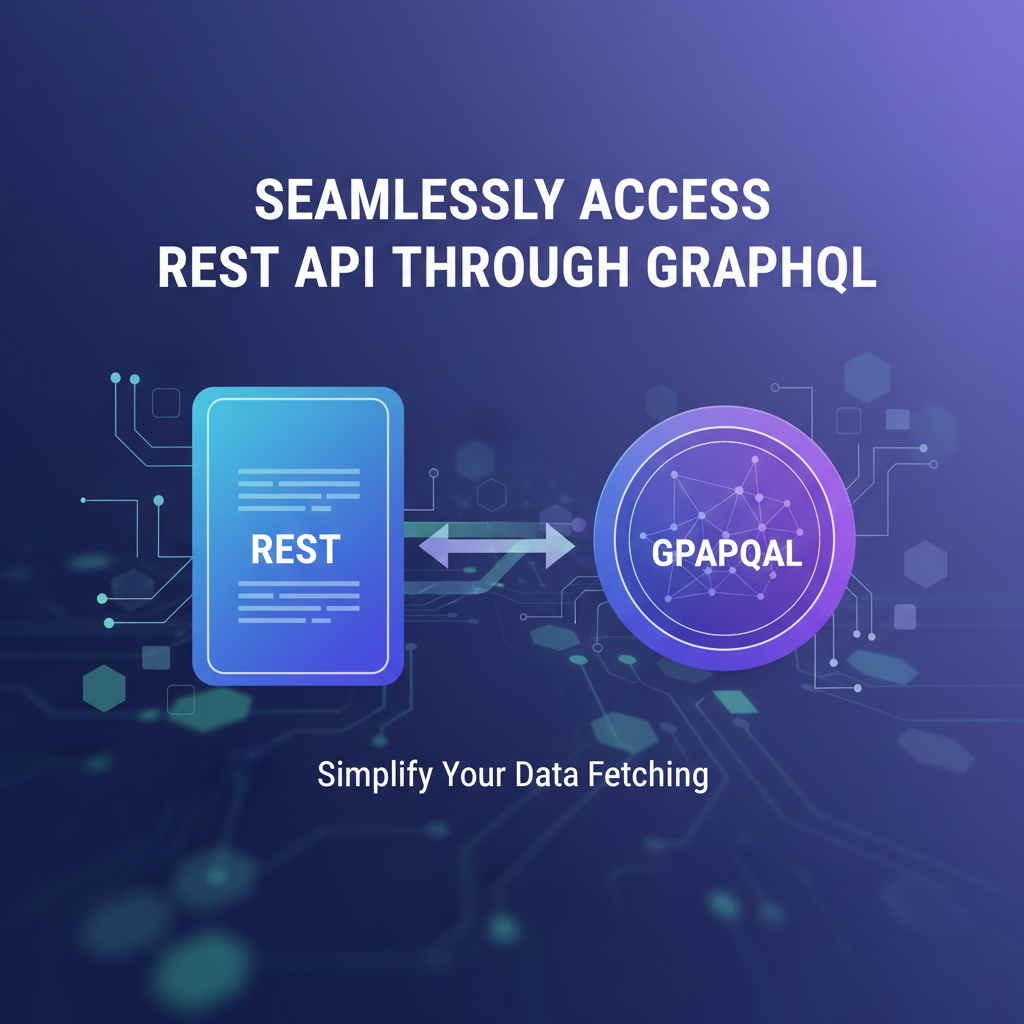


In the sprawling landscape of modern software development, Application Programming Interfaces (APIs) serve as the fundamental connective tissue, enabling disparate systems to communicate, share data, and collaborate. For over a decade, REST (Representational State Transfer) APIs have reigned supreme, becoming the de facto standard for building web services due to their simplicity, statelessness, and reliance on standard HTTP methods. They power everything from mobile applications to enterprise integrations, forming the backbone of the digital economy. However, as applications have grown increasingly complex, demanding more dynamic data interactions and catering to diverse client needs, the inherent patterns of REST, while robust, have begun to exhibit certain limitations that can hinder developer productivity and application performance.
The rise of single-page applications, microservices architectures, and data-intensive client experiences has highlighted challenges such as over-fetching (receiving more data than needed), under-fetching (requiring multiple requests to gather all necessary data), and the inflexibility of fixed endpoint structures. Developers frequently find themselves navigating a labyrinth of endpoints, piecing together information from various sources, and often contending with versioning headaches. It is against this backdrop that GraphQL emerged, offering a powerful and elegant alternative for API interaction. As a query language for your API and a runtime for fulfilling those queries, GraphQL empowers clients to request precisely the data they need, nothing more, nothing less, through a single, unified endpoint.
The intriguing proposition, then, is not necessarily to abandon the vast investment in existing RESTful infrastructure, but rather to strategically leverage it by introducing GraphQL as a flexible, client-centric access layer. This comprehensive guide delves deep into the architectural strategies, benefits, challenges, and best practices for seamlessly accessing existing REST APIs through GraphQL. We will explore how this hybrid approach can unlock significant efficiencies, enhance developer experience, and future-proof your API strategy, all while safeguarding your current technological investments. We will also examine the pivotal role that an api gateway plays in orchestrating such a sophisticated integration, providing crucial management, security, and performance optimizations across the entire API ecosystem.
Understanding REST APIs: The Ubiquitous Foundation
To truly appreciate the value of integrating GraphQL, it's essential to first establish a thorough understanding of REST APIs, their architectural principles, strengths, and the specific pain points they introduce in contemporary development scenarios. REST, an architectural style rather than a protocol, was conceptualized by Roy Fielding in his 2000 doctoral dissertation. It emphasizes a stateless, client-server interaction model, relying on standard HTTP methods (GET, POST, PUT, DELETE) to manipulate resources identified by URLs.
Core Principles of REST
At its heart, REST adheres to several fundamental architectural constraints that dictate how web services should be designed:
- Client-Server Architecture: This principle dictates a clear separation of concerns between the client and the server. The client is responsible for the user interface and user experience, while the server manages data storage and business logic. This separation allows for independent evolution of both components, improving portability across platforms and scalability.
- Statelessness: Each request from client to server must contain all the information necessary to understand the request. The server should not store any client context between requests. This means that every request is self-contained and independent, making the system more reliable, easier to scale, and more visible in its interactions.
- Cacheability: Clients and intermediaries can cache responses. This means that responses must explicitly or implicitly define themselves as cacheable or non-cacheable to prevent clients from reusing stale or inappropriate data. Caching significantly improves performance and reduces server load, especially for frequently accessed resources.
- Uniform Interface: This is perhaps the most crucial constraint, defining how clients interact with resources. It consists of four sub-constraints:
- Resource Identification in Requests: Individual resources are identified in requests, for example, using URIs.
- Resource Manipulation Through Representations: Clients manipulate resources using representations, which could be JSON, XML, HTML, etc. The state of a resource is contained in these representations.
- Self-Descriptive Messages: Each message includes enough information to describe how to process the message. For example, the
Content-Typeheader tells the client how to parse the message body. - Hypermedia as the Engine of Application State (HATEOAS): The client interacts with a REST server entirely through hypermedia provided dynamically by the server. This means that a client needs very little prior knowledge about the API beyond the initial URI. While technically a core constraint, HATEOAS is often the least implemented aspect of "RESTful" APIs in practice.
- Layered System: A client cannot ordinarily tell whether it is connected directly to the end server or to an intermediary along the way. Intermediary servers (like proxies, load balancers, or API gateways) can be introduced to enhance scalability, security, and reliability without affecting the client or the backend server.
- Code-on-Demand (Optional): Servers can temporarily extend or customize the functionality of a client by transferring executable code (e.g., JavaScript applets). This constraint is optional and less commonly utilized in typical REST API designs.
Strengths of REST APIs
The widespread adoption of REST is a testament to its significant advantages:
- Simplicity and Familiarity: REST's reliance on standard HTTP methods and URLs makes it incredibly intuitive for developers. The concepts are easy to grasp, leading to a shallow learning curve for new teams.
- Wide Adoption and Tooling: An enormous ecosystem of tools, libraries, frameworks, and documentation exists for building and consuming REST APIs across virtually every programming language and platform. This maturity fosters rapid development and robust support.
- Cacheability: The stateless nature and clear identification of resources inherent in REST make it highly amenable to caching, which can drastically improve performance and reduce server load for reads.
- Scalability: The statelessness of servers means that requests can be routed to any available server instance without losing context, making horizontal scaling straightforward. The layered system also allows for the easy introduction of load balancers and API gateways to distribute traffic effectively.
- Flexibility in Data Formats: REST is agnostic to data format, allowing for JSON, XML, plain text, or any other suitable representation, giving developers freedom to choose based on client needs.
Limitations and Challenges of Traditional REST
Despite its enduring popularity, the fixed-resource model of REST begins to show its age when confronted with the dynamic data requirements of modern applications, particularly in mobile and complex web interfaces.
- Over-fetching: This occurs when a client receives more data than it actually needs. For instance, an endpoint
GET /users/{id}might return a user's entire profile (name, email, address, phone, preferences, etc.), but a mobile app displaying a list of users might only need theiridandname. This leads to unnecessary network traffic, increased parsing overhead, and slower application performance, especially on bandwidth-constrained devices. - Under-fetching and Multiple Round Trips: Conversely, under-fetching happens when a single REST endpoint doesn't provide enough data, forcing the client to make additional requests. Consider fetching a list of blog posts and then needing to fetch the author details for each post, and then comments for each post. This could result in an
N+1query problem, whereNrequests are made in addition to the initial one, significantly increasing latency due to multiple round trips between the client and server. Each additional HTTP request incurs overhead (DNS lookup, TCP handshake, TLS negotiation, request/response headers), which collectively degrades user experience. - Endpoint Proliferation and Inflexibility: As applications evolve and new data requirements emerge, developers often create new, highly specific REST endpoints (e.g.,
/users/{id}/orders,/users/{id}/addresses). This can lead to an explosion of endpoints, making the API harder to document, understand, and maintain. The fixed nature of these endpoints means clients have little control over the data structure they receive. - Versioning Complexities: Managing changes to REST APIs often involves versioning (e.g.,
/v1/users,/v2/users). While necessary to prevent breaking existing clients, versioning can be cumbersome, requiring clients to update their integrations and potentially leading to multiple versions of the API coexisting, increasing maintenance burden for the backend. - Discovery Challenges: Although tools like Swagger/OpenAPI try to address this, discovering what data is available and how to query it effectively can still be a hurdle for new developers consuming a REST API, especially one without comprehensive documentation. The lack of a strong type system at the API level means that data contracts are often implicitly defined or rely heavily on external documentation.
These limitations, while not insurmountable, often necessitate complex client-side data orchestration or the creation of bespoke "Backend-for-Frontend" (BFF) layers purely to address data fetching inefficiencies. This is precisely where GraphQL offers a compelling alternative or, more accurately, a powerful complementary solution.
Introducing GraphQL: A Paradigm Shift in API Interaction
GraphQL, developed internally by Facebook in 2012 and open-sourced in 2015, fundamentally redefines how clients interact with APIs. Instead of predefined endpoints that return fixed data structures, GraphQL allows clients to declare exactly what data they need, and the server responds with precisely that data in a single request. This paradigm shift empowers client developers, providing them with unprecedented flexibility and efficiency in data consumption.
What is GraphQL?
GraphQL is often described as three things:
- A Query Language for Your API: It's a powerful, declarative language that clients use to describe their data requirements.
- A Runtime for Fulfilling Those Queries: The GraphQL server receives the client's query, understands its structure, and executes the necessary logic (resolvers) to fetch the requested data from various sources.
- A Type System: GraphQL uses a strong type system to define the capabilities of an API. This schema acts as a contract between the client and the server, ensuring data consistency and providing self-documentation.
Key Concepts of GraphQL
Understanding GraphQL involves familiarizing oneself with its core building blocks:
- Schema Definition Language (SDL): At the heart of every GraphQL API is its schema, written using SDL. The schema defines all the types, fields, and relationships that clients can query. It acts as a blueprint, describing the entire data graph that the API exposes.
- Types: Define the structure of objects in your API (e.g.,
User,Product,Order). - Fields: Properties of a type (e.g.,
Userhasid,name,email). Fields can also be objects themselves, allowing for nested data. - Arguments: Fields can take arguments, allowing clients to pass parameters to queries (e.g.,
user(id: "123")).
- Types: Define the structure of objects in your API (e.g.,
- Queries: These are requests for data. Clients specify the types and fields they want, and the GraphQL server responds with a JSON object mirroring the shape of the query.
graphql query GetUserProfile { user(id: "456") { name email orders { id totalAmount } } }This query asks for the name and email of a specific user, along with the IDs and total amounts of their orders, all in a single request. - Mutations: While queries fetch data, mutations are used to modify data on the server. They follow a similar structure to queries but are explicitly declared as
mutationoperations. This separation clarifies whether an operation is intended to read or write data.graphql mutation CreateProduct($name: String!, $price: Float!) { createProduct(name: $name, price: $price) { id name price } }This mutation creates a new product and returns its ID, name, and price. Variables ($name,$price) are passed separately for security and reusability. - Subscriptions: For real-time functionality, GraphQL offers subscriptions. Clients can subscribe to specific events, and the server will push data to them whenever those events occur (e.g., new message notifications, live data updates).
- Resolvers: These are the functions on the GraphQL server that are responsible for fetching the data for a specific field in the schema. When a query comes in, the GraphQL engine traverses the schema, calling the appropriate resolvers to gather the requested data from underlying data sources (databases, microservices, or crucially for this article, existing REST APIs).
How GraphQL Addresses REST's Limitations
GraphQL directly tackles many of the inefficiencies inherent in traditional REST API designs:
- Exact Data Fetching (No Over-fetching or Under-fetching): This is the most celebrated benefit. Clients dictate precisely which fields they need, eliminating the problem of receiving unwanted data (over-fetching) or having to make multiple subsequent requests (under-fetching). A single request can fetch a complex graph of related data, drastically reducing network round trips.
- Single Endpoint for All Requests: Unlike REST, which typically has many endpoints for different resources, a GraphQL API usually exposes a single endpoint (e.g.,
/graphql). All queries and mutations are sent to this one endpoint, simplifying client configuration and routing. The GraphQL server then uses the query's structure to determine what data to fetch. - Strongly Typed Schema for Self-Documentation and Validation: The GraphQL schema acts as an explicit contract between client and server. It defines all available data, their types, and relationships. This strong typing provides powerful benefits:
- Self-documentation: Developers can explore the API's capabilities using tools like GraphiQL or Apollo Studio, which generate documentation directly from the schema.
- Client-side Validation: Clients can validate their queries against the schema before sending them, catching errors early.
- Server-side Validation: The server automatically validates incoming queries against the schema, ensuring that only valid requests are processed.
- Client-Driven Data Requirements: GraphQL shifts the responsibility of data shaping from the server to the client. This empowers client developers to evolve their data needs independently of backend changes, leading to faster iteration cycles and less coordination overhead between front-end and back-end teams.
- Simplified Aggregation of Disparate Data Sources: A single GraphQL query can transparently fetch data from multiple backend services or databases. The resolvers abstract away the complexity of data sourcing, presenting a unified data graph to the client. This is particularly powerful in microservices architectures.
Benefits for Developers
The advantages of GraphQL translate into tangible benefits for development teams:
- Improved Developer Experience (DX): The self-documenting nature, strong typing, and query flexibility make API consumption much more intuitive and enjoyable. Developers spend less time reading external documentation or trying to guess endpoint behaviors.
- Faster Iteration and Development Cycles: Clients can adapt to new data requirements without waiting for backend changes or new REST endpoints. This accelerates front-end development, allowing for quicker feature releases and experiments.
- Reduced Network Payload and Enhanced Performance: By fetching only the necessary data, GraphQL minimizes network traffic, which is critical for mobile applications or users on slow connections. Fewer round trips also lead to lower latency and a snappier user experience.
- API Evolution without Versioning: GraphQL's type system encourages additive changes. You can add new fields and types to your schema without breaking existing queries, largely mitigating the need for painful API versioning schemes typical in REST.
- Platform Agnostic: The GraphQL specification is independent of any programming language or platform, allowing for diverse client and server implementations.
In summary, GraphQL offers a powerful, efficient, and flexible approach to API design and consumption. While it presents a different paradigm from REST, its strengths are particularly relevant when dealing with complex, interconnected data graphs and the diverse data needs of modern client applications.
The Bridge: Why Integrate GraphQL with Existing REST APIs?
While GraphQL offers compelling advantages, the reality for most organizations is that they already have significant investments in existing RESTful APIs. These APIs are often mature, stable, well-documented, and form the backbone of numerous applications. Migrating an entire backend infrastructure from REST to GraphQL is a monumental task, fraught with risks, high costs, and considerable development effort. It's rarely a practical or necessary first step.
This is where the concept of integrating GraphQL with existing REST APIs becomes not just appealing, but a strategically intelligent approach. Instead of a wholesale replacement, organizations can adopt GraphQL incrementally, leveraging its strengths where they matter most, without disrupting their established backend services.
The Reality of Brownfield Environments
Most development environments are "brownfield," meaning they involve working with existing systems, legacy code, and established architectural patterns. A "greenfield" (starting from scratch) opportunity is rare. In a brownfield scenario, a complete API overhaul to GraphQL would entail:
- Massive Refactoring: Rewriting significant portions of backend services to expose GraphQL natively.
- Client Migration: Updating all existing clients (web, mobile, third-party integrations) to consume the new GraphQL API. This is a coordination nightmare.
- Increased Risk: Introducing a new technology stack and making widespread changes increases the risk of regressions, downtime, and unexpected behavior.
- Resource Drain: Diverting significant development resources from feature development to infrastructure migration.
For these reasons, a pragmatic approach is to build a GraphQL layer on top of existing REST APIs. This allows organizations to introduce the benefits of GraphQL incrementally, proving its value before committing to deeper backend changes.
Strategic Advantages of a Hybrid Approach
Integrating GraphQL as a facade over REST APIs offers a compelling blend of benefits, combining the best of both worlds:
- Preserve Existing Investments: The most significant advantage is the ability to retain and continue to utilize your stable, well-tested REST APIs. There's no need for an expensive, risky, and time-consuming backend rewrite. Your existing microservices, legacy systems, and third-party integrations can continue to operate as they always have.
- Incremental Adoption: This hybrid model allows for a phased rollout of GraphQL. You can start by exposing a limited set of REST APIs through GraphQL for a new client application, gather feedback, and gradually expand the GraphQL layer. This de-risks the adoption process and allows teams to learn and adapt.
- Improved Client Experience without Backend Rewrite: Front-end developers gain immediate access to GraphQL's power – precise data fetching, fewer round trips, and a unified API surface – without requiring any modifications to the underlying backend services. This accelerates front-end development cycles and improves application performance from the client's perspective.
- Consolidation of Disparate REST Services: Many organizations have a multitude of REST APIs developed by different teams or acquired through mergers. These APIs often have inconsistent naming conventions, authentication mechanisms, and data structures. A GraphQL layer can act as a unifying abstraction, consolidating these disparate services into a single, coherent, and strongly typed data graph for client consumption. This simplifies client-side data orchestration immensely.
- Future-Proofing Your API Strategy: By introducing GraphQL, you're preparing your API ecosystem for future demands. As client applications become even more data-intensive and dynamic, a GraphQL layer positions you to easily adapt without major architectural overhauls. It also allows for a smoother transition to native GraphQL microservices should that become a strategic imperative down the line.
- Enhanced API Discovery and Documentation: Even for existing REST APIs, wrapping them with GraphQL can significantly improve their discoverability and documentation. The GraphQL schema automatically serves as live, up-to-date documentation that clients can introspect, reducing reliance on external, potentially outdated, markdown files.
- Specialized Backends for Frontends (BFF): This pattern, where a GraphQL server acts as a BFF, is particularly effective. It allows you to tailor the API specifically for a particular client application (e.g., a mobile app vs. a web dashboard), aggregating and transforming data from various REST sources to meet that client's unique needs.
In essence, building a GraphQL layer over REST APIs is a pragmatic, low-risk, high-reward strategy for organizations looking to modernize their API landscape. It allows them to embrace the developer experience and performance benefits of GraphQL while protecting their substantial investments in existing RESTful infrastructure. This approach offers a clear pathway to unlocking new efficiencies and capabilities without the disruption of a full-scale migration.
Strategies for Seamlessly Accessing REST APIs Through GraphQL
Implementing a GraphQL layer on top of existing REST APIs can take several forms, each with its own architectural nuances, benefits, and trade-offs. The choice of strategy often depends on the scale of your API landscape, the autonomy of your development teams, and your appetite for complexity.
Strategy 1: The GraphQL Gateway / Proxy (Backend-for-Frontend - BFF Pattern)
This is perhaps the most common and straightforward approach for integrating GraphQL with existing REST APIs. In this model, a dedicated GraphQL server acts as a proxy or gateway, sitting in front of one or more RESTful services.
- Explanation: The GraphQL server exposes a single GraphQL endpoint to client applications. When a client sends a GraphQL query, the GraphQL server (the "gateway") receives it. Inside the server, specific resolver functions are configured to translate parts of the GraphQL query into calls to the underlying REST APIs. The GraphQL server then aggregates the responses from the REST services, shapes them according to the GraphQL schema, and sends a single, unified JSON response back to the client. This pattern is often closely associated with the Backend-for-Frontend (BFF) pattern, where the GraphQL gateway is specifically designed to serve the needs of a particular client type (e.g., a mobile application or a web SPA).
- How it works:
- Client sends a GraphQL query to the GraphQL Gateway.
- The GraphQL Gateway parses the query and identifies the requested fields.
- For each field, the corresponding resolver function is invoked.
- These resolvers make HTTP requests to one or more backend REST APIs (e.g.,
UserService.getUser(id),ProductService.getProducts(userId)). - The REST API responses are received by the resolvers.
- The resolvers transform and combine the data from REST responses into the shape defined by the GraphQL schema.
- The GraphQL Gateway compiles the resolved data into a single JSON response and sends it back to the client.
- Pros:
- Minimal Changes to Existing REST Services: The backend REST APIs remain untouched, preserving their stability and avoiding any need for refactoring.
- Ideal for Aggregation: Excellently suited for consolidating data from multiple disparate REST services into a single, coherent view for the client.
- Client-Specific APIs (BFF): Allows the GraphQL schema to be tailored precisely to the needs of a specific client, optimizing performance and development for that particular application.
- Incremental Adoption: New client applications can immediately benefit from GraphQL without migrating existing ones.
- Cons:
- Adds an Extra Layer: Introduces an additional hop in the request-response cycle, potentially adding a slight amount of latency.
- Resolver Maintenance: Requires writing and maintaining resolver logic to map GraphQL fields to REST API calls, which can become complex for very large schemas.
- Potential for N+1 Problem: If not carefully implemented with data loaders or batching, resolvers fetching related data from REST APIs can lead to the N+1 problem (e.g., fetching a list of users, then making a separate REST call for each user's details).
- Example Scenario: An e-commerce platform where customer data lives in a
CustomerService(REST), product catalog in aProductService(REST), and order history in anOrderService(REST). A GraphQL gateway can expose a unified schema where a query forcustomer(id: "123") { name, email, orders { id, total, products { name } } }transparently calls all three underlying REST services, aggregates the data, and returns it to the client.
Strategy 2: Schema Stitching / Federation
This strategy is employed when you have multiple GraphQL services (or even other REST APIs that you want to represent as "subgraphs") and you want to combine them into a single, unified data graph. It's particularly relevant in larger organizations with multiple independent teams managing different domains.
- Explanation: Instead of a single monolithic GraphQL server handling all resolvers, schema stitching or federation allows you to combine multiple GraphQL schemas (each potentially backed by REST APIs, databases, or other data sources) into a single, public-facing "supergraph" or "gateway" schema. Clients then query this unified schema, and the gateway intelligently routes parts of the query to the correct underlying GraphQL "subgraph" or service.
- Schema Stitching (Older Approach): This involves programmatically merging separate GraphQL schemas into one. The gateway needs to understand how types from different schemas relate to each other and might require manual effort to resolve conflicts or combine fields. It can become complex to manage as the number of subgraphs grows.
- Apollo Federation (Modern, Declarative Approach): Apollo Federation is a more advanced and widely adopted solution for building distributed GraphQL architectures. It uses a declarative approach where each microservice (or "subgraph") defines its own GraphQL schema, along with directives (
@key,@extends,@requires) that specify how its types relate to types in other subgraphs. A central "gateway" service (often built with Apollo Gateway) then dynamically composes these subgraphs into a unified supergraph. The gateway understands how to split incoming queries and distribute them to the appropriate subgraphs, and then stitch the results back together. - How it works (Federation):
- Each microservice (subgraph) exposes its own GraphQL endpoint, defining its types and how they relate to other subgraphs using Federation directives. Crucially, some of these subgraphs can have resolvers that call REST APIs internally.
- A central Federation Gateway ingests the schemas from all subgraphs.
- When a client sends a query to the Federation Gateway, the gateway analyzes the query plan.
- It breaks down the query into sub-queries that can be fulfilled by individual subgraphs.
- It executes these sub-queries in parallel or sequence, as needed, coordinating data between subgraphs (e.g., fetching a user ID from one subgraph, then using that ID to fetch orders from another).
- The gateway stitches the results back into a single response for the client.
- Pros:
- Decentralized Development: Teams can develop and deploy their GraphQL services (subgraphs) independently, fostering autonomy and scalability in large organizations.
- Unified Client Experience: Clients still interact with a single, unified API, simplifying consumption despite a distributed backend.
- Scalability and Resilience: Failures in one subgraph are less likely to impact the entire supergraph.
- Maintains Autonomy of Subgraphs: Each team owns its domain and its API, preventing tightly coupled monolithic GraphQL servers.
- Excellent for Brownfield: Subgraphs can easily be built on top of existing REST services, databases, or even other legacy systems.
- Cons:
- Higher Complexity: Setting up and managing a federated architecture is more complex than a simple GraphQL gateway. It requires specific tooling and a deeper understanding of distributed systems.
- Increased Learning Curve: Teams need to learn Federation-specific concepts and directives.
- Performance Considerations: While often optimized, the gateway needs to coordinate multiple network calls to subgraphs, which must be managed efficiently to avoid latency.
Strategy 3: Microservices with GraphQL Interfaces
In this approach, rather than a single overarching GraphQL gateway, each microservice in your architecture exposes its own GraphQL endpoint. While this differs from the aggregation approaches above, it's a valid strategy when a service's domain is self-contained and benefits from the GraphQL interface.
- Explanation: Each microservice, instead of (or in addition to) exposing a REST API, exposes a GraphQL API for its specific domain. Internally, this microservice's GraphQL resolvers might still be making calls to other REST APIs, databases, or even other GraphQL services. This means a service might have an internal REST client to talk to other services but exposes GraphQL to its own clients.
- Pros:
- Encapsulation and Service Autonomy: Each microservice fully owns its data and its API contract.
- Fine-grained Control: Teams have complete control over their service's GraphQL schema and resolvers.
- Flexibility: Allows for diverse implementation choices for different services.
- Cons:
- Client Burden: If not combined with a higher-level gateway or federation, clients might have to query multiple GraphQL endpoints to gather all necessary data, negating some of GraphQL's core benefits.
- Potential for Duplication: If multiple services need similar data, there might be redundant data fetching or schema definitions.
- No Unified Schema: Without a gateway/federation, there is no single "API" for the client to interact with.
Strategy 4: Code Generation/Automatic Wrappers
This strategy involves using tools that can automatically generate a GraphQL schema and resolvers directly from existing API definitions, such as OpenAPI/Swagger specifications for REST APIs.
- Explanation: Specialized libraries or tools parse an OpenAPI specification (which describes your REST API's endpoints, request/response bodies, parameters, etc.) and automatically generate a corresponding GraphQL schema and the necessary resolver code. These generated resolvers handle the logic of making HTTP requests to the REST endpoints based on the GraphQL query structure.
- Pros:
- Speed and Consistency: Rapidly generates a GraphQL layer, significantly reducing manual boilerplate code.
- Reduced Manual Effort: Minimizes the need for developers to write resolvers from scratch for every REST endpoint.
- Always Up-to-Date: If your OpenAPI spec is kept current, the generated GraphQL schema can also stay current with minimal intervention.
- Cons:
- Less Flexibility for Custom Logic: Generated resolvers are often generic. If you need complex data transformations, custom authentication logic, or sophisticated error handling beyond simple passthrough, you might need to manually extend or modify the generated code, which can become challenging.
- Potential for Less Optimized Queries: Automatic generation might not always produce the most optimized queries, potentially leading to N+1 problems or inefficient data fetching if not configured correctly.
- Reliance on Spec Quality: The quality of the generated GraphQL API is directly dependent on the completeness and accuracy of the underlying OpenAPI specification.
Choosing the right strategy depends heavily on your organization's specific context. For many, starting with a simple GraphQL Gateway (BFF pattern) provides immediate benefits with manageable complexity. As the architecture scales and more teams adopt GraphQL, transitioning to a federated approach might become more appropriate. Regardless of the chosen path, a well-defined architecture, careful planning, and strategic tooling are paramount to success.
The Indispensable Role of an API Gateway in a Hybrid Architecture
In any modern distributed system, particularly one that involves a blend of architectural styles like REST and GraphQL, an API Gateway transforms from a mere convenience into an indispensable component. It acts as the single point of entry for all client requests, serving as a powerful intermediary between the clients and the various backend services. For an architecture seamlessly accessing REST APIs through GraphQL, the api gateway plays multiple critical roles, providing a centralized control plane for cross-cutting concerns that would otherwise be duplicated across numerous services.
What is an API Gateway?
An API Gateway is a server that acts as an API front-end, or a single entry point, for multiple backend services. It centralizes common API management functions that typically span across all APIs, regardless of their underlying implementation or protocol. Think of it as a bouncer, traffic controller, and security guard all rolled into one, standing at the entrance to your service landscape.
Core Functions Relevant to GraphQL-over-REST
An effective API Gateway provides a suite of functionalities crucial for the robust operation, security, and performance of any API ecosystem, and especially pertinent when combining REST and GraphQL:
- Traffic Management (Routing, Load Balancing, Throttling):
- Routing: Directs incoming requests to the appropriate backend service, whether it's a traditional REST endpoint or a GraphQL server. This is vital in a hybrid architecture where clients might interact with different protocol endpoints.
- Load Balancing: Distributes incoming API traffic across multiple instances of backend services to ensure high availability and optimal performance.
- Throttling/Rate Limiting: Protects backend services from being overwhelmed by too many requests, preventing denial-of-service attacks and ensuring fair usage among consumers. This can be applied globally, per user, or per API.
- Security (Authentication, Authorization, TLS Termination):
- Authentication: Verifies the identity of the client making the request (e.g., using API keys, JWTs, OAuth tokens). The API Gateway can offload this responsibility from individual services.
- Authorization: Determines whether an authenticated client has permission to access a specific resource or perform a particular action.
- TLS Termination: Handles SSL/TLS encryption and decryption, allowing backend services to operate on plain HTTP internally, simplifying their configuration and reducing their computational load.
- Firewalling: Can incorporate Web Application Firewall (WAF) capabilities to protect against common web vulnerabilities.
- Monitoring and Analytics:
- Centralized Logging: Captures detailed logs of all API requests and responses passing through it, providing a single source of truth for auditing and debugging.
- Metrics and Analytics: Collects performance metrics (latency, error rates, request counts) across all APIs, offering a holistic view of API usage and health. This data is invaluable for capacity planning and troubleshooting.
- Caching:
- The API Gateway can cache responses from backend services. For frequently accessed, immutable data, caching at the gateway level significantly reduces the load on backend services and improves response times for clients, irrespective of whether the client queried a REST or GraphQL endpoint.
- Transformation (Request/Response):
- Can modify incoming requests or outgoing responses. This includes translating headers, rewriting URLs, or even transforming data payloads (though for GraphQL, the GraphQL server itself does most of this). In a hybrid setup, it might normalize request parameters before forwarding to a REST service or add specific headers before sending to a GraphQL server.
- Versioning:
- Helps manage different versions of an API, directing traffic to the correct backend service based on version indicators in the request (e.g., URL path, header). This is particularly useful when deprecating old REST APIs or introducing new GraphQL versions.
- Protocol Translation:
- While a GraphQL layer itself performs protocol translation (GraphQL to REST calls internally), an API Gateway can also perform simpler protocol mappings, e.g., converting a legacy SOAP request into a REST call, or even acting as the entry point for both your GraphQL API and traditional REST APIs, making the choice transparent to the client.
How an API Gateway Enhances the GraphQL-over-REST Approach
In the specific context of using GraphQL to access REST APIs, an API Gateway provides immense value:
- Simplifies Client Access: Clients only need to know the single entry point (the api gateway) to access your entire API ecosystem. The gateway then intelligently routes requests to either your GraphQL server (which then talks to REST) or directly to other REST services. This provides a unified external interface.
- Applies Cross-Cutting Concerns Uniformly: Security, rate limiting, logging, and monitoring can be applied consistently across all APIs – your core REST services and your new GraphQL facade – at a single point. This avoids redundant implementation in each service and ensures a robust security posture.
- Provides a Layer of Abstraction: The API Gateway shields clients from the internal complexities of your backend architecture. Clients don't need to know which services are REST, which are GraphQL, or how they are deployed. This allows for internal architectural changes without impacting client integrations.
- Enables Hybrid Environments Seamlessly: A robust gateway is crucial for managing environments where some services are still purely REST, others are native GraphQL, and others are REST-backed GraphQL. It acts as the central orchestrator, ensuring smooth communication across all these different API types.
- Enhanced Observability: By routing all traffic through the gateway, you get a complete picture of your API landscape's health, performance, and usage patterns from a single dashboard. This is critical for diagnosing issues that might span multiple services or API protocols.
APIPark: Empowering Your Hybrid API Landscape
In this complex and dynamic API environment, choosing the right API Gateway and management platform is paramount. APIPark stands out as an open-source AI gateway and API management platform designed to help developers and enterprises manage, integrate, and deploy AI and REST services with ease. Its capabilities extend naturally to supporting a sophisticated GraphQL-over-REST architecture.
Imagine a scenario where your existing REST APIs are serving fundamental data, but you're also integrating new AI models via APIPark's quick integration feature. You can then use APIPark's prompt encapsulation into REST API to expose AI functionalities as standard REST endpoints. Now, to provide a unified, flexible interface for your client applications that want to consume both traditional business data and these new AI-driven capabilities, you build a GraphQL layer.
APIPark would sit in front of this entire setup. It can manage traffic routing to your GraphQL server, which then calls your existing REST services (and potentially the AI-encapsulated REST endpoints managed by APIPark). Here’s how APIPark specifically enhances such a hybrid architecture:
- Unified Management: Regardless of whether your endpoints are raw REST, REST-encapsulated AI models, or your GraphQL facade that sits atop them, APIPark provides a single pane of glass for management.
- Authentication and Cost Tracking: It centralizes authentication for all services behind it, ensuring consistent security policies. For AI-driven services, it offers robust cost tracking capabilities.
- End-to-End API Lifecycle Management: APIPark assists with managing the entire lifecycle of APIs, from design and publication to invocation and decommissioning. This is vital for regulating API management processes, managing traffic forwarding, load balancing, and versioning, regardless of the API protocol. This means your GraphQL API, and the REST APIs it consumes, can all be governed under one platform.
- Performance and Scalability: With performance rivaling Nginx (achieving over 20,000 TPS with modest hardware), APIPark ensures your API gateway can handle large-scale traffic, supporting cluster deployment to prevent bottlenecks for both your REST and GraphQL traffic.
- Detailed API Call Logging and Data Analysis: APIPark provides comprehensive logging for every API call and powerful data analysis tools. This is invaluable for monitoring the performance of your GraphQL resolvers' calls to underlying REST APIs, troubleshooting any issues, and gaining insights into API usage patterns across your entire hybrid landscape.
By leveraging a powerful platform like APIPark, enterprises can ensure their complex, hybrid API ecosystems – spanning traditional REST, AI-driven APIs, and modern GraphQL facades – are managed securely, efficiently, and with optimal performance, greatly simplifying the architectural and operational challenges. The ability to deploy APIPark quickly, in just 5 minutes with a single command, makes it an attractive solution for developers looking to rapidly enhance their API governance.
APIPark is a high-performance AI gateway that allows you to securely access the most comprehensive LLM APIs globally on the APIPark platform, including OpenAI, Anthropic, Mistral, Llama2, Google Gemini, and more.Try APIPark now! 👇👇👇
Implementation Deep Dive: Building a GraphQL Layer Over REST
Building a GraphQL layer over existing REST APIs is a practical, step-by-step process that combines schema design with resolver implementation. This section will walk through the conceptual steps, highlighting key considerations and potential challenges.
Step-by-Step Implementation (Conceptual)
Let's assume we have a few REST APIs: * UserService at https://api.example.com/v1/users/{id} (returns user details) * ProductService at https://api.example.com/v1/products/{id} (returns product details) * OrderService at https://api.example.com/v1/users/{userId}/orders (returns orders for a user)
Our goal is to create a GraphQL API that allows clients to fetch a user, their orders, and the products within those orders in a single query.
- Identify Target REST APIs and Their Data Structures:
- Begin by thoroughly understanding the existing REST APIs. What data do they return? What are their endpoints? What parameters do they accept?
- Example:
GET /v1/users/{id}->{ "id": "U1", "name": "Alice", "email": "alice@example.com" }GET /v1/products/{id}->{ "id": "P1", "name": "Laptop", "price": 1200.00 }GET /v1/users/{userId}/orders->[ { "id": "O1", "userId": "U1", "total": 1500.00, "items": [ { "productId": "P1", "quantity": 1 } ] } ]
- Define the GraphQL Schema:```graphql type User { id: ID! name: String! email: String orders: [Order!] # A list of orders associated with the user }type Product { id: ID! name: String! price: Float! }type OrderItem { productId: ID! quantity: Int! product: Product # Resolve product details for each item }type Order { id: ID! userId: ID! total: Float! items: [OrderItem!]! user: User # Link back to the user who placed the order (optional for this example's query) }type Query { user(id: ID!): User product(id: ID!): Product ordersByUser(userId: ID!): [Order!] } ```
- This is the most critical step. Design a GraphQL schema that represents the desired client view of the data, abstracting away the underlying REST structure. Focus on how clients will logically consume the data, not how it's stored in REST.
- Define types that mirror your domain entities.
- Define query types that allow clients to start fetching data.
- Example Schema (using GraphQL SDL):
- Implement Resolvers:
javascript // Assuming a setup with Apollo Server or similar const resolvers = { Query: { user: async (parent, { id }, context) => { // Resolve Query.user by calling UserService REST API const response = await context.dataSources.userService.getUserById(id); return response; // REST API response maps directly to User type }, product: async (parent, { id }, context) => { // Resolve Query.product by calling ProductService REST API const response = await context.dataSources.productService.getProductById(id); return response; // REST API response maps directly to Product type }, }, User: { orders: async (parent, args, context) => { // 'parent' here is the User object returned by the 'Query.user' resolver // Resolve User.orders by calling OrderService REST API with parent.id const response = await context.dataSources.orderService.getOrdersByUserId(parent.id); return response; // REST API response maps directly to [Order!] type }, }, OrderItem: { product: async (parent, args, context) => { // 'parent' here is an OrderItem object // Resolve OrderItem.product by calling ProductService REST API with parent.productId // This is where DataLoader is crucial to prevent N+1 if many order items exist! const response = await context.dataSources.productService.getProductById(parent.productId); return response; }, }, };- For each field in your GraphQL schema that needs data, you must write a resolver function. A resolver is a function that tells the GraphQL server how to fetch the data for a particular field. This is where the integration with REST APIs happens.
- Resolvers typically take four arguments:
(parent, args, context, info).parent: The result of the parent field.args: Arguments provided in the GraphQL query for the current field.context: An object shared across all resolvers in a single request (e.g., for authentication tokens, shared data loaders).info: An object containing information about the execution state, including the AST of the query.
- Inside the resolver, you'll make HTTP requests to the corresponding REST API using a client library (e.g.,
axios,fetch). - Example Resolver Snippets (using a hypothetical JavaScript/Node.js server):
- Choose a GraphQL Server Framework:
- Select a GraphQL server implementation for your chosen programming language. Popular choices include:
- JavaScript/Node.js: Apollo Server, Express-GraphQL, NestJS with GraphQL module.
- Python: Graphene, Ariadne.
- Java: GraphQL-Java.
- Go: GraphQL-Go.
- These frameworks handle the HTTP server, parsing incoming GraphQL queries, validating them against the schema, and executing the resolvers.
- Select a GraphQL server implementation for your chosen programming language. Popular choices include:
- Deploy and Test:
- Deploy your GraphQL server.
- Use tools like GraphiQL, Apollo Studio, or Postman to test your GraphQL API. Send queries, mutations, and ensure they return the expected data by correctly interacting with your underlying REST APIs.
- Monitor network calls and performance carefully.
Key Considerations in Implementation
Successfully building a GraphQL layer over REST requires careful attention to several cross-cutting concerns:
- Authentication and Authorization:
- Client to GraphQL Server: Clients typically authenticate with the GraphQL server (e.g., by sending a JWT in an
Authorizationheader). - GraphQL Server to REST API: The GraphQL server then needs to forward appropriate authentication credentials to the underlying REST APIs. This might involve passing the client's original token, or the GraphQL server might use its own internal service account credentials to access the REST APIs. Context objects (
contextin resolver arguments) are ideal for passing authentication information down to resolvers and data sources. - Authorization: Implement authorization logic within your resolvers. Before fetching data from a REST API, a resolver should check if the authenticated user has permission to access that specific resource.
- Client to GraphQL Server: Clients typically authenticate with the GraphQL server (e.g., by sending a JWT in an
- Error Handling:
- REST APIs typically use HTTP status codes (4xx, 5xx) and often return custom error bodies.
- GraphQL, on the other hand, always returns a
200 OKstatus code for a valid request, even if errors occurred during data fetching. Errors are communicated within theerrorsarray in the GraphQL response body. - Your resolvers must catch errors from REST API calls (e.g., 404 Not Found, 500 Internal Server Error) and translate them into GraphQL-friendly error formats. This often involves throwing
ApolloErroror custom error classes that conform to the GraphQL error specification.
- Performance (The N+1 Problem and Batching):
- The N+1 problem is a major performance pitfall. If a GraphQL query requests a list of items, and then for each item, a related field requires a separate REST API call, this results in
Nadditional requests. - Solution: DataLoader: The
DataLoaderpattern (a utility provided by GraphQL.js) is the standard solution. It batches and caches requests to backend data sources.- It collects all requests for a specific resource (
getProductByIdfor various IDs) made within a single GraphQL query execution. - It then makes a single batch request to the underlying REST API (if the REST API supports batching or
GET /products?ids=P1,P2,P3). - It then distributes the results back to the individual resolvers.
- DataLoader also provides per-request caching, preventing duplicate calls for the same ID within a single query.
- It collects all requests for a specific resource (
- Caching: Beyond DataLoader, consider caching frequently accessed REST API responses (e.g., using Redis) within your GraphQL server or at the API Gateway level.
- The N+1 problem is a major performance pitfall. If a GraphQL query requests a list of items, and then for each item, a related field requires a separate REST API call, this results in
- Data Transformation:
- The data structure returned by a REST API might not perfectly match your GraphQL type definition.
- Your resolvers will need to perform data mapping or transformation to align the REST response with the GraphQL schema. This could involve renaming fields, combining fields, or splitting fields.
- Example: A REST API might return
firstNameandlastName, but your GraphQL schema might have a singlefullNamefield, requiring concatenation in the resolver.
- Tooling:
- GraphiQL/Apollo Studio: Essential for exploring, writing, and testing GraphQL queries. They provide an interactive in-browser IDE that introspects your schema.
- Postman/Insomnia: Can be used to send GraphQL requests (as
POSTrequests withapplication/jsonbody containing the query). - GraphQL Client Libraries: For client-side development, libraries like Apollo Client or Relay (for JavaScript/React) greatly simplify consuming GraphQL APIs, offering features like caching, state management, and optimistic UI updates.
Building a GraphQL layer over REST is more than just writing resolvers; it involves a holistic approach to API design, performance optimization, and robust error handling. When done correctly, it provides a powerful, flexible, and efficient API experience for client developers, significantly enhancing the overall application architecture.
Advanced Topics and Best Practices for GraphQL over REST
Beyond the foundational implementation, optimizing a GraphQL layer over REST involves addressing more advanced concerns related to performance, security, monitoring, and API evolution. Adhering to best practices in these areas ensures that your hybrid architecture is not only functional but also resilient, scalable, and maintainable.
Caching Strategies
Caching is paramount for performance in any API architecture, and it takes on multiple dimensions when integrating GraphQL with REST.
- Client-Side Caching (e.g., Apollo Client): GraphQL client libraries like Apollo Client come with sophisticated in-memory caches. They store normalized data, allowing subsequent queries for the same data to be served instantly from the cache, reducing network requests. This is often the first line of defense for performance.
- Server-Side Caching for REST Responses: Within your GraphQL server's resolvers, you can implement caching for responses from underlying REST APIs. If a particular REST endpoint returns data that changes infrequently, caching its response (e.g., using Redis or Memcached) can significantly reduce calls to the actual REST service. This is especially useful if multiple GraphQL queries or fields rely on the same REST data.
- DataLoader for Per-Request Caching and Batching: As discussed, DataLoader is crucial for preventing the N+1 problem. It effectively caches and batches requests for the same resource within a single GraphQL operation, ensuring that each unique resource ID is fetched only once from the backend REST API.
- API Gateway Caching: An API Gateway, such as APIPark, can also implement caching mechanisms. For responses that are identical for all clients and change rarely (e.g., static product catalogs), caching at the gateway level provides the fastest possible response and dramatically offloads both the GraphQL server and the backend REST services. This is a powerful optimization for read-heavy workloads.
Security Enhancements
Securing a GraphQL API that proxies REST services requires a multi-layered approach.
- Input Validation: Beyond GraphQL's schema validation, implement robust validation in your resolvers, especially for mutation arguments. Ensure that data passed to underlying REST APIs is clean and conforms to expected formats and business rules.
- Rate Limiting: Protect your GraphQL server and, by extension, your underlying REST APIs from abuse or excessive traffic.
- Implement rate limiting at the API Gateway level (e.g., using APIPark's capabilities) to protect against general traffic floods.
- Implement granular rate limiting within your GraphQL server, potentially based on query complexity or specific fields, to prevent expensive queries from overwhelming resources.
- Deep Query Cost Analysis: GraphQL queries can be arbitrarily deep and complex. Malicious or poorly designed queries could lead to resource exhaustion. Implement query cost analysis to:
- Calculate a "cost" for each incoming query based on its depth, number of fields, and expected data volume.
- Reject queries that exceed a predefined cost threshold.
- This is especially important when exposing a public GraphQL API.
- Authentication and Authorization:
- API Gateway (e.g., APIPark): Centralize authentication for all incoming requests. The gateway can validate tokens (JWTs, OAuth) and ensure only authenticated clients reach your GraphQL server.
- GraphQL Server: Within your resolvers, enforce fine-grained authorization logic. Check user roles and permissions before allowing access to specific fields or executing mutations. This ensures that even if a query is syntactically valid, the user is authorized to view or modify the requested data through the underlying REST APIs.
- Sensitive Data Handling: Ensure that sensitive data passed to or received from REST APIs is never inadvertently exposed through the GraphQL schema. Filter or mask data in resolvers as necessary based on user permissions.
Monitoring and Observability
A production-grade GraphQL over REST setup demands comprehensive monitoring to detect issues, understand performance, and troubleshoot effectively.
- Logging:
- API Gateway (e.g., APIPark): Centralized logging of all API requests and responses (including GraphQL queries) provides a crucial overview of traffic patterns and high-level errors.
- GraphQL Server: Log incoming GraphQL queries, the execution time of individual resolvers, errors occurring during resolver execution (especially from REST API calls), and the latency of calls to underlying REST services.
- Tracing:
- Implement distributed tracing (e.g., using OpenTelemetry, Jaeger, or Zipkin). This allows you to trace a single GraphQL request as it traverses through your GraphQL server, hits multiple resolvers, makes calls to various REST APIs, and receives responses. This end-to-end visibility is invaluable for pinpointing performance bottlenecks and understanding complex interactions.
- Metrics:
- Collect metrics such as query count, mutation count, error rates (per resolver, per REST API call), average resolver latency, and overall API response times.
- Use dashboards (e.g., Grafana, Prometheus) to visualize these metrics and set up alerts for anomalies.
- Error Reporting: Integrate with error monitoring services (e.g., Sentry, Bugsnag) to capture and report unhandled exceptions in your GraphQL server and resolvers, providing detailed stack traces and context.
Performance Optimization
Beyond caching and DataLoader, consider these optimizations:
- Persisted Queries: For static client queries, you can "persist" them on the server by associating a unique ID with each query. Clients then send the ID instead of the full query string. This reduces network payload, improves cacheability, and can offer a layer of security by only allowing known queries.
- Query Batching: Some GraphQL client libraries and servers support sending multiple independent GraphQL queries in a single HTTP request. While less powerful than a single complex query, it can reduce HTTP overhead compared to separate requests.
- HTTP/2: Ensure your API Gateway and GraphQL server support HTTP/2, which offers multiplexing (multiple requests/responses over a single TCP connection) and header compression, improving efficiency.
- Pre-fetching/Preloading: In some cases, based on anticipated user behavior, you might pre-fetch data to populate caches, making subsequent GraphQL queries faster.
Versioning and API Evolution
GraphQL's approach to API evolution is generally more graceful than REST's.
- Additive Changes in GraphQL: GraphQL encourages additive changes to its schema (adding new fields, types, or arguments) rather than removing or changing existing ones. This ensures backward compatibility for existing clients.
- Deprecating Fields: When a field needs to be removed or replaced, it can be marked as
@deprecatedin the schema. Tools like GraphiQL will warn developers, guiding them to new alternatives, without immediately breaking old clients. - Versioning REST APIs: If your underlying REST APIs have their own versioning (e.g.,
/v1,/v2), your GraphQL layer should be robust enough to handle these. A single GraphQL schema might need to interact with different versions of the same REST API depending on the data requirements, requiring careful mapping in resolvers. The API Gateway can help manage routing to these different REST API versions.
By meticulously addressing these advanced topics and best practices, organizations can build a resilient, high-performing, and secure GraphQL layer that seamlessly leverages their existing REST API investments, providing a superior experience for both developers and end-users. This strategic approach ensures that the benefits of GraphQL are realized without compromising the stability or scalability of the underlying infrastructure.
Real-World Use Cases and Success Stories
The strategy of building a GraphQL layer over existing REST APIs is not merely theoretical; it's a proven approach adopted by a multitude of organizations across various industries. These real-world applications underscore the tangible benefits, particularly for companies with extensive legacy systems or complex microservices landscapes.
Example: E-commerce Platforms Unifying Product and Order Data
Consider a large e-commerce company that has evolved over many years. Their backend architecture likely includes: * A legacy ProductService (perhaps an older REST API or even a SOAP service) managing product catalog information, inventory, and pricing. * A modern CustomerService (a newer REST microservice) handling user profiles, authentication, and preferences. * An OrderService (another REST microservice) responsible for order creation, tracking, and history. * A ShippingService, PaymentService, and various other specialized APIs.
A new front-end team is tasked with building a highly dynamic and interactive single-page application (SPA) or a mobile app. This application needs to: * Display a user's profile, including their name, email, and past orders. * For each order, show the order ID, total amount, and details of the products purchased (name, price, image). * Allow users to search for products with various filters.
The REST Challenge: To achieve the above, a traditional REST client would have to: 1. GET /customers/{id} to get customer details. 2. GET /customers/{id}/orders to get a list of order IDs. 3. For each order, potentially GET /orders/{orderId}/details (if not enough info in the list). 4. For each product in an order, GET /products/{productId} to get product name, price, and image. This quickly leads to an N+1 problem and multiple round trips, especially when displaying a list of orders with item details.
The GraphQL Solution: The company implements a GraphQL gateway. This gateway: * Defines a Customer type that links to Order types, which in turn link to Product types. * Resolvers for Customer fields call the CustomerService REST API. * Resolvers for Customer.orders call the OrderService REST API. * Resolvers for Order.items.product call the ProductService REST API. * Crucially, DataLoader is used to batch product fetches, ensuring that if 10 orders each contain 5 products, instead of 50 separate GET /products/{id} calls, only a handful of batched calls are made.
Result: The new SPA or mobile app can now fetch all necessary customer, order, and product data with a single, highly optimized GraphQL query:
query GetCustomerOrdersAndProducts($customerId: ID!) {
  customer(id: $customerId) {
    name
    email
    orders {
      id
      total
      items {
        quantity
        product {
          name
          price
          imageUrl
        }
      }
    }
  }
}
This dramatically simplifies client-side code, reduces network latency, and improves the overall user experience, all while the backend REST services continue to operate without modification. The API Gateway would manage authentication, rate limiting, and monitoring for both the GraphQL gateway and the underlying REST services, providing a unified operational view.
Example: Consolidating Internal Enterprise APIs for a Dashboard
A large enterprise has numerous internal APIs developed by different departments over the years: * EmployeeDirectoryService (REST) for employee information. * ProjectManagementService (REST) for project details and team assignments. * FinancialReportingService (REST) for budget and expense data. * HRService (REST) for payroll and benefits.
A new internal analytics dashboard needs to provide a holistic view for managers, combining data from all these sources: e.g., "Show me all employees in Department X, their active projects, and the budget allocated to those projects."
The REST Challenge: Building this dashboard directly against disparate REST APIs would involve: * Deep knowledge of each API's endpoint structure, authentication, and data models. * Complex client-side data aggregation and transformation. * Potential performance issues due to multiple calls to different services.
The GraphQL Solution: An internal GraphQL gateway is built. * It exposes a unified schema with types like Employee, Department, Project, and Budget. * Resolvers map these GraphQL types and fields to calls to the appropriate internal REST APIs. * Authentication and authorization policies are applied at the GraphQL gateway level to ensure managers only see data relevant to their teams and permissions.
Result: The dashboard developers can query a single GraphQL endpoint, requesting exactly the data they need in a structured, consistent manner. This significantly accelerates dashboard development, improves data consistency, and reduces the complexity of integrating multiple backend systems. The API Gateway would ensure secure access to this internal GraphQL layer, potentially integrating with the enterprise's SSO solution.
General Scenarios Where GraphQL Over REST Shines
- Mobile Applications: Crucial for minimizing data transfer and network round trips on devices with limited bandwidth and battery life.
- Single-Page Applications (SPAs): Enables highly interactive UIs that require complex data graphs fetched efficiently.
- Complex Dashboards and Analytics Tools: Unifies data from multiple sources into a coherent view.
- Third-Party Developer APIs: Provides a more flexible and self-documenting API for external developers, allowing them to tailor data requests to their specific application needs.
- Microservices Architectures: Acts as an aggregation layer (BFF or Federation Gateway) to shield clients from the complexity of numerous backend microservices, whether they are RESTful or otherwise.
- Gradual Modernization: For companies with large, monolithic legacy systems, it offers a pathway to modernize the API consumption layer without immediately re-architecting the entire backend.
These examples illustrate that adopting GraphQL as a facade over existing REST APIs is a pragmatic and powerful strategy for organizations seeking to enhance developer experience, optimize performance, and simplify client-side data management, all while making the most of their existing infrastructure investments. The success stories confirm its viability and effectiveness in addressing the complexities of modern API integration.
Challenges and Potential Pitfalls
While the benefits of seamlessly accessing REST APIs through GraphQL are compelling, it's crucial to approach this architectural pattern with a clear understanding of the challenges and potential pitfalls. Awareness of these issues allows for proactive mitigation strategies and ensures a smoother implementation journey.
- Increased Architectural Complexity:
- New Layer: Introducing a GraphQL server on top of existing REST APIs adds another layer to your architecture. This means more components to deploy, manage, monitor, and secure.
- Debugging: Tracing requests through a GraphQL server that then calls multiple REST APIs can be more complex than debugging a direct client-to-REST interaction. Distributed tracing tools become essential.
- Maintenance Overhead: You now have two API layers to maintain (the original REST APIs and the GraphQL facade), including their schemas, resolvers, and potentially different versioning strategies.
- Learning Curve for GraphQL:
- Paradigm Shift: GraphQL represents a significant shift from the RESTful paradigm. Developers (both backend and frontend) need to learn GraphQL SDL, query language, mutation patterns, and the concept of resolvers.
- Tooling and Best Practices: Understanding how to use DataLoader, implement effective caching, and structure resolvers for optimal performance requires specific GraphQL knowledge.
- Team Buy-in: Successful adoption requires training and buy-in from development teams, who might initially resist a new technology stack.
- Performance Bottlenecks if Not Implemented Carefully (N+1 Problem):
- This is the most common and critical performance pitfall. As discussed, if resolvers make individual HTTP calls to REST APIs for each item in a list or for each related field, it leads to an N+1 problem, drastically increasing latency.
- Mitigation:
DataLoaderis the primary solution, but requires careful implementation and understanding of how to batch requests to underlying REST services. Not all REST APIs are designed for efficient batching, which can limit the effectiveness of DataLoader. Manual optimization of resolvers to combine multiple REST calls where possible is also necessary.
- Over-engineering for Simple Use Cases:
- For very simple APIs with few resources and straightforward data requirements, introducing a GraphQL layer might be overkill. The added complexity might outweigh the benefits.
- Recommendation: Evaluate your specific use case. If your client applications only need fixed data structures from a few endpoints, a direct REST integration might be simpler and more efficient. GraphQL's value shines with complex, interconnected data graphs and diverse client needs.
- Maintaining the Mapping Between GraphQL Schema and REST Endpoints:
- The GraphQL schema acts as an abstraction over your REST APIs. This means you need to maintain the mapping logic within your resolvers.
- Schema Drift: If your underlying REST APIs change (new fields, endpoint changes, deprecations), you must update the corresponding GraphQL schema and resolvers. This can be challenging in large, fast-moving environments.
- Automated Tools Limitations: While tools can generate initial GraphQL schemas from OpenAPI specs, they often struggle with complex transformations or custom business logic, requiring manual intervention which can be time-consuming.
- Security Concerns Specific to GraphQL:
- Query Complexity Attacks: Arbitrarily deep or circular GraphQL queries can exhaust server resources. Without query cost analysis or depth limiting, a malicious client could launch a denial-of-service attack.
- Excessive Data Exposure: A single GraphQL endpoint means clients could potentially query any data defined in your schema. Robust authorization checks at the resolver level are critical to prevent unauthorized access to specific fields or resources, especially those fetched from underlying REST APIs.
- Error Detail Leakage: Care must be taken to ensure that error messages from backend REST APIs are not inadvertently leaked to clients, as they might contain sensitive system information. Error transformation should sanitize and generalize error messages.
- Transaction Management:
- If a single GraphQL mutation needs to update data across multiple underlying REST APIs, ensuring atomicity (all or nothing) can be challenging. GraphQL itself doesn't provide transaction management; it's up to the resolvers and the backend services to handle this through distributed transaction patterns (e.g., Sagas) or compensate for failures.
- Vendor Lock-in (for some tooling):
- While GraphQL is an open standard, some of the advanced tooling (like Apollo Federation) comes with its own ecosystem and conventions, which, while powerful, might introduce a degree of vendor lock-in if not carefully managed.
By acknowledging these challenges, teams can develop strategies to address them head-on. This includes investing in proper training, implementing robust monitoring and security measures (potentially leveraging an API Gateway like APIPark), carefully designing schemas and resolvers, and choosing the right level of abstraction for their specific needs. A pragmatic and iterative approach is often the most successful way to integrate GraphQL with existing REST APIs.
Conclusion
The journey of modern API integration is one of continuous evolution, driven by the ever-increasing demands for flexibility, performance, and developer experience. While REST APIs have undeniably formed the bedrock of the internet's interconnectedness for years, the advent of sophisticated client applications and complex microservices architectures has exposed their inherent limitations, particularly concerning data fetching efficiency and the rigidity of fixed endpoints.
In this landscape, GraphQL emerges not as a replacement, but as a powerful complement, offering a client-driven paradigm that empowers developers to precisely articulate their data needs. The strategy of seamlessly accessing existing REST APIs through GraphQL stands out as a pragmatic and highly effective approach for organizations navigating the complexities of brownfield environments. By introducing a GraphQL layer as a facade, businesses can unlock the profound benefits of GraphQL—including reduced over-fetching and under-fetching, fewer network round trips, and an unparalleled developer experience—without the prohibitive cost and risk associated with a complete rewrite of their established backend infrastructure.
We have explored various architectural strategies, from the straightforward GraphQL Gateway (often leveraging the Backend-for-Frontend pattern) to more sophisticated solutions like Apollo Federation, each offering distinct advantages depending on the scale and decentralization of your services. Regardless of the chosen path, the critical role of an API Gateway in this hybrid architecture cannot be overstated. A robust api gateway centralizes essential cross-cutting concerns such as security, authentication, rate limiting, monitoring, and traffic management, ensuring that both your foundational REST APIs and your modern GraphQL interface operate with maximum efficiency, resilience, and security. Platforms like APIPark, an open-source AI gateway and API management platform, provide the comprehensive tooling and performance necessary to orchestrate such a complex, hybrid API landscape, managing everything from traditional REST endpoints to AI-driven APIs and the GraphQL proxies sitting atop them.
The implementation journey, though rewarding, requires careful consideration of schema design, resolver logic, and proactive measures against common pitfalls like the N+1 problem. Adopting best practices for caching, robust security, comprehensive monitoring, and mindful API evolution ensures the long-term success and maintainability of your integrated system.
In essence, combining GraphQL with your existing REST APIs is more than just a technical decision; it's a strategic move that enhances developer productivity, optimizes application performance, and future-proofs your API ecosystem. It represents an intelligent evolution of your API strategy, enabling you to deliver more dynamic and responsive applications while maximizing the value of your existing technological investments. As the digital world continues to demand more from its underlying infrastructure, the seamless integration of REST and GraphQL, orchestrated by intelligent API gateways, will undoubtedly remain a cornerstone of effective API governance for years to come.
Frequently Asked Questions (FAQ)
1. Why should I use GraphQL over my existing REST APIs instead of just building new native GraphQL services?
Building a GraphQL layer over existing REST APIs allows for incremental adoption of GraphQL without a costly and risky rewrite of your entire backend infrastructure. You can leverage your stable, well-tested REST services while providing modern client applications with the benefits of GraphQL (precise data fetching, fewer round trips, improved developer experience). It's a pragmatic approach for brownfield environments, enabling you to get the best of both worlds.
2. What are the main challenges when integrating GraphQL with REST APIs?
The primary challenges include: * Increased architectural complexity: Adding another layer to manage. * The N+1 problem: Resolvers making excessive, sequential REST calls if not optimized with tools like DataLoader. * Authentication and authorization mapping: Ensuring secure passage of credentials and permissions from GraphQL to REST. * Error handling: Translating REST API errors into GraphQL's error format. * Learning curve: Teams need to adapt to GraphQL's paradigm, including schema design and resolver implementation.
3. How does an API Gateway contribute to a GraphQL-over-REST architecture?
An API Gateway is crucial for centralizing cross-cutting concerns for all your APIs, whether REST or GraphQL. It handles authentication, authorization, rate limiting, traffic routing, monitoring, and caching before requests even reach your GraphQL server or underlying REST services. For a hybrid setup, an API Gateway (like APIPark) provides a unified entry point, simplifies client access, applies consistent security policies, and offers comprehensive observability across your entire API landscape, ensuring efficiency and resilience.
4. What is the N+1 problem in GraphQL, and how can I solve it when calling REST APIs?
The N+1 problem occurs when a GraphQL query fetches a list of items, and then for each item, a separate backend call is made to resolve a related field. For example, fetching 10 orders and then making 10 separate REST calls to get details for each order's customer. This leads to excessive network requests and latency. The primary solution is to use DataLoader. DataLoader batches and caches requests to your backend (REST APIs in this case) within a single GraphQL query execution, ensuring that each unique resource is fetched only once, often in a single batched request if the REST API supports it.
5. Can I use GraphQL for mutations if my backend is REST?
Yes, absolutely. GraphQL mutations are designed to modify data, and your GraphQL server's resolvers for these mutations will typically make POST, PUT, or DELETE requests to your underlying REST APIs to perform the actual data modification. The GraphQL mutation then returns the updated state (or a confirmation) in the desired GraphQL format, abstracting the REST interaction details from the client. Careful handling of transactions and error propagation across the REST services and back to GraphQL is essential.
🚀You can securely and efficiently call the OpenAI API on APIPark in just two steps:
Step 1: Deploy the APIPark AI gateway in 5 minutes.
APIPark is developed based on Golang, offering strong product performance and low development and maintenance costs. You can deploy APIPark with a single command line.
curl -sSO https://download.apipark.com/install/quick-start.sh; bash quick-start.sh

In my experience, you can see the successful deployment interface within 5 to 10 minutes. Then, you can log in to APIPark using your account.

Step 2: Call the OpenAI API.