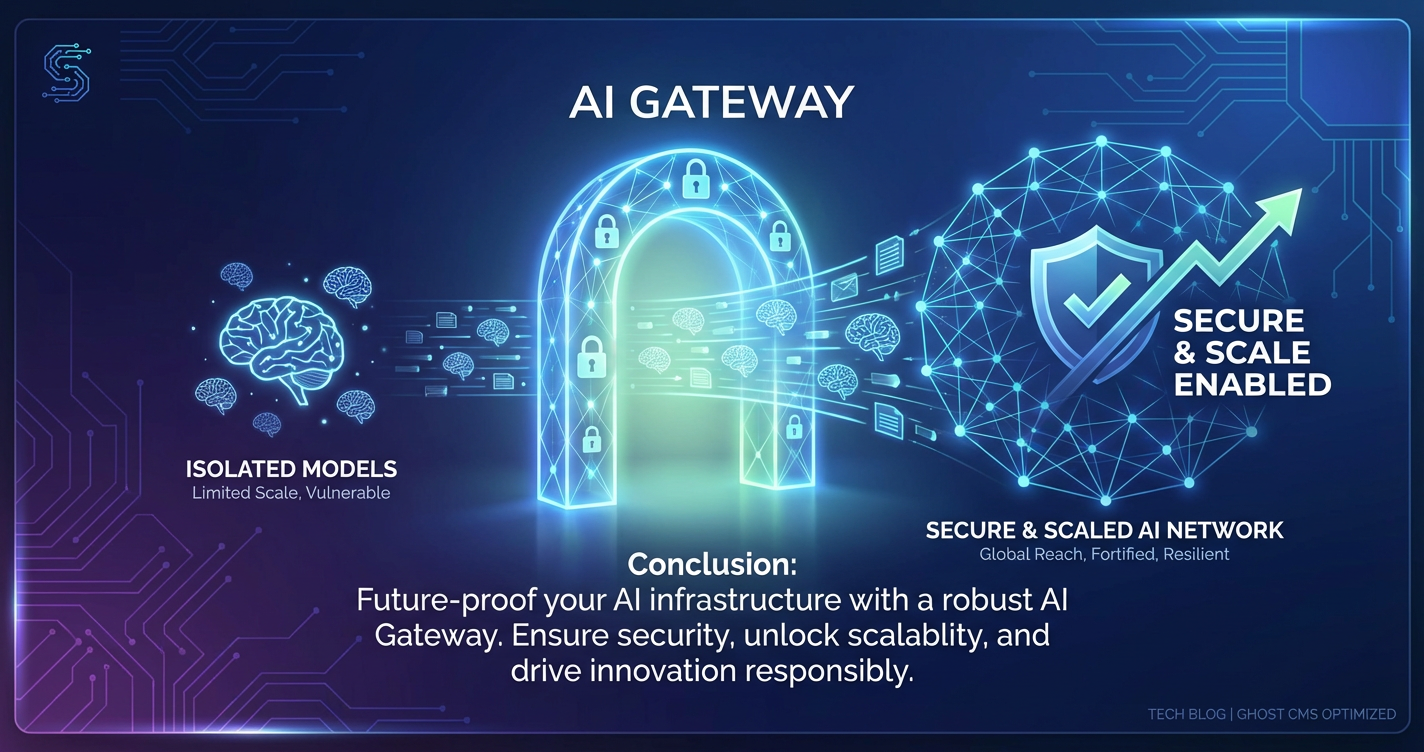
Secure & Scale AI: The Power of an AI Gateway


The rapid acceleration of Artificial Intelligence, particularly with the advent of Large Language Models (LLMs), has ushered in an era of unparalleled innovation and transformative potential. From sophisticated content generation and complex data analysis to powering intelligent automation and highly personalized user experiences, AI is no longer a niche technology but a foundational pillar of modern enterprises. However, this revolutionary progress brings with it a unique set of challenges related to security, scalability, integration complexity, and cost management. As organizations race to harness AI's power, they quickly realize that directly integrating and managing a multitude of AI models, often from disparate providers, can become an unmanageable and risky endeavor.
This is where the AI Gateway emerges as an indispensable architectural component. Acting as a centralized control plane, an AI Gateway provides a unified, secure, and highly scalable entry point for all AI-driven interactions. It stands as a critical intermediary, abstracting the underlying complexities of diverse AI models and service providers, while enforcing essential governance policies. This comprehensive article will delve deep into the multifaceted role of AI Gateways, exploring their fundamental architecture, core functionalities, and the profound impact they have on securing and scaling AI initiatives. We will dissect the nuances between an AI Gateway, an LLM Gateway, and a traditional API Gateway, illuminating how these concepts intertwine and differentiate to meet the specific demands of the AI landscape. Ultimately, understanding and implementing a robust AI Gateway is not merely an operational choice but a strategic imperative for any organization aiming to confidently navigate the complexities and fully unlock the boundless potential of artificial intelligence.
Chapter 1: The AI Tsunami: Opportunities and Obstacles
The past few years have witnessed an unprecedented surge in AI capabilities, profoundly reshaping industries and daily life. At the forefront of this revolution are Large Language Models (LLMs), which have moved from theoretical concepts to practical, widely accessible tools capable of understanding, generating, and manipulating human language with astonishing fluency. This "AI Tsunami" presents immense opportunities for businesses to innovate, enhance efficiency, and create entirely new service models. Companies are leveraging AI for everything from automating customer support and generating marketing copy to accelerating scientific discovery and providing personalized educational experiences. The promise of AI includes reduced operational costs, faster product development cycles, deeper customer insights, and the ability to solve complex problems that were previously intractable.
However, the rapid proliferation and adoption of AI, particularly advanced models like GPT-4, LLaMA, and Claude, also introduce a formidable array of obstacles that can quickly overwhelm unprepared organizations. The sheer diversity of models, each with its own API, data format, authentication scheme, and usage patterns, creates a fragmented and cumbersome integration landscape. Beyond mere integration, the fundamental challenges revolve around several critical dimensions that an effective AI Gateway seeks to address comprehensively:
1. Security Risks and Data Governance
One of the most pressing concerns in the AI era is security. Exposing AI models directly to applications or external users without proper controls can lead to catastrophic consequences. Data breaches are a constant threat, especially when sensitive user data or proprietary business information is fed into AI models for processing. More insidious are AI-specific vulnerabilities such as prompt injection, where malicious inputs can hijack a model's behavior, leading it to reveal confidential information, generate harmful content, or bypass security filters. Unauthorized access to AI endpoints can result in intellectual property theft or denial-of-service attacks. Furthermore, regulatory compliance, such as GDPR, HIPAA, and CCPA, imposes strict requirements on how data is handled and processed, necessitating robust data governance policies and technical controls around AI interactions. Without a centralized security enforcement point, managing these risks across a growing portfolio of AI models becomes an almost impossible task, exposing the organization to significant legal, financial, and reputational damage.
2. Scalability Issues and Performance Bottlenecks
As AI applications gain traction and user bases expand, the demand on underlying AI models can skyrocket. Direct integration often means applications must bear the burden of managing fluctuating traffic, implementing load balancing across multiple model instances, and handling provider-specific rate limits and quotas. Without a strategic approach, peak usage times can lead to performance bottlenecks, slow response times, or even complete service outages, directly impacting user experience and business operations. Furthermore, managing multiple AI providers for redundancy or cost optimization adds another layer of complexity to scalability. An application might need to dynamically switch between providers based on latency, availability, or pricing, a task that is incredibly difficult to implement and maintain at the application level. Ensuring that AI services remain responsive and available under varying loads requires sophisticated traffic management and resource allocation strategies that are beyond the scope of individual microservices or client-side implementations.
3. Complexity of Integration and Interoperability
Integrating various AI models, each with its unique API specifications, input/output formats, and authentication mechanisms, is a significant development hurdle. Developers often spend an inordinate amount of time writing boilerplate code to adapt their applications to different AI services, leading to fragmented codebases and increased maintenance overhead. For instance, one LLM might expect requests in a specific JSON structure with particular field names, while another uses a different format, or even requires entirely different parameters for similar tasks. This lack of standardization hinders rapid innovation and makes switching between models or leveraging multiple models for a single task exceedingly complex. The challenge extends to data transformation, where inputs and outputs need to be consistently mapped to a unified format, regardless of the underlying AI model's native representation. This integration spaghetti can severely impede time-to-market for new AI-powered features and bog down development teams in endless adaptation tasks.
4. Cost Management and Optimization
The operational costs associated with AI models, particularly LLMs, can be substantial and unpredictable. Most models are priced based on usage (e.g., per token, per inference, per hour), and without clear visibility and control, costs can quickly spiral out of budget. Tracking consumption across different applications, users, and models, and then allocating those costs back to respective departments, is a formidable accounting challenge. Moreover, optimizing costs often involves intelligent routing—directing requests to the most cost-effective model provider based on the specific query, current pricing, or even negotiating volume discounts. Implementing such dynamic cost-aware routing logic at the application layer is incredibly complex and prone to errors. Without a centralized mechanism to monitor, control, and optimize AI spending, organizations risk significant financial drain, undermining the economic viability of their AI initiatives.
5. Observability, Monitoring, and Auditing
Understanding how AI models are being used, their performance characteristics, and potential issues is crucial for maintenance, improvement, and compliance. Direct integrations often scatter logging and monitoring data across various application components and third-party AI provider dashboards, making it challenging to gain a holistic view. Diagnosing issues, identifying performance bottlenecks, or understanding usage patterns requires aggregating and correlating data from disparate sources, a process that is both time-consuming and error-prone. Comprehensive auditing trails are also essential for security investigations, regulatory compliance, and internal accountability, allowing organizations to track who accessed which model, with what input, and at what time. The absence of a unified observability layer means organizations operate in the dark, unable to proactively address problems or make data-driven decisions about their AI deployments.
6. Version Control and Model Lifecycle Management
AI models are not static; they evolve, get updated, and are replaced by newer, more capable versions. Managing these iterations across an enterprise can be a nightmare. Applications built directly against a specific model version might break if the underlying API changes, or if a model is deprecated. Enabling A/B testing of new models or rolling out updates gradually to a subset of users is vital for minimizing risk and ensuring continuity of service. Without a dedicated layer to manage model versions, applications become tightly coupled to specific model implementations, making upgrades risky and innovation slow. This lack of a standardized lifecycle management framework leads to brittle systems and restricts the agility needed to adopt the latest AI advancements.
These challenges underscore the critical need for a sophisticated intermediary layer—the AI Gateway—to abstract, secure, scale, and manage the burgeoning landscape of artificial intelligence services.
Chapter 2: Understanding the AI Gateway: A Centralized Control Plane
At its core, an AI Gateway is a specialized type of API management solution designed to sit between applications and various Artificial Intelligence models, whether they are hosted internally or externally by third-party providers. It acts as a single, intelligent entry point for all AI-related requests, providing a robust layer of abstraction, security, and control. Conceptually, it extends the foundational principles of a traditional API Gateway to specifically address the unique requirements and complexities introduced by AI and Machine Learning models, particularly the sophisticated demands of LLM Gateway functionalities. The primary purpose of an AI Gateway is to simplify the consumption of AI services for developers, enhance the security posture of AI deployments, ensure scalability and reliability, and provide granular control over cost and usage.
While a traditional API Gateway primarily focuses on managing RESTful APIs for microservices, providing features like routing, authentication, and rate limiting, an AI Gateway builds upon this foundation by adding AI-specific intelligence. It doesn't just pass requests; it understands the nature of AI requests, potentially transforming them, optimizing them, and applying specific AI governance policies. For instance, an AI Gateway might analyze a prompt for sensitive information, route it to the most appropriate or cost-effective LLM, and then cache the response for future identical queries, all transparently to the calling application. This centralized control plane fundamentally decouples consumer applications from the intricate details and volatile nature of the underlying AI models, fostering greater agility, resilience, and operational efficiency in AI integration.
The key functionalities of an AI Gateway are expansive and critical for modern AI deployments:
1. Unified Access & Intelligent Routing
An AI Gateway provides a single, consistent endpoint for all AI services, regardless of how many different models or providers are used on the backend. This simplifies development by offering a unified API interface, allowing applications to interact with various AI capabilities through a standardized mechanism without needing to know the specific details of each model's API. Beyond basic routing, an AI Gateway employs intelligent routing strategies. It can dynamically direct requests to specific models based on criteria such as the type of task (e.g., text summarization vs. image recognition), the input content (e.g., routing sensitive data to an on-premise model), model availability, performance metrics (e.g., lowest latency), or even real-time cost considerations. For example, a request might be routed to a powerful but expensive LLM for complex, high-priority tasks, while simpler queries are routed to a more economical, smaller model or a fine-tuned open-source alternative. This intelligent orchestration ensures optimal resource utilization and cost efficiency while maintaining performance targets.
2. Security & Access Control
Security is paramount, and the AI Gateway serves as a formidable defensive perimeter for AI models. It centralizes authentication and authorization, ensuring that only legitimate and authorized users or applications can access AI services. This includes integrating with existing identity providers (IdPs) and enforcing granular role-based access control (RBAC) to define who can use which model and for what purpose. Beyond traditional API security, an AI Gateway implements AI-specific threat detection and mitigation. This includes sophisticated prompt injection protection, analyzing incoming prompts for malicious patterns designed to manipulate the AI's behavior. It can also perform data masking or anonymization on sensitive input data before it reaches the AI model, protecting privacy and ensuring compliance. Rate limiting and quota management prevent abuse and ensure fair usage, while IP whitelisting and blacklisting provide further layers of network-level security, acting as a critical guardian against various forms of cyber threats.
3. Performance & Scalability Enhancements
To handle the fluctuating and often intensive demands of AI workloads, an AI Gateway offers robust features for performance optimization and scalability. It employs advanced load balancing techniques, distributing incoming requests across multiple instances of an AI model or across different providers to prevent any single point of failure or overload. Caching mechanisms are crucial; the gateway can store and serve responses for frequently asked or identical queries, significantly reducing latency and computational costs by avoiding redundant calls to the underlying AI models. This is particularly effective for common prompts or recurring analytical tasks. Furthermore, features like retry mechanisms, circuit breakers, and timeouts enhance the resilience of the system, gracefully handling transient errors or model unavailability without disrupting the client application. Traffic shaping and throttling allow administrators to manage the flow of requests, prioritizing critical workloads and preventing resource exhaustion.
4. Observability & Analytics
A crucial function of the AI Gateway is to provide comprehensive visibility into AI usage and performance. It meticulously logs every API call, capturing details such as the requesting application, user ID, timestamp, input prompt, model used, response received, latency, and cost. This detailed logging is invaluable for debugging, auditing, security investigations, and understanding usage patterns. Building on this data, the gateway generates rich metrics and analytics, offering real-time dashboards and historical reports on model performance, error rates, token consumption, and overall cost. This enables businesses to identify trends, pinpoint issues, optimize resource allocation, and accurately attribute costs. Distributed tracing capabilities allow for end-to-end monitoring of requests as they traverse through the gateway to the AI model and back, providing deep insights into the lifecycle of each AI interaction.
5. Transformation & Normalization
Given the diverse APIs and data formats of various AI models, the AI Gateway plays a vital role in data transformation and normalization. It can automatically convert incoming requests from a standardized format used by client applications into the specific format required by the target AI model. Similarly, it can normalize responses from different models into a consistent output structure before sending them back to the calling application. This abstraction layer means applications don't need to implement complex transformation logic for each AI service. It ensures that changes in an AI model's API or data schema do not directly impact downstream applications, thereby greatly simplifying maintenance and ensuring backward compatibility. Data validation at the gateway level further enhances reliability by ensuring inputs conform to expected schemas, preventing malformed requests from reaching the AI models.
6. Versioning & A/B Testing
Managing the evolution of AI models is a continuous challenge. An AI Gateway provides robust version control capabilities, allowing multiple versions of an AI model to run concurrently. Developers can route traffic to specific model versions based on application requirements, user groups, or testing phases. This capability is essential for safely deploying updates, performing A/B testing of new models or prompt engineering strategies, and rolling out changes gradually. It minimizes the risk of introducing regressions and allows for seamless transitions between model iterations without requiring client applications to be re-deployed or re-configured. This facilitates continuous improvement and experimentation with AI models in a controlled environment.
7. Cost Optimization and Control
Beyond basic cost tracking, an AI Gateway actively contributes to cost optimization. Through intelligent routing, it can automatically select the most cost-effective AI model for a given task, potentially switching between different providers or even different-sized models within the same provider based on current pricing, usage volume, and performance requirements. It can also enforce spending limits or budgets at a user, team, or application level, preventing unexpected cost overruns. By providing transparent, real-time cost visibility and granular control, the AI Gateway empowers organizations to manage their AI expenditures proactively and make informed decisions about their AI model strategy, ensuring that AI investments yield optimal return.
8. Prompt Management & Engineering (Specific to LLM Gateways)
For Large Language Models, prompt engineering is a critical discipline. An LLM Gateway specifically extends the AI Gateway concept by offering centralized prompt management. This allows organizations to store, version, and manage a library of optimized prompts. Instead of embedding prompts directly within applications, developers can reference a prompt by an ID, and the gateway will retrieve and inject the latest, approved version of that prompt before sending it to the LLM. This ensures consistency, simplifies prompt updates, and facilitates A/B testing of different prompt strategies without code changes. Furthermore, the gateway can perform prompt templating, variable injection, and even apply safety filters or guardrails to prompts before they reach the model, mitigating risks like hallucinations or generating inappropriate content. This elevates prompt engineering from a developer-specific task to a managed, enterprise-wide capability, allowing for rapid iteration and improved model outputs.
By consolidating these functions into a single, intelligent layer, the AI Gateway transforms the complex landscape of AI integration into a manageable, secure, and scalable ecosystem, empowering businesses to fully capitalize on the AI revolution.
Chapter 3: The Synergy: AI Gateway, LLM Gateway, and API Gateway
To fully appreciate the power and specificity of an AI Gateway, it’s crucial to understand its relationship with and differentiation from its conceptual predecessors and specialized counterparts: the traditional API Gateway and the more focused LLM Gateway. These terms are often used interchangeably, but while they share foundational principles, their areas of specialization and additional functionalities are distinct and designed to address different layers of complexity within modern software architectures. Recognizing these distinctions helps organizations choose the right tools and build resilient, future-proof systems.
1. API Gateway as the Foundation
The API Gateway has long been a cornerstone of modern distributed architectures, particularly in environments embracing microservices. Its primary role is to serve as a single entry point for client applications to access multiple backend services, abstracting the complexity of the microservices architecture. A traditional API Gateway handles a myriad of concerns common to all types of API traffic: * Routing: Directing incoming requests to the appropriate backend service. * Authentication and Authorization: Verifying client identity and permissions before allowing access to services. * Rate Limiting: Protecting backend services from overload by controlling the number of requests clients can make within a given timeframe. * Load Balancing: Distributing traffic across multiple instances of a service for high availability and performance. * Request/Response Transformation: Modifying headers, payloads, or query parameters. * Monitoring and Logging: Providing observability into API traffic. * Security Policies: Enforcing general security measures like IP blacklisting or WAF rules.
In essence, an API Gateway streamlines external access to internal services, enhances security, and improves the overall resilience and manageability of API ecosystems. It’s a generic yet powerful tool for exposing any type of API, be it REST, SOAP, or GraphQL, without specific knowledge of the underlying service’s business logic or domain.
2. LLM Gateway as a Specialization for Large Language Models
An LLM Gateway is a highly specialized form of an AI Gateway, specifically tailored to address the unique challenges and opportunities presented by Large Language Models. While an AI Gateway broadly covers all forms of AI (ML models, deep learning, computer vision, etc.), an LLM Gateway zeroes in on the complexities inherent to text-based generative AI. The specific challenges with LLMs include: * Token Management and Cost Control: LLMs are often billed per token, and managing this effectively across different models and providers requires specialized logic to optimize costs. An LLM Gateway can route to cheaper models for simple tasks or ensure efficient token utilization. * Prompt Engineering and Versioning: The output quality of an LLM heavily depends on the input prompt. An LLM Gateway offers centralized prompt management, allowing organizations to store, version, and A/B test prompts, and apply consistent prompt templates across applications. This ensures that the best, most secure, and most cost-effective prompts are always used. * Model Safety and Guardrails: LLMs can sometimes generate biased, harmful, or inaccurate content (hallucinations). An LLM Gateway can implement pre- and post-processing filters to moderate inputs and outputs, detecting and preventing undesirable content from reaching the model or the end-user. This might involve content moderation APIs or custom rules to ensure ethical AI use. * Provider Agnosticism: Developers often want to switch between different LLM providers (e.g., OpenAI, Anthropic, Google Gemini) based on cost, performance, or specific capabilities. An LLM Gateway provides a unified API interface that abstracts away provider-specific API calls, allowing for seamless model switching without application code changes. * Context Management: For conversational AI, managing session context over multiple turns is critical. An LLM Gateway can assist in maintaining and passing context efficiently to the underlying LLM, reducing redundant information and improving conversational flow.
Essentially, an LLM Gateway extends the general AI Gateway features with specific intelligence and controls that are hyper-focused on optimizing the use, security, and performance of large language models, addressing their unique input/output structures, billing models, and ethical considerations.
3. AI Gateway as the Broad Umbrella
The term AI Gateway serves as the overarching concept, encompassing the functionalities of an API Gateway while adding deep, AI-specific intelligence and management capabilities across the entire spectrum of artificial intelligence models, not just LLMs. It represents the logical evolution of the API Gateway, tailored for the AI-first world. An AI Gateway can manage: * Traditional Machine Learning Models: Regression models, classification models, clustering algorithms. * Deep Learning Models: Computer vision models (image recognition, object detection), speech recognition models, recommendation engines. * Large Language Models (LLMs): Generative AI for text, code, translation, summarization, etc. (thus, an LLM Gateway is a specific type of AI Gateway).
The relationship can be visualized hierarchically: a traditional API Gateway provides the fundamental infrastructure for exposing and managing network services. An AI Gateway builds upon this foundation, specializing in the management of any AI model, integrating AI-specific features like model versioning, prompt management, AI-aware security, and intelligent routing based on AI task types. An LLM Gateway is then a further specialization of an AI Gateway, focusing solely on the intricacies of Large Language Models.
Consider a platform like ApiPark. It positions itself as an open-source AI Gateway and API Management Platform. This means it doesn't just manage general REST APIs; it specifically caters to the integration and management of diverse AI models. By offering capabilities like quick integration of 100+ AI models and a unified API format for AI invocation, ApiPark exemplifies how an AI Gateway extends traditional API management to meet the unique demands of AI. It simplifies the complex task of interacting with multiple AI providers, ensuring that organizations can secure, scale, and effectively manage their entire AI portfolio under a single, cohesive framework. Furthermore, features like prompt encapsulation into REST API align perfectly with the specialized needs typically found in an LLM Gateway, demonstrating the convergence of these concepts within a single, powerful AI Gateway solution. It acts as a comprehensive control plane, allowing enterprises to manage not just general APIs, but specifically tailor its functionalities for the nuanced world of AI.
The synergy is clear: an API Gateway lays the groundwork for robust service communication, the AI Gateway builds upon this to specifically orchestrate and secure all forms of AI interactions, and the LLM Gateway refines this orchestration for the particular domain of generative language models. Together, they form a formidable toolkit for navigating the complex and rapidly evolving landscape of enterprise AI.
Chapter 4: Core Features and Benefits of an AI Gateway in Detail
The comprehensive functionalities of an AI Gateway translate directly into profound benefits, empowering organizations to harness AI more securely, efficiently, and effectively. Each feature is designed to address a specific pain point in AI integration and management, collectively creating a robust and strategic infrastructure layer.
1. Enhanced Security Posture: Building an AI Fortress
Security is non-negotiable in AI deployments, especially when dealing with sensitive data or mission-critical applications. An AI Gateway acts as a fortified gatekeeper, enforcing a multi-layered security strategy that goes beyond traditional API protection.
- Centralized Authentication and Authorization (AuthN/AuthZ): Instead of scattering authentication logic across various applications and AI models, the AI Gateway centralizes it. It can integrate with enterprise-grade identity providers (e.g., OAuth 2.0, OpenID Connect, SAML) to verify the identity of every caller. Granular authorization policies, often role-based (RBAC) or attribute-based (ABAC), ensure that only authorized users or applications can access specific AI models or perform certain operations. For instance, a junior analyst might only have access to a general-purpose summarization model, while a data scientist has access to advanced fine-tuning APIs. This centralized control significantly reduces the attack surface and ensures consistent security policies.
- Prompt Injection Protection: This is an AI-specific vulnerability where malicious inputs can trick an LLM into revealing confidential information, generating harmful content, or executing unintended actions. The AI Gateway can implement sophisticated filters and AI-based detection mechanisms to analyze incoming prompts for suspicious patterns, keywords, or intentions, actively sanitizing or blocking them before they reach the LLM. This proactive defense is critical for maintaining model integrity and preventing data leakage.
- Data Masking and Anonymization: For AI models that process sensitive personal identifiable information (PII) or proprietary business data, the AI Gateway can automatically mask, redact, or tokenize specific data fields in the input prompt before it's sent to the AI model. This minimizes the exposure of sensitive data to external AI providers and helps maintain compliance with privacy regulations like GDPR or HIPAA, reducing the risk of data breaches and preserving user privacy.
- Threat Intelligence Integration: An advanced AI Gateway can integrate with external threat intelligence feeds to identify and block requests originating from known malicious IP addresses, botnets, or compromised accounts. It can also perform real-time anomaly detection, flagging unusual patterns of AI usage that might indicate a security threat or an attempted attack, providing early warnings to security teams.
- Compliance and Governance: The gateway serves as a central enforcement point for organizational and regulatory compliance policies. It can enforce data residency rules (e.g., routing requests to AI models hosted in specific geographical regions), ensure audit trails for every AI interaction, and provide verifiable proof of adherence to industry standards and legal requirements. This simplifies the often-complex task of demonstrating compliance for AI-powered applications.
2. Unprecedented Scalability and Performance: Handling the Deluge
AI workloads can be highly variable, with sudden spikes in demand. An AI Gateway is engineered to manage this variability, ensuring that AI services remain responsive and available even under extreme load, while also optimizing resource utilization.
- Dynamic Load Balancing: The gateway intelligently distributes incoming requests across multiple instances of an AI model, whether they are hosted internally or across different cloud providers. This prevents any single model instance from becoming a bottleneck, ensuring optimal resource utilization and high availability. Advanced algorithms can consider factors like current load, response times, and geographic proximity to route traffic most efficiently.
- Intelligent Caching Strategies: For frequently asked questions, common summarization tasks, or recurring analytical queries, the AI Gateway can cache responses. When an identical request comes in, the gateway serves the cached response instantly, bypassing the need to call the underlying AI model. This significantly reduces latency, decreases computational costs, and frees up AI model resources for unique or complex requests. Caching policies can be configured based on time-to-live (TTL), cache invalidation rules, and specific request parameters.
- Circuit Breakers and Rate Limiting: To protect backend AI models from being overwhelmed, the gateway implements circuit breakers. If an AI model starts exhibiting errors or slow responses, the circuit breaker "opens," preventing further requests from reaching the struggling model and instead failing fast or routing to a healthy alternative. Rate limiting ensures that no single client or application can consume excessive resources, preventing denial-of-service (DoS) attacks and ensuring fair usage across all consumers.
- Connection Pooling and Optimization: Managing numerous concurrent connections to AI model endpoints can be resource-intensive. The gateway employs connection pooling to reuse established connections, reducing the overhead of setting up and tearing down new connections for each request. This enhances performance and reduces the load on both the gateway and the backend AI services, particularly for high-volume scenarios.
3. Simplified Integration and Development: Fueling Developer Agility
The complexity of integrating diverse AI models can significantly slow down development cycles. An AI Gateway dramatically simplifies this process, allowing developers to focus on building innovative applications rather than grappling with integration intricacies.
- Unified API Interface: One of the most significant benefits is the abstraction of disparate AI model APIs. The gateway presents a single, consistent API interface to client applications, regardless of the underlying AI model or provider. For example, ApiPark offers a "Unified API Format for AI Invocation," which standardizes the request data format across all integrated AI models. This means developers write code once to interact with the gateway's standardized API, and the gateway handles the necessary transformations to communicate with the specific backend AI model. This greatly reduces development effort and ensures consistency.
- Abstraction of Underlying Model Complexities: Developers no longer need to worry about the specific authentication tokens, unique request payloads, rate limits, or error handling mechanisms of each individual AI model. The gateway handles these complexities, presenting a clean, simplified interface. This abstraction makes it much easier to swap out AI models or integrate new ones without requiring changes to the application code.
- Rapid API Creation (Prompt Encapsulation): For LLMs, the AI Gateway can enable "Prompt Encapsulation into REST API." This allows users to combine a specific AI model with a carefully crafted prompt (e.g., "summarize this text," "translate to French," "analyze sentiment") and expose this combination as a new, specialized REST API endpoint through the gateway. This significantly accelerates the creation of new AI-powered microservices, allowing non-developers to create powerful AI tools by simply configuring prompts, turning complex AI tasks into simple, reusable API calls.
- Developer Portal Capabilities: Many AI Gateways, especially comprehensive platforms like ApiPark, include a developer portal. This self-service platform provides API documentation, SDKs, code examples, and interactive testing tools, making it easy for developers to discover, understand, and integrate AI services. It fosters collaboration and accelerates adoption within an organization and potentially with external partners.
4. Granular Control and Cost Optimization: Mastering AI Economics
Managing the financial implications of AI consumption is paramount. An AI Gateway provides the visibility and control needed to optimize spending, prevent overruns, and allocate costs effectively.
- Detailed Call Logging and Analytics: Every API call made through the gateway is meticulously logged, capturing essential details such as the model used, input/output tokens, latency, status code, user, application, and timestamp. This comprehensive data is then fed into powerful analytics engines. ApiPark, for example, provides "Detailed API Call Logging" to record every detail of each API call, which is invaluable for traceability and troubleshooting. These logs are crucial for debugging, auditing, security investigations, and understanding usage patterns.
- Real-time Cost Tracking and Budgeting: Based on the detailed logs and configured pricing models for each AI service, the AI Gateway can provide real-time cost tracking. Organizations can set budgets at various levels (per team, per application, per user) and receive alerts when thresholds are approached or exceeded. This allows for proactive cost management and prevents unexpected bills, making the economic impact of AI consumption transparent and predictable.
- Intelligent Routing based on Cost/Performance: The gateway can implement sophisticated routing logic that considers not just performance but also cost. For a given task, it might determine that a slightly slower but significantly cheaper model is acceptable for non-critical requests, while routing high-priority tasks to premium, higher-cost models. This dynamic optimization ensures that AI resources are used efficiently, striking the right balance between performance and expenditure.
- API Service Sharing within Teams: The platform allows for the centralized display of all API services, including AI models, making it easy for different departments and teams to find and use the required API services. This fosters internal collaboration and reduces redundancy, as teams can leverage existing AI integrations rather than building their own, further contributing to cost efficiency and consistency.
5. Robust Observability and Management: Keeping AI Running Smoothly
Beyond core functionality, an AI Gateway ensures the operational health and long-term sustainability of AI deployments through comprehensive monitoring and lifecycle management.
- Comprehensive Monitoring and Alerting: The gateway continuously monitors the health and performance of all integrated AI models and the gateway itself. It tracks key metrics like latency, error rates, throughput, and resource utilization. Configurable alerts notify operations teams of any anomalies or performance degradations, enabling proactive intervention before issues escalate into service outages. This centralized monitoring provides a single pane of glass for all AI operations.
- End-to-End API Lifecycle Management: A mature AI Gateway facilitates the entire lifecycle of an AI service, from design and publication to invocation, versioning, and eventual decommissioning. This includes managing traffic forwarding rules, applying load balancing configurations, and handling different versions of published APIs. As exemplified by ApiPark, this feature helps regulate API management processes, ensuring consistency, governance, and smooth transitions for AI services as they evolve.
- Version Control and A/B Testing: As mentioned earlier, robust versioning allows for seamless updates and experimentation. The gateway can route a percentage of traffic to a new model version (Canary deployment) or A/B test different prompt strategies, gathering performance and quality metrics before a full rollout. This minimizes risk and allows for continuous improvement of AI services without disrupting production applications.
- Auditing and Reporting: All actions and interactions through the gateway are meticulously recorded, creating an immutable audit trail. This is vital for security investigations, compliance adherence, and internal accountability. Comprehensive reports can be generated on usage, performance, costs, and security events, providing stakeholders with critical insights into the AI ecosystem.
- Independent API and Access Permissions for Each Tenant: For larger organizations or SaaS providers, the ability to create multiple teams (tenants) with independent applications, data, user configurations, and security policies is crucial. An AI Gateway can provide this multi-tenancy support, ensuring isolation and security for different internal departments or external customers, while still sharing underlying infrastructure to improve resource utilization and reduce operational costs. ApiPark explicitly supports this with its independent tenant management.
- API Resource Access Requires Approval: For enhanced security and governance, the AI Gateway can enforce a subscription approval workflow. Callers must subscribe to an AI API, and administrators must approve their subscription before they can invoke the API. This prevents unauthorized API calls, strengthens access control, and acts as another layer of defense against potential data breaches, ensuring controlled and deliberate access to valuable AI resources.
- Powerful Data Analysis: Leveraging the detailed historical call data, an AI Gateway provides "Powerful Data Analysis" capabilities, as highlighted by ApiPark. This analysis displays long-term trends and performance changes, allowing businesses to predict potential issues, understand user behavior, and perform preventive maintenance before problems impact operations. Such insights are invaluable for strategic planning and continuous optimization of AI infrastructure.
Table: Key AI Gateway Features and Their Benefits
| Feature Category | Specific Feature | Description | Core Benefit for AI Deployments |
|---|---|---|---|
| Security & Governance | Centralized AuthN/AuthZ | Enforces consistent authentication and authorization for all AI models. | Reduces attack surface, ensures compliance, simplifies access management. |
| Prompt Injection Protection | Detects and blocks malicious prompts before they reach LLMs. | Prevents model hijacking, data leakage, and generation of harmful content. | |
| Data Masking/Anonymization | Redacts or transforms sensitive data in prompts before forwarding to AI models. | Protects privacy, ensures compliance with data regulations (GDPR, HIPAA). | |
| Scalability & Perf. | Dynamic Load Balancing | Distributes AI requests across multiple model instances/providers. | Ensures high availability, prevents bottlenecks, optimizes resource use. |
| Intelligent Caching | Stores and serves responses for frequent AI queries. | Significantly reduces latency, cuts computational costs, improves responsiveness. | |
| Rate Limiting & Circuit Breakers | Controls request traffic, prevents overload, and gracefully handles model failures. | Protects backend AI models, maintains system stability, enhances resilience. | |
| Integration & Dev. | Unified API Interface | Standardizes the request format for diverse AI models (e.g., ApiPark's unified format). | Simplifies developer experience, accelerates integration, reduces maintenance burden. |
| Prompt Encapsulation into REST API | Combines AI models with custom prompts to create new, specialized API endpoints. | Speeds up creation of new AI services, empowers non-developers, promotes reusability. | |
| Model Abstraction | Hides the complexities of individual AI models from client applications. | Allows easy swapping of models, future-proofs applications against model changes. | |
| Control & Optim. | Detailed Call Logging | Records every aspect of AI API interactions. | Enables precise troubleshooting, robust auditing, and security investigations. |
| Real-time Cost Tracking | Monitors AI usage costs across models, users, and applications. | Provides financial transparency, prevents budget overruns, informs strategic spending. | |
| Intelligent Cost-Aware Routing | Routes requests to AI models based on cost, performance, and availability. | Optimizes AI spending without sacrificing performance, ensures best value. | |
| Operations & Mgmt. | End-to-End API Lifecycle Management | Manages the entire lifecycle of AI APIs from design to decommissioning. | Ensures governance, consistency, and smooth evolution of AI services. |
| Monitoring & Alerting | Tracks AI model and gateway performance with proactive notifications. | Identifies issues early, ensures high availability and optimal performance. | |
| Versioning & A/B Testing | Manages different AI model versions and enables controlled experimentation. | Facilitates safe updates, continuous improvement, and risk mitigation. | |
| Independent Tenant Management | Allows creation of isolated environments for different teams/departments. | Enhances security, resource isolation, and operational efficiency for multi-tenant deployments. | |
| Powerful Data Analysis | Analyzes historical call data to identify trends and predict issues. | Supports data-driven decision-making, enables proactive maintenance, and strategic planning. |
By offering this comprehensive suite of features, an AI Gateway transforms the way organizations interact with and manage their AI resources, turning potential chaos into a well-orchestrated, secure, and highly efficient AI ecosystem. The strategic value of such a platform, exemplified by open-source solutions like ApiPark, becomes undeniable in the pursuit of unlocking AI's full potential.
APIPark is a high-performance AI gateway that allows you to securely access the most comprehensive LLM APIs globally on the APIPark platform, including OpenAI, Anthropic, Mistral, Llama2, Google Gemini, and more.Try APIPark now! 👇👇👇
Chapter 5: Real-World Use Cases and Industry Impact
The versatility and robustness of an AI Gateway make it a crucial component across a wide array of industries and enterprise AI initiatives. By centralizing management, security, and scalability for AI models, these gateways enable innovative applications that might otherwise be too complex, risky, or costly to implement. Let's explore several real-world use cases that highlight the transformative impact of AI Gateways.
1. Enterprise AI Adoption: Scaling Innovation Securely
For large enterprises, the journey to becoming "AI-first" involves integrating numerous AI models into existing workflows and applications. An AI Gateway becomes the central nervous system for this transformation. For instance, a multinational conglomerate might use various LLMs for internal document summarization, legal contract analysis, and customer service automation across different departments. Without an AI Gateway, each department would have to manage its own integrations, leading to fragmented security policies, inconsistent cost tracking, and redundant development efforts. The gateway provides a unified platform, ensuring all AI interactions adhere to corporate security standards, enabling centralized cost allocation, and fostering reusability of prompt templates and model configurations. It allows CIOs and IT departments to maintain oversight and control over the proliferation of AI, ensuring compliance and data governance across the entire organization, simplifying the complex landscape of enterprise AI.
2. Financial Services: Enhancing Security and Customer Experience
In the highly regulated financial sector, AI offers immense potential for fraud detection, personalized financial advice, and automated compliance checks. An AI Gateway is indispensable here. For a bank leveraging AI to detect anomalous transactions, the gateway ensures that sensitive financial data is anonymized or masked before it reaches external fraud detection models, protecting customer privacy and meeting strict regulatory requirements. It can intelligently route suspicious transactions to more advanced, compute-intensive (and expensive) models, while routine checks go to lighter, cheaper models, optimizing costs without compromising security. Furthermore, for AI-powered chatbots offering personalized financial advice, the gateway enforces strict authentication, ensures prompt injection protection to prevent manipulation, and logs every interaction for auditability, providing a secure and compliant channel for AI-driven customer engagement.
3. Healthcare: Improving Patient Care and Operational Efficiency
The healthcare industry benefits immensely from AI in areas like diagnostic assistance, drug discovery, and personalized treatment plans. An AI Gateway is critical for navigating the strict privacy regulations (like HIPAA in the US). Imagine a hospital system using AI for preliminary disease diagnosis based on patient records. The gateway ensures that all patient data is meticulously de-identified before being sent to cloud-based diagnostic AI models, preventing any unauthorized exposure of protected health information (PHI). It manages access to specialized AI models, ensuring that only authorized medical professionals or applications can invoke them, and logs all access for auditing purposes. For drug discovery, researchers might use various AI models for protein folding, molecular docking, and clinical trial analysis. The gateway unifies access to these diverse models, applies rate limits to prevent abuse of expensive computational resources, and provides detailed usage analytics to track research costs, accelerating discovery while maintaining data integrity and security.
4. E-commerce: Personalization, Support, and Demand Forecasting
E-commerce thrives on personalization, efficient customer service, and accurate demand forecasting, all powered by AI. An AI Gateway helps orchestrate these AI components seamlessly. For a retail giant, an AI Gateway sits in front of recommendation engines, chatbots, and dynamic pricing models. It ensures that the recommendation engine, which uses customer browsing history, receives anonymized data to personalize product suggestions without compromising privacy. When a customer interacts with an AI-powered chatbot, the gateway applies context management for seamless conversations and routes complex queries to human agents only when necessary, improving customer satisfaction while optimizing operational costs. For demand forecasting, the gateway manages access to various predictive AI models, ensuring they receive the latest sales data securely and provide timely insights for inventory management, preventing stockouts or overstock.
5. Manufacturing: Predictive Maintenance and Quality Control
In manufacturing, AI drives efficiency through predictive maintenance, quality control, and supply chain optimization. An AI Gateway enables the secure and scalable deployment of these AI solutions. Consider a smart factory using AI to predict machinery failures. Sensor data from production lines, which might be voluminous and sensitive, is routed through the gateway to predictive analytics AI models. The gateway ensures this data is securely transmitted, performs transformations if necessary, and balances the load across multiple inference engines to provide real-time failure predictions. For AI-driven visual inspection systems, the gateway manages the flow of high-resolution image data to computer vision models, ensuring low latency for real-time quality control checks and preventing defective products from reaching the market. It also centralizes logging for traceability, allowing manufacturers to pinpoint exactly when and why a defect might have occurred, aiding root cause analysis.
6. Software Development: Code Generation and Intelligent IDEs
The software development lifecycle itself is being transformed by AI, from intelligent code completion and bug detection to automated testing and code generation. An AI Gateway becomes a developer's secret weapon. Development teams can use an AI Gateway to provide unified access to various code generation LLMs (e.g., GitHub Copilot-like services), intelligent refactoring tools, or security vulnerability scanners. The gateway ensures that internal codebases, even when sent to external AI services for analysis or generation, are handled according to strict enterprise security policies (e.g., data masking proprietary variable names). It can manage different model versions for A/B testing new code generation models, allowing teams to evaluate their effectiveness and potential biases before widespread adoption. Furthermore, by encapsulating common AI-powered development tasks as simple API calls, it accelerates development and allows developers to focus on core logic rather than AI integration nuances.
In each of these scenarios, the AI Gateway isn't just an optional add-on; it's a fundamental architectural requirement. It transforms disparate AI models into a cohesive, manageable, and secure service layer, enabling organizations across sectors to confidently leverage the power of AI to drive innovation and achieve strategic objectives.
Chapter 6: Implementing an AI Gateway: Key Considerations
Deploying an AI Gateway is a strategic decision that requires careful planning and consideration of various factors to ensure successful integration and long-term benefits. It's not merely a technical implementation but a shift in how an organization approaches its AI strategy. Here are key considerations for anyone embarking on the journey of implementing an AI Gateway:
1. Deployment Strategies: On-premise, Cloud, or Hybrid
The choice of deployment model significantly impacts control, cost, and compliance. * On-premise Deployment: Provides maximum control over data and infrastructure, which is often crucial for highly regulated industries or organizations with stringent data sovereignty requirements. This offers the lowest latency for internal AI models and absolute control over security policies. However, it demands significant upfront investment in hardware, maintenance, and operational expertise. For instance, solutions like ApiPark can be deployed on-premise, giving organizations full control over their AI infrastructure. * Cloud Deployment: Leveraging cloud-native AI Gateways (e.g., managed services from AWS, Azure, Google Cloud) offers scalability, elasticity, and reduced operational overhead. It allows for rapid deployment and often comes with integrated security features and global availability. However, it means entrusting some control to a third-party provider and can incur variable costs based on usage. Public cloud deployment is ideal for organizations with flexible budgets and less stringent data residency requirements. * Hybrid Deployment: A hybrid approach combines the best of both worlds. Organizations might deploy the AI Gateway on-premise for sensitive AI models that process proprietary data, while routing less sensitive or high-volume requests to cloud-based AI models through the same gateway. This strategy allows for flexibility, cost optimization, and compliance adherence, enabling organizations to place workloads where they make the most sense from a security, performance, and economic perspective.
2. Vendor Selection: Open-Source vs. Commercial Solutions
Choosing the right AI Gateway solution involves evaluating various options, each with its own advantages. * Open-Source Solutions: Offer transparency, flexibility, and often a strong community for support. They provide organizations with full control over the codebase, allowing for extensive customization to meet specific needs. This can be cost-effective initially but requires internal expertise for setup, maintenance, and ongoing development. An excellent example is ApiPark, which is open-sourced under the Apache 2.0 license. It provides core API management and AI gateway features, making it ideal for organizations that prioritize control and community-driven development, and for startups due to its cost-effectiveness. The "quick-start.sh" script for deployment also highlights its ease of initial setup. * Commercial Solutions: Typically come with professional support, enterprise-grade features, comprehensive documentation, and service level agreements (SLAs). They often offer more advanced capabilities out-of-the-box (e.g., AI-specific security modules, advanced analytics, visual management dashboards) and reduce the operational burden on internal teams. While they involve licensing costs, they can provide greater peace of mind and faster time-to-market for complex deployments. ApiPark also offers a commercial version with advanced features and professional technical support for leading enterprises, catering to organizations requiring more robust capabilities and dedicated assistance. The choice depends on an organization's budget, technical capabilities, specific feature requirements, and risk tolerance.
3. Integration Challenges: Existing Infrastructure and Legacy Systems
Implementing an AI Gateway requires careful consideration of its integration with existing IT infrastructure. * Existing API Gateways: If an organization already has a traditional API Gateway in place, the new AI Gateway needs to either complement it, extend its capabilities, or potentially replace it if the AI Gateway offers full API management features. Harmonizing these components is crucial to avoid architectural silos and operational complexities. * Legacy Applications: Older applications might not be designed to interact with modern AI services. The AI Gateway can act as an adapter, transforming requests and responses to bridge the gap between legacy systems and new AI models, allowing older applications to leverage AI without extensive re-engineering. * Data Sources and ETL: AI models often require data from various sources. The gateway might need to integrate with existing data pipelines (ETL/ELT) or data virtualization layers to ensure that AI models receive clean, relevant, and timely data. This includes handling data formats, ensuring data quality, and managing data access permissions.
4. Security Best Practices: Beyond Basic Access Control
Beyond the inherent security features of an AI Gateway, organizations must adhere to broader security best practices. * Least Privilege Principle: Ensure that users and applications are granted only the minimum necessary permissions to access AI models. * Regular Security Audits: Conduct periodic security assessments, penetration testing, and code reviews of the AI Gateway and its configurations to identify and remediate vulnerabilities. * Secure Configuration Management: Implement strict controls over the configuration of the gateway, using infrastructure-as-code principles and automated deployment pipelines to prevent misconfigurations. * Data Encryption: Ensure that all data in transit and at rest, both within the gateway and between the gateway and AI models, is encrypted using strong cryptographic protocols. * Compliance Frameworks: Map the gateway's security features and operational procedures to relevant compliance frameworks (e.g., ISO 27001, SOC 2, PCI DSS) to ensure ongoing adherence.
5. Scalability Planning: Future Growth and Traffic Predictions
AI usage can grow exponentially. Scalability planning is crucial for the long-term success of the AI Gateway. * Performance Benchmarking: Thoroughly test the gateway's performance under various load conditions to understand its limits and identify potential bottlenecks. ApiPark boasts performance rivaling Nginx, achieving over 20,000 TPS with an 8-core CPU and 8GB of memory, and supports cluster deployment, indicating robust scalability. * Resource Provisioning: Plan for dynamic resource allocation for the gateway itself, ensuring it can scale horizontally and vertically to handle increasing AI traffic. This includes CPU, memory, network bandwidth, and storage. * High Availability and Disaster Recovery: Design the deployment for high availability with redundant components and implement a robust disaster recovery plan to ensure business continuity in case of outages. * Traffic Predictions: Work with business units to forecast future AI usage patterns and traffic volumes to ensure the gateway can meet projected demands, potentially factoring in seasonality or new AI application launches.
6. Monitoring and Maintenance: Proactive Issue Detection
Effective monitoring and maintenance are essential for the operational health of the AI Gateway. * Comprehensive Metrics and Logging: As highlighted by ApiPark's "Detailed API Call Logging" and "Powerful Data Analysis" features, collect extensive metrics and logs from the gateway itself (CPU usage, memory, network I/O, error rates) and from the AI models it orchestrates. * Alerting and Dashboards: Set up proactive alerts for critical thresholds and create intuitive dashboards to visualize the performance and health of the AI ecosystem. * Automated Updates and Patching: Implement automated processes for applying security patches and software updates to the gateway to ensure it remains protected against known vulnerabilities. * Regular Review: Periodically review gateway configurations, policies, and routing rules to ensure they align with evolving business needs and AI model strategies.
7. Team Expertise: Training and Skill Development
Successful AI Gateway implementation and operation require a skilled team. * Gateway Administrators: Dedicated personnel with expertise in API management, networking, and security to configure, monitor, and maintain the gateway. * AI Engineers/Data Scientists: Collaboration between gateway administrators and AI teams is crucial to define routing logic, prompt templates, and security policies that are specific to AI models. * Security Teams: Close coordination with security operations to integrate the gateway into the broader security posture and incident response workflows.
By thoughtfully addressing these considerations, organizations can implement an AI Gateway that not only meets their current needs but also provides a resilient, secure, and scalable foundation for their future AI endeavors, truly unlocking the transformative power of artificial intelligence.
Chapter 7: The Future of AI Gateways
As the landscape of Artificial Intelligence continues its relentless evolution, the role and capabilities of the AI Gateway are poised for significant expansion and innovation. The gateway, already a critical component, will become even more sophisticated, adapting to emerging AI paradigms and addressing future challenges. We can anticipate several key trends shaping the next generation of AI Gateways.
1. Autonomous AI Agents and Their Management
The rise of autonomous AI agents, capable of performing complex multi-step tasks and interacting with various tools and services, will introduce new management complexities. Future AI Gateways will evolve into agent orchestration layers, not just managing calls to individual models but coordinating sequences of AI model invocations, tool usage, and decision-making processes by agents. This will involve managing agent identities, securing agent-to-tool interactions, monitoring agent performance, and ensuring agent outputs align with organizational policies. The gateway will become the control tower for an ecosystem of intelligent agents, providing oversight and governance for increasingly complex AI workflows, ensuring they operate securely and predictably within defined boundaries.
2. Edge AI Integration
With the increasing need for real-time processing, reduced latency, and enhanced privacy, more AI inferencing is moving to the edge—closer to data sources on devices or local servers. Future AI Gateways will extend their reach to manage these distributed edge AI deployments. This includes orchestrating model deployment to edge devices, securely synchronizing model updates, aggregating performance metrics from diverse edge locations, and intelligently routing requests between cloud-based and edge-based AI models based on data sensitivity, latency requirements, and resource availability. This distributed gateway architecture will enable hybrid cloud-edge AI strategies, bringing AI closer to the point of action while maintaining centralized governance.
3. Advanced Prompt Engineering and Optimization
The art and science of prompt engineering will continue to mature, and LLM Gateway functionalities within the broader AI Gateway will become even more sophisticated. We can expect more advanced features for dynamic prompt generation, self-optimizing prompts based on historical performance, and contextual prompt adaptation. The gateway will likely incorporate AI-powered prompt testing and evaluation frameworks, allowing organizations to automatically iterate and refine prompts for optimal outputs and cost-efficiency. This will also include more robust mechanisms for guarding against "prompt leakage" and ensuring that proprietary prompt strategies remain secure, effectively turning prompt engineering into a managed, strategic asset within the enterprise.
4. Ethical AI and Bias Detection
As AI becomes more pervasive, the imperative for ethical AI—fairness, transparency, accountability—grows stronger. Future AI Gateways will integrate advanced capabilities for monitoring and mitigating AI bias. This could involve real-time bias detection in model outputs, identifying and flagging potentially discriminatory content, or routing requests to alternative models known for lower bias in specific contexts. The gateway might also enforce "explainability" by integrating with XAI (Explainable AI) tools, providing insights into why an AI model made a particular decision, thereby increasing transparency and trust in AI systems. This will be crucial for regulatory compliance and maintaining public confidence in AI applications.
5. Federated Learning and Privacy-Preserving AI
The drive for privacy will lead to increased adoption of federated learning and other privacy-preserving AI techniques where models are trained on decentralized datasets without the raw data ever leaving its source. The AI Gateway will play a pivotal role in orchestrating these complex, distributed training processes, securely managing the exchange of model weights, enforcing differential privacy mechanisms, and ensuring data governance across disparate data silos. This will allow organizations to leverage vast amounts of sensitive data for AI training while upholding stringent privacy standards, unlocking new possibilities in sectors like healthcare and finance where data sharing is restricted.
6. Closer Integration with MLOps Pipelines
The lines between an AI Gateway and the broader MLOps (Machine Learning Operations) ecosystem will blur further. The gateway will become an integral part of the continuous integration, continuous delivery (CI/CD) pipelines for AI models. This means automated deployment of new model versions through the gateway, seamless integration with model registries, and feedback loops that use gateway metrics to inform model retraining and improvement. This tighter coupling will ensure that AI models are not only securely and scalably served but also continuously developed, updated, and optimized in a streamlined, automated fashion, accelerating the pace of AI innovation within the enterprise.
In essence, the future AI Gateway will transcend its current role as a mere traffic cop or security guard. It will evolve into an intelligent, adaptive, and ethically aware orchestrator for the entire AI lifecycle, acting as the indispensable backbone for managing, securing, and scaling the increasingly complex, powerful, and pervasive world of artificial intelligence. Its importance will only grow as AI continues to reshape industries and redefine human-computer interaction.
Conclusion
The journey into the AI-first era is fraught with both immense opportunity and significant architectural and operational complexities. As organizations increasingly rely on a diverse portfolio of Artificial Intelligence models, ranging from traditional machine learning algorithms to cutting-edge Large Language Models, the need for a robust, intelligent, and centralized control mechanism becomes unequivocally clear. This is the precise void filled by the AI Gateway.
Throughout this extensive exploration, we have meticulously detailed how an AI Gateway serves as the critical intermediary, abstracting the inherent complexities of disparate AI models and providers. It elevates security by centralizing authentication, authorization, and crucial AI-specific defenses like prompt injection protection and data masking. It champions scalability and performance through dynamic load balancing, intelligent caching, and resilient traffic management, ensuring AI services remain responsive under peak loads. Furthermore, it revolutionizes developer agility by offering a unified API interface, simplifying integration, and enabling rapid API creation through prompt encapsulation. From cost optimization and granular control to comprehensive observability and end-to-end API lifecycle management, the AI Gateway is the indispensable architectural component for navigating the intricate landscape of AI.
We've distinguished its foundational roots in the API Gateway—a cornerstone for general service orchestration—and highlighted its specialized extension into the LLM Gateway, tailored for the unique nuances of large language models. The AI Gateway then stands as the overarching umbrella, unifying the management of all AI forms, ensuring consistency, governance, and operational excellence across the entire AI ecosystem. Platforms like ApiPark exemplify this convergence, providing open-source power with enterprise-grade features for comprehensive AI and API management.
In every industry, from finance and healthcare to e-commerce and manufacturing, the AI Gateway is not merely an optional add-on but a strategic imperative. It empowers enterprises to confidently deploy, manage, and scale their AI initiatives, transforming potential chaos into a well-orchestrated, secure, and highly efficient engine of innovation. As AI continues to evolve, pushing the boundaries of what's possible, the AI Gateway will remain at the forefront, an indispensable partner in securing and scaling the future of artificial intelligence.
5 Frequently Asked Questions (FAQs)
Q1: What is the primary difference between an AI Gateway, an LLM Gateway, and a traditional API Gateway? A1: A traditional API Gateway is a general-purpose management layer for RESTful APIs, handling routing, authentication, and rate limiting. An AI Gateway builds on this by adding AI-specific intelligence, managing various AI models (ML, deep learning, LLMs), offering features like model versioning, AI-aware security (e.g., prompt injection protection), and intelligent routing based on AI task types. An LLM Gateway is a specialized type of AI Gateway focused specifically on Large Language Models, addressing unique LLM challenges like token management, prompt engineering, and LLM-specific safety filters. The AI Gateway is the broadest term, encompassing all AI types, with the LLM Gateway being a specific subset.
Q2: Why is an AI Gateway crucial for enterprise AI adoption, especially with Large Language Models? A2: An AI Gateway is crucial because it addresses the core challenges of enterprise AI: security risks (like prompt injection and data breaches), scalability issues with fluctuating demands, integration complexity across diverse AI models, and unpredictable costs. For LLMs specifically, it enables centralized prompt management, cost optimization through intelligent routing, and robust safety guardrails. By providing a unified, secure, and scalable control plane, it simplifies development, reduces operational overhead, ensures compliance, and allows organizations to confidently leverage AI's full potential.
Q3: How does an AI Gateway help optimize the costs associated with AI model usage? A3: An AI Gateway optimizes costs in several ways. It provides detailed, real-time cost tracking for every AI API call, offering transparency. Through intelligent routing, it can dynamically select the most cost-effective AI model or provider for a given task, based on performance requirements and current pricing. It also implements caching for frequently asked queries, reducing redundant calls to expensive AI models. Furthermore, features like rate limiting and budget enforcement prevent uncontrolled usage, ensuring AI investments yield optimal return.
Q4: Can an AI Gateway protect against AI-specific security threats like prompt injection? A4: Yes, a key advantage of an AI Gateway is its ability to implement AI-specific security measures. For prompt injection, the gateway can analyze incoming prompts using advanced filtering, pattern matching, or even AI-based detection models to identify and neutralize malicious inputs before they reach the underlying LLM. This proactive defense helps prevent model manipulation, data leakage, and the generation of harmful content, significantly enhancing the security posture of AI deployments.
Q5: Is it possible to deploy an AI Gateway on-premise, or is it exclusively a cloud-based solution? A5: An AI Gateway can be deployed in various environments, including on-premise, in the cloud, or in a hybrid model. On-premise deployment offers maximum control over data and infrastructure, which is often preferred for stringent regulatory compliance or sensitive data handling. Cloud deployment provides scalability and reduced operational overhead, while a hybrid approach allows organizations to balance control and flexibility, routing specific workloads to the most suitable environment. Solutions like ApiPark offer flexible deployment options, catering to diverse organizational needs and infrastructure preferences.
🚀You can securely and efficiently call the OpenAI API on APIPark in just two steps:
Step 1: Deploy the APIPark AI gateway in 5 minutes.
APIPark is developed based on Golang, offering strong product performance and low development and maintenance costs. You can deploy APIPark with a single command line.
curl -sSO https://download.apipark.com/install/quick-start.sh; bash quick-start.sh

In my experience, you can see the successful deployment interface within 5 to 10 minutes. Then, you can log in to APIPark using your account.

Step 2: Call the OpenAI API.