Simplify AI Access: Your Generative AI Gateway
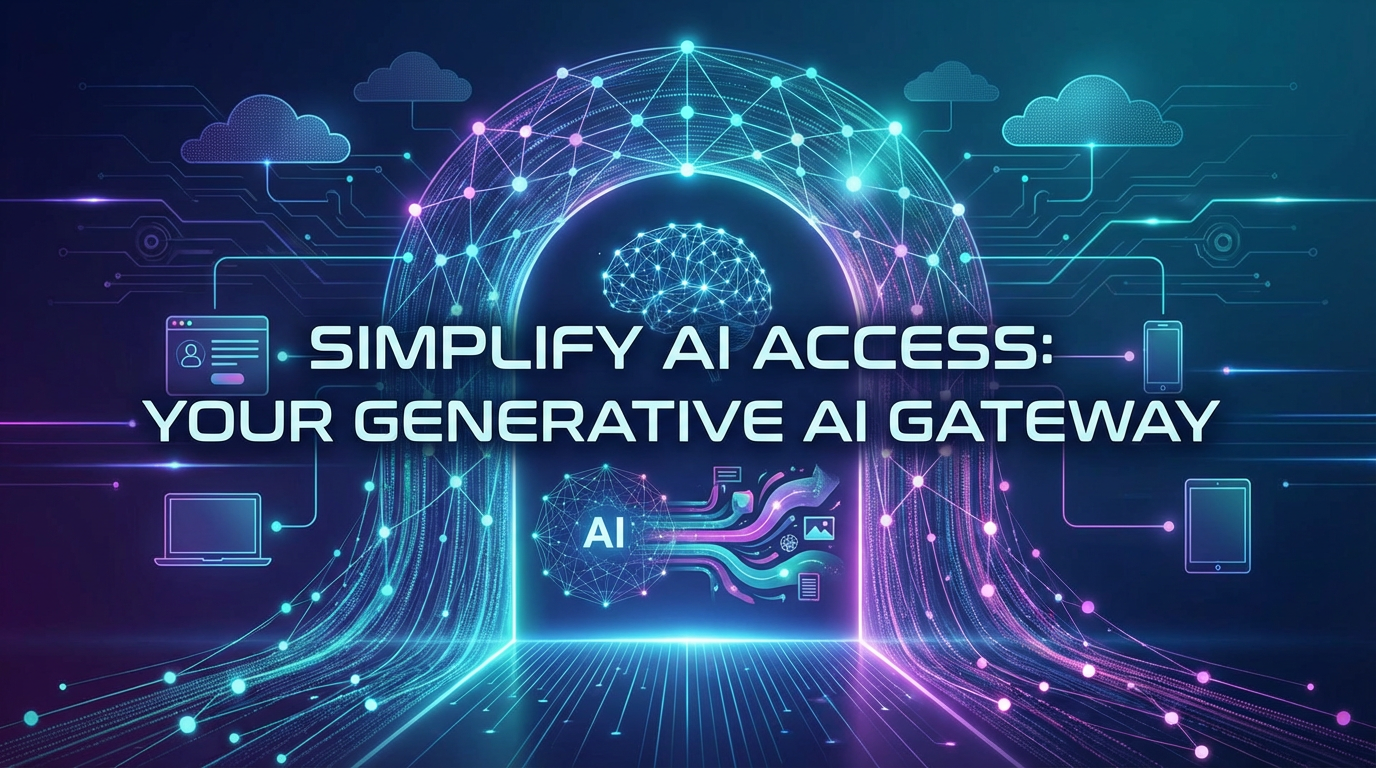


The digital landscape is undergoing a profound transformation, driven by the relentless march of artificial intelligence. At the vanguard of this revolution is Generative AI, a breathtaking class of models capable of creating novel content across various modalities – from text and code to images and music. Large Language Models (LLMs), a prominent subset of Generative AI, have captivated the world with their ability to understand, generate, and manipulate human language with unprecedented fluency and coherence. These technologies promise to unlock unparalleled levels of productivity, innovation, and creativity across every conceivable industry, reshaping how businesses operate, how developers build applications, and how individuals interact with technology.
However, the immense power of Generative AI and LLMs comes with a significant layer of complexity. Integrating these sophisticated models into existing systems, managing their diverse APIs, ensuring their reliable performance, and controlling their operational costs presents a formidable challenge for even the most seasoned technical teams. Developers often find themselves navigating a fragmented ecosystem of model providers, each with its own unique authentication mechanisms, data formats, rate limits, and pricing structures. The sheer effort required to abstract away these underlying complexities, while maintaining security and scalability, can quickly become a bottleneck, stifling innovation and delaying the time-to-market for AI-powered solutions.
This intricate landscape necessitates a sophisticated architectural component that can abstract away these complexities, providing a unified, secure, and efficient interface to the burgeoning world of AI. Enter the AI Gateway, the LLM Gateway, and the fundamental API Gateway. These architectural patterns are not merely technical conveniences; they are indispensable enablers that transform the daunting task of AI integration into a streamlined, manageable process. They act as intelligent intermediaries, standing between your applications and the multitude of AI services, simplifying access, enhancing control, bolstering security, and optimizing resource utilization. This article will delve deep into the critical role these gateways play, exploring their functionalities, benefits, and how they collectively pave the way for a more accessible and democratized AI future. Our journey will reveal how these gateways are not just tools, but strategic assets in the quest to harness the full potential of Generative AI, ultimately simplifying what was once a labyrinthine endeavor.
The Dawn of Generative AI and Its Intrinsic Challenges
The past few years have witnessed an explosive growth in Generative AI, particularly with the advent of Large Language Models (LLMs) like OpenAI's GPT series, Anthropic's Claude, Google's Gemini, and a plethora of open-source alternatives. These models, trained on colossal datasets, have demonstrated capabilities ranging from complex code generation and sophisticated content creation to nuanced sentiment analysis and multi-lingual translation. Businesses across sectors, from finance and healthcare to creative arts and education, are eager to integrate these transformative tools to automate tasks, personalize customer experiences, accelerate research, and unlock new revenue streams. The potential impact is truly revolutionary, promising to fundamentally alter how we conceive of human-computer interaction and the very nature of work.
Yet, beneath the glittering surface of AI's promise lies a tangled web of integration and operational challenges. The journey from a compelling AI proof-of-concept to a robust, production-ready application is often fraught with hurdles that can exhaust resources, delay deployment, and compromise the overall effectiveness of AI initiatives. Understanding these challenges is the first critical step towards appreciating the indispensable role of intelligent gateway solutions.
Navigating the Labyrinth of Direct AI Model Integration
Integrating Generative AI models directly into applications, without an intermediary layer, quickly exposes a multitude of complexities that can overwhelm development teams and introduce significant technical debt. Each model provider, whether it's a proprietary service or a self-hosted open-source solution, often presents its own unique set of requirements and quirks, demanding bespoke handling for almost every aspect of interaction.
- Diverse APIs and Protocols: One of the most immediate challenges is the sheer diversity of interfaces. OpenAI uses one REST API structure, Anthropic another, Google yet another, and then there are countless specialized models from niche providers, or even custom models developed in-house, each potentially requiring different client libraries, data formats, and invocation patterns. A typical application might need to interact with multiple models – perhaps an LLM for text generation, a vision model for image processing, and a specialized embedding model for retrieval-augmented generation (RAG). Managing these disparate interfaces directly within an application introduces considerable boilerplate code and makes the application logic brittle and difficult to maintain. Every new model integration or even a minor API version change from a provider could necessitate substantial code refactoring.
- Authentication and Authorization Complexities: Securing access to AI models is paramount. Each provider typically mandates its own authentication scheme, often involving API keys, OAuth tokens, or other proprietary credentials. Developers must manage these sensitive keys securely, rotating them regularly, and ensuring they are not hardcoded or exposed. Furthermore, authorizing different users or applications within an organization to access specific models or specific functionalities of a model requires a robust authorization framework. Implementing this granular control at the application level for every integrated AI service becomes an arduous task, increasing the risk of security vulnerabilities and unauthorized access.
- Rate Limiting and Quota Management: AI service providers impose strict rate limits to prevent abuse and ensure fair resource distribution. Exceeding these limits can lead to service disruptions, throttled requests, or even temporary bans. Managing these limits dynamically across multiple models and multiple instances of an application is a complex undertaking. Developers need to implement sophisticated retry mechanisms with exponential backoff, circuit breakers, and intelligent queuing systems to gracefully handle rate limit errors and optimize throughput without overwhelming the underlying AI services. Simultaneously, tracking the consumption of allocated quotas – whether it's tokens for LLMs or computation units for other models – is crucial for cost control and resource planning.
- Cost Tracking and Optimization: The operational costs associated with Generative AI models, especially LLMs, can be substantial, often calculated per token, per inference, or per minute of compute time. Without a centralized mechanism, tracking these costs across different models, different departments, and different projects becomes a nightmare. Moreover, optimizing costs often involves intelligent routing (e.g., using a cheaper, smaller model for simple tasks and a more expensive, powerful model for complex ones), caching frequently requested outputs, or batching requests – all of which add significant architectural overhead if implemented directly within the application.
- Data Security and Privacy Concerns: When sensitive data is sent to AI models for processing, ensuring its security, privacy, and compliance with regulations like GDPR, HIPAA, or CCPA is non-negotiable. This involves data encryption in transit and at rest, anonymization techniques, and strict access controls. Direct integration often means data flow paths are harder to monitor and control, increasing the risk of data leakage or non-compliance. Furthermore, some models may retain input data for training purposes, which can be a significant privacy concern for enterprises handling confidential information.
- Model Versioning and Updates: AI models are under continuous development, with providers frequently releasing new versions offering improved performance, new features, or bug fixes. While beneficial, these updates can introduce breaking changes to APIs or subtle shifts in model behavior, requiring applications to be updated and retested. Managing different model versions simultaneously – for instance, running an older version for legacy applications while testing a newer one for new features – poses a significant challenge without a centralized versioning strategy.
- Latency and Performance Optimization: The performance of AI-powered applications is often directly tied to the latency of the underlying AI models. While models themselves strive for speed, network latency, inefficient request handling, and lack of caching can significantly degrade the user experience. Optimizing performance requires techniques like intelligent routing to geographically closer endpoints, response caching for idempotent requests, and efficient connection management, all of which add complexity to direct integrations.
- Prompt Management and Standardization: For LLMs, the "prompt" is the primary interface. Effective prompt engineering is critical for eliciting desired outputs. However, managing a growing library of prompts, versioning them, conducting A/B tests to find optimal prompts, and ensuring consistency across different applications or user groups is a complex task. Without a centralized system, prompts can become fragmented, difficult to update, and prone to "prompt drift," where slight variations lead to inconsistent model behavior.
- Observability, Logging, and Monitoring: In a complex AI ecosystem, understanding what's happening – which requests are being made, which models are being invoked, what the success/failure rates are, and how much resources are being consumed – is vital for debugging, performance tuning, and operational stability. Implementing comprehensive logging, metrics collection, and alerting for every individual AI model interaction within an application is cumbersome and leads to fragmented observability.
- Scalability Issues: As user demand grows, applications need to scale seamlessly. Directly integrating AI models means the application itself must manage the scaling of AI requests, potentially leading to bottlenecks if not handled properly. Distributing load across multiple instances of AI services or managing a pool of API keys for higher throughput complicates application logic considerably.
These challenges collectively underscore the critical need for an intelligent intermediary layer – a gateway – that can abstract away these underlying complexities, providing developers with a simplified, unified, and robust interface to the powerful world of Generative AI.
Understanding the AI Gateway: Your Centralized AI Command Center
In light of the formidable challenges inherent in directly integrating and managing a multitude of Generative AI models, the AI Gateway emerges as an indispensable architectural pattern. Conceptually, an AI Gateway is a sophisticated, centralized management layer that sits between client applications and various AI services. It acts as a single entry point for all AI-related requests, orchestrating interactions, enforcing policies, and providing a unified operational view. Far beyond a simple proxy, an AI Gateway is an intelligent traffic controller, a security enforcer, a performance accelerator, and a cost optimizer, specifically tailored for the unique demands of artificial intelligence workloads.
What Exactly is an AI Gateway?
An AI Gateway is a specialized type of API Gateway (which we'll discuss in more detail later) that is purpose-built to handle the unique characteristics and requirements of AI models and services. It provides a consistent interface for consuming diverse AI capabilities, shielding client applications from the underlying intricacies of different AI providers, model versions, and deployment environments. Think of it as a universal translator and a smart router for your entire AI ecosystem, enabling seamless communication and efficient management.
Core Functions of an AI Gateway
To effectively address the integration challenges, an AI Gateway typically incorporates a rich set of functionalities designed to streamline every aspect of AI service consumption:
- Unified Access Point: At its heart, an AI Gateway offers a single, standardized endpoint for accessing multiple AI models, regardless of their original API structure or provider. This eliminates the need for applications to maintain separate client libraries or tailor requests to each specific model. Developers interact with the gateway's consistent API, and the gateway intelligently routes and transforms the requests to the appropriate backend AI service. This simplification dramatically reduces development effort and makes applications more resilient to changes in the underlying AI landscape.
- Authentication & Authorization: Security is paramount. An AI Gateway centralizes all authentication and authorization logic. Instead of managing API keys, OAuth tokens, or other credentials for each individual AI service within every application, the gateway handles this securely. It can validate incoming requests using a variety of schemes (e.g., API keys, JWTs, OAuth 2.0), enforce granular access policies (e.g., which user or application can access which model, with what permissions), and inject the necessary credentials to the backend AI service. This significantly enhances security posture, simplifies credential management, and enables robust audit trails.
- Rate Limiting & Throttling: To protect backend AI services from overload, prevent abuse, and manage costs, AI Gateways implement sophisticated rate limiting and throttling mechanisms. These controls can be applied globally, per API key, per user, or per application, ensuring fair usage and preventing any single client from monopolizing resources. When limits are reached, the gateway can queue requests, return appropriate error codes, or employ exponential backoff strategies, ensuring system stability and predictability.
- Request/Response Transformation: AI models often expect specific input formats and return outputs in various structures. An AI Gateway can perform real-time transformations on both incoming requests and outgoing responses. For instance, it can convert a generic request format into the specific JSON schema required by a particular LLM, or parse a complex AI response into a simpler, standardized format for the client application. This abstraction ensures that applications remain decoupled from the nuances of individual model APIs, making model switching or upgrading a far less disruptive process.
- Caching: To improve performance and reduce costs, an AI Gateway can cache responses from AI services. For idempotent requests (i.e., requests that produce the same output given the same input), the gateway can serve cached results directly, avoiding redundant calls to the backend AI model. This not only speeds up response times for frequently requested inferences but also reduces the number of billable requests made to external AI providers, leading to significant cost savings. Caching strategies can be sophisticated, considering factors like cache duration, invalidation policies, and cache key generation.
- Load Balancing: When multiple instances of an AI model are deployed (e.g., for high availability or scalability), or when an organization uses multiple providers for the same type of AI task, an AI Gateway can distribute incoming requests across these instances. This ensures optimal resource utilization, prevents any single instance from becoming a bottleneck, and improves overall system resilience. Load balancing can employ various algorithms, such as round-robin, least connections, or intelligent routing based on latency or cost.
- Monitoring & Analytics: An AI Gateway serves as a crucial vantage point for observing the entire AI ecosystem. It can collect comprehensive metrics on API call volumes, latency, error rates, token usage, and cost consumption. This data is invaluable for performance tuning, capacity planning, anomaly detection, and debugging. Centralized dashboards and alerts provide operators with real-time insights into the health and performance of their AI services, enabling proactive intervention and informed decision-making.
- Cost Management: Leveraging its monitoring capabilities, an AI Gateway can provide detailed breakdowns of AI service costs, attributed to specific applications, teams, or users. Beyond mere tracking, it can enforce budget limits, trigger alerts when thresholds are approached, and even implement intelligent routing rules to direct requests to cheaper models or providers when cost-efficiency is prioritized over maximum performance for certain tasks.
- Fallbacks & Retries: To enhance resilience, an AI Gateway can implement automatic retry mechanisms for transient errors, often with exponential backoff. More advanced gateways can also configure fallback strategies, where if a primary AI model or service fails or becomes unavailable, the request is automatically routed to a secondary, backup model or provider. This ensures a higher degree of service continuity and reliability for AI-powered applications.
Benefits of Adopting an AI Gateway
The adoption of an AI Gateway yields a multitude of strategic and operational benefits for organizations venturing into the realm of Generative AI:
- Simplified Developer Experience: Developers are liberated from the burden of complex AI integration. They interact with a consistent, well-documented API, allowing them to focus on building innovative applications rather than wrestling with provider-specific quirks. This acceleration of development cycles leads to faster time-to-market for AI products and features.
- Enhanced Security: Centralized authentication, authorization, and policy enforcement significantly reduce the attack surface and simplify security audits. Sensitive API keys and credentials are confined to the gateway, minimizing their exposure to client applications. Data governance and compliance can be enforced at a single control point.
- Improved Performance & Reliability: Caching, load balancing, and intelligent routing strategies optimize response times and throughput. Fallback mechanisms and automatic retries ensure higher availability and resilience against transient failures or service outages from AI providers.
- Cost Efficiency: Through intelligent routing, caching, and comprehensive cost tracking, an AI Gateway helps organizations optimize their AI expenditure, preventing runaway costs and enabling informed budget allocation. The ability to switch between models based on cost-performance trade-offs is a powerful financial lever.
- Agility & Flexibility in Model Switching: With the gateway abstracting away underlying models, organizations can easily swap out one AI model for another (e.g., upgrading to a newer version, switching providers, or integrating an in-house model) without requiring significant changes to client applications. This future-proofs applications against the rapidly evolving AI landscape.
- Centralized Governance: The gateway acts as a single point of control for managing all AI-related policies, configurations, and monitoring. This ensures consistency, simplifies compliance efforts, and provides a holistic view of AI service consumption across the entire enterprise.
- Innovation Acceleration: By reducing the technical overhead and risk associated with AI integration, organizations are empowered to experiment more freely with different AI models and applications, fostering a culture of innovation and rapid prototyping.
In essence, an AI Gateway transforms the complex, fragmented world of Generative AI into a manageable, secure, and performant ecosystem. It's not just an infrastructure component; it's a strategic enabler that empowers businesses to fully realize the transformative potential of artificial intelligence without being bogged down by its inherent complexities.
Delving Deeper: The LLM Gateway – A Specialized AI Gateway for Language Models
While the general concept of an AI Gateway provides a robust framework for managing diverse AI services, the unique characteristics and operational demands of Large Language Models (LLMs) warrant a specialized approach. The sheer volume of text data, the token-based pricing models, the criticality of prompt engineering, and the nuances of conversational AI necessitate a more focused set of functionalities. This is where the LLM Gateway comes into play – an evolution of the AI Gateway, specifically engineered to optimize interactions with language models.
Why a Specific LLM Gateway? The Unique Challenges of LLMs
LLMs, despite their incredible versatility, present several distinct challenges that go beyond those of typical AI models, requiring specialized gateway capabilities:
- Token Management and Cost Per Token: LLM costs are often calculated per "token" – a unit of text that can be a word, part of a word, or punctuation. Both input prompts and generated outputs contribute to token usage. Managing and optimizing token consumption is crucial for cost control, especially with varying prices per model and context window size. A general AI Gateway might track API calls, but an LLM Gateway needs granular token-level visibility and control.
- Prompt Engineering and Versioning: The effectiveness of an LLM is heavily dependent on the quality and structure of the input prompt. Crafting effective prompts ("prompt engineering") is an iterative, skill-intensive process. As applications evolve, prompts need to be versioned, tested (e.g., A/B testing different prompts), and updated centrally. Direct application integration leads to scattered prompt logic, making it difficult to maintain, optimize, or share best practices across teams.
- Context Window Management: LLMs have a finite "context window" – the maximum amount of input text (tokens) they can process in a single turn. For conversational applications, managing past turns of conversation to keep within this window, summarize older parts, or retrieve relevant information is a complex task. An LLM Gateway can assist in managing this conversational state without burdening the application.
- Model Output Parsing and Validation: While LLMs are excellent at generating text, their outputs are not always perfectly structured or suitable for direct application consumption. Often, outputs need to be parsed (e.g., extracting JSON from a text response), validated against schemas, or even re-prompted if the initial output doesn't meet specific criteria (self-correction).
- Model Routing for LLMs: With a growing number of LLM providers and open-source models, organizations often need to dynamically choose the best model for a given task. This choice might be based on cost (e.g., cheaper model for simple queries), performance (e.g., faster model for real-time interaction), capabilities (e.g., a specific model for code generation), or compliance. Routing logic needs to be intelligent and LLM-aware.
- Guardrails and Content Moderation: LLMs, especially general-purpose ones, can sometimes generate undesirable, unsafe, or biased content. Implementing safety guardrails, content moderation filters, and ethical AI principles is critical for responsible deployment. This often involves pre- and post-processing steps that are best centralized.
- Fine-tuning Management: Organizations often fine-tune base LLMs with their proprietary data to enhance performance for specific use cases. An LLM Gateway can help manage the routing to these fine-tuned models, perhaps selectively using them for certain user groups or types of queries, while falling back to base models for others.
- Latency for Streaming Outputs: Many LLM applications benefit from streaming responses, where tokens are sent back to the client as they are generated, providing a more interactive user experience. An LLM Gateway needs to efficiently handle and proxy these streaming connections, ensuring low latency and reliable data delivery.
Key Features of an LLM Gateway
Given these specialized challenges, an LLM Gateway extends the capabilities of a general AI Gateway with features tailored for language models:
- Prompt Management and Versioning: This is a cornerstone feature. An LLM Gateway allows developers to define, store, version, and manage prompts centrally. Instead of embedding prompts directly in application code, applications reference a prompt by ID or name, allowing prompt engineers to iterate, optimize, and A/B test different prompt strategies without requiring application redeployments. This enables dynamic prompt injection, pre-processing, and post-processing of prompts before they reach the LLM, ensuring consistency and maximizing model effectiveness.
- Model Routing and Orchestration (LLM-Specific): Beyond simple load balancing, an LLM Gateway implements sophisticated routing logic. It can dynamically select the most appropriate LLM based on various criteria:
- Cost: Directing requests to the cheapest available model that meets quality standards.
- Performance: Choosing the fastest model for real-time interactions.
- Capability: Routing specific types of queries (e.g., code generation, summarization) to specialized models.
- Availability: Falling back to a secondary model if the primary is unavailable.
- User/Team: Assigning specific models or fine-tuned versions to particular user groups or departments.
- A/B Testing: Distributing traffic across different models or prompt versions for experimentation.
- Token Optimization and Cost Control: The gateway provides granular monitoring of token usage per request, per user, per application, and per model. It can implement strategies to reduce token usage, such as automatically summarizing long inputs before sending them to the LLM or stripping unnecessary metadata from responses. It can also enforce hard token limits per request to prevent unexpected cost spikes.
- Response Streaming Management: Efficiently handles the streaming of LLM responses back to client applications. It ensures that tokens are delivered with minimal latency, maintains the connection, and can even inject metadata or perform light post-processing on the streamed chunks without buffering the entire response.
- Safety and Compliance Guardrails: An LLM Gateway can integrate with content moderation APIs or implement its own logic to filter out unsafe, biased, or non-compliant inputs before they reach the LLM, and to scrub undesirable outputs before they are returned to the client. This centralized enforcement of ethical AI guidelines is critical for responsible deployment, especially in sensitive domains.
- Context Management and Conversation History: For stateful conversational AI applications, the gateway can manage the conversation history, intelligently summarizing or truncating older turns to fit within the LLM's context window. This offloads complex state management logic from the application layer.
- Output Transformation and Schema Validation: The gateway can automatically parse LLM outputs, extract structured data (e.g., JSON, XML), and validate it against predefined schemas. If the output doesn't conform, the gateway can initiate a retry with an adjusted prompt or flag the issue, ensuring applications receive reliable and usable data.
Benefits of an LLM Gateway
The adoption of an LLM Gateway translates into distinct advantages for organizations building with Generative AI:
- Streamlined LLM Development and Deployment: Developers can integrate new LLMs or fine-tuned models rapidly without modifying application code, thanks to standardized interfaces and centralized prompt management. This significantly accelerates the pace of innovation.
- Reduced Operational Overhead for LLM Applications: By offloading concerns like token management, model routing, and prompt versioning to the gateway, application developers can focus on core business logic, reducing complexity and maintenance effort.
- Improved Cost Control for LLM Usage: Granular token tracking, intelligent cost-aware routing, and caching mechanisms lead to significant reductions in LLM API expenses, ensuring that budget is spent efficiently.
- Enhanced Security and Compliance for Sensitive LLM Interactions: Centralized guardrails, data filtering, and access controls mitigate risks associated with sensitive data and undesirable content generation, helping organizations meet regulatory and ethical requirements.
- Greater Flexibility and Vendor Lock-in Mitigation: The abstraction layer provided by the LLM Gateway allows organizations to easily switch between LLM providers or integrate open-source models without disrupting existing applications, providing strategic independence and negotiation leverage.
- Consistent User Experience: By managing prompts centrally and ensuring consistent model interaction, the gateway helps deliver a more predictable and high-quality user experience across all LLM-powered applications.
In essence, an LLM Gateway is more than just an intermediary; it's a strategic platform that elevates the development, deployment, and management of Large Language Models from a complex, ad-hoc process to a streamlined, controlled, and cost-effective operation. It is the crucial piece of infrastructure that bridges the gap between raw LLM power and robust, enterprise-grade AI applications.
The Foundational Role: The API Gateway – The Bedrock of Modern Service Architectures
Before the advent of specialized AI or LLM Gateways, there was (and still is) the API Gateway. This architectural pattern has long been a cornerstone of modern distributed systems, particularly in environments leveraging microservices. Understanding the API Gateway is crucial because AI and LLM Gateways are, in essence, highly specialized extensions or evolutions of this foundational concept, tailored for the unique nuances of artificial intelligence workloads.
What is an API Gateway?
An API Gateway is a server that sits at the "edge" of a microservices architecture, acting as a single entry point for all client requests. Instead of clients having to directly interact with multiple backend microservices, they send requests to the API Gateway, which then intelligently routes those requests to the appropriate services, aggregates responses, and applies various policies. It serves as a façade, simplifying the client-side experience and centralizing cross-cutting concerns that would otherwise need to be implemented redundantly in each microservice or client application.
The adoption of API Gateways surged with the rise of microservices, where a single application is broken down into numerous smaller, independently deployable services. Without a gateway, a client application would need to know the specific endpoints of dozens or hundreds of services, manage their individual authentication, and aggregate data from multiple sources – a challenging and brittle proposition. The API Gateway elegantly solves this by providing a unified, simplified interface to the entire backend.
Core API Gateway Functionalities (A Recap in Context)
While an API Gateway handles general HTTP/REST traffic, its core functionalities are directly analogous to, and form the basis for, the more specialized AI/LLM Gateways. These functionalities include:
- Request Routing: The primary function is to route incoming requests from clients to the correct backend microservice based on the request path, HTTP method, headers, or other criteria. This ensures that clients interact with a single endpoint, and the gateway intelligently directs traffic.
- Protocol Translation/API Composition: It can translate between different protocols (e.g., HTTP to gRPC). More importantly, it can compose multiple backend service calls into a single response for the client. For instance, a mobile app might need data from a user service, an order service, and a product catalog service; the API Gateway can fan out these requests, aggregate the results, and return a single, tailored response to the client. This reduces chatty communication between client and backend.
- Authentication/Authorization: The API Gateway centralizes security. It can authenticate incoming client requests using various mechanisms (e.g., API keys, JWTs, OAuth 2.0) and enforce authorization policies to determine if the client is permitted to access a particular backend service or resource. This offloads security concerns from individual microservices and ensures consistent policy enforcement.
- Rate Limiting: Similar to AI Gateways, API Gateways implement rate limiting to protect backend services from being overwhelmed by too many requests from a single client. This ensures fair usage, prevents denial-of-service attacks, and maintains system stability.
- Caching: For frequently accessed, idempotent requests, the API Gateway can cache responses, serving them directly from its cache. This significantly reduces latency for clients and decreases the load on backend services, improving overall system performance and efficiency.
- Load Balancing: When multiple instances of a backend service are running, the API Gateway can distribute incoming requests across these instances. This improves scalability, ensures high availability, and prevents any single service instance from becoming a bottleneck.
- Monitoring and Logging: The gateway acts as a central point for collecting metrics (request counts, latency, error rates) and logs for all API traffic. This provides valuable insights into API usage patterns, service health, and aids in debugging and performance tuning across the entire microservices ecosystem.
- API Versioning: It allows organizations to manage different versions of their APIs (e.g.,
/v1/users,/v2/users). The gateway can route requests to the appropriate backend service version, enabling seamless API evolution without breaking existing client applications. - Transformation: The gateway can transform request or response payloads, modifying headers, query parameters, or body content to meet the specific requirements of clients or backend services.
How AI/LLM Gateways Extend API Gateways
The relationship between API Gateways and AI/LLM Gateways is one of specialization and extension. An AI/LLM Gateway leverages all the fundamental capabilities of a general API Gateway but builds upon them with AI-specific intelligence and features.
Consider the general API Gateway as the sturdy foundation and structure of a house. It provides the walls, roof, plumbing, and electricity (routing, security, load balancing, etc.). An AI Gateway, then, adds specialized rooms and appliances tailored for AI life – perhaps a dedicated "prompt engineering studio" (prompt management), a "cost optimization control panel" (token tracking, intelligent routing), or a "safety and compliance monitoring station" (guardrails).
Here’s how AI/LLM Gateways extend the core API Gateway functionalities:
- AI-Specific Authentication: While an API Gateway handles generic API keys or OAuth, an AI Gateway might have direct integrations with AI provider authentication schemes (e.g., securely storing and rotating OpenAI API keys) and inject them transparently.
- AI Model Abstraction: A general API Gateway routes to backend services. An AI Gateway routes to AI models, abstracting not just the service endpoint but also the model's unique invocation patterns, data schemas, and versioning, allowing seamless swapping of models.
- Prompt Engineering Features: This is a distinct extension. A standard API Gateway has no concept of a "prompt." An LLM Gateway specifically introduces prompt templating, versioning, A/B testing, and dynamic injection, which are critical for LLM performance and cost optimization.
- Token Usage Monitoring: An API Gateway tracks request counts and data volume. An LLM Gateway goes deeper, providing granular tracking of token usage for LLM inputs and outputs, which is directly tied to billing and cost management for language models.
- AI-Specific Caching Strategies: While both can cache, an AI Gateway might employ more sophisticated caching tailored for AI. For instance, it could hash input prompts and parameters to cache responses from LLMs, or cache embeddings from an embedding model for RAG architectures.
- Conditional Routing Based on AI Model Performance or Cost: An API Gateway routes based on service availability or path. An AI Gateway (especially an LLM Gateway) adds intelligence to route based on real-time factors like which LLM is currently cheapest, has the lowest latency, or performs best for a given prompt (e.g., routing a simple summarization task to a smaller, cheaper model).
- AI Safety and Content Moderation: This is a highly specialized area. While an API Gateway might have generic input validation, an AI Gateway integrates or applies specific AI guardrails, content filters, and bias detection mechanisms relevant to generative outputs.
In essence, the API Gateway provides the fundamental robust, scalable, and secure infrastructure for managing any API traffic. The AI Gateway and LLM Gateway then build upon this robust foundation, injecting AI-specific intelligence and optimizations to specifically address the nuanced demands of interacting with artificial intelligence models, particularly the increasingly prevalent Large Language Models. They represent the specialized tools built on top of a well-established and proven architectural pattern, ensuring that the power of AI can be accessed and managed with unprecedented ease and control.
APIPark is a high-performance AI gateway that allows you to securely access the most comprehensive LLM APIs globally on the APIPark platform, including OpenAI, Anthropic, Mistral, Llama2, Google Gemini, and more.Try APIPark now! 👇👇👇
APIPark: A Practical Solution for Generative AI Gateway Needs
Having explored the theoretical underpinnings and practical necessities of AI, LLM, and API Gateways, it's beneficial to examine a real-world solution that embodies these principles. This is where APIPark comes into focus. APIPark is an open-source AI gateway and API management platform designed to help developers and enterprises navigate the complexities of managing, integrating, and deploying both AI and traditional REST services with remarkable ease. It represents a comprehensive approach to API lifecycle governance, explicitly addressing many of the challenges we've discussed.
APIPark stands out by offering a unified platform that not only provides the foundational API Gateway capabilities but also incorporates specialized features crucial for the effective management of Generative AI and LLMs. Its open-source nature under the Apache 2.0 license fosters transparency and community involvement, while its enterprise-grade features and commercial support options cater to organizations of all sizes.
Let's delve into how APIPark addresses the core requirements of an AI/LLM/API Gateway, connecting its features directly to the problems identified earlier:
- Quick Integration of 100+ AI Models: One of the primary pain points for developers is the diverse landscape of AI models. APIPark tackles this head-on by offering the capability to integrate a vast array of AI models (over 100, according to its features) within a unified management system. This directly solves the challenge of diverse APIs and protocols, providing a single, consistent interface. Developers no longer need to write bespoke integration code for OpenAI, Anthropic, Google AI, or custom models; APIPark abstracts these differences, simplifying the unified access point function of an AI Gateway. It also centralizes authentication and cost tracking for these integrated models, streamlining security and operational insights.
- Unified API Format for AI Invocation: This feature is crucial for maintaining agility. APIPark standardizes the request data format across all integrated AI models. This means that if an organization decides to switch from one LLM provider to another, or even upgrade to a newer version of a model, the client applications or microservices consuming the AI service via APIPark remain unaffected. This directly addresses the problem of model versioning and updates and request/response transformation, ensuring that changes in underlying AI models or prompts do not ripple through the application layer, significantly reducing maintenance costs and enhancing agility and flexibility.
- Prompt Encapsulation into REST API: For LLMs, prompt engineering is vital. APIPark allows users to quickly combine AI models with custom prompts to create new, specialized APIs. For instance, one could create a "Sentiment Analysis API" or a "Translation API" that internally uses a generic LLM but is encapsulated with a specific prompt within APIPark. This feature directly supports prompt management and versioning, enabling organizations to manage their prompt library centrally, version prompts, and expose them as robust, versioned REST APIs. This greatly simplifies how applications consume prompt-driven AI functionalities and promotes reusability.
- End-to-End API Lifecycle Management: Beyond AI, APIPark functions as a full-fledged API Gateway. It assists with managing the entire lifecycle of APIs, encompassing design, publication, invocation, and decommissioning. This robust capability addresses the core needs of a traditional API Gateway, regulating API management processes, managing traffic forwarding, load balancing, and versioning of published APIs. This ensures that all APIs, whether AI-powered or traditional REST, are governed under a consistent and controlled framework, reinforcing centralized governance.
- API Service Sharing within Teams: In larger organizations, API discovery and sharing can be a challenge. APIPark facilitates this by allowing the centralized display of all API services. This means different departments and teams can easily find and use the required API services, fostering collaboration and preventing redundant development efforts. This promotes a more efficient developer experience and leverages the gateway as a developer portal.
- Independent API and Access Permissions for Each Tenant: For multi-departmental enterprises or SaaS providers, multi-tenancy is critical. APIPark enables the creation of multiple teams (tenants), each with independent applications, data, user configurations, and security policies. While sharing underlying infrastructure, each tenant operates in a secure, isolated environment. This directly enhances security and allows for granular authentication and authorization, ensuring data isolation and operational efficiency by improving resource utilization and reducing operational costs.
- API Resource Access Requires Approval: To prevent unauthorized access and potential data breaches, APIPark allows for the activation of subscription approval features. Callers must subscribe to an API and await administrator approval before they can invoke it. This robust mechanism adds an extra layer of security, enforcing strict access control and accountability for API consumption, which is especially vital for sensitive AI services.
- Performance Rivaling Nginx: Performance is a non-negotiable requirement for high-traffic applications. APIPark boasts impressive performance, capable of achieving over 20,000 Transactions Per Second (TPS) with modest hardware (8-core CPU, 8GB memory). Its support for cluster deployment further ensures it can handle large-scale traffic, directly addressing concerns about latency and performance optimization and scalability. This ensures that the gateway itself doesn't become a bottleneck for demanding AI workloads.
- Detailed API Call Logging: Observability is key to operational stability. APIPark provides comprehensive logging capabilities, recording every detail of each API call. This feature is invaluable for quickly tracing and troubleshooting issues in API calls, ensuring system stability and data security. This fulfills the critical monitoring and analytics function, providing granular insights into AI service usage and performance, aiding in debugging and audit trails.
- Powerful Data Analysis: Beyond raw logs, APIPark analyzes historical call data to display long-term trends and performance changes. This predictive capability helps businesses with preventive maintenance before issues occur, further enhancing observability and supporting proactive performance optimization and capacity planning. This allows for informed decisions on AI resource allocation and strategy.
Here's a summarized comparison illustrating how APIPark's features align with gateway concepts:
| Gateway Concept / Challenge Solved | APIPark Feature | Benefit |
|---|---|---|
| Unified Access / Diverse APIs | Quick Integration of 100+ AI Models | Simplifies AI service consumption, reduces developer effort, and accelerates time-to-market. |
| Model Abstraction / Consistency | Unified API Format for AI Invocation | Decouples applications from underlying AI models, ensuring agility and minimizing refactoring needs. |
| Prompt Management / Reusability | Prompt Encapsulation into REST API | Centralizes prompt engineering, allows for shared, versioned AI functionalities as simple APIs. |
| API Governance / Lifecycle Mgmt. | End-to-End API Lifecycle Management | Provides comprehensive control over all APIs, ensuring consistency, versioning, and policy enforcement. |
| Security / Authorization | Independent API & Access Permissions for Each Tenant | Granular control over API access for different teams/users, enhancing security and resource isolation. |
| Security / Access Control | API Resource Access Requires Approval | Prevents unauthorized API calls, adding a critical layer of security for sensitive AI services. |
| Performance / Scalability | Performance Rivaling Nginx; Cluster Deployment | Ensures the gateway can handle high volumes of AI requests with low latency and high availability. |
| Observability / Debugging | Detailed API Call Logging & Powerful Data Analysis | Offers deep insights into AI service usage, performance, and issues for proactive management. |
| Cost Optimization / Tracking | (Implicit via unified management & data analysis) | Enables informed decisions for AI resource allocation and cost reduction strategies. |
| Developer Experience | API Service Sharing within Teams | Fosters collaboration, improves API discoverability, and streamlines integration across the enterprise. |
APIPark, an open-source AI gateway and API management platform, provides a robust solution for developers and enterprises seeking to simplify AI access.
APIPark, launched by Eolink, a leader in API lifecycle governance, leverages its deep expertise in API management to deliver a product that is both powerful and practical. Its ability to offer both a robust open-source product for startups and a commercial version with advanced features and professional technical support for leading enterprises demonstrates its commitment to serving the entire spectrum of the market. By providing a powerful API governance solution, APIPark empowers developers, operations personnel, and business managers alike to enhance efficiency, security, and data optimization in their AI endeavors.
Implementation Strategies and Best Practices for AI Gateways
Deploying and managing an AI Gateway effectively requires careful planning, strategic decisions, and adherence to best practices. Simply installing a gateway without considering its integration into the broader ecosystem, its operational lifecycle, and its security implications can negate many of its potential benefits. This section will outline key considerations for implementing AI Gateways, helping organizations maximize their value while mitigating common pitfalls.
Choosing the Right Gateway Solution
The market offers a variety of AI Gateway solutions, from open-source projects to commercial products, and cloud-native services to self-hosted platforms. The choice depends heavily on an organization's specific needs, existing infrastructure, budget, and expertise.
- Open-Source vs. Commercial: Open-source solutions like APIPark often provide flexibility, transparency, and cost-effectiveness, especially for startups or organizations with strong in-house development capabilities. They allow for customization and community support. Commercial products, on the other hand, typically offer advanced features, dedicated professional support, SLAs, and often a more polished user experience, which can be critical for large enterprises with complex compliance and operational requirements.
- Cloud-Native vs. Self-Hosted: Cloud-native gateways integrate seamlessly with public cloud providers' ecosystems, leveraging managed services for scalability, security, and maintenance. They reduce operational overhead but can lead to vendor lock-in. Self-hosted gateways offer maximum control, data sovereignty, and can be deployed in hybrid or on-premise environments, but they demand significant operational expertise for deployment, scaling, and maintenance.
- Feature Set Alignment: Crucially, evaluate the gateway's features against your specific AI integration challenges. Does it support your desired AI models? Does it offer the necessary prompt management, cost tracking, security policies, and performance optimizations required for your use cases? For LLM-heavy applications, ensure it has robust LLM-specific features.
Deployment Considerations: Scalability, High Availability, Disaster Recovery
An AI Gateway is a critical component; its failure can bring down all AI-powered applications. Therefore, robust deployment strategies are essential.
- Scalability: The gateway must be able to scale horizontally to handle fluctuating traffic demands. This means deploying it in a cluster behind a load balancer, ensuring that new instances can be added or removed dynamically. Consider containerization (Docker) and orchestration (Kubernetes) for efficient scaling and resource management.
- High Availability (HA): Deploy the gateway across multiple availability zones or data centers to ensure continuous operation even if one zone experiences an outage. This involves redundant instances, shared data stores, and failover mechanisms.
- Disaster Recovery (DR): Establish a comprehensive DR plan. This includes regular backups of gateway configurations, policies, and data, along with a strategy for quickly restoring service in an entirely separate region in the event of a catastrophic failure of the primary deployment.
Security Best Practices
The gateway is a critical security choke point. Implementing robust security measures is paramount.
- API Key Management: Implement a secure system for generating, distributing, revoking, and rotating API keys. Avoid embedding keys directly in client applications. Use environment variables or secure secrets management tools.
- OAuth 2.0 / JWT: For user-based authentication, leverage industry-standard protocols like OAuth 2.0 or JSON Web Tokens (JWT). The gateway should validate these tokens and extract user identity for authorization.
- Role-Based Access Control (RBAC): Define granular roles and permissions within the gateway. Ensure that only authorized users or applications can access specific AI models or perform specific actions.
- Data Encryption: Enforce HTTPS/TLS for all communication between clients and the gateway, and between the gateway and backend AI services. If sensitive data is cached, ensure it is encrypted at rest.
- Input Validation and Sanitization: Implement rigorous validation and sanitization of all inputs at the gateway level to prevent common web vulnerabilities (e.g., injection attacks).
- Content Moderation and Guardrails: For LLM Gateways, proactively implement content moderation filters for both inputs (prompts) and outputs to prevent the generation or transmission of harmful, biased, or non-compliant content.
Observability: Logging, Metrics, Tracing
Comprehensive observability is crucial for monitoring the health, performance, and usage of your AI ecosystem.
- Centralized Logging: All gateway logs (request details, errors, policy violations, token usage) should be aggregated into a centralized logging system (e.g., ELK Stack, Splunk, Datadog). This enables quick searching, analysis, and debugging.
- Metrics Collection: Collect key performance indicators (KPIs) such as request volume, latency, error rates, cache hit ratios, and token usage. Export these metrics to a monitoring system (e.g., Prometheus, Grafana, New Relic) for real-time dashboards and alerting.
- Distributed Tracing: Implement distributed tracing (e.g., OpenTelemetry, Jaeger) to track individual requests as they flow through the gateway and various backend AI services. This helps diagnose latency issues and understand complex request flows.
- Alerting: Configure alerts for critical events, such as high error rates, service outages, rate limit breaches, or cost thresholds being exceeded.
Cost Optimization Strategies
An AI Gateway is a powerful tool for controlling and optimizing AI expenses.
- Intelligent Routing: Implement logic to route requests based on cost. For example, direct routine or less critical tasks to cheaper, smaller models, while reserving powerful, more expensive models for complex or high-value tasks.
- Caching: Aggressively cache responses for idempotent requests. Analyze usage patterns to identify frequently asked questions or common AI inferences that can be served from the cache, significantly reducing billable API calls.
- Budget Alerts: Configure alerts within the gateway or your monitoring system to notify teams when AI consumption approaches predefined budget thresholds, preventing unexpected cost overruns.
- Token Optimization (for LLMs): For LLM Gateways, implement features that optimize token usage, such as automatic summarization of long inputs, truncation, or stripping of unnecessary context before sending to the LLM.
- Provider Diversification: By abstracting AI models, the gateway enables easy switching between providers. This allows organizations to leverage competitive pricing and avoid vendor lock-in.
DevOps Integration: CI/CD for Gateway Configurations
Treat gateway configurations (routes, policies, rate limits, prompt definitions) as code.
- Version Control: Store all gateway configurations in a version control system (e.g., Git). This allows for tracking changes, collaboration, and rollback capabilities.
- CI/CD Pipelines: Implement Continuous Integration/Continuous Delivery (CI/CD) pipelines to automate the deployment and management of gateway configurations. This ensures consistency, reduces manual errors, and accelerates changes.
- Automated Testing: Include automated tests for gateway configurations, ensuring that routing rules work as expected, security policies are enforced, and performance benchmarks are met before changes are deployed to production.
Future-Proofing: Designing for New Models and Evolving AI Landscape
The AI landscape is dynamic. Design your gateway implementation to be adaptable.
- Extensibility: Choose a gateway that is extensible, allowing you to easily add support for new AI models, custom integrations, or specialized pre/post-processing logic without disrupting existing services.
- Modular Architecture: A modular gateway design allows for easy swapping or upgrading of individual components (e.g., authentication module, routing engine) as new technologies emerge.
- Open Standards: Favor gateways that adhere to open standards where possible, reducing vendor lock-in and promoting interoperability.
By meticulously planning and adhering to these best practices, organizations can transform their AI Gateway from a mere proxy into a strategic asset that simplifies AI access, enhances security, optimizes performance and cost, and ensures the long-term success of their AI initiatives. This comprehensive approach is what truly unlocks the potential of Generative AI for the enterprise.
The Future of AI Gateways: Intelligent Orchestration and Beyond
The evolution of AI Gateways is far from complete. As artificial intelligence continues its rapid advancement, the demands placed on these intermediary layers will grow in sophistication and complexity. The future vision for AI Gateways points towards more intelligent, autonomous, and deeply integrated platforms that don't just route and manage, but actively optimize, protect, and evolve alongside the AI models they serve. This next generation of gateways will be crucial in democratizing access to increasingly powerful and diverse AI capabilities.
More Sophisticated Model Routing and Multi-Modal AI
Current LLM Gateways primarily route between different text-based models. The future will see gateways that orchestrate multi-modal AI interactions seamlessly. Imagine a single request that involves: * Sending an image to a vision model for object detection. * Taking the detected objects and generating a textual description using an LLM. * Feeding that description to a text-to-speech model. * All orchestrated and optimized through a single gateway endpoint.
Intelligent routing will move beyond cost/latency to incorporate context-awareness, dynamically selecting the best combination of models (e.g., combining a small, fast model for initial filtering with a larger, more powerful model for deep analysis) based on the input data type, user intent, or even the emotional tone of the query. Gateways will become true AI orchestrators, managing complex AI pipelines rather than just single model invocations.
Enhanced Prompt Optimization and Management Tools
Prompt engineering is an evolving discipline, and future AI Gateways will embed advanced tools to automate and optimize this process. * AI-Powered Prompt Generation/Refinement: The gateway itself might use an LLM to automatically generate or refine prompts based on desired outcomes, reducing the manual effort of prompt engineers. * Adaptive Prompting: Gateways could dynamically adjust prompts based on real-time feedback, user behavior, or even the specific model version being invoked, ensuring optimal performance across a diverse and evolving AI landscape. * Prompt Governance: More robust version control, A/B testing frameworks, and sharing mechanisms will become standard, akin to code repositories but for prompts. * Contextual Prompt Injection: Intelligent gateways will manage and inject complex, dynamic context into prompts, such as user history, retrieved knowledge, or real-time data, enabling more sophisticated and personalized AI interactions without burdening the application.
Integrated AI Safety and Ethical AI Enforcement
As AI becomes more pervasive, the risks of bias, misinformation, and harmful content generation escalate. Future AI Gateways will play an even more critical role in enforcing ethical AI guidelines. * Proactive Guardrails: Beyond simple keyword filtering, gateways will employ advanced semantic analysis and even secondary AI models to detect and mitigate bias, toxicity, and hallucinations in real-time. * Explainable AI (XAI) Integration: Gateways could provide hooks or even generate summaries of why an AI model produced a certain output, or why a request was blocked, enhancing transparency and trust. * Compliance Automation: Automated checks against evolving regulatory frameworks (e.g., EU AI Act) will be built into gateways, ensuring that AI usage remains compliant. * Data Provenance and Lineage: Tracking the flow of data through AI models via the gateway will become standard, crucial for auditing and accountability.
AI-Powered Gateway Intelligence (Autonomous Optimization)
The ultimate evolution will see AI Gateways becoming intelligent agents themselves. * Autonomous Resource Management: Using AI, the gateway could dynamically adjust rate limits, cache invalidation policies, and load balancing algorithms based on predicted traffic patterns, cost targets, and real-time performance metrics, continuously optimizing itself. * Self-Healing Capabilities: AI could enable the gateway to automatically detect and resolve issues (e.g., switch to a healthy model instance, adjust routing on detected latency spikes) without human intervention. * Predictive Cost Management: AI-driven analytics will predict future AI consumption and costs, allowing organizations to proactively adjust budgets and resource allocation.
Closer Integration with MLOps Platforms
The distinction between AI development, deployment, and operations will blur further. Future AI Gateways will integrate more deeply with broader MLOps (Machine Learning Operations) platforms, providing a unified pipeline from model training to production inference and monitoring. * Automated Model Deployment: Gateways will facilitate the seamless deployment of newly trained or fine-tuned models directly into the production environment. * Feedback Loops: Data captured by the gateway (e.g., model performance, user satisfaction signals) will feed directly back into MLOps pipelines to inform model retraining and improvement.
Decentralized AI Gateways and Federated Learning Implications
The rise of privacy-preserving AI and federated learning could lead to decentralized or distributed AI Gateway architectures. * Edge AI Gateways: Gateways deployed closer to the data source (on-device, at the edge) for low-latency inference and enhanced privacy, only sending aggregated or anonymized data to central models. * Federated Gateways: Orchestrating interactions with models trained across decentralized datasets without centralizing the raw data.
The Role of Open Standards and Interoperability
As the AI ecosystem fragments, the need for open standards for AI model invocation, prompt exchange, and security will become paramount. Future AI Gateways will be critical in driving and adopting these standards, ensuring interoperability across different providers and preventing vendor lock-in.
The future AI Gateway will transcend its current role as a mere proxy or management layer. It will evolve into an intelligent, adaptive, and proactive orchestrator of AI, acting as the brain of an organization's AI ecosystem. This transformation will not only further simplify AI access but will also ensure that AI is leveraged responsibly, efficiently, and at an unprecedented scale, making its transformative power accessible to an even wider audience.
Conclusion
The journey into the world of Generative AI, especially with the phenomenal rise of Large Language Models, promises unprecedented innovation and efficiency. However, this exciting frontier is also marked by significant complexities: diverse APIs, intricate authentication schemes, elusive cost controls, and the critical need for robust security and performance. Directly confronting these challenges within every application quickly becomes a daunting task, stifling creativity and delaying the realization of AI's full potential.
This is precisely where the AI Gateway, the specialized LLM Gateway, and the foundational API Gateway emerge as indispensable architectural pillars. These intelligent intermediaries are not just technical conveniences; they are strategic enablers that transform the fragmented AI landscape into a unified, manageable, and secure ecosystem. They abstract away the underlying intricacies of various AI models, providing developers with a consistent and simplified interface, allowing them to focus on building truly innovative applications rather than wrestling with integration hurdles.
We've seen how a general API Gateway provides the essential framework for request routing, security, and performance optimization in microservices architectures. Building upon this, the AI Gateway introduces AI-specific intelligence, offering unified access to diverse models, intelligent load balancing, and comprehensive monitoring. The LLM Gateway further refines this specialization, addressing the unique demands of language models with sophisticated prompt management, token optimization, and robust safety guardrails. Solutions like APIPark exemplify how these gateway concepts are brought to life, offering a powerful, open-source platform that integrates over a hundred AI models, standardizes their invocation, encapsulates prompts into manageable APIs, and provides end-to-end API lifecycle governance with enterprise-grade performance and security.
The benefits of adopting these gateway solutions are clear and profound: * Simplified Developer Experience: Accelerating innovation by abstracting complexity. * Enhanced Security: Centralizing control and enforcing robust access policies. * Improved Performance and Reliability: Optimizing AI interactions through caching, load balancing, and fallbacks. * Cost Efficiency: Providing granular tracking and intelligent routing for significant cost savings. * Unmatched Agility: Enabling seamless model switching and future-proofing against a rapidly evolving AI landscape. * Centralized Governance: Ensuring consistency and compliance across all AI services.
Looking ahead, the evolution of AI Gateways promises even greater intelligence, with features like AI-powered autonomous optimization, sophisticated multi-modal orchestration, and deeper integration with MLOps pipelines. These future iterations will cement the gateway's role not just as a traffic controller, but as the intelligent brain of an organization's AI infrastructure, proactively optimizing and securing every AI interaction.
In conclusion, for any organization looking to harness the full, transformative power of Generative AI, investing in a robust AI Gateway strategy is not merely an option, but a critical imperative. It is the key to simplifying access, ensuring security, optimizing performance, controlling costs, and ultimately, democratizing AI, making its incredible potential truly accessible and manageable for all.
Frequently Asked Questions (FAQs)
1. What is the fundamental difference between an API Gateway, an AI Gateway, and an LLM Gateway? An API Gateway is a general-purpose server that sits at the edge of a microservices architecture, routing requests, handling authentication, rate limiting, and caching for any type of API. An AI Gateway builds upon API Gateway principles but specializes in managing interactions with various AI models (e.g., vision, NLP, generative), offering features like unified access, model abstraction, and AI-specific cost tracking. An LLM Gateway is a further specialization of an AI Gateway, specifically designed for Large Language Models, adding features like advanced prompt management, token optimization, and LLM-specific routing, safety guardrails, and context management.
2. Why do I need an AI Gateway if my application only uses one AI model? Even with a single AI model, an AI Gateway provides significant benefits. It centralizes authentication credentials (API keys), offers rate limiting to protect your application and prevent provider throttling, provides robust logging and monitoring for debugging and performance insights, and introduces a layer of abstraction. This abstraction means that if you later decide to switch models or upgrade to a new version, your application code remains largely unaffected, saving substantial development and maintenance effort. It also prepares your infrastructure for future expansion to multiple models without architectural overhaul.
3. How does an AI Gateway help in controlling the costs of Generative AI models? An AI Gateway acts as a central control point for cost management. It tracks granular usage metrics (like tokens for LLMs), enables intelligent routing to cheaper models for non-critical tasks, and implements caching strategies to reduce redundant calls to billable AI services. Furthermore, it can enforce budget limits and trigger alerts when consumption approaches predefined thresholds, providing enterprises with full visibility and control over their AI expenditure.
4. Can an AI Gateway help with AI safety and compliance? Absolutely. Many AI Gateways, particularly LLM Gateways, are equipped with or can integrate features for AI safety and compliance. This includes content moderation to filter out unsafe or biased inputs and outputs, data anonymization techniques to protect sensitive information, and access control mechanisms to ensure only authorized users or applications can access specific models. By centralizing these controls, organizations can enforce consistent ethical AI guidelines and adhere to regulatory requirements like GDPR or HIPAA.
5. Is APIPark an open-source solution, and what kind of support does it offer? Yes, APIPark is an open-source AI gateway and API management platform released under the Apache 2.0 license. This means its source code is publicly available, allowing for transparency, community contributions, and self-hosting. For enterprises requiring more advanced features, dedicated support, and service level agreements (SLAs), APIPark also offers a commercial version with professional technical assistance.
🚀You can securely and efficiently call the OpenAI API on APIPark in just two steps:
Step 1: Deploy the APIPark AI gateway in 5 minutes.
APIPark is developed based on Golang, offering strong product performance and low development and maintenance costs. You can deploy APIPark with a single command line.
curl -sSO https://download.apipark.com/install/quick-start.sh; bash quick-start.sh

In my experience, you can see the successful deployment interface within 5 to 10 minutes. Then, you can log in to APIPark using your account.

Step 2: Call the OpenAI API.