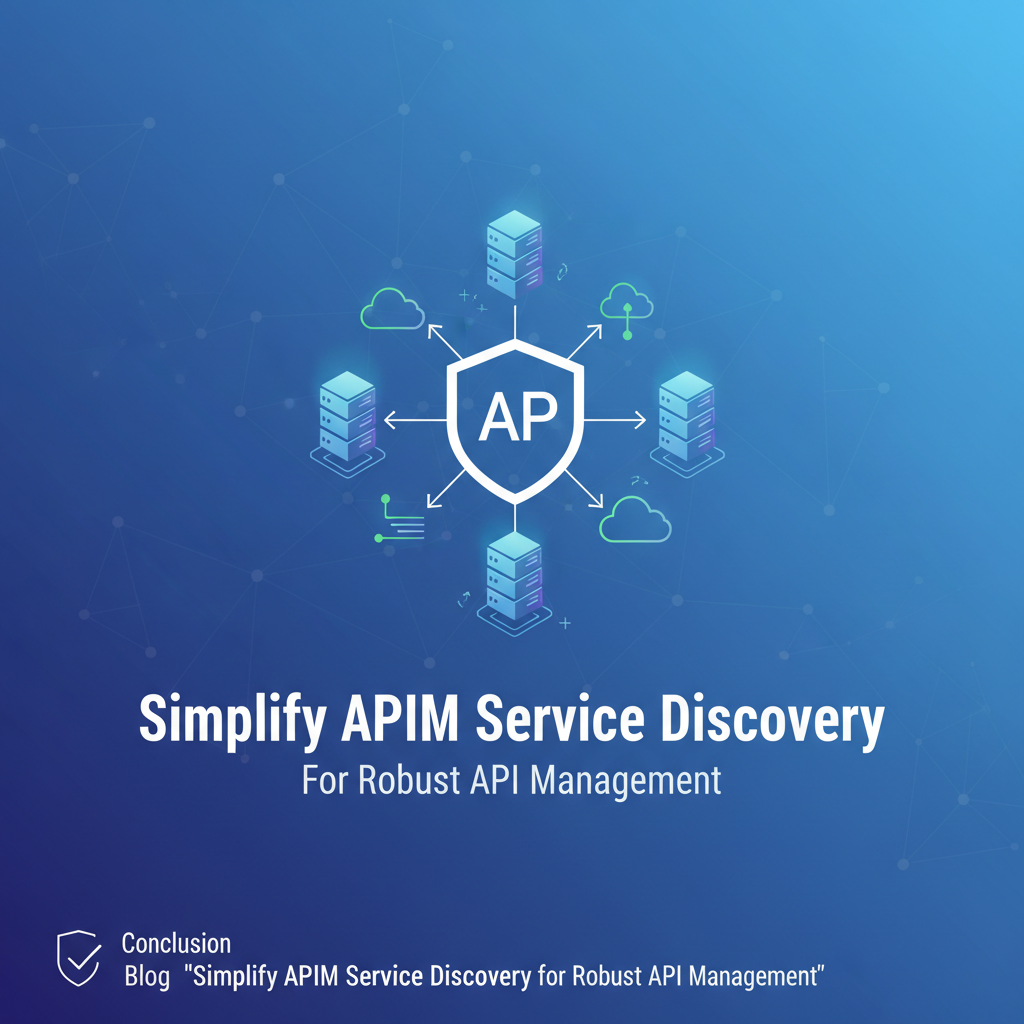
Simplify APIM Service Discovery for Robust API Management



In the rapidly expanding digital landscape, Application Programming Interfaces (APIs) have become the fundamental building blocks of modern software ecosystems, acting as the connective tissue between disparate systems, applications, and services. From microservices architectures to elaborate enterprise integrations, APIs drive innovation, foster collaboration, and enable businesses to reach new markets with unprecedented agility. However, as the number and complexity of APIs proliferate within an organization, the challenge of managing them effectively grows exponentially. One of the most critical, yet often underestimated, aspects of this challenge is API service discovery. Without a streamlined, efficient mechanism for discovering and understanding available APIs, even the most sophisticated API management strategies can falter, leading to inefficiency, security vulnerabilities, and ultimately, a hindered pace of innovation.
This comprehensive article delves deep into the essence of simplifying API Management (APIM) service discovery, articulating its paramount importance for establishing a truly robust and resilient API management infrastructure. We will explore the intricacies of modern API landscapes, dissect the core concepts of service discovery, and detail how it integrates seamlessly with pivotal APIM components such as the api gateway, API Governance frameworks, and the API Developer Portal. Furthermore, we will outline strategic approaches, best practices, and the transformative potential of advanced platforms in demystifying the process of finding, understanding, and leveraging APIs, ensuring that your organization's digital foundations are not just built, but truly thrive.
The Evolving Landscape of APIs and Microservices: A Foundation for Complexity
The architectural landscape of enterprise software has undergone a profound transformation over the past decade. The shift from monolithic applications, where all functionalities were tightly coupled within a single codebase, to microservices architectures has fundamentally reshaped how applications are designed, developed, and deployed. In a microservices paradigm, an application is broken down into a collection of small, independently deployable services, each responsible for a specific business capability. While this approach offers unparalleled benefits in terms of scalability, resilience, and independent team agility, it introduces a new layer of complexity: how do these numerous, often ephemeral, services find and communicate with each other?
This proliferation of services, each potentially exposing multiple APIs, creates a dynamic and fluid environment where endpoints frequently change, new services emerge, and older ones are deprecated. Imagine a large enterprise with hundreds, if not thousands, of microservices, each deployed and scaled independently across various environments – on-premises data centers, public clouds, and hybrid setups. Without a coherent system, identifying which service offers a particular API, where it is located, and how to interact with it becomes a daunting, if not impossible, task. Developers waste valuable time searching for relevant APIs, consumers struggle to integrate with services that lack clear documentation or stable endpoints, and operations teams face an uphill battle in monitoring and managing the interconnected web of services. This fragmented scenario is precisely where robust API service discovery becomes not just a convenience, but an absolute necessity for maintaining operational efficiency and fostering innovation.
Understanding API Service Discovery: Beyond Just Finding an Endpoint
At its core, API service discovery is the automated process by which client applications or other services can locate and communicate with available API services without needing to hardcode their network locations. It’s significantly more sophisticated than merely "finding an endpoint"; it involves understanding the dynamic nature of distributed systems, where service instances can come and go, scale up or down, and move across different network addresses.
There are primarily two patterns for service discovery:
- Client-Side Service Discovery: In this model, the client is responsible for determining the network locations of available service instances. The client queries a service registry, which holds the registration information for all available service instances. The service registry needs to be updated by the service instances themselves (self-registration) or by a third-party registrar. Once the client obtains a list of instances, it uses a load-balancing algorithm to select one and make a request. Examples include Netflix Eureka, which functions as a service registry, with clients often using Netflix Ribbon for load balancing.
- Server-Side Service Discovery: Here, the client makes a request to a service via a load balancer, which acts as an intermediary. The load balancer queries the service registry and routes the request to an available service instance. The client remains unaware of the exact network location of the service instances. Amazon's Elastic Load Balancer (ELB) combined with AWS Auto Scaling groups is a classic example of server-side discovery in action.
Regardless of the pattern, the central component in most service discovery architectures is the service registry. This database stores the network locations of service instances. Services register themselves with the registry upon startup and deregister upon shutdown. Crucially, the service registry also needs a mechanism to detect and remove instances that have crashed or become unhealthy. This is typically achieved through regular health checks, where the registry or a dedicated agent periodically pings registered services.
The absence of effective service discovery leads to a cascade of problems:
- Increased Latency and Downtime: Manual configuration changes for every service update introduce human error and significant delays.
- Operational Overhead: Development and operations teams spend an inordinate amount of time managing endpoint configurations instead of building features.
- Security Gaps: Hardcoded endpoints can be difficult to manage, leading to forgotten updates and potential vulnerabilities.
- Reduced Agility: The inability to quickly find and integrate new services stifles innovation and slows down time-to-market.
- Poor Developer Experience: Developers are frustrated by outdated documentation, broken links, and the sheer effort required to get started with an API.
Simplifying API service discovery is therefore about implementing automated, reliable, and transparent mechanisms that allow services to locate each other and for external consumers to find and use APIs without manual intervention or extensive prior knowledge. This simplification is the bedrock upon which robust API management is built.
The Pillars of Robust API Management: Gateway, Governance, and Portal
Robust API Management is not a single tool or a one-time project; it's a comprehensive strategy encompassing technologies, processes, and people to ensure APIs are designed, developed, deployed, secured, and consumed effectively across their entire lifecycle. Three core pillars stand out in this ecosystem: the API Gateway, API Governance, and the API Developer Portal. Each plays a distinct yet interconnected role, and their synergy is crucial for simplifying service discovery and achieving overall API excellence.
The API Gateway: The Unifying Entry Point
The api gateway is arguably the most critical component in any modern API management architecture. It acts as a single, centralized entry point for all API requests, abstracting the complexity of the backend microservices and providing a unified facade to consumers. Instead of client applications directly calling individual microservices, they interact solely with the API Gateway. This architectural pattern offers a multitude of benefits:
- Request Routing and Load Balancing: The gateway intelligently routes incoming requests to the appropriate backend service instance. Crucially, it leverages service discovery mechanisms to identify available and healthy service instances, distributing traffic efficiently to prevent overload on any single service. This dynamic routing is foundational to simplified discovery; consumers don't need to know the specific location of a service; the gateway handles it.
- Authentication and Authorization: The API gateway centrally handles security concerns such as authenticating client applications (e.g., via API keys, OAuth tokens) and authorizing their access to specific APIs. This offloads security responsibilities from individual microservices, standardizing and simplifying the security posture.
- Rate Limiting and Throttling: To prevent abuse and ensure fair usage, the gateway can enforce rate limits, controlling how many requests a client can make within a given timeframe.
- Traffic Management: Beyond routing, gateways can implement advanced traffic policies like circuit breakers, retries, and request/response transformation, ensuring resilience and adaptability.
- Monitoring and Analytics: By serving as the central point of ingress, the API gateway can collect comprehensive metrics on API usage, performance, and errors. This data is invaluable for monitoring API health, identifying bottlenecks, and understanding consumer behavior.
- API Composition and Transformation: In some cases, the gateway can aggregate multiple backend service calls into a single API response or transform data formats to meet client requirements, further simplifying the client-side consumption experience.
Without a powerful api gateway that is tightly integrated with service discovery, clients would either need to implement complex discovery logic themselves or rely on brittle, hardcoded configurations, fundamentally undermining the goal of simplification.
API Governance: Establishing Order and Consistency
API Governance refers to the comprehensive set of rules, policies, processes, and standards that guide the design, development, deployment, consumption, and evolution of APIs across an organization. It's about establishing order and consistency in an inherently distributed and dynamic environment. Far from being a bureaucratic overhead, effective API governance is a strategic imperative that ensures APIs are high-quality, secure, compliant, and reusable.
Key aspects of robust API Governance include:
- Standardization: Defining common guidelines for API design (e.g., RESTful principles, naming conventions, data formats), documentation (e.g., OpenAPI Specification), and versioning strategies. This consistency makes APIs easier to discover, understand, and integrate with.
- Security Policies: Implementing organization-wide security requirements, such as authentication mechanisms, authorization schemes, data encryption standards, and vulnerability management. Governance ensures these policies are uniformly applied across all APIs, regardless of the underlying service.
- Lifecycle Management: Establishing processes for managing APIs from conception through design, development, testing, deployment, deprecation, and eventual retirement. This ensures APIs are properly maintained and their status is clearly communicated.
- Compliance: Adhering to industry regulations (e.g., GDPR, HIPAA) and internal company policies. Governance provides the framework to ensure all APIs meet necessary compliance standards.
- Visibility and Control: Ensuring that all stakeholders have appropriate visibility into the API landscape, including who owns which API, its current status, and its usage metrics. Governance also provides the mechanisms for control, such as approval workflows for API publication or changes.
- Testing and Quality Assurance: Mandating comprehensive testing protocols to ensure APIs are reliable, performant, and meet defined quality benchmarks.
In the context of service discovery, strong API Governance ensures that the APIs being discovered are not just present, but also conform to expected standards, are secure, and are well-documented. It transforms a chaotic collection of endpoints into a well-ordered, dependable catalog of digital assets.
The API Developer Portal: The Human Interface for Discovery
While the API Gateway handles machine-to-machine interactions and API Governance sets the rules, the API Developer Portal is the human-centric interface that facilitates API discovery and consumption for internal and external developers. It serves as a centralized hub, a self-service platform where developers can find, learn about, register for, test, and integrate with available APIs.
Essential features of an effective API Developer Portal include:
- API Catalog: A comprehensive, searchable directory of all available APIs, often categorized and tagged for easy navigation. Each entry typically includes a clear description, its purpose, and ownership information.
- Interactive Documentation: Rich, up-to-date API documentation, often generated from specifications like OpenAPI, that includes endpoint details, request/response examples, authentication requirements, and error codes. Interactive consoles allow developers to make live API calls directly from the portal.
- Onboarding and Key Management: A streamlined process for developers to register, create applications, and obtain API keys or tokens required for authentication.
- SDKs and Code Samples: Ready-to-use software development kits (SDKs) in various programming languages and code examples to accelerate integration.
- Tutorials and Guides: Step-by-step instructions and best practices for common integration scenarios.
- Community and Support Forums: A platform for developers to ask questions, share insights, and get support from API providers and other users.
- Usage Analytics and Monitoring: Tools for developers to monitor their own API consumption, view usage statistics, and troubleshoot issues.
The API Developer Portal is the ultimate destination for simplified service discovery from a human perspective. It transforms raw service discovery information (like an API's network location found by the gateway) into an understandable, actionable resource for developers. Without a well-maintained and intuitive portal, even perfectly discoverable APIs might remain unused simply because developers cannot easily find or understand them.
The Interplay of Service Discovery and API Management Components
The true power of robust API management emerges when service discovery is seamlessly integrated with the API Gateway, API Governance, and the API Developer Portal. These components do not operate in isolation; rather, they form a cohesive ecosystem where each part reinforces and enhances the others.
Service Discovery and the API Gateway: Dynamic Routing and Resilience
The api gateway is the primary consumer of service discovery information. When an API request arrives at the gateway, it doesn't have a static, hardcoded list of backend service instances. Instead, it queries a service registry (or an internal discovery cache) to dynamically identify the available and healthy instances of the target service. This dynamic lookup allows the gateway to:
- Route requests to the correct service instance: Even if instances are constantly scaling up or down, or their network addresses change, the gateway always knows where to send traffic.
- Perform intelligent load balancing: By having an up-to-date list of all instances, the gateway can distribute requests across them using various algorithms (e.g., round-robin, least connections), ensuring optimal resource utilization and preventing single points of failure.
- Enhance resilience: If a service instance becomes unhealthy or crashes, the service registry will mark it as unavailable, and the gateway will automatically stop routing traffic to it, improving overall system resilience.
- Facilitate blue/green deployments and canary releases: Service discovery makes it easier to gradually shift traffic between different versions of a service, as the gateway can be configured to route a percentage of traffic to new instances while still directing the majority to stable ones.
This tight coupling ensures that the simplification of service discovery at the backend translates directly into robust, intelligent routing at the frontend, making the entire API infrastructure more adaptive and resilient.
Service Discovery and API Governance: Enforcing Consistency Across Dynamics
While service discovery handles the 'where' and 'is it alive' aspects of an API, API Governance addresses the 'how' and 'what' – how should this API behave, and what are its characteristics? The synergy between the two is vital. As services are discovered and registered, governance policies can be automatically applied or validated.
- Standard Compliance: Governance policies can ensure that newly discovered or updated services adhere to predefined API design standards (e.g., using specific security protocols, versioning schemes, or data formats). If an API registers itself with an endpoint that doesn't comply with governance rules, the system can flag it, preventing non-compliant APIs from being exposed.
- Automated Security Enforcement: When a new service is discovered, governance can ensure that the necessary authentication and authorization policies are immediately applied by the API Gateway, preventing rogue or unsecured APIs from becoming accessible. This is crucial for maintaining a strong security posture in a dynamic environment.
- Lifecycle Management Integration: As services are registered (new API) or deregistered (deprecated API), governance workflows can be triggered. For instance, a new registration might kick off a review process, while a deregistration could initiate communication to consumers about an upcoming deprecation.
- Centralized Visibility: The information gathered through service discovery (e.g., service location, health status) feeds into the governance framework, providing a comprehensive, up-to-date view of the entire API landscape. This visibility is essential for auditing, compliance reporting, and strategic planning.
By integrating service discovery with API Governance, organizations can maintain order and security even as their microservices landscape evolves rapidly. It allows for policy enforcement at the point of discovery and registration, preventing governance issues from escalating.
Service Discovery and the API Developer Portal: Empowering Developers with Current Information
The API Developer Portal is the ultimate beneficiary of a simplified and robust service discovery mechanism. Its primary goal is to provide developers with easy access to accurate and up-to-date information about available APIs.
- Dynamic API Catalog Population: A well-integrated service discovery system can automatically populate the API catalog on the developer portal. As new services are registered and expose APIs, their documentation (e.g., OpenAPI specifications) can be automatically ingested and displayed. Conversely, when services are deregistered or deprecated, their entries can be updated or removed from the catalog. This eliminates manual updates, drastically reducing the chances of outdated or incorrect information.
- Accurate Endpoint Information: The portal can display the canonical, stable endpoint for each API, which internally maps to the dynamically discovered service instances via the API Gateway. Developers don't need to worry about the underlying service locations; they interact with the gateway's exposed endpoint.
- Real-time Status Updates: Integration allows the portal to display the live status of APIs, indicating if a service is healthy, undergoing maintenance, or experiencing issues. This transparency helps developers plan their integrations and troubleshoot problems.
- Consistent Documentation: With governance ensuring standardized API descriptions, the portal can present documentation in a uniform and easily digestible format, regardless of which team developed the underlying service.
- Faster Onboarding: By providing a single source of truth for all API-related information, developers can quickly discover relevant APIs, understand their functionality, and start integrating without extensive manual research or internal communication.
In essence, simplified service discovery makes the API Developer Portal a living, breathing directory of an organization's digital capabilities, continuously reflecting the current state of the API ecosystem and significantly enhancing the developer experience.
Strategies for Simplifying APIM Service Discovery
Achieving simplified API service discovery requires a deliberate architectural approach and the implementation of specific strategies and tools. These strategies aim to automate the process, centralize information, and ensure consistency across the entire API lifecycle.
1. Automated Registration and Deregistration with a Central Service Registry
The cornerstone of simplified service discovery is the automation of service instance registration and deregistration.
- Service Registry: Implement a robust service registry (e.g., HashiCorp Consul, Etcd, Apache ZooKeeper, or cloud-native solutions like AWS Cloud Map) as the single source of truth for all running service instances.
- Self-Registration: Configure microservices to automatically register themselves with the service registry upon startup, providing their network location and any relevant metadata (e.g., version, health check endpoint).
- Heartbeating/Health Checks: Services should periodically send "heartbeat" signals to the registry. If a service fails to send heartbeats for a configured duration, the registry automatically marks it as unhealthy or removes it. This ensures that only active and healthy instances are discoverable.
- Deregistration: Implement mechanisms for services to gracefully deregister themselves upon shutdown, preventing the registry from accumulating stale entries.
2. Centralized API Catalogs with Standardized Descriptions
While a service registry stores instances, an API catalog focuses on the API contract and its metadata.
- API Design-First Approach: Start with designing the API contract using a standardized specification like OpenAPI (formerly Swagger). This contract describes all endpoints, operations, parameters, data models, and security schemes.
- Centralized Repository: Store all API specifications in a centralized, version-controlled repository. This repository acts as the definitive source for all API documentation and acts as the input for the API Developer Portal and API Gateway.
- Automated Publishing: Automate the process of publishing these OpenAPI specifications to your API Gateway and API Developer Portal. This ensures consistency between the documented API and the actually exposed API.
3. DNS-based Discovery for Simplicity
For simpler microservices environments, or as a foundational layer, DNS can play a role in service discovery.
- SRV Records: Utilize DNS SRV records to provide service-specific hostnames and ports. While static, this can abstract away direct IP addresses.
- Service Mesh Integration: In more advanced setups, a service mesh (e.g., Istio, Linkerd) can integrate with DNS or service registries to provide traffic management and discovery capabilities at the network level, offering powerful features like automatic retries, circuit breaking, and traffic splitting without modifying application code.
4. Robust Health Checks and Dynamic Load Balancing
Simplified discovery isn't just about finding an instance, but finding a healthy instance.
- Granular Health Checks: Implement detailed health checks for each service that go beyond just network availability, checking database connections, external dependencies, and internal application state.
- Dynamic Load Balancers: Utilize API Gateways or dedicated load balancers that actively query the service registry for healthy instances and distribute traffic accordingly. This prevents requests from being sent to failing services.
5. API Versioning Strategy
As APIs evolve, new versions will be introduced. A clear versioning strategy is crucial for discovery.
- Semantic Versioning: Adopt a consistent versioning scheme (e.g.,
v1,v2) to clearly distinguish different API contracts. - Gateway-Managed Versioning: The API Gateway can manage routing based on API versions, allowing clients to request specific versions while ensuring the underlying service can evolve independently. The API Developer Portal must clearly document these versions.
- Deprecation Policy: Establish a clear policy for deprecating older API versions, including timelines and communication strategies to consumers.
6. Policy-Driven Discovery and Automated Governance Checks
Integrate governance directly into the discovery pipeline.
- Policy Engines: Use policy engines (e.g., OPA, custom scripts) that automatically evaluate newly discovered APIs against predefined governance rules.
- Pre-publication Checks: Implement automated checks that prevent non-compliant APIs from being published to the API Developer Portal or exposed via the api gateway until governance requirements are met.
- Security Scanning: Integrate automated security scanning tools into the discovery process to identify vulnerabilities in newly exposed API endpoints.
APIPark is a high-performance AI gateway that allows you to securely access the most comprehensive LLM APIs globally on the APIPark platform, including OpenAI, Anthropic, Mistral, Llama2, Google Gemini, and more.Try APIPark now! 👇👇👇
Leveraging Advanced Tools and Platforms for Simplified Discovery: The Role of APIPark
While the strategies above provide a roadmap, their effective implementation often requires specialized tools and integrated platforms. For organizations seeking to streamline their API operations, comprehensive platforms are indispensable. Solutions like APIPark, an open-source AI gateway and API management platform, offer an all-in-one solution that not only simplifies service discovery but also provides robust API lifecycle management, AI model integration, and a unified API developer portal.
APIPark stands out by addressing the complexities of API management, especially in the context of emerging AI services, by consolidating many of the aforementioned strategies into a cohesive product. Here’s how its features contribute to simplifying service discovery and ensuring robust API management:
- As an Open Source AI Gateway: APIPark acts as a powerful api gateway, centralizing traffic management, security enforcement, and request routing for both traditional REST APIs and AI models. This gateway inherently simplifies discovery by providing a single, stable entry point for all consumers. It dynamically routes requests to the appropriate backend service or AI model, abstracting away the underlying complexities of service locations and model inference endpoints.
- Quick Integration of 100+ AI Models & Unified API Format for AI Invocation: For organizations leveraging AI, the discovery of specific AI models and their invocation methods can be particularly challenging due to diverse frameworks and APIs. APIPark addresses this by offering quick integration of numerous AI models and standardizing their request data format. This "unified API format" means that regardless of the underlying AI model, developers interact with a consistent API, dramatically simplifying the discovery and integration of AI capabilities. No more hunting for model-specific invocation patterns; APIPark provides a unified facade.
- Prompt Encapsulation into REST API: APIPark allows users to combine AI models with custom prompts to create new, specialized APIs (e.g., sentiment analysis). These newly created APIs are then discoverable and manageable through the platform, extending the scope of simplified discovery beyond just backend services to bespoke AI functionalities.
- End-to-End API Lifecycle Management: By assisting with the entire lifecycle—design, publication, invocation, and decommission—APIPark directly supports API Governance. It helps regulate API management processes, including traffic forwarding, load balancing, and versioning of published APIs. This comprehensive governance ensures that any API discovered via the platform is well-defined, managed according to policy, and its lifecycle status is transparent.
- API Service Sharing within Teams & Independent API and Access Permissions for Each Tenant: APIPark offers a centralized display of all API services, acting as an integrated API Developer Portal. This feature makes it effortless for different departments and teams (tenants) to find and utilize required API services. The multi-tenant architecture with independent permissions further ensures that while discovery is simplified, access control remains robust and secure, aligning perfectly with governance principles.
- API Resource Access Requires Approval: To prevent unauthorized access and data breaches, APIPark allows for subscription approval features. Callers must subscribe to an API and await administrator approval. This governance feature, integrated with the discovery process, adds a critical layer of security and controlled access, ensuring that only authorized consumers can discover and invoke sensitive APIs.
- Detailed API Call Logging & Powerful Data Analysis: Post-discovery and invocation, APIPark provides comprehensive logging of every API call and powerful data analysis tools. This is crucial for robust API management, allowing businesses to trace and troubleshoot issues, monitor performance, and analyze long-term trends. This level of visibility contributes to proactive maintenance and helps refine discovery strategies by identifying popular or problematic APIs.
With its open-source nature and powerful capabilities, APIPark provides a compelling solution for businesses looking to simplify their API service discovery process, enforce strong API Governance, and provide an excellent API Developer Portal experience, all while managing the complexities of modern AI and REST services. Its quick deployment with a single command line makes it accessible for rapid adoption and experimentation.
Best Practices for Implementing Simplified Service Discovery
Beyond tools and strategies, certain best practices underpin the successful implementation of simplified service discovery within a robust API management framework.
1. Start Small, Iterate Often
Don't attempt a "big bang" overhaul. Begin by implementing service discovery for a critical set of microservices or a new project. Learn from this experience, refine your approach, and then gradually expand its adoption across your organization. Iterative development allows for continuous improvement and adaptation.
2. Embrace Automation as a Core Principle
Manual processes are the enemy of simplified discovery. Automate everything from service registration and health checks to API documentation updates and deployment pipelines. Leverage Infrastructure as Code (IaC) principles to define and manage your discovery infrastructure. Automation reduces human error, speeds up deployment, and ensures consistency.
3. Prioritize Security at Every Layer
Simplified discovery should never come at the expense of security. Ensure that: * Service registries are secured with proper access controls. * Communication between services and the registry is encrypted. * The API Gateway enforces authentication and authorization policies for all discovered APIs. * Governance policies include security requirements for all API contracts and implementations. * Regular security audits and vulnerability assessments are performed on discovery components and registered APIs.
4. Document Everything, Consistently
While automation helps machines discover, clear and consistent documentation helps humans discover and understand. * Maintain accurate and up-to-date API specifications (OpenAPI). * Ensure the API Developer Portal is continuously updated with the latest API versions and their documentation. * Document your service discovery architecture, including the registry, health check mechanisms, and API Gateway configurations.
5. Monitor and Analyze Continuously
Visibility into your API ecosystem is paramount. * Implement comprehensive monitoring for your service registry, API Gateway, and individual microservices. * Track key metrics like service uptime, registration/deregistration rates, API call volumes, latency, and error rates. * Utilize analytics (like those offered by APIPark) to understand API usage patterns, identify trends, and anticipate potential issues before they impact consumers.
6. Design for Failure (Resilience)
Distributed systems are inherently prone to failures. Your service discovery mechanism itself must be resilient. * Deploy your service registry in a highly available, clustered configuration. * Implement caching strategies in your API Gateway to gracefully handle temporary registry outages. * Design services to be tolerant of discovery failures, perhaps by using a local cache of service locations or failing over to known stable endpoints.
7. Foster an API-First Culture
Encourage teams to think of APIs as products, with clear contracts, documentation, and a focus on the developer experience. An API-first mindset inherently promotes good design and makes APIs easier to discover and consume, aligning perfectly with the goals of a robust API management strategy. This cultural shift ensures that teams proactively design for discoverability and governance rather than treating them as afterthoughts.
Challenges and Considerations in APIM Service Discovery
While the benefits of simplified service discovery are undeniable, organizations must also be aware of potential challenges and considerations that can arise during implementation and ongoing management.
1. Complexity in Hybrid and Multi-Cloud Environments
As organizations increasingly adopt hybrid cloud strategies or operate across multiple cloud providers, the complexity of service discovery grows. A service registry might need to span different network segments, firewalls, and security policies. Ensuring consistent discovery across disparate environments requires careful network design, federated registries, or sophisticated service mesh implementations that can bridge these gaps. Managing identity and access management (IAM) across these boundaries for discovery mechanisms adds another layer of complexity.
2. Security Implications of Dynamic Discovery
While dynamic discovery simplifies operations, it also introduces potential security risks. If an attacker gains control over the service registry, they could potentially redirect traffic to malicious services or inject false service information. Therefore, securing the service registry and the communication channels between services, the registry, and the API Gateway is paramount. This includes strong authentication and authorization for services registering with the registry, encrypted communication, and rigorous access control to the registry itself. The dynamic nature also means that security policies must be applied dynamically as services are discovered and registered, necessitating robust API Governance enforcement at every stage.
3. Ensuring Data Consistency and Accuracy Across Registries
In large, complex organizations, there might be multiple service registries or API catalogs, especially if different teams or business units adopt their own solutions. Maintaining consistency and accuracy across these disparate sources can be a significant challenge. Stale entries, conflicting information, or lack of synchronization can lead to services being undiscoverable or incorrectly routed. Strategies like federation, master-slave replication, or a "single source of truth" policy for API metadata are crucial to mitigate these issues, but they add overhead.
4. Scalability and Performance of Discovery Mechanisms
The service registry and API Gateway are critical components that must handle a high volume of requests, both from services registering/heartbeating and from clients/gateways querying for service locations. As the number of microservices grows, the load on these components can become substantial. Designing for scalability, employing efficient caching strategies, and monitoring the performance of the discovery infrastructure are essential to prevent bottlenecks that could impact the entire API ecosystem. For example, APIPark explicitly mentions its performance rivalry with Nginx, stating it can achieve over 20,000 TPS with modest hardware, demonstrating an awareness of this scalability challenge.
5. Managing Service Mesh Integration
While service meshes offer advanced capabilities like traffic management, policy enforcement, and observability, integrating them with existing API Gateways and service discovery mechanisms can be complex. Ensuring that the mesh's proxy-based discovery aligns with the broader APIM strategy, including API Governance and the API Developer Portal, requires careful planning and execution. The learning curve associated with service mesh technologies can also be a barrier for some teams.
6. Vendor Lock-in (for proprietary solutions)
While proprietary API management solutions can offer comprehensive features, they might also lead to vendor lock-in, making it difficult to migrate or integrate with other tools in the future. Opting for open-source solutions like APIPark, or platforms built on open standards, can mitigate this risk, providing greater flexibility and control over your API infrastructure.
Addressing these challenges requires a thoughtful, strategic approach, balancing the benefits of simplification and automation with the need for security, consistency, and resilience.
The Future of APIM Service Discovery: Smarter, More Autonomous, and Product-Centric
The journey to simplified API service discovery is continuous, with emerging technologies and evolving architectural patterns constantly pushing the boundaries of what's possible. The future holds promises of even smarter, more autonomous, and inherently product-centric discovery mechanisms.
1. AI/ML-Powered Discovery and Governance
The integration of Artificial Intelligence and Machine Learning will revolutionize service discovery and API Governance. * Intelligent Auto-Discovery: AI algorithms could analyze network traffic and deployment patterns to automatically detect and register new services, even those not explicitly configured for self-registration. * Predictive Anomaly Detection: ML models can predict service failures or performance degradation before they occur, allowing discovery systems to proactively reroute traffic or flag services as unhealthy. * Smart API Recommendations: Based on a developer's past usage, project context, or team affiliations, AI could recommend relevant APIs from the API Developer Portal, significantly enhancing the developer experience and accelerating integration. * Automated Governance Rule Generation: AI could analyze existing API designs and organizational policies to suggest new governance rules or identify deviations, strengthening API Governance enforcement. APIPark's focus on AI model integration and unified invocation hints at this future, where AI isn't just a service to be discovered, but an intelligence layer enhancing discovery itself.
2. Deeper Integration with Service Mesh
The collaboration between API Gateways and service meshes will become more seamless. Service meshes, operating at the network level, offer powerful traffic management and observability for microservice-to-microservice communication. Future integrations will see API Gateways leveraging the mesh's advanced routing, security, and observability capabilities more directly, effectively extending the reach of API Management deeper into the service landscape. This will provide a unified control plane where external API consumption (via the gateway) and internal service interaction (via the mesh) are managed cohesively, further simplifying discovery by providing a single, consistent model for service interaction.
3. Event-Driven Architectures and Async API Discovery
As event-driven architectures (EDA) become more prevalent, the need for discovering asynchronous APIs (like message queues, streaming platforms, and webhooks) will grow. Standards like AsyncAPI are emerging to describe these interfaces. Future service discovery mechanisms will need to expand beyond traditional RESTful endpoints to include the discovery of event channels, topics, and message schemas, making event producers and consumers more discoverable. This will lead to specialized registries for event-driven services and integrated API Developer Portal experiences that can present both synchronous and asynchronous APIs.
4. Continuous Standardization Efforts
Ongoing efforts to standardize API specifications (OpenAPI, AsyncAPI), service mesh interfaces, and governance frameworks will continue to simplify the interoperability and discoverability of APIs across various tools and platforms. Greater standardization reduces fragmentation and promotes a more consistent API ecosystem, making the integration of new services and tools more straightforward.
5. API as a Product Mindset Evolution
The "API as a product" mindset will evolve to encompass the entire discovery and consumption journey. This means treating the API Developer Portal itself as a product, focusing on user experience, feedback loops, and continuous improvement based on how developers discover and interact with APIs. The emphasis will be on making APIs so intuitively discoverable and easy to use that they truly become self-service assets, driving adoption and innovation.
The future of APIM service discovery is not just about technology; it's about creating an intelligent, autonomous, and developer-friendly environment where APIs are effortlessly found, understood, and leveraged, empowering organizations to accelerate digital transformation with unparalleled agility and confidence.
Conclusion
In the intricate tapestry of modern digital operations, the ability to effortlessly discover and leverage APIs stands as a critical determinant of an organization's agility, security, and innovative capacity. As microservices proliferate and the complexity of interconnected systems grows, simplifying API Management (APIM) service discovery is no longer a luxury but an absolute necessity for achieving robust API management.
We have traversed the evolving landscape of APIs, underscored the fundamental importance of service discovery, and meticulously examined the interplay between this crucial process and the foundational pillars of API management: the api gateway, comprehensive API Governance, and the indispensable API Developer Portal. Each component, when harmonized with a simplified discovery strategy, contributes to a resilient, efficient, and secure API ecosystem. The API Gateway acts as the intelligent traffic cop, dynamically routing requests based on real-time service availability. API Governance provides the essential guardrails, ensuring that every discoverable API adheres to stringent quality, security, and compliance standards. And the API Developer Portal transforms raw technical information into an intuitive, self-service hub, empowering developers to find, understand, and integrate APIs with unprecedented ease.
By adopting strategies such as automated registration, standardized API descriptions, dynamic load balancing, and a strong commitment to security, organizations can transform a potentially chaotic API landscape into a well-ordered, high-performing digital asset. Furthermore, the strategic deployment of advanced platforms like APIPark demonstrates how integrated solutions can significantly accelerate this transformation, offering an all-in-one approach to managing traditional REST APIs and the rapidly expanding realm of AI services, simplifying discovery, reinforcing governance, and enriching the developer experience.
The journey towards simplified service discovery is an ongoing commitment to automation, consistency, and a developer-centric mindset. It enables faster innovation, reduces operational overhead, mitigates security risks, and ultimately, empowers businesses to fully unlock the strategic value of their API investments. In an increasingly API-driven world, mastering service discovery is not just about finding what you need; it's about building the future, one seamlessly connected API at a time.
Frequently Asked Questions (FAQs)
1. What is API service discovery and why is it so important for robust API management? API service discovery is the automated process by which client applications or other services can locate and communicate with available API services without needing to hardcode their network locations. It's crucial for robust API management because it enables dynamic routing, resilience, and scalability in microservices architectures. Without it, managing a large number of dynamic services becomes manual, error-prone, and unsustainable, leading to increased latency, downtime, and operational overhead. It forms the backbone for effective API Gateway operations, informs API Governance, and provides current data for the API Developer Portal.
2. How does an API Gateway contribute to simplified API service discovery? An api gateway acts as a centralized entry point for all API requests. It simplifies service discovery by abstracting the backend service locations from the clients. Instead of clients needing to discover individual service instances, they only interact with the gateway. The gateway, in turn, uses internal service discovery mechanisms (like querying a service registry) to dynamically find healthy service instances and intelligently route requests to them. This ensures clients always access the correct and available service, even as backend instances scale or move.
3. What role does API Governance play in enhancing service discoverability and reliability? API Governance establishes the rules, policies, and standards for API design, development, security, and lifecycle management. It enhances service discoverability by ensuring that all APIs adhere to consistent standards for documentation (e.g., OpenAPI), security, and versioning, making them easier for developers to find and understand. For reliability, governance ensures that APIs are properly tested, secured, and managed through their lifecycle, preventing the exposure of faulty or non-compliant services through the discovery process, thereby building trust in the discoverable API catalog.
4. How does an API Developer Portal facilitate API service discovery for developers? The API Developer Portal is a crucial human-facing interface that centralizes API information. It facilitates service discovery by providing a searchable API catalog, comprehensive and interactive documentation, SDKs, and code samples. It acts as a single source of truth where developers can quickly find available APIs, understand their functionality, authentication requirements, and usage patterns. Integrating with backend service discovery mechanisms ensures the portal's content is always up-to-date, reflecting the current state and availability of APIs, empowering developers to self-serve their integration needs.
5. How can platforms like APIPark help simplify API service discovery, especially with AI models? Platforms like APIPark offer an integrated solution that streamlines API service discovery by providing an all-in-one api gateway and API Developer Portal, while also enforcing API Governance. For AI models, APIPark specifically simplifies discovery by offering quick integration of numerous AI models and standardizing their invocation format. This means developers interact with a unified API interface for various AI services, abstracting away the underlying complexity and diversity of AI models. Its end-to-end API lifecycle management, centralized service sharing within teams, and robust logging further ensure that all APIs, including those leveraging AI, are easily discoverable, securely managed, and consistently documented.
🚀You can securely and efficiently call the OpenAI API on APIPark in just two steps:
Step 1: Deploy the APIPark AI gateway in 5 minutes.
APIPark is developed based on Golang, offering strong product performance and low development and maintenance costs. You can deploy APIPark with a single command line.
curl -sSO https://download.apipark.com/install/quick-start.sh; bash quick-start.sh

In my experience, you can see the successful deployment interface within 5 to 10 minutes. Then, you can log in to APIPark using your account.

Step 2: Call the OpenAI API.