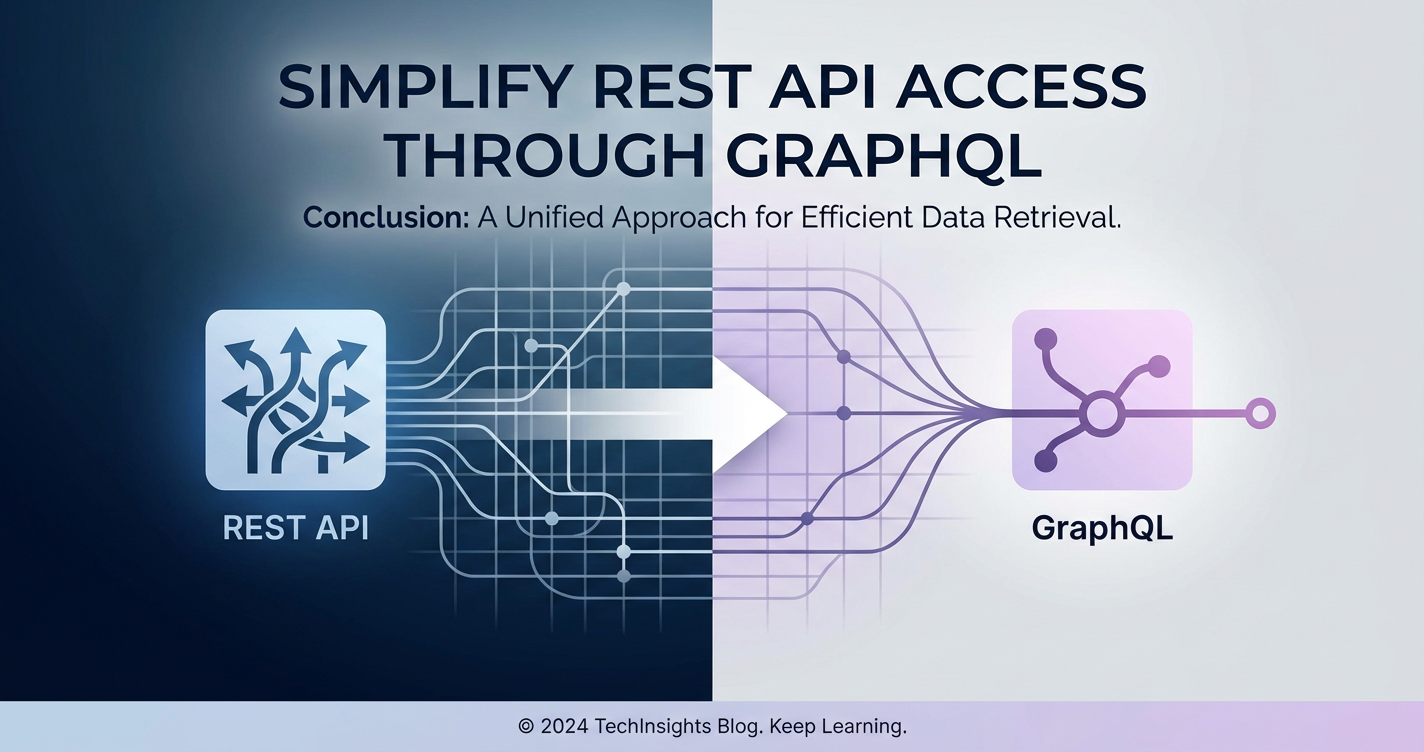
Simplify REST API Access Through GraphQL
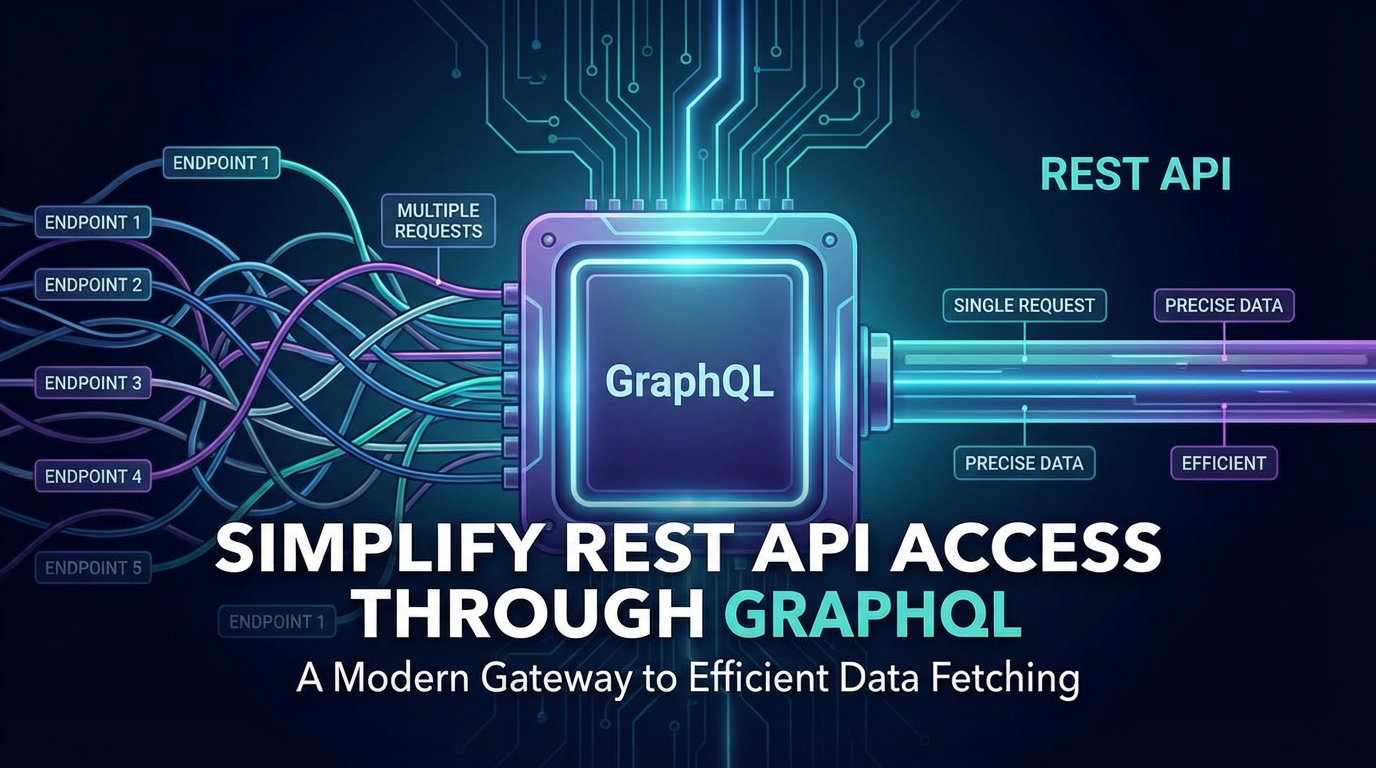


The landscape of modern application development is fundamentally shaped by the ubiquitous presence of Application Programming Interfaces (APIs). From mobile apps fetching real-time updates to web services orchestrating complex business processes, APIs serve as the crucial backbone, enabling disparate systems to communicate and exchange data efficiently. For decades, the Representational State Transfer (REST) architectural style has dominated this domain, celebrated for its simplicity, statelessness, and reliance on standard HTTP methods. REST APIs have powered countless applications, providing a clear and often intuitive way to expose and consume data resources. However, as applications grow in complexity, user interfaces become more dynamic, and data requirements become more nuanced, the limitations inherent in traditional REST API consumption begin to surface. Developers frequently encounter challenges such as over-fetching, under-fetching, and the notorious "N+1 problem," where a single user interface view necessitates multiple, cascading requests to various REST endpoints, leading to performance bottlenecks and increased client-side complexity.
This article delves into how GraphQL, a powerful query language for APIs, can elegantly address many of these challenges by providing a flexible and efficient layer over existing RESTful services. Rather than advocating for a complete overhaul of established backend infrastructure, we will explore a pragmatic approach: using a GraphQL server as a facade to simplify access to, and consumption of, existing REST APIs. This strategy allows organizations to leverage their significant investments in current REST architectures while simultaneously empowering client applications with the agility and efficiency that GraphQL offers. We will dissect the core concepts of REST and GraphQL, illustrate the architectural patterns for integrating them, discuss the practical implications of such an integration, and ultimately demonstrate how this hybrid approach can streamline data access, enhance developer experience, and pave the way for more responsive and scalable applications in an increasingly interconnected digital world. The journey towards simplifying API access is not just about adopting new technologies; it's about intelligently evolving our architectural patterns to meet the escalating demands of modern software development.
Understanding REST APIs: The Foundation of Modern Web Communication
Before we delve into the transformative capabilities of GraphQL, it is essential to have a firm grasp of the foundational principles and operational characteristics of REST APIs. Representational State Transfer, or REST, is an architectural style for networked applications that emerged in the early 2000s, gaining prominence for its conceptual simplicity and alignment with the stateless, client-server model of the World Wide Web. At its core, REST revolves around the concept of resources, which can be any information that can be named, such as a user, a product, or an order. Each resource is identified by a Uniform Resource Identifier (URI), typically a URL, and clients interact with these resources using a constrained set of standard HTTP methods: GET to retrieve data, POST to create new resources, PUT to update existing resources entirely, PATCH to partially update resources, and DELETE to remove resources.
The stateless nature of REST is a critical characteristic, meaning that each request from a client to a server must contain all the information necessary to understand the request, and the server does not store any client context between requests. This design promotes scalability and reliability, as servers can easily handle requests from numerous clients without maintaining session state, and any server can process any request without prior knowledge of the client's interaction history. Data formats for exchange are typically lightweight, with JSON (JavaScript Object Notation) and XML being the most common choices, enabling easy parsing and consumption by a wide array of programming languages and platforms. These principles have made REST an incredibly successful and widely adopted API standard, underpinning much of the internet's modern functionality.
However, the very features that lend REST its simplicity can also become sources of complexity in more dynamic and data-intensive client applications. One prevalent challenge is over-fetching, where a client requests data from a REST endpoint and receives more information than it actually needs. For example, an endpoint like /users/{id} might return a user's ID, name, email, address, date of birth, and numerous other fields, even if the client only requires the user's name and email for a specific display. This unnecessary data transfer wastes bandwidth, increases processing time on both the server and client, and can negatively impact application performance, especially in mobile environments or regions with limited network connectivity. Conversely, under-fetching occurs when a single REST endpoint does not provide all the necessary data for a particular client view, forcing the client to make multiple, chained requests to different endpoints. Consider a scenario where a client needs to display a user's details along with a list of their recent orders and the items within each order. This would typically involve an initial request to /users/{id}, followed by a second request to /users/{id}/orders, and then potentially a series of N additional requests to /orders/{orderId}/items for each order. This sequential dependency, often referred to as the N+1 problem, drastically increases latency, as each subsequent request can only be initiated once the previous one has completed, leading to a waterfall of network calls that significantly degrade user experience.
Moreover, REST APIs often lead to tight coupling between the client and the server. Any change in the data requirements for a client often necessitates a change in the backend REST endpoint or the creation of a new, purpose-built endpoint. This can slow down development cycles and make backend teams a bottleneck for frontend innovations. Versioning REST APIs (e.g., /v1/users, /v2/users) attempts to mitigate breaking changes but introduces its own set of complexities for maintenance and client migration. These challenges highlight a growing need for a more flexible and efficient data access layer, especially as modern applications demand increasingly sophisticated and customizable data interactions.
In this context, the role of an api gateway becomes paramount. An api gateway acts as a single entry point for all client requests, sitting in front of a collection of backend services. It provides a crucial layer of management, security, and routing for all incoming api traffic. Beyond simple request forwarding, a robust api gateway typically handles critical functions such as authentication and authorization, ensuring that only legitimate and authorized clients can access specific resources. It implements rate limiting to protect backend services from being overwhelmed by excessive requests, thereby maintaining system stability and preventing denial-of-service attacks. Furthermore, an api gateway often provides centralized logging and monitoring capabilities, offering visibility into api usage, performance metrics, and potential errors, which is invaluable for operational intelligence and troubleshooting. For complex microservice architectures, the api gateway can perform intelligent routing, directing requests to the appropriate backend service based on various criteria, and can also assist with load balancing to distribute traffic evenly across multiple instances of a service, enhancing availability and performance.
An advanced api gateway and management platform like APIPark exemplifies how such a system can bring order and efficiency to a diverse set of services. APIPark, as an open-source AI gateway and API management platform, offers an all-in-one solution for managing, integrating, and deploying not only AI services but also traditional REST services with remarkable ease. Its capabilities extend far beyond basic routing, encompassing an end-to-end API lifecycle management system that helps regulate processes, manage traffic forwarding, load balancing, and versioning of published APIs. By centralizing the display of all API services, APIPark facilitates easy discovery and consumption across different teams, fostering collaboration and reducing redundancy. This robust gateway functionality is essential for any modern api ecosystem, providing the foundational infrastructure for managing complexity, ensuring security, and optimizing performance, regardless of whether the services are purely RESTful or employ more advanced data access paradigms like GraphQL.
Introducing GraphQL: A Query Language for Your API
In response to the growing complexities associated with consuming REST APIs, particularly the issues of over-fetching, under-fetching, and the N+1 problem, Facebook developed and open-sourced GraphQL in 2015. GraphQL is not a database query language, nor is it a replacement for REST in the same architectural sense. Instead, it is a specification for an API; a query language that enables clients to request exactly the data they need from a server, no more and no less. This fundamental shift in control, from the server dictating the data shape to the client defining it, is what makes GraphQL so powerful and appealing for modern application development.
At the heart of GraphQL lies a strongly typed schema, defined using the GraphQL Schema Definition Language (SDL). This schema acts as a contract between the client and the server, meticulously outlining all the data types, fields, and operations (queries, mutations, and subscriptions) that are available through the API. For instance, a schema might define a User type with fields id, name, and email, and an Order type with fields id, totalAmount, and a list of items. This strong typing provides several benefits: it makes the API self-documenting, allowing developers to understand its capabilities without external documentation; it enables robust tooling, such as auto-completion and validation in development environments; and it reduces the likelihood of runtime errors, as clients are guaranteed to receive data that conforms to the schema.
The primary operation in GraphQL is a query, which clients use to fetch data. Unlike REST, where a client typically interacts with multiple endpoints to gather disparate pieces of information, a GraphQL client sends a single query to a single endpoint (conventionally /graphql). Within this query, the client specifies precisely the resources and fields it requires, even across relationships. For example, a single GraphQL query could fetch a user's name, their last three orders, and the name of each product within those orders. This capability directly tackles both over-fetching and under-fetching. Clients only receive the data they ask for, eliminating wasted bandwidth, and they can combine multiple data requirements into a single request, drastically reducing the number of round trips to the server and improving perceived application performance.
Beyond data retrieval, GraphQL supports two other crucial operation types: * Mutations: These are used to modify data on the server, analogous to POST, PUT, PATCH, or DELETE operations in REST. A mutation query typically specifies the input data for the modification and also allows the client to request specific fields of the modified object in return, ensuring immediate feedback on the operation's success and the new state of the data. This provides a consistent approach to both reading and writing data through the same API endpoint. * Subscriptions: These enable real-time, push-based communication. Clients can subscribe to specific events, and the server will proactively push data updates to the client whenever those events occur. This is invaluable for applications requiring live data feeds, such as chat applications, stock tickers, or real-time dashboards, offering a significant advantage over traditional REST polling mechanisms which are inefficient and often introduce latency.
The single endpoint paradigm of GraphQL simplifies client-side API consumption immensely. Instead of managing various base URLs and understanding the specific structure of dozens of different REST endpoints, clients interact with a single, well-defined GraphQL API gateway. This consistency, combined with the declarative nature of queries, empowers frontend developers to iterate faster, adapt to changing UI requirements without backend modifications, and build more performant and responsive applications. The flexibility of GraphQL shifts the power to the client, allowing applications to evolve dynamically without being constrained by rigid server-side API structures. This fundamental design choice is a key differentiator from REST and lays the groundwork for a more agile and developer-friendly API ecosystem.
The Bridge: Layering GraphQL Over Existing REST APIs
One of the most compelling aspects of GraphQL is its ability to serve not just as a standalone API solution, but also as an intelligent facade or aggregation layer over existing backend services. This is particularly advantageous for organizations with substantial investments in traditional REST APIs and microservice architectures. Instead of undertaking a costly and time-consuming rewrite of their entire backend to adopt GraphQL, they can strategically introduce a GraphQL server that acts as a bridge, translating client GraphQL queries into calls to their underlying RESTful services. This pattern, often referred to as the "GraphQL Server as a Facade" or "GraphQL Gateway," allows for gradual adoption, minimizes disruption to existing systems, and immediately delivers the benefits of GraphQL to client applications.
The "GraphQL Server as a Facade" Pattern Explained
The architecture involves positioning a dedicated GraphQL server between the client applications and the existing collection of REST APIs. When a client sends a GraphQL query to this server, the GraphQL server does not directly access a database. Instead, it serves as an orchestrator: it parses the incoming GraphQL query, determines which pieces of data are required, and then intelligently dispatches corresponding requests to one or more of the underlying REST API endpoints. Once it receives responses from these REST services, it aggregates, transforms, and stitches the data together according to the exact structure specified in the original GraphQL query, finally returning a single, unified JSON response to the client.
This architectural pattern offers a powerful decoupling layer. The client only sees and interacts with the GraphQL schema, which presents a clean, coherent, and highly flexible view of the data. The complexity of interacting with multiple, potentially inconsistent, REST endpoints, handling different authentication mechanisms, and managing data transformations is entirely encapsulated within the GraphQL server. This means frontend developers can focus solely on the data they need, expressed through intuitive GraphQL queries, without needing intricate knowledge of the backend's internal REST architecture. Meanwhile, the backend team can continue to maintain and evolve their REST APIs independently, knowing that the GraphQL facade will abstract these changes for the clients, as long as the underlying data remains accessible.
Implementation Details: Bringing the Facade to Life
Implementing a GraphQL facade over REST involves several key technical considerations:
- Schema Design: This is arguably the most critical step. The GraphQL schema must carefully map the concepts and relationships available through the underlying REST APIs into a unified, client-friendly GraphQL type system. For instance, if you have a
/usersREST endpoint that returns user objects and an/ordersREST endpoint that returns order objects, your GraphQL schema might define aUsertype and anOrdertype. Critically, you would also define relationships between these types, such as aUserhaving a list oforders. The schema should reflect the client's data needs, not necessarily a one-to-one mapping of every REST endpoint's response. This is where you design for efficiency and flexibility. - Resolvers: The core logic of the GraphQL server resides in its resolvers. For every field in your GraphQL schema that can be queried, there is an associated resolver function. When a client queries a specific field (e.g.,
user.orders), the corresponding resolver is executed. This resolver is responsible for fetching the data for that field. In the context of a REST facade, a resolver function would typically make an HTTP call to one or more of your existing REST API endpoints. For example, theordersfield resolver for aUsertype might take theuserIdas an argument and then internally call the/users/{userId}/ordersREST endpoint. The resolver then processes the REST API's JSON response and returns the data in the format expected by the GraphQL schema. - Data Transformation and Stitching: REST API responses often contain data that needs to be reshaped, filtered, or combined with data from other REST endpoints to fulfill a single GraphQL query. Resolvers handle this data transformation. They might extract specific fields, rename properties to align with the GraphQL schema, or even perform light business logic. For complex queries that span multiple REST resources (e.g., getting a user's details and their orders, where orders come from a different service), the GraphQL server acts as a data stitcher. It makes concurrent or sequential calls to the necessary REST APIs, waits for all responses, combines them, and constructs the final, single JSON payload for the client.
- Authentication and Authorization: Securing the GraphQL facade and propagating user identity to downstream REST services is crucial. Typically, the GraphQL server will handle client authentication (e.g., validating an OAuth token or JWT). Once authenticated, the user's identity and any relevant authorization information are then passed along in the headers or body of the HTTP requests made to the underlying REST APIs. This ensures that the REST services apply their existing access controls and process requests in the context of the authenticated user.
Benefits of this Approach: Unlocking Agility and Efficiency
The "GraphQL Server as a Facade" approach yields significant advantages for both client and backend development:
- No Need to Rewrite Existing REST APIs: This is perhaps the most immediate and impactful benefit. Organizations can preserve their valuable investments in battle-tested REST services, allowing for a gradual, evolutionary adoption of GraphQL. There's no need for a "rip and replace" strategy, which can be prohibitively expensive and risky.
- Improved Client Experience and Performance: By enabling clients to request exactly what they need in a single round trip, the GraphQL facade drastically reduces network overhead and the number of HTTP requests. This leads to faster data retrieval, especially for complex UI views, and a much smoother user experience, particularly on mobile devices or slower networks.
- Decoupling Client and Backend: The GraphQL schema becomes the stable contract for client applications, abstracting away the intricacies and potential volatility of the underlying REST APIs. Frontend changes to data requirements are less likely to necessitate modifications to existing REST endpoints, as the GraphQL server can adapt by modifying its resolvers. This speeds up frontend development and reduces dependencies on backend teams.
- Centralized Data Access Layer: The GraphQL server becomes the single, unified point of access for all client data needs. This simplifies client-side data fetching logic, makes the API easier to understand and consume, and provides a consistent interface across potentially diverse backend services (e.g., different microservices written in different languages). It promotes a consistent data model that clients can rely on.
- Enhanced Developer Productivity: With a self-documenting schema and powerful tooling enabled by GraphQL's strong typing, developers can explore the API, write queries, and build user interfaces much more rapidly. Features like automatic query validation and schema introspection simplify the development workflow significantly.
By layering GraphQL over existing REST APIs, organizations can effectively modernize their API consumption strategy without dismantling their current infrastructure, striking a powerful balance between innovation and stability.
Practical Considerations and Advanced Topics
While the concept of layering GraphQL over REST offers compelling advantages, successful implementation requires careful consideration of various practical aspects and the strategic application of advanced techniques. These considerations address potential performance pitfalls, ensure robust error handling, maintain stringent security, and leverage the broader GraphQL ecosystem effectively.
Performance Optimization
Even with GraphQL's inherent ability to reduce over-fetching and under-fetching, the efficiency of the underlying REST API calls remains critical. The GraphQL server, acting as an orchestrator, must be optimized to prevent introducing new bottlenecks.
- Batching and Caching (DataLoader Pattern): A common challenge when fetching related data from REST APIs is the N+1 problem. For instance, if a GraphQL query requests a list of users and their respective orders, the resolver for
user.ordersmight be called N times (once for each user), potentially leading to N separate REST calls to the/users/{userId}/ordersendpoint. The DataLoader pattern (a generic utility, not specific to GraphQL, but widely used) provides an elegant solution. It batches multiple individual data requests into a single request to the backend service, then caches the results, and finally distributes the correct data back to the individual resolvers. This significantly reduces the number of calls to the underlying REST APIs, transforming N calls into one or a few batch calls, dramatically improving performance. - GraphQL Query Complexity Analysis and Depth Limiting: Malicious or poorly constructed GraphQL queries can consume excessive server resources, leading to performance degradation or even denial-of-service attacks. Implementing query complexity analysis allows the server to estimate the computational cost of a query before execution. If a query exceeds a predefined complexity threshold, it can be rejected. Similarly, depth limiting restricts how deeply nested a query can be, preventing clients from requesting excessively deep relationships that could overwhelm the server.
- HTTP Caching Strategies for REST Calls: While GraphQL's client-side caching mechanisms (like those in Apollo Client) are powerful, the GraphQL server itself can also benefit from traditional HTTP caching when making calls to the underlying REST APIs. Implementing
ETagorLast-Modifiedheaders, along with appropriate caching policies (e.g.,Cache-Control), can reduce redundant data fetches from the REST services, especially for frequently accessed, static, or slowly changing data. The GraphQL server can intelligently leverage these HTTP caching mechanisms for its internal REST calls.
Error Handling
Robust error handling is paramount for any production-grade API. GraphQL provides a structured way to report errors, but the GraphQL server acting as a facade must intelligently translate errors from the underlying REST APIs into this GraphQL format.
- GraphQL Error Structure: Unlike REST, where HTTP status codes (4xx, 5xx) typically signal errors, GraphQL generally returns a
200 OKstatus code even if an error occurred, with the error details provided in a dedicatederrorsarray within the JSON response. This array contains structured error objects, each potentially including amessage,locations(indicating where in the query the error occurred), andextensions(for custom error codes or additional context). - Mapping REST Errors: Resolvers must catch errors originating from the REST API calls. A 404 (Not Found) from a REST endpoint might be translated into a
nullvalue for a nullable GraphQL field, accompanied by an entry in theerrorsarray for more details. A 500 (Internal Server Error) from REST might lead to a generic GraphQL error message while logging the full underlying error on the server side for debugging. Providing consistent, client-friendly error messages through GraphQL is key to a good developer experience.
Security
Security is non-negotiable for APIs. When layering GraphQL over REST, several security considerations arise, particularly regarding authentication, authorization, and protection against abuse.
- Authentication and Authorization at the GraphQL Layer: The GraphQL server should be the primary enforcement point for authentication. Client requests should present credentials (e.g., JWT, API key) to the GraphQL server, which validates them. Once authenticated, the GraphQL server determines the client's authorization level based on their identity. This authorization logic dictates which GraphQL queries and fields a client is permitted to access.
- Propagating Identity to Downstream REST Services: After authenticating a client, the GraphQL server must securely pass the client's identity or authorization context (e.g., an internal token, user ID, or role information) to the underlying REST APIs. This ensures that the REST services also apply their own access controls correctly, guaranteeing end-to-end security.
- Rate Limiting: To prevent abuse and ensure fair usage, rate limiting is essential. An api gateway sitting in front of the GraphQL server is an ideal place to enforce global rate limits on incoming GraphQL requests. This protects both the GraphQL server and, by extension, the underlying REST APIs from being overwhelmed. For instance, a robust api gateway allows for the activation of subscription approval features, ensuring that callers must subscribe to an API and await administrator approval before they can invoke it, preventing unauthorized API calls and potential data breaches. This is a crucial security layer for any api, including the GraphQL facade.
Tooling and Ecosystem
The GraphQL ecosystem is rich and rapidly maturing, offering a plethora of tools that enhance developer productivity and simplify complex API architectures.
- GraphQL Clients: Libraries like Apollo Client (for JavaScript/TypeScript applications, supporting React, Vue, Angular) and Relay (from Facebook, often used with React) provide powerful client-side caching, state management, and declarative data fetching capabilities, significantly simplifying the integration of GraphQL into frontend applications.
- GraphQL Server Libraries: Frameworks such as Apollo Server (Node.js), Express-GraphQL (Node.js), Graphene (Python), and GraphQL-Go (Go) provide robust implementations for building GraphQL servers, abstracting away much of the boilerplate code and offering features like schema validation, query parsing, and execution.
- Schema Stitching and Federation: For very large-scale or microservice-oriented architectures where data is spread across multiple GraphQL services, schema stitching and Apollo Federation provide advanced techniques to combine multiple independent GraphQL schemas into a single, unified "supergraph." This allows different teams to own and evolve their respective GraphQL services independently while still presenting a single, cohesive API to clients. While these are more advanced, they highlight the scalability of GraphQL as an architectural pattern, potentially even for aggregating multiple GraphQL services, some of which might themselves be facades over REST.
These practical considerations, when thoughtfully addressed, ensure that the GraphQL facade over REST not only simplifies client-side access but also maintains high performance, reliability, and security across the entire API landscape. A comprehensive api management platform and api gateway are critical enablers for managing these complexities, regardless of the api paradigm employed.
APIPark is a high-performance AI gateway that allows you to securely access the most comprehensive LLM APIs globally on the APIPark platform, including OpenAI, Anthropic, Mistral, Llama2, Google Gemini, and more.Try APIPark now! 👇👇👇
Case Study/Example: Building a Unified Dashboard with GraphQL over REST
To truly grasp the power and elegance of layering GraphQL over existing REST APIs, let's consider a practical scenario. Imagine a fictitious enterprise, "Global Retail Co.," which has grown organically over many years. As a result, its backend systems are a patchwork of legacy applications and newer microservices, each exposing its data through various REST APIs.
The Scenario: Global Retail Co. wants to develop a new "Customer 360 Dashboard" for its customer service representatives (CSRs). This dashboard needs to provide a comprehensive view of a customer, including: 1. Customer Profile: Basic details like name, email, contact number, and shipping address from a legacy /customers/{id} REST API. 2. Recent Orders: A list of the customer's last five orders, retrieved from a separate /orders?customer_id={id}&limit=5 REST API. 3. Order Items: For each order, the dashboard needs to show the items purchased, along with their names and quantities. This data comes from a /orders/{orderId}/items REST API. 4. Loyalty Points: The customer's current loyalty points balance, available through a /loyalty/points/{customerId} REST API endpoint. 5. Support Tickets: A list of recent support tickets associated with the customer, exposed by a /support/tickets?customer_id={id} REST API.
The Problem with Traditional REST Consumption: To populate this dashboard using only direct REST API calls, a CSR application would face significant challenges: * Multiple Requests: Fetching all the required data for a single customer would involve at least one request for the customer profile, one for recent orders, potentially five more for order items (one per order), one for loyalty points, and one for support tickets. This quickly escalates to 8+ HTTP requests for a single dashboard view. * Chained Dependencies: Many of these requests are dependent. You can't fetch order items until you have the order IDs, which come from the /orders API. This creates a waterfall effect, increasing overall latency. * Over-fetching/Under-fetching: The /customers/{id} API might return dozens of fields, while the dashboard only needs a few. Conversely, a single /orders request might not provide the full details of each item, requiring further requests. * Client-Side Orchestration Complexity: The client application would be responsible for making all these disparate calls, coordinating their execution, handling errors from multiple sources, and then stitching together the data into the correct UI format. This adds substantial complexity to the frontend codebase. * Performance Impact: The cumulative network latency from numerous round trips would lead to a slow-loading dashboard, negatively impacting CSR productivity and customer satisfaction.
The Solution: Implementing a GraphQL Server as a Facade Global Retail Co. decides to implement a GraphQL server that sits between the CSR dashboard application and their existing REST APIs.
Illustrative GraphQL Schema:
type Customer {
  id: ID!
  name: String
  email: String
  phone: String
  address: String
  loyaltyPoints: Int
  recentOrders(limit: Int = 5): [Order]
  supportTickets: [SupportTicket]
}

type Order {
  id: ID!
  orderDate: String
  totalAmount: Float
  status: String
  items: [OrderItem]
}

type OrderItem {
  productId: ID!
  productName: String
  quantity: Int
  price: Float
}

type SupportTicket {
  id: ID!
  subject: String
  status: String
  createdAt: String
}

type Query {
  customer(id: ID!): Customer
}
How Resolvers Would Work (Conceptual):
Query.customer(id): This resolver would make an HTTP GET request toGET /customers/{id}to fetch basic customer details.Customer.loyaltyPoints: This resolver, given the customer ID, would make an HTTP GET request toGET /loyalty/points/{customerId}.Customer.recentOrders(limit): This resolver would callGET /orders?customer_id={id}&limit={limit}.Order.items: For eachOrderobject returned byrecentOrders, this resolver would make an HTTP GET request toGET /orders/{orderId}/items. To avoid the N+1 problem here, a DataLoader could be implemented to batch multiple/orders/{orderId}/itemscalls into a single, efficient request.Customer.supportTickets: This resolver would callGET /support/tickets?customer_id={id}.
Illustrative GraphQL Query from the CSR Dashboard:
query CustomerDashboard($customerId: ID!) {
  customer(id: $customerId) {
    id
    name
    email
    phone
    loyaltyPoints
    recentOrders(limit: 3) {
      id
      orderDate
      totalAmount
      items {
        productId
        productName
        quantity
      }
    }
    supportTickets {
      id
      subject
      status
    }
  }
}
Benefits Realized:
- Single Network Request: The entire dashboard view can be fetched with a single GraphQL query and a single HTTP request from the client. The GraphQL server handles all the internal communication with the various REST APIs.
- No Over-fetching/Under-fetching: The query explicitly requests
id,name,email,phone,loyaltyPointsfor the customer, and specific fields for orders, items, and tickets. No unnecessary data is transferred. - Simplified Client-Side Logic: The CSR dashboard application no longer needs complex logic to orchestrate multiple API calls, handle dependencies, and merge data. It simply sends one GraphQL query and receives one perfectly shaped JSON response.
- Improved Performance: Reducing numerous HTTP round trips to a single one dramatically decreases latency and improves the perceived responsiveness of the dashboard.
- Frontend Agility: If the dashboard needs a new field (e.g., customer's last login date), the frontend developer can simply add it to the GraphQL query. As long as the GraphQL server's resolvers can fetch this data from an existing REST API (or a new field is added to a REST API), no changes are required on the client side beyond the query itself.
This case study vividly demonstrates how a GraphQL facade can transform a fragmented, inefficient API landscape into a unified, high-performance data access layer for client applications, all while preserving the underlying REST infrastructure. The GraphQL server acts as an intelligent aggregator, abstracting away the complexity of integrating diverse APIs and presenting a consistent, flexible interface to the client.
When to Choose GraphQL Over REST (and When Not To)
The decision to adopt GraphQL, particularly as a facade over existing REST APIs, is a strategic one that depends heavily on the specific needs, constraints, and long-term vision of a project or organization. GraphQL and REST are not mutually exclusive and often complement each other within a sophisticated API ecosystem. Understanding their respective strengths and weaknesses is key to making an informed choice.
GraphQL Strengths (especially as a Facade)
GraphQL truly shines in scenarios where client applications demand maximum flexibility, efficiency, and a reduced number of network requests.
- Complex UIs Needing Data from Multiple Sources: For dashboards, analytics portals, or highly interactive applications that aggregate data from numerous backend services, GraphQL's ability to fetch disparate data types in a single query is invaluable. It solves the N+1 problem and prevents the client from becoming an orchestration layer.
- Mobile Applications (Bandwidth Efficiency): Mobile environments often suffer from limited bandwidth and higher latency. GraphQL's precise data fetching capabilities minimize data transfer, reducing load times and improving battery life, making it an excellent choice for optimizing mobile API consumption.
- Rapid Frontend Development and Iteration: Frontend teams can iterate faster because they have direct control over the data they receive. Changes to UI often only require modifying a GraphQL query, not waiting for backend API changes. The strongly typed schema and introspection capabilities also facilitate quicker development with better tooling.
- Microservice Architectures (as an Aggregation Layer): In architectures where data is distributed across many microservices, each potentially exposing its own REST API, a GraphQL server can act as a powerful aggregation layer. It provides a single, unified gateway for clients, simplifying interaction with a complex array of backend services. This is precisely where the "GraphQL Server as a Facade" pattern excels.
- API Evolution and Versioning: GraphQL's schema-driven approach allows for additive changes without breaking existing clients. New fields can be added, and old ones can be deprecated (marked as
@deprecated) without needing to version the entire API (e.g.,/v1,/v2). This provides a much smoother evolution path for your API.
REST Strengths
Despite GraphQL's advantages, REST remains highly suitable, and often preferred, for many use cases.
- Simple CRUD Operations: For straightforward create, read, update, and delete operations on individual resources where the client's data needs closely match the resource's structure, REST's simplicity and directness are hard to beat.
- Public APIs and External Consumption: REST's familiarity, standard HTTP methods, and reliance on common web paradigms make it easier for external developers to quickly understand and integrate with. The learning curve for GraphQL (understanding schemas, queries, mutations, resolvers) can be higher for newcomers.
- Caching at the HTTP Level is Straightforward: REST APIs leverage standard HTTP caching mechanisms (like
Cache-Controlheaders,ETags), which are well-understood and easy to implement at proxies or client-side. Caching in GraphQL, while possible, often requires more custom logic at the client or resolver level. - When Backend Resources are Highly Structured and Match Client Needs Closely: If your backend already exposes resources that perfectly align with what your frontend needs, or if your backend is monolithic and data aggregation is not a complex issue, the overhead of introducing a GraphQL layer might outweigh the benefits.
- File Uploads and Binary Data: While GraphQL can handle file uploads, REST endpoints are generally simpler and more conventional for dealing with binary data and large file transfers.
Hybrid Approach: The Best of Both Worlds
In many large-scale enterprise environments, a hybrid approach proves to be the most pragmatic and effective. This involves using GraphQL for complex, data-intensive queries that power dynamic user interfaces, while retaining REST for simpler, direct resource manipulations, public APIs, or specific integrations. For example, a system might use GraphQL for its internal customer dashboard, fetching a wealth of interconnected data in one go, but expose a public REST API for partners to simply create new orders.
The role of an api gateway like APIPark becomes even more critical in such a hybrid environment. A robust api gateway can effectively manage and secure both REST and GraphQL endpoints, offering a unified control plane for all your api needs. It handles the underlying complexity, from traffic forwarding to detailed logging and analytics, regardless of the api paradigm. APIPark's "End-to-End API Lifecycle Management" ensures that whether you're dealing with a legacy REST service or a modern GraphQL facade, the entire api lifecycle – from design and publication to invocation and decommission – is managed consistently. Its "detailed API call logging" and "powerful data analysis" features are vital for gaining insights into the performance and usage of any api service, providing a comprehensive overview across the entire landscape. By centralizing these critical management functions, an api gateway empowers organizations to adopt the best api approach for each specific use case without sacrificing security, performance, or operational visibility.
The API Gateway's Evolving Role in a GraphQL World
The emergence and adoption of GraphQL significantly impacts the traditional role of an api gateway, requiring these critical components to adapt and evolve. Historically, an api gateway has served as the frontline for managing, securing, and routing requests to a multitude of RESTful services, often acting as the interface to a microservice architecture. In a world embracing GraphQL, especially as a facade over REST, the gateway's responsibilities expand and shift, becoming even more central to the overall api strategy.
Traditional API Gateway Functions
Before delving into GraphQL's impact, let's recap the core functions of a traditional api gateway:
- Authentication and Authorization: Verifying client identities and ensuring they have the necessary permissions to access specific backend services.
- Rate Limiting: Protecting backend services from excessive traffic by limiting the number of requests a client can make within a defined period.
- Logging and Monitoring: Capturing detailed request and response information, providing visibility into api usage, performance, and errors for operational intelligence.
- Caching: Storing responses for frequently accessed data to reduce latency and backend load.
- Routing and Traffic Management: Directing incoming requests to the correct backend service instance, often involving load balancing, service discovery, and circuit breaking for resilience.
- Transformation and Protocol Translation: Modifying request/response payloads or translating between different protocols.
How These Functions Apply to a GraphQL API
When a GraphQL server is introduced, particularly as a facade over REST APIs, the api gateway typically sits in front of this GraphQL server. Its role is still crucial for protecting and managing the GraphQL entry point itself, which then orchestrates calls to the underlying REST services.
- Protecting the GraphQL Endpoint: Even though GraphQL offers flexible querying, the single
/graphqlendpoint is a critical asset. The api gateway provides the first line of defense, applying global authentication and authorization policies before any request even reaches the GraphQL server. This means the gateway can validate client tokens, check API keys, and enforce global access rules based on client identity or IP address, preventing unauthorized access attempts. - Applying Global Policies: Rate limiting, for instance, is often best applied at the api gateway level. While GraphQL can implement its own complexity limits and query depth analysis, the gateway provides an overarching guardrail, preventing a single client from overwhelming the system with too many requests, regardless of their internal GraphQL complexity. This multi-layered defense ensures robustness.
- Central Visibility and Observability: The api gateway continues to be the central point for collecting logs and metrics for all incoming API traffic, including GraphQL. This provides a holistic view of API usage, performance trends, and potential issues across the entire ecosystem. While the GraphQL server will log its internal operations (resolver execution times, REST calls made), the gateway offers a broader perspective on overall traffic patterns and client behavior.
- Routing and Load Balancing: In environments with multiple GraphQL server instances (for scalability), the api gateway intelligently distributes incoming GraphQL requests across these instances, ensuring high availability and optimal resource utilization. It acts as the primary traffic manager, abstracting the underlying infrastructure from clients.
APIPark in a GraphQL-over-REST Architecture
A comprehensive api gateway and management platform like APIPark is perfectly positioned to support and enhance a GraphQL-over-REST architecture. APIPark's features are highly relevant to managing the entire api landscape, whether it involves traditional REST, AI services, or a GraphQL facade.
- End-to-End API Lifecycle Management: APIPark assists with managing the entire lifecycle of APIs, including design, publication, invocation, and decommission. This is crucial for both the underlying REST APIs (which still need management) and the GraphQL facade itself. It helps regulate API management processes, manage traffic forwarding, load balancing, and versioning of published APIs, providing a consistent framework across all api types.
- Performance Rivaling Nginx: With impressive performance capabilities (over 20,000 TPS on an 8-core CPU, 8GB memory, supporting cluster deployment), APIPark ensures that the api gateway itself does not become a bottleneck. This is vital when the gateway is sitting in front of a GraphQL server that might be orchestrating numerous backend REST calls, ensuring that the overall response time remains low.
- API Service Sharing within Teams: The platform allows for the centralized display of all API services, making it easy for different departments and teams to find and use the required API services. This is invaluable in a complex environment where teams might be consuming a mix of REST and GraphQL APIs.
- Independent API and Access Permissions for Each Tenant: APIPark enables the creation of multiple teams (tenants), each with independent applications, data, user configurations, and security policies. This granular control is essential for managing access to both the GraphQL facade and the underlying REST services, ensuring that only authorized entities can access specific resources, even in a multi-tenant setup.
- API Resource Access Requires Approval: APIPark allows for the activation of subscription approval features. This adds an additional layer of security and control, requiring callers to subscribe to an API and await administrator approval before invocation. This mechanism can be applied directly to the GraphQL endpoint, providing crucial protection against unauthorized access to the sophisticated data access it offers.
- Detailed API Call Logging and Powerful Data Analysis: APIPark provides comprehensive logging capabilities, recording every detail of each API call. This is critical for tracing and troubleshooting issues in the complex interactions between clients, the GraphQL facade, and the underlying REST APIs. Its powerful data analysis features display long-term trends and performance changes, helping businesses with preventive maintenance and optimizing the entire api ecosystem.
In essence, while GraphQL empowers clients with flexibility, a robust api gateway like APIPark provides the essential infrastructure to manage, secure, and monitor that flexibility, ensuring that the entire api architecture remains performant, reliable, and scalable. The gateway acts as the trusted guardian, unifying management across diverse api paradigms and safeguarding the integrity of the data access layer.
Table: Comparing REST vs. GraphQL (When GraphQL is a Facade)
To provide a clear understanding of the architectural and operational differences, particularly when GraphQL is implemented as a facade over existing REST APIs, the following table summarizes key comparison points:
| Feature | Traditional REST API (Direct Client-to-REST) | GraphQL (as a Facade over REST) |
|---|---|---|
| Data Fetching Paradigm | Fixed endpoints, server dictates response shape. Clients often face over-fetching or under-fetching. Multiple HTTP requests for complex views. | Client specifies exact data needed via a single query. No over-fetching/under-fetching. Single HTTP request for complex views. |
| Number of Endpoints | Multiple, resource-based endpoints (/users, /orders, etc.) for different data types. |
Single /graphql endpoint, acting as an intelligent aggregation point. |
| Client Control over Data | Limited. Client receives the full resource representation provided by the server. | High. Client explicitly requests fields and relationships, shaping the response. |
| Versioning Strategy | Often URI versioning (/v1/users), header versioning, or content negotiation. Can lead to breaking changes for clients with each new version. |
Schema evolution with additive changes. Fields can be deprecated but not removed, maintaining backward compatibility for clients using older fields. |
| Learning Curve | Generally simpler to start for developers familiar with HTTP and web concepts. | Requires understanding GraphQL SDL, query language, mutations, subscriptions, and resolver functions. Higher initial learning curve. |
| Caching Mechanism | Leverages standard HTTP caching (status codes, ETag, Cache-Control headers) at various levels (browsers, CDNs, proxies). | Caching typically implemented at the client-side (e.g., Apollo Client cache) or within resolvers using custom logic (e.g., DataLoader). HTTP caching for the GraphQL endpoint itself is less effective due to POST requests. |
| Server-Side Complexity | Simpler for basic CRUD operations on individual resources. Can become complex for data aggregation across multiple resources. | Higher server-side complexity to implement resolvers, handle data stitching, error translation, and optimize calls to underlying REST APIs (e.g., DataLoader for batching). |
| Client-Side Development Speed | Can be slower due to needing to orchestrate multiple requests, handle disparate responses, and manually stitch data for complex UI. | Significantly faster and more agile for complex UIs. Clients get exactly what they need, reducing data manipulation logic. |
| API Gateway Role | Essential for managing, securing, and routing individual REST endpoints. Protects backend services directly. | Essential for securing and managing the single GraphQL endpoint (the facade). Provides global authentication, rate limiting, and monitoring before queries reach the GraphQL server. Manages the underlying REST APIs that the GraphQL server consumes. |
| Suitability | Best for simple CRUD, public APIs, or when client data needs closely match resource structures. | Best for complex UIs, mobile apps, microservice aggregation, or when rapid frontend iteration and data flexibility are paramount. |
| Implementation Impact | Direct interaction with existing REST infrastructure. | No need to rewrite existing REST APIs; GraphQL acts as a thin, intelligent layer. |
This table underscores that choosing GraphQL as a facade is often a pragmatic decision to enhance client flexibility and performance without abandoning an existing REST API ecosystem. The api gateway remains a critical component, adapting its role to secure and manage this new, unified data access point while continuing to oversee the underlying REST services.
Conclusion: Embracing a Flexible Future
The journey of API evolution is a continuous one, driven by the ever-increasing demands for efficiency, flexibility, and performance in modern application development. While REST APIs have undeniably served as the bedrock of web communication for well over a decade, their inherent architectural constraints—particularly the challenges of over-fetching, under-fetching, and the N+1 problem—have become more pronounced as applications grow in complexity and user interfaces demand highly specific, aggregated data.
This article has thoroughly explored how GraphQL offers a compelling and pragmatic solution to these challenges, not necessarily by replacing existing REST infrastructure wholesale, but by intelligently layering a GraphQL server as a facade. This architectural pattern allows organizations to leverage their significant investments in current REST APIs while simultaneously empowering client applications with the agility, precision, and efficiency that GraphQL provides. By abstracting the intricacies of disparate REST endpoints and presenting a unified, strongly typed, and client-driven data access layer, a GraphQL facade fundamentally simplifies API consumption, reduces network overhead, and accelerates frontend development cycles. Developers gain the power to precisely define their data requirements in a single query, leading to faster loading times, a more responsive user experience, and a streamlined development workflow.
We have delved into the technical details of implementing such a facade, from careful schema design and the role of intelligent resolvers to critical considerations like performance optimization (through techniques like DataLoader), robust error handling, and stringent security measures. Furthermore, we've highlighted that this architectural shift does not diminish, but rather evolves, the crucial role of the api gateway. A robust api gateway remains an indispensable component, acting as the primary line of defense and management for the entire API landscape. Tools like APIPark, with their advanced features for end-to-end API lifecycle management, performance rivaling Nginx, granular access controls, and powerful analytics, are instrumental in orchestrating and securing this hybrid API ecosystem. They ensure that even as the data access paradigm becomes more flexible, the underlying infrastructure remains stable, secure, and highly performant, providing a unified control plane for all api needs—be they REST, GraphQL, or even AI services.
Ultimately, adopting GraphQL as a facade over REST is an evolutionary step, not a revolutionary replacement. It represents a strategic choice to enhance the capabilities of existing systems, fostering a more agile and developer-friendly environment. By embracing this flexible future, organizations can build more responsive, scalable, and adaptable applications, better equipped to meet the dynamic needs of their users and the ever-changing digital landscape. The synergy between a powerful query language like GraphQL and a comprehensive api management platform ensures that the journey towards simplified API access is both innovative and robust.
5 FAQs
1. What exactly is the "GraphQL Server as a Facade" pattern? The "GraphQL Server as a Facade" pattern involves placing a GraphQL server between client applications and your existing REST APIs. Instead of clients directly calling various REST endpoints, they send a single GraphQL query to the GraphQL facade. This server then acts as an orchestrator, translating the GraphQL query into multiple calls to the underlying REST APIs, aggregating and transforming the data, and finally returning a single, unified JSON response to the client. This approach allows organizations to leverage their existing REST infrastructure while providing clients with the flexibility and efficiency of GraphQL.
2. Why would I use GraphQL over my existing REST APIs instead of just creating new REST endpoints? While you could create new REST endpoints for specific client needs, this often leads to a proliferation of highly specific endpoints, increasing backend complexity and maintenance overhead. GraphQL, especially as a facade, offers several key advantages: it eliminates over-fetching and under-fetching by allowing clients to specify exactly the data they need; it reduces the number of network round trips (often to just one) for complex data requirements, significantly improving performance; and it provides a strongly typed, self-documenting API that enhances client-side development speed and agility. It decouples the client from the backend's internal REST structure, making frontend changes less dependent on backend modifications.
3. Does layering GraphQL over REST mean I have to rewrite my entire backend? No, and this is one of the biggest benefits of the facade pattern. You do not have to rewrite your existing REST APIs. Your GraphQL server acts as an intermediary, making calls to your existing REST services. This allows for a gradual adoption of GraphQL, preserving your investment in current backend infrastructure and minimizing disruption. Only the GraphQL server and its resolvers need to be developed, which is a new layer, not a replacement of the core business logic in your REST services.
4. How does an API Gateway fit into a GraphQL-over-REST architecture? An API gateway plays a crucial role by sitting in front of the GraphQL server. It handles initial request validation, global authentication, authorization, and rate limiting for all incoming GraphQL requests. This protects both the GraphQL server and, by extension, the underlying REST APIs from abuse and ensures security. A robust API gateway like APIPark can also provide centralized logging, monitoring, and traffic management for both the GraphQL facade and the REST APIs it consumes, offering a unified control plane for your entire API ecosystem and enhancing overall operational visibility and control.
5. What are the main challenges of implementing GraphQL as a facade? Key challenges include designing a coherent GraphQL schema that maps effectively to potentially disparate REST resources, implementing efficient resolvers (especially handling the N+1 problem with techniques like DataLoader for batching calls to REST APIs), accurately translating errors from REST services into GraphQL's error format, and ensuring robust authentication and authorization flow from the GraphQL layer down to the individual REST services. Managing caching can also be more complex in GraphQL compared to traditional HTTP caching in REST. However, these challenges are addressable with proper planning and tooling, and the benefits often outweigh the implementation complexities for sophisticated applications.
🚀You can securely and efficiently call the OpenAI API on APIPark in just two steps:
Step 1: Deploy the APIPark AI gateway in 5 minutes.
APIPark is developed based on Golang, offering strong product performance and low development and maintenance costs. You can deploy APIPark with a single command line.
curl -sSO https://download.apipark.com/install/quick-start.sh; bash quick-start.sh

In my experience, you can see the successful deployment interface within 5 to 10 minutes. Then, you can log in to APIPark using your account.

Step 2: Call the OpenAI API.