Simplifying Access to REST API Through GraphQL
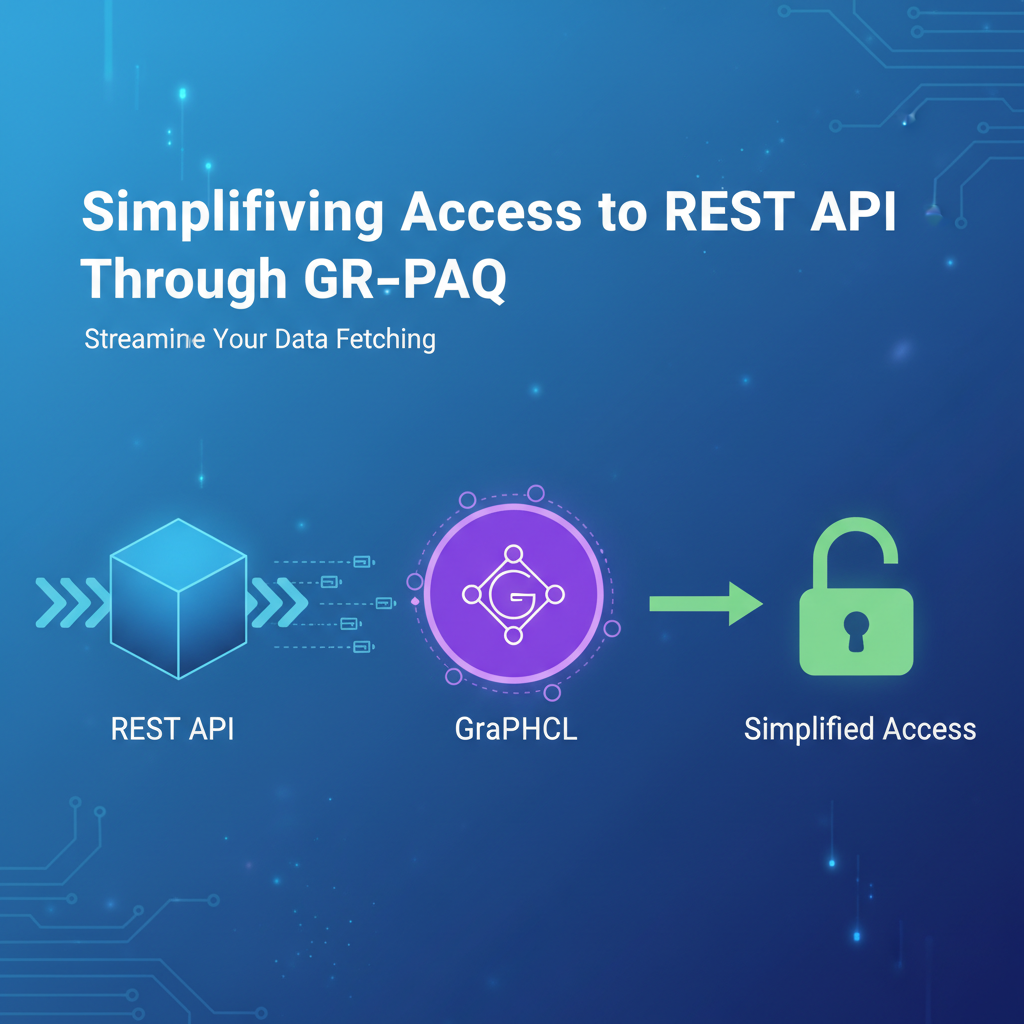


In the ever-evolving landscape of software development, the way applications interact with data is paramount to their success. For decades, Representational State Transfer (REST) has been the de facto standard for building web services, offering a robust and widely understood architectural style. Its statelessness, client-server separation, and cacheability have underpinned countless applications, from sprawling enterprise systems to nimble mobile apps. However, as applications grow in complexity and user expectations for rich, interactive experiences soar, the inherent rigidity of RESTful APIs has begun to show its seams. Developers often grapple with issues like over-fetching (receiving more data than needed), under-fetching (requiring multiple requests to gather sufficient data), and the laborious process of coordinating numerous endpoints to construct a complete view for the client. This operational overhead, though often subtle in its individual manifestations, collectively impacts performance, increases development time, and adds a significant layer of complexity to both client-side and server-side logic.
Enter GraphQL, a powerful query language for APIs and a runtime for fulfilling those queries with your existing data. Conceived by Facebook in 2012 and open-sourced in 2015, GraphQL emerged as a direct response to the challenges faced when building mobile applications with traditional REST APIs. It offers a fundamentally different paradigm for data interaction, empowering clients to specify precisely what data they need, in what structure, and from a single endpoint. This shift in control from the server to the client promises to revolutionize how applications consume data, leading to more efficient network utilization, faster loading times, and a significantly streamlined development experience. The core appeal of GraphQL lies in its ability to act as an intelligent intermediary, transforming complex backend data sources, including existing REST APIs, into a cohesive, client-friendly interface. It's not about replacing REST entirely but rather about complementing it, often by serving as an abstraction layer that simplifies and optimizes access to diverse data sources, including the very REST APIs that power much of the internet today.
This comprehensive exploration will delve into the intricacies of integrating GraphQL with existing REST architectures, examining how a GraphQL layer can serve as a sophisticated API gateway to unify, optimize, and simplify access to various backend services. We will dissect the pain points of traditional REST consumption, illuminate the transformative capabilities of GraphQL, and provide a detailed roadmap for implementing this powerful combination. From understanding the core principles of GraphQL to navigating the practical challenges of implementation and considering the role of robust API management platforms and specialized gateways, our aim is to equip you with the knowledge to leverage GraphQL effectively, making your API interactions more intuitive, performant, and resilient. Ultimately, we will demonstrate that by strategically layering GraphQL over REST, developers can unlock a new era of flexibility and efficiency, paving the way for more agile development cycles and superior user experiences.
The Intrinsic Complexities of Traditional REST APIs in Modern Applications
While REST has undeniably served as the backbone of web services for over two decades, its architectural style, born from the early days of the web, sometimes struggles to align perfectly with the dynamic requirements of contemporary applications. Modern clients, particularly single-page applications (SPAs) and mobile apps, demand granular control over data fetching, real-time updates, and highly optimized network interactions. It is in meeting these demands that REST often reveals its limitations, leading to a cascade of complexities for both frontend and backend developers. Understanding these inherent challenges is crucial before appreciating the value proposition of GraphQL as a simplification layer.
One of the most frequently cited problems with REST APIs is the issue of over-fetching and under-fetching. In a RESTful design, resources are typically exposed through fixed endpoints, and each endpoint returns a predefined structure of data. Consider a scenario where a client needs to display a user's name and profile picture. A REST endpoint like /users/{id} might return a vast amount of information about the user, including their email, address, phone number, creation date, preferences, and more, far beyond what the client actually requires for that specific view. This phenomenon is known as over-fetching. The consequence is a larger payload traveling over the network, consuming unnecessary bandwidth, increasing deserialization time on the client, and potentially exposing sensitive data that isn't strictly necessary for the current context. For mobile users on limited data plans or slow network connections, this inefficiency can significantly degrade the user experience, leading to slower load times and increased data consumption. Developers then have to spend time on the client side filtering out the unwanted data, which adds to the application's complexity.
Conversely, under-fetching occurs when a single REST endpoint does not provide all the necessary information for a particular view, forcing the client to make multiple requests to different endpoints to gather the complete dataset. Imagine a social media application where a user's profile page needs to display not only the user's basic details but also their most recent posts, the comments on those posts, and the names of other users who liked those posts. A typical REST architecture might require separate calls to: 1. /users/{id} for user details. 2. /users/{id}/posts for the user's posts. 3. /posts/{postId}/comments for comments on each post. 4. /posts/{postId}/likes for likes on each post.
This chain of requests, often referred to as the "N+1 problem" in a REST context, results in multiple round trips between the client and the server. Each round trip incurs network latency, and the client-side logic becomes burdened with orchestrating these requests, waiting for responses, and then stitching together the fragmented data into a cohesive view. This "chatty" communication pattern is particularly detrimental in environments with high latency, such as mobile networks, where each additional round trip adds a noticeable delay to the user's interaction. The development team then has to write complex asynchronous code to manage these dependencies and display partial data while waiting for subsequent requests, which can be error-prone and difficult to maintain.
Beyond data fetching efficiency, managing API evolution and versioning poses another significant challenge for RESTful services. As applications evolve, so do their underlying APIs. New fields might be added, existing fields might be deprecated, or resource structures might change entirely. In REST, managing these changes often leads to versioning strategies like /v1/users and /v2/users. While this approach provides a clear demarcation, it forces the backend to maintain multiple versions of the same API concurrently, which doubles or triples the maintenance burden, increases testing overhead, and consumes additional server resources. Clients, on the other hand, must explicitly migrate to newer versions, and delaying this migration can lead to applications consuming outdated APIs that are no longer actively supported. The lifecycle management of these versions can become a logistical nightmare, especially in environments with many different client applications consuming the same API, each on its own release schedule.
Furthermore, the lack of a standardized, client-driven mechanism for introspection and discovery is a common pain point. With REST, clients typically rely on external documentation (e.g., OpenAPI/Swagger specifications) to understand available endpoints, expected request formats, and response structures. While these specifications are invaluable, they are static documents that require manual updates and can sometimes fall out of sync with the actual API implementation. There's no inherent way for a client to dynamically query the API itself to understand what resources and operations are available without prior knowledge. This can slow down client development, as developers must constantly refer to external documentation and manually adapt their code when API changes occur.
Finally, the inherent difficulty in handling complex relationships and graphs of data through simple resource-based access is a fundamental limitation. While REST is excellent for retrieving individual resources or collections, representing and navigating intricate data relationships often requires bespoke endpoint designs or nested resource structures that can quickly become unwieldy. For instance, querying a user and all their followers, and then all posts from those followers, can lead to deeply nested or highly fragmented REST calls that are neither intuitive nor efficient. The architectural constraints of REST, while offering simplicity for basic resource management, begin to strain under the weight of interconnected data models that characterize modern, data-rich applications. These challenges collectively underscore the need for a more flexible and client-centric approach to API interaction, setting the stage for GraphQL's rise as a powerful alternative and a valuable complement to existing REST architectures.
The Paradigm Shift: Understanding GraphQL's Core Principles
GraphQL emerged as a revolutionary answer to the complexities inherent in traditional REST APIs, offering a fresh perspective on how clients interact with data. At its heart, GraphQL is not just an alternative to REST; it's a fundamentally different approach to building and consuming APIs, shifting the control and flexibility from the server to the client. To grasp how it simplifies access to REST, it's essential to first understand its core principles and how they diverge from established norms.
At its most basic, GraphQL is a query language for your API, and a server-side runtime for executing those queries by using a type system you define for your data. This definition encapsulates two critical aspects. Firstly, it provides clients with a powerful, declarative language to ask for exactly what they need. Unlike REST, where the server dictates the structure of the response, GraphQL empowers the client to describe its data requirements with precision. Secondly, it operates within a server-side runtime environment that takes these client-defined queries and fulfills them by orchestrating calls to various data sources, which can include databases, microservices, and, importantly for our discussion, existing REST APIs.
One of the most celebrated principles of GraphQL is declarative data fetching. With GraphQL, clients send a single query that specifies all the fields and relationships they require. The server then responds with a JSON object that exactly mirrors the structure of the query. This "ask for what you need, get exactly that" philosophy directly addresses the over-fetching and under-fetching problems prevalent in REST. Instead of receiving a bloated payload or making multiple requests, a client receives precisely the data it requested, no more, no less, and all in a single network request. For example, to fetch a user's name and their five most recent posts' titles, a GraphQL query might look like this:
query GetUserNameAndPosts {
  user(id: "123") {
    name
    posts(first: 5) {
      title
    }
  }
}
This single query, sent to a solitary endpoint, orchestrates the retrieval of complex, related data, dramatically reducing the number of round trips and the volume of transmitted data.
Another cornerstone of GraphQL is the concept of a single endpoint. In contrast to REST, where different resources are exposed through numerous unique URLs (e.g., /users, /posts, /comments), a GraphQL API typically exposes only one endpoint (e.g., /graphql). All client queries, mutations (data modifications), and subscriptions (real-time data streams) are sent to this single endpoint. The GraphQL server then interprets the request, parses the query, and routes it to the appropriate "resolver" functions that fetch the necessary data. This architectural choice simplifies client-side configuration and centralizes API interaction, making it easier to manage and scale. It means clients don't need to know the intricate network topology of the backend; they only need to interact with the single GraphQL entry point.
The foundation upon which GraphQL builds its robustness and reliability is its strongly typed schema. Before any data can be queried, the GraphQL server defines a schema that precisely describes all the data that clients can query or modify. This schema is essentially a contract between the client and the server, outlining: * Types: The kinds of objects clients can fetch (e.g., User, Post, Comment). * Fields: The properties each type possesses (e.g., a User has name, email, id). * Relationships: How types are connected (e.g., a User has a list of Posts). * Operations: The available queries, mutations, and subscriptions.
This strict type system offers several compelling advantages. Firstly, it provides built-in validation, ensuring that clients only request valid data and that mutations adhere to the defined input types. Secondly, it enables powerful tooling: integrated development environments (IDEs) can provide auto-completion, syntax highlighting, and immediate error checking for GraphQL queries, significantly enhancing developer productivity. Finally, and perhaps most importantly, it facilitates introspection. GraphQL schemas are self-documenting; clients can query the schema itself to discover what data is available and how to query it. This eliminates the need for external, often outdated, documentation, fostering a truly self-service API ecosystem. Developers can use tools like GraphiQL to explore the entire API without ever leaving their browser, dramatically accelerating the learning curve and integration process.
Comparing GraphQL directly with REST highlights these fundamental differences. While REST emphasizes resources and HTTP verbs (GET, POST, PUT, DELETE) to manipulate them across multiple URLs, GraphQL focuses on data graphs and a single query language to fetch and modify data through a single endpoint. REST is often likened to navigating a website by clicking through links, while GraphQL is like asking a database for specific information. This client-centric approach, coupled with its strong type system and unified endpoint, positions GraphQL not merely as an alternative, but as a sophisticated solution for abstracting and simplifying data access, particularly when dealing with complex or evolving backend services, including a multitude of existing REST APIs. This foundational understanding sets the stage for exploring how GraphQL can effectively act as an API gateway, unifying disparate services under a single, flexible API.
GraphQL as a Facade for Existing REST APIs: The API Gateway Paradigm
The true power of GraphQL isn't just in building new APIs from scratch; it often shines brightest when deployed as a sophisticated facade that sits in front of an organization's existing, potentially complex, and diverse array of services, including a multitude of REST APIs. In this architecture, the GraphQL server effectively functions as an intelligent API gateway, providing a unified and optimized entry point for client applications while orchestrating calls to underlying RESTful services. This approach dramatically simplifies client-side development, enhances performance, and insulates clients from the intricate details of the backend.
When a GraphQL server acts as an API gateway, it fundamentally changes the interaction model. Instead of clients making numerous, fragmented requests directly to various REST endpoints, they interact solely with the GraphQL server. This server, equipped with its well-defined schema, understands the client's data requirements expressed in a GraphQL query. Its primary role then becomes translating these elegant, client-centric queries into the necessary series of calls to the underlying REST APIs, aggregating the results, and transforming them into the precise JSON structure requested by the client. This is where the term API gateway becomes highly relevant; the GraphQL server is literally acting as a single point of entry, a gateway, for all data access, abstracting away the backend complexities.
Consider a typical enterprise environment where data might reside in: * A legacy user management system exposed via a SOAP API. * A modern product catalog service using REST. * An order fulfillment service also using REST, but with a different version or authentication scheme. * A real-time inventory service built on a database directly.
Without a GraphQL layer, a client application needing to display a product, its seller's details, and its inventory status would have to know about each of these disparate APIs, manage their different protocols, authentication tokens, and error handling mechanisms. This leads to brittle client code that is highly coupled to the backend infrastructure.
By introducing a GraphQL API gateway, these complexities are centralized within the GraphQL server. The schema would define types like Product, Seller, and Inventory, with fields that represent data sourced from these different services. For instance, a Product type might have a seller field. When a client queries for product { name seller { name } }, the GraphQL resolver for the seller field would internally know to call the appropriate Seller REST API (e.g., /sellers/{sellerId}), fetch the data, and return only the name field, as specified by the client.
This architectural pattern offers profound benefits for clients:
- Reduced Network Requests and Elimination of Over/Under-fetching: As discussed, a single GraphQL query can replace dozens of REST calls. This minimizes latency, especially crucial for mobile applications on unreliable networks. Clients retrieve exactly what they need, optimizing bandwidth usage and processing power.
- Simplified Client-Side Code: Frontend developers no longer need to write complex orchestration logic to combine data from multiple endpoints. The GraphQL layer handles this heavy lifting, allowing client code to be cleaner, more declarative, and focused solely on UI rendering. The mental model shifts from "how do I get this data?" to "what data do I need?".
- Improved Performance (Especially Mobile): Fewer round trips, smaller payloads, and optimized data aggregation at the API gateway level directly translate to faster loading times and a more responsive user experience. This is a critical factor for retaining users in today's performance-sensitive digital landscape.
- Decoupling Clients from Microservices: The GraphQL API gateway acts as a robust abstraction layer. Client applications interact only with the GraphQL schema, remaining completely unaware of the number, type, or even location of the underlying REST services. This means backend teams can refactor, update, or even completely replace underlying microservices without impacting client applications, provided the GraphQL schema remains consistent. This fosters independent team development and speeds up release cycles.
- Easier API Evolution: As backend services evolve, the GraphQL schema can be updated incrementally. New fields can be added without breaking existing clients, as clients only request what they need. Deprecated fields can be marked as such in the schema, allowing a graceful deprecation period. This stands in stark contrast to REST versioning challenges, where major changes often necessitate rolling out entirely new API versions (
/v2/) and maintaining older ones. - Unified Access Layer: For organizations with a myriad of services (REST, SOAP, databases, third-party APIs), GraphQL provides a single, consistent query language and interface. Developers learn one way to interact with data, regardless of its origin, significantly reducing the cognitive load and onboarding time. This also facilitates cross-functional team collaboration, as everyone shares a common language for data access.
This unified approach can be further enhanced in microservice architectures through techniques like schema stitching or schema federation. In schema stitching, multiple independent GraphQL services (each serving a subset of the domain, potentially translating to its own set of REST APIs) are combined into a single, cohesive "gateway schema." Clients then query this single gateway, and the GraphQL API gateway intelligently routes portions of the query to the correct underlying GraphQL service, which then fulfills its part of the query by calling its specific REST APIs. This allows for distributed development of GraphQL services while presenting a unified graph to the client.
In essence, GraphQL acting as an API gateway for REST APIs transforms a fragmented, chatty, and tightly coupled system into an elegant, efficient, and decoupled data graph. It empowers clients with unprecedented flexibility while providing backend teams with the agility to evolve their services independently, all unified under a performant and intuitive API. This architectural pattern is not just about technical elegance; it's about driving developer productivity, improving user experience, and building more resilient and scalable applications in the long run.
Implementing a GraphQL Layer Over REST: A Practical Roadmap
Building a GraphQL layer on top of existing REST APIs involves several deliberate steps, each contributing to the seamless translation of client queries into backend service invocations. This implementation process requires careful planning of the schema, thoughtful design of resolvers, and consideration of performance and error handling. The goal is to create an efficient and robust API gateway that serves client needs without compromising the integrity or performance of the underlying REST services.
1. Choosing a GraphQL Server Framework
The first practical step is to select a GraphQL server framework that aligns with your technology stack and development preferences. Popular choices include: * Apollo Server: A widely adopted, production-ready, open-source GraphQL server that can be integrated with various Node.js HTTP frameworks (Express, Koa, Hapi, Fastify). It provides robust features like caching, error handling, and extensibility. * GraphQL Yoga: A highly flexible and easy-to-use GraphQL server for Node.js, built on top of graphql-js, suitable for rapid development and production environments. * Spring for GraphQL: For Java ecosystems, this provides deep integration with Spring Boot, allowing developers to build GraphQL APIs using familiar Spring concepts. * Graphene (Python): A powerful and popular framework for building GraphQL APIs in Python. * Absinthe (Elixir): Known for its performance and real-time capabilities within the Elixir ecosystem.
The choice of framework will dictate much of the subsequent implementation details, including how you define your schema and write your resolvers.
2. Schema Definition: The Contract
The GraphQL schema is the most critical component, serving as the contract between your clients and your API gateway. It defines all the data types, fields, queries, mutations, and subscriptions that clients can interact with. When layering over REST, your schema should reflect the conceptual data model that clients desire, not necessarily a direct one-to-one mapping of your REST resources.
For instance, if you have a REST API for users (/users/{id}) and another for posts (/users/{id}/posts), your GraphQL schema might look like this:
# types.graphql
type User {
  id: ID!
  name: String!
  email: String
  posts: [Post!]! # A user can have many posts
}

type Post {
  id: ID!
  title: String!
  content: String
  author: User! # A post has one author
}

type Query {
  user(id: ID!): User
  users: [User!]!
  post(id: ID!): Post
  posts: [Post!]!
}

type Mutation {
  createUser(name: String!, email: String): User
  updateUser(id: ID!, name: String, email: String): User
  deleteUser(id: ID!): Boolean
  createPost(title: String!, content: String, authorId: ID!): Post
}
Notice how posts is a field on User and author is a field on Post. This defines the graph of your data, allowing clients to traverse relationships directly in their queries, even if the underlying REST APIs require separate calls to fetch this related data.
3. Resolvers: Connecting the Graph to REST
Resolvers are the functions that execute when a client queries a specific field in your schema. They are the bridge between your GraphQL schema and your backend data sources, in this case, your REST APIs. Each field in your schema needs a corresponding resolver function that knows how to fetch the data for that field.
Let's illustrate with the User and Post example:
// Example using Apollo Server (Node.js)
const resolvers = {
  Query: {
    user: async (parent, { id }) => {
      // Call your REST API for user details
      const response = await fetch(`https://api.example.com/v1/users/${id}`);
      const userData = await response.json();
      return userData;
    },
    users: async () => {
      const response = await fetch('https://api.example.com/v1/users');
      const usersData = await response.json();
      return usersData;
    },
    post: async (parent, { id }) => {
      const response = await fetch(`https://api.example.com/v1/posts/${id}`);
      const postData = await response.json();
      return postData;
    },
  },
  User: {
    // This resolver fetches posts for a given user.
    // 'parent' here is the User object returned by the 'user' or 'users' query.
    posts: async (parent) => {
      const response = await fetch(`https://api.example.com/v1/users/${parent.id}/posts`);
      const userPosts = await response.json();
      return userPosts;
    },
  },
  Post: {
    // This resolver fetches the author for a given post.
    // 'parent' here is the Post object returned by the 'post' or 'posts' query.
    author: async (parent) => {
      // Assuming post object contains an authorId
      const response = await fetch(`https://api.example.com/v1/users/${parent.authorId}`);
      const authorData = await response.json();
      return authorData;
    },
  },
  // ... (Mutations for create/update/delete)
};
This example demonstrates how a single GraphQL query for user { id name posts { title } } would trigger: 1. The Query.user resolver to fetch the user details from /users/{id}. 2. Once the User object is resolved, the User.posts resolver is called, using the user.id to fetch posts from /users/{id}/posts.
The GraphQL server handles the orchestration and data merging, presenting a unified result to the client.
4. Authentication and Authorization
Integrating authentication and authorization into your GraphQL API gateway is critical. You can typically handle this at two levels: * Gateway Level: Implement authentication checks (e.g., JWT validation, OAuth token verification) as middleware before the GraphQL query even hits your resolvers. This ensures only authenticated requests proceed. The authenticated user's context can then be passed to resolvers. * Resolver Level: Within individual resolvers, you might implement fine-grained authorization logic. For example, a User.posts resolver might check if the requesting user has permission to view another user's private posts. This often involves propagating the authenticated user's ID or roles to the underlying REST APIs, which then perform their own authorization checks.
The GraphQL API gateway can simplify this by centralizing security policies, ensuring a consistent approach across all underlying REST APIs.
5. Error Handling
Translating errors from disparate REST APIs into a consistent GraphQL error format is crucial for a good developer experience. When a REST call fails (e.g., 404 Not Found, 500 Internal Server Error), your resolver should catch these errors and reformat them into GraphQL's standard error format, which includes a message and often extensions for additional context (e.g., the original HTTP status code, specific error codes from the REST API).
// Example error handling in a resolver
user: async (parent, { id }) => {
  try {
    const response = await fetch(`https://api.example.com/v1/users/${id}`);
    if (!response.ok) {
      // Handle non-2xx responses as errors
      const errorBody = await response.json();
      throw new GraphQLError(`Failed to fetch user: ${errorBody.message}`, {
        extensions: {
          code: 'USER_FETCH_FAILED',
          httpStatus: response.status,
          originalError: errorBody,
        },
      });
    }
    const userData = await response.json();
    return userData;
  } catch (error) {
    // Handle network errors or other exceptions
    throw new GraphQLError(`An unexpected error occurred: ${error.message}`, {
      extensions: {
        code: 'INTERNAL_SERVER_ERROR',
        details: error.stack,
      },
    });
  }
},
6. Performance Considerations: The N+1 Problem
The "N+1 problem" is a common performance pitfall in GraphQL resolvers, especially when dealing with related data. If you have a Query.users resolver that fetches 100 users, and then the User.posts resolver for each user makes a separate REST call, you end up with 1 (for users) + N (for posts) = 101 REST calls. This defeats the purpose of consolidating requests.
The primary solution for the N+1 problem is DataLoader (or similar batching/caching utilities). DataLoader works by batching multiple individual requests for the same type of resource into a single backend call and then caching the results. For example, if multiple users are queried, and their posts are requested, DataLoader can collect all user.ids that need posts, make a single REST call to an endpoint like /posts?userIds=1,2,3,..., and then distribute the results back to the individual User.posts resolvers. This significantly reduces the number of calls to the underlying REST APIs.
7. Caching Strategies
Beyond DataLoader for batching, you can implement various caching strategies: * HTTP Caching at the REST Layer: Standard HTTP caching (ETags, Cache-Control headers) can still be effective for the underlying REST APIs, especially for read-heavy resources. * In-Memory Caching in Resolvers: For frequently accessed data, resolvers can cache results of REST calls for a short period. * Distributed Caching: Integrate with Redis or Memcached to share cached data across multiple instances of your GraphQL API gateway.
By meticulously planning and implementing these steps, developers can construct a powerful and efficient GraphQL layer that acts as a sophisticated API gateway, unifying and simplifying access to even the most complex landscapes of existing REST APIs. This approach provides a robust solution for enhancing performance, improving developer experience, and future-proofing your API infrastructure.
APIPark is a high-performance AI gateway that allows you to securely access the most comprehensive LLM APIs globally on the APIPark platform, including OpenAI, Anthropic, Mistral, Llama2, Google Gemini, and more.Try APIPark now! 👇👇👇
The Indispensable Role of an API Gateway in Modern Architectures
While a GraphQL layer inherently provides a degree of gateway functionality by unifying disparate backend services under a single, client-centric API, it is crucial to recognize that a dedicated API gateway plays a broader and more foundational role in modern microservices and distributed architectures. A robust API gateway is not just an optional component; it is an indispensable element that centralizes cross-cutting concerns, enhances security, optimizes performance, and provides comprehensive management capabilities for the entire API ecosystem. Understanding its multifaceted functions helps to clarify how GraphQL can complement, rather than completely replace, a full-featured API gateway.
At its core, an API gateway is a server that acts as an API front-end. It stands between a client and a collection of backend services, receiving all API requests, routing them to the appropriate service, and often performing a myriad of additional functions before, during, and after the request is processed. This centralized point of control is particularly vital in environments where an organization manages numerous services, each potentially developed by different teams and running on different technologies.
The traditional functions of a dedicated API gateway are extensive and critical for the health and security of an API landscape:
- Routing and Request Forwarding: This is the most fundamental function. The API gateway intelligently directs incoming requests from clients to the correct backend service based on defined rules (e.g., URL paths, HTTP headers). This decouples clients from knowing the physical locations of services.
- Load Balancing: To ensure high availability and scalability, API gateways distribute incoming traffic across multiple instances of backend services, preventing any single service from becoming overwhelmed.
- Authentication and Authorization: A crucial security role, the API gateway can centrally handle client authentication (e.g., verifying API keys, JWTs, OAuth tokens) and enforce authorization policies before requests even reach backend services. This offloads security concerns from individual services.
- Rate Limiting and Throttling: To protect backend services from abuse or overload, API gateways can limit the number of requests a client can make within a certain timeframe, preventing denial-of-service (DoS) attacks and ensuring fair usage.
- Logging, Monitoring, and Analytics: Centralized logging of all API traffic provides invaluable insights into usage patterns, performance metrics, and error rates. This data is critical for operational monitoring, troubleshooting, and business intelligence.
- Request/Response Transformation: API gateways can modify requests or responses on the fly. This might involve translating between different data formats (e.g., XML to JSON), adding or removing headers, or restructuring payloads to better suit client or backend requirements.
- Caching: By caching responses for frequently requested data, the API gateway can significantly reduce the load on backend services and improve response times for clients.
- Circuit Breaking: In a microservices architecture, a failing service can quickly cascade failures throughout the system. API gateways implement circuit breakers to detect failing services and temporarily divert traffic away from them, preventing system-wide outages.
- Protocol Translation: While GraphQL itself can perform a type of protocol translation (GraphQL to REST), a broader API gateway can handle conversions between HTTP/1.1, HTTP/2, WebSockets, or even older protocols like SOAP.
GraphQL as a Specialized API Gateway
While a GraphQL server, when placed in front of REST APIs, undeniably acts as a gateway for data fetching, it typically specializes in data aggregation and flexible querying. It addresses the "what data do I need and how should it be structured?" problem. A traditional, full-featured API gateway addresses a broader set of operational concerns related to the overall lifecycle and security of all API traffic, regardless of the data querying paradigm.
In many robust architectures, these two components work in tandem. A dedicated API gateway might sit at the very edge of the network, handling global concerns like load balancing, DDoS protection, enterprise-wide authentication (e.g., SSO for internal clients), and rate limiting for all incoming traffic. Requests intended for the GraphQL service would then be routed by this API gateway to the GraphQL server. The GraphQL server, in turn, acts as a more specialized API gateway, taking the GraphQL query, orchestrating calls to specific backend REST services, and returning the aggregated data.
This layered approach offers the best of both worlds: the broad operational and security benefits of a general-purpose API gateway, combined with the client-centric data fetching power of GraphQL. It allows organizations to leverage GraphQL for its agility and flexibility in data access while maintaining a strong foundation of centralized API management.
The Role of Comprehensive API Management Platforms
For enterprises managing a large and growing portfolio of APIs, the capabilities of a dedicated API gateway are often integrated into a more comprehensive API management platform. These platforms go beyond just routing and security, offering tools for the entire API lifecycle: design, documentation, testing, monitoring, analytics, and developer portals.
This is where platforms like APIPark become invaluable. APIPark is an open-source AI gateway and API management platform designed to help developers and enterprises manage, integrate, and deploy AI and REST services with ease. It embodies many of the crucial functions of an API gateway while extending its capabilities specifically towards the integration and management of AI models, a rapidly growing area of concern for modern businesses.
APIPark, for instance, offers robust end-to-end API lifecycle management, assisting with everything from the design and publication of APIs to their invocation and decommissioning. It helps regulate API management processes, handle traffic forwarding, load balancing, and versioning for published APIs. These are precisely the operational concerns that a general-purpose API gateway addresses, ensuring stability and control over the API ecosystem.
Furthermore, APIPark provides critical features like independent API and access permissions for each tenant, supporting multi-tenancy and ensuring data isolation and security. Its capability for API resource access requiring approval adds another layer of security, preventing unauthorized API calls and potential data breaches by enforcing subscription and approval workflows. These security and governance features are hallmarks of a mature API gateway solution.
From a performance standpoint, APIPark rivals Nginx, achieving over 20,000 TPS with modest hardware, and supports cluster deployment for large-scale traffic. This performance is paramount for any API gateway that serves as the entry point to critical services. Moreover, its detailed API call logging and powerful data analysis capabilities provide the essential observability features that allow businesses to quickly trace and troubleshoot issues, understand usage trends, and perform preventive maintenance. These analytics capabilities are indispensable for the effective management and optimization of any API portfolio.
Therefore, while a GraphQL server provides immense flexibility and efficiency in data querying, a comprehensive API gateway solution like APIPark provides the foundational infrastructure for secure, performant, and manageable API operations. Together, they create a powerful and resilient architecture, where GraphQL optimizes the client-server data exchange, and the API gateway ensures the overall health, security, and scalability of the entire API ecosystem, especially for businesses integrating both traditional REST services and emerging AI capabilities.
Advanced Scenarios and Considerations for GraphQL-over-REST
Implementing GraphQL as a facade over existing REST APIs opens up numerous possibilities for advanced architectures and functionalities. While the core benefit lies in simplifying data fetching, extending this approach can unlock real-time capabilities, robust security, and enhanced observability. However, each advanced scenario requires careful consideration to maintain performance and manage complexity.
Hybrid Architectures: The Best of Both Worlds
It's important to recognize that GraphQL is not a silver bullet designed to replace REST in every conceivable scenario. Many applications benefit from a hybrid architecture where GraphQL is used for its strengths – complex data fetching and aggregation – while REST continues to handle other functionalities where it excels.
Common use cases for retaining REST alongside GraphQL include: * File Uploads and Downloads: RESTful endpoints are generally more straightforward and efficient for handling large binary data like file uploads and downloads. HTTP's native support for multipart/form-data and direct byte streaming makes it a natural fit. While GraphQL has mechanisms for file uploads (e.g., using graphql-multipart-request-spec), they often add a layer of complexity without significant benefit over direct REST calls for this specific task. * Long-Running Processes and Asynchronous Operations: If a backend operation is time-consuming (e.g., video encoding, complex report generation), a REST endpoint can trigger the process and return an immediate status or a job ID. Clients can then poll another REST endpoint or subscribe to a GraphQL update (if subscriptions are implemented) to monitor the job's progress. * Webhook Endpoints: REST is well-suited for receiving incoming webhooks from external services, acting as simple event listeners. * Simple CRUD for Specific Resources: For very straightforward Create, Read, Update, Delete (CRUD) operations on isolated resources that don't involve complex relationships, a direct REST endpoint might still be simpler to implement and maintain than defining a GraphQL mutation and its corresponding resolver.
In a hybrid setup, the GraphQL API gateway would expose its unified schema, while a separate traditional API gateway (or the same gateway with different routing rules) would expose specific REST endpoints for binary operations or long-running tasks. Clients would then strategically use the appropriate API for their needs.
Subscriptions for Real-time Data
One of GraphQL's powerful features is subscriptions, which enable clients to receive real-time updates from the server when specific data changes. This transforms the interaction model from request-response to publish-subscribe, allowing for dynamic user interfaces and immediate feedback.
When building a GraphQL layer over REST, integrating subscriptions requires a mechanism to detect changes in the underlying REST services. This can be achieved through: * Polling the REST API: The GraphQL server could periodically poll relevant REST endpoints for changes and push updates to subscribed clients. This is simple but can be inefficient and introduce latency. * Webhooks from REST Services: If your REST services can send webhooks to your GraphQL server when data changes, this provides a more efficient, event-driven approach. The GraphQL server would receive the webhook, identify affected subscriptions, and push updates. * Event Streams/Message Queues: For more sophisticated real-time architectures, underlying REST services can publish events to a message queue (e.g., Kafka, RabbitMQ). The GraphQL server subscribes to these queues, processes the events, and then pushes GraphQL subscription payloads to clients.
Implementing subscriptions significantly enhances the interactivity of applications but introduces additional architectural complexity, particularly in managing persistent connections (often via WebSockets) and ensuring efficient event propagation from the backend.
Security Best Practices Beyond Authentication
While authentication and basic authorization were covered in implementation, several advanced security practices are crucial for a GraphQL API gateway: * Depth Limiting: GraphQL queries can theoretically be infinitely nested. Malicious or poorly designed queries could lead to excessively deep calls, overwhelming backend services or causing performance issues. The API gateway should enforce a maximum query depth. * Complexity Limiting: Beyond depth, a query's overall "complexity" can be measured by the number of fields requested, the cost of resolving certain fields (e.g., fields that trigger expensive database queries or many REST calls), and arguments (e.g., large pagination limits). The API gateway can reject queries exceeding a predefined complexity score. * Field-Level Authorization: This goes beyond checking if a user can access a User object to checking if they can access User.email or User.salary. This granular control can be implemented in resolvers by checking user roles or permissions before returning sensitive fields. * Input Validation: Ensure all arguments and mutation inputs are rigorously validated against the schema and any additional business rules to prevent injection attacks or invalid data from reaching backend services. * Rate Limiting (Comprehensive): While a general API gateway can handle basic rate limiting, GraphQL's single endpoint nature means granular rate limiting by query type, complexity, or specific field access might be necessary at the GraphQL layer itself to prevent abuse targeted at expensive operations.
Advanced Caching Strategies for GraphQL
GraphQL's single endpoint and flexible queries make traditional HTTP caching at the client-side or CDN level more challenging, as each query is unique. Advanced caching strategies include: * Persisted Queries: Clients send a query ID instead of the full query string. The server looks up the pre-registered query, executes it, and can then potentially cache the response more effectively. This reduces payload size and allows server-side optimization. * Normalized Caching (Client-side): GraphQL clients like Apollo Client use a normalized cache that stores data by ID, allowing components to retrieve data from the cache without re-fetching from the server. This is crucial for performance and state management in SPAs. * Gateway-Level Response Caching: The GraphQL API gateway can cache full GraphQL query responses. However, invalidation can be complex given the highly dynamic nature of GraphQL queries. This is more effective for queries that are known to return static or rarely changing data. * Data Source Caching (Resolver-Level): As mentioned, DataLoader provides batching and caching for individual REST calls. Further caching can be implemented within resolvers, leveraging in-memory caches or external distributed caches (e.g., Redis) for the results of expensive REST calls.
Observability: Logging, Tracing, and Monitoring
Given the aggregation nature of a GraphQL API gateway, comprehensive observability is paramount to diagnose performance issues and troubleshoot errors. * Structured Logging: Log incoming GraphQL queries, resolver execution times, and outgoing REST API calls. Include relevant context like client ID, query name, and performance metrics. * Distributed Tracing: Implement distributed tracing (e.g., OpenTelemetry, Zipkin, Jaeger) to trace a single GraphQL query through its resolution process, across multiple resolvers, and into the underlying REST API calls. This helps visualize latency bottlenecks. * Monitoring and Alerting: Monitor key metrics of the GraphQL API gateway (query response times, error rates, resource utilization) and set up alerts for anomalies. This includes monitoring the health and performance of the underlying REST services as well.
The capabilities of a platform like APIPark, with its detailed API call logging and powerful data analysis, become particularly relevant here. Such a comprehensive platform can provide invaluable insights into the performance and behavior of the REST APIs that the GraphQL layer depends upon, allowing for proactive maintenance and rapid issue resolution.
By carefully considering these advanced scenarios and implementing appropriate solutions, developers can build a highly sophisticated and resilient GraphQL layer that not only simplifies data access but also supports real-time features, robust security, and deep observability, leveraging the strengths of both GraphQL and existing REST infrastructure.
Navigating the Challenges and Trade-offs of GraphQL-over-REST
While layering GraphQL over REST offers compelling advantages in terms of flexibility, performance, and developer experience, it's not a silver bullet without its own set of challenges and trade-offs. Adopting this architecture introduces new complexities that teams must anticipate and mitigate. Understanding these potential pitfalls is crucial for a successful implementation and for making informed architectural decisions.
1. Initial Learning Curve and Developer Adoption
For teams accustomed solely to RESTful principles, there's a significant initial learning curve associated with GraphQL. Developers need to understand: * GraphQL Schema Definition Language (SDL): A new syntax for defining types, queries, mutations, and subscriptions. * Resolver Functions: The core logic that connects the schema to data sources, which can be conceptually different from traditional REST endpoint handlers. * GraphQL Client Libraries: How to use client-side libraries (e.g., Apollo Client, Relay) for querying, caching, and state management. * Thinking in Graphs: Shifting from resource-centric thinking to a graph-of-data paradigm requires a different mindset.
This learning curve can initially slow down development velocity and require investment in training and documentation. On the backend, developers need to master writing efficient resolvers, understanding concepts like DataLoader, and handling complex data aggregation.
2. Complexity of Resolvers and Data Aggregation
While the GraphQL schema simplifies client-side interaction, the complexity of resolvers can increase significantly on the server. When aggregating data from multiple disparate REST APIs, a single GraphQL query might trigger a cascade of internal REST calls, data transformations, and error handling logic within the resolver chain. * Orchestration Logic: Resolvers become responsible for orchestrating multiple backend calls, handling parallel requests, and merging results. This can become intricate, especially when dealing with data that requires authentication tokens to be propagated or specific headers to be set for each underlying REST call. * Error Mapping: Translating HTTP status codes and error messages from various REST APIs into a consistent GraphQL error format requires careful mapping and design. * Performance Optimization: Ensuring resolvers are efficient, especially in preventing the N+1 problem, demands vigilance and the correct application of tools like DataLoader. Without proper optimization, a GraphQL API gateway can become a performance bottleneck rather than a solution.
3. Caching Difficulties with Dynamic Queries
GraphQL's flexibility, where clients can request arbitrary combinations of fields, presents a challenge for traditional HTTP caching mechanisms. Unlike REST endpoints with fixed responses that can be cached at the CDN or browser level based on URL, each GraphQL query is potentially unique. * CDN Caching: Caching full GraphQL query responses at the CDN level is difficult because the POST /graphql endpoint will have a different body for every unique query, making cache keys hard to manage. * Client-Side Caching: While GraphQL client libraries like Apollo Client provide sophisticated normalized caching (storing data by ID), this is often internal to the application and doesn't leverage broader HTTP infrastructure. * Server-Side Caching: Caching at the GraphQL API gateway level is possible (e.g., query response caching), but invalidation strategies can be complex. When underlying REST data changes, how does the GraphQL server know to invalidate its cached responses? This often requires custom invalidation logic or shorter cache expiry times.
This means that while GraphQL can reduce network round trips, achieving optimal caching performance requires more sophisticated strategies than with traditional REST.
4. File Uploads and Downloads
As mentioned in advanced scenarios, file uploads and downloads are often less elegant to handle directly through GraphQL. HTTP's native support for these operations in REST often makes it a more straightforward and performant choice. Trying to force binary data through a GraphQL endpoint can introduce unnecessary overhead and complexity without significant gains. This often necessitates maintaining specific REST endpoints alongside the GraphQL API, leading to a hybrid approach.
5. Operational Overhead and Infrastructure
Deploying and maintaining a GraphQL API gateway adds to the overall operational overhead and infrastructure complexity. * New Service to Manage: The GraphQL server itself is another service that needs to be deployed, monitored, scaled, and secured. * Observability Challenges: Tracing requests across the GraphQL layer and into multiple underlying REST services requires robust distributed tracing and logging tools to pinpoint performance bottlenecks or errors. * Schema Evolution Management: While GraphQL simplifies client-side API evolution, managing the GraphQL schema itself as underlying REST APIs change requires a disciplined approach to ensure backward compatibility.
A powerful API management platform like APIPark can significantly mitigate some of this operational overhead, especially for the underlying REST services and general API gateway concerns, but the GraphQL layer still requires dedicated management.
6. Security Concerns: Query Depth and Complexity
GraphQL's power to allow clients to request arbitrary data structures introduces new security considerations. Without proper safeguards, malicious or unoptimized queries can: * Denial of Service (DoS): Extremely deep or complex queries can exhaust server resources (CPU, memory, database connections), leading to a DoS attack. * Data Exposure: While the schema is typed, ensuring field-level authorization is correctly implemented for all sensitive data is paramount, as a single query might otherwise inadvertently expose data from multiple sources.
Implementing depth limiting, complexity analysis, and granular rate limiting at the GraphQL API gateway level is essential to mitigate these risks.
7. Over-abstraction and Performance Debugging
In some cases, the GraphQL layer can introduce over-abstraction, making it harder to debug performance issues or understand the flow of data. When a query is slow, it might be challenging to immediately determine if the bottleneck is in the GraphQL resolver logic, a slow underlying REST API call, network latency, or database performance. Without comprehensive tracing and logging, developers might find themselves peeling back layers of abstraction to find the root cause.
In conclusion, while GraphQL offers a compelling vision for simplifying data access to REST APIs, it's not without its challenges. Teams must carefully weigh the benefits against the increased complexity, the learning curve, and the need for robust operational practices. By proactively addressing these trade-offs, adopting appropriate tools (like DataLoader and comprehensive API management platforms), and investing in developer education, organizations can successfully leverage GraphQL to build more efficient, flexible, and enjoyable API experiences.
The Future of API Access: Complementary Evolution
The discourse around REST versus GraphQL has often been framed as a rivalry, a competition for supremacy in the API landscape. However, a more nuanced and accurate perspective views them as complementary forces, each with distinct strengths that can be leveraged to build more robust, flexible, and performant application architectures. The future of API access is likely not a monolithic standard but a strategic blend of architectural styles, where GraphQL plays a crucial role in enhancing and simplifying access to the vast ecosystem of existing REST APIs.
The ongoing evolution points towards a client-centric design philosophy for APIs. Modern application development is increasingly driven by the needs of diverse clients—web, mobile, IoT, smart devices—each with unique data requirements and network constraints. GraphQL, with its declarative nature and precise data fetching capabilities, is perfectly positioned to cater to this demand. It empowers client developers to be more autonomous, reducing the tight coupling between frontend and backend teams that often plagues traditional REST development. This shift allows frontend teams to iterate faster, prototype new features with greater agility, and deliver tailored user experiences without constantly waiting for backend API modifications.
We will continue to see a strong emphasis on hybrid architectures. Most organizations have a significant investment in existing REST APIs, which power critical business functions and have proven their reliability over years. It is neither practical nor necessary to rewrite all these services in GraphQL. Instead, the pragmatic approach involves strategically placing a GraphQL API gateway in front of these existing REST services, effectively creating a unified data graph that abstracts away the underlying complexities. This allows businesses to gradually adopt GraphQL, leveraging its benefits for new client-facing features while maintaining their stable, performant REST backends for internal service communication, binary data operations, or specific, well-defined resource interactions. This complementary model maximizes the value of existing infrastructure while embracing innovation.
The concept of schema federation is gaining significant traction, particularly in large-scale microservices environments. As organizations grow, maintaining a single, monolithic GraphQL schema becomes unwieldy. Schema federation allows different teams to own and evolve their own GraphQL subgraphs, which are then combined into a unified "supergraph" at the API gateway level. This distributed ownership model aligns perfectly with microservices principles, fostering independent team development while presenting a single, coherent API to consumers. This approach not only streamlines API governance but also enhances the scalability and resilience of the overall API ecosystem. It demonstrates how GraphQL is evolving to meet the demands of enterprise-scale distributed systems, often by orchestrating calls to numerous RESTful microservices.
Furthermore, the integration of API management platforms like APIPark will become even more critical. These platforms provide the foundational gateway capabilities, security, monitoring, and lifecycle management that are essential for any production-grade API architecture, whether it's purely REST, GraphQL, or a hybrid. As API landscapes become more diverse, the need for centralized control, advanced analytics, and robust governance mechanisms will only grow. APIPark's ability to manage both traditional REST services and integrate AI models within a unified platform highlights the trend towards comprehensive solutions that cater to the evolving needs of developers and enterprises. Its features for detailed logging, powerful data analysis, and performance optimization are indispensable for understanding and maintaining the health of complex API interactions, irrespective of the underlying protocol.
In conclusion, the future of API access is not a winner-take-all scenario but rather an intelligent integration of the best tools for the job. REST will continue to thrive in its domain, particularly for resource-based interactions and internal service communication. GraphQL, however, will increasingly serve as the agile, client-centric abstraction layer, simplifying access to and aggregating data from these diverse backend services, including legacy systems and modern microservices. By acting as a sophisticated API gateway, GraphQL empowers developers to build highly performant, flexible, and user-friendly applications, driving innovation and efficiency across the entire software development lifecycle. The synergy between GraphQL and traditional API management platforms represents a powerful pathway to navigating the complexities of modern digital ecosystems, offering a balanced approach that respects existing investments while embracing future-proof API strategies.
Conclusion
The journey through the complexities of modern API consumption reveals a compelling narrative: while REST has been an invaluable cornerstone for web services, the evolving demands of client applications necessitate a more flexible and efficient approach to data access. Traditional REST APIs, with their propensity for over-fetching, under-fetching, and myriad endpoints, often impose significant overhead on client development and network performance, leading to intricate client-side logic and challenging API evolution.
GraphQL emerges as a transformative solution, not as a replacement for REST, but as a powerful complement. By providing a declarative query language and a strongly typed schema, GraphQL empowers clients to request precisely the data they need, in the exact structure they desire, from a single, unified endpoint. This paradigm shift dramatically reduces network requests, optimizes data transfer, and simplifies client-side code, yielding substantial improvements in application performance and developer productivity.
Crucially, GraphQL's greatest utility often lies in its ability to act as a sophisticated API gateway over existing REST APIs. It functions as an intelligent facade, translating client-centric GraphQL queries into orchestrated calls to underlying REST services, aggregating the results, and presenting a cohesive data graph. This architecture decouples clients from the complexities of backend microservices, streamlining API evolution and fostering agile development cycles. Implementing such a layer involves careful schema design, robust resolver development, and strategic considerations for authentication, error handling, and performance optimization, particularly in mitigating the N+1 problem through tools like DataLoader.
Moreover, the role of a dedicated API gateway extends beyond data aggregation. Comprehensive API management platforms, such as APIPark, are indispensable for managing the broader operational concerns of an API ecosystem. These platforms centralize security, load balancing, rate limiting, logging, and lifecycle management, providing a critical foundation for all API traffic, whether it originates from GraphQL or direct REST calls. By leveraging APIPark for robust API governance, enterprises can ensure high performance, security, and scalability for their entire portfolio of REST and AI-driven services, while a GraphQL layer specifically optimizes client data access.
In navigating the challenges and trade-offs of this hybrid approach—including the initial learning curve, resolver complexity, caching nuances, and security considerations—teams must adopt a disciplined and strategic mindset. However, the benefits of enhanced flexibility, superior performance, and a streamlined developer experience far outweigh these complexities when properly addressed.
The future of API access is one of complementary evolution, where REST continues to serve as a robust foundation for internal services and resource management, while GraphQL increasingly acts as the client-facing intelligent gateway, simplifying and optimizing data delivery. This synergy, underpinned by powerful API management platforms, promises a landscape of more agile, resilient, and user-centric applications, driving innovation across the digital realm. Embracing GraphQL as a strategic abstraction layer is not merely a technical choice; it is a strategic investment in the future of scalable, maintainable, and highly performant software development.
FAQ
1. What is the fundamental difference between REST and GraphQL in terms of data fetching?
The fundamental difference lies in control and flexibility. With REST, the server defines fixed endpoints that return specific, predefined data structures. Clients often receive either too much data (over-fetching) or too little, requiring multiple requests (under-fetching). GraphQL, however, empowers the client to specify precisely what data it needs, and in what shape, within a single query to a single endpoint. The server then returns exactly that requested data, eliminating both over-fetching and under-fetching. This client-driven approach makes data fetching significantly more efficient and tailored.
2. How does GraphQL help with the "N+1 problem" when accessing REST APIs?
The "N+1 problem" typically arises in REST when fetching a list of resources (the "1" query) and then needing to make an additional "N" queries to retrieve related details for each item in the list. When GraphQL acts as an API gateway over REST, it uses resolvers to handle these relationships. Tools like DataLoader are crucial here; they batch multiple individual requests for related data into a single, optimized request to the underlying REST API. For instance, if a GraphQL query requests 100 users and their posts, DataLoader can collect all 100 user IDs, make one REST call to a /posts endpoint with a list of user IDs, and then efficiently distribute the results back to the respective user objects, drastically reducing the number of individual REST calls.
3. Can a GraphQL server completely replace a traditional API Gateway?
While a GraphQL server can certainly perform some functions of an API gateway, particularly data aggregation and routing to backend services, it typically doesn't replace a full-featured API gateway. A traditional API gateway handles a broader set of operational concerns like global load balancing, enterprise-wide authentication/authorization, advanced rate limiting, DDoS protection, caching for all traffic types, and protocol translation, irrespective of the data querying paradigm. In many robust architectures, a dedicated API gateway sits at the edge, handling these global concerns, and then routes GraphQL requests to a specialized GraphQL server. Platforms like APIPark offer comprehensive API management platform capabilities that include many of these crucial gateway functions, complementing the data-fetching efficiency of a GraphQL layer.
4. What are the main challenges when implementing GraphQL over existing REST APIs?
Implementing GraphQL over REST introduces several challenges. Firstly, there's a learning curve for developers unfamiliar with GraphQL's schema definition language, resolvers, and client libraries. Secondly, the complexity of resolvers can increase significantly, as they must orchestrate multiple backend REST calls, transform data, and handle errors consistently. Caching also becomes more challenging due to GraphQL's dynamic queries, requiring more sophisticated strategies than traditional HTTP caching. Finally, maintaining operational overhead (monitoring, scaling, securing the new GraphQL layer) and implementing advanced security measures like query depth and complexity limiting are critical.
5. Is GraphQL suitable for all types of API interactions, or are there situations where REST is still preferred?
GraphQL is excellent for complex data fetching and aggregation, especially for client-centric applications that need precise control over data payloads and relationships. However, REST is often still preferred for certain types of API interactions. These include: * File uploads and downloads: HTTP's native support for binary data makes REST more straightforward and efficient. * Simple CRUD operations: For very basic Create, Read, Update, Delete on isolated resources without complex relationships, a direct REST endpoint can be simpler to implement. * Webhooks: REST endpoints are well-suited for receiving incoming webhooks from external services. * Long-running processes: REST can trigger a long-running task and return a status, with GraphQL potentially used for subscriptions to monitor its progress.
In practice, a hybrid architecture that leverages the strengths of both REST and GraphQL is often the most pragmatic and effective approach for modern applications.
🚀You can securely and efficiently call the OpenAI API on APIPark in just two steps:
Step 1: Deploy the APIPark AI gateway in 5 minutes.
APIPark is developed based on Golang, offering strong product performance and low development and maintenance costs. You can deploy APIPark with a single command line.
curl -sSO https://download.apipark.com/install/quick-start.sh; bash quick-start.sh

In my experience, you can see the successful deployment interface within 5 to 10 minutes. Then, you can log in to APIPark using your account.

Step 2: Call the OpenAI API.