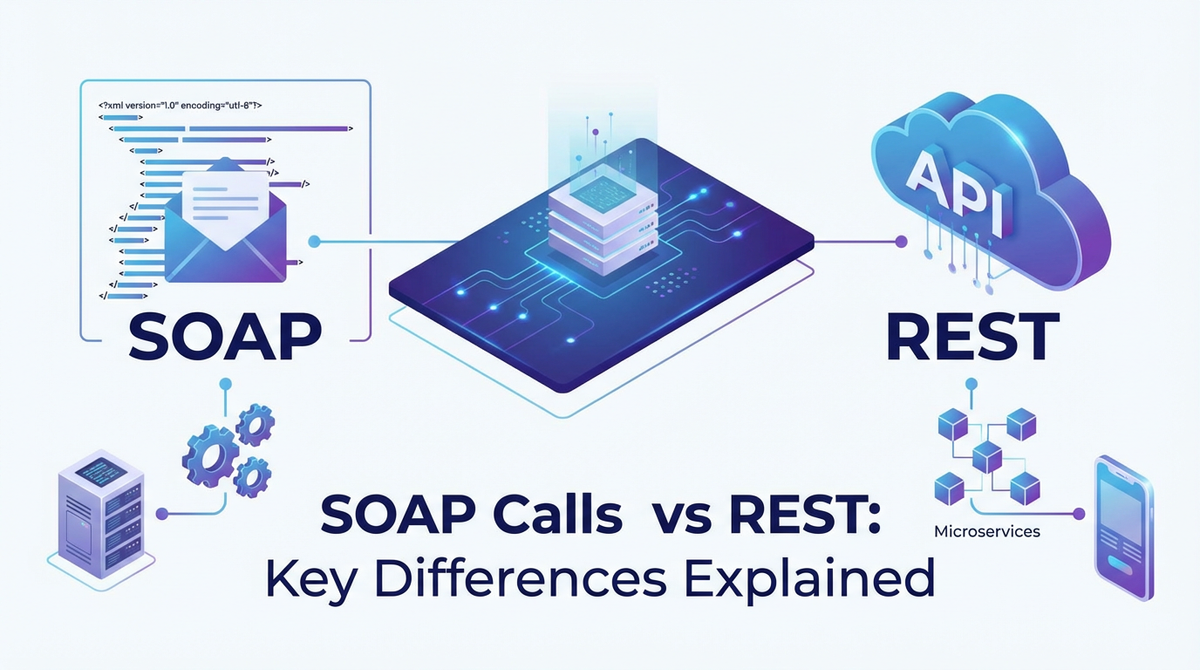
SOAP Calls vs REST: Key Differences Explained


In the intricate tapestry of modern software development, Application Programming Interfaces (APIs) serve as the fundamental threads that weave disparate systems, applications, and services into a cohesive, interconnected whole. They are the silent workhorses enabling everything from fetching weather data for your mobile app to processing complex financial transactions between banks. Without APIs, the rich, dynamic digital experiences we take for granted would simply not exist, leaving us with isolated silos of functionality rather than the vibrant, interoperable ecosystem that defines today's technological landscape. The ability of diverse software components, built on different platforms and written in various programming languages, to communicate seamlessly is entirely predicated on the effectiveness and clarity of their APIs.
As the demand for distributed systems grew, so did the need for standardized communication protocols, giving rise to various architectural styles and protocols designed to facilitate this inter-application dialogue. Among the most prominent and historically significant contenders in this arena are SOAP (Simple Object Access Protocol) and REST (Representational State Transfer). For decades, these two approaches have represented distinct philosophies for building web services, each with its own set of strengths, weaknesses, and optimal use cases. Understanding the nuanced differences between SOAP and REST is not merely an academic exercise; it is a critical skill for architects, developers, and project managers alike, enabling them to make informed decisions that profoundly impact system design, performance, security, and maintainability. This comprehensive exploration delves deep into the core tenets of SOAP and REST, dissecting their architectural principles, operational characteristics, and practical implications. By comparing their message formats, transport protocols, security mechanisms, and overall complexity, we aim to provide a definitive guide that clarifies when and why one might be preferred over the other, navigating the complexities of their coexistence in the modern API landscape.
The Dawn of Connectivity: Understanding APIs
At its core, an API (Application Programming Interface) can be thought of as a set of defined rules and protocols for building and interacting with software applications. It acts as an intermediary, allowing different software components to communicate with each other. Imagine a waiter in a restaurant: you, the customer, are an application, and the kitchen is another application. You don't go into the kitchen to cook your meal yourself; instead, you give your order to the waiter, who then communicates it to the kitchen. The waiter brings back your meal, and you don't need to know how it was prepared. In this analogy, the waiter is the API. It defines what orders can be placed, what ingredients are available, and how the meal will be delivered back to you.
The significance of APIs in the modern digital age cannot be overstated. They are the bedrock of interoperability, enabling systems from various vendors and technological stacks to exchange data and invoke functionality. This capability is fundamental to the architecture of distributed systems, microservices, cloud computing, and the entire concept of the internet of things (IoT). Without APIs, every application would exist in its own isolated silo, unable to leverage data or services from other applications, leading to immense redundancy, inefficiency, and a stifled pace of innovation. The rise of cloud computing, in particular, has cemented the API's role as the primary interface for consuming services, whether it's storage, computation, machine learning, or specialized business logic.
The evolution of integration patterns has been a fascinating journey, mirroring the increasing complexity and scale of software systems. Early forms of integration often involved direct database access or file transfers, which were brittle, tightly coupled, and difficult to scale or maintain. The advent of remote procedure calls (RPC) offered a more abstract way for programs to invoke functions on remote servers, moving towards a service-oriented paradigm. However, RPC often suffered from platform-specific implementations and lacked true interoperability. This paved the way for more generalized and standardized approaches, most notably XML-RPC, which used XML to encode calls and HTTP as a transport mechanism. While a step forward, XML-RPC still had its limitations regarding type systems and extensibility, setting the stage for more robust and comprehensive protocols and architectural styles that could address the demands of enterprise-level integration and the burgeoning World Wide Web.
This historical progression underscores a fundamental need: the requirement for standards and protocols that ensure reliable, secure, and understandable communication between software entities. These standards dictate everything from the format of the data being exchanged to the rules governing how requests are made and responses are received. They aim to reduce ambiguity, enhance predictability, and ultimately lower the barrier to integration, allowing developers to focus on building features rather than wrestling with communication mechanics. It is within this context that SOAP and REST emerged as dominant forces, each offering a distinct philosophy on how best to achieve this essential goal of seamless software communication. While both have profoundly shaped how we build interconnected systems, their underlying principles and practical applications diverge significantly, making a deep understanding of each crucial for any technologist.
SOAP: The Structured and Secure Elder
SOAP, or Simple Object Access Protocol, stands as a testament to the early 2000s' drive for robust, highly structured, and enterprise-grade web service communication. It is not merely an architectural style but a formalized messaging protocol, developed by Microsoft and later standardized by the W3C. At its core, SOAP is designed to exchange structured information in the implementation of web services. Its primary mechanism relies on XML (Extensible Markup Language) to define the format of messages, making it inherently verbose but also incredibly precise and extensible. This XML-centric approach was revolutionary at a time when data interoperability between diverse systems was a significant challenge, providing a common language for machines to understand and process complex data structures.
Key Characteristics and Principles of SOAP
The defining characteristics of SOAP reflect its foundational design philosophy: reliability, security, and extensibility, often prioritized over simplicity and raw speed.
- XML Message Format: Every SOAP message is an XML document, strictly adhering to a defined schema. This document is composed of several key parts:
- Envelope: The mandatory root element that defines the start and end of the message. It encapsulates the entire message, indicating that it is a SOAP message.
- Header (Optional): Provides a mechanism for extending the SOAP message in a decentralized and modular way. It can contain information such as security credentials (e.g., WS-Security), transaction IDs, routing information, or quality-of-service parameters. The header allows for processing of meta-information independent of the actual message content.
- Body (Mandatory): Contains the actual message payload, which includes the request or response information. For a request, it typically defines the method to be invoked and its parameters; for a response, it contains the returned data.
- Fault (Optional): Used for reporting errors. If an error occurs during processing, a Fault element is placed in the Body, containing details about the error, such as a fault code, a human-readable string, and potentially additional details.
- Transport Protocol Independence: One of SOAP's most distinguishing features is its ability to operate over a multitude of transport protocols. While HTTP is the most common choice due to its ubiquity and firewall-friendliness, SOAP is not confined to it. It can also be transmitted over SMTP (for email-based messaging), TCP, JMS (Java Message Service), or even legacy protocols. This independence provides immense flexibility in deployment scenarios, allowing enterprises to integrate services across various network infrastructures without being tied to a specific underlying communication channel.
- Strong Typing and Contract-First Approach (WSDL): SOAP services are typically described by WSDL (Web Services Description Language) files. WSDL is an XML-based language that provides a machine-readable description of the web service's operations, parameters, return types, and message formats. It acts as a formal contract, meticulously defining what the service does, where it resides, and how to invoke it. This "contract-first" approach means that the service interface is defined before implementation, ensuring strict adherence to the defined types and operations. Developers can use WSDL files to generate client-side stubs and server-side skeletons automatically, greatly simplifying the integration process and minimizing potential miscommunications due to mismatched data types or unexpected message structures.
- Security Features (WS-Security): SOAP boasts an extensive suite of extensions, collectively known as WS-*, designed to address various enterprise requirements beyond basic communication. WS-Security is a crucial part of this ecosystem, providing robust mechanisms for message integrity, confidentiality, and authentication. It supports digital signatures, encryption, and various security tokens (e.g., X.509 certificates, SAML assertions) directly within the SOAP message itself, rather than relying solely on transport-level security like HTTPS. This allows for granular security policies to be applied to individual message parts, enabling end-to-end security even when messages traverse multiple intermediaries.
- Reliable Messaging (WS-ReliableMessaging): For mission-critical applications where message delivery guarantees are paramount, SOAP offers WS-ReliableMessaging. This standard ensures that messages are delivered exactly once and in the correct order, even across unreliable networks or system failures. It achieves this through mechanisms like acknowledgments, retransmissions, and message sequencing.
- Transaction Management (WS-AtomicTransaction): In complex distributed systems where multiple services might be involved in a single business process, maintaining data consistency is vital. WS-AtomicTransaction provides a standard for coordinating atomic transactions across multiple web services, ensuring that either all operations within a transaction succeed, or all are rolled back. This is critical for scenarios demanding ACID (Atomicity, Consistency, Isolation, Durability) properties, such as financial transfers or inventory management.
Advantages of SOAP
SOAP's adherence to rigorous standards and its comprehensive suite of extensions bestow upon it several significant advantages, particularly for enterprise-grade applications.
- High Security (WS-Security): As mentioned, WS-Security offers an unparalleled level of message-level security, enabling encryption and digital signatures on specific parts of a message. This is crucial for highly sensitive data where end-to-end security, regardless of intermediate hops, is a non-negotiable requirement. Financial institutions, healthcare providers, and government agencies often leverage this for compliance and data protection.
- Reliability and ACID Transactions: The WS-ReliableMessaging and WS-AtomicTransaction specifications make SOAP an excellent choice for distributed environments where guaranteed message delivery and transactional integrity are paramount. This ensures that business critical operations, even those spanning multiple services, maintain data consistency and recover gracefully from failures.
- Formal Contract (WSDL) for Clear Understanding: The WSDL contract provides a definitive, machine-readable interface definition. This eliminates ambiguity, facilitates automatic code generation for clients and servers, and reduces the chances of integration errors. It's a "contract-first" approach that promotes disciplined development and predictable interactions, especially in large, multi-team projects.
- Language, Platform, and Transport Independent: SOAP's underlying XML structure and its ability to traverse various protocols mean it can seamlessly integrate applications built on diverse technologies (e.g., Java, .NET, Python) and deployed on different operating systems or network infrastructures. This versatility is a major asset in heterogeneous enterprise environments.
- Built-in Error Handling Standards: The SOAP Fault element provides a standardized way to communicate errors, allowing clients to consistently interpret and handle exceptions from the service. This uniformity streamlines error detection and recovery logic across different client implementations.
Disadvantages of SOAP
Despite its strengths, SOAP's design philosophy also introduces certain drawbacks that can make it less suitable for scenarios prioritizing agility and lightweight communication.
- Complexity (XML Overhead, Verbose Messages): The inherent verbosity of XML, coupled with the rigid structure of SOAP envelopes, headers, and bodies, results in larger message sizes compared to more lightweight formats like JSON. This overhead translates to increased bandwidth consumption and more processing power required for serialization and deserialization, potentially impacting performance, especially on resource-constrained devices or high-volume transactions.
- Higher Bandwidth Consumption: Due to the extensive XML markup and the additional elements required for security and reliability, SOAP messages tend to be significantly larger than their RESTful counterparts transmitting the same data. In scenarios where network latency or bandwidth is a concern, this can lead to slower response times and increased operational costs.
- Steeper Learning Curve: Developing and interacting with SOAP services often requires a deeper understanding of various WS-* standards, XML schemas, and tool-specific configurations. The complexity can be intimidating for new developers and requires more specialized knowledge compared to the relatively straightforward principles of REST.
- Tooling Dependency: While WSDL simplifies client generation, it also makes SOAP highly dependent on specialized tooling. Developers often rely on IDE plugins and code generators to consume and produce SOAP services, which can sometimes abstract away too much of the underlying protocol, making debugging and custom implementations challenging without the right tools.
- Performance Implications: The extensive parsing of XML, the processing of various WS-* extensions (like security and reliability), and the larger message sizes can collectively lead to higher latency and lower throughput for SOAP services, especially when compared to the lean nature of REST. This can be a significant bottleneck for high-performance applications or those with tight response time requirements.
When to Use SOAP
Given its robust features and inherent complexities, SOAP is particularly well-suited for specific integration scenarios:
- Enterprise-level Services (Financial, Healthcare): Industries that demand stringent security, transactional integrity, and compliance (e.g., financial transactions, electronic health records) often find SOAP's built-in features indispensable. The granular control over security and reliability provided by WS-* standards meets regulatory requirements that simpler protocols cannot easily satisfy.
- Applications Requiring High Security and Reliability Guarantees: Any system where data integrity, non-repudiation, and guaranteed message delivery are paramount will benefit from SOAP. This includes systems handling sensitive data, critical business processes, or integrations across unreliable networks.
- Legacy Systems Integration: Many older enterprise systems were built with SOAP or similar RPC-based protocols. Integrating with these existing services often means adopting SOAP to ensure compatibility and leverage pre-existing contracts and security models.
- Formal Contracts and Strict Type Enforcement: When a high degree of interoperability and strict adherence to data types and service contracts are necessary across different development teams or organizations, the WSDL-first approach of SOAP provides clarity and reduces integration risks.
In summary, SOAP remains a powerful and relevant protocol, especially in mature enterprise environments where its comprehensive feature set for security, reliability, and transaction management outweighs its perceived complexity and overhead. It represents a "heavyweight" solution designed for maximum control and robustness.
REST: The Flexible and Lightweight Modernist
REST, or Representational State Transfer, stands in stark contrast to SOAP's rigid protocol structure. Coined by Roy Fielding in his 2000 doctoral dissertation, REST is not a protocol but an architectural style that outlines a set of constraints for designing networked applications. It emphasizes simplicity, scalability, and performance, primarily leveraging the existing capabilities of the HTTP protocol. REST's philosophy is rooted in the idea of "resources" – any information that can be named, like a document, an image, a collection of items, or a service. Clients interact with these resources by sending requests to unique URLs (Uniform Resource Locators), which represent the resource's address, and receiving representations of these resources in return.
Key Characteristics and Principles of REST
RESTful architectures adhere to a specific set of constraints that define its unique style, making it highly suitable for the distributed and decentralized nature of the modern web.
- Statelessness: This is one of the most critical constraints in REST. Each request from a client to a server must contain all the information necessary to understand the request. The server should not store any client context between requests. This means that every request is independent and self-contained. While this simplifies server design and improves scalability (as any server can handle any request), it also places the responsibility for managing session state entirely on the client.
- Client-Server Architecture: REST enforces a clear separation of concerns between the client and the server. The client is responsible for the user interface and user experience, while the server is responsible for data storage, security, and business logic. This separation allows clients and servers to evolve independently, promoting modularity and flexibility.
- Cacheable: Clients and intermediaries can cache responses. Servers must explicitly or implicitly label responses as cacheable or non-cacheable to prevent clients from reusing stale or inappropriate data. Caching significantly improves performance and scalability by reducing the need for repeated client-server interactions for the same resource.
- Layered System: A client typically cannot tell whether it is connected directly to the end server or to an intermediary along the way. Intermediary servers (like proxies, gateways, or load balancers) can be introduced to enhance scalability, security, and reliability without affecting the client or the end server. This allows for flexible and extensible system architectures.
- Uniform Interface: This is arguably the most crucial constraint, simplifying the overall system architecture by making interactions with any resource consistent. It involves four sub-constraints:
- Resource Identification in Requests: Individual resources are identified in requests, typically using URIs (Uniform Resource Identifiers).
- Resource Manipulation Through Representations: Clients manipulate resources by sending representations (e.g., JSON, XML) that reflect the desired state of the resource.
- Self-descriptive Messages: Each message includes enough information to describe how to process the message. For example, a request might specify the HTTP method and content type, and a response might indicate the content type of the data returned.
- Hypermedia as the Engine of Application State (HATEOAS): This is the most often overlooked and debated constraint. It dictates that clients should only need a starting URI. All further interactions should be driven by hypermedia links embedded in the representations returned by the server. This allows for truly dynamic and decoupled client applications, where the server dictates the available actions and transitions. While conceptually powerful, HATEOAS is less frequently fully implemented in practical REST APIs, which often lean more towards simple resource-based access.
- Use of Standard HTTP Methods: REST leverages the standard HTTP methods (verbs) to perform actions on resources:
- GET: Retrieve a resource or a collection of resources. (Read-only, idempotent, safe).
- POST: Create a new resource or submit data for processing. (Not idempotent).
- PUT: Update an existing resource, or create it if it doesn't exist. (Idempotent).
- DELETE: Remove a resource. (Idempotent).
- PATCH: Apply partial modifications to a resource. (Not necessarily idempotent).
- Data Formats: While SOAP is exclusively tied to XML, REST is far more flexible. It commonly uses JSON (JavaScript Object Notation) due to its lightweight nature and native compatibility with JavaScript, making it ideal for web and mobile applications. However, REST can also handle XML, plain text, YAML, or any other media type as long as the client and server agree on the representation.
Advantages of REST
REST's architectural style has made it incredibly popular, particularly for web and mobile development, due to its emphasis on simplicity and scalability.
- Simplicity and Ease of Use: REST's fundamental reliance on standard HTTP and straightforward resource URLs makes it exceptionally easy to learn and use. Developers can quickly grasp the concepts of resources and HTTP methods without needing to delve into complex specifications or specialized tooling. This low barrier to entry accelerates development cycles.
- Lightweight (JSON vs. XML): The prevalent use of JSON for data exchange means that REST messages are typically much smaller and faster to parse than SOAP's verbose XML messages. JSON's compact nature significantly reduces bandwidth consumption and processing overhead, making REST highly efficient for applications where performance and responsiveness are critical, such as mobile apps and high-traffic web services.
- Better Performance and Scalability: The stateless nature of REST allows for easy horizontal scaling of servers, as any server can handle any client request without needing prior session information. Coupled with caching mechanisms and smaller message sizes, RESTful services generally offer superior performance and can handle a much larger volume of requests compared to their SOAP counterparts, especially in public-facing internet environments.
- Support for Various Data Formats: REST's flexibility in data representation, primarily JSON, but also XML, YAML, or even plain text, allows developers to choose the most appropriate format for their specific needs. This adaptability fosters broader interoperability and easier integration with a wider range of clients and platforms.
- Statelessness: The stateless constraint simplifies server design, as there's no need to manage session state on the server. This makes servers easier to reason about, recover from failures, and scale out horizontally. It also enhances reliability by making each request independent, reducing the impact of server crashes on ongoing interactions.
- Widespread Adoption (Web, Mobile, Microservices): REST has become the de facto standard for building web services, public APIs, and microservices architectures. Its simplicity and alignment with web principles have led to extensive community support, a rich ecosystem of tools, and a vast body of knowledge, making it a natural choice for modern application development.
Disadvantages of REST
While highly advantageous, REST also comes with certain trade-offs and challenges.
- Lack of Formal Contract (Can Lead to Ambiguity without OpenAPI specifications): Unlike SOAP, which has WSDL to provide a strict contract, REST doesn't inherently enforce a formal service description. This can lead to ambiguity regarding API behavior, expected input/output, and error handling. While tools like OpenAPI (formerly Swagger) specifications have emerged to address this by providing machine-readable documentation, their adoption is optional and not inherent to the REST style itself. Without such specifications, client-side development can be more prone to errors and require more manual effort to understand the api.
- Less Robust Security Out-of-the-Box (Relies on Transport Security like HTTPS): REST relies heavily on transport-level security (like HTTPS/TLS) to encrypt communication and protect against eavesdropping and tampering. While effective, it lacks the built-in message-level security features of WS-Security in SOAP, which can digitally sign and encrypt specific parts of a message. For applications requiring granular, end-to-end message integrity and confidentiality, REST might require additional custom implementations or reliance on broader security frameworks like OAuth 2.0 and JWTs, which are separate from REST itself.
- Statelessness Can Be a Challenge for Complex Transactions: While a boon for scalability, statelessness can complicate the handling of complex, multi-step business transactions that inherently require state. Developers must either manage this state on the client side or implement creative server-side workarounds (e.g., using correlation IDs or temporary resource creation) to simulate stateful interactions, which can add complexity to application logic.
- Versioning Can Be Tricky: As APIs evolve, managing different versions of a REST service can be challenging. There's no single, universally accepted standard for API versioning (e.g., URI versioning, header versioning, query parameter versioning), leading to inconsistencies and potential breaking changes for clients if not managed carefully.
- Over-fetching and Under-fetching (without GraphQL or similar): In traditional REST, clients often receive either too much data (over-fetching) or not enough (under-fetching) in a single request, requiring multiple round trips. For highly specific data requirements, this can lead to inefficient network usage. While this isn't a direct "disadvantage" of REST's core principles, it highlights a common practical challenge that has led to the emergence of alternatives like GraphQL for more optimized data retrieval.
When to Use REST
REST's strengths align perfectly with the requirements of modern web and mobile application development:
- Web Services, Mobile Apps, Single-Page Applications: REST is the ideal choice for public-facing web services, mobile backends, and single-page applications where speed, simplicity, and broad client compatibility are crucial.
- Public APIs: For apis intended for public consumption by a wide developer community, REST's ease of use, discoverability, and lightweight nature make it highly attractive.
- Microservices Architectures: REST's statelessness, clear resource-based model, and alignment with HTTP make it a natural fit for microservices, where individual services communicate independently and scale flexibly.
- When Simplicity, Scalability, and Performance Are Priorities: If the primary drivers for a project are high performance, ease of development, rapid iteration, and the ability to scale to handle large user bases, REST is generally the preferred architectural style.
In essence, REST embodies a "lightweight" and agile approach, designed for the flexibility and scale demanded by the internet and modern distributed systems, often at the expense of the rigid formality and built-in enterprise features characteristic of SOAP.
APIPark is a high-performance AI gateway that allows you to securely access the most comprehensive LLM APIs globally on the APIPark platform, including OpenAI, Anthropic, Mistral, Llama2, Google Gemini, and more.Try APIPark now! 👇👇👇
Direct Comparison: SOAP vs REST
The dichotomy between SOAP and REST is not one of right versus wrong, but rather a spectrum of design philosophies tailored for different integration challenges. While both facilitate communication between software systems, their underlying mechanisms, structural principles, and operational implications differ significantly. Understanding these contrasts is vital for making informed architectural decisions.
Protocol vs. Architectural Style
This is the most fundamental distinction. SOAP is a protocol – a strict set of rules governing message format, communication procedures, and error handling. It dictates precisely how messages should be structured (always XML) and often how they should be exchanged. This protocol-centric approach ensures a high degree of interoperability and predictability, as long as all parties adhere to the SOAP specification and its various extensions (WS-* standards).
REST, on the other hand, is an architectural style – a set of constraints and principles that guide the design of distributed systems. It doesn't prescribe a specific message format or protocol beyond leveraging existing web standards, primarily HTTP. REST focuses on resources, their representations, and the uniform interface provided by HTTP methods. This means that while a SOAP service must adhere to the SOAP protocol, a RESTful API should adhere to REST principles, but there's more flexibility in implementation details.
Message Format
The choice of message format profoundly impacts verbosity, parsing overhead, and human readability. * SOAP: Exclusively uses XML for all message exchanges. While XML offers robust schema validation and extensibility, it is verbose, meaning it typically generates larger messages due to extensive tag overhead. This verbosity increases network traffic and requires more processing power for parsing and serialization. * REST: Offers flexibility, predominantly using JSON (JavaScript Object Notation). JSON is lightweight, human-readable, and parses quickly, making it highly efficient for web and mobile applications. REST can also use XML, YAML, or even plain text, allowing developers to choose the most suitable format for the specific context and client requirements. This adaptability is a key reason for REST's popularity in diverse environments.
Transport Protocols
The underlying mechanism for sending and receiving messages is another point of divergence. * SOAP: Is transport-agnostic. While HTTP is the most common choice, SOAP messages can be sent over virtually any transport protocol, including SMTP (email), TCP, JMS, or even legacy transports. This offers flexibility for integrating with existing enterprise messaging systems or operating in environments where HTTP might not be the primary communication channel. * REST: Is tightly coupled with HTTP. It leverages HTTP methods (GET, POST, PUT, DELETE) directly as verbs for performing operations on resources and relies on HTTP status codes for communicating outcomes. This tight integration simplifies development by building upon well-understood web standards but also limits its transport options.
WSDL/OpenAPI: Formal vs. Informal/Optional Contract
The way service interfaces are defined is a critical difference impacting developer experience and integration complexity. * SOAP: Relies heavily on WSDL (Web Services Description Language). WSDL provides a formal, machine-readable contract that meticulously describes the service's operations, message formats, data types, and network location. This "contract-first" approach allows for automatic client-side code generation and rigorous validation, ensuring strict adherence to the defined interface. * REST: Does not have an inherent formal contract like WSDL. Initially, RESTful APIs often relied on informal documentation or examples, which could lead to ambiguity and integration challenges. However, the rise of specifications like OpenAPI (formerly Swagger) has addressed this gap. OpenAPI allows developers to describe their RESTful APIs in a machine-readable format (JSON or YAML), defining endpoints, operations, parameters, and response structures. While not mandatory, OpenAPI has become an industry standard for documenting REST APIs, simplifying client development and tooling, and fostering consistency across different services. It bridges the documentation gap that was once a significant disadvantage of REST compared to SOAP.
Statelessness
The handling of session state is a core architectural principle that sets them apart. * SOAP: Can support both stateful and stateless operations. While it's generally recommended to design SOAP services as stateless for better scalability, the underlying protocol and its extensions (like WS-Addressing or custom session management in the header) allow for maintaining conversational state between requests, which can be useful for complex, multi-step business processes. * REST: Is strictly stateless. Every request from a client to a server must contain all the information needed to understand the request, and the server must not store any client context between requests. This design simplifies server implementation, improves scalability by allowing any server instance to handle any request, and enhances reliability. Any session state must be managed by the client or passed within each request.
Security
Security mechanisms are a significant differentiator, especially for enterprise-grade applications. * SOAP: Offers robust, built-in message-level security through the WS-Security specification. This allows for granular control over encryption, digital signatures, and authentication tokens directly within the SOAP message, providing end-to-end security regardless of the transport protocol or intermediate proxies. * REST: Primarily relies on transport-level security, most commonly HTTPS/TLS, to secure the communication channel. For authentication and authorization, RESTful APIs typically use industry standards like OAuth 2.0, API keys, or JSON Web Tokens (JWTs), which are separate from the REST architectural style itself. While highly effective, this approach means security is often implemented at a broader level rather than within the message payload itself, which might not meet the strict requirements of some highly regulated environments.
Performance
Performance characteristics are influenced by message size, parsing overhead, and protocol complexity. * SOAP: Generally exhibits lower performance due to its verbose XML messages, the overhead of parsing and validating complex XML schemas, and the additional processing required for WS- extensions (like security and reliability). This can lead to higher latency and reduced throughput compared to REST. * REST: Typically offers superior performance due to its lightweight JSON messages, simpler parsing, and direct leverage of HTTP caching mechanisms. The stateless nature also aids in scalability, allowing for more efficient resource utilization and faster response times, especially for high-volume public api*s.
Complexity
Developer experience and the effort required for implementation vary considerably. * SOAP: Is generally more complex to develop, test, and debug. The reliance on formal WSDL, XML schemas, and numerous WS- specifications requires specialized tooling and a steeper learning curve for developers. Manual introspection of SOAP messages can be challenging due to their verbosity. * REST: Is significantly simpler and easier to work with. Its reliance on standard HTTP methods, clear resource identification, and lightweight data formats makes it intuitive for developers. Tools for interacting with RESTful API*s (e.g., cURL, Postman) are widely available and easy to use, accelerating development and troubleshooting.
Tooling
The ecosystem of supporting tools also differs. * SOAP: Benefits from strong tooling support within enterprise development environments (e.g., Java IDEs, .NET Visual Studio), which can generate client proxies and server skeletons from WSDL definitions. However, these tools are often specific to SOAP. * REST: Benefits from a vast and growing ecosystem of generic HTTP clients, API testing tools, and OpenAPI-driven code generators. Its simpler nature means developers can often interact with REST APIs using basic command-line tools or web browsers, making it highly accessible.
As organizations increasingly adopt a hybrid approach, leveraging both REST and sometimes SOAP for different integration needs, the role of an advanced api gateway becomes paramount. Platforms like APIPark offer robust solutions for managing the entire API lifecycle, whether you're dealing with traditional SOAP services or modern RESTful endpoints, ensuring seamless integration and deployment across diverse environments. While SOAP relies heavily on WSDL for its contract, RESTful APIs often leverage OpenAPI (formerly Swagger) specifications to provide clear, machine-readable descriptions of their capabilities, simplifying client development and ensuring consistency. This demonstrates a convergence towards structured documentation, regardless of the underlying architectural style.
Here's a detailed comparison table summarizing the key differences:
| Feature/Aspect | SOAP (Simple Object Access Protocol) | REST (Representational State Transfer) |
|---|---|---|
| Nature | Protocol (Strict, highly standardized) | Architectural Style (Set of constraints, leverages existing web standards) |
| Message Format | Exclusively XML. Highly verbose, schema-driven. | Flexible (primarily JSON, but also XML, plain text, YAML). Lightweight, human-readable. |
| Transport Protocol | Protocol-agnostic (HTTP, SMTP, TCP, JMS, etc.). | Primarily HTTP (tightly coupled with HTTP methods and status codes). |
| Contract Definition | WSDL (Web Services Description Language). Formal, machine-readable contract for strict interface definition. | Informal by default. Often described by OpenAPI (Swagger) specifications for machine-readability and tooling support. |
| Statefulness | Can be stateful or stateless (though stateless is recommended for scalability). | Strictly stateless (each request independent). |
| Security | Built-in message-level security (WS-Security) for granular control. | Relies on transport-level security (HTTPS/TLS) and separate frameworks (OAuth 2.0, JWTs, API keys). |
| Reliability | High (WS-ReliableMessaging, WS-AtomicTransaction for ACID transactions). | Relies on underlying transport (HTTP) for reliability; custom mechanisms for transactions. |
| Complexity | Higher complexity, steeper learning curve, relies on specialized tooling. | Lower complexity, easier to learn and use, leverages generic HTTP tools. |
| Performance | Generally lower (due to XML parsing, message size, WS-* overhead). | Generally higher (due to lightweight JSON, caching, statelessness). |
| Bandwidth | Higher consumption (verbose XML). | Lower consumption (compact JSON). |
| Error Handling | Standardized SOAP Fault element. | Leverages HTTP status codes (4xx for client errors, 5xx for server errors) and custom error bodies. |
| Use Cases | Enterprise services (finance, healthcare), legacy systems, applications requiring strict contracts, ACID transactions, high security. | Web services, mobile apps, public APIs, microservices, high-performance, scalable systems. |
The Role of API Gateways in a Hybrid World
In the dynamic and increasingly complex landscape of distributed systems, where applications often consume a mix of RESTful APIs, traditional SOAP services, and even newer paradigms like GraphQL, the concept of an API gateway has evolved from a convenience into an absolute necessity. An API gateway acts as a single entry point for all client requests, sitting between the clients and the various backend services. Instead of clients making direct calls to individual microservices or legacy systems, they route their requests through the gateway. This architectural pattern centralizes many common concerns, offloading them from individual service implementations and simplifying client-side logic.
So, what exactly is an API gateway and why has it become so essential? Fundamentally, an API gateway is a management layer that handles routing, composition, and protocol translation requests. It can aggregate calls to multiple backend services, transforming external requests into internal, service-specific requests, and vice versa. This abstraction layer is particularly valuable in a microservices architecture, where a single client request might necessitate interactions with dozens of individual services. Without a gateway, clients would need to manage endpoints, authentication, and error handling for each service, leading to increased complexity and maintenance overhead.
The functions of an API gateway extend far beyond simple request routing:
- Protocol Translation: A crucial capability in a hybrid environment, gateways can translate between different communication protocols. For instance, a client might send a RESTful HTTP request, which the gateway then translates into a SOAP call to a backend legacy system. Conversely, it can expose a simpler REST interface to clients while interacting with more complex internal services. This enables organizations to modernize their client applications without immediately overhauling their entire backend infrastructure.
- Security Enforcement: Gateways are a primary defense line, centralizing authentication and authorization. They can validate API keys, OAuth tokens, and JWTs, preventing unauthorized access to backend services. They also provide features like IP whitelisting, blacklisting, and integration with Identity and Access Management (IAM) systems. This centralizes security policy enforcement, ensuring consistency and simplifying audits.
- Rate Limiting and Throttling: To protect backend services from abuse or overload, API gateways can enforce rate limits, controlling the number of requests a client can make within a specific timeframe. Throttling mechanisms ensure fair usage and prevent denial-of-service attacks.
- Monitoring and Analytics: Gateways provide a centralized point for collecting metrics and logs related to API usage, performance, and errors. This data is invaluable for understanding API traffic patterns, identifying bottlenecks, troubleshooting issues, and making informed decisions about capacity planning and service improvements.
- Load Balancing and High Availability: By sitting in front of multiple instances of backend services, API gateways can distribute incoming traffic efficiently, ensuring optimal resource utilization and preventing single points of failure. They can also perform health checks on backend services, routing traffic away from unhealthy instances.
- Caching: To improve response times and reduce the load on backend services, gateways can cache API responses, serving frequently requested data directly to clients without needing to hit the origin server.
- Request/Response Transformation: Gateways can modify request and response payloads on the fly. This includes enriching requests with additional data, filtering sensitive information from responses, or transforming data formats to meet client expectations (e.g., converting XML to JSON).
- Versioning: As APIs evolve, gateways can help manage different versions, routing requests to appropriate backend service versions based on client headers, URL paths, or query parameters, facilitating smooth transitions and minimizing disruption for existing clients.
How do API gateways support both SOAP and REST? Their flexibility stems from their ability to act as a universal proxy and an intelligent routing layer. For SOAP services, a gateway can: * Expose a REST interface to external clients, translating incoming JSON requests into XML SOAP envelopes and vice versa. * Enforce WS-Security policies or add/remove security headers before forwarding to a SOAP backend. * Manage WSDL definitions and generate documentation. * Provide centralized logging and monitoring for SOAP calls, which might otherwise be harder to track.
For RESTful APIs, the gateway provides: * Consolidated endpoint management. * Centralized authentication/authorization using modern standards like OAuth2. * Rate limiting, caching, and traffic management. * OpenAPI specification serving and validation.
In this context, a powerful api gateway like APIPark becomes an indispensable tool. It not only streamlines the management of RESTful APIs but also provides capabilities to integrate and manage other service types, including a growing number of AI models, offering a unified control plane for diverse integration strategies. APIPark's ability to act as an open-source AI gateway and API management platform means it can handle the traditional SOAP-REST dichotomy while also extending its governance to the rapidly expanding world of AI services. Its feature set, ranging from quick integration of 100+ AI models and unified API formats for AI invocation to end-to-end API lifecycle management and robust security features, makes it a powerful asset in any enterprise striving for comprehensive API governance. By supporting independent APIs and access permissions for each tenant and allowing API resource access to require approval, APIPark ensures a secure and well-regulated API ecosystem, whether you're dealing with the structured world of SOAP, the agile realm of REST, or the cutting-edge domain of AI. It provides a consistent layer of control and visibility, regardless of the underlying communication style.
The Evolution and Future: Beyond the Dichotomy
The technological landscape is one of perpetual motion, and the world of APIs is no exception. While SOAP and REST have dominated the discussion for years, the industry continues to evolve, pushing the boundaries of connectivity and efficiency. The ongoing narrative is not simply about choosing between SOAP and REST, but rather understanding their roles within a broader, more diverse ecosystem of integration patterns.
The rise of microservices architectures, characterized by small, independently deployable services that communicate with each other, has largely cemented REST's position as the preferred choice for inter-service communication. Its lightweight nature, statelessness, and alignment with HTTP make it an ideal fit for the agility and scalability demanded by microservices. Developers building microservices often favor REST because it allows for rapid iteration, reduces boilerplate code, and integrates seamlessly with containerization and orchestration technologies like Docker and Kubernetes. The focus on resources and standard HTTP verbs simplifies the interaction patterns between services, making the overall system easier to understand and manage. This preference has further fueled the adoption of OpenAPI specifications, providing a standardized way to describe these myriad microservices, facilitating discovery, and ensuring consistent interactions across a potentially vast number of internal APIs.
However, the pursuit of even greater efficiency and flexibility has led to the emergence of alternatives. GraphQL, developed by Facebook, represents a significant departure from traditional REST. Instead of fixed endpoints that return predefined data structures, GraphQL allows clients to precisely specify the data they need in a single request. This elegantly solves the problems of over-fetching (receiving more data than required) and under-fetching (requiring multiple requests to get all necessary data), which can plague complex RESTful APIs. For modern front-end applications, especially mobile apps with varying data requirements and network conditions, GraphQL offers a powerful and efficient way to interact with backend services, providing a more tailored and performant data retrieval experience.
Beyond synchronous request-response patterns, event-driven architectures (EDA) are gaining traction, particularly for scenarios requiring real-time updates, reactive systems, and decoupled services. Technologies like Apache Kafka, RabbitMQ, and various cloud-native messaging services enable services to communicate by emitting and subscribing to events, rather than making direct API calls. This paradigm shift supports highly scalable and resilient systems where services react to changes in state, fostering greater autonomy and reducing direct dependencies. While not a direct replacement for REST or SOAP, EDAs complement them by handling asynchronous communication, providing a different dimension to how distributed systems interact.
Despite these innovations, the continued relevance of SOAP in specific niches cannot be understated. Many core enterprise systems, especially in highly regulated sectors like banking, insurance, and healthcare, were built with SOAP and continue to rely on its robust features. Its emphasis on strong contracts, message-level security (WS-Security), and transactional guarantees (WS-AtomicTransaction) often aligns perfectly with the stringent compliance and reliability requirements of these industries. Migrating these mission-critical systems away from SOAP can be an enormously complex, costly, and risky undertaking. Therefore, SOAP will continue to exist as a vital part of the enterprise integration landscape for the foreseeable future, often alongside newer technologies. Hybrid environments, where new RESTful services interact with existing SOAP endpoints, are becoming the norm, underscoring the need for versatile API management platforms.
This brings us to the growing importance of API management and discovery. As the number of APIs within an organization proliferates, effective governance becomes critical. API management platforms provide the tools to design, publish, document, secure, analyze, and version APIs across their entire lifecycle. They offer a centralized portal for developers to discover and subscribe to APIs, ensure consistent security policies, monitor performance, and enforce rate limits. The role of specifications like OpenAPI is crucial here, as they provide the machine-readable descriptions necessary for these platforms to automate many of these management tasks, driving consistency and enhancing the developer experience across diverse APIs, irrespective of whether they are RESTful, SOAP-based (through gateway translation), or even GraphQL.
The future of APIs is undoubtedly one of increased diversity and specialization. There will likely be no single "winner," but rather a landscape where different architectural styles and protocols coexist, each optimized for particular use cases. The challenge for architects and developers lies in understanding this evolving ecosystem and selecting the most appropriate tools and patterns for their specific context, always prioritizing solutions that enhance efficiency, security, and long-term maintainability. The ability to seamlessly integrate and manage these disparate APIs, perhaps through a powerful API gateway like APIPark, will be a key differentiator for organizations seeking to thrive in this interconnected digital era.
Conclusion
In the grand narrative of software architecture, the debate between SOAP and REST is not a simplistic tale of good versus evil, nor of outdated versus cutting-edge. Instead, it is a nuanced story reflecting the diverse demands and priorities that shape the development of distributed systems. Throughout this comprehensive exploration, we have meticulously dissected the core principles, operational characteristics, and practical implications of both SOAP and REST, revealing their inherent strengths and weaknesses.
SOAP, with its formalized protocol, verbose XML messages, and extensive suite of WS-* standards, emerged as the structured and secure elder, perfectly suited for enterprise-grade applications where reliability, transactional integrity, and granular message-level security are non-negotiable. Its contract-first approach via WSDL provides a rigid framework that minimizes ambiguity, crucial for complex, highly regulated environments such as finance and healthcare. However, this robustness comes at the cost of increased complexity, higher bandwidth consumption, and a steeper learning curve, making it less agile for rapid development and resource-constrained environments.
Conversely, REST, an architectural style rooted in the principles of the web, champions simplicity, flexibility, and scalability. Its reliance on standard HTTP methods, lightweight JSON messages, and stateless interactions has made it the modernist's choice for public-facing web services, mobile applications, and microservices. REST excels where high performance, ease of use, and broad interoperability are paramount, leveraging the ubiquity of HTTP and fostering a vast ecosystem of tools and best practices. Yet, its inherent lack of a formal contract and out-of-the-box message-level security features means developers often need to implement or integrate additional layers (like OpenAPI for documentation and OAuth for security) to achieve enterprise-grade reliability and governance.
The key takeaway is that neither SOAP nor REST is inherently "better"; rather, they are optimized for different contexts and requirements. The decision to employ one over the other must be an informed strategic choice, carefully weighing the trade-offs against project-specific needs. Factors such as security mandates, performance targets, developer expertise, existing infrastructure, and the nature of the data being exchanged should all influence this critical architectural decision.
Furthermore, the modern API landscape is increasingly characterized by hybrid environments, where both SOAP and REST (and newer paradigms like GraphQL and event-driven architectures) coexist. This reality underscores the growing importance of robust API management platforms and API gateways. Solutions like APIPark exemplify this necessity, providing a unified control plane to manage, secure, and monitor diverse APIs, bridging the gaps between different architectural styles and even integrating cutting-edge AI services. These platforms abstract away much of the underlying protocol complexity, allowing organizations to leverage the strengths of each approach while maintaining consistency and governance across their entire API portfolio.
In conclusion, understanding the profound differences between SOAP and REST is more than just a technical exercise; it's about mastering the art of thoughtful system design. As technology continues its relentless march forward, the ability to make intelligent choices about how our software communicates will remain a cornerstone of building resilient, scalable, and secure applications that power the digital world.
Frequently Asked Questions (FAQs)
1. What is the fundamental difference between SOAP and REST?
The most fundamental difference is their nature: SOAP is a protocol, a rigid set of rules for structuring messages (always XML) and invoking web services, offering features like built-in security and transaction management. REST, on the other hand, is an architectural style that defines a set of constraints for designing networked applications, primarily leveraging standard HTTP methods and being flexible with data formats (commonly JSON). SOAP dictates how you communicate, while REST describes how to design the system for communication.
2. When should I choose SOAP over REST?
SOAP is generally preferred for enterprise-level applications in highly regulated industries (e.g., finance, healthcare) that require stringent security, ACID transactions, and guaranteed message delivery. Its strong typing, formal contract (WSDL), and built-in message-level security (WS-Security) are crucial for compliance, reliability, and integrating with complex legacy systems where these features are non-negotiable.
3. When is REST a better choice than SOAP?
REST is the preferred choice for modern web services, mobile applications, public APIs, and microservices architectures where simplicity, scalability, and performance are paramount. Its lightweight nature (using JSON), ease of use, and direct leverage of HTTP make it ideal for rapid development, high-volume traffic, and broad client compatibility, especially when integrating with web browsers or mobile devices.
4. Can an API Gateway manage both SOAP and REST APIs?
Yes, absolutely. API gateways are specifically designed to act as a centralized management layer for diverse APIs. A capable API gateway can handle protocol translation (e.g., exposing a REST interface to clients while communicating with a SOAP backend), centralize security policies, perform rate limiting, collect analytics, and manage routing for both SOAP and REST services. Products like APIPark are examples of advanced API gateways that provide comprehensive lifecycle management for a variety of API types, including traditional REST and even AI model integrations.
5. What role does OpenAPI play in REST, similar to WSDL in SOAP?
While SOAP relies on WSDL as a formal, machine-readable contract for service description and code generation, REST initially lacked such a standardized mechanism. OpenAPI (formerly Swagger) emerged to fill this gap for RESTful APIs. It provides a standard, language-agnostic interface description for REST APIs in JSON or YAML format, defining endpoints, operations, parameters, and responses. While not inherent to the REST architectural style itself, OpenAPI serves a similar purpose to WSDL by offering clear, structured documentation that simplifies client development, enables automated testing, and fosters consistency across various RESTful services, making them more discoverable and easier to consume.
🚀You can securely and efficiently call the OpenAI API on APIPark in just two steps:
Step 1: Deploy the APIPark AI gateway in 5 minutes.
APIPark is developed based on Golang, offering strong product performance and low development and maintenance costs. You can deploy APIPark with a single command line.
curl -sSO https://download.apipark.com/install/quick-start.sh; bash quick-start.sh

In my experience, you can see the successful deployment interface within 5 to 10 minutes. Then, you can log in to APIPark using your account.

Step 2: Call the OpenAI API.