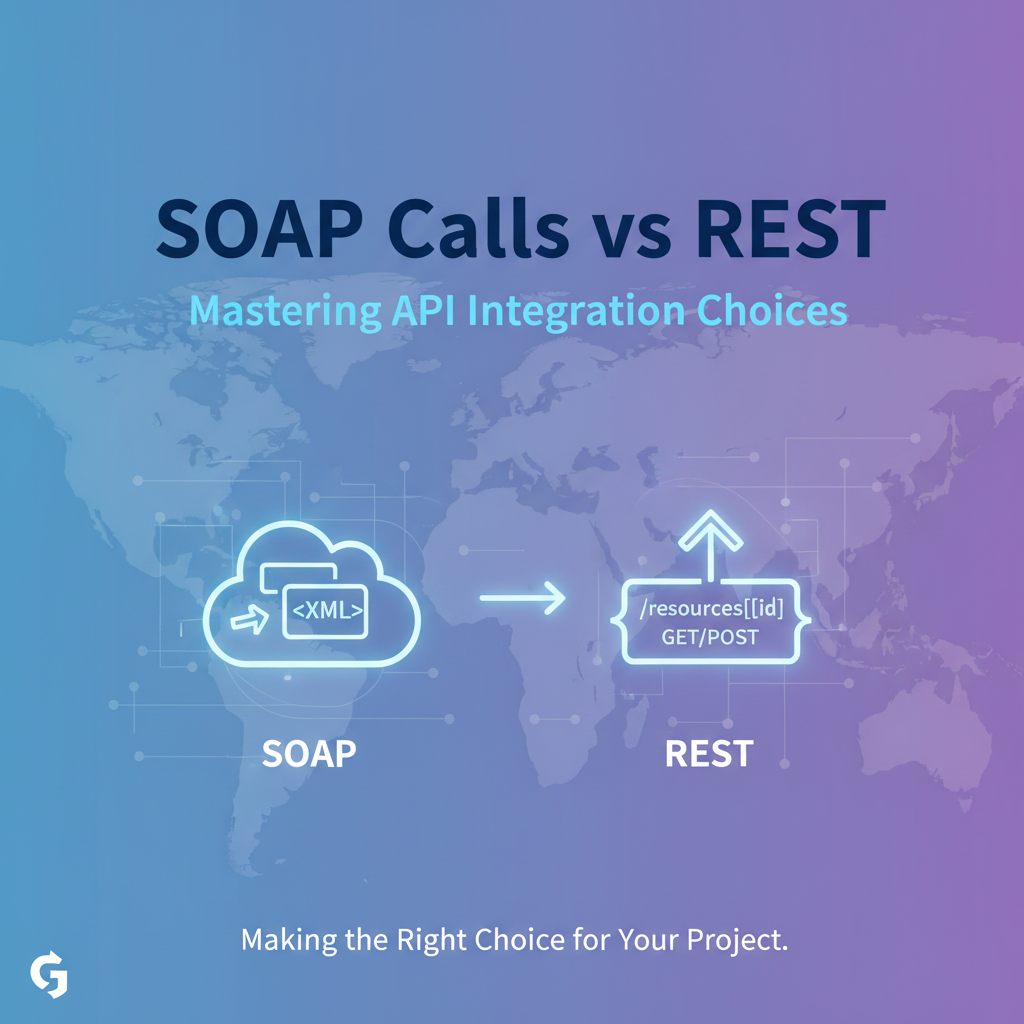
SOAP Calls vs REST: Mastering API Integration Choices


In the rapidly evolving landscape of modern software development, Application Programming Interfaces (APIs) have emerged as the foundational bedrock, enabling disparate systems to communicate, share data, and collaborate seamlessly. They are the silent architects behind virtually every digital interaction, from fetching real-time weather updates on your smartphone to complex financial transactions processed by enterprise systems. The strategic choices made during api integration profoundly impact an organization's agility, scalability, security, and ultimately, its capacity for innovation. Among the myriad architectural styles and protocols available for designing and implementing these crucial interfaces, two dominant contenders have historically captured the lion's share of attention: SOAP (Simple Object Access Protocol) and REST (Representational State Transfer).
While both SOAP and REST aim to facilitate inter-application communication, they represent fundamentally different philosophies and architectural paradigms. Understanding their core principles, strengths, weaknesses, and ideal use cases is not merely an academic exercise; it is an indispensable skill for architects, developers, and business strategists alike. This comprehensive article will embark on an in-depth exploration of SOAP and REST, dissecting their architectural nuances, operational characteristics, and practical implications. We will delve into the critical factors that influence the choice between them, discuss the pivotal role of an api gateway in managing these diverse interfaces, and highlight the significance of standards like OpenAPI in fostering clarity and efficiency. By the end of this journey, readers will possess a robust framework for making informed API integration decisions that align with their project requirements, technical constraints, and long-term strategic objectives.
1. The Foundation of APIs - Understanding the Landscape
Before diving into the specifics of SOAP and REST, it's essential to establish a clear understanding of what an API truly is and why it holds such paramount importance in today's interconnected digital ecosystem. An API, at its core, is a set of defined rules, specifications, and tools that allows software applications to communicate with each other. It acts as a contract, specifying how one piece of software can request services from another, and how it will receive responses.
Imagine an electrical outlet in your home. You don't need to understand the complex wiring behind the walls or the intricate workings of the power plant to use your toaster. You simply plug it into the outlet, which is a standardized interface, and expect it to work. Similarly, an API abstracts away the internal complexities of a system, exposing only the necessary functionalities through a well-defined interface. This abstraction fosters modularity and promotes a clear separation of concerns, allowing developers to build sophisticated applications by assembling components rather than reinventing every wheel.
The omnipresence of APIs in the modern computing era stems from several key drivers:
- Interoperability: APIs break down silos, enabling diverse systems built on different technologies, programming languages, and operating systems to exchange data and evoke functionality. This is critical in a world dominated by hybrid cloud environments and distributed architectures.
- Innovation and Ecosystems: By exposing specific functionalities through APIs, companies can foster vibrant developer ecosystems, allowing third-party developers to build innovative applications and services on top of their platforms. Think of the vast array of mobile apps powered by Google Maps or social media APIs.
- Microservices Architectures: The rise of microservices, where applications are built as collections of small, independently deployable services, relies heavily on efficient API communication between these services. APIs become the glue that holds these distributed systems together.
- Cloud Computing: Cloud platforms extensively use APIs to allow users to programmatically control and manage their cloud resources, from provisioning virtual machines to configuring databases. Automation in the cloud is inherently API-driven.
- Digital Transformation: For many enterprises, APIs are the key enabler for digital transformation initiatives, allowing them to modernize legacy systems, expose internal data and services to partners, and create new digital products.
The evolution of APIs has seen various approaches, from early remote procedure calls (RPC) to the more sophisticated web services we see today. Each approach brought its own set of advantages and challenges, eventually leading to the prominence of architectural styles like SOAP and REST, which have defined the landscape of web-based communication for decades. The choice between them often dictates not just the technical implementation, but also the long-term maintainability, scalability, and developer experience of an entire system.
2. Deep Dive into SOAP (Simple Object Access Protocol)
SOAP, an acronym for Simple Object Access Protocol, represents a foundational architecture in the realm of distributed computing, particularly in enterprise environments. It's not just an architectural style; it's a meticulously defined, XML-based messaging protocol that enables applications to communicate over a network, regardless of their underlying operating systems, programming languages, or hardware. Its genesis in the late 1990s and early 2000s, primarily championed by Microsoft, aimed to address the growing need for robust, standardized, and platform-agnostic communication between disparate systems, especially in the context of integrating complex business logic and workflows.
The primary goal of SOAP was to ensure a high degree of interoperability and reliability in communication. It was designed to overcome the limitations of earlier distributed computing technologies like DCOM and CORBA, which often suffered from platform-specific implementations and firewall traversal issues. By leveraging the universally understood XML format and being transport-agnostic, SOAP offered a promising solution for enterprises grappling with heterogeneous IT infrastructures.
2.1 What is SOAP?
At its core, SOAP is a protocol for exchanging structured information in the implementation of web services. It relies heavily on XML (Extensible Markup Language) for its message format, providing a highly structured and extensible envelope for packaging data. This XML-centric approach brings with it both significant advantages, particularly in terms of strict data validation and rich meta-data, and certain drawbacks, notably verbosity and performance overhead.
Unlike REST, which is an architectural style primarily built on HTTP, SOAP is a full-fledged protocol with its own messaging framework. This means it defines specific rules for how messages should be structured, how services are described, and how these services are discovered. Its design prioritizes formal contracts and rigorous standards, making it particularly well-suited for environments where absolute predictability, reliability, and security are paramount.
2.2 Architecture and Core Concepts
The architecture of a SOAP-based web service is considerably more complex and prescriptive than that of a typical RESTful service. It revolves around several key components and concepts that collectively define the service's contract, behavior, and interaction mechanisms:
- WSDL (Web Services Description Language): This is arguably the most defining characteristic of a SOAP service. WSDL is an XML-based language used to describe the functionality offered by a web service. It acts as a machine-readable contract that outlines all the operations the service can perform, the parameters these operations accept, the data types involved, and the format of the responses. WSDL provides a complete blueprint, allowing client applications to automatically understand and interact with the service without prior knowledge. It specifies the "what" (data types), "who" (operations), and "how" (protocol bindings) of the service, essentially serving as a public interface document.
- SOAP Envelope: Every SOAP message is encapsulated within a SOAP Envelope, which is a mandatory XML element. This envelope serves as the top-level container for the entire message, clearly delineating the boundaries of the SOAP communication. Inside the envelope, there are two primary optional sub-elements:
- SOAP Header: This optional part is used to carry application-specific control information or meta-data that is not directly related to the actual message content but is essential for processing the message. Common uses include authentication credentials (e.g., WS-Security tokens), transaction IDs (e.g., WS-AtomicTransaction), routing information, or session management details. The header allows for extensibility, letting developers add custom information without altering the core message body.
- SOAP Body: This mandatory part contains the actual message content, such as the parameters for a method call (for a request) or the return values (for a response). It is where the operational data for the web service interaction resides. For instance, if you're calling a
getUserDetailsmethod, the user ID would be found in the SOAP Body.
- SOAP Fault: If an error occurs during the processing of a SOAP message, a SOAP Fault element is used to communicate the error information back to the sender. This element, which also resides within the SOAP Body, provides a standardized way to convey error codes, human-readable error messages, and details about the fault source, ensuring consistent error handling across different systems.
- XML Schema: SOAP messages leverage XML Schema Definition (XSD) to define the structure and data types of the XML elements used within the WSDL and the SOAP messages themselves. This provides a rigorous type system, ensuring that data exchanged between applications adheres to predefined formats and constraints, which is crucial for data integrity in complex enterprise systems.
- Transport Binding: While HTTP is the most common transport protocol for SOAP, it is by no means the only one. SOAP is transport-agnostic, meaning it can operate over various protocols, including SMTP (for email-based messaging), JMS (Java Message Service), and even TCP/IP. This flexibility, while offering more options, also adds to the overall complexity of implementation and configuration. The WSDL document typically specifies the transport binding for a particular service endpoint.
2.3 Key Features and Characteristics
The design principles of SOAP endow it with a distinct set of features and characteristics that make it suitable for specific integration scenarios:
- Strictness and Formality: SOAP is highly prescriptive. Every message must conform to a strict XML schema and the WSDL contract. This rigidity minimizes ambiguity and ensures that both the client and the server have a precise understanding of the expected message formats and service behaviors. This formal contract is beneficial in regulated industries or large-scale enterprise integration where consistency is paramount.
- Extensibility through WS-* Standards: One of SOAP's greatest strengths is its extensive ecosystem of related specifications, collectively known as WS-* standards. These extensions address crucial enterprise requirements that are often outside the scope of basic data exchange:
- WS-Security: Provides comprehensive mechanisms for message integrity (digital signatures), confidentiality (encryption), and authentication, operating at the message level rather than just the transport layer. This makes SOAP highly attractive for security-sensitive applications.
- WS-ReliableMessaging: Guarantees message delivery, even in the face of network outages or system failures, by providing mechanisms for message retransmission and sequencing. This is vital for critical business transactions where messages cannot be lost or duplicated.
- WS-AtomicTransaction: Enables distributed transactions across multiple web services, ensuring that a series of operations either all succeed or all fail together, maintaining data consistency in complex workflows.
- WS-Policy: Defines the capabilities and requirements of a web service, such as security policies or reliable messaging assertions, allowing for more dynamic negotiation of service interactions.
- Stateful Operations (Often): While HTTP, a common SOAP transport, is stateless, SOAP itself can be used to implement stateful operations, where the server maintains session information about the client. This is often achieved through the use of WS-Addressing or session IDs passed in the SOAP Header, allowing for multi-step business processes that require context across several requests.
- Language, Platform, and Transport Independence: A core design philosophy of SOAP was to be completely independent of the underlying technology stack. A Java client can easily consume a .NET SOAP service, or vice versa, provided they both adhere to the WSDL contract. This broad interoperability was a significant advantage in the early days of diverse enterprise systems.
2.4 Pros of SOAP
The formal, protocol-driven nature of SOAP brings several compelling advantages, especially in enterprise-grade applications:
- Robustness for Enterprise-Level Transactions: SOAP's strong typing, explicit contracts (WSDL), and rich set of WS-* extensions make it exceptionally robust for complex, mission-critical enterprise applications. Its support for reliable messaging and atomic transactions is invaluable for financial systems, ERP, and CRM integrations where data consistency and transactional integrity are non-negotiable.
- Built-in Error Handling: The SOAP Fault mechanism provides a standardized and highly detailed way to handle errors, allowing clients to understand exactly what went wrong and how to potentially recover. This is often more sophisticated and consistent than ad-hoc error handling in REST.
- Extensive Security Features (WS-Security): For applications where security is paramount, WS-Security offers message-level security features like encryption, digital signatures, and granular access control. This goes beyond transport-level security (like TLS/SSL) by securing individual message elements, providing a higher degree of protection for sensitive data.
- Language, Platform, and Transport Independence: As mentioned, SOAP's strict adherence to XML and WSDL ensures that services can be consumed by virtually any client application, regardless of the programming language or operating system used to build them. This broad interoperability simplifies integration in heterogeneous IT environments.
- Formal Contract for Clear Expectations: The WSDL document serves as an undeniable contract between the service provider and consumer. This eliminates ambiguity, reduces integration errors, and simplifies the development of client applications, as tools can often generate client-side code directly from the WSDL.
2.5 Cons of SOAP
Despite its strengths, SOAP's inherent complexity and verbosity come with a set of significant drawbacks that have contributed to its declining popularity in many modern contexts:
- Complexity and Verbosity (XML Overhead): The most frequently cited criticism of SOAP is its sheer complexity. The XML messages are often very verbose, containing a lot of overhead in terms of tags and namespaces, even for simple operations. This verbosity makes messages larger, harder to read, and more cumbersome to process compared to lighter alternatives like JSON. Developers often find the XML structures and numerous WS-* specifications challenging to grasp and implement.
- Steeper Learning Curve: Due to its protocol-driven nature and the multitude of associated standards (WSDL, WS-Security, WS-ReliableMessaging, etc.), SOAP has a significantly steeper learning curve. Developers require a deeper understanding of XML schemas, namespaces, and the various WS-* specifications to effectively design, implement, and consume SOAP services.
- Performance Overhead: The parsing and processing of large XML messages introduce a notable performance overhead. Generating, transmitting, and validating XML payloads consume more CPU cycles and network bandwidth compared to more compact data formats like JSON, making SOAP less ideal for performance-sensitive applications, especially in mobile or high-throughput scenarios.
- Less Flexible: SOAP's strictness, while a strength for contract enforcement, can also be a weakness in terms of flexibility. Modifying a WSDL contract often requires regenerating client stubs, which can be a tedious process. It is less amenable to rapid iteration and agile development methodologies compared to REST.
- Lack of Native Browser Support: Unlike RESTful APIs, which can be easily invoked directly from web browsers using JavaScript's XMLHttpRequest or Fetch API, SOAP calls are not natively supported by browsers. This means that client-side web applications typically need a proxy or server-side component to interact with SOAP services, adding another layer of complexity.
- Heavy Tooling Requirement: While powerful tools exist for working with SOAP (e.g., SOAPUI for testing, various IDEs for generating client stubs), these tools are often essential due to the inherent complexity. Manual interaction with SOAP messages is rare and difficult.
2.6 Ideal Use Cases for SOAP
Given its particular strengths and weaknesses, SOAP remains a viable and often preferred choice in specific integration scenarios, primarily within the enterprise domain:
- Financial Services (Banking, Payments): Industries handling highly sensitive financial data, intricate transactions, and requiring ironclad security and guaranteed message delivery often lean towards SOAP. The WS-Security and WS-AtomicTransaction standards are critical for ensuring compliance and data integrity in these environments.
- CRM/ERP Systems Integration: Integrating complex enterprise resource planning (ERP) or customer relationship management (CRM) systems often involves mission-critical data, sophisticated business logic, and tight coupling between various modules. SOAP's robust transaction management and formal contracts are well-suited for such integrations, particularly when dealing with legacy systems.
- Telecommunications: In telecommunications, where reliability, billing accuracy, and complex service provisioning are paramount, SOAP has a strong foothold. The need for precise service definitions and robust error handling makes it a suitable choice for inter-carrier communication and network management.
- Government and Healthcare: Regulated industries like government and healthcare, which have stringent compliance requirements for data security, privacy, and auditing, can benefit from SOAP's advanced security features and formal specification, ensuring that interactions meet regulatory standards.
- Any Environment Requiring High Security, Transactionality, and Formal Contracts: Generally, any scenario where a formal, tightly coupled contract is preferred over flexibility, where message-level security is a must, and where distributed transactions or guaranteed delivery are critical, will find SOAP to be a strong contender. This often includes integrating with existing legacy systems that were originally designed with SOAP in mind.
3. Deep Dive into REST (Representational State Transfer)
REST, or Representational State Transfer, is not a protocol in the same vein as SOAP; rather, it is an architectural style. Conceived by Roy Fielding in his 2000 doctoral dissertation, REST offers a set of principles and constraints for designing networked applications that emphasize simplicity, scalability, and loose coupling. It gained prominence as an alternative to the perceived complexity of SOAP, aligning naturally with the evolution of the World Wide Web itself. REST's philosophy is to leverage existing web standards and protocols, most notably HTTP, to create straightforward, resource-oriented APIs that are easy to understand, consume, and scale.
The fundamental idea behind REST is to treat every piece of information or functionality as a "resource." These resources are identified by unique Uniform Resource Identifiers (URIs) and can be manipulated using a small, well-defined set of operations. The interaction is stateless, meaning each request from a client to a server contains all the information needed to understand the request, and the server does not store any client context between requests. This statelessness, combined with the ability to use standard HTTP caching mechanisms, makes REST highly scalable and efficient, particularly for web and mobile applications.
3.1 What is REST?
REST is an architectural style that guides the design of distributed systems, particularly for the web. It is built upon the principles and protocols that already make the web work, primarily HTTP. A system that adheres to these principles is said to be "RESTful." The core concept is that clients and servers interact by exchanging "representations" of "resources."
A resource can be any information that can be named, such as a user, a document, an image, or a collection of items. Each resource is identified by a URI (e.g., /users/123, /products). When a client wants to interact with a resource, it sends an HTTP request to its URI. The server then responds with a "representation" of that resource, which is typically a data format like JSON or XML, along with HTTP status codes and headers. The client, upon receiving this representation, gains all the necessary information to understand the resource's current state and, if applicable, discover further actions it can take through hypermedia links.
This emphasis on using standard web infrastructure (HTTP methods, URIs, status codes, media types) makes REST APIs inherently simple, lightweight, and widely compatible. They are designed to be easily accessible from a multitude of client types, including web browsers, mobile applications, and other backend services, making them the de facto standard for public-facing APIs and modern microservices architectures.
3.2 Core Principles and Constraints (RESTful Principles)
Roy Fielding's dissertation outlined six fundamental architectural constraints that a system must adhere to to be considered RESTful. These constraints are the bedrock of REST's strengths:
- Client-Server: This principle enforces a clear separation of concerns between the client and the server. The client is responsible for the user interface and user experience, while the server handles data storage, business logic, and resource access. This separation enhances portability of the client interface across multiple platforms, improves scalability by simplifying server components, and allows independent development of client and server.
- Statelessness: Each request from the client to the server must contain all the information necessary to understand the request. The server should not store any client context or session state between requests. This means that every request is self-contained and can be processed independently. Statelessness improves scalability because servers don't need to manage session data, making it easier to distribute requests across multiple servers and recover from failures.
- Cacheable: Clients and intermediaries (like proxies or API Gateways) should be able to cache responses to improve performance and network efficiency. Servers must explicitly or implicitly indicate whether a response is cacheable. If a response is cacheable, the client can reuse that response data for equivalent subsequent requests, reducing server load and network traffic.
- Layered System: A client should not be able to tell whether it is connected directly to the end server or to an intermediary along the way. This allows for the use of proxy servers, load balancers, api gateways, and other intermediaries to enhance scalability, security, and performance. For example, an API Gateway can provide caching, security, and routing without the client needing to be aware of its presence.
- Uniform Interface: This is arguably the most crucial constraint, simplifying the overall system architecture by making all components interact in a standardized way. It has four sub-constraints:
- Identification of Resources: Individual resources are identified in requests, for example, using URIs. The resources are conceptually separate from the representations returned to the client.
- Manipulation of Resources Through Representations: When a client holds a representation of a resource, including any attached metadata, it has enough information to modify or delete the resource on the server, provided it has the necessary permissions.
- Self-descriptive Messages: Each message includes enough information to describe how to process the message. For example, media types (like
application/json) indicate how to parse the message body, and HTTP methods (GET, POST, PUT, DELETE) indicate the intended action. - Hypermedia As The Engine Of Application State (HATEOAS): This constraint means that clients interact with a RESTful service entirely through hypermedia provided dynamically by the server. Instead of knowing beforehand what URIs to call, the client discovers available actions and resources by following links embedded in the server's responses. This makes the API self-discoverable and less brittle to changes in URI structures, though it is often the least implemented constraint in practice due to its complexity.
- Code-On-Demand (Optional): Servers can temporarily extend or customize the functionality of a client by transferring executable code (e.g., JavaScript applets). This constraint is optional and rarely used in pure REST APIs, being more common in web applications where a server sends JavaScript to a browser.
3.3 Key Features and Characteristics
RESTful APIs derive their power and popularity from several distinguishing features:
- Resource-Oriented (URIs): REST views the world as a collection of resources, each identified by a unique URI. This intuitive, noun-based approach to defining endpoints makes APIs easy to understand and navigate. For example,
/usersrepresents a collection of users, and/users/123represents a specific user. - Uses Standard HTTP Methods: REST leverages the standard verbs of the HTTP protocol to perform operations on resources. This maps naturally to CRUD (Create, Read, Update, Delete) operations:
GET: Retrieve a resource or a collection of resources.POST: Create a new resource or submit data to a resource.PUT: Update an existing resource (fully replace it) or create a resource if it doesn't exist at a specific URI.DELETE: Remove a resource.PATCH: Partially update an existing resource. This standardization simplifies client development, as HTTP clients already understand these verbs.
- Supports Various Data Formats: While JSON (JavaScript Object Notation) has become the de facto standard for REST APIs due to its lightweight nature, human readability, and direct compatibility with JavaScript, REST is not prescriptive about data formats. It can also support XML, plain text, YAML, or any other format that clients and servers agree upon, indicated by the
Content-TypeandAcceptHTTP headers. - Stateless Communication: As discussed, the stateless nature simplifies server design, improves scalability, and allows for easier load balancing and fault tolerance. Each request is independent, reducing complexity on the server side.
- Simplicity and Lightweight Nature: Compared to SOAP, REST APIs are typically much simpler to design, implement, and consume. The reliance on standard HTTP and lightweight data formats like JSON reduces boilerplate code and network overhead, leading to faster development cycles and improved performance.
- Direct Browser Support: Because REST uses standard HTTP, it can be easily invoked directly from web browsers using JavaScript, making it ideal for single-page applications (SPAs) and dynamic web content.
3.4 Pros of REST
The simplicity and adherence to web standards make REST highly attractive for a vast array of applications:
- Simplicity and Ease of Use: REST APIs are generally much simpler to understand and implement than SOAP. The use of standard HTTP methods and URIs, combined with lightweight data formats like JSON, leads to less overhead and a more intuitive developer experience. This simplicity translates to faster development and easier maintenance.
- Lightweight (especially with JSON): JSON, the predominant data format for REST, is significantly more compact than XML, the default for SOAP. This smaller payload size reduces network bandwidth consumption and improves parsing efficiency, leading to better performance, particularly for mobile applications and high-traffic scenarios.
- Scalability (Statelessness, Caching): The stateless nature of REST makes it inherently scalable. Any server can handle any request, simplifying load balancing and allowing for easy horizontal scaling. Furthermore, leveraging HTTP caching mechanisms significantly reduces server load for frequently accessed read-only resources, leading to improved overall system performance and responsiveness.
- Flexibility in Data Formats: REST is not tied to a single data format. While JSON is dominant, it can readily support XML, plain text, or other formats, allowing providers and consumers to negotiate the most suitable representation via
AcceptandContent-Typeheaders. This adaptability is crucial in diverse ecosystems. - Native Browser Support: Modern web browsers can directly interact with RESTful APIs using standard JavaScript APIs (Fetch API, XMLHttpRequest), without requiring any complex intermediaries or client-side libraries. This makes REST the go-to choice for web-based frontends and single-page applications.
- Wide Adoption in Mobile, Web, and IoT: Due to its lightweight nature, simplicity, and ease of consumption, REST has become the ubiquitous standard for APIs powering mobile applications, web services, and the rapidly expanding Internet of Things (IoT) ecosystem. Its broad adoption ensures a large community, extensive tooling, and readily available libraries.
3.5 Cons of REST
While REST offers numerous advantages, it also comes with certain limitations that need to be considered:
- Lack of Formal Contract (Can Lead to Ambiguity): Unlike SOAP with its WSDL, REST historically lacked a standardized, machine-readable contract. This meant that API documentation was often manual and prone to errors, leading to ambiguity regarding expected request/response formats, error codes, and resource interactions. While tools like OpenAPI (formerly Swagger) have largely mitigated this by providing a standardized way to describe RESTful APIs, the architectural style itself doesn't mandate it.
- Less Built-in Security Than SOAP (Requires External Mechanisms): REST does not have inherent, message-level security standards comparable to SOAP's WS-Security. Security for REST APIs typically relies on transport-level security (TLS/SSL for HTTPS) and external authorization frameworks like OAuth 2.0, API keys, or JWTs. While these are highly effective, they are not part of the core REST architecture and need to be implemented separately, potentially adding complexity.
- Over-fetching/Under-fetching Data Can Be an Issue: In a traditional REST API, clients often retrieve an entire resource representation, even if they only need a few fields. This "over-fetching" can waste bandwidth, especially in mobile environments. Conversely, a client might need data from multiple resources, leading to several individual requests (N+1 problem) or "under-fetching," which increases latency. Alternatives like GraphQL emerged partly to address this flexibility gap.
- No Inherent Transaction Support: REST is inherently stateless and doesn't provide built-in support for distributed transactions, unlike SOAP's WS-AtomicTransaction. Implementing complex multi-step processes that require atomicity across multiple resources typically requires custom application-level logic or sagas, which can be challenging to design and manage.
- Version Management Can Be Challenging: As an API evolves, changes to resource structures or behaviors can break existing clients. Managing different API versions (e.g., via URI versioning, custom headers, or query parameters) can be complex and requires careful planning and communication with API consumers.
- HATEOAS Often Underutilized: While a core REST constraint, HATEOAS (Hypermedia As The Engine Of Application State) is often the least implemented in practice. Many REST APIs are "REST-like" or "HTTP APIs" that use HTTP methods and JSON but do not fully embrace the hypermedia principle. This can make APIs less discoverable and more brittle to changes in resource paths.
3.6 Ideal Use Cases for REST
REST's flexibility, simplicity, and performance characteristics make it the preferred choice for a wide array of modern application development:
- Public APIs (e.g., Social Media, Weather, Mapping Services): For public-facing APIs where ease of use, broad accessibility, and rapid developer adoption are crucial, REST is the undisputed champion. Its straightforward nature allows developers to quickly integrate and build applications on top of existing services.
- Mobile Applications: Given the constraints of mobile devices (limited bandwidth, battery life, varying network conditions), the lightweight nature of REST APIs (especially with JSON) makes them ideal for optimizing data transfer and ensuring responsiveness.
- Web Applications (Single-Page Applications, Dynamic Content): Modern web development, particularly with frameworks like React, Angular, and Vue.js, heavily relies on REST APIs to fetch and send data dynamically to create rich, interactive user experiences without full page reloads.
- Microservices Architectures: The design philosophy of microservices — small, independently deployable services communicating over a network — aligns perfectly with REST's principles of loose coupling, statelessness, and scalability. REST is the dominant communication style within microservices ecosystems.
- Cloud-Based Services: Cloud providers and services widely expose their functionalities through REST APIs, enabling programmatic access and automation for managing resources, deploying applications, and orchestrating workflows.
- Where Performance and Simplicity Are Paramount: For scenarios where the primary drivers are high performance, low latency, easy integration, and rapid development cycles, REST is typically the superior choice. This includes many IoT applications, real-time data feeds, and consumer-facing applications where user experience is directly tied to API responsiveness.
APIPark is a high-performance AI gateway that allows you to securely access the most comprehensive LLM APIs globally on the APIPark platform, including OpenAI, Anthropic, Mistral, Llama2, Google Gemini, and more.Try APIPark now! 👇👇👇
4. Direct Comparison: SOAP vs REST (The Deciding Factors)
Having delved deeply into the individual characteristics of SOAP and REST, it becomes clear that while both serve the purpose of inter-application communication, they do so with fundamentally different philosophies and mechanisms. The decision of which to use is rarely arbitrary; it's a strategic choice driven by specific project requirements, technical constraints, and long-term architectural goals. This section will provide a direct, side-by-side comparison, highlighting the critical distinctions that developers and architects must weigh.
4.1 Architectural Style vs. Protocol
This is the most fundamental difference. * SOAP: Is a rigid, message-based protocol with a strict set of rules for how messages are structured and exchanged. It defines the entire communication framework, from message format (XML) to service description (WSDL) and extensions (WS-*). * REST: Is an architectural style that leverages existing, well-understood protocols and principles, primarily HTTP. It doesn't define a specific message format or communication protocol but rather a set of constraints for designing networked applications that use standard web paradigms.
4.2 Data Format
The choice of data format has significant implications for message size, parsing efficiency, and human readability. * SOAP: Exclusively uses XML for its message payloads. While XML is highly structured and extensible, it is often verbose, leading to larger message sizes and more complex parsing. * REST: Is flexible and supports various data formats. JSON has become the most prevalent due to its lightweight nature, ease of parsing in JavaScript, and human readability. However, it can also support XML, plain text, and others, negotiated via HTTP content negotiation.
4.3 Transport Protocol
The transport layer dictates how messages are physically transmitted across the network. * SOAP: Is transport-agnostic. While HTTP is the most common binding, it can also operate over SMTP, JMS, TCP, and others. This offers flexibility but can also increase complexity in configuration. * REST: Almost exclusively relies on HTTP/HTTPS. It leverages HTTP verbs (GET, POST, PUT, DELETE) and status codes directly, treating the web itself as its application platform.
4.4 Contract and Discoverability
The way a service is described and discovered is crucial for developer experience and integration robustness. * SOAP: Uses WSDL (Web Services Description Language) as a formal, machine-readable contract. WSDL precisely defines all service operations, parameters, and data types, allowing for automated client-side code generation and strict validation. This makes services highly discoverable and self-describing in a formalized way. * REST: Traditionally lacked a formal, standardized description language, relying instead on human-readable documentation. However, the rise of specifications like OpenAPI (formerly Swagger) has addressed this gap. OpenAPI defines a standard, language-agnostic interface for describing RESTful APIs, allowing both humans and computers to discover and understand the capabilities of a service without access to source code. It facilitates automatic generation of documentation, client SDKs, and server stubs, significantly improving the developer experience and ensuring a clear contract, similar in intent to WSDL but tailored for REST's principles.
4.5 Security
Security considerations are paramount for any API integration, especially in enterprise contexts. * SOAP: Offers robust, built-in message-level security through the WS-Security standard. This provides mechanisms for message integrity (digital signatures), confidentiality (encryption of specific message parts), and authentication directly within the SOAP envelope, independent of the transport layer. * REST: Typically relies on transport-level security (TLS/SSL over HTTPS) to encrypt data in transit. For authentication and authorization, it uses external mechanisms like API keys, OAuth 2.0, JSON Web Tokens (JWTs), or basic HTTP authentication. While effective, these are not inherent to the REST architectural style itself and require separate implementation.
4.6 Performance
Performance is a key consideration, especially for high-traffic or latency-sensitive applications. * SOAP: Generally has higher overhead. The verbose XML messages require more bandwidth, and the parsing of complex XML structures consumes more CPU cycles. This can lead to slower response times, particularly for smaller, frequent requests. * REST: Is typically faster and more efficient. Its lightweight data formats (JSON) and minimal overhead reduce bandwidth consumption. Leveraging HTTP caching mechanisms further enhances performance for read operations.
4.7 Complexity and Learning Curve
The ease with which developers can understand and implement an API is a major factor in adoption and development velocity. * SOAP: Has a steeper learning curve due to its protocol-driven nature, the complexity of XML, and the numerous WS-* standards that often accompany it. Developing and consuming SOAP services often requires specialized tools. * REST: Is generally much simpler to learn and implement, especially for developers familiar with HTTP and web concepts. Its direct mapping to HTTP verbs and resources makes it intuitive, and a wide array of generic HTTP client libraries are readily available.
4.8 Tooling and Ecosystem
Both styles have mature ecosystems, but their nature differs. * SOAP: Relies heavily on sophisticated tooling (e.g., SOAPUI for testing, IDEs for WSDL-based code generation) to handle its complexity. These tools are often essential for productive development. * REST: Benefits from a vast and diverse ecosystem of simpler, often language-agnostic tools. HTTP clients are ubiquitous, and OpenAPI tools provide excellent support for documentation, code generation, and testing. The broader web development community actively contributes to REST tooling.
4.9 Statefulness
Understanding how session state is managed is crucial for designing multi-step interactions. * SOAP: Can support both stateless and stateful operations. While the underlying HTTP transport is stateless, SOAP messages can carry session information in their headers (e.g., using WS-Addressing or custom session IDs), allowing for stateful interactions across multiple requests if needed for business processes. * REST: Is fundamentally stateless. Every request from a client to a server must contain all the information needed to understand the request, and the server does not store any client context between requests. Any state management typically occurs on the client side, or state is explicitly passed in subsequent requests.
To provide a quick overview, the following table summarizes the key differences:
| Feature/Aspect | SOAP (Simple Object Access Protocol) | REST (Representational State Transfer) |
|---|---|---|
| Type | Protocol, with a formal specification | Architectural style, based on HTTP standards |
| Primary Data Format | XML (Extensive Markup Language) | JSON (JavaScript Object Notation) is preferred, also XML, plain text, etc. |
| Transport Protocol | Any (HTTP, SMTP, JMS, TCP, etc.); HTTP is most common | Primarily HTTP/HTTPS |
| Message Structure | XML-based Envelope, Header, Body, Fault |
Lightweight, resource-oriented, uses standard HTTP verbs and status codes |
| Contract Definition | WSDL (Web Services Description Language) - formal, machine-readable | OpenAPI (Swagger) is common for formal description; often ad-hoc docs |
| Security | WS-Security (message-level encryption, signatures, authentication) | TLS/SSL (transport-level), OAuth 2.0, API Keys, JWTs (external mechanisms) |
| Performance | Higher overhead (verbose XML, complex parsing) | Lower overhead (lightweight JSON, HTTP caching) |
| Complexity | Higher learning curve, more complex to implement and debug | Simpler, easier to learn and use, intuitive |
| Tooling | Often requires specialized tools (e.g., SOAPUI, WSDL generators) | Leverages standard HTTP tools, strong OpenAPI ecosystem |
| Statefulness | Can be stateful (via WS-Addressing/headers) or stateless | Stateless (server does not store client context) |
| Error Handling | Standardized via SOAP Fault element | Uses HTTP status codes (4xx, 5xx) with custom error bodies |
| Primary Use Cases | Enterprise apps (financial, ERP, CRM), legacy systems, high security | Web, mobile, IoT, public APIs, microservices, cloud-native |
5. API Management and Integration Strategies
Regardless of whether you choose SOAP, REST, or a hybrid approach, the effective management of APIs is paramount for the long-term success of any digital strategy. As organizations increasingly rely on APIs to power their products, integrate with partners, and drive internal processes, the complexity of managing these interfaces grows exponentially. This is where robust API management strategies and specialized tools, particularly an api gateway, become indispensable.
5.1 The Role of an API Gateway
An api gateway acts as a single entry point for all API calls, sitting between clients and backend services. It serves as a central hub that handles a multitude of cross-cutting concerns, offloading them from individual backend services and providing a consistent layer of governance and control. Its importance cannot be overstated in modern architectures, especially when dealing with a mix of different API styles like SOAP and REST.
Key functions of an api gateway include:
- Centralization of API Management: It provides a unified dashboard to publish, secure, monitor, and manage all APIs, irrespective of their backend implementation (SOAP, REST, GraphQL, etc.). This centralization simplifies operations and ensures consistency.
- Security Enforcement: The gateway is a critical enforcement point for API security. It handles authentication (e.g., OAuth 2.0, API keys, JWT validation), authorization, rate limiting (to prevent abuse and ensure fair usage), and IP whitelisting/blacklisting. This protects backend services from malicious attacks and overuse.
- Traffic Management and Routing: An api gateway intelligently routes incoming requests to the appropriate backend service, which can involve complex logic based on URL paths, headers, query parameters, or even dynamic service discovery. It can also perform load balancing across multiple instances of a backend service to ensure high availability and performance.
- Monitoring and Analytics: Gateways provide comprehensive logging of all API traffic, offering insights into usage patterns, performance metrics, error rates, and security events. This data is invaluable for troubleshooting, capacity planning, and understanding API consumption.
- Protocol Translation and Transformation: A sophisticated api gateway can act as a protocol intermediary, allowing you to expose, for example, a legacy SOAP service as a modern RESTful API to external consumers. It can transform messages between different formats (e.g., XML to JSON) and perform content enrichment or manipulation. This capability is crucial for migrating legacy systems without impacting existing clients or exposing their internal complexities.
- Version Management: Gateways can help manage API versions, routing requests to different backend versions based on client-specified headers, paths, or query parameters, facilitating smooth transitions and backward compatibility.
For organizations navigating complex API landscapes, an advanced api gateway becomes indispensable. Platforms like ApiPark offer comprehensive API management solutions, acting as a unified AI gateway and developer portal. It simplifies the integration and deployment of both AI and REST services, handling everything from traffic forwarding and load balancing to sophisticated security policies and detailed api call logging. APIPark also allows for prompt encapsulation into REST API, letting users quickly combine AI models with custom prompts to create new APIs like sentiment analysis or data analysis APIs. This centralization is especially vital when dealing with a mix of SOAP and REST APIs, allowing for consistent governance and visibility across all services, ensuring that even complex integrations are managed with ease and efficiency.
5.2 Hybrid Architectures
In the real world, it's rare to find an enterprise that exclusively uses either SOAP or REST. Most large organizations operate in a hybrid environment, integrating a mix of legacy systems (often SOAP-based) with modern microservices and external APIs (predominantly RESTful). Hybrid architectures are a pragmatic necessity. An api gateway is critical in these scenarios, acting as an abstraction layer that can normalize diverse backend APIs into a consistent external interface. It can expose a SOAP service as REST, or vice-versa, allowing different client types to interact with the same underlying functionality using their preferred protocol. This approach maximizes reuse, minimizes disruption during migration, and shields client applications from the intricacies of the backend architecture.
5.3 Importance of Documentation (OpenAPI specification)
Clear, accurate, and up-to-date documentation is the lifeblood of any successful API. Without it, even the most elegantly designed API will struggle to gain adoption and can become a source of frustration for developers. For RESTful APIs, the OpenAPI Specification (OAS), formerly known as Swagger Specification, has emerged as the industry standard for describing APIs in a machine-readable format. * Machine-Readable Contract: OpenAPI defines a standard, language-agnostic interface for describing RESTful APIs. This YAML or JSON file provides a complete blueprint of the API, including its endpoints, operations (HTTP methods), parameters (inputs), authentication methods, and response formats (outputs). * Enhanced Developer Experience: With an OpenAPI definition, developers can: * Understand the API quickly: They can explore all available endpoints and their expected behavior without guesswork. * Generate client SDKs: Tools can automatically generate client-side code in various programming languages, accelerating integration. * Generate server stubs: This facilitates rapid API development by providing starting points for server-side implementation. * Automatic Documentation: Interactive documentation (like Swagger UI) can be automatically generated from the OpenAPI definition, providing a live, browsable reference for developers. * Automated Testing: The definition can be used to generate test cases, ensuring the API behaves as expected. * Consistency and Collaboration: OpenAPI promotes consistency across different API teams and simplifies collaboration between frontend and backend developers by providing a single source of truth for the API contract.
While SOAP has WSDL for its contract, OpenAPI serves a similar role for REST, providing the necessary formality and tooling to manage complex REST API ecosystems efficiently. The emphasis on clear contracts, whether WSDL for SOAP or OpenAPI for REST, significantly reduces integration friction and boosts development velocity.
5.4 Security Best Practices for APIs
Securing APIs is non-negotiable. Beyond the specific security features of SOAP (WS-Security) or REST (TLS/SSL, OAuth), general best practices apply to all API integrations:
- Authentication and Authorization: Implement strong authentication mechanisms (e.g., OAuth 2.0, API keys, JWTs) to verify the identity of the client. Granular authorization ensures that authenticated clients only access resources they are permitted to.
- Input Validation: Validate all incoming API requests to prevent injection attacks, buffer overflows, and other common vulnerabilities. This should be done at the api gateway level and on the backend service.
- Rate Limiting and Throttling: Prevent API abuse, DDoS attacks, and resource exhaustion by limiting the number of requests a client can make within a given timeframe.
- Encryption in Transit and at Rest: Use HTTPS (TLS/SSL) for all API communication to encrypt data in transit. For sensitive data, consider encryption at rest in databases.
- Error Handling and Logging: Avoid revealing sensitive system details in error messages. Implement robust logging to track API access, errors, and security events for auditing and troubleshooting.
- API Versioning: Plan for API evolution with a clear versioning strategy to prevent breaking changes for existing consumers.
- Regular Security Audits: Continuously monitor and audit API security, conduct penetration testing, and stay updated on the latest security threats and best practices.
5.5 Monitoring and Analytics for API Performance
Visibility into API performance and usage is crucial for maintaining system health and making informed decisions. * Real-time Monitoring: Track key metrics such as latency, error rates, throughput, and availability for all API endpoints. This allows for proactive identification and resolution of issues. * Detailed Logging: Comprehensive logging of every API call provides an audit trail and invaluable data for debugging and security analysis. * Usage Analytics: Understand how APIs are being consumed, which endpoints are most popular, who the primary consumers are, and identify potential bottlenecks or areas for improvement. This data informs API design, capacity planning, and business strategy. * Alerting: Set up automated alerts for critical thresholds (e.g., high error rates, increased latency, security incidents) to ensure immediate response to problems.
Platforms like APIPark provide powerful data analysis capabilities, analyzing historical call data to display long-term trends and performance changes, helping businesses with preventive maintenance before issues occur. This kind of detailed monitoring, often handled by the api gateway, is essential for guaranteeing the reliability and stability of your API ecosystem.
5.6 Versioning Strategies
As your application and its underlying services evolve, your APIs will inevitably need to change. Managing these changes without disrupting existing clients is a critical challenge. Common API versioning strategies include:
- URI Versioning: Embedding the version number directly in the API's URI (e.g.,
/api/v1/users). This is a straightforward and explicit method, though it can lead to URI proliferation. - Header Versioning: Including the API version in a custom HTTP header (e.g.,
X-API-Version: 1). This keeps URIs cleaner but might be less intuitive for developers without explicit documentation. - Query Parameter Versioning: Passing the version as a query parameter (e.g.,
/api/users?version=1). This is simple but can clutter the query string and might be less semantically clear. - Content Negotiation Versioning: Using the
Acceptheader to request a specific media type that includes the version (e.g.,Accept: application/vnd.myapi.v1+json). This aligns well with RESTful principles but can be more complex to implement and test.
The choice of versioning strategy depends on factors like desired explicitness, ease of implementation, and impact on client-side code. Regardless of the method, a clear, consistent approach communicated effectively through documentation (e.g., OpenAPI) is essential.
6. Making the Right Choice - A Decision Framework
The perennial debate between SOAP and REST isn't about declaring a universal winner; it's about making the most appropriate choice for a given set of circumstances. There is no one-size-fits-all answer. Instead, the decision hinges on a careful evaluation of various factors that are unique to each project and organization. This section provides a decision framework to guide you through this critical selection process.
6.1 Consider your Requirements
Before leaning towards either SOAP or REST, conduct a thorough analysis of your project's specific needs and constraints. Ask yourself the following questions:
- Security Needs (Enterprise-grade vs. Public):
- Do you require message-level security features like encryption of specific data fields, digital signatures, and strict access controls that go beyond transport-level security? If so, SOAP's WS-Security might be a strong advantage.
- Is standard transport-level security (HTTPS/TLS) combined with robust authentication/authorization (OAuth 2.0, API keys) sufficient? REST, with external security mechanisms, will likely meet these needs.
- Transactionality and Reliability:
- Do you need guaranteed message delivery, message sequencing, or distributed transactions (all-or-nothing operations across multiple services)? SOAP's WS-ReliableMessaging and WS-AtomicTransaction provide these capabilities out-of-the-box.
- Can you handle transactional integrity at the application level, or are stateless operations generally sufficient? REST typically requires custom logic for complex transactional flows.
- Performance and Scalability:
- Is network bandwidth a significant constraint (e.g., for mobile clients or IoT devices)?
- Do you anticipate high transaction volumes and require extremely low latency?
- Can you heavily leverage caching for read-heavy operations? REST's lightweight nature and HTTP caching capabilities often outperform SOAP in these areas.
- Complexity and Development Overhead:
- How steep is the learning curve acceptable for your development team?
- Do you prefer simpler, more agile development processes, or are you comfortable with more rigorous, tool-driven development? REST generally offers a quicker and simpler development experience.
- Existing Infrastructure and Skill Set:
- Are you integrating with existing legacy systems that are already SOAP-based? Re-implementing them as REST might be more effort than just consuming them as SOAP.
- What are your team's existing skill sets? Are they proficient in XML, WSDL, and WS-* standards, or are they more comfortable with HTTP, JSON, and web frameworks?
- Target Audience (Internal vs. External Developers):
- Are you building an internal enterprise API for a small, controlled group of developers who might be accustomed to formal contracts?
- Are you building a public API for a broad developer community, where ease of adoption and a lightweight development experience are paramount? REST is typically preferred for public APIs.
6.2 When to choose SOAP
Despite the growing popularity of REST, there are still compelling reasons to opt for SOAP:
- Legacy Enterprise Systems: If you're integrating with existing, mature enterprise systems (e.g., SAP, Oracle EBS, older banking systems) that already expose SOAP-based web services, it's often more practical and less risky to consume them directly using SOAP. The cost of rewriting or adding a RESTful wrapper might outweigh the benefits.
- Strict Security and Transaction Requirements: For applications in highly regulated industries (e.g., finance, healthcare, government, defense) where message-level security, guaranteed delivery, and distributed atomic transactions are absolute requirements and compliance mandates the highest level of rigor, SOAP's WS-* standards provide an unparalleled, standardized solution.
- Formal Contracts and Interoperability Across Heterogeneous Platforms: In environments where a very strict, machine-readable contract (WSDL) is crucial for interoperability between diverse, independently developed systems, and where any deviation from the contract is unacceptable, SOAP provides the necessary formality. It ensures that systems built on different technologies can communicate with guaranteed understanding.
- Long-Term, Stable Integrations: For integrations that are expected to be stable for many years with infrequent changes, the initial overhead of SOAP development might be justified by the long-term robustness and predictability of its contract-driven approach.
6.3 When to choose REST
REST has become the de facto standard for many modern applications due to its flexibility and simplicity:
- New Web and Mobile Applications: For building new web frontends (especially single-page applications), mobile apps, or other client-side applications that need to communicate with a backend, REST is almost always the preferred choice. Its lightweight nature and native browser support make development faster and more efficient.
- Public APIs: If you're designing APIs for external developers or partners, especially where broad adoption and ease of use are critical, REST's simplicity, human-readability, and rich ecosystem of tooling will significantly enhance the developer experience.
- Microservices Architectures: REST's statelessness, resource-oriented nature, and strong alignment with HTTP make it an excellent fit for inter-service communication within a microservices ecosystem. It promotes loose coupling and scalability, key tenets of microservices.
- High Performance, Scalability, and Ease of Use Are Priorities: When the primary drivers are maximizing performance, achieving high scalability (through caching and statelessness), and minimizing development time and complexity, REST is typically the superior option. This is common in cloud-native applications and high-throughput data processing.
- Rapid Development Cycles: For projects emphasizing agile methodologies and rapid iteration, REST's simpler design and development model allow teams to quickly build, test, and deploy API functionalities.
6.4 The "It Depends" Reality
Ultimately, the choice is rarely black and white. Many enterprises operate in a hybrid reality, leveraging both SOAP and REST. It's not uncommon to have:
- Legacy SOAP services: Maintained for critical existing integrations, possibly exposed through an api gateway that transforms them into REST for newer clients.
- New RESTful APIs: Built for modern web/mobile applications and microservices.
- Specific SOAP-only interactions: For highly specialized enterprise B2B integrations that explicitly require advanced WS-* features.
The key is to understand the trade-offs and make an informed, pragmatic decision based on the specific context of each integration point. Your api gateway can be a powerful ally in managing this complexity, providing a unified facade over a diverse backend, translating protocols, and enforcing consistent policies.
Conclusion
The decision between SOAP and REST for API integration is a pivotal one, shaping the architectural direction, development efforts, and operational characteristics of your software systems. Both architectural styles have distinct strengths and weaknesses, making each suitable for particular scenarios.
SOAP, with its robust protocol, formal contracts (WSDL), and rich set of WS-* standards, remains a strong contender for enterprise-grade applications demanding unparalleled security, transactional integrity, and guaranteed delivery. It thrives in environments where strict adherence to contracts, complex business processes, and integration with legacy systems are paramount. Its verbosity and complexity, however, can lead to increased development time and performance overhead.
REST, on the other hand, embodies simplicity, flexibility, and scalability, aligning perfectly with the principles of the modern web. By leveraging standard HTTP and lightweight data formats like JSON, it offers a more intuitive, performant, and developer-friendly approach, making it the dominant choice for web, mobile, public APIs, and microservices architectures. While it traditionally lacked a formal contract, the advent of OpenAPI has significantly addressed this, providing a standardized way to describe and manage RESTful APIs effectively.
In today's interconnected world, the reality for many organizations is a hybrid landscape. Successful API integration often involves strategically employing both SOAP and REST where each is most appropriate. This is precisely where robust API management solutions and an api gateway become indispensable. An api gateway like ApiPark serves as a crucial abstraction layer, centralizing control, enforcing security, managing traffic, and even translating between different protocols, thereby simplifying the complexities of a heterogeneous API ecosystem. Moreover, the adoption of standards such as OpenAPI ensures that regardless of the underlying architectural style, your APIs are well-documented, discoverable, and easy for developers to consume.
Ultimately, mastering API integration choices is not about rigid adherence to one technology over another, but about understanding the unique demands of your project, the strengths of each paradigm, and the strategic role of comprehensive API management. By thoughtfully evaluating your requirements against the capabilities of SOAP and REST, and by employing the right tools and strategies, you can build a resilient, scalable, and future-proof digital infrastructure that empowers innovation and drives business success.
FAQ
1. When is SOAP always better than REST? SOAP is not always better, but it is typically a superior choice in scenarios requiring: * Strict transactional reliability: Features like WS-AtomicTransaction provide ACID properties for distributed transactions. * Guaranteed message delivery and sequencing: WS-ReliableMessaging ensures messages aren't lost or duplicated. * Message-level security: WS-Security offers granular encryption and digital signatures within the message, crucial for highly sensitive data beyond transport-level TLS. * Integration with legacy enterprise systems: Many older, mission-critical systems primarily expose SOAP services, making direct SOAP consumption the most practical approach.
2. Can I convert a SOAP service to REST, or vice versa? Yes, it's possible to convert or proxy a SOAP service to expose it as a RESTful API, and less commonly, a REST API as SOAP. This is typically achieved using an api gateway or an Enterprise Service Bus (ESB). The gateway can receive a RESTful request, transform it into a SOAP message, send it to the backend SOAP service, receive the SOAP response, and then transform it back into a RESTful response before sending it to the client. This allows modern REST clients to interact with legacy SOAP services without needing to understand SOAP's complexities.
3. What role does an API Gateway play in a hybrid SOAP/REST architecture? An api gateway is crucial in a hybrid architecture. It acts as a unified entry point for all API traffic, regardless of whether the backend service is SOAP or REST. Key roles include: * Protocol Translation: Transforming REST requests into SOAP requests (and vice-versa) for backend services. * Centralized Security: Enforcing consistent authentication, authorization, and rate limiting policies across all APIs. * Traffic Management: Routing requests to the correct backend services, load balancing, and managing API versions. * Monitoring and Analytics: Providing a single pane of glass for all API performance, usage, and security logs. * Abstraction: Hiding the complexity of diverse backend services from client applications.
4. Is OpenAPI relevant for SOAP services? No, OpenAPI is specifically designed for describing RESTful APIs. For SOAP services, the equivalent and industry-standard description language is WSDL (Web Services Description Language). WSDL provides a formal, machine-readable contract for SOAP services, detailing their operations, parameters, and data types, similar to how OpenAPI describes REST APIs. While both serve the purpose of API documentation and contract definition, they are distinct standards tailored to their respective architectural styles.
5. Are there newer alternatives to SOAP and REST for API communication? Yes, the API landscape continues to evolve. While SOAP and REST remain dominant, several newer alternatives address specific use cases and challenges: * GraphQL: An API query language and runtime for fulfilling queries with existing data. It allows clients to request exactly the data they need, addressing over-fetching/under-fetching issues common in REST. * gRPC: A high-performance, open-source RPC (Remote Procedure Call) framework developed by Google. It uses Protocol Buffers for message serialization, providing efficient, language-agnostic communication, often favored for microservices and inter-service communication where performance is critical. * AsyncAPI: A specification for defining asynchronous API interfaces, similar to OpenAPI but for message-driven architectures (e.g., Kafka, RabbitMQ). These alternatives are gaining traction but often cater to more specialized needs, while SOAP and REST continue to serve broad segments of API integration.
🚀You can securely and efficiently call the OpenAI API on APIPark in just two steps:
Step 1: Deploy the APIPark AI gateway in 5 minutes.
APIPark is developed based on Golang, offering strong product performance and low development and maintenance costs. You can deploy APIPark with a single command line.
curl -sSO https://download.apipark.com/install/quick-start.sh; bash quick-start.sh

In my experience, you can see the successful deployment interface within 5 to 10 minutes. Then, you can log in to APIPark using your account.

Step 2: Call the OpenAI API.