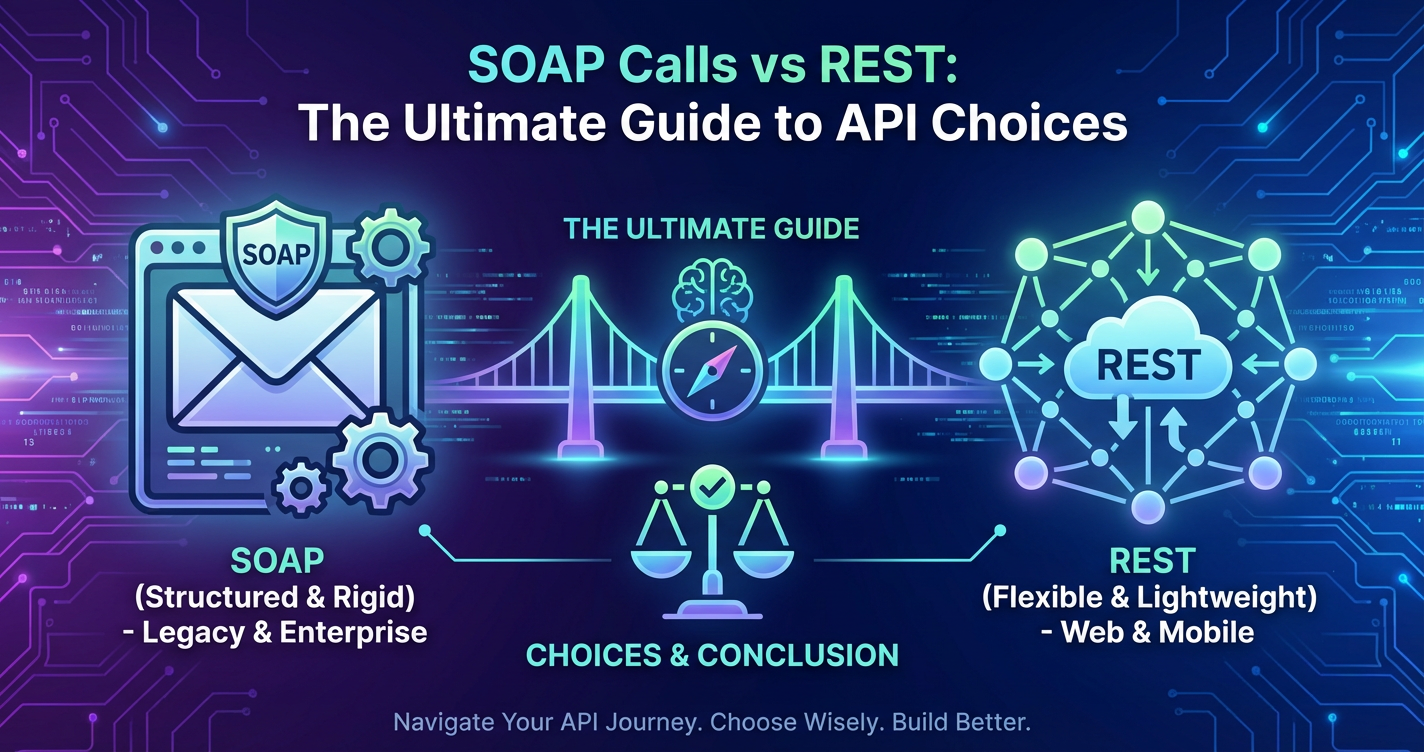
SOAP Calls vs REST: The Ultimate Guide to API Choices


In the ever-evolving landscape of modern software development, Application Programming Interfaces (APIs) stand as the fundamental building blocks enabling disparate systems to communicate, share data, and interoperate seamlessly. From powering mobile applications to facilitating complex enterprise integrations and driving the microservices revolution, APIs are the invisible threads weaving together the fabric of the digital world. Yet, beneath this universal utility lies a critical architectural decision point that profoundly influences a project's scalability, performance, security, and ease of development: choosing between the two dominant API architectural styles – SOAP (Simple Object Access Protocol) and REST (Representational State Transfer).
This article aims to provide an exhaustive, in-depth comparison of SOAP and REST, meticulously dissecting their underlying philosophies, architectural principles, features, advantages, disadvantages, and ideal use cases. By the end of this comprehensive guide, developers, architects, and business leaders will possess the nuanced understanding necessary to make informed decisions when designing or integrating with api services, ensuring the chosen path aligns perfectly with their project's unique requirements and long-term strategic goals. We will navigate through the historical context that shaped these paradigms, explore their technical intricacies, and provide a clear framework for selecting the optimal api choice in a world increasingly reliant on interconnected digital services.
Understanding APIs – The Foundation of Interconnected Systems
Before delving into the specific architectures of SOAP and REST, it is imperative to establish a clear understanding of what an api is and its pivotal role in contemporary software. At its core, an API, or Application Programming Interface, acts as a sophisticated intermediary that allows two software applications to talk to each other. It defines a set of rules, protocols, and tools for building software applications. Think of it as a contract: the API specifies how a developer should request information from a system and what kind of information that system will return.
To draw a common analogy, consider a restaurant. The menu is akin to an API. It lists what the kitchen (the system) can prepare and serve, along with descriptions of each dish. You, as the customer (the calling application), don't need to know how the kitchen prepares the food (the internal workings of the system). You simply choose from the menu (make an API call), and the waiter (the API itself) takes your order to the kitchen, then brings back your prepared meal (the response data). This abstraction is crucial; it allows systems to be developed and evolve independently without breaking the interactions between them.
In the context of modern web development, APIs are particularly transformative. They enable:
- Interoperability: Allowing different systems, often built on different technologies, to communicate.
- Modularity: Breaking down complex applications into smaller, manageable, reusable components (a cornerstone of microservices architecture).
- Innovation: Third-party developers can build new applications and services on top of existing platforms, fostering ecosystems (e.g., social media APIs, payment gateway APIs).
- Efficiency: Developers don't have to reinvent the wheel; they can leverage existing functionalities provided by other services.
The evolution of web services has seen several paradigms emerge, each attempting to address the challenges of distributed computing. Early attempts included technologies like XML-RPC, CORBA, and DCOM, which laid some groundwork but often suffered from platform dependency, complexity, or limited adoption. It was in this environment that SOAP emerged as a standardized approach, soon to be challenged by the more flexible and web-centric architectural style of REST. Understanding this journey is key to appreciating the design philosophies that underpin both SOAP and REST.
Deep Dive into SOAP (Simple Object Access Protocol)
SOAP, an acronym for Simple Object Access Protocol, emerged in the late 1990s, primarily driven by Microsoft, as a robust and standardized method for distributed applications to communicate over the internet. At its inception, the primary goal was to provide a common framework that could overcome the limitations of platform-specific communication mechanisms and enable widespread interoperability across diverse systems. Unlike REST, which is an architectural style, SOAP is a protocol with a strict set of rules governing message structure, message exchange patterns, and error handling. This formality and rigor are both its greatest strength and, for many modern applications, its most significant drawback.
History and Philosophy
The philosophy behind SOAP was deeply rooted in the enterprise world, where concepts like transactional integrity, strong typing, and security were paramount. It aimed to provide a highly reliable and extensible messaging framework suitable for complex business processes. The "Simple" in its name, in retrospect, often draws irony from developers due to its perceived complexity, but at the time, it aimed for simplicity compared to the existing, more cumbersome distributed object technologies. SOAP was designed to be independent of the underlying transport protocol, meaning it could operate over HTTP, SMTP, JMS, or even TCP, though HTTP became its most prevalent carrier due to its ubiquitous nature.
Architectural Principles and Structure
SOAP messages are fundamentally XML-based. Every SOAP message is an XML document structured in a very specific way, adhering to a well-defined schema. A typical SOAP message consists of several key parts:
- Envelope: This is the root element of a SOAP message, defining the XML document as a SOAP message and containing two mandatory child elements: the Header and the Body.
- Header (Optional): The Header block is used for carrying application-specific information that is not part of the actual message content. This is where extensions like WS-Security for authentication and authorization, WS-Addressing for message routing, or WS-ReliableMessaging for guaranteed message delivery are typically implemented. The Header allows for extensibility without modifying the core message body.
- Body (Mandatory): This element contains the actual message content, the payload of the communication. For example, if you're invoking a "getCustomerDetails" operation, the Body would contain the customer ID as an XML element.
- Fault (Optional): This element is used for reporting errors and status information. If an error occurs during the processing of a SOAP message, the Body of the response will contain a Fault element describing the error.
To describe the services a SOAP endpoint offers, WSDL (Web Services Description Language) is used. WSDL is an XML-based language that provides a machine-readable description of how to call a web service, including the operations it exposes, the input and output parameters for each operation, and where the service is located. Clients typically use this WSDL document to generate proxy code in their programming language, which abstracts away the complexities of sending and receiving XML messages, making service invocation feel like a local function call.
Key Characteristics and Features
- Standardization: One of SOAP's greatest strengths is its rigorous standardization through a comprehensive suite of WS-* specifications (e.g., WS-Security, WS-ReliableMessaging, WS-AtomicTransaction). These standards provide robust, interoperable solutions for security, reliability, and transaction management, which are critical in enterprise environments.
- Formality and Contract-Driven: SOAP relies heavily on formal contracts defined by WSDL. This means that both the client and the server must adhere strictly to the defined interface, making it robust against unexpected data types or structures. This strong contract facilitates strict validation and ensures predictable interactions.
- Protocol Agnostic: While most commonly used with HTTP, SOAP's design allows it to be transported over various other protocols like SMTP (for email-based communication), JMS (for message queuing), or even raw TCP. This flexibility was crucial in environments where HTTP might not have been the sole communication channel.
- Built-in Error Handling: The SOAP Fault element provides a standardized way to communicate errors, distinguishing between client-side errors (e.g., invalid request) and server-side errors (e.g., internal processing failure).
- Stateful Operations (with extensions): Although the core SOAP protocol is stateless, extensions like WS-Addressing allow for the correlation of messages, enabling stateful interactions across multiple requests if an application requires maintaining context.
- Strong Tooling Support: Many enterprise development environments (like Java's JAX-WS or Microsoft's WCF) offer extensive tooling that can consume a WSDL file and automatically generate client-side stubs and server-side skeletons. This significantly streamlines development in such ecosystems.
Use Cases where SOAP Shines
SOAP continues to find its niche and excel in specific environments, particularly those with stringent requirements for reliability, security, and transactional integrity:
- Enterprise Applications: Large enterprises, especially in finance, banking, insurance, and telecommunications, often leverage SOAP for internal system integration due to its robust transaction support (WS-AtomicTransaction) and security features (WS-Security).
- Legacy Systems Integration: When integrating with older, established systems that were built with a SOAP-first approach, it often makes sense to continue using SOAP to maintain compatibility and leverage existing infrastructure.
- Government and Healthcare: Industries with strict regulatory compliance and data security mandates often favor SOAP due to its comprehensive security and reliability standards.
- Distributed Transactions: Scenarios requiring complex, multi-step transactions that must either fully complete or fully roll back (ACID properties) can benefit from SOAP's WS-AtomicTransaction specification.
Advantages
- Mature and Robust: SOAP is a mature standard with well-defined specifications for various enterprise needs.
- Enhanced Security: WS-Security provides comprehensive features for encryption, digital signatures, and authentication at the message level, offering a higher degree of security than basic HTTP-level security.
- Built-in Reliability: WS-ReliableMessaging ensures messages are delivered once and only once, even over unreliable networks.
- ACID Transactions: WS-AtomicTransaction supports distributed, atomic transactions, crucial for complex business operations.
- Language, Platform, and Transport Independent: Its underlying XML structure allows for communication between diverse platforms and technologies, and it is not tied to HTTP.
- Extensibility: The WS-* standards allow for a rich set of features beyond basic message exchange.
- Strong Tooling: WSDL-driven development offers strong automation for client code generation.
Disadvantages
- Complexity: The most common criticism of SOAP is its inherent complexity. The XML messages are often verbose, difficult for humans to read, and require extensive parsing. The WS-* extensions, while powerful, add significant configuration overhead.
- Performance Overhead: The verbose XML format of SOAP messages typically results in larger message sizes compared to lighter formats like JSON. This can lead to increased bandwidth consumption and slower processing times, especially for high-volume api calls.
- Steep Learning Curve: Developers often find SOAP more challenging to learn and implement due to its strict specifications and the multitude of WS-* standards.
- Tooling Dependency: Effective SOAP development often necessitates specialized tooling for WSDL parsing, client generation, and message introspection, making it less amenable to simple command-line or browser-based interaction.
- Less Flexible: Its rigid structure and strong typing, while ensuring robustness, can make it less adaptable to rapidly changing requirements or agile development methodologies.
- Not Browser-Friendly: SOAP cannot be directly invoked from web browsers, which complicates its use in modern web applications that rely on client-side scripting.
In summary, SOAP is a powerful, enterprise-grade protocol designed for environments where formality, robust security, and guaranteed delivery are non-negotiable. Its complexity and performance overhead, however, have led many newer projects to explore more lightweight and flexible alternatives, primarily REST.
Deep Dive into REST (Representational State Transfer)
REST, or Representational State Transfer, is not a protocol like SOAP, but rather an architectural style for designing networked applications. Coined by Roy Fielding in his 2000 doctoral dissertation, REST's philosophy is deeply rooted in the principles that made the World Wide Web itself so successful: simplicity, scalability, and statelessness. It offers a fundamentally different approach to api design, focusing on resources and leveraging standard HTTP methods, making it the dominant choice for modern web services, mobile applications, and microservices architectures.
History and Philosophy
Fielding's vision for REST was to create a set of architectural constraints that, if adhered to, would yield a distributed system with desirable properties such as performance, scalability, simplicity, modifiability, visibility, portability, and reliability. He observed the patterns and mechanisms that made the web highly scalable and resilient – namely, the use of URIs to identify resources, standard HTTP methods to manipulate them, and the concept of stateless interaction. REST APIs are essentially designed to mimic the behavior of web browsers interacting with web pages. The goal is to make api interactions as intuitive and lightweight as browsing the internet.
Architectural Principles (REST Constraints)
A system is considered truly RESTful if it adheres to several key architectural constraints:
- Client-Server: This constraint separates the concerns of the user interface (client) from the data storage and processing (server). This separation improves portability of the client UI across multiple platforms and scalability of the server components.
- Stateless: Each request from client to server must contain all the information necessary to understand the request, and the server must not store any client context between requests. This means the server doesn't remember previous requests from a specific client. This constraint improves scalability by allowing servers to process requests independently and makes load balancing easier.
- Cacheable: Responses from the server must explicitly or implicitly define themselves as cacheable or non-cacheable to prevent clients from reusing stale or inappropriate data. This improves network efficiency and client perceived performance.
- Uniform Interface: This is the most crucial constraint, simplifying the overall system architecture by making interactions with any resource consistent. It has four sub-constraints:
- Resource Identification in Requests: Individual resources are identified in requests, typically using Uniform Resource Identifiers (URIs). For example,
/customers/123identifies a specific customer. - Resource Manipulation through Representations: When a client holds a representation of a resource (e.g., a JSON document for a customer), it has enough information to modify or delete the resource on the server, provided it has the necessary permissions.
- Self-Descriptive Messages: Each message includes enough information to describe how to process the message. This often involves using standard HTTP methods (GET, POST, PUT, DELETE, PATCH) and media types (e.g.,
application/json). - Hypermedia as the Engine of Application State (HATEOAS): This constraint means that clients interact with a RESTful service entirely through hypermedia provided dynamically by the server. Instead of knowing specific URLs, a client finds available actions and resources by following links embedded in the representations it receives. This makes the api discoverable and less brittle to URL changes. While fundamental to truly RESTful design, HATEOAS is often the most challenging and overlooked constraint in practical REST API implementations.
- Resource Identification in Requests: Individual resources are identified in requests, typically using Uniform Resource Identifiers (URIs). For example,
- Layered System: A client cannot ordinarily tell whether it is connected directly to the end server, or to an intermediary along the way (e.g., a proxy, a load balancer, or an api gateway). Intermediary servers can enhance system scalability by enabling caching and load balancing.
- Code-on-Demand (Optional): Servers can temporarily extend or customize client functionality by transferring executable code (e.g., JavaScript applets). This constraint is optional and less commonly implemented in typical REST APIs.
Key Characteristics and Features
- Resource-Oriented: REST focuses on "resources," which are abstract concepts (like a customer, an order, or a product) that can be identified by a URL. Operations are performed on these resources.
- Leverages HTTP Methods: REST extensively uses standard HTTP verbs (GET, POST, PUT, DELETE, PATCH) to perform CRUD (Create, Read, Update, Delete) operations on resources.
GET: Retrieve a resource or a collection of resources.POST: Create a new resource.PUT: Update an existing resource (replace the entire resource).PATCH: Partially update an existing resource.DELETE: Remove a resource.
- Flexible Data Formats: Unlike SOAP's strict XML requirement, REST APIs can exchange data in various formats, with JSON (JavaScript Object Notation) being by far the most popular due to its lightweight nature and native support in JavaScript. XML, plain text, and HTML are also common.
- Statelessness: This is a cornerstone feature, simplifying server design, improving scalability, and enabling robust error handling. Each request is independent.
- Simplicity and Ease of Use: REST APIs are generally much simpler to understand, design, and consume compared to SOAP. They often require less boilerplate code and can be tested easily using standard HTTP clients or even web browsers.
- Browser-Friendly: The use of standard HTTP methods means REST APIs can be directly invoked from web browsers, which is crucial for modern web development.
- Self-Descriptive Messages (via HTTP): HTTP headers and status codes provide a wealth of information about the request and response, making messages largely self-descriptive. For instance, a
200 OKindicates success,404 Not Foundindicates a missing resource, and401 Unauthorizedindicates authentication failure. - OpenAPI / Swagger: While REST itself does not prescribe a formal service description language like WSDL, the OpenAPI Specification (formerly known as Swagger Specification) has become the de facto standard for describing, producing, consuming, and visualizing RESTful APIs. It allows developers to document their APIs in a machine-readable format, facilitating automatic client code generation, interactive documentation, and testing.
A modern api gateway is essential for managing the lifecycle and ensuring the security and performance of REST APIs, especially in complex microservices environments. Platforms like APIPark exemplify this, providing an api gateway that streamlines the integration and management of various services, including encapsulating sophisticated AI models into standard REST APIs. This approach significantly simplifies AI invocation, offers unified authentication and cost tracking, and manages the entire API lifecycle from design to decommission. Such platforms are vital in overcoming the potential lack of a formal contract inherent in REST by providing a centralized management layer, enhancing security, and optimizing traffic.
Use Cases where REST Shines
REST is the prevailing choice for new API development across a wide spectrum of applications:
- Public APIs: Nearly all major public APIs (e.g., Twitter, Stripe, GitHub, Google Maps) are RESTful due to their ease of consumption, flexibility, and scalability.
- Mobile Applications: REST's lightweight nature, efficient data formats (JSON), and support for caching make it ideal for mobile apps where bandwidth and battery life are critical.
- Web Applications (SPAs): Single-Page Applications (SPAs) heavily rely on REST APIs to fetch and update data dynamically without full page reloads.
- Microservices Architectures: The statelessness, resource-oriented nature, and simplicity of REST make it a natural fit for building loosely coupled, independently deployable microservices.
- IoT Devices: Low-resource IoT devices benefit from the lightweight communication overhead of REST.
- Anywhere Simplicity and Performance are Key: For projects prioritizing rapid development, ease of integration, and high performance with standard web technologies, REST is generally the preferred option.
Advantages
- Simplicity and Ease of Use: REST APIs are generally easier to design, implement, and consume. They leverage familiar HTTP concepts.
- Lightweight: JSON, the most common data format, is significantly less verbose than XML, leading to smaller message sizes and faster data transfer.
- Better Performance: Smaller message sizes, efficient caching mechanisms (leveraging HTTP caching), and statelessness contribute to better performance and reduced latency.
- Scalability: The stateless nature of REST makes it highly scalable, as any server can handle any request, simplifying load balancing and fault tolerance.
- Flexible Data Formats: Support for various data formats (JSON, XML, text, etc.) offers greater flexibility to developers.
- Browser Support: Can be directly invoked from browsers, making client-side development straightforward.
- Lower Learning Curve: Developers with web development experience can quickly grasp REST concepts.
- Widespread Adoption and Ecosystem: A vast ecosystem of tools, libraries, and frameworks supports REST API development and consumption.
- OpenAPI for Documentation: The OpenAPI specification provides a powerful way to document and describe REST APIs, addressing the lack of a built-in contract.
Disadvantages
- Lack of Formal Contract (Historically): Unlike WSDL for SOAP, REST historically lacked a standardized, machine-readable way to describe services. This has largely been mitigated by the widespread adoption of the OpenAPI Specification.
- Less Built-in Security and Reliability: REST relies on underlying transport security (HTTPS) and implements security (OAuth, JWT) and reliability (retry mechanisms) externally, which can add complexity if not managed properly. It doesn't have the same comprehensive, built-in WS-* standards as SOAP.
- No Inherent State Management: While a strength for scalability, statelessness can be a challenge for complex multi-step workflows that naturally require state. Developers need to manage state on the client side or via other mechanisms.
- HATEOAS Often Neglected: Many "RESTful" APIs are actually "REST-like" or "HTTP APIs," as they fail to fully implement the HATEOAS constraint, limiting their discoverability and evolvability.
- Over-fetching/Under-fetching: Without careful design, clients might receive more data than needed (over-fetching) or require multiple requests to get all necessary data (under-fetching), leading to inefficiencies. (This is where GraphQL offers an alternative).
In conclusion, REST has become the de facto standard for building modern web services due to its simplicity, flexibility, and alignment with the principles of the World Wide Web. While it requires external mechanisms for robust security and transaction management, its advantages in performance, scalability, and developer experience often outweigh these considerations for the majority of use cases.
APIPark is a high-performance AI gateway that allows you to securely access the most comprehensive LLM APIs globally on the APIPark platform, including OpenAI, Anthropic, Mistral, Llama2, Google Gemini, and more.Try APIPark now! 👇👇👇
Direct Comparison: SOAP vs. REST
Having explored each architectural style in depth, it's now time for a direct, side-by-side comparison to highlight their fundamental differences and help crystallize the decision-making process. The choice between SOAP and REST is not merely a technical preference but a strategic decision that impacts the entire lifecycle of a software project.
One of the most crucial distinctions lies in their very nature: SOAP is a protocol, meaning it has a strict set of rules and standards for message structure and communication. REST, on the other hand, is an architectural style, offering a set of guidelines and constraints for building distributed systems that leverage existing web standards, primarily HTTP. This fundamental difference cascades into many other aspects, from message formats to security and service description.
Let's break down the key differences across various critical dimensions:
| Feature / Aspect | SOAP (Simple Object Access Protocol) | REST (Representational State Transfer) |
|---|---|---|
| Nature | Protocol with strict rules and standards. | Architectural Style / Set of guiding principles. |
| Message Format | Strictly XML. Messages are verbose and heavier. | Flexible: predominantly JSON, but also XML, plain text, HTML. Lighter. |
| Transport Protocol | Protocol agnostic: HTTP, SMTP, JMS, TCP, etc. (HTTP is most common). | Primarily HTTP/HTTPS. Leverages HTTP verbs and status codes directly. |
| Service Description | WSDL (Web Services Description Language): formal, machine-readable contract. | OpenAPI Specification (Swagger), human-readable documentation. Less formal. |
| Statefulness | Can support stateful operations (via WS-Addressing and other extensions). | Inherently stateless: each request is independent and self-contained. |
| Security | WS-Security: robust, built-in standard for message-level security (encryption, signatures, authentication). | Relies on underlying transport security (HTTPS) and external standards like OAuth, JWT. |
| Error Handling | Standardized SOAP Faults for detailed error reporting. | Leverages HTTP Status Codes (e.g., 200 OK, 404 Not Found, 500 Internal Server Error) for error indication. |
| Performance | Generally heavier due to XML overhead and more complex processing. | Generally lighter and faster due to JSON, efficient caching, and statelessness. |
| Complexity | High: steep learning curve, verbose messages, complex WS-* standards. | Lower: simpler to understand, implement, and consume, especially with JSON. |
| Tooling | Often requires specialized tools for WSDL parsing and client generation. | Simpler client libraries, browser support, tools like Postman. |
| Transactions | WS-AtomicTransaction for distributed, ACID-compliant transactions. | No inherent transaction support; requires custom implementation or orchestration. |
| Use Cases | Enterprise integration, legacy systems, financial services, telecom, healthcare (where ACID, strict security are paramount). | Web, mobile, microservices, public APIs, IoT, fast-paced development. |
| Adoption | Established, but declining for new web-oriented projects. | Dominant and rapidly growing for new web services. |
Protocol vs. Architectural Style: This is perhaps the most fundamental difference. SOAP's protocol nature means strict adherence to its rules is required, leading to high interoperability among systems that follow these rules, but also to rigidity. REST's architectural style provides flexibility, allowing developers to adapt to specific needs, but also places more responsibility on them to ensure consistency and good practices.
Message Format and Performance: The choice of message format directly impacts performance. SOAP's reliance on XML often leads to larger message sizes, which translates to increased bandwidth usage and processing time. REST's widespread adoption of JSON, a more compact format, coupled with its statelessness and caching capabilities, generally results in better performance, especially crucial for mobile and high-traffic web applications.
Service Description: WSDL provides a formal, machine-readable contract for SOAP services, allowing for robust client code generation. While REST lacked a similar formal contract initially, the OpenAPI Specification (and its predecessor, Swagger) has largely filled this gap, providing a powerful and widely adopted standard for describing REST APIs. This allows for automated documentation, client generation, and testing, effectively bringing much-needed formality to the REST ecosystem without sacrificing flexibility.
Security and Transactions: SOAP's comprehensive WS-Security and WS-AtomicTransaction standards offer robust, built-in solutions for message-level security and distributed transactions, making it a strong contender for highly sensitive enterprise environments. REST, while not having these built-in standards, relies on well-established web security practices like HTTPS, OAuth, and JWT for security, and typically handles transactions at the application level through orchestration or compensation mechanisms. While effective, this requires more explicit implementation by developers.
In essence, SOAP offers a heavyweight, contract-driven, feature-rich approach suitable for complex, enterprise-grade scenarios where strict standards, transactionality, and message-level security are paramount. REST provides a lightweight, flexible, and resource-oriented approach that aligns perfectly with the principles of the web, ideal for modern web, mobile, and microservices development where simplicity, performance, and scalability are prioritized.
Making the Right Choice – Factors to Consider
Deciding between SOAP and REST is rarely a trivial matter; it hinges on a careful evaluation of numerous factors specific to your project, organizational context, and long-term vision. There is no universally "better" choice; rather, there is a "more appropriate" choice for a given set of circumstances. Understanding these factors is key to navigating the API landscape effectively.
Project Requirements
The most critical determinant is the specific requirements of your project. Dissecting these needs will illuminate which architectural style aligns more closely with your goals.
- Security and Reliability Needs:
- If your application handles highly sensitive data (e.g., financial transactions, patient records) or requires guaranteed message delivery and atomic transactions across multiple systems, SOAP's robust WS-Security, WS-ReliableMessaging, and WS-AtomicTransaction standards offer powerful, built-in solutions. These standards provide a level of message-level security and transactional integrity that REST does not inherently provide, requiring custom implementation and orchestration.
- For most web applications, standard HTTPS (TLS) combined with token-based authentication (like OAuth 2.0 or JWT) is sufficient and highly secure for REST APIs. However, if message-level encryption or digital signatures are absolute requirements beyond transport-level security, SOAP might be a stronger candidate.
- Performance and Scalability:
- For high-volume, low-latency applications, particularly mobile apps or public-facing APIs where network efficiency is crucial, REST is almost always the superior choice. Its lightweight JSON messages, efficient HTTP caching mechanisms, and statelessness contribute to significantly better performance and easier horizontal scalability.
- SOAP's verbose XML messages and often stateful operations can introduce considerable overhead, leading to higher bandwidth consumption and potentially slower response times, making it less ideal for high-performance, real-time scenarios.
- Complexity vs. Simplicity:
- If your development team values rapid development, ease of integration, and a flatter learning curve, REST is generally favored. Its use of standard HTTP methods and familiar web concepts makes it intuitive for most developers.
- SOAP, with its strict WSDL contracts, complex XML structures, and extensive WS-* specifications, involves a steeper learning curve and often requires specialized tooling, potentially prolonging development cycles.
- Data Format Flexibility:
- REST offers high flexibility in data formats (JSON, XML, plain text, etc.), with JSON being the most popular due to its conciseness and native JavaScript support. This flexibility can be advantageous when integrating with diverse clients.
- SOAP strictly adheres to XML, which can be less convenient for certain clients (e.g., JavaScript-heavy frontends) and results in larger payloads.
- Existing Infrastructure and Legacy Systems:
- When integrating with existing enterprise systems that were built using SOAP, it often makes practical sense to continue using SOAP for consistency and to leverage existing infrastructure, knowledge base, and tools. Migrating such systems to REST might be a significant undertaking with limited immediate benefits.
- For new projects, especially those built on modern web technologies or microservices architectures, REST is almost always the default choice due to its alignment with contemporary development paradigms.
- Interoperability:
- Both SOAP and REST offer excellent interoperability, allowing systems built with different technologies to communicate. However, REST achieves this with less overhead and greater simplicity for web-based clients.
- SOAP's WSDL ensures strong interoperability through a formal contract, which is beneficial in highly regulated environments.
- Tooling and Documentation:
- The availability of robust tooling and comprehensive documentation is critical. For REST, the OpenAPI Specification has revolutionized API documentation, enabling interactive documentation, client code generation, and testing. This largely addresses REST's historical lack of a formal description language.
- SOAP benefits from mature enterprise tooling that can generate client proxies from WSDL, simplifying consumption for specific environments.
The Role of an API Gateway
Regardless of whether you choose SOAP or REST, an api gateway has become an indispensable component in modern api architectures. An API Gateway acts as a single entry point for all client requests, routing them to the appropriate backend services. It provides a crucial layer of abstraction, management, and security, enhancing the overall robustness and scalability of your API ecosystem.
Benefits of an API Gateway include:
- Centralized Security: Implementing authentication, authorization, and rate limiting at the gateway level simplifies security management and ensures consistent enforcement across all APIs.
- Traffic Management: Handling load balancing, routing, and traffic throttling to protect backend services from overload.
- API Transformation: Translating requests and responses between different formats or protocols, which can be particularly useful when integrating legacy SOAP services with modern RESTful clients, or vice versa.
- Monitoring and Analytics: Providing comprehensive logging, metrics, and insights into API usage, performance, and errors.
- Developer Portal: Offering a centralized portal for API discovery, documentation, and subscription, making it easier for internal and external developers to consume APIs.
Platforms like APIPark exemplify a modern api gateway that significantly enhances the management, security, and performance of various APIs, whether they are RESTful services or even complex AI models encapsulated into standard REST APIs. APIPark, as an Open Source AI Gateway & API Management Platform, offers features like quick integration of 100+ AI models with a unified API format, prompt encapsulation into REST API, and end-to-end API lifecycle management. Its ability to provide powerful data analysis, detailed API call logging, and performance rivaling Nginx (achieving over 20,000 TPS with modest resources) makes it an invaluable asset for organizations seeking to streamline their API governance and leverage AI services efficiently. Such a gateway helps bridge the gap and streamline operations, regardless of the underlying API style, providing a consistent and secure experience for consumers and producers alike.
The Rise of GraphQL and gRPC
While SOAP and REST remain the two dominant paradigms, it's important to acknowledge the emergence of newer alternatives like GraphQL and gRPC, which address specific challenges that neither SOAP nor REST fully resolve.
- GraphQL: An open-source data query and manipulation language for APIs, and a runtime for fulfilling queries with existing data. It allows clients to request exactly the data they need, no more, no less, solving the common REST problems of over-fetching and under-fetching. This flexibility is particularly appealing for complex UIs and mobile applications with varying data requirements.
- gRPC: A high-performance, open-source universal RPC framework developed by Google. It uses Protocol Buffers for message serialization and HTTP/2 for transport, offering significant performance advantages, especially for internal microservices communication where efficiency and strong typing are prioritized.
These alternatives are gaining traction for specific use cases, indicating that the API landscape continues to evolve, offering even more specialized tools for developers to choose from. However, for the vast majority of web-oriented public and internal APIs, REST continues to be the most prevalent and practical choice.
In conclusion, the decision between SOAP and REST is a complex interplay of technical requirements, business needs, and development team capabilities. Carefully weighing these factors will lead to an api strategy that not only meets immediate project goals but also supports long-term scalability, maintainability, and innovation.
Conclusion
The journey through the intricacies of SOAP and REST reveals two powerful yet fundamentally distinct approaches to Application Programming Interface design. SOAP, with its protocol-driven formality, robust WS-* standards for security and transactional integrity, and strong enterprise tooling, continues to hold relevance in specific domains. It shines in environments demanding unparalleled reliability, strict contracts, and complex distributed transactions, such as legacy system integration within financial services, healthcare, and telecommunications.
Conversely, REST, as an architectural style deeply rooted in the principles of the World Wide Web, has emerged as the unequivocal dominant force for modern API development. Its simplicity, lightweight data formats (primarily JSON), statelessness, and alignment with standard HTTP methods make it inherently more flexible, performant, and scalable for web, mobile, and microservices applications. The rise of the OpenAPI Specification has further bolstered REST's ecosystem, providing a much-needed standardized approach to API description and documentation, thereby bridging the gap that WSDL traditionally filled for SOAP.
Ultimately, there is no one-size-fits-all answer to the question of which is "better." The optimal choice is always contextual, dependent on a nuanced evaluation of your project's specific requirements, the technical expertise of your development team, and the existing infrastructure you need to integrate with. For new, web-centric projects prioritizing agility, performance, and developer experience, REST is overwhelmingly the preferred and more practical choice. For highly regulated industries or integration with entrenched enterprise systems where an existing SOAP ecosystem is in place, SOAP's robust features can still be a strategic asset.
Regardless of the architectural style chosen, the paramount importance of effective api management cannot be overstated. An api gateway is a critical component for securing, optimizing, and overseeing the entire API lifecycle. Platforms like APIPark offer comprehensive solutions, providing an open-source AI gateway and API management platform that can streamline the deployment and management of both REST and AI-driven services. By offering capabilities such as unified API formats, prompt encapsulation into REST APIs, detailed logging, and robust security, an API Gateway ensures that your chosen API architecture, whether SOAP or REST, is well-governed, performant, and adaptable to future demands. Making the right api choice, coupled with robust API management, is a critical strategic decision that underpins the success and longevity of any interconnected digital venture.
Frequently Asked Questions (FAQs)
1. What are the main differences between SOAP and REST?
The main differences lie in their nature, message format, transport protocol, and philosophy. SOAP is a protocol with strict rules, using XML exclusively for messages and supporting various transport protocols (HTTP, SMTP, etc.). It emphasizes formality, strong contracts (via WSDL), and built-in standards for security and transactions. REST is an architectural style that leverages existing web standards, primarily HTTP. It is resource-oriented, uses flexible data formats (predominantly JSON), and focuses on simplicity, scalability, and statelessness.
2. When should I choose SOAP over REST?
You should consider choosing SOAP when: * Your project requires highly robust message-level security, guaranteed delivery, and atomic, distributed transactions (e.g., in banking, healthcare, or government sectors). * You need to integrate with existing legacy enterprise systems that already communicate using SOAP and WSDL. * Your application benefits from the strict contracts and strong typing provided by WSDL, which can simplify complex enterprise integrations. * Your team has significant expertise and existing tooling for SOAP development.
3. When is REST the better choice?
REST is generally the better choice for most modern api development, especially when: * Building public APIs, mobile applications, or web applications where performance, simplicity, and ease of use are crucial. * Developing microservices architectures that benefit from statelessness, loose coupling, and rapid development. * Dealing with varying client types (web browsers, mobile apps, IoT devices) that prefer lightweight data formats like JSON. * Prioritizing scalability and relying on standard HTTP caching mechanisms. * Your development team is familiar with web standards and desires a lower learning curve. * You plan to use the OpenAPI Specification for documentation and client generation.
4. What role does an api gateway play in managing SOAP or REST services?
An api gateway is crucial for both SOAP and REST services. It acts as a single entry point for all API requests, providing centralized management for authentication, authorization, rate limiting, traffic routing, and monitoring. For REST, it enhances security and performance, and for SOAP, it can help with protocol translation (e.g., exposing a SOAP service as a RESTful endpoint) and centralized security policy enforcement. Platforms like APIPark further extend this by offering advanced features such as AI model integration and comprehensive API lifecycle management, ensuring robust security, optimal performance, and streamlined operations for diverse API landscapes.
5. Is OpenAPI relevant for SOAP services?
No, the OpenAPI Specification is specifically designed for describing RESTful APIs. For SOAP services, the equivalent and long-established standard for service description is WSDL (Web Services Description Language). While both serve to describe API contracts in a machine-readable format, their syntax, structure, and underlying architectural assumptions are completely different, tailored to their respective API styles.
🚀You can securely and efficiently call the OpenAI API on APIPark in just two steps:
Step 1: Deploy the APIPark AI gateway in 5 minutes.
APIPark is developed based on Golang, offering strong product performance and low development and maintenance costs. You can deploy APIPark with a single command line.
curl -sSO https://download.apipark.com/install/quick-start.sh; bash quick-start.sh

In my experience, you can see the successful deployment interface within 5 to 10 minutes. Then, you can log in to APIPark using your account.

Step 2: Call the OpenAI API.