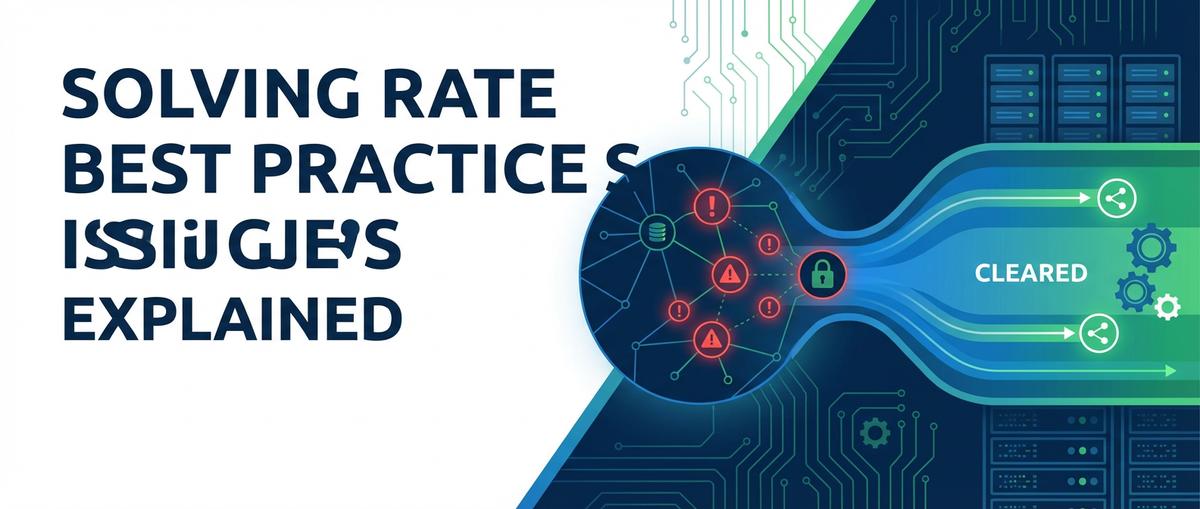
Solving Rate Limited Issues: Best Practices Explained


In the intricate tapestry of modern software architecture, Application Programming Interfaces (APIs) serve as the fundamental threads that connect disparate services, applications, and data sources. They are the conduits through which digital ecosystems communicate, enabling everything from mobile apps accessing backend data to microservices orchestrating complex business processes. However, this omnipresence and constant interaction come with inherent challenges, chief among them being the management of request volume and ensuring the stability, security, and fairness of API usage. This is precisely where the concept of rate limiting becomes not just a feature, but a critical necessity.
Rate limiting is a foundational mechanism employed by API providers to control the number of requests a user or application can make to an API within a specified time frame. Without effective rate limiting, an API endpoint, or indeed the entire backend infrastructure it relies upon, is vulnerable to a myriad of issues: from accidental overloading by a buggy client to malicious denial-of-service (DoS) attacks, or simply disproportionate resource consumption by a single, overly enthusiastic consumer. The consequences can range from degraded performance and service outages to significant operational costs and a breakdown of trust with the developer community.
This comprehensive guide will delve deep into the world of rate limiting, exploring its fundamental principles, the common pitfalls that lead to rate-limited issues, and the robust best practices that both API providers and consumers must adopt to navigate this critical aspect of API management. We will uncover the architectural considerations, delve into the various algorithms, and highlight the pivotal role of an API gateway in orchestrating an effective rate limiting strategy. Our aim is to provide an exhaustive resource that not only explains the 'what' and 'why' but also equips readers with the 'how' to implement and respond to rate limiting in a sophisticated and resilient manner, ensuring the health and longevity of their API ecosystems.
1. Understanding the Imperative of Rate Limiting
To truly appreciate the significance of rate limiting, we must first establish a clear understanding of its definition and the multifaceted reasons behind its implementation. It’s more than just a gatekeeper; it’s a strategic tool for maintaining system health and fostering a fair environment.
1.1 What Exactly is Rate Limiting?
At its core, rate limiting is a network traffic control mechanism that regulates the frequency of requests from a specific client or IP address to a server within a given period. Imagine a popular nightclub with a limited capacity. The bouncer at the door isn't there to stop people from having fun, but rather to ensure the club doesn't become overcrowded, maintaining a comfortable and safe environment for everyone inside. When the club reaches capacity, new patrons are asked to wait, or even denied entry, until space becomes available. In the digital realm, an API gateway acts as that bouncer, managing the flow of requests to your backend services.
When a client sends too many requests within the defined window – be it per second, per minute, or per hour – the rate limiting mechanism intervenes, typically by rejecting subsequent requests and informing the client that they have exceeded their allotted quota. This rejection is usually communicated via an HTTP 429 "Too Many Requests" status code, often accompanied by additional headers that guide the client on when they can safely retry. The specifics of "too many requests" are entirely dependent on the API provider's policy and the context of the API itself. For instance, a simple read operation might allow thousands of requests per minute, while a complex write operation or a resource-intensive AI inference might be limited to just a few per second.
The underlying objective is not to punish legitimate users, but to protect the shared resources of the API provider and ensure equitable access for all consumers. It's a delicate balancing act, requiring thoughtful consideration of system capabilities, user expectations, and potential abuse vectors.
1.2 Why is Rate Limiting an Indispensable Component of Modern APIs?
The reasons for implementing rate limiting are diverse and deeply intertwined with the operational health, security posture, and business sustainability of an API. Neglecting this aspect can lead to a cascade of negative consequences that impact both the provider and the consumer.
1.2.1 Resource Protection and System Stability
Perhaps the most immediate and critical reason for rate limiting is to prevent server overload. Backend services, databases, and computational resources are finite. An uncontrolled surge of requests, whether accidental or malicious, can quickly exhaust CPU, memory, network bandwidth, and database connection pools, leading to degraded performance, timeouts, and ultimately, a complete service outage. Imagine a critical e-commerce API suddenly bombarded with millions of requests per second. Without rate limiting, the backend servers would likely crash, rendering the entire shopping experience unavailable. This protection extends beyond mere availability; it ensures consistent performance for all users, preventing a "noisy neighbor" from monopolizing resources and slowing down the experience for others.
1.2.2 Cost Control and Operational Efficiency
For API providers, especially those operating in cloud environments, every request can incur a cost – whether for compute cycles, data transfer, or database operations. Uncontrolled API usage can lead to unexpectedly high infrastructure bills. By setting limits, providers can better predict and manage their operational expenses. This is particularly relevant for expensive operations, such as generating AI responses, processing large data sets, or performing complex search queries. Rate limiting ensures that these costly operations are not indiscriminately consumed, protecting the provider's bottom line. For consumers, adhering to rate limits helps them manage their own spending, especially if the API has a pay-per-use model.
1.2.3 Abuse Prevention and Security Enhancement
Rate limiting is a frontline defense against various forms of malicious activity. Without it, an API becomes an easy target for:
- Denial-of-Service (DoS) and Distributed DoS (DDoS) Attacks: Malicious actors can flood an API with requests, overwhelming its infrastructure and making it unavailable to legitimate users. Rate limiting helps to mitigate the impact of such attacks by dropping excessive requests before they reach the core services.
- Brute-Force Attacks: Attempts to guess user passwords or API keys by making numerous login or authentication requests. Rate limiting can significantly slow down or halt these attempts, making them impractical.
- Credential Stuffing: Using stolen username/password combinations to gain unauthorized access. Similar to brute-force attacks, rate limiting frustrates this automated process.
- Web Scraping: Automated bots systematically harvesting data from an API. While not always malicious, excessive scraping can mimic DoS patterns and consume significant resources. Rate limiting can deter aggressive scrapers.
- Exploitation of Vulnerabilities: Rapid-fire requests can sometimes be used to uncover and exploit subtle race conditions or other vulnerabilities within an API. Rate limits add a layer of friction, making such exploration more difficult.
By establishing thresholds, providers can identify and block suspicious patterns, safeguarding their systems and the data they manage.
1.2.4 Ensuring Fair Usage and Quality of Service (QoS)
In a multi-tenant or shared-resource environment, rate limiting is crucial for ensuring that all API consumers receive a fair share of the available resources. Without it, a single power user or a misbehaving client could monopolize the API, leading to a degraded experience for everyone else. This is akin to traffic lanes on a highway; without rules, a few aggressive drivers could slow down or endanger everyone. Rate limiting creates a level playing field, guaranteeing a baseline quality of service for all legitimate users and applications. It allows providers to differentiate service levels, offering higher limits to premium subscribers while maintaining a stable, albeit more restricted, service for free-tier users.
1.2.5 Adherence to Service Level Agreements (SLAs) and Monetization Strategies
For commercial APIs, rate limits are often an integral part of the Service Level Agreements (SLAs) established with clients. Different subscription tiers – free, standard, enterprise – typically come with corresponding rate limits, directly linking usage to cost and features. Rate limiting enforcement ensures that these contractual obligations are met by both parties. It also underpins API monetization strategies, allowing providers to package and sell access based on usage volume, throughput, and functionality. For instance, a free tier might have a limit of 100 requests per minute, while a paid enterprise tier might allow for 10,000 requests per minute, with the API gateway handling the enforcement of these different policies.
In summary, rate limiting is not merely a technical constraint; it's a strategic pillar that underpins the reliability, security, cost-effectiveness, and business viability of any robust API ecosystem. Its thoughtful implementation is a testament to an API provider's commitment to delivering a stable, fair, and high-quality service.
2. Unpacking the Roots of Rate Limiting Issues: Why They Occur
Despite the clear benefits, rate limiting issues frequently arise, causing frustration for both API providers and consumers. Understanding the underlying causes is the first step towards implementing effective preventative and reactive strategies. These issues often stem from a combination of factors on both sides of the API interaction.
2.1 Consumer-Side Contributions to Rate Limiting Woes
Even the most well-intentioned API consumers can inadvertently trigger rate limits due to a variety of factors related to their client applications and understanding of API best practices.
2.1.1 Misconfigured Clients and Automated Processes
A common culprit is a client application that, due to a configuration error or oversight, is programmed to send requests at a rate exceeding the API's limits. This could be a batch processing script designed to fetch a large volume of data, an analytics tool polling an endpoint too aggressively, or even a simple user interface component making redundant calls. In many cases, these are not malicious attacks but rather innocent misconfigurations that nonetheless strain the API. Bots and automated scripts, while often legitimate (e.g., search engine crawlers), can also quickly hit limits if not properly configured to respect robots.txt or specific API rate policies. When a large number of such misconfigured clients operate simultaneously, the cumulative effect can overwhelm an API, leading to widespread rate limiting and service degradation.
2.1.2 Unanticipated Burst Traffic and "Thundering Herd" Problems
Even perfectly configured clients can encounter rate limits during periods of legitimate, but exceptionally high, demand. Imagine a flash sale for a highly anticipated product, a major news event breaking, or a sudden viral social media trend that drives massive traffic to an application relying on external APIs. This "burst traffic" can quickly push usage beyond normal thresholds. A related phenomenon is the "thundering herd" problem, where numerous clients, after a temporary outage or delay, all attempt to reconnect and resubmit requests simultaneously once the service resumes. This synchronized onslaught can itself trigger rate limits, creating a cycle of unavailability and retries that exacerbates the problem, even if individual client request rates are within limits.
2.1.3 Faulty Logic: Infinite Loops and Retry Storms
Errors in client application logic can lead to disastrous rate limit breaches. An infinite loop, for example, might unintentionally generate an endless stream of API requests, exhausting any reasonable rate limit in seconds. Another frequent cause is poorly implemented retry logic. When an API returns an error (including a 429), a client might be programmed to immediately retry the request. If this retry is not coupled with an exponential backoff strategy (waiting progressively longer before each retry) or does not respect the Retry-After header, it can quickly devolve into a "retry storm," where the client continuously bombards the API with failed requests, exacerbating the load and prolonging the rate limit enforcement. This creates a vicious cycle that is difficult for both the client and server to escape.
2.1.4 Lack of Awareness and Inadequate Documentation Consumption
Perhaps the simplest, yet most pervasive, consumer-side cause of rate limit issues is a fundamental lack of understanding or awareness of the API's rate limiting policies. Developers integrating with an API might overlook this crucial section of the documentation, or the documentation itself might be unclear, incomplete, or hard to find. Without explicit knowledge of the limits (e.g., 100 requests per minute, 5 requests per second for a specific endpoint), client developers cannot design their applications to conform, making rate limit errors inevitable. This highlights the critical importance of both comprehensive documentation from the provider and diligent review from the consumer.
2.2 Provider-Side Shortcomings Contributing to Rate Limiting Issues
While consumers often bear the immediate brunt of rate limiting, providers also play a significant role in either mitigating or inadvertently contributing to these issues through their design, implementation, and communication strategies.
2.2.1 Ill-Defined or Inappropriately Set Limits
One of the most common provider-side mistakes is setting rate limits that are either too strict or too lenient for the actual demand and underlying system capabilities. * Too Strict Limits: If limits are excessively low, even legitimate and moderate usage can trigger 429 errors, frustrating users and hindering adoption. This can happen if limits are arbitrarily set without thorough analysis of expected traffic patterns, backend capacity, or typical user workflows. * Too Lenient Limits: Conversely, limits that are too high or non-existent fail to provide adequate protection. This leaves the backend vulnerable to overload, abuse, and excessive costs, as discussed earlier. A balance must be struck, based on data, not just assumptions. The ideal limits are often dynamic, evolving as the API matures and traffic patterns change.
2.2.2 Ineffective or Misconfigured Enforcement Mechanisms
Even with well-defined policies, if the rate limiting enforcement mechanism is poorly implemented or configured, it can fail to protect the API effectively. This could involve: * Incorrect Algorithm Choice: Selecting an algorithm that doesn't align with the API's traffic patterns (e.g., using a fixed window counter for an API prone to bursts). * Inconsistent Enforcement: Rate limits applied unevenly across different servers in a distributed system, or only to some endpoints but not others, leading to loopholes. * Performance Bottlenecks: The rate limiter itself becoming a bottleneck if it's not designed for high performance and scalability, especially when deployed as part of an API gateway. * Lack of Granularity: Only implementing broad IP-based limits, which are ineffective for distinguishing between different applications sharing an IP (e.g., behind a NAT) or for handling authenticated user-specific limits.
2.2.3 Scalability Challenges in Backend Systems
Sometimes, the rate limiting mechanism itself works perfectly, but the underlying backend services simply cannot handle the permitted traffic volume. If an API is designed to allow 1000 requests per second, but the database can only sustain 500 queries per second, then even traffic within the rate limits will cause performance degradation and potential outages. Rate limiting can only protect the API up to the point of its own capacity; it cannot magically scale an under-provisioned backend. This highlights the need for holistic system design, where rate limits are aligned with the actual capabilities of the entire service stack.
2.2.4 Insufficient Monitoring and Alerting
A critical provider-side failure is the lack of robust monitoring and alerting for rate limit breaches. If API providers aren't actively tracking how often and by whom rate limits are being hit, they lose valuable insights. They might fail to identify: * Legitimate Usage Trends: Many users consistently hitting limits could indicate limits are too strict or a need for higher tiers. * Emerging Abuse Patterns: Sudden spikes in 429 responses from specific IPs or API keys could signal an attack. * System Bottlenecks: Consistent rate limits might indicate underlying resource contention. Without proactive alerts, providers are left reacting to full-blown outages rather than preventing them, leading to longer recovery times and greater impact.
2.2.5 Poor Communication and Unclear Documentation
Finally, a persistent issue is the failure to clearly and comprehensively communicate rate limiting policies to API consumers. Ambiguous documentation, difficult-to-find policy pages, or a lack of clear Retry-After headers in 429 responses leave consumers guessing. This forces them to implement defensive, often inefficient, retry logic or to inadvertently violate limits. Clear communication is a partnership; providers must articulate the rules, and consumers must adhere to them. The documentation should not only state the limits but also provide examples of how to handle 429 responses gracefully, including recommended backoff strategies.
By understanding these common pitfalls from both perspectives, we can better appreciate the holistic approach required to solve rate limited issues and move towards best practices that foster a stable, predictable, and resilient API ecosystem.
3. Architecting Resilient Rate Limiting Mechanisms
The effective implementation of rate limiting goes beyond simply setting a number; it involves strategic decisions about where, how, and with what granularity limits are enforced. A well-architected rate limiting system is a cornerstone of API resilience and scalability.
3.1 Strategic Placement: Where to Implement Rate Limiting
The choice of where to implement rate limiting significantly impacts its effectiveness, performance, and flexibility. Different layers offer distinct advantages and disadvantages.
3.1.1 Client-Side (Preventative Measures, Not True Enforcement)
While not a true enforcement point for rate limiting, educating and empowering clients to respect limits is a crucial first step. Client-side SDKs can be designed with built-in exponential backoff and Retry-After header parsing. Developers can be guided through clear documentation to implement local rate tracking and self-throttling. This proactive approach reduces the load on the server by preventing excessive requests from even leaving the client. However, client-side measures can always be bypassed and are therefore not sufficient for robust protection. They serve as a cooperative mechanism, not an enforcement one.
3.1.2 Edge/Load Balancer
Basic rate limiting can be implemented at the network edge, typically at the load balancer (e.g., Nginx, HAProxy, AWS ELB/ALB). These usually enforce simple, IP-address-based limits. * Advantages: Very early detection, before requests hit application servers, offloading compute. Good for protecting against broad DDoS attacks based on source IP. * Disadvantages: Limited granularity (IP addresses can be shared via NAT, proxies, or VPNs, making it hard to distinguish individual users). Lacks context about the actual API request (e.g., which endpoint, authenticated user ID). Cannot implement complex, dynamic rules. This layer is best suited for coarse-grained, basic flood protection.
3.1.3 API Gateway: The Central Command (Crucial Keyword Integration)
The API gateway is arguably the most effective and widely adopted location for implementing comprehensive rate limiting. It acts as an intermediary between clients and backend services, allowing for centralized control over all API traffic. * Advantages: * Centralized Control: All rate limiting policies are managed in one place, ensuring consistency across all APIs. * Protocol Agnostic: Can apply limits regardless of the underlying backend service technology. * Rich Features: Supports various algorithms (token bucket, sliding window), different keys (API key, user ID, IP), and conditional rules. * Performance: High-performance gateways are optimized to handle significant traffic volumes with minimal latency, performing these checks efficiently. * Contextual Awareness: Can inspect request headers, body, and authentication tokens to apply highly granular, user-specific, or endpoint-specific limits. * Operational Simplicity: Decouples rate limiting logic from individual backend microservices, simplifying development and deployment. For organizations managing a portfolio of APIs, an API gateway is indispensable. Products like ApiPark offer robust API management features, including sophisticated rate limiting and traffic shaping capabilities, often performing comparably to high-performance solutions like Nginx, making them ideal for managing high-volume API traffic. This strategic placement ensures that a diverse array of rate limiting policies can be applied consistently and efficiently before requests consume valuable backend resources.
3.1.4 Application Layer
Rate limiting can also be implemented within individual backend applications or microservices. * Advantages: Extremely fine-grained and context-aware limits. For example, a "create account" endpoint might have a different limit per IP than a "get user profile" endpoint, or a specific user might have a lower limit on an expensive query within a specific service. It can incorporate deep business logic. * Disadvantages: Inconsistent enforcement across microservices if not carefully managed. Duplication of logic. Adds overhead to application code. Harder to manage and monitor centrally in a large ecosystem. This layer is best reserved for highly specific, complex, or sensitive operations that require business logic awareness not easily achievable at the gateway level. Ideally, the gateway handles most generic rate limiting, and the application layer supplements it for niche requirements.
3.2 Navigating Rate Limiting Algorithms: Choosing the Right Tool
The core of any rate limiting mechanism is the algorithm it employs to count and enforce limits. Each algorithm has distinct characteristics, making some more suitable for particular use cases than others.
3.2.1 Fixed Window Counter
- How it Works: Divides time into fixed-size windows (e.g., 60 seconds). Each request increments a counter for the current window. If the counter exceeds the limit within that window, subsequent requests are rejected.
- Pros: Simple to implement and understand. Low memory usage.
- Cons: Prone to the "burst problem" at window edges. If the limit is 100 requests per minute, a client could make 100 requests in the last second of window 1 and another 100 requests in the first second of window 2, effectively making 200 requests in a very short period (2 seconds) across the boundary, which might overwhelm the system.
- Best For: Simple, less critical APIs where occasional bursts are acceptable.
3.2.2 Sliding Log
- How it Works: For each client, stores a timestamp of every request made. To check if a request is allowed, it counts how many timestamps fall within the defined window (e.g., the last 60 seconds). If the count exceeds the limit, the request is rejected. Old timestamps are eventually purged.
- Pros: Highly accurate and smooths traffic effectively, as it precisely considers the window for each request. No burst problem.
- Cons: Very memory-intensive, especially for APIs with high request volumes or many clients, as it requires storing a list of timestamps. Performance can degrade with large lists.
- Best For: APIs requiring very precise and smooth rate limiting, where memory is not a significant constraint, or for smaller-scale, critical endpoints.
3.2.3 Sliding Window Counter
- How it Works: A hybrid approach. It uses a fixed window counter for the current window but estimates the request count for the past window based on the previous fixed window's count and a weighting factor for the overlap. For example, to check the limit for the last 60 seconds, it combines a percentage of the previous 60-second window's count (based on how much of it overlaps) with the current 60-second window's count.
- Pros: A good compromise between accuracy and efficiency. Less prone to burstiness than fixed window, less memory-intensive than sliding log.
- Cons: Not perfectly accurate; it's an approximation, especially if request rates change drastically within a window.
- Best For: Most general-purpose APIs where a balance of accuracy, performance, and resource usage is desired. This is a very popular choice for many API gateway implementations.
3.2.4 Token Bucket
- How it Works: Imagine a bucket of tokens that fills at a constant rate (e.g., 10 tokens per second). Each incoming request consumes one token. If the bucket is empty, the request is rejected. The bucket has a maximum capacity, allowing for bursts of requests up to the bucket size, even if the fill rate is lower.
- Pros: Allows for controlled bursts, making it more forgiving for clients with intermittent high demand. Smooths traffic over time. Simple to understand conceptually.
- Cons: Requires careful tuning of fill rate and bucket size.
- Best For: APIs that expect occasional, short bursts of traffic, where predictable smoothing is desired. Excellent for managing outbound traffic (throttling) as well.
3.2.5 Leaky Bucket
- How it Works: Similar to Token Bucket but often conceptualized in reverse. Requests are added to a bucket (queue). Requests "leak" out of the bucket at a constant rate, getting processed by the backend. If the bucket overflows (i.e., too many requests arrive faster than they can leak), new requests are dropped.
- Pros: Smooths request rates to a constant output rate, protecting the backend from variable input bursts.
- Cons: Can introduce latency if the bucket fills up. If requests are dropped due to overflow, it might be less user-friendly than rejecting immediately.
- Best For: Protecting backend services that have a very strict and consistent processing capacity, ensuring a steady stream of work.
| Algorithm | Accuracy/Smoothness | Burst Handling | Memory Usage | Implementation Complexity | Common Use Cases |
|---|---|---|---|---|---|
| Fixed Window Counter | Low (bursty at edges) | Poor | Low | Low | Simple APIs, basic flood control. |
| Sliding Log | High | Excellent | Very High | High | Highly critical APIs, precise control, smaller scale. |
| Sliding Window Counter | Medium | Good | Medium | Medium | General-purpose APIs, good balance, popular in API gateway. |
| Token Bucket | Medium | Excellent | Low | Medium | APIs expecting controlled bursts, flexible throttling. |
| Leaky Bucket | High (smooth output) | Good | Low | Medium | Protecting backend from variable input, ensuring steady load. |
3.3 Identifying the Rate Limiting Keys
For rate limiting to be effective and fair, you need to decide what you're applying the limit to. This is known as the "key" for rate limiting.
- IP Address: The simplest key. Limits are applied per source IP.
- Pros: Easy to implement, catches unauthenticated requests.
- Cons: Inaccurate for users behind shared NATs, corporate proxies, or VPNs (many users appear as one IP). Malicious actors can easily change IPs.
- API Key/Token: The most common and effective key for authenticated or authorized requests. Limits are applied per API key.
- Pros: Directly links usage to a specific application or developer. Provides granular control and allows for different tiers.
- Cons: Requires clients to manage and send API keys.
- User ID: For APIs where users are authenticated, using the user ID (e.g., from an OAuth token) allows for personalized limits.
- Pros: Very precise, ties limits directly to individual user behavior.
- Cons: Only applicable after authentication.
- Combination: Often, a combination is best. For example, a global IP-based limit for unauthenticated requests, and an API Key/User ID-based limit for authenticated requests. This multi-layered approach provides robust protection. An API gateway is particularly adept at handling such complex, layered keying strategies.
3.4 Graceful Handling of Rate Limit Exceedance
When a client hits a rate limit, the API provider must respond appropriately to inform the client and guide its subsequent actions. A rude, uninformative error is counterproductive.
- HTTP Status Code 429 "Too Many Requests": This is the standard and correct HTTP status code to return when a client has exceeded its rate limit. It explicitly tells the client that they should reduce their request rate.
Retry-AfterHeader: Crucially, the 429 response should include aRetry-Afterheader. This header tells the client how long they should wait before making another request. It can be an integer representing seconds (e.g.,Retry-After: 60) or a specific date and time (e.g.,Retry-After: Wed, 21 Oct 2015 07:28:00 GMT). Respecting this header is the most important best practice for API consumers.- Informative Error Messages: While the 429 status code is clear, a concise error message in the response body (e.g., JSON payload) can provide further context, such as "You have exceeded your rate limit. Please retry after 60 seconds." or a link to rate limit documentation.
- Rate Limit Indicating Headers: Providing additional headers in all responses (not just 429s) can help clients proactively manage their usage:
X-RateLimit-Limit: The total number of requests allowed in the current window.X-RateLimit-Remaining: The number of requests remaining in the current window.X-RateLimit-Reset: The time (Unix epoch or UTC timestamp) when the current rate limit window resets. These headers empower clients to monitor their usage and adjust their behavior before hitting a 429, fostering a more collaborative and stable interaction.
By carefully considering these architectural elements – placement, algorithms, keys, and response handling – API providers can construct a rate limiting system that is not only robust and performant but also user-friendly and instrumental in maintaining the integrity of their API ecosystem.
4. Best Practices for API Providers: Building a Resilient API Ecosystem
API providers bear the primary responsibility for designing, implementing, and managing an effective rate limiting strategy. Adhering to best practices ensures stability, security, and a positive experience for API consumers.
4.1 Define Clear, Transparent, and Accessible Policies
The foundation of any successful rate limiting strategy is clarity. API providers must explicitly define their rate limiting policies and make them easily discoverable within their API documentation. * Comprehensive Documentation: Detail not just the numerical limits (e.g., 100 requests per minute), but also: * Scope: Is it per IP, per API key, per user, or per endpoint? * Window: What is the time frame (second, minute, hour, day)? * Behavior: What happens when limits are exceeded (429, throttling)? * Headers: Which rate limit-related headers are returned? * Retry Guidance: Specific advice on how clients should handle 429 responses, including recommended exponential backoff patterns. * Differentiate Tiers: If offering multiple service tiers (free, standard, premium), clearly outline the rate limits for each, explaining the value proposition of upgrading. * Explain "What Counts": For complex APIs like GraphQL, clarify how queries (e.g., query complexity, number of fields) contribute to the rate limit count, as a single GraphQL request might consume more resources than a simple REST call. * Communicate Changes: Any changes to rate limiting policies should be communicated well in advance through developer newsletters, API changelogs, and clear versioning. Surprising developers with new, stricter limits can lead to significant disruptions.
4.2 Select and Tune the Right Rate Limiting Strategy
There is no one-size-fits-all rate limiting algorithm or policy. The optimal strategy depends on the nature of the API, its expected traffic patterns, the underlying infrastructure, and the business goals. * Contextual Algorithms: Choose algorithms that match your API's usage profile. For instance, a messaging API prone to bursts might benefit from a Token Bucket, while a steady-state data retrieval API might prefer a Sliding Window Counter. * Layered Approach: Implement rate limits at multiple layers. For example, a broad IP-based limit at the edge for general flood protection, followed by more granular API key/user-ID-based limits at the API gateway, and potentially even finer-grained, business-logic-aware limits within specific backend services for highly sensitive operations. * Dynamic and Adaptive Limits: Consider implementing dynamic rate limits that adjust based on real-time system load, API health, or even user reputation scores. If backend services are under stress, limits could temporarily tighten. Conversely, during off-peak hours, they might loosen. This requires sophisticated monitoring and an adaptable rate limiting solution, often found in advanced API gateway platforms. * Simulate and Test: Before deploying, rigorously test your rate limiting configuration under various load conditions to ensure it behaves as expected and adequately protects your backend without excessively penalizing legitimate users.
4.3 Leverage an API Gateway for Centralized Enforcement (Reiterating the Keyword)
As previously discussed, an API gateway is the ideal location for implementing robust rate limiting. Its capabilities extend far beyond simple request counting. * Centralized Policy Management: Consolidate all rate limiting rules in a single place, simplifying management and ensuring consistency across all endpoints and services. This is especially critical in microservices architectures where many independent services expose APIs. * Advanced Features: Modern API gateway solutions offer sophisticated features such as: * Burst Limits: Allowing temporary spikes beyond the sustained rate limit. * Conditional Limits: Applying different limits based on request parameters (e.g., HTTP method, header values, geographic origin). * Quotas: Enforcing daily, weekly, or monthly usage limits in addition to per-second/minute limits. * Multi-tenant Capabilities: As seen in platforms like ApiPark, an API gateway can support independent API and access permissions for each tenant, enabling distinct rate limiting policies for different organizational teams or clients, while sharing the underlying infrastructure. * Performance and Scalability: High-performance gateways are designed to handle millions of requests per second, ensuring that the rate limiting mechanism itself doesn't become a bottleneck. APIPark, for instance, boasts performance rivaling Nginx with over 20,000 TPS on modest hardware, making it well-suited for enforcing rate limits at scale. * Decoupling: The API gateway decouples rate limiting logic from your backend services, allowing developers to focus on core business logic without worrying about infrastructure concerns.
4.4 Provide Comprehensive Rate Limit Response Headers
Beyond the 429 status code, including informative headers in API responses is crucial for guiding client behavior and fostering a cooperative environment. * X-RateLimit-Limit: Indicates the maximum number of requests permitted in the current window. * X-RateLimit-Remaining: Shows the number of requests left for the client in the current window. This allows clients to proactively adjust their pace. * X-RateLimit-Reset: Provides the time (often as a Unix epoch timestamp or HTTP-date timestamp) when the current rate limit window will reset and requests will be allowed again. This is invaluable for clients implementing exponential backoff. * Retry-After (for 429s): This header is paramount when a 429 is returned. It explicitly tells the client exactly how long to wait (in seconds) or until which specific date/time before retrying. Clients should always respect this header.
4.5 Implement Graceful Degradation and Backoff Guidance
For situations where an API is nearing its capacity or specific clients are approaching their limits, consider a strategy of graceful degradation rather than an immediate hard 429. * Soft Throttling: Instead of outright rejecting requests, the API might temporarily respond with slower responses or return slightly older, cached data. This can provide a better user experience than a complete block, especially for non-critical requests. * Guide Exponential Backoff: In your documentation, provide clear examples and recommendations for implementing exponential backoff with jitter. Exponential backoff involves waiting progressively longer between retries (e.g., 1s, 2s, 4s, 8s...). Jitter (adding a small random delay) prevents a "thundering herd" problem where many clients retry simultaneously after the same waiting period. * Idempotency: Encourage clients to design their requests to be idempotent, meaning making the same request multiple times has the same effect as making it once. This is critical for safe retries without unintended side effects.
4.6 Robust Monitoring, Analytics, and Alerting
Visibility into API usage and rate limit breaches is paramount for proactive management. * Detailed Logging: Log all API calls, including metadata like source IP, API key, endpoint accessed, and response status. Comprehensive logging (like that offered by APIPark) allows for quickly tracing and troubleshooting issues, identifying patterns of abuse, and understanding legitimate usage trends. * Real-time Analytics: Use an API gateway or dedicated monitoring tools to collect and visualize real-time metrics on API traffic, latency, error rates, and rate limit occurrences. APIPark, for instance, offers powerful data analysis capabilities to display long-term trends and performance changes. * Alerting: Set up automated alerts for when: * Specific API keys or IPs consistently hit rate limits. * The overall rate of 429 responses exceeds a predefined threshold. * Backend services show signs of strain (e.g., high CPU, memory, database connections). Proactive alerting enables teams to quickly investigate and intervene, preventing minor issues from escalating into major outages.
4.7 Differentiate Between Soft and Hard Limits
It's useful to consider the distinction between soft and hard limits: * Soft Limits: Primarily for fair usage and cost management. Exceeding these might result in a 429, but with a generous Retry-After or an option to upgrade. The intent is to guide client behavior. * Hard Limits: Strict thresholds designed to protect the infrastructure from overload or malicious attacks. Exceeding these might lead to longer blocks, IP blacklisting, or more severe consequences, indicating potential abuse.
4.8 Offer Different API Endpoints or Versions for High-Throughput Needs
For specific use cases that genuinely require extremely high throughput, consider offering specialized endpoints or API versions with higher (or custom-negotiated) rate limits. This allows regular users to operate under standard limits while accommodating power users or specific enterprise integrations without compromising the overall API stability. Versioning also facilitates introducing changes to rate limits without breaking existing client integrations using older versions.
By meticulously implementing these best practices, API providers can construct a resilient, fair, and highly performant API ecosystem that serves its consumers effectively while safeguarding its underlying infrastructure. The role of a capable API gateway in enabling many of these practices cannot be overstated.
APIPark is a high-performance AI gateway that allows you to securely access the most comprehensive LLM APIs globally on the APIPark platform, including OpenAI, Anthropic, Mistral, Llama2, Google Gemini, and more.Try APIPark now! 👇👇👇
5. Best Practices for API Consumers: Navigating Rate Limits Gracefully
While API providers are responsible for defining and enforcing rate limits, API consumers play an equally vital role in respecting these limits and designing their applications to interact gracefully with APIs, even when limits are encountered. A robust client application anticipates and handles rate limits proactively, rather than reacting poorly after hitting them.
5.1 Thoroughly Read and Understand API Documentation
This might seem obvious, but it's often overlooked. Before integrating with any API, developers must dedicate time to fully comprehend the API's rate limiting policies. This includes: * Specific Limits: How many requests are allowed per second, minute, or hour? * Scope: Is the limit per IP, per API key, per user, or per endpoint? This dictates how you should structure your calls. * Response Headers: What rate limit-related headers (X-RateLimit-Limit, X-RateLimit-Remaining, X-RateLimit-Reset, Retry-After) does the API return? Understanding these is key to proactive management. * Retry Guidance: Does the documentation provide specific recommendations for handling 429 responses, such as exponential backoff algorithms? Ignorance of these policies is not an excuse and will inevitably lead to rate limit errors, disruptions, and potentially temporary bans.
5.2 Implement Exponential Backoff with Jitter
This is perhaps the single most critical best practice for API consumers. When an API returns a 429 "Too Many Requests" status code (or any transient error like 5xx), the client should not immediately retry the request. Instead, it should implement an exponential backoff strategy: * Exponential Delay: Wait for a progressively longer period before each subsequent retry. For example, if the first retry delay is 1 second, the next might be 2 seconds, then 4 seconds, 8 seconds, and so on. This gives the API time to recover or the rate limit window to reset. * Jitter: To prevent the "thundering herd" problem (where many clients retry simultaneously after the same fixed delay), add a small, random amount of "jitter" to the backoff delay. For instance, instead of precisely 2 seconds, wait 2 seconds plus a random number of milliseconds between 0 and 500ms. This disperses the retries, reducing the chances of overwhelming the API again. * Maximum Retries and Timeout: Define a sensible maximum number of retries or a total timeout duration. If requests consistently fail after multiple retries, it's better to log the error and notify a human than to endlessly bombard the API. * Avoid Synchronized Retries: Ensure that different instances of your client application or different processes within your application do not attempt to retry requests in perfect synchronization.
5.3 Meticulously Respect the Retry-After Header
Whenever an API returns a 429 status code, it is best practice for the API provider to include a Retry-After header. As an API consumer, you must prioritize and respect this header above any other retry logic you've implemented. * Override Logic: If Retry-After is present, your client's retry logic should override its own exponential backoff and wait at least the duration specified in the Retry-After header before making any further requests to that specific API endpoint. * Parse Correctly: Be prepared to parse Retry-After as either a number of seconds or a specific HTTP-date timestamp.
5.4 Proactively Monitor Your Own API Usage
Don't wait to hit a 429. Leverage the rate limit-related headers (X-RateLimit-Limit, X-RateLimit-Remaining, X-RateLimit-Reset) returned in every successful API response to monitor your usage and predict when you're approaching limits. * Internal Counters: Maintain internal counters within your client application to track requests made within the current window. * Log and Alert: Log when X-RateLimit-Remaining falls below a certain threshold (e.g., 10% of the limit) and consider triggering internal alerts to investigate potential issues or adjust your application's request rate. * Dashboard: If you have an internal dashboard, display your API usage metrics prominently.
5.5 Implement Intelligent Caching Strategies
Reducing the number of unnecessary API calls is one of the most effective ways to avoid rate limits. * Client-Side Cache: Cache API responses on the client side for data that doesn't change frequently. * ETags and Last-Modified: Leverage HTTP caching headers like ETag and Last-Modified. When making a request, send If-None-Match or If-Modified-Since headers. If the resource hasn't changed, the API will return a 304 "Not Modified" response, saving bandwidth and not counting against rate limits on many API implementations. * Appropriate Lifespans: Ensure your cache lifespans (TTL - Time To Live) are appropriate for the data's volatility.
5.6 Batch Requests When Supported
If the API supports batching multiple operations into a single request, utilize this feature. Instead of making 10 individual API calls to update 10 separate records, a single batch call can update all 10, consuming only one (or a reduced number of) requests against your rate limit. This significantly reduces network overhead and API call volume.
5.7 Design for Idempotency
Ensure that all API requests that modify data (POST, PUT, DELETE, PATCH) are designed to be idempotent when possible. An idempotent operation is one that can be applied multiple times without changing the result beyond the initial application. This is crucial for safe retries after transient network errors or rate limit excursions. If a client retries a non-idempotent operation after a timeout, it might inadvertently cause duplicate data or unintended side effects.
5.8 Prefer Webhooks Over Polling
For scenarios where you need to be notified of changes or events in an external system, prefer using webhooks (server-to-server notifications) over continuous polling (client repeatedly checking for updates). Polling is inherently inefficient and quickly consumes rate limits if the polling interval is too frequent, especially when there are no changes to report. Webhooks push notifications to your application only when an event occurs, dramatically reducing API call volume and resource consumption for both parties.
5.9 Consider Upgrading Your Plan
If your legitimate application usage consistently hits or approaches the API's rate limits despite implementing all best practices, it's a strong indicator that your current plan or tier is insufficient for your needs. Instead of struggling with constant 429s, explore upgrading to a higher-tier subscription offered by the API provider. This is often a more cost-effective and reliable solution than attempting to work around stringent limits with complex client-side logic.
By diligently adopting these best practices, API consumers can build robust, resilient, and polite applications that integrate seamlessly with external APIs, minimizing disruptions and maximizing the value derived from these critical digital connections.
6. Advanced Strategies and Considerations in Rate Limiting
Beyond the fundamental principles and best practices, modern API ecosystems often require more sophisticated approaches to rate limiting. These advanced strategies address challenges inherent in distributed systems, dynamic environments, and complex business models.
6.1 Distributed Rate Limiting: Tackling the Microservices Challenge
In a distributed architecture, particularly one built on microservices, rate limiting across multiple instances of an API or across different services presents a significant challenge. Each instance of your API gateway or microservice needs to have a consistent view of the current rate limit for a given key, even though requests might hit any one of them. * Centralized Counter Store: The most common solution is to use a high-performance, distributed data store (like Redis, Memcached, or a distributed database) to store and manage the rate limit counters. Each API instance increments and checks the counter in this central store. Redis is particularly well-suited due to its atomic operations (e.g., INCRBY for counters, LPUSH / LTRIM for sliding logs) and in-memory performance. * Consistency vs. Performance Trade-off: While a centralized store ensures consistency, it introduces network latency for every rate limit check. For extremely high-throughput APIs, some degree of eventual consistency or localized caching with periodic synchronization might be considered, trading perfect accuracy for higher performance. However, this adds complexity. * Distributed Locks/Mutexes: For certain algorithms or critical sections, distributed locks might be used to ensure only one instance updates a counter at a time, though this can introduce performance bottlenecks if not carefully managed. * Shared State Management within API Gateway: Many commercial and open-source API gateway solutions are specifically designed to handle distributed rate limiting transparently, abstracting away the complexities of shared state management. They often integrate with distributed caches or provide their own internal mechanisms for consistent counting across a cluster.
6.2 Dynamic and Adaptive Rate Limiting
Static rate limits, while simple, may not always be optimal. Dynamic and adaptive rate limiting allows limits to change in real-time based on various factors. * System Load Awareness: Limits can be tightened if backend services are experiencing high CPU, memory, or database load, preventing cascading failures. Conversely, during low-load periods, limits could be relaxed to encourage usage. * User Reputation/Behavior: Rate limits could be dynamically adjusted based on a user's historical behavior. A user with a good track record might receive higher limits, while a user exhibiting suspicious patterns (e.g., failed login attempts, rapid requests to sensitive endpoints) might have their limits drastically reduced or even face temporary bans. * Time of Day/Week: Certain APIs might experience predictable peaks and troughs in demand. Limits could be automatically adjusted to be more generous during off-peak hours and stricter during peak times. * Machine Learning (ML) for Anomaly Detection: Advanced systems can use ML models to learn normal usage patterns and flag anomalous behavior that might indicate an attack or a misbehaving client, triggering immediate rate limit adjustments or specific security responses. This allows for intelligent, real-time protection beyond predefined rules.
6.3 Throttling vs. Rate Limiting: A Subtle Distinction
While often used interchangeably, there's a subtle but important difference: * Rate Limiting: Primarily focuses on enforcing a hard limit on the number of requests within a time window. Its goal is to protect resources and prevent abuse. When the limit is hit, requests are explicitly rejected (429). * Throttling: Focuses on smoothing the flow of requests to a steady rate, often queuing requests rather than immediately rejecting them if the backend can eventually process them. Its goal is to regulate consumption and ensure consistent performance. For example, a leaky bucket algorithm is often used for throttling to ensure a backend service receives a steady stream of requests it can handle, even if input is bursty. Many API gateway solutions offer both capabilities, allowing providers to choose the appropriate strategy based on the specific API and its backend's tolerance for burstiness versus steady load.
6.4 API Versioning and Rate Limits
Changes to rate limiting policies, especially reductions in limits, can be breaking changes for existing API consumers. * Versioning for Stability: Link rate limits to API versions. If you need to change rate limits significantly, consider introducing a new API version (e.g., /v2/) with the updated policies, allowing older clients to continue using the previous version (with its original limits) until they migrate. * Deprecation Strategy: When deprecating older API versions, clearly communicate timelines and provide ample transition periods, ensuring clients have enough time to adapt to new rate limits and other changes.
6.5 Tenant-Specific Rate Limits
In multi-tenant platforms, where different organizations or teams share the same API infrastructure, applying distinct rate limits to each tenant is crucial for fair resource allocation and commercial differentiation. * Granular Control: An API gateway that supports multi-tenancy, such as ApiPark, allows for creating multiple teams (tenants), each with independent applications, data, user configurations, and, critically, their own rate limiting policies. This means Tenant A might have a limit of 1000 requests per minute, while Tenant B (a premium subscriber) might have 10,000 requests per minute, all managed within the same platform. * Improved Resource Utilization: By centralizing management while offering tenant-specific configurations, such platforms can improve resource utilization and reduce operational costs compared to deploying separate API instances for each tenant. This enables fine-tuned control that directly supports different business models and service level agreements.
6.6 Cost Implications of Rate Limiting
Rate limiting is not just a technical control; it has significant financial implications for both providers and consumers. * For Providers: Effective rate limiting directly reduces infrastructure costs by preventing server overloads, minimizing unnecessary scaling events, and protecting against costly database operations. It underpins monetization models by ensuring that higher-tier customers pay for the increased resources they consume. * For Consumers: By adhering to rate limits and understanding the cost implications, consumers can avoid unexpected bills, especially with pay-as-you-go API services. Proactive monitoring of usage against limits is a financial responsibility as much as a technical one.
These advanced strategies highlight the depth and complexity involved in architecting a truly robust and adaptable API ecosystem. They underscore the need for sophisticated tooling, often embodied in a feature-rich API gateway, to manage the intricate demands of modern API traffic effectively.
7. The Pivotal Role of an API Gateway in Solving Rate Limit Issues (Detailed Focus on Keywords)
Throughout this discussion, the API gateway has emerged as the central and most effective component for managing and resolving rate-limited issues. Its strategic position at the entry point of your API ecosystem makes it an indispensable tool for centralized control, enhanced security, and optimized performance. Let's consolidate and expand on its critical functions in this regard.
An API gateway acts as a single entry point for all API requests, sitting between clients and your backend services. This architectural pattern provides a powerful vantage point from which to implement cross-cutting concerns, with rate limiting being one of the most prominent. It functions as a sophisticated traffic cop, inspecting every incoming request before it reaches the fragile backend.
7.1 Centralized Enforcement and Policy Management
The most significant advantage of an API gateway for rate limiting is its ability to centralize enforcement. Instead of scattering rate limiting logic across numerous microservices or relying on disparate edge solutions, the gateway provides a unified configuration point. This ensures: * Consistency: All APIs adhere to the same overarching rate limiting principles, configured consistently. * Simplicity: Policies can be defined, updated, and managed in one place, reducing operational complexity and the chances of misconfigurations. * Scalability: As your API portfolio grows, the gateway can easily extend rate limiting policies to new services without requiring changes to the backend.
7.2 Sophisticated Policy Definition and Granularity
Modern API gateway solutions empower providers to define highly granular and sophisticated rate limiting policies that go far beyond simple IP-based counts. * Multiple Keying Strategies: Gateways can apply limits based on a combination of factors: source IP address, API key, authenticated user ID, client application ID, or even specific request headers or JWT claims. This enables precise control and differentiated service levels. * Algorithm Versatility: They typically support a range of rate limiting algorithms (Fixed Window, Sliding Window, Token Bucket, Leaky Bucket), allowing providers to choose the best fit for different API endpoints or traffic profiles. * Conditional Logic: Policies can be made conditional, applying different limits based on HTTP method, path, time of day, geographic origin, or even the content of the request body (e.g., apply a stricter limit if a request contains sensitive data). * Quotas: Beyond per-second/minute limits, gateways can enforce longer-term quotas (daily, monthly) to manage overall resource consumption.
7.3 Performance and Scalability: The Gateway Advantage
A well-designed API gateway is built for high performance and scalability, ensuring that rate limiting logic itself doesn't become a bottleneck. * Optimized Path: Rate limit checks are performed in the highly optimized path of the gateway, often using in-memory caches or distributed data stores (like Redis) for fast counter lookups. * Concurrency: Gateways are engineered to handle thousands or even millions of concurrent requests, making them suitable for enforcing limits even under heavy load. * Clustering: They typically support cluster deployments, allowing multiple gateway instances to work together, sharing rate limit state consistently across the cluster to handle massive traffic volumes without a single point of failure. This ensures that a global rate limit (e.g., 100 requests/minute for a specific API key) is correctly enforced regardless of which gateway instance a request hits.
For organizations looking to implement robust rate limiting alongside comprehensive API management, an open-source solution like ApiPark presents a compelling option. As an AI gateway and API management platform, APIPark not only offers end-to-end API lifecycle management but also provides powerful traffic control features, including flexible rate limiting configurations. Its ability to manage diverse API services, integrate AI models, and offer tenant-specific access permissions makes it an ideal choice for addressing complex rate limiting scenarios in both AI and traditional REST APIs. The platform's impressive performance, rivaling Nginx in TPS, ensures that rate limiting mechanisms can be enforced without becoming a bottleneck themselves, even under significant load.
7.4 Comprehensive Analytics and Monitoring
API gateway solutions often come with built-in analytics and monitoring capabilities that are invaluable for understanding API usage and rate limit behavior. * Real-time Dashboards: Visual dashboards provide insights into API traffic, latency, error rates, and, crucially, rate limit violations. This allows providers to quickly identify which clients are hitting limits, which APIs are most affected, and detect potential abuse patterns. * Detailed Logging: Gateways record granular details of every API call, including successful requests and those rejected due to rate limits. This comprehensive logging (a key feature of APIPark) is essential for auditing, troubleshooting, and post-incident analysis. * Alerting Integration: They can integrate with alerting systems to notify operations teams immediately when rate limit thresholds are breached, enabling proactive intervention.
7.5 Beyond Rate Limiting: Integrated Security and API Management
The API gateway doesn't just handle rate limiting; it's a multi-functional platform that provides a suite of critical features for API management and security: * Authentication and Authorization: Enforcing API key validation, OAuth2, JWT verification, and access control policies. * Traffic Management: Load balancing, routing, request/response transformation, caching. * Security: Web Application Firewall (WAF) capabilities, DDoS mitigation, threat protection, IP whitelisting/blacklisting. * Developer Portal: Providing a self-service portal for developers to discover, subscribe to, and test APIs, complete with clear documentation (including rate limits). By consolidating these functions, the API gateway becomes a central pillar of API governance, ensuring not only that rate limits are enforced but that the entire API ecosystem is secure, performant, and manageable. Its role in solving rate-limited issues is thus not isolated but deeply integrated into the broader strategy of API resilience and operational excellence.
Conclusion
The intricate dance between API providers and consumers in the digital ecosystem is fundamentally governed by the principles of stability, fairness, and efficient resource utilization. At the heart of this governance lies rate limiting – an indispensable mechanism that safeguards API infrastructure from overload, abuse, and unintended operational costs. As we have thoroughly explored, solving rate-limited issues demands a comprehensive and collaborative approach, encompassing robust technical implementations and clear communication from providers, alongside disciplined and resilient client design from consumers.
For API providers, the journey to a resilient API ecosystem begins with a clear articulation of rate limiting policies, choosing appropriate algorithms, and, critically, leveraging the power of an API gateway. The API gateway stands out as the optimal point for centralized, granular, and high-performance enforcement of these policies, offering advanced features like dynamic limits, tenant-specific configurations, and unparalleled visibility through integrated analytics and logging. Tools like ApiPark, with their focus on AI gateway capabilities and comprehensive API management, exemplify how modern solutions can empower organizations to tackle complex traffic control challenges effectively, ensuring both performance and security.
On the other side of the interaction, API consumers bear the responsibility of being "good citizens" of the API world. This involves meticulously reading documentation, proactively monitoring usage through provided headers, and implementing intelligent retry strategies such as exponential backoff with jitter. By embracing caching, batching, and preferring event-driven models over polling, consumers can drastically reduce their API footprint and minimize the likelihood of encountering rate limits, fostering a more stable and predictable integration.
Ultimately, the goal is not to punish legitimate users, but to protect the shared resources that power our interconnected world. By understanding the causes of rate-limited issues, adopting best practices on both the provider and consumer sides, and strategically deploying powerful tools like a robust API gateway, we can build API ecosystems that are not only capable of handling immense scale but are also resilient, secure, and fair for all participants. The future of APIs is one where intelligent traffic management, driven by well-conceived rate limiting strategies, ensures continuous innovation and seamless digital interaction.
Frequently Asked Questions (FAQs)
1. What is rate limiting in the context of APIs, and why is it necessary? Rate limiting is a mechanism used by API providers to control the number of requests a user or client can make to an API within a specific timeframe (e.g., 100 requests per minute). It's necessary for several critical reasons: to protect the API and backend infrastructure from overload (preventing DoS attacks or accidental spikes), manage operational costs, ensure fair usage among all consumers, and enforce Service Level Agreements (SLAs) or subscription tiers. Without it, a single misbehaving or malicious client could degrade service for everyone or crash the entire system.
2. How does an API Gateway help in solving rate-limited issues? An API gateway is the ideal place to implement rate limiting because it acts as a centralized entry point for all API traffic. This allows for consistent policy enforcement across all APIs, supports a variety of sophisticated algorithms (e.g., sliding window, token bucket), enables granular limits based on API key, user ID, or IP address, and provides high-performance traffic management. Gateways also offer robust monitoring and analytics, allowing providers to track usage, identify anomalies, and respond proactively to potential issues, thus simplifying the management and effectiveness of rate limiting.
3. What is the difference between "rate limiting" and "throttling"? While often used interchangeably, "rate limiting" typically refers to strictly enforcing a hard limit on requests, outright rejecting (with a 429 status code) any requests that exceed the predefined quota. Its primary goal is protection and abuse prevention. "Throttling," on the other hand, focuses on smoothing the flow of requests to a steady, manageable rate, often by queuing requests instead of immediately rejecting them if the backend can eventually process them. Throttling aims to ensure consistent performance and resource consumption, preventing backend systems from being overwhelmed by bursty traffic.
4. What should API consumers do when they encounter a 429 "Too Many Requests" error? When an API returns a 429 error, consumers should: * Respect Retry-After Header: Immediately cease making requests to that API endpoint and wait for the duration specified in the Retry-After HTTP header before retrying. This is the most important guidance. * Implement Exponential Backoff with Jitter: If no Retry-After header is provided, or for subsequent retries, implement an exponential backoff strategy (waiting progressively longer between retries) and add a small random "jitter" to the delay to avoid overwhelming the API with synchronized retries. * Monitor Usage Proactively: Utilize X-RateLimit-Limit, X-RateLimit-Remaining, and X-RateLimit-Reset headers (if provided in successful responses) to monitor their usage and adjust their request pace before hitting limits. * Cache Responses: Implement caching to reduce the number of API calls for static or infrequently changing data.
5. How do distributed systems impact rate limiting, and how are these challenges addressed? In distributed systems (like microservices), applying rate limits consistently across multiple instances of an API or gateway is challenging because requests can hit any instance. This is typically addressed by using a centralized, high-performance data store (like Redis) to maintain and synchronize rate limit counters across all instances. Each API or gateway instance atomically updates and checks the shared counter in this store, ensuring that global limits are enforced consistently, regardless of which instance processes the request. Modern API gateway solutions are often designed to handle this distributed state management transparently.
🚀You can securely and efficiently call the OpenAI API on APIPark in just two steps:
Step 1: Deploy the APIPark AI gateway in 5 minutes.
APIPark is developed based on Golang, offering strong product performance and low development and maintenance costs. You can deploy APIPark with a single command line.
curl -sSO https://download.apipark.com/install/quick-start.sh; bash quick-start.sh

In my experience, you can see the successful deployment interface within 5 to 10 minutes. Then, you can log in to APIPark using your account.

Step 2: Call the OpenAI API.