Space Engineers: How to Add Monolith to Your Save
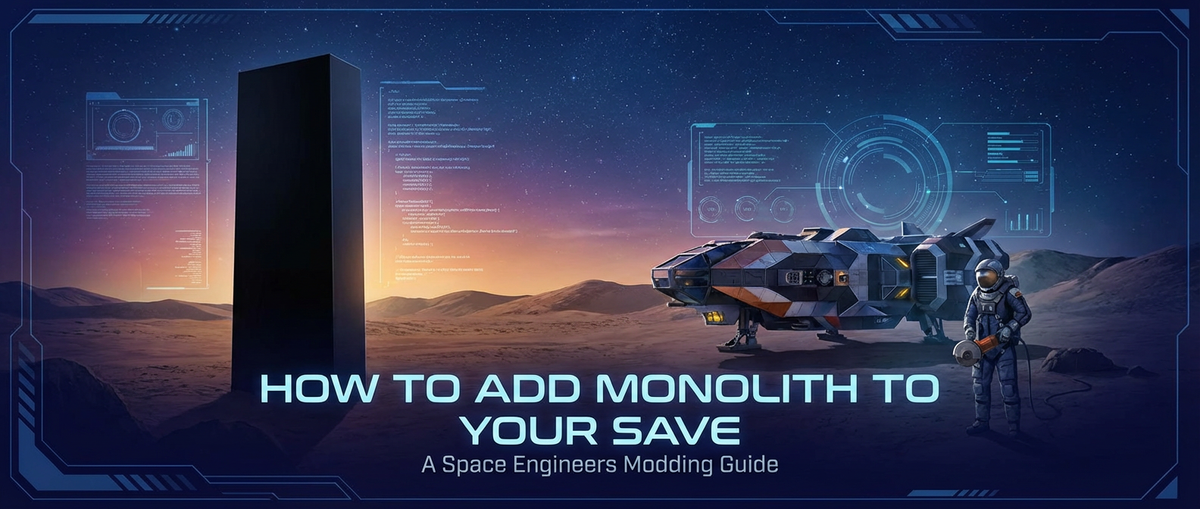


Space Engineers, Keen Software House's beloved sandbox game, has captivated millions with its promise of engineering marvels and boundless exploration in the vast expanse of space. From constructing colossal starships to designing intricate planetary bases, the game empowers players to unleash their creativity with a robust suite of building tools and an unwavering commitment to realistic physics. However, beyond the functional constructs and utilitarian designs, there lies a profound desire among players to imbue their worlds with elements of mystery, grandeur, and narrative depth. One such element that frequently sparks the imagination and beckons a unique addition to any save file is the enigmatic Monolith.
The Monolith, in its various interpretations across science fiction and popular culture, often serves as a symbol of advanced intelligence, ancient mysteries, or cosmic intervention. In Space Engineers, while not a native, interactive game element with predefined lore, the concept of introducing a Monolith into one's personal universe opens up an entirely new dimension of storytelling, aesthetic appeal, and even practical design challenges. Imagine stumbling upon a silent, imposing structure on a distant moon, its dark surface reflecting the stars, hinting at secrets untold. Or perhaps envision it as a central monument within a meticulously crafted space station, a testament to a grand vision or a beacon of a forgotten civilization. Adding such an iconic structure transcends mere construction; it becomes an act of world-building, transforming a functional grid of blocks into a canvas for epic tales and personal narratives. This comprehensive guide will delve deep into the art and science of introducing a Monolith into your Space Engineers save, exploring various methods, best practices, and the profound impact such an addition can have on your game experience. We will navigate the intricacies of in-game tools, community blueprints, and even the broader context of how an "Open Platform" like Space Engineers fosters such creative endeavors, providing a "gateway" for imagination to flourish, even drawing parallels to the sophisticated "API" management found in modern software architecture.
Understanding the Allure: What is a Monolith in Space Engineers?
Before we dive into the technicalities of adding a Monolith, it's crucial to understand what this structure represents within the imaginative framework of Space Engineers. Unlike a functional ship or a mining rig, a Monolith primarily serves as an aesthetic and narrative focal point. It’s an object of pure form, often simple in its geometry yet profound in its implications. Inspired by works like Arthur C. Clarke's "2001: A Space Odyssey," where the Monolith acts as a catalyst for human evolution and a symbol of alien intelligence, players often seek to recreate this sense of awe and mystery within their own game worlds.
In Space Engineers, a Monolith can take many forms. Most commonly, it's a large, rectangular prism, dark and imposing, constructed from robust materials like heavy armor blocks. Its surface might be smooth and featureless, or subtly textured to catch the light in specific ways. The beauty of Space Engineers lies in its block-based construction, which paradoxically allows for incredible fluidity in design. A player isn't just placing a predefined "Monolith" asset; they are building a Monolith, piece by painstaking piece, or importing one designed by another creative mind. This process transforms it from a generic object into a unique artifact within your game world, imbued with the effort and vision of its creator.
The reasons for adding a Monolith are as varied as the players themselves. For some, it's about pure aesthetics—a striking visual element to break up the monotonous landscape of a barren planet or the industrial sprawl of a space station. For others, it's a narrative device. Perhaps it's a relic of an ancient race, an alien signal emitter, a grave marker, or even a futuristic art installation. Role-playing communities often integrate such structures into their lore, creating quests, mysteries, or pilgrimage sites around them. Furthermore, constructing or integrating a very large structure like a Monolith can be a technical challenge, pushing the boundaries of what the game's engine can handle and testing a player's understanding of structural integrity and optimization. The sheer scale and presence of a well-placed Monolith can dramatically alter the feel and atmosphere of a save, transforming it from a mere collection of grids into a living, breathing universe ripe for exploration and storytelling.
Prerequisites and Essential Preparations: Laying the Groundwork
Embarking on the quest to introduce a Monolith into your Space Engineers save requires a methodical approach and some essential groundwork. Rushing into modifications without proper preparation can lead to frustration, performance issues, or, in worst-case scenarios, save file corruption. Therefore, taking a few moments to ensure you're ready will save you considerable headaches down the line.
Firstly, game knowledge and comfort with controls are paramount. While Space Engineers is intuitive, navigating its various menus, understanding block properties, and manipulating grids in 3D space requires a degree of familiarity. If you’re a newcomer, spending some time building smaller structures and experimenting with the core mechanics will be highly beneficial before tackling a project of Monolithic proportions. This understanding extends to knowing the difference between "Small Grid" and "Large Grid" blocks, understanding the concept of structural integrity (especially for very large, freestanding structures), and familiarity with the game's creative tools.
Secondly, and arguably most critically, is the practice of backing up your save files. This cannot be stressed enough. Any significant modification to a game save, especially involving large structures or external tools, carries a degree of risk. A corrupted save can mean losing hours, days, or even weeks of progress. * How to Back Up: 1. Open Space Engineers. 2. Go to "Load Game." 3. Select the save you intend to modify. 4. Click the "Save As" button. 5. Give it a distinct name, perhaps "MyMonolithProject_Backup_Date," to differentiate it from your primary save. 6. Alternatively, you can manually navigate to your save game folder (usually C:\Users\[YourUsername]\AppData\Roaming\SpaceEngineers\Saves\[SteamID]\[SaveName]) and copy the entire folder to a safe location. This offers a robust, external backup. By having a recent backup, you create a safety net, allowing you to experiment freely without the fear of irreversible damage. If something goes wrong, you can always revert to your stable backup and try again.
Thirdly, consider your system specifications and game settings. A Monolith, particularly a very large one, is composed of thousands, if not tens of thousands, of individual blocks. This can be very demanding on your computer's CPU and GPU. * Performance Considerations: * Processor (CPU): Space Engineers is notoriously CPU-intensive, especially for physics calculations and handling numerous blocks. A powerful multi-core CPU is beneficial. * Graphics Card (GPU): Rendering complex scenes with many polygons and lighting effects requires a capable GPU. * RAM: While not as critical as CPU/GPU for block count, sufficient RAM (16GB minimum, 32GB recommended for large builds) helps with overall system stability and loading times. * Settings: Before introducing a massive structure, you might want to temporarily lower some graphical settings (like shadow quality, voxel quality, or render distance) to mitigate potential performance drops, especially during the placement phase. You can always increase them again once the Monolith is stable in your world.
Finally, think about the chosen location for your Monolith. Will it be in space, orbiting a planet? On the surface of a moon, half-buried in the terrain? Or perhaps inside a massive asteroid hollowed out for a secret base? The location will influence the visual impact, the logistical challenges of placement, and even the necessary structural supports. For instance, placing a colossal structure on a planet requires careful consideration of gravity, foundation, and potential terrain deformation if it's placed too heavily without proper support. In space, while gravity isn't an issue, aligning and positioning a large grid without reference points can be tricky. Having a clear vision for its placement will streamline the entire process.
Method 1: Harnessing In-Game Admin Tools for Spawning (Creative Mode/Spectator)
The most direct and often simplest way to introduce a pre-designed Monolith into your Space Engineers save is by utilizing the game's powerful administrative tools, typically accessed in creative mode or by players with admin privileges on a server. This method bypasses the need for external software for initial placement and is ideal for both single-player creative worlds and dedicated servers where an administrator wants to add a significant landmark.
This method primarily relies on the ability to paste blueprints. A blueprint in Space Engineers is essentially a saved design of a grid (or multiple grids) that can be easily replicated. Many players have already designed stunning Monoliths and shared them on the Steam Workshop, or you might choose to build your own from scratch and blueprint it.
Step-by-Step Guide:
- Switch to Creative Mode (if not already):
- If you are in survival mode, you’ll need to enable creative mode tools. Press
Alt+F10to open the Admin Screen. - Navigate to the "Player" tab.
- Check the box labeled "Enable Creative Mode Tools." This grants you unlimited resources and the ability to fly, allowing for easy placement of large structures.
- Alternatively, you can simply load your save in "Creative Mode" from the main menu. This is often the most straightforward approach for initial world-building.
- If you are in survival mode, you’ll need to enable creative mode tools. Press
- Enable Spectator Mode (Optional but Recommended):
- While not strictly necessary, entering Spectator Mode (
F8) allows for incredibly precise and free-form movement, making it much easier to position very large structures without the constraints of character movement or jetpack fuel. You can fly through objects, rapidly change elevation, and view your world from any angle, which is invaluable for intricate placements.
- While not strictly necessary, entering Spectator Mode (
- Find or Create Your Monolith Blueprint:
- From the Steam Workshop: The most common source. Open the Steam client, navigate to the Space Engineers Community Hub, and then to the Workshop. Search for "Monolith," "Obelisk," or similar terms. You'll find a plethora of community-designed structures. Subscribe to the blueprint(s) you like. Once subscribed, the blueprint will automatically download and appear in your in-game blueprint menu.
- Create Your Own: If you have a specific vision, you can build your Monolith from scratch in a creative test world. Use heavy armor blocks (or other desired materials) to construct your imposing structure. Once complete, look at it, press
Ctrl+Bto create a blueprint, give it a name, and save it. This will save it to your local blueprints.
- Access the Blueprint Menu:
- In-game, press
F10to open the Blueprint Screen. - You will see a list of all your local and subscribed blueprints. Locate the Monolith blueprint you wish to add.
- Click on the blueprint's thumbnail. A ghost projection of the Monolith will appear in front of you.
- In-game, press
- Positioning the Monolith:
- This is where Spectator Mode (F8) truly shines. Fly around to the desired location.
- The ghost projection will follow your camera. Use your mouse to rotate the Monolith.
- Keyboard Controls for Placement:
Mouse Scroll Wheel: Adjusts the distance of the projection from your camera.Home/End: Rotates the grid along one axis (usually vertical).Page Up/Page Down: Rotates along another axis.Insert/Delete: Rotates along the third axis.Shift+ Rotation Key: Rotates in larger increments.Ctrl+ Rotation Key: Rotates in smaller, more precise increments.Middle Mouse Button (Hold): Allows for free-form rotation if enabled in options.
- Take your time to align it perfectly with the terrain, another structure, or your desired celestial orientation. Ensure no parts are clipping into terrain or other grids unintentionally, as this can cause physics glitches or structural instability once placed. Pay attention to the "grounding" of the Monolith. If it's meant to stand on a planet, make sure its base is firmly on the surface or slightly buried for stability and aesthetic integration.
- Pasting the Monolith:
- Once you are satisfied with the position and orientation of the ghost projection, simply press
Ctrl+V. - The Monolith will instantly materialize in your world.
- Be patient; for extremely large blueprints, there might be a brief moment of loading or a slight stutter as the game renders all the new blocks.
- Once you are satisfied with the position and orientation of the ghost projection, simply press
- Post-Placement Checks:
- After pasting, carefully inspect the Monolith. Fly around it, check its stability, and ensure it hasn't caused any unintended issues.
- If you're in survival mode and planning to switch back, remember that the Monolith will likely be unowned initially. You might need to
Ctrl+Shift+Gto quickly change ownership of all its blocks to yourself (or your faction) if you want to interact with it or prevent others from claiming it on a server. - Consider adding internal support or modifying the terrain around its base for better integration and stability, especially for planetary placements.
This method offers unparalleled speed and flexibility, making it the preferred choice for players who prioritize immediate gratification and creative freedom. However, it's primarily suited for creative mode or admin use, as survival players would need to gather immense resources to build such a structure block by block, or convert it to survival, which we will discuss briefly later.
Method 2: Importing Blueprints via the Steam Workshop and Local Files
Beyond the immediate admin tools, a vast ecosystem of player-created content thrives within Space Engineers, primarily facilitated by the Steam Workshop. This community-driven "Open Platform" is a "gateway" where thousands of engineers share their creations, from humble utility vehicles to awe-inspiring starships and, yes, enigmatic Monoliths. Leveraging the Workshop allows players to access a nearly infinite library of pre-designed structures, saving countless hours of design and construction time. This method is an extension of the previous one but focuses specifically on the acquisition and integration of community blueprints, highlighting the collaborative spirit that defines Space Engineers.
Detailed Process for Workshop Blueprints:
- Accessing the Steam Workshop:
- The first step is to leave the game for a moment and open your Steam client.
- Navigate to the Space Engineers Community Hub. You can usually find this by right-clicking Space Engineers in your Steam library, selecting "Community Hub," then clicking on "Workshop" at the top.
- Alternatively, in the game's main menu, there is often a direct "Workshop" button that will open the Steam overlay and take you there.
- Searching for Monoliths:
- In the Workshop search bar, type keywords such as "Monolith," "Obelisk," "Ancient Structure," "Art Piece," or even just "Huge Structure."
- Filter the results as needed. You might want to sort by "Most Subscribed," "Top Rated," or "Newest" to find popular or recently updated designs.
- Look for blueprints specifically categorized as "Large Grid" (as Monoliths are almost always large-scale structures) and ensure they are compatible with the latest game version if possible.
- Pay attention to the description and screenshots provided by the creator. These will give you an idea of the Monolith's scale, materials, and any special features or recommendations. Some creators might even provide lore snippets for their designs.
- Subscribing to a Blueprint:
- Once you find a Monolith blueprint that catches your eye, click on its entry to view its detailed page.
- Click the green "Subscribe" button. Steam will automatically download the blueprint file to your local Space Engineers blueprint folder. This usually happens in the background. You don't need to do anything else on the Steam side.
- Loading Space Engineers and Accessing Blueprints:
- Launch Space Engineers.
- Load the save game where you intend to place the Monolith. As with Method 1, having creative tools enabled (
Alt+F10-> "Enable Creative Mode Tools") and using Spectator Mode (F8) will make placement significantly easier.
- Pasting the Blueprint:
- Press
F10to open the Blueprint screen. - Your newly subscribed Monolith blueprint should now appear in the list. It might be listed under "My Blueprints" or a separate Workshop section.
- Select the blueprint, and its ghost projection will appear.
- Follow the positioning and pasting steps detailed in Method 1 (
Mouse Scroll,Home/End,Ctrl+V).
- Press
Creating Your Own Monolith Blueprint (Advanced Design Considerations):
If you're inclined to craft a truly unique Monolith, building your own and then blue-printing it offers unparalleled creative freedom. This process also grants a deeper appreciation for the game's building mechanics.
- Start in a Dedicated Creative World: Create a new, empty creative world specifically for building. This prevents your main save from being cluttered or potentially destabilized during the design phase. A "Solar System" map with "Empty World" or "Star System" settings can provide a clean canvas.
- Design Philosophy:
- Scale: Decide on the desired scale. Will it be towering, stretching into the clouds, or a more modest, ground-level monument? Massive structures require more attention to detail, symmetry, and block count.
- Shape: While typically rectangular, consider variations. A triangular prism, an octagonal column, or even a more organic, alien form composed of many smaller blocks could be equally striking. The key is imposing simplicity.
- Material: Heavy Armor Blocks are the standard for their durability, dark default color, and solid appearance. However, consider other blocks for texture. Light Armor blocks for internal structure (if it's hollow), custom color blocks, or even certain functional blocks (like large batteries or reactors, if intended to be part of the design and not just structure) can add detail. Avoid too many functional blocks if the Monolith is purely aesthetic, as they can add to complexity and potentially increase lag.
- Color and Texture: Default dark grey is classic, but subtle variations in color, perhaps a deep obsidian black, a metallic sheen, or even patterns created by different block types, can enhance its visual impact. The game's new block textures and paint options offer a wide palette.
- Building Process:
- Begin with a foundation. Use an initial block as a reference point.
- Utilize symmetry tools (
Nfor mirror mode) and copy-paste functions (Ctrl+C,Ctrl+X,Ctrl+V) to rapidly build symmetrical structures. Building one side or one section and then mirroring/copying it dramatically speeds up construction. - Build layer by layer, or section by section. For truly enormous Monoliths, it might be beneficial to build in stages, blueprinting and saving intermediate sections as you go.
- Consider internal structure. Even if solid, ensure there aren't massive internal voids that could lead to unexpected physics issues. For a truly solid Monolith, fill it entirely with blocks. For a hollow one, design the interior thoughtfully.
- Optimization (for Performance):
- Block Count: Keep an eye on the total block count (
Ctrl+Alt+F5for performance info). Excessive blocks lead to lower FPS. - Vertices and Triangles: Complex shapes with many small, intricately placed blocks will have a higher polygon count, impacting GPU performance. Simple, large blocks are generally better for performance.
- Grids: If your Monolith is a single, massive grid, that's generally fine. Avoid attaching many small, separate grids to it unless absolutely necessary, as inter-grid physics can be more demanding.
- Block Count: Keep an eye on the total block count (
- Creating the Blueprint:
- Once your Monolith is complete, fly back to a vantage point where you can see the entire structure.
- Look at the grid you want to blueprint.
- Press
Ctrl+B. A blueprint window will appear. - Give your blueprint a descriptive name (e.g., "Obsidian Monolith v2").
- Add a description if you plan to share it on the Workshop, detailing its dimensions, block count, and any lore.
- Click "Save Blueprint." This saves it to your local blueprints folder. From there, you can use the
F10menu to paste it into any of your saves, or upload it to the Steam Workshop for others to enjoy.
By leveraging the Steam Workshop and understanding the blueprint system, players gain access to a powerful collaborative ecosystem. This "Open Platform" approach, where users contribute content that enriches the game experience for everyone, is a cornerstone of Space Engineers' enduring appeal. It's a digital "gateway" for creativity, fostering a vibrant community that continuously expands the possibilities of the game.
Method 3: Advanced Save File Interaction and Analogies to Digital Management
While direct save file editing using external tools like SEToolbox (a popular third-party editor for older versions of Space Engineers) can be a powerful method for manipulating objects, characters, and even terrain data, it's generally considered an advanced and higher-risk approach. For the specific task of adding a Monolith, the in-game blueprint pasting methods are safer and more accessible. However, discussing the underlying mechanics of how a game save operates and how external tools (or even the game itself) interact with this data provides a fascinating analogy to modern digital infrastructure, particularly with concepts like "API" and "gateway."
Space Engineers save files are complex databases, primarily in XML format, that store every detail of your game world: the position and state of every block, the properties of every grid, the location of every asteroid, and the status of every player. When you use in-game tools to paste a blueprint, the game's internal systems are, in essence, interacting with this underlying data structure. It's reading the blueprint's XML data and then writing new block entries into your save file's XML, ensuring proper coordinates, ownership, and structural integrity.
The "API" Analogy in Game Data Interaction:
In a broader sense, one could draw a conceptual parallel between the game's internal methods for handling blueprints and how an "API" (Application Programming Interface) functions in software development. An API defines the methods and data structures that external applications or different parts of a system can use to communicate with each other.
- Game's Blueprint System as a "Internal API": When you press
F10andCtrl+V, you're using a game-provided "interface" (the blueprint menu and paste command) that interacts with the game's core "data services." The blueprint itself is a structured data format, akin to an API's data schema. The game's engine then processes this data (the blueprint) and executes a specific function (placing blocks) by manipulating the save file. This internal "interface" ensures that blocks are placed correctly, physics are applied, and the game state remains consistent, much like a well-designed API ensures proper data exchange and functionality between different software components. - Modding and External Tools: For a more direct analogy, consider modding APIs or SDKs (Software Development Kits) that some games provide. While Space Engineers doesn't have a formal public API for deep game engine manipulation in the same way some simulation games do, its modding support allows external scripts and custom blocks to interact with game logic. These custom components, when properly integrated, follow specific rules and data formats to "talk" to the game engine, much like an external application consumes a web API. Tools like SEToolbox, though unofficial, work by directly parsing and writing to the game's XML save files, essentially acting as an external client that "understands" the save file's "protocol" or "API" for data manipulation. They bypass the in-game GUI but adhere to the underlying data structure definitions.
The "Gateway" Concept in Game Asset Management:
The Steam Workshop, as previously discussed, functions as a powerful "gateway" for community content. It's a centralized hub that authenticates users, hosts files, manages versions, and facilitates the distribution of blueprints and mods. Without such a "gateway," sharing creations would be a fragmented, manual, and often insecure process. The Workshop streamlines the exchange, acting as a trusted intermediary between creators and consumers.
- Workshop as an Asset Gateway: Players upload their blueprints to the Workshop. Other players, through their Steam client (which is connected to the Space Engineers game), subscribe to these blueprints. The Workshop acts as a "gateway" for these digital assets, handling the storage, bandwidth, and seamless integration into the game client's blueprint menu. It's a single point of access for a vast array of user-generated content, simplifying the discovery and acquisition process. This contrasts sharply with a world where every mod or blueprint had to be manually downloaded from disparate, potentially unreliable sources.
- Dedicated Servers as Game Gateways: In a multiplayer context, a dedicated Space Engineers server acts as a "gateway" for players to a shared game world. It manages the persistent game state, handles physics calculations, synchronizes player actions, and enforces game rules. All client connections pass through this server, which acts as the central authority and orchestrator of the multiplayer experience. It's the "gateway" to the collaborative universe, managing who gets in, what they can do, and how their actions are reflected across all connected clients.
Drawing Parallels to Enterprise API Management with APIPark:
The challenges of managing diverse data formats, interfaces, and content gateways in games like Space Engineers, albeit on a micro-scale, find macro-level parallels in the complex world of modern software development, particularly with the proliferation of AI and microservices. Here, the concepts of "API" and "gateway" become not just analogies but critical infrastructure components.
Imagine an enterprise needing to integrate dozens of different AI models (for natural language processing, image recognition, data analytics) from various providers, alongside their existing REST APIs for core business functions. Each AI model might have its own unique "API" or "protocol" for invocation, its own authentication requirements, and different data formats. Managing this sprawling ecosystem manually would be a nightmare—a chaotic free-for-all of disparate interfaces, security vulnerabilities, and inconsistent data handling.
This is precisely where platforms like APIPark come into play. Just as the Steam Workshop acts as a unified gateway for game assets, and a dedicated server acts as a gateway to a shared game world, APIPark serves as an all-in-one AI gateway and API management platform. It provides a standardized "API" for interacting with over 100 AI models, abstracting away their individual complexities. Instead of each application needing to understand the specific "API" of GPT-4, Llama, or a custom vision AI, they simply communicate with APIPark, which acts as the intelligent intermediary.
APIPark streamlines this process by: * Unified API Format: Standardizing request data formats across diverse AI models, much like a well-designed game engine standardizes how blueprints are processed, ensures that changes in underlying models don't break applications. * Prompt Encapsulation: Allowing users to turn custom AI prompts into easily invokable REST APIs, creating new, tailored services. This is akin to a game designer taking a complex building idea and packaging it into an easy-to-use blueprint for players. * End-to-End Lifecycle Management: Managing APIs from design to deployment, ensuring traffic forwarding, load balancing, and versioning—critical functions for any complex digital "Open Platform." * Team Sharing and Permissions: Providing independent API and access permissions for different teams (tenants), ensuring secure and organized collaboration, much like a well-managed Space Engineers server provides tailored access for different factions or players.
So, while adding a Monolith to Space Engineers might seem miles away from enterprise software, the underlying principles of managing diverse data, facilitating content sharing, and creating unified access points (be it for game assets or AI services) are strikingly similar. The game, in its own right, functions as an "Open Platform" for creative expression, with its own forms of "gateways" and "APIs" that enable its vast community.
Method 4: Dedicated Server Management for Monolith Integration
For players who primarily experience Space Engineers on dedicated servers, either privately hosted or community-run, the process of adding a Monolith takes on an additional layer of consideration. While the core method of pasting blueprints remains the same, server administrators have specific tools and responsibilities that streamline the process and ensure a stable environment for all connected players. Managing a dedicated server is, in itself, an exercise in orchestrating an "Open Platform" where multiple users interact, and the server acts as the primary "gateway" for that collective experience.
Key Steps for Server Administrators:
- Server Access and Privileges:
- As a server administrator, you'll need direct access to the server's control panel or remote desktop, depending on how it's hosted.
- You must be logged into the game as an administrator on the server. This means your Steam ID must be whitelisted in the server's
SpaceEngineers-Dedicated.cfgfile or granted admin status through the server's web interface (if applicable). - Once in-game, you can activate creative tools (
Alt+F10) as described in Method 1.
- Blueprint Acquisition:
- Administrators can subscribe to Steam Workshop blueprints directly through their own Steam account, and these will appear in the in-game blueprint menu on the server.
- Alternatively, you can manually copy blueprint files (
.sbcfiles) into the server's dedicated blueprint folder. This is useful if you've created a custom Monolith and want to ensure it's available server-side without going through the Workshop. The folder path is typicallyC:\Users\[YourUsername]\AppData\Roaming\SpaceEngineersDedicated\[ServerName]\Blueprints\local.
- Loading the Server Save:
- Ensure the server is running the specific save game where you want to add the Monolith.
- Connect to the server with your admin account.
- In-Game Placement:
- Once connected and in-game, enable creative mode tools (
Alt+F10-> "Enable Creative Mode Tools"). - Enter Spectator Mode (
F8) for precise positioning. - Open the Blueprint menu (
F10), select your Monolith blueprint, and paste it usingCtrl+Vat the desired location. - As with single-player, meticulously adjust its position and rotation.
- Once connected and in-game, enable creative mode tools (
- Ownership and Permissions:
- After pasting a large grid on a server, it often defaults to no owner or "nobody."
- To ensure you (or your faction) can interact with it, and to prevent other players from claiming it, use the admin tool
Alt+F10, go to the "Grids" tab, find your Monolith grid, and change its owner to yourself or a specific faction. A quicker way is to look at a block on the Monolith and pressCtrl+Shift+Gto change ownership of the entire grid to your character/faction. - Consider if the Monolith should be invincible. Using
Alt+F10-> "Grids" tab, you can set theInvulnerableproperty toTruefor the Monolith's grid, preventing it from being damaged by players or environmental hazards. This is often desirable for purely aesthetic or lore-based structures.
- Server Performance and Optimization:
- Adding a very large Monolith to a server will increase the overall block count, which can impact server performance (Sim Speed).
- Sim Speed Monitoring: Keep an eye on the server's Sim Speed (often displayed in the server console or accessible via admin commands). If it drops significantly below 1.0, the server is struggling.
- Block Optimization: For massive structures, consider using "Static Grids" where possible. If the Monolith doesn't need to move or interact dynamically (e.g., it's a static monument), ensure it's properly welded and connected to a static voxel or other static grids to minimize physics calculations.
- Blueprint Cleanliness: If you're using a Workshop blueprint, check if it contains unnecessary sub-grids, projectors, or other functional blocks that might consume server resources without serving an aesthetic purpose. Simplify where possible.
- Server Hardware: Ensure your dedicated server has robust hardware (high-clock-speed CPU, ample RAM, fast SSD) to handle the increased load.
- Communication with Players:
- It's good practice to inform players on the server about significant additions like a Monolith. This can build excitement, integrate it into server lore, and avoid confusion. You might even involve them in choosing its location or purpose.
Integrating a Monolith into a dedicated server environment underscores the role of the server as a central "gateway" for the entire player base. The administrator, in essence, acts as the curator and manager of this "Open Platform," ensuring that new content is introduced smoothly, performance is maintained, and the collective experience remains enjoyable. This level of management and integration again echoes the challenges faced in professional IT environments, where unified "API gateways" and management platforms are essential for orchestrating diverse services and maintaining an "Open Platform" ecosystem, albeit with very different kinds of "blocks" and "grids."
APIPark is a high-performance AI gateway that allows you to securely access the most comprehensive LLM APIs globally on the APIPark platform, including OpenAI, Anthropic, Mistral, Llama2, Google Gemini, and more.Try APIPark now! 👇👇👇
Integrating the Monolith into Your World: Beyond Placement
Successfully placing a Monolith is only the beginning. To truly enrich your Space Engineers experience, the Monolith must be thoughtfully integrated into the broader context of your game world. This involves considering its aesthetic synergy, narrative potential, and how it impacts the practical aspects of gameplay.
Aesthetic Integration: Making it Belong
A Monolith shouldn't feel like a disconnected object; it should appear as if it has always been a part of your universe, or at least a deliberate, impactful addition.
- Environmental Blending:
- Planetary Surface: If placed on a planet, consider how it interacts with the terrain. Will it rise majestically from a flat plain, be partially buried in a crater, or stand sentinel on a mountain peak? Use the game's voxel manipulation tools (accessible with
F10in creative mode, orAlt+F10for admin tools) to sculpt the terrain around its base. Smooth out jagged edges where the Monolith meets the ground, create subtle ramps leading up to it, or even excavate ancient-looking ruins around its base to suggest a long history. - Space/Asteroids: In space, positioning is key. Does it orbit a planet at a specific distance? Is it embedded within a massive asteroid, peaking out like a shard of unknown origin? Or perhaps it hovers ominously near a player-built station, a silent observer. Consider lighting; the sun's angle and nearby light sources can dramatically alter its visual presence.
- Planetary Surface: If placed on a planet, consider how it interacts with the terrain. Will it rise majestically from a flat plain, be partially buried in a crater, or stand sentinel on a mountain peak? Use the game's voxel manipulation tools (accessible with
- Scale and Proportion: Ensure the Monolith's size feels appropriate for your world. A towering Monolith might overwhelm a small starter base but perfectly complement a sprawling interstellar empire. Conversely, a smaller, more intimate Monolith might be ideal for a secret hideout or a personal shrine.
- Material and Texture Harmony: While heavy armor is standard, consider painting it or using specific texture packs (if modded) to match the surrounding environment or your existing builds. A Monolith near a red planet might look striking in a deep crimson, or one in a futuristic station might have subtle glowing accents using interior lights.
Narrative and Role-Playing Opportunities: Crafting the Lore
The true power of a Monolith lies in its ability to inspire storytelling. It's a blank slate upon which you can project countless narratives, transforming a static object into a dynamic plot device.
- Ancient Artifact: Is it a relic of a long-vanished alien civilization, discovered by your intrepid engineers? What secrets does it hold? What technologies did its creators wield? This can lead to lore about exploration, archaeological digs, and deciphering cryptic messages.
- A Beacon or Signal: Perhaps the Monolith is an active device, emitting a mysterious signal into the void. What is it communicating? Is it a distress call, a warning, or an invitation? This can introduce quests to build receivers, track down the signal's origin, or even attract hostile entities.
- A Monument to Your Achievements: On a personal level, the Monolith can represent a significant milestone in your save. A towering structure marking the completion of a major project, the founding of a new colony, or a tribute to fallen engineers.
- Psychological Impact: For role-playing servers, a Monolith can be a focal point for player interactions. It could be a neutral meeting ground, a disputed territory, or a site of religious pilgrimage for in-game factions. Its imposing presence alone can evoke feelings of wonder, fear, or reverence among players.
Practical Considerations and Performance Optimization
Large structures like Monoliths can significantly impact game performance if not handled carefully.
- Block Count and Grid Complexity: As previously mentioned, the sheer number of blocks can strain your CPU and GPU. If you experience significant Sim Speed drops or FPS issues:
- Simplify Internal Structure: If your Monolith is massive and intended to be completely solid, consider using a mod that allows for "composite blocks" or finding ways to reduce the visible block count while maintaining its mass.
- Static vs. Dynamic: Ensure the Monolith is a static grid unless you intend for it to move. Static grids generally have less performance overhead. If it's a dynamic grid that doesn't need to move, ensure all its sub-grids are welded and that it's properly anchored.
- Disable Unnecessary Physics: If the Monolith has internal components (like conveyors or reactors) that aren't truly active or necessary for its aesthetic, consider removing them or building it as a purely static, unpowered structure.
- Lighting and Visual Effects: While adding internal lights or external spotlights can enhance its visual drama, too many complex light sources can also be a performance drain. Use them judiciously.
- Render Distance: Large structures will be rendered from a greater distance, contributing to load. While you can't selectively adjust render distance for individual objects, being aware of overall render settings can help manage performance.
- Terrain Interaction: Ensure that the Monolith's base is properly integrated with the terrain. Clipping or z-fighting (where two surfaces occupy the same space) can lead to visual glitches or even physics anomalies. Use
Ctrl+F10to view bounding boxes and ensure clean intersections.
By considering these aspects, your Monolith will transition from a mere block placement to a fundamental, immersive component of your Space Engineers saga, adding layers of depth and enjoyment to your personalized universe.
Troubleshooting Common Issues with Large Structure Placement
Even with careful preparation, integrating colossal structures like Monoliths can sometimes encounter snags. Understanding common issues and their solutions will save you from frustration and ensure a smoother building experience.
- Lag and Performance Drops:
- Symptom: Your game's Sim Speed (visible by pressing
Shift+F11) drops significantly, FPS plummets, or the game freezes temporarily, especially during pasting or when near the Monolith. - Cause: Too many blocks, complex physics calculations, or insufficient system resources.
- Solution:
- Reduce Block Count: If building your own, simplify the design. For blueprints, check the block count before pasting.
- Ensure Static Grid: Confirm the Monolith is a static grid if it's not meant to move. If it was pasted as a dynamic grid, you might need to convert it or attach it to a static voxel using a landing gear or connector.
- Lower Graphics Settings: Temporarily reduce render distance, shadow quality, or texture quality in the game options.
- Close Background Applications: Free up CPU and RAM by closing other programs.
- Update Drivers: Ensure your graphics drivers are up to date.
- Restart Game: Sometimes a fresh game session can clear up memory leaks or performance degradation.
- Server Admins: Monitor server Sim Speed. If it's consistently low, consider optimizing the Monolith's design or upgrading server hardware.
- Symptom: Your game's Sim Speed (visible by pressing
- Clipping and Z-Fighting:
- Symptom: Parts of the Monolith appear to be inside the terrain or other structures, causing flickering textures or visual artifacts.
- Cause: Improper positioning during blueprint pasting or minor terrain inconsistencies.
- Solution:
- Reposition: If still in ghost projection phase, carefully adjust the Monolith's position using rotation and distance controls until it's clear of obstructions.
- Voxel Editing: Use the voxel tools (
F10in creative orAlt+F10as admin) to carefully remove terrain where the Monolith is clipping. Conversely, add terrain around its base for better integration. - Precision Placement: When placing, enable "small grid snapping" or use very fine rotation adjustments to get a perfect alignment.
- Failed Pasting/Blueprint Disappearing:
- Symptom: You press
Ctrl+V, but nothing appears, or an error message flashes briefly. - Cause: Corrupted blueprint file, insufficient memory, or an issue with the game's internal pasting mechanism.
- Solution:
- Check Blueprint Integrity: Re-subscribe to the blueprint from the Workshop or verify your local blueprint file isn't corrupted. Try blue-printing a simple cube and pasting it to check if the system works generally.
- Restart Game/Steam: Sometimes a full restart of Space Engineers and Steam can resolve blueprint loading issues.
- Verify Game Files: In Steam, right-click Space Engineers, go to "Properties" -> "Local Files" -> "Verify integrity of game files."
- Free Up RAM: Ensure your system has enough free RAM to handle the load of pasting a massive structure.
- Symptom: You press
- Structural Instability (for Dynamic Grids):
- Symptom: If you somehow pasted the Monolith as a dynamic grid (perhaps accidentally attached it to a moving platform or didn't anchor it), it might slowly drift, shake, or even spontaneously explode under physics stress.
- Cause: Physics calculations on a large, unanchored, or unsupported dynamic grid.
- Solution:
- Convert to Static: If it's meant to be stationary, attach it to the voxel with a landing gear or directly attach it to another static grid. If you need to "freeze" it in place, you can sometimes use the
Alt+F10admin menu, go to "Grids" tab, select the Monolith grid, and setIsStatictoTrue. Be cautious as this can sometimes cause issues if the grid is not perfectly aligned with a static entity. - Add Support: For structures on planets, ensure a wide, stable base is firmly connected to the ground. Gravity is unforgiving.
- Check Connectors/Rotors: If the Monolith blueprint contained any movable parts, ensure they are locked or fully welded if static.
- Convert to Static: If it's meant to be stationary, attach it to the voxel with a landing gear or directly attach it to another static grid. If you need to "freeze" it in place, you can sometimes use the
- Save File Corruption:
- Symptom: Game crashes on load, "world corrupted" error, or severe, unrecoverable glitches.
- Cause: This is the most severe and usually happens due to unexpected game crashes during saving, or aggressive external file manipulation.
- Solution:
- REVERT TO BACKUP: This is why backing up your save is the absolute first prerequisite. Load your most recent stable backup.
- Never Edit Live Saves: Avoid making drastic changes or using external tools on a save that is currently running or not properly closed.
- Report Bugs: If you believe a specific game action (not external tools) led to corruption, report it to Keen Software House.
By being aware of these potential pitfalls and knowing how to address them, you can confidently integrate even the most colossal and mysterious structures into your Space Engineers save, ensuring a stable and immersive experience. The game's robust debugging tools and the invaluable practice of backing up your progress are your best allies in this endeavor.
The Broader Context: Community Creations and the "Open Platform" of Space Engineers
The ability to easily add a Monolith, whether from a community blueprint or your own design, is a testament to the fundamental design philosophy of Space Engineers: an "Open Platform" for creativity. Unlike many games where content is strictly curated by developers, Space Engineers thrives on player-generated content, empowering its community to extend the game's boundaries far beyond its vanilla offerings. This ethos is deeply embedded in the game's core mechanics and its integration with platforms like the Steam Workshop.
Blueprint System: The Engine of Creation The blueprint system is arguably the single most important feature enabling this "Open Platform" status. It allows any player to take a complex grid they've painstakingly built, capture its essence as a blueprint, and then instantly replicate it or share it with the world. This democratizes game content creation; you don't need to be a programmer or a 3D artist to contribute. If you can build it in-game, you can share it. This transforms every player into a potential designer and every game session into an opportunity for innovation. From intricate piston-powered contraptions to magnificent interstellar dreadnoughts and, of course, enigmatic Monoliths, the blueprint system ensures that the collective ingenuity of the player base continually enriches the game.
Modding API (Programmable Blocks & Scripts): A Gateway to Logic Beyond physical blueprints, Space Engineers also provides a rudimentary "API" for in-game scripting through its programmable blocks and the C# scripting environment. While not a full-fledged external modding API, this internal system allows players to write custom scripts that interact with ship systems, automate tasks, create complex logic gates, and even implement rudimentary AI for drones. This is a "gateway" for those with coding knowledge to inject custom behaviors and advanced functionalities directly into their grids, further pushing the boundaries of what's possible within the game's engine. It exemplifies how even within a contained environment, providing an "API" for interaction can unlock immense creative potential.
Dedicated Servers: A Shared "Open Platform" Canvas Dedicated servers amplify the "Open Platform" concept by providing a persistent, shared canvas for multiple players to collaborate and build. Server administrators curate these worlds, often adding custom rules, scenarios, and community-created content (like custom Monoliths or entire mod packs) that further differentiate their "Open Platform" from others. The server itself becomes a "gateway" for players to access this unique, shared experience, fostering vibrant communities that build sprawling empires, engage in epic battles, or simply explore together.
The Economic and Social Impact of an Open Platform The "Open Platform" approach of Space Engineers has a profound social and even economic impact within its community. * Skill Development: Players learn design principles, engineering concepts, problem-solving, and even basic programming through scripting. * Collaboration: The Workshop and dedicated servers foster collaboration, encouraging players to work together on massive projects, share designs, and troubleshoot issues. * Content Longevity: By relying on player-generated content, the game's lifespan is significantly extended. New ships, bases, and scenarios constantly emerge, keeping the experience fresh for years after initial release. * Creative Expression: It provides an unparalleled outlet for creative expression, allowing players to build worlds that are truly their own.
In essence, Space Engineers is more than just a game; it's a creative ecosystem, an "Open Platform" where players are not just consumers but active participants in its ongoing evolution. The ease with which one can introduce a Monolith is but one small, yet impactful, demonstration of this powerful design philosophy. It shows how providing robust tools and an accessible "gateway" for content exchange can transform a game into a vast, collaborative universe.
Enhancing Your Space Engineers Experience with the Monolith
The journey of adding a Monolith doesn't end with its successful placement. It's an opportunity to re-evaluate and enhance your entire Space Engineers experience, using this enigmatic structure as a catalyst for new adventures, deeper immersion, and even further creative endeavors.
Expanding the Narrative and Lore
The Monolith, by its very nature, demands a story. Don't let it be just a silent sentinel; weave it into the fabric of your world's history. * Precursor Civilizations: Develop lore around the beings who might have placed it. Were they benevolent creators, ruthless conquerors, or merely long-gone explorers? What technology did they possess? Could the Monolith contain hidden chambers, puzzles, or data logs waiting to be discovered? * The Monolith's Purpose: Is it a power source, a communication relay, a weapon, or a monument? Consider building around it; perhaps a research outpost to study its properties, or a defensive perimeter to protect its secrets from rival factions. * Player-Driven Events: For multiplayer servers, the Monolith can become the centerpiece of dynamic events. A race to activate it, a battle to control it, or a collaborative effort to understand its origins. This encourages player interaction and fosters a sense of shared purpose or conflict.
Visual and Environmental Enhancements
A Monolith can be further emphasized by careful manipulation of its surrounding environment and the addition of subtle visual effects. * Lighting Design: Strategic placement of spotlights or interior lights can dramatically alter the Monolith's mood. Imagine upward-pointing lights casting long, eerie shadows across its surface at night, or subtle internal glows hinting at a hidden power source. For a more futuristic look, consider colored lights that pulse or slowly change hue. * Terrain Sculpting: Beyond basic integration, use the voxel tools to create dramatic landscapes around it. Canyons leading to its base, ancient-looking ruins partially buried by sand, or lush oases if it's a life-giving artifact. The game's different voxel materials (rock, ice, alien grass, etc.) can add incredible detail. * Atmospheric Mods: If you're open to modding, consider visual enhancement mods that change skyboxes, add new weather effects, or introduce volumetric clouds/fog. These can make your Monolith appear even more imposing or mysterious, especially if it's often shrouded in mist or stands against a backdrop of alien nebulae. * Particle Effects (Modded/Advanced): For advanced builders or server owners, certain mods can introduce custom particle effects. Imagine subtle energy fields emanating from the Monolith, or swirling dust around its base, adding a dynamic layer of visual interest.
Functional Integration (If Desired)
While primarily aesthetic, a Monolith can be given functional roles within your save, especially if you're building it from scratch or modifying a blueprint. * Hidden Base/Vault: Hollow out its interior to create a secret base, a secure vault for your most valuable resources, or a hidden laboratory for experimental technologies. Its unassuming exterior can provide excellent camouflage. * Communications Array: Equip it with an array of antenna and laser antennas to act as a central communication hub for your faction, relaying messages across vast distances. * Power Hub: Integrate a massive array of reactors, batteries, or solar panels within its structure to serve as a central power generation unit for a surrounding base or fleet. Its large surface area is ideal for solar panels. * Defense Platform: Equip it with internal turrets, missile launchers, and point-defense systems to turn it into an impenetrable fortress, protecting a vital location.
Experimentation with Related Builds
The Monolith can inspire an entire suite of related builds: * Discovery Vessels: Design specialized exploration ships or planetary rovers equipped for archaeological digs or long-range scanning, specifically for investigating the Monolith. * Monolith-Inspired Architecture: Adopt the Monolith's stark, geometric aesthetic into your other builds. Create bases, ships, or outposts that echo its minimalist design, fostering a consistent visual language across your world. * Monolith Replicas: Build smaller, personal Monoliths to serve as navigational markers, memorial sites, or simple aesthetic additions in other locations, spreading the mystery.
The addition of a Monolith is a deeply personal act of world-building in Space Engineers. It transforms a functional sandbox into a realm of mystery and narrative, encouraging players to think beyond mere efficiency and embrace the boundless potential of creative storytelling within the stars.
The Future of Space Engineers and Player-Driven Content
The longevity and continued success of Space Engineers are deeply intertwined with its "Open Platform" philosophy and the vibrant community it fosters. The ease with which players can integrate custom creations, such as our enigmatic Monolith, is a cornerstone of this enduring appeal. Keen Software House, the developers, have consistently supported this player-driven ecosystem, understanding that empowering their community is the most effective way to keep the game fresh, engaging, and relevant years after its initial release.
Developer Support for Modding and the Workshop: Keen Software House actively maintains the game's internal systems to ensure compatibility with mods and blueprints. While they don't provide a full, public-facing API for every game function, their consistent updates often include improvements to the modding interface, bug fixes related to content loading, and features that enhance the blueprint system. This developer-backed "Open Platform" ensures that the "gateway" for community content remains stable and accessible. The Steam Workshop integration, seamlessly woven into the game client, is a prime example of this commitment. It provides a standardized, reliable "API" for content distribution, allowing millions of players to share and discover creations with minimal friction.
The Evolving Landscape of Community Contributions: The Space Engineers community is not static; it continually evolves, pushing the boundaries of what's possible within the game. * Increasing Complexity: Blueprints are becoming more intricate, incorporating advanced automation, complex logic, and stunning aesthetic detail. Players are constantly discovering new ways to use the game's blocks and physics engine. * Emergence of New Niches: Beyond traditional ships and bases, the community delves into niche areas like programmable block scripting, cinematic world-building, and even in-game competitive sports. * Cross-Pollination of Ideas: The "Open Platform" encourages a rapid exchange of ideas. A clever mechanism in one blueprint might inspire a new system in another, leading to a continuous cycle of innovation. Players learn from each other, iterate on existing designs, and collectively elevate the standard of community content. * Lore and Role-Playing Development: As players build more elaborate worlds, the narrative aspects grow stronger. Communities develop rich lore, create factions, and engage in elaborate role-playing scenarios, often centered around unique structures like Monoliths or massive, player-built installations.
The Enduring Value of "Open Platform" Games: Space Engineers stands as a prime example of the enduring value of "Open Platform" games in the industry. By providing robust tools, a supportive environment for creators, and efficient "gateways" for content distribution, developers can cultivate a self-sustaining ecosystem that generates infinite replayability. Players aren't just buying a game; they're investing in a creative toolkit and a vibrant community. The Monolith, whether it's a simple black rectangle or an intricately designed alien artifact, is more than just a cluster of blocks; it's a symbol of this powerful player-developer synergy, a testament to what's possible when creativity is truly unleashed. It highlights how the technical infrastructure of the game, including its underlying "API" for content interaction and the "gateway" of the Steam Workshop, empowers individual expression on a grand scale, ensuring Space Engineers remains a beloved sandbox for years to come.
Conclusion: Crafting Your Own Cosmic Enigma
Adding a Monolith to your Space Engineers save is more than just placing blocks; it's an act of profound world-building, a deliberate choice to infuse your universe with mystery, wonder, and narrative depth. Whether you opt for the swift efficiency of the in-game admin tools, the boundless creativity offered by community blueprints on the Steam Workshop, or the meticulous satisfaction of crafting your own design, the journey culminates in the creation of a truly unique focal point within your stellar landscape. We've explored the essential preparations, the step-by-step methods, and the crucial considerations for performance and aesthetic integration. We've even drawn parallels between the game's "Open Platform" nature, its content "gateways," and the underlying "APIs" that enable such robust player interaction, connecting it to the sophisticated API management solutions found in broader tech domains, like the unified AI gateway provided by APIPark for managing diverse services.
The Monolith stands as a testament to the boundless creativity that Space Engineers champions. It invites you to consider not just how things work, but what they mean; not just what you can build, but what stories those builds can tell. So, take your backup, choose your method, and embark on the rewarding task of sculpting your own cosmic enigma. Let your Monolith rise, silent and imposing, an eternal question mark against the backdrop of the stars, forever altering the narrative of your personal Space Engineers saga. May your creations be grand, your engineering sound, and your worlds filled with endless discovery.
Comparison Table: Methods for Adding a Monolith
| Feature / Method | In-Game Admin Tools (Creative Mode) | Steam Workshop Blueprint Import | Custom Blueprint Creation |
|---|---|---|---|
| Ease of Use | Very High | High (requires Steam Workshop access) | Medium (requires building skills) |
| Time Investment | Very Low (instant paste) | Low (browse, subscribe, paste) | High (design and build time) |
| Customization | Low (pre-made design) | Low (pre-made design) | Very High (full creative control) |
| Source | Your own blueprints or previously saved designs | Community-created blueprints | Your own design from scratch |
| Requirements | Creative Mode or Admin privileges | Steam account, Internet connection, Creative Mode/Admin | Creative Mode, Building skills |
| Performance Impact | Depends on blueprint size | Depends on blueprint size | Depends on your design's complexity |
| Best For | Quick aesthetic additions, testing blueprints | Discovering new designs, saving time | Unique visions, learning design |
| Pros | Instantaneous, simple, no external tools needed | Vast selection, high quality designs available, community vetted | Complete creative freedom, unique outcome, deep satisfaction |
| Cons | Limited to existing blueprints, may feel less "earned" | Dependent on community contributions, potential for overly complex designs | Time-consuming, requires building proficiency, potential for performance issues if poorly optimized |
Frequently Asked Questions (FAQs)
1. What is the best method for adding a Monolith to my Space Engineers save? The "best" method depends on your priorities. For speed and simplicity, using in-game admin tools (Method 1) to paste an existing blueprint is ideal. If you want a wide variety of pre-designed Monoliths and don't mind browsing, the Steam Workshop (Method 2) is excellent. For ultimate creative control and a truly unique structure, creating your own blueprint (Method 2, advanced section) is the way to go. Each method has its own advantages and time investment.
2. Will adding a large Monolith cause my game to lag? Potentially, yes. A Monolith, especially a very large one, is composed of thousands of individual blocks. High block counts, complex shapes, and numerous internal components (if present) can significantly increase the load on your CPU and GPU, leading to lower Sim Speed and Frames Per Second (FPS). To mitigate this, consider simplifying the design, ensuring it's a static grid (not dynamic), and optimizing your game's graphics settings. Always back up your save before adding massive structures.
3. Can I add a Monolith to my survival save without using creative mode? While you technically can paste a blueprint in survival mode by using the F10 blueprint menu, the game will then require you to project and weld every single block, necessitating immense resources. The purpose of using creative tools for Monolith placement is generally to bypass this resource gathering for aesthetic or narrative additions. If you want to integrate a Monolith into a survival world, the most practical way is to paste it in creative mode (or as an admin on a server), then switch the save back to survival, perhaps giving yourself the resources to "pay" for the construction symbolically, or simply accepting it as an "admin spawn."
4. How do I make sure my Monolith looks natural in my game world? Aesthetic integration is key. Consider the Monolith's location: on a barren moon, embedded in an asteroid, or orbiting a planet. Use the game's voxel manipulation tools to sculpt the terrain around its base, making it appear naturally settled or half-buried. Pay attention to scale and proportion relative to your other builds. Subtle lighting effects, painting its surface to match the environment, and developing a narrative around its presence can further enhance its natural feel and immerse it within your world's lore.
5. What should I do if my Monolith causes physics glitches or disappears after I place it? First, revert to your last save backup immediately. This is the most crucial step. For physics glitches (like shaking or drifting), ensure the Monolith is properly anchored to a static voxel or another static grid, and that it's set as a "Static" grid if it's not meant to move (check Alt+F10 -> "Grids" tab). If the blueprint disappears after pasting, try restarting Space Engineers and Steam, verifying your game files through Steam, and ensuring your blueprint file is not corrupted. Insufficient system memory during the pasting of extremely large grids can also cause issues.
🚀You can securely and efficiently call the OpenAI API on APIPark in just two steps:
Step 1: Deploy the APIPark AI gateway in 5 minutes.
APIPark is developed based on Golang, offering strong product performance and low development and maintenance costs. You can deploy APIPark with a single command line.
curl -sSO https://download.apipark.com/install/quick-start.sh; bash quick-start.sh

In my experience, you can see the successful deployment interface within 5 to 10 minutes. Then, you can log in to APIPark using your account.

Step 2: Call the OpenAI API.