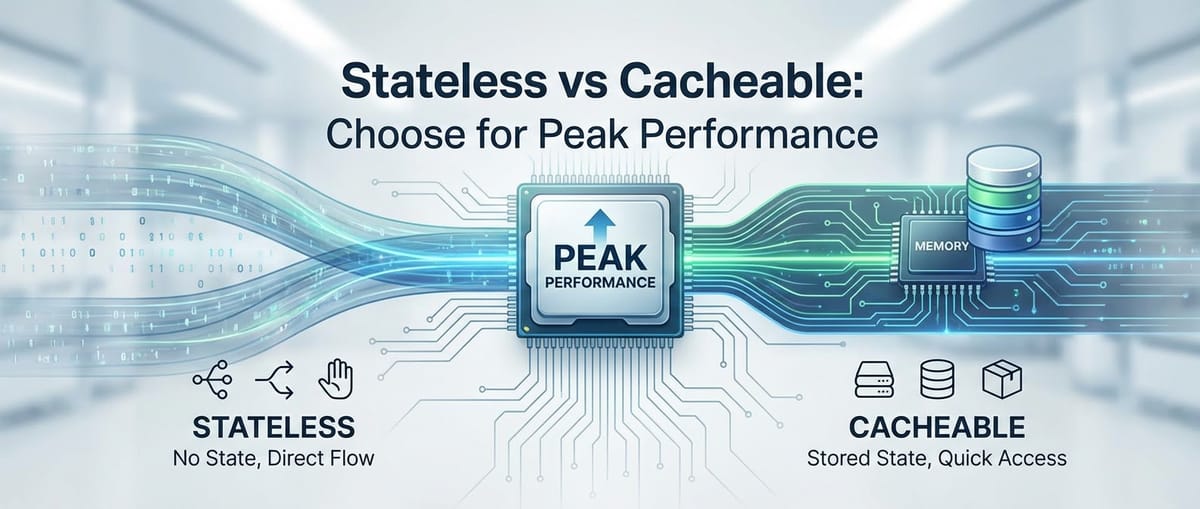
Stateless vs Cacheable: Choose for Peak Performance


In the intricate dance of modern software architecture, the quest for peak performance is an unceasing endeavor. Every design choice, from the micro-level implementation details to the macro-level system topology, reverberates through the entire stack, impacting scalability, reliability, and ultimately, the end-user experience. Among the most fundamental and impactful decisions confronting architects and developers is the distinction between stateless and cacheable system designs. These two paradigms, though seemingly opposing, often coexist in sophisticated ecosystems, each offering distinct advantages and presenting unique challenges. Understanding their nuances is not merely an academic exercise; it is a strategic imperative for anyone aiming to build resilient, high-throughput, and cost-effective applications, especially in an era increasingly dominated by complex APIs and resource-intensive AI models.
This article delves into the core principles, benefits, drawbacks, and optimal application scenarios for both stateless and cacheable architectures. We will explore how these concepts intersect with critical infrastructure components like api gateway solutions, and how they play a pivotal role in emerging fields such as LLM Gateway designs and the implementation of robust Model Context Protocols. By dissecting these paradigms, we aim to provide a comprehensive framework for making informed decisions that drive architectural excellence and unlock unparalleled performance. Our journey will reveal that the choice is rarely binary, but rather a strategic blend, demanding a deep understanding of data characteristics, operational costs, and performance targets.
The Immutable Foundation: Understanding Stateless Architectures
A stateless architecture, at its heart, adheres to a principle of independence and self-sufficiency for every request. In such a system, each client request to a server contains all the information necessary for the server to fulfill that request, without relying on any prior server-side session data or context. The server processes the request, generates a response, and then forgets everything about that specific interaction. It treats every incoming request as if it were the first and only request it has ever received from that client. This fundamental design choice carries profound implications across the entire system.
Consider a classic HTTP request: when your browser asks for a web page, it sends headers, cookies (which are client-side state), and the requested URL. The web server processes this request solely based on the information provided in that specific HTTP packet. It doesn't remember that you clicked a link five seconds ago, nor does it retain any session information about your interaction unless that information is explicitly passed back to it, typically in the form of tokens or parameters within subsequent requests. This inherent simplicity is both the greatest strength and, in certain scenarios, a potential limitation of statelessness.
Core Principles of Statelessness
The philosophy underpinning statelessness can be broken down into several key tenets:
- Self-Contained Requests: Every request from the client to the server must contain all the information needed to understand the request. This includes authentication tokens, necessary parameters, and any context required for processing. The server does not store or depend on any information from previous requests.
- No Server-Side Session State: The server does not maintain session-specific data between requests from the same client. If state is required for a user's interaction, it must either be managed client-side (e.g., in cookies, local storage) or stored in a persistent, shared data store that is external to the individual server instances.
- Idempotency (Often Related): While not strictly a requirement, many stateless operations strive for idempotency. An idempotent operation is one that can be applied multiple times without changing the result beyond the initial application. This characteristic greatly simplifies error handling and retry mechanisms in distributed systems. For instance, a "GET" request is typically idempotent; requesting the same resource multiple times yields the same result.
Advantages of Stateless Architectures
The benefits derived from embracing a stateless design are particularly pronounced in distributed, cloud-native environments:
- Exceptional Scalability: This is arguably the most significant advantage. Since no server instance holds any unique client-specific state, any server can handle any request at any time. This allows for effortless horizontal scaling: simply add more server instances behind a load balancer, and they can immediately start processing traffic. There's no need for complex session replication or sticky sessions, which can complicate scaling strategies. Load balancers can distribute requests across servers in a round-robin fashion or based on current load, without concern for which server handled a previous request from a particular client. This agility is crucial for handling fluctuating demand and achieving elasticity.
- Enhanced Reliability and Fault Tolerance: If a server instance fails, it simply stops processing requests. New requests are routed to healthy servers by the load balancer. There's no loss of session data because no session data was stored on the failed server. This makes stateless systems incredibly resilient to individual component failures, reducing downtime and improving overall system availability. Recovery is often as simple as replacing the failed instance.
- Simplified Design and Development: Eliminating server-side state significantly simplifies the logic within the application servers. Developers don't have to worry about managing session data, synchronizing state across multiple servers, or handling complex state transitions. This reduces the cognitive load, speeds up development cycles, and minimizes the potential for state-related bugs, such as race conditions or inconsistent data.
- Improved Resource Utilization: Without the need to store and manage session data, server resources (memory, CPU) can be more efficiently utilized for processing the current request. There's no overhead associated with maintaining long-lived connections or complex state machines on the server side.
- Easier Deployment and Management: Deploying new versions of a stateless application is straightforward. New instances can be brought online, and old instances can be taken offline without affecting ongoing user sessions, assuming appropriate traffic draining mechanisms are in place. This enables continuous deployment and reduces the risk associated with updates.
Disadvantages and Challenges of Statelessness
While offering compelling advantages, statelessness is not a panacea and comes with its own set of trade-offs:
- Increased Data Transfer Overhead: For interactions that inherently require context or "state" (e.g., a multi-step checkout process, a long conversation with an AI model), the client must send this context with every single request. This can lead to larger request payloads, increased network traffic, and potentially higher latency as more data needs to be transferred over the wire for each interaction. For instance, if a user's shopping cart contents need to be passed with every request, the size of each request grows.
- Client-Side State Management Complexity: Pushing state management to the client or an external data store shifts the complexity rather than eliminating it. Clients need to be designed to reliably store and transmit the necessary state, which can introduce security risks (e.g., tampering with client-side data) and increase complexity on the client application side.
- Performance Bottlenecks for Repeated Data Access: If the same piece of information is needed for multiple consecutive requests, a stateless server will fetch or recompute that information every single time. This can lead to redundant work, increased load on backend databases or services, and higher latency compared to a system that could cache or remember this information. For example, fetching user profile details for every API call, even if they remain constant for a session, is inefficient.
- Challenges with Multi-Step Interactions: Building applications with complex, multi-step user workflows (like form submissions across several pages) can be more challenging. Each step needs to explicitly pass the context of previous steps, or the context needs to be stored externally and referenced by a transient ID in the request.
When to Choose Statelessness
Stateless architectures are particularly well-suited for:
- RESTful APIs: The very design principles of REST (Representational State Transfer) advocate for statelessness between client and server. Each API request should contain all the information needed, enabling easy scaling and caching.
- Microservices: In a microservices architecture, individual services are often designed to be stateless to maximize their independent scalability and resilience. Services communicate through well-defined APIs, passing all necessary context in each request.
- Event-Driven Architectures: Components respond to events, processing them without maintaining any long-term session state. The event itself contains all necessary information.
- Applications with High Scalability Requirements: Websites or services expecting massive, unpredictable traffic spikes benefit greatly from the ease of horizontal scaling.
- Public APIs: Where consumers are diverse and controlled by external entities, relying on client-side state management through tokens or request parameters is a robust approach.
In summary, statelessness offers a powerful foundation for building highly scalable, fault-tolerant, and manageable distributed systems. However, its efficiency can be hampered by repetitive data access and the need to carry extensive context with every request, especially in scenarios involving rich, interactive user experiences or sophisticated AI models that manage complex internal states. This is where the complementary paradigm of cacheable architectures enters the conversation.
The Art of Retention: Embracing Cacheable Architectures
In contrast to stateless systems, cacheable architectures proactively retain copies of frequently accessed data or computationally expensive results closer to the consumer or the point of need. The primary goal of caching is to reduce latency, decrease the load on origin servers or databases, and ultimately improve the responsiveness and efficiency of an application. By avoiding repeated fetches of the same data from its primary source, caching can drastically cut down on network trips, CPU cycles, and I/O operations, translating directly into enhanced performance and reduced operational costs.
Caching is not a monolithic concept; it manifests in various forms and layers throughout a system, from the deepest reaches of the database to the very edges of the network, within the user's browser. Each caching layer serves a specific purpose, targeting different types of data and different points in the request-response cycle.
Core Principles of Caching
The effectiveness of a cacheable architecture hinges on several fundamental principles:
- Data Locality: The closer the cached data is to the point of consumption, the lower the latency for accessing it. This means caching at the client, reverse proxy, application server, or database layer.
- Temporal Locality: Data that has been accessed recently is likely to be accessed again soon. Caching exploits this by retaining recently used items.
- Spatial Locality: Accessing one piece of data often means that nearby data will also be accessed soon. Caching can pre-fetch or store blocks of related data.
- Hit Ratio: The percentage of requests that are successfully served from the cache (a "cache hit") versus those that require fetching from the original source (a "cache miss"). A higher hit ratio indicates more effective caching.
- Cache Invalidation: The mechanism by which cached data is updated or removed when the original data changes, ensuring data freshness and consistency. This is often cited as one of the hardest problems in computer science.
Types of Caching Layers
Caching can be implemented at multiple tiers within a typical application stack:
- Browser/Client-Side Caching: Web browsers store static assets (images, CSS, JavaScript files) and sometimes API responses using
Cache-Controlheaders. This is the closest cache to the user, offering the fastest possible access times. - Content Delivery Networks (CDNs): CDNs are distributed networks of servers that cache static and dynamic content closer to end-users geographically. They are excellent for global content delivery, reducing latency and offloading traffic from origin servers.
- Reverse Proxy/
API GatewayCaching: Anapi gatewayor reverse proxy (like Nginx, Envoy) can cache responses from backend services. This layer sits in front of the application servers, intercepting requests and serving cached content directly if available. This significantly reduces the load on the backend, especially for frequently accessed, non-personalized data. - Application-Level Caching: Within the application code itself, developers can use in-memory caches (e.g., using libraries like Caffeine, Guava Cache) or distributed caches (e.g., Redis, Memcached). In-memory caches are fast but limited to a single application instance, while distributed caches allow multiple application instances to share the same cached data.
- Database Caching: Databases themselves often have internal caching mechanisms (e.g., query cache, buffer pool) to store frequently accessed data blocks or query results. ORMs (Object-Relational Mappers) can also implement caching.
Advantages of Cacheable Architectures
Implementing caching strategies offers a plethora of performance and operational benefits:
- Significant Performance Improvement and Reduced Latency: By serving data from a closer, faster source (e.g., RAM instead of disk, local server instead of remote database), caching drastically reduces the time it takes to respond to a request. This leads to a snappier user experience and higher throughput.
- Reduced Load on Backend Services and Databases: Each cache hit means one less request reaching the origin server, database, or external API. This offloads significant work from these critical backend components, allowing them to handle more unique requests and reducing their resource consumption. This can be particularly impactful for computationally intensive operations or expensive database queries.
- Cost Savings: Lower load on backend systems can translate into reduced infrastructure costs. Less compute, memory, and database I/O are needed, potentially allowing for smaller instance types or fewer servers. For services with per-call pricing (like many external APIs or AI model invocations), caching identical requests can lead to substantial financial savings.
- Improved User Experience (UX): Faster load times and more responsive applications directly contribute to a better user experience, leading to higher engagement and satisfaction.
- Increased System Resilience: By reducing the dependency on origin services for every request, caching can make a system more resilient to temporary outages or slowdowns of those backend services. If an origin service experiences a brief blip, the cache might still be able to serve stale, but acceptable, data.
Disadvantages and Challenges of Caching
Despite its advantages, caching introduces complexity and new challenges that must be carefully managed:
- Cache Invalidation Complexity: This is the most notorious challenge. How do you ensure that cached data is always fresh and consistent with the original source? When the source data changes, the corresponding cached entry must be updated or removed. Incorrect invalidation can lead to users seeing stale or incorrect information, which can be worse than no caching at all. Strategies include time-to-live (TTL), event-driven invalidation, or "cache-aside" patterns.
- Data Staleness and Consistency Issues: There's an inherent trade-off between cache freshness and performance. Aggressive caching for longer durations improves hit ratios and performance but increases the risk of serving stale data. Maintaining strong consistency (where all clients see the most up-to-date data immediately) with caching is difficult and often requires complex distributed cache consistency protocols. Most systems opt for eventual consistency, where data might be stale for a short period.
- Increased System Complexity: Implementing and managing caching layers adds architectural complexity. Decisions need to be made about cache placement, size, eviction policies (LRU, LFU, FIFO), consistency models, and monitoring. Distributed caches, in particular, introduce challenges related to network partitions, data serialization, and fault tolerance for the cache itself.
- Cache Warming: When a cache is empty (e.g., after deployment or a restart), it needs to be populated, a process known as "cache warming." During this period, performance might temporarily degrade as all requests become cache misses and hit the backend.
- Potential for Single Points of Failure: If a centralized cache service becomes unavailable or performs poorly, it can severely impact the entire system, effectively becoming a new bottleneck or single point of failure. Distributed caches mitigate this but introduce their own operational overhead.
When to Choose Cacheability
Caching is most effective in scenarios characterized by:
- Read-Heavy Workloads: Systems where data is read far more frequently than it is written or updated are ideal candidates for caching.
- Static or Semi-Static Data: Content that changes infrequently (e.g., product catalogs, blog posts, user profiles that aren't constantly updated) can be cached for extended periods.
- Expensive Computations or Data Fetch Operations: If generating a response involves complex calculations, multiple database joins, or calls to external APIs with high latency or cost, caching the result can provide massive benefits.
- High Latency Data Sources: When retrieving data from geographically distant data centers or third-party services, caching locally can dramatically improve response times.
- Global Content Delivery: CDNs are essential for delivering web assets and content rapidly to a global user base.
In conclusion, cacheable architectures offer a powerful mechanism to supercharge application performance, reduce backend load, and cut costs. However, this power comes with the responsibility of meticulously managing cache invalidation and ensuring data consistency. The decision to cache, and how to cache, requires a detailed understanding of the data's characteristics, its volatility, and the system's tolerance for eventual consistency.
The Nexus of Performance: The Role of API Gateway
In the landscape of modern distributed systems, the api gateway has emerged as an indispensable component, serving as the single entry point for all client requests into a microservices-based application or a complex backend ecosystem. It acts as a reverse proxy, routing requests to the appropriate backend services, but its role extends far beyond simple traffic forwarding. An api gateway is a powerful enforcement point for various cross-cutting concerns, playing a critical role in both stateless and cacheable architectural patterns, and significantly influencing overall system performance.
Functionally, an api gateway can perform a multitude of tasks: authentication and authorization, rate limiting, traffic management (load balancing, routing, circuit breaking), request and response transformation, logging, monitoring, and importantly, caching. By centralizing these concerns, the gateway frees individual backend services from implementing them redundantly, simplifying service development and promoting consistency.
API Gateway as a Stateless Forwarder
At its most basic, an api gateway operates in a largely stateless manner. It receives a request, inspects it, determines the correct backend service based on routing rules, and forwards the request. It doesn't retain any session state about the client or the ongoing interaction. Each request is processed independently. This inherent statelessness allows the api gateway itself to be highly scalable and fault-tolerant. You can run multiple instances of the gateway behind a load balancer, and any instance can handle any incoming request. This alignment with stateless principles makes the api gateway a natural fit for scaling microservices architectures.
The gateway's stateless forwarding capabilities are crucial for:
- Decoupling Clients from Backend Services: Clients only interact with the gateway, unaware of the specific services running behind it. This allows backend services to evolve independently without affecting clients.
- Aggregating Multiple Services: A single
api gatewayendpoint can expose functionality aggregated from several backend services, simplifying the client experience. - Request Routing: Intelligent routing rules can direct requests based on paths, headers, query parameters, or even advanced logic, providing flexibility in service deployment and versioning.
- Security Enforcement: Authentication tokens can be validated at the gateway, and authorization policies can be applied before requests reach the backend services, ensuring a consistent security posture.
API Gateway as an Intelligent Caching Layer
Beyond stateless forwarding, the api gateway is an ideal location to implement caching strategies, transforming it into a performance-boosting powerhouse. Because it sits at the edge of the backend system, it can intercept all incoming requests and serve cached responses directly, preventing requests from ever reaching the origin services. This positions the api gateway as a crucial component in any cacheable architecture, especially for read-heavy workloads.
The benefits of caching at the api gateway level are substantial:
- Global Cache for Multiple Services: The gateway can serve as a unified cache for responses from various backend services. If multiple services produce similar or identical responses (e.g., common reference data), caching at the gateway reduces redundant fetches across the entire system.
- Reduced Load on Backend Infrastructure: By handling a significant percentage of requests from the cache, the gateway dramatically reduces the strain on backend application servers, databases, and other resources. This allows backend services to focus on processing unique and complex requests.
- Improved Response Times for Clients: Cache hits at the gateway offer extremely low latency, as the response is served without any network calls to the backend. This directly enhances the user experience.
- Protection Against Spikes: For endpoints with predictable, cacheable responses, the gateway can absorb sudden spikes in traffic, shielding backend services from being overwhelmed.
- Cost Efficiency: Reducing backend load can lead to significant cost savings, especially in cloud environments where compute, memory, and data transfer are billed.
Implementing caching at the api gateway typically involves configuring rules based on HTTP methods (GET requests are usually cacheable), URLs, query parameters, and Cache-Control headers from the backend. The gateway uses a configurable cache storage (in-memory, distributed cache like Redis, or even disk-based) and eviction policies.
However, the challenges of cache invalidation remain paramount. The api gateway must be configured with appropriate Time-to-Live (TTL) values or revalidation strategies to ensure that stale data is not served. For highly dynamic content, gateway caching might be unsuitable, or require very short TTLs combined with explicit invalidation mechanisms triggered by backend data changes.
The API Gateway in the AI Era: Beyond Traditional APIs
The role of the api gateway becomes even more critical and nuanced when dealing with the complexities of AI services, particularly Large Language Models (LLMs). The high computational cost, varying latency, and specific interaction patterns of AI models necessitate specialized gateway capabilities. This is where the concept of an LLM Gateway emerges, often built upon or extending traditional api gateway functionalities.
An LLM Gateway is essentially an api gateway tailored to the unique demands of AI inference. It manages requests to various AI models (text generation, image processing, embeddings, etc.), providing a unified interface for diverse model providers and local deployments. The gateway can handle:
- Model Routing: Directing requests to specific models based on criteria like cost, performance, availability, or capabilities (e.g., send complex requests to GPT-4, simpler ones to a smaller, faster model).
- Rate Limiting and Quota Management: Enforcing usage limits for expensive AI models to prevent abuse and manage costs.
- Unified API Formats: AI models from different providers (OpenAI, Anthropic, Hugging Face, custom models) often have different API specifications. An
LLM Gatewaycan standardize these into a single, consistent API, simplifying integration for client applications. - Fallback Mechanisms: If one AI model provider is down or exceeds rate limits, the gateway can automatically switch to an alternative.
- Cost Optimization: Intelligent routing and caching can help reduce the financial outlay associated with expensive AI inference calls.
Consider the challenge of integrating dozens or hundreds of AI models into various applications. Each model might have a different API, authentication scheme, and data format. This creates a significant integration burden for developers and operational overhead for management. Here, a specialized api gateway shines.
For instance, platforms like APIPark are purpose-built to address these challenges, offering an open-source AI gateway and API management platform that simplifies the integration of over 100 AI models with a unified API format, ensuring developers can focus on innovation rather than integration complexities. APIPark standardizes the request data format across all AI models, ensuring that changes in AI models or prompts do not affect the application or microservices, thereby simplifying AI usage and maintenance costs. Its ability to encapsulate prompts into REST APIs also allows users to quickly create new, specialized AI services, enhancing developer productivity and accelerating AI adoption. Furthermore, APIPark's impressive performance, rivaling Nginx with over 20,000 TPS on modest hardware, makes it a robust choice for managing high-volume AI and REST API traffic, offering a comprehensive solution for end-to-end API lifecycle management and detailed call logging.
The ability of an LLM Gateway to manage the lifecycle of requests and responses to AI models highlights its role in balancing the stateless nature of individual API calls with the potential for managing "state" or context that is critical for conversational AI. This brings us to the intricate topic of Model Context Protocol.
APIPark is a high-performance AI gateway that allows you to securely access the most comprehensive LLM APIs globally on the APIPark platform, including OpenAI, Anthropic, Mistral, Llama2, Google Gemini, and more.Try APIPark now! 👇👇👇
Navigating the Conversation: Model Context Protocol and Its Architectural Implications
In the realm of AI, particularly with large language models (LLMs) and conversational agents, the concept of "context" is paramount. An LLM's ability to generate coherent, relevant, and engaging responses is heavily dependent on the context it receives. This context typically includes the current user prompt, previous turns in a conversation, user-specific information, or retrieved external knowledge. How this context is managed, transmitted, and leveraged across multiple interactions is governed by what we can refer to as a Model Context Protocol. This protocol fundamentally influences whether the interaction is primarily stateless or requires a more cacheable, or even stateful, approach.
What is a Model Context Protocol?
A Model Context Protocol defines the conventions and mechanisms for how contextual information is exchanged between a client (e.g., a conversational application, an LLM Gateway) and an AI model. It addresses questions such as:
- How is conversational history represented? (e.g., as an array of messages, a single concatenated string, or a structured object).
- How are system instructions or model parameters included? (e.g., temperature, max tokens, specific model versions).
- How is user-specific or external data injected? (e.g., via RAG - Retrieval Augmented Generation, or direct insertion into the prompt).
- What are the limits on context size? (token limits imposed by the model).
- How is context maintained across multiple turns of a conversation?
The design of this protocol has direct implications for the performance, cost, and complexity of interacting with AI models.
Stateless vs. Cacheable in Context Management
When it comes to managing context for AI models, the tension between stateless and cacheable/stateful approaches becomes particularly clear.
1. Stateless Model Context Protocol
In a purely stateless approach, every single request to the AI model includes the entire relevant context from the beginning of the interaction up to the current turn.
Mechanism: The client application, or an LLM Gateway acting on its behalf, constructs a complete prompt for each API call. This prompt aggregates all previous messages, system instructions, and any other necessary information into a single input payload. The AI model receives this self-contained payload, processes it, generates a response, and then typically discards the context. It doesn't remember anything about previous interactions with that specific client.
Advantages:
- Simplicity on the Model Side: The AI model itself remains stateless, making it easier to scale horizontally. Any model instance can handle any request.
- Resilience: If the client application or gateway crashes, the conversational state is not lost on the server side (because it was never stored there). The client just needs to reconstruct the context for the next request.
- Clear Ownership of State: The client (or the application layer) is explicitly responsible for managing and passing the context, reducing ambiguity.
Disadvantages:
- High Data Transfer Overhead: As conversations grow longer, the size of each request payload increases linearly with the number of turns. This leads to more network traffic, increased latency, and potentially higher costs (many LLM providers charge based on input token count).
- Increased API Call Cost: Sending the full conversation history with every prompt means paying for redundant tokens repeatedly. This can become extremely expensive for long-running conversations.
- Token Limit Constraints: LLMs have finite context windows (e.g., 4K, 8K, 128K tokens). Long conversations can quickly exceed these limits, requiring complex summarization or truncation strategies on the client side, which can degrade conversational quality.
- Client-Side Complexity: The client or gateway needs to implement logic to manage, store, and reconstruct the conversation history for each request.
2. Cacheable/Stateful Model Context Protocol
While the core AI model might remain stateless, the overall interaction can be made "stateful" from the perspective of the application or LLM Gateway by introducing caching or dedicated context management services. Here, only a minimal identifier might be sent with each request, and the LLM Gateway or a specialized service retrieves and reconstructs the full context.
Mechanism: Instead of sending the full conversation history with every request, the client sends a unique session ID or conversation ID along with the new prompt. The LLM Gateway or a separate context store (e.g., Redis, a dedicated database) uses this ID to retrieve the previous conversation history, appends the new prompt, constructs the full input for the AI model, and then potentially caches the model's response or the updated conversation history.
Advantages:
- Reduced Data Transfer Overhead: Only the new prompt and a session ID are sent, significantly reducing payload size and network traffic for subsequent requests in a conversation.
- Lower API Call Cost: If the context store is managed by the application or gateway, tokens are only "paid for" once when initially added to the context, or when the full context is compiled for the model call, rather than repeatedly across network trips. More importantly, prompt responses or even full prompts can be cached if they are identical, eliminating repeated expensive model inferences.
- Improved Latency: Retrieving context from a local, fast cache is quicker than transmitting large payloads over the network.
- Abstracted Context Management: The client application doesn't need to manage the entire conversation history; it delegates this to the
LLM Gatewayor a backend service. This simplifies client-side logic. - Enhanced
Model Context ProtocolLogic: TheLLM Gatewaycan implement sophisticated context management logic:- Summarization: Automatically summarize older parts of the conversation to stay within token limits.
- Retrieval Augmented Generation (RAG): Fetch relevant external knowledge (from databases, documents) and inject it into the prompt based on the current context.
- Semantic Caching: Cache not just exact prompt matches, but also semantically similar queries, serving responses from cache even if the phrasing is slightly different.
Disadvantages:
- Increased System Complexity: Introducing a distributed context store or stateful logic into the
LLM Gatewayadds significant architectural and operational complexity. - Cache Invalidation and Consistency: Managing the context store's lifecycle, ensuring its consistency, and handling its invalidation when conversations end or expire requires careful design.
- State Management Overhead: The context store itself needs to be scalable, fault-tolerant, and performant. Its failure can directly impact the ability to maintain conversations.
- Security Concerns: Storing sensitive conversational data in a shared context store requires robust security measures and data governance.
Hybrid Approaches and Strategic Choices
For most practical LLM Gateway implementations, a hybrid approach combining elements of both stateless and cacheable designs is often the most effective.
- Stateless by Default, Cacheable by Design: Individual calls to the LLM might remain stateless from the model's perspective, but the
LLM Gatewayadds a caching layer for specific purposes. - Prompt Caching: For identical prompts or very common queries, the
LLM Gatewaycan cache the AI model's response. This is a purely cacheable strategy that significantly reduces costs and latency for repetitive requests. - Context Session Caching: For conversational flows, the
LLM Gatewaycan manage a transient cache of conversation history, identified by a session ID. This effectively makes the interaction "stateful" from the client's perspective, while still allowing the underlying LLM to remain stateless. The gateway handles the context assembly and truncation. - Model Response Caching for Deterministic Outputs: For tasks like text embeddings, sentiment analysis (when prompts are short and the output is relatively deterministic), or content moderation checks, caching model responses can be highly effective.
The choice depends heavily on the specific use case:
- Short, One-Off Queries: Purely stateless
Model Context Protocolis efficient. Each request is self-contained. - Long-Running Conversations: A cacheable/stateful
Model Context Protocolmanaged by theLLM Gatewayor a dedicated service is almost mandatory to manage token limits and costs. - Frequently Asked Questions (FAQs) via LLM: The
LLM Gatewaycan implement aggressive caching for common questions and their LLM-generated answers. - Personalized/Real-time Content: This data is often difficult to cache effectively due to its unique and dynamic nature, favoring more stateless or very short-lived caching strategies.
The evolution of LLM Gateways and sophisticated Model Context Protocols highlights how critical a strategic approach to state and caching has become. It's no longer just about optimizing traditional API calls, but about intelligently managing the interaction with highly dynamic, resource-intensive AI services to deliver performance, cost efficiency, and an intuitive user experience.
Making the Choice: A Decision Framework for Peak Performance
The decision between a predominantly stateless or a cacheable architecture is rarely absolute. Most high-performance systems employ a strategic blend, leveraging the strengths of each paradigm at different layers of the application stack. The key is to understand the trade-offs and align architectural choices with specific business requirements, data characteristics, and performance goals. This section provides a framework for making these informed decisions.
Factors Influencing the Decision
Several critical factors should guide your architectural choices:
- Data Characteristics:
- Read-Write Ratio: Is your data read-heavy (many reads, few writes) or write-heavy? Read-heavy workloads are prime candidates for caching. Write-heavy workloads present significant cache invalidation challenges.
- Data Volatility/Freshness Requirements: How quickly does your data change? How critical is it for users to always see the absolute latest data?
- Highly Dynamic (Real-time): Stock prices, live chat, game state. Favor stateless or very short-lived caching, accepting potential staleness for performance.
- Static/Semi-Static: Product catalogs, user profiles (infrequently updated), blog posts. Ideal for aggressive caching.
- Data Size and Structure: Large, complex data objects might be expensive to transfer repeatedly (favor caching or stateful context management), while small, simple data might be fine in a stateless approach.
- Performance Requirements:
- Latency: How quickly must your system respond? Caching dramatically reduces latency.
- Throughput: How many requests per second must your system handle? Statelessness provides raw scalability, while caching enhances effective throughput by reducing backend load.
- Response Time Consistency: Is it critical that response times are consistently fast, even under load? Caching helps smooth out performance variability.
- Scalability Needs:
- Horizontal Scaling: How easily can you add more server instances? Stateless architectures excel here. Caching can also scale horizontally if implemented with distributed caches.
- Elasticity: Can your system quickly adapt to fluctuating loads? Both stateless and cacheable systems can be elastic with proper orchestration.
- Complexity and Operational Overhead:
- Development Complexity: Stateless systems can be simpler to develop on the server side, but push complexity to the client for state management. Cacheable systems introduce complexities around cache invalidation, consistency, and monitoring.
- Operational Complexity: Managing distributed caches, ensuring their health, and debugging cache-related issues can add significant operational overhead.
- Maintainability: Overly complex caching strategies can become difficult to maintain over time.
- Cost Implications:
- Infrastructure Costs: Reduced backend load due to caching can lead to significant savings on compute, memory, and database resources.
- Network Costs: Stateless systems with large contexts can incur higher data transfer costs. Caching reduces network traffic.
- Third-Party API Costs: For services like LLMs that charge per token or per call, caching identical requests can lead to substantial financial savings.
- Storage Costs: Distributed caches require dedicated storage and compute resources.
Comparative Analysis: Stateless vs. Cacheable
To summarize the trade-offs, here's a comparative table:
| Feature/Aspect | Stateless Architecture | Cacheable Architecture |
|---|---|---|
| Core Principle | Each request self-contained; no server-side state. | Store frequently accessed data closer to consumer. |
| Scalability | Excellent horizontal scaling; any server handles any request. | Good horizontal scaling for cache (distributed cache); improves backend scalability. |
| Reliability | High fault tolerance; server failure means no state loss. | Can increase resilience if backend fails; cache failure can be critical. |
| Performance | Potentially higher latency/load for repeated data fetches. | Significantly reduced latency and backend load for cache hits. |
| Data Consistency | Strong consistency by default (always fresh from source). | Eventual consistency typical; risk of stale data. |
| Complexity | Simpler server-side logic; client manages state/context. | Higher complexity due to cache invalidation, consistency, sizing. |
| Network Traffic | Can be higher if large context/data passed repeatedly. | Reduced network traffic for cached resources. |
| Backend Load | Can be higher for repeated fetches/computations. | Significantly reduced backend load for cacheable requests. |
| Cost Efficiency | Can be higher if backend ops are expensive/repeated. | Can offer significant cost savings by offloading backend. |
| Best For | Dynamic, transactional, real-time, simple APIs, microservices. | Read-heavy, static/semi-static data, expensive computations, high latency sources. |
| LLM Context | Each request sends full context (high cost, simple model side). | Gateway manages context, caches responses/prompts (lower cost, complex gateway). |
Hybrid Strategies: The Path to Optimal Performance
In most real-world scenarios, the optimal solution is a hybrid approach. This involves strategically applying caching layers to a fundamentally stateless backend architecture.
- Stateless Backend Services with
API GatewayCaching: Design your microservices to be stateless and independently scalable. Place anapi gatewayin front of them to handle cross-cutting concerns, including caching for common, stable responses. This combines the best of both worlds: backend simplicity and gateway-level performance optimization. - Application-Level Caching for Local Data: Within your stateless application services, use in-memory caches for frequently accessed lookup data or configurations that rarely change.
- Distributed Caching for Shared, Read-Heavy Data: For data that is shared across multiple stateless service instances and is frequently read (e.g., user session tokens, product lists), employ a distributed cache (like Redis) that acts as a fast, shared, external data store.
LLM Gatewaywith Intelligent Context and Prompt Caching: For AI interactions, deploy anLLM Gatewaythat provides a stateless interface to clients but internally manages conversational context (e.g., via a distributed cache) and caches LLM responses for identical or semantically similar prompts. This ensures the client remains simple while the gateway handles the complexity and cost optimization of AI interactions.
Practical Recommendations
- Start Stateless: For new services, begin with a stateless design. This offers maximum flexibility and scalability initially. Introduce caching only when performance bottlenecks or cost inefficiencies are identified.
- Identify Cache Candidates: Analyze your data and API access patterns. Which endpoints are read-heavy? Which responses are static or semi-static? Which operations are computationally expensive? These are your prime candidates for caching.
- Define Clear Invalidation Policies: For every cached item, have a clear strategy for when and how it will be invalidated. TTL is a simple start, but consider event-driven invalidation for critical data.
- Monitor Cache Performance: Continuously monitor cache hit ratios, latency, and resource usage. This feedback is crucial for optimizing your caching strategy.
- Don't Over-Cache: Caching everything can lead to increased complexity without proportional benefits. Be selective.
- Consider "Cache-Aside" Pattern: This is a common pattern where the application first checks the cache; if a miss, it fetches from the database, and then populates the cache. This maintains simplicity and puts the application in control.
- Embrace
API GatewayCapabilities: Leverage yourapi gatewaynot just for routing but also for security, rate limiting, and especially caching, offloading these concerns from your backend services.
Conclusion: A Strategic Blend for Architectural Excellence
The dichotomy between stateless and cacheable architectures presents a foundational choice in system design, profoundly impacting performance, scalability, resilience, and operational costs. Statelessness offers unparalleled horizontal scalability and fault tolerance by eliminating server-side session state, making it the bedrock of modern microservices and cloud-native applications. However, its efficiency can be hampered by the repetitive transfer of large contexts and redundant data fetching, especially in interactions with complex AI models.
Conversely, cacheable architectures proactively retain data closer to the point of need, dramatically reducing latency, alleviating pressure on backend services, and cutting operational expenditures. Yet, the power of caching comes with the notorious challenge of cache invalidation and the inherent trade-offs in data consistency and system complexity.
In the pursuit of peak performance, particularly in an ecosystem increasingly reliant on sophisticated api gateway solutions, LLM Gateways, and intelligent Model Context Protocols, the most potent strategy is rarely an either/or proposition. Instead, it lies in a thoughtful, strategic blend. Architectures that successfully marry stateless backend services with intelligent, layered caching mechanisms—from client-side and CDN caching to robust api gateway and distributed application-level caches—are best positioned to thrive.
The journey to architectural excellence demands a deep understanding of your application's specific data characteristics, performance objectives, and tolerance for complexity. By meticulously analyzing read-write patterns, data volatility, and the unique demands of AI interactions, you can sculpt a system that not only meets but exceeds performance expectations, ensuring optimal resource utilization and delivering a superior user experience. The ultimate choice is not about picking one over the other, but about mastering the art of orchestration, deploying each paradigm where it delivers maximum strategic advantage to unlock true peak performance.
Frequently Asked Questions (FAQs)
1. What is the fundamental difference between stateless and stateful architectures, and why is "cacheable" often considered alongside "stateless"? The fundamental difference is how system state is managed. A stateless architecture ensures that each request from a client to a server contains all necessary information, and the server does not store any session-specific data from previous requests. It treats every request independently. In contrast, a stateful architecture (which "cacheable" often implies a form of managed state, even if transient) means the server retains information about the client's past interactions, usually in a session or context store. "Cacheable" is considered alongside "stateless" because while a core backend service might be stateless, intelligent caching layers (often managed by an api gateway or dedicated cache service) can store responses or context, effectively introducing "state" from a performance optimization perspective without making the backend service itself stateful. This allows for the benefits of reduced latency and load without sacrificing the scalability of a stateless backend.
2. How does an api gateway contribute to both statelessness and cacheability in a system? An api gateway is a critical component that can facilitate both. It acts as a stateless reverse proxy by default, forwarding requests to backend services without maintaining session state, which allows for horizontal scaling of the gateway itself. However, an api gateway is also an ideal location to implement powerful caching mechanisms. By configuring the gateway to cache responses from backend services, it can serve subsequent identical requests directly from its cache, significantly reducing load on backend systems and improving response times, thus enhancing the cacheable aspect of the overall architecture.
3. What are the specific challenges of managing context for Large Language Models (LLMs) in a purely stateless manner, and how does an LLM Gateway help? In a purely stateless manner, interacting with LLMs for conversational AI means sending the entire conversation history (context) with every single prompt. Challenges include: high data transfer overhead due to large payloads, increased API call costs (as many LLMs charge per token), and quickly hitting the LLM's finite token limit. An LLM Gateway addresses these by implementing a Model Context Protocol. It can manage the conversation history externally (e.g., in a cache), sending only the new prompt and a session ID to the gateway. The gateway then reconstructs the full context, potentially applies summarization or RAG (Retrieval Augmented Generation), and sends an optimized prompt to the LLM. It can also cache LLM responses for identical or semantically similar prompts, further reducing costs and latency.
4. When should I prioritize a purely stateless design over implementing extensive caching, and vice versa? You should prioritize a purely stateless design when: * Data is highly dynamic, real-time, or changes frequently, making cache invalidation extremely difficult or risky (e.g., financial transactions). * Each request is unique and carries little redundant information. * The primary goal is raw horizontal scalability and maximum fault tolerance for individual backend services, and performance bottlenecks are not primarily due to repetitive data access. You should prioritize extensive caching when: * Workloads are read-heavy, and data is static or changes infrequently. * Responses are computationally expensive or involve high-latency data sources. * Reducing latency and offloading backend services are critical performance goals. * There are significant cost implications for repeated backend operations or third-party API calls (e.g., LLM inference).
5. How does a Model Context Protocol relate to the trade-offs between stateless and cacheable architectures for AI applications? A Model Context Protocol defines how conversational or interaction context is transmitted and managed when interacting with AI models. If the protocol dictates that the entire context must be sent with every request, it leans towards a stateless approach from the application's perspective, leading to higher costs and latency for long interactions but simpler model-side scalability. Conversely, if the protocol allows for an LLM Gateway or client to maintain and update the context, sending only incremental changes or a session ID, it leverages cacheable/stateful principles. This gateway then manages the full context, potentially caching it, summarizing it, or retrieving external information, effectively blending the scalability of a stateless underlying model with the performance and cost benefits of intelligently managed state (caching) at the gateway layer.
🚀You can securely and efficiently call the OpenAI API on APIPark in just two steps:
Step 1: Deploy the APIPark AI gateway in 5 minutes.
APIPark is developed based on Golang, offering strong product performance and low development and maintenance costs. You can deploy APIPark with a single command line.
curl -sSO https://download.apipark.com/install/quick-start.sh; bash quick-start.sh

In my experience, you can see the successful deployment interface within 5 to 10 minutes. Then, you can log in to APIPark using your account.

Step 2: Call the OpenAI API.