Stateless vs Cacheable: Choosing for Performance & Scalability
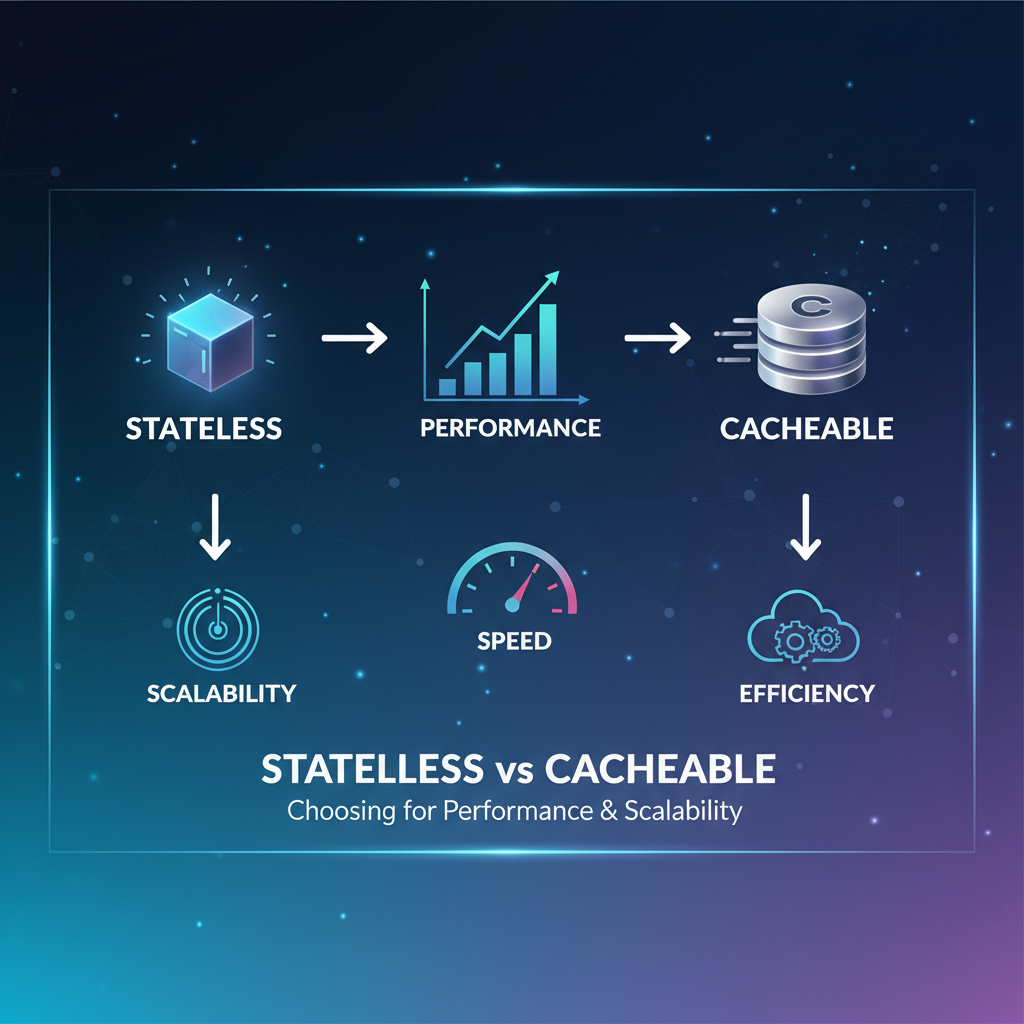


In the intricate world of modern software architecture, the relentless pursuit of superior performance and seamless scalability often leads engineers down paths paved with fundamental design choices. Among the most pivotal of these choices lies the dichotomy between stateless and cacheable architectures. While seemingly distinct, these two paradigms represent powerful, often complementary, strategies for building robust, high-throughput systems that can gracefully handle fluctuating demands. Understanding their nuances, inherent advantages, and potential pitfalls is not merely an academic exercise; it is a critical prerequisite for crafting systems that remain agile, efficient, and resilient in the face of ever-increasing user expectations and data volumes. The decision of whether to embrace statelessness, leverage caching, or, more often, orchestrate a sophisticated blend of both, profoundly impacts a system's ability to process requests swiftly, expand effortlessly, and deliver an uncompromised user experience. This comprehensive exploration will meticulously dissect the philosophies underpinning stateless and cacheable designs, illuminate their individual strengths and weaknesses, analyze their implications for performance and scalability, and ultimately provide a framework for making informed architectural decisions in a landscape dominated by microservices, cloud computing, and intelligent AI Gateway solutions.
Part 1: Deconstructing Stateless Architectures: The Essence of Ephemeral Processing
At its core, a stateless architecture adheres to a principle of radical independence for each incoming request. In such a system, the server retains no memory or knowledge of past interactions with a client. Every single request arriving at the server must contain all the necessary information for the server to fulfill that request entirely, without relying on any stored session data, cookies, or prior context from previous requests by the same client. This fundamental design choice has profound implications, shaping how systems are built, scaled, and maintained.
Definition and Core Principles of Statelessness
Imagine a bustling post office where each letter is a self-contained entity, carrying its destination, return address, and content without the need for the postal worker to remember who sent the previous letter or what was inside. This analogy captures the essence of statelessness in computing. When a client sends a request to a stateless server, that request is processed based solely on the data transmitted within that specific request. The server performs its computation, sends back a response, and then immediately forgets everything about that particular interaction. There is no session state to manage, no user-specific data to store on the server side between requests.
Key characteristics defining a stateless system include:
- Self-Contained Requests: Each request encapsulates all necessary information, including authentication credentials, user context, and data required for processing.
- No Server-Side Session State: The server does not store any client-specific session information. Any state that needs to persist across requests must be managed by the client or an external, shared state management service (e.g., a database, a distributed cache, or a message queue).
- Independence of Requests: The processing of one request is entirely independent of any other request, even if they originate from the same client. This allows requests to be processed in any order and by any available server instance.
- Idempotency (Often): While not strictly required, many stateless operations strive for idempotency, meaning that performing the same operation multiple times will have the same effect as performing it once, which further simplifies retry mechanisms and fault tolerance.
RESTful APIs are perhaps the most widely recognized example of stateless architectures. According to the REST architectural style, clients must maintain their application state, and each request from client to server must contain all the information necessary to understand the request, without the server relying on any previously stored context on the server.
Advantages of Embracing Statelessness
The stateless paradigm offers a compelling suite of benefits, particularly for modern, distributed systems striving for high availability and elastic scalability.
- Exceptional Horizontal Scalability: This is arguably the most significant advantage. Because no server instance maintains client-specific state, new server instances can be added or removed effortlessly to handle fluctuating load. A load balancer can distribute incoming requests to any available server without concern for "sticky sessions" or the need to direct a client's subsequent requests to the same server that handled its previous ones. This simplifies infrastructure management and allows for near-linear scaling by simply adding more commodity servers. For a robust api gateway, being stateless at its core allows it to distribute traffic efficiently across numerous backend services without introducing state-related bottlenecks.
- Enhanced Resilience and Fault Tolerance: If a stateless server instance fails, it does not lead to the loss of any critical session data, as no such data is stored locally. Subsequent requests from affected clients can simply be routed to another healthy server instance, often without the client even noticing the outage. This significantly improves the overall fault tolerance and reliability of the system, minimizing service disruptions.
- Simplified Server Design and Management: Developers can focus purely on processing individual requests without the added complexity of managing session lifetimes, synchronizing state across servers, or handling intricate state transitions. This leads to cleaner code, fewer bugs related to state management, and easier debugging. It reduces the memory footprint on individual servers, as they don't need to allocate resources for maintaining active sessions.
- Improved Resource Utilization: Servers are not burdened with holding onto potentially inactive session data, freeing up memory and CPU cycles for active request processing. This can lead to more efficient use of hardware resources, especially in environments with many intermittent users.
- Predictable Behavior: Without the complexities of shared state and session management, the system's behavior becomes more predictable and easier to reason about. Each request is a distinct unit of work, making testing and debugging more straightforward.
Disadvantages and Challenges of Stateless Architectures
While powerful, statelessness is not without its trade-offs and challenges. Adopting a stateless design requires careful consideration of these potential drawbacks.
- Increased Request Overhead: Since each request must carry all necessary context, the size of individual requests might increase. This could include authentication tokens (e.g., JWTs), user preferences, or other contextual data. While often negligible for small amounts of data, for very chatty interfaces or large contexts, this can consume more bandwidth and slightly increase processing time for parsing the request.
- Client-Side State Management: The burden of maintaining state shifts from the server to the client. Clients (web browsers, mobile apps, other services) must store and manage any information needed for future interactions. This means clients need to be designed to handle this state persistently and securely, which can add complexity to client-side application development.
- Potential for Repeated Processing: If a particular piece of data or the result of a computation is required for multiple subsequent requests from the same client, and this data is not cached externally, a purely stateless server might have to re-fetch or re-compute it for every request. This can lead to inefficiencies if not mitigated with caching strategies.
- Security Considerations: While stateless authentication (like JWTs) simplifies scalability, it introduces new security considerations. JWTs, once issued, are typically valid until expiry and cannot be easily revoked centrally without additional mechanisms (e.g., blacklisting or short TTLs with refresh tokens). This requires careful implementation to prevent token misuse.
- Absence of Server-Initiated Interactions: In a strictly stateless model, the server cannot independently "push" updates or messages to a client because it doesn't maintain an active connection or session state. For real-time updates, other mechanisms like WebSockets or long polling are required, which inherently introduce some form of state management at a different layer.
Use Cases for Stateless Architectures
Stateless architectures are particularly well-suited for a variety of modern application patterns:
- Microservices: Each microservice is typically designed to be stateless, making it easier to deploy, scale independently, and maintain.
- RESTful APIs: As per the REST architectural style, these APIs are inherently stateless, making them highly scalable and cacheable.
- Serverless Functions (FaaS): Functions-as-a-Service environments like AWS Lambda or Azure Functions are the epitome of stateless computing, where each invocation is an independent event.
- Webhooks: These are automated messages sent from an app when something happens. They are stateless in that each webhook notification is a self-contained event.
- API Gateways: A well-designed api gateway is often stateless in its core request routing logic. It processes each incoming request independently, applies policies (authentication, rate limiting), and forwards it to the appropriate backend service. This allows the gateway itself to scale horizontally with ease, becoming a highly available entry point for all API traffic. For specific scenarios involving AI models, an AI Gateway would also ideally operate in a largely stateless manner for routing requests to various AI services, ensuring high availability and load distribution.
By understanding these aspects, architects can better determine when the clarity and scalability of statelessness align with their system's requirements.
Part 2: Embracing Cacheable Architectures: The Power of Stored Efficiency
While statelessness focuses on processing each request independently, caching takes a different approach to efficiency: it minimizes repeated work by storing the results of computations or data fetches in a fast-access temporary location. This strategy directly tackles the performance bottlenecks associated with slow data retrieval from origin sources or expensive computations, fundamentally altering the latency and throughput characteristics of a system.
Definition and Core Principles of Caching
Caching involves storing copies of data that are frequently accessed or computationally intensive to generate, in a location that is closer and faster to access than the original data source. The fundamental principle is "don't re-do what you've already done." When a request for data arrives, the system first checks the cache. If the data is found in the cache (a "cache hit"), it is served immediately, bypassing the slower original source. If the data is not in the cache (a "cache miss"), the system fetches it from the origin, serves it to the client, and then typically stores a copy in the cache for future requests.
Caching can be implemented at various layers of a system architecture, each with its own scope and characteristics:
- Client-Side Caching (Browser Cache): Web browsers store resources (HTML, CSS, JavaScript, images) locally to speed up subsequent visits to the same website.
- DNS Caching: Translates domain names to IP addresses, stored locally to avoid repeated DNS lookups.
- Application-Level Caching: Within an application server, caching frequently used data in memory (e.g., user profiles, configuration settings).
- Database Caching: Caching query results or data blocks within the database system itself to reduce disk I/O.
- Distributed Caching (e.g., Redis, Memcached): Separate, high-performance services designed specifically for caching data across multiple application instances, providing a shared cache layer.
- Proxy Caching / Reverse Proxy Caching (e.g., Varnish, Nginx, API Gateways): Intermediate servers that sit between clients and origin servers, caching responses from the latter. This is a common place for an api gateway to implement caching policies.
- Content Delivery Networks (CDNs): Geographically distributed networks of servers that cache static and sometimes dynamic content closer to users, minimizing latency due to physical distance.
Advantages of Caching
The benefits of intelligently implemented caching are substantial and directly impact both performance and operational efficiency.
- Dramatic Performance Improvement and Reduced Latency: The most immediate and noticeable benefit. By serving data from a fast-access cache (often in-memory), response times can be reduced from milliseconds to microseconds. This significantly enhances the user experience, making applications feel snappier and more responsive.
- Reduced Load on Backend Services: Every cache hit means one less request to the database, one less CPU-intensive computation, or one less call to a slow external service. This offloads a tremendous amount of work from origin servers, allowing them to handle a much higher volume of unique requests or more complex operations. This is particularly crucial for computationally heavy tasks, such as those involving AI model inferences.
- Increased Throughput: With less work per request for cached data, backend services can process a greater number of requests per unit of time, leading to higher overall system throughput.
- Cost Reduction: By reducing the load on backend databases and application servers, caching can help postpone or reduce the need for expensive vertical scaling (upgrading server hardware) or horizontal scaling (adding more instances) of those underlying services, thereby saving infrastructure costs.
- Improved Resiliency (Partial): In some cases, a well-configured cache can serve stale data if the origin server becomes temporarily unavailable, providing a degraded but still functional experience rather than a complete outage.
Disadvantages and Challenges of Caching
Despite its powerful advantages, caching introduces its own set of complexities and challenges, often making it one of the hardest problems in computer science.
- Cache Invalidation - The Hard Problem: Ensuring that cached data remains fresh and consistent with the original source is notoriously difficult. When the source data changes, the corresponding cached entry must be updated or removed (invalidated). Incorrect invalidation can lead to "stale data" being served, which can cause significant issues for users and business logic. Common invalidation strategies include Time-to-Live (TTL), explicit invalidation (push-based or event-driven), and versioning.
- Cache Coherency: In distributed systems with multiple cache instances, ensuring that all caches hold the most up-to-date version of data, especially after a write operation, becomes a complex task. This can involve distributed locking mechanisms, cache replication, or cache-aside patterns.
- Increased System Complexity: Implementing and managing a caching layer adds architectural complexity. Decisions need to be made about cache placement, size, eviction policies (LRU, LFU, FIFO), consistency models, and monitoring. This complexity can make debugging more challenging, as issues might arise from cached data rather than the underlying logic.
- Memory Footprint and Cost: Caches consume memory, especially in-memory caches or distributed cache services. The cost of running and scaling a high-performance distributed cache can be substantial, and the memory footprint needs to be carefully managed to prevent performance degradation or out-of-memory errors.
- Initial Cold Start Performance: When a cache is empty (e.g., after a restart or deployment), the first requests for data will result in cache misses, causing "cold start" performance similar to or sometimes worse than not having a cache at all (due to the overhead of populating the cache). Pre-warming the cache can mitigate this but adds further complexity.
Use Cases for Cacheable Architectures
Caching is highly effective in scenarios characterized by read-heavy workloads, infrequently changing data, and expensive computations.
- Public APIs with Read-Heavy Operations: APIs that serve static or semi-static content, or aggregate data that changes slowly, are ideal candidates for caching. An api gateway can cache responses for common GET requests.
- Database Query Results: Caching the results of complex or frequently executed database queries significantly reduces database load and latency.
- Computed Data: Results of computationally expensive operations (e.g., complex analytics, image processing, or crucially, AI model inferences) can be cached to avoid re-computation. For an AI Gateway, caching common inference results can drastically reduce the load on expensive GPU-backed AI models.
- Static Assets: Images, CSS, JavaScript files, and other static web content are perfectly suited for caching at the client, proxy, and CDN levels.
- Session Data: While not strictly application data caching, storing user session information in a distributed cache (like Redis) allows application servers to remain stateless, delegating state management to a highly available and fast external service.
By carefully considering these aspects, architects can strategically deploy caching to achieve significant performance gains while mitigating the associated complexities.
Part 3: The Interplay and Nuances: Blending Statelessness with Caching for Optimal Performance
A common misconception is that stateless and cacheable architectures are mutually exclusive. In reality, modern, high-performance systems frequently employ both strategies in concert, leveraging the strengths of each to create a more resilient, scalable, and efficient whole. The true power emerges not from choosing one over the other, but from understanding how they can complement each other across different layers of an application stack.
Not Mutually Exclusive: A Symbiotic Relationship
Consider an application server layer designed to be entirely stateless. Each incoming request carries all the necessary information, and the server processes it without storing any client-specific context. However, this stateless server might frequently need to access common configuration data, user profiles, or the results of computationally intensive operations. Rather than fetching this data from a slow database or re-computing it for every request, the stateless server can delegate the retrieval of this data to an external, cacheable store (e.g., a distributed cache like Redis) or benefit from caching implemented at an upstream layer, such as an api gateway.
In this symbiotic relationship:
- Statelessness at the application server level ensures horizontal scalability, simplified server logic, and resilience to individual server failures. The servers themselves are lean, agile, and easily disposable.
- Caching (whether within the application layer for very short-lived items, or more commonly, through external distributed caches or front-end proxies/gateways) addresses the performance overhead of repeatedly fetching or computing data, which would otherwise negate some of the performance benefits of statelessness.
This combination allows the core processing units (the stateless application servers) to remain lightweight and easily scalable, while simultaneously achieving low latency and high throughput for frequently accessed data through intelligent caching.
Caching External State for Stateless Applications
One of the most powerful ways to reconcile the need for state with stateless application servers is to externalize and cache that state. Instead of storing session data, user preferences, or authentication tokens directly on the application server, these pieces of information are stored in a separate, highly available, and fast external data store, which itself is often heavily optimized for caching.
Examples include:
- Distributed Session Stores: Using Redis or Memcached to store user session data. Application servers can then retrieve and update this session data on a per-request basis, remaining stateless themselves while leveraging a central, cacheable session store.
- External Configuration Services: Storing application configurations in a configuration management service (e.g., etcd, ZooKeeper) or even a distributed cache. Stateless application instances fetch configuration as needed, and the configuration itself might be cached for rapid access.
This pattern allows individual server instances to be truly stateless and interchangeable, while the system as a whole can maintain necessary state by delegating its persistence and retrieval to a specialized, high-performance, and cache-friendly external service.
Client-Side Caching and Stateless APIs
The stateless nature of many APIs (especially RESTful ones) makes them highly amenable to client-side caching. HTTP caching headers (e.g., Cache-Control, ETag, Last-Modified) are explicitly designed to allow clients (browsers, mobile apps) and intermediate proxies to cache API responses.
When a client makes a GET request to a stateless API, and the response includes appropriate caching headers:
- The client can store a copy of that response.
- For subsequent requests for the same resource, the client can first check its local cache.
- If the cached response is still valid (e.g., within its
max-ageor if theETagmatches after a conditional request), the client uses the cached version, avoiding a network roundtrip and relieving the server of processing the request.
This pattern significantly improves perceived performance for the end-user and reduces the load on the backend, without requiring the API server itself to maintain any client-specific state beyond general caching directives.
Gateway-Level Caching: A Strategic Intersection
A crucial point where statelessness and caching converge powerfully is at the gateway layer. An api gateway, positioned at the edge of your system, acts as a single entry point for all API requests. While the backend services behind the gateway might be designed to be stateless for maximum scalability, the gateway itself can introduce sophisticated caching mechanisms.
For instance, platforms like ApiPark, an open-source AI gateway and API management platform, often incorporate sophisticated caching mechanisms at the gateway level. This allows them to store responses from frequently called APIs, including those serving AI models, thereby significantly reducing latency and offloading the backend AI services. This demonstrates how a stateless approach at the application layer can be powerfully augmented by an intelligent, cacheable api gateway.
By caching at the gateway, several benefits accrue:
- Reduced Backend Load: The gateway can serve cached responses directly, preventing requests from ever reaching the backend stateless services. This is invaluable for read-heavy APIs or expensive AI model inferences.
- Improved Latency: Responses are served from the gateway (which is closer to the client) much faster than fetching them from a potentially distant backend service.
- Centralized Cache Management: Caching policies can be managed and applied consistently across all APIs from a central point, simplifying operations.
- Decoupling: The caching logic is decoupled from the backend services, allowing them to remain focused on business logic and stateless processing.
This strategic placement of caching at the gateway makes it an indispensable component for optimizing both performance and scalability in microservices and API-driven architectures. For an AI Gateway, this capability is even more critical, as AI model inferences can be extremely resource-intensive and slow. Caching common AI responses at the gateway level can dramatically improve the responsiveness of AI-powered applications.
When to Combine: Strategic Implementation
The decision to combine statelessness with caching is typically driven by specific workload characteristics:
- Expensive Backend Operations: If your backend services perform computationally intensive tasks (like complex calculations, data aggregations, or AI model inferences) that produce results that change infrequently, caching the results is highly beneficial.
- High Read-to-Write Ratio: Systems with a significantly higher proportion of read operations compared to write operations are excellent candidates for caching. The overhead of cache invalidation is manageable because data changes less often.
- Predictable Access Patterns: If certain data or API endpoints are accessed very frequently by many users, caching those responses provides immense value.
- Need for Elastic Scalability: When horizontal scalability of backend services is paramount, coupling stateless services with robust external caching allows for both agility and performance.
In essence, statelessness provides the foundational agility and resilience for scaling your compute, while caching injects targeted performance boosts by intelligently managing data access. Together, they form a formidable combination for building high-performance, highly scalable modern applications.
APIPark is a high-performance AI gateway that allows you to securely access the most comprehensive LLM APIs globally on the APIPark platform, including OpenAI, Anthropic, Mistral, Llama2, Google Gemini, and more.Try APIPark now! 👇👇👇
Part 4: Performance and Scalability Considerations: The Impact of Architectural Choices
The core purpose of distinguishing between stateless and cacheable architectures is to make deliberate choices that optimize a system's performance and scalability characteristics. These two qualities are inextricably linked, yet they address different facets of system efficiency and growth. Understanding how statelessness and caching influence key metrics for each is paramount.
Defining Performance and Scalability
Before diving into the impact, let's briefly define these critical terms:
- Performance: Refers to how quickly a system completes a task or responds to a request. Key metrics include:
- Latency (Response Time): The time taken for a system to respond to a request. Lower is better.
- Throughput: The number of requests or transactions a system can process per unit of time. Higher is better.
- Resource Utilization: How efficiently system resources (CPU, memory, disk I/O, network bandwidth) are used.
- Scalability: Refers to a system's ability to handle an increasing amount of work or users by adding resources. Key aspects include:
- Horizontal Scalability (Scale Out): Adding more instances of servers or components to distribute the load.
- Vertical Scalability (Scale Up): Increasing the capacity of a single server or component (e.g., adding more CPU, memory).
- Elasticity: The ability of a system to dynamically scale up or down based on current demand, automatically provisioning and de-provisioning resources.
Impact of Stateless Architectures
Statelessness primarily champions scalability, particularly horizontal scalability, though its impact on raw performance can be nuanced.
Performance Impact:
- Individual Request Overhead: A purely stateless approach might involve slightly higher overhead per request because all necessary context (e.g., authentication tokens) must be parsed and processed each time. There's no benefit from pre-existing server-side context.
- Aggregate Throughput: Despite the potential individual request overhead, stateless systems generally achieve very high aggregate throughput when horizontally scaled. Because requests can be routed to any available server, a load balancer can effectively distribute the load, and the total processing capacity grows linearly with the number of instances.
- Predictable Performance Under Load: Without the complexities of state synchronization or session affinity, stateless servers tend to exhibit more predictable performance characteristics as load increases. Bottlenecks are more likely to be external (e.g., database, network) rather than internal state management.
- Reduced Memory Footprint (Per Instance): As servers don't store session data, their memory footprint per instance is often smaller, allowing more instances to run on the same physical hardware or virtual machine.
Scalability Impact:
- Excellent Horizontal Scalability: This is where statelessness truly shines. Adding more stateless server instances is remarkably simple. Load balancers can distribute traffic evenly without needing sticky sessions. This makes it effortless to scale out during peak loads and scale back down during quiet periods, contributing to high elasticity.
- Improved Fault Tolerance for Scaling: If an instance fails, it doesn't lose state, so subsequent requests are simply routed to another healthy instance, aiding in continuous availability during scaling operations.
- Simplified Deployment and Management: New versions of stateless services can be deployed using rolling updates or blue/green deployments without complex session migration strategies, further enhancing operational scalability.
- Stateless API Gateway as an Enabler: An api gateway designed to be stateless ensures that the entry point to your system is itself highly scalable and reliable, efficiently routing requests to a dynamic pool of backend services. This is crucial for environments with fluctuating traffic, such as those serving AI models through an AI Gateway.
Impact of Cacheable Architectures
Caching primarily targets performance, dramatically reducing latency and increasing throughput for specific types of requests, which in turn enables greater scalability of the underlying origin systems.
Performance Impact:
- Dramatic Latency Reduction: For cache hits, response times can be orders of magnitude faster, as data is served from a fast, local store rather than a slow origin (database, external API, heavy computation).
- Significantly Increased Throughput (for cached data): By offloading requests from origin servers, caching allows the system to handle many more requests per second that would otherwise strain the backend. This is particularly valuable for read-heavy operations or repeated invocations of expensive AI models.
- Reduced Backend Resource Consumption: Database I/O, CPU cycles for computation, and network bandwidth to backend services are conserved, freeing up resources for unique or write-heavy operations.
- Improved User Experience: Lower latency directly translates to a faster and more responsive application for end-users.
Scalability Impact:
- Scalability of Origin Systems: While caches themselves need to be scalable (e.g., distributed caches), their primary contribution to overall system scalability is reducing the pressure on the origin systems. By absorbing a large percentage of read requests, caches allow databases and compute services to scale less aggressively or defer upgrades, effectively extending their capacity.
- Challenges in Cache Scalability: Distributed caches (like Redis clusters) are designed for scalability, but they introduce their own set of scaling challenges related to sharding, data distribution, and maintaining high availability across many nodes.
- Cache Coherency and Invalidation Complexity: As the system scales and data becomes more distributed, ensuring cache coherency across multiple cache instances and effectively invalidating stale data becomes a significant architectural challenge, potentially impacting the reliability of cached data.
- Bottleneck Shifting: Caching often shifts bottlenecks. While it reduces load on databases, the cache itself can become a bottleneck if not properly sized, sharded, and managed, or if cache misses become too frequent due to poor cache hit ratios.
The Bottleneck Perspective
Understanding where bottlenecks typically occur helps in choosing the right architectural approach:
- Database I/O: Often a primary bottleneck. Caching directly addresses this by serving data from memory instead of hitting the disk.
- CPU-heavy Computations: AI model inferences, complex data transformations, report generation. Caching the results of these operations (especially common ones) dramatically reduces CPU load.
- Network Latency: Calling external APIs or microservices over a network adds latency. Caching external API responses at the gateway or application layer mitigates this.
- Shared State Management: In stateful systems, the need to synchronize or persist shared state can become a scalability bottleneck. Stateless architectures circumvent this by pushing state to the client or external, purpose-built state stores.
Comparative Summary Table
To consolidate the comparison, the following table summarizes the key characteristics and impacts:
| Feature/Aspect | Stateless Architectures | Cacheable Architectures |
|---|---|---|
| Core Principle | No server-side session state; requests self-contained. | Store frequently accessed/computed data for faster retrieval. |
| Primary Goal | Horizontal Scalability, Resilience, Simplicity. | Performance (Latency, Throughput), Backend Load Reduction. |
| Horizontal Scalability | Excellent, near-linear with ease. | Indirect: enables origin scalability; cache itself needs to scale. |
| Resilience/Fault Tolerance | High: server failure doesn't lose state. | Can provide partial resilience (stale data serving). |
| Latency (Individual Request) | Potentially slightly higher (more context per request). | Dramatically lower for cache hits. |
| Throughput (Aggregate) | Very high when scaled horizontally. | Significantly higher for cached content. |
| Complexity | Lower server-side logic; higher client-side state management. | Higher (invalidation, coherency, eviction policies, distributed infra). |
| Data Freshness | Always real-time (if directly from origin). | Can serve stale data if invalidation is complex/slow. |
| Resource Usage | Lower memory per instance; higher bandwidth (potentially). | Higher memory for cache; lower backend CPU/DB I/O. |
| Primary Use Cases | Microservices, RESTful APIs, Serverless, API Gateways. | Read-heavy data, expensive computations, static assets, AI Gateway responses. |
| Common Bottlenecks Addressed | Shared state, session management. | Database I/O, heavy computation, network latency. |
This table highlights that statelessness and caching address different, yet often interconnected, architectural challenges. The most effective strategies typically involve a thoughtful blend of both.
Part 5: Making the Choice – A Decision Framework for Optimal Architectures
Navigating the trade-offs between stateless and cacheable architectures requires a systematic approach. There is no one-size-fits-all solution; the optimal design is always contextual, depending heavily on the specific characteristics of your application, its data patterns, and its business requirements. This section outlines a decision framework to guide architects in making informed choices.
1. Analyze Data Access Patterns and Characteristics
Understanding how your data is used is perhaps the most critical factor.
- Read-Heavy vs. Write-Heavy Workloads:
- Read-Heavy (e.g., product catalogs, news feeds, user profiles, AI model inferences): These are prime candidates for aggressive caching. If the vast majority of operations are reads, caching can absorb a significant portion of the load and drastically improve performance.
- Write-Heavy (e.g., transactional systems, real-time analytics data ingestion): Caching is less effective and more problematic for write-heavy systems due to the immediate need for cache invalidation or update. Statelessness for transaction processing is often preferred, perhaps with externalized, consistent state.
- Data Volatility (How often does data change?):
- Infrequently Changing Data: Ideal for caching. The lower the change frequency, the simpler cache invalidation becomes, and the longer data can reside in the cache.
- Highly Volatile Data (real-time stock prices, sensor readings): Caching is much more challenging. The risk of serving stale data is high, and the overhead of constant invalidation might negate performance benefits. Stateless processing with direct access to the freshest data source is often necessary.
- Access Frequency:
- Frequently Accessed Data (hot data): This is the sweet spot for caching. High hit rates provide maximum benefits.
- Rarely Accessed Data (cold data): Caching provides little value and can consume valuable cache memory unnecessarily.
- Data Sensitivity and Security: Caching sensitive user data requires extra security measures (encryption, restricted access) and careful consideration of compliance regulations. Statelessness might offer a simpler security posture in some aspects as less data resides transiently on servers.
2. Understand Business Requirements and Service Level Objectives (SLOs)
Architectural decisions must align with business needs and performance guarantees.
- Real-time Data Criticality: How critical is it for users to see the absolute freshest data?
- High Criticality (e.g., financial transactions, medical records): Strong consistency is paramount. Caching might need to be very conservative or avoided for specific critical paths, favoring direct, stateless access to the source of truth.
- Low Criticality (e.g., social media feeds, recommended articles): Eventual consistency is often acceptable. More aggressive caching strategies can be employed, even with a slight risk of stale data.
- Latency Targets: What are the acceptable response times for various operations?
- If sub-millisecond or very low-digit millisecond responses are required, caching becomes almost indispensable.
- If higher latency is tolerable for some operations, statelessness alone might suffice, potentially reducing complexity.
- Availability Requirements: How much downtime is acceptable?
- Stateless systems inherently offer high availability and fault tolerance at the application server layer.
- Caches, especially distributed ones, can also be made highly available, but they add another layer to manage for uptime.
- Cost Constraints: Caching infrastructure (e.g., distributed cache clusters) can be expensive to provision and operate at scale. Stateless compute might be cheaper if individual requests are not overly complex and can be horizontally scaled using commodity hardware or serverless functions.
- Developer Productivity and Maintenance Burden: Introducing complex caching layers adds to the cognitive load of developers and operations teams. Is the performance gain worth the added complexity?
3. Consider Your Architectural Style
The overarching architecture of your system often guides these choices.
- Microservices Architectures: Generally lean heavily towards stateless services. Each microservice is designed to be independent and horizontally scalable. Caching is often externalized (distributed caches) or applied at the API Gateway layer to offload microservices.
- Event-Driven Architectures: Event producers are typically stateless. Consumers might maintain internal state, but often leverage external, cacheable data stores for efficiency.
- Monolithic Applications: Can be stateful internally, but benefit from proxy caching (like an api gateway) at the front for public-facing endpoints.
4. Evaluate the Trade-offs Systematically
Every architectural choice involves trade-offs.
- Complexity vs. Performance: Caching introduces complexity (invalidation, coherency) but offers significant performance gains. Statelessness offers simplicity at the server level but might incur repeated work.
- Data Freshness vs. Speed: A fundamental tension in caching. Faster access often means a higher risk of slightly stale data.
- Development Overhead vs. Operational Costs: Is the effort to build and maintain a sophisticated caching strategy justified by the operational savings (reduced backend load, lower infrastructure costs) and performance benefits?
- Security Posture: How does each approach affect your system's security profile? Stateless authentication simplifies some aspects but requires careful token management. Caching sensitive data requires robust security measures.
5. Embrace Hybrid Approaches: The Most Common and Optimal Solution
In reality, most successful large-scale systems are not purely stateless or purely cacheable. Instead, they adopt a pragmatic hybrid approach that strategically combines both paradigms across different layers and components.
- Stateless Services with Distributed Caches: Application servers remain stateless, but delegate state persistence (e.g., session data) or data lookups (e.g., frequently accessed reference data) to a highly available, high-performance distributed cache like Redis or Memcached. This gives you the scalability of stateless services and the performance of caching where needed.
- Caching at the Edge/Gateway: Deploying an api gateway (like ApiPark, an open-source AI gateway and API management platform) that implements response caching for public-facing, read-heavy APIs. This offloads backend services significantly without them needing to implement complex caching logic. An AI Gateway specifically benefits from this for caching expensive AI inference results.
- Client-Side Caching for Static Content: Leveraging HTTP caching headers for static assets and API responses on the client side (browser, mobile app) to reduce network calls and improve perceived performance.
- Micro-caching: Implementing very short-lived caching (seconds to minutes) for highly dynamic content that can tolerate minor staleness, often at a reverse proxy or gateway level.
By following this decision framework, architects can move beyond a simplistic "either/or" choice and design systems that intelligently harness the power of both statelessness and caching, resulting in architectures that are simultaneously performant, scalable, resilient, and cost-effective.
Part 6: Advanced Topics and Best Practices in Stateless and Cacheable Architectures
Building truly high-performance and scalable systems requires delving beyond the basic definitions of statelessness and caching. It involves understanding advanced implementation strategies, operational considerations, and how these paradigms interact within a complex ecosystem.
Distributed Caching: The Backbone of Scalable Caching
For horizontally scalable stateless application servers, local in-memory caching is often insufficient or problematic (due to data inconsistencies across instances). This is where distributed caching becomes indispensable.
- Concept: Data is stored in a separate, dedicated cluster of cache servers (e.g., Redis Cluster, Memcached, Apache Ignite). Application instances access this shared cache, ensuring all instances operate on the same cached data.
- Benefits:
- Global Consistency: All application servers see the same cached data, mitigating consistency issues inherent in local caches.
- Scalability: Distributed caches can scale horizontally independently of application servers, handling massive amounts of data and requests.
- High Availability: Designed with replication and failover mechanisms to prevent a single point of failure.
- Challenges:
- Network Latency: Accessing a remote cache introduces network latency, albeit often much lower than database access.
- Complexity: Managing a distributed cache cluster (sharding, replication, monitoring) adds operational overhead.
- Serialization/Deserialization: Data needs to be serialized before being stored in the cache and deserialized upon retrieval, incurring a small performance cost.
- Cache-Aside Pattern: A common strategy where the application logic explicitly checks the cache first. If a cache miss occurs, it fetches data from the database, serves it, and then populates the cache. This gives the application fine-grained control over caching logic.
CDN Integration: Extending Caching to the Edge
Content Delivery Networks (CDNs) are essentially geographically distributed caching networks optimized for delivering static and sometimes dynamic content. They represent the ultimate form of "cacheable architecture" at the global scale.
- How it Works: Static assets (images, CSS, JS) and sometimes API responses are cached at "edge locations" (Points of Presence - PoPs) that are physically closer to end-users.
- Benefits:
- Global Latency Reduction: Reduces the physical distance data has to travel, significantly improving load times for users worldwide.
- Reduced Origin Load: Offloads a massive amount of traffic from origin servers, as most requests for static content are served from the CDN.
- Improved Availability: CDNs are highly resilient, often able to serve cached content even if the origin is temporarily down.
- DDoS Protection: Can absorb and filter malicious traffic.
Advanced Cache Invalidation Strategies
Effective cache invalidation is crucial for maintaining data freshness and is often the most challenging aspect of caching.
- Time-to-Live (TTL): The simplest method. Cached items expire after a predefined duration. Suitable for data that can tolerate some staleness or changes infrequently.
- Explicit/Event-Driven Invalidation: When data changes in the source, an event is triggered (e.g., a message to a queue) that explicitly invalidates or updates the corresponding entry in the cache. This ensures immediate consistency for critical data.
- Cache Tagging/Versioning: Associating cache entries with tags or versions. When a related entity changes, all entries with that tag/version are invalidated. E.g., caching a user's profile and their associated posts; changing a post invalidates the user's profile cache.
- Write-Through/Write-Back/Write-Around:
- Write-Through: Data is written to both cache and database simultaneously. Simpler consistency but higher write latency.
- Write-Back: Data is written to cache first, and then asynchronously written to the database. Lower write latency but higher risk of data loss on cache failure.
- Write-Around: Data is written directly to the database, bypassing the cache. Cache is only populated on read misses. Good for data that is written once but read rarely.
- Conditional GET Requests (ETag/Last-Modified): Clients send headers indicating the version or last modification time of their cached content. The server can respond with
304 Not Modifiedif the content hasn't changed, saving bandwidth and processing.
Idempotency and Statelessness
Idempotency, the property that an operation can be applied multiple times without changing the result beyond the initial application, perfectly complements stateless architectures.
- Why it Matters: In distributed systems, network issues can lead to duplicate requests. If a stateless API call is idempotent (e.g., PUT operations, DELETE operations), repeated calls due to retries won't cause unintended side effects or data corruption.
- Example: A payment processing API that charges a customer. If the API is made idempotent (e.g., by including a unique transaction ID in the request), even if the client retries the request, the customer will only be charged once.
- Benefit: Enhances the reliability and robustness of stateless services, making them easier to integrate and consume.
Observability: Monitoring Performance and Cache Effectiveness
Implementing stateless and cacheable architectures also means implementing robust monitoring and observability.
- Stateless Services: Monitor request rates, error rates, latency distribution, and resource utilization (CPU, memory) per instance. This helps identify bottlenecks and ensure horizontal scaling is effective.
- Caching Layers: Crucial metrics include:
- Cache Hit Rate: The percentage of requests served from the cache. A high hit rate indicates effective caching.
- Cache Miss Rate: Percentage of requests that require fetching from the origin.
- Cache Latency: Time taken to retrieve data from the cache.
- Cache Size and Eviction Rate: How much data is stored and how often items are removed, indicating potential memory pressure or inefficient eviction policies.
- Memory Usage: For distributed caches, monitoring memory consumption per node is vital.
- Combined View: Correlating metrics from your api gateway, stateless backend services, and caching layers provides a holistic view of system health and performance. This helps pinpoint where optimizations are most needed.
Security Considerations
Security is paramount in any architecture.
- Stateless Security (JWTs): JSON Web Tokens are popular for stateless authentication. They carry user identity and permissions.
- Pros: Highly scalable, no server-side session storage.
- Cons: Cannot be easily revoked centrally (requires blacklisting, short TTLs with refresh tokens), sensitive data in payload needs protection, signature verification is critical.
- Caching Sensitive Data:
- Risk: If sensitive data (PII, financial info) is cached, it becomes accessible to anyone who can access the cache.
- Mitigation: Encrypt data in cache, restrict access to caching infrastructure, implement strict TTLs, and carefully consider what data is safe to cache. An AI Gateway needs to be particularly cautious about caching AI model inputs/outputs if they contain sensitive user data.
The Evolving Role of the API Gateway/AI Gateway
A robust api gateway, like ApiPark, serves as a critical junction, facilitating the implementation of both stateless and cacheable patterns. It can ensure that backend services remain stateless by handling session management externally or by passing all necessary context with each request. Simultaneously, it can introduce caching at the edge, reducing calls to the backend and improving overall system responsiveness. For AI-driven applications, an AI Gateway becomes indispensable, abstracting complex model invocations and potentially caching common AI responses, which significantly boosts performance for frequently queried models.
Specifically, a sophisticated gateway can:
- Decouple Stateless Backends: Abstracting authentication, authorization, rate limiting, and request routing allows backend microservices to remain purely stateless, focusing solely on their business logic.
- Implement Centralized Caching: Offer a centralized caching layer for all upstream APIs, reducing duplicate requests to backend services. This is especially potent for expensive AI inferences.
- Provide Observability: Aggregate metrics and logs for all API traffic, giving a comprehensive view of how stateless services are performing and how effective caching strategies are.
- Standardize AI API Access: For an AI Gateway, it standardizes the invocation format for diverse AI models, encapsulating prompts into REST APIs, and then can cache these standardized responses.
By mastering these advanced topics, architects can design systems that not only meet initial performance and scalability requirements but also remain adaptable, resilient, and performant as demand grows and technologies evolve. The intelligent combination of stateless computation and strategic caching is a hallmark of modern, high-achieving architectures.
Conclusion: Crafting Resilient and Responsive Architectures
The journey through stateless and cacheable architectures reveals that the choice between them is rarely a binary one, but rather a strategic decision involving a nuanced understanding of their individual strengths, weaknesses, and potential for synergistic combination. Statelessness offers the bedrock of horizontal scalability, resilience, and simplicity for the core processing units, making systems inherently more adaptable to fluctuating loads and component failures. Caching, on the other hand, acts as a performance accelerant, dramatically reducing latency and offloading backend services by intelligently storing and serving frequently accessed or computationally intensive data.
Modern, high-performance systems thrive not by adhering strictly to one paradigm, but by pragmatically blending both. The ideal architecture often features stateless backend services that are inherently scalable and fault-tolerant, coupled with intelligent caching layers at various points – from client-side browsers and distributed in-memory stores to powerful api gateway solutions. Platforms such as ApiPark, functioning as an advanced AI Gateway and API management platform, exemplify this hybrid approach by providing critical infrastructure for routing stateless requests while simultaneously offering robust caching mechanisms to optimize performance for even the most demanding AI workloads.
Ultimately, the decision-making process must be anchored in a deep analysis of your application's unique data access patterns, its business-criticality requirements for data freshness and consistency, and the performance and scalability Service Level Objectives (SLOs) you aim to achieve. By meticulously weighing the trade-offs, understanding the inherent complexities introduced by each approach, and strategically deploying both stateless and cacheable principles, architects can design and build systems that are not only robust and efficient today but also capable of gracefully evolving to meet the demands of tomorrow's digital landscape. The continuous pursuit of optimal performance and scalability is an ongoing process, and the judicious application of these fundamental architectural paradigms remains a cornerstone of success.
Frequently Asked Questions (FAQ)
1. What is the fundamental difference between stateless and stateful architectures? The fundamental difference lies in how servers handle client interactions. In a stateless architecture, each request from a client to a server is treated as an independent transaction; the server retains no memory or knowledge of past requests from that client. All necessary information to fulfill the request must be included within the request itself. Conversely, in a stateful architecture, the server remembers the state of previous interactions with a specific client (e.g., user session data), and subsequent requests rely on this stored context.
2. When should I prioritize a stateless design over a stateful one? You should prioritize a stateless design when horizontal scalability, resilience, and simplicity of server-side logic are paramount. This is ideal for microservices, RESTful APIs, and serverless functions where you need to easily add or remove server instances to handle varying loads without complex session management or synchronization issues. Statelessness simplifies load balancing and fault tolerance.
3. What are the main challenges of implementing a cacheable architecture? The primary challenge of cacheable architectures is cache invalidation – ensuring that cached data remains consistent and fresh with the original source data. Incorrect invalidation can lead to stale data being served, causing inconsistencies. Other challenges include managing cache coherency in distributed systems, choosing appropriate eviction policies, dealing with cold start performance, and the added complexity of managing the caching infrastructure itself.
4. Can stateless and cacheable architectures be used together? How? Absolutely, they are often used together in high-performance systems. The most common approach is to have stateless application servers that are highly scalable, but then use external caching layers (like distributed caches or an api gateway) to store frequently accessed data or expensive computation results. This allows the application servers to remain stateless, benefiting from horizontal scalability, while the system as a whole achieves low latency and high throughput through caching. For example, an AI Gateway can be stateless in its routing logic, but cache AI model responses to improve performance.
5. How does an API Gateway or AI Gateway facilitate both statelessness and caching? An api gateway (like ApiPark) acts as an intelligent intermediary. It can facilitate statelessness by offloading concerns like authentication, authorization, and rate limiting from backend services, allowing them to remain stateless. It also helps manage contexts for stateless requests. Simultaneously, a gateway can implement powerful caching mechanisms for common API responses, reducing the load on backend services and improving response times. For an AI Gateway, this is crucial for abstracting complex AI model interactions and caching the results of expensive AI inferences, significantly enhancing the overall performance and scalability of AI-powered applications.
🚀You can securely and efficiently call the OpenAI API on APIPark in just two steps:
Step 1: Deploy the APIPark AI gateway in 5 minutes.
APIPark is developed based on Golang, offering strong product performance and low development and maintenance costs. You can deploy APIPark with a single command line.
curl -sSO https://download.apipark.com/install/quick-start.sh; bash quick-start.sh

In my experience, you can see the successful deployment interface within 5 to 10 minutes. Then, you can log in to APIPark using your account.

Step 2: Call the OpenAI API.