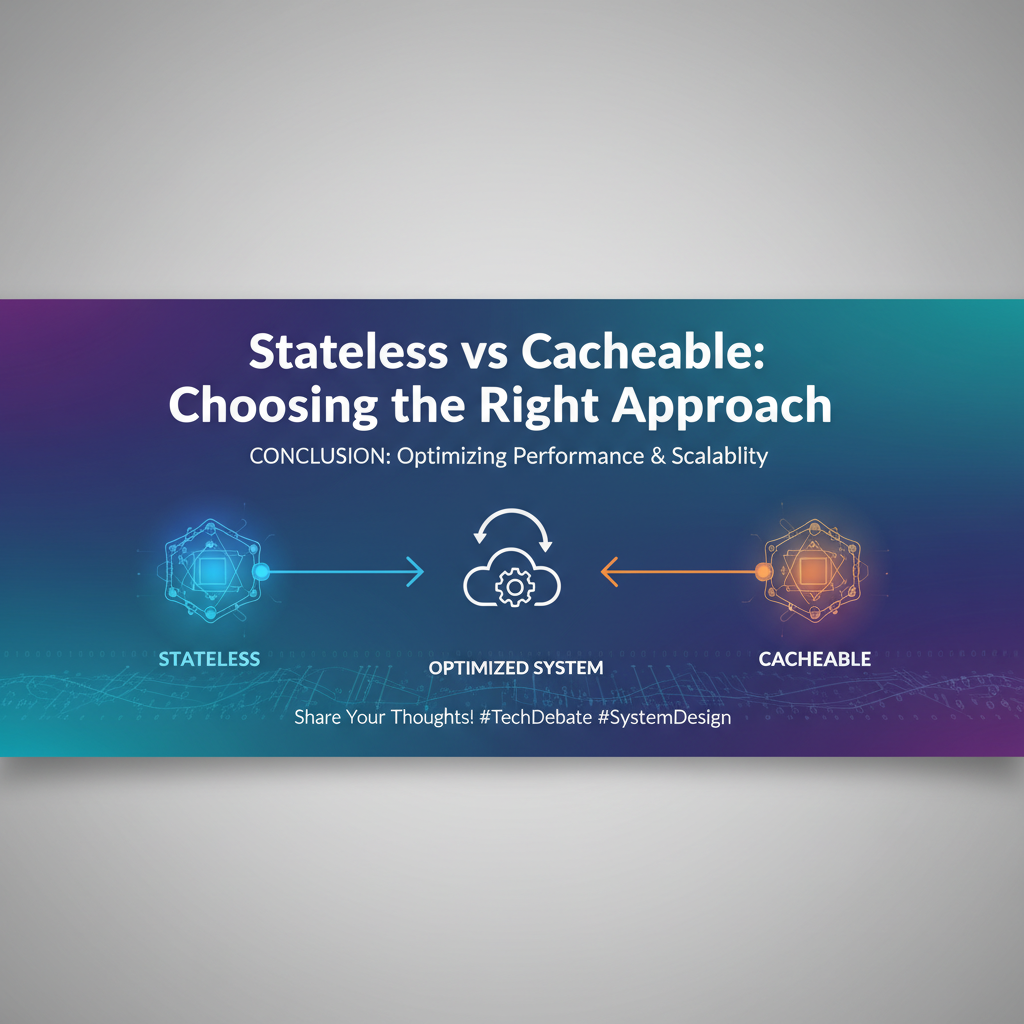
Stateless vs Cacheable: Choosing the Right Approach


In the intricate landscape of modern software architecture, particularly within the realm of web services and distributed systems, developers and architects frequently encounter fundamental design paradigms that profoundly influence system performance, scalability, and maintainability. Among these, the concepts of "statelessness" and "cacheability" stand out as cornerstone principles, each offering distinct advantages and presenting unique challenges. The judicious selection and application of these approaches are paramount, especially when designing and managing APIs (Application Programming Interfaces) that form the backbone of today's interconnected applications. This comprehensive exploration delves deep into the essence of statelessness and cacheability, examining their core tenets, benefits, drawbacks, and practical implications, ultimately guiding the decision-making process for building resilient and high-performing API gateway ecosystems.
Modern systems are characterized by their distributed nature, a vast array of interconnected microservices, and an ever-increasing demand for responsiveness and availability. In such environments, an API gateway often serves as the crucial entry point, orchestrating requests and responses, applying policies, and routing traffic to appropriate backend services. The architectural choices made at the API level, particularly concerning state management and data retrieval optimization, directly impact the efficiency of this gateway and the overall system. Understanding when to enforce a purely stateless interaction model versus when to strategically leverage caching mechanisms is not merely a technical decision; it's a strategic one that can dictate the very success of a digital product or service.
The Essence of Statelessness: A Foundation for Scalability and Resilience
At its core, a stateless system is one where each request from a client to a server contains all the information necessary to understand the request, and the server does not store any client context between requests. In simpler terms, the server treats every request as an independent transaction, unaware of any previous interactions with the same client. This design philosophy is epitomized by HTTP, the foundational protocol of the web, which is inherently stateless.
Defining Characteristics of Stateless Systems
The defining traits of stateless architectures provide a clear understanding of their operational model:
- Independent Requests: Each request carries all the necessary information for the server to process it. This includes authentication tokens, session identifiers (if any, though these are client-managed in a truly stateless system), and all data required for the operation. The server does not rely on any stored "session" data from previous requests from that client.
- No Server-Side Session State: The server does not maintain any persistent or temporary data about the client's interaction between requests. This means that if a client makes multiple requests, each request must be complete and self-contained, without assuming any prior context held by the server.
- Easier Replication and Load Balancing: Since no server holds specific client state, any server instance can handle any client request. This drastically simplifies horizontal scaling, as new server instances can be added or removed without concern for state migration or session affinity (sticky sessions). Load balancers can distribute requests across available servers arbitrarily.
- Improved Fault Tolerance: If a server processing a request fails, the client can simply resend the request to another server, and the operation can be completed without loss of context, as no state was lost on the failed server. This enhances the overall reliability and resilience of the system.
- Simplicity in Design and Implementation: By eliminating the complexities of managing server-side state (e.g., session management, distributed session stores), the server-side logic becomes simpler and easier to reason about. This reduces the surface area for bugs related to state inconsistencies.
Advantages of Adopting a Stateless Approach
Embracing statelessness offers a multitude of benefits that are particularly valuable in distributed and high-traffic environments:
- Exceptional Scalability: Perhaps the most significant advantage of statelessness is its inherent ability to scale horizontally. Since servers do not maintain client-specific state, new instances can be easily spun up or down to meet fluctuating demand without requiring complex state synchronization mechanisms. This makes it straightforward to handle massive increases in traffic, a crucial capability for any modern API or web service expected to serve a global audience. The API gateway can simply distribute requests to any available backend instance, optimizing resource utilization.
- Enhanced Reliability and Fault Tolerance: In a stateless system, the failure of a single server instance does not necessarily lead to a disruption of service or data loss for a client. If a server goes down, subsequent requests can be routed to a healthy server, which can process the request independently. This resilience makes the entire system more robust and less susceptible to single points of failure, improving the overall user experience and minimizing downtime.
- Simplified Load Balancing: Without the need for sticky sessions or session affinity, load balancers can distribute incoming requests across all available server instances using simple algorithms like round-robin or least connections. This maximizes resource utilization and ensures an even distribution of workload, preventing any single server from becoming a bottleneck. An API gateway effectively leverages this by abstracting the backend infrastructure.
- Easier Development and Maintenance: Developers can focus on implementing the core business logic for each request without worrying about the intricacies of managing and synchronizing server-side state across multiple instances. This reduces complexity, accelerates development cycles, and simplifies debugging, as each request can be analyzed in isolation.
- Reduced Resource Consumption on Servers: Servers don't need to allocate memory or storage to maintain client sessions, leading to more efficient use of server resources. This can translate to cost savings, especially in cloud-based deployments where resource consumption directly impacts billing.
Disadvantages and Challenges of Statelessness
Despite its numerous advantages, statelessness is not without its trade-offs:
- Increased Request Payload Size: For operations that involve multiple steps or require a rich client context, the client might need to send redundant data with each request to re-establish the necessary context. This can lead to larger request payloads and increased network traffic, potentially impacting latency, especially for clients with limited bandwidth.
- Potential for Redundant Processing: If the client needs to re-send certain data or information that was previously computed or validated by the server, the server might end up performing redundant computations. This can be mitigated through careful API design, but it remains a consideration.
- Client-Side Complexity: Shifting the responsibility of state management to the client can increase the complexity of client applications. Clients might need to store and manage session tokens, user preferences, or partial transaction data, which requires robust client-side logic and secure storage mechanisms.
- Limited for Long-Running or Conversational Interactions: For use cases that inherently require a continuous, stateful interaction (e.g., real-time chat applications, complex multi-step workflows that must maintain context across requests), a purely stateless approach can become cumbersome. While patterns like using client-managed tokens (JWTs) or external state stores (like databases or distributed caches) can simulate state, they introduce external dependencies.
When to Choose a Stateless Approach
Stateless architectures are highly suitable for a wide range of applications, particularly those built around RESTful principles and microservices:
- RESTful APIs: REST (Representational State Transfer) is intrinsically stateless. Each request to a RESTful API contains all necessary information, making it a perfect fit for stateless designs.
- Microservices Architectures: Microservices thrive on independence. Statelessness allows microservices to be developed, deployed, and scaled independently without worrying about shared state, fostering agility and resilience.
- High-Traffic Web Applications: For applications serving a large number of concurrent users, the scalability benefits of statelessness are invaluable.
- Services Not Requiring Long-Lived Sessions: If the nature of the service involves discrete, independent operations rather than extended, conversational interactions, statelessness is the natural choice. Examples include data retrieval APIs, transaction processing (where each transaction is self-contained), or content delivery services.
The Power of Caching: Optimizing Performance and Reducing Load
While statelessness focuses on simplifying server logic and enhancing scalability, caching is a complementary strategy primarily aimed at optimizing performance and reducing the load on backend systems. Caching involves storing copies of frequently accessed data or computational results in a temporary, high-speed storage location (a "cache") so that future requests for the same data can be served more quickly without needing to re-fetch or re-compute from the original source.
How Caching Works: The Fundamental Mechanism
The fundamental principle behind caching is simple: if a resource has been requested before, and its content is unlikely to have changed, a stored copy can be returned immediately.
- Request Arrival: A client sends a request for a resource.
- Cache Check: The system first checks if a copy of the requested resource exists in the cache.
- Cache Hit: If the resource is found in the cache and is deemed "fresh" (not stale), it's a cache hit. The cached copy is immediately returned to the client, bypassing the backend server.
- Cache Miss: If the resource is not in the cache, or if the cached copy is stale, it's a cache miss. The request is forwarded to the backend server.
- Data Retrieval and Storage: The backend server processes the request, retrieves the data, and sends it back. Before returning it to the client, a copy of the response might be stored in the cache for future requests.
Types of Caching in a Distributed System
Caching can be implemented at various layers of the architecture, each with its own scope and characteristics:
- Browser Cache (Client-Side Caching): Web browsers store static assets (images, CSS, JavaScript) and even API responses to speed up subsequent visits to the same website. This is controlled by HTTP headers like
Cache-ControlandExpires. - CDN (Content Delivery Network): CDNs are distributed networks of servers strategically located closer to end-users. They cache static and dynamic content, reducing latency by serving content from a geographically proximate edge location, significantly offloading the origin server.
- Reverse Proxy Cache / API Gateway Cache: An API gateway or a reverse proxy server (like Nginx, Varnish) can cache responses from backend APIs. This is an excellent place to implement caching for shared resources accessed by multiple clients, offloading backend services and reducing latency for many requests.
- Application-Level Cache: Within an application server, frequently accessed data can be cached in memory or local storage. This can be useful for application-specific configurations, user session data (if the application itself is stateful), or lookup tables.
- Distributed Cache (e.g., Redis, Memcached): For highly scalable, distributed applications, a dedicated distributed cache system allows multiple application instances to share cached data. This prevents cache inconsistencies across instances and provides a centralized, high-performance storage layer for transient data.
- Database Caching: Databases often have their own internal caching mechanisms (e.g., query caches, buffer pools) to speed up data retrieval.
Advantages of Strategic Caching
Implementing caching strategically can yield substantial benefits:
- Reduced Latency and Improved User Experience: By serving requests from a fast cache rather than a slower backend, caching significantly reduces the time it takes for a client to receive a response. This directly translates to a more responsive application and a better user experience. For APIs, faster responses enable more fluid interactions between applications.
- Reduced Load on Backend Servers: When a request is served from the cache, the backend server does not need to process it. This offloads computational work, database queries, and network I/O from the origin servers, allowing them to handle more unique requests or operate under less stress. This is particularly beneficial for read-heavy APIs.
- Increased Throughput: With less load on backend servers, they can process more requests per second. The overall system throughput increases, enabling the system to handle a larger volume of traffic without scaling up backend resources proportionally.
- Cost Savings: By reducing the load on backend infrastructure, caching can lead to lower operational costs. Fewer server instances, less database usage, and reduced bandwidth consumption can result in significant savings, especially in cloud environments where resource usage is directly billed.
- Improved Availability (in some cases): In situations where the backend system might experience temporary outages or performance degradation, a robust cache can continue serving stale (but still useful) data, maintaining a degree of service availability.
Disadvantages and Challenges of Caching
While powerful, caching introduces its own set of complexities and challenges:
- Cache Invalidation Complexities (Stale Data): The most notorious challenge in caching is cache invalidation. Deciding when a cached item is no longer valid and needs to be refreshed from the source is difficult. If not managed carefully, clients might receive stale or incorrect data, leading to inconsistent user experiences or incorrect application logic. Strategies include Time-To-Live (TTL), explicit invalidation, or conditional requests (ETag, Last-Modified).
- Increased System Complexity: Introducing caching layers adds another component to the system architecture. This means more moving parts to configure, monitor, and troubleshoot. Distributed caches, in particular, require careful management, scaling, and operational expertise.
- Consistency Issues: Achieving strong consistency (always serving the most up-to-date data) with caching is challenging. Most caching strategies involve a trade-off between consistency and performance. Applications must be designed to tolerate eventual consistency or employ mechanisms for ensuring consistency, which can add significant overhead.
- Cache Warm-up: When a cache is first deployed or after it's cleared, it's "cold" – it contains no data. The first few requests for each resource will result in cache misses, potentially leading to initial performance degradation until the cache is "warmed up" with frequently accessed data.
- Memory/Storage Overhead: Caches consume memory or storage. While this is often faster than disk or network I/O, it is still a resource that needs to be managed and scaled. Inefficient caching can lead to excessive memory consumption.
- Security Implications: Caching sensitive data (e.g., personal information, authentication tokens) requires careful consideration of security. Ensuring that cached data is properly protected, encrypted, and only accessible to authorized entities is crucial to prevent data breaches.
When to Choose a Cacheable Approach
Caching is most effective for specific types of data and access patterns:
- Read-Heavy Operations: If an API endpoint serves data that is read far more frequently than it is written, it's an ideal candidate for caching. Examples include product catalogs, news articles, public profiles, or configuration data.
- Static or Semi-Static Data: Data that changes infrequently, or data that can tolerate some degree of staleness, benefits greatly from caching. Content that is updated once a day, for example, can be safely cached for a long duration.
- Frequently Accessed Resources: Any resource that experiences a high volume of requests is a prime candidate for caching to reduce the load on the origin server.
- Data That Can Tolerate Eventual Consistency: For scenarios where absolute real-time consistency is not critical, caching can be used aggressively. For instance, displaying a user's follower count might be acceptable if it's a few minutes out of date.
The Interplay: Statelessness and Caching Together
It's crucial to understand that statelessness and cacheability are not mutually exclusive; in fact, they are often complementary design principles that, when combined effectively, lead to highly scalable, performant, and resilient systems.
A common and highly effective strategy involves designing APIs to be stateless while strategically implementing caching at various layers of the architecture. The underlying API endpoints remain simple and independent, ensuring the scalability and reliability benefits of statelessness. Meanwhile, caching layers, such as those provided by an API gateway, CDN, or distributed cache, absorb a significant portion of the read traffic, dramatically improving performance and reducing the load on the stateless backend services.
Strategies for Combining Statelessness and Caching
- Stateless API Design with API Gateway Caching: Design your backend APIs to be purely stateless. This simplifies your microservices and ensures they can scale independently. Then, implement response caching at the API gateway level for idempotent
GETrequests. The API gateway can intelligently cache responses based on request URLs, headers, and query parameters, serving cached data when available and forwarding requests to the backend only on a cache miss or if the cached data is stale. This provides a powerful combination of backend simplicity and frontend performance optimization. - Leveraging HTTP Caching Headers: For APIs that serve cacheable resources, utilize standard HTTP caching headers like
Cache-Control,Expires,ETag, andLast-Modified. These headers instruct clients (browsers, proxies, CDNs) on how and for how long to cache responses, and how to validate cached content without re-downloading the entire resource. This pushes caching intelligence to the edges of the network. - Distributed Caching for Session Data (External State): While the backend services themselves remain stateless, certain applications might require managing user sessions or complex multi-step workflows. In such cases, session data can be stored in an external, highly available, and distributed cache (e.g., Redis). Each stateless application instance can then retrieve the necessary session context from this external store as needed, without storing it locally. This maintains the statelessness of individual application servers while providing a managed "session" experience.
- Content-Based Caching: For APIs that return content, apply content-aware caching strategies. For instance, an API returning a list of products might cache the entire list. If only a single product changes, specific invalidation mechanisms might update only that product in the cache or invalidate the entire list (depending on consistency requirements).
By carefully balancing these two paradigms, architects can build systems that not only handle immense scale but also deliver exceptional performance, offering the best of both worlds. The stateless nature of the core services ensures inherent resilience and scalability, while strategic caching mitigates the need for redundant processing and reduces response times.
Key Considerations for Making the Right Choice
The decision between a predominantly stateless approach, a heavily cached approach, or a hybrid model is rarely straightforward. It requires a thorough understanding of the system's requirements, constraints, and operational environment. Here are critical factors to consider:
1. Performance Requirements (Latency & Throughput)
- High Latency Tolerance: If your APIs can tolerate slightly higher latency and don't require sub-millisecond response times, a purely stateless approach might suffice, especially if the backend is already highly optimized.
- Low Latency Requirement: For applications demanding near real-time responsiveness, caching becomes essential. Identify your target latency for critical operations. Caching can dramatically reduce response times for frequently accessed data.
- High Throughput Requirement: If your system needs to handle a massive number of requests per second, caching is often indispensable. It offloads the backend, allowing it to process more unique requests and scale effectively. Stateless backend services, combined with an effective API gateway and caching strategy, are ideal for high throughput.
2. Scalability Needs (Horizontal Scaling Ease)
- Extreme Horizontal Scaling: Stateless services are inherently easier to scale horizontally. If your architecture demands adding or removing server instances seamlessly without complex state management, prioritize statelessness in your service design. Caching complements this by reducing the overall workload on these scalable services.
- Vertical Scaling Only: If your system is small and not expected to grow significantly, or if your chosen technology stack heavily relies on server-side state, vertical scaling (more powerful single servers) might be sufficient. However, this often becomes a bottleneck in the long run.
3. Data Consistency Requirements (Strict vs. Eventual)
- Strict Consistency: If your API absolutely requires that clients always see the most up-to-date data immediately (e.g., banking transactions, inventory management where over-selling is unacceptable), then caching must be implemented with extreme caution. Cache invalidation must be instantaneous and guaranteed, or caching might be limited to read-after-write consistency models or even avoided for critical data paths.
- Eventual Consistency: For many applications, a slight delay in data propagation is acceptable. News feeds, social media timelines, product recommendations often tolerate eventual consistency. This is where caching shines, as it allows for aggressive caching policies, significantly boosting performance at the cost of transient staleness.
4. System Complexity and Management Overhead
- Simplicity Preferred: Stateless architectures are generally simpler to design, implement, and debug. Adding complex caching layers, especially distributed ones, introduces significant operational complexity.
- Resource Management: Caching systems require resources (memory, CPU for cache eviction, network for distributed caches) and need to be monitored and managed. This adds to the overall operational overhead. An API gateway can simplify managing these policies centrally.
5. Resource Constraints (CPU, Memory, Network)
- Backend Resource Limits: If your backend services are CPU-bound (e.g., heavy computations) or database-bound, caching can significantly alleviate this pressure by reducing the number of requests that reach them.
- Network Bandwidth: For APIs serving large data payloads, caching at a CDN or API gateway level can reduce bandwidth consumption between your origin servers and clients, potentially leading to cost savings and faster delivery. Stateless designs, if they lead to larger repeated payloads, might consume more bandwidth without caching.
6. Security Implications
- Sensitive Data: Carefully evaluate if sensitive data should be cached. If so, ensure that the caching layer adheres to strict security protocols, including encryption at rest and in transit, access control, and robust invalidation mechanisms for sensitive user-specific data upon logout or password change.
- Authentication/Authorization: While user authentication/authorization itself is often stateless (e.g., JWTs), the results of expensive authorization checks could potentially be cached for a very short duration to optimize performance without compromising security.
7. Cost Considerations (Infrastructure, Operational)
- Infrastructure Costs: Caching can reduce the need for more expensive backend resources (e.g., powerful database servers, more application instances) by offloading traffic. However, distributed caching systems also incur their own infrastructure costs.
- Operational Costs: The complexity introduced by caching can increase operational costs in terms of monitoring, maintenance, and troubleshooting.
The table below provides a concise comparison of the stateless and cacheable approaches across several key dimensions:
| Feature/Consideration | Stateless Approach | Cacheable Approach | Hybrid Approach (Stateless API + Caching) |
|---|---|---|---|
| Core Principle | Server holds no client context between requests. | Store copies of data for faster retrieval. | Stateless backend, performance optimized by caching. |
| Primary Goal | Scalability, Simplicity, Resilience. | Performance, Reduced Backend Load. | Scalability, Performance, Resilience. |
| Server-Side State | None (or externalized to a separate store). | Yes (the cache itself is a form of state). | No intrinsic server-side state in API, but cache maintains state. |
| Scalability | Excellent (horizontal scaling is straightforward). | Enhances scalability by reducing backend load. | Inherits excellent scalability from stateless APIs, enhanced by caching. |
| Fault Tolerance | Excellent (any server can handle request). | Can introduce SPOF if cache fails (if not distributed). | Excellent, with added performance benefits. |
| Performance (Latency) | Dependent on backend processing speed and network. | Significant reduction for cache hits. | Optimal, combining low backend latency with fast cache hits. |
| Backend Load | Each request processed by backend. | Significantly reduced for cache hits. | Dramatically reduced, especially for read-heavy operations. |
| Data Consistency | Strong (each request processes fresh data). | Can lead to eventual consistency (stale data). | Strong for writes, eventual for reads via cache. |
| System Complexity | Relatively simple. | Adds complexity (invalidation, management). | Moderate (manage stateless APIs and caching layers). |
| Resource Usage | Each request consumes backend resources. | Cache consumes memory/storage, saves backend CPU/DB. | Balanced resource usage, optimized for overall efficiency. |
| Best Use Cases | Transactions, user sessions (client-managed), microservices. | Read-heavy data, static content, frequently accessed resources. | High-traffic RESTful APIs, content delivery, data retrieval services. |
| HTTP Headers Impact | Minimal (authentication, request data). | Cache-Control, Expires, ETag, Last-Modified. |
Both (stateless headers, plus caching headers for responses). |
APIPark is a high-performance AI gateway that allows you to securely access the most comprehensive LLM APIs globally on the APIPark platform, including OpenAI, Anthropic, Mistral, Llama2, Google Gemini, and more.Try APIPark now! 👇👇👇
Practical Applications and Real-World Use Cases
To further solidify the understanding, let's look at practical scenarios where each approach, or a combination thereof, is optimally applied.
Where Statelessness is Preferred
- E-commerce Checkout Process: Each step of a checkout (adding to cart, entering shipping info, payment) should ideally be stateless from the server's perspective. The client sends all necessary data for each step, ensuring that even if one server instance fails, the transaction can continue seamlessly on another. Session tokens (e.g., JWTs) might be passed by the client to identify the user, but the core processing of each step remains independent.
- Authentication and Authorization APIs: Endpoints for user login, token generation (e.g., OAuth tokens, JWTs), and permission checks are typically stateless. The server validates credentials or tokens provided in each request, but doesn't retain a specific "logged-in" state for that user beyond what's encoded in the token. This allows any authentication service instance to handle any request.
- Transaction Processing APIs: For financial transactions, order placement, or other critical operations, each API call should be idempotent and stateless. This ensures that retrying a failed request doesn't lead to duplicate actions and that each request is processed as a complete unit.
Where Caching is Crucial
- News Feeds and Content APIs: A news website or social media platform's API that delivers articles or posts to users is highly cacheable. The content changes relatively infrequently compared to how often it's requested. Caching these responses at the CDN, API gateway, or application level drastically improves load times and reduces database strain.
- Product Catalogs: E-commerce product listings, product details, and category information are excellent candidates for caching. While inventory or pricing might change, the core product data (descriptions, images) is fairly static. Caching these can significantly speed up browsing.
- User Profile Information (Public): Public user profile data, such as a user's name, profile picture, or public bio, is frequently accessed. Caching this information, possibly with a short TTL, can optimize performance for social applications.
- Weather Data / Stock Quotes: Data feeds that update periodically but are accessed constantly can benefit immensely from caching. A weather API might cache data for a city for 10-15 minutes, serving thousands of requests from the cache.
Hybrid Approaches in Real-World Systems
Most large-scale systems employ a sophisticated hybrid approach:
- Backend Services: Designed to be largely stateless, simplifying their horizontal scaling and resilience.
- API Gateway Layer: Acts as the traffic controller, applying security policies (often stateless checks), rate limiting, and crucial response caching for public-facing APIs.
- CDN: Caches static assets and common API responses at the network edge.
- Distributed Cache (e.g., Redis): Used for managing transient session data (if required for certain application-level features), application configurations, or pre-computed results that multiple stateless backend services might need to access.
This multi-layered strategy ensures that the system is both highly scalable and exceptionally performant, addressing different requirements at different architectural levels.
The Role of API Gateways and API Management in Decision-Making
The concepts of statelessness and cacheability are deeply intertwined with the function of an API gateway and the broader discipline of API management. An API gateway is not just a traffic router; it's a central control point that can enforce architectural principles, optimize performance, and manage the entire lifecycle of APIs.
How an API Gateway Facilitates Both Statelessness and Caching
An API gateway sits between clients and backend services, acting as a reverse proxy. Its position provides a strategic point to implement features that support both stateless and cacheable designs:
- Enforcing Statelessness: An API gateway can handle stateless authentication and authorization by validating tokens (e.g., JWTs) provided by the client in each request, forwarding valid requests and rejecting invalid ones, without maintaining any server-side session state for the client itself. This offloads authentication logic from individual backend services, allowing them to remain purely stateless.
- Centralized Caching: One of the most powerful features of an API gateway is its ability to implement centralized response caching. For idempotent
GETrequests, the gateway can cache responses from backend APIs and serve them directly to clients on subsequent requests, significantly reducing latency and backend load. This means backend services can remain stateless, while the gateway layer provides the performance boost of caching. The gateway often offers fine-grained control over caching policies, including TTLs, cache keys, and invalidation strategies. - Traffic Management: An API gateway manages traffic forwarding, load balancing, and routing. These functionalities are inherently designed to work seamlessly with stateless backend services, as they can distribute requests to any available instance without needing to worry about session affinity.
- API Lifecycle Management: Beyond runtime operations, an API gateway often integrates with an API management platform to handle the entire lifecycle of APIs – from design and publication to versioning and deprecation. This structured approach helps ensure that APIs are designed with best practices, including considerations for statelessness and cacheability, from the outset.
APIPark: An Open-Source Solution for Modern API Management
In the realm of modern API management, robust solutions like APIPark emerge as indispensable tools. This platform, functioning as both an AI gateway and a comprehensive API management system, inherently supports the architectural decisions we've been discussing. For instance, APIPark's ability to manage the entire API lifecycle, from design to publication and invocation, naturally aligns with the principles of creating well-defined, often stateless, APIs. Its unified API format for AI invocation and prompt encapsulation into REST APIs promotes a stateless interaction model for AI services, simplifying integration and maintenance.
Furthermore, APIPark's advanced features for traffic forwarding and load balancing directly contribute to the scalability benefits of stateless architectures. When it comes to performance, a critical aspect where caching plays a significant role, APIPark's impressive ability to achieve over 20,000 TPS with minimal resources, even supporting cluster deployment for large-scale traffic, underscores its capacity to handle high loads, which can be further optimized through strategic caching implemented either at the gateway level or further downstream. Its detailed API call logging and powerful data analysis features can help monitor cache effectiveness and overall API performance, ensuring that caching strategies are working as intended and providing valuable insights into potential performance bottlenecks. By offering a centralized display of all API services and independent API and access permissions for each tenant, APIPark facilitates a well-governed ecosystem where stateless and cacheable APIs can coexist and thrive, ultimately enhancing efficiency, security, and data optimization for developers, operations personnel, and business managers alike.
Advanced Concepts and Future Trends
The evolution of software architecture continues to introduce new paradigms and refine existing ones, further influencing the choices between statelessness and cacheability.
Edge Computing and Caching
With the rise of edge computing, where computation and data storage are moved closer to the data sources and end-users, caching at the edge becomes even more critical. Edge gateways can serve cached content with extremely low latency, further reducing the load on centralized cloud resources and providing ultra-responsive experiences for geographically dispersed users. This extends the concept of CDN caching even further into the network.
Serverless Functions and Their Stateless Nature
Serverless computing platforms (e.g., AWS Lambda, Azure Functions) inherently promote a stateless paradigm. Each function invocation is typically an independent, ephemeral process, making stateless design a natural fit. While the functions themselves are stateless, developers often pair them with external, managed services for state (databases, distributed caches) to achieve desired application behaviors. Caching can still be applied at the API gateway layer in front of serverless functions to optimize performance for frequently accessed data, even if the functions are cold-started.
GraphQL and Its Implications for Caching
GraphQL, a query language for APIs, allows clients to request exactly the data they need, which can complicate traditional caching. Unlike REST, where caching is often based on URL paths, GraphQL typically uses a single endpoint. This requires more sophisticated caching mechanisms, often involving client-side libraries that normalize data, or server-side solutions that understand the semantics of GraphQL queries to cache responses effectively. Despite these challenges, the principles of statelessness still apply to the underlying data fetching and processing within a GraphQL server.
Intelligent Caching with AI/ML
The future of caching may involve more intelligent, AI/ML-driven approaches. Machine learning models could predict data access patterns, identify optimal caching durations, and even proactively fetch and cache data before it's requested, further optimizing performance. Such systems could dynamically adjust caching policies based on real-time traffic, user behavior, and data change patterns, taking the complexity of cache invalidation to a new level of automation.
Conclusion: A Contextual Choice for Enduring Architectures
The decision between a stateless and a cacheable approach in API design and management is not a binary one but rather a spectrum of choices guided by specific use cases, performance requirements, scalability needs, and consistency demands. Statelessness offers the unparalleled benefits of horizontal scalability, resilience, and architectural simplicity, making it the bedrock for modern distributed systems, particularly those built around RESTful APIs and microservices. It ensures that backend services remain independent and easy to manage.
However, the pursuit of optimal performance and the imperative to reduce the load on backend infrastructure often necessitate the strategic application of caching. Caching acts as a powerful accelerator, drastically cutting down latency and increasing throughput for frequently accessed or static data. The true power lies in the judicious combination of these two paradigms: leveraging stateless APIs for their inherent scalability and reliability, while enhancing their performance with intelligently implemented caching layers at various points in the architecture, from CDNs and API gateways to distributed caches.
Ultimately, the most robust and efficient API ecosystems are those that thoughtfully integrate both stateless principles and intelligent caching strategies. By understanding the advantages and disadvantages of each, and by carefully considering the contextual factors discussed, architects and developers can make informed decisions that lead to highly performant, scalable, and resilient applications capable of meeting the ever-growing demands of the digital world. The journey of building and managing such systems is a continuous process of evaluation, optimization, and adaptation, ensuring that the chosen approach aligns perfectly with the evolving needs of the business and its users.
Frequently Asked Questions (FAQs)
1. What is the fundamental difference between a stateless and a stateful API?
The fundamental difference lies in how the server manages client context. A stateless API treats each request as an independent transaction, containing all necessary information, and the server does not store any client-specific data or context between requests. In contrast, a stateful API retains information about past client interactions, meaning the server remembers the "state" of a client's session across multiple requests. This state is typically stored on the server and is required for subsequent requests to be processed correctly.
2. When should I prioritize a stateless API design?
You should prioritize a stateless API design when: * High Scalability is Crucial: Stateless services are inherently easier to scale horizontally as any server instance can handle any request. * High Availability and Fault Tolerance are Key: If a server fails, other servers can pick up requests without losing client context. * Simplicity and Maintainability are Important: Less server-side state management reduces complexity. * Building RESTful APIs or Microservices: These architectures are fundamentally designed around stateless interactions. * Requests are Independent: Each client request is self-contained and does not rely on previous requests' context.
3. What are the main benefits of caching in an API gateway or distributed system?
The main benefits of caching include: * Reduced Latency: Faster response times for clients as data is served from a high-speed cache instead of the slower backend. * Reduced Load on Backend Servers: Offloads processing, database queries, and network I/O from origin servers, allowing them to handle more unique requests. * Increased Throughput: The system can process more requests per second due to reduced backend stress. * Cost Savings: Lower infrastructure costs by needing fewer backend resources (e.g., fewer database calls, fewer server instances). * Improved User Experience: Faster loading times lead to more responsive applications.
4. What is the biggest challenge when implementing caching, and how can it be addressed?
The biggest challenge when implementing caching is cache invalidation, which means ensuring that clients always receive fresh, up-to-date data and avoiding serving stale content. This can be addressed through several strategies: * Time-To-Live (TTL): Setting an expiration time for cached items, after which they are considered stale and must be re-fetched. * Explicit Invalidation: Programmatically removing or updating cached items when the underlying data changes. * Conditional Requests (ETag/Last-Modified): Using HTTP headers to allow clients/proxies to check if their cached version is still valid without re-downloading the entire content. * Versioning/Hashing: Appending a version number or hash to resource URLs, which changes whenever the content is updated, forcing clients to fetch the new version.
5. Can a system be both stateless and utilize caching effectively?
Absolutely. In fact, most high-performing, scalable systems leverage both. The core backend APIs are often designed to be stateless, ensuring they can scale horizontally and remain resilient. Caching is then implemented at various layers (e.g., CDN, API gateway, distributed cache) to optimize performance for frequently accessed data, reducing the load on these stateless backend services. This hybrid approach combines the scalability and simplicity of stateless architectures with the performance benefits of caching, creating a powerful and efficient system.
🚀You can securely and efficiently call the OpenAI API on APIPark in just two steps:
Step 1: Deploy the APIPark AI gateway in 5 minutes.
APIPark is developed based on Golang, offering strong product performance and low development and maintenance costs. You can deploy APIPark with a single command line.
curl -sSO https://download.apipark.com/install/quick-start.sh; bash quick-start.sh

In my experience, you can see the successful deployment interface within 5 to 10 minutes. Then, you can log in to APIPark using your account.

Step 2: Call the OpenAI API.