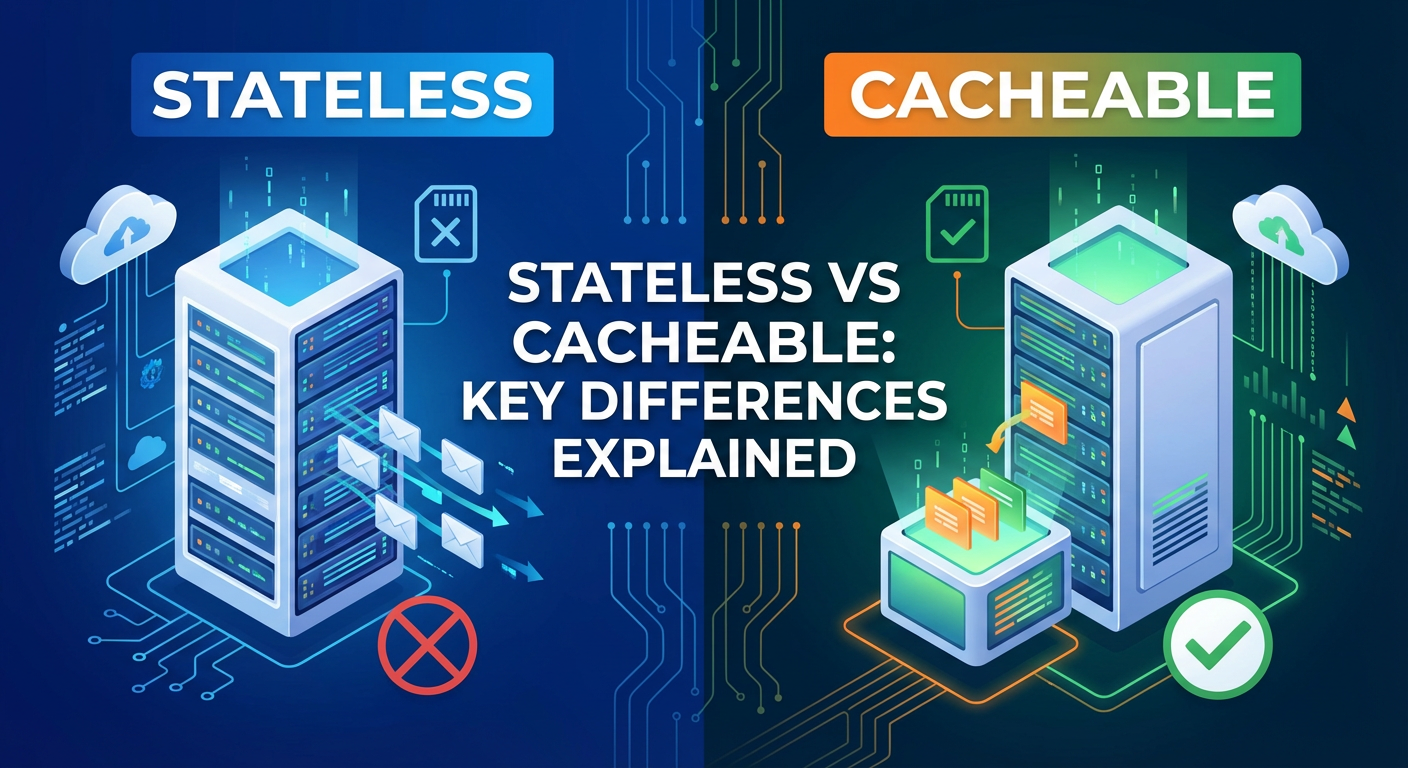
Stateless vs Cacheable: Key Differences Explained


In the intricate world of modern software development, particularly within the realm of distributed systems and microservices, architects and developers constantly grapple with fundamental design principles that dictate the performance, scalability, and maintainability of their applications. Among these foundational concepts, "statelessness" and "cacheability" emerge as two critical pillars. While often discussed in parallel, they represent distinct architectural concerns that, when understood and applied correctly, can profoundly impact the efficiency and robustness of an API gateway and the APIs it manages. This extensive exploration will meticulously dissect these two paradigms, elucidating their core definitions, underlying principles, benefits, challenges, and the nuanced interplay that defines their relationship within a sophisticated API gateway ecosystem. We will delve deep into how these concepts shape the very fabric of web interactions and how their strategic implementation can optimize everything from resource utilization to user experience, providing a comprehensive understanding for anyone building or operating an API-driven platform.
The Enduring Quest for Scalability and Efficiency: Setting the Stage
The digital landscape of today is characterized by an insatiable demand for instant access to information and seamless service delivery. Users expect applications to be responsive, resilient, and available 24/7, irrespective of fluctuating load or geographical distance. For developers, this translates into a continuous pursuit of architectural patterns that can scale effortlessly, handle massive concurrency, and minimize latency. This pursuit naturally leads to concepts like statelessness, which simplifies horizontal scaling, and cacheability, which drastically reduces the need to repeatedly process identical requests.
An API gateway, standing as the crucial ingress point for all external and often internal API traffic, is at the forefront of implementing and leveraging these principles. It acts as a central control plane, orchestrating various concerns from authentication and authorization to routing, rate limiting, and, crucially, caching. Understanding how stateless APIs interact with caching strategies, and how a sophisticated gateway can optimize these interactions, is paramount for building high-performance, resilient distributed systems. Without a clear distinction and strategic application of these concepts, systems can become bottlenecks, suffer from unpredictable performance, and ultimately fail to meet user expectations.
Unpacking Statelessness: The Foundation of Scalable APIs
At its heart, "statelessness" in the context of an API or a service means that the server does not store any client-specific session data between requests. Each request from a client to the server must contain all the information necessary for the server to understand and fulfill that request, entirely independent of any previous requests. The server processes the request based solely on the data provided within that request itself, producing a response without relying on any stored "memory" of past interactions with that specific client. This fundamental principle has profound implications for system design, particularly for APIs exposed through an API gateway.
The Core Tenets of Stateless Design
To truly grasp statelessness, one must consider its underlying principles:
- Self-Contained Requests: Every single request must carry all the necessary information for the server to process it. This includes authentication tokens, user identifiers, transaction details, and any context that would typically be maintained in a session. For example, in a RESTful API, each HTTP request for a resource, say
GET /products/123, is complete in itself. If authentication is required, a token is sent in theAuthorizationheader with each request. - No Server-Side Session State: The server does not maintain information about the client's current session or application state. If a client performs multiple operations, each operation is treated as an independent event. This contrasts sharply with traditional stateful applications where server-side sessions would store user preferences, shopping cart contents, or login status.
- Independent Processing: Because each request is self-contained, any server instance can process any request at any time. There's no need for "sticky sessions" or ensuring a client always connects to the same server instance. This independence is a cornerstone of horizontal scalability.
The Multifaceted Benefits of Statelessness
Adopting a stateless design pattern brings a host of compelling advantages, especially pertinent in large-scale distributed architectures managed by an API gateway:
- Exceptional Scalability: This is perhaps the most significant advantage. Since no server instance holds client-specific state, new server instances can be added or removed dynamically without affecting active users. Load balancers can distribute incoming requests across any available server, leading to seamless horizontal scaling. If a server goes down, another can immediately pick up subsequent requests without loss of context, as the context is provided with each request. This characteristic is invaluable for an API gateway managing a multitude of backend services, allowing it to easily scale its own operations and route traffic efficiently.
- Enhanced Reliability and Fault Tolerance: If a server fails, the client can simply resend the request (if idempotent) to another available server without loss of session data, as there was no server-side session data to begin with. This greatly improves system resilience and uptime, a critical consideration for any production API and the gateway fronting it.
- Simplified Server Design: Developers no longer need to manage complex session synchronization mechanisms across multiple servers, nor do they need to worry about session timeouts or potential memory leaks associated with state management. This simplifies server logic and reduces the potential for bugs.
- Improved Resource Utilization: Without the need to store session data, server memory can be dedicated solely to processing requests, leading to more efficient resource usage. This is particularly beneficial for high-throughput APIs.
- Easier Cacheability (Synergy): As we'll discuss in detail, stateless APIs are inherently more amenable to caching. Since a request's processing doesn't depend on prior interactions, the response to an identical request can often be safely cached and reused.
Challenges and Considerations in Stateless Design
While offering numerous benefits, statelessness also presents certain challenges that developers must navigate:
- Increased Request Size: Each request must carry all necessary information, potentially leading to larger request payloads compared to stateful systems that rely on a small session ID. This can increase network bandwidth usage.
- Security Implications for Authentication: For stateless authentication, mechanisms like JSON Web Tokens (JWTs) are commonly used. While efficient, managing token revocation (e.g., when a user logs out or a token is compromised) can be more complex than invalidating a server-side session.
- Stateless Doesn't Mean Amnesiac: It's crucial to distinguish between server-side application state and client-side application state. While the server remains stateless regarding client sessions, it still needs to access persistent data (e.g., from a database) to fulfill requests. The application itself still has a state, but the interaction with the client is stateless.
- Managing Application Flow: For multi-step processes (e.g., a checkout wizard), all state must be managed on the client side or explicitly passed back and forth with each request. This can sometimes lead to more complex client-side logic.
For an API gateway, statelessness simplifies its own internal operations. The gateway doesn't need to maintain "sticky sessions" or track individual client states to route requests correctly. It can apply policies (authentication, authorization, rate limiting) on a per-request basis, making the gateway itself highly scalable and resilient.
Demystifying Cacheability: The Art of Storing for Speed
If statelessness is about doing things independently, "cacheability" is about avoiding doing them repeatedly. Cacheability refers to the ability to store the response to a request (or parts of it) so that subsequent identical requests can be served much faster, often without even reaching the original backend server. This concept is fundamental to optimizing performance, reducing server load, and minimizing network latency across the entire API ecosystem.
The Core Tenets of Cacheability
Cacheability relies on a few key principles to be effective:
- Data Persistence for Reuse: The primary goal is to store data that is likely to be requested again soon. This stored data, or "cache," acts as a temporary, fast-access data store.
- Consistency vs. Freshness Trade-off: Caching introduces a trade-off between serving the freshest possible data and achieving maximum performance. Stale data can be problematic, so strategies for invalidation and expiration are crucial.
- Identification of Cacheable Resources: Not all resources are equally cacheable. Data that changes frequently (e.g., a real-time stock ticker) is less suitable for caching than static content (e.g., product images) or data that changes infrequently (e.g., a list of countries).
- Cache Control Mechanisms: Standardized mechanisms, often HTTP headers, are used to instruct clients and intermediaries (like an API gateway or CDN) on how to cache a response, for how long, and under what conditions.
The Profound Benefits of Cacheability
Implementing effective caching strategies yields significant advantages for any API infrastructure:
- Dramatic Performance Improvement: By serving responses directly from the cache, the time taken to fulfill a request is drastically reduced, leading to lower latency and a faster user experience. This is especially noticeable for distant clients or for APIs with computationally intensive backend processes.
- Reduced Server Load: Caching offloads requests from backend servers, allowing them to process fewer requests. This frees up CPU, memory, and database resources, enabling the backend to handle a greater volume of unique requests or to perform better under peak loads. An API gateway with robust caching capabilities can significantly protect its backend services from overload.
- Lower Bandwidth Consumption: When responses are served from a local cache (e.g., client-side or nearby gateway), less data needs to travel over the network, reducing bandwidth costs and improving network efficiency.
- Improved Fault Tolerance (Limited): In some scenarios, a cache can serve stale data if the backend is temporarily unavailable, offering a degraded but still functional experience. This can provide a temporary buffer during backend outages.
Challenges and Complexities of Caching
Despite its benefits, caching is notoriously difficult to implement perfectly, often cited as "one of the two hard problems in computer science."
- Cache Invalidation: This is the most formidable challenge. Knowing when cached data is no longer valid and how to invalidate it effectively is critical. Incorrect invalidation can lead to clients receiving stale or incorrect information, which can be worse than no caching at all. Strategies include time-based expiration, explicit invalidation (e.g., using a webhook or message queue), and content-based invalidation (e.g., ETags).
- Cache Consistency: Ensuring that all caches (client, gateway, CDN) reflect the most up-to-date information is complex. Different consistency models exist (e.g., eventual consistency), each with its own trade-offs.
- Cache Hit Ratio: The effectiveness of a cache is measured by its "hit ratio"—the percentage of requests served from the cache. A low hit ratio means the cache isn't very useful, consuming resources without providing much benefit.
- Cache Busting: For resources that must be reloaded (e.g., after a new deployment), techniques like appending a version number or hash to the URL are used to "bust" the cache.
- Memory Management: Caches consume memory. Proper management is needed to prevent them from becoming too large and impacting performance, often involving eviction policies (e.g., LRU - Least Recently Used).
Types of Caching and HTTP Headers
Caching can occur at various layers:
- Client-Side Caching: The user's browser or application stores responses. Controlled primarily by HTTP headers like
Cache-Control,Expires,Last-Modified, andETag. - Proxy/API Gateway Caching: An intermediary server (like an API gateway or reverse proxy) stores responses for multiple clients. This is extremely effective for shared resources.
- CDN Caching: Content Delivery Networks are globally distributed servers that cache content close to users.
- Server-Side Caching: Application-level caches (e.g., Redis, Memcached) store results of database queries or computations.
Key HTTP Caching Headers:
Cache-Control: The most powerful header, specifying caching policies for both clients and proxy servers. Examples:no-store: Do not store any part of the request or response.no-cache: Cache, but revalidate with the origin server before serving.public: Can be cached by any cache.private: Can only be cached by the client's browser.max-age=<seconds>: Specifies how long a resource can be considered fresh.s-maxage=<seconds>: Similar tomax-agebut applies only to shared caches (like CDNs or API gateways).must-revalidate: Cache must revalidate if stale.
Expires: An older header, providing a specific date/time after which the response is considered stale.Cache-Control: max-agetakes precedence.Last-Modified/If-Modified-Since: The server sendsLast-Modifiedwith the resource's last modification time. The client can later sendIf-Modified-Sincewith that time. If the resource hasn't changed, the server responds with304 Not Modified, saving bandwidth.ETag/If-None-Match: AnETagis an opaque identifier representing a specific version of a resource. The client can sendIf-None-Matchwith theETag. If it matches the current serverETag, a304 Not Modifiedis sent.ETagis more robust thanLast-Modifiedas it can account for non-time-based changes.
An API gateway plays a crucial role as a caching layer. It can inspect these HTTP headers, intelligently cache responses, and serve them directly, reducing the load on backend APIs and improving overall response times. For an API gateway to be truly effective, its caching module must be highly configurable, supporting various invalidation strategies and fine-grained control over which APIs and endpoints are cached.
The Intersection and Intricate Relationship: Statelessness and Cacheability
It's common for these two concepts to be discussed together, not because they are mutually exclusive or even directly opposed, but because they are highly complementary and often co-exist harmoniously within well-designed systems. A deep understanding of their relationship is key to optimizing any API architecture.
The most important takeaway is this: Stateless APIs are inherently easier to cache effectively.
Why? Because in a stateless interaction, the server's response to a specific request depends solely on the request itself and the current state of its persistent data (e.g., database), not on any previous interactions with that particular client. This consistency means that if two clients send an identical request, they should receive an identical response (assuming the underlying data hasn't changed). This predictability is precisely what caching thrives on. If a response is predictable and stable, it can be safely stored and served to any client making the same request.
Conversely, a stateful API is much harder to cache. If a server's response depends on a specific client's session state, then even if two clients send seemingly identical requests, their responses might differ because their individual session contexts are different. Caching such responses would require caching per-client session, which is significantly more complex, less efficient, and defeats much of the purpose of shared caching.
Key Distinctions and Synergies
Let's delineate their primary differences and how they work together:
- Purpose:
- Statelessness: Primarily aims to improve scalability, reliability, and simplicity of the server by eliminating server-side session management.
- Cacheability: Primarily aims to improve performance, reduce latency, and offload backend services by storing and reusing responses.
- Focus:
- Statelessness: Focuses on the server's internal state management concerning client interactions.
- Cacheability: Focuses on optimizing data delivery by avoiding redundant computations and network transfers.
- Implementation:
- Statelessness: Achieved by designing APIs where each request is complete, often using authentication tokens (e.g., JWT) instead of server-side sessions.
- Cacheability: Achieved through HTTP caching headers, API gateway configurations, and CDN deployments.
- Impact:
- Statelessness: Directly impacts server architecture, ease of scaling, and fault tolerance.
- Cacheability: Directly impacts response times, network bandwidth, and backend server load.
Synergy in Action: Consider a stateless RESTful API endpoint that retrieves product details: GET /products/{productId}.
- Stateless: When a client requests
GET /products/123, the server doesn't need to know anything about the client's previous requests. It simply looks up product 123 in its database and returns the data. This means any server in a cluster can handle this request. - Cacheable: Because this interaction is stateless and the product data changes infrequently, the server can include
Cache-Control: public, max-age=3600in its response. An API gateway (or the client's browser) can then store this response. If another client (or the same client later) requestsGET /products/123within themax-ageperiod, the API gateway can serve the response directly from its cache, never hitting the backend server.
This example illustrates how statelessness provides the necessary architectural purity for cacheability to flourish. Without statelessness, the API gateway would have a much harder time making intelligent caching decisions across different clients.
Comparison Table: Stateless vs. Cacheable
To further solidify the understanding, let's look at a comparative table highlighting their key attributes:
| Feature/Aspect | Stateless | Cacheable |
|---|---|---|
| Primary Goal | Improve server scalability, reliability, and simplicity. | Reduce latency, server load, and bandwidth usage. |
| Core Principle | Server holds no client-specific session state between requests. | Store and reuse previous responses. |
| Focus | Server-side design and interaction paradigm. | Data optimization and delivery efficiency. |
| Impact on System | Horizontal scalability, fault tolerance, resource efficiency. | Faster response times, reduced backend pressure, cost savings. |
| How Achieved | Self-contained requests; client manages session state. | HTTP headers (Cache-Control, ETag), dedicated caching layers. |
| Challenges | Larger request payloads, managing stateless authentication. | Cache invalidation, consistency, memory management. |
| Relationship | Enables and facilitates cacheability. | Leverages statelessness for greater efficiency. |
| Typical Use Cases | RESTful APIs, Microservices, request/response models. | Static assets, frequently accessed read-only data, idempotent operations. |
| Example | JWT authentication, GET /users/{id} (single request). |
CDN for images, API gateway caching product lists. |
This table clearly demonstrates that while distinct, these concepts are not in opposition but rather work in concert to build highly performant and resilient systems.
APIPark is a high-performance AI gateway that allows you to securely access the most comprehensive LLM APIs globally on the APIPark platform, including OpenAI, Anthropic, Mistral, Llama2, Google Gemini, and more.Try APIPark now! 👇👇👇
The Pivotal Role of the API Gateway in Orchestrating Statelessness and Cacheability
An API gateway is not merely a reverse proxy; it is a sophisticated traffic management and policy enforcement point that sits at the vanguard of your API ecosystem. Its position makes it uniquely suited to leverage both stateless principles and caching strategies to deliver superior performance, security, and manageability.
API Gateway as a Stateless Facilitator
- Uniform Authentication and Authorization: An API gateway can implement stateless authentication mechanisms (e.g., validating JWTs) for all incoming requests before forwarding them to backend services. This offloads authentication concerns from individual microservices and ensures that all downstream APIs receive requests that have already been vetted, regardless of which gateway instance handled the initial request. This inherently stateless nature of JWT validation means the gateway itself doesn't need to maintain session state for authentication.
- Request Transformation and Routing: The gateway can transform requests (e.g., adding headers, converting protocols) and route them to the appropriate backend service based on the information contained within the request itself. This routing logic is typically stateless, meaning the gateway doesn't need to remember past routing decisions for a specific client to correctly route the current request.
- Rate Limiting and Throttling: Policies like rate limiting are often applied by the gateway on a per-client or per-API basis. While the rate limit counter itself might involve state, the decision to allow or deny a request is made stateless-ly for each incoming request, based on its current context and the shared rate limit state.
By embracing statelessness in its own design and in how it interacts with clients and backend services, the API gateway itself becomes highly scalable and fault-tolerant. If one gateway instance fails, another can seamlessly take over without any loss of client context.
API Gateway as a Potent Caching Layer
Perhaps one of the most impactful functions of an API gateway is its ability to serve as an intelligent, centralized caching layer for backend APIs.
- Centralized Cache Management: Instead of each client or service implementing its own caching, the API gateway provides a single point for caching policies. This allows for global cache invalidation strategies and better cache hit ratios across all consumers.
- Reduced Backend Load: For frequently accessed and relatively static data, the gateway can store responses and serve them directly from its cache. This dramatically reduces the number of requests that hit backend servers, allowing them to focus on processing more complex, non-cacheable operations. For example, product catalogs, user profiles (read-only views), or configuration data are excellent candidates for gateway-level caching.
- Improved Response Times: By serving cached responses, the API gateway eliminates the network latency to the backend service, the processing time on the backend, and database lookup times. This can shave hundreds of milliseconds (or even seconds) off response times, leading to a much snappier user experience.
- Support for Various Caching Strategies: A sophisticated API gateway can be configured to respect various HTTP caching headers (
Cache-Control,ETag,Last-Modified), implement time-to-live (TTL) policies, and support explicit cache invalidation mechanisms. - Traffic Spike Management: During peak traffic events, caching at the gateway level can absorb a significant portion of the load, preventing backend services from being overwhelmed and ensuring service availability.
An advanced api gateway like APIPark can significantly enhance the efficiency and resilience of your API ecosystem by intelligently managing both stateless interactions and caching strategies. With its focus on high performance and comprehensive API lifecycle management, APIPark helps developers and enterprises deploy and manage AI and REST services efficiently. Its robust design supports scalable routing for stateless APIs and offers advanced caching mechanisms, ensuring that frequently accessed data is delivered swiftly without burdening backend services. APIPark's ability to achieve over 20,000 TPS with minimal resources and its cluster deployment support underscores its capacity to handle large-scale traffic while intelligently leveraging both stateless principles and caching for optimal performance.
Designing for Success: Best Practices for Stateless and Cacheable APIs
Building highly performant and scalable systems requires a deliberate approach to both statelessness and cacheability from the outset. Here are some best practices:
Best Practices for Designing Stateless APIs
- Keep Request Context Client-Side: Ensure all necessary information for a server to process a request is included in the request itself (headers, body, URL). This might include session tokens, user IDs, or specific resource identifiers.
- Use Idempotent HTTP Methods: For operations that modify state, use idempotent methods like
PUT(for full updates) andDELETE. This means that making the same request multiple times will have the same effect as making it once. This is crucial for handling network retries in a stateless environment.GETandHEADare inherently idempotent.POSTis generally not idempotent. - Leverage Standard Authentication Protocols: Utilize stateless authentication mechanisms like OAuth 2.0 with JWTs. The API gateway can validate these tokens, reducing the burden on backend services.
- Separate Concerns: Clearly distinguish between persistent data storage (databases) and application logic. The application logic itself should not hold client-specific state.
- Embrace Hypermedia (HATEOAS): For RESTful APIs, hypermedia controls within responses guide clients on available actions, further reducing the need for the server to remember client state or flow.
Best Practices for Implementing Effective Caching Strategies
- Identify Cacheable Resources: Not all APIs are good candidates for caching. Prioritize
GETrequests for data that changes infrequently and has a high read-to-write ratio. Data that is highly personalized or changes constantly should generally not be cached at a shared gateway level. - Utilize HTTP Caching Headers Correctly:
Cache-Control: Usemax-agefor time-based freshness. Usepublicfor shared caches (like an API gateway). Useno-cacheandmust-revalidatefor critical data that needs validation before use.ETagandLast-Modified: Implement these headers for conditional requests, allowing caches and clients to validate if resources have changed without re-downloading them entirely.
- Implement Smart Cache Invalidation:
- Time-based (TTL): Set appropriate
max-agevalues based on how frequently the data changes. - Event-driven: When data changes in the backend, proactively invalidate the relevant entries in the API gateway cache. This can be done via webhooks, message queues, or direct gateway management APIs.
- Cache Busting for Deployments: For static assets, append version numbers or content hashes to URLs to ensure clients download new versions after a deployment.
- Time-based (TTL): Set appropriate
- Monitor Cache Performance: Track cache hit ratios, cache size, and latency improvements. This data is crucial for fine-tuning caching policies and identifying areas for improvement. An API gateway like APIPark often provides detailed API call logging and powerful data analysis, which can be invaluable for understanding cache effectiveness and making data-driven decisions.
- Consider Cache Scope: Decide whether caching should be client-side, gateway-side, or CDN-side based on the type of data and target audience. Shared caches (like those in an API gateway) are effective for data that is common across many users.
Real-world Scenarios and Use Cases
To further illustrate the practical application of statelessness and cacheability, let's consider a few real-world scenarios:
E-commerce Platform
- Product Catalog API (Stateless & Cacheable): When a user browses products, the
GET /products/{id}orGET /categories/{id}/productsAPI calls are stateless. The server doesn't care who is making the request to fetch product details. This data also changes relatively infrequently (new products, price updates). An API gateway can cache these responses for hours, significantly speeding up page loads and reducing database load. - Shopping Cart API (Stateful & Non-Cacheable): The
POST /cart/add-itemorGET /cart/{userId}APIs are inherently stateful because the shopping cart contents are unique to each user's session. The server must maintain this state. Such APIs are typically not cacheable at the gateway level, as caching would expose one user's cart to another, or serve outdated information. The API gateway here would focus on routing, authentication, and security, ensuring each request reaches the correct, stateful backend service.
Financial Services API
- Public Exchange Rate API (Stateless & Cacheable): A
GET /exchange-ratesAPI that provides current exchange rates is stateless. Any client can request this. While the data updates frequently, it can still be cached for short periods (e.g., 5-30 seconds) at the API gateway level to reduce the load on the backend rate provider, while still providing near real-time data. - Account Transaction API (Stateless but Complex Cacheability): A
GET /accounts/{accountId}/transactionsAPI is stateless in that each request is independent. However, because transactions are highly personalized and potentially sensitive, caching needs to be very carefully managed. Client-side caching might be acceptable for short durations, but shared gateway caching for this specific API might be too risky or require very granular per-user cache keys and strict invalidation. The API gateway here would focus heavily on authentication, authorization, and audit logging.
Microservices Architecture
In a typical microservices setup, an API gateway acts as the ingress for external traffic. Each microservice behind the gateway is ideally designed to be stateless for maximum scalability. The gateway then performs functions like:
- Routing: Directing requests to the appropriate stateless microservice.
- Authentication/Authorization: Validating tokens (e.g., JWTs) which encapsulate stateless user context.
- Caching: Caching responses from read-heavy, stateless microservices (e.g., a "User Profile Read" service, a "Product Catalog" service) to reduce traffic to those services.
- Rate Limiting: Applying stateless rate limits per API or user.
This pattern allows individual microservices to remain simple and focused on their domain logic, while the API gateway handles cross-cutting concerns, leveraging both statelessness and cacheability to create a robust and efficient distributed system.
Conclusion: The Synergy of Statelessness and Cacheability for Modern API Excellence
In the fast-evolving landscape of API development and distributed systems, understanding and strategically implementing "statelessness" and "cacheability" is no longer optional but a fundamental requirement for success. These two architectural tenets, while distinct in their primary focus, are deeply intertwined and mutually beneficial. Stateless APIs, by their very nature of self-contained requests and lack of server-side session state, provide the ideal foundation for effective caching. When a server doesn't rely on past interactions, its responses become predictable and universally applicable, making them perfect candidates for storage and reuse.
The API gateway stands as the architectural linchpin, strategically positioned to maximize the advantages of both. It can enforce stateless authentication, route requests without maintaining session affinity, and, most importantly, act as an intelligent, high-performance caching layer. By caching responses from frequently accessed, stateless backend APIs, an API gateway dramatically reduces latency, offloads backend servers, and improves the overall resilience and user experience of the entire system. Products like APIPark exemplify how a modern API gateway platform can integrate these principles, offering developers and enterprises the tools to manage, secure, and optimize their APIs, whether they are traditional REST services or cutting-edge AI models, with unmatched efficiency and scalability.
Ultimately, mastering the interplay between statelessness and cacheability is about achieving a delicate balance: designing APIs that are inherently scalable and fault-tolerant through statelessness, and then supercharging their performance and reducing operational costs through intelligent caching. This dual approach is the hallmark of well-engineered, high-performing API ecosystems that can meet the rigorous demands of today's digital world.
Frequently Asked Questions (FAQs)
1. What is the fundamental difference between stateless and cacheable APIs? The fundamental difference lies in their primary concern. Stateless refers to the server's state management regarding client interactions: the server does not store any client-specific session data between requests. Each request is self-contained. Cacheable refers to the ability to store a response to a request for future reuse, aiming to improve performance and reduce server load. While distinct, stateless APIs are inherently easier to cache because their responses are predictable and don't depend on prior client-specific context.
2. Can an API be stateless but not cacheable? Yes, absolutely. An API can be stateless (meaning the server doesn't maintain session state) but not suitable for caching if its data changes extremely frequently or is highly personalized for each request, even if the request itself is identical. For example, a stateless API for real-time stock quotes might not be cacheable for more than a few seconds, or an API returning a unique one-time token might be stateless but its responses are not meant for reuse.
3. What role does an API gateway play in relation to statelessness and cacheability? An API gateway plays a crucial role in both. For statelessness, it can handle stateless authentication (e.g., validating JWTs), route requests based on their content without needing sticky sessions, and apply stateless policies like rate limiting. For cacheability, the API gateway acts as a powerful caching layer, storing responses from backend APIs to serve subsequent identical requests directly from its cache, thus reducing latency and backend load. It often respects HTTP caching headers (Cache-Control, ETag) to manage this.
4. Why is cache invalidation considered one of the hardest problems in computer science? Cache invalidation is challenging because it's difficult to know precisely when cached data becomes stale and needs to be updated or removed. Incorrect invalidation can lead to clients receiving outdated or incorrect information. Strategies like time-based expiration, event-driven invalidation, and content-based validation (ETags) exist, but each has complexities and trade-offs, especially in distributed systems where multiple caches might be involved.
5. How does APIPark contribute to managing stateless and cacheable APIs? APIPark is an open-source AI gateway and API management platform that significantly enhances both statelessness and cacheability. It provides high-performance routing and policy enforcement for stateless API interactions, ensuring scalability. Furthermore, APIPark offers robust caching mechanisms that can intelligently store and serve responses, drastically reducing latency and backend load for cacheable APIs. Its comprehensive API lifecycle management and detailed data analysis features also help developers identify and optimize stateless APIs for maximum cache efficiency.
🚀You can securely and efficiently call the OpenAI API on APIPark in just two steps:
Step 1: Deploy the APIPark AI gateway in 5 minutes.
APIPark is developed based on Golang, offering strong product performance and low development and maintenance costs. You can deploy APIPark with a single command line.
curl -sSO https://download.apipark.com/install/quick-start.sh; bash quick-start.sh

In my experience, you can see the successful deployment interface within 5 to 10 minutes. Then, you can log in to APIPark using your account.

Step 2: Call the OpenAI API.