Stateless vs Cacheable: Master Your Web Design Choices
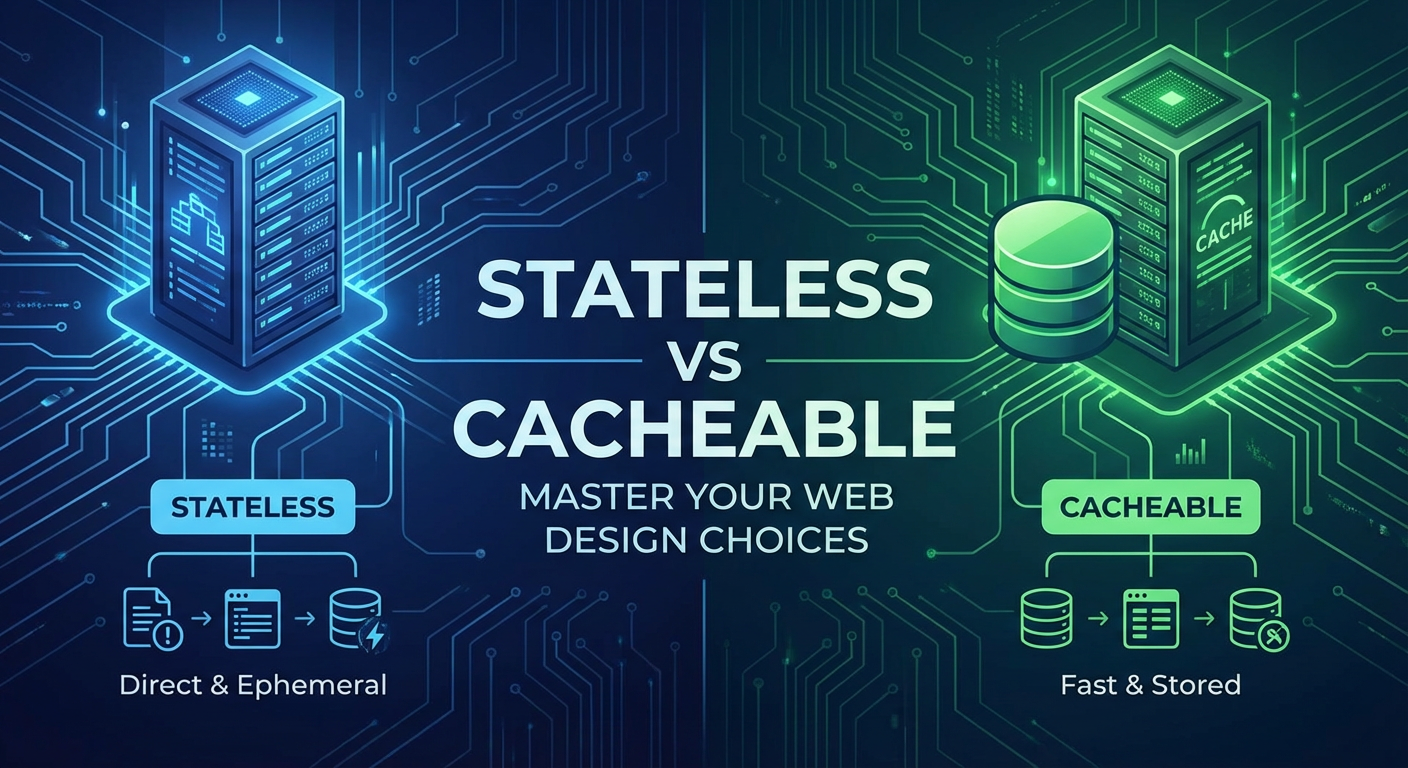


The architecture of modern web applications is a delicate dance between speed, scalability, and maintainability. In this intricate choreography, two fundamental concepts often emerge as pivotal design choices: statelessness and cacheability. While seemingly distinct, these paradigms are deeply intertwined, each amplifying the benefits of the other to forge web systems that are not only performant and robust but also exceptionally agile. Mastering the nuances of stateless design and intelligent caching is no longer a luxury but a prerequisite for any enterprise looking to thrive in an increasingly demanding digital landscape.
This extensive guide will delve into the core principles of stateless architecture, elucidating its inherent advantages and the challenges it presents. We will then explore the multifaceted world of caching, understanding its mechanisms, strategies, and the perennial problem of cache invalidation. Crucially, we will uncover how these two concepts synergize, allowing for the construction of highly efficient and resilient web services. Furthermore, we will examine the critical roles of infrastructure components like the API Gateway and the overarching framework of API Governance, bolstered by standardization efforts such as OpenAPI, in orchestrating these architectural choices. By the end, you will possess a comprehensive understanding to make informed decisions that optimize your web design for the future.
Chapter 1: The Foundations of Statelessness in Web Architecture
The bedrock of much of the modern internet is built upon a principle that often goes unnoticed by the casual user: statelessness. To truly master web design choices, one must first grasp the profound implications of an architecture where the server operates without memory of past client interactions.
What is Statelessness? Unpacking the Core Concept
At its heart, a stateless architecture dictates that each request from a client to a server must contain all the information necessary for the server to understand and process that request. The server, in turn, stores no client context or session data between requests. When a client sends a subsequent request, it is treated as an entirely new, independent interaction, devoid of any presumed knowledge from prior communications. This is in stark contrast to stateful systems, where the server might maintain a "session" object, remembering user preferences, authentication status, or shopping cart contents across multiple requests.
HTTP, the ubiquitous protocol underpinning the web, is inherently stateless. Every HTTP request (GET, POST, PUT, DELETE, etc.) is designed to be self-contained. When your browser requests a webpage, it sends all necessary headers, cookies, and body data for that specific request. Once the server responds, it typically discards any immediate context related to that interaction, preparing itself for the next, potentially unrelated, request.
The Pillars of Stateless Design: Benefits That Transform Web Systems
The adherence to statelessness yields a multitude of architectural advantages that are critical for building scalable, resilient, and maintainable web applications.
1. Unparalleled Scalability
Perhaps the most significant benefit of statelessness is its impact on scalability. In a stateless system, any server instance can handle any client request at any given time. This eliminates the need for "sticky sessions," where a client's requests must always be routed to the same server that initiated their session. - Horizontal Scaling: When demand increases, you can simply add more server instances (e.g., virtual machines, containers) behind a load balancer. The load balancer can distribute incoming requests across all available servers without concern for maintaining session affinity. This makes scaling out a trivial operational task, rather than a complex engineering challenge. - Elastic Cloud Environments: Stateless applications are perfectly suited for cloud environments that offer elastic scaling. Services can scale up or down automatically based on traffic, spinning up new instances or shutting them down without worrying about disrupting active user sessions. This efficiency translates directly into cost savings and improved resource utilization. - Containerization and Serverless: Technologies like Docker, Kubernetes, and serverless platforms (AWS Lambda, Azure Functions) thrive on stateless principles. Containers can be started, stopped, and replaced rapidly, while serverless functions are ephemeral, executing code on demand without persistent state, making stateless design a natural fit.
2. Enhanced Resilience and Fault Tolerance
Statelessness inherently improves the resilience of a system. If a server processing a client's request crashes, it does not lead to the loss of a persistent session state on that server. - Seamless Recovery: The next request from that client can simply be routed to any other available server instance by the load balancer. The client might experience a momentary delay or need to re-authenticate, but the system as a whole remains operational, and the user's progress isn't tied to a single, fragile server. - Easier Deployments and Updates: Deploying new versions of an application or performing rolling updates becomes much simpler. Old server instances can be gracefully drained and replaced with new ones without needing to migrate or restart complex session states. This reduces downtime and minimizes the risk associated with changes.
3. Simplified Server-Side Logic
With no session state to manage, the server-side application logic becomes considerably simpler. Developers no longer need to write complex code to manage session creation, destruction, timeouts, or data consistency across multiple servers. - Reduced Memory Footprint: Servers consume less memory as they don't need to store potentially thousands or millions of active user sessions. - Fewer Bugs: The absence of shared, mutable state often leads to fewer race conditions and concurrency issues, making the application easier to debug and more robust.
Navigating the Challenges of Statelessness
While offering significant advantages, statelessness also introduces its own set of considerations and challenges that require careful design.
1. Increased Data Transfer and Request Size
Since each request must carry all necessary information, the size of individual requests can increase. This often includes authentication tokens, user preferences, or other context that would typically be stored in a server-side session. - Mitigation: Efficient serialization formats (like JSON) and well-designed API contracts can help minimize payload size. HTTP/2 and HTTP/3 protocols also offer features like header compression to reduce overhead.
2. Managing User State: Client-Side Responsibilities
In a stateless system, the burden of managing user-specific state shifts primarily to the client. - Authentication and Authorization: - Cookies: While stateless from the server's perspective (the server doesn't store the cookie's content), cookies allow the client to send an identifier with each request. This identifier can be a session ID (often then linked to a separate stateful session store like Redis, which means the application server is stateless, but the overall system has a stateful component) or a self-contained token. - JSON Web Tokens (JWTs): These are a cornerstone of modern stateless authentication. A JWT is a compact, URL-safe means of representing claims to be transferred between two parties. It consists of a header, a payload (containing claims like user ID, roles, expiration), and a signature. The server issues a JWT upon successful login, and the client stores it (e.g., in local storage, cookies). For subsequent requests, the client includes the JWT in the Authorization header. The server can then validate the JWT's signature and extract the user information without needing to query a database or maintain any server-side session state. - Multi-Step Processes: For workflows like a multi-page form or an e-commerce checkout, the client must manage the intermediate state. This can be done by storing data in the browser's local storage, passing data as hidden form fields, or using URL parameters.
3. Security Considerations with Tokens
The reliance on tokens like JWTs for authentication in stateless systems introduces specific security concerns: - Token Revocation: Once a JWT is issued, it remains valid until its expiration. Revoking an individual JWT before its natural expiration (e.g., after a user logs out or changes password) can be challenging without introducing a server-side blacklist (which reintroduces a form of state). Strategies involve short-lived access tokens combined with longer-lived refresh tokens. - Token Compromise: If a JWT is intercepted, an attacker can use it until it expires. Proper token storage (e.g., secure, HTTP-only cookies to mitigate XSS) and encryption are paramount.
RESTful APIs: The Quintessential Stateless Design
The Representational State Transfer (REST) architectural style, championed by Roy Fielding, is the most prominent embodiment of statelessness in modern web services. One of REST's core architectural constraints is that of "Statelessness." A RESTful API treats each request as independent, providing resources identified by URIs, manipulated by standard HTTP methods (GET, POST, PUT, DELETE), and represented in formats like JSON or XML. This stateless design makes RESTful APIs incredibly scalable and interoperable, forming the backbone of countless microservices architectures and distributed systems.
Chapter 2: Embracing Cacheability for Performance Optimization
While statelessness lays the groundwork for scalability and resilience, achieving peak performance in web applications heavily relies on intelligent caching. Cacheability is the property of a resource that allows it to be stored temporarily, either by the client, an intermediary proxy, or the server itself, to reduce the need for future re-computation or re-retrieval from its original source.
The Imperative of Caching: Why It Matters So Much
Caching is fundamentally about optimizing data access and resource utilization. Its benefits are profound and far-reaching:
1. Drastic Latency Reduction
By storing a copy of a resource closer to the requesting entity, caching significantly reduces the time it takes to retrieve that resource. Instead of a request traveling across networks to an origin server, waiting for processing, and then traveling back, the cached copy can be served almost instantly from a local store or an edge location. This direct impact on response times is crucial for user experience.
2. Significant Bandwidth Savings
When a resource is served from a cache, it often eliminates the need to transfer the data across the wider internet. This conserves network bandwidth, which is particularly beneficial for mobile users, regions with expensive data plans, or for reducing operational costs of data transfer in cloud environments.
3. Reduced Server Load
Every time a request is served from a cache, the origin server is spared the work of processing that request, fetching data, and generating a response. This offloading allows origin servers to handle a greater number of unique, uncached requests or perform more complex computations, enhancing overall system capacity and stability.
4. Improved User Experience
Faster load times, more responsive applications, and a smoother browsing experience are direct results of effective caching. In today's competitive digital landscape, even milliseconds of delay can lead to user frustration and abandonment.
The Landscape of Caching: Where and How It Happens
Caching occurs at multiple layers within the web architecture, each serving a specific purpose.
1. Client-Side Cache (Browser Cache)
The most immediate form of caching happens directly within the user's web browser. When a browser requests a resource (HTML, CSS, JavaScript, images), it can store a local copy for future use. - HTTP Cache Headers: Browsers rely heavily on HTTP response headers to determine caching behavior: - Cache-Control: This is the most powerful and flexible header. Directives include: - max-age=<seconds>: Specifies how long a resource is considered fresh. - no-cache: The cache must revalidate the resource with the origin server before using it. It does not mean "do not cache." - no-store: The cache should never store a copy of the resource. Used for sensitive data. - public: Any cache (client or proxy) can store the resource. - private: Only the client's private cache (e.g., browser) can store the resource. - must-revalidate: The cache must revalidate stale responses with the origin server before use. - Expires: An older header specifying an absolute date/time after which the response is considered stale. Cache-Control max-age takes precedence. - Validation Mechanisms: - ETag (Entity Tag): A unique identifier or hash for a specific version of a resource. When a browser has a cached ETag, it sends an If-None-Match header in a subsequent request. If the server's resource ETag matches, it returns a 304 Not Modified status, signaling the browser to use its cached copy without re-downloading. - Last-Modified: The date and time the resource was last modified. The browser sends an If-Modified-Since header. If the resource hasn't changed since that date, the server returns 304 Not Modified.
2. Proxy Cache (Intermediate Caches)
These caches sit between the client and the origin server. - Content Delivery Networks (CDNs): CDNs are globally distributed networks of proxy servers. They store copies of web content (images, videos, static files, dynamic content) at "edge locations" close to users. When a user requests content, it's served from the nearest CDN node, dramatically reducing latency and improving availability. Examples include Cloudflare, Akamai, AWS CloudFront. - Reverse Proxies / Load Balancers: Servers like Nginx or Varnish Cache can be configured as reverse proxies at the entry point of your infrastructure. They can cache responses from your backend application servers, further reducing the load on them. This is particularly effective for highly trafficked static assets or frequently accessed API responses.
3. Server-Side Cache (Application/Data Layer)
Caching can also be implemented within the server's own infrastructure. - In-Memory Caches: Fast key-value stores like Redis or Memcached can cache results of database queries, computationally intensive operations, or frequently accessed objects directly in RAM, offering extremely low-latency access. - Database Caching: Databases themselves often have internal caching mechanisms (e.g., query caches, buffer pools) to speed up data retrieval. - Application-Level Caching: Developers can implement caching logic directly within their application code, storing results of function calls or rendered templates.
Strategies for Effective Caching: Navigating the Complexities
While the benefits are clear, effective caching is not without its challenges. The primary problem, often cited as one of the hardest in computer science, is cache invalidation.
1. Cache Invalidation Strategies
- Time-Based Invalidation (TTL - Time To Live): The simplest approach, where cached items are automatically removed after a set duration. This is suitable for data that can tolerate some staleness or changes infrequently.
- Event-Driven Invalidation: When the source data changes, an event is triggered to explicitly invalidate the corresponding cache entry. This ensures cache freshness but adds complexity in managing events across distributed systems.
- Cache Busting: For static assets like CSS or JavaScript files, appending a version number or a hash of the file content to its URL (e.g.,
style.css?v=12345orbundle.1a2b3c.js) forces clients and proxies to fetch the new version whenever the file changes, effectively bypassing old caches. - Stale-While-Revalidate/Stale-If-Error: HTTP Cache-Control directives that allow a cache to serve stale content while asynchronously revalidating it in the background (
stale-while-revalidate), or to serve stale content if an error occurs during revalidation (stale-if-error). This improves perceived performance and resilience.
2. Cache Keys
Choosing an effective cache key is crucial for identifying and retrieving cached items efficiently. A good cache key should uniquely represent the underlying data or response it caches. For APIs, this often involves a combination of the URL path, query parameters, request headers (especially Accept for content negotiation), and potentially authentication tokens (if responses vary by user).
3. Choosing What to Cache
Not everything should be cached. - Static Assets: Images, CSS, JavaScript files are ideal candidates. - Immutable Data: Data that rarely or never changes (e.g., historical records, product catalogs that are updated infrequently). - Frequently Read, Rarely Written Data: Public data that is accessed often but modified infrequently. - Computationally Expensive Results: The output of complex calculations or slow database queries. - Avoid Caching Sensitive, User-Specific Data in Public Caches: Use Cache-Control: private or no-store for personalized or confidential information.
The Inherent Challenges of Caching
Despite its immense value, caching introduces complexities that require careful design and management.
1. The Problem of Stale Data
This is the fundamental trade-off. Aggressive caching can lead to users seeing outdated information. Balancing freshness with performance is a constant struggle.
2. Cache Invalidation Complexity
Ensuring that all caches (browser, proxy, server-side) are consistently updated or invalidated when the source data changes is notoriously difficult, especially in distributed systems. A common pitfall is "cache coherence" – ensuring all cached copies of a resource are consistent with each other.
3. Security Risks
Improper caching can expose sensitive data. If a public cache stores private user information, it becomes a security vulnerability. Careful use of private and no-store directives is essential.
4. Cache Warm-up
When a cache is empty (e.g., after a deployment or server restart), it's called a "cold cache." The initial requests will bypass the cache, potentially leading to slower performance until the cache fills up. Strategies like pre-fetching or pre-loading can mitigate this.
By understanding these principles and challenges, web designers can leverage caching to deliver highly performant applications, provided they approach it with a well-thought-out strategy.
Chapter 3: The Interplay: Statelessness and Cacheability Hand-in-Hand
While statelessness and cacheability are distinct concepts, they are far from independent. In fact, a thoughtfully designed stateless system often paves the way for highly effective caching, creating a powerful synergy that forms the backbone of modern, scalable web architectures.
The Synergy: How Stateless Design Enhances Cacheability
The very nature of a stateless interaction makes resources more amenable to caching. When a server processes a request without relying on any prior context, it implies that, for a given identical request, it should consistently produce an identical response (assuming no underlying data changes). This predictability is precisely what caches thrive on.
1. Idempotency and Consistent Responses
A key principle in stateless web services, particularly RESTful ones, is idempotency. An operation is idempotent if applying it multiple times yields the same result as applying it once. GET, PUT, and DELETE methods in HTTP are designed to be idempotent. - GET requests, which retrieve data, are inherently safe and idempotent. When a client performs a GET request to a specific URI with particular parameters, a stateless server should always return the same representation of that resource. This makes GET requests perfect candidates for caching. If the response to /users/123 is always the same for a given moment in time, any cache can store and serve it. - Because responses are predictable and don't depend on the "session" state, caches can store and serve these responses confidently, knowing they accurately represent the current state of the resource.
2. Uniform Resource Identification
Stateless architectures, especially those following REST principles, emphasize uniform resource identification (URIs). A resource is identified by its URI, and its representation is what is exchanged. This consistent identification allows caches to effectively map URIs to their corresponding cached responses. A client requesting GET /api/products/456 will always be looking for the same logical resource, irrespective of previous interactions.
3. Simplified Cache Keys
In a stateless environment, a cache key can often be as straightforward as the request URL, headers that influence content negotiation (like Accept-Language or User-Agent with the Vary header), and query parameters. There's no complex session ID to factor in that might change the resource representation, simplifying cache lookup logic.
Designing APIs for Optimal Caching in a Stateless World
To fully harness the combined power of statelessness and cacheability, APIs must be designed with these principles in mind.
1. Predictable and Consistent URLs
Resource identifiers (URIs) should be stable and descriptive. Avoid dynamic URLs that change without a change in the underlying resource, as this undermines caching. For example, GET /api/articles/latest is more cacheable than GET /api/articles?timestamp=current.
2. Appropriate HTTP Methods
Always use HTTP methods semantically. Use GET for data retrieval, POST for creating new resources, PUT for updating existing ones, and DELETE for removing them. GET requests are most commonly cached, but POST requests can also be cached under specific conditions (e.g., if the server indicates it via Cache-Control).
3. Robust Cache Headers in Responses
The server should explicitly communicate its caching policies through HTTP response headers (Cache-Control, ETag, Last-Modified). This empowers clients and intermediate proxies to make informed caching decisions. For instance, an API for public data might respond with Cache-Control: public, max-age=3600, indicating it can be cached for an hour by any cache.
4. API Versioning
When an API undergoes significant changes that alter its structure or behavior, versioning is crucial. This can be done via URL (e.g., /v1/products, /v2/products), headers, or query parameters. Versioning helps with cache invalidation for API clients, as older cached responses for /v1/products won't interfere with new requests to /v2/products.
The Indispensable Role of the API Gateway
In modern, distributed architectures, particularly those built on microservices, an API Gateway acts as a single entry point for clients consuming multiple backend services. This strategic position makes the API Gateway a pivotal component in managing both stateless interactions and optimizing cacheability.
1. Centralized Caching at the Edge
An API Gateway can implement comprehensive caching policies at the edge of your infrastructure, closer to the client and further away from the origin services. - Response Caching: It can cache the full responses from backend services, serving them directly to subsequent requests without ever hitting the origin. This significantly reduces latency and offloads your backend. - Fragment Caching: For dynamic pages composed of multiple components, the gateway might cache individual fragments. - Load Reduction: By serving cached content, the gateway absorbs a significant portion of the traffic, protecting backend services from overload.
2. Facilitating Stateless Authentication and Authorization
While backend services remain stateless, an API Gateway can handle the complexities of authenticating and authorizing requests. - Token Validation: It can validate JWTs, API keys, or OAuth tokens, performing security checks before forwarding requests to the internal services. This means backend services receive already authenticated requests and don't need to implement their own authentication logic, allowing them to remain truly stateless and focused solely on business logic. - Rate Limiting and Throttling: The gateway can apply rate limits to prevent abuse and protect backend services from denial-of-service attacks, contributing to overall system stability and performance.
3. Traffic Management and Load Balancing
The API Gateway is often co-located with load balancers, dynamically routing requests to available backend service instances. This capability is inherently enhanced by statelessness, as any instance can handle any request.
4. Content Transformation and Aggregation
The gateway can transform request/response formats, aggregate responses from multiple services, or adapt content for different client types. This allows for a consistent API interface to the outside world while maintaining flexibility internally.
This is precisely where platforms like APIPark shine. APIPark, an open-source AI gateway and API management platform, is engineered to manage, integrate, and deploy AI and REST services with remarkable efficiency. Its performance, rivaling Nginx, underscores its capability to handle high TPS, critical for both stateless and cache-optimized architectures. By offering quick integration of over 100+ AI models and providing a unified API format for AI invocation, APIPark streamlines the process for developers, ensuring that these complex services can be exposed in a consistent, stateless, and hence, more cacheable manner. Its ability to support cluster deployment further reinforces its role in handling large-scale traffic for modern web services, effectively bridging the gap between sophisticated backend logic and high-performance, accessible APIs.
The API Gateway acts as an intelligent intermediary, centralizing many cross-cutting concerns (security, caching, routing, monitoring) that would otherwise clutter individual backend services. This abstraction allows developers to focus on building stateless, single-responsibility services, while the gateway ensures these services are exposed efficiently and securely to consumers, leveraging caching wherever possible to maximize performance.
APIPark is a high-performance AI gateway that allows you to securely access the most comprehensive LLM APIs globally on the APIPark platform, including OpenAI, Anthropic, Mistral, Llama2, Google Gemini, and more.Try APIPark now! 👇👇👇
Chapter 4: API Governance and the Standardized Landscape with OpenAPI
As web architectures grow in complexity, encompassing numerous microservices and external integrations, the need for stringent API Governance becomes paramount. This discipline ensures that APIs, whether stateless, cacheable, or a combination thereof, are consistently designed, implemented, and managed throughout their lifecycle. A cornerstone of effective API Governance in today's landscape is the OpenAPI Specification, which provides a universal language for defining API contracts.
The Mandate of API Governance: Ensuring Order in a Dynamic Ecosystem
API Governance refers to the comprehensive set of rules, processes, standards, and tools that an organization implements to manage its APIs from inception to retirement. It provides the framework for ensuring consistency, security, performance, and reliability across all API offerings. Without robust governance, an organization's API landscape can quickly become a chaotic tangle of inconsistent interfaces, security vulnerabilities, and performance bottlenecks.
Why API Governance is Crucial for Stateless and Cacheable Designs:
- Consistency in Design: Governance mandates consistent API design patterns, naming conventions, and resource modeling. This consistency directly supports statelessness, as it makes API interactions predictable. For cacheability, consistent URIs, request parameters, and response structures mean caches can more reliably store and retrieve resources.
- Standardized Authentication and Authorization: Governance defines the single, approved method for authentication (e.g., OAuth 2.0 with JWTs). This ensures all APIs handle authentication in a uniform, stateless manner, simplifying client implementations and centralizing security management. It also dictates how authorization is enforced, preventing unauthorized access.
- Defined Caching Policies: A robust governance framework establishes clear caching policies for different types of API resources. This includes specifying appropriate
Cache-Controlheaders,ETags, andLast-Modifieddirectives, as well as guidelines on which data can be cached (e.g., publicly vs. privately) and for how long. Such policies prevent the caching of sensitive data in public caches and mitigate stale data issues. - Performance and SLA Adherence: Governance often includes performance targets and Service Level Agreements (SLAs). By mandating efficient, stateless designs and intelligent caching, organizations can ensure APIs meet these performance benchmarks, reducing latency and increasing throughput.
- Security and Compliance: Governance ensures that APIs adhere to enterprise security policies and regulatory compliance requirements (e.g., GDPR, HIPAA). This involves defining security best practices for API endpoints, data encryption, input validation, and secure handling of tokens in stateless architectures. It also guides how data privacy is maintained when caching, ensuring sensitive information is never accidentally exposed.
- Lifecycle Management: From design and development to testing, deployment, versioning, and eventual deprecation, API Governance provides a structured approach. This means that changes affecting statelessness or cacheability are managed systematically, preventing breaking changes or unintended side effects.
OpenAPI Specification (OAS): The Blueprint for API Design
The OpenAPI Specification (formerly known as Swagger Specification) is a language-agnostic, human-readable format (typically YAML or JSON) for describing RESTful APIs. It serves as a universal blueprint, providing a precise contract for an API's capabilities and interactions. For API Governance, OpenAPI is an invaluable tool, transforming abstract policies into concrete, verifiable definitions.
Key Benefits of OpenAPI for Stateless and Cacheable API Design:
- Clear and Unambiguous API Contract: OpenAPI meticulously defines an API's endpoints, HTTP methods, request parameters (path, query, header, body), response structures (including status codes and data schemas), and security schemes. This clarity ensures that both API producers and consumers have a consistent understanding of how to interact with the API, fostering predictability essential for statelessness and enabling efficient client-side development.
- Facilitating Consistency through Design-First: By encouraging a design-first approach, OpenAPI prompts architects and developers to meticulously plan their APIs before writing code. This allows for early identification of inconsistencies and helps enforce standards, leading to more uniform, stateless, and cacheable API designs across an organization. It's much easier to apply governance policies (like mandatory cache headers for certain resources) when the API is being designed in OpenAPI.
- Automated Tooling and Ecosystem: The OpenAPI ecosystem is rich with tools that leverage the specification:
- Interactive Documentation: Tools like Swagger UI generate beautiful, interactive API documentation directly from the OpenAPI definition, allowing developers to explore and test endpoints effortlessly.
- Code Generation: Server stubs (boilerplate code for API implementation) and client SDKs (libraries for consuming the API in various programming languages) can be automatically generated, reducing development time and ensuring consistent client integration.
- Testing and Validation: OpenAPI definitions can be used to generate automated tests, validate API responses against defined schemas, and ensure compliance with design standards.
- Defining Cacheability within OpenAPI: Critically, OpenAPI allows for the explicit definition of HTTP response headers within the specification. This means API designers can specify the
Cache-Control,ETag, andLast-Modifiedheaders that should be included in responses for particular endpoints. By documenting these cache directives, OpenAPI guides clients and intermediate caches on how to treat responses, thereby enforcing caching policies at the design level and making cache strategies transparent. This enables automated gateway configurations or client-side caching logic to be built directly from the OpenAPI contract. - Enhanced Discoverability and Integration: A well-documented OpenAPI specification makes APIs easily discoverable and understandable for internal and external developers. This transparency fosters greater adoption and smoother integration processes, which are hallmarks of a well-governed API program.
Beyond just an efficient gateway, APIPark champions robust API Governance through its end-to-end API lifecycle management capabilities. From design to deployment and decommissioning, APIPark assists in regulating API management processes, ensuring consistency and adherence to standards. Its features like "Unified API Format for AI Invocation" and "Prompt Encapsulation into REST API" are perfect examples of how it standardizes complex AI interactions into predictable, RESTful, and thus inherently more cacheable and stateless patterns, making them easier to govern. Furthermore, APIPark centralizes API service sharing within teams and offers independent API and access permissions for each tenant, embodying the principles of effective API Governance that are crucial for scaling complex, distributed systems. With APIPark's "API Resource Access Requires Approval" feature, organizations can implement granular security policies, ensuring that API consumption aligns with pre-defined governance rules, preventing unauthorized API calls and potential data breaches, which is a critical aspect of responsible API management. This holistic approach ensures that APIs are not only performant and scalable but also secure, compliant, and easy to manage throughout their entire existence.
In essence, API Governance provides the strategic direction and rules, while OpenAPI provides the tactical blueprint to implement those rules. Together, they create an environment where stateless and cacheable APIs can flourish, maximizing their benefits while minimizing the risks inherent in complex, distributed systems.
Chapter 5: Advanced Considerations and Best Practices
While statelessness and cacheability form a powerful duo, the real world of web design often calls for more nuanced approaches. Understanding advanced considerations and best practices allows architects to fine-tune their systems for optimal performance, security, and resilience.
Hybrid Architectures: Blending State where Necessary
Though statelessness is generally preferred for scalability, there are scenarios where maintaining some form of state is unavoidable or even beneficial. Real-time applications, long-polling, WebSockets, or intricate multi-step transactional processes might require a stateful component. - Strategic State Management: In hybrid architectures, the core services typically remain stateless, but specialized services or components might manage specific, isolated state. For instance, a chat service might be stateful (maintaining WebSocket connections), while user profile lookups remain stateless. - Gateway as a Mediator: The API Gateway can play a crucial role in mediating between stateless and stateful components. It can route requests to the appropriate service, abstracting the underlying statefulness from the client. For example, it can manage sticky sessions for WebSocket connections while handling stateless REST calls to other services. - Externalizing State: Often, even when a system needs state, it can be externalized to a dedicated, highly available state store (e.g., Redis, database, Kafka for event streams) rather than being kept in the application server's memory. This allows the application servers themselves to remain stateless and horizontally scalable, while the state is managed separately.
Edge Computing and CDNs, Revisited: Pushing Logic Closer to the User
The trend of moving computation and data storage closer to the end-user, known as edge computing, is a powerful extension of caching principles. CDNs, once primarily for static content, now offer capabilities for running serverless functions at the edge (e.g., Cloudflare Workers, AWS Lambda@Edge). - Enhanced Performance: By executing logic at the edge, organizations can further reduce latency for dynamic content and API responses, not just static assets. This means that even some processing or basic API calls can occur at the closest geographic point to the user, enhancing the responsiveness of inherently stateless interactions. - Reduced Origin Load: Edge functions can preprocess requests, validate them, or even serve full dynamic responses from the cache without ever reaching the origin server. This offloads significant compute from your central infrastructure. - Personalization at the Edge: While adhering to private caching rules, edge functions can perform lightweight personalization, ensuring a balance between caching efficiency and tailored user experiences.
Microservices and Distributed Systems: A Natural Fit
Statelessness is almost a prerequisite for the success of microservices architectures. Each microservice should ideally be independent, deployable, and scalable on its own. - Independent Scaling: Stateless microservices can be scaled independently without complex session management across service boundaries. - Resilience: The failure of one stateless microservice doesn't cascade session loss across the entire system. - Intelligent Caching for Inter-service Communication: In a microservices ecosystem, services often call other services. Implementing intelligent caching at the service-to-service communication layer (e.g., using a client-side cache within a service for frequently accessed data from another service) is crucial to avoid "death by a thousand cuts" from numerous small, chatty API calls. An API Gateway also serves this function for external-to-internal calls.
Security Implications: Guarding Both Stateless and Cacheable Paradigms
Security must be a paramount consideration for both statelessness and cacheability.
1. Stateless Security: Token Management
- Secure Token Handling: Ensure JWTs and other tokens are generated securely, signed with strong algorithms, and have appropriate expiration times.
- Token Storage: Clients must store tokens securely (e.g., HTTP-only cookies to prevent XSS attacks for authentication tokens;
localStoragefor access tokens that might be used by JavaScript, but with caution regarding XSS). - Revocation Strategies: Implement mechanisms for token revocation (e.g., short-lived access tokens with refresh tokens, or a centralized token blacklist for critical security events) even if it introduces a minor state component for security purposes.
- Data Confidentiality: Ensure all communication (including tokens) is encrypted with TLS/SSL.
2. Cacheable Security: Preventing Data Leaks
- Prevent Caching of Sensitive Data: Strictly enforce
Cache-Control: no-storeorprivatefor any response containing personally identifiable information (PII), financial data, or other confidential information. - Vary Header: Use the
VaryHTTP header (Vary: Accept-Encoding, User-Agent) to inform caches that the response might differ based on specified request headers. This prevents caches from serving a cached response meant for one user agent or content type to another. For example, if an API response is personalized based on a custom header,Vary: Custom-Personalization-Headershould be used. - Authentication in Caches: Caching authenticated responses, even if
private, requires careful consideration. Ensure the cache key properly includes authentication identifiers to prevent one user's cached data from being served to another.
Monitoring and Analytics for Continuous Optimization
Effective web design is an ongoing process of iteration and optimization. Monitoring and analytics are essential for understanding how statelessness and caching strategies are performing in a real-world environment. - Cache Hit Ratios: Track the percentage of requests served from the cache versus those hitting the origin server. A high hit ratio indicates efficient caching. - Latency Metrics: Monitor response times, distinguishing between cached and uncached requests, to identify bottlenecks. - Error Rates: Observe error rates to detect issues with cache invalidation or backend service failures that caching might mask or exacerbate. - Resource Utilization: Analyze CPU, memory, and network usage on both origin servers and caching layers to ensure efficient resource allocation.
APIPark provides powerful tools in this domain. Its "Detailed API Call Logging" feature records every detail of each API call, offering granular insights into request paths, response times, and any associated errors. This comprehensive logging allows businesses to quickly trace and troubleshoot issues in API calls, ensuring system stability. Furthermore, APIPark's "Powerful Data Analysis" capabilities analyze historical call data to display long-term trends and performance changes. This predictive analysis helps businesses identify patterns, anticipate potential issues, and conduct preventive maintenance before problems impact users, making it invaluable for optimizing cache policies and overall system health. Such insights are critical for fine-tuning cache directives, identifying areas where more aggressive caching can be applied, or conversely, where caching is causing issues.
By continuously monitoring these metrics, architects and developers can make informed decisions to refine their stateless designs and caching strategies, ensuring their web applications remain robust, performant, and future-proof.
Conclusion: Orchestrating a Symphony of Speed and Scale
The journey through the realms of statelessness and cacheability reveals two powerful, complementary paradigms that lie at the core of modern web architecture. Stateless design, with its emphasis on independent, self-contained interactions, provides the foundational resilience and horizontal scalability necessary for systems to grow dynamically under fluctuating loads. It simplifies server logic and enhances fault tolerance, making applications easier to manage and deploy.
In parallel, cacheability emerges as the indispensable engine of performance. By strategically storing and serving resources closer to the user, caching dramatically reduces latency, conserves bandwidth, and significantly lightens the load on origin servers. However, the art of caching lies in mastering its complexities, particularly the challenge of cache invalidation and ensuring data freshness without compromising consistency.
The true mastery in web design, therefore, lies not in choosing one over the other, but in orchestrating their synergistic interplay. A well-designed stateless API, with its predictable responses and clear contracts, inherently lends itself to highly effective caching. This powerful combination is further amplified by intelligent infrastructure components like the API Gateway, which centralizes concerns such as caching, authentication, and traffic management, thereby offloading backend services and streamlining the path to optimal performance. Platforms like ApiPark, an open-source AI gateway and API management platform, stand as exemplars of how an intelligent gateway can provide high-performance foundations, manage complex API lifecycles, and facilitate consistent interactions for both AI and REST services, enabling the full potential of stateless and cacheable architectures.
Crucially, this intricate dance of statelessness and cacheability must be governed by a robust framework of API Governance. By establishing clear standards, processes, and tools, organizations ensure consistency, security, and performance across their API ecosystem. The OpenAPI Specification serves as the universal blueprint for this governance, translating abstract policies into concrete, machine-readable contracts that guide API design, development, and consumption.
Ultimately, mastering statelessness and cacheability is about crafting web systems that are not only fast and scalable but also resilient, secure, and adaptable to future demands. It's about building an architecture that gracefully handles the ever-increasing complexity of the digital world, ensuring that users consistently experience swift, reliable, and secure interactions. By meticulously integrating these design choices, supported by powerful tools and disciplined governance, you pave the way for web applications that truly stand the test of time.
Frequently Asked Questions (FAQs)
1. Can a web system be both stateless and cacheable?
Absolutely, and ideally, it should be. A truly stateless system, especially one adhering to REST principles, is inherently more cacheable. When a server treats each request independently and always provides the same representation for the same resource (given the same parameters and assuming no underlying data changes), caches (whether client-side, proxy, or server-side) can store and serve these responses confidently. The predictability of stateless interactions is a key enabler for effective caching, allowing the two paradigms to work in powerful synergy for performance and scalability.
2. What are the biggest challenges in implementing an effective caching strategy?
The most significant challenge is cache invalidation – ensuring that cached data remains fresh and consistent with the origin source. This is notoriously difficult in distributed systems where multiple caches might hold copies of the same data, and changes to the original data need to propagate quickly and reliably to all cached copies. Other challenges include determining what to cache, choosing appropriate cache keys, managing cache eviction policies, dealing with cold caches (initial performance hit), and preventing the caching of sensitive or personalized data.
3. How does an API Gateway like APIPark contribute to both statelessness and cacheability?
An API Gateway acts as a central control point, strategically positioned to enhance both statelessness and cacheability. For statelessness, it can offload authentication and authorization from backend services (e.g., validating JWTs), allowing services to remain truly stateless. For cacheability, the gateway can implement centralized caching policies at the edge of the network, serving responses directly from its cache to reduce latency and offload backend services. APIPark, as an AI gateway and API management platform, excels in these areas, offering high performance (rivaling Nginx), managing the entire API lifecycle, and facilitating consistent API interactions for diverse services, thereby optimizing both stateless operations and caching efficiency.
4. Is storing server-side session state always a bad practice?
Not necessarily "bad," but it introduces trade-offs. While statelessness offers superior scalability and resilience for many web services, stateful components are sometimes necessary or more efficient for specific use cases (e.g., WebSockets for real-time communication, long-running processes, complex multi-step forms where client-side state management is cumbersome). The key is to be intentional about where state is managed. If server-side state is required, it's often best to externalize it to dedicated, highly available state stores (like Redis or a database) rather than keeping it in individual application server memory, allowing the application servers themselves to remain stateless and scalable.
5. What role does OpenAPI play in designing cacheable and stateless APIs?
OpenAPI (formerly Swagger) plays a crucial role by providing a standardized, machine-readable specification for RESTful APIs. For statelessness, it defines a clear contract for how each API endpoint operates independently, specifying inputs, outputs, and security schemes, which helps ensure consistency and predictability. For cacheability, OpenAPI allows API designers to explicitly define HTTP response headers, including Cache-Control, ETag, and Last-Modified, within the API's contract. This guides clients and intermediate caches on how to treat responses, enforcing caching policies at the design level and making caching strategies transparent and automatable. It promotes a design-first approach that naturally leads to more consistent, stateless, and cacheable API architectures.
🚀You can securely and efficiently call the OpenAI API on APIPark in just two steps:
Step 1: Deploy the APIPark AI gateway in 5 minutes.
APIPark is developed based on Golang, offering strong product performance and low development and maintenance costs. You can deploy APIPark with a single command line.
curl -sSO https://download.apipark.com/install/quick-start.sh; bash quick-start.sh

In my experience, you can see the successful deployment interface within 5 to 10 minutes. Then, you can log in to APIPark using your account.

Step 2: Call the OpenAI API.