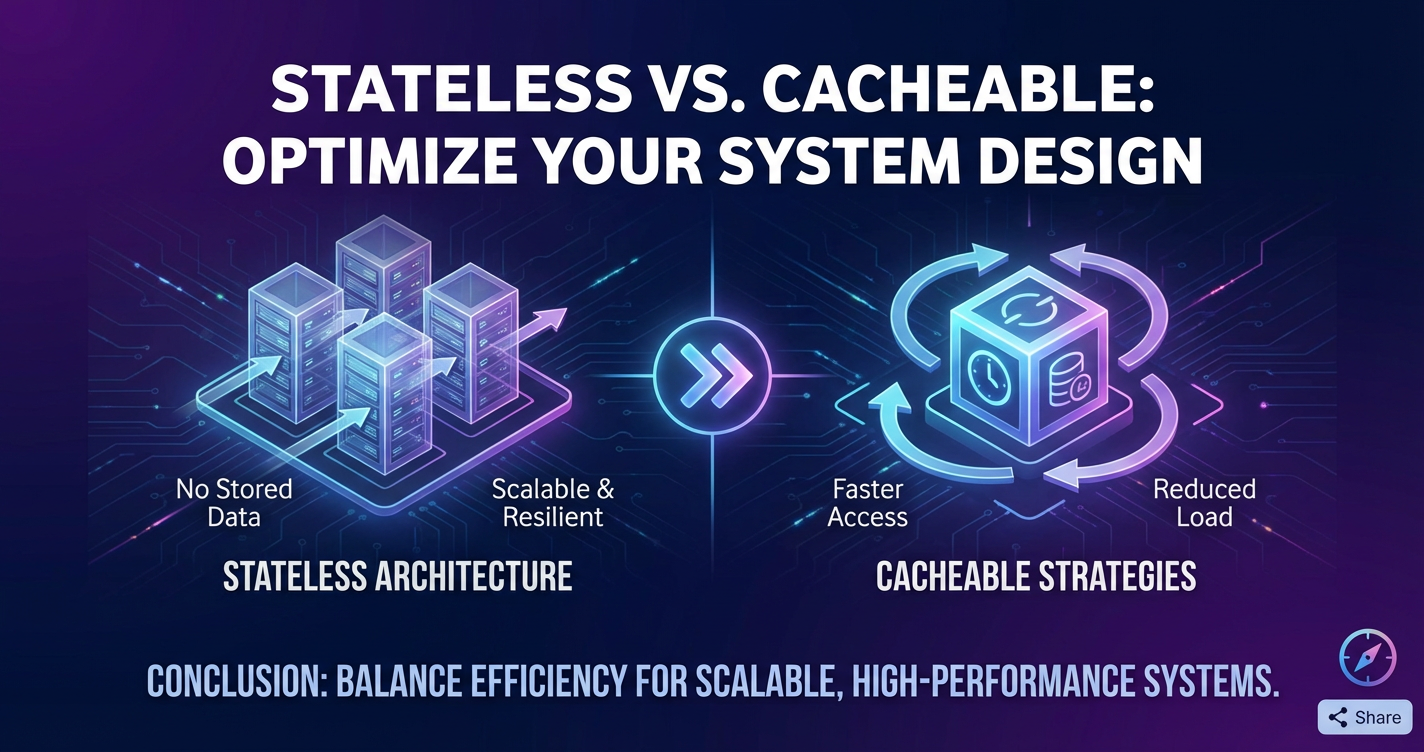
Stateless vs. Cacheable: Optimize Your System Design


In the vast and intricate landscape of modern software architecture, two fundamental paradigms often emerge as cornerstones for building resilient, scalable, and high-performance systems: statelessness and cacheability. While seemingly distinct, these concepts are not mutually exclusive; rather, they are powerful allies that, when understood and implemented effectively, can revolutionize how applications respond to demand, manage resources, and deliver exceptional user experiences. The journey through optimizing system design often begins with a critical evaluation of where state is maintained, how data flows, and where performance bottlenecks might arise. This exploration delves deep into the nuances of stateless architectures, the immense potential of caching strategies, and crucially, how to weave these two principles together to forge robust, efficient systems, often with the indispensable aid of an api gateway at the forefront.
The digital era demands systems that are not only functional but also capable of handling unprecedented loads, adapting to fluctuating user traffic, and maintaining consistent performance under pressure. Whether it’s a global e-commerce platform, a real-time data analytics engine, or a complex microservices ecosystem, the underlying architectural choices significantly dictate its ultimate success or failure. The pursuit of optimal system design is a continuous balancing act between performance, scalability, maintainability, and resource utilization. Understanding the core tenets of statelessness and cacheability provides architects and developers with a potent toolkit to navigate these challenges, enabling them to construct systems that are not just robust today, but also agile and future-proof. This extensive guide will dissect each concept, highlight their individual strengths and weaknesses, and demonstrate how their symbiotic relationship forms the bedrock of highly optimized, modern api-driven applications.
Deep Dive into Stateless Architecture: The Foundation of Scalability
A stateless architecture is a design principle where the server does not store any information about the client's session between requests. Each request from a client to the server is treated as an independent transaction, containing all the necessary information for the server to fulfill that request without relying on any prior context or server-side session data. This fundamental characteristic has profound implications for system design, primarily in achieving unparalleled scalability and resilience. In a truly stateless system, the server processes a request, generates a response, and then discards any memory of that interaction, ready to handle the next request from any client, anywhere.
The core principle of statelessness can be best understood through the lens of HTTP, the very protocol that underpins the web. HTTP is inherently stateless; each request from a browser to a web server is self-contained. While applications built on HTTP often introduce mechanisms to simulate state (like cookies or URL parameters), the underlying gateway and server don't inherently remember who you are from one request to the next. This purity of design is not merely an academic concept; it translates directly into tangible benefits for modern distributed systems, especially those built around microservices and robust api interactions. When an api is designed to be stateless, every request sent to the api gateway can be routed to any available instance of the backend service, as no instance holds specific user session data that another instance might need.
The Defining Characteristics of Stateless Systems
To fully grasp the power of statelessness, it's crucial to understand its defining characteristics:
- Self-Contained Requests: Every request sent from a client to the server must contain all the necessary information for the server to understand and process it. This includes authentication tokens, user IDs, request parameters, and any other data required for the operation. The server does not look up stored session data or client-specific context from previous interactions. This eliminates the need for session management on the server side, simplifying the server's logic and reducing its memory footprint.
- No Server-Side Session State: This is the most critical aspect. The server does not maintain session-specific data for any client. Once a request is processed and a response is sent, the server forgets about that particular client's interaction. This means that if the client sends another request, it must re-authenticate or re-provide any necessary context. While this might seem like an inconvenience, it is the key to achieving high availability and scalability.
- Independence of Requests: Each request is independent of previous requests. The order in which requests arrive does not affect the outcome of any individual request, provided each request is properly authorized and formed. This independence facilitates parallel processing and simplifies error recovery, as a failure in one request does not cascade through a dependent session state.
- Idempotency (Often Desired): While not strictly required for statelessness, many stateless
apiendpoints are designed to be idempotent. An idempotent operation is one that can be performed multiple times without changing the result beyond the initial application. For example, deleting a resource multiple times should have the same effect as deleting it once (the resource remains deleted). Idempotency greatly simplifies client-side logic for retries and makes distributed systems more robust against network issues or transient server failures.
The Unrivaled Advantages of Statelessness
The stateless paradigm offers a plethora of benefits that are highly coveted in today's demanding software landscape:
- Exceptional Scalability: This is arguably the most significant advantage. Since servers do not store session-specific data, any incoming request can be handled by any available server instance. This allows for horizontal scaling by simply adding more server instances behind a load balancer or
api gateway. There's no complex session replication or sticky session management required, which are often performance bottlenecks in stateful systems. The ability to scale out effortlessly means systems can handle massive traffic surges with minimal architectural overhead. Imagine anapi gatewayreceiving millions of requests per second; if backend services were stateful, managing session affinity would be a nightmare, but with statelessness, any instance can pick up any request, simplifying thegateway's routing logic immensely. - High Availability and Fault Tolerance: If a server instance crashes in a stateless system, it has no impact on active user sessions, because no session data is lost. Subsequent requests from clients can simply be routed to another available server instance. This provides inherent fault tolerance and high availability, as the failure of a single component does not lead to a widespread outage or loss of user progress. The system continues to operate seamlessly, gracefully degrading if many instances fail, but never losing critical user-specific state.
- Simplified Load Balancing: Without the need for sticky sessions, load balancers can distribute requests across server instances using simple, efficient algorithms like round-robin or least connections. This greatly simplifies infrastructure management and optimization, as the load balancer doesn't need to maintain complex state or direct specific users to specific servers. This is particularly beneficial when operating an
api gatewayfarm, as thegatewaycan simply forward requests to any healthy backendapiinstance. - Reduced Server Complexity and Memory Footprint: Eliminating server-side session management significantly simplifies the server's design and reduces the memory required per request. This means more resources are available for processing business logic, leading to better overall performance and lower operational costs. Developers can focus on the core functionality of the
apirather than wrestling with session synchronization issues. - Easier Testing and Debugging: Each request being independent makes testing simpler, as individual requests can be tested in isolation without setting up complex prior states. Debugging also becomes more straightforward, as issues are typically confined to the scope of a single request-response cycle, rather than involving intricate sequences of interactions across multiple requests.
- Better Resilience to Network Issues: If a client experiences a temporary network disruption, they can simply retry their request. Since the server holds no memory of the previous attempt, the new request is processed as if it were the first, contributing to a more robust user experience.
Disadvantages and Considerations for Statelessness
While the advantages are compelling, stateless architectures also come with certain considerations:
- Increased Request Size (Potentially): Because each request must carry all necessary information, requests can sometimes be larger than in stateful systems, where some context might be implicitly understood. However, this is often mitigated by using compact tokens (like JWTs for authentication) and efficient data serialization formats. The
api gatewaymight need to handle slightly larger payloads but the benefits typically outweigh this. - Need for External State Management (for some applications): While the server itself is stateless, applications often require persistent user data (e.g., shopping cart contents, user preferences). This state must be stored externally, typically in a shared database, a distributed cache, or a dedicated session store. This adds another component to the architecture, which must be highly available and performant. The
api gatewayitself doesn't typically manage this external state directly but routes requests to services that interact with it. - Security Implications of Token Management: With all authentication and authorization context often carried in tokens (like JWTs), proper token management becomes critical. Tokens must be securely signed, encrypted, and invalidated correctly when a user logs out or credentials are compromised. The
api gatewayplays a crucial role here, validating tokens before forwarding requests to backend services. - Redundancy in Data Fetching (Without Caching): In a purely stateless system without any caching, frequently requested data might be fetched repeatedly from the backend database or service for each request. This can lead to increased load on backend resources and higher latency for clients. This is where the concept of cacheability becomes not just useful, but absolutely essential.
Statelessness forms the bedrock of highly scalable and resilient systems, particularly in the realm of api design and microservices. It simplifies the core server logic and dramatically improves operational agility. However, to truly optimize performance and reduce backend load, stateless systems must be intelligently paired with effective caching strategies.
Deep Dive into Cacheable Design Principles: Accelerating Performance
Caching is a fundamental optimization technique used across all layers of computing, from CPU caches to Content Delivery Networks (CDNs). In the context of system design, cacheability refers to the ability of data or computational results to be stored temporarily in a faster-access tier, so that future requests for that same data can be served more quickly without reprocessing or re-fetching from the original, slower source. The objective of caching is simple yet powerful: reduce latency, offload backend systems, and improve the overall responsiveness and efficiency of an api or application.
The core idea is to trade off memory or storage space for speed. When a piece of data is requested for the first time, it is fetched from its primary source (e.g., a database, an external api, or a complex computation). Before being returned to the client, a copy of this data is stored in a cache. If the same data is requested again before it becomes stale or is explicitly removed, it can be served directly from the cache, bypassing the original source. This significantly reduces the time taken to fulfill the request and lessens the load on the backend. An api gateway, for instance, is an ideal place to implement caching for frequently accessed api responses.
What Makes Something Cacheable?
Not all data is equally suitable for caching. Effective caching relies on several characteristics of the data and the access pattern:
- Read-Heavy Access Patterns: Data that is read much more frequently than it is written or updated is an excellent candidate for caching. Static content (images, CSS, JavaScript files), product catalogs, public profiles, and frequently accessed configuration data fall into this category.
- Immutability or Infrequency of Change: Data that does not change often, or is effectively immutable, is ideal. The less frequently data changes, the longer it can remain in the cache without becoming stale, simplifying cache invalidation.
- Predictable or Repetitive Access: If the same requests are made repeatedly by different clients, caching those responses can yield significant benefits.
- Computational Expense: If generating a piece of data is computationally expensive (e.g., complex database queries, aggregations, AI model inferences), caching the result can save significant processing power and reduce response times.
Levels of Caching in a Modern System
Caching can be implemented at various layers of a system, each offering different trade-offs in terms of scope, control, and complexity. A comprehensive caching strategy often involves multiple layers working in concert:
- Client-Side Caching (Browser Cache):
- Description: The user's web browser stores copies of static assets (images, stylesheets, scripts) and often
apiresponses. - Mechanism: HTTP cache control headers (
Cache-Control,Expires,Last-Modified,ETag) instruct the browser on how long to cache content and how to validate it. - Advantages: Fastest access, reduces load on all upstream systems, immediate display of content.
- Disadvantages: Limited control over invalidation, specific to individual clients.
- Description: The user's web browser stores copies of static assets (images, stylesheets, scripts) and often
- Content Delivery Network (CDN) Caching:
- Description: A geographically distributed network of proxy servers that cache static and sometimes dynamic content close to the end-user.
- Mechanism: CDNs pull content from origin servers and serve it from their edge locations. Cache control headers and CDN-specific configurations govern caching behavior.
- Advantages: Dramatically reduces latency for geographically dispersed users, significantly offloads origin servers, improves global availability.
- Disadvantages: Cost, potential for stale content if invalidation isn't managed carefully, might not be suitable for highly dynamic or personalized content.
- API Gateway / Reverse Proxy Caching:
- Description: The
api gatewayor a reverse proxy (like Nginx, Envoy, or a dedicatedapi gatewaysolution) caches responses from backend services. - Mechanism: Configured at the
gatewaylevel, this cache storesapiresponses and serves them directly if a subsequent identical request arrives. - Advantages: Reduces load on backend services, centralizes caching logic, improves
apiresponse times for all clients hitting thegateway. This is an excellent place to implement caching for frequently accessed publicapiendpoints. - Disadvantages: Requires careful invalidation strategies, adds complexity to the
api gatewayconfiguration. For example, a powerfulapi gatewaylike APIPark can be configured to cache responses, significantly boosting performance and reducing load on downstream AI models or REST services.
- Description: The
- Application-Level Caching:
- Description: Implemented within the application code itself, caching frequently accessed data or computed results in memory or a local cache store.
- Mechanism: Developers use in-memory caches (e.g., Guava Cache, ConcurrentHashMap), or local file-based caches.
- Advantages: Fine-grained control over what is cached and when, can cache complex objects, reduces calls to databases or external services.
- Disadvantages: Memory consumption, cache coherence issues in distributed applications, needs explicit invalidation logic.
- Distributed Caching (e.g., Redis, Memcached):
- Description: A separate, highly optimized service that provides a shared, distributed cache for multiple application instances.
- Mechanism: Key-value stores where applications store and retrieve data. They are designed for high throughput and low latency.
- Advantages: Solves cache coherence for distributed applications, highly scalable, persistent storage options, ideal for shared session data or frequently accessed reference data.
- Disadvantages: Adds network round-trip for cache access, another component to manage, potential for single point of failure if not highly available.
- Database Caching:
- Description: Databases often have their own internal caches (e.g., query cache, buffer pool) to store frequently accessed data blocks or query results.
- Mechanism: Managed by the database system itself.
- Advantages: Automatic, improves database performance directly.
- Disadvantages: Limited control, might not be sufficient for very high traffic
apis, query cache can be invalidated by writes to the underlying tables.
The Mechanism of HTTP Caching
HTTP caching is primarily governed by a set of headers that allow servers to instruct clients and intermediaries (like api gateways and CDNs) on how to cache resources:
Cache-Control: The most important header. It dictates the caching policies:publicvs.private: Whether the response can be cached by shared caches (e.g.,api gateway) or only by private caches (e.g., browser).no-cache: Forces revalidation with the origin server before serving a cached copy.no-store: Prohibits caching entirely.max-age=<seconds>: Specifies the maximum amount of time a resource is considered fresh.s-maxage=<seconds>: Similar tomax-agebut applies only to shared caches (like CDNs,api gateway).must-revalidate: Cache must revalidate its status with the origin server before serving.
Expires: An older header, similar toCache-Control: max-age, specifies a date/time after which the response is considered stale. Less flexible thanCache-Control.ETag(Entity Tag): A unique identifier for a specific version of a resource. The client sends this tag in subsequent requests (If-None-Match), and if the server's resource version matches, it can respond with304 Not Modified, saving bandwidth.Last-Modified: The date and time the resource was last modified. Similar toETag, the client sends this in anIf-Modified-Sinceheader.
Challenges of Caching: The Cache Invalidation Problem
While caching offers immense benefits, it introduces a significant challenge: cache invalidation. This is famously described as one of the two hardest problems in computer science (alongside naming things and off-by-one errors). The goal is to ensure that cached data remains fresh and consistent with the original source. Stale data can lead to incorrect information being presented to users, causing data integrity issues or poor user experience.
Common strategies for cache invalidation include:
- Time-To-Live (TTL): Data is automatically removed from the cache after a predefined period. Simple to implement but might serve stale data until TTL expires, or fetch fresh data unnecessarily if TTL is too short.
- Write-Through/Write-Around/Write-Back: Different strategies for how data is written to the cache and the primary store.
- Event-Driven Invalidation: When the original data changes, an event is triggered to explicitly invalidate or update the corresponding entry in the cache. This is more complex but provides strong consistency guarantees.
- Cache-Aside: The application directly manages the cache. It checks the cache first; if not found (a "cache miss"), it fetches from the database, and then stores it in the cache. When data is updated, the application directly updates the database and then invalidates the cache entry.
| Caching Level | Primary Location | Typical Use Case | Advantages | Disadvantages |
|---|---|---|---|---|
| Client-Side | Browser | Static assets, api responses (short-lived) |
Fastest access, offloads all upstream systems | Limited control, client-specific |
| CDN | Edge Servers (Global) | Static content, public api data |
Geographic distribution, massive offload | Cost, complex invalidation, not for dynamic data |
| API Gateway | Gateway Layer |
Replicable api responses |
Reduces backend load, centralized control | Invalidation complexity, gateway overhead |
| Application-Level | Application Memory/Local | Frequently accessed objects | Fine-grained control, fast in-memory access | Coherence issues in distributed envs, memory use |
| Distributed Cache | Dedicated Cache Service | Shared data, sessions, api results |
Scalable, highly available, consistent across apps | Network latency, adds management overhead |
| Database-Level | Database System | Query results, data blocks | Automatic, transparent for applications | Limited control, often insufficient for high traffic |
Effective caching strategies are a cornerstone of high-performance systems. When combined with stateless design principles, caching allows systems to serve a vast number of requests with minimal latency, transforming potentially slow operations into near-instantaneous responses.
The Synergy: Combining Statelessness with Caching for Optimal Performance
The true power in optimizing system design often lies not in choosing between statelessness and cacheability, but in artfully combining them. Statelessness provides the architectural foundation for horizontal scalability and resilience, ensuring that any server can handle any request without internal state dependencies. Caching, on the other hand, supercharges performance by reducing the need to repeatedly process or fetch data, thereby cutting down latency and offloading backend services. When these two principles are harmoniously integrated, they create a robust, high-performance, and incredibly scalable system capable of handling immense loads efficiently.
Consider a typical api-driven application. Clients interact with an api gateway, which then routes requests to various backend microservices. If these microservices are designed to be stateless, they don't hold session data for any particular client. This means the api gateway can distribute requests across multiple instances of a service with ease, ensuring high availability and load balancing. However, even with stateless services, if every request requires fetching the same data from a database or performing the same expensive computation, the backend can still become a bottleneck. This is precisely where caching steps in.
How Caching Complements Stateless Services
Caching acts as a performance amplifier for stateless architectures by addressing the "redundancy in data fetching" challenge.
- Reducing Backend Load: For stateless
apiendpoints that serve frequently accessed, non-personalized data (e.g., product lists, public configuration, static content), caching theapiresponses at theapi gatewaylevel or in a distributed cache can drastically reduce the number of requests that ever hit the actual backend service. This offloads the database and application servers, allowing them to focus on more complex, personalized, or write-intensive operations. - Improving Response Times: By serving responses directly from a cache, the system eliminates the round-trip time to the backend service and the time spent processing the request there. This results in significantly faster response times for clients, leading to a much smoother and more responsive user experience.
- Enhancing Scalability: While statelessness enables horizontal scaling of services, caching enables scaling of requests. A cached response can serve thousands or millions of identical requests without requiring additional backend compute resources. This means the system can handle a much higher volume of overall traffic with the same number of backend instances, extending the effective capacity of the architecture.
- Resilience to Backend Failures: If a backend service temporarily fails or becomes overloaded, a well-implemented cache can continue to serve stale (but possibly acceptable) data for a period, providing a layer of resilience and allowing the system to maintain partial functionality during an outage. This is often referred to as "cache-as-a-service" or "circuit breaking" with cached responses.
Designing an API Gateway that Supports Both
An api gateway is a critical component in orchestrating this synergy. It acts as the single entry point for all client requests, providing a perfect vantage point to implement both stateless routing and intelligent caching.
- Stateless Request Routing: As established, an
api gatewaynaturally benefits from stateless backend services. It can route any incomingapirequest to any healthy instance of a target service without worrying about session affinity. This simplifies thegateway's configuration and enhances its fault tolerance and load distribution capabilities. - Centralized Caching Logic: The
api gatewayis an ideal place to implement sharedapiresponse caching. When a client requests data, thegatewayfirst checks its cache.- Cache Hit: If the response is found and is still fresh, the
gatewayimmediately returns it to the client, never touching the backend service. This is incredibly fast and efficient. - Cache Miss: If the response is not in the cache or is stale, the
gatewayforwards the request to the backend service. Once the backend responds, thegatewaystores a copy of the response in its cache (if configured to do so) before forwarding it to the client. - Cache Invalidation: The
api gatewaycan also be configured to invalidate cache entries based on specific events (e.g., a PUT/POST/DELETEapicall to a resource might invalidate the GET response for that resource) or TTLs.
- Cache Hit: If the response is found and is still fresh, the
- Unified Cache Control: By managing caching at the
gatewaylevel, developers can enforce consistent caching policies across allapis, or specific groups ofapis, simplifying management and ensuring adherence to performance standards. This also abstracts caching complexity from individual microservices, allowing them to remain focused on their core business logic.
Consider an example: a public api endpoint that retrieves the current stock price of a company. This data changes frequently but is requested by thousands of clients every second. A stateless backend service could provide this, but constantly querying the stock market data provider would be inefficient. By caching the response for, say, 5 seconds at the api gateway level, the gateway can serve thousands of requests from its cache, while only making one call to the backend every 5 seconds. This dramatically reduces the load on the backend api and the external data provider, while still providing near real-time data to clients. A sophisticated gateway solution, like APIPark, offers such api management and caching capabilities, allowing teams to optimize their service delivery without compromising on reliability or performance.
Trade-offs and Decision-Making Criteria
While the combination of statelessness and caching is powerful, it's essential to understand the trade-offs and make informed decisions:
- Consistency vs. Freshness: Caching inherently introduces a potential delay between when data changes at the source and when that change is reflected in the cache. This is the consistency vs. freshness trade-off. For some data (e.g., bank account balances), strong consistency is paramount, and caching might be limited or require immediate invalidation. For other data (e.g., social media feeds, product recommendations), a slight delay in freshness is often acceptable in exchange for performance.
- Complexity of Cache Invalidation: The more dynamic the data, the more complex cache invalidation becomes. Poorly managed cache invalidation can lead to stale data being served, which can be worse than no caching at all. Event-driven invalidation systems, although more complex, often provide better consistency.
- Resource Consumption of Cache: Caches consume memory or storage. For very large datasets or very long TTLs, the cache itself can become a significant resource consumer. Proper sizing and eviction policies (e.g., LRU - Least Recently Used) are important.
- Security of Cached Data: Sensitive data should never be cached without proper encryption and strict access controls. Furthermore, private user-specific data should generally be cached only client-side or in a secure, personalized distributed cache, not in a shared public cache at the
api gatewaylevel.
In essence, statelessness provides the architectural agility and resilience, while caching provides the speed and efficiency. Their combined application, particularly with an intelligently configured api gateway, allows developers to build systems that can scale to meet almost any demand while delivering a fast and responsive user experience. The key is to carefully analyze the data access patterns, consistency requirements, and performance targets to design a caching strategy that complements the stateless nature of the services.
APIPark is a high-performance AI gateway that allows you to securely access the most comprehensive LLM APIs globally on the APIPark platform, including OpenAI, Anthropic, Mistral, Llama2, Google Gemini, and more.Try APIPark now! 👇👇👇
Implementing Stateless & Cacheable Strategies: Practical Approaches
Translating the theoretical benefits of stateless and cacheable design into practical, operational systems requires a comprehensive approach encompassing architecture, API design, technology choices, and ongoing management. It's not just about turning on a cache; it's about deeply integrating these principles into the entire development lifecycle.
Architecture Considerations: Microservices and Distributed Systems
The rise of microservices architecture has been a strong driver for stateless design. In a microservices paradigm, applications are broken down into small, independent services that communicate via well-defined apis.
- Stateless Microservices: Each microservice should ideally be stateless, meaning it doesn't hold session-specific information. This allows services to be independently deployed, scaled, and managed. Load balancers or
api gatewayscan distribute requests across any instance of a microservice. All state (e.g., user profiles, product inventory) is externalized to databases, message queues, or distributed caches. This ensures that scaling up a particular service to handle increased load is a simple matter of adding more instances, without complex session synchronization or affinity issues. - Centralized API Gateway: An
api gatewayacts as the single entry point for all client requests, routing them to the appropriate microservice. It can also handle cross-cutting concerns like authentication, authorization, rate limiting, and crucially,apiresponse caching. By caching commonapiresponses at thegateway, the load on individual microservices can be dramatically reduced, improving overall system performance and resilience. - Distributed Caches: For shared data that needs to be accessed quickly by multiple microservices, a distributed caching solution like Redis or Memcached is essential. This allows services to remain stateless while still benefiting from fast, shared access to data that would otherwise require repeated database queries. This is particularly useful for things like configuration data, frequently accessed reference data, or even user session tokens (if sessions are externalized).
API Design: Embracing REST Principles and Idempotency
The way apis are designed significantly impacts how effectively statelessness and cacheability can be leveraged.
- RESTful APIs: REST (Representational State Transfer) is a naturally stateless architectural style. RESTful
apis emphasize resources, standard HTTP methods (GET, POST, PUT, DELETE), and clear, self-descriptive messages. Each request to a RESTfulapicontains all the information needed to process it, making theapiinherently stateless. - HTTP Methods and Cacheability:
- GET requests are inherently cacheable. They are designed to retrieve data and should have no side effects (i.e., be idempotent). Properly setting
Cache-Controlheaders for GET responses is crucial for optimizing performance. - PUT and DELETE requests should be idempotent. Sending the same PUT request multiple times should result in the same state, and deleting a resource multiple times should still result in it being deleted. While not cacheable in terms of the response content being stored, their idempotent nature simplifies retry logic in stateless systems. These methods typically invalidate cached GET responses for the affected resource.
- POST requests are generally not idempotent and are typically used to create new resources. Their responses are generally not cacheable.
- GET requests are inherently cacheable. They are designed to retrieve data and should have no side effects (i.e., be idempotent). Properly setting
- Clear Resource Identification: Using clear, consistent URIs for resources allows
api gatewaysand caches to easily identify and store responses for specific data. - Version Control:
Apiversioning (e.g.,/v1/users,/v2/users) allows changes toapicontracts without breaking older clients, simplifying cache management as different versions can be cached independently.
Technology Choices: Tools for Stateless and Cacheable Systems
The right tools are essential for implementing these strategies:
- API Gateway Solutions: Crucial for managing
apitraffic, enforcing policies, and implementing centralized caching. Examples include Nginx, Envoy, Kong, AWS API Gateway, and Google Apigee. For open-source enthusiasts seeking robustapimanagement and AIgatewaycapabilities, APIPark stands out. It provides an all-in-one platform for managing, integrating, and deploying AI and REST services, offering features like end-to-endapilifecycle management, performance rivaling Nginx, and detailedapicall logging, all of which are essential for building and optimizing high-performance, cache-awareapiecosystems. - Distributed Caching Systems: Redis and Memcached are industry standards for fast, in-memory distributed caches. They provide key-value storage, various data structures, and high throughput, making them ideal for shared state,
apiresponse caching, and session management (when sessions are externalized). - Content Delivery Networks (CDNs): For public-facing web applications and
apis serving static or semi-static content, CDNs like Cloudflare, Akamai, or AWS CloudFront are invaluable. They cache content geographically close to users, drastically reducing latency and offloading origin servers. - Load Balancers: Essential for distributing requests across multiple stateless service instances. Examples include HAProxy, Nginx, AWS Elastic Load Balancer (ELB), and Google Cloud Load Balancing.
- Containerization and Orchestration: Technologies like Docker and Kubernetes naturally support stateless services. Containers are ephemeral and easily scaled, and orchestrators manage their lifecycle, ensuring high availability and efficient resource utilization, perfectly aligning with stateless principles.
Monitoring and Management: Ensuring Effectiveness
Implementing stateless and cacheable strategies is not a one-time task; it requires continuous monitoring and management:
- Cache Hit Ratio: Monitor the percentage of requests served from the cache versus those that hit the backend. A high hit ratio indicates an effective caching strategy. Low hit ratios might suggest issues with cache configuration, invalidation, or the suitability of content for caching.
- Latency Metrics: Track
apiresponse times for both cached and non-cached requests. This helps quantify the performance benefits of caching. - Backend Load Metrics: Monitor CPU, memory, and I/O utilization of backend services. Caching should ideally lead to a noticeable reduction in these metrics.
- Cache Eviction Policies: Monitor cache size and eviction events to ensure the cache isn't thrashing (constantly adding and removing items) or growing excessively large.
- Invalidation Effectiveness: Implement logging and alerts for cache invalidation events to ensure that stale data is being removed promptly.
- Security Audits: Regularly audit cached data, especially at the
api gatewayor CDN level, to ensure no sensitive or unauthorized information is being exposed or persistently stored inappropriately.
Security Implications: Protecting Cached Data
Caching, while beneficial for performance, can introduce security risks if not handled correctly.
- Sensitive Data: Never cache highly sensitive, user-specific data (e.g., personally identifiable information, financial details) in shared caches, especially at the
api gatewayor CDN level, unless it's strictlyprivateand encrypted. Browser caches might store some private data but must be managed with appropriateCache-Controlheaders (e.g.,private,no-store). - Authentication and Authorization: Caching
apiresponses that contain authentication or authorization status can be risky. If a user's permissions change, a cached response reflecting old permissions could lead to unauthorized access or denial of legitimate access. Token-based authentication (like JWTs) in stateless systems, validated by theapi gateway, helps mitigate this by ensuring each request carries its own, up-to-date authorization context. - Cache Poisoning: An attacker might try to inject malicious data into a cache (e.g., through crafted requests that bypass validation). Proper input validation and sanitization are crucial.
- Invalidation on Security Events: When a user logs out, changes their password, or their permissions are revoked, any associated cached data (especially tokens or authorized content) must be immediately invalidated. This is a critical security consideration for any caching strategy.
Implementing stateless and cacheable strategies requires a holistic view of the system. It's about designing apis to be predictable, choosing the right technologies to support performance and scalability, and continuously monitoring the system to ensure that the optimizations are effective and secure. When done right, these principles allow systems to achieve extraordinary levels of performance and resilience.
Role of an API Gateway in Stateless & Cacheable Systems
An api gateway serves as the crucial intermediary between clients and backend services, acting as a single entry point that manages and routes all API traffic. In the context of stateless and cacheable system design, its role is not just significant but often foundational, enabling the effective implementation and scaling of these architectural paradigms. The gateway centralizes many cross-cutting concerns, making it an ideal place to enforce policies, secure access, and, most importantly, optimize performance through intelligent routing and caching.
Centralized Request Routing and Orchestration
The primary function of an api gateway is to receive incoming requests from clients and route them to the appropriate backend api or microservice. In a stateless system, this routing is simplified:
- Stateless Backend Compatibility: Because backend services are stateless, the
api gatewaydoesn't need to maintain session affinity or "sticky sessions." Any incoming request can be directed to any available, healthy instance of a service. This simplifies thegateway's internal logic and allows for straightforward load balancing across multiple service instances. - Service Discovery and Abstraction: The
gatewaytypically integrates with a service discovery mechanism (e.g., Kubernetes services, Eureka, Consul). This allows backend services to register themselves dynamically, and thegatewaycan abstract away the underlying network location and scaling of these services from the clients. Clients only interact with the stableapi gatewayendpoint. - Request Transformation: The
gatewaycan transform requests and responses, adapting protocols, reformatting data, or enriching requests with additional context (e.g., injecting user ID after authentication). This allows clients to interact with a consistentapiinterface while backend services can evolve independently.
Authentication, Authorization, and Rate Limiting
Beyond routing, an api gateway is a critical enforcement point for various policies:
- Authentication and Authorization: The
api gatewaycan authenticate incoming requests, validating client credentials or tokens (e.g., JWTs) before forwarding them to backend services. This offloads authentication logic from individual microservices and centralizes security enforcement. It can also perform authorization checks, ensuring that a client has the necessary permissions to access a particularapiresource. This is especially important for statelessapis where each request carries its own authentication context. - Rate Limiting: To protect backend services from overload and prevent abuse, the
api gatewaycan enforce rate limits, restricting the number of requests a client can make within a specified timeframe. This ensures fair usage and maintains system stability. - Security Policies: The
gatewaycan implement various security policies, such as IP whitelisting/blacklisting, WAF (Web Application Firewall) capabilities, and TLS termination, securing the perimeter of theapiecosystem.
Crucially, Caching at the Gateway Level
The api gateway is an exceptionally powerful location to implement api response caching, directly benefiting both stateless backend services and client performance. This centralized caching mechanism provides several advantages:
- Centralized Cache Management: All caching logic for public
apis can be managed in one place at thegateway. This simplifies configuration, monitoring, and invalidation strategies across the entireapilandscape. Instead of each microservice implementing its own cache, thegatewayhandles it for common responses. - Reduced Backend Load: For frequently accessed, idempotent
apicalls (typically GET requests), theapi gatewaycan cache the responses. Subsequent identical requests can be served directly from thegateway's cache, completely bypassing the backend services. This drastically reduces the load on databases and application servers, allowing them to allocate resources to more complex or personalized operations. - Improved Response Times: Serving responses from a local
gatewaycache is significantly faster than forwarding the request to a backend service, waiting for its processing, and then receiving the response. This directly translates to lower latency for clients and a snappier user experience. - Resilience and Stability: In scenarios where a backend service becomes temporarily unavailable or slow, the
api gatewaycan potentially serve stale (but acceptable) cached responses, providing a degree of service continuity and mitigating the impact of partial backend failures. - Simplified Cache Invalidation: The
api gatewaycan be configured with intelligent invalidation rules. For example, a POST, PUT, or DELETE request to a specific resource could automatically trigger the invalidation of corresponding GET responses in the cache, ensuring data freshness. - Granular Cache Control:
Api gatewaysoften allow granular control over whichapiendpoints are cached, for how long (TTL), and under what conditions. This flexibility ensures that only suitableapis are cached, balancing performance gains with data freshness requirements.
For organizations looking to implement such robust api management and caching capabilities, a versatile api gateway solution is paramount. For instance, APIPark serves as an open-source AI gateway and API management platform that can significantly enhance system design. APIPark's capabilities, including quick integration of over 100 AI models, unified api format for AI invocation, and end-to-end api lifecycle management, are directly conducive to building highly performant and scalable stateless systems. Its ability to achieve over 20,000 TPS with minimal resources, coupled with detailed api call logging and powerful data analysis, means it can effectively manage high-volume api traffic and contribute significantly to optimizing both stateless and cacheable api designs by facilitating efficient routing and providing the infrastructure for intelligent caching. By abstracting complexity and providing a high-performance layer, platforms like APIPark empower developers to focus on core business logic while offloading critical operational concerns to the gateway.
Summary of API Gateway's Role
The api gateway is more than just a router; it's an intelligent traffic manager, a policy enforcer, and a performance optimizer. In a system embracing statelessness and cacheability:
- It ensures stateless requests are routed efficiently to any available backend service instance.
- It centralizes security, rate limiting, and other operational concerns, reducing the burden on individual services.
- Most importantly, it provides a powerful, centralized caching layer that dramatically improves
apiperformance and reduces the load on backend systems, allowing the entire architecture to scale more effectively.
By strategically positioning the api gateway at the heart of the system, organizations can fully realize the benefits of stateless architecture and sophisticated caching strategies, leading to highly efficient, resilient, and performant api ecosystems.
Advanced Topics and Future Trends
As system architectures continue to evolve, so too do the strategies for optimizing statelessness and cacheability. Emerging technologies and changing paradigms are constantly pushing the boundaries of what's possible, offering even more sophisticated ways to balance performance, scalability, and complexity.
Edge Computing and Caching
Edge computing is rapidly gaining traction, pushing computation and data storage closer to the source of data generation or consumption – the "edge" of the network. This paradigm has profound implications for caching:
- Ultra-Low Latency: By caching data at edge locations, latency for end-users can be dramatically reduced, even more so than with traditional CDNs. This is crucial for applications requiring real-time responsiveness, such as IoT devices, online gaming, and augmented reality.
- Reduced Backhaul Traffic: Edge caching reduces the amount of data that needs to travel back to central data centers, lowering bandwidth costs and reducing network congestion.
- Decentralized Caching Networks: The future might see highly distributed caching networks where data is cached not just in large CDN points of presence, but on a myriad of smaller edge devices, from local
gateways to individual user devices, forming a resilient, self-optimizing mesh. - Stateless Functions at the Edge: Edge functions (serverless functions running at the edge) complement edge caching perfectly. They can process requests, retrieve data from edge caches, and even perform minor computations without ever hitting a central cloud, embodying the stateless principle at a global scale.
Serverless Architectures and Statelessness
Serverless computing, where developers write and deploy code without managing servers, inherently promotes stateless design.
- Ephemeral Functions: Serverless functions (like AWS Lambda, Azure Functions) are typically short-lived and designed to be stateless. Each invocation is independent, and any persistent state must be managed externally (e.g., in databases, object storage, or distributed caches). This aligns perfectly with the stateless paradigm, simplifying scaling and reducing operational overhead.
- Event-Driven Scalability: Serverless platforms automatically scale functions based on incoming events, dynamically provisioning compute resources as needed. This automatic scaling is possible precisely because the functions are stateless, allowing the platform to spin up or tear down instances without concern for session state.
- Integration with Caching: While functions are stateless, the services they interact with often benefit from caching. For example, a serverless function might retrieve data from a distributed cache (like Redis) or make a request through an
api gatewaythat has caching enabled, optimizing its performance.
Intelligent Caching Strategies (ML-Driven)
Traditional caching often relies on heuristics (e.g., TTL, LRU). However, advancements in machine learning are paving the way for more intelligent caching:
- Predictive Caching: Machine learning models can analyze access patterns, user behavior, and data change frequencies to predict which data is likely to be requested next and pre-fetch or pre-cache it. This proactive approach can significantly improve cache hit ratios and reduce perceived latency.
- Adaptive Caching: ML algorithms can dynamically adjust cache parameters (like TTLs, eviction policies) based on real-time traffic patterns, backend load, and data consistency requirements. This allows caches to self-optimize and adapt to changing conditions without manual intervention.
- Personalized Caching: For personalized content, ML can identify user segments or individual user preferences to cache specific content for them, enhancing user experience while still adhering to privacy and security guidelines.
Impact of HTTP/3 on Caching
HTTP/3, the latest version of the Hypertext Transfer Protocol, is built on QUIC (Quick UDP Internet Connections) and brings several improvements that can indirectly benefit caching:
- Reduced Head-of-Line Blocking: HTTP/3's stream-multiplexing over QUIC significantly reduces head-of-line blocking issues compared to HTTP/2, leading to faster page loads and more efficient data transfer. While not directly a caching mechanism, faster transport means that even cache misses can be retrieved more quickly, reducing the impact on perceived latency.
- Improved Connection Migration: QUIC's connection migration feature allows clients to move between network interfaces (e.g., Wi-Fi to cellular) without breaking the connection. This can improve the stability of connections to CDNs and
api gateways, ensuring more consistent access to cached resources. - Enhanced Reliability: QUIC's reliability features can make data transfer more robust, which is beneficial for cache updates and invalidation messages, ensuring they are delivered reliably.
The future of system design will undoubtedly continue to prioritize performance, scalability, and resilience. The interplay between stateless architectures and sophisticated caching mechanisms, supported by advanced api gateway solutions, edge computing, serverless functions, and even AI-driven intelligence, will remain at the forefront of this evolution. Architects and developers who master these evolving concepts will be best positioned to build the next generation of highly optimized digital experiences.
Conclusion
The journey through the realms of stateless and cacheable system design reveals two distinct yet profoundly complementary paradigms, both indispensable for crafting high-performance, scalable, and resilient modern applications. Statelessness provides the foundational blueprint for an agile and fault-tolerant architecture, enabling systems to scale horizontally with remarkable ease, distributing loads across numerous independent service instances without the burden of managing sticky sessions or complex state synchronization. This inherent simplicity in handling requests makes it the bedrock for microservices, api design, and cloud-native deployments, allowing each api interaction to be a self-contained, independent transaction.
However, the pursuit of optimal performance cannot stop at statelessness alone. While incredibly powerful for scalability, a purely stateless system, without intelligent optimization, risks repetitive data fetching and increased load on backend resources. This is where the magic of cacheability enters, acting as a potent accelerator. By strategically storing frequently accessed data at various layers – from client browsers and CDNs to the critical api gateway and distributed in-memory stores – caching dramatically reduces latency, offloads backend servers, and amplifies the system's capacity to handle immense traffic volumes. The decision to cache, where to cache, and how to manage cache invalidation becomes a central concern, demanding careful consideration of data freshness, consistency, and the inherent trade-offs involved.
The synergy between statelessness and cacheability is best realized through a layered architectural approach, with the api gateway playing a pivotal role as the intelligent orchestrator. The api gateway not only routes stateless requests efficiently but also serves as an ideal centralized point for implementing sophisticated api response caching, thereby reducing backend calls and enhancing overall system responsiveness. Robust platforms like APIPark exemplify how a well-designed api gateway can seamlessly integrate these principles, offering powerful management, security, and performance-enhancing features that enable developers to build and optimize api ecosystems that are both highly efficient and incredibly resilient.
As we look towards the future, with the rise of edge computing, serverless architectures, and AI-driven insights, the strategies for leveraging statelessness and cacheability will only become more sophisticated. The ability to push computation and data closer to the user, to dynamically adapt caching strategies, and to abstract away infrastructure complexity will be paramount. Ultimately, mastering the delicate balance between maintaining minimal state and intelligently caching data is not merely a technical choice; it is a strategic imperative for any organization striving to build systems that can meet the ever-increasing demands of the digital world, delivering exceptional experiences with speed, reliability, and unparalleled efficiency.
Frequently Asked Questions (FAQs)
1. What is the fundamental difference between Stateless and Cacheable systems?
A: A Stateless system implies that the server does not store any information about the client's session between requests; each request is self-contained and independent. This primarily benefits scalability and fault tolerance. A Cacheable system, on the other hand, means that data or computational results can be stored temporarily for faster access on subsequent requests, primarily benefiting performance by reducing latency and offloading backend systems. While statelessness is an architectural design principle, cacheability is an optimization strategy often applied within a stateless environment.
2. Why is an api gateway crucial when implementing both stateless and cacheable strategies?
A: An api gateway acts as a central entry point for all client requests, making it an ideal location to implement both stateless routing and intelligent caching. For stateless systems, the gateway can distribute requests to any available backend service instance without needing to manage session affinity. For cacheable systems, the gateway can store api responses, serving subsequent identical requests directly from its cache, thus reducing backend load and improving response times. It centralizes control over these concerns, simplifying management and policy enforcement.
3. What are the main benefits of a stateless architecture?
A: The primary benefits of a stateless architecture include: * High Scalability: Easy to scale horizontally by adding more server instances. * High Availability and Fault Tolerance: Server failures do not impact ongoing sessions, as no session data is lost. * Simplified Load Balancing: No need for complex sticky session management. * Reduced Server Complexity: Lower memory footprint and simpler server-side logic. * Easier Testing and Debugging: Requests can be tested in isolation.
4. What are the common challenges associated with caching, and how can they be mitigated?
A: The main challenges of caching are: * Cache Invalidation: Ensuring cached data remains fresh and consistent. Mitigation includes Time-To-Live (TTL), event-driven invalidation, and strict cache-aside strategies. * Data Consistency vs. Freshness: Balancing immediate data freshness with performance gains. This requires careful analysis of data criticality. * Cache Coherence: In distributed systems, ensuring all cache instances have the same data. Distributed caching systems (e.g., Redis) and careful invalidation strategies help. * Resource Consumption: Caches consume memory or storage. Proper sizing, eviction policies (e.g., LRU), and monitoring are essential. * Security: Not caching sensitive data, invalidating on security events, and protecting against cache poisoning.
5. Can stateless and cacheable principles be used together, and how do they interact?
A: Yes, not only can they be used together, but they are often highly complementary and form the foundation of highly optimized modern systems. Statelessness provides the architectural agility and resilience for scaling backend services, while caching provides the performance boost by reducing the workload on those very services. In this symbiotic relationship, stateless services process requests independently, and caches (often managed by an api gateway or distributed systems) store the results of frequent, expensive, or static requests, ensuring that the stateless services are only engaged when truly necessary. This combination leads to systems that are both highly scalable and incredibly fast.
🚀You can securely and efficiently call the OpenAI API on APIPark in just two steps:
Step 1: Deploy the APIPark AI gateway in 5 minutes.
APIPark is developed based on Golang, offering strong product performance and low development and maintenance costs. You can deploy APIPark with a single command line.
curl -sSO https://download.apipark.com/install/quick-start.sh; bash quick-start.sh

In my experience, you can see the successful deployment interface within 5 to 10 minutes. Then, you can log in to APIPark using your account.

Step 2: Call the OpenAI API.