Stateless vs Cacheable: Optimize Your System Design
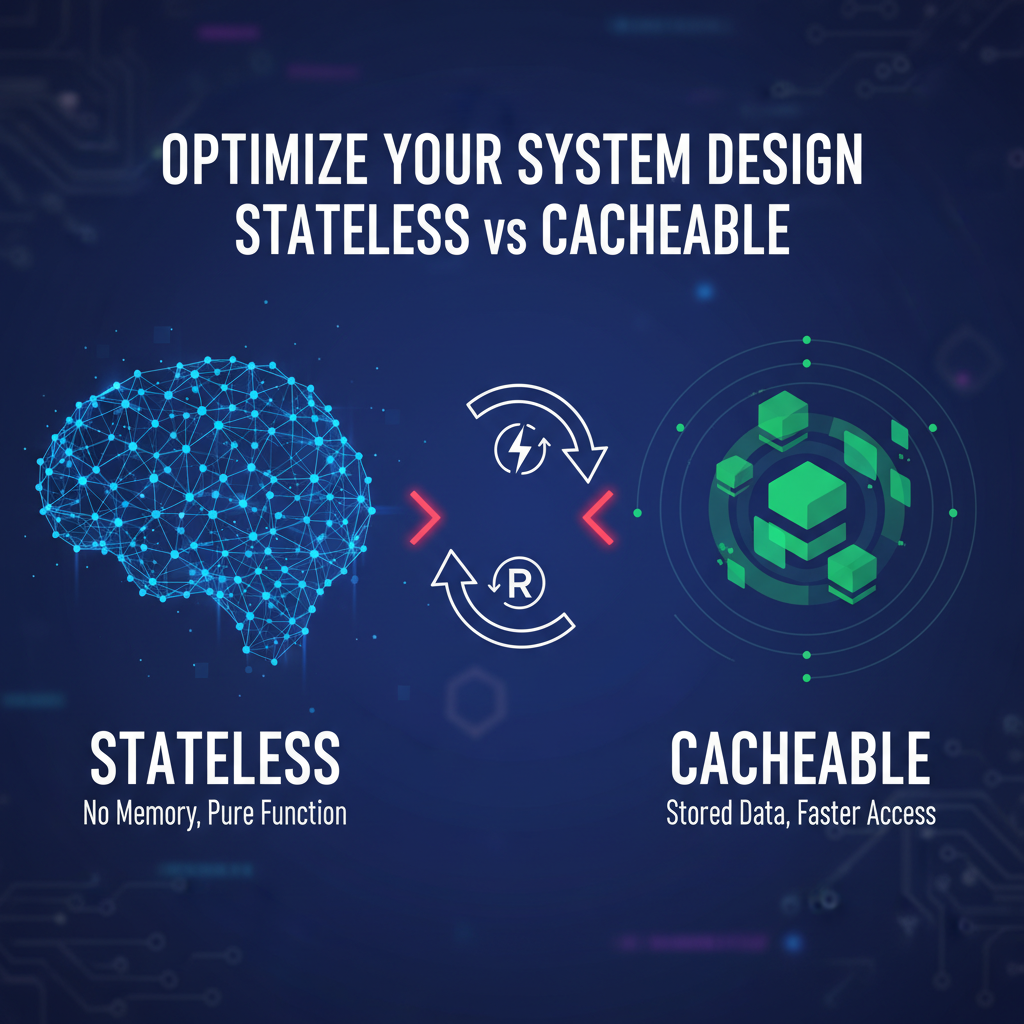


In the ever-evolving landscape of modern software architecture, designing systems that are both resilient and performant is a constant pursuit. Developers and architects are perpetually faced with choices that fundamentally shape the scalability, maintainability, and responsiveness of their applications. Among the most critical of these choices lies the decision to embrace statelessness, to strategically leverage caching, or, more often, to intelligently combine both paradigms. This article delves deep into the foundational principles, advantages, challenges, and intricate interplay between stateless and cacheable system designs, offering a comprehensive guide to optimizing your architectural blueprints. We will explore how these concepts not only stand alone as powerful design philosophies but also how their synergy, often orchestrated through an intelligent api gateway, can unlock unparalleled levels of efficiency and user experience.
The journey through modern system design is fraught with complexities, from managing ever-increasing user loads to ensuring data consistency across globally distributed services. As applications grow in scale and intricacy, traditional monolithic architectures often buckle under the pressure, leading to performance bottlenecks, deployment nightmares, and a crippling inability to scale horizontally. This very challenge has spurred the adoption of more distributed, decoupled architectures, where the principles of statelessness and cacheability become not just good practices, but essential pillars of success. Understanding where and when to apply each of these concepts, and how to govern them effectively through mechanisms like a robust gateway, is paramount for any organization aiming to build a future-proof digital infrastructure.
Part 1: Understanding Stateless Systems
At its core, a stateless system is one where each request from a client to the server is treated as an independent transaction, completely unrelated to any previous request. The server holds no session memory or persistent data regarding the client between requests. Every interaction must contain all the necessary information for the server to fulfill the request, allowing the server to process it without relying on context from prior interactions. This fundamental design choice has profound implications for how systems are built, scaled, and maintained, influencing everything from authentication mechanisms to data storage strategies.
Definition and Core Principles
The defining characteristic of a stateless application is that the server processes each client request based solely on the data provided in that specific request. There is no session state stored on the server's memory or file system that would tie one request to another from the same client. Imagine a vending machine that requires you to insert money and select an item for each purchase, regardless of what you bought before; it doesn't remember your previous selection or the money you inserted an hour ago. In computing terms, this means that if a user logs in and then makes subsequent requests, each request, even if it's for a protected resource, must explicitly include the authentication credentials or a token verifying the user's identity and permissions.
This principle is crucial for several reasons. Firstly, it simplifies the server's responsibility. It doesn't need to manage complex session data, garbage collect old sessions, or replicate session states across multiple instances. Secondly, it inherently promotes idempotency for many operations, meaning that making the same request multiple times has the same effect as making it once, assuming the operation itself is designed that way (e.g., retrieving data). Finally, and perhaps most importantly, statelessness is a cornerstone of horizontal scalability, a topic we will explore in detail.
Architecture and Implementation
Implementing a truly stateless architecture requires careful consideration of how client-server interactions are designed. In a stateless environment, all the necessary information to process a request, such as authentication tokens, user preferences, or partial workflow data, must be either embedded within the request itself or referenced by an identifier that points to an external, shared state store.
- Stateless Services (Microservices): Modern microservice architectures are prime examples of stateless design. Each microservice typically focuses on a single business capability and is designed to operate without internal state specific to a client session. When a client interacts with a microservice, all required context (e.g., user ID, authentication token) is passed in the request header or body. This allows multiple instances of the same microservice to run concurrently, each capable of handling any incoming request interchangeably.
- Load Balancing: Since any server instance can handle any client request, stateless services are inherently compatible with simple and effective load balancing. A load balancer can distribute incoming requests across a pool of identical server instances without needing sticky sessions or worrying about directing a client to the same server that handled its previous request. This vastly simplifies scaling operations, as new instances can be added or removed dynamically without disrupting ongoing client sessions.
- Authentication (JWT, OAuth Tokens): Traditional session-based authentication stores user session IDs on the server. In a stateless system, this approach is replaced by mechanisms like JSON Web Tokens (JWTs) or OAuth tokens. A JWT, for instance, is a self-contained token that includes information about the user (claims), digitally signed to prevent tampering. After initial authentication, this token is sent with every subsequent request. The server can then validate the token's signature and extract the user's identity and permissions from the token itself, without needing to query a central session store. This significantly reduces server load and overhead.
- Data Persistence (External Databases, Message Queues): While the application servers remain stateless, the overall system is not entirely devoid of state. Any persistent data (e.g., user profiles, transaction records, application configurations) must be stored in an external, centralized data store, such as a relational database (PostgreSQL, MySQL), a NoSQL database (MongoDB, Cassandra), or a distributed key-value store (Redis). Similarly, for asynchronous communication and workflow management, message queues (Kafka, RabbitMQ) can be used to pass messages between services without requiring them to maintain direct state about each other. The key is that this state is external to the application server instances themselves, making them interchangeable.
Advantages of Statelessness
The adoption of stateless design principles brings a multitude of benefits, particularly crucial for applications operating at scale and requiring high availability.
- Horizontal Scalability: This is arguably the most significant advantage. Because server instances don't hold client-specific state, you can simply add more instances behind a load balancer to handle increased traffic. Each new instance is immediately ready to serve requests, and existing instances can be scaled down just as easily. This elasticity is fundamental for cloud-native applications that need to adapt dynamically to fluctuating loads, allowing for efficient resource utilization and cost management.
- Resilience and Fault Tolerance: If a server instance fails, it doesn't take any client session state with it. Clients can simply retry their requests, and the load balancer will direct them to a healthy instance. This makes the system far more robust against individual server failures, enhancing overall reliability and uptime. The impact of a single server going down is minimal, as it doesn't disrupt user sessions or require complex failover mechanisms to recover lost state.
- Simplified Development and Deployment: Developing stateless services is often simpler because developers don't need to manage intricate session logic or state synchronization across multiple servers. This reduces the cognitive load and potential for bugs related to state management. Deployment also becomes more straightforward; new versions of a service can be rolled out, and old instances can be retired without needing to migrate or reconcile session data. This facilitates continuous integration and continuous delivery (CI/CD) pipelines.
- Easier Debugging: Debugging stateful applications can be notoriously difficult due to the temporal coupling of requests and the hidden dependencies on server-side session data. In a stateless system, each request is self-contained, making it easier to isolate and reproduce issues. You can examine a single request in isolation, knowing that its outcome doesn't depend on a preceding interaction on that specific server instance.
Challenges and Considerations
While the benefits are compelling, statelessness also introduces its own set of challenges that need to be addressed thoughtfully during system design.
- Increased Payload Size: To compensate for the lack of server-side state, more information often needs to be passed with each request. For instance, JWTs can be larger than simple session IDs. While often negligible for individual requests, this can accumulate over a large number of requests, potentially increasing network traffic and slightly impacting latency, especially for mobile clients with limited bandwidth.
- Potential for Redundant Processing: If every request needs to re-authenticate or re-authorize using a token, this validation logic is executed repeatedly. Without an efficient api gateway to handle this centrally or sophisticated caching strategies, this can lead to redundant computation across services, slightly diminishing performance in very high-throughput scenarios where the validation itself is resource-intensive.
- Need for External State Management for Certain Use Cases: Not all application logic can be purely stateless. Complex multi-step workflows (e.g., multi-page forms, shopping cart checkouts) often require some form of intermediate state. In a stateless architecture, this state cannot reside on the application server. Instead, it must be pushed to an external, shared data store (like a Redis cache, a database, or even the client-side local storage), which then becomes the single source of truth for that session's state. Managing this external state introduces its own complexities, including data consistency, performance of the state store, and fault tolerance for that store.
- Performance Implications Without Good Gateway Management: While stateless systems scale well, the overhead of processing each request completely independently can sometimes lead to performance concerns. For example, if every API call requires extensive re-authentication or re-authorization logic to be executed by the backend service, this could introduce latency. This is where a well-designed api gateway can play a critical role, offloading common tasks like authentication and authorization before requests even reach the backend services, thus optimizing performance and ensuring that statelessness doesn't become a bottleneck.
Use Cases
Stateless design is particularly well-suited for a wide array of modern application architectures:
- Web APIs: RESTful APIs are inherently stateless. Each api request (GET, POST, PUT, DELETE) is typically designed to contain all information needed for processing, making them highly scalable and resilient.
- Microservices: As discussed, microservices thrive on statelessness, allowing for independent deployment, scaling, and fault isolation.
- Serverless Functions (FaaS): Functions-as-a-Service platforms (like AWS Lambda, Google Cloud Functions) are the epitome of stateless computing. Each invocation of a function is completely isolated, making them extremely scalable and cost-effective for event-driven workloads.
- Content Delivery Networks (CDNs): CDNs serve static content (images, videos, CSS, JS) which by nature is stateless and highly cacheable. The CDN edge servers don't maintain session information; they simply respond to requests for content.
Part 2: Exploring Cacheable Systems
In contrast to the concept of statelessness, cacheable systems introduce a layer designed specifically to remember and quickly retrieve frequently accessed data. Caching is a powerful optimization technique that stores copies of data in a temporary, high-speed storage location, closer to the point of consumption. Its primary goal is to reduce latency, alleviate the load on backend services or databases, and ultimately enhance the overall responsiveness and scalability of a system. When a system needs to retrieve data, it first checks the cache; if the data is found (a "cache hit"), it's returned immediately. If not (a "cache miss"), the system fetches the data from its original source, serves it, and typically stores a copy in the cache for future requests.
Definition and Core Principles
The fundamental principle behind caching is locality of reference – the idea that data that has been accessed recently or frequently is likely to be accessed again soon. By storing a copy of this data in a faster, more accessible memory or disk location (the cache), subsequent requests for the same data can be served much quicker, bypassing the slower, more resource-intensive process of retrieving it from its original source (e.g., a database query, a complex computation, or a network call to a distant service).
Caching relies on a trade-off: improved performance versus potential data staleness. A cached item is a snapshot of the data at a certain point in time. If the original data changes, the cached copy might become outdated. Managing this consistency is one of the most significant challenges in cache design. However, for data that changes infrequently or where a small degree of staleness is acceptable, caching offers immense performance benefits.
Types of Caching
Caching can be implemented at various layers of a system architecture, each offering different benefits and challenges:
- Client-Side Caching (Browser Cache, Application Cache): This is the caching mechanism closest to the end-user. Web browsers automatically cache static assets (HTML, CSS, JavaScript, images) based on HTTP
Cache-Controlheaders. Mobile applications can also cache data locally. This dramatically speeds up page loads on subsequent visits and reduces network traffic. Content Delivery Networks (CDNs) also act as a form of client-side caching by placing content geographically closer to users. - Server-Side Caching: This refers to caching mechanisms deployed on the server infrastructure.
- In-Memory Caching: Storing data directly in the application's RAM. This is extremely fast but limited by server memory and is typically not shared across multiple application instances. Examples include simple
HashMapcaches within an application. - Distributed Caches: Centralized, shared caches that can be accessed by multiple application instances. These are typically standalone services like Redis, Memcached, or Apache Ignite. They offer high performance, shared access, and often provide features like persistence and replication for fault tolerance. Distributed caches are crucial for scaling modern microservice architectures where many services might need to cache shared data.
- Database Caching: Many databases have their own internal caching mechanisms (e.g., query caches, buffer pools) to speed up data retrieval. Application-level ORMs can also implement query caching.
- In-Memory Caching: Storing data directly in the application's RAM. This is extremely fast but limited by server memory and is typically not shared across multiple application instances. Examples include simple
- API Gateway Caching: A specialized form of server-side caching, where the api gateway itself caches responses from backend services. When a request comes in for a cached api endpoint, the gateway can serve the response directly from its cache without forwarding the request to the backend service. This offloads significant load from upstream services and dramatically improves the response time for frequently accessed, read-heavy api calls. This is a powerful feature for optimizing public-facing apis.
Cache Invalidation Strategies
One of the most complex aspects of caching is ensuring that cached data remains consistent with the original source of truth. Incorrect cache invalidation can lead to users seeing stale data, which can range from a minor annoyance to a critical business issue. This is often famously dubbed "one of the two hardest problems in computer science."
- Time-to-Live (TTL): The simplest strategy. Cached items are given an expiry time. After this duration, the item is automatically removed from the cache or marked as stale, forcing a fresh retrieval from the origin on the next request. This is effective for data where a certain degree of staleness is acceptable.
- Least Recently Used (LRU) / Least Frequently Used (LFU): These are eviction policies for caches with limited size. When the cache is full, LRU removes the item that hasn't been accessed for the longest time, while LFU removes the item that has been accessed the fewest times.
- Write-Through: Data is written synchronously to both the cache and the permanent storage. This ensures data consistency but can introduce latency to write operations.
- Write-Back: Data is written first to the cache, and then asynchronously written to the permanent storage. This offers faster write performance but carries a risk of data loss if the cache fails before data is persisted.
- Write-Around: Data is written directly to permanent storage, bypassing the cache. Only read data populates the cache. This is useful for data that is written once and rarely read, or for bulk writes.
- Event-Driven Invalidation: When the original data source changes, an event is published (e.g., via a message queue) that triggers the invalidation of the corresponding cached items. This is a more proactive and precise method but requires more complex coordination between services.
Advantages of Caching
The benefits of implementing caching are substantial and directly impact the user experience and operational efficiency of a system.
- Significant Performance Improvement (Reduced Latency): By serving data from a fast memory store instead of a slower disk or a distant network service, caching drastically reduces the response time for data retrieval. This leads to a snappier user experience and can be critical for applications requiring real-time responsiveness.
- Reduced Load on Backend Systems: Each cache hit means a request doesn't need to reach the database, the application server, or an external api. This reduces the computational, memory, and I/O load on these backend components, allowing them to handle more unique requests or operate with fewer resources. This can translate directly into cost savings by needing fewer database servers or application instances.
- Improved Scalability: By offloading load from the origin servers, caching effectively increases the capacity of the entire system. Backend services can focus on processing complex writes and less cacheable requests, while the cache handles the high volume of reads. This allows systems to handle much larger user bases and higher throughput without proportional scaling of backend resources.
- Cost Savings: Fewer backend resources, reduced database query costs, and lower network egress fees (especially with CDNs) all contribute to significant cost savings. Optimizing resource utilization through caching directly impacts the operational expenditure (OpEx) of cloud-based applications.
Challenges and Considerations
Despite its benefits, caching is not without its complexities and potential pitfalls. Architects must carefully weigh these challenges.
- Cache Coherency (Keeping Cache in Sync with Source of Truth): This is the "hardest problem" in caching. Ensuring that cached data accurately reflects the most current state of the original data source is a constant battle. Inconsistent data can lead to incorrect application behavior and poor user experience. The choice of invalidation strategy is critical here.
- Cache Invalidation Complexity: Implementing effective cache invalidation logic can be intricate, especially in distributed systems where multiple caches might exist at different layers (client, api gateway, service, database). A single data update might require invalidating entries across several caches, which must be carefully coordinated to avoid race conditions or missed invalidations.
- Thundering Herd Problem: If a popular item expires from the cache, and many clients simultaneously request it, all those requests will bypass the cache and hit the origin server at once, potentially overwhelming it. This "thundering herd" can lead to system slowdowns or even outages. Strategies like cache pre-warming, probabilistic caching, or introducing a small random delay for cache misses can mitigate this.
- Cache Cold Start: When a cache is empty (e.g., after deployment, restart, or an extensive invalidation), all initial requests will be cache misses, leading to a temporary performance degradation until the cache warms up and fills with data.
- Increased Infrastructure Complexity: Adding a caching layer, especially a distributed one, increases the overall complexity of the system architecture. It introduces new components to manage, monitor, and troubleshoot, requiring expertise in caching technologies and distributed systems.
Use Cases
Caching is universally applicable, but it shines brightest in certain scenarios:
- Static Content Delivery: Images, videos, CSS, JavaScript files are ideal candidates for caching at the CDN and browser level.
- Frequently Accessed API Responses: Read-heavy api endpoints with data that doesn't change often (e.g., product catalogs, user profiles, configuration settings) can be effectively cached at the api gateway or service level.
- Database Query Results: Caching the results of expensive or frequent database queries can significantly reduce database load.
- Session Data (in specific scenarios): While stateless systems avoid server-side session state, distributed caches like Redis are often used as external session stores for web applications or for microservices needing to share transient user data.
Part 3: The Interplay: Statelessness and Cacheability
While statelessness and cacheability might appear to be distinct design philosophies, they are, in fact, highly complementary, forming a powerful synergy that underpins many high-performance, scalable distributed systems. A truly optimized system often leverages the strengths of both, employing stateless services for their inherent scalability and resilience, while strategically integrating caching to mitigate latency and reduce load. The art lies in understanding how to blend these two concepts effectively, ensuring that they work in harmony rather than creating new complexities.
How They Complement Each Other
The inherent nature of stateless services makes them ideal candidates for caching. Because each request to a stateless service is self-contained and independent, the service's response for a given input can often be consistently the same (assuming it's an idempotent read operation). This predictability is precisely what caching thrives on.
- Stateless APIs are Ideal Candidates for Caching: When an api endpoint is stateless and performs a read operation (e.g.,
GET /products/123), the response forproduct ID 123will be consistent over time, or at least for a defined period. This makes it a perfect candidate for caching. An api gateway, a CDN, or even a client's browser can store this response, serving it directly for subsequent requests without bothering the backend service. This significantly boosts performance and reduces load. - Caching Can Mitigate Some Stateless Overheads: As discussed, stateless systems might incur a small overhead per request (e.g., token validation). While this overhead is often negligible, in high-throughput scenarios, repeated processing can add up. Caching can dramatically alleviate this. If an api gateway caches the response for an authenticated, stateless api call, the subsequent calls for the same resource might not even trigger the token validation logic in the backend, as the response is served directly from the cache. This effectively reduces the "redundant processing" concern.
- Combining for Optimal Performance and Scalability: The ultimate goal is to design systems that are both infinitely scalable (achieved through statelessness) and blazing fast (achieved through caching). By combining these approaches, you can build systems that effortlessly handle massive user loads while delivering rapid responses. For instance, a stateless microservice architecture can handle diverse business logic, while a sophisticated caching layer (potentially at the api gateway level) handles the bulk of read requests for frequently accessed data, leaving the microservices free to process the more dynamic, write-heavy, or non-cacheable operations.
Designing for Both
Integrating statelessness and cacheability requires a thoughtful design process that considers where state needs to live, which data can be cached, and how to manage cache consistency.
- Identify Cacheable Resources (Idempotent, Read-Heavy): The first step is to analyze your application's data access patterns. Identify api endpoints or data queries that are primarily read operations (GET requests), return the same result for the same input over time (idempotent), and are frequently accessed. These are your prime candidates for caching. Data that changes very frequently or that must always be real-time consistent (e.g., financial transactions, inventory levels in a rapidly selling store) are generally poor candidates for aggressive caching.
- Leverage HTTP Caching Headers (ETags, Cache-Control): The HTTP protocol provides powerful mechanisms for caching.
Cache-Control: This header allows servers to dictate caching behavior for resources (e.g.,max-agefor TTL,no-cache,public,private). It tells browsers, CDNs, and intermediate proxies (like an api gateway) how to cache the response.ETag(Entity Tag): A unique identifier (often a hash) representing a specific version of a resource. The client can send anIf-None-Matchheader with the ETag on subsequent requests. If the resource hasn't changed on the server, the server responds with a304 Not Modifiedstatus, saving bandwidth by not sending the full response body. This is a form of conditional caching.Last-Modified/If-Modified-Since: Similar to ETags, but based on the last modification timestamp of a resource.
- Placement of Caches (CDN, API Gateway, Service-Level): Strategic placement of caches is crucial.
- CDN: Best for global distribution of static assets and public, read-only content, pushing data closest to users.
- API Gateway: Ideal for caching responses from internal or external apis, acting as a central cache for all incoming api traffic. This is a powerful point of interception and optimization.
- Service-Level Caches (Distributed Caches): Used by individual microservices to cache data that is internal to their domain or shared among a few tightly coupled services (e.g., user profiles, product data).
- The Role of an API Gateway as a Central Point: An api gateway naturally serves as an orchestration point for both stateless interactions and caching policies. It acts as the single entry point for all client requests, allowing it to enforce statelessness by handling token validation and routing. Simultaneously, it can implement sophisticated caching policies, transparently serving cached responses for appropriate apis, without the backend services even being aware of the cache hit. This centralizes control over caching and security, making the system more manageable and performant.
When to Prioritize One Over the Other
While often combined, there are scenarios where one paradigm takes precedence:
- Prioritize Stateless:
- Transactional Systems: For operations that modify data (e.g., creating an order, updating a user profile), stateless processing is essential. While the initial request might be part of a stateless api, caching the response of a mutable operation is generally dangerous and leads to inconsistency.
- Highly Dynamic Data: Data that changes constantly and must be real-time accurate (e.g., stock prices, chat messages) should bypass caches to ensure users always see the latest information.
- Sensitive Operations Requiring Strict Real-Time Consistency: Financial transactions, medical records, or legal documents require the absolute latest state and cannot tolerate any staleness.
- Unique or Infrequent Requests: If a request is unlikely to be repeated, caching it offers no benefit and simply adds overhead.
- Prioritize Cacheable:
- Read-Heavy Workloads: If your application primarily retrieves data rather than modifying it (e.g., news portals, product display pages, static documentation sites), caching will provide immense benefits.
- Static or Infrequently Updated Data: Content that rarely changes (e.g., blog posts, product descriptions, configuration data) is a perfect candidate for long-term caching.
- Public API Endpoints for Information Retrieval: For public-facing apis that provide general information, caching can drastically reduce the load on your backend and improve external developer experience by providing faster responses.
- Global Distribution: When serving users across the globe, CDN caching is indispensable for reducing latency by bringing content closer to the user.
APIPark is a high-performance AI gateway that allows you to securely access the most comprehensive LLM APIs globally on the APIPark platform, including OpenAI, Anthropic, Mistral, Llama2, Google Gemini, and more.Try APIPark now! 👇👇👇
Part 4: The Crucial Role of an API Gateway
In the intricate dance between statelessness and cacheability, the api gateway emerges as a critical choreographer, harmonizing these two powerful concepts to create a seamless, high-performance, and secure system. An api gateway acts as the single entry point for all client requests into a microservice-based or distributed system, abstracting the complexity of the backend services from the client. It's not merely a router; it's an intelligent layer capable of performing a wide array of cross-cutting concerns that are essential for both stateless and cacheable architectures.
Centralization and Management
An api gateway provides a centralized control point for managing interactions between clients and your backend services. This centralization offers numerous advantages for architects designing systems around stateless principles.
- Unified Entry Point for All API Requests: Instead of clients needing to know the individual endpoints of dozens or hundreds of microservices, they interact solely with the api gateway. The gateway then intelligently routes requests to the appropriate backend service, effectively decoupling clients from the evolving internal topology of your services. This abstraction is vital in a distributed system where services might be deployed, scaled, or retired frequently.
- Authentication and Authorization for Stateless Systems: One of the most significant roles of an api gateway in a stateless architecture is handling authentication and authorization. Rather than each backend service needing to validate a JWT or OAuth token for every incoming request, the gateway can perform this validation once. After successfully validating the token, it can then pass the authenticated user's identity and permissions (e.g., as custom headers) to the downstream microservice. This offloads a common, repetitive task from backend services, making them simpler and more performant. For a stateless system, this means the backend service receives a pre-validated context, enabling it to focus purely on business logic.
- Rate Limiting, Throttling, and Security: The gateway is the ideal place to implement policies that protect your backend services.
- Rate Limiting: Prevents abuse and ensures fair usage by restricting the number of requests a client can make within a certain timeframe.
- Throttling: Controls the overall request rate to prevent backend services from being overwhelmed during traffic spikes.
- Security: Beyond authentication, a gateway can provide robust security measures such as IP whitelisting/blacklisting, WAF (Web Application Firewall) capabilities, DDoS protection, and SSL/TLS termination, shielding your internal services from direct exposure to the internet. This centralized security posture is far easier to manage and audit than implementing security across every individual service.
Caching at the Gateway Level
Beyond managing stateless request flow and security, the api gateway is an exceptionally powerful location for implementing caching. This feature allows the gateway to serve responses directly, preventing requests from even reaching the backend services, which has profound implications for performance and scalability.
- Reducing Load on Upstream Services: When an api gateway caches a response, every subsequent request for that same resource (within the cache's validity period) is served by the gateway itself. This means the backend service is not even invoked. For frequently accessed, read-heavy apis, this can dramatically reduce the load on backend application servers and databases, freeing them up to handle more complex or dynamic requests. It acts as a powerful buffer against traffic surges.
- Consistent Caching Policies Across Multiple Services: Rather than individual microservices each implementing their own caching logic, the api gateway can enforce a unified caching strategy across all your exposed apis. This centralizes configuration, simplifies management, and ensures consistency in cache behavior. For example, all
GETrequests to a specific path pattern could be cached for 5 minutes, irrespective of which microservice ultimately provides the data. - Improved Response Times for Cached API Calls: By eliminating the network round-trip to a backend service and the processing time on that service, gateway caching significantly reduces the latency for cached requests. Users experience faster response times, which translates directly into a better user experience and higher satisfaction. This is especially beneficial for global applications where backend services might be geographically distant from some users.
- Example: Consider a
/productsapi endpoint that retrieves product details. This api is typically stateless, meaning each request contains all necessary parameters. If product details don't change frequently, the api gateway can cache the response forGET /products/123. The first request hits the backend, and the gateway stores the response. All subsequent requests forGET /products/123are served directly by the gateway's cache until the cache expires or is invalidated. This scenario perfectly illustrates how the stateless nature of the api makes it cacheable at the gateway level, leading to huge performance gains.
APIPark Integration: A Gateway to Optimized System Design
For organizations seeking a robust, feature-rich solution to manage these complexities, platforms like APIPark offer a comprehensive suite of features that directly address the challenges of designing scalable, performant, and secure systems through both stateless and cacheable paradigms.
APIPark is an open-source AI gateway and API management platform that excels in orchestrating the flow of api requests, enabling developers and enterprises to manage, integrate, and deploy AI and REST services with remarkable ease. Its capabilities are directly relevant to optimizing system design in the context of statelessness and caching.
- Unified API Management: APIPark provides an all-in-one developer portal and management system. This centralized approach aligns perfectly with the need for a unified entry point that handles authentication, authorization, and routing – all critical for stateless apis. Its ability to manage the entire API lifecycle, from design to publication and invocation, ensures that stateless apis are properly governed and exposed.
- Performance Rivaling Nginx: APIPark's impressive performance, capable of achieving over 20,000 TPS with modest resources, underscores its ability to handle high volumes of stateless requests efficiently. This performance is crucial for an api gateway that intercepts and processes every incoming request, ensuring that the gateway itself doesn't become a bottleneck, especially when implementing complex routing or security policies. Such high throughput also provides a solid foundation for robust gateway-level caching, allowing it to serve cached responses quickly without affecting overall system performance.
- Detailed API Call Logging: In a stateless system, where each request is independent, comprehensive logging is vital for monitoring, debugging, and auditing. APIPark's detailed API call logging records every detail, allowing businesses to trace and troubleshoot issues quickly. This granular visibility helps in understanding request patterns, identifying potential bottlenecks in stateless services, and monitoring the effectiveness of caching strategies (e.g., by analyzing hit rates).
- Powerful Data Analysis: By analyzing historical call data, APIPark helps businesses understand long-term trends and performance changes. This predictive capability is invaluable for proactive maintenance and for continuously optimizing both stateless service performance and cache efficacy, ensuring the system remains responsive under varying loads.
- Quick Integration and Unified API Format: APIPark's capability to integrate over 100 AI models and standardize their invocation format simplifies the deployment of complex, often stateless, AI-driven microservices. This abstraction layer ensures that backend AI services can remain stateless and focused on their core function, while the gateway handles the translation and routing.
By leveraging an advanced api gateway like APIPark, organizations can effectively implement and manage the principles of statelessness and cacheability, turning architectural challenges into strategic advantages.
Part 5: Advanced Optimization Strategies
Beyond the foundational principles of statelessness and caching, modern system design incorporates several advanced strategies to further enhance performance, scalability, and resilience. These strategies often build upon or interact with stateless and cacheable paradigms, pushing the boundaries of what distributed systems can achieve.
Event-Driven Architectures
Event-driven architectures (EDA) are a powerful paradigm where services communicate by emitting and consuming events. This approach naturally complements statelessness and provides elegant solutions for cache invalidation.
- Decoupling and Scalability: Services in an EDA are highly decoupled. A service emits an event (e.g., "product updated") without needing to know which other services will consume it. This promotes statelessness among services themselves, as they don't maintain direct knowledge or state about their consumers. This enhances scalability, as new consumers can subscribe to events without affecting the producers.
- Driving Cache Invalidation: EDA provides a robust mechanism for cache invalidation. When a data change occurs in the source of truth (e.g., a database), the responsible service can emit an event (
product.updated). A dedicated cache invalidation service (or the api gateway itself, if it supports event listeners) can subscribe to this event. Upon receivingproduct.updated, the cache invalidation service can then precisely invalidate the relevant cached entries across all affected caches (e.g., in the api gateway, distributed caches, or even trigger CDN purges). This ensures that caches are proactively updated, minimizing the window for stale data. - Real-time Updates to Stateless Consumers: Events can also be used to push updates to stateless consumers in near real-time. For instance, a websocket gateway could subscribe to events and push notifications to connected clients without the application servers needing to maintain long-lived connections for each client.
Microservices and Service Meshes
Microservices inherently promote statelessness by advocating for small, independent, and loosely coupled services. A service mesh augments this architecture by providing sophisticated network communication capabilities.
- Microservices' Embrace of Statelessness: Each microservice is typically designed to be stateless concerning client sessions, focusing on its specific domain logic. This allows for independent deployment, scaling, and fault isolation, which are core tenets of modern cloud-native applications. A service mesh ensures that communication between these stateless microservices is reliable, secure, and observable.
- Enhancing with Intelligent Caching: While individual microservices are stateless, they often interact with each other and with shared data stores. A service mesh (e.g., Istio, Linkerd) can, at times, integrate with caching solutions. For example, a sidecar proxy in the service mesh could potentially implement localized caching for frequent calls between services or to an external api. This adds another layer of caching granularity, optimizing inter-service communication.
- Traffic Management and Observability: Service meshes provide advanced traffic management features (e.g., routing, retries, circuit breakers) that ensure stateless requests are handled gracefully, even under adverse network conditions. Critically, they offer deep observability into service-to-service communication, including metrics on latency, errors, and throughput. This data is invaluable for identifying bottlenecks and optimizing both stateless service performance and the effectiveness of caching strategies.
Content Delivery Networks (CDNs)
CDNs are a specialized form of distributed caching infrastructure designed to deliver content, particularly static assets and web pages, to users with high availability and performance.
- Pushing Caches Closer to the User: CDNs achieve their primary goal by geographically distributing content across numerous edge servers around the world. When a user requests content, the CDN directs them to the closest available edge server that has the requested item cached. This significantly reduces network latency, as the data travels a shorter physical distance.
- Global Stateless Access: For global applications, CDNs are indispensable. They serve static content (images, CSS, JavaScript, videos) and even dynamic web content (via edge computing and serverless functions at the edge) in a fundamentally stateless manner. Each request for content is handled independently by the nearest edge server, making the entire content delivery pipeline highly scalable and resilient.
- Offloading Origin Servers: By serving the vast majority of requests from their edge caches, CDNs dramatically offload traffic from your origin servers, reducing bandwidth costs and allowing your backend infrastructure to focus on serving dynamic content and processing complex business logic. This is a massive win for performance and cost-efficiency, directly extending the benefits of caching.
Data Consistency Models
In a world of distributed, stateless services and pervasive caching, managing data consistency becomes a nuanced challenge. Different consistency models exist, each offering a trade-off between strict consistency and performance/availability.
- Eventual Consistency vs. Strong Consistency:
- Strong Consistency: Guarantees that all users always see the most up-to-date data. This is crucial for transactional data but often comes at the cost of higher latency and lower availability in distributed systems. Implementing strong consistency with aggressive caching is difficult, as cache invalidation must be instantaneous and guaranteed.
- Eventual Consistency: Guarantees that if no new updates are made to a given data item, eventually all accesses to that item will return the last updated value. This model is often acceptable for read-heavy data where a slight delay in updates being reflected is not critical (e.g., social media feeds, product descriptions). Eventual consistency is highly compatible with caching, as it allows for a TTL-based or event-driven invalidation that might have a small propagation delay.
- Choosing the Right Model: The choice of consistency model dictates how aggressively caching can be applied. For stateless apis that handle read-only data, eventual consistency often enables powerful caching strategies. For write-heavy or highly sensitive transactional apis, stronger consistency models might necessitate less aggressive caching or more sophisticated cache invalidation mechanisms.
Observability
Observability – the ability to understand the internal state of a system by examining its external outputs – is paramount for debugging, optimizing, and maintaining complex distributed systems that leverage statelessness and caching.
- Monitoring Cache Hit Rates: A critical metric is the cache hit rate. A high hit rate indicates effective caching, while a low rate suggests that the cache is not being utilized efficiently, potentially leading to unnecessary load on backend services. Monitoring this provides insights into cache configuration, invalidation strategies, and overall performance.
- Latency Tracking: Tracking end-to-end latency, as well as latency at each layer (client, api gateway, service, database), helps pinpoint bottlenecks. If cached requests are slow, it might indicate an issue with the api gateway or the cache service itself. If backend requests are slow even after caching, it points to problems in the stateless services or their dependencies.
- API Gateway Performance: Monitoring the performance of the api gateway is crucial, as it's the single point of entry. Metrics like request throughput, error rates, and latency through the gateway itself are vital indicators of system health. This also includes tracking how effectively the gateway is offloading requests through its caching mechanisms.
- Stateless Service Health: Monitoring individual stateless services for CPU usage, memory consumption, error rates, and response times ensures they are performing optimally. Since they are stateless, any issue can be isolated to a single request, but aggregate metrics are needed to understand overall service health and scalability.
By combining these advanced strategies, architects can design systems that not only meet current performance and scalability demands but are also adaptable and resilient enough to evolve with future requirements.
Part 6: Practical Implementation Guidelines and Best Practices
Designing and implementing systems that effectively leverage both statelessness and cacheability requires a thoughtful approach and adherence to best practices. Without careful planning, the benefits can quickly turn into complexities, leading to inconsistent data, performance bottlenecks, or security vulnerabilities. This section outlines actionable guidelines for bringing these concepts to fruition.
Design for Idempotency
Idempotency is a crucial property for APIs, especially in a stateless and potentially cached environment. An idempotent operation is one that can be applied multiple times without changing the result beyond the initial application.
- Importance for Stateless APIs: In a stateless system, client requests might be retried due to network issues or server failures. If a
POSTrequest (which is typically not idempotent) is retried and the server processes it multiple times, it could lead to duplicate resource creation. DesigningPOSToperations to be idempotent (e.g., by including a unique client-generated ID) ensures that retries don't cause unintended side effects. - Enabling Robust Caching: Idempotent read operations (
GETrequests) are the perfect candidates for caching. Since the result of aGETrequest for a given resource identifier is always the same, caching its response is safe and highly effective. Ensuring your read APIs are truly idempotent simplifies cache management dramatically. For update operations (PUT), the operation should be idempotent, ensuring that repeatedPUTrequests for the same resource with the same data yield the same final state.
Leverage HTTP Headers
The HTTP protocol provides a rich set of headers specifically designed to facilitate caching and manage content negotiation. Utilizing these headers correctly is fundamental for effective caching.
Cache-Control: This is the most powerful header for controlling caching behavior.max-age=<seconds>: Specifies how long a resource is considered fresh.no-cache: Means the cache must revalidate with the origin server before serving a cached copy (but it can still store it).no-store: Instructs caches not to store any part of the request or response. Essential for sensitive data.public/private:publicallows any cache (e.g., CDN, api gateway) to store the response;privateis for user-specific data and only allows client-side caching.
ETagandIf-None-Match: As discussed, ETags provide a robust mechanism for conditional requests. The server sends anETag(a hash of the content) with the response. On subsequent requests, the client sendsIf-None-Match: <ETag>. If the content hasn't changed, the server responds with304 Not Modified, saving bandwidth.Last-ModifiedandIf-Modified-Since: Similar to ETags, these headers use timestamps for conditional requests, suitable for resources where a last modified date is easily available.- Vary Header: Specifies that the response varies depending on the request headers (e.g.,
Vary: Accept-Encodingif the response content is compressed differently for various clients). This is crucial for proxies and caches to serve the correct cached version.
Monitoring and Analytics
"What gets measured gets managed." Comprehensive monitoring and analytics are non-negotiable for understanding how your stateless services and caching layers are performing.
- Track Cache Effectiveness: Monitor cache hit rates, cache miss rates, and eviction rates across all your caching layers (client, CDN, api gateway, distributed caches). These metrics directly indicate the efficiency of your caching strategy. A low hit rate might suggest an ineffective cache key, insufficient cache size, or an overly aggressive invalidation policy.
- API Performance Metrics: Collect metrics for every API endpoint: response times (average, p90, p99), error rates, and throughput. Segment these by cached vs. non-cached requests (especially at the api gateway level) to precisely understand the impact of caching.
- Stateless Service Health: Monitor the CPU, memory, network I/O, and disk I/O of your stateless service instances. Alert on anomalous behavior. Track the latency of calls between services (using a service mesh or distributed tracing) to identify inter-service bottlenecks.
- Logging and Tracing: Implement centralized logging and distributed tracing. For stateless systems, being able to trace a single request across multiple services is crucial for debugging. Logs help understand runtime behavior, while traces provide a holistic view of a request's journey. Tools like APIPark provide detailed API call logging, which is invaluable here.
Gradual Adoption
Don't attempt to implement every optimization strategy at once. Start with the basics and iterate.
- Start with Statelessness: Design your core services to be stateless first. This provides the foundational scalability and resilience.
- Introduce Caching Strategically: Once your stateless services are running, identify specific bottlenecks or frequently accessed APIs that would benefit most from caching. Begin with simple TTL-based caching at the api gateway or application level for low-risk data.
- Iterate and Optimize: Continuously monitor the impact of your caching strategies. Adjust TTLs, eviction policies, and invalidation mechanisms based on real-world performance data. Gradually introduce more sophisticated caching or invalidation techniques (e.g., event-driven) where the benefits outweigh the increased complexity.
Security Considerations
Security must be a first-class concern in both stateless and cacheable designs.
- Stateless Authentication Tokens: Ensure that JWTs or other tokens are properly signed and encrypted. Validate tokens rigorously at the api gateway to prevent unauthorized access. Implement short token expiry times and robust token revocation mechanisms to mitigate the risk of stolen tokens. Avoid putting sensitive, unencrypted information directly into tokens.
- Caching Sensitive Data: Exercise extreme caution when caching sensitive user data (e.g., personal identifiable information, financial details). If such data must be cached, ensure it's encrypted at rest and in transit, and implement very short TTLs or immediate invalidation upon any change. Always ask: "Can this data be seen by another user if cached incorrectly?"
- Cache Poisoning: Protect against cache poisoning attacks where malicious actors trick the cache into storing corrupted or unauthorized content. This typically involves manipulating HTTP headers. Ensure your api gateway and CDN configurations are hardened against such attacks.
- Access Permissions for API Resources: Platforms like APIPark allow for independent API and access permissions for each tenant and require approval for API resource access. This granular control is essential for securing your APIs, ensuring that even stateless services are only invoked by authorized callers, and preventing unauthorized data access, even if a token is valid for other services.
Testing
Rigorous testing is essential to validate the correctness and performance of your stateless and cacheable system.
- Functional Testing for Statelessness: Ensure that each API request can be handled independently, without relying on prior server-side state. Test edge cases with missing or malformed tokens.
- Cache Invalidation Testing: This is critical. Test all scenarios where data changes in the source of truth to ensure that the corresponding cached entries are correctly invalidated or updated. Test for cache coherency issues, especially in distributed environments with multiple caches.
- Performance and Load Testing: Simulate realistic user loads to identify bottlenecks in stateless services and to measure the effectiveness of your caching layers. Monitor cache hit rates under load to ensure they remain high. Test for the "thundering herd" problem when cache entries expire simultaneously.
- Security Testing: Conduct penetration testing and vulnerability scanning to identify weaknesses in token handling, authentication, authorization, and potential cache poisoning vectors.
By diligently applying these practical guidelines and best practices, architects and developers can build resilient, scalable, and high-performing systems that effectively harness the combined power of stateless architecture and intelligent caching.
Conclusion
The journey through modern system design reveals a landscape where performance, scalability, and resilience are not merely desirable traits but fundamental requirements. In this complex environment, the architectural choices of embracing statelessness and strategically leveraging caching stand out as two of the most potent optimization techniques available. While seemingly distinct, these paradigms are, in fact, deeply complementary, offering a powerful synergy when implemented thoughtfully.
Stateless systems, characterized by their independence from session-specific server-side state, provide an unparalleled foundation for horizontal scalability and fault tolerance. By ensuring that each request carries all necessary context, these systems can effortlessly distribute load across numerous interchangeable instances, leading to robust and highly available applications. However, this inherent independence can sometimes introduce minor overheads or necessitate external state management for complex workflows.
Conversely, cacheable systems, through their intelligent storage of frequently accessed data, dramatically reduce latency and offload significant processing from backend services. They are the linchpin of high-performance applications, allowing systems to deliver rapid responses and handle massive read-heavy workloads with remarkable efficiency. Yet, the challenge of maintaining cache coherency and designing effective invalidation strategies remains a non-trivial undertaking, often dubbed one of the most difficult problems in computer science.
The true magic unfolds when statelessness and cacheability are orchestrated in unison. Stateless APIs, by their very nature, are ideal candidates for aggressive caching, allowing an api gateway or CDN to serve responses without ever engaging the backend. This combination mitigates the potential overheads of statelessness while amplifying the performance gains of caching, culminating in systems that are both infinitely scalable and incredibly fast.
The role of an api gateway is particularly critical in this symbiotic relationship. Acting as the centralized entry point, it can efficiently handle stateless authentication, enforce security policies, and, crucially, implement intelligent caching strategies that shield backend services from repetitive requests. Platforms like APIPark, with their focus on unified API management, high performance, and detailed logging, exemplify how a robust gateway can empower organizations to fully realize the benefits of these architectural principles.
Ultimately, optimizing your system design is not about choosing between statelessness and cacheability, but about understanding their unique strengths and designing strategies to harness their combined power. It requires a meticulous approach to identifying where state truly belongs, which data can be safely cached, and how to manage the trade-offs between consistency and performance. By adhering to best practices, leveraging appropriate tools, and continuously monitoring your infrastructure, you can build resilient, scalable, and highly performant systems that meet the demands of today's dynamic digital landscape.
Comparison: Stateless vs. Cacheable Systems
| Feature / Aspect | Stateless System | Cacheable System | Synergy & API Gateway Role |
|---|---|---|---|
| Core Principle | Each request is independent, no server-side session state. | Stores frequently accessed data for faster retrieval. | Stateless APIs are ideal candidates for caching. |
| Primary Benefit | Horizontal scalability, resilience, simplified server logic. | Reduced latency, reduced backend load, improved performance. | Combined for high performance, high scalability, and cost efficiency. |
| State Management | Client-managed (tokens) or external shared state store. | Temporary data storage, often external (Redis) or local (memory). | API Gateway handles stateless token validation and centralizes cache policies. |
| Data Consistency | Generally real-time, as no state is remembered. | Potential for stale data; requires robust invalidation. | Careful design ensures acceptable consistency levels for cached stateless data. |
| Overhead | Potentially larger payload per request. | Increased infrastructure complexity, cache invalidation complexity. | Caching at API Gateway reduces stateless request overhead. |
| Ideal Use Cases | Microservices, RESTful APIs, serverless functions, authentication. | Static content, read-heavy APIs, database query results, public content. | Most web APIs, content delivery, AI services, microservices ecosystems. |
| Key Challenge | Managing external state; redundant processing without gateway. | Cache coherency, invalidation strategies, "thundering herd." | Orchestrating invalidation and ensuring consistent behavior. |
| Role of HTTP Headers | Less direct impact on statelessness itself, but important for authentication (e.g., Authorization). |
Cache-Control, ETag, Last-Modified, Vary are critical. |
API Gateway enforces and respects these headers for both routing and caching. |
| Scaling Mechanism | Add more identical server instances (horizontal scaling). | Add more cache nodes, increase cache size, distribute caches. | API Gateway scales linearly to handle requests, its cache scales to handle hits. |
5 FAQs
1. What is the fundamental difference between stateless and stateful systems? The fundamental difference lies in how servers handle client interactions over time. A stateless system treats each request from a client as a completely new and independent transaction, containing all the necessary information within the request itself. The server doesn't remember any prior client interactions. In contrast, a stateful system retains information about past interactions from a client (its "state" or "session data") on the server, using this context to process subsequent requests. Stateless systems are inherently more scalable and resilient, while stateful systems can simplify certain application logic but introduce challenges in scaling and fault tolerance.
2. How does an API Gateway contribute to both stateless and cacheable system designs? An API Gateway acts as a crucial intermediary that enhances both statelessness and cacheability. For stateless systems, it can centralize authentication and authorization by validating tokens (like JWTs) once, before forwarding requests to backend services, thus offloading this task from individual microservices. For cacheable systems, the API Gateway is an ideal place to implement caching policies. It can store responses from frequently accessed, read-heavy APIs and serve them directly from its cache, significantly reducing the load on backend services and improving response times. This dual role makes it a powerful tool for optimizing system design, allowing services to remain stateless while leveraging caching at the edge.
3. What are the main advantages of designing an API to be stateless? Designing an API to be stateless offers several key advantages. Firstly, it provides excellent horizontal scalability, as any server instance can handle any client request, making it easy to add or remove servers based on demand. Secondly, it enhances resilience and fault tolerance; if a server fails, no client session state is lost, and subsequent requests can simply be routed to a healthy instance. Thirdly, it simplifies development and deployment by removing the complexity of managing server-side session data. Finally, statelessness often leads to easier debugging because each request can be analyzed in isolation.
4. What are the common challenges when implementing caching, and how can they be mitigated? The primary challenges with caching revolve around cache coherency (keeping cached data synchronized with the original source), cache invalidation complexity (knowing when to remove or update stale entries), the thundering herd problem (many requests hitting the backend simultaneously after a cache expires), and cache cold starts (performance degradation when a cache is empty). These can be mitigated by using Time-to-Live (TTL) for data where some staleness is acceptable, implementing event-driven invalidation for critical data, utilizing HTTP caching headers (Cache-Control, ETag) effectively, and employing techniques like cache pre-warming or adding small random delays for cache misses to prevent thundering herds.
5. When should I prioritize a stateless design over a cacheable one, or vice-versa? You should prioritize a stateless design for operations that modify data (e.g., creating, updating, deleting resources) to ensure transactional integrity and avoid unintended side effects from retries. It's also critical for highly dynamic data or sensitive operations requiring strict real-time consistency where any staleness is unacceptable. Conversely, you should prioritize cacheable design for read-heavy workloads, static or infrequently updated data (e.g., product catalogs, news articles), and public API endpoints that serve general information. In most optimized systems, the goal is to combine both: design services to be stateless and then apply caching strategically to the stateless read operations that are frequently accessed.
🚀You can securely and efficiently call the OpenAI API on APIPark in just two steps:
Step 1: Deploy the APIPark AI gateway in 5 minutes.
APIPark is developed based on Golang, offering strong product performance and low development and maintenance costs. You can deploy APIPark with a single command line.
curl -sSO https://download.apipark.com/install/quick-start.sh; bash quick-start.sh

In my experience, you can see the successful deployment interface within 5 to 10 minutes. Then, you can log in to APIPark using your account.

Step 2: Call the OpenAI API.