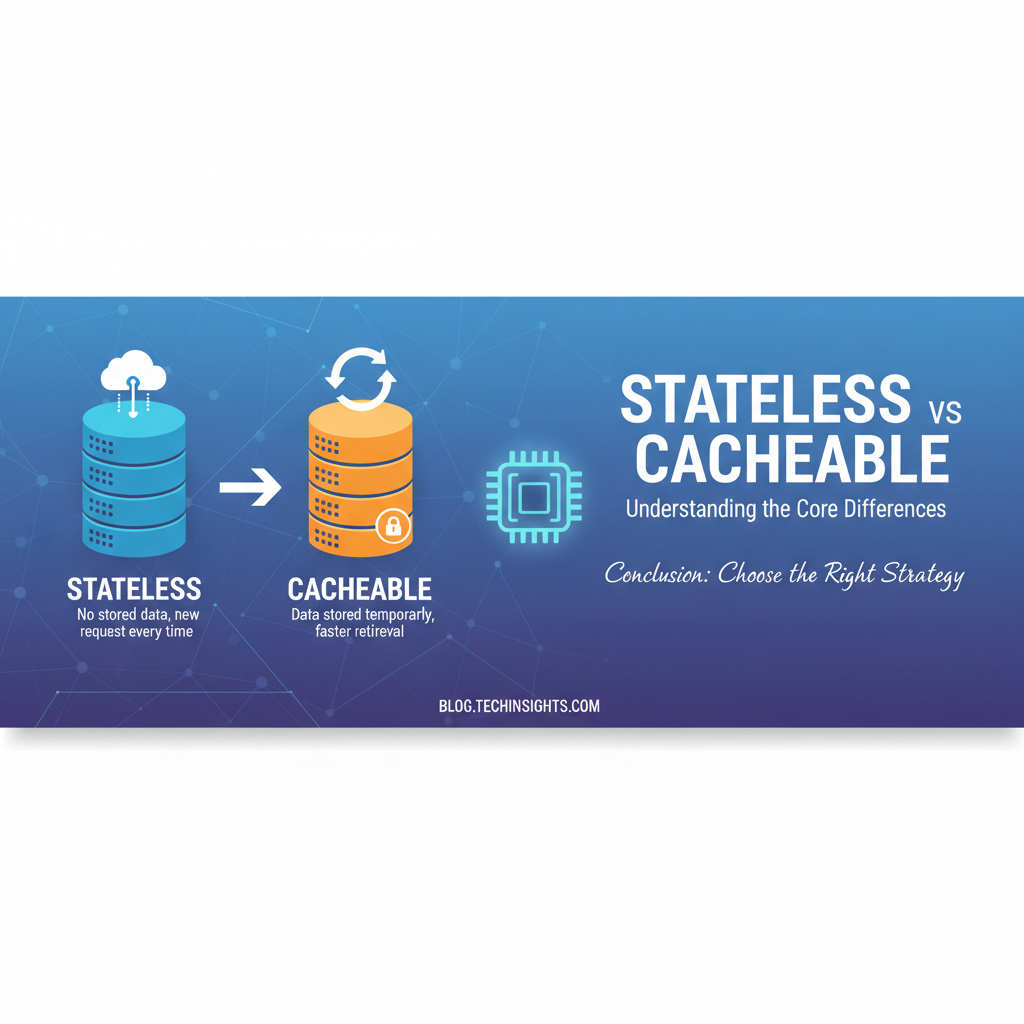
Stateless vs Cacheable: Understanding the Core Differences


In the vast and intricate landscape of modern software architecture, two fundamental concepts often emerge as cornerstones for building robust, scalable, and high-performing systems: "stateless" and "cacheable." While seemingly distinct, these paradigms are deeply intertwined and frequently complement each other, shaping the very fabric of how distributed applications, web services, and APIs interact. Grasping the nuanced differences and appreciating their synergistic potential is not merely an academic exercise; it is a critical skill for architects, developers, and system administrators striving to engineer resilient digital experiences. From microservices to content delivery networks, the principles of statelessness and cacheability dictate efficiency, dictate resilience, and ultimately, dictate the user experience.
This exhaustive exploration will delve into the depths of each concept, dissecting their definitions, unraveling their characteristics, and meticulously cataloging their advantages and disadvantages. We will scrutinize how they interact, especially within the critical infrastructure layer provided by an api gateway, and examine the practical implications for designing systems that are not only performant but also maintainable and future-proof. By the end, readers will possess a profound understanding of these architectural pillars, enabling them to make informed decisions that optimize for speed, scalability, and operational simplicity in their own projects.
The Immutable Principle of Statelessness: A Foundation for Scale
At its core, a "stateless" system, component, or interaction is one where the server or processing entity does not retain any memory or context from previous requests made by the same client. Each request from the client to the server is treated as an entirely new and independent transaction, containing all the necessary information for the server to fulfill that request without relying on any prior interactions or session data stored on the server side. This fundamental design choice has profound implications for how systems are built, scaled, and maintained, offering a powerful blueprint for managing complexity in distributed environments.
Consider a typical web application interaction. In a stateful design, the server might remember that "User A just logged in and is now browsing product page X." This session information is stored on the server, often linked to a session ID that the client sends with subsequent requests. If User A then navigates to product page Y, the server retrieves User A's session context to process the request. In contrast, a stateless approach mandates that every single request, from login to page navigation, must carry all the data needed for the server to understand and respond to it, independent of any previous server-side memory. The server doesn't "remember" User A; instead, each request from User A explicitly includes credentials or tokens validating their identity and specifying their desired action.
Defining Characteristics of a Stateless System
The essence of statelessness manifests through several key characteristics that dictate its operational behavior and architectural advantages:
- Self-Contained Requests: Each request from a client to a server must contain all the information necessary to understand the request, including authentication, authorization, content, and any other data required to process it. The server should not need to query a backend database or an in-memory store for session-specific information to fulfill the request. This self-sufficiency means that if a request were replayed, the server's response would be identical, assuming the underlying data hasn't changed.
- No Server-Side Session Data: Perhaps the most defining characteristic, stateless systems explicitly avoid storing any client-specific session state on the server. This includes user preferences, shopping cart contents, or a login status that persists across multiple requests. Any state that needs to be maintained for the user's interaction must be managed by the client (e.g., in cookies, local storage, or embedded in subsequent requests) and explicitly passed with each interaction.
- Independence of Requests: Critically, the processing of one request does not affect, nor is it affected by, the processing of any other request, even if they originate from the same client. There are no implicit dependencies between successive requests, making each operation an atomic unit. This independence simplifies the logic on the server side significantly.
- Simplified Server Logic: Without the burden of managing and synchronizing session states across multiple requests and potentially multiple server instances, the server's internal logic becomes considerably simpler. It can focus solely on processing the current request based on the explicit data it receives, rather than juggling complex state machines or potential race conditions related to session updates.
- Easy Load Balancing: Because each request is independent and self-contained, it can be routed to any available server instance capable of handling it. A load balancer doesn't need "sticky sessions" or affinity rules to ensure a client's requests always go to the same server that holds their session state. This greatly simplifies load distribution and improves fault tolerance.
Advantages of Adopting a Stateless Architecture
The architectural decision to embrace statelessness brings a plethora of significant benefits, particularly salient in the era of cloud computing, microservices, and massive distributed systems:
- Exceptional Scalability: This is arguably the most compelling advantage. Since no server instance holds specific client state, any server can handle any request. To scale up, one simply adds more identical server instances, and a load balancer distributes incoming requests among them. This horizontal scaling is incredibly efficient, allowing systems to effortlessly handle spikes in traffic without complex state migration or synchronization mechanisms. This makes a system built on stateless principles incredibly adaptable to fluctuating demand.
- Enhanced Reliability and Resilience: If a server instance fails in a stateless system, it merely means that any ongoing request it was processing might fail. However, subsequent requests from the client can be immediately routed to a healthy server instance without any loss of session data, because no such data was stored on the failed server to begin with. This self-healing property significantly improves the overall fault tolerance and reliability of the system, minimizing service interruptions.
- Operational Simplicity: Deploying, updating, and managing server instances becomes significantly simpler. There's no need to worry about intricate state synchronization protocols when deploying new versions or rolling back updates. Servers can be spun up and down on demand, facilitating continuous integration and continuous deployment (CI/CD) pipelines. This ease of operation translates directly into reduced maintenance overhead and faster development cycles.
- Easier Load Balancing and Distribution: As previously mentioned, the absence of sticky sessions simplifies load balancing immensely. Any request can go to any server, allowing load balancers to distribute traffic purely based on server availability and current load. This maximizes resource utilization and ensures even distribution of work, preventing "hot spots" where some servers are overloaded while others remain idle.
- Improved Recoverability: In the event of a system-wide failure, recovery is often much faster. Since no state needs to be restored from server memory or replicated databases, the focus is solely on bringing up functional server instances. This contrasts sharply with stateful systems, where recovering and rehydrating session data can be a complex and time-consuming process.
Disadvantages and Challenges of Statelessness
While offering compelling benefits, stateless architectures are not without their trade-offs and potential drawbacks:
- Increased Request Size and Network Overhead: Since each request must carry all necessary contextual information, the size of individual requests can increase. For interactions that involve frequent small requests, this can lead to a higher volume of data being transmitted over the network, potentially impacting latency and increasing bandwidth costs. Clients often need to send authentication tokens, user IDs, and other session-related data with every single interaction.
- Potential for Redundancy in Data Transmission: If a client repeatedly sends the same piece of information (e.g., a user ID) with every request, this information is redundant across requests. While often a small overhead, in very high-volume, low-latency scenarios, this can become a consideration. The server receives and processes this redundant data with each request, even if it has seen it many times before.
- Increased Client-Side Complexity: The burden of managing session state shifts from the server to the client. Clients must now reliably store, retrieve, and include necessary state information with each request. This can mean more complex client-side logic for managing tokens, local storage, or cookies, and ensuring data integrity and security on the client side. Developers must carefully consider how to securely store sensitive data on the client without exposing it to risks.
- Replication of Business Logic (in some cases): While servers are simpler, some business logic that relies on sequential interactions might need to be explicitly handled by the client or translated into idempotent server operations, potentially leading to a slight increase in client-side business logic. For example, if an action requires multiple steps, the client needs to explicitly manage which step it's on and pass that context.
Real-World Embodiments: HTTP and REST APIs
The most prevalent and perhaps best example of a stateless protocol is HTTP itself. Every HTTP request (GET, POST, PUT, DELETE, etc.) is designed to be independent of any preceding request. The server processing an HTTP request does not inherently maintain knowledge of previous requests from the same client. This stateless nature is a cornerstone of the web's scalability and distributed nature.
Building upon HTTP, RESTful APIs inherently champion statelessness. A fundamental constraint of REST (Representational State Transfer) is that the server should not store any client context between requests. All information required to process a request is contained within the request itself. This architectural style has become the de facto standard for building web services and microservices, precisely because it aligns so perfectly with the need for scalable, resilient, and loosely coupled systems. When you interact with a RESTful api, you're experiencing the power of statelessness firsthand. Each call to the api stands alone, allowing for unparalleled distribution and reliability.
The API Gateway and Stateless Operations
An api gateway serves as the single entry point for all client requests into an application or microservices architecture. Its primary role is to route requests to appropriate backend services, enforce security policies, perform rate limiting, and often handle authentication and authorization. Crucially, a well-designed api gateway itself typically operates in a largely stateless manner regarding client sessions.
While an api gateway might perform complex tasks like JWT validation or request transformation, it generally doesn't maintain long-lived session state for individual clients that spans multiple requests. Instead, it processes each incoming request based on its contents, applies policies, and forwards it to a backend service. This stateless operation of the gateway is essential for its own scalability and resilience. If the api gateway itself were to become stateful for client sessions, it would become a bottleneck and a single point of failure, undermining the very benefits it aims to provide to the downstream services. By remaining stateless, the api gateway can be easily scaled horizontally, with any instance capable of handling any incoming api call, ensuring high availability and throughput for the entire system.
The Pragmatic Power of Cacheability: Accelerating Access and Reducing Load
In direct contrast to, yet often in harmonious concert with, statelessness, the concept of "cacheability" introduces a mechanism for optimizing performance by storing copies of frequently accessed data or responses. A "cacheable" resource or response is one that can be stored at an intermediary location (a cache) and reused for subsequent identical requests, thereby avoiding the need to repeatedly fetch the resource from its original source. This simple yet incredibly powerful principle is a cornerstone of performance optimization across virtually all layers of modern computing, from CPU design to global content delivery.
The primary motivation behind cacheability is efficiency: to reduce latency, decrease network traffic, and alleviate the load on origin servers. Imagine a scenario where thousands of users request the same profile picture or product description every second. Without caching, each request would hit the origin server, consuming compute resources, database connections, and network bandwidth. With caching, after the first request, subsequent requests can be served much faster from a closer, temporary storage, leading to a dramatic improvement in response times and a significant reduction in server strain.
Defining What Makes a Resource Cacheable
The cacheability of a resource is determined by several factors, predominantly governed by protocols like HTTP, which provide explicit mechanisms for indicating whether a response can be cached and for how long:
- Ability to Store and Reuse: The fundamental criterion is that the response to a request can be stored and later served again to fulfill a subsequent, identical request. This implies that the resource's representation is relatively stable or that the system can tolerate a degree of staleness.
- Identification of Resource: Caches need a unique identifier for each resource to store and retrieve it. In HTTP, the URL (and sometimes request headers) serves this purpose. An identical request (same URL, same relevant headers) should ideally retrieve the same cached response.
- HTTP Caching Headers: The most critical aspect of cacheability on the web is the presence and configuration of specific HTTP response headers. These headers explicitly instruct clients and intermediary caches on how to handle the response:
Cache-Control: This header is the most powerful and widely used, allowing fine-grained control over caching behavior. Directives likepublic,private,no-cache,no-store,max-age=<seconds>,s-maxage=<seconds>,must-revalidate, andproxy-revalidatedictate who can cache the response, for how long, and under what conditions it must be re-validated.Expires: An older header specifying a date/time after which the response is considered stale.Cache-Control: max-agegenerally supersedes it.ETag(Entity Tag): A unique identifier (often a hash) for a specific version of a resource. Clients can send this back in anIf-None-Matchheader with subsequent requests. If theETagmatches, the server can respond with a304 Not Modified, telling the client to use its cached version, saving bandwidth.Last-Modified: A date/time indicating when the resource was last modified. Clients can send this back in anIf-Modified-Sinceheader. Similar toETag, if the resource hasn't changed since that time, the server responds with304 Not Modified.
- Idempotency and Safety: Generally, requests that are "safe" (don't change server state, like GET) and "idempotent" (can be repeated without different effects, like PUT for update) are good candidates for caching. Non-idempotent requests (like POST for creating new resources) are typically not cached by default, as repeating them could have unintended side effects.
Varieties of Caching in Distributed Systems
Caching is not a monolithic concept; it manifests in various forms across different layers of a system architecture, each serving a specific purpose:
- Client-Side Caching (Browser Cache): Web browsers are equipped with their own caches to store static assets (images, CSS, JavaScript files) and even API responses. When a user revisits a page, the browser first checks its local cache, significantly speeding up subsequent page loads. This is the closest cache to the user, offering the greatest latency reduction.
- Proxy Caching: Intermediate proxies, often operated by ISPs or large enterprises, can cache content for multiple users. This reduces the load on origin servers and network traffic for popular content, serving it closer to the user population.
- Content Delivery Networks (CDNs): CDNs are distributed networks of servers strategically placed around the globe. They cache static and sometimes dynamic content at "edge locations" close to end-users. When a user requests content, it's served from the nearest CDN node, drastically reducing latency and improving content delivery speed on a global scale.
- API Gateway Caching: Many advanced api gateway solutions include built-in caching capabilities. The gateway can cache responses from backend services, reducing the number of requests that actually hit those services. This is particularly valuable for read-heavy APIs or static data served through an api.
- Application-Level Caching: Within an application server, frequently accessed data (e.g., configuration settings, user profiles, database query results) can be stored in memory. This avoids repeated database queries or computationally expensive operations.
- Database Caching: Databases themselves employ various caching mechanisms (e.g., query caches, buffer caches) to store frequently accessed data blocks or query results, speeding up data retrieval.
- Distributed Caches (e.g., Redis, Memcached): For large-scale distributed applications, dedicated in-memory data stores like Redis or Memcached are used as shared caches across multiple application instances. They provide fast access to data that would otherwise require slower database lookups.
Advantages of Embracing Cacheability
Implementing effective caching strategies yields substantial benefits for any system:
- Dramatic Performance Improvement: The most immediate and noticeable advantage is faster response times. By serving content from a closer, faster cache, the round-trip time to the origin server is eliminated or significantly reduced, leading to a much snappier user experience. For static assets, this can mean instantaneous loading.
- Reduced Server Load and Resource Consumption: Caching offloads a significant portion of the request volume from origin servers. This means less CPU processing, fewer database queries, and fewer network I/O operations on the backend, allowing servers to handle more unique requests or operate with fewer resources. This can translate directly into cost savings on infrastructure.
- Lower Network Bandwidth Usage: When content is served from a cache (especially a client-side or CDN cache), less data needs to travel across the wider internet. This reduces bandwidth costs for the origin server and can improve network performance for users, particularly in regions with limited or expensive bandwidth.
- Enhanced Reliability and Availability: In some scenarios, especially with CDNs, cached content can still be served even if the origin server experiences an outage. This provides a layer of resilience, ensuring that users can still access at least some parts of the application or content during a backend issue. The system becomes more robust against transient failures.
- Improved User Experience (UX): Faster load times and more responsive interactions directly translate into a better user experience. Users are less likely to abandon a site or application that responds quickly, leading to higher engagement and satisfaction. This is a crucial factor in retaining users in a competitive digital landscape.
Disadvantages and Challenges of Cacheability
Despite its powerful advantages, caching introduces its own set of complexities and potential pitfalls:
- Data Staleness and Consistency Issues: The fundamental trade-off with caching is the potential for serving outdated (stale) data. If the original resource changes, but the cache holds an older version, clients will receive incorrect information until the cache is invalidated or expires. Managing this consistency is the most significant challenge in caching. Developers must decide on an acceptable level of staleness for different types of data.
- Cache Invalidation Complexity: Deciding when and how to invalidate cached data is notoriously difficult. Strategies range from simple time-based expiration (
max-age), to explicit invalidation upon data change, to more complex event-driven or cache-tagging mechanisms. Incorrect invalidation can lead to either serving stale data or prematurely invalidating, reducing caching effectiveness. This is often referred to as "the hardest problem in computer science." - Increased Memory and Storage Usage: Caches, by definition, store copies of data, which consume memory or disk space. For large volumes of data or very active caches, this can become a significant resource requirement. Distributed caches require dedicated infrastructure and management.
- Security and Privacy Concerns: Caching sensitive or personalized data can introduce security risks if not handled properly. Cached data might be accessible to unauthorized parties, or private information could be exposed if a cache is improperly secured or shared.
privateandno-storedirectives are crucial for protecting sensitive content. - Cache Warming and Cold Starts: When a cache is empty (e.g., after a restart or deployment), it experiences a "cold start." The first few requests for each resource will miss the cache and hit the origin server, resulting in slower responses until the cache is populated ("warmed"). This can temporarily negate caching benefits after system events.
- Debugging Complexity: When issues arise, determining whether the problem lies with the origin server or a caching layer can be challenging. Debugging cached responses requires understanding cache-control headers,
ETags, and potentially inspecting intermediate cache logs.
When to Prioritize Cacheable Design
Caching is most effective for resources that are: * Read-Heavy: Data that is read much more frequently than it is written or updated. * Relatively Static: Content that changes infrequently (e.g., images, CSS, JavaScript files, archived articles, product descriptions). * Widely Accessed: Popular resources requested by many users.
It is generally less suitable for highly dynamic, personalized, or frequently updated data where immediate consistency is paramount.
The Interplay and Distinctive Characteristics: Statelessness and Cacheability
While "stateless" and "cacheable" describe different aspects of system behavior, they are far from mutually exclusive. In fact, they often operate in a symbiotic relationship, where the benefits of one enhance the effectiveness of the other. Understanding their core distinctions and how they can be leveraged together is key to designing robust and performant architectures.
Statelessness defines how a server processes individual requests—without relying on prior server-side context. Cacheability defines whether a response to a request can be stored and reused to fulfill future requests, irrespective of how the original request was processed by the origin server.
Are They Mutually Exclusive? Absolutely Not.
A common misconception is that if a system is stateless, it cannot be cacheable, or vice versa. This is incorrect. A system can be, and often ideally should be, both. * Statelessness enables easier caching: Because a stateless request is self-contained and each request is independent, a cache can more confidently store and serve a response without worrying about subtle server-side session state implications. If the server doesn't remember anything about the client, then serving an identical response from a cache won't break any server-side state. This simplifies cache logic significantly. * Cacheability enhances stateless systems: While stateless systems inherently require clients to send all necessary state with each request, caching can significantly reduce the effective overhead of this. If a client sends a request for a resource that has been cached (either by the client itself, an api gateway, or a CDN), the full request might still be sent to the cache, but the full response doesn't need to be generated and transmitted from the origin server, thus reducing the overall load and latency of the interaction.
Consider a RESTful api endpoint that retrieves user profile information. This api is stateless because the server doesn't maintain an ongoing session for the user. Each request for /users/{id}/profile is processed independently. However, the response from this api endpoint is highly cacheable. If user profile information doesn't change frequently, the api gateway or the client's browser can cache this response. Subsequent requests for the same profile from the same or different users can then be served from the cache without hitting the backend service. Here, statelessness simplifies the backend service's design and scaling, while cacheability enhances the performance of accessing that stateless service.
Key Distinctions Summarized
To further solidify the understanding, let's delineate their primary differences:
| Feature | Stateless System | Cacheable Resource/System |
|---|---|---|
| Core Principle | Server holds no client-specific state between requests; each request is self-contained. | Responses can be stored temporarily and reused for subsequent identical requests. |
| Primary Goal | Scalability, resilience, architectural simplicity, ease of horizontal scaling. | Performance improvement, reduced latency, decreased network traffic, alleviation of origin server load. |
| State Management | All necessary state is managed by the client and explicitly sent with each request. | A cache (client, proxy, server) manages temporary copies of resources, deciding when to store/retrieve. |
| Request Impact | Each request is processed independently and completely, without relying on server-side memory of past requests. | Subsequent identical requests can be served much faster from the cache, potentially avoiding interaction with the origin server. |
| Network Load | Can be higher for individual requests due to full state transmission; but overall system handles more concurrent users. | Significantly reduced for cached requests, as full responses don't always need to traverse the network from the origin. |
| Complexity | Simplifies server logic and horizontal scaling; shifts some state management complexity to the client. | Introduces complexity in managing cache invalidation, ensuring consistency, and dealing with potential staleness. |
| Dependency | No dependency on previous requests at the server level; server treats each request in isolation. | Depends on cache validity rules (e.g., Cache-Control, ETag); a valid cache entry depends on the original resource. |
| Typical Use | RESTful APIs, microservices, cloud functions, web servers (HTTP). | Static content, frequently accessed dynamic data, API responses, database query results, CDN content. |
| Focus | How the server processes requests. | How responses are stored and delivered. |
The table clearly illustrates that statelessness is about the operational model of the server, emphasizing its independence from client context, while cacheability is about the optimization strategy for delivering resources, focusing on efficiency and speed. One concerns the backend processing logic, the other concerns frontend delivery and network efficiency.
APIPark is a high-performance AI gateway that allows you to securely access the most comprehensive LLM APIs globally on the APIPark platform, including OpenAI, Anthropic, Mistral, Llama2, Google Gemini, and more.Try APIPark now! 👇👇👇
The Pivotal Role of API Gateways: Orchestrating Statelessness and Cacheability
In modern microservices architectures, an api gateway stands as a critical component, acting as the single entry point for all client requests. It's the first line of defense and often the first point of optimization. A robust api gateway is inherently designed to embody both stateless principles in its own operation and to leverage caching strategies to enhance the performance of the services it manages. This dual capability makes the api gateway a powerful orchestrator of efficiency and scalability.
The API Gateway's Stateless Nature
At its architectural core, an effective api gateway typically operates in a stateless fashion regarding the client-server interaction it intermediates. When a client sends a request to the gateway, the gateway processes this request based solely on the information provided within that request. It doesn't usually maintain long-lived, client-specific session state that would require subsequent requests from the same client to be routed to the same gateway instance.
This stateless design for the gateway itself is crucial for several reasons:
- Scalability of the Gateway: Just like backend services, the api gateway needs to scale horizontally to handle increasing loads. If the gateway stored client session state, scaling would become complex, requiring sticky sessions or distributed state management among gateway instances. By remaining stateless, any gateway instance can process any request, allowing for easy addition or removal of gateway nodes.
- Resilience of the Gateway: If a gateway instance fails, its stateless nature means there's no client session state to lose. Other healthy gateway instances can immediately take over processing requests from affected clients without interruption (assuming clients can retry requests or load balancing is configured for failover).
- Simplified Gateway Logic: The gateway can focus on its primary responsibilities—routing, authentication, authorization, rate limiting, traffic management—without the added burden of managing complex, distributed session state. This makes the gateway itself simpler to develop, deploy, and maintain.
When a client sends an api request, the gateway might validate an authentication token (e.g., a JWT), enforce rate limits, transform the request, and then forward it to the appropriate backend service. Each of these operations is typically self-contained within the context of that single request, reinforcing the stateless principle. The gateway doesn't "remember" that a specific client has made 5 requests in the last minute; it evaluates each incoming request against a real-time or near real-time counter.
Leveraging Cacheability Within the API Gateway
While the api gateway generally operates stateless, it often incorporates sophisticated caching mechanisms to improve the overall performance and reduce the load on downstream services. This is where the concept of cacheability becomes profoundly valuable within the gateway layer.
An api gateway can act as a powerful HTTP proxy cache, storing responses from backend services and serving them directly to clients for subsequent, identical requests. This form of caching is strategically placed: it's closer to the client than the origin service but central enough to serve multiple clients, offering an optimal balance.
Key ways an api gateway leverages caching:
- Reduced Backend Load: For api endpoints that serve relatively static or frequently accessed data (e.g., product catalogs, public user profiles, configuration settings), the gateway can cache the responses. This significantly reduces the number of requests that reach the actual backend services, alleviating their processing burden and allowing them to focus on more dynamic or computationally intensive tasks.
- Improved Response Times: By serving cached responses directly from the gateway, the latency associated with communicating with the backend service (network hops, backend processing time, database queries) is eliminated. This results in much faster response times for clients, enhancing the user experience.
- Offloading Policy Enforcement: Some api gateways can cache the results of policy evaluations (e.g., authorization decisions for specific requests or resources). If a particular client is authorized to access a resource, this decision can be cached for a short period, speeding up subsequent authorization checks.
- Support for HTTP Caching Headers: A sophisticated api gateway understands and respects standard HTTP caching headers (
Cache-Control,Expires,ETag,Last-Modified). It can use these headers from backend responses to intelligently store, validate, and serve cached content, ensuring that caching behavior aligns with the backend's intent. - Custom Caching Rules: Beyond standard HTTP headers, many api gateways allow administrators to define custom caching rules based on specific api paths, query parameters, request headers, or client IDs. This provides granular control over what gets cached, for how long, and under what conditions.
For organizations looking to implement robust api management solutions that skillfully balance these architectural principles, platforms like APIPark offer comprehensive tools. APIPark, an open-source AI gateway and api management platform, allows for efficient management, integration, and deployment of both AI and REST services. Its capabilities extend to end-to-end api lifecycle management, including traffic forwarding and load balancing – features that heavily benefit from both stateless design and intelligent caching strategies. APIPark simplifies the entire api lifecycle, ensuring that the benefits of statelessness for scalability and cacheability for performance are fully realized, providing developers and enterprises with a unified platform for modern service delivery.
By strategically employing caching at the api gateway layer, organizations can achieve a powerful combination: highly scalable, stateless backend services protected and accelerated by an intelligent, stateless api gateway that leverages caching to optimize performance and reduce load. This layered approach is a hallmark of high-performance, resilient distributed systems.
Architectural Implications and Best Practices for Implementation
Integrating statelessness and cacheability into a system's architecture requires careful planning and adherence to best practices. These decisions have far-reaching consequences, impacting not just performance and scalability but also security, consistency, and the overall complexity of development and operations.
Designing for Scalability with Statelessness
The primary architectural implication of statelessness is the enablement of horizontal scalability. To fully capitalize on this, several best practices should be followed:
- Shift State to the Client or External Stores: Any necessary session state, user preferences, or contextual information that might traditionally reside on the server should be moved to the client (e.g., local storage, cookies, URL parameters) or to external, shared, and highly available data stores like distributed caches (e.g., Redis, Memcached), shared databases, or dedicated session services. This ensures that any server instance can retrieve the state it needs, if necessary, without holding it locally.
- Employ Idempotent Operations: Design api operations to be idempotent whenever possible. An idempotent operation can be called multiple times without producing different results beyond the first call. This is crucial for stateless systems where requests might be retried due to network issues or server failures without knowing if the first attempt succeeded.
- Utilize Authentication Tokens: Instead of server-side sessions, rely on self-contained authentication tokens (like JSON Web Tokens or JWTs). These tokens, issued by an authentication service, contain all necessary user identification and authorization claims. They are sent by the client with each request, allowing any server to validate them independently without needing to query a central session store every time.
- Adopt a Share-Nothing Architecture: Aim for a "share-nothing" architecture for your application instances. Each instance should be self-sufficient and not depend on local state from other instances. This simplifies scaling and ensures resilience against individual node failures.
- Leverage Cloud-Native Principles: Statelessness is a cornerstone of cloud-native development. Containerization (Docker, Kubernetes) and serverless computing (AWS Lambda, Azure Functions) thrive on stateless services, allowing platforms to effortlessly scale instances up and down based on demand.
Implementing Effective Caching Strategies
Implementing caching effectively requires a nuanced understanding of your data, traffic patterns, and consistency requirements:
- Harness HTTP Caching Headers: Master the use of
Cache-Control,ETag, andLast-Modifiedheaders. These are the standardized mechanisms for controlling cache behavior across the web. Correctly configuremax-age,s-maxage,public,private,no-cache, andno-storedirectives based on the sensitivity and volatility of your data.max-age: For how long the resource can be considered fresh by private caches (browsers).s-maxage: For how long the resource can be considered fresh by shared caches (CDNs, api gateways).public: Can be cached by any cache.private: Can only be cached by the client's private cache (e.g., browser).no-cache: Forces revalidation with the origin server before use, but can store the response.no-store: Absolutely forbids caching the response by any cache.
- Choose the Right Caching Layer: Decide where caching is most effective: client-side, api gateway, CDN, application-level, or distributed cache. Often, a multi-layered caching strategy is most effective, with different layers caching different types of data for varying durations.
- Implement Robust Cache Invalidation: This is the most challenging aspect. Strategies include:
- Time-based Expiration: Simple but can lead to staleness or premature invalidation.
- Event-Driven Invalidation: When data changes, broadcast an event to invalidate relevant cache entries. This requires sophisticated messaging systems.
- Cache-Aside Pattern: The application tries to get data from the cache. If not found (cache miss), it fetches from the database, then stores it in the cache for future requests.
- Write-Through/Write-Back: Data is written to both cache and database simultaneously (write-through) or written to cache first and then asynchronously to the database (write-back).
- Cache Tagging/Key-Based Invalidation: Associate cache entries with tags or specific keys, allowing for granular invalidation of groups of related items.
- Prioritize Static and Read-Heavy Content: Focus caching efforts on assets and data that change infrequently and are accessed often. Highly dynamic, real-time, or personalized content is generally a poor candidate for aggressive caching.
- Consider Cache Busting for Deployments: For static assets (CSS, JS, images), append version hashes or timestamps to their filenames (e.g.,
app.js?v=12345) to ensure clients fetch the new version after a deployment, bypassing old cached versions. - Monitor Cache Performance: Implement monitoring to track cache hit rates, miss rates, latency, and eviction policies. This data is crucial for identifying bottlenecks, fine-tuning cache configurations, and ensuring caching is actually providing the intended benefits.
Balancing Consistency and Performance
The tension between data consistency and performance is a fundamental trade-off introduced by caching. Strict consistency (always serving the freshest data) often means no caching or very short cache durations, leading to higher load and latency. Eventual consistency (data will eventually become consistent) allows for more aggressive caching, improving performance but introducing a window of potential staleness.
- Understand Data Requirements: For critical financial transactions, real-time inventory, or highly sensitive user data, immediate consistency is paramount, and caching might be limited or avoided. For blog posts, product images, or general news articles, eventual consistency is usually acceptable.
- Segment Data: Separate highly dynamic, critical data from more static, less critical data. Apply aggressive caching to the latter, and minimal or no caching to the former.
- Provide User Feedback: If a system relies on eventual consistency, inform users. For example, "Your order is being processed, updates may take a few moments to appear."
Security Considerations for Both Paradigms
Security is paramount, and both statelessness and cacheability introduce specific considerations:
- Stateless Security:
- Token Security: Ensure authentication tokens (e.g., JWTs) are cryptographically signed, have appropriate expiration times, and are stored securely on the client side (e.g., HTTP-only cookies to prevent XSS, local storage with caution).
- Input Validation: Since each request is self-contained, rigorous input validation is essential at the api gateway and backend services to prevent injection attacks (SQL injection, XSS) and malformed requests.
- Rate Limiting: Protect your stateless services from abuse and DDoS attacks with effective rate limiting, often implemented at the api gateway.
- Cache Security:
- Sensitive Data: Never cache highly sensitive or personalized data in public or shared caches without explicit
Cache-Control: privateorno-storedirectives. Ensure user-specific data is never cached in a way that it could be served to another user. - Authentication and Authorization in Cache Keys: If caching personalized data (e.g., user-specific dashboards), ensure that the cache key includes authentication or authorization details to prevent one user's data from being served to another.
- SSL/TLS: Always use SSL/TLS encryption for all traffic to and from caches, especially CDNs and api gateways, to prevent eavesdropping and data tampering.
- Sensitive Data: Never cache highly sensitive or personalized data in public or shared caches without explicit
Monitoring and Observability in Stateless and Cacheable Systems
Effective monitoring is critical to understand the behavior and performance of both stateless components and caching layers:
- For Stateless Services: Monitor request throughput, error rates, latency, and resource utilization (CPU, memory) per service instance. Ensure load balancers are distributing traffic evenly. Track authentication failures and rate-limit triggers at the api gateway.
- For Caching Layers: Crucially monitor cache hit rates and miss rates. A low hit rate indicates ineffective caching. Track cache eviction rates, cache size, and latency improvements from cached responses. Observe cache invalidation events. This helps identify if your caching strategy is working as intended or if it's causing staleness issues.
- Distributed Tracing: Implement distributed tracing (e.g., OpenTelemetry, Jaeger) to visualize the flow of requests through stateless services and caching layers. This helps debug performance bottlenecks and identify which parts of the system are contributing to latency.
Advanced Scenarios and Trade-offs
The architectural choices between statelessness and cacheability become even more intricate in advanced scenarios, demanding a deeper understanding of their implications and the trade-offs involved.
When State Is Necessary: Stateful Services vs. Client-Managed State
While statelessness is highly desirable for scalability, not all services can be purely stateless. Some applications inherently require stateful interactions, such as:
- Long-running Processes: Workflow engines, real-time gaming sessions, or complex multi-step forms where the entire interaction needs server-side context.
- WebSockets/Streaming: Persistent connections where the server needs to maintain client-specific context for continuous bidirectional communication.
- Transaction Management: Database transactions that span multiple operations and require a consistent state throughout.
In such cases, the strategy shifts: 1. Isolate Stateful Components: Design your system so that only specific, necessary components are stateful. Keep the majority of your services stateless. 2. Externalize State: Even for stateful components, consider externalizing the state to a highly available, fault-tolerant store (like a distributed database, a dedicated session store, or a message queue for orchestrating workflows) rather than holding it in application memory. This allows the stateful component instances themselves to be more easily scaled or replaced if they fail. 3. Client-Managed State as a Default: Prioritize pushing state management to the client whenever feasible. This could involve using client-side libraries that manage complex UI states or relying on URL parameters and hidden fields for simpler workflow states.
The goal is to minimize server-side state and make it explicit and externalized where it cannot be avoided, thereby retaining many of the benefits of a largely stateless architecture.
Eventual Consistency with Caching
As discussed, caching often implies a move towards eventual consistency. In large-scale distributed systems, achieving strong consistency across all data replicas and caches in real-time is incredibly complex and often prohibitively expensive in terms of performance and availability.
- Understanding Your Consistency Model: Be explicit about the consistency model your application demands. For many user-facing features, eventual consistency is perfectly acceptable. For example, a "likes" count on a social media post might be slightly out of date for a few seconds without negatively impacting user experience.
- Designing for Eventual Consistency: Implement mechanisms to handle potential staleness gracefully. This might involve displaying a "last updated" timestamp, allowing users to manually refresh, or showing temporary placeholders while fresh data is being fetched.
- Cache Invalidation Strategies: For systems requiring a higher degree of consistency, implement more aggressive cache invalidation (e.g., publish-subscribe patterns where data updates trigger immediate invalidation of relevant cache entries) to reduce the window of staleness.
Microservices and Their Natural Synergy
Microservices architectures, by their very definition, are collections of small, independent, and loosely coupled services. This paradigm naturally aligns with statelessness. Each microservice should ideally be stateless, processing requests independently and communicating with other services or databases only as needed.
- Stateless Microservices: Promote horizontal scaling, independent deployment, and resilience for each service. If one microservice instance fails, it doesn't take down the entire system or lose session state for its clients.
- Caching in Microservices: While individual microservices should be stateless, they can still benefit immensely from caching. A microservice might cache data fetched from another microservice or from its own database to reduce inter-service communication overhead and improve its individual response times. Furthermore, a central api gateway can cache responses from multiple microservices, providing a global performance boost.
- Distributed Caches: Microservices often leverage distributed caches (like Redis) for shared, high-speed data access without introducing statefulness into the microservice instances themselves. This allows multiple instances of a microservice to access the same cached data.
The Impact on User Experience: Perceived Performance
The combination of statelessness and cacheability profoundly impacts the user's perceived performance.
- Faster Interactions: Cacheable resources lead to quicker page loads and more responsive application interfaces, making the application feel faster and more fluid.
- Higher Availability: Stateless services contribute to higher system uptime and resilience, meaning users encounter fewer errors and outages.
- Consistent Experience: While caching can introduce momentary staleness, well-managed caching combined with stateless architecture ensures that the system as a whole is consistently available and performs predictably, even under heavy load.
Cost Implications: Computing vs. Network
Architectural choices also have direct cost implications:
- Statelessness and Computing Costs: While stateless services are simpler to scale, they might incur higher computing costs for processing redundant data in each request if not optimized. However, the ability to rapidly scale down when demand is low often leads to overall cost savings in cloud environments.
- Cacheability and Network Costs: Caching, especially at the edge (CDNs, api gateway), significantly reduces network egress costs from origin servers, as data is served closer to the user. However, caching infrastructure itself (e.g., Redis clusters, CDN subscriptions) adds its own cost.
- Balancing Act: The ideal solution often involves a judicious balance: stateless services for efficient backend processing, combined with smart caching layers to minimize network traffic and offload repetitive tasks, thereby optimizing both computing and network costs.
Conclusion
The concepts of statelessness and cacheability, though distinct in their immediate focus, are two sides of the same coin when it comes to designing high-performance, scalable, and resilient distributed systems. Statelessness provides the foundational blueprint for a system that can grow horizontally without bound, immune to the complexities of session management and server affinity. It simplifies server logic, enhances reliability, and fundamentally reshapes how applications can operate in elastic cloud environments. Every api interaction built on REST principles implicitly leverages this power, making each request an independent, self-sufficient entity.
Conversely, cacheability offers the pragmatic power of speed and efficiency, dramatically reducing latency, alleviating server load, and conserving network resources by storing and reusing responses. From client browsers to robust api gateways, caching layers act as accelerators, ensuring that frequently accessed data is delivered with minimal delay. While it introduces the inherent challenge of data consistency, its benefits in terms of user experience and operational cost savings are undeniable.
The true mastery lies not in choosing one over the other, but in skillfully integrating both. A stateless backend service, exposed through an api gateway that itself operates in a stateless manner but judiciously caches responses, represents a modern architectural ideal. Such a design leverages the inherent scalability of stateless components while mitigating the overhead and enhancing the speed through intelligent caching. Platforms like APIPark exemplify how sophisticated API management can facilitate this synergy, providing the tools to build, deploy, and manage services that are both infinitely scalable and incredibly performant.
As software systems continue to evolve, becoming ever more distributed and demanding, a deep understanding of statelessness and cacheability will remain indispensable. By meticulously designing for statelessness and strategically implementing caching, architects and developers can engineer systems that not only meet today's rigorous demands but are also poised to adapt and thrive in the future.
Frequently Asked Questions (FAQs)
1. Can a system be both stateless and cacheable?
Absolutely, and ideally, many modern systems are designed to be both. Statelessness refers to the server's operational model, meaning it doesn't store client session state between requests. Cacheability refers to whether the responses from that server can be stored and reused by a cache (client, api gateway, CDN). In fact, stateless design often simplifies caching, as a cache can confidently store and serve a response without worrying about server-side session implications. For example, a stateless RESTful api can easily provide cacheable responses for static content or infrequently changing data.
2. What are the main benefits of statelessness in API design?
The primary benefits of statelessness in api design revolve around scalability, reliability, and simplicity. * Scalability: Since any server can handle any request, adding more server instances to cope with increased load is straightforward (horizontal scaling). * Reliability: The failure of one server instance does not impact ongoing user sessions, as no session state is lost, leading to higher fault tolerance. * Simplicity: Server logic is simpler because it doesn't need to manage, synchronize, or persist client-specific session state, reducing development and maintenance overhead. This simplifies load balancing as well, as no "sticky sessions" are required.
3. How does an API Gateway leverage caching?
An api gateway typically operates in a stateless manner itself, processing each incoming request independently. However, it can significantly enhance system performance by implementing powerful caching mechanisms for the backend services it routes to. The gateway can cache responses from backend apis for frequently accessed or static data. This reduces the number of requests that hit the actual backend services, lowering their load and improving overall response times for clients by serving content directly from the gateway's cache. It often leverages standard HTTP caching headers like Cache-Control and ETag to manage this effectively.
4. What are the primary risks associated with caching?
The main risks of caching are: * Data Staleness/Consistency: The most significant risk is serving outdated data if the cached content isn't synchronized with the original source, leading to inconsistency. * Cache Invalidation Complexity: Deciding when and how to invalidate cached entries is notoriously difficult and error-prone. Incorrect invalidation can either serve stale data or prematurely invalidate, reducing caching benefits. * Security & Privacy: Caching sensitive or personalized data improperly can lead to data breaches or unauthorized access if caches are not secured or configured to respect privacy directives (e.g., Cache-Control: private).
5. When should you prioritize statelessness over stateful design?
You should prioritize statelessness whenever possible, especially when designing: * High-scale web applications and APIs: For services that need to handle a large and fluctuating number of concurrent users. * Microservices architectures: To ensure services are independent, loosely coupled, and can be deployed and scaled autonomously. * Cloud-native applications: Statelessness aligns perfectly with cloud environments where resources are elastic and ephemeral. * Public-facing APIs: To maximize resilience and availability for external consumers.
While some scenarios inherently require state (e.g., real-time gaming sessions, complex workflows), the best practice is to isolate stateful components and externalize their state to shared, highly available stores, keeping the majority of the system's interactions stateless.
🚀You can securely and efficiently call the OpenAI API on APIPark in just two steps:
Step 1: Deploy the APIPark AI gateway in 5 minutes.
APIPark is developed based on Golang, offering strong product performance and low development and maintenance costs. You can deploy APIPark with a single command line.
curl -sSO https://download.apipark.com/install/quick-start.sh; bash quick-start.sh

In my experience, you can see the successful deployment interface within 5 to 10 minutes. Then, you can log in to APIPark using your account.

Step 2: Call the OpenAI API.