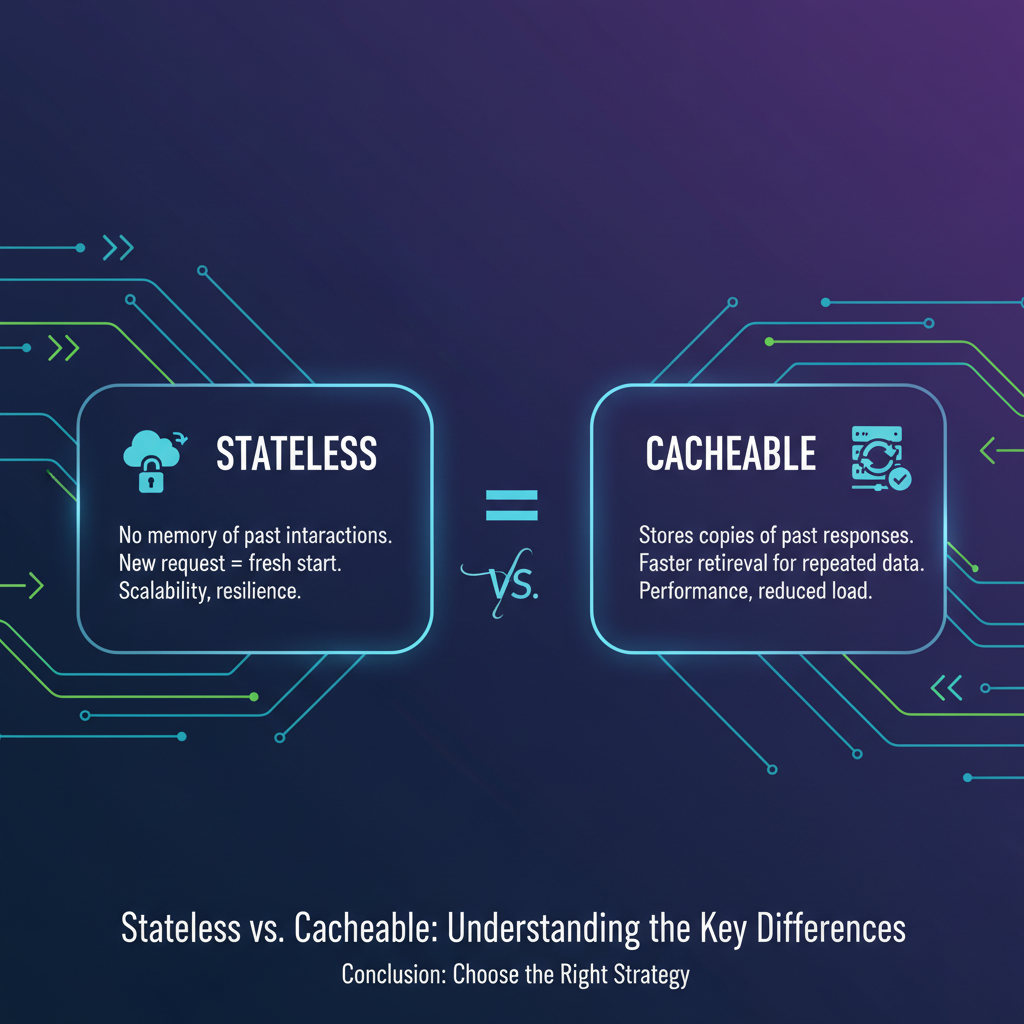
Stateless vs. Cacheable: Understanding the Key Differences


In the vast and interconnected digital landscape that defines our modern technological era, the performance, scalability, and reliability of applications are paramount. At the heart of this intricate ecosystem lies the Application Programming Interface (API), the fundamental mechanism enabling disparate software systems to communicate and interact seamlessly. As developers and architects strive to build resilient, high-performing systems, two concepts frequently emerge as central tenets of effective API design: statelessness and cacheability. While seemingly distinct, these principles often complement each other, shaping the very fabric of how information flows across networks.
The advent of microservices architectures, cloud computing, and the increasing demand for real-time data processing has pushed the boundaries of traditional system design. Applications are no longer monolithic giants but rather constellations of smaller, specialized services, each communicating through APIs. In this environment, understanding the nuances of statelessness and cacheability is not merely an academic exercise; it is a critical skill for crafting robust, scalable, and maintainable software. Statelessness champions simplicity and scalability by ensuring that each API request is an independent transaction, devoid of server-side memory of previous interactions. Conversely, cacheability focuses on optimizing performance and reducing server load by storing frequently accessed data closer to the consumer, thereby minimizing redundant data fetches and accelerating response times.
This comprehensive exploration aims to meticulously unpack the definitions, architectural implications, advantages, and disadvantages of both statelessness and cacheability. We will delve into how these two principles, rather than being mutually exclusive, can be strategically combined to yield powerful results. Furthermore, we will examine the indispensable role of an API gateway in orchestrating these concepts, serving as a critical intermediary that can enforce statelessness for backend services while simultaneously implementing sophisticated caching strategies. By the end of this deep dive, readers will possess a clear understanding of when and how to apply these design patterns, ensuring their APIs are not only functional but also exceptionally performant, scalable, and ready to meet the ever-evolving demands of the digital world. The journey through these core API design philosophies promises to illuminate the pathways to building more efficient and resilient software infrastructures, empowering developers to navigate the complexities of distributed systems with greater confidence and precision.
Demystifying Statelessness in API Design
Statelessness stands as a cornerstone principle in the design of scalable and resilient API architectures, particularly within the realm of Representational State Transfer (REST), which is the dominant architectural style for web services. To truly grasp its significance, one must delve into its fundamental definition and the profound architectural shifts it necessitates.
Definition and Core Principles of Statelessness
At its most basic, statelessness dictates that each request from a client to a server must contain all the information necessary to understand the request, and the server must not store any client context between requests. In essence, the server treats every request as if it's the first time it has encountered that client, relying solely on the information provided within that specific request to process it. This means there are no "sessions" maintained on the server-side in the traditional sense, where server memory is allocated to remember a client's past interactions or progress through a series of steps.
Consider a transaction where a client makes multiple requests. If the API is stateless, each of these requests—whether it's to retrieve user data, add an item to a cart, or finalize an order—must be entirely self-contained. It must include all necessary authentication credentials, identifiers, and any other relevant parameters needed for the server to fulfill that request, without referencing any previously stored session data. This contrasts sharply with stateful protocols or architectures where the server might remember that "user X is logged in" or "user Y has items A, B, C in their shopping cart" from an earlier interaction, thereby influencing how subsequent requests are processed. The beauty of statelessness lies in its simplicity for the server; it only needs to focus on the immediate request at hand, process it, and send back a response, then forget about it.
Architectural Implications of Statelessness
The adherence to statelessness yields several critical architectural advantages that are highly coveted in modern distributed systems:
Enhanced Scalability
One of the most profound benefits of statelessness is its inherent support for horizontal scaling. Since no client-specific state is stored on any particular server, any request from a client can be routed to any available server in a pool. This means that adding more servers to handle increased load becomes a trivial task, as new servers do not need to be aware of or synchronize existing client sessions. Load balancers can distribute incoming requests uniformly across an array of identical, stateless servers, maximizing resource utilization and ensuring high availability. If a server goes down, clients can simply re-send their request to another server without losing any session data, as that data would have been included in the request itself or managed on the client side. This characteristic is particularly vital for applications that experience unpredictable spikes in traffic or need to serve a global user base.
Improved Reliability and Resilience
Statelessness significantly boosts the fault tolerance of a system. In a stateful system, if a server hosting a client's session crashes, that session data is lost, often leading to a disrupted user experience and requiring the client to start over. In a stateless environment, however, if one server fails, any subsequent request can simply be rerouted to another operational server. As long as the client retains its own state (e.g., tokens, identifiers) and can resend the request, the system remains robust against individual server failures. This resilience is a key driver for building highly available services that can withstand partial outages without compromising overall functionality.
Simplified Server Architecture
From a server-side perspective, statelessness can simplify application logic. Developers don't need to write complex code for session management, state synchronization across multiple servers, or handling session expiry. Each request is a distinct operation, which makes debugging easier as problems can often be isolated to a single request-response cycle rather than being intertwined with a sequence of past interactions. This streamlined approach allows engineers to focus more on the core business logic rather than the complexities of state management.
Adherence to RESTful Principles
Statelessness is a fundamental constraint of the REST architectural style, as defined by Roy Fielding. It ensures that the client-server interaction adheres to a clear, uniform interface, where all necessary information for processing a request is transferred in the request itself. This promotes loose coupling between client and server, enhancing the evolvability and maintainability of the system over time. A truly RESTful API, therefore, is inherently stateless, leading to predictable behaviors and easier integration for third-party developers.
How State is Managed (Client-side/External)
While the server remains stateless, the overall application naturally requires state. This "state" is typically managed on the client-side or externally:
- Tokens: JSON Web Tokens (JWTs) are a popular mechanism. After a user authenticates, the server issues a JWT which contains claims (e.g., user ID, roles). The client stores this token and sends it with every subsequent request in the
Authorizationheader. The server simply validates the token's signature and expiration, extracting the necessary user information without storing any session data itself. - Client-side Cookies/Local Storage: For web applications, cookies or browser's local storage can hold user preferences, session IDs (which are then used to look up state in an external state store), or other client-specific data.
- Query Parameters & Headers: Information directly embedded in the URL (e.g.,
?userId=123) or HTTP headers can convey state for a specific request. - External Data Stores: For complex application state (like a shopping cart), the server might store this data in a dedicated, highly available external database (e.g., Redis, DynamoDB) and use a unique identifier (like a cart ID) passed by the client in each request to retrieve and update that state. The crucial point here is that the application servers themselves remain stateless; the state management is delegated to a specialized external service.
Advantages of Statelessness
- Enhanced Scalability: As discussed, effortless horizontal scaling through simple addition of servers.
- Improved Fault Tolerance: System resilience against server failures, as no session data is lost.
- Simplified Server Design: Reduced complexity in server-side logic by eliminating session management concerns.
- Easier Load Balancing: Any server can handle any request, simplifying load balancer configuration.
- Better Resource Utilization: Servers don't hold onto memory for idle sessions, freeing up resources.
- Easier Debugging and Testing: Each request can be tested independently, as it doesn't depend on prior interactions.
Disadvantages of Statelessness
- Potentially Larger Requests: Each request must carry all necessary information, which can lead to larger request payloads compared to stateful systems that rely on server-side session context. This can increase bandwidth consumption, especially for highly interactive applications.
- Increased Bandwidth Consumption: As a direct consequence of larger requests, the overall network traffic can increase, potentially impacting latency and cost.
- More Complex Client-side State Management: The burden of maintaining session information and ensuring it's sent with every request shifts to the client, which might require more intricate client-side logic.
- Repeated Authentication Challenges: Without server-side sessions, every request needs authentication credentials, typically in the form of a token. While efficient, managing token refresh and expiry on the client side adds a layer of complexity.
- Potential for Performance Overhead: The parsing and validation of tokens or other self-contained information with every request can introduce a small overhead, though modern systems are highly optimized for this.
Real-world Examples
The internet itself, built on HTTP, is largely stateless. Every time you type a URL into your browser, it sends a new, independent request to the server. RESTful apis, widely used for mobile apps, web applications, and microservices communication, are the most prominent examples of stateless design. Authentication mechanisms leveraging JWTs are also prime examples of how state can be externalized to maintain server statelessness. This design paradigm is crucial for services that need to handle millions of requests from diverse clients, ensuring that performance and reliability are not compromised by state synchronization challenges.
The Power of Cacheability for Performance
While statelessness ensures architectural scalability and resilience, cacheability focuses squarely on optimizing performance and efficiency. In the modern web, where users demand instant responses and applications interact with a multitude of services, judicious caching is no longer merely an option but a critical necessity for any high-performing API.
Definition and Purpose of Cacheability
Cacheability refers to the ability to store a copy of a given resource or response for a certain period, thereby allowing subsequent requests for that same resource to be served from the cache rather than being re-generated or re-fetched from the original source. The primary purpose of caching is multifaceted:
- Reducing Latency: By serving responses from a nearby cache, the round-trip time to the original server is eliminated or significantly shortened, leading to faster response times for clients.
- Offloading Backend Servers: Caches absorb a significant portion of the request load, preventing backend servers from being overwhelmed by repetitive requests for the same data. This frees up backend resources to focus on processing unique or computationally intensive tasks.
- Minimizing Bandwidth Consumption: When responses are served from a local or intermediate cache, less data needs to travel across the wider network, reducing bandwidth costs and improving network efficiency.
- Improving User Experience: Faster response times directly translate to a more fluid and satisfying user experience, reducing frustration and increasing engagement.
Essentially, caching acts as a buffer, strategically placing frequently accessed data closer to the request origin, creating a more responsive and efficient communication channel between client and server.
How Caching Works: Mechanisms and Strategies
Caching isn't a single technique but a collection of mechanisms and strategies primarily governed by HTTP headers for web apis.
HTTP Caching Headers
The HTTP protocol provides a robust set of headers that allow both servers and clients to control caching behavior:
Cache-Control: This is the most powerful and widely used header. It defines directives for caching, such as:max-age: Specifies the maximum amount of time (in seconds) a resource is considered fresh.no-cache: Means the cache must revalidate the resource with the origin server before using a cached copy. It doesn't mean "don't cache."no-store: Means the cache should not store any part of the client request or server response.public: Indicates that any cache (even shared proxy caches) can store the response.private: Indicates that the response is intended for a single user and cannot be stored by a shared cache.must-revalidate: The cache must revalidate a stale entry with the origin server before using it.
Expires: An older header, similar tomax-age, providing an absolute expiration date/time.Cache-Controlgenerally takes precedence.Last-ModifiedandIf-Modified-Since: The server sendsLast-Modifiedto indicate when the resource was last changed. The client (or cache) can then sendIf-Modified-Sincewith a subsequent request. If the resource hasn't changed, the server responds with a304 Not Modifiedstatus, indicating the client can use its cached version, saving bandwidth.ETagandIf-None-Match:ETag(Entity Tag) is a unique identifier (often a hash) for a specific version of a resource. When a client makes a subsequent request, it can send theETagit has in anIf-None-Matchheader. If the server finds that its currentETagfor the resource matches the client's, it also responds with304 Not Modified.ETagis more robust thanLast-Modifiedas it can handle situations where content changes without the modification date changing, or where different representations of a resource have the same modification date.
Cache-Busting Strategies
Sometimes, caches need to be bypassed or explicitly invalidated to ensure users receive the latest content. Common strategies include: * Versioned URLs: Appending a version number or a hash of the content to the URL (e.g., /api/v1/products/123 or /api/products/123?hash=abcdef). When the content changes, the URL changes, forcing caches to fetch the new resource. * Forced Reloads: Clients can sometimes explicitly bypass the cache (e.g., Ctrl+F5 in browsers). * Direct Cache Invalidation: Some caching systems (like CDNs or API gateways) offer programmatic ways to purge specific cached items or entire caches.
Types of Caches
Caching can occur at various layers in a distributed system:
- Browser/Client-side Caches: The web browser itself stores static assets (images, CSS, JavaScript) and API responses to avoid re-fetching them.
- Proxy Caches: Intermediate servers that sit between clients and origin servers, caching content for multiple users. These can be transparent proxies (ISP-level) or explicit proxies (corporate networks).
- API Gateway Caches: A dedicated api gateway can implement caching policies for all apis it manages. This is a powerful point for centralized cache management and optimization.
- CDN (Content Delivery Network) Caches: Geographically distributed networks of servers that cache content closer to end-users, drastically reducing latency for static and even dynamic content.
- Application-level Caches: Caches within the application code itself (e.g., an in-memory cache like Guava Cache, or a distributed cache like Redis) to store results of database queries or computations.
- Database Caches: Databases often have their own internal caching mechanisms for query results or data blocks.
When to Cache and When NOT to Cache
Strategic caching is crucial. Not all data is suitable for caching.
When to Cache:
- Idempotent Operations: Primarily GET requests, which retrieve data and do not modify server state. These are ideal candidates.
- Static or Infrequently Changing Data: Content like product catalogs, configuration settings, user profiles (if updates are rare), or blog posts are perfect for long cache durations.
- Frequently Accessed Data: Even if data changes, if it's accessed thousands of times a second and changes only once a minute, caching still provides significant benefits.
- Publicly Accessible Data: Information that doesn't vary per user is highly cacheable by shared caches.
When NOT to Cache:
- Highly Sensitive Data: Personal identifiable information (PII), financial transactions, or security credentials should generally not be cached, especially in shared caches, due to the risk of exposure.
- Rapidly Changing Data: Real-time stock prices, live sensor data, or auction bids that update second-by-second are poor candidates for caching, as the cached data would quickly become stale.
- Personalized User Data: Content that is unique to a specific logged-in user (e.g., a personalized dashboard view, a shopping cart that is frequently modified) is often unsuitable for shared caching, though private client-side caching might be acceptable.
- Non-Idempotent Operations: POST, PUT, DELETE requests, which modify server state, should almost never be cached by intermediaries, as caching them could lead to incorrect or unexpected behavior.
Advantages of Cacheability
- Drastically Improved Response Times: The most immediate and noticeable benefit, leading to a superior user experience.
- Reduced Server Load: Offloads backend systems, allowing them to handle more unique requests or perform other critical tasks.
- Lower Bandwidth Consumption: Saves on network transfer costs and speeds up data delivery by serving content closer to the client.
- Increased System Scalability: By reducing the load on origin servers, caching effectively scales the entire system's capacity to handle requests.
- Enhanced Reliability: Caches can serve stale content during origin server outages, providing some level of service continuity.
Disadvantages of Cacheability
- Cache Staleness: The greatest challenge. Data in the cache can become outdated compared to the origin. Managing this requires careful design.
- Cache Invalidation Complexity: Deciding when and how to invalidate cached items can be notoriously difficult, often dubbed one of the two hardest problems in computer science. Incorrect invalidation can lead to users seeing old data or unnecessary backend hits.
- Increased Infrastructure and Operational Complexity: Implementing and managing a robust caching layer (e.g., Redis clusters, CDN configurations) adds complexity and operational overhead.
- Potential for Serving Outdated Data: A direct consequence of staleness, which can lead to incorrect decisions or user frustration if not managed effectively.
- Increased Memory/Storage Usage: Caches require dedicated memory or storage resources.
Cache Invalidation Strategies
Effective cache invalidation is key to mitigating the staleness problem:
- Time-Based Invalidation (TTL): The simplest method, where cached items expire after a predefined Time-To-Live (TTL). This is suitable for data that can tolerate some staleness or updates predictably.
- Event-Driven Invalidation: When the source data changes (e.g., a database update), an event is triggered to explicitly invalidate the corresponding cached items. This offers stronger consistency but requires tight coupling between the data source and the cache.
- URL-Based Invalidation: Purging specific URLs or URL patterns from the cache, often done programmatically via a cache management api.
- Versioned URLs: As mentioned earlier, changing the URL itself when content changes.
By carefully considering these factors, developers can leverage caching as a potent tool to significantly boost the performance and efficiency of their APIs, ensuring a faster, more responsive experience for users while reducing the burden on backend infrastructure.
Statelessness and Cacheability: An Interplay
At first glance, statelessness and cacheability might appear to be orthogonal concerns, perhaps even contradictory. Statelessness mandates that the server remembers nothing about prior interactions, while caching explicitly involves storing past responses. However, a deeper examination reveals that these two powerful principles are not mutually exclusive but rather complementary, forming a robust foundation for building highly scalable, performant, and resilient API-driven systems. Understanding their interplay is crucial for mastering modern API design.
Are They Mutually Exclusive? No.
The common misconception is that a stateless system cannot also be cacheable, or that caching somehow introduces statefulness at the server level. This is incorrect. Statelessness refers specifically to the server's processing of a request. It means the server doesn't rely on or store any internal, client-specific session state to fulfill the request. The request itself must contain all the necessary information.
Cacheability, on the other hand, concerns the storage and retrieval of responses for performance optimization. When a response is cached, it's not the server maintaining "session state" for a particular client; it's an intermediary (or the client itself) storing a copy of a resource that the server provided. The server, from its perspective, remains stateless with respect to the client's interaction. If the cached response is served, the origin server isn't even involved. If the cache needs to revalidate, the request sent to the server is still stateless, containing all necessary revalidation tokens (like If-None-Match or If-Modified-Since).
Thus, a stateless API can and should leverage caching. In fact, statelessness often facilitates caching due to the predictability and independence of requests.
How Statelessness Facilitates Caching
The very nature of stateless API interactions makes them ideal candidates for caching:
- Predictable Requests: Because each request is self-contained and doesn't depend on prior server-side state, a request for a specific resource with the same parameters will always yield the same response (assuming the resource hasn't changed). This predictability makes it easy for a cache to identify and store responses.
- Easier Cache Key Generation: With stateless requests, the unique identifier for a cached resource (the cache key) can often be directly derived from the request URL, headers, and query parameters. There's no complex session state to consider when generating a cache key.
- Simplified Invalidation Logic: If a resource is stateless, updates to that resource can often trigger straightforward cache invalidation based on its URL or ETag, without worrying about how those updates affect multiple client sessions.
How Caching Impacts Statelessness
Caching doesn't make a stateless server stateful; instead, it optimizes the interaction around the stateless server:
- Externalized Performance Layer: Caches introduce an external layer that stores data. This layer holds a "state" – the cached response – but this state is distinct from the server's internal, client-specific session state. The cache serves as an intermediary, reducing the need for the stateless backend to be hit repeatedly.
- Preserving Server Independence: By serving requests from the cache, the backend server can remain entirely unaware of how many times a particular resource has been requested or which clients have received it from the cache. Its stateless nature is preserved, as it only processes requests that actually reach it.
- Reduced Server Load, Maintained Scalability: Caching helps maintain the scalability benefits of statelessness by ensuring that the origin servers, while remaining stateless, are not overburdened by redundant requests. This allows the system to scale even more effectively.
Key Differences Table
To further clarify, let's delineate the primary focus and characteristics of statelessness versus cacheability:
| Aspect | Stateless API Design | Cacheable API Responses |
|---|---|---|
| Primary Goal | Scalability, Resilience, Simplicity of Server Logic | Performance, Reduced Server Load, Lower Latency |
| What it Affects | How the server processes requests and manages client context | How and where responses are stored and retrieved |
| State Storage | Client-side (tokens, cookies), external data stores | Cache layer (browser, proxy, CDN, API gateway, app) |
| Server Interaction | Each request is independent and self-contained | May bypass origin server if response is cached |
| Complexity Shift | Client-side for state management; potentially larger requests | Cache invalidation logic, cache coherency management |
| Impact on Resources | Can increase client-side processing, network bandwidth (due to full requests) | Reduces network bandwidth, server CPU/DB load |
| Typical Use Case | Transactional APIs, session management via tokens, microservices communication | Read-heavy APIs, static content, frequently accessed data |
| HTTP Methods | Applies to all HTTP methods (GET, POST, PUT, DELETE) | Primarily GET (and sometimes HEAD) requests |
| Dependency | No server memory for session or past request context | Depends on data volatility and freshness requirements |
| Risk | Larger request payloads, increased client-side complexity | Serving stale data, complex cache invalidation bugs |
| Architectural Focus | Backend service design, communication protocol | Frontend optimization, middleware (e.g., API gateway), infrastructure |
Example Scenarios
- A Product Catalog API: Imagine an e-commerce platform. The api for fetching product listings (
GET /productsorGET /products/{id}) should be stateless. Each request to get a product's details needs to contain only the product ID. However, the response from this api is highly cacheable. Product details don't change frequently. An api gateway or CDN can cache the response for hours or even days, drastically speeding up access for millions of users without ever hitting the backend service. When a product is updated, a targeted cache invalidation can be triggered for that specific product ID. - User Profile Update API: A
PUT /users/{id}orPATCH /users/{id}api is stateless. The request to update a user's email must contain the user's ID, the new email, and authentication credentials. The server processes this request and forgets about it. This api is not cacheable, as it modifies data, and caching its response would be meaningless or harmful. However, a subsequentGET /users/{id}request (which is stateless) might return the updated profile, and that response could then be cached. - Authentication API: A
POST /loginapi takes credentials and, if successful, returns a JWT. This interaction is stateless: the server doesn't remember the login attempt after sending the token. The token itself allows subsequent stateless interactions with other apis. The login api's response (the JWT) is typically not cached itself, but the existence of the token enables caching for subsequent resource requests.
In essence, statelessness provides the architectural foundation for scalability and resilience by decoupling requests, while cacheability builds upon this foundation to layer on performance optimizations. They work in tandem, allowing architects to design systems that are both robust in their core logic and lightning-fast in their delivery.
APIPark is a high-performance AI gateway that allows you to securely access the most comprehensive LLM APIs globally on the APIPark platform, including OpenAI, Anthropic, Mistral, Llama2, Google Gemini, and more.Try APIPark now! 👇👇👇
The Crucial Role of an API Gateway
In the complex landscape of modern distributed systems, particularly those built around microservices, the API gateway emerges as an indispensable architectural component. It acts as the single entry point for all client requests, routing them to the appropriate backend services. More than just a traffic manager, an api gateway is a powerful intermediary that can profoundly influence the application of both statelessness and cacheability, turning these theoretical principles into practical, optimized realities.
What is an API Gateway?
An API gateway is a service that sits in front of a group of backend services, often microservices. It aggregates common functionalities, shields clients from the complexity of the backend architecture, and provides a unified, consistent api for consumption. Rather than clients having to interact with multiple individual services directly, they interact with the api gateway, which then handles the internal routing, transformation, and policy enforcement.
Key functions of an api gateway typically include:
- Request Routing: Directing incoming requests to the correct microservice based on the request path, host, or other criteria.
- Authentication and Authorization: Centralizing security concerns, verifying client identity, and enforcing access control policies before requests reach backend services.
- Request/Response Transformation: Modifying request or response payloads to match the expectations of clients or backend services, bridging compatibility gaps.
- Load Balancing: Distributing traffic efficiently across multiple instances of backend services.
- Rate Limiting/Throttling: Protecting backend services from overload by limiting the number of requests a client can make within a given period.
- Monitoring and Logging: Collecting metrics and logs about api usage, performance, and errors.
- Caching: Storing responses to reduce latency and backend load.
- Protocol Translation: Enabling clients using one protocol (e.g., HTTP/1.1) to communicate with backend services using another (e.g., gRPC, HTTP/2).
- Circuit Breaking: Implementing resilience patterns to prevent cascading failures.
How an API Gateway Facilitates Statelessness
While backend services should ideally be designed to be stateless, an api gateway can greatly assist in this by handling aspects that might otherwise introduce stateful concerns or increase the payload size for backend services.
- Centralized Authentication and Authorization: This is a prime example. While the backend service itself can be stateless (only validating a token provided in the request), the process of acquiring and managing that token might involve state. An api gateway can handle the initial authentication flow, issuing JWTs or session tokens. Subsequent requests will then pass through the gateway, which validates these tokens and extracts necessary user context (like user ID or roles). This validated and parsed information can then be passed to the backend services, often in custom headers. The backend service receives a clean, stateless request with all necessary authorization details, without needing to worry about session management or token validation complexity. This offloads the burden from individual microservices, allowing them to remain purely stateless.
- Request Transformation and Enrichment: Sometimes, a client might send a minimalist request, and a backend service requires additional context that is derived from other services or static configurations. An api gateway can "enrich" stateless requests by adding headers or modifying the payload with this information (e.g., adding an internal service ID, correlating transaction IDs, or fetching tenant-specific configurations) before forwarding it to the backend. This ensures the backend receives a complete, self-contained, and stateless request without needing to perform these enrichments itself.
- Header-Based State Propagation: The gateway facilitates the propagation of state through headers or query parameters, which aligns with stateless principles. For instance, if a client needs to specify a particular version of an api, the gateway can ensure this version information is consistently passed via a header to the correct stateless backend service.
How an API Gateway Manages Cacheability
The API gateway is an ideal location to implement and manage caching strategies, leveraging its position as the central point of ingress for all api traffic.
- Centralized Caching Policies: Instead of individual backend services implementing their own caching logic, the gateway can apply consistent caching policies across all or specific api endpoints. This simplifies development, ensures uniformity, and makes cache management much easier. For example, all
GET /productsrequests can be cached for 5 minutes, whileGET /users/{id}requests might be marked as private and cached for a shorter duration. - Smart Caching and Validation: An api gateway can intelligently manage HTTP caching headers like
Cache-Control,ETag, andLast-Modified. It can generateETags for backend responses, sendIf-None-MatchorIf-Modified-Sinceheaders to backend services for conditional requests, and return304 Not Modifiedresponses directly to clients if the cached content is still fresh. This significantly reduces redundant data transfer and backend processing. - Reduced Backend Load and Improved Performance: By serving cached responses directly from the gateway, the load on backend services is dramatically reduced. This translates to faster response times for clients, as the network hop to the backend is often eliminated, and the backend services are free to process unique or more complex requests without being bogged down by repetitive data fetching.
- Fine-grained Cache Control: Many api gateways offer robust features for cache configuration, allowing administrators to define cache keys, TTLs, cache invalidation strategies (e.g., explicit purge apis, time-based expiry), and cache partitioning (e.g., per-tenant caches). This level of control is crucial for balancing freshness and performance.
- Integration with External Caches/CDNs: An api gateway can often integrate with external caching solutions like Redis or even act as an edge cache, pushing content to CDNs to bring it even closer to global users.
APIPark and its Contribution to API Management
For organizations seeking robust and efficient api management, particularly in the AI domain, platforms like APIPark provide crucial capabilities. As an open-source AI gateway and api management platform, APIPark excels at streamlining the integration and deployment of AI and REST services. It offers features like unified api formats, prompt encapsulation, and end-to-end api lifecycle management, making it an invaluable tool for developers to design, govern, and optimize both stateless and cacheable apis effectively. Its high performance, rivalling Nginx, and detailed logging capabilities ensure that api interactions, whether stateless for transactional integrity or cacheable for performance, are managed with utmost efficiency and visibility. APIPark’s ability to quick-integrate 100+ AI models and standardize AI invocation formats means that developers can build stateless apis around complex AI models, knowing that the gateway will handle the underlying complexities, authentication, and even cost tracking, while simultaneously supporting intelligent caching for frequently requested AI model outputs or prompts. This comprehensive approach empowers developers to build and deploy advanced AI services without compromising on the core principles of scalability and performance, critical for both stateless apis and cacheable responses.
Other API Gateway Functions
- Security (Rate Limiting, Throttling, Circuit Breaking): Beyond authentication, api gateways can implement sophisticated security measures. Rate limiting prevents abuse and protects against DDoS attacks, ensuring backend services remain available. Circuit breaking, a resilience pattern, can temporarily stop requests to failing services, preventing cascading failures and allowing services to recover.
- Monitoring and Analytics: An api gateway is a choke point where all api traffic flows. This makes it an ideal place to gather comprehensive metrics on api usage, performance (latency, error rates), and traffic patterns. This data is invaluable for capacity planning, troubleshooting, and understanding how both statelessness and caching impact real-world performance. Detailed api call logging, a feature highlighted in platforms like APIPark, allows businesses to quickly trace and troubleshoot issues, ensuring system stability and data security while enabling powerful data analysis to display long-term trends and performance changes.
In essence, the api gateway serves as an intelligent traffic cop, a bouncer, and a librarian all rolled into one. It empowers developers to build backend services that are lean and focused on their core business logic (often by being stateless), while the gateway itself handles the complex operational and performance concerns, including sophisticated caching. This separation of concerns simplifies development, improves system resilience, and ultimately delivers a better experience for both developers and end-users.
Best Practices and Strategic Considerations
Designing and implementing APIs that are both scalable and performant requires a deep understanding of statelessness and cacheability, and critically, how to apply them strategically. It's not about choosing one over the other, but rather about leveraging their complementary strengths to build robust, efficient, and user-friendly systems.
Designing for Statelessness: Foundations for Scalability
Embracing statelessness as a core design principle lays the groundwork for highly scalable and resilient architectures. Here are key best practices:
- Utilize Tokens for Authentication and Authorization: Instead of server-side sessions, rely on self-contained tokens like JSON Web Tokens (JWTs). Once a user authenticates, a JWT is issued. The client stores this token and sends it with every subsequent request. The server (or api gateway) merely validates the token's signature and expiry, extracting user information without storing any session state. This decouples authentication from the backend service state.
- Ensure Self-Contained Requests: Every request should carry all the necessary information for the server to process it independently. This includes all parameters, identifiers, and credentials. Avoid design patterns where the server needs to remember a client's "step 1" to process "step 2" of a multi-stage operation. If a multi-step process is required, the client should manage the state of the process and send it with each step's request.
- Avoid Server-Side Session State at the Service Layer: This is the cardinal rule. Do not use server-side memory to store user-specific data between requests. If state is absolutely necessary (e.g., a complex, transient workflow), consider offloading it to a dedicated, external, highly available state store (like Redis, a message queue, or a specialized database) which the backend service can access via an identifier provided in the stateless request. The backend service itself remains stateless.
- Design Idempotent Operations Where Possible: While not strictly a requirement for statelessness, designing idempotent operations (especially for PUT and DELETE) is a good practice for stateless APIs. An idempotent operation can be called multiple times without changing the result beyond the initial call, which enhances reliability in distributed systems where requests might be retried.
- Favor RESTful Principles: Adhere to the core tenets of REST, especially the Uniform Interface and Statelessness constraints, as these naturally guide towards a scalable and evolvable api design.
Implementing Caching Effectively: Optimizing for Performance
Strategic caching is a powerful lever for boosting API performance. However, it must be implemented thoughtfully to avoid common pitfalls like stale data.
- Identify Ideal Cache Candidates: Prioritize caching for
GETrequests that fetch data which is either static or changes infrequently. Examples include product listings, news articles, public profiles, and configuration data. Data that is highly dynamic, sensitive, or user-specific (and not meant for shared caching) should generally be avoided or cached with extreme caution and short TTLs. - Leverage HTTP Caching Headers Correctly: Master
Cache-Control,Expires,Last-Modified, andETag. Usemax-ageands-maxage(for shared caches) to define appropriate cache durations. Employno-cachefor resources that must always be revalidated, andno-storefor truly sensitive data that should never be cached. - Implement Robust Cache Invalidation Strategies: This is often the trickiest part.
- Time-Based (TTL): The simplest. Define a TTL appropriate for the data's volatility. If data can be stale for a few minutes, this works well.
- Event-Driven: For stronger consistency, implement a mechanism where a data change (e.g., a database update) triggers an event that explicitly purges the relevant item(s) from the cache. This requires more integration but ensures freshness.
- Versioned URLs/Content Hashes: For static assets or content bundles, embedding a version number or content hash in the URL forces clients and caches to fetch the new version when content changes.
- Monitor Cache Hit Rates and Staleness: Implement metrics to track how often cached items are served (hit rate) versus how often the origin is hit (miss rate). Also, monitor for cache staleness – situations where outdated data is served. This feedback is critical for fine-tuning cache policies.
- Consider Multi-Layer Caching: Combine client-side caching (browser), edge caching (CDN, api gateway), and backend application-level caches (e.g., Redis) for maximum effect. Each layer serves a specific purpose and can contribute to overall performance.
Balancing the Trade-offs: The Art of API Design
The ultimate goal is to strike a balance. There are always trade-offs to consider:
- Statelessness vs. Request Size: Pure statelessness might lead to larger requests. Caching can mitigate the impact by reducing the number of requests that hit the backend.
- Performance vs. Freshness: Aggressive caching boosts performance but increases the risk of stale data. The acceptable level of staleness depends on the application's requirements. For a news site, a few minutes of staleness might be fine; for a financial trading platform, it's unacceptable.
- Complexity of Caching vs. Backend Load: While caching adds operational complexity, it significantly reduces the load on backend services, potentially saving infrastructure costs and improving reliability.
The optimal strategy often involves building core services that are strictly stateless to maximize scalability and resilience. Then, strategically introduce aggressive caching at the edge (via a CDN or an api gateway like APIPark) for read-heavy, less volatile resources. This allows the system to be both inherently robust and exceptionally fast. For critical, real-time data or transactional operations, bypass caching entirely or use very short, meticulously managed cache durations.
Future Trends: Statelessness, Caching, and the Edge
As computing moves towards the edge and serverless architectures gain prominence, these concepts remain as relevant as ever. Serverless functions are inherently stateless, making them ideal for scaling. Edge computing brings computation and data storage closer to the user, enhancing the potential for low-latency caching and efficient stateless interactions, as the "origin" server is geographically nearer. These trends will only reinforce the importance of mastering stateless api design and intelligent caching strategies to build the next generation of performant and resilient applications.
Conclusion
The journey through the realms of statelessness and cacheability reveals them not as competing philosophies, but as indispensable and complementary pillars of modern API design. Statelessness, by liberating the server from the burden of session management, lays the architectural groundwork for unparalleled scalability, simplified server logic, and robust fault tolerance. It ensures that each API request is an independent, self-contained transaction, allowing systems to effortlessly scale horizontally and withstand individual component failures without compromising user experience.
Conversely, cacheability acts as the performance accelerant, strategically placing frequently accessed data closer to the consumer. By leveraging various caching layers—from client-side to API gateways and CDNs—it drastically reduces response times, alleviates the load on backend servers, and minimizes network bandwidth consumption. While statelessness dictates how interactions occur, cacheability optimizes the speed and efficiency of those interactions, ensuring that data is delivered swiftly and without taxing origin resources unnecessarily.
The true mastery of API design lies in understanding their symbiotic relationship. A stateless API is inherently well-suited for caching because its requests are predictable and self-contained, simplifying cache key generation and invalidation. Conversely, caching, particularly at the API gateway layer, empowers backend services to remain truly stateless by offloading authentication, authorization, and data retrieval tasks, ensuring they can focus on core business logic without accumulating client-specific state. Platforms like APIPark exemplify how a robust api gateway can unify the management of both stateless and cacheable APIs, providing the performance, security, and visibility needed for complex, modern architectures.
In the rapidly evolving landscape of distributed systems, microservices, and AI-driven applications, the ability to thoughtfully apply these principles is more critical than ever. Developers and architects who meticulously design for statelessness at the service level and judiciously implement caching at the edge will build systems that are not only capable of handling immense scale and diverse workloads but also deliver exceptional performance and reliability. By embracing these core tenets, we pave the way for more resilient, efficient, and future-proof digital infrastructures that can readily adapt to the challenges and opportunities of tomorrow.
Frequently Asked Questions (FAQs)
1. What is the fundamental difference between stateless and cacheable APIs?
The fundamental difference lies in their primary concerns: * Stateless: Focuses on the server's processing model. A stateless API server does not store any client-specific session state between requests. Each request must contain all information for the server to process it independently. Its main goal is to enhance scalability and resilience. * Cacheable: Focuses on performance optimization. A cacheable API response is one that can be stored by an intermediary (like an API gateway, CDN, or browser) for a period, so subsequent identical requests can be served from the cache without hitting the original server. Its main goal is to reduce latency and backend load.
2. Can a stateless API also be cacheable, or are they mutually exclusive?
No, they are not mutually exclusive; in fact, they are highly complementary. A stateless API can, and often should, be designed to serve cacheable responses. Statelessness ensures that requests are predictable and self-contained, making them ideal candidates for caching. The cache stores a copy of a resource, not client-specific session state, so the backend server remains stateless even if its responses are cached.
3. What role does an API Gateway play in stateless and cacheable API architectures?
An API Gateway is crucial. It acts as a central intermediary that can: * Facilitate Statelessness: By handling authentication/authorization (e.g., validating JWTs) and enriching requests before forwarding them to backend services, it allows backend services to remain purely stateless. * Manage Cacheability: It can implement centralized caching policies, store API responses, handle HTTP caching headers (like Cache-Control, ETag), and serve cached content directly to clients, significantly reducing backend load and improving response times.
4. What are the main benefits of designing stateless APIs?
The main benefits of stateless API design include: * Enhanced Scalability: Easy horizontal scaling as any server can handle any request. * Improved Fault Tolerance: System resilience against individual server failures, as no session data is lost. * Simplified Server Logic: Reduced complexity in server-side code by eliminating session management. * Easier Load Balancing: Any server can be used to process a request. * Better Resource Utilization: Servers don't hold onto memory for idle sessions.
5. What are the primary challenges or disadvantages associated with caching API responses?
The primary challenges with caching API responses include: * Cache Staleness: The risk of serving outdated data to clients if the original data changes but the cache is not updated or invalidated. * Cache Invalidation Complexity: Deciding when and how to invalidate cached items can be notoriously difficult to manage correctly. * Increased Infrastructure Complexity: Implementing and maintaining a robust caching layer adds operational overhead and infrastructure costs. * Risk of Serving Sensitive Data: Caching highly personalized or sensitive information inappropriately can lead to security vulnerabilities.
🚀You can securely and efficiently call the OpenAI API on APIPark in just two steps:
Step 1: Deploy the APIPark AI gateway in 5 minutes.
APIPark is developed based on Golang, offering strong product performance and low development and maintenance costs. You can deploy APIPark with a single command line.
curl -sSO https://download.apipark.com/install/quick-start.sh; bash quick-start.sh

In my experience, you can see the successful deployment interface within 5 to 10 minutes. Then, you can log in to APIPark using your account.

Step 2: Call the OpenAI API.