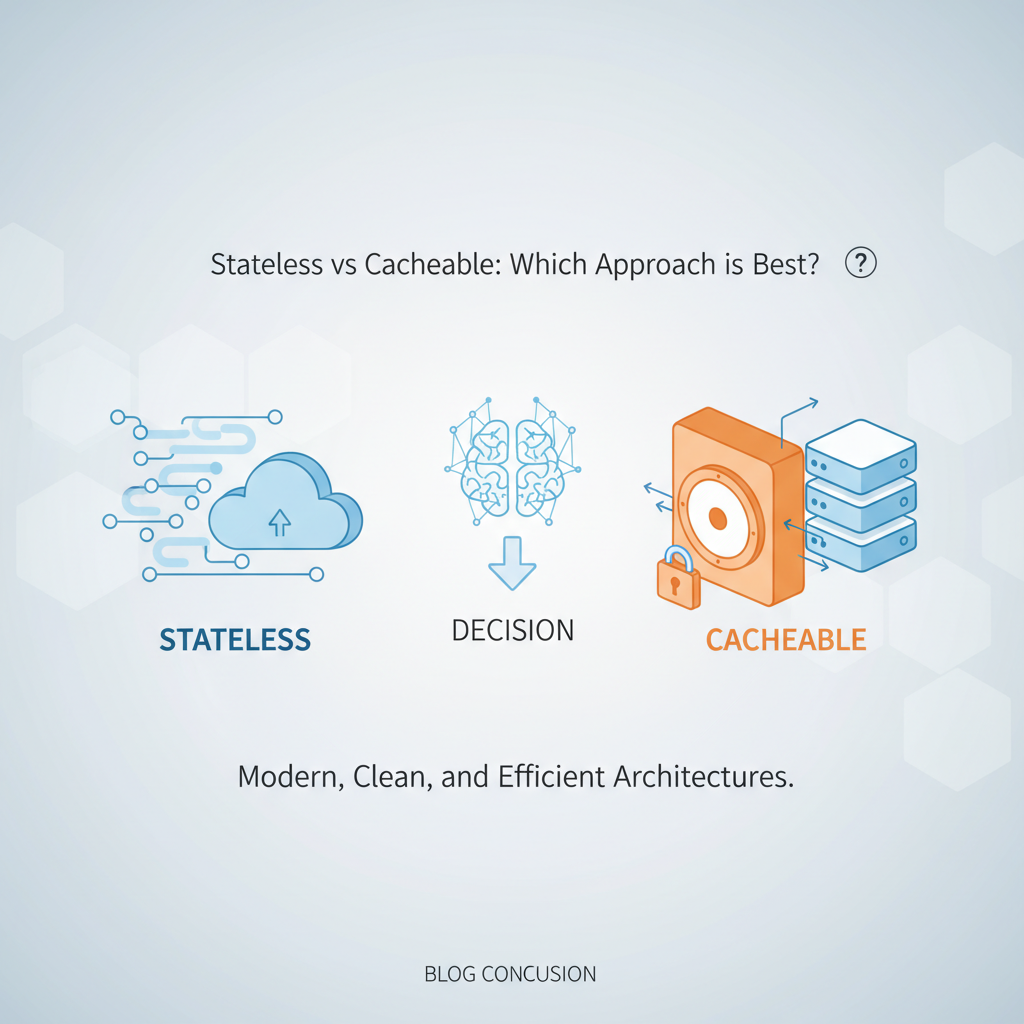
Stateless vs Cacheable: Which Approach is Best?


In the intricate world of modern software architecture, designers and developers constantly grapple with fundamental choices that dictate the scalability, performance, and resilience of their systems. Among these pivotal decisions are the architectural paradigms of "statelessness" and "cacheability." While often discussed independently, these two concepts are profoundly interconnected, shaping how applications interact with data, manage client sessions, and ultimately deliver value to users. The seemingly simple question – "Stateless vs Cacheable: Which Approach is Best?" – quickly unravels into a multifaceted exploration of trade-offs, design patterns, and strategic implementations, particularly in the context of distributed systems managed by an API gateway.
This article embarks on a deep dive into statelessness and cacheability, dissecting their core principles, advantages, disadvantages, and architectural implications. We will explore how these paradigms influence the design of APIs, the efficiency of microservices, and the operational demands on infrastructure. More importantly, we will examine how they are not mutually exclusive but often synergistic, culminating in hybrid strategies that harness the strengths of both. Understanding their nuances is not merely an academic exercise; it is essential for building robust, high-performance, and cost-effective solutions in an increasingly interconnected digital landscape. By the end of this comprehensive discussion, you will gain a clear perspective on when and why to favor one approach over the other, or more often, how to skillfully combine them for optimal results.
Part 1: Unraveling the Essence of Statelessness
Statelessness stands as a cornerstone principle in the design of scalable and resilient distributed systems, forming the very foundation of much of the modern web and cloud infrastructure. At its core, a stateless system is one where the server does not retain any information about the client's session or previous interactions. Each request from a client to a server is treated as an independent transaction, containing all the necessary information for the server to fulfill that request, without relying on any stored context from prior communications. This fundamental characteristic profoundly impacts how applications are designed, deployed, and scaled.
1.1 Definition and Core Principles of Statelessness
Imagine a scenario where you walk up to a vending machine. Each time you select an item and insert money, the machine processes that request entirely on its own, based solely on the input you provide at that moment. It doesn't remember what you bought five minutes ago, or who you are. This is a perfect real-world analogy for a stateless interaction. In computing terms, for a system to be truly stateless:
- Each Request is Independent: The server processes every client request as if it were the very first, and potentially the only, request it has ever received from that client. There's no "memory" of past interactions directly maintained by the server itself.
- Self-Contained Information: All the data required to process a request (e.g., authentication tokens, transaction identifiers, input parameters) must be included within the request itself. The client is responsible for sending this information with every interaction.
- No Server-Side Session State: Crucially, the server does not store any session-specific data. If a client needs to maintain a "session" (like a shopping cart or user login state), this state must either be managed by the client (e.g., in cookies, local storage) or stored in an external, shared, and distributed data store that is accessible to all server instances, rather than being tied to a specific server instance.
HTTP, the protocol underpinning the web, is inherently stateless. Each HTTP request (GET, POST, PUT, DELETE, etc.) is independent. While features like cookies exist to introduce a semblance of state at the client side, the underlying server-side protocol remains stateless, promoting the design of highly distributed and decoupled applications.
1.2 Advantages of a Stateless Architecture
The adoption of a stateless paradigm brings forth a multitude of significant advantages that are particularly crucial for building robust, high-traffic, and evolving systems:
- Exceptional Scalability: This is arguably the most compelling advantage. Because no server holds client-specific state, any server instance can handle any client request at any time. This dramatically simplifies horizontal scaling. When demand increases, you can simply add more server instances to your pool, and a load balancer can distribute incoming requests uniformly. There's no need for complex session replication or sticky sessions, where a client must repeatedly be routed to the same server that holds its state. This flexibility allows for effortless elasticity, enabling systems to rapidly scale up or down based on fluctuating load.
- Enhanced Resilience and Fault Tolerance: In a stateless system, if a server instance fails, it has no impact on active sessions, because no sessions are "active" on that particular server in the first place. Clients can simply retry their request, or their next request can be routed to a different, healthy server, without any loss of context or interruption of their perceived session. This makes the system far more resistant to individual server failures, leading to higher availability and uptime. Recovery from failures becomes simpler and quicker, as there's no state to migrate or reconstruct.
- Simplified Load Balancing: With stateless servers, load balancing becomes trivial. Any request can go to any available server. This allows for simple, round-robin, or least-connection balancing strategies, maximizing resource utilization across the server farm. Complex load balancing algorithms needed for stateful systems, such as those requiring session stickiness, are largely eliminated, reducing overhead and potential points of failure.
- Improved Resource Utilization: Servers in a stateless environment don't need to dedicate memory or CPU cycles to maintaining individual client session states. This frees up resources, allowing them to focus entirely on processing the current request, potentially handling more requests per server instance. It also simplifies memory management and garbage collection, as there are fewer long-lived objects tied to client sessions.
- Greater Consistency in API Design: Statelessness aligns perfectly with RESTful principles, promoting idempotent operations and predictable API behavior. This makes APIs easier to understand, consume, and integrate for developers, fostering a more consistent and maintainable interface between services.
1.3 Disadvantages and Challenges of Stateless Architectures
While highly advantageous, statelessness is not without its trade-offs and challenges that require careful design considerations:
- Increased Request Payload Size: Since each request must carry all necessary information, there's a potential for larger request payloads. For example, authentication tokens (like JWTs) or user context might need to be sent with every single request, leading to more data being transmitted over the network. While often negligible for small pieces of information, this can become a concern in scenarios with very high request volumes and numerous, larger context parameters.
- Potential for Repeated Computations: If certain context or data is required for multiple sequential requests but cannot be cached effectively, the server might need to re-fetch or re-compute this information for every single request. This can lead to inefficient resource usage and increased latency, as the same work is performed repeatedly.
- No Persistent Server-Side Context: The inability to store session state on the server means that building features that inherently rely on a sequence of interactions (e.g., complex multi-step forms, real-time chat with conversational context) becomes more challenging. While solutions exist (client-side state, external distributed state stores), they introduce their own complexities.
- Client-Side State Management Burden: Pushing the responsibility of state management to the client can increase the complexity of client applications. Clients need to intelligently store, manage, and transmit necessary session information, which might require more sophisticated client-side logic and robust error handling.
- Security Concerns with Client-Side State: If sensitive information is stored client-side, it must be carefully protected to prevent tampering or exposure. While techniques like signed cookies or encrypted tokens help, the security surface expands beyond the server's direct control.
1.4 Architectural Implications of Statelessness
The decision to embrace statelessness reverberates throughout the entire system architecture, influencing component design, deployment strategies, and operational practices:
- Load Balancers Become Simpler and More Effective: As discussed, the absence of sticky sessions simplifies load balancer configurations. Any incoming request can be directed to any available backend instance, maximizing parallelism and resource distribution. This also improves the efficiency of auto-scaling groups, as new instances can immediately start serving traffic without needing to synchronize state.
- Enabling Microservices Architectures: Statelessness is a natural fit for microservices. Each microservice typically exposes an API and is designed to operate independently, processing requests without relying on a shared session state across services. This promotes loose coupling, independent deployment, and domain-driven design, which are hallmarks of microservices. An API gateway often sits in front of these microservices, routing requests to the appropriate stateless backend service.
- Facilitating Serverless Computing: Serverless functions (like AWS Lambda, Azure Functions) are inherently stateless. Each invocation of a function is independent, receiving inputs and producing outputs without maintaining long-term memory. This model perfectly aligns with the principles of statelessness, enabling highly elastic and cost-effective execution environments.
- Simplified Deployment and Operations: Deploying new versions of stateless services is straightforward. You can roll out updates by gradually replacing old instances with new ones, without worrying about draining active sessions or performing complex state migrations. This facilitates continuous delivery and reduces downtime during deployments. Monitoring and troubleshooting also become less complex in some aspects, as the state of a service doesn't depend on its historical interactions with a particular client.
1.5 Use Cases for Stateless Architectures
Statelessness shines in a variety of common architectural patterns and applications:
- RESTful APIs: The Representational State Transfer (REST) architectural style, widely adopted for web APIs, explicitly mandates statelessness. Each request from client to server must contain all the information necessary to understand the request, and the server must not store any client context between requests. This design principle allows RESTful APIs to be highly scalable, cacheable, and reliable.
- Microservices: As mentioned, microservices inherently lean towards statelessness. Each service typically manages its own data and exposes APIs that are independent of client session state, facilitating loose coupling and independent scaling. An API gateway acts as the entry point, directing stateless requests to the appropriate microservice.
- Authentication and Authorization with JWTs: JSON Web Tokens (JWTs) are a prime example of stateless authentication. Once a user authenticates, a server issues a signed JWT containing user identity and permissions. This token is then sent with every subsequent request. The server can validate the token purely based on cryptographic signature, without needing to query a database or maintain session state. This makes authentication highly scalable and distributed.
- Content Delivery Networks (CDNs): CDNs serve static content (images, videos, CSS, JavaScript) from edge locations. These servers are entirely stateless; they receive a request for a file and simply return it, often after retrieving it from an origin server or a local cache. Their ability to operate without state is what allows them to be globally distributed and highly performant.
1.6 Deep Dive: Implementing Statelessness
Implementing statelessness effectively often involves careful design patterns for handling state that appears to be continuous from the client's perspective:
- Externalizing State: Instead of storing state on the application server, it is offloaded to dedicated external services.
- Distributed Databases: For persistent data (e.g., user profiles, product catalogs), relational or NoSQL databases are the primary external state stores. Each request can query the database for necessary information.
- Distributed Caches: For frequently accessed, temporary state (e.g., shopping cart items, session data for a stateful application proxy), distributed caches like Redis or Memcached are excellent choices. These systems allow any application server instance to access and update shared state, ensuring consistency across a horizontally scaled fleet.
- Message Queues: For asynchronous processing, message queues can hold state relevant to ongoing tasks, decoupling the client request from the immediate processing of that state.
- Client-Side State Management: The client itself can store and manage state, transmitting it with each request.
- Cookies: HTTP cookies allow websites to store small pieces of data on the user's browser, which are sent back with subsequent requests. While useful, they can increase request header size and have security implications if not handled carefully (e.g.,
HttpOnly,Secureflags). - Local Storage/Session Storage: Modern web browsers offer client-side storage mechanisms that allow JavaScript to store larger amounts of data. This data is not automatically sent with every HTTP request but can be retrieved by JavaScript and explicitly added to API requests.
- Cookies: HTTP cookies allow websites to store small pieces of data on the user's browser, which are sent back with subsequent requests. While useful, they can increase request header size and have security implications if not handled carefully (e.g.,
- The Role of an API Gateway in Stateless Architectures: An API gateway is a critical component in stateless architectures. It acts as a single entry point for all client requests, sitting between the clients and the backend services. In a stateless setup, the gateway is responsible for:
- Routing Requests: Directing incoming requests to the appropriate backend service, which are typically designed to be stateless.
- Authentication and Authorization: Performing initial authentication (e.g., validating JWTs) and authorization checks. Since JWTs are self-contained and stateless, the API gateway can validate them without needing to query a centralized identity store for every request, offloading this burden from individual backend services.
- Rate Limiting and Throttling: Managing and enforcing rate limits, ensuring that backend services are not overwhelmed by traffic spikes, without needing to maintain per-client state itself, other than perhaps aggregated counters in a distributed store.
- Request/Response Transformation: Modifying requests or responses on the fly, for instance, adding correlation IDs or transforming data formats, all in a stateless manner.
The beauty of statelessness, when carefully implemented, is the inherent simplicity it brings to the server-side infrastructure, allowing systems to achieve unprecedented levels of scalability and resilience. However, this often shifts complexity, or the responsibility for state, either to the client or to external, distributed state management systems.
Part 2: Embracing Cacheability – The Art of Speed and Efficiency
While statelessness optimizes for horizontal scalability and resilience, cacheability primarily targets performance and efficiency. Caching is a technique where copies of frequently accessed data are stored in a temporary, high-speed storage location, closer to the consumer or the processing unit, to serve future requests faster. It's an indispensable strategy for reducing latency, alleviating stress on backend systems, and minimizing bandwidth consumption across a wide array of computing environments, from individual devices to global cloud infrastructures.
2.1 Definition and Core Principles of Cacheability
At its heart, caching operates on the principle of locality: data that has been accessed recently or frequently is likely to be accessed again soon. By storing this data closer to where it's needed, we bypass the need to re-fetch or re-compute it from its original, slower source.
- Data Duplication: The fundamental operation of caching involves creating and storing a duplicate of data. This copy resides in a cache memory or storage, which is typically faster and closer than the original data source.
- Reduced Latency: The primary goal of caching is to reduce the time it takes to retrieve data. A "cache hit" (when the requested data is found in the cache) results in significantly faster retrieval compared to a "cache miss" (when data must be fetched from the original source).
- Decreased Server Load: By serving requests from the cache, the load on origin servers, databases, and other backend systems is dramatically reduced. This frees up their resources to handle other tasks or less frequently requested data, leading to overall system efficiency and stability.
- Bandwidth Savings: Caching, especially at network edges (like CDNs), reduces the amount of data that needs to travel across the network from origin servers, saving bandwidth costs and improving network performance.
2.2 Types of Caching in Distributed Systems
Caching can be implemented at various layers of a system architecture, each serving specific purposes and offering different benefits:
- Client-Side Caching (Browser Cache): Web browsers extensively cache static assets (images, CSS, JavaScript, fonts) and even API responses. When a user revisits a page or requests the same resource, the browser can serve it directly from its local cache, significantly speeding up page load times and reducing server requests. This is governed by HTTP caching headers like
Cache-ControlandExpires. - Proxy Caching (CDN, Reverse Proxy, API Gateway Cache):
- Content Delivery Networks (CDNs): CDNs are globally distributed networks of proxy servers that cache content (primarily static files, but increasingly dynamic API responses) at "edge" locations geographically closer to users. This drastically reduces latency for geographically dispersed users.
- Reverse Proxies: A reverse proxy server sits in front of one or more web servers, intercepting requests. It can cache responses from the backend servers, serving them directly for subsequent identical requests. Nginx and Varnish are popular choices.
- API Gateway Cache: An API gateway often incorporates caching capabilities. It can cache responses from backend APIs, particularly for frequently accessed read-only API endpoints. This not only speeds up response times but also protects backend services from being overwhelmed by repetitive requests. The gateway can also handle cache invalidation logic.
- Server-Side Caching:
- Application Cache (In-Memory Cache): Within an application server, data can be cached in memory (e.g., using Java's Caffeine, Python's
functools.lru_cache). This provides the fastest access but is limited to the memory of a single server instance and is lost if the server restarts. - Database Caching: Databases themselves often have internal caching mechanisms (e.g., query cache, buffer pool) to store frequently accessed data blocks or query results.
- Object Cache: Caching frequently used objects or complex data structures within the application logic to avoid re-creating them.
- Distributed Cache: These are standalone caching systems (e.g., Redis, Memcached) that are external to the application server but accessible by all instances. They provide a shared, scalable, and resilient cache layer, ideal for storing session data, frequently queried database results, or API responses across a cluster of application servers. They address the limitations of in-memory caches by providing a centralized, fault-tolerant store.
- Application Cache (In-Memory Cache): Within an application server, data can be cached in memory (e.g., using Java's Caffeine, Python's
2.3 Advantages of Caching
The strategic implementation of caching yields a wide array of benefits, making it an indispensable tool for high-performance systems:
- Dramatic Performance Improvement: This is the most direct and obvious benefit. Serving data from a fast cache (often in milliseconds or microseconds) instead of performing a full round-trip to a database or a remote service (which can take tens or hundreds of milliseconds) significantly reduces latency and improves response times for users. For web applications, this translates directly to faster page loads and a more responsive user experience.
- Reduced Load on Backend Systems: By intercepting and fulfilling requests from the cache, caching shields origin servers, databases, and backend APIs from redundant requests. This reduces their CPU, memory, and I/O utilization, allowing them to perform more efficiently and handle higher peak loads. It also means smaller, less powerful backend instances might be sufficient, leading to cost savings.
- Cost Savings: Less load on backend systems often means you can run fewer or smaller server instances, reducing compute costs. Reduced network traffic (especially with CDNs) also translates to lower bandwidth bills. Furthermore, faster response times can indirectly lead to better user engagement and conversion rates for businesses.
- Improved User Experience (UX): From a user's perspective, a fast-loading application is a good application. Caching directly contributes to a snappier, more fluid user experience, reducing frustration and improving satisfaction. This is particularly noticeable in situations with high network latency or limited bandwidth.
- Increased Availability and Resilience: In some scenarios, especially with distributed caches, cached data can serve as a fallback if the primary data source becomes temporarily unavailable. While this requires careful design (e.g., stale-while-revalidate), it can improve the perceived availability of the system during outages of backend services.
2.4 Disadvantages and Challenges of Caching
Despite its powerful benefits, caching introduces its own set of complexities and potential pitfalls that must be carefully managed:
- Cache Coherency / Stale Data: The most notorious challenge in caching is ensuring that cached data remains consistent with the original source. If the source data changes but the cached copy is not updated or invalidated, users might receive "stale" or outdated information. Managing cache invalidation strategies (when to remove or update cached items) is notoriously difficult and is often referred to as "one of the two hardest problems in computer science."
- Increased System Complexity: Implementing caching adds a new layer to the architecture. This involves deciding what to cache, where to cache it, for how long, and how to invalidate it. It requires careful configuration, monitoring, and debugging. Complex invalidation logic, cache eviction policies (e.g., LRU, LFU), and cache topologies (distributed vs. local) contribute to this complexity.
- Potential for Single Points of Failure (Without Distribution): A local, in-memory cache is tied to a single application instance. If that instance fails or restarts, the cache is lost. For critical data, a single point of failure within a caching layer can lead to significant performance degradation or even data inconsistencies. Distributed caches mitigate this by providing redundancy and fault tolerance.
- Resource Overhead: While caching reduces backend load, the cache itself consumes resources – memory, CPU for cache management, and potentially network bandwidth for distributed cache communication. For small datasets or rarely accessed data, the overhead of caching might outweigh its benefits.
- Thundering Herd Problem: If a popular item expires from the cache, and many concurrent requests for that item hit the backend simultaneously, it can overwhelm the origin server. This "thundering herd" problem requires careful design, often with techniques like cache stampede prevention (e.g., using locks or regeneration queues).
- Security Implications: Caching sensitive data (e.g., personal identifiable information, authentication tokens) requires meticulous attention to security. Ensuring proper access controls on the cache, preventing unauthorized access, and understanding the lifespan of cached sensitive data are critical to avoid data breaches.
2.5 Use Cases for Cacheable Data
Caching is most effective for specific types of data and access patterns:
- Frequently Accessed, Rarely Changing Data: This is the ideal candidate for caching. Examples include product catalogs (where prices and descriptions don't change hourly), user profile information (updated infrequently), static configuration files, or public API responses that don't need real-time freshness.
- Static Content: Images, CSS files, JavaScript bundles, video files – these are perfect for client-side and CDN caching because they rarely change and are downloaded by many users.
- Database Query Results: For complex or time-consuming database queries that return the same result set for a given input, caching the results can dramatically speed up subsequent requests and reduce database load.
- Computational Results: The output of expensive computations or aggregations that are frequently needed can be cached to avoid recalculating them for every request.
- Public API Endpoints: Many public APIs provide data that is suitable for caching, especially if the API provider encourages it through
Cache-Controlheaders. This offloads load from the API provider and improves the consumer's experience.
2.6 Deep Dive: Implementing Caching Strategies
Effective caching involves more than just storing data; it requires strategic choices about when and how to cache and invalidate data:
- HTTP Caching Headers: These are fundamental for web caching:
Cache-Control: The most powerful header, allowing fine-grained control over caching behavior for both private (browser) and shared (proxy/CDN) caches. Directives likemax-age,no-cache,no-store,public,private,s-maxage,stale-while-revalidateprovide extensive control.Expires: An older header specifying an absolute expiration date/time. Less flexible thanCache-Control: max-age.ETag(Entity Tag): A unique identifier for a specific version of a resource. When a client requests a resource with anIf-None-Matchheader containing an old ETag, the server can check if the resource has changed. If not, it responds with304 Not Modified, saving bandwidth.Last-Modified: Indicates the last time the resource was modified. Similar to ETag, it works withIf-Modified-Sinceto conditionally retrieve resources.
- Cache Patterns:
- Cache-Aside: The application code is responsible for managing the cache. When data is needed, the application first checks the cache. If it's a hit, the data is returned. If it's a miss, the application fetches data from the database, stores it in the cache, and then returns it. This pattern gives the application full control but requires explicit cache management logic.
- Write-Through: Data is written simultaneously to both the cache and the database. This ensures data consistency but can introduce latency as both write operations must complete.
- Write-Back (Write-Behind): Data is written directly to the cache, and the cache asynchronously writes the data to the database at a later time. This offers excellent write performance but carries a risk of data loss if the cache fails before the data is persisted to the database.
- Distributed Caching Systems: For large-scale applications, distributed caches like Redis and Memcached are essential:
- Redis: A powerful, in-memory data structure store, used as a database, cache, and message broker. It supports various data structures (strings, hashes, lists, sets, sorted sets), persistence, and replication, making it incredibly versatile for caching.
- Memcached: A high-performance, distributed memory object caching system. It's simpler than Redis, primarily focusing on key-value storage in memory, making it excellent for straightforward caching of small objects.
- Cache Invalidation Strategies:
- Time-to-Live (TTL): The simplest method, where cached items automatically expire after a predefined duration. This works well for data where eventual consistency is acceptable.
- Event-Driven Invalidation: When the source data changes, an event is triggered to explicitly invalidate or update the corresponding cached item. This provides stronger consistency but adds complexity to the data modification pipeline.
- Cache Busting: For static assets, appending a version hash or timestamp to filenames (e.g.,
style.css?v=12345) ensures that browsers and proxies always fetch the latest version when the file changes, effectively "busting" the cache. - Least Recently Used (LRU) / Least Frequently Used (LFU): Eviction policies used when the cache is full, removing items that are least likely to be needed again.
Caching is a powerful tool to enhance the speed and efficiency of applications. However, it's a double-edged sword: while it offers significant performance gains, its incorrect or careless implementation can lead to data consistency issues, increased complexity, and even new failure modes. The key lies in understanding the nature of the data, its volatility, and the acceptable levels of staleness for different parts of the system.
Part 3: The Interplay and Nuances – When Statelessness Meets Cacheability
It's tempting to view statelessness and cacheability as opposing forces, distinct paradigms that one must choose between. However, in the realm of sophisticated distributed systems, this is a misleading oversimplification. The reality is that the most robust, scalable, and high-performing architectures often skillfully integrate both principles, leveraging the advantages of each in a complementary fashion. Modern systems rarely choose one exclusively; instead, they operate in a hybrid mode, where stateless components are frequently enhanced by strategic caching layers.
3.1 It's Not an Either/Or: The Synergistic Relationship
To reiterate, statelessness and cacheability are not mutually exclusive. A system or service can, and often should, be both.
- Stateless Services Benefit from Caching: A backend service designed to be stateless is inherently scalable. However, even a perfectly stateless API might perform expensive computations or database lookups for every request. By placing a caching layer in front of this stateless service, these redundant computations can be avoided for subsequent requests for the same data. The service remains stateless internally, but its external performance is dramatically boosted by caching.
- Caching Relies on Stateless Principles: The very effectiveness of certain caching mechanisms, especially shared or distributed caches, often relies on the principle that the cached data itself doesn't carry client-specific state. This allows any cache instance to serve the data, enhancing scalability of the cache layer itself. For instance, caching the response of a public, read-only API endpoint is simple because the response is the same for all clients (stateless from the client interaction perspective at the API level).
This synergy allows architects to design systems that are both highly scalable (through statelessness) and incredibly performant (through caching). The challenge lies in identifying the appropriate boundaries and implementing these layers effectively without introducing undue complexity.
3.2 Combining Approaches: Real-World Scenarios
Let's consider how these two approaches are combined in practical architectures:
- Stateless Backend, Cached API Gateway: A common pattern involves a collection of stateless microservices in the backend. These services process requests, perform business logic, and interact with databases without maintaining any client session state. In front of these services sits an API gateway. This API gateway can then implement aggressive caching strategies for specific API endpoints that serve frequently accessed, relatively static data. For example, a "get product details" API call might be routed to a stateless product service, but the API gateway can cache its response for a few minutes, serving subsequent identical requests directly from its cache. This reduces the load on the product service and the database, even though the product service itself is stateless.
- Client-Side Caching with Stateless APIs: Web browsers or mobile applications interact with stateless APIs. These client applications can then cache API responses locally. When the user navigates back to a previously viewed page or resource, the client can serve the content from its local cache without even hitting the API gateway. The API remains stateless, but the client-side experience is significantly faster due to caching.
- External Distributed Caches for "Pseudo-State": For applications that require session-like behavior (e.g., a shopping cart), but where the backend services need to remain stateless, an external distributed cache (like Redis) is often used. When a client performs an action, the stateless backend service stores or retrieves the relevant session data from this distributed cache. All backend instances can access this shared cache, making the application appear stateful to the user while keeping the individual service instances stateless. This decouples the session state from the application instances, allowing for independent scaling and fault tolerance of the application servers.
3.3 Challenges and Considerations in a Hybrid Environment
While combining statelessness and cacheability offers powerful benefits, it also introduces a new set of challenges that demand thoughtful design and careful management:
- Consistency vs. Freshness (The CAP Theorem Revisited): This is the eternal dilemma. Caching inherently introduces a potential for data staleness. A cached copy might not perfectly reflect the latest state of the data in the original source. The CAP theorem (Consistency, Availability, Partition tolerance) dictates that a distributed system can only guarantee two out of three. In the context of caching, you often trade strong consistency for higher availability and performance. Deciding the acceptable level of staleness for different data types is paramount. For example, a user's current account balance might require strong consistency, while a product recommendation list can tolerate eventual consistency.
- Complex Invalidation Strategies: When data in the origin changes, how do you invalidate or update all relevant cached copies across various layers (client, CDN, API gateway, distributed cache)? Simple TTLs might lead to excessive staleness or too frequent cache misses. Event-driven invalidation (e.g., using message queues to broadcast cache invalidation messages) provides stronger consistency but adds significant architectural complexity. Cache-busting for static assets helps but isn't suitable for dynamic API responses.
- Granularity of Caching: What exactly should be cached? Should it be the entire API response, or just specific data objects or fragments? Caching entire responses is simpler but less flexible. Caching smaller data fragments allows for more granular updates but increases cache management complexity. For example, caching a list of products might be efficient, but if a single product's price changes, do you invalidate the whole list or just that product?
- Security Implications of Cached Data: When caching sensitive data, ensuring that only authorized users can access it is critical. If an API gateway caches responses, it must respect user-specific authorization and avoid serving sensitive cached data to the wrong user. This often means carefully segmenting caches based on user roles or explicitly not caching highly sensitive, personalized responses. Encryption of cached data at rest is also a consideration.
- Cache Warming and Cold Starts: When a cache is empty (e.g., after a deployment or a cache restart), the first requests will all be cache misses, potentially leading to a "thundering herd" effect on the backend. "Cache warming" strategies involve pre-populating the cache with frequently accessed data during off-peak hours or immediately after deployment to mitigate this.
3.4 The Critical Role of an API Gateway
An API gateway emerges as a central orchestrator in environments that cleverly combine statelessness and cacheability. It sits at the crucial intersection between diverse clients and an ecosystem of backend services (often stateless microservices). Its position makes it an ideal point to implement and enforce both paradigms.
- Unified Entry Point for Stateless Services: The API gateway acts as the single entry point for all client requests, routing them to the appropriate backend APIs, which are typically designed to be stateless. It can perform initial authentication (e.g., validating stateless JWTs), authorization, and request transformation without requiring backend services to maintain session state.
- Intelligent Caching Layer: Beyond routing, an API gateway is perfectly positioned to implement intelligent caching. For frequently accessed, idempotent API calls (e.g., GET requests for public data), the gateway can cache responses directly. This intercepts requests before they even reach the backend services, drastically reducing load and improving response times. The gateway can manage cache policies, TTLs, and even some aspects of cache invalidation based on backend events or time.
- Offloading and Centralizing Concerns: By handling cross-cutting concerns like caching, authentication, rate limiting, and request logging at the gateway level, individual backend services can remain focused on their core business logic, adhering strictly to stateless principles. This simplifies backend service development and maintenance.
For instance, modern API gateway solutions, such as ApiPark, an open-source AI gateway and API management platform, are designed to orchestrate complex interactions between clients and diverse backend services. They can effectively manage the lifecycle of APIs, offering capabilities to streamline integration of AI models and standard REST services. Such platforms can be configured to enforce statelessness on the backend while strategically caching responses at the gateway level, thereby offering the best of both worlds: backend simplicity and frontend performance. They provide the necessary infrastructure to manage traffic forwarding, load balancing, and versioning of published APIs, all of which are crucial for maintaining both stateless operations and efficient caching strategies. Furthermore, APIPark’s ability to quickly integrate 100+ AI models and standardize their invocation format means it can act as a powerful caching proxy for AI service responses, especially for models that produce consistent outputs for identical inputs, protecting the underlying AI models from repetitive processing while ensuring rapid responses.
The API gateway transforms from a simple router into a powerful policy enforcement point and a performance accelerator, making it an indispensable component in architecting scalable and performant systems that harmoniously blend statelessness and cacheability.
APIPark is a high-performance AI gateway that allows you to securely access the most comprehensive LLM APIs globally on the APIPark platform, including OpenAI, Anthropic, Mistral, Llama2, Google Gemini, and more.Try APIPark now! 👇👇👇
Part 4: Deciding Which Approach (or Combination) is Best
The decision of whether to prioritize statelessness, cacheability, or more commonly, a sophisticated blend of both, is rarely clear-cut. It hinges upon a careful evaluation of various factors intrinsic to the application's requirements, operational environment, and the nature of the data it processes. There is no universally "best" approach; instead, there is an optimal strategy tailored to specific circumstances and trade-offs. Making the right choice involves a deep understanding of these influencing factors.
4.1 Factors to Consider for Architectural Decisions
To guide the decision-making process, architects and developers must systematically assess several key dimensions:
- Data Volatility: This is perhaps the most crucial factor for caching.
- High Volatility (Changes Frequently): Data that changes every second, minute, or even hour is a poor candidate for aggressive caching. The risk of serving stale data is high, and the overhead of constant invalidation might negate any performance benefits. Statelessness is suitable here, ensuring real-time data access from the source.
- Low Volatility (Changes Infrequently): Data that changes rarely (e.g., once a day, week, or month), or static content, is an excellent candidate for caching. The benefits of reduced load and improved performance far outweigh the minimal risk of staleness.
- Read vs. Write Ratio:
- Read-Heavy Systems: Applications with significantly more read operations than write operations (e.g., content websites, search engines, public APIs) benefit immensely from caching. Caching read responses reduces the load on databases and backend services, allowing them to handle a higher volume of traffic efficiently.
- Write-Heavy Systems: Applications with a high proportion of write operations (e.g., transactional systems, financial applications) pose challenges for caching. Maintaining cache consistency with frequent writes is complex and can lead to performance bottlenecks if not handled carefully. Statelessness is often preferred for core write operations to ensure immediate consistency.
- Performance Requirements (Latency Goals):
- Strict Latency Requirements: If an application demands extremely low latency and rapid response times (e.g., real-time bidding, interactive dashboards), caching is almost always a necessity to meet these stringent performance goals. Even a few milliseconds saved can be critical.
- Moderate Latency Tolerance: For applications where a few hundred milliseconds of response time is acceptable, the overhead of implementing complex caching might not be justified, and a purely stateless backend might suffice, relying on efficient database access.
- Scalability Needs:
- High Horizontal Scalability: For applications expected to handle massive, fluctuating user loads, statelessness is paramount. Its inherent ability to scale by simply adding more instances without session stickiness makes it the foundation for highly elastic systems. Caching can then further enhance the performance of these scalable systems.
- Limited Scaling Needs: For internal tools or niche applications with predictable and modest user bases, the extreme scalability benefits of statelessness might not be a primary driver, and a more stateful approach (though generally discouraged in modern architectures) could be simpler to implement for certain features.
- Consistency Requirements:
- Strong Consistency: If the system absolutely requires users to always see the most up-to-date data (e.g., banking transactions, inventory levels), aggressive caching becomes problematic. Any caching must be very short-lived or employ robust, real-time invalidation, which adds significant complexity and potential performance overhead. Stateless direct access to the source often guarantees strongest consistency.
- Eventual Consistency: For many applications, a slight delay in data propagation is acceptable (e.g., social media feeds, news articles). In these cases, caching with reasonable TTLs is highly effective, accepting temporary staleness for massive performance gains.
- Complexity Tolerance:
- Simple Systems (Low Complexity Tolerance): Implementing sophisticated caching strategies, especially with distributed caches and complex invalidation logic, adds considerable complexity to the architecture, development, and operational burden. For simpler applications, the added complexity might not be justified by the performance gains. Stateless design, without a complex caching layer, can initially appear simpler.
- Complex Systems (High Complexity Tolerance): Large-scale, high-performance systems often embrace complexity in exchange for superior scalability, resilience, and performance. In such environments, the intricate dance of stateless services and multi-layered caching is a necessary investment.
- Security Concerns:
- Caching Sensitive Data: Caching user-specific, highly sensitive, or personally identifiable information (PII) requires extreme caution. Security controls on the cache itself must be as stringent as on the original data source. Often, such data is explicitly excluded from caching, forcing direct access to ensure proper authorization and auditing.
- Stateless Authentication: Stateless authentication mechanisms like JWTs generally enhance security by eliminating server-side session state vulnerabilities. However, the revocation of such tokens requires careful design (e.g., blacklist or short expiry).
4.2 Decision Matrix: Stateless, Cacheable, or Hybrid?
To synthesize these considerations, the following table provides a quick reference for typical characteristics and implications of each approach:
| Feature/Criterion | Purely Stateless Approach | Purely Cacheable Approach (Data Source) | Hybrid Approach (Stateless Backend + Caching Layer) |
|---|---|---|---|
| Scalability | Excellent: Easy horizontal scaling, no sticky sessions. | Limited for writes: Caching doesn't directly scale writes. | Excellent: Stateless backend scales, caching reduces load. |
| Performance | Good: Depends on backend efficiency, no overhead of state. | Outstanding for reads: Low latency on cache hits. | Outstanding for reads: Caching accelerates stateless services. |
| Consistency | Stronger: Direct access to source, real-time data. | Weakened (Potential Stale Data): Cache coherency challenges. | Trade-off: Strong on writes, eventual on reads (configurable TTLs). |
| Complexity | Moderate: State pushed to client/external services. | High: Cache invalidation is complex, eviction policies. | Very High: Managing both stateless services AND multi-layered caching. |
| Resource Usage | Higher backend load: Each request hits source. | Lower backend load: Many requests served from cache. | Optimized: Backend load significantly reduced, cache consumes resources. |
| Data Volatility | Ideal for high volatility, constantly changing data. | Ideal for low volatility, rarely changing data. | Best for mixed volatility: dynamic data remains stateless, static/slow-changing data is cached. |
| Read/Write Ratio | Suitable for balanced or write-heavy scenarios. | Ideal for read-heavy scenarios. | Highly effective for read-heavy operations on stateless services. |
| Typical Use Cases | Transactional APIs, real-time notifications, personal data. | Static content, public lookup data, pre-computed reports. | Most modern web applications, microservices with high traffic, API gateway for public APIs. |
| Ease of Deployment | Simpler, no cache warm-up issues for services. | Requires careful cache management, potential cold starts. | Requires careful orchestration of cache and service deployments. |
The decision matrix clearly illustrates that a purely stateless approach emphasizes strong consistency and simplifies backend scaling at the cost of potentially higher backend load for every request. A purely cache-centric approach (at the data source level) maximizes read performance and reduces backend strain but introduces significant challenges in maintaining data freshness and managing complexity. The hybrid approach, therefore, emerges as the most balanced and frequently adopted strategy for modern, large-scale systems, expertly navigating these trade-offs.
Part 5: Advanced Considerations and Best Practices for Hybrid Architectures
Moving beyond the fundamental choices, building highly optimized and resilient hybrid architectures that skillfully combine statelessness and cacheability requires delving into more advanced considerations and adhering to best practices. These often involve distributed systems, robust monitoring, and proactive design patterns to mitigate the inherent complexities introduced by caching layers.
5.1 Distributed Caching Patterns and Eviction Policies
When scaling, local in-memory caches quickly become insufficient. Distributed caching systems are paramount, but their effective use requires understanding specific patterns and policies:
- Cache Topologies:
- Client-Server: Traditional setup where application servers act as clients to a dedicated cache server (e.g., Redis cluster).
- Peer-to-Peer: Each application server hosts a portion of the cache and can communicate with other peers to retrieve data. Less common for primary caching layers due to complexity.
- Consistency Models for Distributed Caches:
- Eventual Consistency: Most common. Updates to the cache propagate eventually. Some degree of staleness is acceptable.
- Strong Consistency: Requires more complex mechanisms (e.g., distributed locks, two-phase commits) to ensure all cache nodes have the absolute latest data, which can negatively impact performance and availability. Usually avoided for general-purpose caching.
- Eviction Policies: When a cache reaches its capacity, it must decide which items to remove to make room for new ones.
- Least Recently Used (LRU): Evicts items that haven't been accessed for the longest time. This is often the most effective general-purpose policy.
- Least Frequently Used (LFU): Evicts items that have been accessed the fewest times. Good for identifying truly unpopular items.
- First-In, First-Out (FIFO): Evicts the oldest item regardless of usage. Simple but often less efficient than LRU/LFU.
- Random: Evicts a random item. Simple but generally inefficient.
- Expiration-based (TTL): Items are automatically evicted after a set Time-To-Live. This is often combined with other policies when the TTL expires before capacity is reached.
Implementing these policies correctly within a distributed environment ensures that the cache remains relevant and performs optimally without consuming excessive resources.
5.2 Edge Caching (CDNs) for Global Reach
For applications serving a global user base, edge caching through Content Delivery Networks (CDNs) is a game-changer. CDNs take the concept of proxy caching to a global scale:
- Proximity to Users: CDNs deploy their servers (Points of Presence, or PoPs) in data centers across the world. When a user requests content, it's served from the closest PoP, dramatically reducing network latency caused by geographical distance.
- Offloading Origin Servers: By caching static assets (images, CSS, JS, videos) and increasingly dynamic API responses at the edge, CDNs significantly reduce the load on origin servers. This is particularly beneficial for stateless backend services, as many requests never even reach them.
- Improved User Experience: Faster load times and lower latency contribute to a superior user experience, which is critical for engagement and conversion rates, especially for global audiences.
- DDoS Protection: Many CDNs also offer integrated DDoS (Distributed Denial of Service) protection, shielding origin servers from malicious traffic by absorbing attacks at the edge.
Integrating a CDN requires careful configuration of caching headers (Cache-Control) to instruct the CDN on how long to cache content and how to handle revalidation.
5.3 Microservices and Caching Strategies
In a microservices architecture, the approach to caching can vary:
- Service-Specific Caches: Each microservice might implement its own local in-memory cache for highly specific data relevant only to that service. This maintains the autonomy of microservices but doesn't share cache benefits across the system.
- Shared Distributed Cache: A common pattern is to have a shared distributed cache (e.g., Redis cluster) that multiple microservices can utilize. This is ideal for caching common lookup data or frequently accessed API responses that are shared across different service boundaries. It enables "stateless" services to access "shared state" without coupling tightly.
- API Gateway Caching: As discussed, the API gateway (which sits in front of microservices) is a prime location for caching API responses that are common across users or frequently requested from a particular service. This shields the entire microservice ecosystem from redundant requests.
- Event-Driven Cache Invalidation: For maintaining consistency across services and shared caches, an event-driven approach is effective. When a microservice updates its data, it can publish an event (e.g., to a message queue). Other services or the cache management system can subscribe to these events and invalidate or update their cached copies accordingly. This helps maintain eventual consistency in a decoupled manner, crucial for stateless microservices.
5.4 Cache Warming: Mitigating Cold Starts
A common issue with caching is the "cold start" problem: when a cache is empty (e.g., after deployment, restart, or eviction), all initial requests will be cache misses, hitting the backend directly. This can lead to temporary performance degradation and overload the origin servers.
- Pre-population: Explicitly loading critical data into the cache during application startup or immediately after deployment. This can involve running scripts to query frequently accessed APIs or database tables and storing the results in the cache.
- Lazy Loading with Asynchronous Update: When a cache miss occurs, fetch the data, serve it to the client, and asynchronously update the cache. This prevents blocking the client for cache warming but might still result in the first client experiencing a slower response.
- Stale-While-Revalidate: A
Cache-Controldirective that allows a cache to serve a stale response while it asynchronously revalidates the cache entry with the origin server. This improves perceived performance by always serving a quick response, even if it's slightly stale, and avoids cold starts.
5.5 Resilience and Fallbacks for Cache Failures
While caches boost performance, they also introduce a potential point of failure. Designing for resilience is crucial:
- Circuit Breaker Pattern: Implement a circuit breaker around cache access. If the cache becomes unresponsive, temporarily bypass it and directly hit the backend to prevent the cache failure from cascading and bringing down the entire system.
- Graceful Degradation: If the cache fails, the system should gracefully degrade, perhaps by increasing direct backend calls or serving slightly older data if acceptable, rather than crashing.
- Redundancy and Replication: For distributed caches, ensure high availability through replication and clustering (e.g., Redis Sentinel or Cluster) so that if one cache node fails, others can take over seamlessly.
- Timeouts and Retries: Configure appropriate timeouts for cache operations and implement retry mechanisms with exponential backoff to handle transient cache connectivity issues.
5.6 Monitoring and Analytics: The Key to Optimization
Finally, a robust monitoring and analytics strategy is indispensable for any system employing caching:
- Cache Hit Ratio: Track the percentage of requests served from the cache versus those hitting the backend. A low hit ratio indicates inefficient caching or configuration issues.
- Cache Miss Rate: Conversely, a high miss rate points to items not being cached or frequently invalidated.
- Latency Metrics: Monitor response times for both cache hits and cache misses to understand the performance impact.
- Cache Size and Evictions: Track the cache's memory footprint and how often items are being evicted. This helps in tuning cache capacity and eviction policies.
- Origin Server Load: Observe the load on backend services to confirm that caching is effectively reducing pressure.
Robust monitoring and analytics are paramount. Understanding cache hit ratios, invalidation rates, and overall API performance is critical. Platforms like ApiPark offer detailed API call logging and powerful data analysis, providing invaluable insights into traffic patterns and system behavior, which directly informs effective caching strategies and resource allocation. By analyzing historical API call data, APIPark can display long-term trends and performance changes, helping businesses perform preventive maintenance and continuously optimize their hybrid architectures, ensuring that both stateless efficiency and cache-driven performance are maximized. This data-driven approach is key to refining API design, tuning caching parameters, and ensuring the long-term health and scalability of the system.
Conclusion: Crafting Optimal Architectures with Statelessness and Cacheability
The journey through statelessness and cacheability reveals that software architecture is a landscape of nuanced choices and strategic trade-offs rather than rigid adherence to single doctrines. Statelessness offers the bedrock for unparalleled scalability, resilience, and horizontal elasticity, simplifying the distribution of processing load across numerous server instances. It aligns perfectly with modern paradigms like microservices and serverless computing, fostering decoupled, fault-tolerant backend services that can scale to meet immense demand without the burden of persistent server-side session state.
Conversely, cacheability is the ultimate enabler of speed and efficiency. By strategically storing copies of data closer to the point of consumption, caching dramatically reduces latency, minimizes backend server load, and conserves valuable network bandwidth. It transforms user experience, making applications feel snappier and more responsive, and significantly cuts operational costs for data-intensive systems.
However, the true power lies not in choosing one over the other, but in intelligently combining them. The most successful modern architectures are inherently hybrid. They leverage stateless backend services to ensure scalability and maintainability, while simultaneously deploying sophisticated caching layers at various points – from client browsers and global CDNs to API gateways and distributed caches – to supercharge performance for frequently accessed data.
The API gateway emerges as a pivotal component in this hybrid model, acting as an intelligent intermediary that can manage API lifecycles, enforce stateless authentication and authorization, route requests efficiently, and implement robust caching policies. Platforms like ApiPark exemplify how a well-designed API gateway can be central to orchestrating these complex interactions, facilitating the integration and management of diverse APIs, including AI models, while providing the necessary tools for performance optimization through logging and analytics.
The decision of where and how to apply statelessness and caching is not trivial. It requires a deep understanding of data volatility, read/write patterns, performance targets, and consistency requirements. It demands careful consideration of cache invalidation strategies, potential cold starts, and the inherent complexities introduced by distributed systems. Architects must be prepared to accept trade-offs, continuously monitor system performance, and iterate on their designs.
In essence, there is no single "best" approach. The optimal strategy is a custom-fit solution, meticulously designed to meet the specific demands of each application. By mastering the principles of statelessness and cacheability, and expertly blending them, developers and architects can construct truly high-performing, scalable, and resilient systems that are well-equipped to thrive in the dynamic and demanding digital ecosystem of today and tomorrow.
Frequently Asked Questions (FAQs)
1. What is the fundamental difference between a stateless and a stateful API?
A stateless API processes each request independently, without retaining any memory of past interactions or client sessions on the server side. All necessary information (e.g., authentication tokens, data) must be included with every request. In contrast, a stateful API server retains context from previous requests, meaning subsequent requests rely on the server remembering information from earlier interactions. This typically involves server-side session management. Stateless APIs are easier to scale horizontally and are more resilient to server failures.
2. When should I prioritize a stateless API design?
You should prioritize a stateless API design when: * High Scalability is Required: For applications expecting massive and fluctuating user loads. * Resilience and Fault Tolerance are Critical: To ensure the system can recover easily from server failures without losing client context. * Microservices Architectures: To promote loose coupling and independent deployment of services. * RESTful Design Principles: To adhere to the standard best practices of web APIs. * Load Balancing Simplicity: When you need to distribute requests evenly across any available server instance without sticky sessions.
3. What are the biggest challenges with implementing caching effectively?
The biggest challenges with caching primarily revolve around cache coherency and complexity. Cache coherency refers to ensuring that cached data remains consistent with the original source; failure to do so leads to "stale data." Implementing effective cache invalidation strategies (e.g., knowing when to remove or update cached items) is notoriously difficult. Additionally, caching adds significant architectural complexity due to decisions around cache location, eviction policies, distributed cache management, and handling cache-related failures (e.g., the "thundering herd" problem or cache server outages).
4. How does an API gateway interact with statelessness and caching?
An API gateway plays a critical role in both. For statelessness, it acts as a central entry point, routing requests to backend stateless services, and can handle stateless concerns like JWT validation, rate limiting, and request transformation. For caching, the API gateway can itself implement a caching layer, storing responses from backend APIs (especially for frequently accessed, read-only data). This allows the gateway to serve requests directly from its cache, reducing load on stateless backend services and improving overall performance, effectively blending both paradigms.
5. Can a system be both stateless and cacheable? If so, how?
Yes, absolutely, and this is often the ideal approach for modern, high-performance systems. A system can be both stateless and cacheable by designing its backend services to be stateless, ensuring they don't retain client context. Then, caching layers are strategically placed in front of these stateless services. This can include client-side caching (browser), edge caching (CDN), or a caching layer within the API gateway or a distributed cache. For example, a stateless user profile API might have its responses cached by the API gateway for a few minutes. When the cache expires, the next request hits the stateless backend, which computes and returns the latest data, allowing the API gateway to re-cache it. This combination provides both horizontal scalability for the backend and exceptional performance through caching.
🚀You can securely and efficiently call the OpenAI API on APIPark in just two steps:
Step 1: Deploy the APIPark AI gateway in 5 minutes.
APIPark is developed based on Golang, offering strong product performance and low development and maintenance costs. You can deploy APIPark with a single command line.
curl -sSO https://download.apipark.com/install/quick-start.sh; bash quick-start.sh

In my experience, you can see the successful deployment interface within 5 to 10 minutes. Then, you can log in to APIPark using your account.

Step 2: Call the OpenAI API.