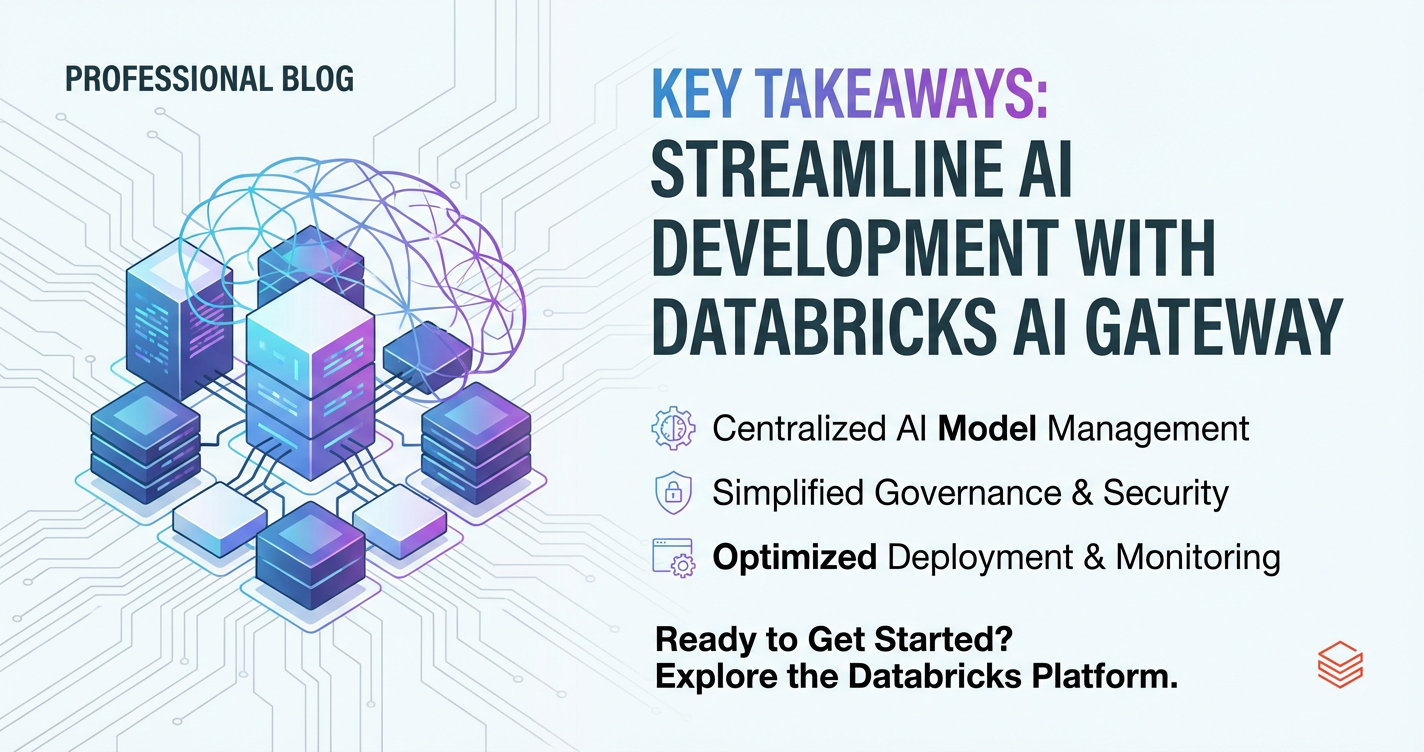
Streamline AI Development with Databricks AI Gateway
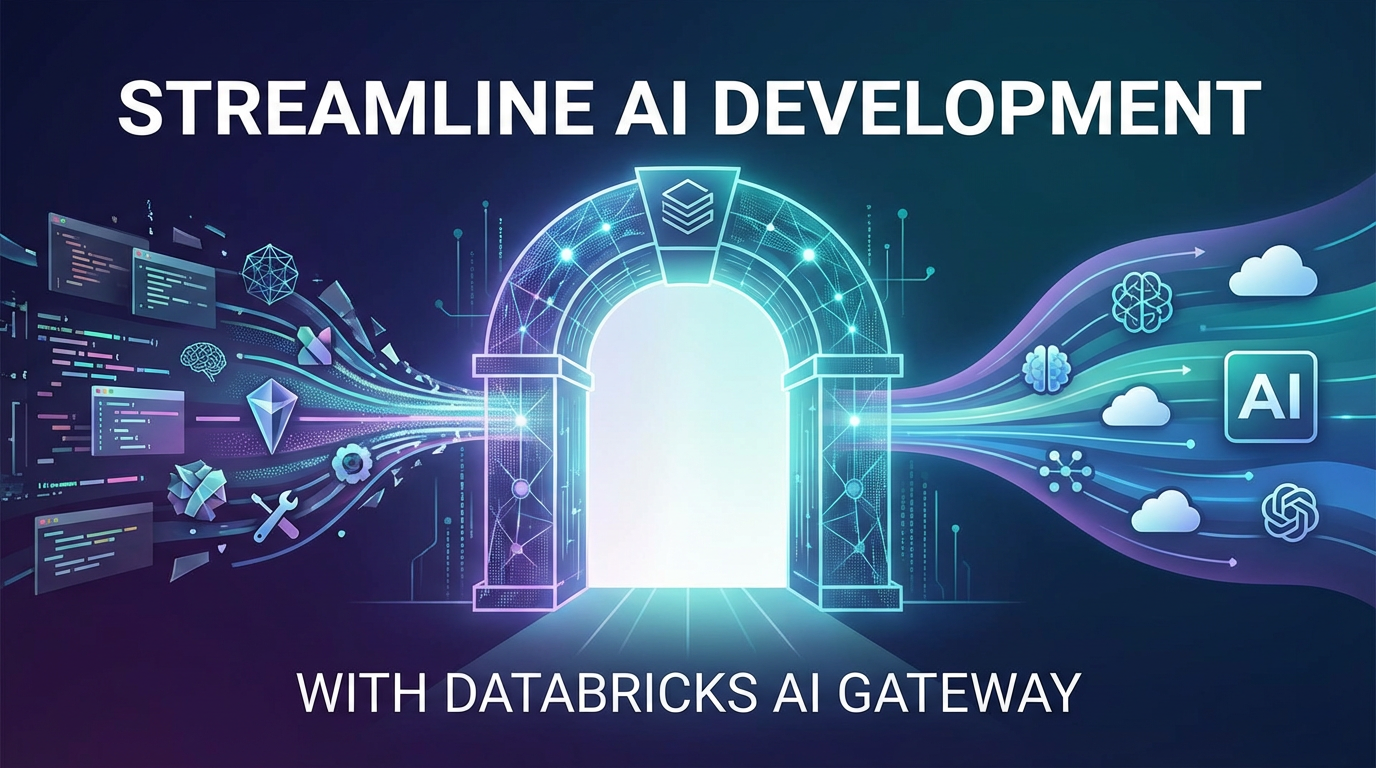


The landscape of Artificial Intelligence has undergone a profound transformation, evolving from academic curiosities into foundational technologies that drive innovation across every industry imaginable. At the heart of this revolution lies the development and deployment of sophisticated AI models, particularly Large Language Models (LLMs), which are rapidly redefining how applications interact with users and process information. However, the journey from model experimentation to robust, scalable, and secure production deployment is fraught with challenges. Developers and enterprises often grapple with a complex myriad of issues, including managing diverse models, ensuring consistent security, optimizing costs, maintaining performance at scale, and facilitating collaborative development. This intricate web of operational complexities can significantly impede the velocity and efficiency of AI initiatives, turning promising prototypes into stagnant projects.
Recognizing these pervasive hurdles, the industry has seen the emergence of specialized infrastructure solutions designed to abstract away much of this underlying complexity. Among the most critical of these innovations is the AI Gateway. An AI Gateway acts as a central control point, a sophisticated intermediary that manages and orchestrates requests to various AI models, much like a traditional api gateway manages access to microservices. Its role becomes even more pronounced in the era of LLMs, where it often takes on the specific mantle of an LLM Gateway, tailored to the unique demands of these powerful, yet resource-intensive, models. These gateways provide a unified interface, allowing developers to interact with multiple AI services through a single, consistent API, thereby decoupling applications from the underlying model implementations and offering a powerful layer of abstraction and control.
Databricks, a leader in data and AI, has stepped forward with its own robust solution to these modern challenges: the Databricks AI Gateway. Seamlessly integrated into the Lakehouse Platform, the Databricks AI Gateway is engineered to significantly streamline the development, deployment, and management of AI applications, especially those leveraging LLMs. By providing a centralized, secure, and observable access layer, it empowers organizations to accelerate their AI journey, reduce operational overhead, and ensure that their AI initiatives are not only innovative but also sustainable and scalable. This article will delve deep into the intricacies of AI development challenges, elucidate the transformative capabilities of the Databricks AI Gateway, and explore how it serves as an indispensable tool for enterprises aiming to harness the full potential of AI with unprecedented efficiency and control.
The Convoluted Landscape of Modern AI Development: Unpacking the Challenges
The explosive growth in AI capabilities, particularly with the advent of sophisticated Large Language Models, has undeniably opened up new frontiers for innovation. However, this exciting potential is often accompanied by an equally complex array of development and operational challenges. For organizations striving to integrate AI into their core business processes, navigating this complexity is paramount. Without a strategic approach and robust tooling, the promises of AI can quickly become bogged down by technical debt, security vulnerabilities, and ballooning operational costs. Understanding these challenges is the first step towards appreciating the value an AI Gateway brings.
1. Model Proliferation and Management Complexity
The AI ecosystem is characterized by an ever-expanding universe of models. Enterprises often find themselves working with a diverse portfolio that includes open-source LLMs like Llama, proprietary models from providers like OpenAI and Anthropic, specialized fine-tuned models, and even custom models developed in-house. Each of these models might have different APIs, authentication mechanisms, input/output formats, and rate limits. Managing this heterogeneous collection manually becomes a significant burden. Developers are forced to write bespoke integration code for each model, leading to fragmented applications and a brittle architecture. Updating or swapping out a model can necessitate extensive code refactoring across multiple applications, introducing errors and delaying deployment cycles. This lack of standardization not only slows down development but also makes it incredibly difficult to maintain a consistent developer experience and implement organization-wide best practices for AI consumption. The challenge intensifies when different teams within an organization adopt their preferred models, leading to silos and duplicated efforts in integration and management.
2. Ensuring Robust Security and Access Control
Integrating AI models, especially those handling sensitive data, introduces critical security considerations. Exposing raw AI endpoints directly to applications or external users without proper safeguards is a recipe for disaster. Organizations must implement granular access control, ensuring that only authorized applications and users can invoke specific models. This involves managing API keys, tokens, and credentials securely, preventing unauthorized access, and mitigating risks like data leakage or misuse. Furthermore, robust authentication and authorization mechanisms are essential to protect against malicious attacks, such as prompt injection or denial-of-service attempts. The auditing of AI model access is equally vital for compliance and forensic analysis, requiring detailed logs of who accessed which model, when, and with what parameters. Without a centralized control point, implementing consistent security policies across a multitude of AI services becomes an arduous and error-prone endeavor, potentially leaving critical vulnerabilities unaddressed.
3. Cost Optimization and Usage Monitoring
The computational resources required by modern AI models, particularly LLMs, can be substantial, leading to significant operational costs. Publicly hosted models from cloud providers often charge based on token usage, model invocations, or compute time. Without proper monitoring and control, costs can quickly spiral out of budget. Enterprises need granular visibility into how much each team, project, or even individual application is spending on AI inference. This demands sophisticated tracking and reporting mechanisms that can attribute costs accurately. Beyond tracking, effective cost optimization requires implementing strategies like rate limiting to prevent runaway usage, setting quotas for different projects, and potentially caching responses for frequently asked queries to reduce redundant model invocations. Manually configuring and managing these cost control mechanisms across various AI service providers is incredibly complex and time-consuming. The ability to forecast and manage AI expenses becomes a strategic imperative, allowing organizations to maximize their AI investment without incurring unexpected financial burdens.
4. Performance, Scalability, and Reliability
Production AI applications demand high performance, low latency, and unwavering reliability. Direct interaction with AI models can be subject to network latency, model inference times, and provider-specific rate limits. Ensuring that applications remain responsive and available even under peak load requires careful management of these factors. Load balancing requests across multiple instances of a model or even different model providers can enhance availability and distribute traffic efficiently. Caching frequently requested responses can dramatically reduce latency and improve throughput by avoiding redundant model calls. Furthermore, the reliability of AI services needs to be carefully monitored. What happens if an upstream model provider experiences an outage or a specific model version performs poorly? A resilient architecture must account for these scenarios, perhaps by implementing fallback mechanisms or intelligent routing to alternative models. Building these capabilities into every application that consumes AI models is inefficient and error-intensive. A centralized api gateway specifically designed for AI can abstract these complexities, providing a consistent and reliable layer of service for all downstream applications, ensuring that AI-powered features remain robust and performant even as demand fluctuates.
5. Observability and Troubleshooting
When an AI-powered application malfunctions, diagnosing the root cause can be notoriously difficult. Is the issue with the application logic, the model itself, the prompt, or the integration layer? Without comprehensive observability, troubleshooting becomes a frustrating and time-consuming guessing game. Developers need detailed logs of every AI model invocation, including input prompts, model responses, metadata (like latency and token usage), and any errors encountered. Monitoring the health and performance of AI endpoints in real-time is crucial to proactively identify issues before they impact users. This involves tracking metrics like request rates, error rates, latency distribution, and resource utilization. End-to-end tracing capabilities, which allow developers to follow a request's journey from the application through the AI Gateway to the underlying model and back, are invaluable for debugging complex distributed systems. A lack of centralized logging, monitoring, and tracing makes it incredibly challenging to gain insights into AI model behavior, optimize performance, and quickly resolve production incidents, undermining the stability and trustworthiness of AI applications.
6. Prompt Engineering and Model Versioning
The effectiveness of LLMs is heavily dependent on the quality of the prompts provided. Prompt engineering has become a specialized discipline, and prompts often need to be carefully crafted, tested, and iterated upon. Managing different versions of prompts, associating them with specific model versions, and ensuring consistency across various applications can be a significant undertaking. If a prompt needs to be updated or a new, optimized prompt is introduced, developers need a streamlined way to deploy these changes without requiring application-level code modifications. Similarly, AI models themselves are constantly evolving. New versions are released, existing ones are updated, and fine-tuned models are retrained. Applications need to be able to seamlessly switch between model versions, perhaps for A/B testing new models, rolling back to a stable version, or migrating to a more performant alternative. Manually managing these prompt and model versions within each application creates tight coupling, increases maintenance overhead, and hinders agile iteration. An LLM Gateway specifically can provide mechanisms for versioning prompts, associating them with models, and routing requests based on these versions, offering a flexible and decoupled approach to prompt and model management.
7. Data Governance and Compliance
As AI models consume and generate vast amounts of data, adherence to data governance policies and regulatory compliance frameworks (like GDPR, HIPAA, or industry-specific standards) becomes paramount. Organizations must ensure that sensitive data is handled appropriately throughout the AI lifecycle, from input to output. This includes data anonymization, encryption, and strict controls over data residency and retention. Auditing data flows through AI models, proving compliance, and demonstrating responsible AI practices are critical requirements. The AI Gateway can play a pivotal role here by acting as a policy enforcement point, ensuring that all data passed to and from AI models adheres to predefined rules. Without such a centralized control, maintaining a consistent data governance posture across disparate AI services is a monumental task, increasing the risk of non-compliance and reputational damage.
These formidable challenges underscore the urgent need for a sophisticated, centralized solution that can abstract away the operational complexities of AI and LLM deployment. It is precisely this need that the Databricks AI Gateway addresses, providing a powerful platform to transform fragmented AI initiatives into a cohesive, secure, and scalable enterprise strategy.
Introducing Databricks AI Gateway: A Central Control Plane for AI
In the face of the complex challenges outlined above, the Databricks AI Gateway emerges as a strategic imperative for any organization serious about operationalizing AI effectively. Integrated directly within the Databricks Lakehouse Platform, this AI Gateway serves as a unified, intelligent control plane designed to simplify and accelerate the deployment, management, and consumption of AI models, especially Large Language Models. It acts as a sophisticated proxy, sitting between your applications and the various AI services, abstracting away their inherent heterogeneity and providing a consistent interface.
At its core, the Databricks AI Gateway empowers developers to interact with a multitude of AI models—whether they are proprietary LLMs from third-party vendors, open-source models hosted on Databricks endpoints, or custom-trained models—through a single, standardized API. This architectural simplification is revolutionary, decoupling the application layer from the specific details of each AI model. Instead of writing custom integration code for every model API, developers can now make requests to the Databricks AI Gateway, which intelligently routes and processes these requests to the appropriate backend AI service. This unified approach not only drastically reduces development time but also enhances the robustness and maintainability of AI-powered applications.
The philosophy behind the Databricks AI Gateway is rooted in providing enterprise-grade capabilities for AI operations. It's not merely a simple passthrough proxy; rather, it’s an intelligent layer that adds critical functionalities such as robust security, granular access control, efficient cost management, performance optimization, and comprehensive observability. By centralizing these cross-cutting concerns, the gateway ensures that AI models are consumed securely, cost-effectively, and reliably across an organization. This centralization is particularly beneficial in collaborative environments, allowing different teams to leverage AI services consistently while adhering to organizational policies and best practices.
Furthermore, the Databricks AI Gateway is built to leverage the inherent strengths of the Databricks Lakehouse Platform. This means it can seamlessly integrate with your existing data pipelines, governance tools, and machine learning workflows within Databricks. For instance, it can access models registered in the Unity Catalog, or serve endpoints created with Databricks Model Serving. This deep integration ensures a cohesive experience, making it easier to manage the entire AI lifecycle from data ingestion and model training to deployment and inference. This eliminates the friction often encountered when trying to piece together disparate tools for data, ML, and AI deployment, offering a truly end-to-end solution.
The strategic placement of the Databricks AI Gateway as a central hub for all AI interactions fundamentally reshapes how enterprises approach AI development. It transforms a potentially chaotic and unmanageable collection of AI models into a well-ordered, accessible, and governable resource. This architectural shift empowers organizations to innovate faster, experiment more freely with different models, and deploy AI solutions with confidence, knowing that the underlying infrastructure is handling the complexities of security, scalability, and cost efficiency. It’s an essential component for any modern data and AI strategy, particularly those leveraging the power of LLMs.
Core Features and Transformative Capabilities of Databricks AI Gateway
The Databricks AI Gateway is packed with a comprehensive suite of features designed to address the multifaceted challenges of modern AI development and deployment. These capabilities work in concert to provide a secure, efficient, and scalable foundation for building AI-powered applications, with a particular focus on LLMs. Let's delve into the specific functionalities that make the Databricks AI Gateway a game-changer.
1. Unified Access to Diverse AI Models (The Ultimate LLM Gateway)
One of the most significant advantages of the Databricks AI Gateway is its ability to provide a single, unified API endpoint for accessing a wide array of AI models. This includes: * Proprietary LLMs: Seamlessly integrate with services like OpenAI's GPT models, Anthropic's Claude, Google's Gemini, and others, all through the same gateway interface. * Open-Source Models: Access popular open-source LLMs (e.g., Llama 2, Falcon) deployed as Model Serving Endpoints within Databricks. * Custom Models: Support for your own fine-tuned or custom-trained models hosted on Databricks. * Traditional ML Models: While primarily focused on LLMs, the gateway can also manage access to other machine learning models if integrated via Databricks Model Serving.
This unification transforms the LLM Gateway concept from a theoretical ideal into a practical reality. Developers no longer need to manage multiple SDKs, authentication schemes, or API specifications. Instead, they interact with a single, well-documented endpoint, simplifying application code and reducing the cognitive load. This consistency accelerates feature development and makes it significantly easier to experiment with different models, switch providers, or update model versions without requiring extensive application-level changes.
2. Robust Security and Access Control
Security is paramount when dealing with AI models, especially those handling sensitive data. The Databricks AI Gateway offers enterprise-grade security features: * Centralized Authentication: It acts as a choke point for all AI requests, enforcing authentication using Databricks personal access tokens, service principals, or other integrated identity providers. This ensures only authorized entities can access AI models. * Granular Authorization: Administrators can define fine-grained access policies, controlling which users, groups, or applications can invoke specific AI models or model types. This prevents unauthorized access and ensures adherence to the principle of least privilege. * Secure Credential Management: The gateway securely stores and manages API keys and credentials for external AI providers, preventing them from being hardcoded into application logic or exposed in client-side code. This significantly reduces the attack surface. * Auditing and Compliance: All requests passing through the AI Gateway are meticulously logged, providing a comprehensive audit trail for compliance, security monitoring, and forensic analysis. This ensures transparency and accountability for all AI interactions.
3. Intelligent Rate Limiting and Quota Management
To prevent abuse, control costs, and ensure fair resource allocation, the gateway provides sophisticated rate limiting and quota management capabilities: * Request-Based Rate Limiting: Configure limits on the number of requests per minute, hour, or day for individual models, users, or applications. This protects backend AI services from being overwhelmed and prevents sudden cost spikes. * Token-Based Quotas (for LLMs): Specifically for LLMs, define quotas based on token usage, allowing for more precise cost control and resource management. This is critical for managing expensive LLM inference costs. * Dynamic Policies: Policies can be dynamically adjusted based on usage patterns, ensuring optimal performance and cost efficiency. * Client-Specific Limits: Implement different rate limits for different client applications or user tiers, enabling differentiated service levels.
These features are essential for maintaining the stability of AI infrastructure and for financially responsible AI deployment, making the Databricks AI Gateway an indispensable tool for budget-conscious organizations.
4. Cost Optimization and Monitoring
The gateway provides powerful tools to gain visibility into and control over AI-related expenditures: * Detailed Usage Reporting: Track token usage, request counts, and associated costs for each model, application, and user. This granular reporting provides deep insights into consumption patterns. * Cost Attribution: Easily attribute AI costs to specific projects, teams, or departments, facilitating accurate chargebacks and budget management. * Proactive Alerts: Set up alerts to notify administrators when usage or costs approach predefined thresholds, allowing for timely intervention before budget overruns occur. * Caching (Future/Advanced): While not always an out-of-the-box feature for all gateways, advanced LLM Gateway implementations often include caching mechanisms for frequently requested prompts and their responses. This can significantly reduce redundant model calls, thereby cutting down costs and improving latency. (Databricks' capabilities are continually evolving, and such features are often on the roadmap for comprehensive gateways).
5. Enhanced Observability: Logging, Monitoring, and Tracing
Understanding the performance and behavior of AI applications is critical for debugging and optimization. The Databricks AI Gateway offers comprehensive observability: * Centralized Logging: All requests and responses, along with metadata such as latency, status codes, and token counts, are centrally logged. This provides a single source of truth for debugging and auditing. * Real-time Monitoring: Integrate with Databricks monitoring tools to track key metrics like request throughput, error rates, average latency, and model-specific usage. Dashboards provide real-time insights into the health and performance of AI services. * Error Handling and Alerts: The gateway can detect and log errors from upstream AI models, providing detailed error messages and allowing for immediate alerts to operational teams, enabling rapid response to incidents. * Traceability: While full end-to-end tracing may involve additional tooling, the gateway provides crucial connection points to trace requests from the application through the gateway to the model, offering visibility into potential bottlenecks.
This level of observability transforms troubleshooting from a complex hunt into a streamlined process, drastically reducing downtime and improving the reliability of AI applications.
6. Prompt Engineering and Model Versioning
For LLM-driven applications, managing prompts and model versions is critical: * Prompt Management (Indirect/Via Configuration): While not a full-blown prompt engineering platform, the gateway can facilitate prompt management by routing requests to specific model configurations that encapsulate pre-defined prompts or prompt templates. This allows for versioning and A/B testing of prompts by simply updating gateway routing rules. * Model Versioning and Routing: Define rules to route requests to specific versions of models or even different models based on application context, user groups, or traffic split percentages. This enables seamless A/B testing of new model versions, canary deployments, and safe rollbacks without modifying application code. * Failover and Redundancy: Configure the gateway to automatically failover to a backup model or provider if the primary service becomes unavailable or experiences degraded performance, significantly improving the resilience of AI applications.
This capability empowers data scientists and developers to iterate on prompts and models rapidly and safely, accelerating the refinement of AI system performance.
7. Integration with Databricks Lakehouse Platform
The Databricks AI Gateway's native integration with the broader Lakehouse Platform is a key differentiator: * Unity Catalog Integration: Leverage Unity Catalog for managing AI models, endpoints, and credentials, ensuring consistent governance and lineage tracking across data and AI assets. * Databricks Model Serving: Seamlessly expose models deployed via Databricks Model Serving (including custom LLMs) through the gateway, integrating them with external and internal applications. * Data and AI Governance: Extend existing Databricks data governance policies to AI model access and usage, ensuring a unified approach to security and compliance across the entire data and AI estate.
This deep integration simplifies the entire AI lifecycle, from data preparation and model training to deployment and inference, all within a single, coherent ecosystem.
Sidebar: The Broader AI Gateway Ecosystem & Open Source Options
While the Databricks AI Gateway offers a powerful, integrated solution within the Lakehouse Platform, it's also important to acknowledge the broader ecosystem of AI Gateway and LLM Gateway solutions available. The general concept of an API Gateway managing access to services is not new, but its application to AI brings unique requirements. Many organizations explore different options based on their specific needs for flexibility, deployment environments, and customizability.
For instance, in addition to proprietary solutions, there are robust open-source alternatives that offer similar core functionalities for managing AI services. One such noteworthy platform is APIPark. APIPark is an open-source AI gateway and API management platform that provides an all-in-one solution for managing, integrating, and deploying AI and REST services. It is particularly strong in quickly integrating over 100 AI models, unifying API formats for AI invocation, and encapsulating prompts into REST APIs. APIPark offers end-to-end API lifecycle management, team sharing capabilities, independent tenant configurations, and impressive performance rivaling Nginx, alongside detailed logging and data analysis. For organizations seeking a highly customizable, self-hostable, and feature-rich open-source api gateway specifically tailored for AI, APIPark presents a compelling option that aligns with many of the benefits found in commercial gateways, particularly regarding integration, management, and observability of diverse AI models and APIs. Such open-source solutions empower developers with greater control over their infrastructure and can be particularly appealing for startups or enterprises with unique customization requirements, proving that the innovation in the AI Gateway space is vibrant and diverse.
The comprehensive features of the Databricks AI Gateway directly address the operational complexities of AI development, transforming how enterprises interact with and leverage AI models. By centralizing control, enhancing security, optimizing costs, and streamlining operations, it accelerates the journey from AI experimentation to impactful production deployment.
Benefits of Adopting the Databricks AI Gateway: A Strategic Advantage
The adoption of the Databricks AI Gateway is not merely a technical implementation; it represents a strategic shift in how organizations approach their AI initiatives. By centralizing the management and access to AI models, enterprises unlock a myriad of benefits that directly translate into faster innovation, reduced operational burdens, and a more robust and secure AI infrastructure. These advantages extend across technical teams, business stakeholders, and the overall organizational strategy.
1. Accelerated AI Application Development
One of the most immediate and profound benefits is the significant acceleration of AI application development. By providing a unified LLM Gateway interface, developers are freed from the onerous task of integrating with diverse and constantly evolving AI model APIs. Instead of writing custom code for each model, handling unique authentication schemes, or deciphering varying input/output formats, they simply interact with a single, consistent Databrabricks AI Gateway endpoint. This simplification reduces development complexity, minimizes boilerplate code, and allows engineers to focus their efforts on building core application logic and user experiences rather than infrastructure plumbing. New features can be rolled out faster, experiments with different models can be conducted more rapidly, and the overall time-to-market for AI-powered products and services is dramatically shortened. The ability to seamlessly swap out models or update prompts via the gateway without touching application code further enhances agility, enabling continuous iteration and improvement.
2. Enhanced Security Posture and Compliance
The Databricks AI Gateway acts as a critical security enforcement point, fundamentally improving the organization's security posture for AI. By centralizing authentication and authorization, it ensures that only legitimate users and applications with appropriate permissions can invoke AI models. This prevents unauthorized access, reduces the risk of data breaches, and protects against malicious use of AI services. Secure credential management means sensitive API keys for external AI providers are never exposed directly to client applications. All interactions are logged and auditable, providing a clear trail for compliance purposes and internal security reviews. For regulated industries, this level of control and transparency is invaluable, helping organizations meet stringent data governance and privacy regulations (e.g., GDPR, HIPAA, CCPA) by ensuring consistent policy enforcement across all AI model interactions.
3. Significant Cost Optimization and Financial Predictability
Managing the costs associated with AI inference, especially with token-based LLMs, can be a major challenge. The Databricks AI Gateway provides the tools necessary to gain granular visibility and control over these expenditures. Through sophisticated rate limiting and quota management, organizations can prevent runaway usage, capping costs and ensuring budget adherence. Detailed usage reports and cost attribution capabilities allow finance teams and project managers to understand exactly where AI spend is going, enabling accurate chargebacks to departments or projects. This financial transparency transforms AI costs from an opaque and unpredictable expense into a managed and forecastable line item. By optimizing resource consumption through features like caching (if implemented), organizations can maximize their AI investment and achieve a higher return on their AI initiatives.
4. Improved Reliability and Scalability of AI Applications
Production-grade AI applications demand high availability, low latency, and the ability to scale seamlessly with demand. The Databricks AI Gateway significantly bolsters these aspects. By acting as an intelligent proxy, it can manage traffic, distribute requests, and potentially implement failover mechanisms to ensure continuous service availability even if an underlying AI model or provider experiences an issue. The centralized nature of the gateway means that performance optimizations, such as caching frequent responses (if configured), benefit all consuming applications uniformly. This reduces redundant model calls, lowers latency, and improves overall system responsiveness. As demand for AI services grows, the gateway provides a scalable layer that can handle increased traffic volumes, protecting backend models from being overwhelmed and ensuring a consistent user experience. This resilience is crucial for business-critical applications that rely on AI.
5. Simplified Operations and Reduced Operational Overhead
Without an AI Gateway, operational teams face the daunting task of managing multiple AI endpoints, monitoring their health individually, and troubleshooting issues across a fragmented infrastructure. The Databricks AI Gateway centralizes these operational concerns, providing a single point of control and observability. Centralized logging, monitoring dashboards, and error alerts streamline incident detection and resolution. Instead of sifting through disparate logs from various model providers, operations teams have a unified view of all AI interactions. This reduces the time and effort required for maintenance, monitoring, and troubleshooting, allowing operational staff to focus on higher-value tasks and proactive system improvements. The abstraction provided by the gateway simplifies deployment pipelines and reduces the complexity associated with model updates or migrations.
6. Greater Agility and Experimentation with LLMs
The pace of innovation in LLMs is staggering, with new models and capabilities emerging constantly. The Databricks AI Gateway fosters greater agility by decoupling applications from specific model implementations. This means teams can: * A/B Test Models: Easily compare the performance of different LLMs (e.g., GPT-4 vs. Llama 2) for specific tasks by routing a percentage of traffic to each, without changing application code. * Roll Back Safely: If a new model version introduces regressions, the gateway allows for instant rollbacks to a previous stable version. * Experiment with Prompts: Test variations of prompts or prompt engineering techniques by simply updating gateway configurations, allowing for rapid iteration and optimization of LLM interactions. * Rapid Adoption of New Models: As new state-of-the-art LLMs become available, integrating them into applications via the gateway is significantly faster and less disruptive.
This ability to experiment and iterate quickly is crucial for staying competitive and continually improving AI-powered offerings.
7. Consistency and Standardization Across the Organization
For large enterprises, ensuring consistency in how AI models are consumed and managed across different departments and teams is a significant challenge. The Databricks AI Gateway enforces standardization by providing a common interface and policy enforcement point for all AI interactions. This leads to: * Standardized API Usage: All teams interact with AI models through a consistent api gateway interface. * Uniform Security Policies: Security and access controls are applied universally. * Consistent Observability: All AI usage is logged and monitored uniformly, providing a holistic view. * Shared Best Practices: The gateway facilitates the adoption of organizational best practices for AI consumption, promoting efficiency and reducing fragmented efforts.
In summary, the Databricks AI Gateway transforms AI development from a complex, risky, and expensive endeavor into a streamlined, secure, and cost-effective process. It empowers organizations to fully realize the transformative potential of AI, particularly with LLMs, by providing the robust infrastructure needed to innovate with confidence and scale with precision.
Key Use Cases for the Databricks AI Gateway in Practice
The versatility and robustness of the Databricks AI Gateway make it applicable across a wide spectrum of AI-driven initiatives. By centralizing access and control, it unlocks new possibilities and streamlines existing workflows for various types of AI applications. Understanding these practical use cases helps illustrate the tangible impact of deploying such an AI Gateway.
1. Building Robust Retrieval Augmented Generation (RAG) Applications
RAG systems are becoming increasingly prevalent, combining the generative power of LLMs with external knowledge bases to produce more accurate, up-to-date, and grounded responses. Developing production-ready RAG applications involves orchestrating multiple components: retrieving relevant documents from a vector database, orchestrating these retrievals, and then feeding them to an LLM. The Databricks AI Gateway simplifies the LLM invocation part of this process. Instead of directly calling diverse LLMs from the RAG application, the application can consistently interact with the gateway. This allows developers to: * Easily experiment with different LLMs: Swap out a GPT model for a Llama 2 endpoint for evaluation without code changes. * Implement caching for frequently asked questions: Reduce latency and costs by caching LLM responses for common queries within the gateway layer, thereby optimizing the RAG pipeline's overall efficiency. * Apply rate limits: Protect the upstream LLM provider and manage costs, ensuring the RAG application scales gracefully. * Monitor LLM usage: Get detailed insights into how the LLM is being used within the RAG application, which is crucial for cost attribution and performance tuning.
By abstracting the LLM layer, the LLM Gateway ensures that the RAG application remains focused on its core logic of retrieval and context preparation, while the gateway handles the complexities of LLM interaction.
2. Developing and Managing AI Agents
AI agents are a rapidly evolving paradigm where LLMs are given tools and the ability to autonomously reason and act to achieve goals. These agents often involve multiple interactions with various LLM calls, tool invocations, and decision-making loops. The complexity of managing these interactions grows exponentially. The Databricks AI Gateway provides a centralized access point for the LLM component of AI agents, allowing developers to: * Standardize LLM calls: Ensure all LLM interactions, regardless of the agent's internal state or decision-making path, go through a consistent, secure, and monitored endpoint. * Implement version control for agent prompts: If an agent's reasoning capabilities are heavily dependent on system prompts or tool descriptions, the gateway can facilitate routing to different prompt versions for testing and deployment. * Control agent costs: Apply rate limits to agent interactions with LLMs, preventing agents from making excessive or runaway calls that could lead to unexpected costs. * Gain visibility into agent behavior: Log all LLM calls made by agents, providing crucial data for debugging agent logic, understanding their decision-making processes, and ensuring responsible AI behavior.
The AI Gateway helps bring structure and control to the often-unpredictable nature of AI agent development, making them more robust and manageable in production.
3. Productionizing Custom Fine-Tuned LLMs
Many organizations train or fine-tune their own LLMs for specific domain knowledge, stylistic requirements, or performance optimizations. Once these custom models are trained on Databricks, they need to be served efficiently and securely to applications. The Databricks AI Gateway seamlessly integrates with Databricks Model Serving endpoints, allowing organizations to: * Expose custom LLMs securely: Serve fine-tuned LLMs behind the gateway, leveraging its authentication and authorization features to control access. * Manage custom model versions: Easily switch between different versions of a fine-tuned LLM (e.g., as new data becomes available for retraining) by updating gateway routing rules, enabling A/B testing and seamless updates. * Scale custom LLM inference: Leverage the gateway's traffic management capabilities to ensure high availability and performance for custom models, distributing load and handling spikes in demand. * Monitor custom model usage: Track usage patterns, latency, and error rates for proprietary LLMs, providing valuable feedback for model improvement and resource allocation.
This functionality transforms custom LLMs from isolated assets into fully integrated, production-ready services accessible throughout the enterprise via a reliable api gateway.
4. Integrating AI into Existing Enterprise Applications
Modernizing legacy applications or enhancing existing business processes with AI capabilities often involves integrating LLMs or other AI models. This typically requires minimal disruption to the existing application architecture. The Databricks AI Gateway simplifies this integration by: * Providing a stable interface: Existing applications can connect to a single, stable gateway endpoint without needing to know the specifics of the underlying AI model. * Abstracting model changes: If the backend AI model changes (e.g., migrating from one LLM provider to another, or updating a model version), the consuming application remains unaffected, requiring only a configuration update on the gateway. * Enforcing enterprise policies: All AI calls from existing applications automatically adhere to organizational security, cost, and rate-limiting policies enforced by the gateway. * Centralized logging and auditing: Easily track AI usage within existing applications, providing insights into their AI consumption patterns for compliance and performance optimization.
This capability significantly lowers the barrier to entry for integrating AI into a broad range of enterprise applications, fostering greater adoption and value creation.
5. A/B Testing and Canary Deployments for AI Models
The iterative nature of AI development necessitates robust mechanisms for testing new models or prompt variations in a controlled production environment before a full rollout. The Databricks AI Gateway is perfectly suited for this: * Traffic Splitting: Route a percentage of live traffic to a new model version (canary deployment) or a different model entirely (A/B testing) while the majority of traffic still goes to the stable version. * Performance Comparison: Monitor key metrics (latency, error rates, model quality metrics) for both versions in real-time, using the gateway's observability features, to compare their performance under actual production load. * Safe Rollbacks: If the new model version performs poorly, traffic can be instantly routed back to the stable version via a simple gateway configuration update, minimizing user impact. * Prompt Variation Testing: Test different prompt templates or prompt engineering strategies by routing specific requests to different LLM configurations managed by the gateway, allowing for data-driven optimization of prompt effectiveness.
These capabilities are essential for data scientists and MLOps teams to confidently iterate on and improve their AI models in a production setting, ensuring that only the highest performing and most reliable models are fully deployed.
By supporting these diverse and critical use cases, the Databricks AI Gateway positions itself as an indispensable tool for enterprises navigating the complexities of the AI revolution. It transforms the potential of AI into tangible, operational reality, driving innovation and efficiency across the organization.
APIPark is a high-performance AI gateway that allows you to securely access the most comprehensive LLM APIs globally on the APIPark platform, including OpenAI, Anthropic, Mistral, Llama2, Google Gemini, and more.Try APIPark now! 👇👇👇
Deep Dive into the Technical Architecture of Databricks AI Gateway
To fully appreciate the power and efficiency of the Databricks AI Gateway, it's beneficial to understand its underlying technical architecture. While Databricks abstracts much of this complexity for the end-user, grasping the fundamental components and their interactions sheds light on how it delivers its robust capabilities as an AI Gateway and LLM Gateway.
At a high level, the Databricks AI Gateway operates as a sophisticated, intelligent proxy layer. It intercepts incoming requests from client applications, processes them according to defined policies, and then forwards them to the appropriate backend AI model endpoints. Upon receiving a response from the model, it can further process it before sending it back to the client.
1. The Gateway Endpoint
The first point of interaction for any client application is the dedicated Databricks AI Gateway endpoint. This is a single, stable URL that applications will integrate with, abstracting away the specifics of numerous backend AI models. This endpoint is highly available and scalable, designed to handle high volumes of concurrent requests. It acts as the universal api gateway for all AI services within the Databricks ecosystem and beyond.
2. Request Routing Engine
Central to the gateway's functionality is its intelligent request routing engine. When a request arrives at the gateway endpoint, this engine is responsible for determining which backend AI model should process the request. This decision can be based on several factors: * Model ID/Name: The most common approach, where the client specifies the desired AI model (e.g., "openai/gpt-4", "my-custom-llm-v2"). * Routing Rules: Configured by administrators, these rules can dynamically route requests based on attributes like: * User/Application ID: Direct specific users or applications to certain model versions or providers. * Request Headers/Payload: Inspect incoming request attributes to make routing decisions. * Traffic Splitting: Distribute a percentage of traffic to different model versions for A/B testing or canary deployments. * Failover Logic: Automatically route requests to a backup model or provider if the primary one is unhealthy or unavailable. * Endpoint Configuration: The gateway is configured with details of each backend AI model, including its actual API endpoint (e.g., OpenAI API, Databricks Model Serving endpoint), authentication credentials, and specific model parameters.
3. Policy Enforcement Layer
Before forwarding a request, the gateway’s policy enforcement layer applies a series of rules and checks. This is where many of the key benefits of an AI Gateway are realized: * Authentication: Verifies the identity of the incoming request using Databricks identity mechanisms (e.g., personal access tokens, service principals). * Authorization: Checks if the authenticated entity has permission to invoke the requested AI model based on predefined access control policies. * Rate Limiting: Enforces configured rate limits (requests per second, tokens per minute) for the specific user, application, or model, rejecting requests that exceed quotas. * Quota Management: Tracks and enforces overall usage quotas, particularly for token-based billing with LLMs. * Security Policies: Can implement additional security checks, such as input sanitization or prompt content filtering (though this might also involve upstream model capabilities).
This layer ensures that every request adheres to organizational security, cost, and usage policies before reaching the expensive or sensitive AI backend.
4. Integration with Backend AI Services
The Databricks AI Gateway maintains robust and optimized integrations with a variety of backend AI services: * External LLM Providers: Securely manages API keys and communicates with external services like OpenAI, Anthropic, or others using their respective APIs, abstracting away the specific HTTP calls and authentication headers. * Databricks Model Serving Endpoints: For models deployed within Databricks (including custom LLMs), the gateway leverages direct and optimized connections to these serving endpoints, often benefiting from the tight integration with the Lakehouse Platform for seamless data access and model management. * Other Databricks Services: Integrates with Databricks Unity Catalog for model metadata, governance, and access control, ensuring a unified security and management plane across data and AI assets.
The gateway handles the translation and transformation of requests and responses to match the specific requirements of each backend service, ensuring interoperability.
5. Observability and Logging Subsystem
A critical component of the architecture is the comprehensive observability subsystem. Every request that passes through the gateway generates detailed telemetry: * Request/Response Logging: Captures full details of each AI invocation, including input prompts, model responses, timestamps, client information, status codes, latency, and token usage (for LLMs). These logs are centralized for easy access and analysis. * Metrics Collection: Gathers real-time metrics such as request rates, error rates, average latency, and resource utilization. These metrics feed into monitoring dashboards, allowing operators to track the health and performance of AI services. * Alerting: Integrates with Databricks monitoring and alerting systems to notify administrators of anomalies, threshold breaches, or service disruptions.
This subsystem is invaluable for troubleshooting, performance optimization, cost management, and compliance auditing, providing a single pane of glass for all AI interactions.
6. Caching Layer (Potential Advanced Feature)
While specific implementation details vary and features evolve, advanced LLM Gateway architectures often include a caching layer. This layer stores responses for frequently recurring prompts or requests. * Mechanism: When a request arrives, the gateway first checks its cache. If a valid response is found, it's immediately returned to the client without calling the backend AI model. If not, the request proceeds to the model, and its response is then stored in the cache for future use. * Benefits: Dramatically reduces latency for common queries, significantly lowers costs by avoiding redundant model invocations, and reduces the load on backend AI services. Cache invalidation strategies are critical here to ensure data freshness.
The robust architecture of the Databricks AI Gateway, comprising these interconnected components, allows it to serve as an enterprise-grade control plane for AI. It transforms the complex task of integrating and managing diverse AI models into a streamlined, secure, and highly observable process, empowering organizations to accelerate their AI journey with confidence and efficiency.
Security Best Practices with the Databricks AI Gateway
Securing AI models and their access points is paramount, especially when dealing with sensitive data or critical business operations. The Databricks AI Gateway provides a robust framework for implementing strong security measures, but its effectiveness relies on adhering to best practices. By following these guidelines, organizations can maximize the security benefits of their AI Gateway deployment.
1. Principle of Least Privilege for Access Control
Always apply the principle of least privilege. This means granting users, applications, and service principals only the minimum necessary permissions to perform their required tasks. * Granular Permissions: Use the Databricks AI Gateway's authorization features to define specific access policies for each AI model. For instance, a finance application might only need access to a sentiment analysis model, while a research team might require access to a broader set of experimental LLMs. * Role-Based Access Control (RBAC): Organize users and applications into roles, and assign permissions to these roles. This simplifies management and ensures consistency. For example, a "Developer" role might have access to staging models, while a "Production Application" role has access to specific production models. * Audit Permissions Regularly: Periodically review and audit assigned permissions to ensure they are still appropriate and remove any unnecessary access.
2. Secure Management of API Keys and Credentials
Sensitive credentials for external AI providers (e.g., OpenAI API keys) must be handled with the utmost care. * Centralized Secret Management: Leverage Databricks secrets management or an integrated secrets manager (like Azure Key Vault, AWS Secrets Manager, HashiCorp Vault) to store and retrieve API keys. Never hardcode credentials directly into application code or gateway configurations. * Gateway as Credential Proxy: The Databricks AI Gateway acts as a secure intermediary. Client applications only need to authenticate with the gateway, and the gateway itself securely uses the backend AI provider's API keys. This means the sensitive keys are never exposed to client-side applications. * Rotate Keys Regularly: Implement a schedule for rotating API keys and other credentials to minimize the impact of a potential compromise.
3. Implement Robust Authentication for All Requests
Every request to the AI Gateway must be authenticated to identify the caller. * Databricks Identity: Utilize Databricks' native authentication mechanisms, such as personal access tokens (PATs) for individual users or service principals for programmatic access by applications. * Strong Authentication Methods: Encourage or enforce the use of strong authentication practices, including multi-factor authentication (MFA) for users, to prevent unauthorized access to the gateway. * Token Scopes: When creating PATs or service principals, limit their scope to only what is necessary for interacting with the AI Gateway.
4. Proactive Rate Limiting and Quota Enforcement
While primarily for cost and performance, rate limiting is also a security measure against denial-of-service (DoS) attacks or accidental runaway processes. * Sensible Defaults: Start with conservative rate limits for all AI models and gradually adjust them based on observed usage patterns. * Client-Specific Limits: If possible, implement different rate limits for different client applications or user types. For instance, a development environment might have lower limits than a production application. * Alerting on Breaches: Configure alerts when rate limits or quotas are approached or exceeded, allowing for proactive intervention.
5. Comprehensive Logging and Auditing
Detailed logging is critical for security monitoring, incident response, and compliance. * Capture Rich Details: Ensure the LLM Gateway captures comprehensive logs for every request, including: caller identity, timestamp, requested model, input (potentially masked for PII), output (potentially masked), latency, status code, and any errors. * Centralized Log Storage: Store logs in a secure, immutable, and centralized location (e.g., Databricks Delta Lake, cloud logging services) with appropriate retention policies. * Regular Log Review: Implement processes for regularly reviewing gateway access logs for suspicious activity, failed authentication attempts, or unusual usage patterns. * Integration with SIEM: Forward gateway logs to a Security Information and Event Management (SIEM) system for advanced threat detection and correlation with other security events.
6. Data Privacy and Prompt Content Filtering (Considerations)
While the gateway doesn't typically perform deep content analysis, it's part of the overall data flow. * Data Masking/Anonymization: Ensure that any sensitive data (Personally Identifiable Information - PII, Protected Health Information - PHI) is appropriately masked, anonymized, or encrypted before it reaches the AI Gateway and subsequently the backend AI model. The gateway can be a choke point where such policies are enforced if custom logic is integrated. * Prompt Filtering (Advanced): For certain use cases, consider implementing simple prompt filtering at the gateway level to block obviously malicious or inappropriate prompts, or to enforce specific content guidelines. This might involve integrating with a separate content moderation service. * Model Provider Terms: Be aware of the data privacy and retention policies of external AI model providers and ensure they align with your organizational and regulatory requirements.
7. Secure Deployment and Management of the Gateway Itself
The gateway itself is a critical piece of infrastructure and must be secured. * Network Segmentation: Deploy the Databricks AI Gateway within a securely configured network segment, isolated from public internet access where possible, or protected by robust firewalls. * Vulnerability Management: Regularly patch and update the underlying infrastructure and software components that host the gateway to address known vulnerabilities. * Configuration Management: Maintain strict version control and access control over gateway configurations to prevent unauthorized or accidental changes.
By meticulously applying these security best practices, organizations can transform the Databricks AI Gateway into an impenetrable shield for their AI models, ensuring that their AI initiatives are not only innovative and efficient but also inherently secure and compliant. The api gateway truly becomes a guardian of your AI ecosystem.
Performance and Scalability: Ensuring AI Applications Thrive Under Load
In the production environment, the performance and scalability of AI applications are non-negotiable. Users expect immediate responses, and businesses require the ability to handle fluctuating demands without degradation in service. The Databricks AI Gateway is architected to address these critical needs, ensuring that AI models, particularly resource-intensive LLMs, can be served efficiently and reliably even under significant load.
1. Low-Latency Design and Efficient Request Handling
The Databricks AI Gateway is designed with a focus on minimizing latency. Every millisecond added by an intermediary layer can impact user experience. * Optimized Path: The gateway processes requests with minimal overhead, ensuring that the additional latency introduced by the proxy layer is negligible. This involves highly optimized code paths for routing, authentication, and policy enforcement. * Connection Pooling: It maintains persistent connections to backend AI services where appropriate, reducing the overhead of establishing new connections for every request. * Asynchronous Processing: Many modern gateway architectures leverage asynchronous I/O and non-blocking operations to handle a large number of concurrent requests efficiently without tying up computational resources.
This efficient design means that the AI Gateway can act as a high-throughput conduit, allowing applications to leverage powerful AI models without suffering from unacceptable delays.
2. Horizontal Scalability for High Throughput
Modern cloud applications require the ability to scale out horizontally, adding more instances to handle increased load. The Databricks AI Gateway is inherently designed for this kind of scalability. * Distributed Architecture: It can be deployed as a distributed service, allowing multiple instances of the gateway to run concurrently. * Load Balancing: External load balancers (e.g., cloud provider load balancers) distribute incoming traffic across these gateway instances, ensuring no single point of failure and maximizing throughput. * Stateless Operation: Typically, the core request processing of the gateway is largely stateless, meaning any request can be handled by any instance. This greatly simplifies horizontal scaling and fault tolerance.
This architecture ensures that as the demand for AI services grows, the LLM Gateway layer can scale effortlessly to meet that demand, maintaining consistent performance characteristics.
3. Rate Limiting and Resource Protection
While designed for performance, the gateway also proactively manages load to protect backend AI models and control costs. * Preventing Overload: Rate limits prevent individual applications or users from overwhelming expensive or sensitive backend AI models, ensuring fairness and stability for all consumers. * Cascading Failure Prevention: By intelligently rejecting requests that exceed limits, the gateway can prevent a single misbehaving client from triggering a cascade of failures across the entire AI infrastructure. * Cost Management: For token-based LLMs, rate limits and quotas are crucial for preventing unexpected cost spikes, effectively managing the financial aspects of scaling AI inference.
This protective layer ensures that the system remains stable and predictable, even under conditions of high or unexpected demand.
4. Caching for Latency Reduction and Cost Savings (If Implemented)
As mentioned, a caching layer is a powerful feature for performance and cost optimization in an AI Gateway. * Reduced Latency: For requests with identical inputs, a cached response can be returned almost instantaneously, dramatically improving user experience. * Reduced Load: By serving responses from cache, the number of calls to the backend AI model is significantly reduced, alleviating load on these often resource-intensive services. * Cost Savings: Fewer calls to expensive LLM APIs directly translate to lower operational costs. * Configurable TTLs: Cache entries can have configurable Time-To-Live (TTL) values to ensure data freshness, balancing performance gains with the need for up-to-date information.
While the specifics of caching implementation may vary, its inclusion in an advanced LLM Gateway context is a major booster for both performance and financial efficiency.
5. Monitoring and Alerting for Proactive Management
Ensuring continuous high performance and availability requires constant vigilance. The Databricks AI Gateway's robust observability features are crucial here. * Real-time Metrics: Detailed metrics on request rates, error rates, latency distribution, and resource utilization provide real-time insights into the gateway's performance. * Proactive Alerting: Configured alerts notify operational teams immediately if key performance indicators (KPIs) deviate from normal thresholds (e.g., elevated error rates, increased latency), allowing for rapid response to potential issues. * Root Cause Analysis: Centralized logs and metrics facilitate quick root cause analysis for performance bottlenecks or outages, whether they originate at the gateway, the application, or the backend AI model.
This comprehensive monitoring ensures that any performance degradation or scalability issue can be identified and addressed swiftly, maintaining the reliability of AI-powered applications.
6. Seamless Integration with Databricks Model Serving
For custom and open-source models deployed via Databricks Model Serving, the AI Gateway benefits from the optimized infrastructure of the Lakehouse Platform. * High-Performance Endpoints: Databricks Model Serving endpoints themselves are engineered for high throughput and low latency, and the gateway seamlessly connects to them. * Shared Infrastructure Benefits: Leveraging the underlying Databricks infrastructure means the gateway can efficiently manage and scale access to these models, benefiting from Databricks' own optimizations for compute and data access.
In essence, the Databricks AI Gateway is not just a routing mechanism; it's a performance and scalability multiplier for AI applications. It empowers organizations to deploy AI solutions that are not only powerful but also resilient, responsive, and capable of handling the demands of enterprise-scale production environments, ensuring a smooth and efficient interaction with AI models under all conditions.
The Evolving Role of LLM Gateways in the Future of AI
The rapid advancements in Large Language Models (LLMs) are fundamentally reshaping how we build and interact with software. As LLMs become more sophisticated, specialized, and integral to business operations, the role of the LLM Gateway is poised to evolve beyond its current function as a sophisticated proxy. It will become an even more critical component, adapting to new paradigms in AI development and offering increasingly intelligent capabilities.
1. Intelligent Orchestration and Prompt Optimization
Future LLM Gateway solutions will likely move beyond simple routing to more intelligent orchestration of LLM calls. * Dynamic Model Selection: Instead of relying solely on explicit model IDs, gateways could dynamically select the optimal LLM for a given request based on factors like cost, latency, token length, specific task requirements, and even real-time model performance metrics. This would enable true vendor agnosticism and cost-efficiency. * Automated Prompt Engineering: Gateways might incorporate advanced prompt optimization techniques, automatically rephrasing or enriching prompts based on contextual metadata, historical performance, or A/B testing results to maximize model efficacy. This could include adding contextual data from internal knowledge bases or implementing few-shot examples transparently. * Chaining and Tool Use: As AI agents become more prevalent, the LLM Gateway could facilitate more complex AI workflows, orchestrating calls across multiple LLMs and external tools (APIs, databases) as part of a single, coherent request.
2. Enhanced Security for AI-Specific Threats
The rise of LLMs brings new security challenges, such as prompt injection, data leakage through generated content, and adversarial attacks. Future AI Gateway solutions will incorporate more advanced, AI-specific security measures. * Prompt Injection Detection and Mitigation: Gateways will integrate sophisticated NLP techniques to detect and neutralize prompt injection attempts, preventing malicious instructions from reaching the LLM. * Output Content Moderation: Automatically analyze LLM responses for undesirable content (e.g., bias, hate speech, PII leakage) and redact or block them before they reach the end-user. * Data Lineage and Governance: Deeper integration with data governance platforms to track the lineage of data used in prompts and generated by LLMs, ensuring compliance with data privacy regulations throughout the AI lifecycle. * AI Firewall Capabilities: Functioning as a true "AI Firewall," the gateway will inspect both inbound prompts and outbound responses for malicious patterns, anomalies, and policy violations.
3. Deeper Integration with MLOps and Data Platforms
The synergy between the AI Gateway and broader MLOps platforms, like the Databricks Lakehouse, will continue to strengthen. * Unified Model Registry: The gateway will seamlessly pull model configurations and metadata directly from model registries (like Unity Catalog), ensuring consistency and streamlining deployment. * Feedback Loops for Continuous Improvement: Richer telemetry collected by the gateway (e.g., prompt effectiveness metrics, user satisfaction data) will feed directly back into MLOps pipelines, enabling continuous model retraining and prompt optimization. * Automated Deployment from CI/CD: Configuration changes for the gateway (new models, prompt variations, routing rules) will be fully automated and managed through CI/CD pipelines, treating gateway configurations as code.
4. Edge AI and Hybrid Deployments
As AI becomes more pervasive, the need for gateways at the edge or in hybrid cloud environments will grow. * Edge LLM Gateways: Deployable on edge devices or in local data centers, these gateways will enable low-latency AI inference close to the data source, critical for real-time applications and environments with limited connectivity. * Multi-Cloud and Hybrid Management: An api gateway that can seamlessly manage LLM deployments across various cloud providers and on-premises infrastructure, offering a truly unified control plane regardless of where the models reside.
5. Advanced Cost Intelligence and FinOps for AI
Cost management will become even more sophisticated, with gateways offering more predictive and proactive financial controls. * Predictive Cost Analysis: Forecast LLM usage and costs based on historical patterns and planned application scaling, allowing for proactive budget adjustments. * Real-time Cost Optimization: Dynamically adjust model routing or fallback strategies in real-time based on the current cost of different LLMs or providers. * FinOps Integration: Provide deeper integration with enterprise FinOps platforms, automating cost attribution, reporting, and optimization recommendations for AI workloads.
The LLM Gateway is transforming from a basic proxy into an intelligent, secure, and cost-aware orchestrator for AI models. Platforms like the Databricks AI Gateway, with their deep integration into comprehensive data and AI ecosystems, are at the forefront of this evolution. They are not just simplifying current AI development but are laying the groundwork for the next generation of AI-powered applications, making them more robust, secure, intelligent, and cost-effective than ever before. This continuous evolution underscores the enduring and increasingly strategic importance of a well-implemented AI Gateway in any forward-looking enterprise.
Conclusion: Empowering the Future of AI Development with Databricks AI Gateway
The journey through the intricate landscape of modern AI development reveals a panorama of immense potential shadowed by significant operational complexities. From the proliferation of diverse models and the imperative for robust security, to the challenges of cost optimization, performance at scale, and comprehensive observability, organizations face a daunting task in harnessing the full power of Artificial Intelligence. Without a centralized, intelligent solution, these complexities can quickly stifle innovation, inflate costs, and compromise the integrity of AI-powered applications.
It is precisely within this challenging environment that the Databricks AI Gateway emerges as a pivotal and transformative technology. By acting as a sophisticated AI Gateway and specialized LLM Gateway, it elegantly abstracts away the underlying fragmentation of AI models, providing a unified, secure, and observable control plane. This foundational shift empowers developers to accelerate their AI initiatives, moving from experimental prototypes to robust, production-ready applications with unprecedented speed and confidence.
The Databricks AI Gateway delivers a comprehensive suite of features that directly address the most pressing concerns of modern AI development. Its ability to provide unified access to a myriad of AI models, coupled with robust security mechanisms like centralized authentication and granular access control, ensures that AI resources are consumed responsibly and securely. Intelligent rate limiting and quota management provide a crucial lever for cost optimization and financial predictability, while its high-performance, scalable architecture guarantees that AI applications can meet the demands of enterprise-grade production environments. Furthermore, its deep integration with the Databricks Lakehouse Platform fosters a cohesive data and AI ecosystem, streamlining the entire lifecycle from data ingestion to model deployment.
Beyond its current capabilities, the strategic role of the Databricks AI Gateway is poised for continuous evolution. As AI technologies advance, we can anticipate future enhancements in intelligent orchestration, proactive security for AI-specific threats, even deeper integration with MLOps pipelines, and advanced FinOps capabilities. These future developments will further solidify its position as an indispensable component in the ever-expanding universe of AI.
In essence, the Databricks AI Gateway is more than just a technical component; it is a strategic enabler. It frees developers from infrastructure complexities, empowers operations teams with enhanced control and observability, and provides business leaders with the confidence to invest in AI, knowing that their initiatives are built on a secure, scalable, and cost-effective foundation. By streamlining the development and deployment of AI, particularly with the transformative power of Large Language Models, the Databricks AI Gateway is actively shaping a future where AI is not just an aspiration but a seamlessly integrated, impactful, and manageable reality for every enterprise. For any organization committed to leveraging AI for competitive advantage, embracing a robust api gateway solution like the Databricks AI Gateway is not merely an option, but a strategic imperative for navigating and thriving in the AI-driven era.
Frequently Asked Questions (FAQs)
1. What is an AI Gateway and why is it essential for LLM development?
An AI Gateway acts as a central control point or proxy for all requests to Artificial Intelligence models, including Large Language Models (LLMs). It provides a unified API interface, abstracting away the complexities of interacting with diverse AI models from various providers. It's essential for LLM development because it addresses critical challenges such as managing multiple LLM APIs, ensuring consistent security, controlling costs, optimizing performance, and providing centralized observability. For example, an LLM Gateway allows you to switch between different LLMs (e.g., OpenAI's GPT, open-source Llama 2, or a custom model) without changing your application code, simply by updating a configuration in the gateway.
2. How does Databricks AI Gateway help with cost management for LLMs?
The Databricks AI Gateway provides crucial features for cost optimization and management of LLMs, which can be expensive due to token-based billing. It offers granular rate limiting, allowing you to cap the number of requests or tokens an application or user can consume within a given period. It also provides detailed usage reporting and cost attribution, giving you visibility into exactly how much each project or team is spending on LLM inference. In advanced implementations, features like caching frequently requested LLM responses can further reduce the number of costly calls to backend models. These controls prevent unexpected cost overruns and enable more predictable budgeting for AI initiatives.
3. Can the Databricks AI Gateway secure access to both external and custom-trained AI models?
Yes, absolutely. The Databricks AI Gateway is designed to secure access to a wide range of AI models. It can manage requests to external, proprietary LLM providers (like OpenAI or Anthropic) by securely storing and using their API keys, never exposing them to your client applications. Simultaneously, it seamlessly integrates with Databricks Model Serving, allowing you to expose your own custom-trained or fine-tuned LLMs (deployed as Databricks Model Serving endpoints) through the same secure gateway. This unified approach means you apply consistent authentication, authorization, and rate-limiting policies across all your AI assets, regardless of their origin.
4. What are the key observability features offered by the Databricks AI Gateway?
Observability is a cornerstone of the Databricks AI Gateway's functionality. It provides comprehensive logging, monitoring, and tracing capabilities to give you deep insights into your AI interactions. This includes centralized logging of every AI model invocation, capturing details such as caller identity, timestamps, requested model, input prompts (potentially masked), output responses, latency, token usage, and any errors encountered. These logs are invaluable for debugging, auditing, and compliance. Additionally, it provides real-time metrics on request rates, error rates, and latency, which can be visualized in dashboards and used to configure proactive alerts, ensuring you are immediately notified of any performance degradation or issues.
5. How does the Databricks AI Gateway facilitate A/B testing and model versioning for LLMs?
The Databricks AI Gateway significantly streamlines A/B testing and model versioning, which are critical for iteratively improving LLM performance. It allows you to define routing rules that can direct a percentage of your live traffic to a new model version or a different LLM (A/B testing) while the majority of traffic continues to use the stable version. This enables canary deployments and safe experimentation. If the new version performs poorly, you can instantly roll back to the previous stable version by simply updating the gateway configuration, without modifying your application code. This flexibility also extends to prompt engineering, allowing you to test different prompt variations by routing requests to configurations that use different templates, fostering rapid iteration and optimization.
🚀You can securely and efficiently call the OpenAI API on APIPark in just two steps:
Step 1: Deploy the APIPark AI gateway in 5 minutes.
APIPark is developed based on Golang, offering strong product performance and low development and maintenance costs. You can deploy APIPark with a single command line.
curl -sSO https://download.apipark.com/install/quick-start.sh; bash quick-start.sh

In my experience, you can see the successful deployment interface within 5 to 10 minutes. Then, you can log in to APIPark using your account.

Step 2: Call the OpenAI API.