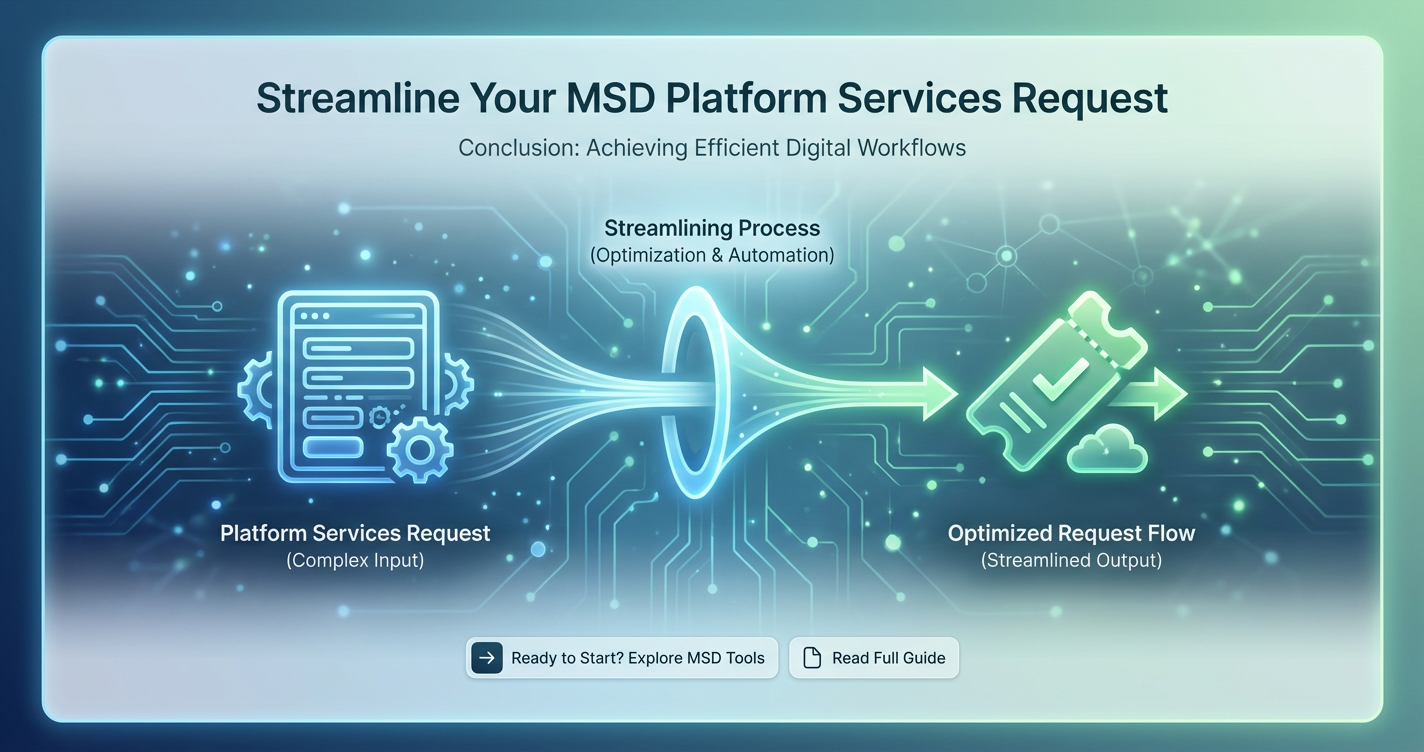
Streamline Your MSD Platform Services Request


In today's interconnected digital landscape, organizations are increasingly reliant on a sprawling ecosystem of services, applications, and data sources to power their operations. At the heart of many complex enterprise architectures lies the concept of a multi-service delivery (MSD) platform. These platforms are instrumental in providing a diverse array of capabilities, ranging from core business functions like customer relationship management and enterprise resource planning to specialized microservices that handle specific tasks, data analytics, and artificial intelligence models. However, the sheer breadth and depth of an MSD platform, while offering immense potential, often bring with them significant challenges, particularly when it comes to efficiently managing and fulfilling service requests. The process of requesting, approving, integrating, and deploying new services or accessing existing ones within such a multifaceted environment can be cumbersome, time-consuming, and fraught with inefficiencies, ultimately hindering innovation and operational agility.
The traditional approaches to managing these service requests frequently involve manual ticketing systems, email chains, and face-to-face approvals, creating bottlenecks, human error, and a lack of transparency. Developers attempting to integrate new functionalities find themselves navigating fragmented documentation, inconsistent access protocols, and a labyrinth of internal dependencies. Business units struggle to get new services deployed quickly enough to meet market demands, while operations teams wrestle with managing the security and performance of an ever-growing array of disparate systems. It's a scenario that, if left unaddressed, can stifle productivity, escalate costs, and put organizations at a distinct disadvantage in a rapidly evolving competitive landscape.
This article delves into how modern API management strategies, underpinned by the strategic deployment of an API Developer Portal, a robust API Gateway, and the embrace of an Open Platform philosophy, can fundamentally transform and streamline the MSD platform services request process. By adopting these powerful paradigms, organizations can transition from reactive, manual service provisioning to a proactive, automated, and self-service model, fostering a culture of innovation, improving developer experience, bolstering security, and ultimately unlocking the full potential of their multi-service delivery capabilities. We will explore the inherent challenges, the transformative solutions, and the tangible benefits of adopting a holistic API-first approach to service request management, ensuring that your MSD platform becomes a catalyst for growth rather than a drag on progress.
The Intricacies and Inefficiencies of Traditional MSD Platform Service Request Management
Before we delve into the solutions, it's crucial to thoroughly understand the complexities that plague conventional approaches to managing service requests within a large-scale MSD platform. These challenges are often deeply embedded in organizational culture, technical legacy, and operational processes, making them resistant to quick fixes.
The Labyrinth of Manual Processes and Communication Silos
One of the most pervasive issues is the reliance on manual processes for service requests. Imagine a developer needing to integrate with a new payment processing service, or a data scientist requiring access to a specialized analytics API hosted on the MSD platform. In many organizations, this often kicks off a series of manual steps: submitting a request via email or an internal ticketing system, waiting for an operations team member to acknowledge it, potentially engaging in multiple back-and-forth email exchanges for clarifications, obtaining approvals from various stakeholders (security, business unit leads, IT management), and then finally, awaiting manual provisioning of access credentials, often followed by a hunt for fragmented documentation.
This process is inherently slow and error-prone. Each manual handoff introduces potential delays and opportunities for miscommunication. Different departments might use different systems or terminologies, leading to further confusion. The absence of a centralized, automated workflow means that tracking the status of a request becomes a manual exercise, often requiring direct inquiries, which further distracts teams from their core responsibilities. This lack of transparency and the sheer effort involved can significantly increase the time-to-market for new features and services, frustrating both the requesters and the service providers within the organization. The inherent latency in these processes is not just an inconvenience; it can be a significant drag on an organization's ability to respond swiftly to market changes or competitive pressures.
Fragmented Discovery and Poor Developer Experience
For developers, one of the most frustrating aspects of working with an unmanaged MSD platform is the difficulty in discovering available services. Without a central catalog, developers often rely on tribal knowledge, internal wikis (which may be outdated), or direct inquiries to colleagues to find out what services exist and how to use them. Even when a service is discovered, the documentation might be incomplete, inconsistent, or scattered across different repositories. Some services might only be documented in internal code comments, while others might have poorly maintained external wikis.
This fragmented discovery leads to a significantly poor developer experience. Developers waste valuable time searching for services and understanding how to interact with them, rather than building innovative solutions. They might have to learn different authentication mechanisms, data formats, and error handling patterns for each individual service, increasing the cognitive load and potential for integration errors. The absence of self-service capabilities means developers cannot independently provision access keys, test integrations, or monitor their usage, further prolonging the development cycle. In essence, the friction created by these hurdles means that valuable internal services, meticulously built and maintained, remain underutilized or are adopted at a glacial pace, ultimately limiting the ROI of the underlying MSD platform investments.
Security Vulnerabilities and Governance Gaps
Traditional MSD platform service request management often presents significant security and governance challenges. When access to services is provisioned manually and ad-hoc, it becomes incredibly difficult to enforce consistent security policies. Access keys might be shared insecurely, permissions might be overly broad, or unmonitored access to sensitive data might persist long after it's needed. Auditing who accessed what, when, and for what purpose becomes a Herculean task, making it challenging to identify and mitigate potential breaches or ensure compliance with regulatory requirements (e.g., GDPR, HIPAA, PCI DSS).
Furthermore, without a centralized control point, managing the lifecycle of services – from their creation and versioning to their eventual deprecation – becomes chaotic. Deprecated services might continue to be used, leading to technical debt and security exposures. New versions might be introduced without proper communication, breaking existing integrations. The lack of standardized processes for API design, documentation, and security reviews means that each service might have varying levels of quality and robustness, creating an inconsistent and potentially vulnerable attack surface across the entire MSD platform. These governance gaps not only pose significant risks but also inhibit the ability of an organization to scale its service offerings securely and sustainably.
Performance Bottlenecks and Scalability Limitations
As an MSD platform grows, handling an increasing volume of service requests and API calls through traditional means quickly hits performance bottlenecks. Direct connections to backend services without any intermediate layer for traffic management can overload individual services, leading to degraded performance, timeouts, and system instability. Without mechanisms like load balancing, caching, or circuit breaking, a single problematic service can trigger a cascading failure across dependent systems, causing widespread outages.
Scaling such a platform to meet fluctuating demand is incredibly challenging. Manually configuring new instances, updating routing rules, or applying rate limits for each service is not only time-consuming but also prone to errors. This lack of automated scalability means that organizations either over-provision resources, incurring unnecessary costs, or under-provision, leading to poor user experiences and lost business opportunities during peak demand. The absence of real-time monitoring and analytics also means that performance issues are often discovered reactively, after they have already impacted users, rather than proactively identified and addressed.
These entrenched challenges collectively paint a picture of an MSD platform environment that is complex, inefficient, insecure, and difficult to scale. It's a clear indicator that a fundamental shift in strategy is required – a shift towards modern API management principles that leverage automation, standardization, and centralized control to unlock the true potential of an organization's digital assets.
The Paradigm Shift: Embracing APIs for Streamlined MSD Services
The solution to the multifaceted challenges described above lies in a strategic pivot towards treating every consumable capability within an MSD platform as an API (Application Programming Interface). This "API-first" philosophy is more than just a technical implementation; it's a fundamental change in how organizations design, deliver, and consume services. By exposing MSD platform services through well-defined, standardized APIs, organizations can abstract away the underlying complexity, providing a clean, consistent, and discoverable interface for interaction.
APIs serve as the universal connectors in the modern digital economy. They enable different software components, applications, and systems to communicate and exchange data seamlessly, regardless of their underlying technologies or programming languages. For an MSD platform, adopting an API-first approach means:
- Standardized Access: Instead of bespoke integration methods for each service, APIs provide a consistent way to interact. This reduces the learning curve for developers and simplifies integration efforts.
- Abstraction of Complexity: APIs hide the intricate details of the backend MSD services. Developers don't need to know how a specific microservice is implemented or what database it uses; they only need to understand the API contract.
- Encouraging Modularity: APIs naturally promote a modular architecture, where services are independently developed, deployed, and scaled. This fosters agility and reduces dependencies.
- Enabling Automation: Once services are exposed as APIs, their invocation can be automated, paving the way for self-service provisioning, continuous integration/continuous deployment (CI/CD) pipelines, and intelligent orchestration.
- Fostering Innovation: By making services easily accessible and understandable through APIs, organizations empower their internal teams and potentially external partners to combine these services in novel ways, creating new products and experiences without requiring deep knowledge of the underlying systems.
This paradigm shift doesn't just simplify technical integrations; it fundamentally transforms how an organization operates, fostering greater collaboration, enhancing efficiency, and accelerating the pace of innovation. The move towards API-driven MSD service management is not a luxury but a necessity for organizations striving for agility and competitiveness in the digital age.
The Cornerstone: Leveraging an API Developer Portal for MSD Service Discovery and Consumption
The API-first strategy, while powerful, requires a robust mechanism to manage the full lifecycle of these APIs and facilitate their consumption. This is where an API Developer Portal becomes an indispensable component in streamlining MSD platform services requests. Far more than just a documentation repository, an API Developer Portal acts as the central hub, the storefront, and the community center for all your organization's internal and external APIs.
What is an API Developer Portal?
An API Developer Portal is a dedicated web-based interface designed to serve the needs of developers (both internal and external) who wish to discover, understand, subscribe to, and integrate with your APIs. It provides a comprehensive, self-service environment that empowers developers to work independently, reducing the burden on internal support teams and accelerating the adoption of your MSD platform services.
Centralized Discovery and Comprehensive Documentation
The primary function of an API Developer Portal is to provide a single, authoritative source for discovering all available MSD platform services. Instead of hunting through disparate documents or asking around, developers can browse a curated catalog of APIs, categorized by function, business domain, or department. Each API entry within the portal should feature:
- Detailed API Specifications: Using standards like OpenAPI (Swagger) to describe endpoints, request/response formats, authentication methods, and error codes. This ensures clarity and consistency.
- Interactive Documentation: Tools that allow developers to try out API calls directly from the portal, seeing immediate responses, which significantly shortens the learning curve.
- Tutorials and How-to Guides: Step-by-step instructions for common use cases, helping developers quickly understand how to achieve specific outcomes with the APIs.
- Code Samples and SDKs: Providing pre-written code snippets in various programming languages and software development kits (SDKs) to accelerate integration efforts. This eliminates boilerplate coding and reduces errors.
- Versioning Information: Clearly indicating API versions, deprecation policies, and migration guides to help developers manage their integrations over time and plan for updates.
By centralizing all this information in an easily navigable format, an API Developer Portal drastically improves the developer experience, transforming the opaque process of service discovery into a transparent and efficient one. It democratizes access to information, ensuring that everyone has the most up-to-date and accurate details about the services available on the MSD platform.
Empowering Self-Service Capabilities
Beyond discovery, a crucial aspect of an effective API Developer Portal is its ability to offer robust self-service functionalities. These capabilities are key to eliminating manual bottlenecks in the service request process:
- Application Registration: Developers can register their applications that will consume the APIs. This registration process often assigns a unique application ID.
- API Key and Credential Management: Once an application is registered, developers can generate and manage their own API keys, client IDs, and client secrets directly within the portal. This eliminates the need for manual provisioning by operations teams.
- Subscription Management: For APIs that require explicit approval, developers can subscribe to them through the portal, initiating an automated approval workflow. This ensures that access is granted only after necessary checks, maintaining security and governance.
- Usage Analytics and Monitoring: Developers can view real-time metrics on their API consumption, including call volumes, latency, and error rates. This empowers them to monitor their integrations, troubleshoot issues, and understand their billing implications if applicable.
- Sandbox Environments: The portal can provide access to sandbox or testing environments, allowing developers to test their integrations against mock data or non-production systems without impacting live services.
These self-service features significantly reduce the operational overhead for IT teams, freeing them from repetitive provisioning tasks. For developers, it means immediate access to the resources they need, accelerating the development cycle and fostering greater autonomy.
Fostering Community and Support
An API Developer Portal also serves as a critical platform for community building and support. It can include features such as:
- Forums and Q&A Sections: Allowing developers to ask questions, share insights, and help each other, creating a self-sustaining support ecosystem.
- Announcement Boards: For communicating API updates, maintenance windows, or important news.
- Feedback Mechanisms: Enabling developers to provide direct feedback on APIs, documentation, or the portal itself, fostering continuous improvement.
By providing a communal space, the portal not only enhances the support experience but also cultivates a sense of ownership and collaboration among the users of the MSD platform services. It turns a collection of disparate services into a cohesive, collaborative ecosystem.
In summary, an API Developer Portal is not just a technical tool; it's a strategic asset that streamlines the entire MSD platform services request journey, from initial discovery to ongoing consumption. It transforms a potentially chaotic and inefficient process into a smooth, self-service, and developer-friendly experience, accelerating innovation and maximizing the value derived from your organization's digital assets.
The Enforcer and Orchestrator: Securing and Managing Services with an API Gateway
While an API Developer Portal provides the crucial front-end for API discovery and consumption, it's the API Gateway that acts as the traffic cop, bouncer, and orchestrator for all API calls to your MSD platform services. It stands as the single entry point for all API requests, providing a robust layer of security, management, and optimization before requests reach the backend services. Without an API Gateway, the sophisticated self-service capabilities of a developer portal would lack the necessary enforcement and control mechanisms to ensure secure, reliable, and scalable service delivery.
What is an API Gateway?
An API Gateway is a central management component that intercepts all API requests, acting as a reverse proxy to route them to the appropriate backend services. More importantly, it applies a host of policies and transformations to these requests and responses, ensuring that the services are consumed securely, efficiently, and according to defined rules. It effectively decouples client applications from the complexities of the backend architecture, providing a unified and consistent interface.
Centralized Policy Enforcement: Security and Governance
One of the most critical functions of an API Gateway is to enforce security and governance policies at a single, centralized point. This is paramount for protecting sensitive MSD platform services and data:
- Authentication and Authorization: The gateway verifies the identity of the calling application and user, often using API keys, OAuth tokens, or JSON Web Tokens (JWTs) issued via the developer portal. It then authorizes whether the authenticated user/application has the necessary permissions to access the requested service and perform the specific operation. This prevents unauthorized access and potential data breaches.
- Rate Limiting and Throttling: To protect backend services from being overwhelmed by excessive requests (which could lead to denial-of-service attacks or performance degradation), the gateway can enforce rate limits, allowing only a certain number of calls within a specific timeframe per application or user. Throttling can be applied to smooth out traffic spikes.
- IP Whitelisting/Blacklisting: The gateway can restrict access to APIs based on the IP addresses of the callers, adding another layer of security.
- Request/Response Transformation: The gateway can modify incoming requests (e.g., adding headers, transforming data formats) and outgoing responses (e.g., masking sensitive data, aggregating responses from multiple services) to ensure compatibility and consistency across various consumers and backend services. This is particularly useful when dealing with legacy MSD services that may have non-standard interfaces.
By centralizing these enforcement mechanisms, the API Gateway ensures that security and governance policies are consistently applied across all MSD platform services, reducing the attack surface and simplifying compliance efforts.
Traffic Management and Performance Optimization
Beyond security, an API Gateway plays a vital role in optimizing the performance and reliability of your MSD platform services:
- Load Balancing: The gateway can distribute incoming API traffic across multiple instances of a backend service, preventing any single instance from becoming overloaded and ensuring high availability.
- Routing: It intelligently routes API requests to the correct backend service based on defined rules (e.g., path, headers, query parameters), often involving complex routing logic for microservices architectures.
- Caching: Frequently accessed data or responses can be cached at the gateway level, reducing the load on backend services and significantly improving response times for subsequent requests.
- Circuit Breaking: In a distributed system, if a backend service starts to fail or become unresponsive, the gateway can "trip the circuit," preventing further requests from being sent to that service and allowing it to recover, thereby preventing cascading failures.
- Retries and Timeouts: The gateway can manage automatic retries for transient errors and enforce timeouts to prevent client applications from waiting indefinitely for unresponsive services.
These traffic management features are crucial for maintaining the stability, scalability, and responsiveness of a complex MSD platform, ensuring a consistent and reliable experience for consumers.
Monitoring, Analytics, and API Lifecycle Management
An API Gateway is also a rich source of operational data and a key enabler for effective API lifecycle management:
- Real-time Monitoring and Logging: The gateway captures detailed logs for every API call, including request/response payloads, latency, error codes, and caller information. This data is invaluable for real-time monitoring, troubleshooting, and auditing.
- Analytics and Reporting: By aggregating and analyzing the vast amount of data collected, the gateway can provide insights into API usage patterns, performance trends, popular services, and potential bottlenecks. This data-driven approach helps optimize resource allocation and identify areas for improvement.
- Versioning: The gateway facilitates seamless API versioning, allowing multiple versions of an API to run concurrently. It can route requests to the appropriate version based on headers or path parameters, enabling smooth transitions and preventing breaking changes for existing consumers.
- Deployment and Decommissioning: It provides a controlled environment for deploying new API versions or decommissioning old ones, minimizing disruption to consumers.
For organizations seeking to efficiently manage and secure their MSD platform services, particularly those integrating cutting-edge AI functionalities, a robust API Gateway is indispensable. Consider a solution like ApiPark. APIPark, as an open-source AI gateway and API management platform, is specifically designed to handle the complexities of both traditional REST services and advanced AI models. Its capabilities, such as quick integration of over 100+ AI models, unified API format for AI invocation, and prompt encapsulation into REST API, directly address the needs of an MSD platform that is looking to leverage artificial intelligence. Furthermore, features like end-to-end API lifecycle management, performance rivaling Nginx (achieving over 20,000 TPS on modest hardware), and detailed API call logging, position APIPark as a powerful tool for organizations that require a high-performance, secure, and observable gateway for their diverse MSD services. Its ability to support independent API and access permissions for each tenant and require approval for API resource access directly contributes to enhanced security and governance within the MSD ecosystem.
In essence, the API Gateway serves as the critical enforcement point and intelligence hub for all MSD platform services exposed via APIs. It ensures that every request is authorized, optimized, and logged, providing the security, performance, and insights necessary to run a highly effective and resilient multi-service delivery platform.
The Foundation of Flexibility: Embracing the Open Platform Philosophy
Beyond the specific tools like an API Developer Portal and an API Gateway, the overarching philosophy that truly liberates and empowers an MSD platform is that of an Open Platform. This concept extends beyond merely having APIs; it embraces transparency, interoperability, extensibility, and community participation as core tenets of service delivery. An Open Platform approach for an MSD environment transforms it from a rigid, proprietary system into a dynamic, adaptable ecosystem capable of rapid evolution and broad collaboration.
What Constitutes an Open Platform?
An Open Platform is characterized by several key attributes that collectively foster innovation, reduce vendor lock-in, and maximize the utility of an organization's digital assets:
- Open Standards and Protocols: Reliance on widely accepted, non-proprietary standards (like HTTP, REST, OAuth, OpenAPI Specification) for API design and communication. This ensures interoperability with a vast array of technologies and prevents a single vendor from dictating the terms of integration.
- Well-Documented and Accessible APIs: All services are exposed through public or internal APIs with comprehensive, clear, and easily discoverable documentation (as facilitated by an API Developer Portal). This transparency is fundamental.
- Extensibility and Customization: The platform is designed to allow developers to build new services, applications, and integrations on top of existing capabilities, often using SDKs or development frameworks provided by the platform itself. It’s not just about consuming services, but about creating new value.
- Community and Ecosystem: Fostering a vibrant community of developers, partners, and users who contribute to the platform's evolution, share knowledge, and build complementary solutions.
- Transparency and Trust: Openness about the platform's architecture, roadmap, and policies, building trust with developers and partners. For open-source components, this also implies code transparency.
Fostering Innovation and Accelerating Ecosystem Development
The most significant benefit of an Open Platform philosophy for an MSD environment is its unparalleled ability to foster innovation. By making services easily accessible and providing the tools to build upon them, organizations empower a broader range of stakeholders to contribute:
- Internal Innovation: Different departments and teams within an organization can independently develop new applications and services by integrating existing MSD platform capabilities. This breaks down internal silos and accelerates cross-functional projects. For example, a marketing team could quickly build a custom dashboard using sales data APIs combined with sentiment analysis APIs, without needing deep technical knowledge of the underlying systems.
- Partner Ecosystem Expansion: An Open Platform encourages external partners, vendors, and third-party developers to integrate with your MSD services, creating a rich ecosystem of complementary applications and driving new revenue streams. Think of marketplaces built around your core services, or specialized applications that enhance your offerings.
- Rapid Prototyping and Experimentation: The ease of access and integration allows for faster experimentation with new ideas. Developers can quickly prototype new features or even entirely new products by leveraging existing APIs, reducing the time and cost associated with failed experiments.
This collaborative approach dramatically increases the surface area for creativity and problem-solving, far beyond what a single development team could achieve in isolation. It transforms the MSD platform from a mere collection of services into a dynamic engine of business growth.
Reducing Vendor Lock-in and Enhancing Agility
Adopting an Open Platform strategy significantly mitigates the risk of vendor lock-in. When an MSD platform is built on open standards and provides open APIs, it becomes easier to integrate with different vendors' products or switch components if a better solution emerges. This flexibility is crucial for long-term strategic planning and ensures that an organization is not beholden to a single provider for its core technological infrastructure.
Furthermore, the agility gained from an Open Platform is invaluable. Changes in market demands, technological advancements, or regulatory landscapes can be addressed more quickly because the platform is designed for adaptability. New services can be integrated, existing ones can be updated, and novel solutions can be deployed with greater speed and less friction, ensuring the organization remains responsive and competitive.
A prime example of an Open Platform in action is ApiPark. APIPark is an open-source AI gateway and API management platform, licensed under Apache 2.0. This open-source nature is a direct embodiment of the Open Platform philosophy. It provides transparency, allowing developers to inspect, understand, and even contribute to the underlying code. This not only builds trust but also allows for deep customization to fit specific enterprise needs, avoiding proprietary black boxes. Organizations can integrate APIPark into their MSD platform with confidence, knowing they have control and flexibility. Its open-source foundation aligns perfectly with the goal of creating a flexible, extensible, and collaborative environment for managing and integrating services, especially when those services include advanced AI models. By offering both open-source and commercial versions, APIPark also demonstrates a commitment to broad accessibility while providing enterprise-grade support and advanced features for larger deployments, further strengthening the Open Platform ethos.
In essence, an Open Platform philosophy transforms an MSD platform from a static collection of services into a vibrant, evolving ecosystem. It empowers developers, fosters innovation, provides strategic flexibility, and ultimately ensures that the MSD platform remains a dynamic asset capable of driving continuous business value.
The Synergistic Power: API Developer Portal + API Gateway + Open Platform for MSD
The true power in streamlining MSD platform services requests emerges not from implementing an API Developer Portal, an API Gateway, or an Open Platform in isolation, but from their harmonious integration and synergistic operation. Together, these three components form a robust, comprehensive API management solution that transforms the entire service lifecycle, making service consumption efficient, secure, and highly scalable.
Imagine the journey of a developer needing to access a new service within your MSD platform – perhaps a new data analytics API powered by an AI model.
- Discovery via the API Developer Portal: The developer first navigates to the API Developer Portal. There, they easily find the "Data Analytics API" within a categorized catalog. The portal provides comprehensive documentation, including OpenAPI specifications, code samples in their preferred language, and an interactive console to test the API immediately. They learn about its capabilities, the required input parameters, and the expected output. If the API leverages AI, they can also discover how the underlying AI models are integrated and invoked. The portal might even showcase examples of how this analytics API, perhaps using a feature from ApiPark like prompt encapsulation into REST API, combines an AI model with custom prompts to create a specific sentiment analysis API.
- Self-Service Subscription and Credential Management: The developer decides this API is perfect for their new application. Directly from the portal, they register their application, generate a unique API key, and subscribe to the Data Analytics API. If the API requires approval, an automated workflow is triggered, and upon approval, their credentials are activated, often through a secure communication with the underlying API Gateway. This entire process, which traditionally could take days or weeks of manual interaction, is completed in minutes through self-service. The portal's capability for independent API and access permissions for each tenant, ensures that the developer only sees and can subscribe to APIs relevant to their team, while approval features ensure necessary oversight.
- Secure and Managed Invocation via the API Gateway: When the developer's application makes its first call to the Data Analytics API, the request doesn't go directly to the backend service. Instead, it's first intercepted by the API Gateway. The gateway performs several crucial functions:
- Authentication & Authorization: It validates the developer's API key and ensures their application is authorized to access this specific API.
- Rate Limiting: It checks if the application is within its permitted call limits to prevent abuse or overloading of the backend service.
- Traffic Management: It might route the request to the least busy instance of the data analytics service, potentially using load balancing, and ensures that the request adheres to any necessary transformations before reaching the backend.
- Security Policies: It inspects the request for any malicious patterns (e.g., SQL injection attempts) and applies security policies to protect the backend.
- Logging & Monitoring: Crucially, the gateway logs every detail of the API call, contributing to the detailed API call logging provided by platforms like APIPark, which is essential for troubleshooting and performance analysis.
- Backend Service Execution and Response: Only after passing through the API Gateway's rigorous checks and transformations does the request reach the actual backend Data Analytics service within the MSD platform. The service processes the request, potentially invoking an integrated AI model (managed and standardized through the API Gateway's unified AI invocation features, as seen in APIPark), and returns the results. The response then flows back through the API Gateway, which might apply further transformations (e.g., masking sensitive data) before sending it back to the developer's application.
- Monitoring and Iteration: Back in the API Developer Portal, the developer can then monitor their API usage, view call volumes, latency, and error rates, and quickly identify any issues. The detailed API call logging and powerful data analysis features, like those offered by APIPark, empower both developers and operations teams to understand performance trends and proactively address potential problems.
This seamless flow, orchestrated by the API Gateway and facilitated by the API Developer Portal, is built upon an Open Platform philosophy. The use of open standards (like OpenAPI), the transparency of API specifications, the extensibility offered for building new services, and the open-source nature of components like APIPark, all contribute to a flexible, adaptable, and collaborative environment. This open approach allows the organization to avoid vendor lock-in, integrate diverse technologies (including a wide range of AI models), and foster innovation both internally and with external partners.
The Holistic Benefits of This Synergy:
- Enhanced Developer Experience: Developers enjoy a frictionless experience, accelerating their ability to integrate and build.
- Robust Security and Governance: Centralized policy enforcement, subscription approvals, and detailed logging ensure that all service access is secure, compliant, and auditable.
- Scalability and Performance: Traffic management, load balancing, and caching at the gateway ensure that MSD platform services can handle high volumes of requests reliably and efficiently.
- Faster Time-to-Market: Self-service capabilities and streamlined processes drastically reduce the time required to provision and deploy new services.
- Data-Driven Decision Making: Comprehensive analytics from the gateway and portal provide insights into API usage and performance, informing strategic decisions.
- Cost Efficiency: Automation reduces manual effort, while optimized resource utilization improves operational costs.
The combined power of an API Developer Portal, an API Gateway, and an Open Platform philosophy fundamentally redefines how organizations manage and deliver services within their MSD environment. It transforms a complex, often chaotic process into an organized, efficient, and innovative ecosystem, ready to meet the demands of the modern digital economy.
APIPark is a high-performance AI gateway that allows you to securely access the most comprehensive LLM APIs globally on the APIPark platform, including OpenAI, Anthropic, Mistral, Llama2, Google Gemini, and more.Try APIPark now! 👇👇👇
Implementing a Modern API Strategy for MSD Platform Services: A Step-by-Step Guide
Embarking on a journey to streamline MSD platform services requests requires a strategic, phased approach. It’s not just about deploying tools but about fundamentally changing how an organization perceives and manages its digital capabilities. Here's a comprehensive guide to implementing a modern API strategy.
Step 1: Comprehensive Assessment and Vision Definition
Before any technical implementation, it's crucial to understand the current state and define the desired future.
- Audit Existing Services: Catalog all current services within your MSD platform, identifying their functions, dependencies, consumers, and existing access mechanisms. Document integration points and common bottlenecks.
- Identify Pain Points: Gather feedback from developers, business users, and operations teams regarding the current service request process. Pinpoint areas of inefficiency, frustration, security concerns, and scalability issues.
- Define Strategic Objectives: Clearly articulate what you aim to achieve with a modern API strategy. Goals might include:
- Reducing service delivery time by X%.
- Improving developer satisfaction scores by Y%.
- Enhancing security posture and compliance.
- Enabling new business models or partner integrations.
- Reducing operational costs associated with manual provisioning.
- Establish an API-First Mindset: Begin cultivating a culture where new services are designed as APIs from the outset, rather than being an afterthought. This requires executive sponsorship and cross-departmental buy-in.
- Identify Key Stakeholders: Bring together representatives from IT, development, operations, security, and relevant business units to ensure alignment and collective ownership of the initiative.
Step 2: API Design and Standardization
With a clear vision, the next step is to standardize how services are exposed as APIs.
- Adopt an API Design Standard: Choose a consistent approach for API design, such as RESTful principles, and utilize a specification language like OpenAPI (Swagger) to describe all APIs. This ensures uniformity across your MSD platform services.
- Define Data Models and Schemas: Standardize data formats (e.g., JSON) and define consistent schemas for request and response payloads. This minimizes integration errors and cognitive load for developers.
- Implement Consistent Authentication and Authorization: Design a unified security model for all APIs, preferably leveraging industry standards like OAuth 2.0 and OpenID Connect. This simplifies access management for both consumers and providers.
- Version Management Strategy: Plan for API versioning from the beginning. Decide on a clear strategy for introducing breaking changes (e.g., URL versioning, header versioning) and how to manage the deprecation of older versions to minimize disruption.
- Design for Reusability: Encourage the design of granular, composable APIs that can be combined to create more complex functionalities. This fosters an agile development environment and maximizes the utility of each service.
Step 3: Tooling Selection and Implementation (Developer Portal & API Gateway)
Choosing the right API management tools is crucial for realizing your strategy.
- Select an API Developer Portal: Evaluate different solutions based on features like ease of API discovery, comprehensive documentation capabilities, self-service application and key management, analytics dashboards for developers, and community features. Ensure it supports your chosen API specifications.
- Choose an API Gateway: Select a robust API Gateway that offers:
- Comprehensive Security: Authentication, authorization, rate limiting, threat protection, IP filtering.
- Traffic Management: Load balancing, routing, caching, circuit breaking, request/response transformation.
- Monitoring & Analytics: Detailed logging, real-time metrics, and reporting capabilities.
- Scalability & Performance: High-throughput, low-latency processing, and support for cluster deployments.
- Extensibility: Ability to integrate with existing identity providers, security tools, and monitoring systems.
- AI Integration: For MSD platforms looking to incorporate AI, prioritize gateways that simplify the management and invocation of AI models. For instance, ApiPark stands out as an AI Gateway that offers quick integration of over 100+ AI models, a unified API format for AI invocation, and the ability to encapsulate prompts into REST APIs, making it exceptionally well-suited for modern, AI-powered MSD platforms. Its performance, rivaling Nginx, ensures that even high-volume AI requests can be handled efficiently.
- Phased Deployment: Start with a pilot project or a subset of non-critical MSD services to test the chosen tools and refine processes before a broader rollout. This allows for learning and adaptation.
Step 4: Governance and Lifecycle Management
Effective API management extends throughout the entire lifecycle of a service.
- Establish API Governance Council: Form a cross-functional team responsible for defining and enforcing API standards, reviewing API designs, and making strategic decisions about the API program.
- Define API Lifecycle Workflow: Document clear processes for API design, development, testing, publication (via the developer portal and gateway), versioning, monitoring, and eventual deprecation.
- Implement Security Policies: Beyond gateway-level enforcement, establish comprehensive security policies for API development, including secure coding practices, regular security audits, and vulnerability testing.
- Onboarding and Training: Provide training and resources for developers (both API providers and consumers) on new API standards, tools, and processes. This ensures smooth adoption.
Step 5: Monitoring, Analytics, and Continuous Improvement
An API strategy is not a one-time project but an ongoing commitment to excellence.
- Leverage Monitoring and Analytics: Utilize the capabilities of the API Gateway and Developer Portal to continuously monitor API performance, usage patterns, and error rates. Platforms like APIPark provide powerful data analysis to display long-term trends and performance changes, enabling proactive maintenance.
- Establish Feedback Loops: Encourage feedback from API consumers through the developer portal, internal channels, or regular forums. Use this feedback to iterate and improve existing APIs and develop new ones.
- Performance Optimization: Continuously analyze performance data to identify bottlenecks and optimize API gateway configurations or backend service performance.
- Regular Audits and Reviews: Periodically review API designs, security policies, and governance processes to ensure they remain relevant and effective.
- Evangelize and Promote: Actively promote your API program internally and externally. Showcase successes, highlight new services, and encourage broader adoption.
By meticulously following these steps, organizations can systematically transform their MSD platform services request process from a source of friction into a powerful engine of agility, security, and innovation, fully leveraging the combined capabilities of API Developer Portals, API Gateways, and an Open Platform approach.
Detailed Benefits of Streamlining MSD Platform Services through Modern API Management
The implementation of a modern API strategy, integrating an API Developer Portal, an API Gateway, and an Open Platform philosophy, yields a multitude of profound benefits across various organizational functions. These advantages collectively transform the efficiency, security, and innovation potential of an MSD platform.
For Developers: Enhanced Productivity and Empowerment
- Accelerated Development Cycles: With a centralized API Developer Portal, developers can quickly discover, understand, and integrate with existing MSD platform services. Comprehensive documentation, interactive consoles, and SDKs reduce the learning curve and eliminate time spent on searching or deciphering inconsistent interfaces. This means features can be built and shipped faster.
- Self-Service Autonomy: The ability to register applications, generate API keys, and monitor usage independently empowers developers, freeing them from reliance on other teams for basic provisioning. This autonomy fosters a sense of ownership and reduces bottlenecks in the development workflow.
- Consistent Experience: By enforcing standard API design principles and leveraging the API Gateway for uniform access and security, developers interact with a consistent interface across all MSD services, regardless of their underlying technology. This reduces cognitive load and minimizes integration errors.
- Access to Cutting-Edge Technologies: For platforms leveraging AI, the integration of an AI Gateway like ApiPark provides developers with quick and standardized access to over 100+ AI models. Features like unified API format for AI invocation and prompt encapsulation into REST APIs mean developers can integrate powerful AI capabilities into their applications without needing deep AI expertise or worrying about model changes, greatly accelerating the adoption of AI within new products and services.
- Faster Troubleshooting: Detailed API call logs and performance analytics available through the API Gateway and API Developer Portal enable developers to quickly trace issues, debug integrations, and resolve problems, ensuring system stability.
For Operations Teams: Improved Control, Security, and Observability
- Centralized Control and Enforcement: The API Gateway provides a single point of control for all API traffic to the MSD platform. This allows operations teams to consistently apply security policies, authentication, authorization, rate limiting, and traffic management rules across all services, significantly reducing the attack surface.
- Enhanced Security Posture: Features like subscription approval for API resources (as offered by APIPark), robust authentication mechanisms, and continuous threat protection at the gateway level prevent unauthorized access and protect sensitive data, bolstering the overall security of the MSD platform.
- Simplified Governance and Compliance: With end-to-end API lifecycle management (a key feature of APIPark) and centralized policy enforcement, operations teams can easily ensure compliance with internal standards and external regulations, streamlining auditing processes.
- Proactive Performance Management: Real-time monitoring, detailed logging, and powerful data analysis capabilities (e.g., APIPark's ability to analyze historical call data for trends) enable operations teams to proactively identify performance bottlenecks, anticipate issues, and optimize resource allocation, preventing outages and ensuring high availability.
- Reduced Operational Overhead: Automation of provisioning and access management tasks, enabled by the API Developer Portal and API Gateway, frees operations teams from repetitive manual work, allowing them to focus on more strategic initiatives.
For Business Stakeholders: Accelerated Innovation, Agility, and Cost Efficiency
- Faster Time-to-Market for New Services: Streamlined service requests and accelerated development cycles mean that new business capabilities, products, and features can be brought to market significantly faster, allowing the organization to respond quickly to market demands and gain a competitive edge.
- New Revenue Streams and Business Models: An Open Platform approach encourages internal teams and external partners to build innovative applications and services on top of the MSD platform's APIs, potentially unlocking new revenue streams and fostering a vibrant partner ecosystem.
- Improved Agility and Responsiveness: The modularity, standardization, and self-service nature of an API-driven MSD platform enable the organization to adapt more quickly to changing business requirements, technology shifts, and competitive landscapes.
- Better Data-Driven Decisions: Comprehensive API usage and performance analytics provide valuable insights into how services are being consumed, which APIs are most popular, and where investments should be focused. This data informs strategic business decisions.
- Reduced Operational Costs: Automation, optimized resource utilization, and increased developer productivity contribute to significant cost savings in development, operations, and IT support. The performance of platforms like APIPark, which can achieve high TPS with modest hardware, also translates into cost efficiency for infrastructure.
- Enhanced Inter-Departmental Collaboration: By making services easily discoverable and consumable, APIs foster better collaboration between different departments, allowing them to leverage each other's capabilities more effectively.
In conclusion, streamlining MSD platform services requests through a modern API strategy is not merely a technical upgrade; it is a strategic imperative that delivers profound, measurable benefits across the entire organization. It transforms the MSD platform from a complex IT burden into a dynamic, secure, and highly efficient engine of innovation and business growth.
Transforming MSD Service Request Management: A Hypothetical Case Study
To illustrate the tangible impact of adopting a modern API strategy for MSD platform services, let's consider a hypothetical enterprise, "GlobalTech Innovations."
The Challenge at GlobalTech:
GlobalTech Innovations, a large multinational corporation, relied on a complex MSD platform encompassing hundreds of legacy and modern services, databases, and third-party integrations. Their existing process for requesting access to these services was highly fragmented:
- Discovery: Developers spent weeks trying to locate relevant services, often relying on outdated internal wikis or informal communication channels.
- Access Request: Service requests were submitted via email or an outdated SharePoint form, leading to a long queue. Each request required manual review by multiple teams (IT, security, relevant business unit), often taking 2-4 weeks for approval.
- Provisioning: Once approved, API keys or access credentials were manually generated and delivered, a process prone to errors and delays.
- Documentation: API documentation was inconsistent, scattered, and frequently out of sync with the actual service implementations.
- Security: Ad-hoc access management led to inconsistent security enforcement, broad permissions, and difficulties in auditing.
- Scalability: The manual nature of traffic management and monitoring meant that during peak demand, services often struggled, leading to performance degradation and frustrated users.
This inefficiency significantly hampered GlobalTech's ability to innovate, launch new products quickly, and respond to competitive pressures. Developer satisfaction was low, and operational costs for IT support were high.
The Solution: A Modern API Management Implementation
GlobalTech decided to embark on a comprehensive API management initiative, implementing an API Developer Portal, a robust API Gateway, and embracing an Open Platform philosophy.
- API Design Standardization: They first established clear API design guidelines, mandating RESTful principles and OpenAPI specifications for all new and existing services exposed via APIs.
- Deployment of an API Developer Portal: They implemented a feature-rich API Developer Portal. All MSD platform services were cataloged here with interactive documentation, code samples, and tutorials. The portal offered self-service capabilities for developers to register applications, generate API keys, and subscribe to services. A critical feature was the integration of subscription approval workflows directly within the portal, allowing business and security teams to review and approve access requests with a click, rather than endless email threads.
- Introduction of an API Gateway: An enterprise-grade API Gateway was deployed as the single entry point for all API traffic to the MSD platform. This gateway was configured to handle:
- Centralized Authentication/Authorization: Validating API keys and OAuth tokens, ensuring consistent security.
- Rate Limiting & Throttling: Protecting backend services from overload.
- Traffic Management: Load balancing across service instances and intelligent routing.
- Security Policies: Implementing Web Application Firewall (WAF) capabilities and threat protection.
- Comprehensive Logging & Monitoring: Capturing detailed metrics on API calls for real-time visibility and analytics.
- AI Service Integration: Crucially, GlobalTech recognized the growing importance of AI. They integrated an advanced AI Gateway, similar to ApiPark, into their API management stack. This allowed their developers to quickly access and integrate over 50 different AI models (e.g., for natural language processing, image recognition, predictive analytics) via standardized REST APIs, abstracting away the complexities of various AI model invocation formats. The unified API format for AI invocation drastically simplified the use of AI services across the MSD platform.
- Embracing an Open Platform: GlobalTech cultivated an Open Platform mindset. They encouraged internal teams to expose their services as APIs, making them discoverable and reusable. The open-source nature of their chosen AI Gateway (like APIPark) gave them flexibility and transparency, allowing for customization and deep integration into their existing infrastructure. They also started exploring partnerships that could leverage their newly exposed APIs.
The Transformative Results:
Within 12 months, GlobalTech Innovations experienced a dramatic transformation:
- Service Request Time Reduced by 80%: The average time from initial request to full service access (including API key generation) dropped from 3 weeks to less than 3 days, with many self-service requests fulfilled instantly.
- Developer Productivity Soared: Developers reported a 60% increase in productivity, attributing it to easy discovery, comprehensive documentation, and immediate access to services. They could now focus on building rather than navigating bureaucracy.
- Enhanced Security & Compliance: Centralized API Gateway policies and automated approval workflows ensured consistent security enforcement, making auditing much simpler and significantly reducing the risk of unauthorized access. APIPark's feature of API resource access requiring approval was particularly impactful here.
- Accelerated AI Adoption: The integrated AI Gateway enabled GlobalTech to rapidly incorporate AI capabilities into numerous internal applications and customer-facing products, leading to new intelligent features that differentiated them in the market.
- Improved System Stability: Proactive monitoring and traffic management capabilities of the API Gateway led to a 95% reduction in API-related outages during peak loads.
- Cost Savings: Automation of manual tasks, reduced developer churn, and optimized infrastructure utilization resulted in significant operational cost reductions.
GlobalTech Innovations’ journey demonstrates that streamlining MSD platform services requests through a modern API strategy is not just a technical upgrade but a fundamental shift that drives significant business value, fostering agility, security, and innovation across the entire enterprise.
The Future of MSD Service Management: Embracing Intelligence and Hyper-Automation
As organizations continue to expand the scope and complexity of their MSD platforms, the evolution of service request management will increasingly intertwine with advanced technologies like Artificial Intelligence (AI), Machine Learning (ML), and hyper-automation. The future promises an even more intelligent, predictive, and autonomous approach to how services are managed, discovered, and consumed.
AI and Machine Learning in API Management
The integration of AI and ML is no longer a futuristic concept but a present reality that is reshaping API management. Platforms like ApiPark, which is specifically an AI gateway, are at the forefront of this evolution.
- Intelligent Discovery and Recommendation: Future API Developer Portals will leverage AI to offer personalized API recommendations to developers based on their project context, past usage patterns, and organizational roles. AI-powered search capabilities will go beyond keyword matching to understand intent, guiding developers to the most relevant services within the vast MSD ecosystem.
- Automated API Generation and Adaptation: AI could assist in automatically generating API specifications from backend service definitions or even adapt existing APIs to new requirements, significantly accelerating the API creation process.
- Predictive Analytics for Performance and Security: AI-powered analytics, already a strength of platforms like APIPark's powerful data analysis capabilities, will move beyond historical trends to predict potential performance bottlenecks, security vulnerabilities, or resource saturation points before they occur. This enables proactive interventions, ensuring uninterrupted service delivery.
- Smart Threat Detection: Machine learning algorithms will become increasingly sophisticated in detecting anomalous API call patterns indicative of security threats (e.g., bot attacks, credential stuffing, data exfiltration), enabling the API Gateway to automatically block malicious traffic in real-time.
- Autonomous Optimization: AI could autonomously adjust API Gateway policies – such as rate limits, caching strategies, or routing rules – in response to real-time traffic fluctuations, resource availability, or service performance metrics, optimizing for cost, latency, or throughput without human intervention.
- AI Model Lifecycle Management: As AI models become core services within MSD platforms, tools will emerge to specifically manage the entire lifecycle of these models, from training and deployment to versioning and monitoring, ensuring their reliability and ethical use. An AI Gateway like APIPark is foundational in this space, standardizing invocation and management of diverse AI models.
Event-Driven Architectures and Microservices
The trend towards event-driven architectures and highly decoupled microservices will continue to shape MSD platforms. APIs will not just be for request-response patterns but also for publishing and subscribing to events. This enables more reactive and resilient systems, where services communicate asynchronously, further enhancing scalability and fault tolerance. Modern API Gateways will evolve to manage event streams and mediate between synchronous and asynchronous service invocations.
Hyper-Automation and Intelligent Orchestration
The ultimate goal of streamlining MSD platform service requests is hyper-automation – the combination of multiple technological components, including Robotic Process Automation (RPA), AI, ML, and process mining, to automate as many business and IT processes as possible.
- Self-Healing Systems: Intelligent orchestration layers, leveraging APIs, will enable MSD platforms to automatically detect and resolve issues. For example, if a service instance fails, the orchestrator could automatically provision a new one via API calls to infrastructure services, demonstrating true resilience.
- No-Code/Low-Code Integration: Future MSD platforms will increasingly offer no-code or low-code environments that allow business users to compose new services or integrate existing ones using drag-and-drop interfaces, all powered by APIs under the hood. This democratizes service creation and further accelerates innovation.
- Automated Compliance and Governance: AI and automation will streamline compliance checks and governance enforcement, ensuring that all service requests and API uses adhere to regulatory requirements and internal policies with minimal manual oversight.
The future of MSD service management is intrinsically linked to intelligence and automation. By embracing platforms that are designed for this future, such as APIPark with its open-source nature, comprehensive AI integration, and robust management capabilities, organizations can position themselves at the forefront of digital transformation, building MSD platforms that are not only efficient and secure but also predictive, adaptive, and truly intelligent. The journey towards a fully streamlined MSD platform is continuous, driven by technological innovation and a relentless pursuit of operational excellence.
Conclusion
The journey to Streamline Your MSD Platform Services Request is a critical undertaking for any organization navigating the complexities of modern digital operations. We have explored the inherent challenges of traditional approaches – the manual processes, fragmented discovery, security vulnerabilities, and scalability issues that plague many multi-service delivery environments. These challenges not only stifle innovation but also incur significant operational costs and hinder an organization's agility in a rapidly evolving market.
The transformative solution lies in a holistic and strategic embrace of modern API management principles. By meticulously implementing an API Developer Portal, deploying a robust API Gateway, and fostering an Open Platform philosophy, organizations can fundamentally revolutionize how services are requested, managed, and consumed within their MSD ecosystem.
The API Developer Portal acts as the central hub for discovery, offering self-service capabilities and comprehensive documentation that empower developers and accelerate integration cycles. The API Gateway stands as the vigilant enforcer and orchestrator, centralizing security, managing traffic, optimizing performance, and providing invaluable insights through monitoring and analytics. Solutions like ApiPark, functioning as an open-source AI gateway and API management platform, exemplify how these components can be combined to not only manage traditional REST services but also seamlessly integrate advanced AI models, offering unified invocation, prompt encapsulation, and robust lifecycle management capabilities. Finally, the Open Platform philosophy fosters transparency, interoperability, and extensibility, building a vibrant ecosystem that promotes internal and external innovation while reducing vendor lock-in.
The synergistic power of these three pillars creates an environment where:
- Developers are empowered with frictionless access and accelerated productivity.
- Operations teams gain unparalleled control, enhanced security, and predictive observability.
- Business stakeholders achieve faster time-to-market, drive new revenue streams, and maintain unparalleled agility.
Implementing this modern API strategy is not a one-time project but an ongoing commitment to excellence, requiring continuous assessment, design, governance, and iteration. However, the benefits are profound and enduring, transforming a potential operational burden into a dynamic engine of business growth. By moving beyond ad-hoc methods and embracing the future of API management, organizations can ensure their MSD platform is not just a collection of services, but a powerful, streamlined, and intelligent asset capable of driving sustained competitive advantage in the digital age.
Comparative Overview: Traditional vs. Modern MSD Service Request Management
| Feature | Traditional MSD Service Request Management | Modern MSD Service Request Management (API Developer Portal + API Gateway + Open Platform) |
|---|---|---|
| Service Discovery | Fragmented (wikis, emails, tribal knowledge), time-consuming, inconsistent information. | Centralized API Developer Portal with comprehensive, interactive documentation, code samples, and search. |
| Access Request & Approval | Manual ticketing, email chains, multi-departmental approvals (weeks/months), lack of transparency. | Self-service via API Developer Portal; automated workflows, instant/rapid approval, transparent tracking. |
| Access Provisioning | Manual generation and delivery of credentials, prone to errors, delays. | Automated API key/token generation via API Developer Portal and secure enforcement by API Gateway. |
| Security Enforcement | Inconsistent, ad-hoc, broad permissions, difficult to audit, fragmented controls. | Centralized, consistent policy enforcement by API Gateway (auth, auth, rate limit, threat protection). |
| Traffic Management | Limited or no centralized control, direct calls to backend, potential for overload/cascading failures. | API Gateway handles load balancing, routing, caching, circuit breaking, ensuring resilience and performance. |
| Developer Experience | Poor; high cognitive load, frustrating search, inconsistent interfaces, manual testing. | Excellent; self-service, standardized APIs, rich documentation, sandbox environments, immediate feedback. |
| Innovation & Ecosystem | Siloed; limited internal reuse, difficult for external partners to integrate. | Fosters innovation; easy reuse, encourages internal/external ecosystem development via Open Platform philosophy. |
| Time-to-Market | Slow, bottlenecked by manual processes and integration challenges. | Rapid; accelerated development, quick integration, fast deployment of new features and products. |
| Monitoring & Analytics | Limited, reactive; often manual log analysis after issues occur. | Real-time, comprehensive logging and analytics from API Gateway and API Developer Portal for proactive insights. |
| AI Integration | Complex, ad-hoc, inconsistent invocation patterns for different models, high maintenance. | Standardized, unified invocation and management of diverse AI models via an AI Gateway (e.g., APIPark). |
| Operational Cost | High due to manual efforts, support tickets, and reactive problem-solving. | Reduced through automation, self-service, proactive management, and optimized infrastructure. |
| Scalability | Challenging; manual scaling, prone to bottlenecks. | Highly scalable; automated traffic management, robust performance, cluster deployment support. |
5 Frequently Asked Questions (FAQs)
1. What exactly is an MSD Platform and why is streamlining service requests within it so important?
An MSD (Multi-Service Delivery) Platform is a comprehensive ecosystem that provides a wide range of interconnected services, applications, and data sources to support an organization's operations. This can include everything from core business applications (CRM, ERP) to specialized microservices, data analytics tools, and AI models. Streamlining service requests within an MSD platform is crucial because traditional, manual processes for accessing and integrating these services often lead to significant delays, human errors, security risks, and a poor developer experience. By streamlining, organizations can accelerate innovation, improve operational efficiency, enhance security, and ensure faster time-to-market for new products and features.
2. How do an API Developer Portal and an API Gateway work together to streamline MSD service requests?
An API Developer Portal acts as the self-service storefront for your MSD platform's APIs. It provides a centralized hub for developers to discover, learn about, register applications, generate API keys, and subscribe to services, complete with comprehensive documentation and interactive tools. Once a developer's application makes an API call, the request first passes through the API Gateway. The Gateway then acts as the central enforcement point, applying crucial policies like authentication, authorization, rate limiting, and security checks. It also handles traffic management (e.g., load balancing, routing) and logs all API activity. Together, the portal empowers developers with autonomy and rich information, while the gateway ensures that all service access is secure, controlled, and optimized, transforming a complex request process into a smooth, governed workflow.
3. What does it mean to adopt an "Open Platform" philosophy for MSD service management?
Adopting an "Open Platform" philosophy means building your MSD platform on open standards, providing transparent and well-documented APIs, and fostering an environment of extensibility and collaboration. It signifies moving away from proprietary, closed systems towards an ecosystem that encourages developers (both internal and external) to easily discover, integrate with, and build new solutions on top of your existing services. This approach reduces vendor lock-in, accelerates innovation by leveraging broader community contributions, and enhances agility, allowing the platform to adapt more quickly to changing business needs and technological advancements. Open-source tools like APIPark (an Apache 2.0 licensed AI Gateway) are excellent examples of this philosophy in action, offering transparency and flexibility.
4. How can an AI Gateway like APIPark specifically help in managing AI services within an MSD platform?
APIPark, as an open-source AI Gateway and API management platform, is specifically designed to simplify the integration and management of AI models within an MSD platform. It addresses key challenges by: * Quick Integration: Offering the capability to integrate 100+ AI models under a unified management system. * Unified API Format: Standardizing the request data format across all AI models, so developers don't need to learn different invocation methods for each AI service. This also means changes to underlying AI models or prompts won't break existing applications. * Prompt Encapsulation: Allowing users to combine AI models with custom prompts to quickly create new, specialized REST APIs (e.g., for sentiment analysis or translation). * Comprehensive Lifecycle Management: Handling the full lifecycle of AI services, from design and publication to invocation and decommissioning, with robust security and performance features. This makes AI services as manageable and secure as traditional REST services within your MSD platform.
5. What are the key benefits for business stakeholders when MSD platform service requests are streamlined with a modern API strategy?
For business stakeholders, the benefits are significant and directly impact the bottom line. Streamlining MSD service requests leads to: * Faster Time-to-Market: New products, features, and business capabilities can be deployed much more rapidly. * Increased Agility: The organization can respond more quickly to market changes and competitive pressures. * New Revenue Streams: An open and accessible API ecosystem can enable new business models and foster partnerships. * Reduced Operational Costs: Automation and increased efficiency in development and operations lead to significant cost savings. * Enhanced Innovation: By empowering developers and fostering collaboration, the organization can unlock new forms of innovation and leverage advanced technologies like AI more effectively. * Improved Security and Compliance: Centralized governance ensures greater control over data and services, reducing risks.
🚀You can securely and efficiently call the OpenAI API on APIPark in just two steps:
Step 1: Deploy the APIPark AI gateway in 5 minutes.
APIPark is developed based on Golang, offering strong product performance and low development and maintenance costs. You can deploy APIPark with a single command line.
curl -sSO https://download.apipark.com/install/quick-start.sh; bash quick-start.sh

In my experience, you can see the successful deployment interface within 5 to 10 minutes. Then, you can log in to APIPark using your account.

Step 2: Call the OpenAI API.