The Power of AI Gateway: Simplify & Scale Your AI
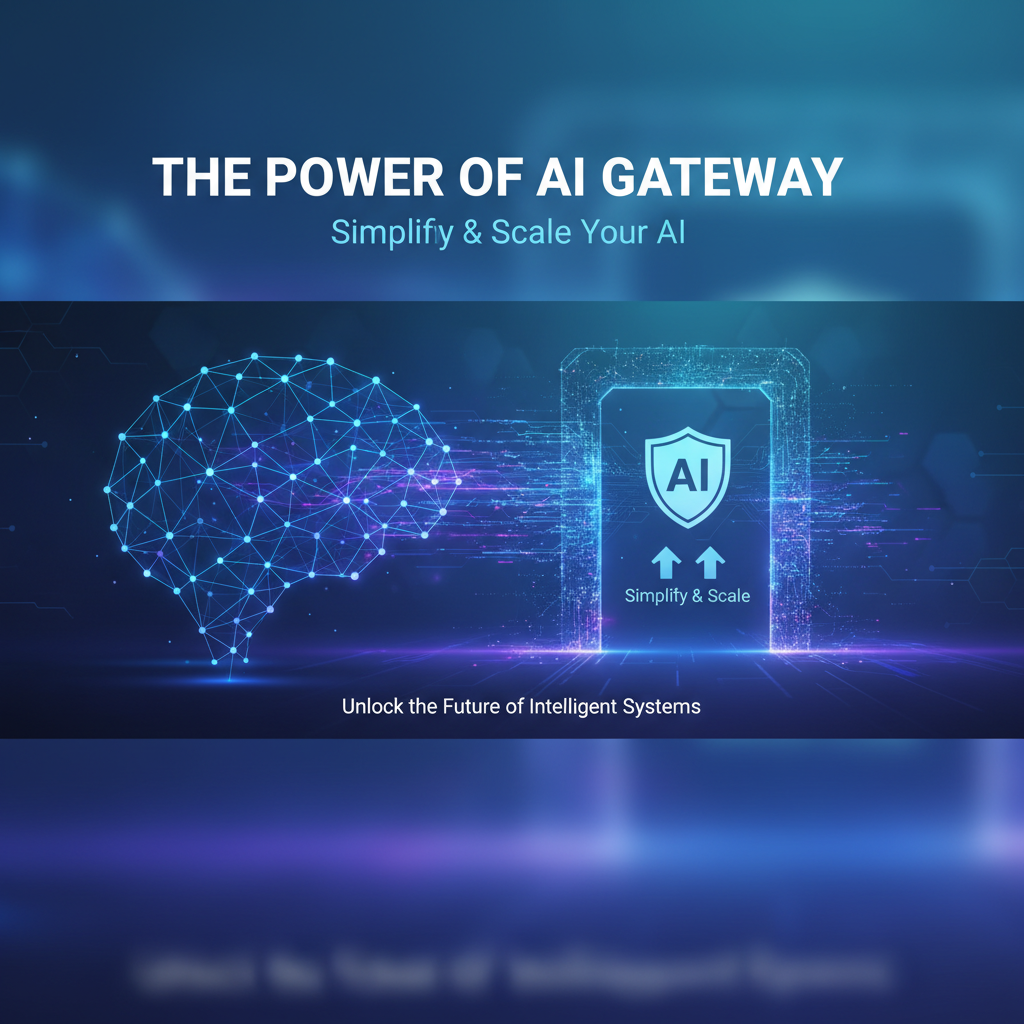


The digital landscape is in the throes of a profound transformation, spearheaded by the unprecedented advancements in Artificial Intelligence. From sophisticated recommendation engines and intelligent automation to the revolutionary capabilities of Generative AI and Large Language Models (LLMs), AI is rapidly becoming the bedrock of modern applications and enterprise strategies. However, as organizations increasingly integrate diverse AI models into their operations, a new wave of complexity emerges. The sheer variety of models, providers, APIs, security protocols, and performance requirements presents a formidable challenge that can hinder innovation and significantly escalate operational overhead. It is within this intricate environment that the concept of an AI Gateway rises as an indispensable solution, poised to simplify and scale the deployment and management of AI, unlocking its full transformative potential.
This comprehensive exploration will delve into the multifaceted power of an AI Gateway, dissecting its core functionalities, unparalleled benefits, and its pivotal role in navigating the intricate world of AI integration. We will examine how an AI Gateway, often built upon the robust foundations of an api gateway, evolves to specifically address the unique demands of AI models, including specialized variants like the LLM Gateway. By acting as a centralized, intelligent intermediary, an AI Gateway promises to abstract away complexity, bolster security, optimize performance, and provide invaluable insights, thereby empowering businesses to harness AI with unprecedented efficiency and agility.
Understanding the Core Concept: What is an AI Gateway?
At its heart, an AI Gateway is a sophisticated piece of infrastructure that acts as a unified entry point for all AI-related interactions within an ecosystem. Imagine a central control tower for all your artificial intelligence models, regardless of their origin, type, or underlying technology. This gateway orchestrates requests, manages responses, and applies a layer of intelligent policies and optimizations tailored specifically for AI workloads. While it shares conceptual similarities with a traditional api gateway – handling traffic, security, and routing for various backend services – an AI Gateway extends these capabilities with AI-specific intelligence and features.
A traditional api gateway primarily focuses on managing HTTP/RESTful APIs, routing requests to appropriate microservices, enforcing security policies like authentication and authorization, and handling concerns such as rate limiting, caching, and monitoring. It acts as a reverse proxy, insulating backend services from direct client exposure. This foundation is crucial, but insufficient for the dynamic and often idiosyncratic nature of AI models.
An AI Gateway, in contrast, is designed to understand the unique characteristics of AI interactions. It comprehends the nuances of prompt engineering for LLMs, the token-based pricing models of various providers, the varying input/output formats across different machine learning frameworks, and the need for dynamic routing based on model performance, cost, or specific task requirements. It provides a standardized interface that abstracts away the underlying complexities of integrating with a multitude of AI models, whether they are hosted on-premises, in a cloud provider’s ecosystem (like OpenAI, Google AI, AWS Bedrock, etc.), or through open-source deployments. This abstraction is a game-changer, allowing developers to consume AI capabilities without needing to deeply understand the unique API specifications and operational intricacies of each individual model.
Furthermore, a specialized variant, the LLM Gateway, focuses specifically on Large Language Models, which have become a cornerstone of generative AI applications. LLMs, with their unique needs for prompt management, context windows, token limits, and often complex invocation patterns, benefit immensely from a gateway designed to standardize these interactions. An LLM Gateway can manage prompt templates, enforce content filters, handle model fallback strategies, and optimize for the specific cost structures associated with token usage, making the integration of diverse LLMs seamless and cost-effective.
In essence, an AI Gateway is not just about routing traffic; it's about intelligent traffic management, security enforcement, performance optimization, and comprehensive governance specifically engineered for the unique demands of artificial intelligence, ultimately providing a powerful mechanism to simplify and scale your AI initiatives across the enterprise.
The Evolution of AI Integration Challenges
The journey towards widespread AI adoption has been punctuated by a series of persistent challenges, many of which amplify in complexity as the number and diversity of integrated AI models grow. Understanding these hurdles is critical to appreciating the transformative value an AI Gateway brings to the table.
1. Diversity of AI Models and Providers
The AI ecosystem is incredibly fragmented and dynamic. Developers and businesses are faced with a dizzying array of choices: * Proprietary Models: Giants like OpenAI's GPT series, Google's Gemini, Anthropic's Claude, each with their own unique strengths, weaknesses, and, critically, their own proprietary APIs and rate limits. * Open-Source Models: An explosion of models like Llama, Mistral, Falcon, often deployable on-premises or via various cloud platforms, offering flexibility but demanding more infrastructure management. * Domain-Specific Models: AI models tailored for specific tasks such as sentiment analysis, image recognition, fraud detection, or natural language processing, each potentially coming from different vendors or developed in-house. * Multi-Modal AI: The emergence of models that can process and generate across different data types—text, image, audio, video—adds another layer of integration complexity, requiring interfaces that can handle diverse data payloads.
Integrating just one or two of these models might be manageable, but as applications grow to leverage a portfolio of AI capabilities, the task of managing these disparate integrations becomes exponentially harder. Each model often necessitates a distinct set of SDKs, authentication mechanisms, and data serialization formats, leading to bloated codebases and significant developer overhead.
2. API Inconsistencies and Protocol Variations
Perhaps one of the most immediate pain points is the lack of standardization across AI APIs. Every AI service provider or model endpoint tends to have its own unique API specification: * Request Data Formats: One model might expect JSON with specific keys and nested structures, while another might require different fields, or even a different protocol entirely (e.g., gRPC instead of REST). * Authentication Methods: API keys, OAuth tokens, specific HTTP headers, service accounts – the variety of authentication schemes means developers must implement bespoke logic for each AI service. * Response Structures: Even for similar tasks, the output format can vary wildly, requiring significant post-processing to normalize data for consumption by the application. * Error Handling: Different providers return different error codes and messages, making unified error handling a complex endeavor.
This fragmentation means that changing an underlying AI model, or even updating to a new version from the same provider, can necessitate substantial refactoring in the application layer, delaying deployments and increasing maintenance costs. For instance, if a business decides to switch from one LLM provider to another due to cost, performance, or ethical considerations, without an abstraction layer, the application code that interacts with the LLM would likely need significant modifications.
3. Cost Management and Optimization
AI consumption, particularly with LLMs, can be notoriously difficult to budget and control without proper oversight. Pricing models are diverse and often complex: * Token-Based Pricing: Most LLMs charge per input and output token, which can fluctuate wildly depending on prompt length, model verbosity, and conversational context. * Per-Request/Per-Image Pricing: Other models might charge per API call or per unit of processing (e.g., image generation). * Tiered Pricing and Discounts: Different providers offer various pricing tiers, commitment discounts, or region-specific pricing, making it hard to compare costs directly. * Lack of Visibility: Without a centralized mechanism, tracking consumption across multiple teams, projects, and AI providers becomes a monumental accounting challenge. This lack of granular visibility can lead to unexpected cost overruns and inefficient resource allocation. Understanding exactly which applications or users are consuming which models, and at what cost, is often elusive.
4. Security and Access Control
Exposing AI models directly to client applications or microservices introduces significant security vulnerabilities: * API Key Management: Directly embedding API keys in client-side code or even in backend services without robust management practices is a major security risk. Leaked keys can lead to unauthorized access and substantial financial losses. * Authorization and Permissions: Ensuring that only authorized users or services can access specific AI models or perform certain operations is crucial. Implementing granular access control across a distributed ecosystem of AI services is complex. * Data Privacy and Compliance: Many AI models process sensitive data. Ensuring compliance with regulations like GDPR, HIPAA, or CCPA requires careful management of data ingress and egress, including anonymization or masking strategies. * Prompt Injection and Adversarial Attacks: LLMs are particularly susceptible to prompt injection attacks where malicious users try to manipulate the model's behavior. Direct exposure without protective layers increases this risk. * Rate Limiting and Abuse Prevention: Without centralized rate limiting, a single application component or malicious actor could exhaust quotas or overwhelm AI endpoints, leading to service degradation or excessive costs.
5. Performance and Scalability
As AI integration scales, performance becomes paramount. Ensuring low latency, high throughput, and reliable service is challenging: * Variable Latency: Different AI models or providers can have wildly different response times, impacting user experience. * Concurrency Management: Handling a large volume of concurrent requests to multiple AI services without overwhelming them or introducing bottlenecks requires sophisticated load balancing and request queuing. * Resource Provisioning: For self-hosted models, scaling infrastructure up and down dynamically to meet fluctuating demand can be complex and expensive. * Caching: Many AI inferences are repetitive. Without a caching layer, identical requests are sent repeatedly, wasting resources and increasing latency. * Network Overhead: Direct calls to geographically distant AI endpoints can introduce significant network latency.
6. Prompt Engineering and Model Versioning
The art and science of "prompt engineering" is critical for extracting optimal results from LLMs. Managing prompts is an evolving challenge: * Prompt Proliferation: Different teams or applications might develop their own prompt variations for the same task, leading to inconsistency and difficulty in optimization. * Version Control: As models are updated or new prompt strategies emerge, managing versions of prompts and ensuring that applications use the correct ones becomes complex. * A/B Testing Prompts: Experimenting with different prompts to find the most effective ones requires robust testing and deployment mechanisms. * Model Lifecycle: AI models are not static; they are continuously updated, retrained, or replaced. Managing these changes without breaking dependent applications is a significant operational challenge. A new model version might introduce subtle behavior changes or entirely new API contracts.
7. Observability and Monitoring
Understanding the health, performance, and usage patterns of AI services is vital for troubleshooting, optimization, and strategic planning. However, this is often lacking in a fragmented AI environment: * Fragmented Logging: Logs are scattered across multiple AI providers and internal services, making it difficult to get a holistic view of AI interactions. * Lack of Unified Metrics: Performance metrics like latency, error rates, and throughput are inconsistent across different AI services, hindering comparative analysis. * Tracing Complex AI Workflows: For multi-step AI processes or chained model calls, tracing the full execution path and identifying bottlenecks is incredibly difficult without specialized tools. * Audit Trails: Ensuring comprehensive audit trails for regulatory compliance and accountability of AI decisions is a complex undertaking.
These formidable challenges underscore the critical need for a centralized, intelligent solution that can abstract, secure, optimize, and manage the entire AI interaction lifecycle. An AI Gateway is precisely that solution, designed to turn these integration complexities into manageable, scalable, and secure operations.
Key Benefits of Implementing an AI Gateway
The strategic adoption of an AI Gateway addresses the aforementioned challenges head-on, delivering a multitude of benefits that collectively simplify the integration, enhance the security, optimize the performance, and streamline the management of AI models across an enterprise.
1. Simplification of Integration through Abstraction
One of the most profound advantages of an AI Gateway is its ability to create a unified and standardized interface for diverse AI models. Instead of developers needing to learn the unique API specifications, authentication methods, and data formats of each individual AI provider or open-source model, they interact with a single, consistent API exposed by the gateway. * Unified API Interface: The gateway translates incoming requests from your applications into the specific format required by the target AI model and then normalizes the model's response back into a consistent format for your application. This significantly reduces development effort, as application code can remain largely unchanged even if the underlying AI model or provider is swapped. * Reduced Boilerplate Code: Developers no longer need to write custom integration logic, error handling, or authentication mechanisms for each AI service. The gateway handles these cross-cutting concerns, allowing developers to focus on core business logic. * Faster Time-to-Market: By abstracting complexity, teams can integrate new AI capabilities into their applications much faster, accelerating product development and innovation cycles. This agility is crucial in the fast-evolving AI landscape. * Future-Proofing: Applications become decoupled from specific AI vendors. If a superior or more cost-effective model emerges, swapping the backend AI service within the gateway configuration is far simpler than re-architecting application code.
2. Enhanced Security Posture
Security is paramount when dealing with AI, especially with sensitive data or mission-critical applications. An AI Gateway acts as a formidable security enforcement point, centralizing and strengthening your organization's defenses. * Centralized Authentication and Authorization: The gateway can enforce robust authentication mechanisms (e.g., OAuth2, JWT, API Keys) and granular authorization policies (e.g., Role-Based Access Control - RBAC, Attribute-Based Access Control - ABAC) for all AI interactions. Instead of distributing credentials across multiple services, they are managed securely at the gateway level. * API Key Protection: Crucially, sensitive API keys for AI providers are stored and managed securely within the gateway, never directly exposed to client applications or less secure backend services. This minimizes the risk of credentials being compromised. * Rate Limiting and Throttling: Prevent abuse, protect against DDoS attacks, and control costs by setting limits on the number of requests clients can make within a given timeframe. This ensures fair usage and prevents a single entity from monopolizing AI resources. * Data Masking and Anonymization: For compliance with data privacy regulations (e.g., GDPR, HIPAA), the gateway can be configured to automatically mask, redact, or anonymize sensitive information in requests before forwarding them to AI models, and similarly for responses before sending them back to applications. * Threat Protection: Integration with Web Application Firewalls (WAFs) and other security tools allows the gateway to detect and block malicious requests, including common injection attacks, safeguarding AI models from exploitation. * Prompt Injection Prevention: For LLMs, an AI Gateway can implement specific rules or even integrate with specialized models to detect and mitigate prompt injection attempts, protecting the integrity and intended behavior of the language model.
3. Optimized Performance and Scalability
An AI Gateway is engineered for high performance and scalability, ensuring that AI services can meet demand efficiently and reliably. * Intelligent Routing and Load Balancing: The gateway can dynamically route requests to the most appropriate AI model or instance based on various criteria: * Cost-effectiveness: Route to the cheapest available model that meets quality requirements. * Latency: Direct traffic to the fastest responding model or geographically closest endpoint. * Availability: Route away from unhealthy or overloaded instances. * Specific Features: Direct requests to models best suited for a particular task (e.g., one LLM for creative writing, another for factual summarization). * Caching Mechanisms: Repeated AI inferences can be expensive and time-consuming. The gateway can cache responses to identical or similar requests, serving them directly from the cache to drastically reduce latency and operational costs for common queries. * Request Queuing and Throttling: During peak loads, the gateway can queue requests or gracefully throttle them, preventing backend AI services from being overwhelmed and ensuring consistent service quality. * Connection Pooling: Efficiently manages and reuses connections to backend AI services, reducing overhead and improving resource utilization. * Horizontal Scalability: AI Gateways are typically designed for horizontal scaling, allowing them to handle massive volumes of traffic by simply adding more instances of the gateway, ensuring robust performance even under extreme demand. APIPark, for instance, boasts performance rivaling Nginx, capable of achieving over 20,000 transactions per second (TPS) with modest resources, and supports cluster deployment to handle large-scale traffic.
4. Granular Cost Management and Tracking
Controlling and optimizing AI spend is a critical business concern. An AI Gateway provides the visibility and control needed to manage costs effectively. * Centralized Usage Monitoring: Track every AI API call, including which model was used, by whom, at what time, and crucially, the associated cost (e.g., number of tokens consumed for LLMs). * Budgeting and Quotas: Set budget limits or usage quotas for specific teams, projects, or individual users. The gateway can trigger alerts when thresholds are approached or exceeded, or even block further requests. * Cost Allocation: Attribute AI costs back to specific departments, applications, or user groups, providing clear accountability and enabling accurate chargebacks. * Provider Comparison and Optimization: With centralized data, it becomes easier to compare the actual cost-performance ratio of different AI providers or models and make data-driven decisions about which models to prioritize for various tasks. * Preventive Maintenance: By analyzing historical call data, the gateway can display long-term trends and performance changes, helping businesses with preventive maintenance and cost optimization before issues occur. This robust data analysis is a key feature of platforms like APIPark.
5. Improved Observability and Analytics
Understanding what's happening within your AI ecosystem is vital for operational excellence, troubleshooting, and continuous improvement. An AI Gateway offers a single pane of glass for comprehensive observability. * Comprehensive Logging: The gateway captures detailed logs for every AI interaction, including request payloads, responses, latency, errors, authentication details, and more. This central repository of logs simplifies troubleshooting and provides a robust audit trail. APIPark specifically offers detailed API call logging, recording every aspect of each interaction, which is invaluable for debugging and security. * Unified Metrics and Monitoring: Collects standardized metrics (e.g., request count, error rates, average latency, token usage) across all integrated AI models, regardless of their source. This allows for consistent monitoring and alerts. * Distributed Tracing: Integrate with tracing systems to provide end-to-end visibility into complex AI workflows, identifying bottlenecks and dependencies across multiple services and AI calls. * Advanced Analytics and Reporting: Transform raw log and metric data into actionable insights, providing dashboards for performance trends, cost analysis, usage patterns, and anomaly detection. This powerful data analysis capability helps businesses make informed decisions and proactively manage their AI infrastructure.
6. Agility and Flexibility in Model Selection
The AI landscape is rapidly evolving, with new, more powerful, or more cost-effective models emerging constantly. An AI Gateway provides the agility to adapt quickly. * Seamless Model Swapping: The abstraction layer allows developers to switch between different AI models or providers (e.g., from GPT-4 to Gemini, or from an external sentiment analysis service to an in-house model) without modifying the application code. This is invaluable for cost optimization, performance tuning, and leveraging the latest AI innovations. * A/B Testing of Models: Easily route a percentage of traffic to a new model or model version to test its performance, quality, and cost-effectiveness in a live environment before a full rollout. * Model Fallback Strategies: Configure the gateway to automatically failover to a different, pre-defined AI model if the primary model becomes unavailable, unresponsive, or exceeds its rate limits, ensuring continuous service availability.
7. Streamlined Prompt Management and Versioning (Especially for LLMs)
For LLM-centric applications, prompt engineering is a critical discipline. An AI Gateway elevates prompt management to an enterprise-grade capability. * Centralized Prompt Repository: Store, version, and manage all prompts within the gateway, ensuring consistency and reusability across different applications and teams. * Prompt Templating: Define dynamic prompts with placeholders, allowing applications to inject specific data without needing to construct the full prompt themselves. This simplifies development and reduces errors. * Prompt Orchestration: For complex tasks, the gateway can orchestrate multiple AI calls, potentially using different models, in a sequence, managing the context and flow between them. * A/B Testing for Prompts: Similar to model A/B testing, experiment with different prompt variations to optimize output quality, relevance, or adherence to specific guidelines. * Prompt Encapsulation into REST API: Solutions like APIPark allow users to quickly combine AI models with custom prompts to create new, specialized APIs (e.g., a sentiment analysis API, a translation API, or a data analysis API), making these sophisticated AI functions easily consumable by any application.
8. End-to-End API Lifecycle Management
Beyond just AI, many modern AI Gateway solutions provide comprehensive API management capabilities that extend to traditional REST services as well. * Design, Publish, Invoke, Decommission: The gateway assists with managing the entire lifecycle of APIs, from initial design and publication to invocation and eventual decommissioning. This helps regulate API management processes and ensures governance. APIPark excels in this area, helping regulate API management processes, manage traffic forwarding, load balancing, and versioning of published APIs, effectively turning complex AI capabilities into discoverable and manageable API services. * API Service Sharing and Collaboration: Facilitate the centralized display of all API services, making it easy for different departments and teams to find, subscribe to, and use required API services. This fosters collaboration and prevents duplication of effort. APIPark enables API service sharing within teams, and with its multi-tenancy support, allows for independent API and access permissions for each tenant, improving resource utilization while maintaining strict isolation. * Subscription and Approval Workflows: For controlled access, the gateway can activate subscription approval features, ensuring that callers must subscribe to an API and await administrator approval before they can invoke it, preventing unauthorized API calls and potential data breaches. This is a crucial security and governance feature offered by platforms like APIPark.
By delivering these profound benefits, an AI Gateway transforms the challenging landscape of AI integration into a streamlined, secure, and scalable operation, empowering organizations to fully realize the strategic value of artificial intelligence.
Deep Dive into AI Gateway Features and Capabilities
To fully appreciate the power of an AI Gateway, it's essential to dissect its rich array of features, many of which extend beyond the capabilities of a traditional api gateway to specifically cater to the intricacies of AI workloads.
1. Unified API Abstraction Layer
The cornerstone of any effective AI Gateway is its ability to provide a single, consistent interface to a multitude of disparate AI models. This abstraction layer performs crucial transformations: * Request Normalization: It takes a standardized request from the client application (e.g., a generic JSON payload for a "text_completion" task) and translates it into the specific request format required by the target AI provider (e.g., model="gpt-4", messages=[{"role": "user", "content": "..."}] for OpenAI, or model_id="gemini-pro", contents=[{"parts": [{"text": "..."}]}] for Google Gemini). * Response Unification: Conversely, it parses the unique response format from the AI model and converts it into a consistent, predictable structure for the client application. This might involve extracting the generated text, identifying metadata, or standardizing error messages. * Parameter Mapping: It intelligently maps generic parameters (e.g., temperature, max_tokens) to the specific names and ranges used by each underlying AI model. * Model Agnosticism: This layer ensures that application code does not need to change even if the underlying AI model is swapped, offering true vendor lock-in avoidance. As mentioned in the APIPark product overview, it unifies the request data format across all AI models, ensuring that changes in AI models or prompts do not affect the application or microservices, thereby simplifying AI usage and maintenance costs. This is a critical feature for long-term scalability and flexibility.
2. Intelligent Routing and Load Balancing
Beyond simple round-robin or least-connection routing, an AI Gateway employs advanced, AI-aware routing logic: * Cost-Based Routing: Route requests to the AI model that offers the lowest cost for a given task, considering token prices, request charges, and any active discounts. * Latency-Based Routing: Direct traffic to the model or provider endpoint that consistently delivers the lowest response times, crucial for real-time applications. * Performance-Based Routing: Monitor the quality of responses (e.g., accuracy, relevance) from different models and dynamically route requests to the best-performing one for specific use cases. * Capability-Based Routing: Route requests to models based on their unique strengths (e.g., one LLM for creative text generation, another for factual summarization, or a specialized model for code generation). * Geographic Routing: Direct requests to AI models deployed in data centers closest to the user or application to minimize network latency. * Weighted Routing: Distribute traffic across multiple models based on predefined weights, useful for gradual rollouts or A/B testing. * Health Checks: Continuously monitor the health and availability of all integrated AI endpoints, automatically routing traffic away from unhealthy instances.
3. Advanced Security Mechanisms
An AI Gateway elevates security far beyond basic API key management: * Robust Authentication: Support for industry-standard authentication protocols such as OAuth2, JSON Web Tokens (JWT), client certificates, and traditional API keys, often with secure vault integration for storing credentials. * Granular Authorization: Implement fine-grained access control policies based on user roles (RBAC), attributes (ABAC), or even specific API paths and HTTP methods. This means certain users or applications might only be authorized to use specific AI models or perform certain types of inferences. * Rate Limiting and Throttling: Enforce sophisticated rate limits at various levels (per user, per API key, per IP address, per application) to prevent abuse, ensure fair usage, and protect against denial-of-service attacks. Throttling can also be configured to gracefully degrade service during peak loads instead of outright blocking requests. * Web Application Firewall (WAF) Integration: Integrate with WAFs to detect and mitigate common web vulnerabilities and attacks, protecting the gateway and upstream AI services. * DDoS Protection: Advanced gateways can leverage cloud-native DDoS protection services or implement their own mechanisms to safeguard against volumetric attacks. * Data Masking and Redaction: Automatically identify and mask sensitive data (e.g., PII, financial information) in both incoming requests and outgoing responses. This is critical for data privacy compliance and reducing the exposure of sensitive data to third-party AI models. * Content Filtering and Moderation: Before forwarding prompts to LLMs, the gateway can run them through content moderation models (either its own or another AI service) to filter out harmful, inappropriate, or malicious inputs. Similarly, it can scan model outputs. * Subscription Approval Workflows: For managed access, the gateway can require callers to subscribe to an API, with requests pending administrator approval before actual invocation is permitted. This feature, offered by APIPark, adds an extra layer of governance and prevents unauthorized API calls and potential data breaches.
4. Caching Strategies
Optimizing performance and reducing costs often hinges on intelligent caching: * Response Caching: Store the results of AI inferences for a specified duration. If an identical request comes in, the cached response is served instantly, reducing latency and avoiding redundant calls to expensive AI models. This is particularly effective for frequently asked questions or common data analysis tasks. * Semantic Caching (Advanced): For LLMs, this can involve caching not just exact matches, but semantically similar queries. Using embedding models, the gateway can determine if a new prompt is conceptually similar enough to a previously answered one to serve a cached response, even if the wording is slightly different. * Cache Invalidation Policies: Implement policies to invalidate cached entries based on time-to-live (TTL), specific events, or changes in underlying data, ensuring freshness.
5. Observability Stack
A robust AI Gateway provides a comprehensive suite of tools for monitoring, logging, and tracing AI interactions: * Comprehensive Logging: Capture detailed logs for every API call, including request/response payloads, headers, latency, status codes, errors, authentication details, and the specific AI model/provider used. This unified logging is essential for debugging, auditing, and compliance. APIPark provides this with its detailed API call logging, ensuring businesses can quickly trace and troubleshoot issues, maintaining system stability and data security. * Metrics and Monitoring: Collect and expose key performance indicators (KPIs) such as requests per second (RPS), average latency, error rates, cache hit ratios, token usage, and cost per request. These metrics are typically integrated with popular monitoring systems (e.g., Prometheus, Datadog). * Distributed Tracing: Generate and propagate trace IDs across AI calls, allowing developers to visualize the entire request flow through multiple services and AI models. This helps pinpoint performance bottlenecks and understand complex AI workflows. * Alerting: Configure alerts based on predefined thresholds for metrics (e.g., high error rates, increased latency, budget overruns), proactively notifying operators of potential issues. * Powerful Data Analysis: Leveraging historical call data, the gateway can generate powerful analytics to display long-term trends, performance changes, and usage patterns. This helps businesses with predictive insights and preventive maintenance. This is a core strength of APIPark, enabling informed decision-making.
6. Cost Management Features
Beyond basic tracking, an AI Gateway empowers proactive cost control: * Usage Quotas: Define and enforce quotas based on the number of requests, tokens, or CPU/GPU usage per user, team, or application over a specific period. * Budget Alerts: Configure alerts to notify stakeholders when spending approaches or exceeds predefined budget limits for specific AI services or projects. * Cost Allocation Tags: Automatically apply tags to AI usage data, facilitating accurate cost allocation to specific departments, projects, or business units. * "Least Cost" Routing: As mentioned in Intelligent Routing, this feature directly contributes to cost savings by always selecting the most economical option. * API Cost Simulation: Some advanced gateways can simulate the cost of a prompt or a series of calls before execution, providing real-time cost estimates.
7. Prompt Management and Orchestration (LLM Gateway Specific)
For LLMs, these features are paramount: * Centralized Prompt Store: A repository for managing and versioning prompts. This ensures consistency, reusability, and facilitates collaboration among prompt engineers and developers. * Prompt Templating and Variables: Allow for dynamic prompt construction using variables that can be filled in by the application at runtime. This prevents hardcoding prompts and makes them more flexible. * Prompt Chaining and Orchestration: For complex multi-turn conversations or multi-step reasoning tasks, the gateway can manage the sequence of prompts, model calls, and intermediate context. For example, it can send an initial prompt, get a response, process it, and then formulate a follow-up prompt to another model. * A/B Testing Prompts: Easily test different prompt variations to optimize for specific outcomes (e.g., better accuracy, more creative output, lower token count). The gateway can split traffic between different prompt versions and collect metrics on their performance. * Prompt Encapsulation into REST API: A powerful feature exemplified by APIPark, allowing users to combine specific AI models with custom prompts and expose them as new, highly specialized REST APIs. For instance, a complex prompt for "summarize this article and extract key entities" can be encapsulated into a simple /summarize-and-extract API endpoint, making advanced AI functions readily consumable.
8. Model Management and Discovery
An AI Gateway also serves as a central hub for managing the entire AI model catalog: * Integration of 100+ AI Models: Platforms like APIPark boast the capability to quickly integrate a vast array of AI models from various providers and open-source projects, offering a unified management system for authentication and cost tracking across all of them. This is a crucial enabler for enterprises adopting a multi-model strategy. * Model Cataloging: Maintain a comprehensive catalog of all integrated AI models, their versions, capabilities, pricing, and status. * Model Versioning: Manage different versions of the same AI model, allowing applications to specify which version they want to use and facilitating seamless upgrades or rollbacks. * Model Discovery: Provide mechanisms for developers to discover available AI models and their associated capabilities, often through a developer portal.
9. API Lifecycle Management
Extending beyond just AI, many modern api gateway solutions, including AI-specific ones, offer robust lifecycle management for all APIs: * Design and Documentation: Tools for designing APIs (e.g., OpenAPI/Swagger) and generating comprehensive documentation, often through a developer portal. * Publication and Versioning: Facilitate the structured publication of APIs, managing different versions, and ensuring backward compatibility. APIPark assists with managing the entire lifecycle, including traffic forwarding, load balancing, and versioning of published APIs. * Testing and Validation: Integrate with testing frameworks to ensure API functionality and performance. * Decommissioning: Provide a graceful process for deprecating and retiring old APIs without impacting dependent applications.
10. Multi-tenancy and Team Collaboration
For larger organizations, an AI Gateway must support complex organizational structures: * Independent Teams/Tenants: Allow for the creation of multiple independent teams or tenants, each with their own applications, data, user configurations, and security policies. This is crucial for large enterprises, service providers, or companies with distinct business units. APIPark enables this with its support for independent API and access permissions for each tenant, while sharing underlying infrastructure to improve resource utilization and reduce operational costs. * API Service Sharing within Teams: The platform allows for the centralized display of all API services, making it easy for different departments and teams to find and use the required API services. This fosters internal collaboration and reduces redundant development efforts.
These comprehensive features transform an AI Gateway from a simple proxy into an intelligent orchestration and management layer, essential for deriving maximum value from AI investments.
AI Gateway vs. Traditional API Gateway: A Comparative Perspective
While an AI Gateway inherently builds upon the principles of a traditional api gateway, its specialized focus on artificial intelligence introduces crucial distinctions that warrant a comparative analysis. Understanding these differences is key to appreciating why a generic API Gateway often falls short for complex AI workloads.
Similarities: The Shared Foundation
Both traditional API Gateways and AI Gateways serve as intermediary layers between clients and backend services, sharing several fundamental responsibilities:
- Centralized Entry Point: Both provide a single, unified entry point for clients, abstracting the complexity of underlying services.
- Traffic Management: Both handle request routing, load balancing, and potentially traffic shaping to distribute requests efficiently across backend instances.
- Security Enforcement: Both are critical control points for authentication (API keys, OAuth, JWT), authorization, rate limiting, and basic threat protection.
- Monitoring and Logging: Both capture request/response logs and metrics (latency, errors, throughput) to provide observability into API traffic.
- Caching: Both can implement caching strategies to improve performance and reduce load on backend services.
- Protocol Translation: Both can translate between different protocols (e.g., HTTP/1.1 to HTTP/2, REST to gRPC).
These shared capabilities highlight that an AI Gateway is often an evolution or specialization of a robust api gateway framework, rather than an entirely separate entity.
Key Differences: The AI-Specific Evolution
The divergence arises from the unique characteristics and operational requirements of AI models, particularly LLMs.
| Feature Area | Traditional API Gateway (e.g., Nginx, Kong, Apigee) | AI Gateway / LLM Gateway (e.g., APIPark, custom LLM proxies) |
|---|---|---|
| Payload Understanding | Treats payloads as opaque data (JSON, XML, binary). Focuses on routing based on HTTP headers, paths. | Deep understanding of AI-specific payloads (prompts, tokens, model IDs, parameters like temperature/top_k, image data). Parses content for semantic meaning or toxicity. |
| AI-Specific Optimizations | Generic caching, load balancing (e.g., round-robin). | Intelligent, AI-aware caching: Semantic caching, prompt result caching. Intelligent Routing: Based on model cost, latency, quality, capability. Token-aware processing. |
| Model Abstraction | Routes to specific microservices/APIs as defined. Limited abstraction of diverse service interfaces. | Core Function: Provides a unified API for any underlying AI model (OpenAI, Gemini, custom, open-source). Abstracts different APIs, data formats. |
| Prompt Management | Not applicable. | Crucial Feature: Centralized prompt repository, templating, versioning, A/B testing of prompts, prompt chaining, prompt encapsulation into REST APIs. |
| Cost Metrics & Management | Tracks requests, bandwidth. Cost usually per API call or server resources. | Granular AI Cost Tracking: Tracks token usage, cost per inference, cost per model. Implements budget alerts, cost allocation specific to AI consumption. |
| Security Enhancements | Authentication, authorization, rate limiting, WAF for HTTP traffic. | All traditional features PLUS: Prompt Injection Protection: Specific mitigation for LLMs. Content Moderation: Filtering inputs/outputs for harmful content. Data Masking (AI-specific): Redacting PII in AI prompts/responses. |
| Model Lifecycle & Discovery | Focus on traditional API lifecycle. | Manages integration of diverse AI models (100+ AI models like APIPark), model versioning, capabilities catalog, A/B testing models. |
| Performance Metrics | Standard HTTP metrics (latency, throughput). | All standard metrics PLUS: AI-specific metrics: Token count (input/output), inference time, model-specific error codes. AI-aware health checks. |
| Error Handling | Generic HTTP error codes. | Translates diverse AI provider error codes into standardized, actionable messages. |
| Scalability Focus | Scaling backend services generally. | Scaling access to potentially external, rate-limited AI services; optimizing calls to external providers. |
The "LLM Gateway" as a Specialized Type
The explosion of Large Language Models (LLMs) has led to the emergence of highly specialized AI Gateways, often referred to as LLM Gateway solutions. These gateways fine-tune their capabilities to the specific demands of LLMs: * Token Management: Deep understanding of tokens for pricing, context window management, and input/output length limits. * Prompt Engineering Orchestration: Centralized management of prompt templates, few-shot examples, and system messages. * Context Window Management: Intelligent handling of conversational history to keep responses relevant while staying within model token limits. * Guardrails for Generative AI: Specific features to prevent harmful outputs, ensure factual consistency (where applicable), and enforce brand voice or safety guidelines. * Model Fallback Strategies: Automatically switching between LLMs if one fails, is too expensive, or performs poorly for a specific query.
In summary, while a traditional api gateway provides the foundational infrastructure for managing API traffic, an AI Gateway, and its specialized counterpart the LLM Gateway, augment this foundation with AI-specific intelligence, optimizations, and management capabilities. It’s the difference between a general-purpose highway system and a dedicated, intelligent transport network designed specifically for a complex, high-value cargo like AI. Ignoring these distinctions can lead to significant operational challenges, security vulnerabilities, and missed opportunities in the rapidly evolving AI landscape.
Implementing an AI Gateway: Considerations and Best Practices
Successfully deploying and leveraging an AI Gateway requires careful planning, strategic decision-making, and adherence to best practices. This ensures that the gateway not only addresses immediate integration challenges but also provides a scalable and secure foundation for future AI initiatives.
1. Vendor Selection: Open-Source vs. Proprietary
The first critical decision involves choosing the right AI Gateway solution, which often boils down to open-source versus commercial offerings.
- Open-Source Solutions (e.g., APIPark, custom proxies built on Nginx/Envoy):
- Advantages:
- Transparency: Full access to the source code allows for deep customization, auditing, and understanding of internal workings.
- Cost-Effectiveness: Often free to use, significantly reducing initial licensing costs.
- Community-Driven Innovation: Benefits from contributions and feedback from a global developer community.
- No Vendor Lock-in (Code): While still dependent on the project, the code itself is available, reducing lock-in concerns.
- Flexibility: Can be adapted to specific enterprise requirements. APIPark, being open-sourced under the Apache 2.0 license, embodies these advantages, providing an excellent starting point for many organizations.
- Disadvantages:
- Support: Typically relies on community support, which may not be as immediate or comprehensive as commercial offerings. Requires in-house expertise.
- Feature Gaps: May lack some advanced features found in proprietary solutions (e.g., very sophisticated analytics, enterprise-grade UI).
- Maintenance Overhead: Organizations are responsible for hosting, maintenance, and patching.
- Advantages:
- Proprietary/Commercial Solutions:
- Advantages:
- Professional Support: Guaranteed SLAs, dedicated support teams, and faster bug fixes.
- Rich Feature Set: Often come with comprehensive UIs, advanced analytics, integrations, and enterprise-grade features out-of-the-box.
- Ease of Use: May offer more user-friendly interfaces and guided setup processes.
- Compliance: Often built with enterprise security and regulatory compliance in mind.
- Managed Services: Some vendors offer managed gateway services, reducing operational burden.
- While APIPark is open-source, it also offers a commercial version with advanced features and professional technical support for leading enterprises, providing a path for organizations whose needs evolve beyond the open-source offering.
- Disadvantages:
- Licensing Costs: Can be significant, especially at scale.
- Vendor Lock-in: Dependence on a single vendor for features, updates, and support.
- Less Customization: Limited ability to modify core functionality.
- Advantages:
When selecting, consider your organization's budget, in-house technical capabilities, regulatory requirements, and the scale of your AI operations.
2. Deployment Strategies: On-Premises, Cloud-Native, or Hybrid
The chosen deployment model will impact operational costs, scalability, and security posture. * On-Premises Deployment: * Control: Maximum control over data, infrastructure, and security. * Compliance: Easier to meet strict regulatory requirements for data residency and privacy. * Latency: Can offer lower latency if AI models and applications are co-located. * Overhead: Requires significant investment in hardware, maintenance, and operational staff. * Use Case: Best for organizations with stringent security needs, existing on-prem infrastructure, or highly sensitive data. * Cloud-Native Deployment: * Scalability: Leverages cloud elasticity for automatic scaling up and down based on demand. * Managed Services: Can use cloud-provider managed services for databases, load balancers, etc., reducing operational burden. * Cost Efficiency: Pay-as-you-go model, potentially reducing upfront costs. * Accessibility: Easier global accessibility. * Use Case: Ideal for rapid deployment, elastic workloads, and organizations already heavily invested in cloud infrastructure. APIPark is designed for quick deployment, easily set up in just 5 minutes with a single command line (curl -sSO https://download.apipark.com/install/quick-start.sh; bash quick-start.sh), making it highly adaptable for cloud-native environments. * Hybrid Deployment: * Flexibility: Combines the benefits of both, often running sensitive AI models or gateways on-premises while leveraging cloud for less sensitive or burstable workloads. * Gradual Migration: Allows for a phased transition to the cloud. * Complexity: Inherently more complex to manage and secure due to distributed nature. * Use Case: For enterprises with existing on-premises investments seeking to gradually adopt cloud AI services.
3. Scalability Requirements: Planning for High TPS
AI workloads can be highly variable, from infrequent batch processing to real-time, high-volume inference. * Anticipate Peak Loads: Design the gateway infrastructure to handle anticipated peak traffic. Consider the number of concurrent users, applications, and the typical requests per second (RPS) or transactions per second (TPS). * Horizontal Scalability: Ensure the chosen gateway solution supports horizontal scaling (adding more instances of the gateway) to distribute load effectively. Solutions like APIPark are built with this in mind, with its performance capabilities and support for cluster deployment designed to handle large-scale traffic. * Resource Allocation: Provision adequate CPU, memory, and network resources. AI Gateways performing complex transformations, caching, or data masking can be resource-intensive. * Auto-Scaling: Leverage cloud auto-scaling features or container orchestration platforms (like Kubernetes) to automatically adjust gateway instances based on demand.
4. Security Audits and Compliance
Security must be a continuous process, not a one-time setup. * Regular Audits: Conduct regular security audits and penetration testing of the AI Gateway and its configurations. * Compliance Frameworks: Ensure the gateway's security features and operational practices align with relevant industry standards and regulatory frameworks (e.g., GDPR, HIPAA, ISO 27001). * Least Privilege: Configure access permissions with the principle of least privilege, granting only the necessary permissions to users and services. * Secure Configuration: Implement secure configuration best practices, such as disabling unnecessary services, strong password policies, and network segmentation.
5. Integration with Existing Infrastructure
The AI Gateway should not operate in a vacuum; it needs to integrate seamlessly with your broader IT ecosystem. * Observability Tools: Integrate gateway logs, metrics, and traces with your existing monitoring, logging, and tracing (MLT) stack (e.g., ELK stack, Splunk, Datadog, Prometheus/Grafana). This provides a unified view of your entire application landscape. * Identity and Access Management (IAM): Integrate with your corporate IAM system (e.g., Okta, Azure AD, Keycloak) for centralized user authentication and authorization. * CI/CD Pipelines: Automate the deployment, configuration, and testing of the AI Gateway as part of your Continuous Integration/Continuous Delivery pipelines. * API Developer Portal: If your organization already uses a developer portal, ensure the AI Gateway can publish its APIs there for easy discovery and consumption by internal and external developers.
6. Gradual Adoption and Phased Rollout
Implementing an AI Gateway can be a significant architectural change. A phased approach minimizes risk. * Start Small: Begin by routing a limited number of AI-powered applications or a subset of requests through the gateway. * Monitor and Optimize: Closely monitor performance, security, and cost metrics. Iterate on configurations and policies. * Expand Gradually: Once confidence is built, progressively route more AI workloads through the gateway, leveraging its full capabilities. * A/B Testing: Use the gateway's routing capabilities to A/B test new models, prompts, or configurations with a small percentage of live traffic before a full rollout.
By thoughtfully considering these aspects and adhering to best practices, organizations can ensure their AI Gateway implementation is robust, secure, scalable, and ultimately, a powerful enabler for their AI strategy.
The Role of Open-Source in AI Gateway Development
The open-source paradigm has played a pivotal role in democratizing technology and fostering rapid innovation, and its influence is particularly pronounced in the evolving landscape of AI infrastructure. AI Gateway development is a prime example of where open-source principles offer substantial advantages, empowering organizations to build flexible, transparent, and community-driven solutions.
Advantages of Open-Source AI Gateways
- Transparency and Auditability:
- With access to the full source code, organizations can meticulously audit the gateway's logic, security implementations, and data handling practices. This is invaluable for ensuring compliance with strict regulatory requirements (e.g., GDPR, HIPAA) and building trust in the system's integrity, especially when processing sensitive data through AI models.
- Developers can understand exactly how requests are processed, transformed, and routed, which aids significantly in debugging and performance tuning.
- Community-Driven Innovation and Rapid Development:
- Open-source projects benefit from the collective intelligence and contributions of a global developer community. This often leads to faster iteration cycles, quicker bug fixes, and the introduction of new features that address real-world challenges faced by diverse users.
- Feature requests and enhancements can be driven by a broader user base, ensuring the gateway evolves in line with industry needs and emerging AI technologies (e.g., new LLM providers, multi-modal AI).
- Cost-Effectiveness and Reduced Vendor Lock-in:
- The most immediate financial benefit is the absence of licensing fees for the core product. This significantly lowers the barrier to entry for startups, small and medium-sized enterprises (SMEs), and even large corporations looking to experiment or deploy at scale without prohibitive upfront costs.
- While operational costs (hosting, maintenance, staffing) still exist, the freedom from vendor-specific contracts provides greater flexibility. The ability to customize the code means organizations are not locked into a single vendor's product roadmap or pricing structure.
- Flexibility and Customization:
- Organizations can tailor the AI Gateway to their exact requirements, integrating it deeply with existing internal systems, adding proprietary features, or optimizing it for specific workloads. This level of customization is often impossible or prohibitively expensive with commercial off-the-shelf products.
- It allows for a truly "build vs. buy" decision, where the open-source base provides a strong foundation that can be extended rather than starting from scratch.
- Learning and Talent Development:
- Engaging with open-source projects provides excellent learning opportunities for development and operations teams. It exposes them to best practices, robust architectures, and current trends in API and AI management.
- It also aids in attracting and retaining top engineering talent who often prefer working with open and collaborative technologies.
An Exemplar: APIPark as an Open-Source AI Gateway
APIPark stands out as a compelling example of an open-source AI Gateway and API Management Platform that embodies these advantages. Launched by Eolink, a leader in API lifecycle governance, APIPark is open-sourced under the Apache 2.0 license, making it accessible and transparent.
APIPark directly addresses many of the challenges discussed earlier, leveraging its open-source nature to provide powerful capabilities: * Quick Integration of 100+ AI Models: Its open architecture likely facilitates rapid integration of new AI models as they emerge, driven by community contributions or direct extensions. * Unified API Format for AI Invocation: This core abstraction aligns perfectly with the need for simplified AI integration, a benefit inherently enhanced by its open design. * Prompt Encapsulation into REST API: This innovative feature, allowing users to combine AI models with custom prompts to create new APIs, showcases the flexibility often found in open-source solutions where complex logic can be exposed simply. * End-to-End API Lifecycle Management: While an AI Gateway, APIPark integrates comprehensive API management, demonstrating how open-source solutions can deliver broad feature sets. * API Service Sharing & Multi-tenancy: These features, critical for enterprise adoption, can be transparently implemented and audited within an open-source framework. * Performance Rivaling Nginx: Achieving over 20,000 TPS, APIPark demonstrates that open-source solutions can offer enterprise-grade performance, often leveraging highly optimized underlying components (like Nginx or Envoy). * Detailed API Call Logging & Powerful Data Analysis: Transparency in logging and robust analytics are crucial, and open-source provides the confidence that these features are implemented without hidden agendas.
For organizations starting their AI journey or seeking a highly customizable solution, APIPark offers a robust, flexible, and community-supported foundation. Its quick deployment in just 5 minutes underscores its practical usability. While the open-source product meets the basic API resource needs of startups, APIPark also offers a commercial version with advanced features and professional technical support for leading enterprises, providing a flexible pathway from open-source adoption to enterprise-grade solutions.
The open-source movement continues to be a driving force in the technological landscape, and its role in the development and adoption of AI Gateways is set to become even more critical as enterprises seek greater control, transparency, and flexibility in their AI infrastructure.
Real-World Use Cases and Impact
The theoretical benefits of an AI Gateway translate into tangible advantages and transformative impacts across a myriad of real-world scenarios, empowering businesses to deploy, manage, and scale their AI initiatives more effectively.
1. Enterprise AI Adoption and Democratization
For large enterprises, the challenge of adopting AI at scale is not just technical but also organizational. An AI Gateway acts as a catalyst for widespread AI adoption and democratization across departments. * Centralized AI Service Catalog: An AI Gateway creates a single, discoverable catalog of all available AI services, whether they are proprietary LLMs, specialized image recognition models, or custom-built internal models. This makes it easy for any team – from marketing to product development – to find and consume relevant AI capabilities without needing deep AI expertise. * Standardized Access: By providing a unified API, the gateway simplifies the onboarding process for new teams, reducing the learning curve and accelerating their ability to integrate AI into their applications. * Governance and Compliance: Large organizations often operate under strict regulatory frameworks. The gateway's centralized security, logging, and audit capabilities ensure that all AI interactions comply with data privacy laws (e.g., GDPR, CCPA) and internal governance policies. For example, sensitive customer data can be automatically masked before being sent to an external LLM, ensuring compliance. * Cost Control and Chargeback: With detailed usage and cost tracking per team or project, enterprises can accurately allocate AI expenses, fostering accountability and enabling internal chargeback models. This turns AI consumption into a manageable, transparent operational cost.
2. Accelerating AI-Powered Product Development
Product teams are constantly striving to embed more intelligence into their offerings. An AI Gateway significantly speeds up this process. * Rapid Prototyping: Developers can quickly experiment with different AI models or prompt strategies by simply changing a configuration in the gateway, rather than rewriting application code. This accelerates the prototyping phase for new AI features (e.g., trying out various LLMs for chatbot responses). * Vendor Agnosticism for Core AI Features: A product might initially use one LLM provider, but the AI Gateway allows the product team to switch to a more cost-effective or higher-performing alternative later without impacting the application's codebase. This provides a crucial competitive advantage in a rapidly evolving market. * Consistency Across Applications: For a suite of products, the gateway ensures that all applications using, for example, a sentiment analysis model, are using the same, well-managed version, providing consistent results and reducing maintenance effort. * Prompt-as-an-API: The ability to encapsulate complex prompts into simple REST APIs (as offered by APIPark) is invaluable. A product manager might define a "summarize meeting notes" API, which abstracts away the underlying LLM calls and prompt engineering, making it consumable by various internal tools or external applications.
3. Enhancing AI Research and Development / Experimentation
Data scientists and AI researchers often need to quickly iterate and test various models, prompts, and configurations. * A/B Testing Framework: The gateway provides an ideal platform for A/B testing different models, model versions, or prompt variations in a live production environment without disrupting users. For example, 10% of users might get responses from Model A with Prompt X, while 10% get Model B with Prompt Y, allowing for real-time performance and quality comparison. * Controlled Rollouts: New models or features can be rolled out gradually to a small subset of users, allowing researchers to gather feedback and fine-tune before a full deployment. * Reproducibility and Versioning: By centralizing prompts and model configurations, the gateway helps ensure the reproducibility of experiments and provides clear version control for AI assets. * Access to Diverse Models: Researchers can easily access and experiment with a wide array of AI models (e.g., integrating 100+ AI models like APIPark allows) from a single interface, fostering innovation and comparative analysis.
4. Cost Control in AI Workloads
One of the most immediate and quantifiable impacts of an AI Gateway is its ability to manage and optimize costs, particularly for expensive LLM interactions. * Real-world Scenario: Overcoming Unexpected LLM Costs: A startup integrates a popular LLM directly into their chatbot. Within weeks, their monthly bill skyrockets due to unforeseen token usage from long user conversations and verbose model responses. * Without AI Gateway: They face manual code changes, frantic re-optimization, and potential service interruption. * With AI Gateway: The gateway automatically detects high token usage, triggers alerts, and can be configured to: * Route high-volume, low-priority queries to a cheaper, smaller LLM. * Implement prompt truncation or response summarization to reduce token count. * Apply caching for common queries, eliminating redundant calls. * Enforce granular usage quotas per user or application to prevent runaway costs. * The outcome is a controlled budget, optimized resource allocation, and a proactive approach to cost management, leveraging the powerful data analysis features that platforms like APIPark offer to understand and predict spending.
5. Building Resilient and High-Performance AI Applications
Ensuring reliability and speed for AI-powered features is crucial for user experience and business continuity. * High Availability and Fault Tolerance: If a primary AI provider experiences an outage, the gateway can automatically failover to a secondary model or provider, maintaining uninterrupted service. This resilience is critical for mission-critical AI applications. * Improved User Experience: Caching frequently requested AI inferences and intelligently routing to low-latency models significantly reduces response times, leading to a smoother and more responsive user experience. * Load Management: The gateway prevents individual AI services from being overwhelmed during traffic spikes, ensuring stable performance across the board. For example, during a flash sale, the AI-powered recommendation engine can still function optimally because the gateway is managing and distributing the load efficiently.
In essence, an AI Gateway moves AI from being a collection of disparate, complex, and potentially costly integrations to a unified, manageable, and highly strategic asset. It allows businesses to not only consume AI but to truly govern, optimize, and scale it, transforming potential liabilities into powerful capabilities that drive innovation and competitive advantage.
The Future of AI Gateways: Trends and Innovations
The rapid evolution of AI, particularly in generative models and multi-modal capabilities, ensures that AI Gateways will continue to evolve, incorporating new functionalities and addressing emerging challenges. The future landscape of AI Gateways promises even greater intelligence, security, and adaptability.
1. Adaptive Intelligence and Self-Optimization
Future AI Gateways will become increasingly intelligent, learning from real-time operational data to self-optimize: * Dynamic Routing Optimization: Beyond predefined rules, gateways will leverage machine learning models to dynamically route requests based on real-time factors like provider load, cost fluctuations, detected model performance drift, and even specific user context. For instance, an LLM Gateway might learn that a particular prompt category performs better with Model A during peak hours but is cheaper and equally effective with Model B off-peak. * Predictive Scaling: Integrating with AI Observability platforms, gateways will predict impending traffic surges or model bottlenecks and proactively scale resources or adjust routing strategies to maintain optimal performance. * Automated Policy Generation: AI Gateways could suggest or even automatically generate new security policies, rate limits, or caching rules based on observed traffic patterns and identified vulnerabilities.
2. Enhanced Security for Generative AI
As AI models become more powerful and widely used, the attack surface expands, necessitating more sophisticated security measures specifically for generative AI: * Advanced Prompt Injection Prevention: Moving beyond rule-based detection, future AI Gateways will use AI itself (e.g., smaller, specialized LLMs or adversarial networks) to detect and neutralize increasingly subtle and sophisticated prompt injection attacks. * Output Guardrails and Alignment Enforcement: Gateways will play a critical role in ensuring that LLM outputs adhere to brand guidelines, ethical principles, and safety regulations. This includes real-time detection of factual inaccuracies, harmful content, or hallucinated information before it reaches the end-user. * Data Lineage and Explainability (XAI): As AI systems become more complex, gateways will need to provide better tools for tracking data lineage through AI pipelines and offering insights into why a particular AI model or prompt generated a specific output, supporting XAI initiatives. * Homomorphic Encryption and Federated Learning Integration: For highly sensitive data, gateways might integrate with cryptographic techniques like homomorphic encryption, allowing AI models to process encrypted data without decrypting it, or facilitate secure federated learning across distributed datasets.
3. Multi-Modal AI Orchestration
The shift towards AI that understands and generates across text, image, audio, and video will require gateways to evolve beyond text-centric processing: * Unified Multi-Modal API: A single gateway API capable of accepting diverse input modalities and orchestrating calls to various specialized multi-modal AI models (e.g., sending text to one model, generating an image, and then sending the image to another for analysis). * Cross-Modal Data Transformation: The gateway will perform necessary transformations between modalities, such as converting text descriptions into image prompts, or extracting text from audio transcripts before sending to an LLM. * Complex Workflow Orchestration: Managing intricate sequences of multi-modal AI calls, handling context across different data types, and ensuring synchronized processing will become a core capability.
4. Edge AI Integration and Decentralization
The deployment of AI models closer to the data source (on-device or edge servers) will necessitate new gateway functionalities: * Hybrid Cloud-Edge Management: AI Gateways will manage a distributed fleet of AI models, seamlessly routing requests to either cloud-based or edge-deployed models based on latency requirements, data residency, and computational cost. * Edge Data Filtering and Pre-processing: Gateways at the edge will perform initial data filtering, aggregation, and pre-processing before sending relevant (and potentially anonymized) data to more powerful cloud AI models, reducing bandwidth and improving privacy. * Local Model Orchestration: For scenarios where multiple small AI models run on a single edge device, the gateway could orchestrate their interactions and resource usage.
5. Governance, Compliance, and Ethical AI
As AI becomes more ingrained in society, regulatory scrutiny and ethical considerations will intensify: * Automated Policy Enforcement: Gateways will automate the enforcement of complex ethical AI policies, such as bias detection in model outputs, fairness metrics, and transparency requirements. * AI Explainability (XAI) Hooks: Providing standardized hooks for integrating XAI tools that can explain model decisions, particularly for high-stakes applications. * Regulatory Reporting: Generating comprehensive audit trails and reports required by emerging AI regulations, proving compliance with data handling, fairness, and safety standards. * Blockchain Integration for Trust: Potentially leveraging blockchain for immutable logging of AI interactions, model provenance, and consent management, enhancing trust and transparency in AI systems.
6. Integration with AI Observability (AIOps for AI) Platforms
The future will see tighter integration between AI Gateways and broader AI Observability platforms that provide end-to-end visibility into the AI lifecycle: * Unified AI Health Dashboard: A single pane of glass showing the health, performance, and cost of all AI models, prompts, and interactions managed by the gateway and beyond. * Anomaly Detection in AI Outputs: AI-powered anomaly detection within the gateway's data streams to identify unusual model behavior, performance degradation, or security incidents that might indicate an attack or model drift. * Automated Remediation: Beyond alerts, the gateway, in conjunction with AIOps tools, might automatically trigger remediation actions, such as rolling back a problematic model version or rerouting traffic.
The future of AI Gateways is one of increasing sophistication, intelligence, and integration. They will not merely be traffic managers but strategic orchestrators of an increasingly complex and critical AI ecosystem, ensuring that organizations can confidently and responsibly harness the full potential of artificial intelligence.
Conclusion: Unlocking the Full Potential of AI
The advent of artificial intelligence, particularly the transformative capabilities of Generative AI and Large Language Models, heralds a new era of innovation and efficiency across every sector. Yet, the journey to fully harness this power is fraught with complexities: the daunting diversity of models, inconsistent APIs, spiraling costs, pervasive security risks, and the persistent challenge of scaling and managing a rapidly evolving AI landscape. Without a robust and intelligent intermediary, organizations risk drowning in integration debt, stifling innovation, and undermining the very promise of AI.
This is precisely where the AI Gateway emerges as an indispensable architectural cornerstone. As we have thoroughly explored, an AI Gateway, built upon the mature foundations of an api gateway but specialized with AI-aware intelligence, serves as the critical abstraction layer that simplifies the intricate world of AI integration. It acts as a unified control plane, abstracting away the idiosyncrasies of myriad AI models and providers, including the nuances of an LLM Gateway for language models.
The benefits are profound and far-reaching: * Simplification: Developers interact with a consistent, standardized API, dramatically accelerating development and reducing maintenance overhead. * Enhanced Security: Centralized authentication, authorization, rate limiting, and AI-specific threat protection (like prompt injection prevention) safeguard valuable data and models. * Optimized Performance: Intelligent routing, caching, and load balancing ensure low latency, high throughput, and resilient AI services even under peak demand. * Granular Cost Control: Comprehensive tracking, budgeting, and cost allocation provide unprecedented visibility and control over AI expenditures. * Improved Observability: Unified logging, metrics, and powerful data analytics offer deep insights into AI usage, performance, and potential issues. * Agility and Flexibility: Organizations can seamlessly swap models, A/B test prompts, and adapt to the dynamic AI landscape without code changes, fostering continuous innovation.
Products like APIPark exemplify how an open-source AI Gateway and API Management Platform can bring these sophisticated capabilities to organizations, offering quick integration of diverse AI models, unified API formats, prompt encapsulation, and robust lifecycle management with enterprise-grade performance and detailed observability.
In a world where AI is no longer a luxury but a strategic imperative, the AI Gateway is not merely a piece of infrastructure; it is the enabler of efficiency, the guardian of security, and the engine of scalability. By embracing the power of an AI Gateway, businesses can confidently navigate the complexities of modern AI, unlock the full potential of their intelligent applications, and accelerate their journey towards a truly AI-powered future.
Frequently Asked Questions (FAQ)
1. What is the fundamental difference between an AI Gateway and a traditional API Gateway? While both serve as intermediaries for API traffic, an AI Gateway is specifically designed with AI-aware intelligence. A traditional api gateway treats data payloads as opaque; an AI Gateway understands AI-specific payloads (like prompts, tokens, model IDs). It offers AI-specific optimizations such as intelligent routing based on model cost or performance, prompt management, token-based cost tracking, and specialized security (e.g., prompt injection prevention). It provides a unified abstraction layer for diverse AI models, unlike a traditional gateway which routes to specific, predefined services.
2. Why is an AI Gateway particularly important for Large Language Models (LLMs)? LLMs introduce unique complexities. An LLM Gateway specializes in these, offering: * Prompt Management: Centralized storage, versioning, and templating of prompts to ensure consistency and facilitate experimentation. * Token-Based Cost Tracking: LLMs are primarily priced per token, and the gateway tracks this granularly for cost optimization. * Model Fallback: Automatically switching to a different LLM if the primary one is unavailable, too slow, or exceeds rate limits. * Content Moderation & Guardrails: Implementing specific checks for harmful or inappropriate content in both input prompts and model outputs. * Unified Interface: Abstracting away the different API formats and parameters of various LLM providers (e.g., OpenAI, Google, Anthropic).
3. How does an AI Gateway help in managing AI costs? An AI Gateway provides granular visibility and control over AI spending by: * Centralized Usage Monitoring: Tracking every API call, including the model used, user, and associated cost (e.g., tokens consumed). * Budgeting and Quotas: Setting limits on usage for teams or projects, with alerts for approaching thresholds. * Intelligent Cost-Based Routing: Automatically directing requests to the most cost-effective AI model for a given task. * Caching: Reducing redundant calls to expensive AI models by serving cached responses. This proactive approach ensures better budget control and efficient resource allocation.
4. Can an AI Gateway integrate with both cloud-based and self-hosted AI models? Yes, a robust AI Gateway is designed for maximum flexibility. It can integrate with a wide array of AI models, whether they are hosted on cloud platforms (e.g., OpenAI, Google AI, AWS Bedrock, Azure AI), deployed on-premises, or running on specialized hardware at the edge. The core function of the gateway is to provide a unified access layer regardless of the underlying model's deployment location, simplifying integration for developers.
5. How does a product like APIPark fit into the AI Gateway ecosystem? APIPark is an open-source AI gateway and API management platform that embodies many of the advanced features discussed. It acts as an intelligent intermediary, helping developers and enterprises manage, integrate, and deploy AI and REST services with ease. Key features like its quick integration of 100+ AI models, unified API format, prompt encapsulation into REST APIs, and detailed API call logging, position it as a comprehensive solution to simplify and scale AI adoption. Its open-source nature provides transparency and flexibility, while its commercial version offers enhanced support for larger enterprises.
🚀You can securely and efficiently call the OpenAI API on APIPark in just two steps:
Step 1: Deploy the APIPark AI gateway in 5 minutes.
APIPark is developed based on Golang, offering strong product performance and low development and maintenance costs. You can deploy APIPark with a single command line.
curl -sSO https://download.apipark.com/install/quick-start.sh; bash quick-start.sh

In my experience, you can see the successful deployment interface within 5 to 10 minutes. Then, you can log in to APIPark using your account.

Step 2: Call the OpenAI API.