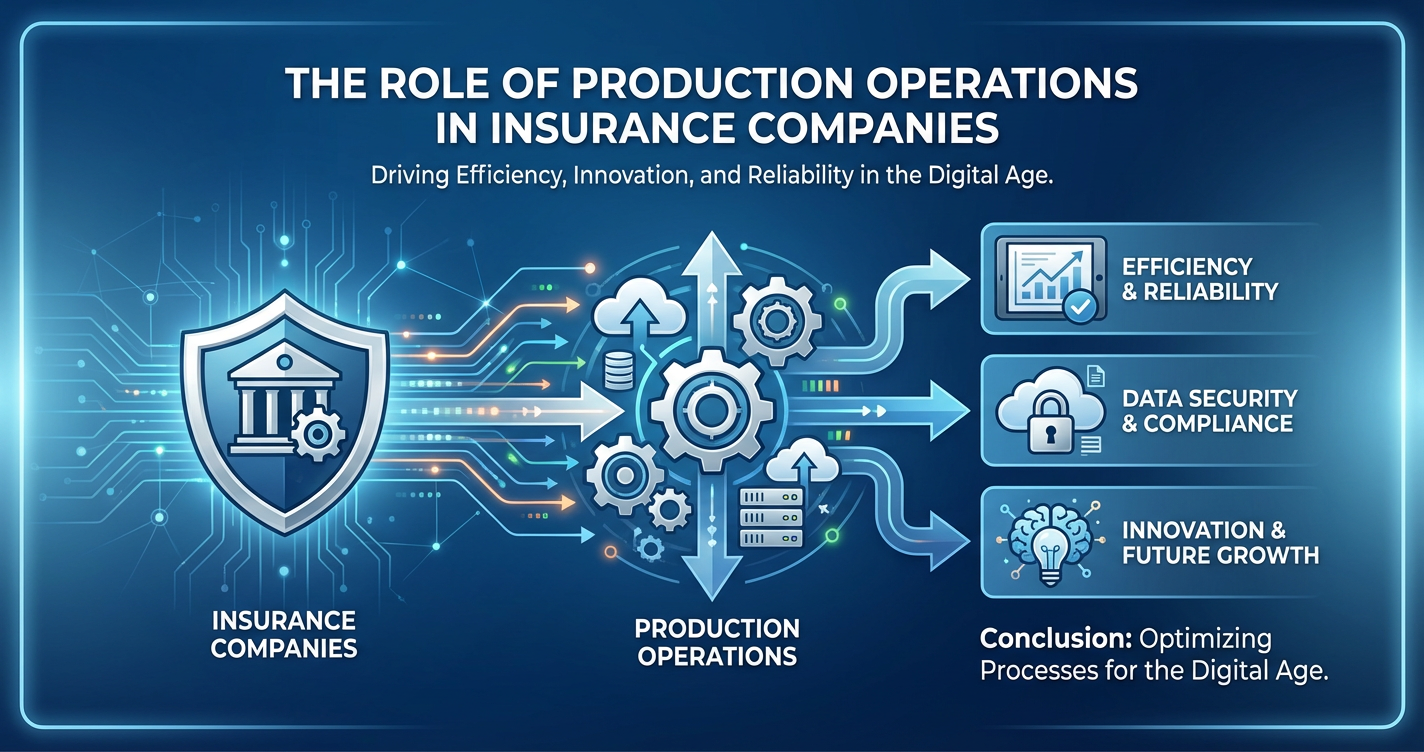
The Role of Production Operations in Insurance Companies


The insurance industry, a cornerstone of economic stability and individual well-being, operates on the intricate balance of risk assessment, financial prudence, and robust operational execution. At the heart of this complex ecosystem lies production operations, a multifaceted domain that encompasses the entire lifecycle of an insurance policy, from initial inquiry and underwriting to claims processing and ongoing policy administration. Far from being a mere back-office function, production operations are the lifeblood of an insurance company, directly influencing its efficiency, profitability, customer satisfaction, and regulatory compliance. In an era defined by rapid technological advancements, evolving customer expectations, and heightened competitive pressures, the role of production operations has transcended traditional paradigms, becoming a strategic imperative for sustained success.
This comprehensive exploration delves deep into the critical role of production operations in insurance companies, dissecting its core components, highlighting the pervasive challenges it faces, and illuminating the transformative power of modern technologies and strategic approaches. We will examine how a meticulously managed production operations framework not only streamlines internal processes but also crafts superior customer experiences, mitigates risks, and fosters innovation, ultimately shaping the insurer's competitive advantage in a dynamic global market.
The Foundational Pillars of Insurance Production Operations
Production operations in insurance are fundamentally about translating the promise of protection into tangible reality for policyholders. This involves a series of interconnected, sequential, and often parallel processes, each critical to the overall operational integrity and service delivery. Understanding these pillars is essential to grasp the breadth and depth of the function.
Underwriting: The Art and Science of Risk Assessment
Underwriting is arguably the most critical pillar of insurance production operations, serving as the gateway to policy issuance and the primary mechanism for managing an insurer's risk portfolio. This meticulous process involves evaluating applications, assessing potential risks, and determining the terms, conditions, and pricing of an insurance policy. It is a sophisticated blend of actuarial science, statistical analysis, market intelligence, and seasoned judgment.
In a traditional setup, underwriting could be a lengthy, manual process, heavily reliant on human underwriters sifting through paper applications, medical records, financial statements, and other documentation. The underwriter's expertise was paramount in discerning subtle risk factors and making informed decisions that directly impacted the company's profitability. However, the modern underwriting landscape has been dramatically transformed by technology. Today, data analytics, predictive modeling, and artificial intelligence play an increasingly central role. Underwriters now leverage vast datasets, including public records, credit scores, telematics data (for auto insurance), sensor data (for property insurance), and even behavioral analytics, to gain a more granular understanding of risk. This technological augmentation not only accelerates the underwriting process but also enhances accuracy, reduces adverse selection, and allows for more personalized pricing, aligning premiums more closely with individual risk profiles. The integration of external data sources often relies on robust API (Application Programming Interface) integrations, allowing insurers to pull real-time information securely and efficiently from third-party providers, government databases, and specialized data aggregators. This real-time data access, managed and secured by an API gateway, is pivotal for quick, data-driven underwriting decisions.
The goal of underwriting is twofold: to ensure that accepted risks are accurately priced to generate profit for the insurer, and to maintain a diversified and balanced portfolio that can withstand unforeseen losses. A misstep in underwriting can lead to either excessive losses or an inability to attract sufficient policyholders due to uncompetitive pricing. Therefore, optimizing this process through advanced analytics and efficient data flow is a continuous strategic objective within production operations.
Claims Processing: Fulfilling the Promise
For policyholders, the moment of truth for their insurance coverage arrives during the claims process. This pillar of production operations is where the insurer’s promise of financial protection is tangibly delivered. An efficient, empathetic, and transparent claims process is paramount for customer satisfaction, brand reputation, and retention.
The claims lifecycle typically begins with the First Notice of Loss (FNOL), where a policyholder reports an incident. This initial interaction is critical; prompt and clear communication sets the tone for the entire experience. Subsequent steps involve investigation, assessment of damages or losses, verification of coverage, negotiation (if necessary), and ultimately, settlement. Traditionally, claims processing has been a labor-intensive activity, involving adjusters visiting sites, reviewing documents, communicating with various parties (medical providers, repair shops, legal counsel), and manually calculating payouts. This often led to extended processing times, frustrating policyholders and increasing operational costs.
Modern claims operations have undergone significant transformation. Digital portals and mobile applications now allow policyholders to submit claims, upload evidence (photos, videos, documents), and track their claim status in real-time. Automation, particularly through Robotic Process Automation (RPA) and AI, is being deployed to handle routine tasks such as data entry, document validation, and even initial damage assessments using image recognition. For instance, AI algorithms can analyze photographs of damaged vehicles or properties to estimate repair costs, significantly accelerating the assessment phase. Furthermore, sophisticated fraud detection systems, powered by machine learning, analyze claims data patterns to flag suspicious activities, protecting the insurer from significant financial losses.
The efficiency of claims processing is not just about speed; it's also about accuracy and fairness. Technology, coupled with skilled claims professionals, ensures that policyholders receive the compensation they are entitled to, promptly and equitably. An insurer's ability to seamlessly integrate various data sources, communicate effectively across internal departments and with external vendors, and automate decision-making processes, often hinges on well-managed API integrations and a robust API gateway infrastructure that secures and orchestrates these interactions.
Policy Administration: The Ongoing Relationship Management
Beyond the initial sale and potential claim, policy administration forms the continuous backbone of the insurer-policyholder relationship. This pillar of production operations encompasses all activities related to managing a policy from its inception through its entire lifecycle, including renewals, endorsements, cancellations, premium billing, and customer data management.
Effective policy administration ensures that policy information is accurate, up-to-date, and accessible. This is crucial for maintaining compliance with regulatory requirements, providing consistent customer service, and enabling effective cross-selling and up-selling opportunities. In legacy systems, policy administration was often fragmented across multiple, disparate systems, leading to data silos, inconsistencies, and manual reconciliation efforts. This not only increased operational costs but also hindered the ability to provide a unified view of the customer, making personalized service challenging.
Contemporary policy administration systems are integrated platforms designed to centralize policy data, automate routine administrative tasks, and provide a comprehensive customer profile. These systems support automated billing and payment processing, digital policy document delivery, self-service portals for policyholders to make changes or request documents, and streamlined renewal processes. The ability to seamlessly modify policy details, update beneficiary information, or adjust coverage levels with minimal human intervention significantly enhances operational efficiency and customer satisfaction. The robust exchange of data between the policy administration system, CRM, billing systems, and external partners necessitates a well-designed API strategy, with an API gateway acting as the central control point for secure and reliable data flow. This integration ensures that any change made in one system is instantly reflected across all relevant platforms, maintaining data integrity and accuracy.
Customer Service and Support: The Human Touch in a Digital World
While technology drives efficiency, the human element in customer service remains indispensable within production operations. This pillar focuses on directly interacting with policyholders, agents, and other stakeholders to address inquiries, resolve issues, and provide support throughout their insurance journey.
Modern customer service is multi-channel, offering policyholders a choice of interaction points: phone, email, chat, social media, and self-service portals. The challenge for insurers is to provide a consistent, high-quality experience across all these channels. This requires sophisticated CRM systems that consolidate customer interaction history, policy details, and claim status, enabling service representatives to have a complete view of the customer at their fingertips.
The role of technology here extends beyond mere data access. AI-powered chatbots and virtual assistants are increasingly used to handle routine queries, provide instant answers to FAQs, and guide policyholders through self-service options, freeing up human agents to focus on more complex or sensitive issues. This blended approach – technology for efficiency and human empathy for critical interactions – is crucial for managing customer expectations in a digital age. Personalization, driven by data analytics, allows insurers to proactively reach out to customers with relevant information, offers, or support, transforming reactive service into proactive engagement. The underlying infrastructure supporting these multi-channel interactions often involves a complex network of internal and external services, all orchestrated and secured by an API gateway, ensuring seamless communication and data exchange across various touchpoints.
The Operational Ecosystem: People, Process, and Technology
The success of production operations in insurance is not solely dependent on technology; it is a holistic endeavor driven by the synergy of skilled people, optimized processes, and advanced technological infrastructure. Each component plays a vital role in creating an efficient, resilient, and customer-centric operational framework.
Human Capital: The Engine of Operations
Despite the pervasive advancements in automation and AI, people remain the most valuable asset in insurance production operations. Expert underwriters, empathetic claims adjusters, meticulous policy administrators, and skilled customer service representatives are indispensable. Their judgment, problem-solving abilities, and interpersonal skills are crucial for handling complex cases, building trust, and navigating the nuances of human interaction that technology cannot fully replicate.
The evolving landscape, however, necessitates a shift in skill sets. Manual, repetitive tasks are increasingly automated, prompting a need for employees to develop analytical capabilities, digital literacy, and adaptive problem-solving skills. Training and development programs are essential to upskill and reskill the workforce, ensuring they can effectively leverage new technologies, interpret data insights, and focus on higher-value activities that require critical thinking and empathy. Change management initiatives are also paramount to ensure a smooth transition and foster a culture of continuous learning and innovation.
Process Optimization: The Blueprint for Efficiency
Well-defined and optimized processes are the foundational blueprint for efficient production operations. This involves mapping out workflows, identifying bottlenecks, eliminating redundancies, and standardizing procedures to ensure consistency, quality, and speed. Methodologies such as Lean Six Sigma and Agile are increasingly adopted to streamline operations, reduce waste, and foster a culture of continuous improvement.
Process optimization extends to every facet of production operations, from the intake of a new policy application to the final settlement of a claim. It involves: * Workflow Automation: Digitizing manual steps, routing tasks automatically, and setting up triggers for subsequent actions. * Standardization: Establishing uniform procedures for routine tasks to ensure consistency and reduce errors. * Exception Handling: Designing clear protocols for addressing non-standard situations or complex cases that require human intervention. * Performance Monitoring: Continuously tracking process metrics to identify areas for improvement and ensure adherence to Service Level Agreements (SLAs).
Effective process design, coupled with robust execution, ensures that operational tasks are performed efficiently, costs are managed, and service quality remains high.
Technological Infrastructure: The Digital Nervous System
The technological infrastructure is the digital nervous system that underpins all production operations. This includes a vast array of systems and platforms, each contributing to the overall operational capability.
- Core Systems: These are the bedrock applications, including Policy Administration Systems (PAS), Claims Management Systems (CMS), and Customer Relationship Management (CRM) systems. Modern core systems are often modular, cloud-native, and designed for scalability and flexibility, moving away from monolithic legacy architectures.
- Data Management and Analytics Platforms: These systems are responsible for collecting, storing, processing, and analyzing the massive volumes of data generated across all operational functions. They enable insurers to extract insights for risk assessment, fraud detection, customer segmentation, and performance monitoring.
- Digital Transformation Enablers: This category includes technologies like cloud computing for scalable infrastructure, Artificial Intelligence (AI) and Machine Learning (ML) for advanced analytics and automation, Robotic Process Automation (RPA) for task automation, and most importantly, APIs for system integration.
APIs are the unsung heroes of modern insurance operations. They enable different software applications to communicate and exchange data seamlessly. In a complex operational ecosystem with numerous internal systems (PAS, CMS, CRM, accounting) and external integrations (data providers, third-party adjusters, distribution partners), APIs are indispensable for creating a cohesive and agile environment. For instance, an API can allow an agent's front-end system to instantly query a backend underwriting engine for a quote, or permit a claims system to pull medical records from a healthcare provider.
To manage the burgeoning number of APIs, secure their access, monitor their performance, and control their usage, an API gateway becomes an absolutely critical piece of infrastructure. An API gateway acts as a single entry point for all API calls, handling authentication, authorization, traffic management, rate limiting, caching, and analytics. It shields backend services from direct exposure, enhancing security and providing a centralized control plane for all API interactions. Without a robust API gateway, managing a complex web of integrations would be chaotic, insecure, and prone to performance bottlenecks, directly impacting the efficiency and reliability of production operations.
Key Challenges and Strategic Responses in Production Operations
Insurance production operations, while foundational, are fraught with unique challenges that require strategic foresight and adaptive responses.
Legacy Systems Integration: The Modernization Dilemma
Many established insurance companies still grapple with decades-old legacy IT systems. These systems, often built on outdated architectures and programming languages, are rigid, expensive to maintain, and notoriously difficult to integrate with modern technologies. The challenge lies in migrating away from or integrating with these systems without disrupting critical business operations.
Strategic Response: Insurers are adopting a multi-pronged approach: * "Lift and Shift" to Cloud: Moving legacy applications to cloud environments to improve scalability and reduce infrastructure costs. * Wrap and Extend: Using APIs to create a modern interface around legacy systems, allowing them to communicate with new applications without a full rip-and-replace. This is where a robust API gateway is invaluable, acting as the translator and orchestrator between old and new. * Phased Modernization: Gradually replacing components of legacy systems with modern, modular alternatives, often in a microservices architecture, reducing the risk of a big-bang transformation.
Regulatory Compliance: Navigating a Shifting Landscape
The insurance industry is one of the most heavily regulated sectors, subject to a myriad of local, national, and international laws concerning data privacy (e.g., GDPR, CCPA), consumer protection, financial solvency, and market conduct. Production operations must ensure unwavering compliance across all processes, from data collection and storage to claims handling and reporting. Non-compliance can result in hefty fines, reputational damage, and loss of operating licenses.
Strategic Response: * Governance Frameworks: Establishing robust internal controls, policies, and audit trails. * Automated Compliance Checks: Integrating compliance rules directly into operational workflows and systems, using AI to monitor for potential violations. * Data Lineage and Auditability: Ensuring that all data movements and decisions are traceable and auditable, often facilitated by detailed logging capabilities within systems like an API gateway. * Continuous Monitoring: Employing RegTech (Regulatory Technology) solutions to keep abreast of evolving regulations and ensure real-time adherence.
Fraud Detection and Prevention: Protecting the Bottom Line
Insurance fraud, ranging from exaggerated claims to elaborate schemes, costs the industry billions annually. Detecting and preventing fraud is a continuous battle, requiring sophisticated tools and vigilant processes within production operations.
Strategic Response: * Advanced Analytics and AI/ML: Leveraging machine learning algorithms to analyze vast datasets, identify suspicious patterns, anomalies, and networks of fraudulent activity in real-time. This can be applied across underwriting (identifying misrepresentations) and claims (flagging suspicious claims). * Data Sharing and Collaboration: Participating in industry-wide fraud databases and collaborating with law enforcement agencies (where permissible). * Integrated Systems: Ensuring that all claims-related data, from FNOL to payment, is captured and analyzed centrally, often facilitated by a comprehensive API gateway managing data flows from various sources.
Customer Expectations: The Demand for Digital and Personalization
Modern customers, accustomed to seamless digital experiences in other sectors (retail, banking), now demand similar speed, transparency, and personalization from their insurers. They expect instant quotes, easy online claim submissions, real-time status updates, and personalized communication.
Strategic Response: * Digital Channels: Investing in intuitive web portals, mobile apps, and self-service options. * Personalization: Using data analytics to tailor products, communications, and service interactions to individual customer needs and preferences. * Omni-channel Experience: Ensuring a consistent and unified customer experience across all touchpoints, from digital to human interactions. The agility provided by APIs and the seamless integration managed by an API gateway are crucial here for a fluid customer journey. * Proactive Engagement: Leveraging insights to anticipate customer needs and offer proactive support or relevant policy adjustments.
Cost Management & Operational Efficiency: Balancing Quality and Profitability
In a highly competitive market, insurers are under constant pressure to optimize operational costs while simultaneously improving service quality. Inefficiencies in production operations can directly erode profitability.
Strategic Response: * Automation: Extensive use of RPA and AI to automate repetitive, rule-based tasks, reducing manual effort and processing times. * Process Re-engineering: Redesigning workflows to eliminate waste, reduce cycle times, and improve throughput. * Cloud Adoption: Shifting infrastructure to the cloud to reduce capital expenditures, improve scalability, and convert fixed costs to variable costs. * Vendor Management: Optimizing relationships with third-party service providers (e.g., claims adjusters, repair networks) to ensure cost-effectiveness and quality.
Cybersecurity and Data Protection: Safeguarding Sensitive Information
Insurance companies handle vast amounts of sensitive personal and financial data. Protecting this data from cyber threats, breaches, and unauthorized access is not just a regulatory requirement but a fundamental trust imperative. A single data breach can have catastrophic consequences for an insurer's reputation and financial health.
Strategic Response: * Robust Security Frameworks: Implementing multi-layered security protocols, including encryption, multi-factor authentication, intrusion detection systems, and regular vulnerability assessments. * Employee Training: Educating staff on cybersecurity best practices and identifying phishing attempts. * API Security: Ensuring that all API endpoints, especially those exposed externally, are rigorously secured with strong authentication, authorization, and encryption. An API gateway plays a pivotal role here, acting as the first line of defense, enforcing security policies, and providing threat protection for all API traffic. * Incident Response Plans: Developing clear protocols for detecting, responding to, and recovering from cyber incidents.
Leveraging Advanced Technologies for Operational Excellence
The relentless march of technological innovation continues to reshape the landscape of insurance production operations, offering unprecedented opportunities for efficiency, accuracy, and customer engagement.
Artificial Intelligence and Machine Learning (AI/ML)
AI and ML are revolutionizing every aspect of insurance, moving beyond simple automation to enable intelligent decision-making and predictive capabilities.
- Intelligent Underwriting: ML models can analyze a myriad of data points—beyond what a human underwriter could process—to more accurately assess risk, detect inconsistencies in applications, and recommend personalized premiums. This includes leveraging external data sources such as social media, public records, and IoT data (e.g., smart home sensors for property insurance, telematics for auto insurance) to build more comprehensive risk profiles.
- Automated Claims Processing: AI is used for intelligent document processing (extracting information from claims forms, invoices, medical reports), image recognition (assessing vehicle damage from photos, evaluating property damage), and natural language processing (NLP) to understand customer inquiries in claims intake. AI also powers sophisticated fraud detection, identifying anomalies and suspicious patterns that human eyes might miss.
- Personalized Customer Service: Chatbots and virtual assistants, powered by NLP, provide instant responses to routine customer queries, guide policyholders through processes, and even offer personalized recommendations based on their profiles. This frees up human agents to focus on complex, high-value interactions.
- Predictive Analytics: AI models can predict policy lapse rates, anticipate customer churn, and identify cross-selling opportunities, allowing production operations to proactively manage policyholder relationships and optimize marketing efforts.
The integration of diverse AI models, often from different vendors or developed in-house, presents its own set of challenges. Each model might have different input/output formats, contextual assumptions, and confidence scores. To ensure seamless interaction and consistent interpretation of model outputs within complex operational workflows, a sophisticated mechanism is required. This is where the concept of a Model Context Protocol (MCP) becomes highly relevant. Imagine a scenario where one AI model evaluates a claim for fraud, another assesses damage severity, and a third predicts customer sentiment. An MCP would standardize how these models communicate their findings, including the confidence level of their predictions, the specific context in which their analysis was valid, and any underlying assumptions. This protocol would ensure that the insights from various AI models are consistently understood and appropriately acted upon by subsequent automated systems or human operators within the production operations pipeline, preventing misinterpretation and enabling robust, AI-driven decision-making. This kind of standardization is crucial when orchestrating multiple AI services, especially within an AI gateway that manages their invocation and response.
Robotic Process Automation (RPA)
RPA involves deploying software robots (bots) to automate repetitive, rule-based, and high-volume tasks that traditionally required human intervention. Unlike AI, RPA doesn't "think" or "learn" in a complex way; it simply mimics human actions on a computer interface.
- Data Entry and Validation: Automating the transfer of data between disparate systems, validating information against predefined rules, and updating records.
- Policy Issuance and Renewals: Expediting the process of generating policy documents, sending renewal notices, and processing simple policy changes.
- Claims FNOL and Processing: Automating the initial intake of claims data, routing claims to appropriate adjusters, and generating standard communications.
- Compliance Reporting: Automatically collecting data from various systems and generating compliance reports, reducing manual effort and ensuring accuracy.
RPA improves efficiency, reduces human error, and frees up employees to focus on more complex tasks that require judgment and human interaction.
Blockchain Technology
While still nascent in its widespread adoption within insurance production operations, blockchain holds significant promise, particularly for areas requiring high levels of trust, transparency, and immutable record-keeping.
- Smart Contracts: Automating claims payouts for simple, predefined events (e.g., flight delay insurance, crop insurance triggered by weather data) where the conditions are verifiable by external data feeds.
- Fraud Reduction: Creating an immutable, shared ledger for claims and policy history across insurers, making it harder for individuals to commit serial fraud.
- Identity Management: Securely managing customer identities and sensitive data with enhanced privacy and control.
- Subrogation and Reinsurance: Streamlining complex inter-company processes by providing a transparent and auditable record of transactions.
Big Data Analytics
The sheer volume, velocity, and variety of data generated in the insurance industry—from policy applications and claims history to social media interactions and IoT device telemetry—present both a challenge and an enormous opportunity. Big Data analytics involves processing these massive datasets to uncover hidden patterns, correlations, and insights.
- Personalized Products: Analyzing customer behavior and preferences to develop highly customized insurance products and services.
- Enhanced Risk Assessment: Integrating data from diverse sources (e.g., public records, credit bureaus, weather patterns) to build more accurate risk profiles and dynamically adjust pricing.
- Operational Optimization: Analyzing historical operational data (e.g., claims processing times, underwriting cycle times) to identify bottlenecks, predict future performance, and optimize resource allocation.
- Customer Lifetime Value (CLV) Prediction: Using predictive models to identify high-value customers and tailor retention strategies.
APIPark is a high-performance AI gateway that allows you to securely access the most comprehensive LLM APIs globally on the APIPark platform, including OpenAI, Anthropic, Mistral, Llama2, Google Gemini, and more.Try APIPark now! 👇👇👇
The Strategic Role of API Management in Modern Insurance Production Operations
In the increasingly interconnected and digital world of insurance, the strategic management of APIs is no longer a technical afterthought but a fundamental pillar of operational excellence and competitive advantage. APIs are the conduits through which data flows, services integrate, and new digital products are born. Without effective API management, the promise of digital transformation, AI integration, and seamless customer experiences remains largely unfulfilled.
Modern insurance companies operate within a complex ecosystem that demands constant interaction with a multitude of internal systems, external partners, data providers, regulatory bodies, and diverse customer touchpoints. This intricate web of interactions necessitates a robust and secure mechanism for communication and data exchange – precisely the role of APIs.
- Enabling Digital Transformation: APIs are the building blocks for modernizing legacy systems, migrating to cloud-native architectures, and adopting microservices. They allow insurers to decouple their systems, build new digital experiences quickly, and innovate without having to overhaul their entire IT infrastructure. For example, a new mobile app for policyholders can connect to existing underwriting, policy administration, and claims systems via APIs, providing a unified digital experience.
- Fostering Partnerships and Ecosystems: APIs are crucial for building partnerships with InsurTech startups, aggregators, embedded insurance providers, and other third parties. They allow insurers to expose their services (e.g., quoting, policy inquiry, claims submission) to external partners in a controlled and secure manner, expanding distribution channels and creating new revenue streams. This "Open Insurance" paradigm relies entirely on well-managed APIs.
- Internal Microservices Architecture: Many insurers are moving towards a microservices architecture, breaking down monolithic applications into smaller, independent, and loosely coupled services. APIs are the primary communication mechanism between these microservices, enabling agility, scalability, and independent development cycles.
- Real-time Data Exchange: APIs facilitate real-time data exchange, which is critical for dynamic pricing, instant quotes, fraud detection, and personalized customer interactions. Imagine an underwriting system pulling real-time weather data, traffic patterns, and property records via APIs to provide an immediate and accurate quote.
- Compliance and Security: With sensitive customer data constantly being exchanged, API security is paramount. A well-implemented API management strategy ensures that all data flowing through APIs is encrypted, authenticated, authorized, and monitored for suspicious activity.
This is precisely where a solution like APIPark comes into play, offering a comprehensive platform that addresses the complex needs of API and AI integration for insurance production operations. APIPark serves as an all-in-one AI gateway and API management platform, designed to simplify the integration and deployment of both AI and REST services. For an insurance company dealing with a multitude of internal systems and external data providers, as well as an increasing number of AI models for tasks like risk assessment, fraud detection, and customer service, APIPark becomes an indispensable tool.
Imagine an insurer wanting to leverage cutting-edge AI models from various vendors for underwriting and claims. APIPark's ability to quickly integrate 100+ AI models with a unified management system for authentication and cost tracking streamlines this process significantly. Furthermore, its unified API format for AI invocation means that even if the underlying AI models change, the core applications within the insurance company remain unaffected. This decoupling is vital for maintaining operational stability and reducing maintenance costs, especially when dealing with the rapid evolution of AI technology. This also speaks to the need for a Model Context Protocol (MCP) discussed earlier, as APIPark helps standardize the invocation and management of these diverse AI services.
The platform's feature allowing users to encapsulate prompts into REST API means that insurance business analysts or data scientists can quickly create specialized APIs for specific tasks, such as a "sentiment analysis API" for customer feedback or a "fraud likelihood API" for claims adjusters, without deep coding expertise. These custom APIs can then be easily consumed by various internal systems or partner applications.
From an operational perspective, APIPark offers end-to-end API lifecycle management, assisting with design, publication, invocation, and decommissioning. This helps insurance companies regulate their API management processes, manage traffic forwarding, load balancing, and versioning of published APIs, all of which are critical for maintaining system stability and performance under varying load conditions. For large insurance organizations with multiple departments and teams, API service sharing within teams becomes a significant advantage, allowing for a centralized display of all API services, making it easy for different internal groups to discover and utilize existing APIs, fostering reuse and reducing redundancy.
Security is non-negotiable in insurance. APIPark addresses this with independent API and access permissions for each tenant, allowing large enterprises to create multiple teams (tenants) with independent applications, data, user configurations, and security policies while sharing underlying infrastructure. The feature that API resource access requires approval further enhances security by ensuring callers must subscribe to an API and await administrator approval before invocation, preventing unauthorized API calls and potential data breaches—a critical safeguard for sensitive insurance data.
Performance is equally crucial for real-time operations. With performance rivaling Nginx, capable of over 20,000 TPS on modest hardware and supporting cluster deployment, APIPark can handle the large-scale traffic demands of a busy insurance operation. Finally, for compliance and troubleshooting, detailed API call logging and powerful data analysis capabilities provide comprehensive visibility into API usage, performance trends, and potential issues, enabling proactive maintenance and rapid issue resolution.
APIPark, developed by Eolink, a leading API lifecycle governance solution company, offers a strategic advantage by enhancing efficiency, security, and data optimization for developers, operations personnel, and business managers alike within the insurance sector. It represents a vital tool for insurers aiming to master their digital transformation journey, streamline their production operations, and harness the full power of AI. More information about this powerful platform can be found at ApiPark.
Measuring and Improving Operational Performance
To ensure production operations consistently contribute to an insurance company's strategic goals, continuous measurement and improvement are essential. This involves defining key performance indicators (KPIs), setting service level agreements (SLAs), and establishing feedback loops.
Key Performance Indicators (KPIs)
KPIs provide quantifiable metrics to track the effectiveness and efficiency of various operational functions. * Underwriting: * Underwriting cycle time: Time from application submission to policy issuance. * Loss ratio: Ratio of claims paid to premiums earned (reflects underwriting accuracy). * Straight-through processing (STP) rate: Percentage of applications processed without human intervention. * New business hit ratio: Percentage of quoted policies that are accepted. * Claims Processing: * Claim cycle time: Time from FNOL to final settlement. * Claim accuracy rate: Percentage of claims processed without errors. * Customer satisfaction (CSAT) scores: Related to claims experience. * Fraud detection rate: Percentage of fraudulent claims identified. * Litigation rate: Percentage of claims leading to legal disputes. * Policy Administration: * Policy change request processing time: Time taken to process endorsements or modifications. * Renewal retention rate: Percentage of policies renewed. * Billing accuracy: Error rate in premium billing. * First contact resolution (FCR) rate: Percentage of customer service issues resolved in the first interaction. * Overall Operations: * Cost per policy/claim: Operational efficiency metric. * Employee productivity: Output per employee. * Compliance adherence rate: Percentage of processes conforming to regulations.
Service Level Agreements (SLAs)
SLAs define specific performance expectations for internal teams and external vendors. For example, an SLA might stipulate that 90% of simple claims must be processed within 5 business days, or that customer service calls must be answered within 60 seconds. Adherence to SLAs is critical for maintaining service quality and managing customer expectations.
Continuous Feedback Loops and Iterative Improvements
A culture of continuous improvement is vital. This involves: * Regular Performance Reviews: Analyzing KPIs and SLA adherence. * Root Cause Analysis: Investigating the underlying reasons for operational bottlenecks or failures. * Voice of the Customer (VOC): Gathering feedback from policyholders through surveys, direct interaction, and social media monitoring to identify pain points and areas for improvement. * Employee Feedback: Soliciting insights from front-line staff who often have the best understanding of process inefficiencies. * Agile Methodologies: Applying agile principles to operational improvement initiatives, allowing for iterative development and rapid deployment of solutions.
Future Trends Shaping Insurance Production Operations
The future of insurance production operations will be characterized by continued innovation, deeper personalization, and an even greater reliance on intelligent automation.
Hyper-Personalization Through Data
The ability to collect and analyze vast quantities of data from various sources (IoT devices, social media, public records, transactional data) will enable insurers to offer hyper-personalized products and services. This includes dynamic pricing based on real-time behavior (e.g., pay-as-you-drive, pay-as-you-live insurance), customized coverage options, and proactive risk mitigation advice. Production operations will need to be agile enough to handle this level of customization at scale.
Embedded Insurance
Insurance will increasingly become embedded directly into the purchase journey of other products and services. For instance, travel insurance offered at the point of booking a flight, or product protection plans offered during an e-commerce checkout. This requires seamless API integrations with non-insurance platforms and highly automated, instant underwriting and claims processes within production operations.
Proactive Risk Mitigation and Prevention (IoT Integration)
The proliferation of IoT devices (smart homes, wearables, connected cars) provides insurers with real-time data that can be used not just for risk assessment but for proactive risk prevention. For example, a smart home sensor detecting a water leak could trigger an alert to the policyholder and the insurer, potentially preventing significant damage and reducing claims. Production operations will evolve to integrate these real-time data streams and respond to preventative alerts.
Greater Emphasis on Ethical AI and Data Governance
As AI becomes more pervasive, the focus on ethical AI, algorithmic transparency, and robust data governance will intensify. Insurers will need to ensure that AI models used in underwriting and claims are fair, unbiased, and compliant with privacy regulations. Production operations will be responsible for implementing and monitoring these ethical guidelines.
The Evolving Role of Human Workers Alongside AI/Automation
The future workforce in production operations will be a hybrid of human expertise and intelligent automation. Humans will shift from repetitive tasks to roles requiring critical thinking, creativity, empathy, and oversight of automated systems. Training and reskilling initiatives will be crucial to prepare the workforce for these new collaborative roles. The interaction between human operators and AI insights, potentially facilitated by standardized communication like a Model Context Protocol (MCP), will become a central aspect of future workflows.
Conclusion
The role of production operations in insurance companies is undeniably pivotal, serving as the strategic engine that drives profitability, customer satisfaction, and long-term sustainability. Far from being a static back-office function, it is a dynamic, evolving domain that is continuously reshaped by technological innovation, shifting customer expectations, and a complex regulatory landscape. From the meticulous risk assessment of underwriting to the empathetic delivery of claims processing and the ongoing relationship management of policy administration, every facet of production operations directly impacts an insurer's ability to fulfill its core promise.
The modern insurance enterprise thrives on an intricate blend of skilled human capital, optimized processes, and a sophisticated technological infrastructure. Digital transformation, powered by robust API integrations, secure API gateways, and the intelligent application of AI and machine learning, has become non-negotiable for overcoming challenges like legacy systems, fraud, and intense competition. Platforms like APIPark exemplify this evolution, providing critical tools for managing the complex interplay of APIs and AI models that underpin efficient and secure operations. The ability to integrate, manage, and scale these technologies, while maintaining a keen focus on regulatory compliance and customer-centricity, defines the leaders in today's insurance market.
As the industry continues its trajectory towards hyper-personalization, proactive risk management, and embedded insurance, the strategic importance of production operations will only amplify. Insurers that proactively invest in optimizing these core functions—embracing advanced analytics, intelligent automation, and agile methodologies—will not only survive but thrive, building resilient operations that deliver exceptional value to policyholders and stakeholders alike, solidifying their position as trusted guardians in an uncertain world.
5 FAQs about Production Operations in Insurance Companies
Q1: What exactly constitutes "production operations" within an insurance company?
A1: Production operations in an insurance company encompass the core, day-to-day activities directly related to the lifecycle of an insurance policy and the fulfillment of the insurer's promise. This includes critical functions such as underwriting (assessing risk and issuing policies), claims processing (handling and settling claims), policy administration (managing policies from issuance through renewals, endorsements, and cancellations), and customer service and support (interacting with policyholders and resolving inquiries). It's the functional engine that ensures policies are correctly managed, claims are efficiently paid, and customer relationships are maintained, forming the bedrock of an insurer's service delivery and profitability.
Q2: How has technology transformed traditional insurance production operations?
A2: Technology has profoundly revolutionized insurance production operations by moving from manual, paper-intensive processes to highly automated, data-driven, and digital workflows. Key transformations include the widespread adoption of APIs for seamless system integration and data exchange, the implementation of API gateways for secure and efficient management of these integrations, and the deployment of advanced analytics, Artificial Intelligence (AI), and Machine Learning (ML) for intelligent underwriting, sophisticated fraud detection, and personalized customer service. Robotic Process Automation (RPA) automates repetitive tasks, while cloud computing provides scalable and flexible infrastructure. These technologies enhance efficiency, reduce costs, improve accuracy, and enable real-time, personalized customer experiences that were previously unimaginable.
Q3: What role do APIs and API gateways play in modern insurance production operations?
A3: APIs (Application Programming Interfaces) are fundamental to modern insurance operations as they enable different software applications—both internal (like policy administration systems, claims systems, CRMs) and external (like data providers, InsurTech partners, aggregators)—to communicate and exchange data seamlessly. They are the backbone of digital transformation, allowing insurers to create new digital products, integrate with ecosystems, and modernize legacy systems. An API gateway acts as a centralized control point for all API traffic. It secures API access, authenticates users, enforces security policies, manages traffic (e.g., rate limiting, load balancing), monitors performance, and provides crucial analytics and logging. Without a robust API gateway, managing the complex web of integrations essential for efficient production operations would be chaotic, insecure, and prone to performance issues, making it a critical component for operational stability and agility.
Q4: What are the biggest challenges faced by production operations in insurance today?
A4: Current production operations in insurance face several significant challenges. These include integrating or modernizing cumbersome legacy IT systems, ensuring strict adherence to an ever-evolving landscape of regulatory compliance (e.g., data privacy laws), effectively combating sophisticated insurance fraud, meeting increasingly high customer expectations for digital and personalized services, and simultaneously managing operational costs while improving efficiency. Additionally, cybersecurity threats and data protection remain paramount concerns, requiring continuous vigilance and robust security frameworks across all operational processes.
Q5: How does AI, including concepts like Model Context Protocol (MCP), impact production operations?
A5: AI significantly impacts production operations by enabling more intelligent automation and predictive capabilities across underwriting, claims, and customer service. It powers advanced analytics for risk assessment, image recognition for damage evaluation, natural language processing for customer interactions, and machine learning for fraud detection. The concept of a Model Context Protocol (MCP) becomes relevant when an insurer integrates multiple, diverse AI models (e.g., for fraud, sentiment, and risk) into their operational workflows. An MCP would standardize how these different AI models communicate their outputs, assumptions, and confidence levels, ensuring consistent interpretation and robust integration. This standardization, often managed through an AI gateway like APIPark, is crucial for orchestrating complex AI-driven decisions within production operations, leading to more accurate, reliable, and scalable automated processes.
🚀You can securely and efficiently call the OpenAI API on APIPark in just two steps:
Step 1: Deploy the APIPark AI gateway in 5 minutes.
APIPark is developed based on Golang, offering strong product performance and low development and maintenance costs. You can deploy APIPark with a single command line.
curl -sSO https://download.apipark.com/install/quick-start.sh; bash quick-start.sh

In my experience, you can see the successful deployment interface within 5 to 10 minutes. Then, you can log in to APIPark using your account.

Step 2: Call the OpenAI API.