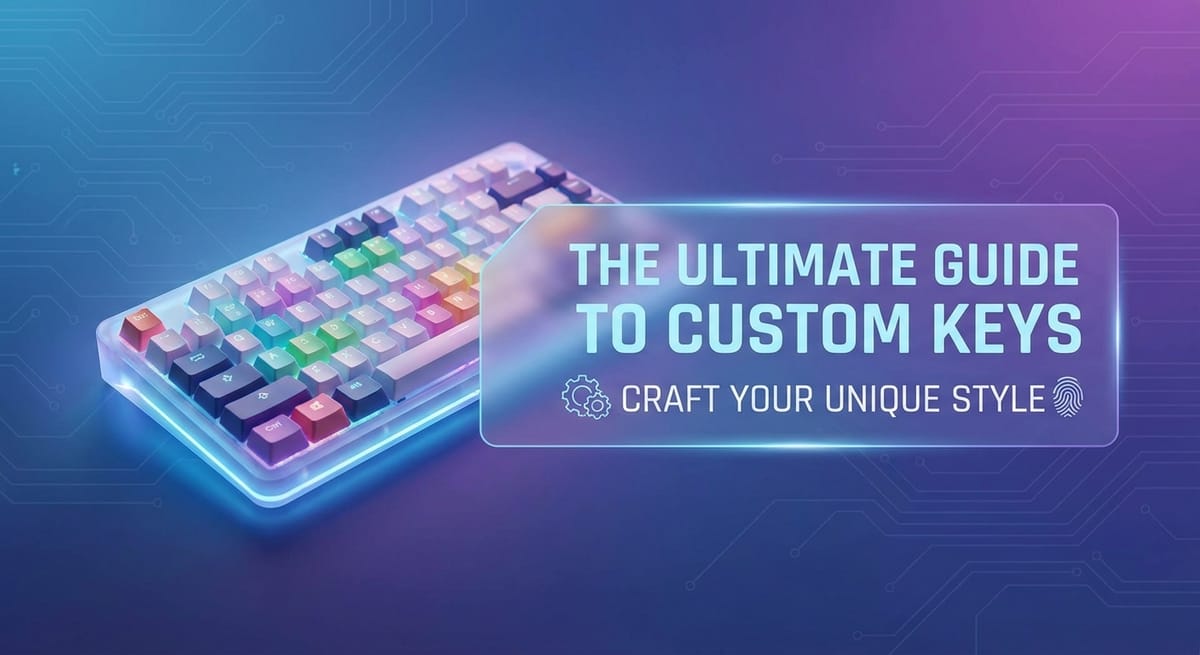
The Ultimate Guide to Custom Keys: Craft Your Unique Style


In a world increasingly dominated by mass production and standardized experiences, the desire for personalization has never been stronger. From the clothes we wear to the digital interfaces we navigate, there's a growing yearning to infuse our daily lives with a touch of our unique identity. This profound human need to stand out, to express individuality, finds a fascinating and incredibly tactile outlet in the realm of custom keys. More than mere functional components, custom keys, particularly in the vibrant world of mechanical keyboards, transform mundane tools into extensions of one's personality, a canvas for self-expression, and even miniature works of art. This guide is your definitive journey into the intricate and rewarding universe of customizing keys, an exploration that promises to empower you to transform the ordinary into the extraordinary, truly crafting your unique style.
We are not just talking about keys in the traditional sense – the ones that unlock doors or start engines. While the principle of a key granting access or enabling function remains constant, our focus here delves much deeper into the aesthetic, ergonomic, and creative dimensions of keys as elements of interaction and identity. Primarily, we will explore the burgeoning ecosystem of custom keycaps and the broader landscape of mechanical keyboard customization. This includes everything from the tactile feel of switches to the resonant acoustics of cases, culminating in the creation of a typing instrument that is not only highly functional but also a profound reflection of its owner's taste and preferences. Prepare to unlock a world where every keystroke is an experience, and every key tells a story.
The Philosophy of Customization – Beyond Utility
The human spirit inherently yearns for uniqueness. From prehistoric cave paintings to Renaissance portraits, from bespoke tailoring to personalized digital avatars, our species has consistently sought ways to imprint our individual mark on the world around us. This fundamental desire is deeply rooted in our psychology, reflecting not only a need for self-expression but also a yearning for connection, a way to communicate who we are without uttering a single word. In an era where many aspects of our lives feel increasingly homogenized and dictated by broad market trends, the act of customization becomes a powerful antidote, a reclaiming of agency over the tools and objects we interact with daily.
Consider the humble keyboard. For decades, it was a purely utilitarian device, a gateway to the digital realm, largely ignored beyond its functional capacity. Its design, materials, and aesthetic were almost universally standardized, driven by efficiency and cost-effectiveness rather than individual flair. Yet, beneath this surface of uniformity, a quiet revolution was brewing, ignited by enthusiasts who saw beyond the factory-standard plastics and imagined something more. They envisioned keyboards that didn't just facilitate work but inspired it; tools that weren't just functional but beautiful; interfaces that weren't just responsive but resonated with a personal touch. This shift marks the transition from viewing a keyboard as a mere peripheral to recognizing it as a personal canvas, transforming it from a commodity into a cherished possession.
The advent of custom keycaps perfectly encapsulates this philosophical evolution. Keycaps are the small, individual caps that sit atop the switches of a keyboard, bearing the legends (letters, numbers, symbols) that guide our fingers. In their standard form, they are functional; in their customized form, they become the primary medium through which users can imbue their keyboard with personality. Imagine a keyboard whose keycaps are not just plain black or white, but a vibrant spectrum of colors, intricately sculpted designs, or rare artisan creations that tell a story. This isn't just about aesthetics; it's about making a statement. It's about taking a mass-produced item and transforming it into something deeply personal, something that sparks joy and inspiration every time it's used.
This drive for personalization extends far beyond mere visual appeal. There are profound psychological benefits associated with engaging in the customization process. The act of choosing, designing, and even assembling custom components fosters a sense of ownership and connection that a generic, off-the-shelf product simply cannot replicate. It taps into our innate creativity, providing an avenue for problem-solving and aesthetic decision-making. For many, the process itself becomes a meditative and deeply satisfying hobby, a break from the digital grind that the keyboard usually facilitates. Moreover, the thriving communities built around mechanical keyboard customization provide a sense of belonging and shared passion, allowing enthusiasts to connect, share ideas, and showcase their unique creations. This communal aspect reinforces the value of individual expression while simultaneously fostering a collective appreciation for craftsmanship and design. In essence, customizing keys is not just about changing an object; it's about enhancing an experience, fostering a connection with our tools, and celebrating the boundless creativity of the human spirit. It is a powerful testament to our desire to make our mark, transforming the functional into the truly personal.
Decoding the World of Custom Keycaps
To truly embark on the journey of crafting your unique style, a deep understanding of the foundational elements is essential. In the realm of mechanical keyboards, custom keycaps are arguably the most impactful and visible component for personalization. They are the interface between your fingertips and the underlying technology, and their choice dictates much of the keyboard's aesthetic, tactile, and even acoustic profile. Moving beyond the generic, understanding the nuances of keycap materials, profiles, legends, and compatibility is paramount for anyone serious about mechanical keyboard customization.
What Exactly Are Custom Keycaps?
At their core, keycaps are the caps that sit on top of the switches of a mechanical keyboard, serving as the tactile and visual point of interaction. "Custom keycaps" refer to any keycaps that deviate from the standard, often mass-produced sets that come with most pre-built keyboards. These custom sets are typically produced in limited runs, feature unique color schemes, profiles, materials, or legends, and are designed to appeal to specific aesthetic tastes or ergonomic preferences. They allow users to completely overhaul the look and feel of their keyboard, making it truly their own. The three main characteristics of a keycap are its material, its profile (shape and height), and its legend (the character printed or molded on it).
Materials Matter: The Foundation of Feel and Durability
The material from which a keycap is made profoundly influences its feel, sound, durability, and how it accepts legends. Each material has its distinct characteristics, making the choice a crucial step in defining your keyboard's personality.
- ABS (Acrylonitrile Butadiene Styrene): This is a very common plastic used in many standard keycap sets.
- Pros: ABS keycaps are relatively inexpensive to produce, can achieve vibrant and complex colors, and are excellent for doubleshot molding (where two plastics are molded together for durable legends). They often have a smoother, slightly softer texture compared to PBT.
- Cons: The main drawback of ABS is its tendency to develop "shine" over time with use, particularly on frequently pressed keys. This is due to the smooth plastic wearing down and becoming glossy, which can feel greasy to some users. They are also generally less durable against wear and tear than PBT.
- PBT (Polybutylene Terephthalate): Widely considered a premium choice for many enthusiasts, PBT offers a distinct typing experience.
- Pros: PBT keycaps are renowned for their exceptional durability. They are highly resistant to developing shine, maintaining their original matte or textured finish for much longer than ABS. PBT often has a slightly rougher, "grittier" texture, which many users find pleasing and less prone to slippage. They are also known for producing a deeper, more satisfying "thock" sound profile when bottoming out on switches, especially thicker PBT sets. They are ideal for dye-sublimation.
- Cons: PBT can be more challenging and expensive to mold than ABS, leading to fewer options for doubleshot PBT sets (though they do exist and are highly sought after). Achieving vibrant, consistent colors, especially lighter ones, can also be more difficult with PBT compared to ABS.
- POM (Polyoxymethylene): Less common than ABS or PBT, POM keycaps offer a unique feel.
- Pros: POM keycaps are known for their extremely smooth and slightly slippery surface, often described as a "buttery" feel. They are very durable and resistant to shine, similar to PBT. They can also have a unique acoustic signature, often described as slightly muted or dampened.
- Cons: Availability is limited compared to ABS and PBT. They are also more difficult to dye, meaning color options are generally restricted to translucent or specific opaque colors.
- Resin: This material is predominantly used for artisan keycaps, which are miniature sculptures more than functional keys.
- Pros: Resin allows for incredibly intricate, diverse, and often artistic designs that are impossible with injection molding. Colors can be mixed, layers embedded, and unique textures created.
- Cons: Resin keycaps are typically handcrafted, making them much more expensive and produced in extremely limited quantities. They can also be more fragile than plastic keycaps and are usually only used for a few accent keys rather than a full set.
- Metal (CNC Aluminum, Brass, Zinc, Titanium): Used for premium accent keys or occasionally full sets (though rare due to weight and cost).
- Pros: Offers unparalleled durability, a unique cold and heavy feel, and a distinctive metallic sound profile. Provides a truly premium aesthetic.
- Cons: Extremely heavy, which can alter the feel of a specific key and make an entire board very heavy. Very expensive to produce, and legends are typically laser-etched or engraved rather than doubleshot.
- Wood: A niche but aesthetically pleasing option for custom accent keys or full sets.
- Pros: Offers a natural, warm aesthetic and a distinct tactile feel. Can be carved and finished in various ways.
- Cons: Less durable than plastic or metal, susceptible to moisture and temperature changes, and generally much more expensive. Typing feel can be inconsistent across different wood types.
Profiles – The Ergonomics and Aesthetics of Keycap Shape
The "profile" of a keycap refers to its shape, height, and the angle of its top surface. Different profiles dramatically affect the typing experience, impacting comfort, speed, and overall feel. Profiles can be broadly categorized as "sculpted" or "uniform."
- OEM Profile: This is the most common profile found on most pre-built mechanical keyboards. It's a sculpted profile, meaning each row of keycaps has a different height and angle designed to ergonomically curve towards the user's fingers. It's familiar and generally comfortable for most typists.
- Cherry Profile: Very similar to OEM but typically slightly shorter and with a slightly less aggressive curve. It's also a sculpted profile and is highly favored by many enthusiasts for its comfortable, low-profile feel and clean aesthetics. Many custom keycap sets are produced in Cherry profile.
- SA Profile: A significantly taller, highly sculpted profile known for its spherical tops and retro aesthetic, reminiscent of vintage terminals.
- Pros: Visually striking, offers a deep, satisfying "thocky" sound when bottoming out due to its height and larger internal volume. Spherical tops can guide fingers well.
- Cons: The height can be an adjustment for many typists, potentially leading to fatigue without a wrist rest. The aggressive sculpting might not suit everyone.
- DSA Profile: A uniform, low-profile spherical profile. This means all keycaps across all rows have the same height and shape.
- Pros: Offers flexibility in layout, as any keycap can be placed on any row. Clean, minimalist aesthetic. Easy to adapt to for touch typists.
- Cons: The uniform height can feel less ergonomic for some compared to sculpted profiles, as fingers have to travel more to reach keys on different rows.
- XDA Profile: Another uniform, low-profile profile, similar to DSA but with a larger, flatter top surface (cylindrical instead of spherical).
- Pros: Offers a clean, modern aesthetic and the same layout flexibility as DSA. The larger surface area can feel spacious.
- Cons: Similar ergonomic considerations to DSA due to its uniform nature.
- MT3 Profile: A high-profile, deeply sculpted spherical profile inspired by vintage terminals, but with a more aggressive scoop and angle than SA.
- Pros: Ergonomically designed to cradle fingertips, providing a very distinct and often loved typing experience. Unique vintage aesthetic.
- Cons: Very tall, requires adjustment. Can be expensive and is less common than Cherry or OEM.
- KAT Profile: A medium-height, sculpted spherical profile that aims to bridge the gap between Cherry and SA, offering a comfortable typing angle with a pleasant spherical top.
- Pros: A good balance of ergonomics and aesthetics, often praised for its smooth feel and appealing legends.
- Cons: Still relatively new, so fewer sets are available compared to more established profiles.
Legends and Printing Methods: How Characters Appear on Your Keys
The "legends" are the characters or symbols on your keycaps. How these legends are applied significantly impacts their durability and appearance.
- Doubleshot: Considered the gold standard for durability. Two separate pieces of plastic are molded together: the first forms the legend, and the second forms the body of the keycap around it.
- Pros: Legends will never fade, rub off, or wear down as they are physically part of the keycap. Produces crisp, clear legends.
- Cons: More expensive and complex to manufacture, limiting color combinations and legend complexity. Not suitable for PBT without advanced techniques.
- Dye-sublimation (Dye-sub): A process where dye is heated and permeated into the plastic of the keycap. Primarily used on PBT keycaps.
- Pros: Legends are highly durable and won't fade or rub off as the dye permanently bonds with the plastic. Allows for intricate and multi-color legends.
- Cons: Typically only works with darker legends on lighter keycaps (dye has to be darker than the plastic). Can't achieve the same sharpness as doubleshot.
- Pad Printing: The cheapest and least durable method. Ink is literally printed onto the surface of the keycap.
- Pros: Inexpensive, allows for any color combination and complex legends.
- Cons: Legends will wear off relatively quickly with consistent use, especially on frequently pressed keys.
- Laser Etching/Engraving: A laser burns or melts the surface of the plastic to create the legend.
- Pros: Relatively durable as the legend is etched into the material. Can be used on various materials.
- Cons: Can create a slightly rough or discolored legend. May still wear down over time if the etching is shallow. Not as vibrant as doubleshot or dye-sub.
- Blank Keycaps: Keycaps with no legends at all.
- Pros: Ultra-minimalist aesthetic. Forces touch-typing, which can improve speed and accuracy for experienced typists.
- Cons: Not suitable for beginners or those who rely on visual cues. Can be challenging for less common symbols.
Compatibility: Ensuring Your Custom Keycaps Fit
Before investing in a custom keycap set, ensuring compatibility with your existing or planned keyboard is crucial.
- MX Stem Compatibility: The vast majority of custom keycaps are designed to fit Cherry MX-style switches, which feature a cross-shaped stem. This is the industry standard.
- Stabilizers: Larger keys (like Spacebar, Shift, Enter, Backspace) use stabilizers to prevent wobble. The two main types are Cherry stabilizers (most common) and Costar stabilizers (less common on modern boards). Most custom keycap sets are designed for Cherry stabilizers. Ensure your keyboard's stabilizers match your keycaps.
- Row Profiles for Different Keyboard Layouts: While most keycap sets include standard sizes for ANSI (US) layouts, if you have an ISO (EU) layout, a non-standard bottom row (e.g., specific Corsair or Razer boards), or a smaller form factor like 60% or 65% with non-standard key sizes (e.g., 1.75u Shift, 1u Alt/Fn keys), you'll need to check if the custom set includes the necessary key sizes. Many custom sets offer "novelty" or "extension" kits to cover these less common layouts.
Understanding these fundamental aspects of keycaps – material, profile, and legend application – provides the necessary groundwork for making informed decisions on your custom keycaps journey. This knowledge empowers you to choose a set that not only looks stunning but also feels incredible to type on, truly elevating your mechanical keyboard customization experience.
The Art of Artisan Keycaps – Miniature Masterpieces
Beyond the comprehensive sets designed to cover an entire keyboard, lies a unique and highly sought-after niche within custom keycaps: the world of artisan keycaps. These are not merely keycaps; they are miniature, handcrafted sculptures, often produced in extremely limited quantities, that transform a single key position into a focal point of artistic expression. For many, collecting and showcasing artisan keycaps is as much a hobby as building a custom keyboard itself, adding an unparalleled layer of personality and exclusivity to their setup.
What are Artisan Keycaps?
Artisan keycaps are individual keycaps that are meticulously crafted by independent artists or small studios, rather than mass-produced in a factory. While a full custom keycap set provides a cohesive aesthetic for the entire keyboard, artisan keycaps serve as accent pieces, often adorning keys like the Esc key, a specific function key, or a novelty key on the right side of the board. They typically feature intricate designs, ranging from fantastical creatures and adorable animals to pop culture references, abstract geometric patterns, or even food items. Most artisan keycaps are made from resin, a versatile material that allows for complex molding, layering of colors, and the embedding of various small objects. However, artisans also work with other materials like metal, wood, and even ceramic, pushing the boundaries of what a "keycap" can be.
The Craftsmanship Behind Artisans: A Labor of Love
The creation of an artisan keycap is a multi-stage process that demands significant skill, patience, and artistic vision. It begins with an original sculpt, often done by hand using clay or digitally. This initial sculpture is then used to create a master mold. From this master mold, silicone production molds are made, into which liquid resin is carefully poured.
The casting process itself is an art form. Artists often use a pressure pot or vacuum chamber to eliminate air bubbles, ensuring a flawless finish. Achieving vibrant colors, intricate patterns, and precise details often involves multiple pours of different colored resins, sometimes layering them, or hand-painting tiny details with extreme precision. The process can involve:
- Sculpting: Creating the original design, often a tiny creature or character.
- Molding: Making silicone molds from the original sculpt.
- Casting: Pouring resin into the molds. This often involves multiple layers of different colored resins to create depth, intricate patterns, or translucent effects.
- Demolding: Carefully removing the cured resin cap from the mold.
- Finishing: Sanding, polishing, and sometimes hand-painting intricate details.
- Stem Attachment: Ensuring a perfectly sized and durable stem for compatibility with MX switches.
Each artisan cap is a testament to the artist's dedication, embodying hours of work and artistic passion. This labor-intensive process is what contributes to their higher price point and limited availability, making each piece truly special.
Themes and Aesthetics: Transforming a Keyboard into a Personal Art Gallery
The sheer diversity of themes and aesthetics in artisan keycaps is astounding. Artists draw inspiration from an infinite array of sources, catering to every conceivable taste. You might find:
- Fantasy Creatures: Dragons, goblins, mystical beasts, mythical entities.
- Animals: Cats, dogs, foxes, owls, fish, and more, often depicted in stylized or adorable ways.
- Pop Culture: Characters from video games, movies, anime, and comics.
- Food Items: Miniature donuts, ramen bowls, sushi, fruits – often looking surprisingly realistic.
- Nature: Flowers, leaves, mountains, clouds, or even entire miniature landscapes embedded in resin.
- Abstract Designs: Swirls of color, geometric patterns, translucent effects with embedded glitter or small objects.
- Sci-Fi/Cyberpunk: Robots, spaceships, circuit boards, futuristic motifs.
These miniature works of art allow enthusiasts to personalize their keyboard in a way that full keycap sets cannot. A single artisan keycap can become the focal point of a keyboard, drawing the eye and adding a pop of color, texture, and personality that tells a unique story about its owner's interests and passions. They transform the keyboard from a mere tool into a personalized art gallery, where each piece is a conversation starter.
The Hunt for Artisans: A Community and Culture of Passion
Acquiring artisan keycaps is often a journey in itself, a testament to their exclusivity and desirability. Unlike mass-produced items, artisans are rarely available for immediate purchase in large quantities. The primary methods of acquisition include:
- Group Buys/Pre-orders: Artists may run pre-orders for a specific design, taking orders over a set period and then producing the caps.
- Raffles: Due to the limited nature of production and high demand, many popular artisans are sold through timed raffles. Enthusiasts enter a lottery for the chance to purchase a cap. This method helps to distribute rare caps fairly and prevents bots from snatching up all inventory.
- Flash Sales: Occasionally, artists will drop a small batch of caps for immediate purchase, which sell out in seconds.
- Aftermarket/Secondary Market: Highly sought-after artisan keycaps can fetch significant prices on the secondary market (e.g., Reddit's r/mechmarket) due to their rarity and demand.
The culture surrounding artisan keycaps is incredibly vibrant and community-driven. Forums, Discord servers, and Instagram are filled with collectors showcasing their acquisitions, sharing photography tips, discussing new releases, and participating in the "hunt." This communal aspect adds another layer of enjoyment, fostering connections among like-minded enthusiasts.
Pricing and Rarity
Artisan keycaps typically range in price from $30-$150 USD for a single cap, with some extremely rare or intricate pieces fetching hundreds or even thousands on the aftermarket. This pricing reflects the labor, skill, and limited production involved in their creation. The rarity is driven by the artist's time constraints, the complexity of the design, and the deliberate decision to keep production numbers low to maintain exclusivity.
While the investment in a single artisan keycap might seem steep to an outsider, for collectors, it's akin to collecting fine art or unique collectibles. Each piece holds aesthetic, sentimental, and often financial value, contributing to a truly unique and personalized keyboard experience. The world of artisan keycaps is a vivid testament to the power of human creativity and the lengths enthusiasts will go to truly make their style unique.
Beyond Keycaps – Comprehensive Mechanical Keyboard Customization
While custom keycaps offer the most immediate and visible transformation, the true depth of mechanical keyboard customization extends far beyond the surface. A keyboard is an intricate ecosystem of interconnected components, each offering an opportunity for personalization that impacts not just aesthetics, but also the fundamental typing feel, sound profile, and overall user experience. To truly craft a unique style and achieve an unparalleled typing experience, one must delve into the world beneath the keycaps.
Switches: The Heart of the Keyboard
The mechanical switch is arguably the most crucial component in determining the typing feel and sound of a keyboard. It's the mechanism that registers a keystroke. Understanding the types and their characteristics is foundational.
- Linear Switches: These switches offer a smooth, consistent actuation from top to bottom, with no tactile bump or click sound.
- Feel: Smooth, no interruption.
- Sound: Typically quieter, a soft "thock" or "clack" depending on other components.
- Popular Examples: Cherry MX Red, Gateron Yellow, Kailh Cream. Often preferred by gamers for rapid, uninterrupted key presses.
- Tactile Switches: These switches provide a noticeable "bump" or resistance during the keypress, indicating actuation, but without an audible click.
- Feel: A distinct tactile feedback point.
- Sound: Quieter than clicky, but the bump often generates a slight sound.
- Popular Examples: Cherry MX Brown, Holy Panda, Glorious Panda. Favored by typists who appreciate feedback without the noise.
- Clicky Switches: These switches have both a tactile bump and an audible "click" sound during actuation.
- Feel: Tactile bump followed by an audible click.
- Sound: Distinct and often loud click.
- Popular Examples: Cherry MX Blue, Kailh Box Jade. Loved by those who enjoy the auditory confirmation of a keypress, but can be disruptive in shared environments.
Switch Customization and Modding: Beyond choosing a switch type, enthusiasts often further modify their switches: * Spring Weights: Switches come with various spring weights, dictating how much force is required to press them. Custom springs can change actuation force, making a switch lighter or heavier. * Lubrication (Lube): Applying a thin layer of specialized lubricant to the switch housing, stem, and spring can dramatically improve smoothness, reduce friction, and alter the sound profile, often making it deeper and less scratchy. This is one of the most impactful modifications for typing feel. * Film: Thin plastic films can be inserted between the upper and lower housing of a switch to reduce housing wobble, making the switch feel more solid and sometimes improving acoustics. * Hot-swappable vs. Soldered: Keyboards can be hot-swappable (switches can be easily pulled out and swapped without soldering) or soldered (switches are permanently attached to the PCB and require soldering to change). Hot-swap PCBs offer immense flexibility for experimentation.
Stabilizers: Taming the Wobble of Large Keys
Stabilizers are crucial components found under larger keys like the Spacebar, Shift, Enter, and Backspace. Their purpose is to prevent these keys from wobbling and ensure consistent travel when pressed anywhere on their surface. Poorly tuned stabilizers can be a source of annoying rattle and an inconsistent typing experience.
Stabilizer Modding: Customizing stabilizers is almost a mandatory step for a truly premium build: * Lubrication: Applying dielectric grease or specialized stabilizer lube to the wires and housings reduces friction and eliminates rattle, resulting in a smooth, quiet keypress. * Clipping: Trimming small feet on the stabilizer stems can eliminate an unwanted "mushy" feeling when bottoming out, leading to a crisper keypress. * Band-Aid Mod: Placing small adhesive bandages (or similar material) under the stabilizer housing on the PCB can further reduce rattling and soften bottom-out sounds, creating a more pleasant "thock." * Screw-in vs. Plate-mount: Screw-in stabilizers are generally preferred as they offer greater stability and less rattle than plate-mount stabilizers.
Cases: The Keyboard's Enclosure and Acoustic Chamber
The keyboard case is more than just a housing; it's a significant contributor to the keyboard's overall aesthetic, weight, and acoustic properties.
- Material:
- Aluminum: Most popular for custom keyboards. Offers a premium feel, excellent durability, and a clean, resonant sound profile. Can be anodized in a vast array of colors.
- Acrylic: Transparent or translucent, allowing for stunning RGB underglow effects. Lighter than aluminum, with a softer, sometimes "hollower" sound.
- Plastic (Polycarbonate, ABS): Common in pre-built boards, lighter and more affordable. Can be surprisingly good with proper dampening.
- Wood: Unique aesthetic, warm sound profile, but often more expensive and requires care.
- Form Factor: Refers to the size and layout of the keyboard.
- Full-size (100%): All keys, including numpad.
- Tenkeyless (TKL - 80%): No numpad, compact but retains function row and arrow keys.
- 75%: Similar to TKL but more compact, often without gaps between sections.
- 65%: No function row or numpad, dedicated arrow keys.
- 60%: Extremely compact, no function row, numpad, or arrow keys (accessed via layers).
- 40%/Ortholinear/Split: Niche, highly specialized layouts for maximum ergonomics or portability.
- Mounting Styles: How the PCB and plate assembly are held within the case significantly impacts typing feel and sound.
- Tray Mount: PCB/plate screws directly into the bottom case. Stiffest feel, can sometimes lead to inconsistent sound.
- Top Mount: Plate screws into the top case. Generally more consistent feel and sound than tray mount.
- Gasket Mount: Plate/PCB assembly floats within the case, cushioned by gaskets (often foam or silicone). Offers a softer, more flexible typing feel and a deeper, more uniform sound profile. Highly sought after for premium builds.
- Sandwich Mount: Plate is clamped between two case halves.
- Burger Mount: Similar to gasket mount but uses O-rings to dampen vibrations.
Plates: The Intermediate Layer Affecting Flex and Sound
The plate sits between the switches and the PCB, providing a mounting surface for the switches. Its material and mounting style heavily influence the overall feel and sound of the keyboard.
- Material:
- Aluminum: Stiff, resonant, common.
- Brass: Very stiff, heavy, produces a higher-pitched, clackier sound.
- Polycarbonate (PC): Flexible, softer typing feel, produces a deeper, softer sound.
- Carbon Fiber: Stiff, light, distinctive look.
- FR4 (Fiberglass): Similar to PCB material, offers a balanced feel.
- Flex: Softer plate materials (like PC) or certain mounting styles (like gasket mount) introduce more flex, which can make typing feel less fatiguing and more enjoyable for long sessions. Stiffer plates provide a more solid, unyielding feel.
PCBs (Printed Circuit Boards): The Brains of the Operation
The PCB is the circuit board that registers key presses and communicates with the computer.
- Hot-swap vs. Soldered: As mentioned, hot-swap PCBs allow for easy switch changes, while soldered PCBs require desoldering.
- RGB Lighting: Many PCBs offer per-key RGB backlighting or underglow RGB (lights around the edges of the board).
- QMK/VIA Compatibility: QMK (Quantum Mechanical Keyboard) and VIA are open-source firmware platforms that allow for advanced key remapping, macro creation, and layer customization. A QMK/VIA compatible PCB offers unparalleled control over your keyboard's functionality.
Cables: An Often Overlooked Aesthetic and Functional Touch
A custom keyboard build isn't complete without a custom cable.
- Coiled Cables: Popular for their aesthetic appeal, adding a touch of vintage or industrial design.
- Custom Colors: Cables can be ordered in colors that match or complement your keycaps and case.
- Aviator Connectors: These quick-disconnect connectors (often GX16 or LEMO-style) allow for easy detachment of the coiled section from the straight section, adding to the modularity and aesthetic.
- Materials: Paracord, techflex, and other sleeving options allow for different textures and appearances.
Dampening Materials: Fine-Tuning the Acoustics
Modifying the internal acoustics of a keyboard case is essential for achieving a desirable sound profile, often to eliminate hollowness or pinging noises.
- Foam:
- Case Foam: Placed at the bottom of the case to fill empty space, reducing resonance and creating a deeper, more muted sound.
- Plate Foam: Sits between the plate and the PCB, absorbing sound and further dampening switch noise.
- PE Foam Mod: A thin layer of polyethylene foam (e.g., packing foam) placed between the PCB and the switches. This mod can create a higher-pitched, "poppy" sound, often described as "marbly."
- Tape Mod: Applying painter's tape to the back of the PCB can slightly alter the sound profile, often making it deeper and more uniform by absorbing vibrations.
- Fillers: Other materials like silicone pour or even cotton can be used to fill voids in the case, though foam is generally the most common and effective.
The table below provides a concise comparison of keycap materials, highlighting their key characteristics to help you make an informed decision on your journey to custom keycaps.
| Keycap Material | Typical Texture | Durability Against Shine | Sound Profile (General) | Common Manufacturing | Aesthetic Potential |
|---|---|---|---|---|---|
| ABS | Smooth, slightly soft | Low (shines quickly) | Brighter, higher-pitched | Doubleshot, Pad Print | Vibrant colors, crisp legends |
| PBT | Textured, slightly grainy | High (shine resistant) | Deeper, "thockier" | Dye-sublimation | Subtler colors, durable legends |
| POM | Very smooth, slippery | High (shine resistant) | Muted, "buttery" | Injection molding | Translucent or limited opaque colors |
| Resin | Varies (sculpted) | Varies (decorative) | Minimal (accent) | Handcrafted casting | Intricate sculptures, unique art pieces |
| Metal | Smooth, cold | Very High | Distinct metallic ping | CNC machining | Premium, industrial, heavy |
| Wood | Natural, warm | Medium (prone to wear) | Warm, organic | Carving | Rustic, natural, bespoke |
By exploring and meticulously selecting each of these components – switches, stabilizers, cases, plates, PCBs, cables, and dampening materials – in conjunction with your custom keycaps, you gain unparalleled control over every aspect of your keyboard. This holistic approach to mechanical keyboard customization allows you to transcend mere functionality and create a truly personalized, high-performance, and aesthetically pleasing instrument that resonates with your unique style and enhances your daily interactions.
APIPark is a high-performance AI gateway that allows you to securely access the most comprehensive LLM APIs globally on the APIPark platform, including OpenAI, Anthropic, Mistral, Llama2, Google Gemini, and more.Try APIPark now! 👇👇👇
Planning Your Custom Key Journey – A Step-by-Step Guide
Embarking on a mechanical keyboard customization journey can seem daunting given the sheer number of options and components involved. However, with a structured approach, it becomes an incredibly rewarding and enjoyable process. This step-by-step guide will help you navigate the complexities, ensuring you make informed decisions and achieve the custom key setup of your dreams.
1. Define Your Vision: Aesthetic Goals and Desired Typing Feel
Before you buy anything, spend time envisioning your ideal keyboard. * Aesthetic: What colors, themes, or overall look are you aiming for? Do you prefer minimalist, vibrant, retro, or futuristic? Gather inspiration from photos, custom keyboard communities (like Reddit's r/MechanicalKeyboards or Instagram), or even art and design websites. Consider how your keyboard will fit into your workspace. * Typing Feel: Do you prefer a light and airy keystroke, or a more substantial, deliberate press? Do you want a smooth, linear feel, a distinct tactile bump, or an audible click? Do you like a firm, rigid bottom-out, or a softer, more cushioned feel? Consider what you'll be using the keyboard for – gaming, extensive typing, or a mix of both. This vision will guide your choices for keycaps, switches, case material, and mounting style. * Sound Profile: Do you want a deep, "thocky" sound, a higher-pitched "clack," or something muted and silent? This will influence your choice of switches, plate material, case material, and dampening mods.
2. Set Your Budget: Customization Can Range Widely
Custom keyboards can range from relatively affordable upgrades to existing boards to high-end, bespoke creations costing well over a thousand dollars. * Entry-Level (Under $200-$300): Often involves a hot-swappable pre-built keyboard (e.g., from Keychron, Akko), a budget custom keycap set, and basic switch modding (lubing). This is a great starting point to experiment. * Mid-Range ($300-$700): Allows for barebones kits (case, PCB, plate), more premium switches (lubed and filmed), a high-quality PBT or ABS custom keycap set, and custom cables. You can start exploring different mounting styles like gasket mount. * High-End ($700+): Enters the realm of limited-run aluminum or brass cases, artisan keycaps, premium switches, and professionally built or heavily modded components. This tier focuses on achieving an uncompromising typing experience and aesthetic. Be realistic about what you're willing to spend. Remember to factor in tools (switch puller, keycap puller, lube brush, lubricant), shipping costs, and potential import duties.
3. Research and Learn: Tap into Community Knowledge
The mechanical keyboard community is incredibly rich with resources. * Online Forums & Communities: Reddit (r/MechanicalKeyboards, r/CustomKeyboards, r/mechmarket), keyboard-specific Discord servers, and dedicated forums are invaluable. Look for build logs, sound tests, reviews, and advice. * YouTube Channels: Many content creators specialize in custom keyboard builds, switch reviews, and modding tutorials. Watching and listening to different setups can help you visualize and "hear" what you like. * Blogs and Websites: Many sites offer guides, glossaries, and news on upcoming custom keycap sets and keyboard kits.
4. Choosing Your Keyboard Base: Pre-built, Barebones Kit, or Full Custom Build
This decision sets the foundation for your entire project. * Pre-built Keyboard (for modifications): A good option if you want to start with minimal effort. Look for models with hot-swappable PCBs, which allow you to easily change switches without soldering. You can then swap keycaps, lube switches, and perform basic stabilizer mods. * Barebones Kit: Includes the case, PCB, and plate, but no switches or keycaps. This is a popular choice for mid-range builds, offering more control over component selection. You'll need to purchase and install switches and keycaps separately. * Full Custom Build: You source the case, PCB, plate, switches, and stabilizers individually. This offers maximum flexibility but requires more research and potentially soldering if the PCB isn't hot-swappable.
5. Selecting Keycaps: Profile, Material, Legends, and Theme
Refer back to Section 2 for detailed information. * Profile: Consider your ergonomic preferences (sculpted vs. uniform, tall vs. low) and aesthetic leanings (retro SA, modern Cherry, versatile XDA). * Material: PBT for durability and a textured feel, ABS for vibrant colors and doubleshot legends. * Legends: Doubleshot for ultimate durability, dye-sub for PBT vibrancy, or blanks for minimalism. * Theme/Colorway: Find a set that matches your defined aesthetic vision. Look for group buys from reputable vendors, or in-stock options. Don't forget to check for compatibility with your keyboard layout (e.g., specific modifiers for 65% layouts).
6. Considering Switches: Type, Weight, and Modifications
- Type: Linear for smooth presses, tactile for a bump, clicky for audible feedback.
- Weight: Consider if you prefer light (e.g., 45-55g) or heavy (e.g., 60-70g+) actuation force.
- Modifications: If you're using hot-swappable switches, plan to lube them for optimal smoothness and sound. Filming them is also a common step. If you're soldering, make sure you're confident in your soldering skills or find someone who can help.
7. Accessorizing: Cables, Desk Mats, and Wrist Rests
These smaller details significantly enhance the overall aesthetic and ergonomic experience. * Custom Cable: A coiled cable with an aviator connector can add a premium, cohesive look. Choose colors that complement your keyboard. * Desk Mat: A large mousepad/desk mat not only protects your desk but also completes the aesthetic theme. It can also slightly alter the sound profile of your keyboard by acting as a dampening layer. * Wrist Rest: Crucial for ergonomics, especially with taller keycap profiles like SA or MT3. Choose a material (wood, resin, foam) and height that matches your keyboard.
8. Assembly and Testing: What to Look Out For
- Assembly: Follow guides and videos carefully. Take your time, especially with switch installation and stabilizer tuning.
- Testing: After assembly, use a key tester website (e.g., keyboard checker) to ensure every key registers correctly. Listen for any stabilizer rattle or inconsistent switch sounds, and address them promptly (e.g., more lube, adjusting wire).
9. Maintenance and Care: Cleaning and Storage
To preserve your investment and unique style, proper care is essential. * Cleaning: Regularly dust your keycaps and case. For deeper cleaning, remove keycaps and wash them with mild soap and water. Clean the case with appropriate cleaners for its material. * Switch Care: If you notice switches becoming scratchy, they might need re-lubing. * Storage: If you have multiple keycap sets or artisans, store them in compartmentalized trays or bags to prevent damage.
By meticulously following these steps, you will transform the complex world of mechanical keyboard customization into a clear, manageable, and deeply satisfying journey. The result will be a keyboard that is not only a joy to use but also a profound reflection of your unique style, truly customized from the ground up.
The Intersection of Digital and Physical – API Management and Custom Keys
Our exploration of "custom keys" has largely focused on the tangible, tactile world of mechanical keyboards and their highly personalized components. We've seen how physical keys, in this context, serve as powerful symbols of individuality, access, and control, transforming an everyday tool into a unique extension of self. However, the concept of "keys" extends far beyond the physical realm, permeating the digital landscape where they play an equally crucial, albeit often invisible, role in granting access, ensuring security, and enabling functionality for a myriad of services and applications.
Just as a physical key grants you access to your customized keyboard or your home, digital keys – specifically API keys – are fundamental for accessing and securing digital services. In the networked world, applications constantly communicate with each other, exchanging data and executing functions. These interactions are powered by Application Programming Interfaces (APIs), which define the rules and protocols for how software components should interact. API keys, like their physical counterparts, act as credentials, authenticating users or applications and ensuring that only authorized entities can access specific data or functionalities.
Consider the complexity involved in managing these digital keys across a vast ecosystem of services, especially with the rapid proliferation of Artificial Intelligence (AI) models. As developers and enterprises increasingly integrate AI capabilities into their products, they face the challenge of orchestrating interactions with numerous AI models, each potentially having its own unique API, authentication method, and data format. This is where the need for sophisticated API management becomes critical, much like the precision and care put into crafting the perfect physical key.
This brings us to APIPark, an innovative open-source AI gateway and API management platform designed to streamline and secure the management of both AI and REST services. Just as you meticulously customize your physical keys for optimal efficiency, aesthetics, and personal style, developers and businesses require robust, flexible tools to manage their "digital keys" – their APIs – with similar precision and control.
APIPark stands out as an all-in-one solution that helps developers and enterprises manage, integrate, and deploy AI and REST services with remarkable ease. It acts as a central hub, simplifying the otherwise complex task of interacting with diverse digital services.
Here are some ways APIPark enhances the management of these critical "digital keys":
- Quick Integration of 100+ AI Models: Imagine trying to get a hundred different physical keys to work with one lock. APIPark solves this by offering the capability to integrate a variety of AI models under a unified management system. This means easier authentication and cost tracking across multiple AI services, allowing you to quickly unlock a vast array of AI capabilities.
- Unified API Format for AI Invocation: One of the biggest headaches in working with multiple AI models is their differing API formats. APIPark standardizes the request data format, ensuring that changes in underlying AI models or prompts do not disrupt your applications or microservices. This is akin to having a master key that works across all your digital locks, simplifying usage and significantly reducing maintenance costs.
- Prompt Encapsulation into REST API: APIPark allows users to combine AI models with custom prompts to create new, specialized APIs. For instance, you can quickly build an API for sentiment analysis, translation, or data analysis. This empowers developers to craft custom "digital keys" tailored to specific business needs, much like designing a unique keycap for a specific function key.
- End-to-End API Lifecycle Management: From design and publication to invocation and decommission, APIPark assists with managing the entire lifecycle of APIs. It helps regulate API management processes, manage traffic forwarding, load balancing, and versioning, ensuring your digital services are always running smoothly and securely.
- API Service Sharing within Teams: The platform centralizes the display of all API services, making it easy for different departments and teams to find and utilize the required API services. This fosters collaboration and efficiency, ensuring everyone has the right "digital keys" to access shared resources.
- Independent API and Access Permissions for Each Tenant: APIPark enables the creation of multiple teams (tenants), each with independent applications, data, user configurations, and security policies. This provides a robust, secure framework for managing access, much like providing different users with unique physical keys to specific areas.
- API Resource Access Requires Approval: To prevent unauthorized access and potential data breaches, APIPark allows for the activation of subscription approval features. Callers must subscribe to an API and await administrator approval before they can invoke it, adding a critical layer of security.
- Performance Rivaling Nginx: Performance is key, both in physical and digital systems. With just an 8-core CPU and 8GB of memory, APIPark can achieve over 20,000 TPS, supporting cluster deployment to handle large-scale traffic, ensuring your digital keys operate at peak efficiency.
- Detailed API Call Logging: APIPark provides comprehensive logging, recording every detail of each API call. This feature allows businesses to quickly trace and troubleshoot issues, ensuring system stability and data security – an essential "audit trail" for your digital keys.
- Powerful Data Analysis: By analyzing historical call data, APIPark displays long-term trends and performance changes, helping businesses with preventive maintenance before issues occur, much like predictive maintenance for physical systems.
The parallel is clear: just as customizing a keyboard improves your tactile interaction with a machine, APIPark improves your programmatic interaction with digital services and AI. Both endeavors aim to enhance control, efficiency, and the overall experience, whether you're crafting a unique physical style or securely managing the complex ecosystem of digital keys that power our modern world. To learn more about how APIPark can unlock the full potential of your AI and API management, visit ApiPark.
The Future of Custom Keys and Personalization
The journey into the world of custom keys, particularly in the realm of mechanical keyboards, is not a static one; it is a dynamic landscape continuously evolving with new technologies, materials, and artistic expressions. As our desire for personalization deepens and technology advances, the future of custom keys promises even more intricate, sustainable, and personalized possibilities.
Emerging Trends: New Materials, 3D Printing, and Advanced Manufacturing
The innovation in materials science continues to push the boundaries of what's possible for keycaps and keyboard components. We might see wider adoption of exotic alloys, ceramics, or advanced polymers that offer unique tactile properties, improved durability, or entirely new aesthetic finishes. Imagine keycaps that change color with temperature, or cases infused with self-healing properties.
3D printing is set to play an increasingly significant role. While already used by some small-scale artisans, advancements in resolution, material strength, and accessibility for 3D printing could revolutionize custom keycap production. This would allow for even more intricate and complex designs that are currently impossible with traditional injection molding, enabling truly one-off, bespoke keycaps to be manufactured on demand. Furthermore, 3D printing could democratize the design process, allowing hobbyists to easily bring their unique keycap concepts to life without relying on large-scale manufacturing. The ability to prototype and produce small batches quickly could lead to an explosion of creativity and diversity in designs.
Advanced manufacturing techniques, such as precision CNC milling for metal cases, will continue to refine tolerances and finishes, offering even more premium and durable options. The integration of transparent materials with embedded electronics could lead to interactive keycaps or cases that display real-time information or respond to user input in novel ways.
Sustainability in Customization
As global environmental awareness grows, the custom keyboard community, like many other industries, will face increasing pressure to adopt more sustainable practices. This could manifest in several ways: * Recycled Materials: A push towards using recycled plastics (e.g., recycled ABS or PBT) for keycap production. * Biodegradable Materials: Exploration of plant-based or biodegradable polymers for components that have a shorter lifecycle or are designed for eventual disposal. * Modular and Repairable Designs: Emphasis on keyboards that are easier to disassemble, repair, and upgrade, extending their lifespan and reducing waste. * Local Production: A shift towards more localized manufacturing and distribution models to reduce carbon footprints associated with shipping. * Ethical Sourcing: Greater transparency and scrutiny regarding the sourcing of materials and the labor practices involved in production.
The demand for unique, high-quality products can coexist with environmental responsibility, fostering innovation in eco-friendly manufacturing processes within the custom key industry.
AI's Role in Design and Personalization
The integration of artificial intelligence will undoubtedly transform how custom keys are designed and personalized. * Generative Design: AI algorithms could be used to generate novel keycap designs based on user input, aesthetic preferences, or specific themes. Imagine describing your ideal keycap to an AI, and it generates a unique, optimized design that you can then 3D print or have manufactured. * Ergonomic Optimization: AI could analyze typing patterns and hand geometry to recommend or even design custom keycap profiles and keyboard layouts that are optimally ergonomic for an individual user, minimizing strain and maximizing comfort. * Predictive Personalization: AI-powered platforms could learn user preferences over time, suggesting new keycap sets, artisan designs, or keyboard components that perfectly match their evolving style and needs, much like a curated art gallery for your desk. * Smart Keyboards: Beyond aesthetics, AI could enable keyboards with adaptive layouts or intelligent macros that learn from user behavior, dynamically adjusting functionality to enhance productivity.
This level of AI-driven personalization promises to push the boundaries of what "unique style" truly means, creating products that are not just custom, but hyper-personalized and intimately tailored to the individual.
The Continued Growth of the Personalization Market
The underlying human desire for self-expression and ownership will continue to fuel the growth of the personalization market across various industries. Custom keys are a perfect microcosm of this trend. As more people discover the joy and satisfaction of building and customizing their own tools, the community will expand, driving further innovation and greater accessibility. The stigma of a "niche" hobby will diminish as mainstream awareness grows, bringing more diverse perspectives and creative talent into the fold.
Broader Implications for Self-Expression and Consumer Culture
The rise of custom keys and similar personalization trends signifies a broader shift in consumer culture. It's a move away from passive consumption of mass-produced goods towards active co-creation and engagement with products. Consumers are no longer content with being recipients; they want to be participants in the design and evolution of their possessions. This trend empowers individuals to exert more control over their environment, fostering a deeper connection with their tools and surroundings. Custom keys are a vivid illustration of how even the most utilitarian objects can be transformed into powerful vehicles for identity and artistic statement, challenging the norms of what we expect from our everyday items. The future of custom keys is bright, innovative, and deeply intertwined with our evolving understanding of self-expression in a rapidly changing world.
Conclusion
Our journey through "The Ultimate Guide to Custom Keys: Craft Your Unique Style" has traversed a fascinating landscape, from the fundamental philosophy of personalization to the intricate technicalities of custom keycaps and comprehensive mechanical keyboard customization. We've delved into the tactile world of keycap materials and profiles, explored the miniature artistry of artisan keycaps, and examined the myriad components—switches, stabilizers, cases, plates, and PCBs—that contribute to a truly bespoke typing experience. We've also bridged the gap between physical and digital, highlighting how the concept of "keys" extends into the critical realm of API management, with platforms like ApiPark simplifying access and control in the digital domain.
Ultimately, this guide underscores a profound truth: customization is more than just an aesthetic choice; it is an act of self-expression, a reclaiming of individuality in a world often dominated by uniformity. Crafting your unique style through custom keys transforms a mere tool into a personal artifact, a piece of art that you interact with every single day. It enhances your connection with your work, sparks joy, and provides a tactile, auditory, and visual experience tailored precisely to your preferences.
The decision to embark on this journey, whether it's through selecting a vibrant new keycap set, hand-lubing switches for the perfect feel, or meticulously assembling a keyboard from scratch, is an investment in your own comfort, productivity, and personal satisfaction. The process itself is a rewarding hobby, fostering learning, creativity, and connection within a passionate global community.
So, as you conclude this guide, we encourage you to take the first step. Define your vision, set your budget, immerse yourself in the rich resources available, and begin the exciting process of bringing your ideal keyboard to life. The world of custom keys awaits, ready for you to unlock its full potential and truly craft a unique style that is unequivocally yours. May every keystroke be a testament to your individuality and a source of endless inspiration.
Frequently Asked Questions (FAQs)
1. What are the essential components needed to build a custom mechanical keyboard from scratch? To build a custom mechanical keyboard from scratch, you'll need several key components: a case (the outer housing), a PCB (Printed Circuit Board, the brain), a plate (which sits between the switches and PCB), switches (the actual key mechanisms), keycaps (the covers for the switches), and stabilizers (for larger keys like spacebar). Optionally, you might also consider a custom cable, dampening foam, and a wrist rest for ergonomics and aesthetics. Many beginners start with a "barebones kit" which includes the case, PCB, and plate, and then choose their own switches and keycaps.
2. What's the difference between ABS and PBT keycaps, and which should I choose? ABS (Acrylonitrile Butadiene Styrene) and PBT (Polybutylene Terephthalate) are the two most common plastics for keycaps. ABS keycaps are generally smoother, can achieve more vibrant colors, and are excellent for "doubleshot" legends (which won't wear off). However, they tend to develop "shine" over time with use. PBT keycaps are known for their durability, resistance to shine, and often have a slightly textured, matte finish. They typically produce a deeper, "thockier" sound. Your choice depends on preference: ABS for vibrant colors and smooth feel (if shine isn't an issue), PBT for longevity, a textured feel, and often better acoustics.
3. What are "artisan keycaps" and how do I get them? Artisan keycaps are individual, handcrafted keycaps that are often sculpted and cast from resin (or other materials) by independent artists. They are miniature works of art, highly detailed and often produced in very limited quantities. They serve as accent pieces on a keyboard, adding unique personality. Acquiring them often involves participating in online raffles or limited "group buys" due to their scarcity and high demand, as artists cannot mass-produce them. The secondary market can also be a source, though prices can be significantly higher.
4. Can I customize my existing pre-built mechanical keyboard, or do I need to buy a new one? Yes, you can absolutely customize your existing pre-built mechanical keyboard! The extent of customization depends on your keyboard's features. If your keyboard has hot-swappable switches, you can easily change out the switches for different types (linear, tactile, clicky) without soldering. You can almost always change the keycaps on any mechanical keyboard, as long as the new set has the correct sizes for your layout. Basic modifications like lubing stabilizers, adding case foam, or replacing the cable are also common upgrades that don't require a new board and can significantly improve the typing experience.
5. How much does mechanical keyboard customization typically cost? The cost of mechanical keyboard customization varies widely, depending on the depth of personalization and the quality of components you choose. You can start with simple upgrades like a new keycap set (typically $30-$150) or a basic hot-swappable board with new switches ($100-$200). A mid-range custom build (barebones kit, premium switches, custom keycaps) can range from $300-$700. High-end, limited-edition custom keyboards with rare cases and artisan keycaps can easily exceed $1000 or even several thousands. Budget for tools (keycap puller, switch puller, lubricant, brushes) as well, which are a one-time investment.
🚀You can securely and efficiently call the OpenAI API on APIPark in just two steps:
Step 1: Deploy the APIPark AI gateway in 5 minutes.
APIPark is developed based on Golang, offering strong product performance and low development and maintenance costs. You can deploy APIPark with a single command line.
curl -sSO https://download.apipark.com/install/quick-start.sh; bash quick-start.sh

In my experience, you can see the successful deployment interface within 5 to 10 minutes. Then, you can log in to APIPark using your account.

Step 2: Call the OpenAI API.