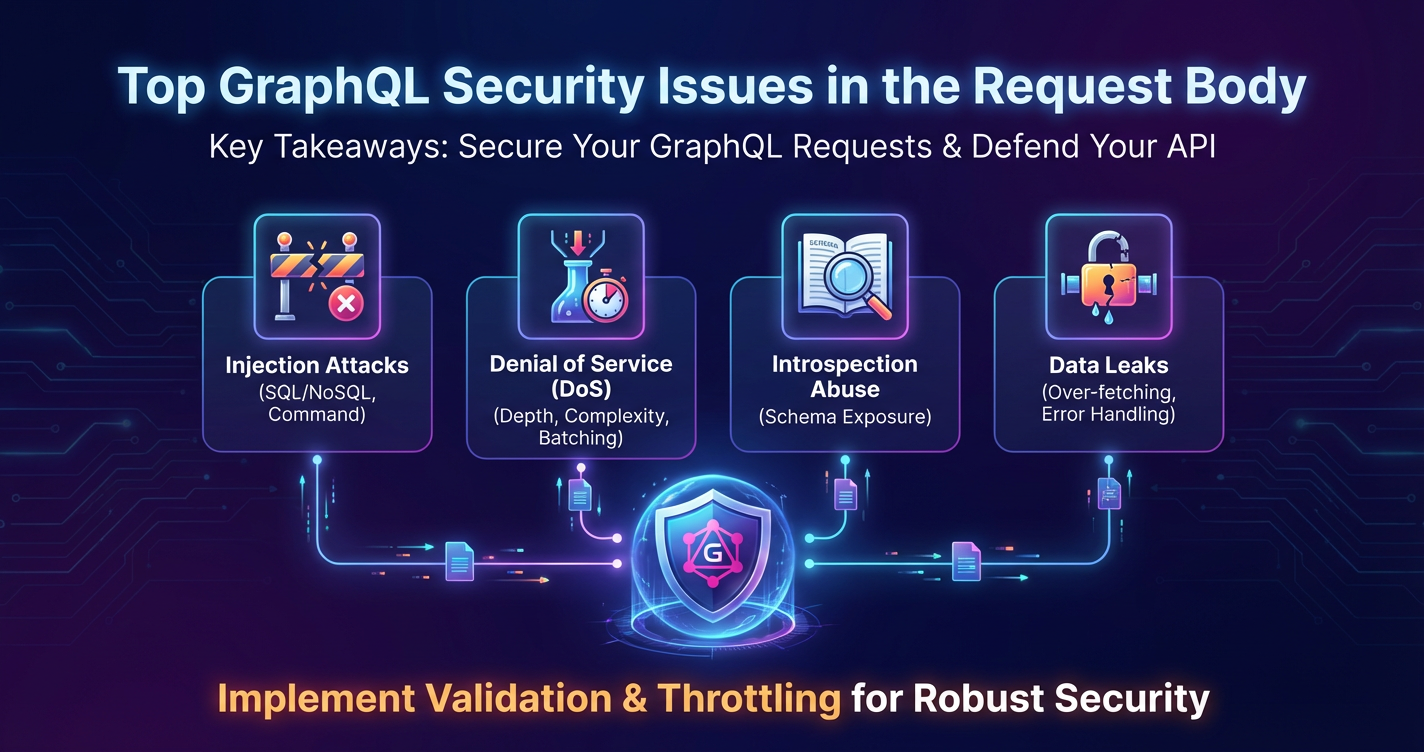
Top GraphQL Security Issues in the Request Body


GraphQL has rapidly emerged as a powerful and flexible alternative to traditional REST APIs, revolutionizing how clients fetch and interact with data. Its ability to allow clients to request precisely the data they need, and nothing more, offers significant benefits in terms of efficiency, reduced over-fetching, and a streamlined development experience. From mobile applications optimizing network payloads to complex web applications orchestrating diverse data sources, GraphQL's declarative nature provides an elegant solution to many modern data consumption challenges. Developers laud its strong typing, introspection capabilities, and the ability to combine multiple data fetches into a single network request, drastically reducing the chattiness often associated with numerous REST endpoints. This efficiency, however, introduces a new paradigm in API design and, consequently, a unique set of security considerations, particularly concerning the structure and content of the request body itself.
While much of the conventional API security discourse often centers on authentication tokens in headers, secure communication protocols, or endpoint-level authorization, GraphQL shifts a substantial portion of the security burden directly into the request payload. The very flexibility that makes GraphQL so appealing can, if not meticulously managed, become a significant attack vector. Unlike REST, where the server dictates the data structure returned by a fixed endpoint, GraphQL empowers the client to define the query's shape and depth. This client-driven data fetching mechanism means that the server must be inherently robust in validating, authorizing, and processing every intricate detail within the GraphQL request body. Consequently, neglecting security best practices in this area can lead to a plethora of vulnerabilities, ranging from excessive data exposure and resource exhaustion to injection attacks and unauthorized data manipulation. Understanding these specific risks and implementing comprehensive mitigation strategies is paramount for any organization leveraging GraphQL, ensuring that the power and flexibility do not inadvertently compromise the integrity, confidentiality, and availability of their sensitive data and systems. This article will meticulously explore the top security issues residing within the GraphQL request body, providing in-depth explanations and actionable strategies to fortify your GraphQL endpoints against these sophisticated threats, often leveraging an api gateway as a first line of defense.
Understanding the GraphQL Request Body
At its core, a GraphQL operation – be it a query to fetch data, a mutation to modify data, or a subscription to receive real-time updates – is typically sent to a single endpoint (often /graphql) via an HTTP POST request. The fundamental difference from REST is that the entire operation, specifying what data to fetch or modify and with what parameters, is encapsulated within the HTTP request body, usually as a JSON payload. This payload contains at least two critical components: the query document and, optionally, variables.
The query document is a string containing the GraphQL operation itself, written in the GraphQL query language. This includes the operation type (query, mutation, subscription), the operation name (for debugging and logging), and the selection set – a nested structure defining precisely which fields the client wishes to retrieve or which arguments to pass to a mutation. For instance, a simple query might look like query GetUser { user(id: "1") { name email } }, explicitly asking for a user's name and email given their ID. The variables field, also a JSON object, allows clients to dynamically pass arguments to the operation without having to interpolate values directly into the query string. This separation is crucial for security, preventing basic injection attacks and improving cacheability. For example, the previous query could be written as query GetUser($userId: ID!) { user(id: $userId) { name email } } with variables: { "userId": "1" }.
This structured and flexible nature of the GraphQL request body is both its greatest strength and a significant source of its unique security challenges. The server must parse this complex payload, validate it against its predefined schema, resolve the requested fields by interacting with various backend services (databases, other apis, microservices), and then construct a response that precisely matches the client's request. Every step of this process, from parsing the query string to processing variables and executing resolvers, presents potential vulnerabilities if not handled with rigorous security considerations. The ability to request deeply nested data, combine multiple operations, or pass arbitrary arguments demands a proactive security posture that goes beyond traditional API security models, necessitating a deep understanding of how malicious actors might manipulate these capabilities to their advantage.
Top Security Issues in the Request Body
The architectural freedom offered by GraphQL, while powerful, shifts significant responsibility onto the server to interpret and execute client-defined operations securely. This section delves into the most prevalent security issues stemming directly from the structure and content of the GraphQL request body.
3.1. Excessive Data Exposure / Inefficient Query Depth Limiting
GraphQL's core promise is its ability to allow clients to request exactly what they need, eliminating over-fetching. However, this flexibility can inadvertently become a major security loophole if not properly constrained, leading to excessive data exposure. The problem arises when attackers craft deeply nested and broadly encompassing queries designed to exfiltrate a vast amount of data, potentially including sensitive information, that was not explicitly intended for public access in such a consolidated manner.
Consider a scenario where a GraphQL schema exposes a User type, which has a friends field returning a list of User types, and each User also has fields like email, address, and internalId. A legitimate client might query for a user's name and their immediate friends' names. An attacker, however, could construct a query that recursively requests User -> friends -> friends -> friends up to many levels deep, simultaneously asking for all potentially sensitive fields (email, address, internalId) at each level. For example, a query could start with:
query DeepUserInfo {
  user(id: "some_id") {
    name
    email
    address
    internalId
    friends {
      name
      email
      address
      internalId
      friends {
        name
        email
        address
        internalId
        # ... and so on, for many more levels
      }
    }
  }
}
This single, seemingly innocuous api request could trigger a massive data retrieval operation on the backend, fetching not just the target user's details but also the details of hundreds or even thousands of interconnected users, based on the depth and breadth of the social graph. If granular authorization checks are not in place at every field level, or if the system assumes that only "reasonable" queries will be made, this can lead to a severe data breach, exposing private user information or internal system identifiers to an unauthorized party. The impact extends beyond data confidentiality; such expansive queries can also lead to significant performance degradation, database strain, and even Denial of Service (DoS) due to the sheer volume of data processing required to fulfill the request. The server might spend an exorbitant amount of CPU, memory, and database I/O resources trying to resolve a single malicious query, affecting the availability of the api for legitimate users.
Mitigation Strategies:
- Query Depth Limiting: This is a fundamental server-side mitigation. Before executing any GraphQL query, the server should analyze its abstract syntax tree (AST) to determine its maximum depth. A predefined maximum depth (e.g., 5 or 7 levels) can be enforced, and any query exceeding this limit is rejected. This prevents attackers from crafting infinitely recursive queries.
- Query Complexity Analysis: A more sophisticated approach involves assigning a "cost" to each field or resolver based on its anticipated resource consumption (e.g., database calls, external
apicalls). The server then calculates the total complexity score of an incoming query and rejects it if it exceeds a predefined threshold. This allows for more granular control than simple depth limiting, as a broad but shallow query might be more expensive than a deep but narrow one. - Pagination and Cursor-Based Access: For fields that return lists of items (like
friends), always enforce pagination. Instead of allowing clients to fetch an unlimited number of items, require them to specifyfirst,last,before, orafterarguments to retrieve items in smaller, manageable chunks. This prevents large list fetches and ensures that data exposure is controlled. - Field-Level Authorization: This is critical. Even if a field is part of the schema, access to it should be strictly controlled based on the authenticated user's roles and permissions. Every resolver function responsible for fetching data for a specific field must perform an authorization check. For example, an
internalIdfield might only be accessible toADMINusers, even ifemailandnameare public. - Rate Limiting on Query Complexity/Cost: Beyond simple request-per-second rate limiting, an
api gatewayor the GraphQL server itself should implement rate limits based on the computed complexity or cost of queries. This can prevent a single malicious actor from exhausting resources with a few highly complex queries, even if they stay within a lower request-per-second limit. This advanced rate limiting is a feature often managed by a dedicatedapi gateway.
By combining these strategies, developers can effectively rein in the potential for excessive data exposure and resource exhaustion, ensuring that the flexibility of GraphQL does not come at the cost of security and system stability.
3.2. Batching Attacks / Resource Exhaustion
GraphQL's ability to process multiple operations within a single api request body is a significant feature designed to enhance client-side performance by reducing network round trips. A client can send several independent queries or mutations in one go, receiving a consolidated response. While beneficial for legitimate use cases, this batching capability introduces a critical vulnerability if not properly managed, making it susceptible to batching attacks that can quickly lead to resource exhaustion and Denial of of Service (DoS).
An attacker can exploit this feature by crafting a request body that contains a large number of identical, or slightly varied but equally expensive, operations. For instance, instead of making multiple individual api calls for different user profiles, a malicious actor could embed hundreds or thousands of complex GetUser queries within a single batch request:
query BatchGetUser {
  user1: user(id: "1") { name email posts { title comments { text } } }
  user2: user(id: "2") { name email posts { title comments { text } } }
  # ... imagine 998 more similar queries
  user1000: user(id: "1000") { name email posts { title comments { text } } }
}
Each of these individual queries, especially if deeply nested (as shown with posts and comments), might be expensive on its own, involving multiple database lookups or calls to other microservices. When hundreds or thousands of such queries are executed concurrently as part of a single batch request, the cumulative impact on the backend resources can be catastrophic. The server's CPU could spike, memory usage could soar, database connection pools could be exhausted, and network bandwidth could be saturated. This rapid consumption of resources makes the system unavailable or severely degraded for legitimate users, effectively constituting a Denial of Service (DoS) attack. The insidious nature of this attack is that it might bypass simple rate limiting mechanisms that only count the number of HTTP requests, as the entire batch is sent in just one HTTP POST request.
Mitigation Strategies:
- Operation Count Limiting: The simplest mitigation is to implement a server-side limit on the number of individual operations (queries, mutations) allowed within a single GraphQL batch request. For example, an
api gatewayor the GraphQL server can reject any request body containing more than, say, 10 or 20 distinct operations. This directly counters the ability to send massive batches. - Cost Analysis and Throttling: Similar to mitigating excessive data exposure, a more sophisticated approach involves performing a cost analysis for each operation within the batch. The total cost of all operations in the batch is then aggregated. If this aggregated cost exceeds a predefined threshold, the entire batch request is rejected. This provides a more intelligent way to limit resource consumption than just counting operations, as a batch of ten very expensive queries could be more harmful than a batch of 100 very cheap ones. This mechanism is an advanced feature often implemented at the
api gatewaylayer. - Throttling and Rate Limiting: While an
api gatewaywill typically apply request-per-second rate limits, these must be complemented by more granular rate limiting for GraphQL. This can include limits on the total "cost" of queries per client within a time window, or limits on the number of "heavy" operations. Leveraging client identifiers (IP address, API key, user ID) to enforce these limits is crucial. - Disabling or Restricting Batching: If batching is not a critical feature for your application, consider disabling it entirely at the GraphQL server level or restricting its use to only specific trusted clients or internal services. If it must be enabled, ensure all other mitigation strategies are robustly in place.
- Monitoring and Alerting: Implement comprehensive monitoring of GraphQL
apiendpoint performance, including CPU usage, memory consumption, database load, and response times. Set up alerts for unusual spikes in these metrics, especially those triggered by singleapirequests with high complexity or numerous batched operations. Anapi gatewayoften provides robust logging and monitoring capabilities that are invaluable for detecting such attack patterns.
By diligently implementing these controls, organizations can harness the performance benefits of GraphQL batching while effectively protecting their api infrastructure from malicious resource exhaustion and DoS attacks. The role of a central api gateway in enforcing these policies at the edge cannot be overstated, providing a crucial layer of defense before requests reach the core GraphQL service.
3.3. Malicious Arguments / Input Validation Vulnerabilities
The variables section of a GraphQL request body, designed to safely pass dynamic data to queries and mutations, is a common target for attackers if server-side input validation and sanitization are insufficient. While GraphQL's strong type system provides a first line of defense (e.g., an Int type prevents string injection into numeric fields), it does not protect against all forms of malicious input. If the resolver functions responsible for processing these variables do not adequately validate and sanitize them before interacting with backend systems, it can lead to severe vulnerabilities like SQL Injection, Cross-Site Scripting (XSS), Command Injection, or Path Traversal. These are not GraphQL-specific vulnerabilities but rather standard web application flaws that can manifest through the GraphQL api if inputs are mishandled.
Consider a mutation designed to update a user's bio field:
mutation UpdateUserBio($userId: ID!, $newBio: String!) {
  updateUser(id: $userId, bio: $newBio) {
    id
    bio
  }
}
If an attacker provides a malicious string for $newBio, and the backend resolver directly inserts this string into a database query without proper escaping or parameterization, it could lead to SQL Injection:
{
  "userId": "123",
  "newBio": "Very interesting bio'); DROP TABLE Users; --"
}
If the backend forms a raw SQL query like UPDATE Users SET bio = 'Very interesting bio'); DROP TABLE Users; --' WHERE id = '123', the database would execute the DROP TABLE Users command, leading to data loss. Similarly, if the bio field is later rendered on a webpage without escaping, an attacker could inject XSS payloads:
{
  "userId": "123",
  "newBio": "<script>alert('You are hacked!');</script>"
}
When a user views this bio, the malicious script would execute in their browser. Beyond these common examples, arguments that specify file paths could be exploited for Path Traversal (e.g., ../etc/passwd), or arguments passed to shell commands could lead to Remote Code Execution (RCE) if not properly sanitized. The vulnerability lies not with GraphQL itself, but with the underlying resolver implementation that fails to adhere to secure coding practices.
Mitigation Strategies:
- Strict Schema-Level Type Validation: Leverage GraphQL's type system to its fullest. Use specific scalar types like
ID,Int,Boolean, and custom scalar types (e.g.,Email,URL,Date) where appropriate. This provides initial validation; for instance, trying to pass a string to anIntfield will result in a schema validation error before hitting the resolver. - Server-Side Input Validation and Sanitization: This is the most crucial step. Never trust client-provided input, even if it passes schema validation. Every resolver function must explicitly validate the format, length, and content of all arguments.
- SQL Injection: Always use parameterized queries or prepared statements when interacting with databases. Never concatenate user input directly into SQL strings.
- XSS: When rendering user-generated content, always escape or sanitize HTML and JavaScript. Use libraries designed for this purpose.
- Command Injection: Avoid calling shell commands with user-provided input. If absolutely necessary, use libraries that safely escape arguments or execute commands in a sandboxed environment.
- Path Traversal: Validate file paths rigorously to ensure they stay within intended directories. Disallow
../sequences and resolve absolute paths.
- Custom Scalar Types for Complex Validation: For inputs requiring more complex validation than basic types, define custom scalar types (e.g., an
EmailAddressscalar type that performs regex validation). This centralizes validation logic and makes it reusable across your schema. - Allowlisting and Denylisting: For string inputs where possible, define a set of allowed values (allowlisting) rather than trying to block known malicious patterns (denylisting). Allowlisting is generally more secure.
- Error Handling: Ensure that error messages returned to the client do not expose sensitive details about the backend (e.g., stack traces, database error codes) that could aid an attacker in probing for vulnerabilities.
- Security Testing: Regularly conduct security audits, static code analysis, and penetration testing (including fuzzing inputs) specifically targeting input validation in GraphQL resolvers.
By implementing a robust, multi-layered approach to input validation and sanitization at both the schema and resolver levels, developers can significantly reduce the risk of malicious arguments leading to critical backend system compromises. This is a foundational security principle for any api, regardless of its underlying technology.
3.4. Insecure Direct Object References (IDOR) within Request Body
Insecure Direct Object References (IDOR) is a common vulnerability where an api exposes a direct reference to an internal implementation object (like a database ID or file name) and does not sufficiently verify that the requesting user is authorized to access or modify the specified resource. In the context of GraphQL, where clients are encouraged to specify resource IDs directly within their queries and mutations in the request body, this vulnerability can be particularly prevalent and insidious if authorization logic is not meticulously implemented at the resolver level.
GraphQL's design paradigm often involves clients directly referencing resource identifiers in their operations. For example, a query to fetch a specific user's details might look like:
query GetUserProfile($userId: ID!) {
  user(id: $userId) {
    name
    email
    orders {
      id
      total
    }
  }
}
If the backend resolver for the user field, or more critically, for the nested orders field, only checks for general authentication (i.e., "is this a logged-in user?") but fails to verify if the authenticated user is actually authorized to access the specific user(id: $userId) or orders associated with that user, then an IDOR vulnerability exists. An attacker could simply enumerate IDs by changing the $userId variable in the request body:
// Attacker is logged in as user 'A' but tries to access data for user 'B'
{
  "userId": "B's_ID"
}
If the authorization check is missing or flawed, the attacker, despite being user 'A', would successfully retrieve sensitive information (name, email, order history) belonging to user 'B'. This issue is compounded when relationships are traversed. An attacker might get user(id: "B's_ID") { orders { id } } to fetch order IDs for user 'B', and then use a separate mutation like cancelOrder(id: "B's_order_ID") to cancel another user's order. The critical point is that the direct object reference (B's_ID or B's_order_ID) is provided in the request body, and the server's backend logic fails to ensure the requester has proper ownership or permissions for that specific object.
Impact:
- Unauthorized Data Access: Attackers can view sensitive data belonging to other users.
- Data Manipulation/Deletion: Attackers can modify or delete resources they are not authorized to touch.
- Privacy Breaches: Exposure of personal identifiable information (PII).
- Business Logic Bypass: Circumventing intended application workflows or access controls.
Mitigation Strategies:
- Granular Resolver-Level Authorization: This is the cornerstone of IDOR prevention in GraphQL. Every resolver function that accesses or modifies a resource identified by an ID in the request body must perform an explicit authorization check. This check should verify that the currently authenticated user has the necessary permissions (e.g., ownership, specific role) to interact with that specific instance of the resource.
- For
user(id: $userId), the resolver should checkif (currentUser.id !== $userId && !currentUser.isAdmin) { throw new UnauthorizedError(); }. - For
orders, the resolver should verify thatorder.userId === currentUser.id.
- For
- Use Global Unique Identifiers (GUIDs) / UUIDs: While not a security control in itself, using opaque, non-sequential GUIDs or UUIDs for resource IDs instead of predictable integers (
1, 2, 3...) makes it significantly harder for attackers to enumerate and guess valid IDs. This adds a layer of obscurity, making brute-force IDOR attacks less practical, though it doesn't replace proper authorization. - Implement Robust Access Control Policies: Beyond simple
isOwnerchecks, implement role-based access control (RBAC) or attribute-based access control (ABAC) systems. Define clear policies on who can access what resources and under what conditions. These policies should be enforced at the resolver level. - Context-Aware Authorization: Pass the authenticated user's context (e.g., ID, roles, permissions) down to every resolver function. This ensures that resolvers have all the necessary information to make an informed authorization decision for the specific data they are fetching or modifying.
- Proactive Security Testing: Regularly conduct penetration tests and security audits, specifically looking for IDOR vulnerabilities. Test with different user roles and try to access resources by manipulating IDs in the GraphQL request body. Automated testing tools can also help identify potential IDOR patterns.
By diligently applying granular, context-aware authorization at every resolver that handles direct object references, organizations can effectively prevent IDOR vulnerabilities, safeguarding user data and maintaining the integrity of their GraphQL apis. The api gateway can handle initial authentication, but the deep, object-level authorization must occur within the GraphQL service itself.
3.5. Alias-Based Information Disclosure
GraphQL's aliasing feature allows a client to request the same field multiple times within a single query, but with different names (aliases) and potentially different arguments. For instance, a client might need to fetch details for two different users in one request:
query GetMultipleUsers {
  firstUser: user(id: "1") {
    name
    email
  }
  secondUser: user(id: "2") {
    name
    email
  }
}
This is a perfectly legitimate and useful feature for consolidating multiple fetches into a single api call, reducing network overhead. However, aliases can be misused by malicious actors in subtle ways, primarily for information disclosure or to bypass naive security controls, potentially exacerbating issues like IDOR or contributing to resource exhaustion.
The core problem arises when simplistic security mechanisms, such as rate limiting, are designed to count unique field accesses or requests based on their original field name rather than the underlying resource or the cumulative complexity. An attacker might use aliases to:
- Bypass Naive Rate Limits: If a rate limit is set on the
userfield to, say, "10 calls per minute," an attacker could use aliases to requestuser100 times in a single batch request, effectively bypassing the limit designed for single calls. While this is primarily a batching attack, aliases make it syntactically easy and elegant within the GraphQL language. - Exfiltrate Data under the Guise of Single Requests: By combining aliases with IDOR vulnerabilities (as discussed in the previous section), an attacker could make a single request to fetch potentially sensitive data from multiple objects that they are not authorized to view. The aliases make it appear as a single, complex request, which might evade simpler security scanners looking for individual malicious calls.
- Probe for Data Differences: An attacker might use aliases to repeatedly query a field with slightly different arguments or context, trying to deduce information or identify sensitive data that changes based on subtle input variations. For example,
statusA: orderStatus(id: "123", type: "A")andstatusB: orderStatus(id: "123", type: "B")might reveal different internal states.
The impact can range from unauthorized information disclosure (if resolver-level authorization is weak) to increased server load and denial of service (if complexity or batching limits are absent). While aliases themselves are not inherently malicious, they provide a powerful syntax that, when combined with other weaknesses, can make attacks more efficient and harder to detect.
Mitigation Strategies:
- Robust Resolver-Level Authorization: This is the most crucial defense. Regardless of how many times a field is aliased or how many different arguments are passed, every single resolution of that field must perform its own authorization check. If the
secondUser: user(id: "2")alias resolves to data that the authenticated user is not permitted to see, the resolver should simply returnnullfor that field or throw an access denied error. Aliases do not grant additional permissions; they merely rename the output. - Query Complexity and Cost Analysis: Implement comprehensive query complexity and cost analysis (as discussed in Section 3.1 and 3.2). This is highly effective against alias-based attacks because each aliased field contributes to the overall complexity score of the query. If an attacker tries to use aliases to request 100 different users, the combined cost of these 100 resolutions will be calculated, and the query will be rejected if it exceeds the predefined threshold. An
api gatewayor the GraphQL server should handle this pre-execution. - Intelligent Rate Limiting: Move beyond simple request-per-second rate limits. Implement rate limiting based on the computed cost or complexity of the GraphQL request. This means a single, highly aliased and complex request will consume more of the user's rate limit budget than a simple, single-field query.
- Thorough Schema Design: Ensure that your GraphQL schema minimizes redundant fields and relationships that could be abused for information gathering. If certain data is inherently sensitive, ensure it's protected by strong authorization from the outset.
- Monitoring and Auditing: Monitor GraphQL request logs for patterns that suggest excessive aliasing, unusually high complexity, or frequent attempts to access unauthorized resources using aliases. Detailed logging provided by an
api gatewayis invaluable here.
By focusing on strong authorization at the resolver level and employing advanced query analysis techniques, the legitimate utility of GraphQL aliases can be preserved without opening doors to stealthy information disclosure or resource exhaustion attacks. Aliases are a feature that demands careful attention to underlying security controls.
The Role of API Gateways in GraphQL Security
An api gateway serves as the single entry point for all api requests, sitting in front of your backend services. It acts as a reverse proxy, routing requests to appropriate microservices, and critically, enforcing a wide array of policies and controls before requests ever reach the backend. For GraphQL APIs, which introduce unique security challenges within their complex request bodies, an api gateway becomes an indispensable component in a robust security architecture. It provides an essential layer of defense, offloading critical security functions from the GraphQL server itself and offering centralized control and visibility over all api traffic.
General Gateway Functionality Relevant to GraphQL Security:
- Traffic Management: Directing requests to the correct GraphQL service, load balancing, and managing traffic flow.
- Authentication and Authorization: Verifying client identity (e.g., API keys, OAuth tokens) and enforcing initial access policies before requests are even forwarded.
- Logging and Monitoring: Providing comprehensive logs of all
apirequests and responses, essential for auditing, troubleshooting, and detecting suspicious activity. - Rate Limiting and Throttling: Controlling the volume of requests a client can make within a given time frame.
Specific Contributions of an API Gateway to GraphQL Request Body Security:
- Pre-execution Validation and Schema Enforcement: An
api gatewaycan perform initial validation of incoming GraphQL requests before they even hit your GraphQL server. This includes:- Syntax Validation: Ensuring the request body is valid GraphQL syntax.
- Schema Validation: Verifying that the requested fields and arguments exist within the published GraphQL schema.
- Query Depth and Complexity Analysis: Crucially, a sophisticated
api gatewaycan analyze the incoming GraphQL query's abstract syntax tree (AST) to calculate its depth and complexity score. It can then enforce predefined limits (e.g., maximum depth of 7, maximum complexity score of 1000). Requests exceeding these limits are rejected at thegatewaylevel, preventing resource-intensive queries from ever reaching the backend GraphQL service. This is a powerful defense against excessive data exposure and batching attacks.
- Advanced Rate Limiting and Throttling: While basic rate limits (requests per second) are standard, an
api gatewaycan implement more intelligent, GraphQL-aware rate limiting:- Cost-based Rate Limiting: Limiting clients based on the aggregated complexity or "cost" of their GraphQL operations within a time window, rather than just raw request count. This directly combats batching attacks where a single request contains many expensive operations.
- Client-specific Throttling: Applying different rate limits based on client identity (e.g., premium users get higher limits).
- Burst Limiting: Allowing short bursts of high traffic while maintaining a lower average rate.
- Centralized Authentication and Authorization Enforcement: The
api gatewaycan handle primary authentication (e.g., validating JWTs, API keys) for all incoming GraphQL requests. While granular, resolver-level authorization is still required within the GraphQL service, thegatewaycan ensure that only authenticated and initially authorized traffic proceeds. It can also inject user context (e.g., user ID, roles) into the request headers for downstream resolvers to use. - Auditing and Logging for GraphQL Traffic: A centralized
api gatewayprovides a single point for comprehensive logging of all GraphQL requests and their outcomes. This includes logging the full GraphQL query string (or a hash/ID of it), variables, and response status. Such detailed logs are invaluable for:- Security Incident Detection: Identifying patterns of suspicious queries, high-complexity requests, or attempts to access unauthorized data.
- Forensics: Tracing back the origin and details of an attack after an incident.
- Performance Monitoring: Understanding how GraphQL queries impact backend performance.
- Request and Response Transformation (Selective): While less common for GraphQL due to its precise data fetching, an
api gatewaycan potentially transform requests (e.g., adding security headers) or filter responses (e.g., stripping certain sensitive fields if they bypass internal GraphQL server filtering, though this should be a last resort and not a primary defense). - Schema Stitching/Federation Security: If your GraphQL architecture uses schema stitching or federation across multiple microservices, the
api gateway(or a dedicated GraphQLgateway) becomes the critical point for orchestrating and securing these distributed GraphQL operations. It can enforce policies that apply across the entire federated graph, ensuring consistent security posture.
For organizations seeking a robust solution for managing their APIs, especially in complex environments involving AI and REST services alongside GraphQL, platforms like ApiPark offer comprehensive API lifecycle management. As an open-source AI gateway and API management platform, APIPark provides essential features that directly contribute to mitigating many of the GraphQL request body vulnerabilities discussed. For instance, its capability for end-to-end API lifecycle management and robust access permission controls can significantly bolster the security posture of your GraphQL endpoints, ensuring that only authorized requests, even those with intricate GraphQL payloads, are processed securely and efficiently. By centralizing API management, APIPark helps enforce consistent security policies, manage traffic, and provide detailed call logging, all of which are vital for protecting against sophisticated GraphQL attacks. Its powerful capabilities extend to performance rivalry with Nginx and detailed API call logging, ensuring system stability and data security while handling large-scale traffic.
In summary, an api gateway acts as a crucial security front-door for your GraphQL APIs. By offloading critical validation, rate limiting, and initial authorization functions, it reduces the load on your GraphQL server, simplifies its security posture, and provides a centralized, enforceable layer of defense against a wide array of request body-centric attacks. While it doesn't replace the need for secure resolver implementations, it significantly enhances the overall security landscape of your GraphQL infrastructure.
APIPark is a high-performance AI gateway that allows you to securely access the most comprehensive LLM APIs globally on the APIPark platform, including OpenAI, Anthropic, Mistral, Llama2, Google Gemini, and more.Try APIPark now! 👇👇👇
Best Practices for Securing GraphQL Request Bodies
Securing GraphQL APIs, particularly the complexities inherent in their request bodies, demands a comprehensive and multi-layered approach. Relying on a single control point or a superficial understanding of GraphQL's mechanics is insufficient. The following best practices provide a roadmap for developers and security professionals to build and maintain robust GraphQL endpoints.
- Embrace Defense in Depth: No single security measure is foolproof. Combine multiple layers of security controls, from the network edge (via an
api gateway) to the deepest parts of your backend resolvers. Assume that one layer might fail, and ensure subsequent layers can still detect and mitigate threats. This philosophy is crucial given the dynamic nature of GraphQL requests. - Design a Secure GraphQL Schema from the Ground Up:
- Minimize Exposure: Only expose fields and types that are absolutely necessary for your clients. Avoid exposing internal system details or database-specific identifiers unless explicitly required and secured.
- Use Non-Nullable Fields Wisely: Mark fields as non-nullable (
!) where appropriate to ensure data integrity and prevent unexpectednullvalues that could lead to logic errors or expose underlying issues. - Leverage Custom Scalar Types: Define custom scalar types (e.g.,
EmailAddress,PositiveInt,DateTime) for specific data formats and embed validation logic within them. This centralizes validation and makes it reusable and consistent across your schema. - Avoid Overly Generic Types: While flexible, overly generic types (e.g.,
JSONscalar type) can bypass type-level validation and create a pathway for arbitrary data injection. Use them with extreme caution and always accompany them with stringent runtime validation.
- Implement Strict Input Validation and Sanitization at All Levels:
- Schema-Level Validation: GraphQL's type system provides initial validation. Ensure all arguments are strongly typed (
ID,Int,String, custom scalars). - Resolver-Level Validation: Never trust client input, even if it passes schema validation. Every resolver function that receives arguments from the request body must perform explicit, server-side validation and sanitization.
- For database interactions, always use parameterized queries or ORMs to prevent SQL injection.
- For HTML/JavaScript content, escape or sanitize all output to prevent XSS.
- For file paths, validate against allowed directories and prevent path traversal (e.g.,
../). - For arguments passed to shell commands, strictly sanitize and escape or, ideally, avoid dynamic command execution.
- Schema-Level Validation: GraphQL's type system provides initial validation. Ensure all arguments are strongly typed (
- Enforce Granular Authentication and Authorization at the Resolver Level:
- Authentication at the Edge: Use an
api gatewayto handle primary authentication (e.g., JWT validation, API key checks) for all incoming requests, ensuring only authenticated traffic reaches your GraphQL server. - Per-Field/Per-Object Authorization: This is the most critical defense against IDOR and excessive data exposure. Every resolver function must explicitly check if the authenticated user has the necessary permissions to access or modify the specific data it is about to fetch or mutate. This context-aware authorization should consider the user's ID, roles, and any other relevant attributes.
- Ownership Checks: For resources identified by IDs in the request body, always verify that the requesting user is the owner or has specific permissions (e.g., administrator) to interact with that resource.
- Authentication at the Edge: Use an
- Implement Robust Query Complexity and Depth Limiting:
- Static Analysis: Before execution, analyze the incoming GraphQL query's abstract syntax tree (AST) to determine its depth and complexity.
- Enforce Limits: Set hard limits on query depth (e.g., max 7 levels) and complexity score (a calculated value based on field weights). Reject any query that exceeds these limits. This prevents deep, recursive queries that lead to excessive data exposure and batching attacks that exhaust server resources. An
api gatewayis an ideal place to enforce these policies.
- Apply Intelligent Rate Limiting and Throttling:
- API Gateway Control: Leverage an
api gatewayto apply rate limits based on client IP, API key, or authenticated user ID. - Cost-Based Rate Limiting: Implement advanced rate limits that factor in the computed complexity or cost of GraphQL queries. A single, highly complex request should consume more of a user's rate limit budget than multiple simple requests. This is crucial for mitigating resource exhaustion attacks that exploit GraphQL's batching capabilities.
- API Gateway Control: Leverage an
- Handle Errors Securely:
- Avoid Verbose Errors: Do not expose sensitive details in error messages returned to clients (e.g., stack traces, internal database error codes, specific validation failures that aid in enumeration).
- Generic Messages: Provide generic, user-friendly error messages, while logging detailed errors internally for debugging.
- Controlled Error Objects: Structure GraphQL errors with
extensionsfor developer-friendly, non-sensitive context without compromising security.
- Comprehensive Logging and Monitoring:
- Detailed Request Logging: Log all GraphQL requests, including the query string (or a hash of it), variables, client identifiers, and the outcome. This is essential for detecting anomalies and investigating security incidents.
- Performance Metrics: Monitor backend resource usage (CPU, memory, database connections) and
apiresponse times. Set up alerts for unusual spikes that could indicate an ongoing attack (e.g., DoS, resource exhaustion). - API Gateway Logs: Utilize the extensive logging capabilities of your
api gatewayfor centralized visibility.
- Regular Security Audits and Penetration Testing:
- Proactive Testing: Regularly schedule security audits and penetration tests specifically designed for GraphQL APIs. These tests should target known GraphQL vulnerabilities, including those related to the request body.
- Fuzzing: Use fuzzing tools to generate malformed or unexpected inputs for arguments and queries to test resolver robustness.
- Review Code: Conduct periodic code reviews focusing on security, particularly for resolver implementations and input handling logic.
- Leverage an API Gateway for Edge Protection: As discussed, an
api gatewaylike ApiPark is invaluable for:- Centralized security policy enforcement.
- Pre-execution query validation (depth/complexity limiting).
- Advanced rate limiting.
- Unified authentication and authorization.
- Comprehensive logging and monitoring.
By embedding these best practices into your development lifecycle, from schema design to deployment and ongoing operations, you can harness the full potential of GraphQL while effectively defending against sophisticated request body-centric security threats. A vigilant and multi-faceted approach is key to maintaining a secure and reliable GraphQL api ecosystem.
Summary of GraphQL Request Body Security Issues
To consolidate the understanding of the various security challenges discussed and their corresponding mitigation strategies, the following table provides a concise summary. This overview highlights how critical it is to address vulnerabilities stemming directly from the GraphQL request body, ensuring that the power of GraphQL is not inadvertently misused.
| Issue | Description | Impact | Mitigation Strategies | Related Keywords |
|---|---|---|---|---|
| Excessive Data Exposure | Attackers craft deeply nested and broad queries to fetch large volumes of sensitive data, exploiting GraphQL's flexibility when query depth/complexity is not limited. | Unauthorized access to sensitive information, data breaches, privacy violations, severe performance degradation, and potential Denial of Service (DoS) due to excessive backend resource consumption. | Implement Query Depth Limiting, Query Complexity Analysis, Field-Level Authorization (granular checks at resolvers), and pagination for list fields. Use an api gateway for pre-execution validation. |
api, gateway |
| Batching Attacks / Resource Exhaustion | A single HTTP request body contains numerous expensive GraphQL operations (queries/mutations). While legitimate for efficiency, attackers abuse this to overwhelm the server. | Denial of Service (DoS), resource exhaustion (CPU, memory, database connections), service unavailability for legitimate users, and increased operational costs due to overloaded infrastructure. | Enforce Operation Count Limiting per request, implement Cost Analysis for batched operations, apply intelligent Throttling and Rate Limiting based on query complexity. An api gateway is crucial for enforcing these limits at the edge. |
api gateway, gateway |
| Malicious Arguments / Input Validation Vulnerabilities | The variables section of the request body is exploited by injecting malicious input (e.g., SQL code, XSS payloads, file paths) that, if not properly validated and sanitized by backend resolvers, can lead to system compromise. |
SQL Injection (data manipulation/deletion), Cross-Site Scripting (XSS) in client browsers, Remote Code Execution (RCE), Path Traversal (unauthorized file access), and other command injection attacks, leading to data breaches or server compromise. | Implement Strict Schema-Level Type Validation, rigorous Server-Side Input Validation and Sanitization (e.g., parameterized queries, output escaping, path sanitization) at every resolver. Use Custom Scalar Types for complex validation and avoid exposing verbose error messages. | api |
| Insecure Direct Object References (IDOR) | Attackers manipulate object IDs (e.g., user ID, order ID) directly provided in the request body to access or modify resources belonging to other users, due to insufficient authorization checks at the resolver level. | Unauthorized access to user-specific data, data modification or deletion without consent, privacy breaches, and business logic bypass, undermining the integrity and confidentiality of the api. |
Implement Granular Resolver-Level Authorization (explicit ownership/permission checks for every resource access), use Global Unique Identifiers (GUIDs) to make enumeration harder, and establish Robust Access Control Policies (RBAC/ABAC). | api |
| Alias-Based Information Disclosure | While aliases are a legitimate feature, they can be abused to make multiple calls to the same field with different arguments within a single request, potentially bypassing naive rate limits or aiding in information exfiltration. | Information disclosure by circumventing simplistic security controls, increased server load contributing to DoS, and more efficient probing for vulnerabilities like IDOR by an attacker consolidating multiple checks into one api call. |
Ensure Robust Resolver-Level Authorization for each aliased field, integrate Query Complexity and Cost Analysis, and apply Intelligent Rate Limiting that accounts for the combined complexity of aliased operations. Monitor for suspicious alias patterns. | api |
Conclusion
GraphQL has undeniably transformed the landscape of API development, offering unparalleled flexibility and efficiency for data retrieval and manipulation. Its client-driven query model empowers developers to build highly performant and adaptable applications. However, this very power, concentrated within the complex structure of the GraphQL request body, introduces a distinct set of security challenges that demand a proactive and meticulous approach. Ignoring these nuances can leave your APIs vulnerable to sophisticated attacks, compromising data integrity, confidentiality, and the overall availability of your services.
As we've explored, the top security issues stemming from the GraphQL request body – including excessive data exposure through deep queries, resource exhaustion via batching attacks, input validation flaws leading to injection vulnerabilities, insecure direct object references, and the subtle risks of alias-based information disclosure – are not merely theoretical. They represent real-world threats that require robust, multi-layered defenses. The common thread among these vulnerabilities is the necessity for diligent validation, stringent authorization, and intelligent resource management at every stage of the GraphQL request lifecycle.
Effective mitigation strategies extend beyond traditional api security measures. They necessitate a deep understanding of GraphQL's mechanics, from schema design and resolver implementation to the deployment of an advanced api gateway. Solutions like query depth and complexity limiting, granular resolver-level authorization, rigorous input sanitization, and intelligent cost-based rate limiting are not optional but essential. Furthermore, the strategic deployment of an api gateway, such as ApiPark, plays a pivotal role in acting as the first line of defense, providing critical pre-execution validation, centralized authentication, sophisticated traffic management, and comprehensive logging capabilities that are indispensable for securing GraphQL endpoints at scale. By offloading these responsibilities, the gateway allows the core GraphQL service to focus on business logic while maintaining a strong security posture.
Ultimately, harnessing the immense benefits of GraphQL requires a commitment to security excellence. Organizations must embrace a defense-in-depth philosophy, integrate security practices throughout the development lifecycle, and continually monitor and test their GraphQL APIs for emerging threats. The evolving api landscape demands vigilance, but with the right strategies and tools, GraphQL can remain a secure and powerful cornerstone of modern application architectures.
5 Frequently Asked Questions (FAQs)
1. What makes GraphQL request body security different from REST API security?
GraphQL's security concerns in the request body differ from REST because the client dictates the data structure and depth of the operation. In REST, endpoints are typically fixed, and the server defines the returned data. In GraphQL, the request body contains a flexible query language that can ask for arbitrary nested data or multiple operations, leading to unique vulnerabilities like excessive data exposure (deep queries), resource exhaustion (batching attacks), and the need for per-field authorization. REST focuses more on endpoint-level authorization, while GraphQL requires granular, resolver-level authorization for individual fields and objects within a single endpoint. An api gateway is crucial for both but handles different aspects.
2. Can an API Gateway completely solve all GraphQL security issues?
No, an api gateway cannot completely solve all GraphQL security issues, but it is an indispensable component of a strong security architecture. An api gateway excels at providing a first line of defense, handling initial authentication, advanced rate limiting (including complexity-based throttling), and pre-execution query validation (e.g., depth and complexity analysis). However, it cannot replace the need for robust, granular authorization checks and input sanitization that must be implemented within the GraphQL server's resolver functions. The gateway protects the perimeter, but the core application must ensure internal security.
3. What is query complexity analysis, and why is it important for GraphQL security?
Query complexity analysis is a server-side technique where a "cost" is assigned to each field or type in your GraphQL schema based on its anticipated resource consumption (e.g., database lookups, external api calls). Before executing an incoming GraphQL query, the server calculates its total complexity score by summing the costs of all requested fields and their arguments. If this total score exceeds a predefined threshold, the query is rejected. This is crucial for GraphQL security because it prevents attackers from crafting overly expensive queries (like deeply nested or broadly batched operations) that can lead to excessive data exposure, performance degradation, or Denial of Service (DoS) attacks, even if they stay within traditional request-per-second rate limits. It's often enforced by an api gateway or within the GraphQL server itself.
4. Are all GraphQL APIs vulnerable to Insecure Direct Object References (IDOR)?
All GraphQL APIs have the potential for IDOR vulnerabilities because clients often directly specify object IDs in their queries and mutations within the request body (e.g., user(id: "123")). However, whether a specific GraphQL API is actually vulnerable depends entirely on the implementation of its resolver functions. If resolvers fail to perform strict, context-aware authorization checks to verify that the authenticated user is authorized to access or modify the specific object identified by the ID, then it is vulnerable. Robust, per-field, and per-object authorization logic is the primary defense against IDOR in GraphQL.
5. How often should I review my GraphQL API for security vulnerabilities?
GraphQL APIs should be reviewed for security vulnerabilities regularly and as part of a continuous security process. This includes: * During Development: Implement security best practices (e.g., input validation, authorization) from the outset and conduct peer code reviews focused on security. * Before Deployment: Perform thorough security testing, including static application security testing (SAST), dynamic application security testing (DAST), and penetration testing, specifically targeting GraphQL-centric vulnerabilities. * After Schema Changes: Any modification to the GraphQL schema, especially adding new fields, arguments, or types, warrants a security review to ensure new attack vectors aren't introduced. * Periodically (e.g., Quarterly/Annually): Conduct comprehensive security audits and penetration tests to catch any vulnerabilities that may have emerged due to evolving threats, changes in dependencies, or new application features. * After any Major Incident or Breach: A thorough post-mortem security review is essential. Leveraging api gateway logging and monitoring features can also help detect unusual activity between scheduled reviews.
🚀You can securely and efficiently call the OpenAI API on APIPark in just two steps:
Step 1: Deploy the APIPark AI gateway in 5 minutes.
APIPark is developed based on Golang, offering strong product performance and low development and maintenance costs. You can deploy APIPark with a single command line.
curl -sSO https://download.apipark.com/install/quick-start.sh; bash quick-start.sh

In my experience, you can see the successful deployment interface within 5 to 10 minutes. Then, you can log in to APIPark using your account.

Step 2: Call the OpenAI API.