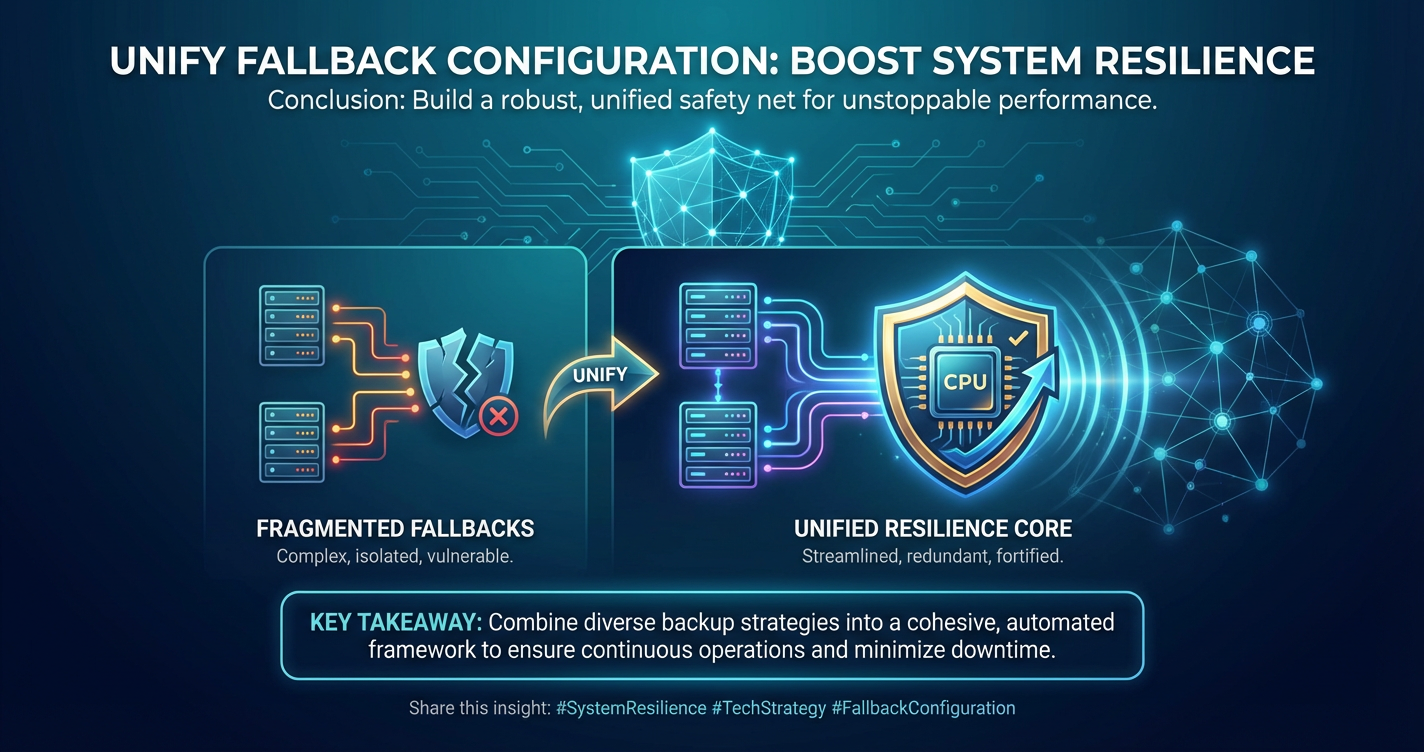
Unify Fallback Configuration: Boost System Resilience


In the intricate tapestry of modern software systems, where microservices communicate across networks, cloud resources abstract infrastructure, and AI models power critical decisions, the specter of failure is not a possibility but a certainty. Components will fail, networks will experience latency, and external dependencies will become unavailable. The true measure of a robust system, therefore, lies not in its ability to avoid failure, but in its capacity to gracefully withstand and recover from it. This fundamental concept is known as system resilience, and at its heart lies a well-orchestrated strategy for fallback.
Yet, as systems grow in complexity and scope, particularly with the proliferation of AI-driven services, fallback mechanisms often emerge in an ad-hoc, decentralized manner. Different teams implement their own solutions, leading to fragmentation, inconsistency, and a compounded struggle when outages occur. The mission to unify fallback configuration is not merely an operational nicety; it is a strategic imperative to move beyond reactive firefighting and towards proactive, predictable, and profoundly resilient system architectures. This article will delve into the critical need for such unification, explore its benefits, detail implementation strategies, and provide practical guidance for fostering true system resilience in an increasingly interconnected and AI-powered world.
The Foundation of System Resilience: Navigating a World of Inevitable Failure
System resilience is the ability of a system to continue operating, perhaps in a degraded but still functional state, despite the failure of some of its components or dependencies. It encompasses a broad range of capabilities, including fault tolerance, graceful degradation, quick recovery, and adaptability to changing conditions. In an era dominated by distributed computing, cloud-native architectures, and a growing reliance on external services—including sophisticated AI models—resilience has become the cornerstone of reliability and user trust.
The modern software landscape is inherently fragile. Microservices architectures, while offering agility and scalability, introduce a multitude of network calls, serialization points, and potential single points of failure. Containerization and orchestration platforms like Kubernetes add layers of abstraction but also complexity in managing resource allocation and service discovery. Furthermore, the increasing adoption of AI and machine learning models, often deployed as independent services, introduces new vectors of potential failure, such as model inference latency, data pipeline issues, or the unavailability of specialized hardware. User expectations, too, have soared; any significant downtime or performance degradation can lead to immediate user dissatisfaction, reputational damage, and financial losses. Consequently, building systems that can bend without breaking, and gracefully degrade rather than outright fail, is no longer a luxury but a fundamental requirement for business continuity and competitive advantage.
Common failure modes in distributed systems are diverse and pervasive. Network partitions, where communication between services is disrupted, are frequent occurrences. Individual service instances can crash due to bugs, memory leaks, or unhandled exceptions. External third-party APIs might experience outages or rate limit requests, starving dependent services of critical data or functionality. Resource exhaustion, such as CPU, memory, or database connection pool limits, can bring services to a crawl. Data corruption, whether subtle or overt, can lead to incorrect processing and cascading failures. Even seemingly benign events, like a misconfigured deployment or an unexpected spike in traffic, can trigger system-wide instability. The sheer volume and variety of these potential failure points necessitate a robust and coherent strategy for handling them, rather than relying on isolated, last-minute fixes. This is where the concept of unified fallback configuration becomes incredibly powerful, providing a systemic defense against the unpredictable nature of distributed environments.
Understanding Fallback Mechanisms: The Art of Graceful Degradation
At its core, fallback is a predefined alternative action or response taken when a primary operation or service fails or becomes unavailable. It's a proactive measure designed to prevent a small, isolated issue from escalating into a catastrophic system-wide outage. The purpose of fallback is multifaceted: it aims to maintain some level of service functionality, preserve user experience, reduce the blast radius of a failure, and provide time for recovery of the primary service. Without well-designed fallback, a single point of failure can trigger a cascade, bringing down entire applications or even critical business operations.
Fallback mechanisms manifest in various forms, tailored to address different types of failures and at different layers of the system architecture. Understanding these types is crucial for designing a comprehensive and unified strategy.
1. Data Fallback: This category focuses on situations where the primary data source is unavailable or returns an error. * Stale Data/Cached Data: Instead of failing, the system might serve previously cached data. For instance, a news website might display an older version of an article if the live content database is unreachable, or an e-commerce platform might show slightly outdated product availability until the inventory service recovers. This maintains functionality, albeit with slightly less up-to-date information. * Default/Placeholder Data: If no cached data is available, the system might provide default values or placeholder information. An image gallery might show a generic placeholder image if a specific image cannot be loaded, or a profile page might display "N/A" for certain fields if the user data service is down.
2. Service Fallback: This involves redirecting requests or providing alternative functionality when a primary service becomes unresponsive or returns errors. * Alternative Service: If a primary service (e.g., a high-performance recommendation engine) fails, the system might switch to a simpler, less resource-intensive alternative (e.g., a static list of popular items). This ensures some recommendation functionality persists. * Simplified Service: A feature might be temporarily disabled or simplified. For instance, a complex search filter might be removed, leaving only basic keyword search, if the underlying search index service is struggling. * Static Response/Hardcoded Data: In extreme cases, a service might return a predefined static response. For example, a weather API might return a hardcoded "sunny, 20°C" if its upstream data provider is down, or an authentication service might temporarily block new logins to prevent further system strain.
3. Resource Fallback: These mechanisms prevent resource exhaustion and protect downstream services. * Circuit Breakers: Inspired by electrical circuit breakers, this pattern prevents a system from repeatedly trying to access a failing service. Once a certain threshold of failures is met, the circuit "trips," and subsequent requests are immediately rejected or routed to a fallback, allowing the failing service time to recover. After a configurable cool-down period, the circuit moves to a "half-open" state, allowing a small number of requests to test if the service has recovered. * Rate Limiting: Protects services from being overwhelmed by too many requests. If a service is nearing its capacity, excess requests can be rejected or queued, sometimes with a "Too Many Requests" (HTTP 429) response, allowing the client to retry later. This prevents cascading failures due to resource exhaustion.
4. User Experience Fallback: Focuses on communicating failures gracefully to the end-user. * Degraded UI: Parts of the user interface might be hidden or replaced with informative messages indicating that certain features are temporarily unavailable. * Informative Messages: Instead of a generic error page, users receive clear messages explaining what happened and what to expect (e.g., "Our recommendation engine is temporarily unavailable, please check back later," or "We are experiencing high traffic, your request may take longer").
Fallback mechanisms can be broadly categorized as manual or automated. Manual fallback often involves human intervention, such as an operator switching a database replica or deploying a hotfix. While necessary for complex, unforeseen issues, manual processes are slow, error-prone, and unsustainable for frequent failures. Automated fallback, on the other hand, relies on predefined rules and system logic to detect failures and trigger alternative actions without human involvement. This includes everything from circuit breakers automatically tripping to an AI Gateway rerouting requests from an unresponsive LLM to a cached response. The goal of unified fallback configuration is to maximize automation, ensuring consistent, rapid, and predictable responses to system distress, thereby dramatically boosting overall system resilience.
The Challenge of Disparate Fallback Configurations: A Recipe for Disaster
While the necessity of fallback is universally acknowledged in modern system design, the manner in which these mechanisms are often implemented presents significant challenges. In many organizations, particularly those with rapidly evolving, distributed architectures, fallback configurations tend to emerge organically, driven by immediate needs rather than a holistic strategy. Different teams, responsible for different services or microservices, implement their own unique solutions for handling failures. This ad-hoc approach inevitably leads to a landscape of disparate fallback configurations, creating a host of problems that undermine the very resilience they are intended to foster.
One of the most immediate and impactful issues is inconsistency and complexity. Imagine a system with dozens or hundreds of microservices, each potentially having its own retry logic, timeout settings, circuit breaker thresholds, and alternative data sources defined in separate configuration files, codebases, or even environment variables. Some services might implement aggressive retries, while others have no retry logic at all. One service might return a default "empty" response, while another throws an unhandled exception for the same upstream failure. This fragmentation makes it incredibly difficult to understand the system's true failure behavior. When an incident occurs, pinpointing the exact point of failure, understanding how various services will react, and predicting the cascade effect becomes a Herculean task, often delaying diagnosis and recovery.
This leads directly to maintenance nightmares and increased operational overhead. Each unique fallback implementation requires separate maintenance, testing, and documentation. Updating a global policy, such as adjusting a common timeout value across all services, becomes a laborious and error-prone process, requiring changes across multiple repositories and deployments. Debugging becomes significantly harder; reproducing failure scenarios and understanding how different fallback policies interact can consume countless engineering hours. This not only burdens development and operations teams but also increases the likelihood of human error during configuration changes, potentially introducing new vulnerabilities or regressions.
Furthermore, disparate configurations contribute to delayed recovery and prolonged outages. During a widespread incident, the lack of a unified, predictable fallback strategy means that responses are often reactive and chaotic. Teams might scramble to manually activate fallback mechanisms, leading to slower incident resolution. The absence of standardized behavior across the system can also exacerbate cascading failures, as an overloaded service might trigger unhandled exceptions in its dependents, which in turn might lack proper fallback, propagating the failure further. This "domino effect" transforms a localized issue into a system-wide crisis, directly impacting uptime and user experience.
Security risks are another often-overlooked consequence. Inconsistent fallback logic can inadvertently expose sensitive data or create pathways for denial-of-service attacks. For example, a service that provides overly verbose error messages when an external dependency fails might leak internal system details. Or, a lack of consistent rate limiting fallback at the gateway level could allow an attacker to overwhelm backend services. Ensuring uniform, secure failure responses across the entire system becomes nearly impossible without a centralized approach.
The impact of these challenges is particularly pronounced in the context of AI and LLM-driven systems. These systems often rely on specialized, resource-intensive models that might be hosted on external platforms or proprietary hardware. Fallback in such environments must consider: * Model Availability: What happens if the primary LLM Gateway or the underlying LLM service is down, slow, or returning invalid responses? Different AI services might have different resilience needs or fallback options (e.g., reverting to a simpler model, using cached inference results, or providing a generic answer). * Latency and Cost: AI model inference can be computationally expensive and time-consuming. A unified fallback strategy needs to intelligently handle these considerations, perhaps by short-circuiting expensive calls when not critical, or by prioritizing requests differently under load. * Versioning and Updates: AI models are continuously updated. How do fallback configurations adapt when a new model version is deployed, or an older one is deprecated? Disparate approaches make this version management a nightmare. * Data Integrity: When using fallback mechanisms like cached responses for AI, ensuring the data's relevance and integrity is paramount.
Without a unified approach, managing the resilience of an AI-powered ecosystem becomes overwhelmingly complex. The ad-hoc patchwork of individual fallback strategies, while perhaps solving immediate problems, ultimately creates a brittle, unpredictable, and difficult-to-manage system, hindering innovation and threatening operational stability. The solution lies in a deliberate and systematic effort to unify these configurations, transforming system resilience from an afterthought into an intrinsic design principle.
APIPark is a high-performance AI gateway that allows you to securely access the most comprehensive LLM APIs globally on the APIPark platform, including OpenAI, Anthropic, Mistral, Llama2, Google Gemini, and more.Try APIPark now! 👇👇👇
The Power of Unifying Fallback Configuration: A Blueprint for Predictable Resilience
The transition from fragmented, ad-hoc fallback mechanisms to a unified configuration strategy represents a profound shift in how organizations approach system resilience. This deliberate and systematic approach centralizes the management and enforcement of failure-handling policies across the entire distributed system. The benefits of such a unification are far-reaching, transforming a system from one that merely reacts to failures into one that anticipates, mitigates, and recovers with predictability and grace.
1. Consistency and Predictability: The most immediate and significant advantage of unified fallback is the establishment of uniform behavior across all services. When a system-wide policy dictates how timeouts are handled, how retries are attempted, or what type of default response is returned when a critical dependency fails, engineers can confidently predict the system's behavior during an incident. This eliminates ambiguity and reduces the cognitive load during troubleshooting, allowing teams to focus on resolution rather than deciphering disparate logic. For instance, if a global policy specifies that all external API calls will have a maximum timeout of 5 seconds before triggering a specific fallback, every service will adhere to this, leading to consistent performance degradation rather than unpredictable failures.
2. Simplified Management and Reduced Operational Overhead: Centralizing fallback configurations vastly simplifies their management. Instead of configuring settings in dozens of separate microservices, policies can be defined and updated in a single, authoritative location. This could be a shared configuration service, a configuration-as-code repository, or a powerful management platform. This streamlined approach drastically reduces the effort involved in making system-wide changes, minimizes the risk of human error, and accelerates deployment cycles. Less time spent wrestling with inconsistent configurations translates directly to more time for innovation and feature development, lowering overall operational costs.
3. Faster Recovery and Reduced Mean Time To Recovery (MTTR): With unified fallback, the system's response to failure becomes automated and predictable. When an issue arises, the fallback mechanisms kick in consistently across affected components, preventing cascading failures. This proactive mitigation limits the blast radius of an incident, giving operations teams a clearer picture of the problem and more focused targets for intervention. Faster diagnosis, coupled with automated containment, means the system can return to full health much more quickly, minimizing downtime and its associated business impact.
4. Improved Observability and Debuggability: A unified approach naturally lends itself to better observability. When fallback policies are consistently applied, it becomes easier to instrument and monitor their activation. Dashboards can provide a holistic view of which fallback mechanisms are active, which services are relying on degraded modes, and the overall health of the system under stress. This real-time insight is invaluable for understanding system behavior during an incident and for proactively identifying potential bottlenecks or weaknesses before they manifest as critical failures. Consistent logging around fallback events further enhances debuggability.
5. Enhanced Reliability and User Experience: By consistently and gracefully handling failures, unified fallback configurations significantly boost overall system reliability. Users encounter fewer hard errors, experience smoother degradation, and receive more informative feedback. Instead of encountering unresponsive pages or cryptic error messages, they might see slightly older data, simplified functionality, or clear explanations. This positive experience builds trust and retains users, even when the underlying system is experiencing turbulence.
6. Better Security Posture: Consistent fallback behavior can also improve security. When services fail predictably, it reduces the chances of unexpected behavior that could be exploited. For example, a unified policy for handling external service failures can ensure that no sensitive data is accidentally exposed in error messages, or that a service doesn't enter an insecure state due to unhandled exceptions. Consistent rate limiting and denial-of-service protection applied uniformly across the gateway layer can prevent malicious actors from overwhelming backend services.
7. Cost Optimization: By preventing cascading failures and ensuring faster recovery, unified fallback can also lead to cost savings. Fewer prolonged outages mean less lost revenue. More efficient resource utilization during degraded modes can reduce the need for immediate scaling up, optimizing cloud infrastructure costs.
Achieving this level of unification requires careful architectural considerations: * Centralized Configuration Stores: Tools like Apache ZooKeeper, HashiCorp Consul, Etcd, or even Kubernetes ConfigMaps and Secrets, provide a single source of truth for configuration data. Services can dynamically fetch their fallback policies from these stores. * Configuration as Code (CaC): Defining fallback policies in version-controlled files (e.g., YAML, JSON) alongside the application code ensures that configurations are immutable, auditable, and subject to the same development workflows as the code itself. * Policy Engines: For complex decision-making, policy engines (e.g., Open Policy Agent) can be used to define and enforce granular fallback rules dynamically across the system. * Dynamic Configuration Updates: The ability to update fallback policies without redeploying services is crucial for rapid response to evolving threats or system conditions. This often involves push/pull mechanisms with the centralized configuration store.
By embracing these principles and tools, organizations can move beyond a reactive stance towards failure and build truly resilient systems that are predictable, manageable, and highly reliable, even in the face of inevitable disruptions.
Implementing Unified Fallback Strategies: A Layered Defense
Implementing a unified fallback configuration is not a one-size-fits-all solution; it requires a layered approach, applying different strategies at various architectural levels to create a comprehensive defense against failures. Each layer offers unique opportunities to detect issues and activate appropriate fallback mechanisms, contributing to overall system resilience.
Layered Approach to Fallback:
1. Client-Side Resilience: The journey of a request begins at the client, making this the first opportunity for resilience. * Retries with Exponential Backoff: Clients should be configured to retry failed requests, but not immediately. Exponential backoff increases the delay between retries to avoid overwhelming a struggling service. A jitter (randomized delay) should also be added to prevent thundering herd problems. * Timeouts: Clients must enforce reasonable timeouts for all network operations. If a service doesn't respond within a defined period, the client should assume failure and trigger its own fallback (e.g., show an error, use cached data). * Client-side Load Balancing: Clients can use intelligent load balancing (e.g., based on observed service health or latency) to avoid sending requests to known unhealthy instances.
2. Service Mesh Resilience: In microservices architectures, a service mesh (e.g., Istio, Linkerd) provides a dedicated infrastructure layer for service-to-service communication, offering powerful resilience features without modifying application code. * Circuit Breaking: The service mesh can automatically trip circuit breakers for failing upstream services, preventing requests from being sent to unhealthy instances. This is a critical pattern to stop cascading failures. * Rate Limiting: Global or per-service rate limits can be applied to protect services from being overwhelmed. * Retries and Timeouts: The mesh can enforce consistent retry policies and timeouts for all service-to-service calls, centralizing these configurations. * Traffic Shifting/Mirroring: In case of service degradation, the mesh can be configured to shift traffic away from the problematic service to a healthier alternative, or even mirror a small percentage of traffic to a new version for testing.
3. API Gateway/Proxy Resilience (Leveraging Keywords): The gateway serves as the entry point for all incoming requests, making it an ideal control plane for applying unified fallback policies. Whether it's a traditional API gateway handling REST APIs or a specialized AI Gateway managing calls to large language models, its position enables powerful, centralized control. * Global Fallback Policies: A gateway can enforce global policies like returning a static response for specific endpoints if a backend service is down. For example, if a recommendation service fails, the gateway might return a hardcoded list of popular items instead of forwarding the request, preventing application errors. * Service Redirection/Routing: If a primary service is unhealthy, the gateway can transparently redirect requests to a predefined fallback service or a degraded version of the original service. * Caching at the Edge: The gateway can cache responses, serving stale data if the backend is unreachable, reducing load and improving perceived availability. * Rate Limiting and Throttling: The gateway is the first line of defense against excessive traffic, capable of applying comprehensive rate limits to protect all downstream services. * Request/Response Transformation: In failure scenarios, the gateway can modify responses to provide user-friendly error messages or transform data to fit a degraded UI experience.
For organizations dealing heavily with AI, an AI Gateway or LLM Gateway becomes particularly vital here. These specialized gateways can manage access to multiple AI models, abstracting away their complexities. If an underlying LLM becomes unavailable or experiences high latency, an LLM Gateway can implement fallback strategies such as: * Routing requests to an alternative, perhaps less sophisticated, LLM. * Returning a cached or pre-computed response for common queries. * Providing a generic error message indicating model unavailability. * Leveraging a prompt fallback, where if a complex prompt fails, a simpler, more robust prompt is used.
This is where a product like APIPark demonstrates its value. As an all-in-one AI gateway and API management platform, APIPark helps unify the management of API and AI service resilience. It enables quick integration of 100+ AI models and provides a unified API format for AI invocation, meaning fallback strategies can be applied consistently across different models. Its ability to encapsulate prompts into REST APIs, manage the end-to-end API lifecycle, and handle traffic forwarding and load balancing makes it an excellent platform for implementing and unifying fallback configurations for both traditional and AI-driven APIs. For example, with APIPark, you could define a single policy that dictates how all AI model calls should behave when an upstream model inference service is unresponsive, whether it's returning a static "model unavailable" message or redirecting to a backup, less resource-intensive model. This centralization significantly reduces the complexity inherent in managing resilience across a diverse set of AI services.
4. Application Level Fallback: Within the application code itself, specific business logic can implement finer-grained fallback. * Data Caching: Applications can maintain local caches for frequently accessed data, using them when the primary data source is unavailable. * Alternative Algorithms: If a complex algorithm fails, the application can switch to a simpler, more robust one (e.g., simpler recommendation logic if the sophisticated AI model is down). * Feature Degradation: The application can dynamically disable non-essential features based on system health indicators.
5. Data Layer Fallback: The data storage layer also plays a crucial role in resilience. * Read Replicas: If the primary database becomes unavailable, applications can temporarily switch to read replicas for read-heavy operations, perhaps accepting eventually consistent data. * Eventual Consistency: Designing for eventual consistency allows parts of the system to continue operating even if data synchronization is temporarily delayed. * Backup/Restore: While not an immediate fallback, robust backup and restore procedures are the ultimate fallback for data loss scenarios.
Pattern-based Implementation:
Beyond layers, specific patterns underpin effective fallback: * Circuit Breaker: Prevents repeated calls to a failing service, allowing it to recover and preventing cascading failures. * Bulkhead: Isolates failing components so they don't bring down the entire system. Think of compartments in a ship. * Retry with Exponential Backoff: As mentioned, for transient failures, client retries are essential. * Timeout: Crucial for preventing services from hanging indefinitely. * Cache Fallback: Serving stale or cached data during primary source unavailability. * Feature Toggle/Kill Switch: Allows dynamic enabling/disabling of features at runtime, useful for quickly turning off problematic parts of the system without redeployment.
Monitoring and Alerting: The Eyes and Ears of Fallback:
No fallback strategy is complete without robust monitoring and alerting. * Define Metrics: Track key metrics related to fallback activation: how often circuits trip, how frequently fallback services are invoked, latency during fallback states, and the success rate of fallback operations. * Set Up Alerts: Configure alerts for critical fallback events (e.g., prolonged circuit breaker trips, high rates of fallback invocations) to notify operations teams promptly. * Dashboards: Create dashboards that visualize fallback states, allowing real-time observation of system resilience. Understanding when and why fallback mechanisms are engaged is vital for continuous improvement and proactive maintenance.
By meticulously implementing these layered and pattern-based strategies, underpinned by strong observability, organizations can build systems that are not just fault-tolerant but truly resilient, capable of navigating the inherent unpredictability of distributed environments with grace and efficiency.
Challenges and Best Practices: Forging True Resilience
While the benefits of unifying fallback configurations are clear, the path to achieving it is not without its challenges. Modern distributed systems are complex, heterogeneous environments, and implementing a truly unified and effective fallback strategy requires careful planning, rigorous testing, and continuous refinement. Addressing these challenges proactively and adhering to best practices is paramount for success.
Key Challenges in Unifying Fallback:
1. Complexity in Heterogeneous Environments: The primary challenge lies in the sheer diversity of technologies, programming languages, and deployment models within a typical enterprise. A system might comprise services written in Java, Python, and Node.js, running on Kubernetes, bare metal, and serverless platforms, interacting with various databases, message queues, and external APIs. Harmonizing fallback configurations across such a disparate landscape, ensuring consistent behavior and management, is a monumental task. For instance, configuring a uniform circuit breaker policy that behaves identically in a Java Spring Boot application, a Python FastAPI service, and a serverless AWS Lambda function requires significant abstraction or reliance on platform-level features like a service mesh or gateway.
2. Testing Fallback Mechanisms: One of the most critical yet often overlooked challenges is thoroughly testing fallback mechanisms. Simulating specific failure modes (e.g., network partitions, service slowdowns, database unavailability, LLM Gateway outages) in a controlled and repeatable manner is difficult. Furthermore, ensuring that fallback logic activates correctly, provides the intended degraded service, and does not introduce new issues (like infinite retry loops or unexpected data corruption) requires sophisticated testing strategies, including chaos engineering. Without robust testing, fallback mechanisms can create a false sense of security, potentially failing when they are most needed.
3. Ensuring Data Consistency During Fallback: When fallback involves serving stale data from caches or redirecting to alternative data sources, maintaining data consistency and integrity becomes a significant concern. Systems must be designed to explicitly handle eventual consistency, understand the implications of serving outdated information, and manage potential conflicts when the primary data source recovers. For example, if an e-commerce platform uses cached inventory data as a fallback, it must ensure that overselling doesn't occur when the real-time inventory service eventually comes back online.
4. Avoiding Infinite Loops or Unexpected Behavior: Poorly designed fallback logic can lead to unintended consequences, such as services repeatedly retrying a failing dependency in an infinite loop, consuming excessive resources, or a chain of fallback actions leading to an unexpected system state. Careful design of retry policies, backoff strategies, and clear exit conditions for fallback flows is essential to prevent these pitfalls. Similarly, fallback must not introduce new security vulnerabilities or data exposure risks.
5. Managing Configuration Drift: Even with centralized configuration, ensuring that all services actually adhere to the unified policies and that no "shadow" configurations emerge can be challenging. Teams might introduce local overrides or custom logic that deviates from the intended unified approach, leading to configuration drift and reintroducing inconsistency.
Best Practices for Forging True Resilience:
To overcome these challenges and successfully implement a unified fallback strategy, consider the following best practices:
1. Design for Failure from the Outset: Resilience and fallback should not be an afterthought but an integral part of the system design process. As new services or features are planned, explicitly define their failure modes, what constitutes acceptable degradation, and the corresponding fallback strategies. This "failure-first" mindset fosters a more robust architecture from day one.
2. Start Simple, Iterate and Expand: Don't try to implement every possible fallback mechanism across all services at once. Begin with the most critical services and the most common failure modes. Implement basic timeouts, retries, and simple static fallbacks. Once these are stable and proven, iterate by adding more sophisticated patterns like circuit breakers, bulkheads, and more intelligent fallback logic, gradually expanding the scope of unification.
3. Test Thoroughly with Chaos Engineering: Regular and systematic testing of fallback mechanisms is non-negotiable. Employ chaos engineering principles by intentionally injecting failures into the system (e.g., latency, service crashes, network partitions) to validate that fallback mechanisms activate correctly and the system behaves as expected under stress. This goes beyond traditional unit and integration testing, verifying resilience in a realistic operational context.
4. Document Everything and Create Runbooks: Clear, up-to-date documentation of all unified fallback policies, their implementation details, and expected behavior during various failure scenarios is crucial. Develop detailed runbooks for operations teams, outlining how to monitor fallback states, what actions to take during prolonged fallback, and how to manually intervene if automated fallback isn't sufficient. This knowledge sharing is vital for effective incident response.
5. Monitor Continuously and Alert Proactively: Implement robust monitoring and observability tools to track the health of services and the activation of fallback mechanisms. Set up meaningful alerts that notify teams when fallback thresholds are breached or when a service enters a prolonged degraded state. Real-time visibility into the system's resilience status is key to proactive management.
6. Automate Deployment and Management of Configurations: Leverage Configuration as Code (CaC) and automated deployment pipelines to manage fallback configurations. This ensures that changes are version-controlled, auditable, and consistently applied across the environment. Dynamic configuration systems that allow for runtime updates (e.g., via a centralized config store) are also highly beneficial for rapid response.
7. Regularly Review and Refine Policies: The operational landscape is constantly evolving. Conduct periodic reviews of fallback policies and their effectiveness. Analyze incident reports to identify gaps or areas for improvement. As new services, technologies (like novel AI models), or business requirements emerge, existing fallback strategies may need to be adapted or new ones introduced. This iterative refinement ensures that the unified fallback configuration remains relevant and effective.
8. Leverage Platform Capabilities (e.g., Service Mesh, API Gateway): Instead of reinventing the wheel in every service, leverage the resilience features offered by platform components. A service mesh can provide consistent circuit breaking and retry logic for inter-service communication. An AI Gateway or an LLM Gateway can centralize failure handling for all AI model invocations. Products like APIPark can significantly simplify the implementation of unified fallback by providing out-of-the-box features for traffic management, load balancing, and API lifecycle management, ensuring consistency across a wide array of services including AI.
By embracing these best practices, organizations can transform the abstract concept of unified fallback into a tangible, operational reality, building systems that are not just resilient in theory, but demonstrably robust and dependable in the face of real-world challenges. This proactive approach to failure is what truly distinguishes leading-edge systems and ensures sustained business continuity.
Conclusion: The Indispensable Role of Unified Fallback in an AI-Driven Future
In an era defined by the accelerating pace of digital transformation, the proliferation of distributed systems, and the burgeoning influence of artificial intelligence, system resilience has transcended its status as a mere technical objective to become a fundamental business imperative. The intricate web of microservices, cloud dependencies, and sophisticated AI models that power modern applications introduces an inherent fragility, where even minor component failures can trigger a cascade of disruptions. Against this backdrop, the concept of unified fallback configuration emerges not just as a best practice, but as an indispensable strategic pillar for building truly robust, reliable, and trustworthy systems.
We have explored how a fragmented, ad-hoc approach to fallback inevitably leads to inconsistency, complexity, delayed recovery, and increased operational burden. These disparate configurations are a recipe for chaos during an outage, transforming predictable issues into prolonged crises. The power of unification lies in its ability to instill consistency, simplify management, accelerate recovery, and enhance the overall reliability of the system. By centralizing the definition and enforcement of fallback policies, organizations can achieve a level of predictability and control that is simply unattainable with siloed implementations.
The layered approach to implementing unified fallback, from client-side retries to the strategic use of API Gateway and AI Gateway solutions, demonstrates that resilience is a holistic endeavor. Whether it’s intelligently routing requests away from an unresponsive LLM Gateway, serving cached data during a database outage, or gracefully degrading user experience when an external service fails, each layer contributes to a collective defense. Products like APIPark offer tangible platforms to achieve this unification, particularly in the complex realm of AI and API management, allowing for streamlined integration and consistent fallback policies across diverse models and services.
Looking ahead, the importance of unified fallback will only intensify. As AI models become more integrated into core business processes, the resilience of the AI inference pipeline will be paramount. A unified approach ensures that when primary models are unavailable, alternative strategies can be consistently and predictably applied, preventing disruptions to AI-powered features. Furthermore, the continuous evolution of cloud-native patterns and serverless architectures will demand even more sophisticated and automated fallback mechanisms that can adapt dynamically to transient failures and resource fluctuations.
The journey to achieve a fully unified fallback configuration is challenging, requiring a commitment to design for failure, rigorous testing through chaos engineering, continuous monitoring, and iterative refinement. However, the investment pays dividends in the form of systems that gracefully weather storms, maintain high availability, and deliver consistent value to users. By embracing unified fallback, organizations are not merely preparing for the inevitable; they are actively shaping a future where their digital infrastructure is not just functional, but profoundly resilient, ensuring business continuity and fostering enduring user trust in an ever-changing technological landscape.
Frequently Asked Questions (FAQ)
1. What exactly does "Unified Fallback Configuration" mean in practice? Unified Fallback Configuration refers to the practice of centrally defining, managing, and enforcing consistent fallback policies across all services and components within a distributed system. Instead of individual teams or services implementing their own ad-hoc failure handling (e.g., unique timeout values, different retry logic, varied error responses), unification ensures a single source of truth for these configurations. In practice, this means using tools like a centralized configuration store, a service mesh, or an API Gateway (like APIPark) to apply standard rules for things like circuit breaking, retries, timeouts, and static responses when primary services or data sources become unavailable. This consistency makes the system's behavior predictable during failures, simplifies management, and accelerates recovery.
2. Why is unified fallback particularly important for systems that use AI/LLM models? AI/LLM models introduce unique resilience challenges due to their computational intensity, potential reliance on specialized hardware or external services, and varying latency characteristics. A unified fallback strategy is crucial because it allows an AI Gateway or LLM Gateway to consistently manage responses when a primary AI model is slow, unavailable, or returning errors. This could involve automatically routing requests to a backup, less resource-intensive model, serving cached inference results, providing a generic explanatory message, or even falling back to simpler business logic. Without unification, each AI-powered service might handle model failures differently, leading to inconsistent user experiences, higher operational complexity, and difficulty in maintaining the overall reliability of AI-driven features.
3. What are the main benefits of implementing a unified fallback configuration? The primary benefits include: * Increased System Consistency: All services behave predictably during failures, reducing ambiguity. * Simplified Management: Centralized control reduces operational overhead and human error during configuration changes. * Faster Recovery (Reduced MTTR): Automated and consistent fallback mechanisms prevent cascading failures and help pinpoint issues, leading to quicker incident resolution. * Improved Observability: Easier to monitor and understand system behavior during degraded states. * Enhanced Reliability and User Experience: Fewer hard errors, graceful degradation, and clear user communication build trust. * Better Security Posture: Consistent error handling can prevent accidental data exposure or insecure states. * Cost Optimization: Prevents costly prolonged outages and can optimize resource use during degraded modes.
4. How does an API Gateway contribute to unifying fallback configurations? An API Gateway acts as the central entry point for all client requests, giving it a unique vantage point to enforce unified fallback policies. It can apply global rules such as: * Centralized Rate Limiting: Protecting all downstream services from overload. * Circuit Breaking: Preventing requests from reaching failing backend services. * Service Redirection: Rerouting requests to fallback services or static responses. * Caching: Serving cached responses when backend services are unavailable. * Response Transformation: Modifying error responses for consistency and user-friendliness. For AI-specific scenarios, an AI Gateway (like APIPark) extends these capabilities to AI models, allowing unified management of model access, versioning, and failure handling across multiple AI services.
5. What are the key steps to start implementing a unified fallback strategy in an existing system? 1. Audit Current State: Document existing fallback mechanisms (or lack thereof) across your services. 2. Identify Critical Paths: Determine which services and dependencies are most crucial for your core business functions. 3. Define Core Policies: Establish initial, simple, system-wide policies for common failures (e.g., standard timeouts, retry attempts with backoff, generic fallback responses). 4. Leverage Platform Tools: Implement these policies using existing infrastructure components like your service mesh, API Gateway, or centralized configuration service. Consider specialized solutions like APIPark for AI services. 5. Start Small, Iterate: Apply unified policies to a few non-critical or moderately critical services first, learn, and then expand. 6. Test Rigorously: Use chaos engineering to validate that your unified fallback mechanisms work as expected under realistic failure conditions. 7. Monitor and Refine: Continuously monitor fallback activation, collect metrics, and use incident data to iteratively improve and refine your policies.
🚀You can securely and efficiently call the OpenAI API on APIPark in just two steps:
Step 1: Deploy the APIPark AI gateway in 5 minutes.
APIPark is developed based on Golang, offering strong product performance and low development and maintenance costs. You can deploy APIPark with a single command line.
curl -sSO https://download.apipark.com/install/quick-start.sh; bash quick-start.sh

In my experience, you can see the successful deployment interface within 5 to 10 minutes. Then, you can log in to APIPark using your account.

Step 2: Call the OpenAI API.