Unlock AI Security with a Safe AI Gateway Solution



The rapid advancements in Artificial Intelligence (AI) are fundamentally reshaping industries, revolutionizing how businesses operate, interact with customers, and derive insights from vast datasets. From automating complex processes and powering sophisticated analytics to enabling natural language understanding and predictive modeling, AI’s transformative potential is undeniable. However, this exhilarating pace of innovation brings with it a new frontier of security challenges, operational complexities, and governance requirements that traditional IT infrastructures are often ill-equipped to handle. As organizations increasingly integrate AI models, especially large language models (LLMs), into their core operations, the need for robust, specialized security and management solutions becomes paramount.
At the heart of addressing these emerging challenges lies the concept of an AI Gateway. More than just a simple proxy, a well-implemented AI Gateway acts as a critical control plane, safeguarding AI interactions, standardizing model access, optimizing performance, and ensuring regulatory compliance. This comprehensive article delves into the indispensable role of a safe AI Gateway solution, exploring its foundational principles, distinguishing it from traditional API Gateways, and highlighting its specialized functions as an LLM Gateway. We will uncover how such a solution empowers organizations to confidently harness the power of AI, mitigating risks, enhancing operational efficiency, and unlocking unprecedented levels of security and scalability in their AI-driven initiatives. By understanding the intricacies and strategic importance of these gateways, businesses can pave the way for a more secure, manageable, and ultimately, more successful AI future.
The AI Revolution and Its Security Implications: Navigating a New Digital Frontier
The current era is unequivocally defined by the accelerating ascent of Artificial Intelligence. What once seemed like science fiction is now an everyday reality, with AI systems permeating every facet of modern life and business. Industries ranging from finance and healthcare to manufacturing and retail are leveraging AI to automate mundane tasks, unearth hidden patterns in data, personalize customer experiences, and make predictions with unprecedented accuracy. The allure of increased efficiency, enhanced decision-making capabilities, and significant competitive advantages drives widespread AI adoption. Companies are investing heavily in machine learning algorithms, deep neural networks, and, most notably, large language models (LLMs) to unlock new avenues of innovation and growth. This transformative wave promises not just incremental improvements but often fundamental shifts in how value is created and delivered.
However, beneath the surface of this innovation lies a complex landscape of security vulnerabilities and operational hurdles that demand immediate and sophisticated attention. The very nature of AI, with its reliance on vast datasets, intricate models, and dynamic interactions, introduces a unique set of risks that traditional cybersecurity measures, primarily designed for static applications and network perimeters, struggle to address adequately. The sheer volume and sensitivity of data fed into AI models present a prime target for malicious actors. A data breach involving an AI system could expose not only proprietary algorithms but also highly confidential personal, financial, or health information, leading to severe reputational damage, hefty regulatory fines, and a catastrophic loss of customer trust.
Beyond data breaches, AI systems are susceptible to novel forms of attack. Model poisoning, for instance, involves injecting corrupted data into training sets, subtly manipulating an AI's learning process to produce biased or incorrect outputs, potentially leading to flawed decisions in critical applications like medical diagnosis or financial fraud detection. Adversarial attacks, another growing concern, involve crafting deliberately misleading inputs that appear benign to humans but cause an AI model to misclassify or behave unexpectedly. Imagine an autonomous vehicle misidentifying a stop sign as a speed limit sign due to a minor, visually imperceptible alteration. Unauthorized access to AI endpoints, even without direct data extraction, could lead to intellectual property theft of valuable models or their misuse for illicit purposes. Furthermore, the burgeoning regulatory landscape surrounding data privacy (like GDPR, CCPA, and upcoming AI-specific regulations) and ethical AI use adds layers of compliance complexity. Organizations must ensure their AI systems are transparent, fair, and accountable, avoiding biases and respecting user privacy, or face severe legal and ethical repercussions. Managing the computational costs associated with powerful AI models, especially LLMs, also presents a significant operational challenge, requiring careful monitoring and optimization to prevent runaway expenditures.
In essence, while the promise of AI is immense, its full potential can only be realized if these inherent security risks and operational complexities are effectively managed. A reactive approach is insufficient; a proactive, dedicated solution is required to build a resilient and trustworthy AI infrastructure. This is precisely where the concept of a specialized gateway becomes not just beneficial, but absolutely indispensable.
Understanding the Core Concepts: API, AI, and LLM Gateways
To truly appreciate the necessity and functionality of a safe AI Gateway solution, it's crucial to first understand its foundational technologies and how it evolves to meet specialized AI requirements. We begin with the generalized concept of an API Gateway, then move to the specialized AI Gateway, and finally focus on the highly specific LLM Gateway. Each layer builds upon the previous, adding crucial functionalities tailored to the unique demands of modern application and AI architectures.
The Foundational Role of an API Gateway
At its core, an API Gateway acts as the single entry point for all clients interacting with a collection of backend services, typically in a microservices architecture. It’s not merely a simple reverse proxy but a powerful layer that abstracts the complexities of the underlying services from the consuming clients. When a client makes a request, it first hits the API Gateway, which then intelligently routes that request to the appropriate backend service. This architectural pattern emerged as a solution to the challenges of managing numerous, independently deployable microservices, offering a unified, consistent, and secure interface.
The traditional role of an API Gateway encompasses a wide array of critical functionalities. First and foremost, it handles routing and traffic management, directing incoming requests to the correct service based on predefined rules. This is essential for ensuring that each service receives only the traffic intended for it, improving overall system organization and maintainability. Secondly, authentication and authorization are pivotal. The gateway can verify client identities using various schemes (e.g., OAuth, JWT, API keys) and then determine whether the authenticated client has permission to access the requested resource. This offloads security concerns from individual microservices, centralizing access control.
Furthermore, rate limiting is a common feature, protecting backend services from being overwhelmed by too many requests, which could lead to denial-of-service (DoS) attacks or simply poor performance. Caching frequently accessed responses at the gateway level significantly reduces the load on backend services and improves response times for clients. Request and response transformation allows the gateway to modify incoming requests or outgoing responses to match client expectations or service requirements, decoupling client applications from specific service implementations. Logging and analytics capabilities enable comprehensive monitoring of API traffic, providing insights into usage patterns, performance metrics, and potential issues, which are vital for troubleshooting and capacity planning. Finally, load balancing distributes incoming traffic across multiple instances of a service, ensuring high availability and optimal resource utilization.
In essence, an API Gateway is indispensable for any modern distributed system, providing a robust, scalable, and secure interface that simplifies development, enhances operational efficiency, and improves the overall resilience of the application ecosystem. It is the bedrock upon which more specialized gateways, like those for AI, are built.
The Evolution to an AI Gateway: Specialization for Intelligent Services
While a traditional API Gateway provides excellent foundational capabilities, the unique characteristics and requirements of Artificial Intelligence services demand a more specialized approach. An AI Gateway builds upon the robust infrastructure of an API Gateway but extends its functionalities to specifically address the distinctive challenges presented by AI models. It acts as an intelligent intermediary, optimizing interactions with AI services, enhancing their security, and streamlining their integration into broader applications.
One of the primary challenges an AI Gateway tackles is model diversity and heterogeneity. In a typical enterprise, AI deployments often involve a mix of models: some might be proprietary cloud-based services (e.g., Google AI, AWS AI/ML services, Azure AI), others might be open-source models deployed on-premise, and still others could be custom-trained models. Each of these models might have its own unique API structure, authentication methods, and data formats. An AI Gateway provides a unified interface, abstracting away these differences. It translates incoming requests into the specific format required by the target AI model and converts model responses back into a standardized format for the consuming application. This significantly simplifies development, as applications no longer need to be aware of the underlying complexities of each individual AI service. This also eases model switching and versioning, allowing organizations to swap out AI providers or update models without disrupting dependent applications.
Beyond mere translation, an AI Gateway also focuses on intelligent prompt engineering and input validation. For many AI models, especially generative ones, the quality and format of the input prompt critically influence the output. The gateway can enforce best practices for prompts, validate input data against schemas, and even preprocess inputs to optimize model performance or mitigate common vulnerabilities. Furthermore, sensitive data handling is a crucial aspect. AI models often process highly confidential information. The gateway can implement data anonymization, redaction, or tokenization techniques on inputs before they reach the AI model, and similarly, filter sensitive information from model outputs before they are returned to the client, ensuring greater privacy and compliance.
Security functions are significantly enhanced within an AI Gateway context. It can implement more granular access control specific to AI models or even specific functions within a model, ensuring that only authorized applications or users can invoke particular AI capabilities. It becomes a choke point for threat detection and prevention unique to AI, such as identifying and mitigating attempts at model poisoning or adversarial attacks by analyzing input patterns for suspicious characteristics. Cost management is another vital feature. By tracking invocations and token usage across different AI models and providers, the gateway enables organizations to monitor, analyze, and optimize their AI expenditure, preventing unexpected cost overruns. This centralized control also fosters better governance and ethical AI use, allowing organizations to enforce policies around data usage, model fairness, and output validation.
In essence, an AI Gateway is the specialized layer that transforms raw AI services into manageable, secure, and integrated components of an enterprise architecture, making the promise of AI more accessible and safer to realize. An exemplary solution in this space, offering many of these advanced features, is ApiPark, an open-source AI gateway and API management platform designed to help developers and enterprises manage, integrate, and deploy AI and REST services with remarkable ease and efficiency.
The Further Specialization: An LLM Gateway for Large Language Models
The proliferation of Large Language Models (LLMs) like GPT, Claude, Llama, and others has introduced a new paradigm of AI interaction, presenting its own set of unique security and operational challenges. An LLM Gateway represents a further specialization of an AI Gateway, specifically tailored to manage the nuances, risks, and complexities associated with these powerful generative models. Given their ability to understand, generate, and manipulate human language, LLMs introduce specific vectors for abuse and operational concerns that require dedicated solutions.
One of the foremost security concerns addressed by an LLM Gateway is prompt injection. Malicious actors might craft prompts designed to bypass safety filters, extract sensitive information from the model's context, or coerce the model into performing unintended actions (e.g., generating harmful content). The gateway can implement sophisticated prompt sanitization, validation, and threat detection mechanisms to identify and neutralize such adversarial inputs before they reach the LLM. This includes analyzing the semantic content of prompts for suspicious patterns, applying rule-based filters, and even using a secondary AI model to assess prompt safety.
Data leakage through responses is another critical risk. LLMs, especially when given access to proprietary or sensitive information during a session, might inadvertently reveal that information in subsequent responses to different users if not properly isolated or managed. An LLM Gateway can enforce strict context management and isolation, ensuring that user sessions are compartmentalized and that no sensitive information from one interaction can bleed into another. It can also apply output filtering and redaction to scan model responses for PII (Personally Identifiable Information), confidential data, or undesirable content before it reaches the end-user, adding an extra layer of protection.
Controlling model behavior and enforcing guardrails is paramount. LLMs are powerful but can sometimes be "hallucinatory" or generate biased, inappropriate, or factually incorrect content. The gateway can implement content moderation filters that analyze model outputs for adherence to ethical guidelines and brand safety policies, flagging or blocking responses that violate these rules. It can also manage access to different LLM capabilities, ensuring that users only interact with authorized functions of the model.
From an operational perspective, cost optimization for token usage is a major benefit. LLMs incur costs based on the number of tokens processed (both input and output). An LLM Gateway can meticulously track token usage per user, application, or project, implement quotas, and even route requests to the most cost-effective LLM provider available based on real-time pricing and performance, providing significant savings. Managing different LLM providers (e.g., OpenAI, Anthropic, Google, custom open-source models) is also streamlined. Just as an AI Gateway unifies various AI models, an LLM Gateway specifically standardizes the invocation and response formats for diverse LLMs, allowing organizations to easily switch between providers or leverage multiple models for redundancy and optimal performance without re-architecting their applications. This abstraction is invaluable for maintaining flexibility and avoiding vendor lock-in.
Finally, an LLM Gateway provides enhanced observability and auditability for conversational AI interactions. Every prompt, every response, and critical metadata can be meticulously logged, creating an immutable audit trail. This is essential for debugging, performance analysis, compliance verification, and post-incident forensic investigations.
In sum, an LLM Gateway is not just an added layer but a strategic imperative for any organization seriously engaging with large language models. It transforms the potential chaos of diverse, powerful, and sometimes unpredictable LLMs into a controlled, secure, and cost-effective operational asset, fully realizing the vision of a safe AI Gateway for the age of generative AI.
Key Security Features of a Safe AI Gateway Solution
The true value proposition of a dedicated AI Gateway lies in its ability to fortify the security posture of AI deployments against a diverse array of threats. Moving beyond the general capabilities of an API Gateway, a safe AI Gateway solution incorporates specialized security features meticulously designed to protect sensitive AI interactions, prevent misuse, and ensure compliance. These features are not merely additive but are intrinsically woven into the gateway's architecture, creating a multi-layered defense mechanism.
Robust Authentication and Authorization
At the foundational level, stringent authentication and authorization mechanisms are paramount for any secure system, and an AI Gateway is no exception. It serves as the primary enforcement point for who (or what service) can access AI models and what actions they are permitted to perform.
Firstly, the gateway must support strong user and service authentication. This typically involves validating identities using industry-standard protocols such as OAuth 2.0 for user authentication, JSON Web Tokens (JWTs) for secure information exchange, or secure API keys for service-to-service communication. The gateway centralizes this process, offloading the burden from individual AI models and ensuring a consistent security policy across all AI endpoints. By decoupling authentication from the AI models themselves, organizations can more easily manage credentials, implement multi-factor authentication (MFA), and revoke access swiftly when necessary, without requiring changes to the underlying AI services.
Secondly, granular access control for AI models and endpoints is critical. Not every user or application needs access to every AI model, nor do they need the same level of permission on the models they do access. An AI Gateway enables administrators to define precise access policies, specifying which users or roles can invoke particular AI models (e.g., a sentiment analysis model vs. a highly sensitive medical diagnostic model), which specific endpoints within a model they can call (e.g., read-only access vs. data-submission access), and even under what conditions (e.g., time-based access, IP-restricted access). This "principle of least privilege" minimizes the attack surface by ensuring that even if an unauthorized entity gains access, their potential impact is severely limited.
Finally, Role-Based Access Control (RBAC) is an indispensable feature for managing permissions efficiently in complex organizational structures. Instead of assigning permissions to individual users, RBAC allows administrators to define roles (e e.g., "AI Developer," "Data Scientist," "Application User," "Auditor") and assign specific permissions to these roles. Users are then assigned one or more roles, inheriting their associated permissions. This simplifies management, especially in environments with many users and AI services, ensuring that access rights are consistent, auditable, and easily scalable as teams grow or responsibilities change. An AI Gateway implementing robust RBAC ensures that different departments or teams interacting with AI models have independent and appropriately constrained access to resources, promoting both security and operational clarity.
Data Protection and Privacy
Given that AI models often process vast quantities of sensitive and proprietary data, data protection and privacy are non-negotiable aspects of a safe AI Gateway solution. The gateway acts as a crucial checkpoint to prevent data breaches, ensure confidentiality, and maintain regulatory compliance.
One of the fundamental measures is encryption in transit and at rest. All communications between clients, the AI Gateway, and backend AI models must be encrypted using strong protocols like TLS/SSL to prevent eavesdropping and data interception. Furthermore, any data temporarily stored by the gateway (e.g., for caching or logging purposes) should be encrypted at rest, protecting it even if the underlying storage infrastructure is compromised. This end-to-end encryption strategy safeguards data throughout its lifecycle within the AI interaction pipeline.
More specifically for AI, data anonymization and redaction techniques are vital for handling sensitive inputs and outputs. Before sending data to an AI model, especially third-party services, the gateway can automatically identify and redact or anonymize Personally Identifiable Information (PII), protected health information (PHI), or other confidential data. For example, names, addresses, credit card numbers, or medical record identifiers can be replaced with placeholders or masked, reducing the risk of sensitive data exposure to the AI model itself or external parties. Similarly, the gateway can scan model outputs for inadvertently generated sensitive information and redact it before it reaches the end-user, preventing potential data leakage through AI responses. This is particularly important for generative models.
Crucially, an AI Gateway helps organizations achieve and demonstrate compliance with regulations such as GDPR, CCPA, HIPAA, and industry-specific data governance policies. By enforcing data handling rules, access controls, and auditing capabilities, the gateway provides a technical framework for adhering to these legal and ethical mandates. It allows organizations to precisely control what data enters AI models, how it's processed, and who can access the results, thereby building a verifiable compliance posture.
Finally, a well-designed AI Gateway is instrumental in the prevention of data leakage through model responses. LLMs, in particular, have a propensity to "memorize" parts of their training data or inadvertently reveal snippets of previous conversations if context management is not rigorous. The gateway can implement sophisticated output filters that scan for patterns indicative of data leakage, preventing sensitive information from being unintentionally exposed to end-users or other systems. This layer of defense is essential for maintaining privacy and preventing intellectual property theft, especially when AI models are integrated into customer-facing applications.
Threat Detection and Prevention
The evolving landscape of AI-specific threats necessitates specialized threat detection and prevention capabilities within an AI Gateway. These features go beyond generic network security, focusing on vulnerabilities inherent to AI models and their interaction patterns.
One of the most critical functions, particularly for LLMs, is prompt injection prevention. Malicious prompts can trick an LLM into ignoring its system instructions, revealing confidential data, or generating harmful content. The gateway can employ several techniques: 1. Input sanitization and validation: Filtering out suspicious characters, keywords, or code snippets from user prompts. 2. Rule-based detection: Identifying known prompt injection patterns. 3. Semantic analysis: Using another AI model or heuristics to analyze the intent and safety of an incoming prompt before it reaches the target LLM. 4. Multi-turn conversation analysis: Detecting attempts to gradually manipulate the model over multiple interactions. By intercepting and neutralizing these malicious inputs at the gateway level, the integrity and safety of the AI model's operation are significantly enhanced.
Adversarial attack detection is another advanced capability. Adversarial attacks involve subtle perturbations to input data that are imperceptible to humans but cause an AI model to make incorrect predictions. While some attacks require direct model access, others can be attempted via the input interface. An AI Gateway can implement input validation and anomaly detection algorithms that scrutinize incoming data for characteristics commonly associated with adversarial examples. For instance, it might check for unusual pixel patterns in image inputs or statistical anomalies in numerical datasets. While a complete defense against all adversarial attacks is challenging, the gateway acts as a first line of defense, identifying and potentially blocking suspicious inputs before they can impact the model.
Standard network security measures like DDoS protection and rate limiting are also essential and are typically enhanced by an AI Gateway. AI endpoints, especially those requiring significant computational resources, are attractive targets for denial-of-service attacks. The gateway can enforce strict rate limits on requests per second, per user, or per IP address, preventing a single client or a botnet from overwhelming the AI service. Advanced DDoS mitigation techniques, often integrated within the gateway, can detect and deflect large-scale malicious traffic, ensuring the continuous availability of critical AI services.
Finally, bot detection and mitigation play a vital role. Automated bots can be used for various malicious activities, including scraping data, attempting prompt injections at scale, or conducting credential stuffing attacks against AI user accounts. An AI Gateway can integrate with bot detection services, analyze traffic patterns for bot-like behavior, and implement CAPTCHAs or other challenges to distinguish human users from automated scripts, thereby protecting AI endpoints from automated abuse.
These combined threat detection and prevention features transform the AI Gateway into a formidable shield, protecting AI models from both common and sophisticated attacks, ensuring their reliable and secure operation.
Comprehensive Observability and Auditing
Beyond prevention, the ability to monitor, analyze, and audit AI interactions is crucial for maintaining security, ensuring compliance, and optimizing performance. A safe AI Gateway solution provides robust observability and auditing capabilities, offering deep insights into every facet of AI usage.
Firstly, comprehensive logging of all AI interactions is a cornerstone feature. The gateway meticulously records every detail of each API call to AI models. This includes the incoming request (prompts, parameters), the outgoing response (model output), timestamps, client identifiers, authentication details, latency, error codes, and resource usage (e.g., token counts for LLMs). This detailed logging creates an immutable record of all AI activity, which is indispensable for multiple purposes. For instance, ApiPark offers comprehensive logging capabilities, recording every detail of each API call, which is invaluable for tracing and troubleshooting issues, ensuring system stability and data security.
Building on detailed logs, real-time monitoring and alerting for security incidents are essential. The AI Gateway should integrate with monitoring systems to visualize key metrics, such as traffic volume, error rates, latency, and resource consumption. More importantly, it can be configured to trigger alerts for predefined security events: unusual spikes in failed authentication attempts, attempts at prompt injection, unexpected data volumes, or deviations from normal model behavior. Immediate alerts enable security teams to respond swiftly to potential threats, minimizing their impact.
Audit trails for compliance and forensic analysis are another critical outcome of comprehensive logging. Regulatory bodies often require proof of data handling practices, access controls, and incident response. The detailed, time-stamped logs generated by the gateway provide irrefutable evidence of compliance. In the event of a security breach or an operational issue, these audit trails are invaluable for forensic analysis, allowing security teams to reconstruct events, identify the root cause, and understand the scope of any compromise. This capability is vital for both internal investigations and external regulatory reporting.
Finally, performance monitoring and bottleneck identification are intrinsically linked to observability. By tracking metrics like request latency, throughput, and error rates for each AI model, the gateway provides a clear picture of performance. If a particular AI service is experiencing high latency or generating excessive errors, the gateway's monitoring dashboards can quickly highlight the issue, allowing operations teams to diagnose and resolve bottlenecks before they impact end-users. This proactive approach to performance management ensures that AI services remain responsive and reliable, maximizing their business value.
Collectively, these observability and auditing features empower organizations with unparalleled visibility and control over their AI ecosystem. They transform opaque AI interactions into transparent, manageable, and highly secure operations, serving as the eyes and ears of AI security.
APIPark is a high-performance AI gateway that allows you to securely access the most comprehensive LLM APIs globally on the APIPark platform, including OpenAI, Anthropic, Mistral, Llama2, Google Gemini, and more.Try APIPark now! 👇👇👇
Operational and Management Benefits of an AI Gateway
Beyond its critical security functions, a well-implemented AI Gateway solution significantly enhances the operational efficiency, management capabilities, and overall agility of an organization's AI infrastructure. It streamlines complex processes, reduces technical debt, and provides the tools necessary to scale AI deployments effectively and cost-efficiently.
Unified Model Integration
One of the most compelling operational advantages of an AI Gateway is its ability to provide unified model integration. In today's diverse AI landscape, organizations rarely rely on a single AI model or provider. Instead, they often leverage a mix of: * Cloud-based AI services: Such as those from Google Cloud AI, AWS AI/ML, Microsoft Azure AI, or specialized LLM providers like OpenAI and Anthropic. * On-premise deployments: Custom-trained models or open-source solutions running on internal infrastructure for data privacy or performance reasons. * Open-source models: Leveraging community-driven innovations like various LLama models, Falcon, Mistral, etc.
Each of these models typically comes with its own proprietary API, specific data formats for requests and responses, and unique authentication mechanisms. This heterogeneity creates significant integration challenges for developers, forcing them to write model-specific code for every AI service they wish to use, leading to increased complexity, longer development cycles, and substantial technical debt.
An AI Gateway brilliantly addresses this by serving as a universal adapter. It provides a seamless integration of various AI models under a single, consistent interface. Developers interact with the gateway's standardized API, and the gateway handles the underlying translation and communication with the diverse backend AI services. This means that applications are decoupled from the specific implementation details of any given AI model. The gateway effectively presents a homogenous front for a heterogeneous backend.
This unification also extends to standardized invocation formats, abstracting away model-specific APIs. Whether an application needs to perform sentiment analysis using a cloud AI service, image recognition with an on-premise model, or generate text with an LLM, the request format from the application to the gateway remains consistent. The gateway then translates this standardized request into the specific JSON, gRPC, or other format required by the target AI model and similarly translates the AI model's response back into the standardized format for the application. This drastically simplifies development, as engineers no longer need to learn and implement different APIs for each AI service.
Furthermore, this abstraction greatly simplifies model switching and versioning. If an organization decides to replace one sentiment analysis model with a newer, more accurate one from a different provider, or if a specific AI model is updated to a new version with breaking API changes, the change only needs to be managed at the gateway level. The applications consuming the AI service remain unaffected, as their interaction with the gateway's standardized API remains constant. This significantly reduces downtime, minimizes redevelopment efforts, and allows organizations to adopt newer, better models with far greater agility.
For instance, ApiPark explicitly highlights its capability to integrate a variety of AI models with a unified management system and offers a unified API format for AI invocation. This ensures that changes in underlying AI models or prompts do not affect the application or microservices, thereby simplifying AI usage and maintenance costs—a prime example of how an AI Gateway delivers robust unified model integration. This feature is invaluable for future-proofing AI investments and fostering continuous innovation without incurring prohibitive technical burdens.
Cost Management and Optimization
As AI adoption scales, especially with resource-intensive models like LLMs, cost management and optimization become a paramount concern. Unexpected expenses can quickly erode the return on investment for AI initiatives. An AI Gateway provides the necessary tools and controls to gain visibility into, and effectively manage, these costs.
Firstly, the gateway enables meticulous tracking of AI model usage and token consumption. Every request routed through the gateway to an AI model can be logged with precise details, including which model was used, by whom, the size of the input, and the size of the output. For LLMs, this specifically means tracking the number of input and output tokens consumed, which is the primary billing metric for most LLM providers. By centralizing this data, organizations gain a clear, granular understanding of where their AI spending is going, allowing for accurate chargebacks to different departments or projects.
Building on this data, an AI Gateway can implement sophisticated features for cost limits and alerts. Administrators can set predefined budget thresholds for specific AI models, teams, or even individual users. If projected usage approaches these limits, the gateway can automatically trigger alerts to relevant stakeholders, warning them of impending overages. In more stringent scenarios, the gateway can even enforce hard limits, temporarily blocking access to an AI model once a budget is exceeded, preventing runaway costs. This proactive cost control mechanism is invaluable for maintaining financial discipline in AI deployments.
Furthermore, the gateway facilitates optimizing routing to the cheapest/best-performing models. In a multi-provider or multi-model AI strategy, different AI services might offer varying price points for similar capabilities. An intelligent AI Gateway can be configured with routing policies that dynamically select the most cost-effective model for a given request, potentially based on real-time pricing data or performance metrics. For example, a request might first be routed to a cheaper, open-source model, and only if that fails or cannot meet specific quality criteria, then routed to a more expensive, proprietary cloud service. This dynamic routing ensures that resources are utilized optimally, balancing cost against performance and quality requirements.
Finally, caching frequently requested AI responses is a highly effective cost-saving measure, particularly for idempotent AI requests (requests that produce the same output given the same input). If an identical prompt or input is sent to an AI model multiple times, the gateway can serve the response directly from its cache after the first successful invocation, without needing to invoke the actual AI model again. This not only reduces computational costs (and thus API charges) but also significantly improves response times, enhancing the user experience. The gateway can implement intelligent caching policies, including time-to-live (TTL) settings and cache invalidation strategies, to ensure data freshness and relevance.
By offering these robust cost management and optimization features, an AI Gateway transforms AI from a potential financial drain into a predictable and fiscally responsible investment, making advanced AI capabilities more accessible to a wider range of business applications.
Performance and Scalability
For AI systems to deliver real business value, they must be performant and capable of scaling to meet fluctuating demand. An AI Gateway is instrumental in ensuring that AI services are not only secure and manageable but also highly responsive and scalable. It achieves this by centralizing critical performance-enhancing functionalities.
Firstly, load balancing across multiple AI instances or providers is a core capability. As demand for an AI service grows, a single instance or provider might become a bottleneck. The AI Gateway can intelligently distribute incoming requests across multiple instances of an AI model (e.g., several deployed copies of an open-source model) or even across different AI providers for the same capability. This ensures that no single resource is overwhelmed, leading to consistent performance, reduced latency, and improved fault tolerance. Various load balancing algorithms (e.g., round-robin, least connections, weighted round-robin) can be employed based on the specific needs and infrastructure.
Secondly, caching for reduced latency and load extends beyond cost savings to directly impact performance. As discussed earlier, serving responses from a cache is significantly faster than invoking a backend AI model, which might involve network latency, computational processing, and waiting in queues. For frequently requested AI inferences, caching drastically reduces response times, improving the user experience and decreasing the load on the AI services, allowing them to handle a higher volume of unique requests.
Crucially, the underlying architecture of an AI Gateway often prioritizes high-performance architecture. To handle large volumes of concurrent requests and act as an efficient intermediary, the gateway itself must be built for speed and low latency. Many modern gateways leverage lightweight, asynchronous frameworks or highly optimized proxy technologies, which can rival the performance of specialized web servers. For example, ApiPark boasts performance rivaling Nginx, capable of achieving over 20,000 TPS with just an 8-core CPU and 8GB of memory. This demonstrates that the gateway itself is not an added bottleneck but rather a performance enhancer, designed to process requests with minimal overhead.
Finally, for truly massive-scale deployments, cluster deployment for high availability is indispensable. A single instance of an AI Gateway can become a single point of failure and a performance bottleneck. By supporting cluster deployment, the gateway can be deployed across multiple servers or containers, operating as a resilient, distributed system. This ensures that even if one gateway instance fails, others can seamlessly take over, maintaining continuous service availability. Cluster deployments also inherently provide horizontal scalability, allowing organizations to add more gateway instances as traffic grows, ensuring that the AI infrastructure can scale to handle virtually any workload. This robustness and scalability are essential for mission-critical AI applications that demand uninterrupted service and consistent performance under varying loads.
These performance and scalability features are critical for ensuring that AI initiatives can grow and adapt to evolving business needs, delivering reliable and responsive services at scale.
API Lifecycle Management
An AI Gateway is not just about securing and routing requests; it also plays a pivotal role in the complete lifecycle management of AI-powered APIs. By treating AI models as consumable services, the gateway extends traditional API management practices to the realm of artificial intelligence, bringing structure, governance, and discoverability to AI deployments.
The gateway assists with the design, publication, versioning, and decommissioning of AI-powered APIs. It provides a centralized platform where AI services, once integrated and exposed through the gateway, can be formally documented, packaged, and published as APIs. This involves defining the API's contract (e.g., using OpenAPI/Swagger specifications), specifying input/output schemas, and adding descriptive metadata. As AI models evolve or new versions are released, the gateway facilitates seamless versioning, allowing developers to expose multiple versions of an AI API simultaneously (e.g., /v1/sentiment and /v2/sentiment), ensuring backward compatibility for existing applications while enabling new applications to leverage the latest capabilities. When an AI model or service is no longer needed, the gateway provides controlled mechanisms for decommissioning its associated API, preventing unintended usage.
A crucial component of lifecycle management is the provision of a developer portal for easy discovery and consumption. The gateway can host or integrate with a developer portal where internal and external developers can browse available AI APIs, view comprehensive documentation, understand usage policies, and generate API keys. This self-service capability significantly accelerates development cycles, as developers can quickly find and integrate the AI services they need without direct interaction with the AI engineering team. This also promotes the reuse of AI assets across the organization, maximizing their value.
Furthermore, the gateway supports robust subscription and approval workflows. For sensitive or high-cost AI services, organizations might want to control who can access them. The gateway can implement a subscription model where developers must formally subscribe to an AI API before they can consume it. This subscription request can then go through an approval process, where administrators review the request and grant access only if deemed appropriate. This not only enhances security by preventing unauthorized API calls but also allows for better governance and resource allocation. For example, ApiPark allows for the activation of subscription approval features, ensuring callers must subscribe to an API and await administrator approval, preventing unauthorized API calls and potential data breaches. This feature embodies a critical aspect of controlled API consumption.
In essence, an AI Gateway elevates AI models from isolated components to well-managed, discoverable, and governed enterprise APIs. This structured approach to API lifecycle management enhances security, fosters collaboration, accelerates innovation, and ensures that AI assets are effectively leveraged across the entire organization.
Team Collaboration and Multi-Tenancy
In large organizations, AI initiatives often span multiple teams, departments, and even different business units. Managing access, resources, and configurations across these varied groups can quickly become complex without a robust framework. An AI Gateway provides essential features for enhancing team collaboration and supporting multi-tenancy, bringing order and efficiency to distributed AI development and consumption.
Firstly, the platform allows for the centralized management and sharing of AI services within teams. Instead of each team developing or integrating its own set of AI models, the AI Gateway acts as a central repository where all integrated AI services are cataloged and made accessible. Teams can discover and share AI-powered APIs, reducing redundant efforts and promoting consistency. For example, a core AI team might develop a highly accurate fraud detection model, and through the gateway, it can be easily exposed as an API to the financial operations team, the risk management team, and the customer service team, each with appropriate access levels. This centralized display of all API services, as offered by ApiPark, makes it easy for different departments and teams to find and use the required API services, fostering an ecosystem of internal AI reuse and collaboration.
Secondly, an AI Gateway is particularly adept at supporting independent API and access permissions for each tenant, a critical aspect of multi-tenancy. In many enterprise scenarios, different business units, external partners, or customer organizations (tenants) need to interact with AI services, but each requires its own isolated environment. The gateway enables the creation of multiple logical tenants, each with: * Independent applications: Each tenant can register and manage their own applications that consume AI APIs. * Independent data: While sharing underlying AI models, each tenant's interactions and associated data (e.g., usage logs, cached responses) can be kept separate. * Independent user configurations: Each tenant can have its own set of users, roles, and access policies for AI services. * Independent security policies: Specific security rules (e.g., rate limits, IP restrictions, content filters) can be applied per tenant.
Crucially, this multi-tenancy model allows organizations to share underlying applications and infrastructure to improve resource utilization and reduce operational costs, as highlighted by ApiPark's capabilities. By partitioning a single gateway instance or cluster into multiple isolated tenant environments, organizations can efficiently provide AI capabilities to diverse internal and external stakeholders without duplicating entire infrastructure stacks. This is incredibly cost-effective and simplifies management, as the core AI models and gateway infrastructure are maintained once, while custom configurations and access controls are applied at the tenant level.
This combination of centralized sharing and robust multi-tenancy features makes an AI Gateway an indispensable tool for enterprises looking to scale their AI adoption across a complex organizational structure, ensuring both collaboration and stringent isolation where needed.
| Feature Area | Traditional API Gateway | AI Gateway (Specialization) | LLM Gateway (Further Specialization) |
|---|---|---|---|
| Core Functionality | Routing, Auth, Rate Limit | Unified AI Model Access, Prompt Management | Prompt Injection Prevention, Context Isolation |
| Authentication/Auth | Basic RBAC, API Keys | Granular model-specific access control | Granular access control for LLM features/capabilities |
| Data Handling | Encryption in transit | Data Redaction/Anonymization, sensitive data filtering | Output filtering for PII/confidential info in responses |
| Threat Detection | DDoS, Basic WAF | Adversarial Attack Detection, Input Validation | Prompt Injection Detection, Jailbreak Prevention |
| Cost Management | Basic usage metrics | AI model usage tracking, cost alerts | Token usage tracking, LLM cost optimization/routing |
| Model Integration | N/A (service-agnostic) | Standardized API for diverse AI models | Unified interface for multiple LLM providers |
| Performance | Caching, Load Balancing | AI-specific caching, optimized AI request handling | Optimized LLM API calls, context-aware caching |
| Observability | HTTP logs, API metrics | Detailed AI interaction logs, model performance | LLM prompt/response logs, token usage analysis |
| Compliance Focus | General data privacy | AI ethics, model fairness, data governance | Preventing biased/harmful LLM outputs, PII compliance |
| Complexity Handled | Microservices routing | Diverse AI model APIs, data formats | Varied LLM provider APIs, prompt engineering, context |
| Key Benefit | System organization | Streamlined AI adoption, enhanced AI security | Secure & cost-efficient LLM integration and control |
This table illustrates the progression and specialized features that an AI Gateway and particularly an LLM Gateway bring beyond the foundational capabilities of a traditional API Gateway.
Implementing an AI Gateway: Best Practices and Considerations
Implementing an AI Gateway is a strategic decision that requires careful planning and execution to maximize its benefits while avoiding common pitfalls. Adhering to best practices ensures a robust, secure, and scalable AI infrastructure.
Choose the Right Solution
The first critical step is selecting an AI Gateway solution that aligns with your organization's specific needs, existing infrastructure, and long-term AI strategy. The market offers a range of options, each with its own advantages.
One primary consideration is the choice between open-source vs. commercial solutions. Open-source gateways, like ApiPark, offer flexibility, transparency, and often a vibrant community for support and development. They can be highly cost-effective for organizations with in-house expertise to deploy, customize, and maintain the solution. They also provide the freedom to avoid vendor lock-in. Commercial gateways, on the other hand, typically come with professional support, extensive documentation, and often more out-of-the-box features tailored for enterprise use cases, though at a recurring cost. The decision often hinges on budget, internal capabilities, and the desired level of managed service.
Another crucial factor is cloud-native vs. on-premise deployment. Cloud-native gateways are designed to integrate seamlessly with cloud environments, leveraging services like serverless functions, managed databases, and cloud-specific security features. They offer inherent scalability and elasticity. On-premise solutions provide complete control over the infrastructure, which might be necessary for strict data sovereignty requirements, highly sensitive data, or specialized hardware. Hybrid approaches, combining elements of both, are also common, where some AI models are managed in the cloud and others locally.
Finally, evaluate the scalability and flexibility of the chosen gateway. Can it handle your projected AI traffic? Does it support cluster deployments for high availability? How easily can it integrate new AI models or third-party services? Does it offer customization options through plugins or extensions? A solution like ApiPark, for example, explicitly offers cluster deployment support for large-scale traffic and provides a robust, open-source foundation for flexibility. Choosing a solution that can evolve with your AI needs is paramount to avoid future re-architecture efforts.
Integration Strategy
Once a gateway solution is chosen, a well-thought-out integration strategy is essential for a smooth rollout and minimal disruption.
A phased adoption approach is often the most prudent. Instead of attempting a "big bang" migration, start by routing a subset of your AI traffic or integrating a few non-critical AI models through the gateway. This allows your team to gain experience with the new system, identify and resolve issues in a controlled environment, and fine-tune configurations before onboarding critical AI services. A phased approach reduces risk and allows for iterative improvements.
Consider integrating with existing CI/CD pipelines. For seamless management and deployment, the AI Gateway's configuration (API definitions, routing rules, security policies) should be treated as code. Integrating gateway configuration into your Continuous Integration/Continuous Delivery pipelines enables automated testing, version control, and consistent deployment practices. This "GitOps" approach ensures that changes to your AI gateway are managed with the same rigor as application code, improving reliability and auditability.
Furthermore, plan for integration with existing monitoring, logging, and alerting systems. The gateway should feed its detailed logs and metrics into your centralized observability platforms, ensuring a unified view of your entire IT and AI landscape. This avoids creating new silos of information and leverages existing operational tools and expertise.
Security by Design
Embedding security from the outset, or security by design, is a non-negotiable principle when implementing an AI Gateway. It's far more effective and cost-efficient to build security in than to try and bolt it on later.
Regularly conduct security audits and penetration testing on the gateway infrastructure and its configurations. This includes testing for common vulnerabilities, misconfigurations, and specific AI-related threats like prompt injection attempts. Engaging independent security experts for these assessments can provide an objective evaluation and uncover potential weaknesses that internal teams might overlook.
Adhere to the principle of least privilege for both human users and automated services interacting with the gateway. Grant only the minimum necessary permissions required for a specific task. For instance, an application that only needs to invoke a sentiment analysis model should not have administrative access to the gateway or permissions to modify routing rules. Regularly review and revoke unnecessary permissions to reduce the attack surface.
Implement secure configuration management. All gateway settings, including API keys, authentication credentials, and sensitive configurations, should be stored securely, ideally in a secrets management system, and never hardcoded into application configurations or version control. Automate configuration deployment where possible to minimize human error and ensure consistency across environments. Implement configuration baselines and routinely audit deployed configurations against these baselines to detect and remediate deviations.
Monitoring and Alerting
Effective monitoring and alerting are the eyes and ears of your AI Gateway operation, providing crucial insights into performance, security, and usage.
Establish comprehensive monitoring for performance and security. This means tracking key metrics such as API request volume, latency, error rates, CPU/memory utilization of the gateway instances, and specific AI-related metrics like token usage or model response quality. Dashboards should provide real-time visibility into the health and performance of the gateway and the AI services it manages.
Crucially, set up alerts for anomalies and potential threats. Define thresholds for metrics that, when exceeded, indicate a problem. Examples include: * Sudden spikes in error rates for an AI API. * Unusual patterns in authentication failures (potential brute-force attempts). * High latency exceeding acceptable limits. * Spikes in token usage for an LLM that exceed budgeted allowances. * Detection of known prompt injection patterns in logs. Alerts should be routed to appropriate teams (e.g., security, operations, AI engineering) via preferred channels (email, Slack, PagerDuty) to ensure prompt investigation and remediation. ApiPark's detailed API call logging and powerful data analysis features are particularly valuable here, allowing businesses to analyze historical call data, display long-term trends, and identify performance changes for preventive maintenance.
Compliance and Governance
Finally, a strong focus on compliance and governance is essential for responsible AI adoption, especially when processing sensitive data.
Define clear policies for AI usage and data handling. This includes policies on what types of data can be sent to specific AI models, how model outputs should be handled, ethical guidelines for AI model behavior, and data retention policies for logs and cached responses. These policies should be clearly communicated to all stakeholders, from developers to business users.
Ensure adherence to industry regulations such as GDPR, CCPA, HIPAA, and any upcoming AI-specific regulations. The AI Gateway can be configured to enforce many of these regulatory requirements at a technical level, such as data anonymization, access logging, and consent management. Regularly review your gateway configurations and policies to ensure they remain compliant with the evolving regulatory landscape. Leverage the audit trails provided by the gateway to demonstrate compliance to auditors.
By meticulously following these best practices, organizations can confidently implement an AI Gateway solution that not only unlocks the full potential of their AI investments but also establishes a secure, well-managed, and compliant foundation for their AI-driven future.
The Future of AI Gateways: Evolving with the Intelligent Frontier
As Artificial Intelligence continues its relentless march forward, the role and capabilities of AI Gateways will undoubtedly evolve in lockstep, adapting to new AI paradigms, emerging threats, and increasing demands for sophisticated management. The future promises even more intelligent, autonomous, and integrated gateway solutions.
One significant area of development will be more sophisticated threat detection powered by AI for AI security. Future AI Gateways will likely incorporate advanced machine learning models trained specifically to identify novel prompt injection attacks, highly nuanced adversarial inputs, and zero-day vulnerabilities in AI models. Instead of relying solely on rule-based detections, these gateways will learn from historical attack patterns and real-time threat intelligence to predict and prevent previously unseen forms of AI abuse. This will turn the gateway itself into an intelligent security agent, constantly adapting to the evolving threat landscape of AI.
Enhanced compliance automation is another critical trajectory. As AI-specific regulations become more prevalent and complex globally, AI Gateways will integrate deeper with governance frameworks. They will offer more automated tools for data lineage tracking, bias detection in model outputs, explainability features, and even automated reporting for regulatory audits. The gateway could proactively flag potential compliance violations in real-time, helping organizations navigate the intricate web of ethical AI and data privacy mandates with greater ease and confidence.
The trend towards serverless AI gateway functions will likely accelerate. As cloud providers offer more robust serverless computing options, organizations will increasingly deploy lightweight, ephemeral gateway functions that scale automatically with demand and incur costs only when actively processing requests. This will offer unprecedented agility, cost-efficiency, and resilience, allowing for highly distributed and responsive AI gateway architectures without the overhead of managing dedicated servers.
Deeper integration with MLOps pipelines is also on the horizon. Future AI Gateways will not just be runtime proxies but integral components of the entire Machine Learning Operations lifecycle. They will seamlessly connect with model registries, feature stores, and CI/CD pipelines for AI, enabling automated deployment of new model versions, A/B testing of different AI models, and dynamic routing based on model performance metrics directly from the MLOps platform. This tight integration will transform the gateway into a dynamic orchestration layer for AI workloads.
Finally, the proliferation of edge computing and IoT devices will drive the demand for edge AI gateway deployments. As AI processing moves closer to the data source for lower latency and increased privacy, lightweight, highly optimized AI Gateways will be deployed on edge devices or local gateways. These edge gateways will perform local inference, pre-process data, apply local security policies, and only send aggregated or necessary information back to central cloud AI services, addressing critical issues of latency, bandwidth, and data sovereignty in distributed AI ecosystems.
The journey of AI Gateways is far from over. As AI technology continues to innovate, these crucial control planes will continue to evolve, becoming more intelligent, more secure, and more integrated, ensuring that humanity can harness the full potential of artificial intelligence responsibly and effectively.
Conclusion
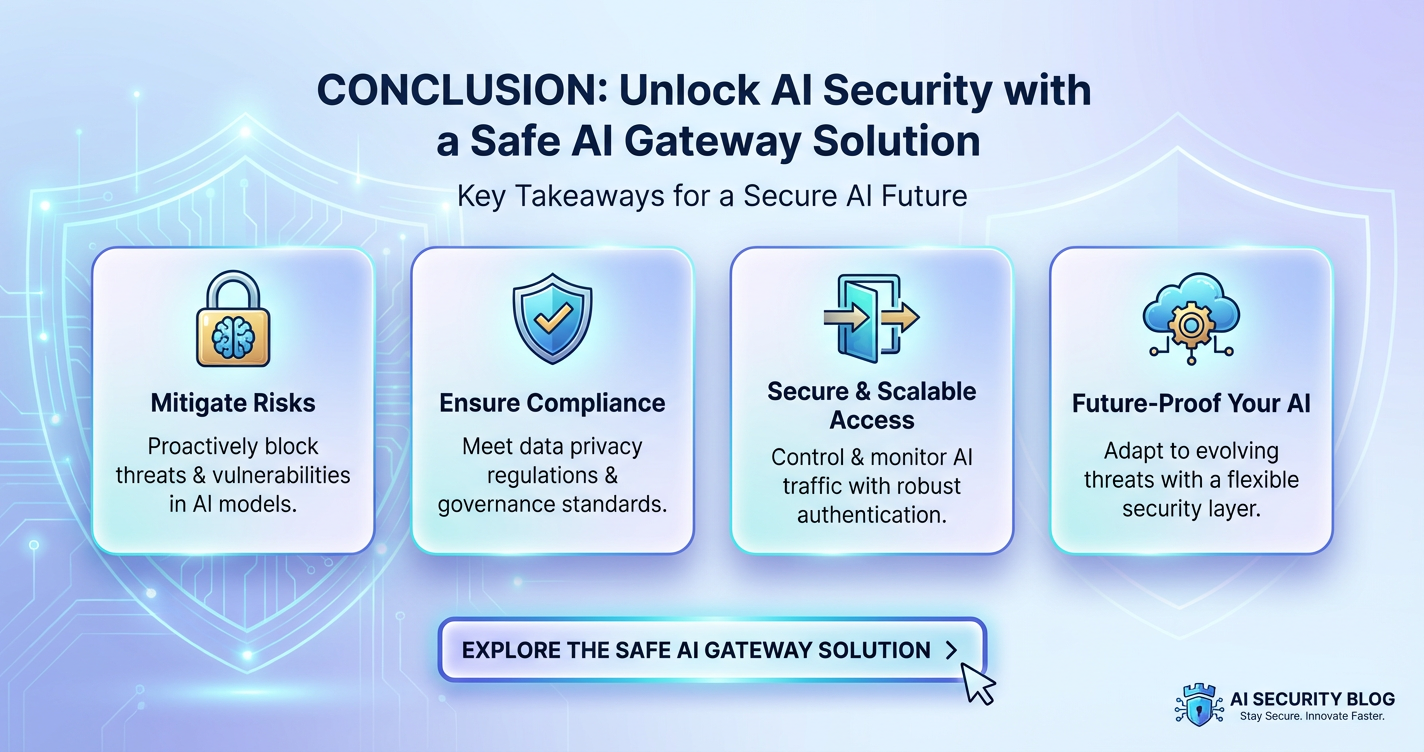
The advent of Artificial Intelligence has ushered in an era of unprecedented innovation and transformation, offering businesses the power to redefine operations, enhance customer experiences, and unlock new insights. However, this transformative power is intrinsically linked with a new paradigm of security threats, operational complexities, and governance challenges. Without a dedicated and intelligent control plane, the promise of AI can quickly turn into a liability, plagued by data breaches, cost overruns, and compliance nightmares.
This article has underscored the critical and evolving role of a safe AI Gateway solution as the indispensable guardian and orchestrator of modern AI ecosystems. We began by establishing the foundational importance of an API Gateway in managing distributed services, then explored how an AI Gateway specializes to meet the unique demands of diverse AI models, providing unified integration, intelligent prompt management, and advanced security. We further delved into the specific functionalities of an LLM Gateway, highlighting its essential role in mitigating unique risks like prompt injection and data leakage prevalent in large language model interactions.
The array of security features offered by an AI Gateway—from robust authentication and granular authorization to sophisticated data protection, threat detection, and comprehensive observability—forms a formidable shield against the myriad of AI-specific vulnerabilities. Beyond security, its operational benefits are equally profound, enabling unified model integration, meticulous cost management, superior performance and scalability, streamlined API lifecycle management, and enhanced team collaboration through multi-tenancy. Products like ApiPark, an open-source AI gateway and API management platform, exemplify how a well-designed solution can empower organizations to navigate this complex landscape with confidence, offering quick integration of diverse AI models, unified API formats, and enterprise-grade performance and logging capabilities.
As AI continues to mature and integrate deeper into the fabric of our digital world, the AI Gateway will remain a cornerstone, adapting to new challenges and capabilities. It is not merely an optional component but a strategic imperative for any organization committed to harnessing AI responsibly, securely, and efficiently. By embracing a robust AI Gateway solution, businesses can unlock the full potential of AI, turning its complexities into manageable opportunities and paving the way for a future where innovation and security advance hand-in-hand. The journey into AI's frontier is exciting, and with a safe AI Gateway, it is also a journey we can embark upon with greater confidence and control.
Frequently Asked Questions (FAQs)
1. What is the fundamental difference between an API Gateway, an AI Gateway, and an LLM Gateway? An API Gateway is a general-purpose entry point for backend services, handling basic routing, authentication, and rate limiting. An AI Gateway builds on this by specializing for AI models, offering unified integration for diverse models, prompt management, and AI-specific security. An LLM Gateway is a further specialization designed specifically for Large Language Models, focusing on prompt injection prevention, token usage optimization, context isolation, and managing different LLM providers.
2. Why can't I just use a traditional API Gateway to manage my AI models? While a traditional API Gateway provides foundational capabilities like routing and authentication, it lacks the specialized features needed for AI. It won't abstract away the diverse APIs of different AI models, track token usage for LLMs, perform prompt injection prevention, or offer AI-specific data redaction and security monitoring. These specialized features are crucial for secure, efficient, and cost-effective AI deployment.
3. How does an AI Gateway help with cost management for AI services? An AI Gateway provides granular tracking of AI model usage, including token consumption for LLMs, enabling accurate cost attribution. It can enforce budget limits, send alerts for potential overages, and even dynamically route requests to the most cost-effective AI providers or models based on real-time pricing, significantly optimizing expenditures.
4. What are the key security threats an LLM Gateway helps mitigate? An LLM Gateway is critical for mitigating prompt injection attacks (where malicious prompts trick the LLM), data leakage through model responses (inadvertently revealing sensitive information), and controlling unintended model behavior. It achieves this through advanced prompt sanitization, output filtering, context isolation, and content moderation rules.
5. Is an AI Gateway suitable for both cloud-based and on-premise AI models? Yes, a comprehensive AI Gateway solution is designed to integrate and manage AI models regardless of their deployment location. It can connect to cloud-based AI services, models running on your own on-premise infrastructure, or even open-source models deployed in hybrid environments, providing a unified control plane across your entire AI landscape.
🚀You can securely and efficiently call the OpenAI API on APIPark in just two steps:
Step 1: Deploy the APIPark AI gateway in 5 minutes.
APIPark is developed based on Golang, offering strong product performance and low development and maintenance costs. You can deploy APIPark with a single command line.
curl -sSO https://download.apipark.com/install/quick-start.sh; bash quick-start.sh

In my experience, you can see the successful deployment interface within 5 to 10 minutes. Then, you can log in to APIPark using your account.

Step 2: Call the OpenAI API.