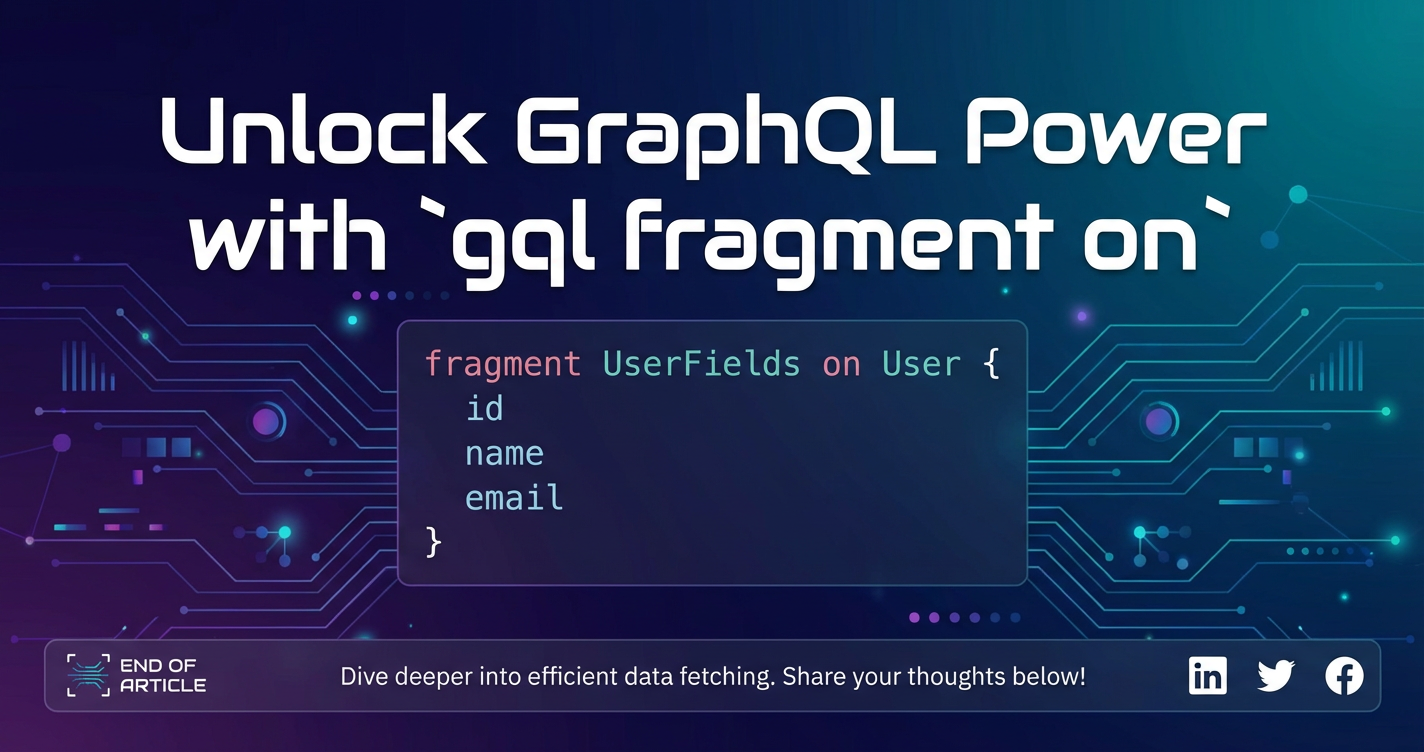
Unlock GraphQL Power with `gql fragment on`


In the rapidly evolving landscape of web and application development, efficient data fetching remains a perennial challenge and a critical determinant of user experience and system performance. As applications grow in complexity, encompassing diverse data sources and dynamic user interfaces, developers constantly seek more robust, flexible, and maintainable ways to interact with backend services. For years, REST APIs dominated this space, offering a straightforward, resource-oriented approach. However, the inherent rigidity of REST often leads to common pitfalls like over-fetching (receiving more data than needed) or under-fetching (requiring multiple requests to gather all necessary data), ultimately impacting performance and increasing development overhead. It was against this backdrop that GraphQL emerged as a powerful alternative, promising to revolutionize how clients request and receive data. By empowering clients to precisely declare their data requirements, GraphQL offered a compelling vision of efficiency and flexibility. Yet, even within the elegant framework of GraphQL, as queries grow in size and complexity, the need for organization, reusability, and modularity becomes paramount. This is precisely where the concept of gql fragment on steps into the spotlight, unlocking a deeper level of power and sophistication within GraphQL. Fragments are not merely syntactic sugar; they are a fundamental building block for building scalable, maintainable, and highly performant GraphQL applications, especially when dealing with intricate data structures and component-driven architectures. They transform the way developers think about data requirements, moving from monolithic queries to composable, declarative data units that can be reused and combined with unprecedented ease. This extensive guide will delve deep into the world of GraphQL fragments, exploring their syntax, diverse benefits, advanced patterns, integration with client libraries, and how they fit into a holistic api management strategy, ultimately demonstrating how mastering gql fragment on is essential for any developer aiming to truly harness the full potential of GraphQL.
I. The Evolving Landscape of Data Fetching: Why GraphQL?
Before we immerse ourselves in the intricacies of GraphQL fragments, it's crucial to understand the context that necessitated GraphQL's creation and its fundamental departure from traditional data fetching mechanisms. For decades, REST (Representational State Transfer) served as the de facto standard for building web services. REST APIs operate on the principle of resources, where each resource is identified by a unique URL, and interactions are performed using standard HTTP methods (GET, POST, PUT, DELETE). This model brought much-needed standardization and simplicity to web apis, enabling loose coupling between clients and servers. However, as frontend applications became more dynamic, rich, and component-based, the limitations of REST started to surface, creating significant friction for developers.
One of the most prominent challenges with REST apis is the issue of over-fetching. Imagine a scenario where a client application needs only a user's name and profile picture for a comment section. A typical REST endpoint might return a comprehensive User object, including email, address, phone number, and various other fields. The client then receives this entire payload, discards the unnecessary data, and uses only what it needs. While seemingly innocuous for small requests, this pattern scales poorly. Over-fetching leads to increased network latency, higher data consumption (especially critical for mobile users), and unnecessary processing on the client side, all of which degrade the user experience.
Conversely, the problem of under-fetching forces clients to make multiple requests to gather all the necessary data. Consider displaying a list of articles, each with its author's name and a count of comments. A REST api might provide an endpoint for articles, another for users/{id}, and perhaps a third for articles/{id}/comments. To display the required information, the client would first fetch the articles, then for each article, make a separate request to fetch the author's details, and yet another to get the comment count. This "N+1 problem" results in a cascade of network requests, dramatically slowing down the application and putting a significant strain on the backend server. The complexity of orchestrating these multiple requests, handling potential failures, and combining the data on the client side adds considerable development burden.
GraphQL was specifically engineered to address these fundamental shortcomings. Introduced by Facebook in 2012 and open-sourced in 2015, GraphQL redefines the client-server interaction by shifting control over data requirements directly to the client. Instead of hitting multiple endpoints or accepting a fixed data structure, a GraphQL client sends a single query to a single /graphql endpoint, specifying precisely the data it needs, in the exact shape it requires. The server, equipped with a strongly typed schema, then intelligently resolves this query, fetching only the requested data and returning it in a predictable JSON structure that mirrors the query's shape. This paradigm shift offers immense benefits: reduced network overhead, fewer round trips, and a more streamlined development workflow. Developers can evolve their backend schemas independently of client applications, as clients only consume the fields they explicitly request, minimizing breaking changes. This client-driven approach makes GraphQL particularly attractive for complex applications with diverse data requirements and rapidly iterating user interfaces.
However, as GraphQL queries themselves grow in size and scope, especially in large-scale applications with numerous UI components each requiring specific subsets of data, a new form of complexity can emerge. Developers might find themselves duplicating field selections across multiple queries, leading to repetitive code, increased risk of inconsistencies, and challenges in maintaining a cohesive data fetching strategy. This is the very problem that GraphQL fragments are designed to solve, introducing a layer of reusability and modularity that elevates GraphQL's power to new heights.
II. The Genesis of Reusability: Understanding GraphQL Fragments
At its core, a GraphQL fragment is a reusable unit of selection logic. Imagine a common scenario where multiple parts of your application, perhaps different UI components or pages, need to display similar information about a specific entity, such as a User, a Product, or an Order. Without fragments, each query would independently define the fields it needs from that entity, leading to redundant code and potential inconsistencies. Fragments abstract this common field selection into a named, reusable block, which can then be "spread" into any query, mutation, or even another fragment. This concept directly embodies the "Don't Repeat Yourself" (DRY) principle, a cornerstone of good software engineering.
What Exactly Is a GraphQL Fragment?
Simply put, a GraphQL fragment is a named, reusable set of fields. It acts like a mini-query or a partial query definition that operates on a specific GraphQL type. When you define a fragment, you're essentially saying, "Whenever I refer to this fragment, I want to include these specific fields from this particular type." This allows developers to encapsulate common data requirements in a single place. For instance, if you consistently need a user's id, name, and email across various parts of your application, you can define a UserFields fragment that includes these three fields. Then, wherever you need this common set of user data, you simply reference ...UserFields within your main query.
Why Were Fragments Introduced?
The primary motivations behind the introduction of fragments in GraphQL were directly tied to addressing the challenges of managing large and evolving GraphQL queries:
- DRY Principle Enforcement: The most immediate benefit. Fragments eliminate the need to repeat the same set of fields across different queries or nested selections. This reduces boilerplate code and makes queries more concise and readable.
- Modularity: Fragments enable the decomposition of large, monolithic queries into smaller, self-contained, and semantically meaningful units. This promotes a modular architecture, especially when co-locating fragments with UI components that depend on specific data. Each component can declare its data needs via a fragment, making the component more self-sufficient and easier to reason about.
- Co-location: A powerful pattern often associated with fragments is co-location. In frontend frameworks like React or Vue, a UI component often has specific data requirements. By defining a fragment directly within or alongside the component that uses it, developers can keep the component's data dependencies tightly coupled with its rendering logic. This makes it easier to understand what data a component expects, simplifies maintenance, and improves overall developer experience.
- Consistency: By centralizing field definitions for common data types, fragments ensure that all parts of the application requesting the same entity will receive a consistent set of fields. This reduces the risk of subtle bugs caused by different parts of the application fetching slightly different subsets of data for the same conceptual entity.
Basic Syntax of a Fragment
The syntax for defining and using a GraphQL fragment is straightforward and elegant:
# 1. Fragment Definition
fragment <FragmentName> on <TypeName> {
  field1
  field2
  nestedField {
    subField1
  }
}

# 2. Fragment Usage (Spreading)
query GetDetailedUser {
  user(id: "123") {
    ...<FragmentName> # The spread operator
    # Other fields specific to this query, not part of the fragment
    createdAt
  }
}
Let's break down this syntax with an example:
Imagine we have a User type in our GraphQL schema with fields like id, firstName, lastName, email, and profilePictureUrl. Many parts of our application might need a user's basic identification details.
# Fragment Definition: UserBasicInfoFragment
# This fragment operates on the 'User' type
fragment UserBasicInfo on User {
  id
  firstName
  lastName
  # We can also include nested fields within a fragment
  profile {
    # Assuming 'profile' is another object type
    profilePictureUrl
  }
}

# Fragment Usage Example 1: In a query for a single user
query GetSpecificUserDetails {
  user(id: "456") {
    ...UserBasicInfo # Spreads the fields defined in UserBasicInfo
    email # Adding an additional field not in the fragment
    lastLogin
  }
}

# Fragment Usage Example 2: In a query for a list of users
query GetAllUsersSummary {
  users {
    ...UserBasicInfo # Spreading the same fragment here
    status # Adding another field specific to this list context
  }
}
In this example: * We define a fragment named UserBasicInfo. * The on User clause specifies that this fragment can only be applied to objects of type User. This is crucial for type safety and validation. * Inside the curly braces, we list the fields we want to select: id, firstName, lastName, and profile { profilePictureUrl }. * In GetSpecificUserDetails, we use ...UserBasicInfo to "spread" these fields into our query for a single user. We can then add other fields like email and lastLogin that are specific to this particular query's needs. * Similarly, in GetAllUsersSummary, we reuse the exact same UserBasicInfo fragment for each user in the list, ensuring consistency and reducing duplication, and again add a specific field, status.
This simple yet powerful mechanism immediately highlights the core value of fragments: centralizing common data requirements. When the User type evolves, or if the profilePictureUrl field needs to be changed to avatarUrl, only the UserBasicInfo fragment needs to be updated, and all queries leveraging it will automatically benefit from the change without manual modification of each query. This dramatically enhances maintainability and reduces the cognitive load on developers. The next section will delve deeper into these multifaceted benefits, exploring how fragments contribute to modularity, readability, type safety, and overall developer experience.
III. The Multifaceted Benefits of Embracing Fragments
The initial introduction to GraphQL fragments reveals their immediate utility in promoting code reusability and adhering to the DRY principle. However, their true power extends far beyond mere syntactic convenience. By strategically incorporating fragments into your GraphQL api design and client-side implementations, you unlock a spectrum of benefits that profoundly impact the modularity, maintainability, readability, and even the perceived performance of your applications. These advantages are particularly evident in large-scale projects with complex data models and numerous evolving UI components.
Modularity and Reusability: Building with Blocks
One of the most significant advantages of fragments is their ability to foster a truly modular architecture. In modern frontend development, applications are often built as a composition of smaller, self-contained UI components. Each component typically requires a specific set of data to render itself correctly. Without fragments, managing these data requirements can become cumbersome. A parent component might fetch all the data for its children, leading to large, monolithic queries that are hard to understand and maintain. Alternatively, each child component might declare its own data needs, leading to the dreaded "N+1" problem in the context of GraphQL, where multiple components in the same render tree might independently request overlapping data, increasing query size.
Fragments elegantly solve this by allowing each UI component to declare its own data requirements in a self-contained fragment. For example, a UserProfileCard component might define a UserProfileCard_User fragment, specifying the name, bio, and profilePicture fields it needs. A separate UserFollowButton component might define UserFollowButton_User for id and isFollowing fields. The parent component then simply "spreads" these fragments into its main query:
# UserProfileCard.graphql
fragment UserProfileCard_User on User {
  id
  name
  bio
  profilePictureUrl
}

# UserFollowButton.graphql
fragment UserFollowButton_User on User {
  id
  isFollowing
}

# ParentComponent.graphql
query GetUserDataForProfilePage {
  user(id: "789") {
    ...UserProfileCard_User
    ...UserFollowButton_User
    # Any other fields needed by the parent component itself
    lastActiveAt
  }
}
This approach creates a clear separation of concerns. Each component is responsible for defining its own data dependency, making it reusable across different parts of the application without needing to modify its data fetching logic. When UserProfileCard is updated to display a new field, only its fragment needs to change; the parent query automatically incorporates the update without explicit modification. This modularity not only simplifies development but also enhances testability, as components can be tested in isolation with their specific data requirements.
Maintainability: Simplifying Evolution
Large codebases naturally accumulate technical debt, and data fetching logic is often a prime candidate. Without fragments, modifications to the data model (e.g., renaming a field, adding a new nested object, changing field types) can necessitate widespread changes across numerous queries. This is a tedious, error-prone, and time-consuming process. Fragments act as central points of truth for specific data selections, dramatically improving maintainability.
When a field name changes, or a new field needs to be consistently included for a particular entity, developers only need to update the relevant fragment. All queries that spread this fragment will automatically inherit the change. This significantly reduces the surface area for errors and accelerates the pace of development, allowing the api and application to evolve more gracefully. Furthermore, when onboarding new developers, understanding the data flow becomes easier as common field selections are encapsulated and named, rather than being scattered throughout the codebase. The consistency enforced by fragments means less time spent debugging discrepancies in fetched data and more time building new features.
Readability: Clarity Through Structure
Complex GraphQL queries, especially those with deeply nested selections or multiple inline fragments, can quickly become difficult to parse and understand. The sheer volume of curly braces and field names can obscure the query's intent. Fragments offer a powerful mechanism to break down these behemoths into smaller, more digestible, and semantically meaningful units, vastly improving readability.
By giving names to reusable field sets, fragments allow developers to express the "what" of data fetching more clearly. Instead of seeing a long list of fields, one sees ...UserBasicInfo or ...ProductDetails, immediately conveying the semantic block of data being requested. This higher level of abstraction makes queries easier to skim, understand, and debug. When reviewing pull requests or revisiting old code, the intent behind a query becomes much clearer when structured with well-named fragments. This clarity is not just a cosmetic improvement; it reduces cognitive load, minimizes misinterpretations, and ultimately leads to more robust code.
Type Safety: Enforced by the Schema
GraphQL's strong type system is one of its most compelling features, and fragments leverage this system to provide an additional layer of safety and confidence. Every fragment is defined on <TypeName>, explicitly associating it with a specific GraphQL type (e.g., on User, on Product). This association has several crucial implications:
- Validation: The GraphQL server (or a build-time client-side validator) can check whether the fields requested within a fragment actually exist on the specified
TypeName. If you try to include a field likenonExistentFieldinfragment UserBasicInfo on User, the system will flag an error, preventing invalid queries from even reaching the backend. - Compile-time Checks (with client libraries): Advanced GraphQL client libraries like Relay and Apollo Client (especially with code generation) can leverage these type associations at compile time. This means errors related to incorrect fragment usage or mismatched types can be caught before deployment, rather than at runtime.
- IntelliSense and Autocompletion: Development tools and IDEs, when integrated with GraphQL schemas, can provide intelligent autocompletion and validation for fields within fragments, enhancing developer productivity and reducing errors.
This strong type safety ensures that fragments are not just arbitrary text blocks but are deeply integrated into the GraphQL schema, guaranteeing that the data requested is consistent with the server's capabilities.
Performance (Indirectly): Encouraging Precise Fetching
While fragments don't directly optimize network requests in the same way that a gateway might by caching or load balancing, they contribute to performance indirectly by encouraging better query design. By allowing developers to precisely define the data requirements for individual components, fragments naturally lead to more granular and focused queries. This reduces the likelihood of over-fetching data, as each component only asks for what it genuinely needs, and the overall query is a sum of these precise requirements.
Consider an application with many small components on a single page. Without fragments, a developer might write one large query for the entire page, potentially including fields that only one small, conditionally rendered component truly needs. With fragments, each component's data needs are isolated. When a component is not rendered (e.g., due to a feature flag or user permissions), its associated fragment's data is not requested, leading to smaller, more efficient payloads. This disciplined approach to data fetching, fostered by fragments, translates into faster page loads and a more responsive user interface.
Co-location: Bridging UI and Data
The co-location pattern, where a UI component and its data fetching logic (represented by a fragment) reside in the same file or directory, is a powerful architectural choice enabled by fragments. This tightly couples the component's presentation with its data needs, making the codebase more intuitive to navigate and understand.
When a developer needs to modify a component, they can immediately see its data dependencies without having to search through separate data fetching files or global query definitions. This reduces context switching, simplifies refactoring, and promotes a more independent, plug-and-play component model. Modern client libraries like Apollo Client and Relay strongly advocate for and facilitate this co-location, further solidifying fragments as a cornerstone of contemporary frontend data architectures.
In summary, GraphQL fragments are far more than a syntactic feature; they are a strategic tool for building robust, scalable, and maintainable applications. By promoting modularity, enhancing maintainability, improving readability, enforcing type safety, indirectly boosting performance, and enabling co-location, fragments empower developers to manage complexity, accelerate development cycles, and deliver superior user experiences. The next step is to explore how these fundamental building blocks can be combined and extended to tackle even more complex data fetching scenarios through advanced fragment patterns.
IV. Diving Deeper: Advanced Fragment Patterns and Techniques
Having established the foundational understanding and manifold benefits of GraphQL fragments, it's time to explore how they can be applied in more sophisticated scenarios. GraphQL's flexibility, combined with the power of fragments, allows for intricate data fetching patterns that address complex data models, polymorphic relationships, and dynamic UI requirements. Mastering these advanced techniques is crucial for unlocking the full expressive power of gql fragment on in real-world applications.
Nested Fragments: Composing Complexity with Elegance
Just as objects can be nested within other objects in a GraphQL schema, fragments can be nested within other fragments. This allows for the composition of complex data requirements from smaller, more manageable fragment units. This pattern is particularly useful when dealing with deeply nested data structures where certain sub-objects have a consistent set of fields required across multiple parent entities.
Consider a User type that has an address field, which is of type Address. If various parts of your application consistently need the street, city, and zipCode of an address, you can define an AddressFields fragment. Then, your UserBasicInfo fragment can incorporate this AddressFields fragment.
# 1. Define the innermost fragment: AddressFields
fragment AddressFields on Address {
  street
  city
  zipCode
}

# 2. Define a fragment that uses AddressFields: UserProfileFragment
fragment UserProfileFragment on User {
  id
  firstName
  lastName
  # Nesting AddressFields within UserProfileFragment
  address {
    ...AddressFields
  }
}

# 3. Use the top-level fragment in a query
query GetUserAndAddress {
  user(id: "101") {
    ...UserProfileFragment
    # Additional fields specific to this query
    email
    phoneNumbers
  }
}
In this example: * AddressFields encapsulates the common fields for an Address. * UserProfileFragment then uses ...AddressFields to include these fields when requesting a User's address. This means UserProfileFragment itself becomes a composition of User specific fields and the reusable AddressFields. * Finally, GetUserAndAddress spreads UserProfileFragment, implicitly bringing along all the fields from both UserProfileFragment and AddressFields.
The benefits of nested fragments are profound: * Enhanced Modularity: Even complex data requirements can be broken down into highly focused, reusable units. * Deep Consistency: Ensures that whenever an address is fetched through a fragment, it consistently includes the same set of fields. * Simplified Refactoring: If the structure of Address changes, only AddressFields needs adjustment, propagating the change correctly through UserProfileFragment and all queries that use it.
Nested fragments are a cornerstone for managing complexity in large-scale GraphQL apis, allowing developers to build robust data fetching patterns piece by piece.
Inline Fragments (... on Type { ... }): Handling Polymorphism
One of GraphQL's powerful features is its ability to handle polymorphic data through interfaces and union types. An Interface allows different object types to implement a common set of fields (e.g., Node interface might have an id field, implemented by User, Product, Post). A Union type allows a field to return one of several distinct object types (e.g., SearchResult union could be Photo, Video, or Article).
When querying fields that might return an interface or union type, you often need to fetch different fields depending on the concrete type of the object returned. This is where inline fragments become indispensable. An inline fragment allows you to conditionally select fields based on the specific type of the object at runtime.
The syntax for an inline fragment is ... on TypeName { ... }.
Let's consider a Media interface that Photo and Video types implement:
interface Media {
  id: ID!
  url: String!
  creator: User!
}

type Photo implements Media {
  id: ID!
  url: String!
  creator: User!
  resolution: String!
  aspectRatio: Float!
}

type Video implements Media {
  id: ID!
  url: String!
  creator: User!
  duration: Int!
  thumbnailUrl: String!
}

type Query {
  media(id: ID!): Media
  feed: [Media!]!
}
Now, when querying a feed that returns Media items, you might want specific fields for Photo and different fields for Video:
query GetFeedMedia {
  feed {
    id
    url # Fields common to all Media types

    # Inline fragment for Photo type
    ... on Photo {
      resolution
      aspectRatio
    }

    # Inline fragment for Video type
    ... on Video {
      duration
      thumbnailUrl
    }

    # Also include the creator's name, accessible by all Media types
    creator {
      firstName
      lastName
    }
  }
}
In this query: * id and url are fetched for all Media items, as they are part of the Media interface. * The ... on Photo { ... } block specifies that if the returned media item is specifically a Photo, then also fetch its resolution and aspectRatio. * The ... on Video { ... } block does the same for Video items, fetching duration and thumbnailUrl. * The creator field is also fetched, and its firstName and lastName are consistently requested for all Media items.
Inline fragments are crucial for handling polymorphism in GraphQL, allowing for type-specific data fetching within a single query. They ensure that clients receive precisely the data relevant to the concrete type of an object, without over-fetching or requiring multiple conditional queries. This makes them indispensable for building flexible UIs that display different information based on the type of data received.
Fragment Colocation with UI Components (e.g., React/Vue): A Modern Approach
The co-location principle, where a component defines its own data requirements via a fragment, is one of the most transformative aspects of using gql fragment on in modern frontend development. This pattern is heavily promoted by libraries like Relay and is increasingly adopted by Apollo Client users, often with the help of code generation.
The core idea is to treat a UI component and its data dependencies as a single, cohesive unit. Instead of a centralized data-fetching file, each component Component.js (or Component.tsx) would have an accompanying Component.graphql (or Component.fragment.ts) file containing its specific fragment definition.
Example in a React context (conceptual, actual implementation varies by client library):
// components/UserProfileCard/UserProfileCard.js
import React from 'react';
// Imagine a hook that uses a fragment to fetch data
import { useFragment } from '@apollo/client';
import { USER_PROFILE_CARD_FRAGMENT } from './UserProfileCard.graphql'; // Imported fragment

function UserProfileCard({ userId }) {
  // Use the fragment with a source object (e.g., from a parent query)
  const { user } = useFragment({
    fragment: USER_PROFILE_CARD_FRAGMENT,
    from: { __typename: 'User', id: userId }, // A reference to the user object
  });

  if (!user) return <div>Loading...</div>;

  return (
    <div className="user-profile-card">
      <h2>{user.firstName} {user.lastName}</h2>
      <img src={user.profilePictureUrl} alt={`${user.firstName}'s profile`} />
      <p>{user.bio}</p>
    </div>
  );
}

export default UserProfileCard;
# components/UserProfileCard/UserProfileCard.graphql
fragment UserProfileCard_user on User {
  id # Required for caching/identification
  firstName
  lastName
  profilePictureUrl
  bio
}
This pattern offers several compelling advantages: * Encapsulation: The component fully owns its data requirements. Changing the component's UI or data needs only involves modifying these two files. * Reusability: The component can be dropped into any part of the application, and as long as its fragment is spread by an ancestor query, it will receive the data it needs. * Simplified Reasoning: When debugging or understanding a component, all relevant logic (rendering and data) is in one place. * Reduced Prop Drilling: Data can be "passed down" through fragments, often without needing explicit props for every single field, especially in Relay's model. * Optimized Rendering: Client libraries can use fragments to intelligently re-render only the components whose data has changed, improving performance.
While Apollo Client offers ways to achieve co-location, Relay's architecture is fundamentally built around this concept, using a compile-time step to ensure fragments are correctly defined and propagated. This co-location pattern significantly enhances the developer experience and promotes robust, scalable application architectures.
Fragment Spreading for Dynamic Queries (Advanced)
In some advanced scenarios, you might want to dynamically decide which fragments to include in a query based on runtime conditions (e.g., user permissions, feature flags, or A/B test variations). While GraphQL syntax itself is static, client-side libraries can facilitate this.
For instance, you might have a PremiumUserFragment and a BasicUserFragment. Based on a user's subscription status, your client-side application could construct a query that includes one or the other. This usually involves: 1. Defining all possible fragments. 2. Using client-side logic to combine a base query with the appropriate fragment spreads before sending the query to the server. This often requires using a build-time step (like Relay's compiler or Apollo's codegen) to ensure all fragments are known.
This technique, while powerful, adds complexity and must be used judiciously. Over-reliance on dynamic fragment spreading can make queries harder to statically analyze and understand. However, for genuinely dynamic data requirements, it provides a flexible solution.
In conclusion, advanced fragment patterns like nesting, inline fragments for polymorphism, and co-location with UI components are not just theoretical constructs; they are indispensable tools for managing complexity in modern GraphQL applications. They empower developers to build scalable, maintainable, and highly performant user interfaces that adapt gracefully to evolving data models and business requirements. By mastering these techniques, developers can truly leverage the "Power with gql fragment on" to its fullest extent. The next step is to understand how these powerful constructs are integrated and managed by popular GraphQL client libraries, which provide the runtime environment for fragments to shine.
APIPark is a high-performance AI gateway that allows you to securely access the most comprehensive LLM APIs globally on the APIPark platform, including OpenAI, Anthropic, Mistral, Llama2, Google Gemini, and more.Try APIPark now! 👇👇👇
V. Integrating Fragments with GraphQL Clients: Apollo & Relay
While GraphQL fragments define how data should be structured and requested, it's the client-side libraries that bring them to life within an application. These libraries handle the parsing, execution, caching, and state management associated with GraphQL queries and fragments, integrating them seamlessly into frontend frameworks like React, Vue, Angular, or Svelte. Two of the most prominent and widely adopted GraphQL clients are Apollo Client and Relay, each offering a distinct philosophy and approach to working with fragments. Understanding these differences is crucial for making informed architectural decisions.
Apollo Client's Approach to Fragments
Apollo Client, developed by Apollo GraphQL, is renowned for its flexibility, ease of use, and extensive feature set, making it a popular choice for many developers. It provides a comprehensive solution for managing GraphQL data in JavaScript applications, including caching, local state management, and seamless integration with UI frameworks. Apollo Client's approach to fragments is highly adaptable, allowing developers to choose their preferred patterns, from simple fragment reuse to more advanced co-location strategies, often augmented by code generation.
gqlTag for Parsing Fragments: In Apollo Client, fragments are defined using thegqltag (fromgraphql-tagor@apollo/client/utilities). This tag parses the GraphQL query string into an Abstract Syntax Tree (AST), which Apollo Client can then use to understand and execute the query.```javascript // fragments.js import { gql } from '@apollo/client';export const USER_BASIC_INFO_FRAGMENT = gqlfragment UserBasicInfo on User { id firstName lastName };// components/ProfilePage.js import { useQuery, gql } from '@apollo/client'; import { USER_BASIC_INFO_FRAGMENT } from '../fragments';const GET_USER_QUERY = gqlquery GetUserProfile($id: ID!) { user(id: $id) { ...UserBasicInfo # Spread the fragment email bio } } ${USER_BASIC_INFO_FRAGMENT} # Important: The fragment definition must be included;function ProfilePage({ userId }) { const { data, loading, error } = useQuery(GET_USER_QUERY, { variables: { id: userId }, });// ... render logic }`` The key point here is that for a fragment to be used in a query, its definition (e.g.,USER_BASIC_INFO_FRAGMENT`) must be included alongside the query definition itself. Apollo Client needs to see the full AST of the query and all its referenced fragments to execute correctly.- Fragment Masking and Unmasking:
useFragmentintroduces the concept of fragment masking. When a parent query fetches data for aUserand passes auserRefto a childUserCardcomponent, theuserRefis "masked." The child component, usinguseFragmentwithUserCard_user, effectively "unmasks" only the fields it cares about. This prevents the child component from accidentally accessing fields that it didn't explicitly request via its fragment, enforcing stronger data encapsulation. - Benefits for Caching and UI Updates: Apollo Client's normalized cache heavily relies on
idfields (or a configuredkeyFields) to store data efficiently. Fragments, by consistently including theidof an object, contribute to this efficient caching. When data for a specific object changes (e.g., through a mutation), Apollo's cache can automatically update all UI components that rely on fragments referencing that object, leading to reactive and consistent user interfaces without manual state management.
useFragment Hook (and older patterns): With Apollo Client 3.4+, the useFragment hook was introduced, specifically designed to facilitate fragment co-location and local data reads within components. This hook allows a component to declare its data needs via a fragment and read that data from the Apollo cache, provided an ancestor query has already fetched it. This is a significant step towards a Relay-like data masking pattern.```javascript // components/UserCard/UserCard.graphql import { gql } from '@apollo/client';export const USER_CARD_FRAGMENT = gqlfragment UserCard_user on User { id name avatarUrl };// components/UserCard/UserCard.js import React from 'react'; import { useFragment } from '@apollo/client'; import { USER_CARD_FRAGMENT } from './UserCard.graphql';function UserCard({ userRef }) { // userRef is a reference to a User object in the cache const { data } = useFragment({ fragment: USER_CARD_FRAGMENT, fragmentName: 'UserCard_user', // Specify fragment name if not using default export or when multiple fragments in one file from: userRef, // The cache object or object reference });if (!data) return null; // Data might not be available yetreturn (
{data.name}
); } `` TheuseFragmenthook reads data from the cache based on the providedfromobject (which typically includes__typenameandid` for cache normalization). This enables components to declare their own data requirements, making them more portable and maintainable.
Relay's Opinionated Fragment Architecture
Relay, also developed by Facebook, is a highly opinionated and powerful GraphQL client library known for its rigorous approach to data management, compile-time optimizations, and strict co-location philosophy. Relay's design emphasizes performance, data consistency, and developer experience in large, complex applications.
- Compile-time Fragment Validation: Unlike Apollo Client, which often performs most fragment resolution at runtime, Relay employs a build-time compiler. This compiler analyzes all your GraphQL queries and fragments, validates them against your schema, and generates optimized JavaScript code. This strong compile-time validation catches errors early, preventing invalid queries from ever reaching production.
- Strong Co-location Principle: Relay enforces a strict co-location strategy. Fragments are almost always defined alongside the components that consume them. This tightly couples the UI with its data requirements, reinforcing the encapsulation benefits discussed earlier.
- Relay's Compiler and its Role: The Relay compiler is central to its architecture. It performs several optimizations:
- Fragment Inlining: It can inline fragments into root queries, reducing network payload size in some cases.
- Global Object Identification: Relay heavily relies on globally unique IDs (often
ID!orNodeinterface implementations) for efficient caching and data consistency. Fragments are always expected to include theidfield. - Type Generation: The compiler can generate TypeScript types based on your GraphQL schema and queries/fragments, providing end-to-end type safety from server to UI.
- Data Masking: Ensures that components only receive the data they requested via their fragments, preventing unintended data access.
- Data Consistency and Global Object Identification: Relay maintains a highly consistent client-side store by leveraging global object identification. When data for an object is updated (e.g., via a mutation), all components displaying that object, regardless of which fragment they used to fetch it, are automatically updated. This robust consistency model is a hallmark of Relay.
Fragment "Containers" (or useFragment): Relay's core mechanism for using fragments involves "containers" (or the modern useFragment hook in Relay Hooks). A Relay container is a higher-order component (or a custom hook) that wraps a UI component and connects it to its data dependencies defined by a fragment.```javascript // components/UserCard/UserCard.js import React from 'react'; import { useFragment } from 'react-relay'; // New hooks API// Generated file by Relay compiler import type { UserCard_user$key } from './generated/UserCard_user.graphql';// Import the fragment definition generated by Relay compiler import { graphql } from 'react-relay';// The component's fragment definition export const UserCardFragment = graphqlfragment UserCard_user on User { id name avatarUrl };function UserCard({ user }: { user: UserCard_user$key }) { // Use the fragment key to read the data const data = useFragment(UserCardFragment, user);if (!data) return null;return (
{data.name}
); }export default UserCard; `` In Relay,userinUserCardis not the raw data object but a "fragment reference" or "fragment key." TheuseFragmenthook then uses this key to read the specific data requested byUserCard_user` from Relay's store. This ensures that the component only ever receives the data it explicitly declared in its fragment.
Comparison Table: Apollo vs. Relay Fragment Handling
| Feature/Aspect | Apollo Client | Relay |
|---|---|---|
| Philosophy | Flexible, incrementally adoptable, developer-friendly. | Opinionated, performance-oriented, strong consistency. |
| Fragment Definition | gql tag (runtime parsing). |
graphql tag (compile-time processing). |
| Validation | Runtime (with dev tools), build-time (with codegen). | Strict compile-time validation via Relay compiler. |
| Data Masking | useFragment provides masking (Apollo Client 3.4+). |
Fundamental to its design; enforced by compiler and runtime. |
| Co-location | Encouraged, facilitated by useFragment and codegen. |
Strongly enforced and fundamental. |
| Caching Model | Normalized cache, id based, flexible keying. |
Normalized store, ID based, global object identification. |
| Tooling | @apollo/client, graphql-code-generator. |
relay-compiler, react-relay. |
| Learning Curve | Generally lower, easier to get started. | Steeper, requires understanding of compiler and specific patterns. |
| Type Safety | Achieved with graphql-code-generator. |
Intrinsic with compiler-generated types. |
Both Apollo Client and Relay effectively leverage GraphQL fragments to enable modular, reusable, and maintainable data fetching. Apollo offers more flexibility and a gentler learning curve, suitable for a wider range of projects, while Relay provides a more opinionated, highly optimized, and rigorously consistent experience, particularly beneficial for large, complex applications demanding peak performance and consistency. The choice between them often comes down to project requirements, team familiarity, and the desired level of upfront architectural commitment. Regardless of the choice, mastering fragments within either framework is key to building robust GraphQL-powered applications.
VI. Best Practices for Crafting Effective GraphQL Fragments
Leveraging GraphQL fragments effectively goes beyond understanding their syntax; it involves adopting strategic best practices that ensure your fragments are modular, maintainable, performant, and easy to understand. Adhering to these principles transforms fragments from a mere convenience into a powerful architectural cornerstone for your GraphQL applications.
Granularity: Finding the Right Balance
One of the most common questions regarding fragments is, "How fine-grained should they be?" The answer lies in striking a balance between reusability and potential overhead. * Too fine-grained: Creating a fragment for every single field or a pair of fields might lead to an explosion of fragment definitions, making the codebase cluttered and harder to manage. It can also lead to fragmented data requests that are less efficient for the server to resolve. * Too coarse-grained: A fragment that fetches a huge chunk of data, much like an over-fetching REST endpoint, defeats the purpose of precise data fetching and leads to less modular components.
Best Practice: Design fragments to encapsulate the complete data requirements of a single, logical UI component or a well-defined conceptual block of data. For instance, a UserCard component might need name, profilePicture, and tagline. This forms a cohesive UserCard_User fragment. An Address fragment could include street, city, state, zipCode because these typically go together. Think about the smallest reusable unit of data presentation or business logic within your application.
Naming Conventions: Clarity is Key
Clear, consistent naming is paramount for fragment readability and discoverability, especially in larger codebases. Adopting a standardized naming convention makes it easy to understand a fragment's purpose and the type it operates on.
Best Practice: Use a convention that clearly indicates the fragment's purpose and its target type. A common and highly effective pattern, especially championed by Relay, is ComponentName_TypeName. * UserCard_user for a User fragment used by a UserCard component. * ProductDetails_product for a Product fragment used by a ProductDetails component. * For fragments not tied to a specific component (e.g., reusable utility fragments), TypeNameBasicInfo or TypeNameDetailedFields can be effective, such as UserBasicInfo or AddressFields. Avoid generic names like MyFragment or DataFragment, as they offer no semantic value.
Avoid Over-fetching (Even with Fragments): Mindful Design
While fragments encourage precise data fetching, they don't automatically prevent over-fetching if poorly designed. A fragment that includes every field of a type, simply because it's convenient, will still result in over-fetching when spread into queries that don't need all those fields.
Best Practice: Design each fragment with a specific purpose in mind. Only include the fields that are genuinely required by the component or logic that consumes that fragment. If a component sometimes needs an additional field, consider if that field should be part of a separate, optional fragment, or fetched directly by the parent query. Regularly review your fragments to ensure they are lean and focused.
Version Control: Managing Changes Over Time
As your GraphQL schema and application evolve, so too will your fragments. Managing these changes in a version-controlled environment is crucial.
Best Practice: Treat fragments like any other piece of code. Store them in dedicated .graphql or .js/.ts files alongside their consuming components. Ensure that changes to fragments are part of regular code reviews. When making breaking changes to a fragment (e.g., removing a field that was widely used), consider a phased deprecation strategy: 1. Add a new fragment with the updated structure. 2. Update consumers gradually. 3. Eventually remove the old fragment. Using tools like graphql-code-generator can help detect breaking changes at build time.
Documentation: Clarifying Purpose and Usage
Even with clear naming, the exact purpose and intended use of a fragment might not always be immediately obvious, especially for complex or highly contextual fragments.
Best Practice: Add comments to your fragment definitions explaining their purpose, the TypeName they operate on, and any specific assumptions or contexts in which they should be used. This is particularly helpful for inline fragments or fragments that are part of a larger composition pattern.
# fragments/UserStatusFragment.graphql
# Description: This fragment provides the essential fields for displaying a user's online status.
# Intended Use: Primarily for user lists, chat interfaces, or profile headers where status is critical.
fragment UserStatus_user on User {
  id
  isOnline
  lastActiveAt
}
Testing: Ensuring Data Integrity
Components relying on fragments need robust testing to ensure they correctly receive and utilize their required data.
Best Practice: When testing UI components that use fragments, provide mocked data that matches the exact shape specified by the component's fragment. Modern client libraries (like Apollo Client's MockedProvider or Relay's MockPayloadGenerator) offer utilities to facilitate this. This ensures that the component renders correctly with the data it expects and that any changes to the fragment are reflected in the tests.
Schema Awareness: Designing with the Schema in Mind
Effective fragment design is deeply intertwined with a thorough understanding of your GraphQL schema. Fragments are built upon the types and fields defined in your schema, so familiarity with the schema's structure, interfaces, and union types is fundamental.
Best Practice: * Understand Type Relationships: Know which types implement which interfaces, and what types are part of a union. This is critical for correctly using inline fragments. * Identify Common Patterns: Recognize recurring data requirements across different parts of your schema. These are prime candidates for reusable fragments. * Collaborate with Backend Teams: Front-end developers consuming apis should collaborate with backend GraphQL schema designers. A well-designed schema makes fragment creation intuitive and powerful. Conversely, fragment usage patterns can inform schema evolution.
By diligently applying these best practices, developers can maximize the benefits of GraphQL fragments, creating highly modular, maintainable, and performant applications that are a joy to build and evolve. Fragments become not just a syntactic feature but a strategic tool for managing complexity and fostering collaboration across large development teams.
VII. Fragments in the Broader API Ecosystem: Beyond the Query
While GraphQL fragments are an invaluable tool for optimizing data fetching within a GraphQL API, they represent just one piece of the larger puzzle of building and managing robust, scalable, and secure applications. The true power of any api strategy extends beyond the query language itself, encompassing crucial aspects like performance, security, governance, and the integration of diverse service types. In an enterprise environment, where applications often interact with a multitude of backend services—ranging from traditional REST apis to rapidly evolving AI models—a holistic approach to api management becomes paramount.
The Role of a Robust API Strategy: Beyond Specifics
A comprehensive api strategy involves more than just selecting a data fetching technology like GraphQL or REST. It's about designing, implementing, securing, deploying, and monitoring all the programmatic interfaces that power your applications and allow them to interact with internal and external services. This strategy needs to consider the entire lifecycle of an api, from initial design to deprecation. While GraphQL fragments empower front-end teams to define their data needs with unparalleled precision, they do not inherently solve broader architectural concerns such as authentication, authorization, rate limiting, logging, caching at the network edge, or the seamless integration of disparate backend systems. These are concerns typically addressed by a robust api gateway or a comprehensive api management platform.
Performance Monitoring: A Layered Approach
GraphQL fragments contribute significantly to application performance by reducing over-fetching and streamlining client-side data requirements, leading to smaller network payloads and fewer round trips. However, the overall performance of your application and its underlying services depends on a layered approach: * Client-side Optimization: Fragments are key here, ensuring efficient data consumption. * Network Performance: Latency, bandwidth, and caching at the edge are critical. * GraphQL Server Performance: Efficient resolver implementation, database query optimization, and server-side caching are vital. * Backend Service Performance: The performance of the microservices or legacy systems that your GraphQL server queries.
A dedicated api gateway can provide a crucial layer for monitoring the end-to-end performance of all your apis, offering insights into latency, error rates, and traffic patterns across different services. It can identify bottlenecks before they impact end-users, irrespective of whether the underlying api is GraphQL, REST, or something else.
API Security: Gatekeeping the Digital Frontier
Security is non-negotiable for any api. While GraphQL's type system helps prevent certain types of query-based attacks (like SQL injection if resolvers are implemented correctly), it doesn't natively handle fundamental security aspects like: * Authentication: Verifying the identity of the client (e.g., OAuth, JWT). * Authorization: Determining what resources an authenticated client is allowed to access. * Rate Limiting: Protecting your backend from abusive clients by limiting the number of requests over a period. * Input Validation: Beyond schema types, ensuring business logic constraints on input data. * Denial of Service (DoS) Protection: Protecting against complex or deep queries that could overwhelm your server (GraphQL Depth Limiting, Query Cost Analysis).
These security concerns are typically handled at the api gateway level, acting as the first line of defense for all incoming requests. A strong gateway enforces security policies uniformly across all apis before requests even reach your GraphQL server or other backend services. This offloads security responsibilities from individual services, allowing developers to focus on core business logic.
API Governance and Management: The Enterprise Imperative
In an enterprise environment, managing a diverse set of apis—including GraphQL, REST, event-driven, and specialized AI services—requires a unified platform for governance, lifecycle management, and developer experience. Without such a platform, api sprawl, inconsistent security policies, and poor discoverability can cripple productivity and introduce significant risks.
An api management platform provides: * Centralized Control: A single pane of glass for monitoring, securing, and deploying all apis. * Developer Portal: A self-service portal for developers to discover, subscribe to, and test apis, complete with documentation and SDKs. * Lifecycle Management: Tools to manage api versions, deprecation, and retirement. * Traffic Management: Load balancing, routing, and traffic shaping. * Analytics: Insights into api usage, performance, and monetization.
Introducing APIPark: Your Open Source AI Gateway & API Management Platform
While gql fragment on provides unparalleled control over data fetching for GraphQL APIs, organizations must also consider the external management and governance of their entire api landscape. This is where tools like an advanced api gateway become indispensable. For companies dealing with a complex array of services, including a growing number of AI models and traditional REST apis, a robust gateway solution is paramount to ensure efficiency, security, and scalability.
An excellent example of such a comprehensive platform is APIPark, an open-source AI gateway and API management platform. APIPark is designed to help developers and enterprises effortlessly manage, integrate, and deploy both AI and REST services. It provides a crucial layer of infrastructure that complements the internal elegance of GraphQL by offering robust external management capabilities for a diverse api portfolio.
APIPark stands out with several key features that address the broader api ecosystem challenges:
- Quick Integration of 100+ AI Models: While your application might use GraphQL for its core data, it might also leverage various AI models for tasks like sentiment analysis or content generation. APIPark offers a unified management system for integrating a wide variety of AI models, simplifying authentication and cost tracking across these services.
- Unified API Format for AI Invocation: A significant challenge with AI models is their diverse input/output formats. APIPark standardizes the request data format across all integrated AI models, ensuring that changes in AI models or prompts do not affect the consuming application or microservices. This drastically simplifies AI usage and reduces maintenance costs.
- Prompt Encapsulation into REST API: APIPark allows users to quickly combine AI models with custom prompts to create new, ready-to-use REST
apis (e.g., a sentiment analysis API). This empowers developers to expose sophisticated AI capabilities as easily consumableapis, which can then be governed by thegateway. - End-to-End API Lifecycle Management: Beyond AI, APIPark assists with managing the entire lifecycle of all your
apis—including design, publication, invocation, and decommission. It helps regulateapimanagement processes, manage traffic forwarding, load balancing, and versioning of publishedapis. This means even if you're primarily using GraphQL, APIPark can act as the overarchinggatewayto manage your GraphQL endpoint alongside other services. - API Service Sharing within Teams & Independent API and Access Permissions for Each Tenant: APIPark facilitates collaboration by allowing for the centralized display of all
apiservices, making them easy for different departments to find and use. Furthermore, it supports multi-tenancy, enabling the creation of multiple teams, each with independent applications, data, user configurations, and security policies, while sharing underlying infrastructure. - API Resource Access Requires Approval: For enhanced security, APIPark allows for the activation of subscription approval features, ensuring that callers must subscribe to an
apiand await administrator approval before they can invoke it. This prevents unauthorizedapicalls and potential data breaches, offering a criticalgatewaysecurity function. - Performance Rivaling Nginx & Detailed API Call Logging: With just an 8-core CPU and 8GB of memory, APIPark can achieve over 20,000 TPS, supporting cluster deployment for large-scale traffic. It also provides comprehensive logging capabilities, recording every detail of each
apicall, essential for traceability, troubleshooting, and ensuring system stability and data security. - Powerful Data Analysis: APIPark analyzes historical
apicall data to display long-term trends and performance changes, helping businesses with preventive maintenance before issues occur.
APIPark, being an open-source api gateway developed by Eolink, a leader in API lifecycle governance, offers a robust solution for enhancing efficiency, security, and data optimization across your api landscape. While gql fragment on refines your GraphQL interactions, a platform like APIPark ensures that your entire digital ecosystem is well-governed and protected, providing the critical infrastructure necessary for scaling modern applications that integrate a mix of GraphQL, REST, and AI services. It represents the broader api management layer that ensures your elegantly crafted GraphQL fragments are delivered securely and efficiently to your end-users.
VIII. The Future of Data Fetching with Fragments
The journey through GraphQL fragments underscores their fundamental importance in building resilient, modular, and high-performance applications. As the digital landscape continues its relentless evolution, driven by new technologies, increasing user expectations, and ever-more complex data requirements, the role of fragments is only set to grow. They are not a fleeting trend but a foundational pattern that will continue to shape how developers interact with data.
Evolving GraphQL Specifications: The GraphQL specification itself is a living document, constantly evolving to meet the demands of the developer community. Future additions or refinements to the specification might introduce new ways to declare or compose fragments, enhancing their capabilities even further. For instance, discussions around defer and stream directives aim to improve performance for slow fields or lists by allowing clients to receive partial responses, and fragments are inherently compatible with these directives, allowing specific parts of a query (defined by a fragment) to be deferred. As GraphQL adoption widens, the tooling and ecosystem around fragments will only become more sophisticated, offering better developer experience, more robust type generation, and deeper integration with various frameworks and build pipelines.
The Continued Importance of Client-Driven Data: The core philosophy of GraphQL—empowering clients to request precisely what they need—remains a powerful and enduring principle. Fragments are the clearest embodiment of this philosophy on the client side, enabling component-driven data requirements that perfectly align with modern UI architectures. As applications become more dynamic and personalized, the ability to tailor data fetching to individual UI components, rather than relying on monolithic endpoints, will become even more critical. Fragments provide the necessary abstraction layer to manage this complexity, ensuring that clients can adapt swiftly to changing design and feature requirements without cumbersome backend adjustments.
GraphQL Fragments as a Cornerstone of Modern Frontend Architecture: In the era of micro-frontends and highly modular UI components, fragments serve as a crucial contract between a component and its data dependencies. They solidify the principle of co-location, allowing developers to treat a UI component and its data as a single, self-contained unit. This approach significantly simplifies maintenance, enhances reusability, and fosters a more independent development workflow. As frontend frameworks continue to emphasize component-based development, fragments will remain an indispensable tool for managing the associated data requirements, ensuring that complexity is contained rather than spread across the application.
The Interplay of GraphQL with Other Data Layers and Microservices: While this article focuses on GraphQL and fragments, it's vital to remember that most enterprise environments operate with a hybrid architecture. GraphQL often sits as an api gateway or a façade layer, unifying data from a multitude of underlying microservices, legacy systems, and specialized apis (including REST and AI services). In this context, fragments ensure that the client-facing GraphQL api remains efficient and maintainable, even as the complexity of the underlying data sources grows. The ability to abstract away backend intricacies, while providing clients with a precise and flexible data fetching mechanism via fragments, is a key enabler for building modern, composable architectures. Tools like APIPark, which manage the broader api landscape, complement GraphQL's internal efficiency by ensuring external governance, security, and performance across all services. The future will see an even tighter integration between GraphQL client tooling, backend schema design, and api management platforms, creating a seamless development experience from data source to user interface.
In essence, the power of gql fragment on is not just about optimizing today's GraphQL applications; it's about building a foundation for tomorrow's, equipping developers with the tools to navigate the ever-increasing demands of data-rich, user-centric applications.
IX. Conclusion: Harnessing the Full Potential of GraphQL
Our comprehensive exploration of GraphQL fragments reveals them as an indispensable construct for anyone building scalable, maintainable, and high-performance applications with GraphQL. From their foundational role in promoting the DRY principle to their advanced applications in handling polymorphic data and enabling robust component co-location, fragments elevate GraphQL's power beyond merely fetching data to crafting sophisticated, modular data architectures. They provide the necessary abstraction to break down complex queries into manageable, reusable units, drastically improving code readability, ensuring type safety, and streamlining the development workflow.
By embracing gql fragment on, developers gain: * Unparalleled Modularity: Components become self-aware of their data needs, fostering independence and reusability. * Enhanced Maintainability: Centralized field definitions mean fewer places to update when the schema evolves, reducing errors and accelerating feature delivery. * Crystal-Clear Readability: Complex queries transform into a legible composition of semantic data blocks, improving understanding and collaboration. * Robust Type Safety: Fragments, explicitly tied to GraphQL types, enable compile-time validation and provide a strong contract between client and server. * Optimized Performance: By encouraging precise data requests, fragments minimize over-fetching, leading to faster loading times and more responsive applications. * Seamless Client Integration: Libraries like Apollo and Relay demonstrate how fragments are woven into the fabric of modern frontend frameworks, empowering reactive and consistent user experiences.
However, the journey doesn't end with mastering fragments. The overall success of an application also hinges on a robust api strategy that addresses broader concerns of security, performance monitoring, and governance across all api types. This is where a holistic api gateway and management platform like APIPark becomes a critical partner. APIPark complements the internal elegance of GraphQL fragments by providing the external infrastructure to manage, secure, and scale your entire api ecosystem, from REST services to cutting-edge AI models. It acts as the intelligent gateway that ensures your meticulously designed GraphQL apis, powered by efficient fragments, are delivered securely and reliably to your end-users, alongside all other digital services.
In essence, gql fragment on is not just a syntax; it's a paradigm shift in how we approach data requirements within a GraphQL api. When combined with sound architectural practices and comprehensive api management solutions, it allows developers to truly unlock the full potential of GraphQL, building applications that are not only powerful and efficient but also adaptable, sustainable, and ready for the future. The ability to compose data needs with such precision and elegance is a testament to GraphQL's design and a vital skill for every modern developer.
X. Frequently Asked Questions (FAQs)
1. What is a GraphQL fragment and why should I use it? A GraphQL fragment is a reusable selection of fields that you can define and then "spread" into queries, mutations, or other fragments. You should use them to adhere to the DRY (Don't Repeat Yourself) principle, making your queries more modular, readable, maintainable, and to co-locate data requirements with UI components, especially in large-scale applications. They help avoid repeating the same field selections for a given type across different parts of your codebase.
2. How do fragments contribute to modularity in a GraphQL application? Fragments promote modularity by allowing individual UI components or logical data blocks to declare their specific data requirements. Instead of a large, monolithic query fetching everything, each component defines its own small fragment. Parent queries then simply spread these component-specific fragments. This makes components self-contained, reusable, and easier to understand, test, and maintain, as their data dependencies are explicitly defined alongside their rendering logic.
3. What is the difference between a standard fragment and an inline fragment? A standard fragment is a named, reusable set of fields defined on TypeName { ... } that can be spread using ...FragmentName. It applies to a specific concrete type. An inline fragment, defined as ... on TypeName { ... }, is used directly within a query (without a separate name) to conditionally fetch fields based on the concrete type of an object that implements an interface or is part of a union type. It's essential for handling polymorphism in GraphQL.
4. How do client libraries like Apollo and Relay handle fragments differently? Apollo Client offers flexibility, parsing fragments at runtime with the gql tag and providing the useFragment hook for co-location and data masking. You must explicitly include fragment definitions alongside your queries. Relay, on the other hand, is more opinionated, relying on a compile-time step (relay-compiler) for strict validation, optimization, and generating highly optimized code. Relay enforces a strong co-location principle and uses "fragment references" with its useFragment hook to ensure components only access data explicitly defined by their fragments, providing robust data consistency and performance guarantees.
5. Do GraphQL fragments help with API security or performance at the gateway level? While fragments significantly improve client-side performance by preventing over-fetching and enhance overall api design by promoting modularity, they do not directly handle api gateway level security or performance. Core security concerns like authentication, authorization, rate limiting, and network-level caching, as well as broader api governance, are typically managed by an api gateway or an api management platform. Solutions like APIPark provide this crucial external layer, securing and optimizing the delivery of all your apis (including GraphQL, REST, and AI services) to clients, complementing the internal efficiencies gained through GraphQL fragments.
🚀You can securely and efficiently call the OpenAI API on APIPark in just two steps:
Step 1: Deploy the APIPark AI gateway in 5 minutes.
APIPark is developed based on Golang, offering strong product performance and low development and maintenance costs. You can deploy APIPark with a single command line.
curl -sSO https://download.apipark.com/install/quick-start.sh; bash quick-start.sh

In my experience, you can see the successful deployment interface within 5 to 10 minutes. Then, you can log in to APIPark using your account.

Step 2: Call the OpenAI API.