Upstream Request Timeout: Causes & Solutions
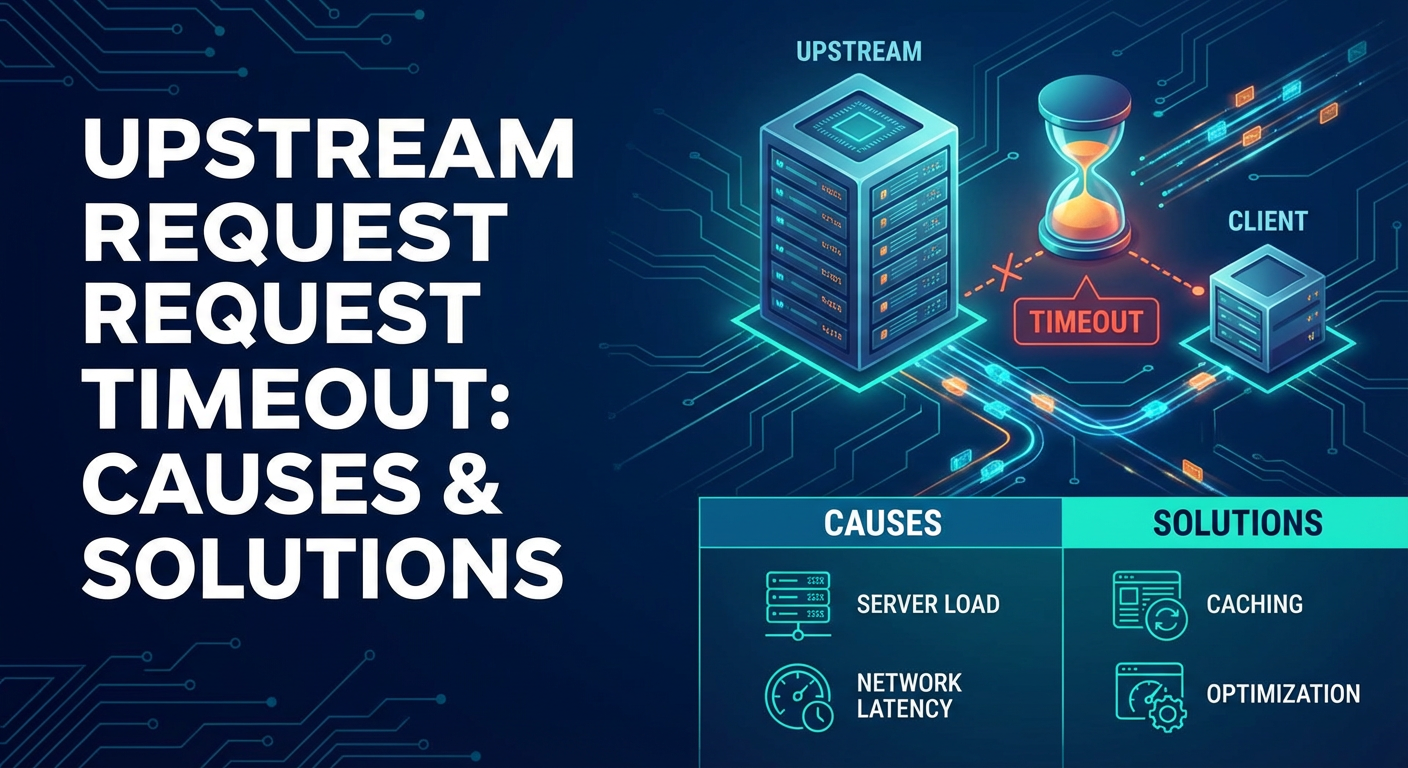


In the intricate tapestry of modern distributed systems, where myriad services communicate ceaselessly to deliver seamless user experiences, the concept of an "upstream request timeout" stands as a formidable challenge. It represents a critical point of failure where a service, attempting to interact with another dependent service (its "upstream"), fails to receive a response within an expected timeframe. This isn't merely a minor hiccup; it's a symptom that can ripple through an entire architecture, leading to degraded performance, frustrated users, and potentially significant operational overhead. Understanding the root causes and implementing robust solutions is paramount for any organization striving for high availability and reliability in its digital infrastructure. This comprehensive guide will delve deep into the phenomenon of upstream request timeouts, dissecting their myriad origins and outlining actionable strategies for prevention and resolution, with a particular focus on the pivotal role played by API gateways in this complex landscape.
The Anatomy of a Request-Response Cycle: Where Timeouts Emerge
To truly grasp the implications of an upstream request timeout, it is essential to first understand the journey a typical request undertakes within a distributed system. Imagine a client—perhaps a mobile application or a web browser—initiating a request. This request rarely reaches its final destination, the target business logic, directly. Instead, it embarks on a multi-stage voyage, each segment of which introduces potential points of delay and failure.
The journey typically begins with the client sending a request to an API gateway. This gateway acts as the primary entry point for all external requests, serving as a powerful orchestrator that directs traffic, enforces security policies, handles authentication, and often performs rate limiting or caching. Upon receiving the request, the API gateway processes it and determines the appropriate "upstream service" to which it should forward the request. This upstream service could be a microservice, a monolithic application, a database, or even another external API. The gateway then establishes a connection to this upstream service, transmits the request, and patiently (or impatiently, depending on its configuration) awaits a response.
Once the upstream service receives the request, it undertakes its own internal processing. This might involve querying a database, performing complex computations, interacting with other internal or external dependencies, or simply retrieving data from a cache. Throughout this processing, the upstream service is expected to generate a response and send it back to the API gateway. Finally, the API gateway receives this response, potentially transforms it, and then relays it back to the originating client.
An upstream request timeout occurs precisely during the segment where the API gateway (or any intermediate proxy/service) is waiting for a response from its immediate upstream dependency. If that dependency fails to deliver a response within the configured time limit, the waiting service declares a timeout. This timeout signal then propagates back through the chain, eventually informing the client that its request could not be fulfilled in time. The consequences can range from a slightly delayed operation to a complete system outage, highlighting the critical importance of effective timeout management at every layer, especially at the API gateway, which stands as the frontline defender against such failures.
Core Causes of Upstream Request Timeouts: Unraveling the Complexity
Upstream request timeouts are rarely attributable to a single, isolated factor. More often, they are the culmination of several interacting issues, spanning network infrastructure, application performance, configuration oversights, and system load. A deep dive into these causes is crucial for effective diagnosis and resolution.
1. Network Latency and Congestion: The Invisible Threads
The network, often taken for granted, is a common culprit behind upstream request timeouts. It's the invisible medium through which all digital communication flows, and any impediment here can significantly delay or outright prevent responses from reaching their destination in time.
- Geographical Distance and Physical Latency: The speed of light, while immense, is finite. When an API gateway is geographically distant from its upstream service—for example, a gateway in Europe calling a service hosted in North America—the physical distance introduces inherent latency. Data packets must travel thousands of kilometers, adding milliseconds to every round trip. While often negligible for single requests, cumulative latency across multiple hops or for highly interactive sessions can push response times beyond configured thresholds. Organizations leveraging global infrastructure often grapple with this, necessitating careful data center placement or the use of Content Delivery Networks (CDNs) and edge computing.
- Poor Network Infrastructure and Connectivity: The quality of the underlying network infrastructure is paramount. This includes everything from the physical cabling and switches within a data center to the internet service providers (ISPs) connecting different regions. Faulty network hardware, misconfigured routers, or unreliable ISP connections can introduce packet loss, jitter, and increased latency, causing requests to be delayed or dropped entirely. In enterprise environments, this can stem from aging network equipment, insufficient bandwidth provisioned for critical links, or even subtle misconfigurations in network policies that prioritize certain types of traffic over others.
- Network Congestion and Bottlenecks: Just like a highway during rush hour, networks can become congested when traffic volume exceeds their capacity. This is particularly true at chokepoints—routers, firewalls, or load balancers—that become overwhelmed. When a network link or device is saturated, packets are queued, leading to increased latency. In severe cases, queues can overflow, causing packet drops, necessitating retransmissions and further exacerbating delays. This congestion can be transient, occurring during peak usage periods, or persistent, indicating an underlying under-provisioning of network resources. Identifying these bottlenecks often requires sophisticated network monitoring tools that can track bandwidth utilization, packet loss, and latency across various network segments.
- Firewall and Security Appliance Delays: Security measures, while essential, can inadvertently contribute to timeouts. Firewalls, Intrusion Detection/Prevention Systems (IDPS), and Web Application Firewalls (WAFs) inspect incoming and outgoing traffic for malicious patterns. This inspection process takes time. If these security appliances are under heavy load, improperly configured, or suffering from performance issues themselves, they can introduce significant latency, delaying the forwarding of requests to upstream services and the return of responses to the gateway. Regular performance monitoring of security devices is crucial to ensure they don't become bottlenecks.
2. Upstream Service Performance Issues: The Heart of the Problem
Even with a perfectly optimized network, an upstream service that struggles to process requests efficiently will inevitably lead to timeouts. These issues often lie deep within the application logic or its immediate dependencies.
- Slow Database Queries: Databases are frequently the slowest component in many application stacks. Complex SQL queries, missing or inefficient indexes, large data sets, contention for database locks, or an overloaded database server can cause queries to run for extended periods. If an application waits synchronously for a slow database response, the entire request processing chain is stalled, potentially triggering a timeout at the API gateway or even earlier. Database performance tuning, including query optimization, proper indexing, and efficient connection pooling, is critical.
- Inefficient Application Code and Business Logic: The application code itself can be a major source of delays. Inefficient algorithms, synchronous blocking I/O operations (e.g., waiting for external file system access or an external API call without proper async patterns), excessive logging, or resource-intensive computations (e.g., complex data transformations, image processing) can consume significant CPU cycles or memory, slowing down request processing. Memory leaks or inefficient garbage collection can also lead to increased latency as the application struggles to manage its resources. Code profiling and performance testing are indispensable tools for identifying and rectifying such inefficiencies.
- Resource Exhaustion (CPU, Memory, Disk I/O): Every service runs on finite resources. If an upstream service consistently exhausts its CPU, memory, or disk I/O capacity, it will become unresponsive or extremely slow.
- CPU Exhaustion: Occurs when the service is performing too many computations or threads are stuck in tight loops.
- Memory Exhaustion: Leads to excessive swapping to disk (if available), dramatically slowing down operations, or the service crashing altogether.
- Disk I/O Bottlenecks: Can arise from frequent disk writes (e.g., heavy logging, persistent storage operations) on an overloaded or slow storage system. Monitoring system-level metrics (CPU utilization, memory usage, disk I/O rates) is vital to identify and address resource contention through scaling, optimization, or re-architecture.
- Deadlocks or Contention: In concurrent programming, deadlocks can occur when two or more processes or threads are blocked indefinitely, waiting for each other to release a resource. Similarly, high contention for shared resources (e.g., mutexes, locks, shared data structures) can serialize operations, significantly reducing throughput and increasing latency. These issues are notoriously difficult to debug and often require sophisticated concurrency analysis tools.
- External Dependencies (Third-Party APIs, Microservices): Modern applications rarely operate in isolation. They often depend on other internal microservices or external third-party APIs (e.g., payment gateways, identity providers, mapping services). If any of these downstream dependencies are slow or unresponsive, the upstream service waiting for their response will also become slow, leading to a timeout. This highlights the importance of implementing robust error handling, retries with exponential backoff, and circuit breakers when interacting with external services.
- Long-Running Synchronous Operations: Certain business operations are inherently time-consuming, such as generating complex reports, processing large files, or performing batch computations. If these operations are executed synchronously as part of a request-response cycle, they will block the request until completion, almost guaranteeing a timeout. The solution often involves re-architecting these operations to be asynchronous, offloading them to message queues, background workers, or separate processing services, and providing users with immediate feedback or status updates.
3. Incorrect Timeout Configurations: The Unseen Tripwire
Even if all services are performing optimally, misconfigured timeouts can trigger false alarms or lead to premature request termination. This category focuses on the settings that define how long a service should wait.
- Misconfigured API Gateway Timeouts: The API gateway is often the first point of timeout configuration. If the gateway's timeout is set too aggressively (e.g., 1 second) while the upstream service legitimately takes longer (e.g., 3 seconds) for certain operations, timeouts will frequently occur even if the upstream service eventually responds successfully. Conversely, an excessively long gateway timeout can lead to client-side timeouts or tie up gateway resources unnecessarily. Striking the right balance requires understanding typical upstream service response times and considering worst-case scenarios.
- Client-Side Timeout Settings: The client initiating the request also has its own timeout settings. If a client expects a response within 5 seconds, but the API gateway is configured for 10 seconds and the upstream service also for 10 seconds, the client might time out even before the gateway or upstream service does. This creates a poor user experience. Consistency in timeout configurations across the entire request path, from client to
API gatewaytoupstream services, is essential. - Service-Level Timeouts (Application Code): Within the upstream service itself, individual operations or calls to its dependencies might have internal timeouts. For instance, a service might set a 2-second timeout when querying its database or calling another internal microservice. If this internal timeout is exceeded, the upstream service might respond with an error, but if it simply hangs or waits indefinitely, it will lead to a timeout at the API gateway level. Developers must explicitly manage timeouts for all external interactions within their application code.
- Load Balancer/Proxy Timeouts: In complex architectures, there might be multiple layers of load balancers or reverse proxies (e.g., Nginx, HAProxy, cloud load balancers) between the API gateway and the upstream services, or even between the client and the API gateway. Each of these components has its own set of timeout configurations (e.g., connection timeout, read timeout, write timeout). An inconsistency where an intermediary proxy has a shorter timeout than the next component in the chain can prematurely terminate requests, leading to timeouts that are difficult to trace.
4. High Traffic Volume and Load: The Overwhelm Factor
Sudden or sustained surges in traffic can overwhelm even well-optimized systems, pushing services beyond their capacity and leading to timeouts.
- Thundering Herd Problem: This occurs when a large number of requests simultaneously hit a service that is already struggling or has just recovered from a failure. The sheer volume of concurrent requests can quickly deplete available resources (threads, connections, memory), causing the service to become unresponsive and triggering timeouts for all new incoming requests. This is often exacerbated when combined with retry mechanisms that are not properly implemented (e.g., simple retries without exponential backoff).
- Lack of Auto-Scaling: Cloud-native applications often rely on auto-scaling to dynamically adjust resource capacity based on demand. If auto-scaling is misconfigured, too slow to react, or simply not implemented for critical upstream services, a sudden spike in traffic can quickly lead to resource exhaustion and timeouts before new instances can be provisioned and made available.
- Spikes in Demand: Unforeseen events like viral marketing campaigns, flash sales, or malicious DDoS attacks can generate traffic spikes that far exceed normal operating parameters. Without adequate capacity planning, resilient architecture patterns, and effective rate limiting at the
API gatewaylevel, such spikes will inevitably result in timeouts.
5. Faulty Deployments or Bugs: The Human Element
Even the most robust systems are susceptible to human error and software defects.
- Recent Code Changes Introducing Performance Regressions: A seemingly innocuous code change in an upstream service, released during a new deployment, can inadvertently introduce performance bottlenecks, memory leaks, or inefficient database queries. These "regressions" might not be immediately apparent during testing but manifest under production load, leading to increased response times and timeouts. Rigorous testing, including performance and load testing, is crucial before production deployments.
- Resource Leaks: Bugs in application code can lead to resource leaks, such as unclosed database connections, open file handles, or unreleased memory. Over time, these leaks accumulate, steadily consuming finite system resources until the service becomes unresponsive or crashes, leading to timeouts for new requests. Continuous monitoring of resource usage and periodic restarts can mitigate the immediate impact, but identifying and patching the leak is the permanent solution.
- Misconfigurations in Deployed Services: Beyond timeout settings, other service configurations can impact performance. Incorrect connection pool sizes, improper cache settings, logging levels that generate excessive I/O, or faulty feature flags can all degrade an upstream service's responsiveness, contributing to timeouts. Configuration management and validation are key to preventing these issues.
6. DNS Resolution Issues: The Address Book Dilemma
Before a service can connect to an upstream dependency, it needs to resolve its hostname to an IP address via the Domain Name System (DNS).
- Slow or Failing DNS Lookups: If the DNS server is slow to respond, overloaded, or experiencing issues, the time taken to resolve an upstream service's hostname can add significant delay to the request. In some cases, if DNS resolution fails altogether, the connection attempt might hang until a network-level timeout occurs. Ensuring reliable and fast DNS infrastructure (e.g., using local DNS caching, redundant DNS servers) is essential.
7. Rate Limiting by Upstream or Intermediaries: The Gatekeepers
While often a protective measure, rate limiting can also appear as a timeout from the perspective of the calling service if not handled gracefully.
- Upstream Services Imposing Rate Limits: An upstream service might have its own internal rate limiting policies to protect itself from overload. If the API gateway or a client sends too many requests within a certain period, the upstream service might respond with a
429 Too Many Requestsstatus code, or it might simply queue the requests internally, causing delays that lead to timeouts at the caller's end. Proper communication of rate limit policies and implementing client-side throttling or retries with backoff are important. - Intermediate Proxies or Gateways Imposing Rate Limits: Similar to upstream services, other intermediate proxies or
gatewaysin the path might impose rate limits. For instance, a cloud provider's load balancer might throttle traffic to prevent abuse or ensure fair resource allocation. TheAPI gatewayitself should also implement robust rate limiting to protect upstream services from being overwhelmed.
Identifying the precise cause of an upstream request timeout often requires a systematic approach, combining real-time monitoring, historical data analysis, and an understanding of the entire request path.
Impact of Upstream Request Timeouts: The Ripple Effect
The consequences of upstream request timeouts extend far beyond a single failed transaction. They can destabilize entire systems, erode user trust, and incur substantial business costs.
- Degraded User Experience: This is perhaps the most immediate and visible impact. Users encountering delayed responses, spinning loaders, or outright error messages (e.g., "Service Unavailable," "Request Timed Out") quickly become frustrated. In today's fast-paced digital world, users expect instant gratification; even a few seconds of delay can lead to abandonment, loss of productivity, or negative brand perception. For critical applications, such as e-commerce or financial services, degraded experiences directly translate to lost revenue.
- Cascading Failures (Systemic Meltdown): One of the most dangerous impacts of timeouts is their potential to trigger cascading failures. Imagine an API gateway timing out while waiting for Service A. If Service A is itself waiting for Service B, and Service B is also slow, the gateway's timeout might lead to Service A holding onto resources (threads, connections) unnecessarily while still trying to process its request to Service B. If many such requests time out from the gateway but continue to consume resources in Service A, Service A can become overwhelmed and unresponsive. This pattern can propagate rapidly, bringing down multiple interconnected services and potentially the entire system. Without proper resilience patterns like circuit breakers, a single slow upstream service can become a single point of failure for the entire application stack.
- Resource Exhaustion on the API Gateway and Downstream Services: When an API gateway or an intermediate service times out on an upstream call, it doesn't immediately release the resources it was using to handle that request. Connections remain open, threads might still be blocked, and memory might be held until the gateway's own internal timeout or cleanup mechanisms kick in. If timeouts occur frequently, the
API gatewayitself can exhaust its connection pool, thread pool, or memory, leading to it becoming unresponsive even if its upstream services are eventually fine. This amplifies the problem, as the gateway can no longer process any requests, even those to healthy services. - Data Inconsistency: In scenarios involving writes or updates, a timeout can leave the system in an inconsistent state. For example, if a payment
APItimes out after processing a transaction internally but before confirming it to the caller, the customer might not receive confirmation, but their bank account might still be debited. Conversely, if a service commits a change and then times out returning the response, the client might retry the operation, leading to duplicate entries or conflicting data. Designing for idempotency and robust transaction management becomes crucial to mitigate this risk. - Loss of Revenue/Business Reputation: For businesses operating online, any form of service disruption or performance degradation directly impacts the bottom line. Lost sales, inability to process orders, or disrupted customer service can lead to significant financial losses. Beyond direct revenue, a poor track record of reliability can severely damage a company's reputation, making it harder to attract and retain customers in the long term.
- Increased Operational Overhead: Diagnosing and resolving upstream request timeouts are often complex, time-consuming endeavors. Operations teams spend valuable time sifting through logs, tracing requests, and correlating metrics across multiple services. The "war room" scenarios triggered by critical timeouts can be stressful and inefficient, diverting engineering resources from development to firefighting. Proactive monitoring, robust logging, and distributed tracing are essential to reduce this operational burden.
The pervasive nature of these impacts underscores why managing upstream request timeouts is not just a technical concern, but a critical business imperative.
APIPark is a high-performance AI gateway that allows you to securely access the most comprehensive LLM APIs globally on the APIPark platform, including OpenAI, Anthropic, Mistral, Llama2, Google Gemini, and more.Try APIPark now! 👇👇👇
Strategies and Solutions to Mitigate Upstream Request Timeouts: Building Resilience
Addressing upstream request timeouts requires a multi-faceted approach, combining proactive monitoring, performance optimization, robust configuration, and advanced resilience patterns.
1. Monitoring and Alerting: The Eyes and Ears of Your System
You cannot solve what you cannot see. Comprehensive observability is the cornerstone of effective timeout management.
- Comprehensive Observability (Metrics, Logs, Traces):
- Metrics: Collect and monitor key performance indicators (KPIs) across all services and network components. This includes request latency, error rates, throughput, CPU utilization, memory consumption, network I/O, and database query times. Real-time dashboards displaying these metrics provide an immediate snapshot of system health.
- Logs: Standardized, structured logging is crucial. Logs should capture request and response details (including HTTP status codes, headers, and timings), error messages, and relevant context (e.g., user IDs, trace IDs). Centralized logging systems enable efficient searching and analysis across distributed services.
- Distributed Tracing: This is arguably the most powerful tool for diagnosing timeouts in distributed systems. A unique trace ID is propagated across all services involved in a single request. This allows engineers to visualize the entire journey of a request, identify exactly which service or operation introduced latency, and pinpoint the specific bottleneck that led to a timeout. Tools like OpenTelemetry, Jaeger, or Zipkin are indispensable here.
- Proactive Alerts: Configure alerts based on predefined thresholds for critical metrics. For example, an alert should fire if:
- Average upstream latency exceeds
Xmilliseconds forYconsecutive minutes. - Error rates (e.g., 5xx status codes, specifically timeout-related errors) rise above
Zpercent. - Resource utilization (CPU, memory) on an upstream service exceeds
Ppercent. - Connection pool exhaustion is detected at the
API gatewayor an upstream service. These alerts should be routed to appropriate on-call teams, enabling rapid response before timeouts escalate into widespread outages.
- Average upstream latency exceeds
2. Optimizing Upstream Service Performance: Strengthening the Core
Directly improving the efficiency of upstream services is often the most impactful long-term solution.
- Code Profiling and Optimization: Regularly profile application code in development and staging environments to identify performance bottlenecks within the business logic. Tools like JProfiler, VisualVM, or language-specific profilers can reveal CPU-intensive functions, inefficient loops, or excessive object allocations. Optimizing these areas can significantly reduce request processing time.
- Database Tuning (Indexing, Query Optimization): Analyze slow database queries and optimize them. This includes:
- Adding appropriate indexes to frequently queried columns.
- Refactoring complex queries into simpler, more efficient ones.
- Using query caching where data changes infrequently.
- Ensuring proper database connection pooling to avoid connection overhead.
- Regularly reviewing execution plans for queries.
- Caching Strategies (In-Memory, Distributed Caches): Implement caching at various levels to reduce the load on upstream services and databases.
- In-memory caches: For frequently accessed, relatively static data within a single service instance.
- Distributed caches (e.g., Redis, Memcached): For sharing cached data across multiple service instances, reducing redundant computations or database calls.
- API Gateway caching: The
API gatewayitself can cache responses for idempotentGETrequests, shielding upstream services from repetitive traffic for common data.
- Asynchronous Processing for Long-Running Tasks: Re-architect long-running operations to be asynchronous. Instead of blocking the request thread, offload these tasks to message queues (e.g., Kafka, RabbitMQ) and process them in separate background workers. The API can immediately return a
202 Acceptedstatus with a link to check the status of the asynchronous operation, preventing timeouts. - Right-Sizing Instances: Ensure that upstream service instances are provisioned with adequate CPU, memory, and disk I/O resources for their expected load. Regularly review resource utilization metrics and adjust instance types or sizes as needed. Over-provisioning wastes resources, but under-provisioning guarantees performance issues under load.
3. Configuring Timeouts Correctly: A Symphony of Settings
Harmonizing timeout settings across all layers of the architecture is crucial to prevent premature termination or prolonged blocking.
- Setting Realistic Timeouts at Each Layer:
- Client: Clients should have a timeout that is slightly longer than the maximum expected end-to-end processing time, but not excessively long to avoid poor user experience.
- API Gateway: The
API gatewaytimeout should be greater than the maximum expected processing time of its immediate upstream service. It's often beneficial to configure separate timeouts for connection establishment, read operations, and write operations. - Upstream Service (and its internal dependencies): Each service should define explicit timeouts when calling its own internal or external dependencies. The sum of these internal timeouts, plus the service's own processing time, should be less than the timeout configured at the
API gatewayfor that service. This creates a "timeout cascade," where the innermost timeout is the shortest, allowing failures to be detected closer to the source and propagate gracefully.
- Differentiating Connect, Read, and Write Timeouts:
- Connect Timeout: The maximum time allowed to establish a connection to an upstream service. A short connect timeout helps quickly identify unavailable services.
- Read Timeout: The maximum time allowed for the client (or
API gateway) to receive a response (or a chunk of data) after a connection is established and the request is sent. This prevents hanging connections. - **Write Timeout: The maximum time allowed to send the request body to the upstream service. Configuring these separately provides granular control and helps pinpoint the exact stage of interaction that is failing.
- Graceful Degradation Strategies: For non-critical functionalities, consider implementing graceful degradation. If an upstream service providing supplementary data times out, instead of failing the entire request, the
API gatewayor the calling service can return a partial response, default data, or a cached stale response. This ensures core functionality remains available even if ancillary services are struggling.
4. Implementing Resilience Patterns: Building Fortifications
Resilience patterns are architectural strategies designed to make systems more tolerant to failures and prevent cascading outages.
- Circuit Breakers: This pattern prevents a service from repeatedly trying to access a failing upstream dependency, which could otherwise consume resources and exacerbate the problem. When an upstream service fails (e.g., multiple timeouts or errors), the circuit breaker "trips" open, quickly failing subsequent requests to that service without actually trying to connect. After a defined cool-down period, it enters a "half-open" state, allowing a few test requests to pass through. If these succeed, the circuit closes; otherwise, it trips open again. This protects the failing service from further overload and allows it time to recover, while also preventing the calling service from becoming resource-exhausted waiting for responses.
- Retries with Exponential Backoff: When a transient error occurs (e.g., network glitch, temporary service unavailability), retrying the request can often lead to success. However, naive retries (e.g., immediately retrying multiple times) can overwhelm an already struggling service. Exponential backoff is a superior strategy where successive retries are delayed by progressively longer intervals (e.g., 1s, 2s, 4s, 8s). This reduces load on the upstream service and increases the chance of successful recovery. It's crucial to only retry idempotent operations (operations that produce the same result regardless of how many times they are performed) to avoid unintended side effects.
- Bulkheads: Inspired by the compartments in a ship, the bulkhead pattern isolates resources (e.g., thread pools, connection pools) for calls to different upstream services. If one upstream service becomes slow or unresponsive, only the bulkhead dedicated to that service will be affected, preventing its issues from consuming all shared resources and impacting calls to other healthy services. For instance, an
API gatewaymight maintain separate connection pools for calls to Service A and Service B. - Load Balancing and Scaling:
- Horizontal Scaling: Increase the number of instances of upstream services to distribute the load. Cloud platforms make this relatively straightforward with features like auto-scaling groups.
- Effective Load Balancing Algorithms: Utilize intelligent load balancing algorithms (e.g., least connections, weighted round robin, session-aware routing) to ensure traffic is evenly distributed among healthy instances of an upstream service. This prevents a single instance from becoming a bottleneck.
- Auto-Scaling: Configure upstream services to automatically scale up or down based on metrics like CPU utilization, request queue length, or network I/O. This ensures that capacity dynamically matches demand, preventing overload during peak times and optimizing costs during off-peak periods.
- Geographic Distribution: For globally distributed applications, deploy services in multiple regions. Use geo-aware DNS or load balancers to route requests to the nearest healthy service instance, minimizing latency.
5. Network Optimization: Streamlining the Pipes
Optimizing the underlying network infrastructure can significantly reduce latency and improve reliability.
- Using CDNs (Content Delivery Networks): For static assets or cached API responses, CDNs can dramatically reduce latency by serving content from edge locations geographically closer to users. This offloads traffic from core services and improves perceived performance.
- Optimizing Routing and Network Paths: Review network topologies and routing configurations to ensure the most efficient paths between services. In cloud environments, leverage private networking options (e.g., VPC peering, direct connect) to reduce latency and improve security for inter-service communication.
- Ensuring Sufficient Bandwidth: Regularly assess network bandwidth requirements and ensure that all critical links have ample capacity to handle peak traffic without congestion. This includes links between data centers, to cloud providers, and within the data center itself.
- Monitoring Network Health: Implement robust network monitoring to track packet loss, latency, jitter, and interface errors. This helps detect network issues proactively before they lead to widespread service timeouts.
6. API Gateway's Central Role in Timeout Management: The Orchestrator
The API gateway is strategically positioned at the edge of your service mesh, making it an ideal place to implement and enforce many of these timeout mitigation strategies. It acts as a powerful orchestrator, safeguarding your upstream services and enhancing overall system resilience.
- Centralized Timeout Configuration: An
API gatewayprovides a single point of control for configuring timeouts for all upstreamAPIs. Instead of scattering timeout settings across individual microservices, you can define consistent and appropriate timeouts at the gateway level, simplifying management and ensuring uniformity. - Request Throttling/Rate Limiting: To protect upstream services from being overwhelmed, the
API gatewaycan implement robust rate limiting policies. By limiting the number of requests per user, perAPI key, or globally within a given timeframe, the gateway prevents traffic spikes from reaching and drowning upstream services, thus avoiding resource exhaustion and subsequent timeouts. - Circuit Breaking at the Gateway Level: Implementing circuit breakers directly within the
API gatewayis highly effective. If the gateway detects that an upstream service is repeatedly failing or timing out, it can automatically open the circuit for that service. Subsequent requests to the failing service are then immediately rejected or routed to a fallback, preventing the gateway from wasting resources trying to connect to an unhealthy service and shielding other services from cascading failures. This also provides faster feedback to clients. - Fallback Responses: When an upstream service times out or is unreachable, the
API gatewaycan be configured to provide a fallback response instead of a generic error. This could be a cached stale response, a default dataset, or a simplified error message that guides the user without exposing internal system failures. This enhances user experience and allows for graceful degradation. - Retry Mechanisms: Advanced
API gatewayscan be configured to perform automatic retries (with exponential backoff) for transient errors or timeouts from upstream services. This offloads the retry logic from individual client applications and ensures that temporary network glitches or brief service hiccups don't result in persistent failures. - Health Checks: The
API gatewaycan periodically perform health checks on its registered upstream services. If a service is deemed unhealthy, the gateway can temporarily stop routing traffic to it, allowing it to recover and preventing requests from timing out against an unresponsive endpoint.
Platforms like APIPark offer robust API management features, including advanced traffic forwarding, load balancing, detailed API call logging, and comprehensive lifecycle management, which are crucial for identifying and mitigating timeout issues. With APIPark, you can define granular timeout policies, implement circuit breakers, manage API versions, and monitor the health of your upstream services, ensuring a stable and performant API ecosystem. Its capabilities for quick integration of AI models and prompt encapsulation into REST APIs further emphasize the need for robust gateway-level timeout and resilience management, as these specialized services can sometimes introduce their own unique latency characteristics. The ability to manage independent APIs and access permissions for each tenant, coupled with powerful data analysis and detailed logging, provides deep insights into potential timeout triggers and overall API performance.
7. Chaos Engineering: Stress Testing for Resilience
- Proactive Testing: Instead of waiting for production outages, chaos engineering involves intentionally injecting failures into the system (e.g., introducing latency, causing service failures, resource exhaustion) in controlled environments. This helps uncover weaknesses and validate the effectiveness of resilience patterns like circuit breakers and timeouts before they impact real users. Tools like Chaos Monkey are popular for this purpose.
Summary Table: Common Timeout Configurations and Their Purpose
To help consolidate the understanding of various timeout settings, the following table outlines common types of timeouts and their typical locations within a distributed architecture:
| Timeout Type | Location/Component | Purpose | Typical Configuration (Examples) |
|---|---|---|---|
| Client Connect | Web Browser, Mobile App, cURL, SDK | Max time to establish a TCP connection to the first server in the chain (API Gateway/Load Balancer). |
2-5 seconds |
| Client Read/Response | Web Browser, Mobile App, cURL, SDK | Max time for the client to receive the entire response after sending the request. | 10-60 seconds |
| API Gateway Connect | Nginx, Envoy, Kong, APIPark, Cloud Gateways | Max time for the API Gateway to establish a TCP connection to the upstream service. |
1-3 seconds |
| API Gateway Read | Nginx, Envoy, Kong, APIPark, Cloud Gateways | Max time for the API Gateway to receive data from the upstream service after connection. |
5-30 seconds |
| API Gateway Write | Nginx, Envoy, Kong, APIPark, Cloud Gateways | Max time for the API Gateway to send the request body to the upstream service. |
5-15 seconds |
| Service Connect | Application Code (e.g., HTTP client library) | Max time for an upstream service to connect to its internal/external dependency (e.g., database, other microservice). | 1-2 seconds |
| Service Read | Application Code (e.g., HTTP client library) | Max time for an upstream service to receive a response from its dependency. | 5-15 seconds |
| Service Query/Operation | Application Code (e.g., Database ORM, specific business logic execution) | Max time allowed for a specific database query or a computationally intensive operation within the service. | Variable, 1-10 seconds |
| Load Balancer Idle | AWS ALB/NLB, Azure Load Balancer, GCP Load Balancer | Max time a TCP connection can remain idle without data being sent or received. | 60-300 seconds |
It's critical that these timeouts are configured hierarchically and consistently, ensuring that an outermost timeout is always longer than the sum of all internal processing and waiting times, preventing premature cuts by intermediate components.
Conclusion: A Continuous Pursuit of Resilience
Upstream request timeouts are an inescapable reality in the complex world of distributed systems. They are multifaceted problems stemming from a confluence of network issues, application performance bottlenecks, misconfigurations, and system overload. However, by embracing a proactive and systematic approach to observability, optimization, configuration, and resilience engineering, organizations can significantly mitigate their impact and foster a more robust and reliable digital infrastructure.
The API gateway stands as a crucial control point in this endeavor. Its ability to centralize timeout management, enforce rate limiting, implement circuit breakers, and provide robust monitoring capabilities makes it an indispensable component in preventing and resolving upstream request timeouts. Investing in comprehensive API management solutions, alongside a culture of continuous improvement and rigorous testing, transforms timeouts from dreaded system failures into manageable, transient events. Ultimately, the goal is not merely to react to timeouts but to build systems that are inherently resilient, capable of gracefully handling the inevitable challenges of distributed computing, and consistently delivering superior experiences to users.
Frequently Asked Questions (FAQs)
1. What exactly is an upstream request timeout, and why is it problematic? An upstream request timeout occurs when a service (like an API gateway) sends a request to a dependent service (its "upstream") and fails to receive a response within a predefined time limit. This is problematic because it can lead to degraded user experiences (slow loading, error messages), cause cascading failures across interconnected services, exhaust system resources, and result in lost revenue or damage to business reputation. It signifies a bottleneck or failure point in the request processing chain.
2. How do API gateways help in managing and preventing upstream request timeouts? API gateways are strategically positioned to play a crucial role. They can centrally configure and enforce timeouts for all upstream APIs, implement rate limiting to protect services from overload, deploy circuit breakers to prevent cascading failures to unhealthy services, and provide fallback responses for graceful degradation. Additionally, gateways often offer comprehensive monitoring and logging capabilities, which are essential for identifying the root causes of timeouts. Platforms like APIPark offer many of these features, centralizing the control and visibility needed to manage API performance effectively.
3. What are the most common causes of upstream request timeouts? The most common causes can be categorized into several areas: * Network issues: High latency, congestion, or unreliable connections between services. * Upstream service performance: Slow database queries, inefficient application code, resource exhaustion (CPU, memory), deadlocks, or slow external dependencies. * Incorrect configurations: Timeouts set too aggressively at the API gateway, client, or service level, or inconsistencies across different layers. * High traffic: Sudden spikes in demand overwhelming services without adequate scaling or rate limiting. * Software bugs: Recent deployments introducing performance regressions or resource leaks.
4. What are some effective strategies to prevent cascading failures due to timeouts? Preventing cascading failures is critical for system stability. Key strategies include: * Circuit Breakers: Implement circuit breakers (e.g., at the API gateway or service level) to quickly stop traffic to failing upstream services, giving them time to recover and preventing resource exhaustion in the calling service. * Bulkheads: Isolate resource pools for different dependencies to ensure that a failure in one upstream service doesn't consume all shared resources and impact others. * Retries with Exponential Backoff: For transient errors, use retries with progressively longer delays, but only for idempotent operations. * Load Balancing and Auto-scaling: Ensure upstream services can scale horizontally to handle increased load and that traffic is evenly distributed among healthy instances. * Graceful Degradation: Design your system to function partially or with reduced features if certain non-critical upstream services are unavailable.
5. How can I effectively diagnose the root cause of an upstream request timeout in a complex distributed system? Diagnosing timeouts requires a systematic approach leveraging strong observability tools: * Distributed Tracing: Use tools like OpenTelemetry, Jaeger, or Zipkin to visualize the entire request path across all services, pinpointing exactly where the latency or error occurred. * Centralized Logging: Analyze logs from the API gateway, intermediate proxies, and upstream services. Look for error messages, status codes, and timing information associated with the timed-out request. * Metrics Monitoring: Correlate metrics such as request latency, error rates, CPU/memory utilization, network I/O, and database query times across all involved components to identify performance bottlenecks. * Network Analysis: Investigate network-specific metrics like packet loss, jitter, and bandwidth utilization between the gateway and the upstream service. * Configuration Review: Verify timeout settings at every layer (client, API gateway, load balancers, and application code) to ensure consistency and appropriateness.
🚀You can securely and efficiently call the OpenAI API on APIPark in just two steps:
Step 1: Deploy the APIPark AI gateway in 5 minutes.
APIPark is developed based on Golang, offering strong product performance and low development and maintenance costs. You can deploy APIPark with a single command line.
curl -sSO https://download.apipark.com/install/quick-start.sh; bash quick-start.sh

In my experience, you can see the successful deployment interface within 5 to 10 minutes. Then, you can log in to APIPark using your account.

Step 2: Call the OpenAI API.