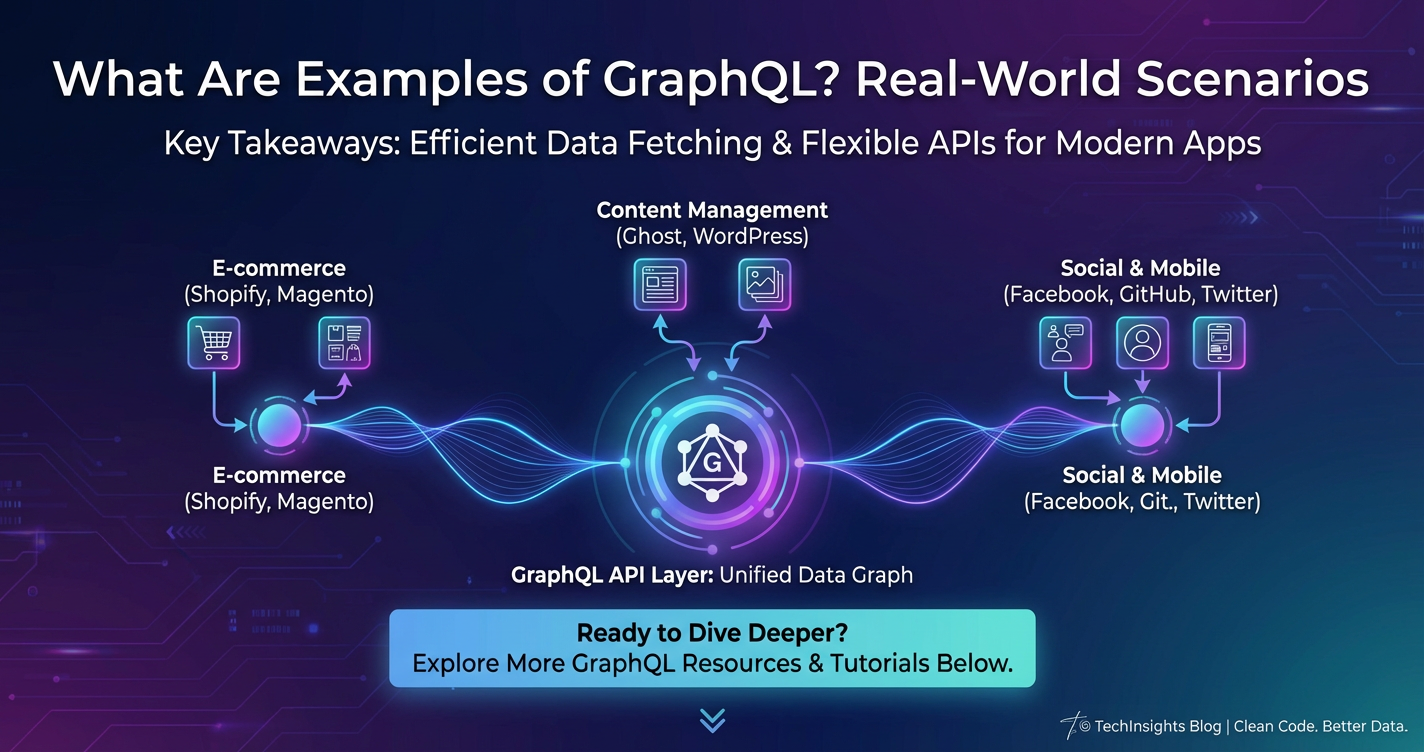
What Are Examples of GraphQL? Real-World Scenarios


In the rapidly evolving landscape of digital experiences, the demand for instant, precise, and dynamic data has pushed the boundaries of traditional API architectures. From the smallest mobile applications to the sprawling canvases of enterprise systems, developers and organizations alike are constantly seeking more efficient and flexible ways to interact with data. For decades, REST (Representational State Transfer) APIs served as the de facto standard, providing a robust framework for client-server communication. However, as applications grew in complexity, incorporating diverse data sources, intricate user interfaces, and demanding real-time updates, the limitations of REST began to surface. Developers often grappled with issues like over-fetching (receiving more data than needed), under-fetching (requiring multiple requests to gather all necessary data), and the rigid versioning headaches that frequently accompanied API evolution.
Enter GraphQL, a revolutionary query language for your API and a server-side runtime for executing those queries by using a type system you define for your data. Born out of Facebook's internal needs in 2012 and open-sourced in 2015, GraphQL was designed to address the very challenges that weighed down RESTful development. It empowers clients to specify exactly what data they need, no more, no less, and receive it in a single, predictable response. This fundamental shift in how clients interact with servers has profound implications for application performance, development agility, and the overall developer experience. It transforms the client-server contract, offering a collaborative surface where front-end needs directly inform back-end data exposure, fostering a more harmonious and efficient development cycle.
This comprehensive exploration delves deep into the power and versatility of GraphQL, moving beyond theoretical discussions to illuminate its practical applications across a multitude of real-world scenarios. We will dissect its core principles, highlight its distinct advantages over traditional API paradigms, and, most importantly, provide concrete examples of how organizations are leveraging GraphQL to build more responsive, scalable, and maintainable applications. From optimizing data delivery in e-commerce platforms and orchestrating complex data flows in social media networks to enhancing enterprise integrations and powering real-time dashboards, GraphQL is reshaping how we conceive, design, and interact with the digital world. By the end of this journey, you will gain a profound understanding of GraphQL's transformative potential and its indispensable role in the modern API ecosystem.
1. Understanding GraphQL Fundamentals: A Paradigm Shift in Data Interaction
To truly appreciate the real-world utility of GraphQL, it's essential to first grasp its foundational concepts. Unlike REST, which is architectural pattern relying on multiple endpoints representing resources, GraphQL provides a single endpoint through which clients can send queries to request specific data. This fundamental difference underpins its power and flexibility.
1.1. What is GraphQL? More Than Just a Query Language
At its heart, GraphQL is a query language for your API. It's not a database query language like SQL, nor is it a network protocol. Instead, it's a specification that dictates how a client can request data from a server, and how a server can respond to those requests. The "graph" in GraphQL refers to the idea that data is often connected in a graph-like structure, with relationships between different types of entities. GraphQL allows you to query these interconnected entities with remarkable precision and efficiency, traversing the data graph as needed.
Beyond being a query language, GraphQL is also a server-side runtime for executing queries. This means that once a server implements the GraphQL specification, it provides an execution engine that interprets incoming queries against a predefined schema and then fetches the requested data. This dual nature – a client-driven query language and a server-driven execution environment – is what gives GraphQL its unparalleled expressive power and operational efficiency. It provides a robust contract between client and server, ensuring predictable data interactions and reducing communication overheads.
1.2. Key Concepts: The Building Blocks of a GraphQL API
Understanding the following core concepts is crucial for anyone looking to build or consume a GraphQL api:
- Schema Definition Language (SDL): The GraphQL schema is the bedrock of any GraphQL
api. It is a strong type system that defines all the data types and fields available in the API, along with their relationships. The SDL is used to write this schema, providing a human-readable and machine-interpretable blueprint of theapi. It acts as a contract between the client and the server, ensuring that both parties agree on the structure and types of data that can be exchanged. This strict typing helps prevent many commonapiintegration errors and provides powerful introspection capabilities. - Types: At the core of the schema are types. GraphQL supports several fundamental types:
- Object Types: Represent a collection of fields. For example, a
Usertype might have fields likeid,name, andemail. - Scalar Types: Primitive data types that resolve to a single value, such as
Int(integer),Float(floating-point number),String(text),Boolean(true/false), andID(a unique identifier string). Custom scalar types can also be defined for more complex data structures likeDateorJSON. - Enum Types: A special scalar type that restricts a field to a specific set of allowed values, like
OrderStatus(PENDING, SHIPPED, DELIVERED). - Input Types: Used for passing complex objects as arguments to mutations, allowing for structured input data.
- Interface Types: Define a set of fields that multiple object types must include, similar to interfaces in object-oriented programming, enabling polymorphism.
- Union Types: Allow an object field to return one of several different object types, providing flexibility when the exact return type is unknown at query time.
- Object Types: Represent a collection of fields. For example, a
- Queries: Queries are how clients request data from the GraphQL
api. They specify the exact fields and nested relationships the client needs, mirroring the structure of the data as defined in the schema. For instance, a query might ask for a user's name and their five most recent blog posts, and for each post, its title and publication date. The server then responds with precisely that data, eliminating the problems of over-fetching or under-fetching that are common in REST. - Mutations: While queries are for reading data, mutations are for writing data. They allow clients to create, update, or delete data on the server. Similar to queries, mutations also specify the desired changes and can include a selection set to return the new or modified data after the operation. For example, a mutation to create a new user might return the
idandnameof the newly created user, confirming the operation's success. This immediate feedback mechanism simplifies client-side state management. - Subscriptions: Subscriptions are a powerful feature of GraphQL that enable real-time data updates. They allow clients to subscribe to specific events and receive live data streams from the server whenever that event occurs. This is particularly useful for applications requiring instant updates, such as chat applications, live dashboards, or notification systems. When data changes on the server, the server pushes the relevant updates to all subscribed clients, providing a seamless and responsive user experience without constant polling.
- Resolvers: On the server side, resolvers are functions that handle the actual fetching or manipulation of data for each field defined in the schema. When a client sends a query or mutation, the GraphQL execution engine traverses the schema and calls the appropriate resolver for each field in the request. Resolvers can fetch data from various sources, including databases, other REST APIs, microservices, or even static files. This flexibility allows GraphQL to act as a powerful aggregation layer, unifying disparate data sources under a single, coherent
api.
1.3. How GraphQL Differs from REST: A Fundamental Shift
The contrast between GraphQL and REST is stark and highlights why GraphQL has gained significant traction:
- Single Endpoint vs. Multiple Endpoints: REST APIs typically expose multiple endpoints, each representing a distinct resource or collection of resources (e.g.,
/users,/products/123,/orders). To gather related data, a client often needs to make multiple requests to different endpoints. GraphQL, conversely, uses a single endpoint (commonly/graphql) where all requests are sent. The client then specifies its data requirements within the request body, effectively querying the entire data graph. - Over-fetching and Under-fetching: In REST, an endpoint typically returns a predefined set of data. If a client only needs a few fields from a resource, it still receives the entire payload (over-fetching). Conversely, if it needs data from multiple related resources, it often has to make several requests (under-fetching), leading to increased latency and network overhead. GraphQL solves both problems by allowing clients to specify exactly which fields and nested relationships they need, fetching only the necessary data in a single request.
- Strongly Typed Schema vs. Loosely Defined Contracts: GraphQL mandates a strong type system defined in its schema, acting as a clear contract between client and server. This schema provides powerful introspection capabilities, allowing tools and clients to discover the
api's capabilities. REST APIs often rely on less formal documentation (e.g., OpenAPI/Swagger) and implicitly defined contracts, which can lead to ambiguity and more complex client-side validation. The explicit nature of GraphQL's schema significantly improves developer experience and reduces integration errors. - Versioning: Versioning REST APIs can be a thorny issue. Changes to an endpoint's response structure often necessitate a new
apiversion (e.g.,/v1/users,/v2/users), requiring clients to update to the latest version to avoid breakage. GraphQL's schema evolution is more graceful. Developers can deprecate fields and add new ones without immediately breaking existing clients, as clients only receive the data they explicitly request. This allows for continuousapievolution without forcing disruptive updates on consumers, making theapimore resilient to change. - Client-Driven vs. Server-Driven: REST APIs are largely server-driven; the server dictates the structure of the resources and how they are accessed. GraphQL is client-driven, empowering clients to declare their data requirements. This client-centric approach optimizes data delivery for specific UI components and application logic, allowing front-end teams to iterate faster and tailor data consumption precisely to their needs.
These foundational differences underscore why GraphQL is not just an alternative to REST, but a paradigm shift that offers significant advantages for modern application development, particularly in scenarios demanding flexibility, efficiency, and real-time capabilities.
2. The Core Advantages of GraphQL in Real-World Scenarios
The theoretical underpinnings of GraphQL translate into tangible benefits that address many pain points developers face daily. These advantages are not merely abstract concepts but practical improvements that directly impact the efficiency, scalability, and maintainability of applications in diverse real-world contexts.
2.1. Unprecedented Data Fetching Efficiency: Eliminating Over-fetching and Under-fetching
One of GraphQL's most celebrated features is its ability to eliminate the notorious problems of over-fetching and under-fetching that plague traditional REST APIs. In a RESTful architecture, endpoints often return a fixed payload of data. For example, requesting /users/123 might return an id, name, email, address, phone_number, and a list of order_ids. If a client only needs the user's name and email for a specific UI component, it still receives all the other fields, leading to wasted bandwidth and increased processing on both client and server (over-fetching). Conversely, if the client needs the user's name, email, and the details of their last three orders (which might be separate resources like /orders/abc), it would typically require multiple round trips to different endpoints (under-fetching), significantly increasing latency.
GraphQL elegantly resolves this by allowing clients to specify precisely what data they require. A client can send a query asking for user(id: "123") { name email orders(limit: 3) { id total status } }. The server then processes this query and returns only the name, email, and the specified fields for the last three orders. This precision means less data traveling over the network, faster load times for applications, and reduced processing overhead for both the client and the server. For mobile applications, where bandwidth and battery life are critical constraints, this efficiency can be a game-changer, leading to snappier user interfaces and a more fluid user experience.
2.2. Reduced Network Requests and Simplified Client-Side Logic
The ability to fetch all necessary data in a single request, even if it spans multiple related resources, dramatically reduces the number of network round trips a client needs to make. Consider a complex dashboard that displays user information, recent activities, notifications, and associated project details. In a REST scenario, this might involve separate GET requests to /users/{id}, /activities?userId={id}, /notifications?userId={id}, and /projects?userId={id}. Each request incurs network overhead, contributes to cumulative latency, and necessitates complex client-side orchestration to combine the disparate pieces of data.
With GraphQL, all this data can be retrieved with a single, intelligently crafted query. The client sends one request, and the GraphQL server, leveraging its resolvers, orchestrates the fetching of data from various underlying services or databases before compiling it into a single, comprehensive response. This consolidation not only slashes network latency but also simplifies client-side development. Front-end developers no longer need to manage a cascade of Promise.all or sequential fetch calls, nor do they need to write extensive logic to merge and normalize data from multiple API responses. The data arrives pre-assembled and shaped exactly as needed for the UI, leading to cleaner, more maintainable client-side code and faster feature development cycles.
2.3. Faster Iteration and Development: Decoupling Frontend and Backend
GraphQL fosters a healthy decoupling between frontend and backend development teams, leading to faster iteration cycles. In a traditional REST setup, if a new UI component requires additional data, the frontend team often has to wait for the backend team to modify an existing endpoint or create a new one. This dependency can create bottlenecks and slow down development.
With GraphQL, the frontend team has significantly more autonomy. As long as the data is available within the GraphQL schema (or can be easily added by exposing existing backend services), the frontend can simply adjust its query to request the new fields. The backend team's role shifts from constantly adapting endpoints to designing a robust and extensible schema that reflects the organization's data model. This means frontend developers can rapidly prototype and iterate on user interfaces without constant backend intervention, significantly accelerating the pace of development. The clear contract provided by the schema also reduces miscommunication and integration errors, as both teams operate from a shared understanding of the data capabilities.
2.4. Type Safety and Self-Documentation: A Strong Contract
The GraphQL Schema Definition Language (SDL) enforces a strong type system that serves as an unambiguous contract between the client and the server. Every field, every argument, and every return type is explicitly defined. This inherent type safety helps catch errors early in the development process, often before runtime, by preventing clients from requesting non-existent fields or providing incorrect argument types.
Beyond error prevention, the schema is inherently self-documenting. Tools like GraphiQL or GraphQL Playground can introspect the schema and provide an interactive documentation explorer. Developers can instantly see what queries, mutations, and types are available, what arguments they accept, and what data they return. This eliminates the need for external, often outdated, API documentation, making it significantly easier for developers to understand and consume the api. New team members can onboard faster, and external consumers can integrate more smoothly, reducing the friction typically associated with api adoption.
2.5. Versionless APIs: Evolving the Schema Without Breaking Clients
API versioning is a recurring headache for developers and a source of friction for api consumers. When a REST api needs to change its data structure, it often leads to the creation of new versions (e.g., /v1, /v2), forcing clients to upgrade, or maintaining multiple versions simultaneously, which adds significant operational overhead.
GraphQL offers a more graceful approach to api evolution. Because clients explicitly specify the fields they need, the schema can evolve without immediately breaking existing clients. New fields can be added to existing types, and old fields can be marked as deprecated within the schema. Clients that haven't updated their queries will simply continue to receive data for the fields they explicitly request, ignoring any new or deprecated fields. This allows the api to grow and adapt to new requirements over time without imposing mandatory, disruptive updates on all consumers. The deprecated fields can remain in the schema for a period, allowing clients ample time to migrate, and then be safely removed once their usage drops to zero. This flexible evolution strategy makes GraphQL APIs incredibly resilient and future-proof.
2.6. Aggregating Disparate Data Sources: A Unified Data Graph
Modern applications often draw data from a multitude of sources: relational databases, NoSQL stores, third-party REST APIs, microservices, legacy systems, and even real-time data streams. Orchestrating data fetching from these diverse sources in a coherent and efficient manner can be incredibly complex.
GraphQL excels as an aggregation layer. Its resolvers can be configured to fetch data from any source. A single GraphQL api can sit on top of multiple backend services, unifying them into a single, cohesive data graph. For instance, a User type's data might come from a UserService (via a REST api), their Order history from an OrderDatabase (via a direct database connection), and their ProductReview data from a ReviewMicroservice (via an RPC call). The GraphQL server abstracts away these underlying complexities, presenting a clean, unified api to the client. This capability makes GraphQL particularly powerful in microservices architectures, where it can serve as an api gateway or a "Backend for Frontend" (BFF) layer, simplifying client interactions with a distributed backend. This unification not only streamlines data access for clients but also allows backend teams to choose the best technology for each specific service without impacting the frontend api contract.
These core advantages collectively paint a picture of GraphQL as a powerful and pragmatic solution for modern api development. Its client-centric design, efficiency, flexibility, and robust type system contribute to faster development cycles, improved application performance, and a more sustainable api ecosystem.
3. Real-World Examples of GraphQL Implementation
The theoretical benefits of GraphQL come vividly to life when examining its application across various industries and use cases. These examples demonstrate how organizations leverage GraphQL to solve complex data challenges, optimize user experiences, and streamline development workflows.
3.1. E-commerce Platforms: The Omnipresent Data Challenge
E-commerce platforms are inherently data-intensive. A single product page might need to display a product's name, description, images, price, availability, customer reviews, related products, shipping information, and potentially personalized recommendations. Managing this rich data landscape efficiently is crucial for conversion rates and customer satisfaction.
Challenges with REST: In a traditional REST architecture, fetching all this information often involves numerous API calls: * GET /products/{id} for core product details. * GET /product/{id}/images for images. * GET /product/{id}/reviews for reviews. * GET /product/{id}/related for related products. * GET /inventory/{id} for availability. * GET /prices/{id} if pricing comes from a separate service. * GET /recommendations?userId={id}&productId={id} for personalized data.
This multitude of requests leads to significant latency, especially on mobile networks, and requires complex client-side logic to aggregate and display the data. Furthermore, different client types (web, iOS, Android) might need slightly different subsets of this data, leading to the notorious over-fetching/under-fetching problem or the creation of specialized "BFF" (Backend For Frontend) REST endpoints, which can complicate backend maintenance.
Solutions with GraphQL: GraphQL offers a highly efficient solution for e-commerce: * Single Request for Product Details: A single GraphQL query can fetch all necessary data for a product page in one round trip. graphql query ProductPage($productId: ID!, $userId: ID) { product(id: $productId) { id name description price { amount currency } images { url altText } availability { inStock quantity } reviews(first: 5) { id rating comment author { name } } relatedProducts(limit: 3) { id name price { amount } } recommendations(userId: $userId, limit: 3) { # Personalized recommendations id name imageUrl } } } This query combines data from what would typically be many separate REST endpoints, dramatically reducing network requests and improving page load times. * User Profile Management: A customer's profile might include their order history, wishlists, saved addresses, and payment methods. A single GraphQL query can fetch all this information for a personalized dashboard. graphql query UserDashboard($userId: ID!) { user(id: $userId) { name email orders(first: 10) { id total status items { product { name } quantity } } wishlist { product { id name price { amount } } } addresses { street city zipCode } } } * Shopping Cart and Checkout: Mutations in GraphQL allow for seamless management of the shopping cart (add, remove, update quantity) and the checkout process. graphql mutation AddItemToCart($productId: ID!, $quantity: Int!) { addItemToCart(productId: $productId, quantity: $quantity) { cart { totalItems totalAmount { amount } } } } After adding an item, the client can immediately query for the updated cart total or contents in the same response, ensuring UI consistency. * A/B Testing and Feature Flags: With GraphQL, it's easier to implement A/B tests or feature flags by selectively exposing fields or arguments. Different client variants can request slightly different data sets without requiring new backend endpoints.
By using GraphQL, e-commerce platforms can deliver richer, faster, and more personalized user experiences while simplifying backend api development and maintenance. The client-driven nature ensures that mobile apps, web apps, and even internal tools get exactly the data they need, optimized for their specific context.
3.2. Social Media Networks: Managing a Complex Data Graph
Social media platforms are quintessential examples of highly interconnected data graphs. Users, posts, comments, likes, shares, followers, following relationships, messages, and notifications all form a complex web of relationships that need to be efficiently queried and updated.
Challenges with REST: Imagine loading a user's feed on a social media app. A REST api might require: * GET /users/{id}/following to get followed users. * GET /posts?userIds={followed_user_ids} to get posts. * GET /comments?postId={post_id} for each post. * GET /likes?postId={post_id} for each post. * GET /notifications?userId={id}.
This again results in an excessive number of requests and complex data aggregation on the client side, leading to slow loading times and a choppy user experience, especially on feeds with high engagement.
Solutions with GraphQL: GraphQL is a natural fit for social media's graph-like data structure: * Unified Feed Query: A single query can fetch a user's personalized feed, including posts from followed users, their comments, likes, and even nested information about the authors of those comments. graphql query UserFeed($userId: ID!, $first: Int = 10, $after: String) { user(id: $userId) { feed(first: $first, after: $after) { pageInfo { hasNextPage endCursor } edges { node { id content timestamp author { id username profilePictureUrl } likes { count isLikedByUser(userId: $userId) } comments(first: 3) { id text author { username } } shares { count } } } } } } This allows for infinite scrolling feeds that load new content efficiently. * Profile Management: Fetching a user's own posts, follower count, and other profile details is also streamlined. graphql query UserProfile($username: String!) { user(username: $username) { id username bio profilePictureUrl followerCount followingCount posts(first: 10) { id imageUrl caption likes { count } } } } * Real-time Updates with Subscriptions: Subscriptions are invaluable for social media. * Live Notifications: A user can subscribe to receive new notifications (e.g., new follower, new like on a post, new comment) in real-time. graphql subscription NewNotification($userId: ID!) { newNotification(userId: $userId) { id type message timestamp relatedEntityId } } * Live Comment Streams: In a live video or popular post, new comments can stream in real-time using subscriptions, enhancing user engagement. * Chat Applications: Direct messages are a perfect use case for GraphQL subscriptions, allowing for instant message delivery and receipt confirmation.
Social media giants like Facebook (the originators of GraphQL), Twitter, and LinkedIn have adopted GraphQL to manage their complex data models, improve performance, and deliver dynamic, real-time user experiences that are crucial for user retention and engagement.
3.3. Content Management Systems (CMS) & Blogging Platforms: Flexible Content Delivery
For any platform dealing with content – be it articles, blog posts, documentation, marketing pages, or media assets – flexibility in content delivery across various channels (web, mobile, smart devices) is paramount. Traditional CMS architectures often export content via rigid REST APIs, which can be restrictive for diverse frontends.
Challenges with REST: A typical CMS REST api might offer endpoints like /articles, /articles/{id}, /categories, /authors. If a client needs a list of articles with their categories, authors, and a snippet of content, it might involve: * GET /articles to get basic article info and IDs. * Looping through article IDs to GET /authors/{authorId} and GET /categories/{categoryId} for each article. * Or, the backend creates a specific /articlesWithDetails endpoint which might over-fetch for some clients.
Different views (e.g., a blog index page, a single article page, an author profile) require different combinations of fields, often leading to either over-fetching or multiple requests.
Solutions with GraphQL: GraphQL provides an elegant and flexible api layer for CMS platforms: * Tailored Content Queries: Frontends can request precisely the content they need for specific displays. ```graphql # Query for a blog index page query BlogIndexPage($first: Int = 10, $after: String) { posts(first: $first, after: $after) { pageInfo { hasNextPage endCursor } edges { node { id title slug publishedAt excerpt coverImageUrl author { name avatarUrl } categories { name } tags { name } } } } }
# Query for a single article page
query SingleArticlePage($slug: String!) {
  post(slug: $slug) {
    id
    title
    contentHtml # Full HTML content
    publishedAt
    author {
      name
      bio
      avatarUrl
      socialLinks { platform url }
    }
    categories { name }
    tags { name }
    comments(first: 5) {
      id
      text
      authorName
      publishedAt
    }
  }
}
```
- Rich Content Relationships: GraphQL effortlessly handles relationships between articles, authors, categories, and tags, allowing clients to traverse these relationships in a single query. This is particularly powerful for content graph models where content pieces are interconnected.
- Multi-Channel Delivery: The same GraphQL
apican serve content to a static site generator (like Gatsby), a single-page application, a mobile app, or even an IoT device, each requesting content optimized for its display context. Theapiremains consistent, only the queries change. - Content Preview: During content creation, authors often need to preview changes before publishing. GraphQL can expose a "draft" state of content, allowing preview systems to query unpublished content without affecting the live site.
- Headless CMS Architectures: GraphQL is a cornerstone of modern headless CMS architectures (e.g., Strapi, Contentful, DatoCMS), providing a powerful and flexible
apito decouple content from its presentation, enabling developers to build highly customized frontends.
By providing a unified and highly customizable api for content, GraphQL liberates CMS users and developers from the constraints of fixed-payload REST endpoints, enabling more dynamic, efficient, and channel-agnostic content delivery.
3.4. Mobile Applications (Native & Cross-Platform): Optimizing for Constraints
Mobile environments present unique challenges for data fetching: limited bandwidth, intermittent connectivity, high latency, and battery consumption are all critical factors. Applications need to load quickly and consume data efficiently to provide a smooth user experience.
Challenges with REST: REST APIs, with their tendency for over-fetching and multiple requests, can be detrimental to mobile performance: * Increased Data Usage: Over-fetching means consuming more mobile data than necessary, which can be costly for users on limited data plans. * Higher Latency: Multiple round trips significantly increase the perceived load time, especially over cellular networks. * Battery Drain: More network activity and data processing can lead to faster battery depletion. * Rigid Data Structures: If a specific mobile UI component only needs two fields, but the REST endpoint returns ten, the mobile app still has to process the extra data.
Solutions with GraphQL: GraphQL is exceptionally well-suited for mobile application development: * Tailored Data for Specific UI Components: Mobile apps can request only the exact fields needed for a particular screen or widget. For example, a card in a list view might only need a title and thumbnail, while a detail view needs much more. ```graphql # Query for a list item in a mobile app query ListItemDetails($itemId: ID!) { item(id: $itemId) { id title thumbnailUrl } }
# Query for the full detail page on mobile
query ItemDetailPage($itemId: ID!) {
  item(id: $itemId) {
    id
    title
    description
    fullImageUrl
    category { name }
    price { amount currency }
    # ... and so on, for the full detail page
  }
}
```
This eliminates over-fetching and ensures minimal data transfer, leading to faster loading times and reduced data consumption.
- Reduced Round Trips: A single GraphQL query can replace multiple REST calls, drastically cutting down on network latency, which is often a major bottleneck on mobile.
- Offline Capabilities: By fetching only the essential data, GraphQL facilitates more effective caching strategies for offline support. Apps can store precisely what they need locally.
- Faster Development with Frontend Autonomy: Mobile developers can iterate on UI changes and data requirements without constant coordination with backend teams for
apimodifications, accelerating the development process. This is particularly valuable in fast-paced mobile development cycles. - Optimized for Different Device Sizes: A tablet layout might need more data fields than a phone layout. GraphQL allows clients to adapt their queries based on screen size or device type, ensuring optimal data delivery for each form factor.
Companies like Airbnb, Coursera, and the New York Times have publicly shared their experiences with GraphQL for mobile, citing significant improvements in performance, data efficiency, and developer productivity. GraphQL ensures that mobile applications can deliver rich features without compromising on speed, responsiveness, or data economy.
3.5. Enterprise Integrations & Microservices Architectures: The Orchestration Layer
In large enterprises, data often resides across dozens, if not hundreds, of disparate systems, microservices, and legacy applications. Integrating these systems to provide a unified experience for internal tools or external partners is a monumental challenge. Microservices architectures further amplify this complexity by distributing functionality across many independent services.
Challenges with REST/Traditional Integration: * Spaghetti Integrations: Clients often end up calling multiple microservices directly, leading to complex client-side orchestration, tight coupling, and a "spaghetti" architecture where any service change can break multiple clients. * Data Aggregation Hell: Aggregating data from multiple microservices (e.g., user profiles from an Identity service, order history from an Order service, product details from a Product service) for a single view becomes a daunting task, requiring complex orchestration logic often replicated across clients. * Version Mismatch: Managing api versions across numerous microservices and clients becomes an operational nightmare. * Security & Governance: Applying consistent security policies, monitoring, and rate limiting across a fragmented landscape of microservices APIs is extremely difficult.
Solutions with GraphQL: GraphQL shines as an api gateway or a "Backend For Frontend" (BFF) layer in enterprise and microservices environments. It acts as an orchestration point, unifying a fragmented backend landscape under a single, coherent api.
- Unified API Gateway: A GraphQL server can sit in front of an array of microservices and legacy systems. Its resolvers can delegate requests to the appropriate backend service (e.g., a REST
apicall to a User Service, a database query to an Order Service, an RPC call to a Payment Service). This creates a unifiedapiwhere clients interact with one predictable interface, abstracting away the underlying complexity of the distributed system. - Backend for Frontend (BFF) Pattern: For specific frontend applications, a GraphQL server can act as a BFF, tailored to the exact data needs of that application. This dedicated
apiaggregates data from multiple microservices into a single, optimized response for the client, without over-fetching or requiring the client to perform complex data joining. This pattern allows frontend teams to iterate independently and optimize their data consumption without directly coupling to backend microservices. - Simplified Data Aggregation: Consider a customer service dashboard that needs to display a customer's personal details, recent orders, support tickets, and subscription status. In a microservices architecture, this data would come from an Identity Service, an Order Service, a Support Service, and a Billing Service, respectively. A single GraphQL query can aggregate all this data efficiently:
graphql query CustomerServiceDashboard($customerId: ID!) { customer(id: $customerId) { id name email phone address { street city } recentOrders(first: 5) { id total status } supportTickets(first: 3) { id subject status } subscriptions { planName status renewalDate } } }The GraphQL server handles the internal routing and aggregation, presenting a simplified view to the client. - API Management and Governance: This is where a robust
api gatewaysolution becomes indispensable. While GraphQL defines the client-server interaction, the underlying infrastructure that secures, scales, and monitors these APIs is critical. Anapi gatewayprovides capabilities like:This is an excellent context to naturally mention APIPark. APIPark is an open-source AIgatewayandAPImanagement platform that excels in managing, integrating, and deploying various services, including those that might form the backend for a GraphQL layer. It can act as a powerfulAPI gatewayfor your microservices, helping you manage traffic forwarding, load balancing, and versioning of published APIs. Imagine a scenario where your GraphQLapineeds to interact with various AI models or traditional REST services; APIPark can facilitate quick integration of 100+ AI models and standardize the API format for AI invocation, abstracting away complexities for your GraphQL resolvers. It also provides end-to-endAPIlifecycle management, detailedAPIcall logging, and powerful data analysis, making it an ideal companion for securing and optimizing the underlying services that feed your GraphQLapi. APIPark's ability to encapsulate prompts into RESTAPIs and its performance rivaling Nginx further solidify its utility in a high-performance, AI-driven enterprise environment.- Authentication and Authorization: Securing access to the GraphQL endpoint and enforcing granular permissions based on user roles.
- Rate Limiting: Protecting backend services from abuse by limiting the number of requests clients can make.
- Caching: Improving performance by caching frequently requested data at the
gatewaylevel. - Load Balancing: Distributing incoming traffic across multiple GraphQL server instances.
- Monitoring and Analytics: Providing insights into API usage, performance, and error rates.
The adoption of GraphQL in enterprise settings reduces integration complexity, enhances security, improves performance, and significantly boosts developer productivity by providing a flexible and unified api for a fragmented backend.
3.6. Real-time Dashboards & Analytics: Live Data for Informed Decisions
Modern business intelligence dashboards and operational monitoring tools require up-to-the-minute data to enable quick, informed decision-making. Whether tracking sales, server health, social media engagement, or IoT sensor readings, real-time updates are essential.
Challenges with REST: Achieving real-time updates with REST typically involves: * Polling: Clients repeatedly send GET requests to an endpoint at short intervals (e.g., every 5 seconds). This is inefficient, generates a lot of unnecessary network traffic, and can strain backend resources, especially with many clients. * Long Polling: The server holds a connection open until new data is available, then responds and closes the connection, after which the client immediately re-opens a new connection. This is more efficient than polling but still involves overhead and can be complex to manage. * WebSockets: While WebSockets provide true real-time push capabilities, integrating them with REST APIs often means managing a separate WebSocket api alongside the REST api, increasing complexity.
Solutions with GraphQL: GraphQL's subscription feature is a perfect fit for real-time dashboards and analytics: * Event-Driven Real-time Updates: Clients can subscribe to specific events or data streams, and the server automatically pushes updates to them as soon as data changes. This eliminates inefficient polling and provides truly live data. graphql subscription LiveSalesMetrics { salesMetricsUpdated { totalSales newOrdersCount averageOrderValue topSellingProduct { name revenue } } } When a new sale occurs, the server triggers the salesMetricsUpdated subscription, and all connected clients instantly receive the updated metrics. * Customizable Dashboards: Different users or roles might need different sets of metrics or data aggregations. GraphQL allows clients to define exactly what metrics they want to subscribe to, enabling highly customizable dashboards. An executive might subscribe to high-level KPIs, while an operations manager might subscribe to granular system health metrics. * Aggregating Real-time Data: The GraphQL server's resolvers can aggregate data from multiple real-time sources (e.g., streaming apis, message queues) and present them through a single, coherent subscription. For example, aggregating live sensor data from IoT devices with historical data from a database. * Reduced Backend Load: By only pushing updates when changes occur, and only sending the data specifically requested by the client, GraphQL subscriptions significantly reduce backend load compared to constant polling.
Companies building operational dashboards, financial trading platforms, logistics tracking systems, or any application requiring immediate data visibility can leverage GraphQL subscriptions to deliver dynamic, responsive, and resource-efficient real-time experiences.
3.7. Developer Tools & IDEs: Powering Interactive Development Experiences
Developer tools, Integrated Development Environments (IDEs), and command-line interfaces (CLIs) often need to interact with various backend services: version control systems, CI/CD pipelines, issue trackers, documentation repositories, and more. A unified and introspectable api can greatly enhance the developer experience.
Challenges with REST: * Fragmented Tooling: Each backend service typically has its own REST api, requiring developer tools to integrate with many different, often inconsistent, APIs. * Discovery Issues: Without strong tooling, discovering the capabilities of each api can be cumbersome, relying on external documentation. * API Changes: Changes in backend REST APIs can break tooling, requiring frequent updates to maintain compatibility. * Complex Interactions: Building features that span multiple services (e.g., "show commits related to this issue in this repository") often involves making multiple api calls and manually stitching data together.
Solutions with GraphQL: GraphQL provides a powerful foundation for building sophisticated developer tools: * Unified API for Multiple Services: A GraphQL api can act as a facade over various developer services. For instance, a single api could expose data from GitHub, Jira, Jenkins, and Confluence. A developer tool can then query this unified api to fetch a project's repositories, recent commits, associated issues, and relevant documentation pages with a single request. graphql query ProjectOverview($projectId: ID!) { project(id: $projectId) { name repositories(first: 3) { name latestCommit { message author { name } } } issues(status: OPEN, first: 5) { id title assignee { name } } buildPipelines(status: FAILED, first: 2) { name lastRunStatus } } } * Introspection for Auto-completion and Validation: GraphQL's introspection capabilities are a boon for IDEs and developer tools. They can query the schema to understand all available types, fields, and arguments. This information can then be used to provide: * Auto-completion: Suggesting fields and arguments as a developer types a query. * Real-time Validation: Highlighting syntax errors or invalid field requests directly in the editor. * Contextual Documentation: Displaying documentation for a field when hovering over it. * Schema Visualization: Generating visual representations of the data graph. These features significantly enhance the developer experience, making it faster and less error-prone to interact with the api. * Flexible Data for Different Tools: A CLI tool might need minimal output, while a graphical IDE might need rich, nested data. GraphQL allows each tool to fetch exactly what it needs without over-fetching. * Versionless API Evolution: As backend services evolve, the GraphQL api can adapt without forcing immediate updates to all developer tools, thanks to its graceful schema evolution capabilities (deprecating fields).
Tools like Hasura, Apollo Studio, and Postman leverage GraphQL's introspection and query capabilities to provide powerful development and testing environments. By creating a unified, introspectable, and flexible api for their ecosystem, organizations can empower their developers with more efficient and intuitive tools, accelerating their productivity and improving their overall experience.
APIPark is a high-performance AI gateway that allows you to securely access the most comprehensive LLM APIs globally on the APIPark platform, including OpenAI, Anthropic, Mistral, Llama2, Google Gemini, and more.Try APIPark now! 👇👇👇
4. Implementing GraphQL: Practical Considerations for Success
Adopting GraphQL is more than just choosing a new API technology; it involves architectural decisions, tooling choices, and strategic planning. Successfully integrating GraphQL into an existing ecosystem requires careful consideration of several practical aspects.
4.1. Choosing a GraphQL Server: The Engine of Your API
The GraphQL server is the backbone of your api, responsible for receiving queries, validating them against the schema, and executing them using resolvers. The choice of server-side implementation depends heavily on your existing technology stack, performance requirements, and preferred development paradigm.
- Apollo Server: A popular, production-ready GraphQL server that can be easily integrated with various Node.js frameworks (Express, Koa, Hapi) or run standalone. It offers robust features like schema stitching, federation, caching, and excellent integration with the Apollo client ecosystem. Apollo Federation is particularly powerful for large-scale microservices architectures, allowing multiple GraphQL services to be composed into a single, unified graph.
- Express-GraphQL: A simple, lightweight implementation for Node.js, often used for quickly standing up a basic GraphQL endpoint. It's great for getting started but might require more custom work for advanced features.
- Yoga (GraphQL Yoga): A robust and performant GraphQL server built on
graphql-jsthat emphasizes simplicity and developer experience. It's framework-agnostic and provides features like subscriptions out-of-the-box. - Spring for GraphQL (Java): For Java ecosystems, Spring for GraphQL provides first-class support for building GraphQL APIs with Spring Boot, leveraging existing Spring Data and WebFlux capabilities.
- Graphene-Python (Python): A popular library for building GraphQL APIs in Python, integrating well with frameworks like Django and Flask.
- Absinthe (Elixir): Known for its high performance and scalability, Absinthe is a powerful choice for building GraphQL APIs in Elixir, particularly well-suited for real-time applications using Phoenix.
- GraphQL-Go (Go): For high-performance microservices,
graphql-gooffers a robust and efficient way to implement GraphQL APIs in Go.
When making a choice, consider factors like community support, documentation quality, advanced features (e.g., subscriptions, federation), and how well it integrates with your existing backend services and database technologies. The learning curve for the chosen framework and the availability of skilled developers are also crucial.
4.2. Client-Side Libraries: Consuming Your GraphQL API
While you can technically consume a GraphQL api with a simple fetch request, client-side libraries significantly enhance the developer experience by providing features like caching, state management, normalization, and UI integration.
- Apollo Client: The most comprehensive and widely adopted GraphQL client. It integrates seamlessly with React, Vue, Angular, and vanilla JavaScript. Key features include a powerful in-memory cache, normalization of data, optimistic UI updates, real-time subscriptions, and excellent tooling. Its strong ecosystem makes it a default choice for many projects.
- Relay: Developed by Facebook, Relay is a highly optimized GraphQL client specifically designed for React. It focuses on performance, data consistency, and colocation of data requirements with components. Relay requires a stricter
apicontract (using fragments extensively) and build-time code generation, which can have a steeper learning curve but offers unparalleled performance benefits for large-scale applications. - Urql: A lighter-weight and more customizable GraphQL client compared to Apollo Client. It offers a "fully pluggable" architecture, allowing developers to swap out core components (like caching or exchanges) to tailor it to their specific needs. It's a good choice for those who want more control and a smaller bundle size.
- GraphQL Request: A very minimal GraphQL client that provides a thin wrapper around
fetchfor sending GraphQL queries and mutations. It's excellent for simple use cases or when you want to build your own caching and state management logic.
The choice of client depends on your frontend framework, desired level of abstraction, performance needs, and how much control you want over data management. For most modern web and mobile applications, a feature-rich client like Apollo Client often provides the best balance of power and ease of use.
4.3. Performance Optimization: Tackling the N+1 Problem and Beyond
While GraphQL is efficient by design, performance pitfalls can arise if not handled correctly. The most infamous is the N+1 problem. This occurs when a resolver for a list of items (N) makes an individual database query or api call for each item's related data (+1). For example, fetching 10 posts and then fetching the author for each post separately would result in 1 (for posts) + 10 (for authors) = 11 database queries, instead of just 2 (one for posts, one for authors with IDs).
Strategies to mitigate performance issues: * Dataloaders: Dataloaders (a common pattern, often implemented via libraries like dataloader in Node.js) are essential. They batch multiple individual requests for objects into a single request to the underlying data source and cache results. This effectively solves the N+1 problem by transforming many individual queries into a few batched queries. * Caching: Implementing caching at various layers is crucial. * HTTP Caching: Standard HTTP caching headers can be used for the GraphQL endpoint, though their effectiveness can be limited due to GraphQL's single POST endpoint nature. * Application-Level Caching: Caching data within resolvers or using client-side caches (like Apollo Client's in-memory cache) dramatically improves performance for repeat requests. * API Gateway Caching: A robust api gateway can cache GraphQL responses or parts of them, reducing the load on the GraphQL server. * Query Complexity and Depth Limiting: To prevent malicious or overly complex queries from overwhelming your server, implement limits on query depth (how many nested levels a query can go) and complexity (assigning a cost to each field and limiting total cost). * Persisted Queries: For production applications, using persisted queries (where clients send a query ID, and the server retrieves the full query from a pre-registered list) can reduce bandwidth, simplify caching at the api gateway, and offer an additional layer of security. * GraphQL Federation/Schema Stitching: For highly distributed microservices architectures, these techniques allow you to compose multiple GraphQL subgraphs into a single supergraph, with the gateway handling query execution across services. This distributes the load and improves scalability.
4.4. Security: Protecting Your GraphQL API
Securing a GraphQL api involves many of the same considerations as securing any api, but with some GraphQL-specific nuances.
- Authentication & Authorization: Integrate with existing authentication mechanisms (JWT, OAuth) to verify the client's identity. Authorization, controlling what data a user can access, should be implemented at the resolver level. Each resolver should check if the authenticated user has permission to view or modify the requested data. For instance, a user can only query their own orders, not another user's.
- Rate Limiting: Implement rate limiting at the
api gatewayor server level to prevent abuse and denial-of-service attacks. This limits the number of requests a client can make within a given time frame. - Query Depth and Complexity Limits: As mentioned above, this is a critical security measure to prevent resource exhaustion from overly complex or deeply nested queries.
- Input Validation: Ensure all input arguments to mutations and queries are rigorously validated to prevent injection attacks or malformed data. GraphQL's strong type system helps, but custom validation logic is often needed.
- Error Handling: Provide informative but not overly revealing error messages. Avoid exposing internal server details in production errors.
- Denial-of-Service (DoS) Attacks: Beyond depth/complexity limiting, consider query cost analysis or other dynamic techniques to manage resource usage for diverse queries.
- API Gateway for Enhanced Security: A powerful
api gatewaysuch as APIPark can provide a crucial layer of security. It can enforce access policies, conductAPIsubscription approvals, implement IP whitelisting/blacklisting, and provide advanced threat protection and detailed logging. This centralized security management offloads significant work from the GraphQL server and ensures consistent protection across allapis.
4.5. Tooling and Ecosystem: Boosting Developer Productivity
The GraphQL ecosystem is rich with tools that enhance developer productivity and streamline the development and consumption of APIs.
- GraphiQL/GraphQL Playground: These are interactive in-browser IDEs for exploring and testing GraphQL APIs. They leverage introspection to provide auto-completion, real-time validation, and interactive documentation, making it incredibly easy for developers to understand and interact with the
api. - Code Generation: Tools can automatically generate client-side code (e.g., TypeScript types, React hooks) from your GraphQL schema and queries. This ensures type safety throughout your application and reduces boilerplate code, enhancing developer velocity and reducing errors.
- Schema Linting: Tools like
graphql-eslintcan enforce coding standards and best practices for your GraphQL schema and queries, ensuring consistency and maintainability. - Monitoring and Tracing: Solutions like Apollo Studio (for Apollo ecosystem) or custom integrations with OpenTelemetry can provide detailed insights into query performance, resolver execution times, and error rates, which are crucial for debugging and optimization in production environments.
- Static Analysis: Tools that analyze your GraphQL schema and queries at build time to catch potential issues before deployment.
Leveraging these tools can significantly accelerate development, improve api quality, and provide better operational visibility.
4.6. Integrating with Existing REST APIs: A Gradual Transition
Many organizations won't simply replace all their existing REST APIs overnight. GraphQL can be introduced gradually by sitting on top of existing REST services.
- GraphQL as an API Gateway/BFF: As discussed, a GraphQL server can act as a façade, with its resolvers calling out to existing REST endpoints to fetch data. This allows you to expose a modern GraphQL
apito your clients while incrementally migrating or wrapping your legacy REST services. - Schema Stitching/Federation: If you have multiple independent REST services that could conceptually be part of a unified graph, you can use schema stitching (or Apollo Federation for microservices) to combine them into a single GraphQL
apiaccessible via a single endpoint. The GraphQLgatewaywould then handle routing requests to the appropriate underlying REST service based on the query. - Incremental Adoption: Start with a smaller part of your application or a specific microservice where GraphQL's benefits are most apparent (e.g., a new mobile app, a complex dashboard). As you gain experience, you can expand its usage.
Integrating GraphQL doesn't have to be an all-or-nothing proposition. Its flexibility allows for a phased adoption, minimizing disruption while maximizing the benefits.
5. GraphQL and the Future of API Management
As GraphQL continues to mature and gain wider adoption, its relationship with broader api management strategies, particularly the role of the api gateway, becomes increasingly important. The future of api management is not about choosing one api style over another, but rather about effectively orchestrating a diverse portfolio of apis to meet evolving business needs.
5.1. The Evolving Role of the API Gateway in a GraphQL World
Traditionally, an api gateway acts as a single entry point for all API requests, providing a centralized layer for concerns like security, rate limiting, caching, routing, and monitoring. In a GraphQL context, the api gateway continues to play this critical role, but its responsibilities can expand.
- Unified Entry Point: The
api gatewaystill serves as the front door for your GraphQLapi, routing incoming requests to the appropriate GraphQL server instances. This is essential for load balancing and high availability. - Enhanced Security: The
gatewaycan apply pre-authentication, authorization policies, and rate limiting before a request even reaches the GraphQL server. This protects your GraphQL server from malicious traffic and helps enforce consistent security policies across all yourapis, regardless of their underlying technology. AnAPI gatewaycan also implement more sophisticated security measures like IP filtering, DDoS protection, and even WAF (Web Application Firewall) capabilities, safeguarding your GraphQL endpoint from a wider range of threats. - Advanced Caching: While GraphQL clients and servers have their own caching mechanisms, a smart
api gatewaycan implement powerful response caching or fragment caching, significantly reducing the load on your GraphQL server for frequently requested data. This can be particularly effective with persisted queries. - Traffic Management: Beyond simple load balancing, a
gatewaycan enable advanced traffic routing based on headers, query parameters, or even payload content, allowing for A/B testing, canary deployments, and fine-grained control over how traffic flows to different GraphQL server versions or instances. - Observability and Monitoring: The
api gatewayis a prime location for collecting comprehensive metrics onapiusage, performance, and errors. It provides a holistic view ofapitraffic, which is crucial for operational insights and troubleshooting. This complements the detailed tracing provided by GraphQL-specific monitoring tools, offering a multi-layered approach to observability. - Protocol Translation/Bridging: In scenarios where GraphQL acts as a facade over existing REST APIs or other protocols, the
api gatewaycan further assist in orchestrating these backend calls or even perform protocol translation, simplifying the GraphQL resolver logic. This allows for seamless integration of diverse backend services, presenting a unified interface to the client.
5.2. How an API Gateway like APIPark Can Enhance GraphQL Deployments
A comprehensive api gateway solution like APIPark can significantly enhance a GraphQL deployment, especially in an environment that also utilizes REST APIs or integrates AI models. APIPark, as an open-source AI gateway and API management platform, is designed to manage, integrate, and deploy AI and REST services with ease. This capability is highly relevant for GraphQL, which often acts as an aggregation layer over such services.
Consider how APIPark's features align with and augment GraphQL's strengths:
- Unified Management of Diverse APIs: While GraphQL provides a unified client-facing
api, its resolvers often interact with various backend services – some might be custom microservices, others third-party REST APIs, and increasingly, AI models. APIPark can provide a centralized platform to manage these upstream APIs that feed your GraphQL server. Its "Quick Integration of 100+ AI Models" and "Unified API Format for AI Invocation" features mean your GraphQL resolvers can easily fetch data from or trigger actions in AI models without dealing with their individual complexities. - End-to-End API Lifecycle Management: APIPark assists with managing the entire lifecycle of APIs, from design and publication to invocation and decommission. This governance extends to the underlying services that your GraphQL
apiconsumes, ensuring they are properly managed, versioned, and secured. It helps regulate API management processes, manage traffic forwarding, load balancing, and versioning of published APIs. - Robust Security and Access Control: APIPark offers powerful security features, including
APIresource access requiring approval and independentAPIand access permissions for each tenant. This means that access to the backend services feeding your GraphQLapican be tightly controlled, adding an extra layer of security beyond what your GraphQL server alone provides. It prevents unauthorized API calls and potential data breaches for the crucial underlying services. - High Performance and Scalability: APIPark's performance rivaling Nginx (achieving over 20,000 TPS with minimal resources) ensures that the
gatewayitself isn't a bottleneck, even under heavy load. This is crucial for high-traffic GraphQL deployments that demand low latency and high throughput. It supports cluster deployment to handle large-scale traffic, providing the necessary infrastructure to scale your GraphQL solution. - Detailed Call Logging and Analytics: APIPark provides comprehensive call logging and powerful data analysis features. This allows businesses to quickly trace and troubleshoot issues in underlying
APIcalls made by your GraphQL resolvers, ensuring system stability and data security. It also analyzes historical call data to display long-term trends and performance changes, which is invaluable for optimizing your overallapiecosystem.
In essence, APIPark can act as a sophisticated API gateway that not only manages the exposure of your GraphQL api but, more importantly, provides robust management, security, and performance optimization for the diverse set of upstream APIs and services that your GraphQL layer orchestrates. It creates a cohesive, high-performance, and secure api ecosystem.
5.3. The Evolving API Landscape and GraphQL's Place in It
The api landscape is dynamic, with new technologies and patterns continually emerging. GraphQL is not merely a transient trend but a significant advancement that addresses fundamental challenges in data fetching and api design.
It represents a move towards more client-centric and declarative apis, where the consumer's needs drive the api's response. This contrasts with traditional server-centric REST APIs, which often force clients to adapt to predefined resource structures.
However, GraphQL is not a silver bullet, nor is it intended to replace all other api styles. REST remains excellent for resource-oriented apis with clear boundaries and well-defined CRUD operations. Event-driven architectures are superior for asynchronous communication and loosely coupled systems. The future likely involves a polyglot api strategy, where organizations judiciously choose the best api style for each specific use case.
GraphQL's strength lies in its ability to unify disparate services, optimize data fetching for complex UIs, and enable rapid frontend iteration. Its adoption will continue to grow in areas requiring flexible data consumption, real-time updates, and sophisticated data aggregation from microservices. As api ecosystems become more complex, the role of intelligent api gateway solutions, like APIPark, becomes increasingly vital in orchestrating, securing, and optimizing these diverse api portfolios, ensuring that GraphQL and other api technologies can coexist and thrive.
Conclusion
The journey through the intricate world of GraphQL reveals not just an alternative api technology, but a profound paradigm shift in how we approach data interaction within modern applications. From its foundational concepts of a unified schema, precise queries, transformative mutations, and real-time subscriptions, GraphQL has carved a niche as an indispensable tool for developers grappling with the complexities of contemporary digital landscapes. We have seen how its inherent advantages—unparalleled data fetching efficiency, reduced network overhead, faster iteration cycles, robust type safety, and graceful api evolution—directly translate into tangible benefits across diverse real-world scenarios.
Whether powering the dynamic product pages of e-commerce giants, orchestrating the vast interconnected graphs of social media networks, delivering flexible content for multi-channel CMS platforms, optimizing data consumption for resource-constrained mobile applications, or acting as the crucial orchestration layer in complex enterprise and microservices architectures, GraphQL consistently demonstrates its capacity to deliver more performant, flexible, and maintainable solutions. Its ability to aggregate disparate data sources under a single, client-driven api endpoint profoundly simplifies development, empowering front-end teams with unprecedented autonomy and accelerating the delivery of rich, responsive user experiences.
Furthermore, we explored the practical considerations for implementing GraphQL, from selecting the right server and client libraries to crucial aspects of performance optimization and robust security. In this evolving api ecosystem, the role of a sophisticated api gateway like APIPark emerges as a critical enabler, providing the necessary infrastructure for managing, securing, and optimizing the underlying services that feed a GraphQL api. Such gateway solutions ensure that as GraphQL scales and integrates with diverse backend services, including AI models and traditional REST APIs, it does so within a framework that guarantees high performance, stringent security, and comprehensive lifecycle management.
In a world where data is king and user expectations for seamless, instant experiences are ever-increasing, GraphQL stands out as a powerful response to the limitations of past api paradigms. It is not merely a trend but a fundamental shift towards a more intelligent, adaptable, and client-centric approach to api design and consumption. By embracing GraphQL, organizations are not just adopting a technology; they are investing in a future where their apis are more resilient, their development teams are more agile, and their applications are more capable of meeting the dynamic demands of the digital age. The examples provided herein are but a glimpse into the vast potential GraphQL holds, continuously reshaping the boundaries of what's possible in the realm of api development.
Frequently Asked Questions (FAQs)
- What is the fundamental difference between GraphQL and REST APIs? The fundamental difference lies in how clients request data. REST APIs are resource-oriented, exposing multiple endpoints (URLs), each representing a specific resource. Clients typically make multiple requests to different endpoints to gather related data, often leading to over-fetching (receiving more data than needed) or under-fetching (requiring multiple requests). GraphQL, conversely, uses a single endpoint and empowers clients to send precise queries specifying exactly what data fields and nested relationships they need, receiving all the requested data in a single, efficient response. This makes GraphQL client-driven, whereas REST is more server-driven.
- When should I choose GraphQL over REST for my project? You should consider GraphQL when your application has complex and evolving data requirements, needs to fetch data from multiple disparate backend services efficiently, or targets diverse client platforms (web, mobile, IoT) that require different subsets of data. GraphQL excels in scenarios where over-fetching and under-fetching are significant issues, network efficiency is crucial (e.g., mobile apps), and frontend teams require more autonomy and faster iteration cycles. For simple CRUD operations on well-defined, singular resources, or purely server-to-server communication, REST might still be a simpler and perfectly adequate choice.
- Does GraphQL replace API Gateways, or do they work together? GraphQL does not replace
API Gateways; instead, they work together synergistically. A GraphQL server provides a unifiedapilayer for clients, defining how data is queried and manipulated. AnAPI Gateway, like APIPark, operates at a lower level, providing crucial infrastructure concerns such as authentication, authorization, rate limiting, caching, load balancing, and monitoring for allapitraffic, including your GraphQL endpoint. TheAPI Gatewayacts as the first line of defense and management for your GraphQLapi, ensuring security, scalability, and operational oversight, while GraphQL handles the specific data fetching logic. - Is GraphQL suitable for real-time applications, and how? Yes, GraphQL is highly suitable for real-time applications thanks to its "Subscriptions" feature. Subscriptions allow clients to establish a persistent connection to the GraphQL server (typically via WebSockets) and subscribe to specific events or data changes. When the subscribed event occurs on the server, the server automatically pushes the relevant data updates to all connected clients in real-time. This eliminates the need for inefficient polling and provides truly live data streams, making it ideal for features like live chat, notifications, collaborative tools, and dynamic dashboards.
- What are some common challenges when implementing GraphQL, and how can they be addressed? Common challenges include:
- N+1 Query Problem: Resolvers might trigger too many individual database/API calls. This is best addressed using
Dataloaderpatterns, which batch requests and cache results. - Performance Optimization: Complex queries can be slow. Implement query complexity and depth limiting to prevent abuse, and leverage caching strategies at the client, server, and
API Gatewaylevels. - Security: Overly complex or deeply nested queries can lead to DoS attacks. Again, query depth/complexity limits, along with robust authentication, authorization (at the resolver level), and rate limiting (often managed by an
API Gatewaylike APIPark), are crucial. - Schema Design: Designing a flexible, scalable, and well-documented schema that caters to diverse client needs can be challenging. Invest time in proper schema design, use best practices, and iterate based on client feedback.
- Integration with Existing Systems: Wrapping existing REST APIs or legacy systems can require careful orchestration in resolvers. GraphQL can act as an
API Gatewayor BFF, abstracting these complexities for clients.
- N+1 Query Problem: Resolvers might trigger too many individual database/API calls. This is best addressed using
🚀You can securely and efficiently call the OpenAI API on APIPark in just two steps:
Step 1: Deploy the APIPark AI gateway in 5 minutes.
APIPark is developed based on Golang, offering strong product performance and low development and maintenance costs. You can deploy APIPark with a single command line.
curl -sSO https://download.apipark.com/install/quick-start.sh; bash quick-start.sh

In my experience, you can see the successful deployment interface within 5 to 10 minutes. Then, you can log in to APIPark using your account.

Step 2: Call the OpenAI API.