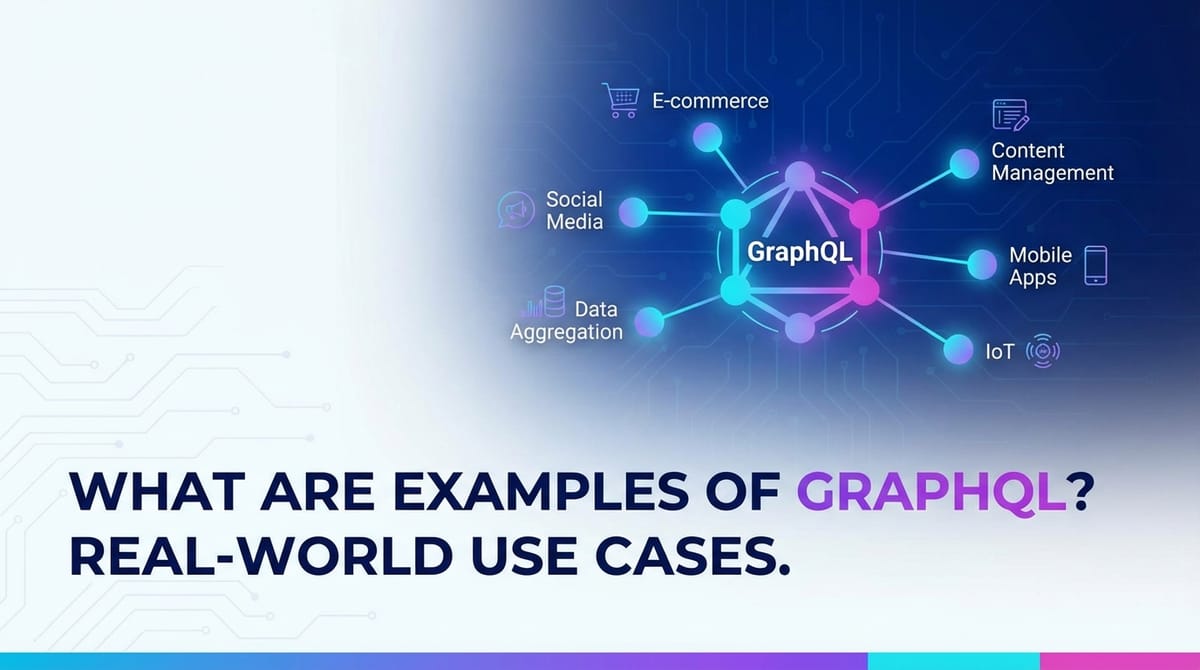
What Are Examples of GraphQL? Real-World Use Cases


The landscape of web development and data exchange has undergone a profound transformation over the past few decades. From the early days of simple client-server interactions to the complex, distributed systems that power our modern digital world, the methods by which applications communicate have continuously evolved. Initially, the Simple Object Access Protocol (SOAP) provided a rigid, XML-based framework for structured messaging, often requiring extensive boilerplate and complex configurations. While robust, its verbosity and overhead often made it less appealing for agile development.
Subsequently, Representational State Transfer (REST) emerged as a more lightweight and flexible alternative, quickly becoming the dominant architectural style for building web services. REST's reliance on standard HTTP methods (GET, POST, PUT, DELETE) and resource-based URLs offered a simpler, more intuitive approach to API design, enabling developers to build scalable and maintainable applications. Its stateless nature and cacheability made it a powerful choice for many web and mobile applications, allowing for broad adoption and fostering a rich ecosystem of tools and best practices.
However, as applications grew in complexity, particularly with the advent of dynamic single-page applications (SPAs) and mobile-first development, REST began to exhibit certain limitations. Clients often found themselves facing the "over-fetching" problem, receiving more data than they actually needed, or the "under-fetching" problem, requiring multiple requests to different endpoints to assemble all the necessary data for a single view. These inefficiencies led to increased network latency, higher data consumption, and more complex client-side logic for data aggregation.
It was out of this evolving need for greater data efficiency and flexibility that GraphQL was conceived and open-sourced by Facebook in 2015. GraphQL represents a paradigm shift in API design, moving away from resource-centric endpoints to a query language that empowers clients to precisely define the data they require. Instead of predefined responses from various endpoints, clients send a single query to a GraphQL server, specifying the exact fields and relationships they need. This fundamental change addresses the shortcomings of traditional RESTful APIs by providing a more efficient, flexible, and developer-friendly approach to data fetching, ushering in a new era of powerful and adaptable API interactions. This article will delve deep into the core principles of GraphQL, explore its myriad advantages, and illustrate its transformative power through a series of real-world use cases, demonstrating why it has become an indispensable tool in the modern developer's arsenal.
Understanding GraphQL – The Foundation
To fully appreciate the real-world applications of GraphQL, it's essential to first grasp its fundamental concepts and how it diverges from traditional API architectures. GraphQL is not a database technology, nor is it a specific programming language. Rather, it is a query language for your API and a server-side runtime for executing those queries using a type system you define for your data.
What is GraphQL?
GraphQL originated at Facebook in 2012 as an internal project to power their mobile applications, eventually being open-sourced in 2015. Its primary motivation was to address the inefficiencies developers faced when building complex, data-rich applications using traditional RESTful APIs. With REST, clients typically interact with multiple fixed endpoints, each returning a predefined set of data. For instance, fetching a user's profile might involve one endpoint, their posts another, and their friends yet another. This often led to the aforementioned problems of over-fetching (receiving data not needed) and under-fetching (needing multiple requests for related data).
GraphQL fundamentally changes this interaction model. Instead of a collection of distinct endpoints, a GraphQL API exposes a single endpoint. Clients send a query (a string describing the data requirements) to this endpoint, and the server responds with a JSON object containing precisely the data requested, and nothing more. This client-driven data fetching stands in stark contrast to the server-driven approach of REST, where the server dictates the structure of the response.
The core components of GraphQL are crucial for understanding its operation:
- Schema Definition Language (SDL): At the heart of every GraphQL API is its schema, defined using SDL. The schema acts as a contract between the client and the server, precisely describing all the data that can be queried, modified, or subscribed to. It defines types, fields, relationships between types, and the operations (queries, mutations, subscriptions) that clients can perform. This strong typing ensures predictability and enables powerful tooling. For example, you might define a
Usertype with fields likeid,name,email, andposts, wherepostsitself is a list ofPosttypes. - Queries: Queries are used to fetch data. They are declarative, allowing clients to specify exactly which fields they need from the available types defined in the schema. A query can request nested data, fetching a user and all their associated posts in a single request, eliminating the need for multiple round trips. This is a cornerstone of GraphQL's efficiency.
- Mutations: While queries are for reading data, mutations are for writing, updating, or deleting data. Like queries, mutations are strongly typed and allow clients to specify the input data and the fields they want returned after the operation. This ensures that clients can perform CUD (Create, Update, Delete) operations with the same precision and efficiency as data fetching.
- Subscriptions: Subscriptions enable real-time capabilities, allowing clients to receive instant updates when specific data changes on the server. They are particularly useful for applications requiring live notifications, chat functionalities, or real-time dashboards. When a client subscribes to an event, the server pushes data to the client whenever that event occurs, typically via WebSockets.
The type system is another fundamental aspect. Beyond basic scalar types (like Int, String, Boolean, ID, Float), GraphQL allows for complex object types, interfaces (for polymorphic types), unions (for returning one of several types), enums (for a predefined set of values), and input types (for structured data passed into mutations). This rich type system ensures data consistency and provides a self-documenting aspect to the API.
Key Advantages of GraphQL
GraphQL's architectural choices provide a multitude of benefits that address many challenges faced by developers using traditional APIs:
- Efficient Data Fetching: Solving Over-fetching and Under-fetching: This is arguably the most celebrated advantage. With GraphQL, clients declare precisely what data they need, eliminating the problem of receiving excessive data (over-fetching) or having to make multiple requests to retrieve related data (under-fetching). For example, if a mobile app only needs a user's name and profile picture, it can query just those fields, significantly reducing payload size and network bandwidth consumption compared to a REST endpoint that might return an entire user object. This is particularly crucial for mobile applications operating on limited bandwidth or data plans.
- Reduced Network Requests: Single Endpoint for Complex Data: Instead of making multiple HTTP requests to different REST endpoints to gather related resources (e.g.,
/users/{id},/users/{id}/posts,/users/{id}/comments), a GraphQL client can send a single query to one endpoint. This query can traverse the graph of relationships defined in the schema, fetching a user, their posts, and the comments on those posts all in one go. This drastically reduces the number of round trips between the client and server, leading to faster loading times and a more responsive user experience, especially important for rich, interactive applications. - Strongly Typed Schema: Predictable Data and Better Tooling: The presence of a strong type system, defined by the GraphQL SDL, offers a robust contract between the client and the server. Clients know exactly what data they can request and in what format. This predictability enables compile-time validation, catching errors early in the development cycle rather than at runtime. Furthermore, the schema provides a self-documenting API, making it easy for new developers to understand and interact with the data. It also powers an ecosystem of powerful developer tools, such as GraphiQL (an in-browser IDE for GraphQL) and client-side libraries that can generate types, cache data, and simplify data management.
- Enhanced Developer Experience: GraphQL significantly improves the developer experience in several ways. The self-documenting nature of the schema, combined with interactive tools like GraphiQL, allows developers to explore the API and craft queries with ease. Client-side libraries (like Apollo Client or Relay) abstract away much of the complexity of data fetching, state management, and caching, allowing frontend teams to focus more on UI development. This leads to faster iteration cycles and higher productivity.
- Real-time Capabilities: Subscriptions for Live Updates: The built-in support for subscriptions allows applications to respond to real-time events without constantly polling the server. This feature is invaluable for applications that require immediate updates, such as chat applications, live dashboards, stock tickers, or notification systems. Subscriptions provide a more efficient and responsive way to handle dynamic data flows, enhancing the user experience with live information.
- Versionless APIs: Evolve the API Without Breaking Old Clients: One of the persistent challenges with RESTful APIs is versioning (e.g.,
/v1/users,/v2/users). When an API changes, older clients might break if they rely on deprecated fields or structures. GraphQL offers a more elegant solution. Because clients explicitly request fields, new fields can be added to the schema without affecting existing clients. Old fields can be deprecated and eventually removed, but clients that don't request those fields are unaffected. This allows for continuous API evolution without the need for disruptive version bumps, simplifying maintenance and reducing the operational burden.
Real-World Use Cases of GraphQL – Where It Shines
The theoretical advantages of GraphQL translate into tangible benefits across a wide spectrum of real-world applications. Its flexibility and efficiency make it an ideal choice for diverse industries and complex systems.
Case Study 1: E-commerce Platforms
E-commerce platforms are inherently data-intensive and require fetching a vast array of interconnected information to create a rich user experience. From product details and customer reviews to personalized recommendations and order histories, the data landscape is complex and dynamic. GraphQL shines brightly in this environment for several compelling reasons:
Traditional RESTful APIs in e-commerce often necessitate multiple requests. For instance, displaying a product page might involve: 1. Fetching product core details from /products/{id}. 2. Fetching product images from /products/{id}/images. 3. Fetching customer reviews from /products/{id}/reviews. 4. Fetching inventory and pricing from a separate microservice via /products/{id}/stock-price. 5. Fetching related products or recommendations from /products/{id}/recommendations.
Each of these requests introduces network latency and requires client-side logic to assemble the disparate pieces of information. This leads to slower page loads, particularly on mobile devices, and a more cumbersome development process.
With GraphQL, an e-commerce platform can define a comprehensive schema that links all these data points. A single query could then fetch a product's name, description, price, available variants (size, color), high-resolution images, the average rating, the last five customer reviews (including reviewer names and dates), and a list of three related products, all in one go.
Example GraphQL Query for an E-commerce Product Page:
query ProductDetails($productId: ID!) {
  product(id: $productId) {
    id
    name
    description
    price {
      amount
      currency
    }
    variants {
      size
      color
      stock
    }
    images {
      url
      altText
    }
    averageRating
    reviews(first: 5) {
      id
      reviewer {
        name
      }
      rating
      comment
      createdAt
    }
    relatedProducts(limit: 3) {
      id
      name
      imageUrl
      price {
        amount
        currency
      }
    }
  }
}
This single query dramatically reduces network chatter, resulting in faster rendering of product pages. Furthermore, different components of the e-commerce site can request exactly what they need. A product listing page might only need id, name, imageUrl, and price, while a shopping cart might need id, name, price, and selectedVariant. This client-driven approach ensures optimal data transfer for every scenario, improving performance and user experience across the board. The strongly typed schema also ensures data consistency and makes it easier for different teams (frontend, backend, mobile) to understand and interact with the product data graph.
Case Study 2: Social Media Networks
Social media platforms are perhaps the quintessential example of highly interconnected data graphs. Users, posts, comments, likes, followers, notifications – all these entities are deeply intertwined, and different views within the application require varying subsets of this data. Facebook, the creator of GraphQL, developed it precisely to address the complexities of its own massive social graph.
Consider the data required to render a typical social media news feed. For each post, you need: * The author's profile (name, picture). * The post content (text, images, video). * The number of likes and comments. * A preview of the latest comments. * Information about who else liked the post. * Whether the current user has liked or saved the post.
A RESTful approach would involve numerous requests: one for the feed items, then for each item, additional requests for the author's details, comments, and like status. This is inefficient and can lead to a sluggish user experience, especially when scrolling through a long feed.
GraphQL allows for an incredibly efficient way to fetch this complex, nested data. A single query can retrieve a user's entire personalized feed, with each post containing its author's details, a specified number of comments, and the like count, all tailored to the client's exact needs.
Example GraphQL Query for a Social Media News Feed:
query UserFeed($userId: ID!, $limit: Int = 10) {
  user(id: $userId) {
    feed(limit: $limit) {
      id
      content
      timestamp
      author {
        id
        username
        profilePictureUrl
      }
      likesCount
      comments(first: 3) {
        id
        text
        author {
          username
        }
        timestamp
      }
      isLikedByCurrentUser
      sharedPost { # If it's a shared post
        id
        content
        author {
          username
        }
      }
    }
  }
}
Furthermore, GraphQL's subscription feature is a game-changer for social media. New posts, new comments, friend requests, and notifications can be pushed to clients in real-time, providing an immediate and engaging user experience without the constant polling that would otherwise be required. This real-time capability is crucial for keeping users engaged and informed, making GraphQL an indispensable tool for social networks.
Case Study 3: Mobile Applications
Mobile applications often operate under significant constraints: limited battery life, variable network conditions (from fast Wi-Fi to slow cellular data), and a need for highly responsive user interfaces. These factors make efficient data fetching paramount, and this is precisely where GraphQL offers a distinct advantage over REST.
Traditional REST APIs, by virtue of their fixed responses, frequently lead to over-fetching on mobile. Even if a mobile app only needs a few fields for a list view, a REST endpoint might return a large JSON object containing many unnecessary fields. This consumes more bandwidth, takes longer to parse, and ultimately drains the user's battery faster.
GraphQL's ability to fetch only the required data directly addresses these issues. A mobile news application, for example, might display a list of article headlines and thumbnails on its main screen. A GraphQL query can specifically request just these fields, without downloading the full article content, author details, or comment sections. When a user taps on an article, a subsequent query can then fetch the full article body and comments. This granular control over data payloads dramatically optimizes network usage and improves loading times on mobile devices.
Benefits for Mobile Applications:
- Reduced Bandwidth Consumption: By eliminating over-fetching, mobile apps transfer less data, leading to faster load times and lower data costs for users.
- Improved Battery Life: Less data transfer and processing translate to less CPU and radio activity, conserving battery power.
- Faster Development Cycles: Mobile developers can query exactly what they need, reducing the complexity of client-side data parsing and manipulation. GraphQL client libraries (like Apollo iOS/Android) also provide powerful caching and state management capabilities, further streamlining mobile development.
- Adaptability for Varied Devices and Screen Sizes: Different mobile devices or even different orientations on the same device might require slightly different data subsets. GraphQL's flexibility allows a single backend to serve these varied needs without requiring specific endpoints for each client variant, simplifying backend maintenance.
Companies like Airbnb have publicly discussed their adoption of GraphQL for their mobile applications, citing improved developer productivity and application performance as key drivers. For any mobile application striving for efficiency and a superior user experience, GraphQL is a powerful ally.
Case Study 4: Content Management Systems (CMS) & Headless CMS
The evolution of Content Management Systems (CMS) has seen a significant shift from monolithic, tightly coupled systems to headless architectures. In a headless CMS, the content repository (the "head") is decoupled from the presentation layer (the "body"), allowing content to be delivered via APIs to any frontend, whether it's a website, a mobile app, a smart device, or even a virtual reality experience. This decoupling makes API-first content delivery a critical component, and GraphQL is perfectly suited for this role.
Traditional CMS platforms often provide RESTful APIs, which, while functional, can be limiting in a multi-channel content delivery scenario. Different frontends might need different combinations of content fields, and a REST API might either over-fetch for some clients or require multiple requests for others.
A headless CMS leveraging GraphQL provides unparalleled flexibility. Content models (e.g., Article, Author, Category, Page) can be defined in the GraphQL schema. Frontend developers can then craft precise queries to retrieve exactly the content they need for any given channel.
Example GraphQL Query for a Blog Article:
query GetArticle($slug: String!) {
  article(slug: $slug) {
    id
    title
    content {
      html
      markdown
    }
    publishedDate
    author {
      name
      bio
      profilePictureUrl
    }
    category {
      name
      slug
    }
    tags {
      name
    }
    relatedArticles(limit: 3) {
      title
      slug
      imageUrl
    }
  }
}
This single query can fetch an article's details, its author's information, category, tags, and even a list of related articles. A website displaying a full article might request all fields, while a mobile app displaying an article summary might only request title, slug, and a truncated content field.
Benefits for Headless CMS:
- Multi-Channel Content Delivery: A single GraphQL API can efficiently serve content to websites, iOS apps, Android apps, smart TVs, IoT devices, and more, each requesting only the data relevant to its context.
- Frontend Agnosticism: Frontend teams are empowered to choose their preferred technology stack, as they are no longer constrained by a tightly coupled CMS.
- Flexible Content Models: GraphQL's type system makes it easy to define complex and interconnected content models, reflecting the rich relationships between content entities.
- Simplified Content Evolution: As content models evolve (e.g., adding a new field to an
Articletype), existing clients remain unaffected unless they explicitly query the new field. This fosters continuous iteration without breaking deployed applications.
Many modern headless CMS providers now offer GraphQL APIs as a primary means of content delivery, recognizing its superior flexibility and efficiency for today's dynamic digital experiences.
Case Study 5: Microservices Architectures
Microservices architectures, characterized by a collection of small, independent, and loosely coupled services, bring tremendous benefits in terms of scalability, resilience, and independent deployability. However, they also introduce a significant challenge for client-side applications: how to efficiently interact with a fragmented backend where data might be spread across dozens or even hundreds of distinct services. This is where GraphQL, often deployed as an API Gateway or a "BFF" (Backend for Frontend) layer, proves to be exceptionally valuable.
In a typical microservices setup, a single client request might require data from several different services. For example, to display a user's order history, a client might need: 1. User profile data from the User Service. 2. Order details from the Order Service. 3. Product information for each item in the order from the Product Catalog Service. 4. Payment status from the Payment Service.
Without an aggregation layer, the client would have to make multiple requests to different service endpoints and then stitch the data together on its own. This leads to increased client-side complexity, higher network latency due to multiple round trips, and tight coupling between the client and the microservices' internal structure.
GraphQL acts as a unified facade or a powerful API Gateway over these disparate microservices. A GraphQL server can be configured with "resolvers" that know how to fetch data from various underlying services. When a client sends a GraphQL query, the GraphQL server intelligently dispatches requests to the appropriate microservices, aggregates the responses, and then shapes the data into the exact format requested by the client. This effectively abstracts away the microservices' complexity from the client.
Benefits of GraphQL in Microservices:
- Unified API for Clients: Clients interact with a single, coherent GraphQL API, regardless of how many microservices are running behind it. This simplifies client-side development and reduces the mental overhead.
- Data Orchestration and Aggregation: The GraphQL server becomes responsible for orchestrating data retrieval from multiple sources, alleviating this burden from client applications. It can perform complex joins and transformations efficiently on the server-side.
- Decoupling Client from Microservices: Clients are no longer directly coupled to the internal structure or specific endpoints of individual microservices. If a microservice changes its internal API, the GraphQL layer can adapt without requiring changes to client applications.
- Improved Performance: By aggregating data on the server and allowing clients to fetch everything in a single request, GraphQL significantly reduces the number of network round trips, enhancing performance.
For organizations managing a broad portfolio of APIs, including RESTful services and AI models, a dedicated API Gateway and management platform like APIPark can be invaluable. APIPark, an open-source AI gateway and API management platform, helps developers and enterprises manage, integrate, and deploy AI and REST services with ease, offering unified management for various APIs and streamlining the invocation process. It provides features like quick integration of 100+ AI models, unified API format for AI invocation, and prompt encapsulation into REST API, which are essential when exposing a diverse set of services, including GraphQL endpoints. APIPark can effectively complement a GraphQL layer by providing additional capabilities for API lifecycle management, security, traffic control, and analytics across all your API types.
Case Study 6: Dashboards and Analytics Tools
Dashboards and analytics tools are designed to provide insights into complex datasets by visualizing various metrics, trends, and key performance indicators (KPIs). The nature of these applications often requires fetching highly customized combinations of data from different sources, and the data requirements can change dynamically based on user interactions, chosen filters, and varying reporting needs. This makes GraphQL an excellent fit.
Consider a business intelligence dashboard that allows users to monitor sales, user engagement, inventory levels, and customer support metrics. Each panel or widget on the dashboard might require data from a different backend system (e.g., CRM for customer data, ERP for sales and inventory, a custom analytics service for engagement). A traditional RESTful approach would involve: 1. Multiple separate requests for each widget's data. 2. The client needing to know which endpoints to hit for which data. 3. Potential for over-fetching if specific subsets of data are needed. 4. Challenges when a user customizes their dashboard, requiring different data combinations.
With GraphQL, the dashboard application can define a flexible schema that represents all the available data points from the underlying analytics services. When a user configures their dashboard or applies filters, the client can construct a precise GraphQL query that fetches only the metrics and dimensions needed for the current view.
Example GraphQL Query for an Analytics Dashboard:
query DashboardData($startDate: Date!, $endDate: Date!) {
  sales(startDate: $startDate, endDate: $endDate) {
    totalRevenue
    ordersCount
    averageOrderValue
    revenueByProductCategory {
      categoryName
      revenue
    }
  }
  userEngagement(startDate: $startDate, endDate: $endDate) {
    activeUsers
    newRegistrations
    bounceRate
    sessionsByDeviceType {
      deviceType
      sessionCount
    }
  }
  inventory(threshold: 100) {
    lowStockItems {
      productId
      productName
      currentStock
    }
    totalValue
  }
}
This single query fetches sales data, user engagement metrics, and low inventory items within a specified date range, all tailored to the dashboard's specific layout and filters. If a user only wants to see sales data, the client simply omits the userEngagement and inventory fields from the query.
Benefits for Dashboards and Analytics:
- Dynamic Data Fetching: Dashboards can adapt their data requests dynamically based on user configurations, filters, and selected timeframes without requiring new backend endpoints.
- Reduced Data Redundancy: Only the precise data needed for visualization is transferred, optimizing network usage, which is crucial for complex dashboards displaying large volumes of data.
- Simplified Frontend Logic: Frontend developers can construct queries that mirror the structure of their UI components, simplifying data binding and state management.
- Unified Data Access: Despite drawing from multiple backend data sources, GraphQL presents a single, coherent API for all dashboard data, making development and maintenance more straightforward.
For any application that needs to present a highly customizable and data-rich view to users, GraphQL offers a powerful and efficient solution, enabling faster loading, greater flexibility, and a more streamlined development process.
Case Study 7: Financial Services
The financial services industry is characterized by an immense volume of complex, highly sensitive, and often real-time data. This includes customer accounts, transactions, portfolios, market data, regulatory information, and intricate financial instruments. The need for secure, efficient, and precise data access is paramount, making GraphQL a compelling solution for various applications within this sector.
Consider a trading application or a personal finance management tool. Users need to view their portfolio holdings, current market prices, recent transactions, and potentially detailed information about specific stocks or funds. A traditional REST architecture might require: 1. Fetching account details from /accounts/{id}. 2. Fetching portfolio holdings from /accounts/{id}/portfolio. 3. Fetching real-time stock quotes for each holding from /marketdata/quotes?symbols=AAPL,GOOG. 4. Fetching recent transactions from /accounts/{id}/transactions.
This often results in a waterfall of requests, leading to delays and potential inconsistencies if data is not synchronized. Moreover, the security requirements in financial services are incredibly stringent, demanding granular control over what data can be accessed by whom.
GraphQL's ability to fetch interconnected data in a single request, combined with its strong type system, makes it ideal for managing the complexity of financial data.
Example GraphQL Query for a Trading Portfolio:
query UserPortfolio($accountId: ID!) {
  account(id: $accountId) {
    id
    accountNumber
    balance {
      amount
      currency
    }
    portfolio {
      holdings {
        id
        symbol
        companyName
        quantity
        averageCost
        currentPrice {
          amount
          currency
          lastUpdated
        }
        dailyChange {
          percentage
          absolute
        }
      }
      totalMarketValue
      totalGainLoss
    }
    recentTransactions(first: 5) {
      id
      type # BUY, SELL, DEPOSIT, WITHDRAWAL
      symbol
      amount
      pricePerUnit
      timestamp
    }
  }
}
This query allows a user to fetch their account balance, a detailed breakdown of their portfolio holdings (including real-time prices), and their five most recent transactions, all in one efficient network call.
Benefits for Financial Services:
- Data Efficiency and Performance: Minimize data transfer and network latency, crucial for real-time trading applications where every millisecond counts.
- Complex Data Modeling: The GraphQL schema can accurately represent intricate financial relationships, such as parent-child accounts, complex derivatives, or detailed transaction histories.
- Granular Access Control: GraphQL's type system, combined with robust backend authorization logic, enables very precise control over which fields a particular user or application can access, which is vital for security and compliance.
- API Evolution without Disruption: Financial regulations and product offerings frequently change. GraphQL's versionless nature allows for adding new fields (e.g., new regulatory data points) without breaking existing applications that don't need those fields, simplifying API maintenance.
- Auditability: Detailed logging of GraphQL queries can contribute to audit trails, which are a regulatory requirement in many financial contexts.
While security and compliance remain paramount and require careful implementation regardless of the API technology, GraphQL provides the architectural flexibility and efficiency that can significantly enhance the development and performance of financial applications.
APIPark is a high-performance AI gateway that allows you to securely access the most comprehensive LLM APIs globally on the APIPark platform, including OpenAI, Anthropic, Mistral, Llama2, Google Gemini, and more.Try APIPark now! 👇👇👇
Implementing GraphQL – Best Practices and Considerations
Adopting GraphQL is more than just swapping out a REST endpoint; it involves a shift in how you design, build, and maintain your API. Successful implementation requires careful consideration of several key areas to maximize its benefits and avoid common pitfalls.
Schema Design: Importance of Well-Designed, Evolving Schemas
The GraphQL schema is the single most critical component of your GraphQL API. It defines the "shape" of your data and the operations clients can perform. A well-designed schema is intuitive, consistent, and extensible. * Think in terms of a Graph: Instead of isolated resources, view your data as interconnected nodes and edges. Design types and fields that naturally represent these relationships. For instance, an Order type should easily link to Customer and Product types. * Focus on Client Needs: Design your schema from the perspective of what clients will need to display and interact with. This often leads to more ergonomic and efficient APIs. * Naming Conventions: Establish clear, consistent naming conventions for types, fields, arguments, and enums (e.g., camelCase for fields, PascalCase for types). * Modularity: For large schemas, consider breaking them down into smaller, logical modules (e.g., User schema, Product schema) that can be combined, particularly useful in a microservices environment using schema stitching or federation. * Deprecation Strategy: As your API evolves, you'll need to update your schema. GraphQL has a built-in @deprecated directive that allows you to mark fields or enum values as deprecated, providing a smooth transition path for clients without immediately breaking them. This is a powerful feature for maintaining a versionless API.
Resolvers: How to Fetch Data from Various Sources
Resolvers are the functions that populate the data for a field in your schema. When a client queries a field, the corresponding resolver is executed to fetch the actual data. Resolvers are the bridge between your GraphQL schema and your backend data sources. * Data Sources: Resolvers can fetch data from anywhere: databases (SQL, NoSQL), other RESTful APIs, third-party services, internal microservices, or even static files. * Efficiency: The performance of your resolvers directly impacts the overall performance of your GraphQL API. Optimizing resolver logic is crucial. * N+1 Problem: A common performance anti-pattern in GraphQL is the "N+1 problem." If a query fetches a list of items (N) and then, for each item, needs to fetch a related sub-item, the resolver might make N+1 separate database queries. This can lead to severe performance bottlenecks.
N+1 Problem: Solutions like DataLoader
To combat the N+1 problem, Facebook developed DataLoader. DataLoader is a generic utility that provides a simple, consistent API for fetching data from various backend stores. It works by: * Batching: Coalescing individual requests into a single request. For instance, if multiple posts need their authors' details, DataLoader will collect all unique author IDs and fetch all authors in one database query, then distribute the results back to the individual post resolvers. * Caching: Caching requests over the lifetime of a request. If the same data is requested multiple times within a single GraphQL query, DataLoader ensures it's fetched only once.
Implementing DataLoader (or similar solutions in other languages) is a critical best practice for building performant GraphQL APIs, especially when dealing with nested data and complex graph traversals.
Caching: Client-Side (Apollo, Relay) and Server-Side Strategies
Caching is vital for improving performance and reducing the load on your backend services. GraphQL requires different caching strategies compared to REST due to its single endpoint and dynamic queries. * Client-Side Caching: Modern GraphQL client libraries like Apollo Client and Relay come with sophisticated normalized caches. These caches store data by ID, allowing clients to efficiently retrieve previously fetched data without making a network request. If a piece of data is updated (e.g., via a mutation), the cache can automatically update all components that display that data. * Server-Side Caching: * HTTP Caching: While a single GraphQL endpoint might seem to preclude traditional HTTP caching (like Cache-Control headers), it's still possible for specific, often-requested queries (e.g., common static data) by hashing the query string and caching the response. * Data Source Caching: Implement caching at the data source level (e.g., Redis, Memcached) within your resolvers. Cache results of expensive database queries or third-party API calls. * Response Caching: For static or infrequently changing queries, you can cache the entire GraphQL response on the server. However, this is more complex due to the dynamic nature of GraphQL queries (each query can be unique).
Authentication and Authorization: Integrating with Existing Systems
Security is paramount for any API. GraphQL doesn't inherently define authentication or authorization mechanisms, but it integrates seamlessly with existing solutions. * Authentication: Typically handled before the GraphQL resolver chain is invoked. Users authenticate using tokens (JWT, OAuth), session cookies, or API keys. The authenticated user's context (e.g., userId, roles) is then passed down to the resolvers. * Authorization: * Field-Level Authorization: Most commonly implemented within resolvers. A resolver checks if the authenticated user has permission to access a specific field or resource. For example, a salary field on a User type might only be accessible to Admin roles. * Type-Level Authorization: Granting or denying access to entire types. * Argument-Level Authorization: Limiting access based on the arguments passed to a query (e.g., a user can only query their own account details). * Middleware: Implement authorization logic as middleware that wraps resolvers or at the API Gateway level to enforce policies before queries even reach your GraphQL server.
Error Handling: Standardized Error Responses
Consistent error handling is crucial for a good developer experience. GraphQL specifications dictate that errors should be returned as part of the errors array in the response, even if some data was successfully fetched. * Custom Error Types: Define custom error types in your schema (e.g., AuthenticationError, PermissionDeniedError, NotFoundError) and throw these from your resolvers. This allows clients to handle specific error conditions gracefully. * Error Messages: Provide clear, concise, and helpful error messages for debugging, but avoid leaking sensitive internal details. * Logging: Log all server-side errors thoroughly for monitoring and debugging purposes.
Performance Monitoring: Tools and Techniques
Monitoring the performance of your GraphQL API is essential for identifying bottlenecks and ensuring a responsive user experience. * Tracing: Implement API tracing to understand the execution time of individual resolvers and identify slow queries. Tools like Apollo Server's built-in tracing or OpenTelemetry can help. * Logging: Detailed logging of incoming queries, arguments, and resolver execution times. * Metrics: Collect metrics on query execution counts, error rates, response times, and payload sizes. * Dedicated GraphQL Monitoring Tools: Services like Apollo Studio provide powerful insights into GraphQL API performance, schema changes, and client usage.
Rate Limiting and Security: Protecting Your API
Protecting your GraphQL API from abuse and malicious attacks is paramount. * Rate Limiting: Prevent denial-of-service (DoS) attacks and ensure fair usage by limiting the number of queries or mutations a client can perform within a given timeframe. Unlike REST, where rate limits are often applied per endpoint, GraphQL rate limiting can be more nuanced, potentially considering query complexity or depth. * Query Depth and Complexity Limits: GraphQL queries can be arbitrarily deep. Maliciously crafted deep or complex queries can tie up server resources. Implement limits on query depth (how many nested levels) and complexity (e.g., assigning a cost to each field) to prevent such attacks. * Input Validation: Thoroughly validate all input arguments to queries and mutations to prevent injection attacks and ensure data integrity. * CORS (Cross-Origin Resource Sharing): Properly configure CORS headers to control which domains can make requests to your GraphQL API. * API Key Management: For programmatic access, robust API key management, rotation, and revocation policies are essential.
Effective management of GraphQL APIs, particularly regarding security, rate limiting, and detailed logging, can be significantly enhanced by a comprehensive API Gateway. Products like APIPark offer end-to-end API lifecycle management, including traffic forwarding, load balancing, performance monitoring, and advanced security features. These features are critical for maintaining a secure and efficient API Open Platform, where various types of APIs, including GraphQL, can be exposed, managed, and protected across different teams and tenants. APIPark's capabilities, such as independent API and access permissions for each tenant and the requirement for API resource access approval, provide a robust layer of control and security for any API ecosystem.
Tooling and Ecosystem: GraphQL Clients, IDE Integrations, Schema Stitching, Federation
The GraphQL ecosystem is rich and rapidly maturing, providing developers with a wealth of tools to streamline development. * GraphQL Clients: Libraries like Apollo Client (JavaScript/TypeScript, iOS, Android), Relay (React), URQL (React/Preact/Vue), and others provide powerful features for consuming GraphQL APIs, including caching, state management, UI integration, and subscriptions. * IDE Integrations: Extensions for popular IDEs (VS Code, WebStorm) offer syntax highlighting, autocomplete, schema introspection, and validation for GraphQL queries. * GraphiQL/GraphQL Playground: In-browser interactive development environments that allow developers to explore schemas, write and test queries, and view documentation. * Schema Stitching and Federation: For large, distributed systems, schema stitching (combining multiple GraphQL schemas into one) and especially GraphQL Federation (Apollo Federation, the more advanced approach) allow you to build a unified GraphQL API from multiple underlying GraphQL services, enabling a truly composable and scalable GraphQL architecture for microservices.
GraphQL in the Broader API Landscape
While GraphQL offers compelling advantages, it's not a silver bullet that replaces all other API styles. Understanding its place in the broader API landscape and how it can coexist or even integrate with existing solutions is key to making informed architectural decisions.
GraphQL vs. REST: When to Choose Which. Hybrid Approaches.
The debate between GraphQL and REST is often framed as an "either/or" choice, but in reality, they address different needs and can even complement each other.
REST (Representational State Transfer): * Strengths: Simplicity, widespread adoption, excellent for resource-oriented data, well-understood caching mechanisms (HTTP caching), good for traditional web services where fixed resource structures are acceptable. Excellent for publicly exposed APIs where the backend dictates the data structure. * Weaknesses: Over-fetching/under-fetching, multiple round trips for complex data, rigid versioning strategies, harder for rapidly evolving client requirements. * Best for: * Simple CRUD operations on well-defined resources. * Public APIs where the API provider wants to control the data structure. * Caching at the network level is a primary concern. * When the client requirements are stable and predictable.
GraphQL: * Strengths: Client-driven data fetching (no over-fetching/under-fetching), single endpoint, reduced network requests, strong type system, self-documenting, flexible API evolution, built-in real-time capabilities (subscriptions), excellent for complex, interconnected data graphs. * Weaknesses: Can be more complex to set up initially, requires a server-side runtime, caching can be more involved (less reliant on HTTP caching), potential for complex or expensive queries if not properly managed, might not be necessary for very simple APIs. * Best for: * Complex applications with dynamic data requirements (e.g., e-commerce, social media, dashboards). * Mobile applications with limited bandwidth. * Microservices architectures needing a unified API layer. * Applications requiring real-time updates. * When rapid client-side iteration and flexible data access are priorities.
Hybrid Approaches: It's very common and often pragmatic to use both REST and GraphQL within the same ecosystem. * Internal vs. External APIs: Expose a GraphQL API for internal clients (mobile, web app) that need flexibility, while maintaining RESTful APIs for public or partner integrations that benefit from REST's simplicity and widespread familiarity. * GraphQL over REST: A GraphQL server can act as a facade that queries underlying RESTful APIs. This allows you to leverage existing REST services while providing the benefits of GraphQL to your clients. This is especially useful during migration or when integrating with legacy systems. * Specialized Endpoints: Use REST for simple, resource-specific operations (e.g., file uploads, health checks) where GraphQL might be overkill, and GraphQL for complex data fetching.
The choice largely depends on the specific project requirements, team expertise, and the nature of the data being exposed.
The Role of API Gateways with GraphQL
API Gateways play a crucial role in modern distributed architectures, serving as the single entry point for all client requests. They handle cross-cutting concerns like authentication, authorization, rate limiting, logging, and traffic management before requests reach the backend services. While GraphQL itself can act as a kind of "logical gateway" by aggregating data from multiple sources, a dedicated API Gateway provides essential operational and security layers that complement GraphQL deployments.
How API Gateways Enhance GraphQL APIs: * Centralized Security: An API Gateway can enforce global security policies, such as JWT validation, OAuth scopes, and API key authentication, before requests even hit the GraphQL server. This offloads security concerns from the GraphQL service itself. * Rate Limiting and Throttling: Gateways are ideal for implementing robust rate limiting strategies to protect your GraphQL API from abuse, based on client IP, API key, or user ID. This is particularly important for GraphQL due to the potential for complex queries. * Monitoring and Analytics: An API Gateway can provide a centralized point for collecting metrics on all incoming requests, including GraphQL queries. This allows for comprehensive monitoring, performance analytics, and logging of API calls. * Load Balancing and Traffic Management: For high-traffic GraphQL APIs, gateways can distribute requests across multiple instances of your GraphQL server, ensuring high availability and scalability. * Request/Response Transformation: While GraphQL defines its own query language, an API Gateway can perform transformations on incoming or outgoing data, such as adding headers, modifying payloads, or routing requests based on complex rules. * Caching: Some advanced API Gateways can implement caching strategies for GraphQL responses, especially for static or frequently accessed data. * Service Discovery: In a microservices environment, an API Gateway can integrate with service discovery mechanisms to dynamically locate and route requests to the correct GraphQL or other backend services.
In an API Open Platform scenario, where various types of APIs (REST, GraphQL, gRPC, etc.) are exposed to a wide array of developers and applications, a robust API Gateway becomes indispensable. It serves as the control plane for managing access, ensuring security, and providing a consistent experience for all consumers. APIPark stands out as an API Gateway and management platform designed to excel in such environments. APIPark not only offers high-performance traffic forwarding and load balancing but also provides powerful data analysis, detailed API call logging, and advanced access control features, including the ability to require approval for API resource access. These features ensure that even complex GraphQL deployments within an API Open Platform are secure, manageable, and performant, enabling businesses to confidently expose their digital assets.
GraphQL and the Future of APIs: Trends, Adoption, Evolving Standards
GraphQL has firmly established itself as a leading API technology, and its influence is only growing. * Increasing Adoption: Major companies across various sectors (e-commerce, media, finance, healthcare) are adopting GraphQL for its efficiency and flexibility. The community continues to grow, with more frameworks, tools, and libraries becoming available. * Federation as a Standard: Apollo Federation is emerging as a de-facto standard for building distributed GraphQL architectures, allowing large organizations to compose a single, unified GraphQL graph from many independent GraphQL services owned by different teams. This is a crucial development for scaling GraphQL in enterprise environments. * Real-time Everywhere: The demand for real-time capabilities is increasing, and GraphQL subscriptions provide a standardized, efficient way to meet this need, likely leading to more widespread use in applications requiring live data. * Focus on Developer Experience: The GraphQL ecosystem continues to prioritize developer experience, with ongoing improvements in tooling, documentation generation, and client libraries. * Intersection with Serverless and Edge Computing: GraphQL's single-endpoint nature and efficient data fetching make it a good candidate for deployment in serverless environments or at the edge, reducing latency and operational overhead. * Integration with AI/ML: As AI models become more prevalent, managing access to these models via APIs is crucial. GraphQL's flexibility could potentially be used to query model capabilities or results, similar to how platforms like APIPark are designed to unify the invocation of various AI models and encapsulate prompts into REST APIs. An API Open Platform approach, integrating GraphQL with other technologies like AI, will likely define the next generation of interconnected digital services.
Conclusion
The journey through the examples of GraphQL in real-world use cases illuminates a clear truth: GraphQL is not merely an incremental improvement over previous API paradigms; it represents a fundamental shift in how applications interact with data. Born out of the necessity to address the inefficiencies of over-fetching and under-fetching that plagued traditional RESTful APIs, GraphQL empowers clients with unprecedented control, allowing them to precisely declare their data requirements through a single, powerful query.
From the complex data graphs of e-commerce platforms and the dynamic, interconnected feeds of social media networks, to the bandwidth-sensitive environments of mobile applications and the flexible content delivery systems of headless CMS, GraphQL consistently demonstrates its ability to optimize performance, enhance developer productivity, and accelerate iteration cycles. Its utility extends into the intricacies of microservices architectures, where it acts as a unifying API Gateway, abstracting backend complexity from clients, and into the demanding world of financial services and analytics dashboards, where precision, efficiency, and real-time capabilities are paramount.
The core strengths of GraphQL—its efficient data fetching, reduced network requests, strongly typed schema, superior developer experience, and built-in real-time subscriptions—make it an indispensable tool for building modern, resilient, and highly performant applications. While it coexists with and often complements other API styles like REST, its unique graph-based approach offers distinct advantages for applications dealing with complex, interconnected data and dynamic client needs. Moreover, dedicated API Gateway solutions like APIPark further bolster GraphQL deployments, providing crucial layers of security, management, and operational insights, especially within the context of a diverse API Open Platform.
As the digital landscape continues its rapid evolution, with an increasing demand for rich, interactive, and real-time user experiences, GraphQL is poised to play an even more central role. Its flexibility, scalability, and developer-centric design ensure that it will remain a cornerstone technology for architects and developers aiming to build the next generation of powerful, efficient, and adaptable software systems.
| Feature | RESTful API | GraphQL API |
|---|---|---|
| Architectural Style | Resource-oriented, multiple endpoints | Graph-oriented, single endpoint |
| Data Fetching | Server dictates response structure (over-fetching/under-fetching possible) | Client dictates response structure (precise data fetching) |
| Network Requests | Often multiple round trips for complex data | Typically a single round trip for complex data |
| Schema/Contract | Implicit, often documented via OpenAPI/Swagger | Explicit, strongly typed schema using SDL |
| Versioning | Common practice (/v1, /v2), can break clients |
Versionless, uses deprecation for backward compatibility |
| Real-time | Requires separate technologies (WebSockets, SSE) | Built-in subscriptions for real-time updates |
| Error Handling | Standard HTTP status codes, custom JSON bodies | Standardized errors array in response |
| Caching | Relies heavily on HTTP caching mechanisms | Client-side normalized caching (e.g., Apollo Client), server-side data source caching |
| Developer Experience | Can involve more client-side data aggregation | Intuitive querying, self-documenting, powerful tooling (GraphiQL) |
| Use Cases | Simple CRUD operations, public APIs, traditional web services | Complex data graphs, mobile apps, microservices aggregation, real-time apps, dynamic UIs |
Frequently Asked Questions (FAQs)
1. What is the fundamental difference between GraphQL and REST APIs?
The fundamental difference lies in how clients request data. RESTful APIs are resource-centric, providing multiple fixed endpoints (e.g., /users, /products) where the server dictates the structure of the response. Clients often need to make multiple requests to different endpoints to gather all necessary data, potentially leading to over-fetching (receiving too much data) or under-fetching (not enough data, requiring more requests). GraphQL, on the other hand, is a query language for your API that exposes a single endpoint. Clients send a single, precise query specifying exactly the fields and nested relationships they need, and the server responds with only that requested data, eliminating over-fetching and under-fetching.
2. When should I choose GraphQL over REST for my project?
You should consider GraphQL when your application: * Has complex, interconnected data that resembles a graph (e.g., social networks, e-commerce, content management). * Requires highly flexible data fetching, where different clients or UI components need varying subsets of data. * Is a mobile application operating under bandwidth or battery constraints. * Needs to reduce the number of network requests between the client and server. * Operates within a microservices architecture and needs a unified API facade. * Requires real-time updates through subscriptions. * Prioritizes rapid iteration on the client-side without frequent API versioning. For simpler APIs with fixed data structures or when leveraging traditional HTTP caching is a priority, REST might still be a more straightforward choice.
3. Can GraphQL replace an API Gateway in a microservices architecture?
While GraphQL can act as a "logical gateway" or a "Backend for Frontend" (BFF) by aggregating data from multiple microservices and providing a unified client-facing API, it doesn't fully replace a dedicated API Gateway. A comprehensive API Gateway like APIPark handles broader operational concerns such as centralized authentication and authorization, global rate limiting, traffic management, load balancing, detailed logging, and sometimes even request/response transformations or service discovery, which are typically outside the core responsibility of a GraphQL server. In many modern architectures, GraphQL works in conjunction with an API Gateway, where the gateway handles the initial request security and routing, and then forwards the request to the GraphQL server for data resolution.
4. How does GraphQL handle real-time data updates?
GraphQL includes a feature called Subscriptions for handling real-time data updates. Unlike queries (for fetching data) and mutations (for modifying data), subscriptions allow clients to "subscribe" to specific events or data changes on the server. When the subscribed event occurs, the server automatically pushes the updated data to all listening clients, typically over a persistent connection like WebSockets. This eliminates the need for clients to constantly poll the server for new information, making real-time features like live notifications, chat messages, or dynamic dashboards much more efficient and responsive.
5. What are some potential challenges or drawbacks of using GraphQL?
While powerful, GraphQL does come with certain considerations: * Initial Complexity: Setting up a GraphQL server and designing a robust schema can be more complex than spinning up simple REST endpoints. * Caching: Traditional HTTP caching strategies are less straightforward with GraphQL's single endpoint and dynamic queries, requiring more sophisticated client-side (e.g., normalized caches in Apollo Client) or server-side data source caching. * Performance Management: The flexibility of GraphQL means clients can construct very complex queries. Without proper query depth/complexity limiting and efficient resolvers (e.g., using DataLoader), a GraphQL API can be vulnerable to performance bottlenecks or resource exhaustion. * Tooling Maturity: While rapidly maturing, the ecosystem (especially for niche languages or specific use cases) might not be as universally mature as REST-based tooling. * File Uploads: Handling file uploads directly through GraphQL can be slightly more involved than with traditional REST approaches, often requiring multipart forms.
🚀You can securely and efficiently call the OpenAI API on APIPark in just two steps:
Step 1: Deploy the APIPark AI gateway in 5 minutes.
APIPark is developed based on Golang, offering strong product performance and low development and maintenance costs. You can deploy APIPark with a single command line.
curl -sSO https://download.apipark.com/install/quick-start.sh; bash quick-start.sh

In my experience, you can see the successful deployment interface within 5 to 10 minutes. Then, you can log in to APIPark using your account.

Step 2: Call the OpenAI API.