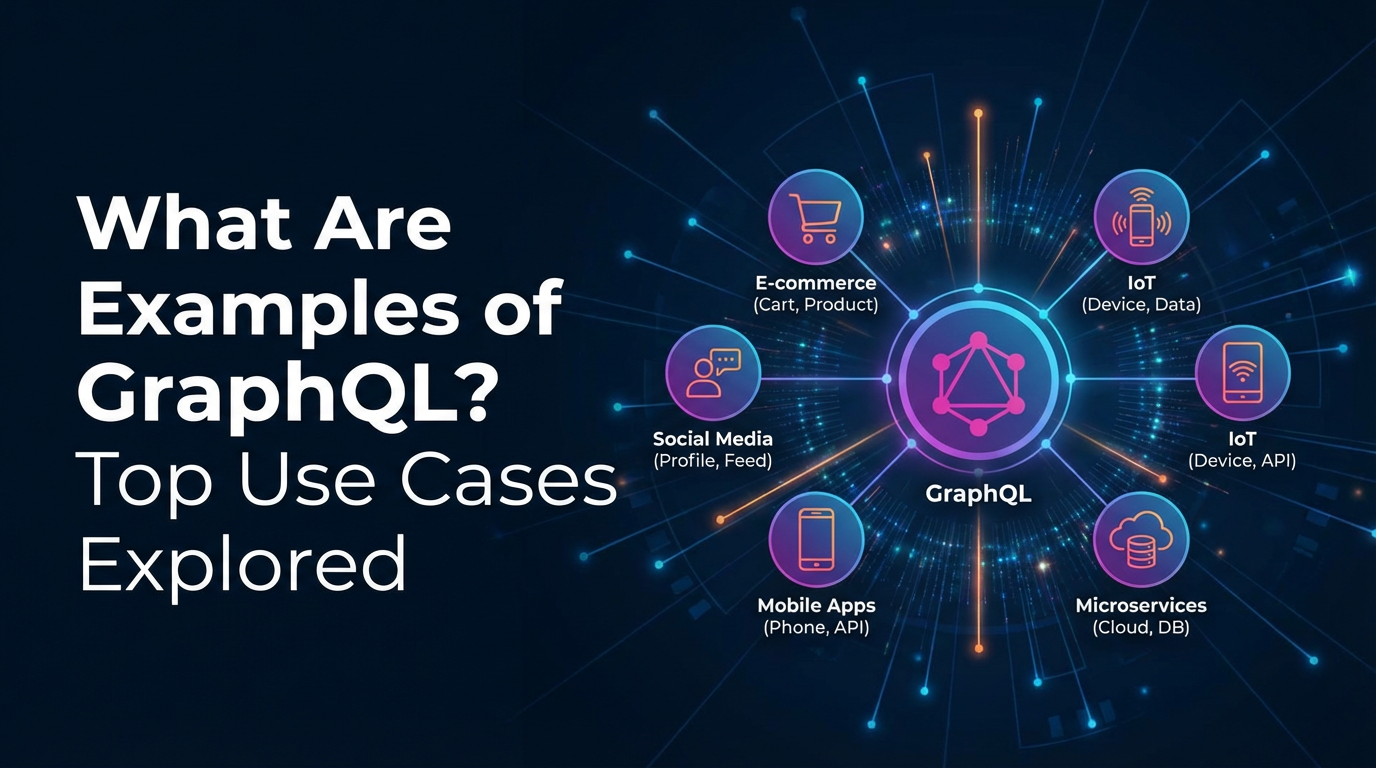
What Are Examples of GraphQL? Top Use Cases Explored


In the rapidly evolving landscape of web development, the methods by which applications communicate with servers are fundamental to their performance, scalability, and developer experience. For decades, REST (Representational State Transfer) APIs have dominated this space, offering a robust and widely understood architectural style. However, as applications grew more complex, particularly with the advent of diverse client types like mobile apps, single-page applications, and IoT devices, the limitations of REST began to surface. Developers often found themselves grappling with issues like over-fetching (receiving more data than needed), under-fetching (requiring multiple requests to gather all necessary data), and the rigid structure of predefined endpoints. These challenges frequently led to inefficient data transfer, increased network latency, and a slower pace of development as backend and frontend teams struggled to keep pace with evolving data requirements.
It was against this backdrop that GraphQL emerged, first internally at Facebook in 2012, and then open-sourced in 2015. GraphQL is not a database technology, nor is it a programming language in the traditional sense. Instead, it is a query language for your api and a server-side runtime for executing those queries using a type system you define for your data. Its core philosophy revolves around empowering clients to request exactly the data they need, and nothing more. This client-driven approach represents a paradigm shift from REST's server-driven philosophy, offering unparalleled flexibility and efficiency in data retrieval. By allowing clients to define the structure of the response, GraphQL mitigates the problems of over- and under-fetching, streamlines data aggregation, and significantly enhances the agility of both frontend and backend development teams. The adoption of GraphQL has since exploded across various industries, from startups to large enterprises, as developers increasingly recognize its potential to build more responsive, data-efficient, and maintainable applications. This comprehensive exploration will delve into the intricacies of GraphQL, contrast it with traditional api designs, elucidate its myriad benefits, and meticulously detail its top real-world use cases, demonstrating why it has become an indispensable tool in the modern developer's arsenal.
Understanding the Fundamentals of GraphQL: A Paradigm Shift in API Design
At its heart, GraphQL provides a declarative way for clients to describe their data requirements. Instead of interacting with a multitude of fixed endpoints that each return a predefined data structure, a GraphQL client sends a single query to a single endpoint, specifying precisely the fields and relationships it needs. The server then responds with a JSON object that mirrors the shape of the query. This fundamental difference radically alters the dynamics of api interaction, placing the power of data selection firmly in the hands of the client.
To grasp GraphQL fully, it’s crucial to understand its core components. Firstly, there’s the Schema, which is the backbone of any GraphQL api. Defined using the GraphQL Schema Definition Language (SDL), the schema acts as a contract between the client and the server, describing all the data that can be queried, the operations that can be performed, and the types of data involved. It dictates the entire structure of the api, ensuring both consistency and discoverability. Secondly, Types are foundational within the schema. They define the shape of objects, the scalar values (like strings, integers, booleans), and the relationships between different data entities. This strong typing is a significant advantage, as it enables robust validation, clearer error messages, and powerful tooling for both client and server development.
Thirdly, there are Queries, which are read operations used by clients to fetch data. A query specifies the data fields that the client is interested in, potentially including nested fields and arguments to filter or paginate data. For instance, a client might query for a user's name, their email, and the titles of their most recent blog posts, all within a single request, even if this data originates from disparate backend services. Fourthly, Mutations are write operations. While queries are for fetching data, mutations are used to create, update, or delete data on the server. Similar to queries, mutations also follow the typed schema, allowing clients to specify both the input data for the operation and the desired return data after the operation is complete. This ensures that clients receive immediate feedback on the success of their modifications and any updated data. Finally, Subscriptions provide real-time capabilities. They allow clients to subscribe to specific events, receiving automatic updates from the server whenever the requested data changes. This feature is particularly valuable for applications requiring live data feeds, such as chat applications, stock tickers, or collaborative editing tools, bridging the gap that often required separate WebSocket implementations in traditional api architectures.
The server-side implementation of GraphQL involves Resolvers. These are functions that correspond to each field in the schema and are responsible for fetching the actual data from a database, a microservice, a legacy api, or any other data source. When a query comes in, the GraphQL engine traverses the schema, calling the appropriate resolvers to gather the requested data. This decoupling of the api schema from the underlying data sources provides immense flexibility, allowing GraphQL to serve as a powerful aggregation layer over complex and heterogeneous backend systems. Furthermore, GraphQL supports Introspection, a powerful feature that allows clients to query the schema itself. This means developers can use tools like GraphiQL or Apollo Studio to explore the api's capabilities, discover available types, fields, and arguments, making the api inherently self-documenting and significantly improving the developer experience.
In essence, GraphQL isn't just an alternative to REST; it's a fundamentally different way of thinking about apis. It shifts the focus from resources and fixed endpoints to a graph of data, empowering clients with precise control over their data needs. This client-centric design offers profound advantages in terms of efficiency, flexibility, and accelerated development cycles, especially for applications that demand complex data interactions and rapid iteration.
The Pillars of GraphQL: Core Concepts in Detail
Delving deeper into GraphQL reveals a meticulously designed system built on several interconnected core concepts, each contributing to its power and flexibility. Understanding these in detail is paramount to harnessing GraphQL's full potential.
Schema Definition Language (SDL)
The Schema Definition Language (SDL) is a simple, human-readable syntax used to define the GraphQL schema. It’s the blueprint of your api, outlining every piece of data that can be accessed and manipulated. The SDL ensures consistency and serves as a contract, clearly articulating what clients can expect from the api and what the server must provide. For example, a basic SDL might define a User type with specific fields and relationships:
type User {
  id: ID!
  name: String!
  email: String
  posts: [Post!]!
}

type Post {
  id: ID!
  title: String!
  content: String
  author: User!
  comments: [Comment!]!
}

type Comment {
  id: ID!
  text: String!
  author: User!
  post: Post!
}

type Query {
  user(id: ID!): User
  users: [User!]!
  post(id: ID!): Post
  posts: [Post!]!
}

type Mutation {
  createUser(name: String!, email: String): User!
  updateUser(id: ID!, name: String, email: String): User
  createPost(title: String!, content: String, authorId: ID!): Post!
}
This example shows how types (User, Post, Comment), their fields (id, name, title), and relationships (posts, author, comments) are defined. The ! denotes a non-nullable field, meaning it must always return a value. The Query and Mutation types are special root types that define the entry points for reading and writing data, respectively.
Types in GraphQL
GraphQL is strongly typed, which means every piece of data has a predefined type. This typing system is a cornerstone of GraphQL, enabling robust data validation, improving tooling, and reducing runtime errors. * Scalar Types: These are the fundamental units of data that cannot be broken down further. GraphQL's built-in scalars include ID (a unique identifier, often serialized as a String), String, Int, Float, and Boolean. You can also define custom scalar types for more complex data, like Date or JSON. * Object Types: These are the most common types in a GraphQL schema. They represent a collection of fields, each with its own type. For instance, the User and Post types shown in the SDL example above are object types. * List Types: When a field can return multiple items of a specific type, it's defined as a List type, denoted by square brackets []. [Post!]! in the User type means a list of non-nullable Post objects, and the list itself is non-nullable. * Enum Types: Enums restrict a field to a specific set of allowed values. For example, you might have an enum Status { PENDING, APPROVED, REJECTED } for a task's status. * Input Types: These are special object types used as arguments for mutations. They allow you to pass complex objects as input to your api operations, improving clarity and organization. They are defined with the input keyword, e.g., input CreateUserInput { name: String!, email: String }. * Interface Types: Interfaces define a set of fields that multiple object types can implement. This is useful for polymorphic data structures where different types share common fields. For example, an Animal interface could be implemented by Dog and Cat types, both having a name field. * Union Types: Union types allow a field to return one of several different object types, but they don't share common fields like interfaces. For instance, a SearchResult union could return either a User or a Post object.
Queries: Fetching Data Precisely
Queries are how clients read data from the GraphQL server. The power of queries lies in their ability to specify the exact shape and content of the data needed.
query GetUserProfileAndPosts {
  user(id: "123") {
    id
    name
    email
    posts {
      id
      title
      comments {
        id
        text
      }
    }
  }
}
This query fetches a user's id, name, email, and for each of their posts, the id, title, and the id and text of its comments. Notice how nested fields are requested within the same query, eliminating the need for multiple round trips that REST often requires. * Arguments: Fields can take arguments to filter, sort, or paginate data, e.g., user(id: "123"). * Aliases: If you need to query the same field with different arguments within a single query, you can use aliases to disambiguate the results, e.g., user1: user(id: "123") { name } user2: user(id: "456") { name }. * Fragments: Fragments allow you to reuse parts of queries. They are particularly useful for complex queries where several fields are common across different parts of the query, reducing repetition.
Mutations: Modifying Data Safely
Mutations are the GraphQL equivalent of POST, PUT, PATCH, and DELETE operations in REST. They are explicitly designed for altering data on the server. Unlike queries, mutations are executed serially by default, ensuring that multiple write operations occur in a predictable order.
mutation AddNewPost {
  createPost(title: "My First GraphQL Article", content: "Exploring the power...", authorId: "123") {
    id
    title
    author {
      name
    }
  }
}
This mutation creates a new post and, upon successful creation, returns the id and title of the new post, along with the name of its author. This immediate feedback mechanism ensures clients have the most up-to-date data following a modification.
Subscriptions: Real-time Data Streams
Subscriptions enable real-time communication, pushing data from the server to the client whenever a specific event occurs. This is invaluable for applications requiring live updates without continuous polling.
subscription NewCommentSubscription {
  commentAdded(postId: "456") {
    id
    text
    author {
      name
    }
  }
}
This subscription tells the server to send updates whenever a new comment is added to the post with id: "456". When a new comment is indeed added, the client automatically receives the id, text, and author's name for that comment. Under the hood, subscriptions often leverage WebSockets to maintain a persistent connection between the client and the server.
Resolvers: The Backend Data Fetchers
While the schema defines what data can be accessed, resolvers define how that data is fetched. A resolver is a function that maps a field in the schema to a backend data source. When a GraphQL query is executed, the GraphQL engine traverses the query tree, calling the appropriate resolver for each field requested by the client. Resolvers can fetch data from databases (SQL, NoSQL), other REST apis, microservices, file systems, or even in-memory data. This abstraction layer means that the client doesn't need to know where the data comes from; it just needs to know the schema. For example, the user field's resolver might query a users table in a database, while the posts field's resolver might call a separate posts microservice. This is where GraphQL truly shines as an api gateway, unifying disparate backend services into a coherent and flexible client-facing api.
Introspection: Self-Documenting APIs
Introspection is a powerful feature that allows clients to query the GraphQL schema itself. This means that an api developer portal or any client tool can ask the GraphQL server about its capabilities – what types are available, what fields they have, what arguments those fields accept, and so on. This makes GraphQL APIs inherently self-documenting, significantly enhancing the developer experience. Tools like GraphiQL and Apollo Studio leverage introspection to provide auto-completion, real-time validation, and interactive schema exploration, making it far easier for developers to understand and interact with the api. This feature alone saves countless hours typically spent poring over external api documentation and keeps client-side implementations perfectly in sync with the server's capabilities.
By combining these core concepts, GraphQL offers a robust, flexible, and efficient framework for building modern apis that cater precisely to the needs of diverse client applications, marking a significant evolution in api development practices.
Why Choose GraphQL? Comprehensive Benefits for Modern Development
The shift towards GraphQL is driven by a compelling suite of benefits that address many of the pain points encountered with traditional api architectures like REST, particularly in complex, data-rich environments. These advantages empower developers to build more efficient, flexible, and responsive applications, ultimately leading to faster development cycles and a superior user experience.
Efficiency in Data Fetching: Solving Over-fetching and Under-fetching
Perhaps the most heralded benefit of GraphQL is its ability to eliminate over-fetching and under-fetching. In a typical RESTful api, endpoints are designed to return a fixed data structure. If a client needs only a few fields from a resource, it still receives the entire payload (over-fetching), wasting bandwidth and increasing processing overhead, especially for mobile clients with limited data plans. Conversely, if a client needs data from multiple related resources, it often has to make several requests to different endpoints (under-fetching), leading to increased network latency and complex client-side data aggregation logic.
GraphQL elegantly solves both problems. Clients specify exactly the data fields they need, and the server responds with a JSON object that precisely matches the query's shape. For instance, if a user profile page only needs a user's name and avatar URL, the GraphQL query will only request those two fields. If an advanced dashboard needs a user's name, email, last five orders, and the total value of each order, a single GraphQL query can fetch all this deeply nested and related information in one go. This precision in data fetching results in: * Reduced Network Payload Size: Especially critical for mobile applications where bandwidth is often limited and costly. * Faster Load Times: Less data to transfer means quicker responses and a snappier user interface. * Optimized Resource Usage: Both on the client (less data parsing) and the server (only necessary data is retrieved from sources).
Reduced Network Requests
In scenarios where a client application needs to display a rich user interface, such as a product detail page on an e-commerce site or a social media feed, REST often necessitates multiple api calls. A product page might require one request for product details, another for reviews, a third for related products, and a fourth for seller information. Each request incurs network overhead. GraphQL, with its ability to query multiple resources and nested relationships within a single request, drastically reduces the number of round trips between the client and the server. A single GraphQL query can fetch all the disparate pieces of data required to render a complex UI component, significantly improving the application's responsiveness and perceived performance. This consolidated request approach simplifies client-side logic and reduces the overall network chatter, which is a significant win for user experience.
Strongly Typed Schema: Robustness and Predictability
GraphQL's strong type system, defined by its Schema Definition Language (SDL), provides a clear and unambiguous contract between the client and the server. Every field and argument has a defined type, which offers several advantages: * Data Validation: The server automatically validates incoming queries against the schema, catching errors early before they reach the resolvers. This prevents malformed requests and ensures data integrity. * Improved Developer Experience: The schema acts as comprehensive, live documentation for the api. Developers can use introspection tools like GraphiQL to explore the api's capabilities, discover available types, fields, and arguments in real-time. This eliminates the need to constantly refer to external, potentially outdated, documentation. * Enhanced Tooling: The strong typing enables powerful tooling on both the client and server sides, including auto-completion for queries, static analysis, code generation for client-side data models, and compile-time error checking. This boosts developer productivity and reduces the likelihood of bugs.
Rapid Product Development and Iteration
GraphQL significantly accelerates the development process, particularly for frontend teams. With a GraphQL api, frontend developers are no longer blocked by backend development if they need additional data fields or slightly different data structures. They can simply modify their queries to request the new information, provided it's available in the schema. This self-service approach allows frontend teams to iterate faster and deploy new features or UI changes independently, without requiring backend api changes or new endpoints. This agility is especially beneficial in fast-paced product development environments where requirements frequently evolve. It fosters better collaboration and reduces dependencies between teams.
API Evolution Without Versioning Headaches
Versioning has always been a challenge in api management. As apis evolve, changes often necessitate new versions (e.g., /v1/users, /v2/users), leading to fragmentation, maintenance overhead for older versions, and a forced migration path for clients. GraphQL approaches api evolution differently. Because clients specify exactly what they need, adding new fields to an existing type in the schema does not break old clients that aren't requesting those fields. Deprecating fields can be handled gracefully using schema directives, informing clients that a field will eventually be removed, allowing them to migrate incrementally. This "additive-only" approach to api evolution largely eliminates the need for explicit api versioning, making api maintenance much simpler and enabling continuous api development without fear of breaking existing applications.
Better for Mobile Applications
Mobile applications often operate under constraints such as limited bandwidth, intermittent connectivity, and battery life. GraphQL's precise data fetching directly addresses these challenges. By minimizing data transfer and reducing the number of requests, GraphQL helps mobile apps: * Consume Less Data: Reducing cellular data usage, which is beneficial for users with limited data plans. * Improve Battery Life: Fewer network requests and less data processing translate to less CPU and radio usage. * Perform Faster: Quicker data retrieval contributes to a more responsive and fluid mobile experience. * Adapt to Changing UI: As mobile UI often changes rapidly, the flexibility of GraphQL allows the client to adapt its data needs without requiring backend modifications.
Real-time Capabilities with Subscriptions
For applications that demand live updates, such as chat apps, collaborative editing tools, or financial dashboards, GraphQL subscriptions provide a first-class solution. Instead of relying on periodic polling (which can be inefficient and create unnecessary server load) or implementing separate WebSocket connections with custom protocols, subscriptions offer a standardized and integrated way to push real-time data from the server to subscribed clients. This streamlines the development of reactive user interfaces and provides a more immediate and engaging experience for users.
Improved Developer Experience
Beyond self-documentation and strong typing, GraphQL fosters an overall superior developer experience. Tools like GraphiQL, Apollo Client, and various language-specific libraries provide robust ecosystems that simplify client-side data management, caching, and state management. The single endpoint approach simplifies routing and deployment compared to managing numerous REST endpoints. For an api developer portal, offering a GraphQL endpoint significantly simplifies how developers interact with and integrate the api, providing them with an interactive playground to explore and test queries directly.
In summary, GraphQL offers a powerful and modern approach to api development that directly tackles the complexities of contemporary application needs. Its efficiency, flexibility, and strong developer tooling make it an attractive choice for building high-performance, maintainable, and scalable apis, especially in environments characterized by diverse clients and rapidly evolving data requirements.
Top Use Cases for GraphQL: Real-World Applications Explored
GraphQL's unique capabilities make it an excellent choice for a wide array of applications, particularly those facing data fetching challenges inherent in complex, distributed systems. Its client-driven nature, strong typing, and ability to aggregate data from multiple sources position it as a powerful solution across various industries and architectural patterns.
1. Complex Frontend Applications (Web & Mobile)
Modern frontend applications, whether single-page web applications or native mobile apps, often require data from numerous sources to render a single view. GraphQL excels here by allowing the client to define its exact data needs for a specific UI component, consolidating what would typically be many REST calls into a single, efficient request.
E-commerce Platforms
Consider the intricacies of an e-commerce platform. A product detail page alone might need to display: * Basic product information (name, description, price, images). * Product variants (sizes, colors, stock levels). * Customer reviews and ratings. * Seller information (name, rating, return policy). * Related products or recommendations. * Shipping options and estimated delivery times.
In a RESTful architecture, fetching all this data could involve 5-10 separate api calls. Each call introduces network latency and adds complexity to the client-side code responsible for orchestrating these requests and stitching the data together. With GraphQL, a single query can fetch all this information in one round trip. The client specifies product by id, then explicitly requests its name, description, price, images, a list of variants with their size, color, and stock, then reviews with author and text, seller details, and relatedProducts with their basic name and price. This dramatically simplifies client-side development, reduces load times, and creates a smoother user experience, particularly on mobile devices where network conditions can be variable. Moreover, as the UI evolves (e.g., adding a new "customer questions" section), the frontend team can simply extend the existing GraphQL query without requiring any backend api changes, enabling rapid feature iteration.
Social Media Feeds
Social media platforms are another prime example. A user's news feed comprises a diverse range of content: posts, images, videos, comments, likes, shares, and data from followed users. Each item in the feed might have different associated metadata. GraphQL is perfectly suited for this dynamic data aggregation. A single query can fetch a feed of posts, where each post might include its author, text, images, likeCount, comments (with their author and text), and crucially, for each author and comment_author, it can fetch their avatar and username. This ability to fetch deeply nested and varied data structures in a single query is invaluable for rendering complex and ever-changing social feeds efficiently. Frontend developers have the flexibility to adjust the amount of detail fetched for each item based on screen size or user preference, without backend modifications.
Dashboards and Analytics
Business intelligence dashboards and analytics platforms often pull data from numerous sources to present a consolidated view of metrics, charts, and reports. Imagine a sales dashboard needing data on total sales, sales by region, top-selling products, customer demographics, and campaign performance. These datasets might reside in different databases, data warehouses, or even third-party apis. GraphQL can act as a unified api layer, allowing the dashboard to query all these disparate data points in a single, well-structured request. For example, a dashboard query could request totalSales, salesByRegion, topProducts (including productName and revenue), and customerDemographics (e.g., age, location). This significantly simplifies the data aggregation logic on the frontend and ensures that all required data for a complex visualization is available immediately, improving the responsiveness and interactivity of the dashboard.
Content Management Systems (CMS)
Headless CMS solutions, which provide content via apis rather than tightly coupled templating engines, benefit greatly from GraphQL. Websites built with modern JavaScript frameworks often consume content dynamically. A GraphQL api allows clients to query for specific content types (e.g., articles, authors, categories, media assets) and define the exact fields they need for a particular page or component. For a blog post, a client might query the article title, content, author's name, and related articles. For a category page, it might request a list of articles with only their titles and images. The flexibility of GraphQL enables content creators to define rich content models while giving frontend developers the precise control they need to fetch and display that content across various platforms (web, mobile, smart displays) with optimal efficiency.
Collaboration Tools
Tools like project management platforms, team chat applications, or document collaboration systems rely heavily on interconnected data: users, projects, tasks, comments, files, and notifications. When a user opens a project, they typically need to see the project's details, a list of associated tasks, the members assigned to each task, and recent comments. A GraphQL query can efficiently fetch all this information. For example, a project query could fetch id, name, description, a list of tasks (each with its title, assignee's name, and status), and recent comments (each with text and author's name). This integrated data fetching approach streamlines the development of complex collaborative interfaces and provides a cohesive user experience.
2. Microservices Architectures and API Gateways
In a microservices architecture, a single application is broken down into a collection of loosely coupled, independently deployable services. While this architecture offers advantages in scalability and maintainability, it introduces complexity in terms of client-server communication. Clients often need data that spans multiple microservices, leading to numerous calls to different services and client-side data stitching. GraphQL, especially when combined with concepts like schema stitching or federation, can serve as a powerful aggregation layer or api gateway over these disparate microservices.
GraphQL as an API Gateway with Federation/Schema Stitching
GraphQL can sit at the edge of a microservices architecture, acting as a unified api gateway for clients. Instead of clients having to know about and interact with 10-20 individual microservice apis, they interact with a single GraphQL endpoint. This GraphQL layer, powered by schema stitching or federation, aggregates the schemas from all underlying microservices into a single, cohesive "supergraph" schema. When a client sends a query, the GraphQL api gateway intelligently resolves the fields by calling the appropriate backend microservices, combining the results, and returning a single, tailored response to the client.
For instance, an e-commerce platform might have: * A Product microservice (for product details, inventory). * A User microservice (for user profiles, authentication). * An Order microservice (for order history, processing). * A Review microservice (for customer reviews).
Without GraphQL, a client might call /products/{id}, then /users/{id}/orders, then /reviews?productId={id}. With a GraphQL api gateway, a single query like query { product(id: "XYZ") { name price reviews { text user { name } } } } would be handled by the gateway. The gateway would call the Product service for name and price, the Review service for reviews, and then the User service for each review user's name. The gateway then composes the final response.
This pattern offers several benefits: * Unified API for Clients: Clients interact with a single, well-defined api, abstracting away the underlying microservice complexity. This simplifies client-side development and integration. * Reduced Client-Side Complexity: Clients don't need to know which microservice provides what data or how to combine data from different services. * Improved Performance: The api gateway can optimize data fetching from microservices, for example, by batching requests (e.g., fetching multiple user details in a single call to the User service). * Backend Agility: Backend teams can evolve or change microservices independently without impacting client applications, as long as the GraphQL schema remains stable.
This is a scenario where a powerful api gateway and management platform becomes essential. For example, APIPark, an open-source AI gateway and API management platform, excels in providing unified management, security, and performance for various APIs, including those built with GraphQL or acting as a facade for AI models. It can effectively serve as the central hub for managing the GraphQL layer over your microservices, providing features like traffic forwarding, load balancing, and detailed api call logging, which are critical for observability in such distributed systems. This allows enterprises to manage their entire api lifecycle, from design to deployment, within a powerful API Developer Portal.
Data Aggregation from Disparate Sources
Beyond microservices, many enterprises deal with a mix of legacy systems, third-party apis, and newer services. GraphQL can serve as a flexible data aggregation layer that exposes a unified view of data, regardless of its origin. A single GraphQL server can integrate data from: * An SQL database (e.g., customer data). * A NoSQL database (e.g., product catalog). * A legacy SOAP api (e.g., inventory management). * A third-party REST api (e.g., payment gateway).
The resolvers in the GraphQL server handle the specifics of connecting to and querying each source, abstracting this complexity from the client. This allows developers to build modern applications that seamlessly consume data from a heterogeneous backend environment without requiring extensive refactoring of legacy systems.
Backend-for-Frontend (BFF) Pattern
The Backend-for-Frontend (BFF) pattern involves creating a dedicated backend service for each specific frontend application. GraphQL naturally fits into this pattern. Instead of a generic api serving all clients, a GraphQL BFF can be tailored precisely to the data needs of a particular client (e.g., a mobile app vs. a web dashboard). The BFF can expose a GraphQL schema that is optimized for that specific client's UI, pulling data from various upstream services. This gives frontend teams more control over their data layer and allows them to iterate rapidly, as they can define the GraphQL schema that best suits their UI requirements.
3. Real-time Applications
GraphQL subscriptions provide a built-in mechanism for real-time data updates, making it an excellent choice for applications that require live, interactive experiences.
Chat Applications
Chat applications require instant delivery of messages and presence updates. GraphQL subscriptions can be used to notify clients in real-time when new messages are sent to a chat room, when a user types, or when a user's online status changes. For instance, a client can subscribe to newMessages(chatRoomId: "XYZ") { id text author { name } timestamp }. When a new message is posted, all subscribed clients for that chat room receive the message payload instantly, enabling a truly responsive chat experience without the need for manual polling or complex WebSocket implementations.
Live Sports Scores or Stock Tickers
Applications that display rapidly changing data, such as live sports scores, financial stock tickers, or cryptocurrency prices, can leverage GraphQL subscriptions to push updates to clients as soon as they occur. A subscription to liveScoreUpdates(matchId: "ABC") or stockPriceUpdates(symbol: "XYZ") ensures that users always see the most current information without any manual refreshing. This delivers a highly dynamic and engaging user experience.
IoT Dashboards
Internet of Things (IoT) applications often involve monitoring data from numerous sensors and devices in real-time. A GraphQL api with subscriptions can provide an efficient way to stream sensor data to dashboards or control interfaces. For example, a dashboard monitoring temperature sensors could subscribe to temperatureReadings(deviceId: "123") { value unit timestamp }. As sensors report new data, the dashboard automatically updates, providing operators with immediate insights into environmental conditions or device performance.
4. Public APIs and API Developer Portals
For organizations that expose apis to third-party developers, partners, or even internal teams, GraphQL offers a flexible and developer-friendly alternative to traditional REST.
Providing Flexible Public APIs
When offering a public api, it's challenging to anticipate the exact data needs of all potential consumers. REST apis often struggle with this, requiring multiple versions or broad endpoints that lead to over-fetching. GraphQL's client-driven nature allows third-party developers to customize their data requests precisely. This means that a partner integrating with your api for a specific feature can request only the fields relevant to them, making their integration more efficient and robust. This flexibility is a major draw for api consumers. An API Developer Portal powered by GraphQL simplifies the onboarding of external developers by offering an interactive schema exploration tool (GraphiQL) and clear examples, greatly improving the time-to-value for integrators.
GraphQL as an Internal API for Large Enterprises
In large enterprises with many internal teams building various applications that consume shared data, GraphQL can serve as a powerful internal api layer. It enables different teams to build client applications with diverse data requirements without constantly requesting backend changes or dealing with the complexities of multiple internal REST apis. The unified schema and robust tooling offered by GraphQL foster greater independence and efficiency across internal development teams.
5. Legacy System Modernization
Many organizations operate with sprawling, complex legacy systems that are difficult and costly to replace entirely. GraphQL offers a strategic approach to modernizing access to data from these systems without undergoing a full rip-and-replace.
Wrapping Legacy REST/SOAP APIs
Instead of rewriting an entire legacy backend, a GraphQL layer can be placed on top of existing RESTful apis, SOAP services, or even direct database connections. The GraphQL server's resolvers act as adaptors, translating GraphQL queries into calls to the legacy apis or database queries. This allows new, modern frontend applications to consume data from legacy systems through a flexible GraphQL interface, while the backend remains largely untouched. This "strangler fig" pattern enables a gradual migration path, allowing organizations to modernize their frontend experiences and api interactions incrementally, reducing risk and cost. For example, a legacy system might have separate endpoints for customer_details, customer_orders, and customer_shipping_addresses. A GraphQL server could expose a Customer type where the details, orders, and shippingAddress fields are resolved by calling the respective legacy REST endpoints, unifying them under a single GraphQL query for the client.
In conclusion, GraphQL's versatility and inherent advantages in data fetching, real-time capabilities, and api aggregation make it an invaluable tool for modern software development. From enhancing complex frontend user experiences to streamlining microservices communication through an api gateway and modernizing legacy system access, GraphQL provides robust solutions that empower developers to build more efficient, flexible, and scalable applications across the board.
APIPark is a high-performance AI gateway that allows you to securely access the most comprehensive LLM APIs globally on the APIPark platform, including OpenAI, Anthropic, Mistral, Llama2, Google Gemini, and more.Try APIPark now! 👇👇👇
Implementing GraphQL: Key Considerations and Best Practices
Adopting GraphQL is more than just choosing a query language; it involves embracing a set of architectural patterns and best practices to ensure a scalable, secure, and maintainable api. Thoughtful implementation can unlock GraphQL's full potential, while neglecting key aspects can lead to performance bottlenecks or security vulnerabilities.
Choosing a GraphQL Server and Client
The GraphQL ecosystem is rich with tools and libraries. On the server-side, popular choices include: * Apollo Server: A widely used, production-ready GraphQL server that can be integrated with various Node.js frameworks (Express, Koa, Hapi). It provides robust features like caching, authentication plugins, and schema federation. * Graphene (Python): A powerful library for building GraphQL apis in Python, compatible with Django, Flask, and other frameworks. * HotChocolate (.NET): A comprehensive GraphQL platform for .NET, offering schema-first and code-first approaches, subscriptions, and federation. * Spring for GraphQL (Java): Integrates GraphQL capabilities into Spring Boot applications, leveraging existing Spring infrastructure. * Absinthe (Elixir/Phoenix): Known for its performance and real-time capabilities, particularly with Phoenix channels for subscriptions.
The choice often depends on the existing technology stack and developer expertise. On the client-side, especially for JavaScript applications, Apollo Client stands out as a full-featured caching GraphQL client that integrates seamlessly with React, Vue, Angular, and other frontend frameworks. It manages the entire data fetching lifecycle, including caching, local state management, error handling, and api interaction, significantly simplifying frontend development. Other notable clients include relay (from Facebook, often paired with React) and urql (a lightweight, highly customizable client). Choosing a mature client library is crucial for abstracting away much of the boilerplate associated with GraphQL interactions and leveraging features like normalized caching.
Data Loaders and Batching: Solving the N+1 Problem
One common performance pitfall in GraphQL is the "N+1 problem." This occurs when fetching a list of items, and then for each item, an additional query is made to fetch its related data. For example, if you query for 10 users and then for each user, you query their posts, this could result in 1 (for users) + 10 (for posts) = 11 database queries. As the list grows, the number of queries explodes, leading to significant performance degradation.
Data Loaders (a concept popularized by Facebook and implemented in various languages) are the standard solution. A Data Loader acts as a caching and batching mechanism. When multiple requests for the same or similar data come in during a single GraphQL query execution, the Data Loader batches these individual requests into a single call to the backend data source. It also caches results, so if the same data is requested again during the query, it's served from the cache. Implementing Data Loaders for each distinct data source (e.g., users, products, orders) is a critical best practice to ensure efficient data fetching and prevent the N+1 problem, particularly when dealing with complex, nested queries.
Caching Strategies
Caching is vital for api performance, but it can be more complex with GraphQL than with REST due to the single endpoint and dynamic query structure. * Client-Side Caching: Libraries like Apollo Client implement normalized caching. They store api responses in a cache based on unique identifiers (often the id field of an object). When subsequent queries for the same data come in, if the data is already in the cache, it can be served instantly without a network request. This is highly effective for improving perceived performance and reducing network traffic. * Server-Side Caching: Since GraphQL queries can be arbitrary, traditional HTTP caching (based on URLs) is less effective. Server-side caching typically involves: * Response Caching: Caching the results of entire GraphQL queries (if they are frequently identical). This requires careful invalidation strategies. * Fragment Caching: Caching parts of the GraphQL response that correspond to specific fragments. * Data Source Caching: Implementing caching at the resolver level for the underlying data sources (e.g., caching database query results or api responses from microservices). This is often the most practical approach.
Proper caching requires a deep understanding of data access patterns and thoughtful design to ensure data freshness and consistency.
Security: Authentication, Authorization, and Abuse Prevention
Security is paramount for any api. GraphQL apis require robust security measures: * Authentication: Verifying the identity of the client. This typically happens at the api gateway or the GraphQL server layer before any resolvers are executed. Standard methods like JWT (JSON Web Tokens) or OAuth are commonly used. * Authorization: Determining if an authenticated client has permission to access specific data or perform certain operations. This should be implemented at the resolver level. Each resolver should check if the authenticated user has the necessary roles or permissions to fetch that field or execute that mutation. For example, a user.salary field might only be accessible to users with an admin role. * Rate Limiting: Preventing api abuse by limiting the number of requests a client can make within a given timeframe. This can be implemented at the api gateway or directly in the GraphQL server. * Query Depth Limiting: Malicious or poorly designed queries can be deeply nested, leading to excessive resource consumption on the server. Implementing a maximum query depth prevents such "denial-of-service by query" attacks. * Query Complexity Analysis: A more advanced technique where queries are assigned a complexity score based on the fields requested and their relationships. The server rejects queries that exceed a predefined complexity threshold. This is more flexible than depth limiting as it accounts for the actual work involved in resolving a query. * Input Validation: While GraphQL's strong type system provides some basic validation, more granular validation (e.g., ensuring an email is in a valid format or a password meets strength requirements) should be performed at the resolver or service layer.
For platforms like APIPark, an api gateway and api management platform, these security aspects are handled comprehensively. APIPark provides features like API resource access requiring approval, independent apis and access permissions for each tenant, and detailed call logging, all of which contribute to a secure and auditable api environment. Such a platform can greatly simplify the implementation and enforcement of security policies across all your GraphQL and REST apis.
Error Handling
GraphQL has a defined way to handle errors. When an error occurs during query execution, the server returns a JSON response that includes an errors array alongside any partial data that was successfully resolved. Each error object typically includes a message and can also contain locations (where in the query the error occurred), path (the field path to the error), and optionally extensions for custom error codes or additional context.
Best practices for error handling include: * Provide Meaningful Error Messages: Error messages should be informative enough for developers to understand and debug the issue without exposing sensitive internal details to the client. * Categorize Errors: Use custom error codes or extensions to categorize errors (e.g., UNAUTHENTICATED, PERMISSION_DENIED, VALIDATION_ERROR). This allows client applications to handle different types of errors gracefully. * Log Errors Server-Side: Comprehensive logging of server-side errors is crucial for monitoring and debugging.
Monitoring and Logging
For production GraphQL apis, robust monitoring and logging are indispensable. * Performance Monitoring: Track query response times, resolver execution times, and error rates. Tools like Apollo Studio provide excellent insights into GraphQL api performance. * Access Logging: Log every api call, including the client IP, user ID, query string, variables, and response status. This is crucial for security audits, debugging, and understanding api usage patterns. * Error Logging: Centralize error logs to quickly identify and address issues. Integrate with services like Sentry, DataDog, or ELK stack.
As mentioned earlier, APIPark provides detailed api call logging, recording every detail of each api call, and powerful data analysis features to display long-term trends and performance changes. This level of observability is vital for maintaining system stability and data security in any api landscape.
Schema Design Best Practices
A well-designed schema is the foundation of a successful GraphQL api. * Clear and Consistent Naming: Use clear, descriptive, and consistent naming conventions for types, fields, and arguments (e.g., camelCase for fields, PascalCase for types). * Think in Graphs: Design your schema as a graph of interconnected objects rather than a collection of distinct resources. Focus on relationships between data entities. * Use Interfaces and Unions: Leverage interfaces and union types for polymorphic data to simplify the schema and improve type safety when dealing with varying data shapes. * Avoid Over-Normalization: While normalization is good, sometimes denormalizing certain fields in the schema can simplify client queries and reduce complexity in resolvers. Strike a balance. * Document Your Schema: Use GraphQL's built-in description fields to add documentation to types, fields, and arguments. This documentation is exposed through introspection, making the api truly self-documenting. * Plan for Evolution: Design the schema to be additive, making it easy to add new fields or types without breaking existing clients. Use @deprecated directives for fields that are no longer recommended.
By adhering to these implementation considerations and best practices, developers can build powerful, efficient, and secure GraphQL apis that deliver an exceptional experience for both api consumers and maintainers.
GraphQL vs. REST: A Deeper Comparison
While GraphQL and REST both serve the purpose of allowing clients to communicate with servers to manage data, they represent fundamentally different architectural paradigms. Understanding their core distinctions is crucial for choosing the right approach for a given project.
REST (Representational State Transfer) is an architectural style that emphasizes resources. In a RESTful api, data is exposed as resources (e.g., /users, /products, /orders), and clients interact with these resources using standard HTTP methods (GET, POST, PUT, DELETE). Each resource typically has its own URL endpoint, and clients typically receive a fixed data structure from each endpoint.
GraphQL, on the other hand, treats data as a graph. It exposes a single, unified endpoint, and clients define the exact data shape they need through queries. Instead of thinking about discrete resources, clients think about a graph of interconnected data objects.
Let's delve into a comparative table to highlight their key differences:
| Feature | GraphQL | REST (Representational State Transfer) |
|---|---|---|
| Architectural Style | Query language for your api, graph-centric |
Architectural style, resource-centric |
| Data Fetching Principle | Client requests exactly what it needs, declarative | Server defines data structures per endpoint, imperative |
| Endpoints | Typically a single endpoint (e.g., /graphql) |
Multiple, resource-specific endpoints (e.g., /users, /products/123) |
| Over/Under-fetching | Virtually eliminates over-fetching (gets only what's asked) and under-fetching (single request for all data) | Prone to over-fetching (gets too much data) and under-fetching (needs multiple requests for related data) |
| Network Requests | Often one request per UI view, regardless of complexity | Often multiple requests for complex UIs or related data |
| Schema/Type System | Strongly typed, defined using SDL. Self-documenting, supports introspection. | Less formal, often relies on external documentation (OpenAPI/Swagger). Types often inferred from JSON. |
API Evolution/Versioning |
Additive design allows for non-breaking changes. Deprecation using directives. Seldom requires explicit versioning. | Changes often require new API versions (e.g., /v1, /v2), leading to maintenance overhead. |
| Real-time Capabilities | First-class support with Subscriptions (often over WebSockets). | Requires external solutions like WebSockets or long-polling for real-time updates. |
| Caching | More complex at the HTTP layer due to single POST endpoint. Relies heavily on client-side normalized caching and server-side resolver caching. | Simpler, leverages standard HTTP caching mechanisms (GET requests are cacheable by default). |
| Developer Experience | High (introspection, powerful tooling, precise data control). Interactive playgrounds like GraphiQL. | Good, but can become cumbersome with many endpoints and fragmented documentation. |
| Learning Curve | Steeper initially due to new concepts (schema, queries, mutations, resolvers). | Gentler initially, as it's built on familiar HTTP concepts. Complexity grows with api scale. |
Complexity for Simple APIs |
Can be overkill for very simple CRUD operations or when data requirements are stable and uncomplicated. | Well-suited for simple CRUD operations and stable data models. |
| File Uploads | Requires specific workarounds (e.g., multipart forms over mutations). | Straightforward using standard HTTP multipart form data. |
API Gateway Functionality |
Can naturally act as an aggregation layer over microservices, unifying disparate data sources into a single graph. | Can route requests to different microservices, but client still needs to know specific endpoints. |
When to Choose GraphQL: * Complex, Evolving Frontend Applications: When clients have diverse and changing data requirements across various views (e.g., social media feeds, e-commerce, dashboards). * Microservices Architectures: To provide a unified api layer (api gateway) over multiple backend services, simplifying client interactions. * Mobile Applications: To minimize data transfer and optimize for limited bandwidth and battery life. * Real-time Features: When applications require live updates (e.g., chat, notifications, live data feeds). * API Developer Portal: To offer a highly flexible and self-documenting public api to third-party developers.
When to Choose REST: * Simple CRUD APIs: When the api provides simple Create, Read, Update, Delete operations on well-defined resources and data requirements are stable. * Public APIs with Fixed Resources: If the api is intended for broad consumption and clients benefit from standard HTTP caching and a simpler conceptual model. * File Upload/Download Focused APIs: Where large binary data transfers are the primary use case. * Existing Tooling and Ecosystem: When working in an environment heavily invested in RESTful tooling and patterns, and the pain points of REST are manageable.
In essence, REST remains a robust choice for many scenarios, particularly when resource boundaries are clear and data needs are predictable. However, for the agility, efficiency, and flexibility demanded by modern, data-intensive applications with diverse client experiences, GraphQL offers a compelling and often superior alternative. It allows developers to build more client-centric apis that empower consumers to shape their data, leading to faster development, reduced network overhead, and a significantly improved user experience.
Challenges and When Not to Use GraphQL
While GraphQL offers significant advantages, it's not a silver bullet for all api development scenarios. Understanding its limitations and potential challenges is crucial for making an informed decision about its adoption. There are specific contexts where GraphQL might introduce unnecessary complexity or where alternative solutions are more appropriate.
Caching Complexity
As discussed earlier, one of the most frequently cited challenges with GraphQL is caching, particularly at the HTTP layer. RESTful apis can leverage standard HTTP caching mechanisms quite effectively because GET requests to specific URLs are idempotent and inherently cacheable. A GET /products/123 request will always return the same product details (until updated), making it easy for proxies, CDNs, and browser caches to store and reuse responses.
GraphQL, however, typically uses a single POST endpoint for all queries. Since POST requests are generally not cacheable by HTTP standards, traditional caching infrastructure cannot easily cache GraphQL responses. This means: * More reliance on client-side caching: Libraries like Apollo Client implement sophisticated in-memory caches, but these are client-specific. * Server-side caching is more complex: It requires custom logic to cache individual fields, fragments, or entire query responses, along with robust invalidation strategies. This adds overhead to server implementation and maintenance. * CDN integration is harder: Caching at the CDN level, which is critical for global performance, becomes less straightforward without custom solutions or specialized GraphQL CDN proxies.
For applications where data rarely changes and maximum HTTP caching is a top priority, REST might still offer a simpler and more efficient caching strategy out of the box.
File Uploads and Downloads
GraphQL was primarily designed for querying and mutating structured data, typically represented as JSON. While it's possible to handle file uploads and downloads with GraphQL, it's not as natively straightforward or ergonomic as with REST. * Uploads: Handling file uploads typically involves using multipart form data within a GraphQL mutation. This requires specific server-side middleware and client-side setup that can feel like a workaround rather than a first-class feature. Compared to a simple POST /upload endpoint with multipart/form-data in REST, it adds a layer of complexity. * Downloads: Similarly, direct file downloads are usually handled by providing a URL to the file within a GraphQL query result, which then triggers a separate HTTP GET request for the file itself. GraphQL doesn't typically stream binary data directly within its responses.
If your api's primary function revolves around managing large binary files, images, or streaming media, a dedicated RESTful api or a specialized file storage api might be a simpler and more performant solution.
Overkill for Simpler APIs
For very simple apis that perform basic CRUD (Create, Read, Update, Delete) operations on a few stable resources with predictable data requirements, GraphQL can be overkill. The initial overhead of setting up a GraphQL server, defining a comprehensive schema, and understanding its concepts (types, resolvers, mutations, subscriptions) might outweigh the benefits. * Increased complexity: Introducing GraphQL adds a new layer of abstraction, a new query language, and a new set of tools to learn and maintain. * Higher initial learning curve: For teams unfamiliar with GraphQL, there's a ramp-up period to understand its paradigms, which can slow down initial development. * Unnecessary features: If you don't need flexible data fetching, real-time updates, or complex data aggregation, then the advanced capabilities of GraphQL might not be fully utilized, yet you still incur the complexity cost.
In cases where a simple api for a mobile app fetching a user's profile and a list of static items is all that's needed, a well-designed REST api can be perfectly adequate and simpler to implement and maintain.
Learning Curve for Teams
While GraphQL is incredibly powerful, it introduces new concepts that require a learning investment for development teams, particularly those accustomed to REST. * Schema Definition Language (SDL): Developers need to learn how to define types, fields, queries, and mutations using SDL. * Resolvers: Understanding how to write efficient resolvers that fetch data from various sources and handle potential N+1 problems. * Client-side paradigms: Adopting new client libraries (like Apollo Client) and understanding their caching strategies, local state management, and how to write effective queries and mutations. * Server-side implementation: Configuring and maintaining a GraphQL server, including security, performance optimizations, and deployment.
For teams with limited resources or tight deadlines who are already proficient in REST, the initial productivity dip during the GraphQL learning phase might be a significant concern. However, many find that the long-term benefits in terms of development velocity and api flexibility quickly outweigh this initial investment.
Performance Monitoring and Debugging
Debugging and monitoring performance in a GraphQL api can be more nuanced than with REST. * Black box effect: Since all requests go through a single endpoint and are dynamically constructed, it's harder to get an immediate sense of what's happening just by looking at network logs, compared to distinct REST endpoints. * Resolver performance: Identifying which specific resolver is causing a bottleneck requires more granular instrumentation within the GraphQL execution pipeline. Tools are improving rapidly (e.g., Apollo Studio), but it's still a different approach than monitoring individual HTTP endpoints. * Query complexity: A deeply nested or overly complex query can unintentionally consume significant server resources. Implementing query depth and complexity limiting, as discussed in best practices, is crucial but also adds configuration and logic to the server.
Effective monitoring requires thoughtful integration of GraphQL-specific tools and metrics to gain visibility into resolver execution times, error rates per field, and overall query performance.
Security Concerns (if not handled properly)
While GraphQL can be highly secure with proper implementation, its flexibility also introduces new security considerations: * Query Depth and Complexity Attacks: Without proper safeguards (depth limiting, complexity analysis), a malicious client could craft a very deep or wide query that exhausts server resources, leading to a denial-of-service. * Information Disclosure: Introspection is powerful, but in some sensitive internal apis, you might want to disable it in production to avoid revealing too much about your backend structure. * Authorization granularity: Implementing field-level authorization in resolvers requires careful coding to ensure no sensitive data is accidentally exposed.
These challenges are manageable with best practices and mature tooling, but they underscore the need for a thorough understanding of GraphQL's security implications.
In conclusion, GraphQL is an incredibly powerful tool for building modern, data-driven applications. However, it's not a universal solution. For projects with very simple api requirements, heavy file transfer needs, or teams with a strong existing investment in REST and a low tolerance for new learning curves, REST might still be the more pragmatic choice. The decision to adopt GraphQL should be based on a careful assessment of project needs, team capabilities, and the specific problems it aims to solve. For many complex and evolving applications, the benefits of GraphQL often far outweigh its challenges.
The Future of GraphQL: Continued Growth and Evolution
GraphQL has firmly established itself as a major player in the api landscape, and its trajectory suggests continued growth, innovation, and broader adoption. Its fundamental strengths in addressing the challenges of modern application development—such as diverse client needs, microservices complexity, and real-time data requirements—ensure its relevance and expansion into new domains.
One significant area of continued evolution is Federation and Schema Stitching. As organizations increasingly adopt microservices architectures, the need to manage and combine multiple GraphQL services into a single, unified graph becomes paramount. Solutions like Apollo Federation have revolutionized this space, allowing independent teams to build and deploy their own GraphQL subgraphs while contributing to a coherent supergraph. This decentralized yet unified approach offers unparalleled scalability, team autonomy, and api consistency across large enterprises. We can expect more sophisticated tools and patterns for managing these distributed GraphQL architectures, further solidifying GraphQL's role as the ideal api gateway in such environments. The ability of an api gateway like APIPark to integrate and manage various APIs, including those serving AI models, demonstrates how GraphQL's federated approach can simplify complex system landscapes. By providing unified management, authentication, and traffic control, platforms like APIPark can act as a critical layer enabling the efficient deployment and consumption of services built on or aggregated by GraphQL.
The Tooling Ecosystem around GraphQL is also maturing rapidly. From advanced client libraries that simplify state management and caching (e.g., Apollo Client, Relay) to powerful server frameworks, IDE integrations, and developer productivity tools (e.g., GraphiQL, GraphQL Playground, VS Code extensions), the developer experience continues to improve. We'll likely see even more intelligent code generation, better static analysis, and more integrated observability platforms specifically tailored for GraphQL, making it easier for developers to build, test, monitor, and debug complex GraphQL apis. The self-documenting nature of GraphQL, enhanced by these tools, will continue to reduce the friction in api consumption and collaboration.
Performance Optimizations will remain a key focus. While Data Loaders effectively solve the N+1 problem, advancements in persistent caching, query optimization at the server level, and efficient data serialization will further boost GraphQL's performance capabilities. Techniques like automatic persisted queries (APQ), which allow clients to send a hash of a query instead of the full query string, reduce network bandwidth and enhance caching opportunities. Expect more innovations in areas like real-time caching invalidation and smarter query planning engines.
Edge Computing and Serverless Functions are another natural fit for GraphQL. The ability to deploy GraphQL resolvers as serverless functions (e.g., AWS Lambda, Google Cloud Functions) allows for highly scalable and cost-effective api backends. Combining this with GraphQL apis deployed closer to the user at the edge can drastically reduce latency and improve responsiveness for global applications. This synergy between GraphQL and modern cloud infrastructure will continue to drive new architectural patterns.
Furthermore, GraphQL's influence is extending beyond traditional web apis. It's increasingly being used for internal data orchestration, connecting diverse data sources within an organization (data lakes, CRMs, ERPs), creating a unified data fabric. Its strong type system and introspective capabilities make it ideal for data exploration and integration, providing a consistent interface over heterogeneous data landscapes. The emergence of GraphQL for databases (e.g., Hasura, PostGraphile) that automatically generate a GraphQL api from a database schema is also gaining traction, accelerating backend development for many applications.
The growing importance of API Security and Governance will also shape GraphQL's future. As GraphQL apis become more widespread, the demand for sophisticated security measures, including fine-grained access control, robust rate limiting, and advanced query complexity analysis, will increase. Platforms that offer comprehensive api management solutions, like APIPark, will be crucial in providing these enterprise-grade security and governance features across the entire api lifecycle, ensuring that GraphQL apis are not only flexible and performant but also secure and compliant.
In summary, GraphQL is not just a trend; it's a fundamental shift in how apis are designed and consumed. Its focus on client-centric data fetching, strong typing, and real-time capabilities addresses many of the core challenges in modern software development. As the ecosystem matures, tooling becomes more sophisticated, and adoption spreads across more enterprises and use cases, GraphQL is poised to remain a dominant force in shaping the future of apis and how applications interact with data.
Conclusion
The journey through the world of GraphQL reveals a powerful and transformative approach to api design, one that has fundamentally reshaped how developers think about data interaction in modern applications. Born out of the necessity to overcome the inherent limitations of traditional RESTful architectures, GraphQL has emerged as a beacon of efficiency, flexibility, and developer empowerment. Its client-driven philosophy, allowing applications to request exactly the data they need, directly addresses the persistent problems of over-fetching and under-fetching, leading to leaner network payloads, faster load times, and a significantly improved user experience, especially crucial for bandwidth-constrained mobile environments.
We've explored its foundational concepts, from the robust Schema Definition Language (SDL) that acts as a contract between client and server, to the precise control offered by Queries, the data manipulation capabilities of Mutations, and the real-time prowess of Subscriptions. The strongly typed nature of GraphQL not only ensures data integrity but also fosters an incredibly rich tooling ecosystem, providing developers with self-documenting APIs, auto-completion, and static analysis that dramatically accelerate development cycles and reduce errors. This agility in api evolution, largely sidestepping the complexities of traditional api versioning, further solidifies its appeal for fast-paced product development.
The top use cases highlighted demonstrate GraphQL's versatility and impact across diverse domains. From simplifying data aggregation for complex frontend applications like e-commerce platforms and social media feeds, to acting as an intelligent api gateway that unifies disparate microservices into a cohesive graph, GraphQL proves its mettle. Its ability to power real-time features in chat applications and IoT dashboards, provide flexible public apis for developer portals, and even modernize access to legacy systems, underscores its broad applicability. Whether facilitating the management of a myriad of services through an advanced api gateway or streamlining the operations within an API Developer Portal, GraphQL offers a compelling solution. For instance, platforms like APIPark exemplify how an open-source AI gateway and API management platform can seamlessly integrate and manage such flexible apis, providing crucial features like lifecycle management, access control, and performance monitoring across the entire api ecosystem.
However, a candid assessment also reveals that GraphQL is not without its challenges. The increased complexity in caching strategies, the less straightforward handling of file uploads, and a steeper initial learning curve for teams transitioning from REST are valid considerations. For the simplest of APIs, the overhead of GraphQL might outweigh its benefits. Yet, for the vast majority of modern, data-intensive, and evolving applications, the advantages in terms of development velocity, client-side efficiency, and architectural flexibility often far outweigh these initial hurdles.
As GraphQL continues to evolve, driven by advancements in federation, tooling, performance optimization, and integration with modern cloud paradigms like serverless and edge computing, its position as a cornerstone of the api economy will only strengthen. For organizations navigating the complexities of distributed systems and striving to deliver exceptional digital experiences, investing in GraphQL represents a strategic move towards building apis that are not only powerful and efficient today but also adaptable and future-proof for tomorrow. Embracing GraphQL is ultimately about empowering both developers and end-users with a more precise, flexible, and robust way to interact with the ever-growing graph of data that defines our digital world.
Frequently Asked Questions (FAQ)
1. What is the fundamental difference between GraphQL and REST APIs?
The fundamental difference lies in their approach to data fetching and endpoint design. REST is resource-centric, using multiple endpoints (URLs) that each return a fixed data structure for a specific resource (e.g., /users, /products/123). Clients typically make multiple HTTP requests to gather all necessary data, which can lead to over-fetching (getting more data than needed) or under-fetching (needing multiple requests for related data). GraphQL, conversely, is graph-centric, using a single endpoint. Clients send a single query to this endpoint, specifying exactly the fields and relationships they need, and the server responds with a data structure that precisely matches the query's shape. This eliminates over- and under-fetching and reduces the number of network requests.
2. Can GraphQL replace REST entirely, or do they serve different purposes?
GraphQL is not intended to entirely replace REST, but rather to complement it or serve as a superior alternative in specific scenarios. While GraphQL excels in complex, data-intensive applications with diverse client needs (e.g., mobile apps, single-page applications, microservices integration), REST remains a robust and simpler choice for straightforward CRUD operations, apis with stable resource definitions, or those primarily focused on binary file transfers. Many organizations adopt a hybrid approach, using GraphQL as an api gateway or for specific frontends, while retaining REST for internal services or simpler apis. The choice depends on the project's specific requirements, team expertise, and data complexity.
3. What is an API Gateway in the context of GraphQL, and how does it help?
In the context of GraphQL, an api gateway acts as a unified entry point for all client requests, sitting in front of potentially many backend services (like microservices, legacy systems, or third-party apis). For GraphQL, the gateway often stitches together the schemas of these disparate backend services into a single, client-facing GraphQL schema. When a client sends a query, the GraphQL api gateway intercepts it, determines which backend services are needed to resolve the requested fields, fetches data from those services, aggregates the results, and returns a single, tailored response to the client. This simplifies client-side development, abstracts backend complexity, improves performance by optimizing calls to backend services, and provides a central point for applying security policies, rate limiting, and monitoring, similar to what a platform like APIPark offers for api management.
4. What are GraphQL Subscriptions, and how are they used?
GraphQL Subscriptions are a mechanism to enable real-time communication between the server and clients. Unlike queries (for fetching data) or mutations (for modifying data), subscriptions allow clients to "subscribe" to specific events or data changes on the server. When that event occurs or the data changes, the server automatically pushes the updated data to all subscribed clients, typically over a persistent connection like WebSockets. This is incredibly useful for applications requiring live updates, such as chat applications (new messages), live sports scores, stock tickers, collaborative editing tools, or real-time dashboards (e.g., IoT sensor data). Subscriptions eliminate the need for inefficient polling or custom WebSocket implementations, providing a standardized way to build dynamic and responsive user experiences.
5. How does GraphQL improve the developer experience, especially for an API Developer Portal?
GraphQL significantly improves the developer experience in several ways. Firstly, its strong type system and Schema Definition Language (SDL) make APIs inherently self-documenting. Developers can use introspection tools (like GraphiQL or Apollo Studio) to explore the entire API schema, understand available types, fields, and arguments in real-time, eliminating reliance on outdated external documentation. For an API Developer Portal, this means external developers can easily discover and experiment with the API using interactive playgrounds. Secondly, clients get precise control over data, leading to simpler client-side code and faster development cycles as frontend teams can iterate on UI independently. Thirdly, the rich tooling ecosystem provides features like auto-completion, static analysis, and integrated caching, further boosting productivity and reducing errors. This combination of self-documentation, flexibility, and robust tooling makes integrating with a GraphQL API a much more streamlined and enjoyable experience for developers.
🚀You can securely and efficiently call the OpenAI API on APIPark in just two steps:
Step 1: Deploy the APIPark AI gateway in 5 minutes.
APIPark is developed based on Golang, offering strong product performance and low development and maintenance costs. You can deploy APIPark with a single command line.
curl -sSO https://download.apipark.com/install/quick-start.sh; bash quick-start.sh

In my experience, you can see the successful deployment interface within 5 to 10 minutes. Then, you can log in to APIPark using your account.

Step 2: Call the OpenAI API.