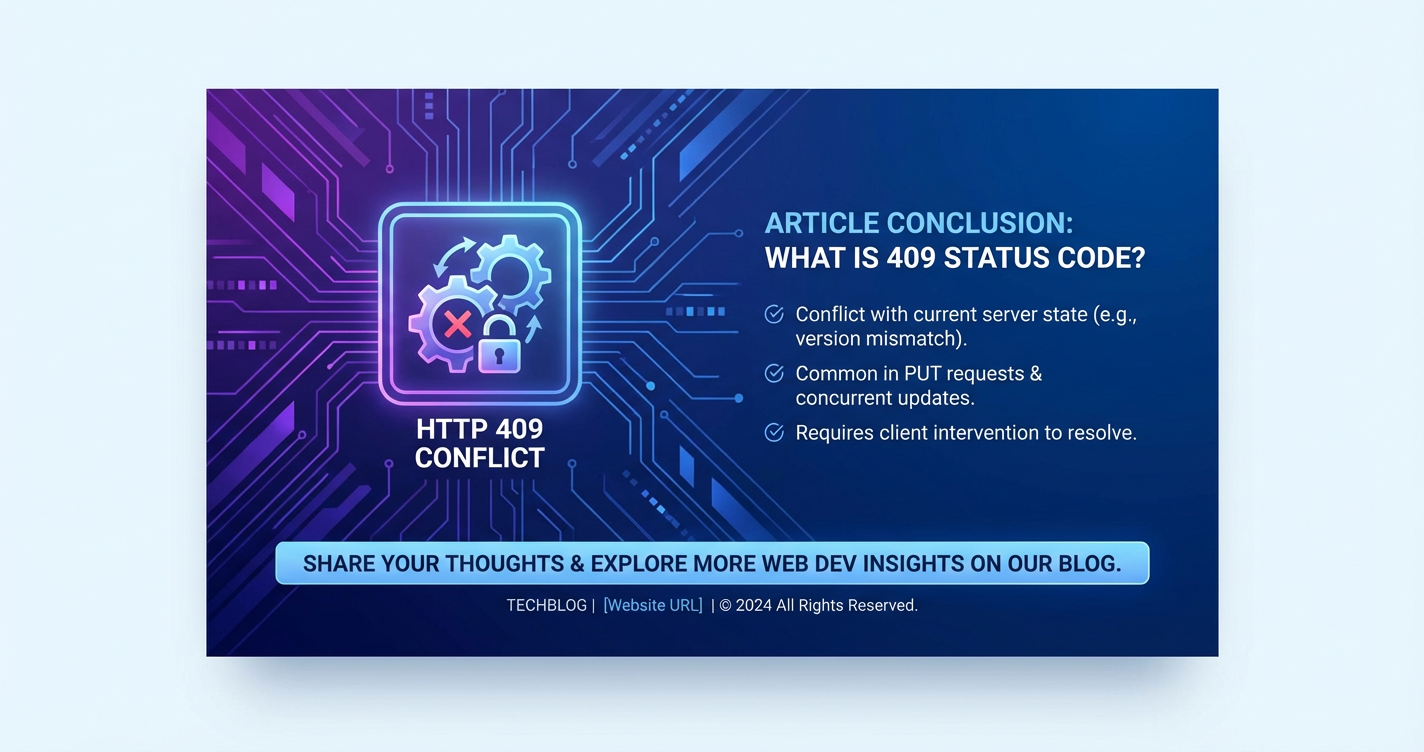
What is 409 Status Code? Understanding HTTP 409 Conflict


Introduction: Decoding the Digital Dialogue
In the sprawling, interconnected landscape of the modern internet, communication is paramount. Every interaction, from fetching a simple web page to orchestrating complex microservices, relies on a sophisticated system of requests and responses. At the heart of this system lies the Hypertext Transfer Protocol (HTTP), a foundational protocol that governs how data is exchanged between clients (like web browsers or mobile apps) and servers. A critical component of HTTP communication is the status code – a three-digit integer returned by the server, indicating the outcome of a client's request. These codes are not mere technical details; they are the server's way of speaking, conveying success, redirection, client-side errors, or server-side issues. Understanding them is fundamental for any developer, system administrator, or architect involved in building and maintaining web applications and APIs.
Among the myriad of HTTP status codes, the 400 series often signals problems originating from the client's request. While codes like 404 Not Found or 401 Unauthorized are widely recognized, others like 409 Conflict carry a more nuanced and context-specific meaning. The HTTP 409 Conflict status code is a powerful indicator that a request could not be completed because of a conflict with the current state of the target resource. Unlike a generic "bad request," a 409 implies that the request itself might be syntactically correct and potentially valid in a different context, but it clashes with the existing reality on the server. This status code is particularly relevant in dynamic environments where multiple users or systems might be attempting to modify the same resources concurrently, or when specific business rules govern resource states.
This comprehensive article will embark on a deep dive into the 409 Conflict status code, unraveling its precise definition, exploring the diverse scenarios that trigger it, and outlining robust strategies for both api developers and client applications to effectively manage and resolve such conflicts. We will examine how 409 plays a crucial role in maintaining data integrity and ensuring a predictable user experience in complex api-driven applications. Furthermore, we will investigate the implications of 409 conflicts within distributed systems and microservices architectures, considering the pivotal role that components like an api gateway play in observing, logging, and sometimes even influencing these critical interactions. By the end of this journey, you will possess a master's understanding of 409 Conflict, empowering you to design more resilient, robust, and user-friendly apis.
Chapter 1: The Anatomy of HTTP Status Codes
To fully appreciate the specifics of the 409 Conflict status code, it is essential to first grasp the broader landscape of HTTP status codes. These humble three-digit numbers are the silent communicators of the web, providing immediate feedback on the success or failure of a client-server interaction.
1.1 What are HTTP Status Codes?
HTTP status codes are part of the first line of the HTTP response message, signifying the outcome of the client's request. They are standardized by the Internet Engineering Task Force (IETF) and are categorized into five main classes, each representing a general category of response:
- 1xx Informational: These codes indicate that the request has been received and understood. They are provisional responses, indicating that the client should continue with the request or ignore it if it's already finished. Examples include 100 Continue and 101 Switching Protocols.
- 2xx Success: These codes signify that the client's request was successfully received, understood, and accepted. They are the most desired outcomes, indicating that the server has fulfilled the request as intended. Common examples include 200 OK (the ubiquitous success code), 201 Created (resource successfully created), and 204 No Content (request successful, but no content to return).
- 3xx Redirection: These codes inform the client that further action needs to be taken to complete the request. This often means the requested resource has moved to a different URL. Examples include 301 Moved Permanently and 302 Found, guiding the client to the new location.
- 4xx Client Error: These codes indicate that the client appears to have made an error in its request. The server is unable or unwilling to process the request due to a client-side issue. This category is where 409 Conflict resides, along with many other familiar error codes.
- 5xx Server Error: These codes signify that the server failed to fulfill an apparently valid request. This indicates a problem on the server's side, preventing it from completing the operation. Common examples include 500 Internal Server Error (a generic server-side issue) and 503 Service Unavailable (the server is currently unable to handle the request due to temporary overloading or maintenance).
The consistent use of these status codes is paramount for building robust and debuggable systems. They provide a common language that both machines and human developers can interpret, allowing for automated error handling, logging, monitoring, and efficient troubleshooting. Without them, deciphering the outcome of a network request would be a chaotic and time-consuming endeavor.
1.2 Diving Deeper into 4xx Client Error Codes
The 4xx series of status codes specifically points the finger at the client. While server-side errors (5xx) suggest a problem with the server's infrastructure or application logic, 4xx errors imply that the client's request was somehow malformed, unauthorized, or simply inappropriate given the current server state. Understanding the nuances between different 4xx codes is crucial for both api design and client-side error handling. Here's a brief look at some common 4xx codes to distinguish them from 409 Conflict:
- 400 Bad Request: This is a generic client error, indicating that the server cannot or will not process the request due to something that is perceived to be a client error (e.g., malformed request syntax, invalid request message framing, or deceptive request routing). It's often used when the request body doesn't conform to expected schema.
- 401 Unauthorized: The client must authenticate itself to get the requested response. This typically involves providing valid credentials (e.g., an
apikey or OAuth token). - 403 Forbidden: The client does not have access rights to the content; unlike 401, where authentication might grant access, 403 implies that even with authentication, the client is forbidden from accessing the resource.
- 404 Not Found: The server cannot find the requested resource. This is perhaps the most famous HTTP status code and simply means the URL or resource path does not correspond to anything on the server.
- 405 Method Not Allowed: The request method (e e.g., POST, GET, PUT, DELETE) is known by the server but has been disabled or is not supported for the target resource. For example, trying to POST to a read-only endpoint.
- 408 Request Timeout: The server would like to shut down this unused connection. It means the server didn't receive a complete request message within the time that it was prepared to wait.
- 410 Gone: Similar to 404, but it indicates that the resource was available at some point but is no longer. This provides more specific information than 404, implying the resource has been intentionally removed.
- 413 Payload Too Large: The request entity is larger than limits defined by the server; the server might close the connection or return a Retry-After header field.
- 415 Unsupported Media Type: The media format of the requested data (e.g.,
application/json,text/xml) is not supported by the server. - 422 Unprocessable Entity: The server understands the content type of the request entity, and the syntax of the request entity is correct, but it was unable to process the contained instructions. This code is often used for semantic errors in the request body, such as invalid values for fields (e.g., an invalid email format). It’s similar to 400 but more specific about data validity.
- 429 Too Many Requests: The user has sent too many requests in a given amount of time ("rate limiting").
Amidst these, 409 Conflict stands out because it specifically addresses a situation where the client's request conflicts with the current state of the resource. It's not about malformed syntax (400), wrong credentials (401), missing permissions (403), or a non-existent resource (404). Instead, it's about a legitimate operation that cannot proceed now because of the resource's existing condition. This distinction is crucial for understanding when and how to appropriately use and handle a 409 status code in an api context.
Chapter 2: Unveiling the 409 Conflict Status Code
The HTTP 409 Conflict status code is a sentinel, guarding against operations that would compromise the integrity or logical consistency of a server's resources. Its precise definition and application are critical for developers striving to build robust and predictable apis.
2.1 The Core Definition: What Does 409 Conflict Truly Mean?
According to RFC 7231, Section 6.5.8, the 409 Conflict status code "indicates that the request could not be completed due to a conflict with the current state of the target resource." This definition immediately highlights the key elements: "conflict" and "current state." It's not just any error; it's a specific type of error where the proposed action, while syntactically valid, cannot be performed because it clashes with the existing reality of the data or resource on the server.
Consider the difference between a 400 Bad Request and a 409 Conflict. A 400 might be returned if a client sends a request body that is missing required fields or uses an invalid data type for a particular field. The request itself is fundamentally flawed in its structure or basic content. A 409, however, implies that the request structure and data types are perfectly fine, but the values or the intended operation are inconsistent with the current state of the server's resource. For example, trying to update a user's email address (syntactically correct) to one that already exists for another user (conflict with server state) would typically warrant a 409.
This status code is typically expected when the request attempts to modify a resource, and the server detects that applying the client's modification would result in an inconsistent or invalid state. It's a signal to the client that they need to understand the current state of the resource better before attempting their operation, or that their operation fundamentally violates a unique constraint or business rule at that moment. The server's response body for a 409 should ideally contain enough information for the user to recognize the source of the conflict and take corrective action.
2.2 Common Scenarios Leading to a 409 Conflict
The versatility of the 409 Conflict status code stems from its ability to address a variety of logical and data-integrity conflicts. Understanding these common scenarios is key to both emitting and handling 409s effectively.
2.2.1 Concurrency Conflicts (Optimistic Locking)
One of the most frequent and classic uses of the 409 status code is to manage concurrency conflicts, often in the context of "optimistic locking." Imagine a scenario where multiple clients (users, systems, etc.) attempt to modify the same resource simultaneously. Without proper mechanisms, one client's changes might overwrite another's without either knowing, leading to a "lost update" problem.
Optimistic locking is a strategy to prevent this. When a client retrieves a resource, the server provides a unique identifier representing the resource's version or state at that moment. This is often done using the ETag HTTP header, which contains a hash or a version number of the resource. When the client later attempts to update the resource, it includes this ETag in an If-Match HTTP header in its PUT or PATCH request. The server then checks if the ETag provided by the client matches the ETag of the current version of the resource on the server.
If the ETags match, it means the resource has not been modified by anyone else since the client last fetched it, and the update proceeds successfully (200 OK or 204 No Content). However, if the ETags do not match, it signifies that another client has modified the resource in the interim. In this case, the server should respond with a 409 Conflict. The client's proposed update clashes with the updated state of the resource. The client's responsibility then is usually to fetch the latest version of the resource, merge their changes, and re-attempt the update.
Example: Two project managers are simultaneously editing a project's description in a web application. 1. Manager A fetches the project document, receiving ETag: "abc". 2. Manager B fetches the same project document, also receiving ETag: "abc". 3. Manager B makes a change and saves it. The server updates the document and generates a new ETag: "def". 4. Manager A makes a change and attempts to save it, sending If-Match: "abc". 5. The server compares If-Match: "abc" with the current ETag: "def". They don't match. 6. The server responds with 409 Conflict, informing Manager A that their changes cannot be applied because the resource has been modified. Manager A must then refresh, see Manager B's changes, and re-apply their own if still desired.
2.2.2 Resource Duplication Attempts
Another common scenario for a 409 Conflict is when a client attempts to create a resource that must be unique, but a resource with identical unique identifiers already exists on the server. This prevents the creation of duplicate entities that would violate data integrity constraints.
Example: User registration or creating a unique identifier. 1. A new user tries to register with the username "john.doe". 2. The server checks its database and finds that a user with "john.doe" already exists. 3. Instead of creating a duplicate user, the server responds with a 409 Conflict, indicating that the requested username is already taken. The client application can then prompt the user to choose a different username. This applies to any resource with unique constraints, such as email addresses, product SKUs, or unique IDs assigned by a client.
2.2.3 State-Dependent Operations
Many api operations are stateful, meaning they can only be performed if the target resource is in a particular state. Attempting an operation when the resource is in an incompatible state is a classic reason for a 409 Conflict.
Example: Order processing or workflow management. * Deleting a non-empty directory: An api to delete a directory might only permit deletion if the directory is empty. Attempting to delete a directory with files in it could return a 409, requiring the client to clear the directory first. * Approving an already approved request: If an api endpoint exists to approve a pending request, and a client sends an approval request for an item that has already been approved, the server should respond with a 409 Conflict, as the state transition is invalid. * Shipping an order that is still pending payment: An api for shipping orders might require the order's status to be "paid." If a client attempts to ship an order with a "pending payment" status, a 409 Conflict would be appropriate. * Modifying an immutable resource: In some systems, once a resource reaches a certain state (e.g., "archived" or "finalized"), it becomes immutable. Any attempt to modify it would result in a 409 Conflict.
2.2.4 Business Logic Constraints
Beyond simple state transitions or uniqueness, complex business rules often dictate valid operations. When a client's request violates one of these rules, even if the resource is technically available and the request format is correct, a 409 Conflict can be an appropriate response. This signals that the conflict arises from the application's specific business logic rather than a generic error.
Example: Financial transactions or booking systems. * Insufficient funds: A client attempts to withdraw money from an account, but the account balance is insufficient. While a 403 Forbidden might be considered (client lacks "permission" to overdraft), a 409 could be more precise, indicating a conflict with the current state of the account balance. * Conflicting appointments/bookings: In a scheduling api, if a user tries to book a meeting room that is already occupied during the requested time slot, the api should return a 409 Conflict, as the booking conflicts with an existing reservation. * Exceeding limits: A user tries to add an item to a shopping cart, but the inventory for that item is zero, or they try to subscribe to a plan when they've already reached the maximum allowed subscriptions.
2.2.5 Version Control Systems Integration (Analogous)
While HTTP status codes are typically for web apis, the concept of a 409 Conflict has strong parallels in version control systems like Git. When a developer tries to push changes to a remote repository, but their local branch is behind the remote (meaning others have pushed changes that conflict with theirs), Git will reject the push, requiring the developer to first pull (fetch and merge) the remote changes before being allowed to push. This is fundamentally a concurrency conflict, where the proposed change (push) conflicts with the current state of the remote resource (the branch). In an api that interacts with document storage or content management, this analogy holds strong, emphasizing the need for clients to reconcile local changes with server changes.
The rich set of scenarios for 409 Conflict highlights its importance in maintaining data integrity, enforcing business rules, and providing precise feedback to clients about why their requested operation could not be fulfilled at that specific moment. Properly implementing and handling 409s is a hallmark of a well-designed api.
Chapter 3: Implementing and Handling 409 in API Design
The utility of the 409 Conflict status code lies not just in its definition but in its thoughtful application within api design and robust client-side error handling. Effectively managing 409s requires careful consideration from both the server and client perspectives.
3.1 Designing APIs to Emit 409 Conflicts Appropriately
For api developers, the decision of when to return a 409 versus other 4xx codes is a critical design choice that impacts the clarity and usability of the api.
When to Use 409 vs. Other Codes:
- 409 vs. 400 Bad Request: Use 400 when the request itself is malformed or fundamentally incorrect in its syntax or basic validation (e.g., a required field is missing, data type mismatch). Use 409 when the request is syntactically valid and semantically plausible, but conflicts with the current state of the resource or a specific business rule. For instance, an invalid email format might be 400, but an email already taken by another user is 409.
- 409 vs. 422 Unprocessable Entity: This distinction can be subtle. RFC 4918 (WebDAV, which introduced 422) states 422 is for "semantic errors." Many developers use 422 for validation errors where the request body is syntactically correct but contains logical errors (e.g., an invalid date range where start date is after end date). 409 is typically reserved for conflicts with the server's current state (e.g., optimistic locking, unique constraint violations). If the error is purely about the validity of the data within the request itself (e.g., "minimum quantity must be positive"), 422 might be more appropriate. If it's about the data in relation to existing data on the server (e.g., "this unique ID already exists"), then 409 is often preferred. The key differentiator is usually whether the error is independent of the server's current resource state or directly caused by it.
- 409 vs. 403 Forbidden: 403 implies a lack of authorization or permission. The client simply isn't allowed to perform that action, regardless of the resource's state. 409 implies the client could be allowed, but the action cannot proceed due to a temporary or resolvable conflict with the resource's state.
Importance of Clear, Informative Error Messages: When a server responds with a 409, the work isn't done. The response body is the client's guide to understanding and resolving the conflict. A generic "Conflict" message is unhelpful. The response should provide:
- A specific error code or type: To allow programmatic handling.
- A human-readable message: Explaining what the conflict is.
- Details about the conflicting data: Which field, which resource ID, what the conflicting value is.
- Suggestions for resolution: What action the client should take (e.g., "fetch latest version and retry," "choose a different username").
Using Standard Error Formats (e.g., Problem Details for HTTP APIs - RFC 7807): To ensure consistency and ease of parsing, apis should adopt a standardized format for error responses. RFC 7807, "Problem Details for HTTP APIs," defines a generic JSON or XML format for carrying machine-readable details of errors. This standard includes fields like type (a URI that identifies the problem type), title (a short, human-readable summary), status (the HTTP status code), detail (a human-readable explanation), and instance (a URI that identifies the specific occurrence of the problem). By adhering to such standards, clients can build robust error-handling logic that works across different apis or different error types within the same api.
HTTP/1.1 409 Conflict
Content-Type: application/problem+json

{
  "type": "https://example.com/probs/out-of-stock",
  "title": "Product out of stock",
  "detail": "Cannot add 5 units of product 'ABC' to cart. Only 2 units remaining.",
  "instance": "/techblog/en/orders/12345/items",
  "remaining_stock": 2,
  "product_id": "ABC"
}
Or for a concurrency conflict:
HTTP/1.1 409 Conflict
Content-Type: application/problem+json
ETag: "latest-etag-of-resource" // Optionally, provide the current ETag

{
  "type": "https://example.com/probs/concurrency-conflict",
  "title": "Resource modified by another user",
  "detail": "Your update could not be applied because the document has been updated since you last retrieved it. Please fetch the latest version, reconcile changes, and retry.",
  "instance": "/techblog/en/documents/doc-123",
  "current_etag": "new-etag-value" // More specific detail than the header
}
This level of detail is invaluable for automated client-side processing and for informing end-users.
3.2 Client-Side Strategies for Resolving 409 Conflicts
Receiving a 409 Conflict places the onus on the client to take corrective action. Effective client-side handling is crucial for a smooth user experience and reliable application behavior.
2.2.1 User Notification and Interaction
For interactive applications, a 409 Conflict often necessitates informing the user and guiding them towards a resolution. * Clear Explanation: Instead of a generic "error," the application should translate the server's detailed error message into an understandable prompt for the user. For instance, "This username is already taken. Please choose another one." or "The document you are editing has been modified by someone else. Do you want to reload the latest version and lose your changes, or attempt to merge them?" * Providing Options: Depending on the conflict type, the client can offer specific actions: * Retry with new data: (e.g., for unique constraint violations, prompt for a new username). * Reload and discard local changes: (e.g., for optimistic locking conflicts, where the user might accept losing their unsaved changes). * Attempt to merge changes: (more complex, might require user input or sophisticated client-side merge logic). * Cancel the operation.
2.2.2 Retries with Backoff (Carefully Considered)
While retries with exponential backoff are a common strategy for transient errors (like 503 Service Unavailable or network issues), they are generally not appropriate for 409 Conflict. A 409 indicates a logical conflict, not a temporary network glitch or server overload. Simply retrying the exact same request without modifying it will almost certainly result in another 409.
The only rare exceptions might be if the conflict is expected to resolve very quickly by another system process, and the client is simply waiting for that state change. Even then, the client must understand the specific nature of the conflict to determine if a retry is logical. In most cases, a 409 requires client-side intervention: fetching the latest data, user input, or modifying the request.
2.2.3 Data Synchronization and Merge Logic
For concurrency conflicts, the most sophisticated client-side strategy involves data synchronization and merge logic: 1. Fetch the latest state: Upon receiving a 409 due to an ETag mismatch, the client should immediately make a GET request to retrieve the most current version of the resource. 2. Identify differences: The client application needs to compare its unsaved local changes with the newly fetched, current version of the resource. 3. Merge logic: * Automatic merge: In some cases, if changes are in different, non-overlapping parts of the resource, the client might be able to automatically merge its changes with the server's current version. * Manual merge (user intervention): More often, especially with textual content, conflicts will require user interaction to decide which version to keep or how to combine them. The application needs to present the conflict clearly (e.g., a "diff" view) and allow the user to resolve it. 4. Re-apply changes: Once the conflict is resolved (either automatically or manually), the client constructs a new PUT or PATCH request with the merged data and the newest ETag (from the step 1 GET request), then re-submits the request. This cycle continues until the update is successfully applied or the user abandons it.
This process is critical for collaborative editing tools and any system where data integrity is paramount despite concurrent modifications.
3.3 Server-Side Best Practices for 409 Responses
Beyond simply returning the 409 status code, how the server constructs and delivers its response significantly impacts the client's ability to recover.
3.3.1 Providing Contextual Details
As previously discussed, a detailed response body is non-negotiable for a 409. This might include: * The exact field or condition that caused the conflict (e.g., "username 'john.doe' already exists"). * The current value of the conflicting resource if it's relevant (e.g., the current ETag of the document). * Additional data that might help the client formulate a new request (e.g., available stock quantity if the conflict was due to insufficient inventory). * A URL to more extensive documentation about this specific error type.
The goal is to provide a comprehensive diagnosis, not just a symptom.
3.3.2 Consistency and Idempotency
- Consistency: Ensure that 409 responses are consistently applied across your
apifor similar conflict types. This predictability allows clients to build generalized error handling. - Idempotency: An operation is idempotent if executing it multiple times produces the same result as executing it once. While
PUToperations are generally idempotent (if youPUTthe same data twice, the resource will be in the same state), a 409 Conflict can interrupt this. If aPUTfails with a 409, the resource's state hasn't changed from the client's perspective of the update. However, the server has rejected the specific state transition. Developers should designapis to minimize unintended side effects when a 409 occurs and provide clear guidance on how to achieve the desired idempotent state after conflict resolution.
3.3.3 Security Considerations
When providing detailed error messages in a 409 response, always be mindful of security implications: * Avoid Leaking Sensitive Information: Do not include internal system details, database query information, or overly specific business logic that could aid an attacker in probing your system. For example, instead of "Database constraint users_email_uq violated," say "The provided email address is already in use." * Provide Actionable, Not Exploitable, Information: The details should be sufficient for a legitimate client to resolve the conflict but not so verbose that it reveals architectural weaknesses or allows for enumeration attacks (e.g., confirming the existence of a resource that should otherwise be hidden).
By adhering to these server-side best practices, apis can transform a potential stumbling block (a 409 conflict) into a clear communication point, guiding clients effectively towards resolution and contributing to the overall robustness of the system.
Chapter 4: The Role of API Gateways and Gateways in Managing 409s
In modern distributed architectures, particularly those built on microservices, the api gateway has emerged as a critical component. While api gateways are primarily known for routing, security, and performance, they also play an indirect but vital role in the broader context of managing HTTP status codes like 409 Conflict.
4.1 What is an API Gateway?
An api gateway acts as a single entry point for all client requests, abstracting the complexity of the underlying microservices architecture. Instead of clients making direct requests to multiple backend services, they communicate with the api gateway, which then intelligently routes requests to the appropriate services. Beyond routing, a robust api gateway typically provides a suite of essential features:
- Request Routing: Directing incoming requests to the correct backend service based on defined rules.
- Authentication and Authorization: Centralizing security concerns, ensuring only authorized clients and users access services.
- Rate Limiting and Throttling: Protecting backend services from overload by controlling the number of requests clients can make.
- Load Balancing: Distributing traffic across multiple instances of backend services for improved availability and performance.
- Caching: Storing responses to reduce the load on backend services and improve response times.
- Monitoring and Logging: Providing a centralized point for collecting metrics, logs, and traces of
apiinteractions. - Protocol Translation: Converting requests between different protocols (e.g., HTTP to gRPC).
- Response Transformation: Modifying or enriching responses before sending them back to the client.
- Service Discovery: Integrating with service registries to locate available backend services.
In essence, an api gateway provides a secure, efficient, and scalable façade for your apis, simplifying client interactions and offloading common concerns from individual microservices.
4.2 How an API Gateway Interacts with 409s
While an api gateway doesn't typically generate a 409 Conflict response itself (that responsibility usually lies with the specific backend service handling the business logic), its role in handling these errors is nonetheless significant.
4.2.1 Passthrough and Logging
The most common interaction is straightforward: the api gateway acts as a transparent proxy. When a backend service encounters a conflict and returns a 409 Conflict status code, the gateway simply passes this response, including its headers and body, directly back to the client. It doesn't interpret or modify the 409 in this basic scenario.
However, the gateway's crucial role here is in logging and monitoring. Every request and response passing through the api gateway is typically logged. This includes the HTTP status code. This centralized logging is incredibly valuable for: * Identifying APIs prone to conflicts: Tracking the frequency of 409s for specific endpoints can highlight apis that are frequently targeted by concurrent modifications or unique constraint violations. * Detecting problematic client behavior: If a single client or application consistently receives 409s, it might indicate a flaw in its api consumption logic. * Operational insights: Analyzing 409 logs over time can reveal trends, help optimize backend services, or inform api design revisions.
4.2.2 Error Transformation (Rare but Possible)
In more advanced or complex api gateway deployments, the gateway might be configured to perform error transformation. This is less common for standard HTTP status codes like 409 but can be useful in specific scenarios: * Standardizing diverse backend errors: If different microservices return 409s with varying response body formats (e.g., one uses a custom XML format, another a non-standard JSON structure), the gateway could intercept these and transform them into a unified, standardized format (like RFC 7807 Problem Details). This provides a consistent api contract for clients regardless of the backend implementation. * Masking internal details: The gateway could strip potentially sensitive information from backend 409 responses before passing them to external clients, enhancing security. * Enriching error messages: The gateway might add additional context from its own environment (e.g., a request ID, correlation ID) to the 409 response body to aid in tracing and debugging.
This level of error transformation makes the api layer more robust and user-friendly, especially in heterogeneous environments.
4.2.3 Conditional Routing and Policies
While an api gateway doesn't directly resolve a 409, its policies can indirectly influence scenarios that might lead to conflicts: * Pre-validation policies: For extremely common and simple uniqueness checks (e.g., a cached list of reserved usernames), a gateway could theoretically perform a quick check before forwarding the request to the backend. If a conflict is detected at the gateway level, it could respond with a 409 directly, saving backend resources. However, this is generally discouraged for critical data as the gateway would need to maintain a highly consistent, potentially stale, view of the data, which is difficult to scale and prone to race conditions. Most complex validation and conflict detection should remain with the authoritative backend service. * Header enforcement: The gateway can enforce the presence of specific HTTP headers, such as If-Match for optimistic locking. If a PUT or PATCH request is made to an endpoint known to require optimistic locking, and the If-Match header is missing, the gateway could theoretically reject the request with a 400 Bad Request or a custom error code, preventing the request from even reaching the backend where it would eventually result in a 409. This is a subtle preventative measure.
4.3 Monitoring and Analytics for 409 Conflicts via a Gateway
The api gateway is a choke point for all api traffic, making it an ideal place to collect comprehensive metrics and logs. This capability is particularly powerful for understanding and managing 409 conflicts.
By leveraging an API gateway's monitoring features, teams can: * Track 409 frequency: Observe how often 409s occur for different apis, potentially correlating them with deployments, specific client versions, or peak usage times. * Identify root causes: Analyze detailed logs associated with each 409 (request headers, body, timestamp, client IP, etc.) to pinpoint the exact conditions that led to the conflict. * Gauge system health: A sudden spike in 409s might indicate a problem with concurrency control in a backend service, unexpected client behavior, or even attempts at malicious data manipulation. * Inform API design improvements: Persistent 409s for certain workflows might suggest that the api's design is not intuitive for clients, or that a more robust conflict resolution mechanism needs to be implemented.
Platforms like ApiPark, an open-source AI gateway and API management platform, offer robust capabilities for detailed API call logging and powerful data analysis. By tracking every detail of each api call, including status codes like 409, businesses can quickly trace and troubleshoot issues, ensuring system stability and data security. This granular logging is invaluable for understanding the context and frequency of 409 conflicts. APIPark's comprehensive logging features record every aspect of API interactions, providing a rich dataset for performance monitoring and security auditing. This detailed insight helps operations teams and developers proactively address potential conflicts and refine their apis for optimal performance and user experience.
The ability of an api gateway to centralize and analyze this information is a critical asset for maintaining the health and resilience of modern api ecosystems.
APIPark is a high-performance AI gateway that allows you to securely access the most comprehensive LLM APIs globally on the APIPark platform, including OpenAI, Anthropic, Mistral, Llama2, Google Gemini, and more.Try APIPark now! 👇👇👇
Chapter 5: Real-World Scenarios and Advanced Considerations
Beyond the theoretical definitions, understanding how 409 Conflicts manifest in real-world applications and how advanced techniques address them is crucial for building resilient systems.
5.1 Concurrency Control Mechanisms in Detail
The core problem that 409 often addresses is concurrency – how to manage simultaneous access to shared resources without data corruption or loss.
- Optimistic Locking (ETags,
If-Match, Version Numbers): This is the most prevalent strategy in RESTfulapis, as it's typically more scalable than pessimistic locking. As detailed earlier, it involves allowing multiple users to access and modify data, but then checking for conflicts only when an update is attempted. If a conflict is detected (e.g., viaETagmismatch or an outdated version number), the update is rejected with a 409. The client is then responsible for re-fetching the data and resolving the conflict. Optimistic locking relies on the assumption that conflicts are rare, making it efficient by avoiding locks during read operations.- Implementation with Version Numbers: Instead of
ETags, many systems use a simple version number field (e.g.,version,revision) within the resource itself. When a client retrieves the resource, it gets the current version number. When updating, it sends the original version number along with the changes. The server checks if the original version number matches its current version. If not, a 409 is returned, and the server increments the version number on successful update.
- Implementation with Version Numbers: Instead of
- Pessimistic Locking (Brief Mention): In contrast, pessimistic locking prevents conflicts by locking a resource when it's being accessed or modified, thereby preventing other users from accessing it until the lock is released. While common in traditional database transactions (e.g.,
SELECT ... FOR UPDATE), it's generally avoided in highly scalable, stateless RESTapis due to its performance overhead and potential for deadlocks. It's more suited for scenarios where conflicts are very frequent and must be absolutely prevented at the cost of concurrency. 409 Conflict is fundamentally a response to an optimistic locking failure, not a pessimistic one.
5.2 Handling 409s in Distributed Systems
Distributed systems, with their inherent eventual consistency models and multiple moving parts, introduce unique challenges for conflict management.
- Eventual Consistency: In systems where data is replicated across multiple nodes and consistency is eventually achieved rather than immediately, a 409 might occur if a client's update reaches a node that has not yet synchronized with the latest state from another node. Designing
apis for such environments requires careful thought.- Conflict Resolution at the Data Store: Some NoSQL databases (e.g., CouchDB, Cassandra with specific configurations) have built-in multi-master conflict resolution strategies. When a conflict occurs (often similar to a 409 but handled internally by the database), these systems might create conflicting versions of a document, requiring the application to provide explicit merge logic.
- Idempotency and Compensation: While a direct 409 might still occur, distributed systems often rely more heavily on idempotent operations and compensating transactions. If an operation fails with a 409, the client might retry with an
idempotency keyto ensure that if the original request did eventually succeed on another node, the retry doesn't create a duplicate. For more complex workflows, a failure might trigger a compensating transaction to undo previous actions.
- Microservices Architecture: In a microservices environment, a single user action might involve calls to several backend services. A 409 from one of these services can halt the entire workflow. The challenge lies in ensuring that intermediate changes are rolled back or that the client is guided through a recovery process. This is where
api gateways often play a role in centralizing error handling, even if it's just logging and passing the detailed 409 from the originating microservice.
5.3 Impact on User Experience and System Performance
The way 409 Conflicts are handled has a direct impact on both the end-user experience and the overall performance of the system.
- User Experience:
- Poorly Handled: A generic, uninformative 409 error can confuse and frustrate users, leading to abandoned tasks or calls to support. If the application crashes or freezes due to an unhandled 409, the experience is even worse.
- Well Handled: A well-crafted 409 response, translated into an actionable message with clear options, empowers users to resolve the conflict themselves. This fosters trust and makes the application feel robust and reliable. For example, a "File changed, click here to see differences and merge" message is vastly superior to a cryptic "Error 409".
- System Performance:
- Frequent 409s: A high rate of 409s might indicate underlying problems:
- High contention: Many users trying to edit the same resources, pointing to a need for better concurrent editing features or different resource partitioning.
- Poor
APIdesign:APIs that make it too easy to cause conflicts, or whoseapicontract isn't clear about state transitions. - Client-side bugs: Clients not correctly using
ETags or version numbers, or blindly retrying requests.
- Server Load: Each 409 still represents a request that the server had to process, potentially performing database lookups and business logic validation before rejecting it. While preferable to data corruption, a very high volume of 409s can still contribute to server load. Monitoring these trends via an
api gatewayis vital to identify and address such inefficiencies.
- Frequent 409s: A high rate of 409s might indicate underlying problems:
5.4 Tools and Frameworks that Aid 409 Management
Developers are not left to tackle 409s alone; many tools and frameworks provide built-in support.
- ORM Capabilities for Optimistic Locking: Object-Relational Mappers (ORMs) like Hibernate (Java), Entity Framework (.NET), and SQLAlchemy (Python) often provide features for optimistic locking. They can automatically add a version column to database tables, check its value during updates, and throw a specific exception (which the
apilayer can then translate into a 409) if a concurrency conflict is detected. APIDocumentation Generators (e.g., OpenAPI/Swagger): Tools that generateapidocumentation from specifications (like OpenAPI) are crucial for explicitly defining expected 409 responses. The documentation should clearly state when a 409 might be returned for a specific endpoint, what the structure of the 409 response body will be, and how clients should handle it. This explicit contract is invaluable for client developers.- Centralized
APIManagement Platforms: Platforms that offer comprehensiveapilifecycle governance are essential for managing the complexities ofapis, including error handling.
Furthermore, API management platforms like ApiPark provide end-to-end API lifecycle management, assisting with the design, publication, invocation, and decommissioning of apis. This comprehensive approach helps regulate api management processes, making it easier to define and communicate expected error responses, including the nuanced 409 Conflict. APIPark’s capabilities extend to managing traffic forwarding, load balancing, and versioning of published apis, all of which indirectly contribute to reducing scenarios where 409s might arise from system-level issues rather than pure business logic conflicts. Its developer portal features also facilitate clear communication of api contracts and error codes to consumers.
By leveraging these tools and understanding these advanced considerations, api designers can transform the potential challenges of 409 Conflicts into opportunities for building more resilient, understandable, and user-friendly apis.
Chapter 6: Practical Examples and Code Snippets (Conceptual)
To solidify our understanding of the 409 Conflict status code, let's explore conceptual examples that illustrate how it's used in practice for different scenarios. These snippets will focus on the logic rather than full, runnable code in a specific language, emphasizing the HTTP interactions.
6.1 Example 1: Creating a Unique User Account
This is a classic scenario for a unique constraint violation. When a user attempts to register, their chosen username or email must not already exist in the system.
Client Request (POST /users):
POST /users HTTP/1.1
Host: api.example.com
Content-Type: application/json

{
  "username": "alice_smith",
  "email": "alice.smith@example.com",
  "password": "securepassword123"
}
Server Logic (Conceptual): 1. Receive POST /users request. 2. Parse request body. 3. Check if username "alice_smith" already exists in the database. 4. If YES, a conflict is detected. 5. Construct a 409 Conflict response.
Server Response (409 Conflict):
HTTP/1.1 409 Conflict
Content-Type: application/problem+json

{
  "type": "https://api.example.com/problems/user-already-exists",
  "title": "User account with this username already exists",
  "detail": "The username 'alice_smith' is already registered. Please choose a different username.",
  "instance": "/techblog/en/users",
  "conflicting_field": "username",
  "conflicting_value": "alice_smith"
}
Client Handling Logic (Conceptual): 1. Receive HTTP 409 status code. 2. Parse the application/problem+json response body. 3. Extract detail and conflicting_field. 4. Display an error message to the user: "The username 'alice_smith' is already taken. Please try another one." 5. Clear the username input field or highlight it as invalid, prompting the user for a new input.
This example clearly demonstrates how 409 signals a specific business rule violation related to data uniqueness.
6.2 Example 2: Updating a Document with Optimistic Locking
This scenario uses ETags to prevent "lost updates" when multiple clients might modify the same resource.
Scenario: 1. Client A fetches a document. 2. Client B fetches the same document. 3. Client B modifies and saves the document successfully. 4. Client A, unaware of Client B's changes, attempts to save its own modifications.
Step 1: Client A Fetches Document
Client A Request (GET /documents/doc-123):
GET /documents/doc-123 HTTP/1.1
Host: api.example.com
Server Response to Client A:
HTTP/1.1 200 OK
Content-Type: application/json
ETag: "v1.2.3-hash-abcd"

{
  "id": "doc-123",
  "title": "Project Proposal",
  "content": "Initial draft of the proposal...",
  "last_updated_by": "john.doe"
}
Client A stores ETag: "v1.2.3-hash-abcd".
Step 2: Client B Modifies and Saves (Success)
Client B Request (PUT /documents/doc-123 with If-Match):
PUT /documents/doc-123 HTTP/1.1
Host: api.example.com
Content-Type: application/json
If-Match: "v1.2.3-hash-abcd"

{
  "id": "doc-123",
  "title": "Project Proposal (Revised)",
  "content": "Initial draft of the proposal with new sections...",
  "last_updated_by": "jane.smith"
}
Server Logic for Client B: 1. Receive PUT /documents/doc-123. 2. Check If-Match: "v1.2.3-hash-abcd". 3. Current document ETag is indeed "v1.2.3-hash-abcd". Match found. 4. Update document, generate new ETag: "v1.2.4-hash-efgh". 5. Construct a 200 OK response.
Server Response to Client B:
HTTP/1.1 200 OK
Content-Type: application/json
ETag: "v1.2.4-hash-efgh"

{
  "id": "doc-123",
  "title": "Project Proposal (Revised)",
  "content": "Initial draft of the proposal with new sections...",
  "last_updated_by": "jane.smith"
}
Step 3: Client A Attempts to Save (Conflict)
Client A Request (PUT /documents/doc-123 with If-Match):
PUT /documents/doc-123 HTTP/1.1
Host: api.example.com
Content-Type: application/json
If-Match: "v1.2.3-hash-abcd"  // Client A still has the old ETag

{
  "id": "doc-123",
  "title": "Project Proposal (A's changes)",
  "content": "Client A's content addition to the initial draft...",
  "last_updated_by": "alice_smith"
}
Server Logic for Client A: 1. Receive PUT /documents/doc-123. 2. Check If-Match: "v1.2.3-hash-abcd". 3. Current document ETag is now "v1.2.4-hash-efgh". No match! Conflict detected. 4. Construct a 409 Conflict response.
Server Response to Client A (409 Conflict):
HTTP/1.1 409 Conflict
Content-Type: application/problem+json
ETag: "v1.2.4-hash-efgh" // Optionally, server can include the current ETag to assist client

{
  "type": "https://api.example.com/problems/concurrency-conflict",
  "title": "Resource conflict: Document has been modified",
  "detail": "The document 'Project Proposal' has been updated by another user since you loaded it. Please fetch the latest version and reconcile your changes.",
  "instance": "/techblog/en/documents/doc-123",
  "current_etag": "v1.2.4-hash-efgh"
}
Client A Handling Logic (Conceptual): 1. Receive HTTP 409 status code. 2. Parse application/problem+json response body, especially the detail and current_etag. 3. Display a message to the user: "Warning: This document has been updated by someone else. What do you want to do?" 4. Offer options: * "Reload latest version (discard your changes)" - Client makes a GET request. * "View differences and merge" - Client makes a GET request, then uses local changes and fetched changes to present a merge UI. 5. If the user chooses to merge, the client fetches the latest version (GET /documents/doc-123), applies its local changes to that version (potentially with user input), and then resubmits the PUT request with the new ETag it just received.
This example highlights the full lifecycle of optimistic locking and 409 conflict resolution.
6.3 Example 3: State Transition Conflict
Here, the 409 is used to prevent an operation that is invalid given the current state of a resource, violating a business rule.
Scenario: An api to manage orders. An order can only be shipped if its status is "paid." An attempt to ship an order that is still "pending_payment" should result in a conflict.
Client Request (POST /orders/order-456/ship):
POST /orders/order-456/ship HTTP/1.1
Host: api.example.com
(Assume order-456 currently has status: "pending_payment")
Server Logic (Conceptual): 1. Receive POST /orders/order-456/ship. 2. Retrieve order order-456 from the database. 3. Check the order's status field. 4. If status is not "paid" (e.g., it's "pending_payment"), a state transition conflict is detected. 5. Construct a 409 Conflict response.
Server Response (409 Conflict):
HTTP/1.1 409 Conflict
Content-Type: application/problem+json

{
  "type": "https://api.example.com/problems/invalid-order-state",
  "title": "Cannot ship order in current state",
  "detail": "Order 'order-456' cannot be shipped because its current status is 'pending_payment'. It must be 'paid' before shipping.",
  "instance": "/techblog/en/orders/order-456/ship",
  "order_id": "order-456",
  "current_status": "pending_payment",
  "required_status": "paid"
}
Client Handling Logic (Conceptual): 1. Receive HTTP 409 status code. 2. Parse the application/problem+json response body. 3. Extract detail, current_status, required_status. 4. Display an informative message to the user: "Order 'order-456' cannot be shipped. It is currently in 'pending payment' status and must be 'paid' first." 5. The client application might then guide the user to the payment section or suggest checking the payment status.
These examples illustrate the power of the 409 Conflict status code to communicate specific, actionable errors stemming from the state of resources, allowing for more intelligent and user-friendly error recovery.
Chapter 7: API Gateway as a Strategic Asset for Resilient APIs
The api gateway is far more than just a proxy; it's a strategic control point that can significantly enhance the resilience, security, and developer experience of an api ecosystem. While it primarily passes through 409 Conflict errors from backend services, its broader capabilities contribute to building a robust environment where such conflicts can be better understood, managed, and sometimes even prevented indirectly.
7.1 Beyond Error Handling: API Gateway as an Orchestrator
An api gateway orchestrates interactions between clients and backend services, making complex distributed systems appear as a unified, coherent api. This orchestration layer helps in several ways that ultimately contribute to a more resilient api landscape:
- Centralized Authentication and Authorization: By enforcing security policies at the
gatewaylevel, it ensures that only legitimate, authenticated, and authorized requests reach the backend services. This prevents many types of "conflicts" before they even begin. For example, an unauthorized request to modify a resource would be stopped with a 401 Unauthorized or 403 Forbidden at thegateway, rather than hitting the backend service and potentially causing a 409 if it also conflicted with an optimistic lock or business rule. Thegatewayacts as the first line of defense. - Rate Limiting and Throttling:
API gateways protect backend services from being overwhelmed by too many requests. This prevents server-side issues (which might manifest as 5xx errors) but also helps ensure that when a request does reach a backend, the service has sufficient resources to process it properly and detect conflicts accurately, rather than buckling under pressure and returning ambiguous errors. Excessive, uncontrolled requests might also inadvertently trigger more concurrency conflicts if they are not correctly using optimistic locking. - Protocol Translation and Aggregation: In complex systems, an
api gatewaycan aggregate calls to multiple microservices into a single client-facing endpoint. This simplifies client-side logic and reduces network overhead. While it doesn't directly handle 409s, by presenting a cleaner, more focusedapito the client, it can reduce the chances of client-side logic errors that might indirectly lead to conflicts.
7.2 Enhancing Developer Experience with an API Gateway
A well-implemented api gateway significantly improves the experience for developers consuming apis, which in turn leads to more correctly implemented clients and fewer errors, including 409s.
- Standardized
APIInterfaces and Documentation: Thegatewaypresents a consistentapiinterface to the world, regardless of the underlying backend diversity. This allows for centralizedapidocumentation, often through a developer portal. Clear, comprehensive documentation (generated from OpenAPI specifications, for example) that explicitly outlines expected 409 responses, their causes, and resolution strategies is invaluable for client developers. When a client developer understands why they might get a 409 and how to fix it, they are much more likely to implement correct handling. APIDeveloper Portals: Manyapi gatewaysolutions include a developer portal. This self-service portal provides developers withapidiscovery, documentation, tutorials, SDKs, and the ability to register applications and manageapikeys. A good developer portal ensures thatapiconsumers are well-equipped to use theapis correctly, reducing misinterpretations that could lead to unexpected behavior or conflicts.
An advanced API gateway like ApiPark also offers a unified API format for AI invocation, abstracting away complexities. This design philosophy extends to error handling, ensuring that developers receive consistent and actionable error messages, including clear 409 Conflict responses, regardless of the underlying service. By standardizing the format and centralizing the management, APIPark helps developers quickly integrate and manage diverse apis, including those using AI models, minimizing the learning curve and potential for misconfigurations that could result in conflicts. Its ability to encapsulate prompts into REST apis also means that the api contract for consumers can be carefully controlled, reducing ambiguity in api usage.
7.3 Performance and Scalability: The Unsung Heroes
The performance and scalability capabilities of an api gateway are crucial for maintaining system stability, which indirectly impacts conflict management.
- Traffic Management and Load Balancing:
API gateways are designed to handle massive volumes of traffic, distribute requests efficiently across multiple backend service instances, and automatically scale up or down. A stable and performant infrastructure is less prone to timeouts or service unavailability (5xx errors) that might mask underlying 409 conflicts or complicate their resolution. - Caching: By caching responses for frequently accessed, immutable resources, a
gatewaycan significantly reduce the load on backend services. While caching for resources that might cause 409s (i.e., mutable resources) is complex and requires careful invalidation strategies, forGETrequests that retrieve data withETags, caching can make the initial fetch faster, improving the overall responsiveness of systems using optimistic locking.
Indeed, platforms like APIPark are built for performance, rivaling Nginx with capabilities to achieve over 20,000 TPS, supporting cluster deployment to handle large-scale traffic. This robust performance ensures that even when conflicts occur, the underlying gateway infrastructure remains stable and responsive. The high throughput capabilities of APIPark mean that the api gateway itself is not a bottleneck, allowing backend services to process requests and return accurate 409 responses efficiently, without being overwhelmed by network congestion or slow processing. This stability is critical for real-time applications where rapid conflict detection and resolution are paramount.
The strategic placement and capabilities of an api gateway make it an indispensable tool for building, managing, and maintaining resilient apis. It acts as a central nervous system, ensuring that api interactions are secure, performant, and well-understood, even when complex situations like 409 Conflicts arise.
Chapter 8: Building a Culture of API Resilience
Effectively managing 409 Conflict status codes and other HTTP errors is not merely a technical task; it's a reflection of a deeper commitment to building resilient apis and a robust digital infrastructure. This commitment requires a cultural shift towards proactive design, rigorous testing, continuous monitoring, and comprehensive documentation.
8.1 Proactive Design Thinking: Anticipating Conflicts
The best way to handle conflicts is to anticipate them and design the api to minimize their occurrence or streamline their resolution. * Identify Critical Resources: Which resources are most likely to be contended? Which require uniqueness? Which have complex state transitions? These are the candidates for robust concurrency control and explicit 409 handling. * Clear API Contracts: Design api endpoints with clear semantics. When should a PUT be used versus a PATCH? When is an If-Match header required? What are the valid state transitions? Ambiguity leads to incorrect client usage and more conflicts. * Granularity of Resources: Sometimes, conflicts arise because resources are too broad. Breaking down a large document into smaller, more granular sub-resources can reduce the likelihood of conflicts, as concurrent modifications might affect different sub-resources rather than the entire parent. * Idempotency by Design: Wherever possible, make api operations idempotent. This reduces the risk of creating duplicate resources or unintended side effects if a client retries a request after a timeout, even if a 409 has occurred.
8.2 Comprehensive Testing: Unit, Integration, and Load Testing for Conflict Scenarios
Thorough testing is paramount to ensuring apis behave as expected under conflict conditions. * Unit Tests: Verify that individual business logic components correctly detect conflicts and return appropriate signals (e.g., exceptions). * Integration Tests: Test the full stack, from client request to database update, to ensure that the api layer correctly translates conflict signals into 409 HTTP responses with informative bodies. Simulate concurrent requests using tools like pytest-asyncio or JUnit with multiple threads. * Load and Stress Testing: Subject the api to high concurrency levels to see how frequently 409s occur, whether the optimistic locking mechanisms hold up, and if the system remains stable. Tools like JMeter, k6, or Locust can simulate many users making simultaneous requests to conflict-prone endpoints. This helps identify bottlenecks or weaknesses in the conflict resolution strategy.
8.3 Continuous Monitoring and Feedback: Using Gateway Logs and Analytics to Refine API Behavior
Monitoring is the feedback loop that informs continuous improvement. * Centralized Logging: As discussed, api gateways are excellent for centralizing logs. This allows teams to aggregate 409 occurrences, track their frequency, and analyze patterns. * Alerting: Set up alerts for sudden spikes in 409 errors for critical apis. This can indicate a new bug in client logic, a change in user behavior leading to more contention, or an issue with the backend's concurrency control. * Dashboards and Analytics: Visualize 409 trends over time on dashboards. Correlate 409s with other metrics like successful requests, response times, and system load. This provides a holistic view of api health. * Feedback Loop: Use the insights gained from monitoring to inform future api design decisions, refine documentation, and prioritize client-side fixes.
To foster such resilience, platforms like ApiPark provide essential features like API service sharing within teams and independent api and access permissions for each tenant. This enables teams to collaborate effectively on api design and conflict resolution strategies, ensuring that all stakeholders understand and adhere to best practices. Furthermore, APIPark's capability for API resource access requiring approval adds another layer of control, preventing unauthorized api calls and potential data breaches, which can indirectly reduce certain types of conflicts or unauthorized state changes. The detailed API call logging and powerful data analysis features within APIPark directly support continuous monitoring, allowing businesses to analyze historical call data, display long-term trends, and identify performance changes, helping with preventive maintenance before issues occur. This comprehensive suite of features equips development and operations teams with the tools needed to not only react to conflicts but also to proactively design apis that are inherently more robust and secure.
8.4 Documentation as a First-Class Citizen: Clearly Outlining Expected 409 Responses and Resolution Strategies
Documentation is often an afterthought, but for complex apis, it's a critical component of resilience. * Explicit 409 Specifications: Every api endpoint that can return a 409 Conflict should explicitly state this in its OpenAPI/Swagger specification. This includes the exact HTTP status code, the expected structure of the response body (e.g., using RFC 7807 Problem Details), and examples. * Resolution Guides: Provide clear, user-friendly guides for client developers on how to handle a 409. This might include pseudocode examples, flowcharts, or step-by-step instructions for scenarios like optimistic locking reconciliation. * Developer Portal Integration: Publish all this documentation on an easily accessible developer portal. Make it searchable and keep it up-to-date.
By embedding these practices into the development and operational culture, organizations can build apis that are not just functional, but also resilient, reliable, and a pleasure to work with for both internal teams and external consumers.
Conclusion: Mastering the Art of Conflict Resolution in the Digital Age
In the intricate choreography of client-server interactions, HTTP status codes serve as the universal language, translating the server's verdict on a client's request. Among these, the 409 Conflict status code occupies a unique and significant position, signaling a sophisticated type of client-side error: a request that is syntactically sound but logically incompatible with the current state of a target resource. This distinction is paramount, setting 409 apart from generic malformed requests or authorization failures.
Throughout this extensive exploration, we have delved into the multifaceted nature of 409 Conflict, dissecting its definition as per RFC 7231 and illuminating the diverse real-world scenarios that trigger it. From the crucial dance of concurrency control, often managed through optimistic locking with ETags and If-Match headers, to the enforcement of unique constraints and complex state-dependent business rules, the 409 status code acts as a guardian of data integrity and system consistency. We've seen how it prevents unintended overwrites, duplicate entries, and invalid workflow transitions, ensuring that the digital tapestry of our applications remains coherent and predictable.
Mastering the 409 Conflict code demands a holistic approach, requiring meticulous attention from both api designers and client implementers. Server-side best practices dictate the return of not just a status code, but a richly detailed response body, ideally structured according to standards like RFC 7807 Problem Details, offering actionable insights for resolution. On the client side, effective handling transcends simple retries; it often necessitates intelligent data synchronization, user interaction, and sophisticated merge logic to reconcile conflicting states. The user experience hinges on the clarity and guidance provided by the application in the face of such conflicts.
Moreover, in the era of distributed systems and microservices, the api gateway emerges as a pivotal strategic asset. While it primarily facilitates the passage of 409 responses, its broader capabilities – including centralized logging, monitoring, and robust traffic management – provide the critical observability needed to understand the frequency and context of conflicts. Platforms like ApiPark exemplify how an advanced api gateway and management platform can elevate an organization's capacity to manage the entire api lifecycle, ensuring not only performance and scalability but also providing the detailed analytics and developer experience features necessary for a resilient api ecosystem. By offering unified api formats, detailed logging, and performance rivaling Nginx, APIPark empowers teams to build, deploy, and monitor apis with confidence, including the nuanced handling of status codes like 409.
Ultimately, building a culture of api resilience means embracing proactive design, comprehensive testing of conflict scenarios, continuous monitoring with actionable feedback loops, and first-class documentation. By treating 409 Conflict not as a mere error, but as a precise form of communication, developers can design apis that are not only robust against concurrent challenges but also intuitively guide users and systems through complex digital interactions. In the ever-evolving digital landscape, the ability to gracefully manage and resolve conflicts is a hallmark of sophisticated api design and a testament to the enduring power of well-understood communication protocols.
FAQ (Frequently Asked Questions)
Q1: What is the primary difference between a 409 Conflict and a 400 Bad Request?
A1: A 400 Bad Request indicates that the server cannot or will not process the request due to something perceived as a client error in syntax, invalid request message framing, or deceptive request routing. It implies the request is fundamentally malformed or invalid structurally. In contrast, a 409 Conflict means the request is syntactically valid and often logically sound, but it cannot be completed because it clashes with the current state of the target resource on the server. For example, trying to create a user with a malformed email address might be a 400, but trying to create a user with an email address already taken by another user would be a 409.
Q2: How does the 409 Conflict status code relate to optimistic locking?
A2: Optimistic locking is a concurrency control strategy where the 409 Conflict status code is commonly used. In optimistic locking, clients retrieve a resource along with a version identifier (like an ETag or a version number). When they later attempt to update the resource, they include this original version identifier. If the server detects that the resource's version has changed (meaning another client modified it in the interim), the server responds with a 409 Conflict, indicating that the client's proposed update conflicts with the current state of the resource. This prevents the "lost update" problem, requiring the client to fetch the latest version and reconcile changes.
Q3: Should an API gateway generate 409 Conflict responses?
A3: Generally, no. The responsibility for generating a 409 Conflict response typically lies with the specific backend service that owns the resource and understands its current state and business rules. An api gateway acts as a proxy, passing the 409 response from the backend service directly to the client. However, an api gateway is crucial for logging and monitoring these 409 errors, providing valuable insights into api usage and potential issues. In some advanced scenarios, a gateway might transform a backend's 409 response into a standardized format for consistent client experience.
Q4: What information should be included in a 409 Conflict response body?
A4: A 409 Conflict response body should be as informative as possible to help the client understand and resolve the conflict. It should ideally follow a standard format like RFC 7807 (Problem Details for HTTP APIs) and include: * A specific type identifier (e.g., a URI for the problem type). * A human-readable title (e.g., "Resource modified by another user"). * A detail field explaining the conflict clearly (e.g., "The document has been updated since you last retrieved it. Please fetch the latest version and reconcile your changes."). * Optionally, specific conflicting data points (e.g., the current_etag, conflicting_field, or remaining_stock). * Suggestions for how the client can resolve the conflict.
Q5: How can APIPark help in managing 409 Conflict status codes?
A5: ApiPark, as an open-source AI gateway and API management platform, significantly aids in managing 409 Conflict status codes through its robust features. It provides detailed API call logging, capturing every aspect of each api interaction, including status codes like 409. This allows businesses to quickly trace and troubleshoot conflict issues, gain insights into their frequency, and identify problematic apis or client behaviors. Furthermore, APIPark's end-to-end API lifecycle management capabilities assist in designing apis with clear conflict handling strategies, while its developer portal helps communicate these expected 409 responses and resolution guidelines to api consumers, fostering a more resilient api ecosystem. Its performance capabilities also ensure that conflict detection and response are handled efficiently without introducing bottlenecks.
🚀You can securely and efficiently call the OpenAI API on APIPark in just two steps:
Step 1: Deploy the APIPark AI gateway in 5 minutes.
APIPark is developed based on Golang, offering strong product performance and low development and maintenance costs. You can deploy APIPark with a single command line.
curl -sSO https://download.apipark.com/install/quick-start.sh; bash quick-start.sh

In my experience, you can see the successful deployment interface within 5 to 10 minutes. Then, you can log in to APIPark using your account.

Step 2: Call the OpenAI API.