What is an API Waterfall: A Simple Explanation
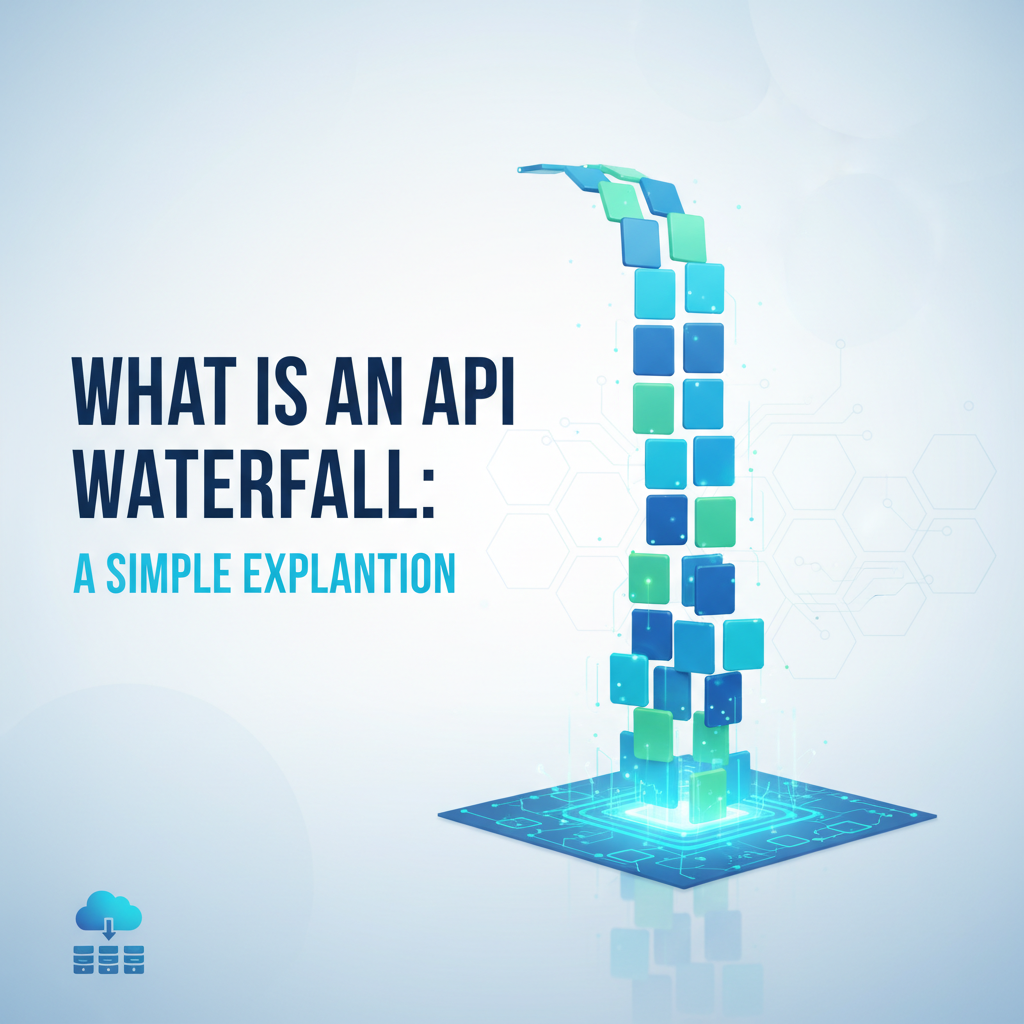


In the intricate landscape of modern software development, where applications are increasingly built as constellations of interconnected services, the concept of an "API waterfall" emerges as a fundamental, albeit often unspoken, reality. While not a formal industry term with a universally accepted definition, it conceptually captures the sequential and often dependent nature of API calls that collectively fulfill a complex business function or user request. Imagine a series of data transformations, orchestrations, and external service interactions, each relying on the successful completion and output of the previous step, flowing down like a cascade. This article will delve deep into this phenomenon, explaining its nature, the challenges it presents, and, critically, how robust API management, particularly through the strategic use of an API gateway, becomes indispensable for navigating its complexities. We will explore how understanding and proactively managing these API waterfalls can significantly impact application performance, reliability, security, and the overall developer and user experience, culminating in a discussion of advanced platforms designed to streamline these processes.
Modern applications rarely operate in isolation. From a simple e-commerce transaction that involves checking inventory, processing payment, updating order status, and notifying shipping services, to a sophisticated data analytics dashboard that aggregates information from dozens of disparate sources, multi-stage API interactions are the norm. These sequences, where one API call’s output becomes another’s input, or where multiple calls are carefully choreographed to achieve a single outcome, form what we refer to as an API waterfall. It's a natural consequence of modular architectures, service specialization, and the pervasive need for integration with external systems. However, this inherent complexity, if left unmanaged, can quickly devolve into a quagmire of performance bottlenecks, error propagation, and security vulnerabilities. The journey through this article will illuminate the intricacies of these waterfalls, providing a comprehensive understanding for developers, architects, and business stakeholders alike.
The Anatomy of an API Waterfall
To truly grasp the implications of an API waterfall, it's essential to understand its fundamental composition. At its core, an API waterfall describes a series of programmatic interactions, typically HTTP requests, where the successful execution of one or more calls directly influences or enables subsequent calls. It's less about a single monolithic operation and more about a choreographed dance of distinct service requests working in concert. This concept is particularly relevant in distributed systems and microservices architectures, where a single user action might trigger a ripple effect across multiple independent services.
Consider a typical user registration process in a modern web application. When a new user signs up, the client-side application might initiate an API call to an authentication service to create the user account. Upon successful creation, the authentication service might return a user ID. This user ID then becomes a crucial piece of information for the next step: an API call to a profile service to create a user profile with default settings, perhaps including the user's name and email. Simultaneously or subsequently, another API call might be made to a notification service to send a welcome email, again utilizing the user's email address obtained earlier. Furthermore, if the application integrates with a third-party analytics platform, another API call would push the new user event data to that external service. This entire sequence—account creation, profile setup, email notification, analytics tracking—forms a conceptual API waterfall, where each step is distinct yet interdependent.
The dependency within an API waterfall isn't always strictly linear. While some cascades are purely sequential (A then B then C), others might involve parallel execution branches converging at a later stage. For instance, in an e-commerce product page, loading product details (API Call 1), customer reviews (API Call 2), and recommended items (API Call 3) might all happen concurrently. However, the final rendering of the complete product page on the client-side depends on the successful aggregation of data from all these parallel API calls. This aggregation itself might be managed by a dedicated aggregation service or an API gateway, which then presents a unified response to the client. This illustrates a "fan-out/fan-in" pattern within the waterfall, where multiple paths diverge and then converge.
Moreover, data transformation is a common element within these waterfalls. The raw output from one API might not be directly suitable as input for the next. Intermediate services or the API gateway itself might perform data mapping, enrichment, or filtering to prepare the data for the subsequent step. For example, a customer ID from a CRM system might need to be translated into a payment gateway's specific customer token before a payment processing API can be invoked. This transformation layer adds another dimension to the complexity of managing these interconnected flows. Understanding these dependencies, whether sequential, parallel, or involving data transformation, is the first step towards effectively managing and optimizing the performance and reliability of complex applications built on an API-first philosophy.
Why API Waterfalls Emerge: Drivers of Complexity
The prevalence of API waterfalls is not accidental; it is a direct consequence of modern software development paradigms and the evolving needs of digital businesses. Several key drivers contribute to the inherent complexity and the cascading nature of API interactions, each bringing its own set of advantages and, inadvertently, its own management challenges.
One of the most significant drivers is the widespread adoption of Microservices Architecture. Unlike monolithic applications, where all functionalities reside within a single codebase, microservices break down an application into smaller, independent, and loosely coupled services. Each service typically specializes in a specific business capability, such as inventory management, user authentication, or payment processing. While this approach offers immense benefits in terms of scalability, independent deployment, and technological diversity, it inherently increases inter-service communication. A single user request that previously might have been handled by a few internal function calls within a monolith now often translates into a series of API calls across multiple microservices. For example, updating a user's profile might require calls to a user service, a preference service, and an activity log service, each managed by a different team and deployed independently. This distributed nature is a primary catalyst for the formation of elaborate API waterfalls.
Data Aggregation and Orchestration also play a crucial role. Modern applications frequently need to present a holistic view of data that originates from various internal and external sources. A customer dashboard, for instance, might pull customer details from a CRM, order history from an e-commerce platform, support tickets from a helpdesk system, and recent activity from an analytics tool. Each piece of information requires a separate API call, and these calls often need to be aggregated and merged before being presented to the user. Orchestration becomes necessary to coordinate these calls, ensure data consistency, and handle potential failures. This is particularly true when dealing with diverse data formats and authentication mechanisms across different API providers. The challenge lies in efficiently performing these aggregations without introducing undue latency or increasing the load on individual services.
Furthermore, the need for Enrichment and Transformation frequently necessitates multi-stage API calls. Raw data from one service might not be sufficient or in the correct format for another. For example, an API providing geographical coordinates might need to be followed by another API call to a geocoding service to translate those coordinates into human-readable addresses. Or, a user ID might need to be enriched with demographic data from a separate profile service. These enrichment steps, crucial for enhancing the value and utility of data, naturally extend the API waterfall. Each transformation step, while adding value, also adds a point of potential failure and latency.
The pervasive reliance on Third-Party Integrations further contributes to API waterfalls. Very few applications today are entirely self-contained. Payment gateways, shipping providers, social media platforms, analytics tools, mapping services, and various SaaS solutions are regularly integrated into custom applications. Interacting with these external services invariably means making API calls to endpoints outside the application's direct control. A single user action might trigger a sequence involving internal services and then branch out to several third-party APIs. For example, an order placement might hit an internal order service, then a payment gateway API, then a shipping provider API, and finally an inventory management API. The variability in performance, reliability, and API contracts of these external services significantly complicates the management of the overall waterfall.
Finally, the drive towards Business Process Automation often results in complex API waterfalls. Automating workflows, such as onboarding new employees, processing claims, or managing supply chains, frequently involves a series of sequential and conditional steps, each potentially invoking one or more APIs. An automated onboarding process might involve API calls to an HR system, an IT provisioning system, an access management system, and a communication platform. The logical flow of these processes dictates the sequence of API calls, forming intricate waterfalls that represent the digital backbone of organizational operations. These drivers, while individually offering substantial benefits, collectively create a landscape where API waterfalls are not just common, but an inherent and growing characteristic of modern software systems.
The Challenges Posed by API Waterfalls
While API waterfalls are an inevitable consequence of sophisticated, interconnected systems, they also introduce a unique set of challenges that, if not addressed proactively, can severely impact application performance, reliability, security, and maintainability. Understanding these hurdles is crucial for designing resilient and efficient systems.
One of the most immediate and impactful challenges is Performance Bottlenecks and Latency Accumulation. In a sequential API waterfall, the total response time for the entire operation is the sum of the latencies of each individual API call, plus any network overhead and processing time between calls. If an application makes three sequential calls, each taking 100 milliseconds, the client experiences a minimum of 300 milliseconds delay, even before considering network travel time to the client. This "N+1" problem, where N additional calls are made for each primary request, can quickly degrade user experience, especially in scenarios with multiple dependencies. A single slow API in the chain can bring the entire waterfall to a crawl, creating a significant bottleneck. Moreover, managing connection pools and resource allocation across these numerous calls can become complex, leading to resource exhaustion under heavy load.
Error Handling Complexity skyrockets within API waterfalls. When multiple interdependent services are involved, an error in any single API call can have cascading effects. If the second API call in a five-step sequence fails, what happens? Does the entire transaction roll back? Are partial results acceptable? Implementing robust error handling, retry mechanisms (with exponential backoff to avoid overwhelming services), and compensatory transactions (to undo previously completed steps) becomes incredibly intricate. Distinguishing between transient network errors, application-specific errors, and critical system failures, and then devising appropriate responses for each, demands meticulous design and implementation. Without proper strategies, a single point of failure can destabilize an entire application or workflow.
Monitoring and Observability become significantly more challenging in a distributed environment characterized by API waterfalls. Tracing a single user request through multiple services, each with its own logs and metrics, requires sophisticated tools and practices. Traditional centralized logging is often insufficient; what's needed is distributed tracing, where a unique correlation ID propagates through every API call in the waterfall, allowing developers to reconstruct the entire request path and pinpoint the exact service or step where an issue occurred. Without adequate observability, diagnosing performance issues, debugging failures, and understanding the flow of data becomes a daunting, time-consuming task, leading to prolonged downtimes and frustrated support teams.
Security Vulnerabilities multiply with each additional API call in a waterfall. Every interaction point is a potential attack vector. Authentication and authorization must be consistently enforced at each service boundary. Data in transit must be encrypted. Input validation is critical at every stage to prevent injection attacks and ensure data integrity. Furthermore, ensuring that sensitive data is only accessed by authorized services at the appropriate stages of the waterfall requires careful access control policies. Misconfigurations or weaknesses in any part of the chain can compromise the entire system, leading to data breaches or unauthorized access.
Version Management presents another significant hurdle. As individual services evolve, their API contracts might change. If an upstream service updates its API without proper versioning or backward compatibility, it can break all downstream services that rely on its previous contract, causing the entire waterfall to collapse. Coordinating changes across multiple independent teams and services, ensuring seamless transitions, and deprecating old API versions gracefully requires robust governance and communication strategies.
Data Consistency is also a major concern, particularly in waterfalls involving asynchronous operations or distributed transactions. Ensuring that data remains consistent across multiple services, especially in the event of partial failures, can be extremely complex. Implementing eventual consistency models or distributed transaction patterns (like the Saga pattern) requires careful design to avoid data corruption or conflicting states, which can be hard to reconcile.
Finally, the Developer Experience can suffer significantly. Understanding the full scope of a complex API waterfall, debugging issues that span multiple services, and contributing new features without inadvertently breaking existing flows can be overwhelming for developers. The cognitive load associated with navigating numerous service contracts, deployment pipelines, and operational concerns can reduce productivity and increase the likelihood of errors. These accumulated challenges highlight the critical need for effective strategies and tools to manage API waterfalls, transforming them from potential liabilities into controlled, robust assets.
APIPark is a high-performance AI gateway that allows you to securely access the most comprehensive LLM APIs globally on the APIPark platform, including OpenAI, Anthropic, Mistral, Llama2, Google Gemini, and more.Try APIPark now! 👇👇👇
The Role of an API Gateway in Managing API Waterfalls
Given the myriad challenges posed by API waterfalls, a crucial architectural component has emerged as the linchpin for their effective management: the API Gateway. An API gateway acts as a single entry point for all client requests, serving as a façade that centralizes common functionalities, orchestrates complex interactions, and shields backend services from direct exposure. It's not merely a proxy; it's an intelligent intermediary that can transform a chaotic cascade of individual API calls into a streamlined, secure, and performant experience for both consumers and producers of APIs.
At its core, an API Gateway provides Centralized Orchestration. Instead of clients making multiple individual API calls to different backend services to fulfill a single logical request, the gateway can take a single incoming request and fan it out to multiple backend services. It then aggregates their responses and returns a single, unified response to the client. This dramatically simplifies client-side development, reduces network chattiness (fewer round trips between client and server), and makes the API waterfall transparent to the client. For instance, a mobile app requesting a "user dashboard" might make one call to the API gateway. The gateway then orchestrates calls to the user profile service, order history service, and notification service in parallel or sequence, gathers their data, combines it, and sends back a single JSON payload. This pattern, often referred to as "Backend-for-Frontend" (BFF) or API composition, is a powerful technique for abstracting complex waterfalls.
Beyond orchestration, an API Gateway provides robust Load Balancing and Routing capabilities. It can distribute incoming requests across multiple instances of backend services, ensuring high availability and preventing any single service from becoming overloaded. Intelligent routing rules can direct requests to specific service versions, different data centers, or based on request parameters, allowing for seamless service updates and A/B testing within a complex API waterfall. This ensures that even as the waterfall grows, individual services remain responsive and scalable.
Authentication and Authorization are critical functions that an API Gateway centralizes. Instead of each backend service implementing its own security logic, the gateway can enforce global security policies. It can validate API keys, OAuth tokens, or JWTs, and perform authorization checks before forwarding requests to backend services. This ensures that only authenticated and authorized requests ever reach the core services, significantly enhancing the security posture of the entire API waterfall and simplifying security management across multiple services.
To protect backend services from abuse and ensure fair usage, Rate Limiting and Throttling are essential, and the API Gateway is the ideal place to implement them. It can restrict the number of requests a client can make within a given timeframe, preventing denial-of-service attacks or inadvertent overloading of backend resources. By applying these policies at the gateway, the individual services in the waterfall can focus solely on their business logic, unburdened by security and traffic management concerns.
Caching is another powerful feature of an API Gateway that can drastically improve the performance of API waterfalls. For frequently accessed data that doesn't change often, the gateway can cache responses, serving them directly to clients without needing to hit the backend services. This reduces latency, decreases the load on backend systems, and ultimately speeds up the execution of waterfalls that rely on common data.
Request/Response Transformation allows the gateway to adapt API contracts. If an upstream service in a waterfall produces data in a format unsuitable for a downstream service, or if the client requires a different data structure than what the backend provides, the gateway can perform the necessary transformations. This decouples services, allowing them to evolve independently without forcing changes on their consumers or dependents in the waterfall.
For comprehensive insight into the health and performance of API waterfalls, Monitoring and Analytics capabilities are paramount. An API Gateway can log every request and response, gather metrics on latency, error rates, and traffic volumes, and export this data to monitoring systems. This centralized visibility allows operators to quickly identify bottlenecks, diagnose issues, and understand the overall behavior of complex API interactions, providing crucial observability for the entire waterfall.
Finally, an API Gateway can implement Circuit Breaker and Retry Logic, enhancing the resilience of API waterfalls. If a backend service becomes unavailable or starts returning errors, the gateway can temporarily halt requests to that service (trip the circuit breaker) to prevent cascading failures, allowing the service time to recover. It can also implement intelligent retry policies for transient errors, automatically reattempting failed calls with increasing delays, thereby improving the overall fault tolerance of the system.
One excellent example of a platform that embodies many of these capabilities is APIPark. As an open-source AI Gateway and API Management Platform, APIPark is designed to manage, integrate, and deploy AI and REST services with ease. Its capabilities directly address the complexities of API waterfalls by offering features such as end-to-end API lifecycle management, which aids in regulating API management processes, traffic forwarding, load balancing, and versioning. Moreover, APIPark's detailed API call logging and powerful data analysis features provide the necessary visibility to monitor and troubleshoot intricate API waterfalls, helping businesses maintain system stability and identify performance issues before they impact users. Its ability to encapsulate prompts into REST APIs and unify API formats for AI invocation further simplifies complex AI-driven waterfalls, making them easier to build and manage.
Strategies and Best Practices for Optimizing API Waterfalls
Effectively managing and optimizing API waterfalls is not just about deploying an API gateway; it requires a holistic approach encompassing careful design, robust development practices, and continuous monitoring. By adhering to established strategies and best practices, organizations can transform potential liabilities into streamlined, high-performing assets.
One foundational principle is to Design for Idempotency. An idempotent operation is one that can be executed multiple times without changing the result beyond the initial execution. In the context of API waterfalls, where retries are often necessary due to transient network issues or service unavailability, idempotency is crucial. If an API call to create an order is not idempotent, retrying it could lead to duplicate orders. Designing APIs to be idempotent, perhaps by including unique request IDs or ensuring state changes are applied only once, simplifies error handling and retry logic, preventing unintended side effects and ensuring data consistency throughout the waterfall.
Asynchronous Processing is a powerful technique for breaking up long-running API waterfalls and improving perceived performance. Instead of waiting for every step in a complex transaction to complete synchronously, certain operations can be offloaded to message queues or event streams. For example, after a customer places an order, the immediate response might confirm the order, while the subsequent steps—inventory deduction, shipping notification, analytics updates—are processed asynchronously in the background. This approach frees up the client and reduces synchronous latency, making the application feel more responsive. It does, however, introduce the complexity of eventual consistency and requires robust mechanisms for monitoring background job status.
Batching and Aggregation can significantly reduce the "chattiness" of API waterfalls. Instead of making multiple individual API calls to fetch related pieces of data, services can expose APIs that allow clients to request multiple items in a single call or aggregate related data from various sources into a single response. An API gateway is particularly adept at this, allowing clients to send one request that the gateway then fans out to several backend services, aggregates their responses, and returns a consolidated payload. This minimizes network overhead and the number of round trips, directly improving performance.
For client-specific needs, particularly in diverse client landscapes (web, mobile, IoT), GraphQL or Backend-for-Frontend (BFF) patterns offer flexible solutions. GraphQL allows clients to specify exactly what data they need, preventing over-fetching or under-fetching, which can reduce the payload size and the number of API calls in a waterfall. A BFF pattern involves creating a dedicated API for each client type, which then orchestrates the underlying API waterfall specific to that client's requirements, further abstracting complexity and optimizing for client performance.
API Versioning Strategies are essential for managing the evolution of services within a waterfall without breaking existing dependents. Clear versioning (e.g., in the URL, header, or query parameter) allows services to evolve independently while maintaining backward compatibility for older clients or dependent services. A robust API gateway can help route requests to appropriate versions of backend services, ensuring graceful degradation or seamless transitions during updates.
Comprehensive Testing is non-negotiable for API waterfalls. This includes unit tests for individual APIs, integration tests to verify the interactions between dependent services, and end-to-end tests that simulate real-world user flows spanning the entire waterfall. Automated testing pipelines are critical for catching regressions and performance degradations early in the development cycle, especially as services and their dependencies evolve.
Robust Monitoring and Alerting capabilities are vital for operational excellence. Implementing distributed tracing (as mentioned earlier) is crucial for understanding the flow of requests through complex waterfalls. Beyond tracing, granular metrics on latency, error rates, throughput, and resource utilization for each API call within the waterfall are necessary. Proactive alerting, triggered by deviations from baseline performance or error thresholds, allows operations teams to identify and address issues before they significantly impact users. Platforms like APIPark, with its detailed API call logging and powerful data analysis, are instrumental in providing this level of insight. The platform records every detail of each API call, enabling businesses to quickly trace and troubleshoot issues, ensuring system stability and data security. APIPark also analyzes historical call data to display long-term trends and performance changes, which is invaluable for preventive maintenance.
Smart Caching Strategies should be applied at multiple levels: at the API gateway, within individual services, and even at the client-side. Identifying static or semi-static data that is frequently requested can yield significant performance gains. Proper cache invalidation strategies are key to ensuring data freshness while maximizing cache hit rates.
Fault Tolerance Patterns are essential for building resilient API waterfalls. Techniques like Circuit Breakers (to prevent cascading failures by stopping requests to failing services), Bulkheads (to isolate failures within a subsystem), and Retries with Exponential Backoff (to gracefully handle transient errors without overwhelming services) should be implemented. These patterns ensure that a failure in one part of the waterfall does not bring down the entire application.
Finally, Comprehensive API Documentation is often overlooked but critical for managing the complexity of waterfalls. Clear, up-to-date documentation for each API's contract, expected inputs/outputs, error codes, and dependencies allows developers to understand and integrate services effectively. Tools that automatically generate documentation from API definitions (like OpenAPI/Swagger) can streamline this process.
By diligently applying these strategies and best practices, organizations can transform their API waterfalls from a source of operational headaches into a well-oiled machine that powers responsive, reliable, and scalable applications.
Comparison of API Waterfall Management Approaches
Managing API waterfalls effectively requires choosing the right architectural approach. Here's a comparison of common strategies:
| Feature/Aspect | Client-Side Orchestration | API Gateway Orchestration | Service Mesh Orchestration |
|---|---|---|---|
| Description | Client directly makes multiple, sequential/parallel calls to various backend services. | A dedicated API Gateway acts as a single entry point, composing multiple backend calls into one client response. | A dedicated infrastructure layer (sidecar proxies) manages inter-service communication within the backend. |
| Where Orchestration Occurs | Client application (e.g., browser, mobile app) | API Gateway | Service proxies (transparent to application code) |
| Primary Benefit | Simplicity for very small systems; direct control for client. | Centralized management, reduced client complexity, performance optimization. | Deep observability, policy enforcement, traffic management between services. |
| Complexity Handled | Low to moderate waterfall complexity | Moderate to high waterfall complexity | High internal service-to-service waterfall complexity |
| Performance Impact | Higher client-side latency due to multiple network round-trips; potential N+1 problem. | Lower client-side latency (single round-trip); gateway adds minimal overhead. | Minimal per-service latency; adds network hop between service and its proxy. |
| Security Management | Distributed across client and each backend service; harder to enforce globally. | Centralized at the gateway (auth, authz, rate limiting, WAF). | Centralized policy enforcement, mTLS, access control between services. |
| Observability | Difficult to trace full request path across services. | Centralized logging/metrics for client-to-gateway and gateway-to-service. | Excellent distributed tracing, metrics, and logging for all service calls. |
| Scalability | Limited by client's ability to manage connections; backend services scale independently. | Gateway scales independently; backend services scale independently. | Services and proxies scale together; robust for large microservices. |
| Use Cases | Simple applications with few backend dependencies. | Complex web/mobile apps, public-facing APIs, third-party integrations. | Large microservices environments, complex internal API communication, zero-trust networks. |
| Best Fit For | Rapid prototyping, very small scale. | Most enterprise-level API management, external clients. | Advanced microservice management, internal service governance. |
This table illustrates that while client-side orchestration might seem simple initially, it quickly becomes unmanageable for complex API waterfalls. API Gateway orchestration offers a robust and comprehensive solution for external-facing APIs and internal service composition. Service mesh takes this a step further by focusing on the internal service-to-service communication, providing unparalleled control and observability for very large, distributed systems. Often, a combination of API gateway and service mesh is employed, with the gateway handling edge traffic and external APIs, and the service mesh managing internal microservice interactions.
Introducing APIPark: An Advanced Solution for API Management
In the rapidly evolving digital landscape, where API waterfalls are becoming increasingly intricate, the need for advanced API management platforms is paramount. These platforms are designed not only to simplify the deployment and governance of APIs but also to provide the robust infrastructure required to handle complex, multi-stage API interactions efficiently and securely. One such powerful and comprehensive solution is APIPark.
APIPark stands out as an all-in-one AI gateway and API developer portal, open-sourced under the Apache 2.0 license. It's purpose-built to empower developers and enterprises to seamlessly manage, integrate, and deploy both AI and REST services, directly addressing many of the challenges inherent in navigating complex API waterfalls. For organizations grappling with the orchestration of numerous services, especially those incorporating AI models, APIPark offers a compelling suite of features.
One of APIPark's core strengths, directly relevant to API waterfalls, is its End-to-End API Lifecycle Management. This feature assists organizations in regulating the entire process, from designing and publishing APIs to managing their invocation and eventual decommissioning. Within the context of an API waterfall, this means that APIPark can facilitate the precise management of traffic forwarding, load balancing, and versioning for published APIs. When a complex workflow involves multiple backend services, APIPark ensures that requests are routed optimally, workloads are distributed evenly, and different versions of dependent services can coexist and be managed gracefully, preventing the cascading failures often seen with unmanaged waterfalls.
Performance is a critical concern for any API waterfall, and APIPark is engineered to deliver exceptional speed. Boasting Performance Rivaling Nginx, APIPark can achieve over 20,000 Transactions Per Second (TPS) with just an 8-core CPU and 8GB of memory. Furthermore, it supports cluster deployment, enabling it to handle large-scale traffic, ensuring that even the most demanding API waterfalls execute swiftly and without bottlenecks. This high throughput is vital for maintaining responsive applications where multiple API calls need to be processed quickly.
Navigating the complexities of an API waterfall often requires deep visibility into every step of the process. APIPark addresses this with its Detailed API Call Logging and Powerful Data Analysis capabilities. The platform records every single detail of each API call, providing an invaluable audit trail. This feature allows businesses to quickly trace and troubleshoot issues within complex API waterfalls, ensuring system stability and data security. Beyond immediate troubleshooting, APIPark analyzes historical call data to display long-term trends and performance changes. This proactive data analysis helps businesses identify potential performance degradations or emerging issues before they escalate, enabling preventive maintenance and continuous optimization of API workflows.
In the era of artificial intelligence, API waterfalls are increasingly involving AI models. APIPark simplifies this by offering Quick Integration of 100+ AI Models and providing a Unified API Format for AI Invocation. This standardization means that changes in underlying AI models or prompts do not affect the application or microservices consuming them, thereby simplifying AI usage and significantly reducing maintenance costs in API waterfalls that leverage diverse AI capabilities. Furthermore, its ability to allow users to Prompt Encapsulation into REST API means that complex AI-driven workflows, which might otherwise be a challenging API waterfall to manage, can be exposed as simple, consumable REST APIs, such as sentiment analysis or data analysis APIs.
Beyond these core features, APIPark also offers functionalities like API Service Sharing within Teams, facilitating collaboration, and Independent API and Access Permissions for Each Tenant, which is ideal for multi-tenant environments where distinct teams or departments need isolated API governance while sharing underlying infrastructure. The platform also includes API Resource Access Requires Approval, enhancing security by ensuring that callers must subscribe to an API and await administrator approval before invocation, preventing unauthorized access and potential data breaches within your API ecosystem.
For organizations looking to enhance efficiency, security, and data optimization across their development, operations, and business management functions, APIPark provides a powerful API governance solution. Its open-source nature makes it accessible for startups, while its commercial version offers advanced features and professional technical support for leading enterprises. Deploying APIPark is remarkably simple, achievable in just 5 minutes with a single command line:
curl -sSO https://download.apipark.com/install/quick-start.sh; bash quick-start.sh
By leveraging platforms like ApiPark, businesses can transform the inherent complexity of API waterfalls into robust, observable, and high-performing components of their digital infrastructure. It helps bring order and control to the cascading interactions that power modern applications, ensuring a seamless experience for both developers and end-users.
Conclusion
The concept of an API waterfall, though not a formally defined term, vividly describes the cascading, interdependent nature of API calls that characterize modern applications. From the simplest user interaction to the most complex business process, a sequence of programmatic steps, often spanning multiple services and third-party integrations, is typically required to deliver a complete outcome. This inherent complexity, while a testament to the power of modular and distributed architectures, simultaneously introduces significant challenges related to performance, error handling, security, and observability.
We have explored how factors like microservices architecture, the need for data aggregation, enrichment, and widespread third-party integrations are the primary drivers behind the emergence of these intricate waterfalls. Consequently, these multi-stage interactions lead to critical issues such as accumulating latency, complex error propagation, daunting monitoring requirements, and increased security vulnerabilities. Without a strategic approach, these challenges can quickly erode application reliability and user experience, while overburdening development and operations teams.
The pivotal role of an API Gateway in mitigating these issues cannot be overstated. By acting as a central entry point, an API gateway effectively transforms a chaotic cascade of individual API calls into a well-orchestrated, secure, and performant flow. Its capabilities, including centralized orchestration, load balancing, authentication, rate limiting, caching, and robust monitoring, are indispensable for bringing order and control to the API waterfall. Furthermore, adhering to best practices such as designing for idempotency, embracing asynchronous processing, employing batching, and implementing comprehensive testing and fault tolerance patterns are crucial for building resilient and efficient systems.
Platforms like APIPark exemplify how advanced API management solutions can comprehensively address the demands of modern API ecosystems. With its focus on end-to-end API lifecycle management, high performance, detailed logging, powerful analytics, and specialized support for AI integration, APIPark provides the tools necessary to master even the most complex API waterfalls. It empowers organizations to ensure their applications are not just functional, but also fast, secure, and maintainable.
In essence, understanding and strategically managing API waterfalls is no longer an optional consideration but a fundamental requirement for success in today’s interconnected digital world. By embracing thoughtful design principles and leveraging robust API gateway solutions, businesses can unlock the full potential of their service-oriented architectures, delivering seamless experiences to users and fostering innovation without being bogged down by complexity.
Frequently Asked Questions (FAQs)
1. What exactly is an API waterfall, and why is it not a standard term? An API waterfall conceptually refers to a series of sequential and often interdependent API calls that collectively fulfill a complex business function or a single user request. The output of one API call typically serves as the input for the next, or multiple calls are orchestrated to aggregate data. While widely experienced in modern software architectures (especially microservices), it's not a formal, standardized term in API literature. Instead, it's a descriptive metaphor to illustrate the cascading nature and dependencies of these interactions, drawing parallels to how resources load on a webpage (a "network waterfall").
2. How do API waterfalls impact application performance? API waterfalls significantly impact performance primarily through latency accumulation. In a sequential waterfall, the total response time for the entire operation is the sum of the latencies of each individual API call, plus any network overhead and processing time between calls. A slow API in the chain can create a bottleneck, leading to a degraded user experience, slow application responsiveness, and potential timeouts, especially with "N+1" problems where numerous calls are made for a single client request.
3. What role does an API Gateway play in managing API waterfalls? An API Gateway is crucial for managing API waterfalls by acting as a single entry point for client requests. It can orchestrate multiple backend API calls into a single client response, reducing network round trips and client-side complexity. Furthermore, it centralizes vital functions like authentication, authorization, rate limiting, caching, load balancing, and monitoring. This ensures that the waterfall is more secure, performant, resilient, and easier to observe and troubleshoot, abstracting much of its complexity from the client.
4. What are some common challenges associated with API waterfalls? Key challenges include performance bottlenecks (latency accumulation), complex error handling (cascading failures, partial successes), difficulties in monitoring and observability (tracing requests across multiple services), increased security vulnerabilities (more attack vectors), and complexities in version management (breaking changes affecting dependents). Additionally, ensuring data consistency across multiple steps and maintaining a positive developer experience are significant hurdles.
5. How can organizations optimize their API waterfalls for better efficiency and reliability? Optimization involves several strategies: designing API operations for idempotency to handle retries safely, employing asynchronous processing for long-running tasks, using batching and aggregation to reduce chattiness, implementing smart caching at various levels, and applying robust fault tolerance patterns like circuit breakers. Comprehensive testing, detailed monitoring with distributed tracing, and effective API versioning strategies are also essential. Platforms like APIPark, with features like end-to-end API lifecycle management, high performance, and advanced analytics, can provide the tools needed to implement these optimizations effectively.
🚀You can securely and efficiently call the OpenAI API on APIPark in just two steps:
Step 1: Deploy the APIPark AI gateway in 5 minutes.
APIPark is developed based on Golang, offering strong product performance and low development and maintenance costs. You can deploy APIPark with a single command line.
curl -sSO https://download.apipark.com/install/quick-start.sh; bash quick-start.sh

In my experience, you can see the successful deployment interface within 5 to 10 minutes. Then, you can log in to APIPark using your account.

Step 2: Call the OpenAI API.