What is an API Waterfall: Simply Explained


The landscape of modern software development is characterized by an intricate web of interconnected services, each communicating through Application Programming Interfaces (APIs). From the simplest mobile application fetching user data to complex enterprise systems orchestrating global supply chains, APIs are the foundational building blocks that enable seamless interaction and functionality. Yet, beneath the surface of this apparent simplicity lies a phenomenon that, if not understood and managed proactively, can lead to significant performance bottlenecks, reliability issues, and security vulnerabilities: the API Waterfall.
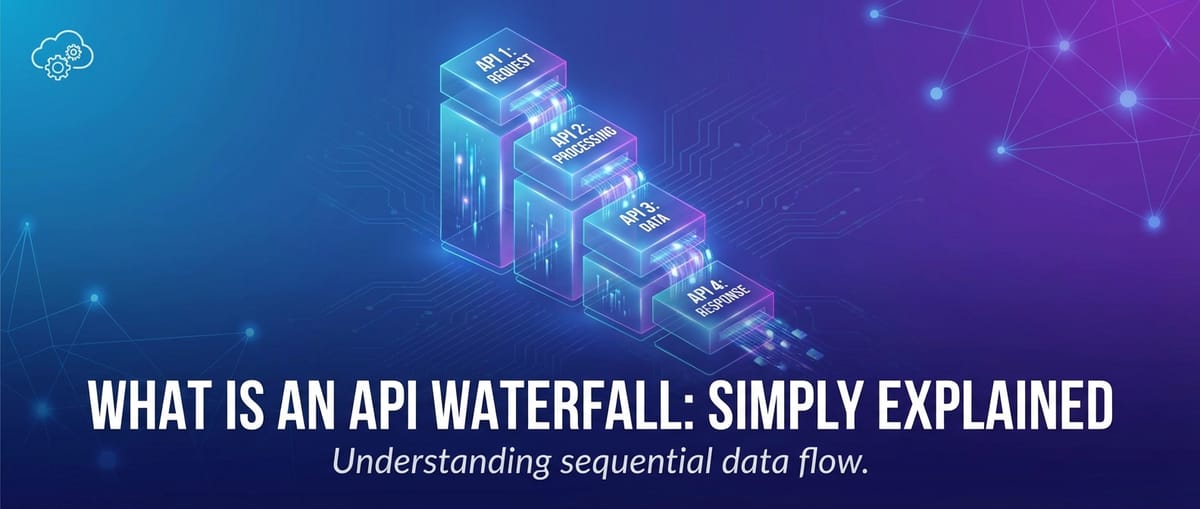
While "API Waterfall" may not be a formally standardized term in the same vein as "RESTful API" or "Microservices," it is a descriptive concept widely understood by developers and architects grappling with the complexities of dependent API calls. At its core, an API Waterfall refers to the sequential and often interdependent execution of multiple API requests and responses, where the completion or result of one API call triggers or is necessary for the initiation of subsequent calls. Imagine a cascade of water, where each drop flows into the next, creating a continuous, downward motion. Similarly, in the digital realm, a single user action or system event can initiate a chain reaction of API calls, each waiting for the preceding one to complete, forming a digital "waterfall" of data exchanges.
Understanding this phenomenon is not merely an academic exercise; it is absolutely critical for anyone involved in designing, developing, or maintaining distributed systems. The implications of an unoptimized API Waterfall can manifest as slow application load times, frustrated users, increased operational costs, and even system-wide failures. This comprehensive exploration will demystify the API Waterfall, delve into its causes, analyze its far-reaching impacts, and, most importantly, provide actionable strategies and architectural patterns, including the indispensable role of an API gateway, to mitigate its challenges and harness its potential for building robust, high-performance, and secure applications.
The Foundational Layer: Demystifying APIs and Their Interconnections
Before we plunge deeper into the API Waterfall, it’s essential to reaffirm our understanding of APIs themselves and the intricate ways in which they intertwine to form complex systems. An API, or Application Programming Interface, is fundamentally a set of definitions and protocols for building and integrating application software. It’s a contract between two software components, allowing them to communicate with each other. Think of it as a waiter in a restaurant: you, the customer, are the application; the kitchen is another application. You don't go into the kitchen to cook your own food; you tell the waiter what you want (make an API call), and the waiter conveys your request to the kitchen, then brings back your meal (the API response). This abstraction simplifies development, promotes modularity, and allows disparate systems to work in harmony.
Over the past two decades, the API landscape has evolved dramatically. From the early days of SOAP (Simple Object Access Protocol) with its rigid XML-based messaging, we've transitioned largely to REST (Representational State Transfer), which leverages standard HTTP methods for communication, offering greater flexibility and simpler integration. More recently, GraphQL has emerged as a powerful alternative, allowing clients to request precisely the data they need, thereby mitigating common issues like over-fetching or under-fetching of data. Furthermore, gRPC, a high-performance, open-source universal RPC framework, is gaining traction for microservices communication, particularly in environments where efficiency and low latency are paramount. Each of these API styles plays a role in how the "waterfall" manifests.
The proliferation of APIs has been inextricably linked to the rise of microservices architecture. In this architectural pattern, a single application is composed of many loosely coupled, independently deployable services, each performing a specific business function. For instance, an e-commerce platform might have separate microservices for user authentication, product catalog, shopping cart, order processing, and payment. While microservices offer undeniable benefits in terms of scalability, resilience, and development velocity, they inherently increase the reliance on inter-service communication via APIs. When a user requests to view their order history, for example, the "Order History" microservice might need to call the "User Profile" microservice to verify the user, then the "Product Catalog" microservice to fetch product details for items in past orders, and perhaps the "Payment" microservice to display payment statuses. Each of these calls is an API request, and their sequential or parallel execution forms the essence of the API Waterfall.
This interconnectedness is not limited to internal microservices. Modern applications frequently consume external APIs from third-party providers for functionalities like payment processing (Stripe, PayPal), mapping services (Google Maps), social media integration (Facebook, Twitter), or even AI capabilities (OpenAI, Google AI). When integrating these external dependencies, the potential for complex, multi-layered API waterfalls grows exponentially, introducing variables beyond the immediate control of the application developer. It is this pervasive reliance on interconnected API calls, both internal and external, that makes understanding and strategically managing the API Waterfall an indispensable skill for contemporary software engineering.
Deconstructing the API Waterfall Phenomenon: A Closer Look
Having established the ubiquity of APIs and their role in modern architectures, let us now dive deeper into the API Waterfall concept itself. As mentioned, the term "API Waterfall" is a metaphorical description rather than a rigid technical definition. It broadly encapsulates scenarios where a series of API calls are executed in a dependent sequence, often with performance implications that resemble the cascading nature of a physical waterfall.
Defining the "Waterfall" in API Context
The core idea revolves around dependency. An API Waterfall occurs when: 1. Sequential Dependencies: An API call (Call B) cannot be initiated until a previous API call (Call A) has completed and its response has been received. This is the most straightforward and common form of a waterfall. The output or status from Call A is often required as input for Call B. 2. Cascading Operations: A single initial user action or system event triggers a series of backend API calls, where each subsequent call might be processed by a different service or component, propagating the original request through a chain of operations. 3. Performance Visualization: The term also draws inspiration from network waterfall charts commonly seen in browser developer tools (e.g., Chrome DevTools, Firefox Network Monitor). These charts visually represent the loading sequence of resources (HTML, CSS, JavaScript, images, and crucially, API requests) on a web page, showing how each resource download or API call begins and ends, and often highlighting the cumulative effect of latency when requests are sequential. When a page makes multiple dependent API calls, their staggered completion times form a "waterfall" pattern on these charts.
Let's illustrate with some concrete, real-world scenarios:
Common Scenarios of API Waterfalls
- User Authentication and Profile Loading:
- Initial Action: User logs into an application.
- API 1 (Authentication): Client sends credentials to
POST /api/login. - API 2 (Token Validation/Session Creation): Upon successful login, the authentication service might internally call another service to create a session token and store it.
- API 3 (Fetch User Profile): With a valid token, the client then calls
GET /api/user/{id}to retrieve the user's basic profile information (name, email). - API 4 (Fetch User Preferences): Subsequently,
GET /api/user/{id}/preferencesis called to load personalized settings. - API 5 (Fetch Dashboard Data): Finally, a call to
GET /api/dashboardmight aggregate data specific to the user, potentially involving calls to several other internal services. Each of these client-side calls (or internal server-side orchestrations) must largely wait for the previous one, creating a visible waterfall of network requests.
- E-commerce Transaction Flow:
- Initial Action: User clicks "Checkout" in their shopping cart.
- API 1 (Validate Cart Contents):
POST /api/cart/validatechecks item availability, prices, and promotions. - API 2 (Calculate Shipping):
POST /api/shipping/calculatetakes validated cart items and user address to determine shipping options and costs. - API 3 (Process Payment):
POST /api/payment/processsends payment details (e.g., credit card token) and total amount to a payment gateway service. This service might itself make calls to external banking APIs. - API 4 (Create Order):
POST /api/orderscreates the final order record, including payment confirmation, shipping details, and product IDs. - API 5 (Update Inventory):
PUT /api/inventory/updatedecrements stock levels for purchased items. - API 6 (Send Confirmation Email):
POST /api/notifications/emailtriggers an email service to send a confirmation. This multi-step process, especially when choreographed synchronously, epitomizes an API Waterfall, where delays at any stage directly impact the overall transaction time.
- Data Aggregation from Multiple Sources:
- Initial Action: An analytics dashboard requests "Overall Sales Performance."
- API 1 (Sales Data):
GET /api/sales/monthlyfetches raw sales figures. - API 2 (Marketing Spend):
GET /api/marketing/spendretrieves advertising expenditure. - API 3 (Customer Feedback):
GET /api/customer/feedback/summarygets aggregated sentiment scores. - API 4 (External Market Trends):
GET /api/external/market-trendsintegrates data from a third-party market research API. While some of these might be parallelizable, often the dashboard needs all data before it can process and display the "overall performance," and sometimes the subsequent data processing step needs the output of prior data fetching, turning it into a waterfall.
In each of these examples, the sequential nature of calls is either necessitated by data dependencies (e.g., you can't process payment before knowing the total cost) or by design choices. It's this chained dependency that creates the "waterfall" effect, where the total time taken is the sum of the individual API call durations, plus network latency and processing time between calls. Recognizing these patterns is the first step toward effective management and optimization.
Architectural Patterns Leading to API Waterfalls
The prevalence of API waterfalls is deeply rooted in contemporary software architectural decisions, particularly those favoring distributed systems. While these patterns offer tremendous advantages, they also inherently foster the conditions for complex API interaction sequences. Understanding these foundational patterns helps in identifying where and why waterfalls emerge.
Microservices Communication: Synchronous vs. Asynchronous
The microservices paradigm, as discussed, is a primary driver. In this architecture, an application is decomposed into small, independent services. For these services to collaborate and fulfill a user request, they must communicate.
- Synchronous Communication: This is the most direct cause of API waterfalls. When one microservice (Service A) makes a direct HTTP (or gRPC) request to another microservice (Service B) and waits for Service B's response before proceeding, it's a synchronous call. If Service B then needs to call Service C, and Service C calls Service D, we immediately have a chain, or a waterfall. Each service in the chain must respond successfully and within an acceptable timeframe for the entire operation to complete. This is simple to implement for straightforward interactions but introduces tight coupling and makes the overall transaction highly susceptible to latency and failures in any part of the chain.
- Asynchronous Communication: While often presented as an antidote to synchronous waterfalls, asynchronous patterns (e.g., using message queues like Kafka or RabbitMQ, or event streams) don't eliminate the concept of a waterfall entirely; rather, they transform its nature. Instead of waiting directly, a service publishes an event or message, and another service subscribes to it, reacting independently. The "waterfall" here becomes a chain of events and reactions. For example, an "Order Placed" event might trigger a "Process Payment" service, which then publishes a "Payment Processed" event, triggering an "Update Inventory" service. The key difference is that the initiating service doesn't wait for the subsequent services; it simply signals. While this decouples services and improves resilience, tracking the overall flow and debugging can become more challenging, as the "waterfall" is no longer a linear, easily observable request-response chain but a distributed, time-shifted sequence of events.
Chained APIs and Service Orchestration
Many business processes naturally require a sequence of operations. When each operation is encapsulated as a distinct API, chaining becomes inevitable. This is often seen in:
- Backend-for-Frontend (BFF) Pattern: A BFF is a specialized API gateway or aggregation service designed specifically for a single client type (e.g., a mobile app, a web app). Instead of the client making multiple calls directly to various backend microservices (which would create a client-side waterfall and increase network round trips), the BFF orchestrates these calls on the server side. The BFF acts as a façade, making internal calls to multiple backend services, combining their responses, and returning a single, tailored response to the client. This effectively moves the waterfall from the client to the server, where network latency is typically lower and processing power is greater, but the waterfall itself still exists within the server infrastructure.
- API Composition and Orchestration Services: Beyond BFFs, dedicated orchestration services can be built to manage complex business workflows. These services are responsible for coordinating calls across multiple underlying APIs, applying business logic, handling failures, and ensuring the overall process completes correctly. They are explicit developers of API waterfalls, by design, as their primary role is to sequence and integrate disparate services.
Service Mesh and its Role
A service mesh (e.g., Istio, Linkerd) is an infrastructure layer that handles service-to-service communication in a microservices environment. It provides features like traffic management, security, and observability without requiring changes to service code. While a service mesh enhances the reliability and performance of individual API calls within a waterfall by adding capabilities like intelligent routing, retries, and circuit breaking, it doesn't eliminate the waterfall itself. Instead, it provides better tooling and infrastructure to manage the effects of the waterfall, ensuring that each step in the chain is as efficient and resilient as possible. It helps manage the cascade, not necessarily prevent it.
The very nature of building modular, distributed applications almost guarantees the existence of API waterfalls. The goal is not to eliminate them entirely, which is often impossible or impractical, but rather to understand their implications and employ strategies and tools – especially an API gateway – to manage them effectively, minimizing their negative impacts while leveraging the benefits of a modular architecture.
The Impact of API Waterfalls: Challenges and Risks
While API waterfalls are an inherent consequence of modern distributed architectures, their uncontrolled presence can introduce significant challenges across various dimensions of system operation and performance. Ignoring these impacts can lead to a degraded user experience, increased operational overhead, and potential security breaches.
Performance Bottlenecks: The Accumulation of Latency
Perhaps the most immediately noticeable impact of an API waterfall is the degradation of performance. Each step in a sequential API call chain adds to the total execution time, leading to a cumulative effect.
- Latency Accumulation: If an operation requires five sequential API calls, and each call takes an average of 100 milliseconds (including network round-trip time and backend processing), the total minimum time for that operation will be 500 milliseconds, excluding any processing time between calls. This linear accumulation can quickly make user-facing operations feel sluggish, especially as the number of calls in the waterfall increases or individual service latencies fluctuate.
- Network Overhead: Each API call, regardless of its processing time, incurs network latency – the time it takes for data to travel from the client to the server and back. In a waterfall, this overhead is multiplied by the number of sequential calls. Furthermore, establishing new TCP connections (if not persistent) and performing TLS handshakes for each call adds further delays.
- Serialization/Deserialization Costs: Data exchanged between services often needs to be serialized (e.g., to JSON or XML) at the sender's end and deserialized at the receiver's end. In a long API waterfall, this process occurs repeatedly, consuming CPU cycles and memory at each hop, which can become a significant performance drain in high-throughput systems.
- Database Contention: Often, multiple services in a waterfall might access the same underlying database or data store. Sequential operations can lead to increased contention for database resources, potentially slowing down queries and updates, and further extending the duration of individual API calls.
Reliability and Resiliency: The Domino Effect of Failures
An API waterfall also introduces significant vulnerabilities in terms of system reliability and resilience. The tight coupling of synchronous calls means that a failure in one service can easily cascade and bring down the entire operation.
- Single Point of Failure / Cascading Failures: In a sequential chain, if any service fails to respond or responds with an error, the subsequent services cannot proceed, and the entire transaction typically fails. This creates a "single point of failure" for the waterfall. In extreme cases, a timeout or error in one stressed service can lead to a backlog of requests in preceding services, causing them to also become overwhelmed and fail, propagating the failure across the entire system – a phenomenon known as a cascading failure or a "domino effect."
- Error Propagation: When an error occurs deep within a waterfall, it must be carefully handled and propagated back up the chain to the initiating client in a meaningful way. Poor error handling can lead to ambiguous error messages, partial data, or even inconsistent states, making debugging and user recovery difficult.
- Retry Storm Scenarios: If clients are configured to retry failed API calls, a temporary glitch in a downstream service can lead to a "retry storm," where a surge of retried requests overwhelms the recovering service, preventing it from stabilizing. This exacerbates the cascading failure problem.
Security Vulnerabilities: Expanding the Attack Surface
Every API call in a waterfall represents a potential point of attack or data exposure. The more hops data makes, the greater the security challenge.
- Increased Attack Surface: Each service involved in an API waterfall potentially exposes its own API endpoints. If any of these internal endpoints are not adequately secured, it can create a vulnerability that an attacker could exploit if they gain access to the internal network.
- Data Exposure Through Multiple Hops: Sensitive data might be passed through several services in a waterfall. Each service must ensure that the data is handled securely (encrypted in transit, stored securely if persisted). The more services involved, the higher the risk of accidental data leakage or improper logging of sensitive information.
- Authentication/Authorization Complexities: Managing authentication and authorization across multiple services in a waterfall can be complex. While an initial API gateway might authenticate the client, ensuring that each subsequent internal service call has appropriate authorization checks (e.g., using JWTs, or propagating user context) is crucial. A misconfigured authorization policy at any point in the chain could lead to unauthorized access to data or functionality.
Maintainability and Debugging: Navigating the Labyrinth
Troubleshooting and evolving systems with complex API waterfalls can be a daunting task, consuming significant developer time and resources.
- Tracing Requests Across Services: When an error occurs or performance degrades in a microservices architecture with waterfalls, identifying the exact service or API call responsible can be extremely challenging. Traditional monolithic logging is insufficient; what's needed is distributed tracing, which allows a single request to be followed across multiple service boundaries.
- Dependency Management: As systems grow, managing the web of dependencies between services in an API waterfall becomes difficult. Changes to one service's API contract can break multiple downstream services, leading to integration issues and delayed deployments.
- Version Control Issues: Evolving APIs in a waterfall requires careful versioning strategies. Incompatible changes in one service's API can disrupt the entire chain if not managed with backward compatibility or robust migration paths.
In summary, while API waterfalls are an inevitable outcome of modular architectures, their uncontrolled proliferation can severely impact the performance, reliability, security, and maintainability of an application. Addressing these challenges effectively requires a strategic approach, leveraging both architectural patterns and specialized tooling, which we will explore in the subsequent sections.
Strategies for Managing and Optimizing API Waterfalls
Effectively managing API waterfalls is not about eliminating them entirely, but rather about transforming them from performance liabilities and reliability risks into predictable, efficient, and resilient sequences of operations. This requires a multi-faceted approach, encompassing design patterns, infrastructure choices, and robust operational practices.
Performance Optimization: Making the Water Flow Faster
The primary goal here is to minimize the cumulative latency inherent in sequential API calls.
- Parallelization vs. Sequentialization: The most impactful optimization is to identify opportunities to execute API calls in parallel instead of sequentially. If Call B does not strictly depend on the result of Call A, they can be initiated simultaneously. This drastically reduces the total execution time from (Latency A + Latency B) to Max(Latency A, Latency B). This is often achieved through concurrent programming models (threads, async/await, Promises) on the client or an orchestrating server. However, strict data dependencies (e.g., needing a user ID from an auth service before fetching user preferences) will always necessitate some degree of sequentialization.
- Caching Strategies: Caching is a powerful technique to reduce the need for repeated API calls.
- Client-Side Caching: Browsers, mobile apps, or desktop clients can cache API responses locally, serving subsequent requests directly from the cache if the data is still fresh.
- CDN (Content Delivery Network) Caching: For static or semi-static API responses, CDNs can cache data at edge locations, serving clients from geographically closer servers and reducing load on the origin API servers.
- Gateway Caching: An API gateway can cache responses for frequently requested APIs, preventing requests from even reaching backend services.
- In-Memory Caching (Backend): Individual microservices can use in-memory caches (e.g., Redis, Memcached) to store frequently accessed data, avoiding redundant database queries or calls to other internal services.
- Batching Requests: If a client needs to perform multiple similar operations (e.g., update 10 user settings) or fetch multiple related resources, batching them into a single API call can significantly reduce network overhead. The backend API then processes these operations in bulk. This is a common pattern in GraphQL, where clients can request multiple resources in a single query.
- Asynchronous Processing with Message Queues/Event Streams: For non-critical, non-real-time operations that would otherwise contribute to a long synchronous waterfall, shifting to asynchronous processing is a game-changer. Instead of calling an API and waiting, the initiating service simply publishes a message or event to a queue (e.g., Kafka, RabbitMQ). Downstream services consume these messages independently and process them. This breaks the synchronous chain, improving the responsiveness of the initiating service and enhancing overall system resilience. For example, sending a confirmation email after an order is processed can be an asynchronous operation.
- Efficient Data Transfer:
- Payload Optimization: Minimize the size of API request and response payloads. Avoid over-fetching data by returning only what the client truly needs. GraphQL excels here.
- Compression: Use HTTP compression (Gzip, Brotli) for API responses to reduce data transfer size over the network.
- Protocol Optimization: For high-performance internal microservices communication, consider protocols like gRPC, which uses Protocol Buffers for efficient serialization and HTTP/2 for multiplexing multiple requests over a single connection, reducing overhead compared to REST over HTTP/1.1.
Resiliency Patterns: Building Robustness Against Failure
Given the inherent risks of cascading failures in waterfalls, building resilience is paramount.
- Circuit Breakers: Inspired by electrical circuit breakers, this pattern prevents a system from repeatedly attempting to invoke a service that is currently unavailable or failing. If a service experiences a threshold of failures, the circuit breaker "trips," short-circuiting subsequent calls to that service and redirecting them to a fallback mechanism or returning an immediate error. After a defined period, the circuit may enter a "half-open" state, allowing a few test requests to pass through to see if the service has recovered. This prevents cascading failures and gives the failing service time to recover.
- Timeouts and Retries (with Exponential Backoff):
- Timeouts: Configure strict timeouts for all API calls. This prevents a slow or unresponsive service from holding up the entire waterfall indefinitely.
- Retries: For transient failures (e.g., network glitches, temporary service overload), implement retry logic. However, simple retries can exacerbate problems.
- Exponential Backoff: Combine retries with exponential backoff, where the delay between retries increases exponentially. This prevents overwhelming a recovering service and reduces the chance of a "retry storm." Jitter (adding random small delays) can further improve this.
- Bulkheads: This pattern isolates parts of a system to prevent failures in one area from impacting others, similar to the watertight compartments in a ship. For API waterfalls, this might involve assigning separate thread pools, connection pools, or even deploying different services on separate infrastructure, so that a failure or overload in one service doesn't exhaust resources needed by other services.
- Fallbacks: When an API call fails, provide a graceful fallback mechanism. Instead of outright failure, the system can return cached data, default values, or a reduced feature set. For example, if a recommendation service fails, the system might show popular items instead of personalized recommendations.
- Idempotency: Design APIs such that making the same request multiple times has the same effect as making it once. This is crucial for retries, as it ensures that even if a request is processed multiple times due to retries (e.g., the response was lost but the operation succeeded), it doesn't lead to duplicate operations (like charging a credit card twice).
Security Best Practices: Fortifying Every Link in the Chain
Each hop in an API waterfall is a potential security vulnerability. Robust security measures are essential throughout the entire chain.
- API Authentication and Authorization:
- Authentication: Verify the identity of the client (user, application, or service). Common methods include OAuth 2.0, API keys, JWT (JSON Web Tokens).
- Authorization: Determine what an authenticated client is permitted to do. This should be enforced at every service boundary. If a client is authorized at the API gateway, the gateway must securely propagate this authorization context (e.g., via JWT claims) to downstream services, which then re-verify based on their specific resource permissions.
- Rate Limiting and Throttling: Protect backend services from being overwhelmed by too many requests. Rate limiting restricts the number of requests a client can make within a certain timeframe, while throttling limits the rate at which an API can be called. These are typically enforced at the API gateway.
- Input Validation: Sanitize and validate all inputs at every API boundary to prevent injection attacks (SQL injection, XSS) and ensure data integrity. Never trust input, even from internal services.
- TLS/SSL Encryption: Ensure all API communication, both external and internal (within the data center), is encrypted using TLS/SSL to prevent eavesdropping and data tampering.
- API Security Gateways: A specialized API gateway offers centralized enforcement of security policies, acting as a single point for authentication, authorization, rate limiting, and threat detection, protecting backend services from direct exposure.
Observability and Monitoring: Seeing Through the Waterfall
When something goes wrong in an API waterfall, having clear visibility into the system's behavior is invaluable.
- Distributed Tracing: Implement distributed tracing (e.g., OpenTelemetry, Zipkin, Jaeger). This allows a single request to be tracked as it traverses multiple services in a waterfall, showing the latency and outcome of each individual API call, making it easy to pinpoint bottlenecks or errors.
- Centralized Logging: Aggregate logs from all services into a central logging system (e.g., ELK stack, Splunk, Datadog). Ensure logs include correlation IDs (from distributed tracing) to link log entries related to a single request across services.
- Metrics and Alerts: Collect detailed metrics (latency, error rates, throughput) for each API endpoint and service. Set up alerts for deviations from normal behavior (e.g., high error rates, increased latency) to proactively identify and address issues.
- Synthetic Monitoring: Simulate user journeys by regularly making API calls to critical endpoints, including those involving waterfalls. This helps detect performance regressions or outages before actual users are affected.
By combining these strategies, organizations can transform their API waterfalls from sources of anxiety into well-managed, efficient, and resilient components of their distributed systems, ensuring both a smooth user experience and stable operations.
APIPark is a high-performance AI gateway that allows you to securely access the most comprehensive LLM APIs globally on the APIPark platform, including OpenAI, Anthropic, Mistral, Llama2, Google Gemini, and more.Try APIPark now! 👇👇👇
The Pivotal Role of an API Gateway in API Waterfalls
In the ongoing quest to tame the complexities of API waterfalls, one architectural component stands out as particularly indispensable: the API gateway. Far more than just a reverse proxy, an API gateway acts as a single entry point for all client requests, abstracting the complexity of the backend microservices, and providing a centralized mechanism for managing, securing, and optimizing API interactions. For systems characterized by intricate API waterfalls, an API gateway is not merely beneficial; it becomes a critical enabler of performance, security, and operational efficiency.
What is an API Gateway?
At its core, an API gateway is a management tool that sits between clients and a collection of backend services. It acts as an intermediary, handling requests from clients, routing them to the appropriate backend services, and then returning the consolidated responses to the client. This concept is particularly powerful in microservices architectures where clients would otherwise need to know the individual addresses and complexities of dozens or hundreds of services. The gateway effectively acts as a façade, simplifying the client's interaction with the backend.
How an API Gateway Addresses Waterfall Challenges
The capabilities of an API gateway directly address many of the challenges posed by API waterfalls, especially those arising from multiple, dependent backend calls.
- Request Routing: An API gateway intelligently routes incoming requests to the correct backend service instance. This includes load balancing requests across multiple instances of a service, ensuring that no single instance is overwhelmed, which is crucial when one service in a waterfall experiences high demand.
- Load Balancing: By distributing incoming API requests across multiple instances of a backend service, the API gateway ensures high availability and optimizes resource utilization. If a service within a waterfall is under heavy load, the gateway can redirect traffic to less busy instances, preventing bottlenecks from forming and breaking the cascade.
- Centralized Authentication & Authorization: Instead of each backend service needing to implement its own authentication and authorization logic, the API gateway can enforce these policies at the edge. The gateway validates client credentials (e.g., API keys, OAuth tokens) once, before any request even reaches a backend service. This drastically simplifies security management, reduces redundant code in microservices, and ensures consistent security enforcement across all APIs, protecting all subsequent calls in a waterfall.
- Rate Limiting & Throttling: To protect backend services from being overwhelmed by sudden spikes in traffic or malicious attacks (like DDoS), the API gateway provides centralized rate limiting and throttling. This ensures that even if an API call initiates a long waterfall, the overall request rate to the backend is controlled, preventing a single client from monopolizing resources and causing cascading failures.
- Caching: As discussed, caching is a powerful optimization. An API gateway can implement an intelligent caching layer, storing responses for frequently requested API calls. If a subsequent request for the same data comes in, the gateway can serve it directly from its cache without forwarding the request to the backend service. This significantly reduces latency for cached responses and offloads work from backend services, especially for data that might be fetched early in an API waterfall.
- Request/Response Transformation: An API gateway can transform API requests and responses on the fly. This means it can standardize input formats for backend services, convert data types, or filter/aggregate response data before sending it back to the client. For complex waterfalls where different backend services might return data in varied structures, the gateway can unify these responses into a single, consistent format for the client, simplifying client-side development.
- API Composition/Orchestration (Taming the Waterfall): This is where the API gateway truly shines in managing complex waterfalls. Instead of the client making multiple sequential API calls to different microservices (e.g.,
get-user-profile, thenget-user-orders, thenget-order-details), the API gateway can be configured to orchestrate these calls internally. A single client request toGET /user-dashboardcan trigger the gateway to:- Call the
User Profileservice. - Use the user ID from the profile to call the
Order Historyservice. - Call the
Product Catalogservice for each item in the orders. - Aggregate all these responses into a single, coherent response tailored for the client. This moves the waterfall logic from the client (where latency is high) or from individual backend services (which would lead to tight coupling) to a dedicated, high-performance layer. The client sees a single, optimized API endpoint, significantly reducing network round trips and improving overall perceived performance.
- Call the
- Monitoring & Analytics: API gateways provide a centralized point for collecting metrics, logs, and trace data for all API traffic. This unified observability is invaluable for understanding the performance of API waterfalls, identifying bottlenecks, and troubleshooting issues. Detailed logs can record every step of a gateway-orchestrated waterfall, providing crucial insights into what went wrong and where.
- Resiliency Features: Many advanced API gateways incorporate resiliency patterns directly, such as circuit breakers, timeouts, and automatic retries with exponential backoff. These features protect the backend services from overload and ensure that a temporary failure in one service within a waterfall doesn't lead to a complete system outage.
Introducing APIPark: An Open-Source Solution for API Management and Gateway Needs
For organizations grappling with the complexities of managing their API ecosystem, especially in the context of intricate API waterfalls and the burgeoning field of AI integration, a robust API gateway and management platform is not just an advantage – it's a necessity. This is where a solution like APIPark comes into play.
APIPark is an all-in-one AI gateway and API developer portal that is open-sourced under the Apache 2.0 license. It's designed specifically to help developers and enterprises manage, integrate, and deploy AI and REST services with remarkable ease. By centralizing API management, APIPark directly addresses many of the challenges inherent in API waterfalls.
Consider how APIPark's key features can directly impact the management and optimization of API waterfalls:
- End-to-End API Lifecycle Management: APIPark assists with managing the entire lifecycle of APIs, from design and publication to invocation and decommissioning. This structured approach helps regulate API management processes, making it easier to control traffic forwarding, load balancing, and versioning of published APIs. In a waterfall scenario, consistent lifecycle management across all involved APIs ensures stability and predictability, reducing unexpected breakages.
- Unified API Format for AI Invocation & Prompt Encapsulation: When AI models become part of an API waterfall (e.g., a sentiment analysis step in an e-commerce review process), managing their diverse invocation formats can add complexity. APIPark standardizes the request data format across all AI models. This means changes in underlying AI models or prompts do not affect the application or microservices, simplifying API usage and maintenance. Furthermore, users can quickly combine AI models with custom prompts to create new, specialized APIs, encapsulating complex AI logic into simple, manageable REST APIs, which can then be easily integrated into or orchestrated within an API waterfall.
- Performance Rivaling Nginx: With just an 8-core CPU and 8GB of memory, APIPark can achieve over 20,000 TPS, supporting cluster deployment to handle large-scale traffic. This high performance is crucial for an API gateway that sits at the forefront of handling potentially complex API waterfalls, ensuring that the gateway itself doesn't become a bottleneck.
- Detailed API Call Logging & Powerful Data Analysis: APIPark provides comprehensive logging capabilities, recording every detail of each API call. This feature is invaluable for tracing and troubleshooting issues in complex API waterfalls, ensuring system stability and data security. Moreover, APIPark analyzes historical call data to display long-term trends and performance changes, helping businesses with preventive maintenance before issues occur. This granular visibility is exactly what's needed to diagnose performance bottlenecks and error propagation within an API waterfall.
- API Service Sharing within Teams & Independent API/Access Permissions: APIPark allows for centralized display of all API services, fostering collaboration and reuse. It also enables the creation of multiple teams (tenants) with independent applications and security policies, while sharing underlying infrastructure. This helps in managing access control for different parts of an API waterfall, ensuring that only authorized callers and services can access specific downstream APIs.
By centralizing these crucial functions, APIPark empowers organizations to build more resilient, secure, and performant systems, effectively taming the inherent complexities of API waterfalls and leveraging the power of APIs and AI models without being overwhelmed by their management overhead.
Designing for Scalability and Maintainability in a Waterfall Context
Beyond tactical optimizations and the deployment of an API gateway, strategic design decisions are fundamental to ensuring that systems with API waterfalls remain scalable, robust, and easy to maintain over their lifespan. These considerations permeate the entire software development lifecycle, from initial design to continuous deployment.
Version Control for APIs
APIs are contracts. As systems evolve, these contracts inevitably change. In an API waterfall, where multiple services depend on each other's APIs, managing these changes is critical to prevent cascading failures.
- Semantic Versioning: Adopt semantic versioning (e.g.,
v1.2.3) for all APIs. Major version increments (e.g.,v1tov2) indicate backward-incompatible changes, while minor and patch versions indicate backward-compatible additions or bug fixes. - Backward Compatibility: Strive for backward compatibility whenever possible. New features should be added without breaking existing clients. When breaking changes are unavoidable, provide clear deprecation warnings and ample time for consumers to migrate.
- Parallel Versions: For critical APIs, support multiple versions in parallel (e.g.,
/v1/usersand/v2/users) for a transition period. The API gateway can be instrumental here, routing requests based on the requested version. This allows services in an API waterfall to upgrade independently without immediately breaking the entire chain.
Documentation Practices
Comprehensive and up-to-date documentation is the lifeline of any complex API ecosystem, especially those with intricate waterfalls.
- API Specifications: Use tools like OpenAPI (Swagger) to formally define API contracts. This generates machine-readable specifications that can be used for client code generation, testing, and documentation portals. For an API waterfall, having clear specifications for each API in the chain is paramount.
- Developer Portals: Provide a centralized developer portal (like that offered by APIPark) where internal and external developers can easily discover, understand, and test available APIs. This includes detailed explanations of API dependencies, expected input/output, error codes, and authentication methods.
- Runbook Documentation: For operational teams, create detailed runbooks for managing and troubleshooting API waterfalls. These should include common failure scenarios, diagnostic steps, and recovery procedures.
Testing Strategies
Robust testing is essential to catch issues in API waterfalls early, before they impact production.
- Unit Testing: Each individual service's API logic should be thoroughly unit-tested.
- Integration Testing: Test the interactions between services. For an API waterfall, this means simulating the entire chain of calls, ensuring that data flows correctly and errors are handled gracefully between services.
- End-to-End (E2E) Testing: Simulate real user journeys that traverse multiple API waterfalls. These tests validate the entire system from the client's perspective.
- Performance Testing: Conduct load testing and stress testing on API waterfalls to identify bottlenecks and ensure they can handle expected (and peak) traffic loads without degrading performance or causing cascading failures.
- Contract Testing: Use contract testing (e.g., Pact) to ensure that producers (services providing an API) and consumers (services consuming that API in a waterfall) adhere to agreed-upon API contracts. This helps prevent breaking changes introduced by a producer from impacting consumers.
CI/CD Pipelines for API Deployments
Continuous Integration and Continuous Deployment (CI/CD) pipelines are critical for safely evolving systems with API waterfalls.
- Automated Builds and Tests: Every code commit should automatically trigger builds and run a suite of unit, integration, and contract tests.
- Automated Deployments: Successful builds and tests should lead to automated deployments to staging or production environments. This ensures consistent deployment processes and reduces manual errors.
- Canary Deployments/Blue-Green Deployments: For critical services in an API waterfall, use deployment strategies that minimize risk. Canary deployments gradually roll out new versions to a small subset of users, monitoring for issues before a full rollout. Blue-green deployments run two identical production environments, only switching traffic to the new "green" environment after it has been fully validated.
- Rollback Capabilities: Ensure that any deployment can be quickly and reliably rolled back to a previous stable version if issues are detected, preventing prolonged outages in the middle of an API waterfall.
By meticulously implementing these design and operational practices, organizations can build API ecosystems that are not only powerful and flexible but also resilient, scalable, and manageable, even when dealing with the inherent complexities of API waterfalls. These strategies shift the focus from merely reacting to problems to proactively designing for stability and long-term sustainability.
Advanced Topics and Future Trends
As the digital landscape continues to evolve, so too do the strategies and technologies used to manage complex API interactions, including those that form API waterfalls. Emerging patterns and technologies are constantly pushing the boundaries of what's possible, offering new ways to optimize performance, enhance resilience, and simplify development.
Event-Driven Architectures and Their Impact on Waterfalls
While we discussed asynchronous communication, event-driven architectures (EDA) take this a step further. Instead of services directly calling each other in a request-response pattern, services communicate by emitting and reacting to events.
- Decoupling: EDA inherently promotes extreme decoupling. A service publishes an event (e.g.,
OrderCreated), and multiple other services (e.g., Payment, Inventory, Shipping, Notification) can react to it independently, without direct knowledge of each other. This breaks the synchronous waterfall. - Resilience and Scalability: If one reacting service fails, it doesn't prevent others from processing the event. Events can be retried or processed later, enhancing resilience. Services can also scale independently.
- Transformation of the Waterfall: In an EDA, the "waterfall" transforms from a direct call chain into a flow of events and their asynchronous reactions. While the sequence of business logic still exists, the tight temporal coupling is removed. This requires sophisticated event tracing and monitoring to understand the flow, but it ultimately leads to a more robust system.
Serverless Functions and API Orchestration
Serverless computing (e.g., AWS Lambda, Google Cloud Functions, Azure Functions) allows developers to run code without provisioning or managing servers. This paradigm interacts interestingly with API waterfalls.
- Fine-Grained Services: Serverless functions are typically small, single-purpose units of code, ideal for specific API endpoints or steps in an API waterfall.
- Managed Orchestration: Cloud providers offer serverless orchestration services (e.g., AWS Step Functions) that allow developers to visually define complex workflows, including sequential and parallel steps, retries, and error handling. This is a powerful way to manage complex API waterfalls within the serverless ecosystem, as the platform handles the underlying infrastructure and execution logic. This essentially externalizes and manages the waterfall's logic outside of individual functions, providing a declarative way to define the cascade.
AI-Powered API Management
The integration of Artificial Intelligence (AI) and Machine Learning (ML) is beginning to revolutionize API management itself, impacting how we deal with waterfalls.
- Predictive Analytics: AI can analyze historical API traffic and performance data to predict potential bottlenecks or failures in an API waterfall before they occur, allowing for proactive scaling or intervention.
- Automated Anomaly Detection: ML algorithms can identify unusual patterns in API call metrics (e.g., sudden spikes in latency for a specific API in a waterfall, or unusual error rates) that might indicate a problem, often faster than human operators.
- Intelligent Routing and Optimization: Future API gateways might use AI to dynamically optimize API request routing based on real-time network conditions, service health, and even predicted load, enhancing the performance and resilience of waterfalls.
- AI Integration as a Service: Products like APIPark, which offer quick integration of 100+ AI models and prompt encapsulation into REST API, are making it easier to incorporate AI functionalities into existing API waterfalls. This means adding an AI-driven step (like real-time fraud detection or content summarization) to a cascade of operations becomes much more manageable and less complex.
GraphQL for Reducing Over-fetching and Under-fetching
GraphQL is an API query language and runtime for fulfilling those queries with your existing data. It offers a powerful alternative to traditional REST for managing the data fetching aspect of API waterfalls.
- Client-Driven Data Fetching: With GraphQL, clients specify exactly what data they need from the server. Instead of making multiple REST calls to fetch different resources (e.g., one for user details, one for orders, one for product details within orders), a single GraphQL query can retrieve all the necessary data in one round trip.
- Eliminating Over-fetching: REST APIs often return more data than the client needs, leading to larger payloads and increased network usage. GraphQL allows clients to avoid this, only receiving relevant fields.
- Solving Under-fetching (and waterfall): Conversely, clients often need to make multiple REST calls to get all the required data (under-fetching), which directly creates an API waterfall. GraphQL allows fetching related resources (like a user's profile and their last five orders, including product details for each order) in a single query, which on the backend might still trigger an internal API waterfall but orchestrates it efficiently to return a unified response to the client. This significantly reduces client-side API waterfalls and improves application performance.
These advanced topics and future trends highlight a continuous evolution in how developers and architects approach the challenges of interconnected systems. While the fundamental concept of an API waterfall will persist in various forms, the tools and strategies for managing its complexity and impact are becoming increasingly sophisticated, paving the way for even more robust, intelligent, and responsive applications.
Conclusion: Taming the Digital Deluge
The journey through the intricate world of API waterfalls reveals a fundamental truth about modern software: complexity is an inherent byproduct of distributed architectures designed for scalability, flexibility, and rapid innovation. What initially appears as a simple sequence of API calls can quickly cascade into a convoluted chain of dependencies, impacting performance, challenging reliability, opening security vulnerabilities, and complicating maintenance efforts. While the term "API Waterfall" may be a metaphor, the phenomena it describes – the sequential execution, the cumulative latency, and the cascading failures – are very real and demand proactive management.
We've explored how common architectural patterns, from microservices communication to service orchestration, naturally lead to the formation of these digital cascades. More importantly, we've delved into a comprehensive arsenal of strategies designed to mitigate their negative impacts. These include meticulous performance optimizations like parallelization and caching, robust resiliency patterns such as circuit breakers and intelligent retries, stringent security measures enforced at every layer, and advanced observability tools like distributed tracing.
Central to this arsenal is the API gateway. As a unified entry point, it provides an unparalleled vantage point and control mechanism over the entire API ecosystem. An API gateway actively helps tame the API waterfall by centralizing authentication, enforcing rate limits, optimizing routing, providing caching, and critically, orchestrating complex backend calls into simpler, aggregated responses for clients. It transforms a scattered, client-side waterfall into a controlled, server-side cascade, improving efficiency and reducing exposure.
Products like APIPark exemplify the evolution of API gateway and management platforms, offering powerful features that directly address the challenges of API waterfalls. From providing end-to-end API lifecycle management and high-performance routing to offering unified API formats for AI models and detailed analytics, APIPark empowers developers and enterprises to navigate the complexities of their API landscape with greater confidence and control. By deploying such comprehensive solutions, organizations can ensure that their APIs not only function but thrive, delivering speed, security, and stability across their interconnected systems.
Ultimately, mastering the API waterfall is about understanding the flow of data and control within a distributed system. It's about recognizing the critical junctures where delays can accumulate or failures can propagate. It's about applying thoughtful design, proven patterns, and powerful tools to transform potential liabilities into assets. As the digital world continues its relentless march towards greater interconnectedness and AI integration, the ability to build and manage resilient, performant, and secure API ecosystems will remain a cornerstone of successful software development. By embracing the principles outlined here, from meticulous design to the strategic deployment of an API gateway, organizations can ensure their systems don't just survive the digital deluge but truly flourish within it.
API Waterfall Management: Challenges and Solutions Summary
| Category | Key Challenges in API Waterfalls | Effective Solutions & Strategies |
|---|---|---|
| Performance | - Cumulative latency from sequential calls | - Parallelization of independent API calls |
| - High network overhead (multiple round trips, connection setup) | - Caching (client, CDN, gateway, in-memory) | |
| - Repeated serialization/deserialization costs | - Batching multiple requests into one | |
| - Database contention from sequential access | - Asynchronous processing with message queues | |
| - Efficient data transfer (payload optimization, compression, gRPC) | ||
| Reliability | - Cascading failures (single point of failure) | - Circuit Breakers to isolate failing services |
| - Error propagation leading to system-wide outages | - Timeouts and intelligent retries with exponential backoff | |
| - Retry storms overwhelming recovering services | - Bulkheads for resource isolation | |
| - Fallbacks (e.g., default data, reduced functionality) | ||
| - Idempotency for API operations | ||
| Security | - Increased attack surface (more exposed endpoints) | - Centralized API authentication & authorization (e.g., via API Gateway) |
| - Data exposure across multiple service hops | - Rate limiting & throttling to prevent abuse | |
| - Complex authorization across distributed services | - Strict input validation at all API boundaries | |
| - End-to-end TLS/SSL encryption | ||
| Maintainability | - Difficult distributed tracing and debugging | - Distributed tracing (OpenTelemetry, Zipkin) and centralized logging |
| - Complex dependency management between services | - Comprehensive API documentation (OpenAPI specs, developer portals) | |
| - Version control issues (breaking changes impacting downstream services) | - Robust testing (unit, integration, end-to-end, contract, performance) | |
| - Semantic API versioning & backward compatibility strategies | ||
| - Automated CI/CD pipelines with canary/blue-green deployments and quick rollback capabilities | ||
| General Solution | - Managing the overall complexity and orchestration of interdependent APIs | - API Gateway: Provides centralized routing, security, caching, load balancing, and crucially, API composition/orchestration to aggregate multiple backend calls into a single client-facing API, effectively taming the waterfall. |
| - APIPark: An open-source AI gateway & API management platform, offering end-to-end API lifecycle management, AI model integration, high performance, and detailed logging/analytics to specifically address these challenges. |
Frequently Asked Questions (FAQs)
Q1: What exactly is an API Waterfall, and why is it problematic?
A1: An API Waterfall refers to the sequential execution and often interdependent nature of multiple API requests, where the completion or result of one API call is necessary for the initiation of subsequent calls. It's problematic because it can lead to cumulative latency (the total time is the sum of individual call times), increased network overhead, and a higher risk of cascading failures where a failure in one service can bring down the entire operation. It also complicates debugging and can introduce security vulnerabilities across multiple service hops.
Q2: How does an API Gateway help in managing API Waterfalls?
A2: An API Gateway is a crucial tool for managing API Waterfalls by acting as a single entry point for all client requests. It can perform API composition and orchestration, aggregating multiple backend API calls into a single response for the client, thereby reducing network round trips and client-side latency. Additionally, it centralizes authentication, authorization, rate limiting, caching, and provides resilience features like circuit breakers, protecting backend services and streamlining the entire waterfall process.
Q3: Are all API Waterfalls bad, or can they be useful?
A3: Not all API Waterfalls are inherently bad. They are often a natural consequence of modular, distributed architectures like microservices, where different functionalities are handled by separate services. The problem arises when waterfalls are unoptimized, uncontrolled, or overly complex. When managed effectively with proper strategies (like parallelization, caching, and an API Gateway), they can be efficient and necessary for complex business logic, allowing for greater system flexibility and scalability. The goal is to make them robust and performant, not necessarily eliminate them.
Q4: What are the key strategies for optimizing the performance of an API Waterfall?
A4: Key strategies for optimizing API Waterfall performance include: 1. Parallelization: Executing independent API calls simultaneously rather than sequentially. 2. Caching: Implementing client-side, CDN, gateway, or in-memory caching to avoid redundant calls. 3. Batching: Grouping multiple similar requests into a single API call. 4. Asynchronous Processing: Using message queues or event streams for non-real-time operations to decouple services. 5. Efficient Data Transfer: Optimizing payload sizes, using compression, and considering high-performance protocols like gRPC.
Q5: How do tools like APIPark contribute to better API Waterfall management, especially with AI integration?
A5: APIPark, as an open-source AI gateway and API management platform, significantly contributes by providing end-to-end API lifecycle management, which helps regulate traffic, load balancing, and versioning across all services in a waterfall. Its high-performance capabilities prevent the gateway itself from becoming a bottleneck. Crucially, APIPark offers a unified API format for AI model invocation and prompt encapsulation, simplifying the integration of AI-driven steps into existing API waterfalls. This allows organizations to leverage AI functionalities within their cascaded operations without adding significant complexity, while also providing detailed logging and analytics for crucial troubleshooting and performance monitoring.
🚀You can securely and efficiently call the OpenAI API on APIPark in just two steps:
Step 1: Deploy the APIPark AI gateway in 5 minutes.
APIPark is developed based on Golang, offering strong product performance and low development and maintenance costs. You can deploy APIPark with a single command line.
curl -sSO https://download.apipark.com/install/quick-start.sh; bash quick-start.sh

In my experience, you can see the successful deployment interface within 5 to 10 minutes. Then, you can log in to APIPark using your account.

Step 2: Call the OpenAI API.