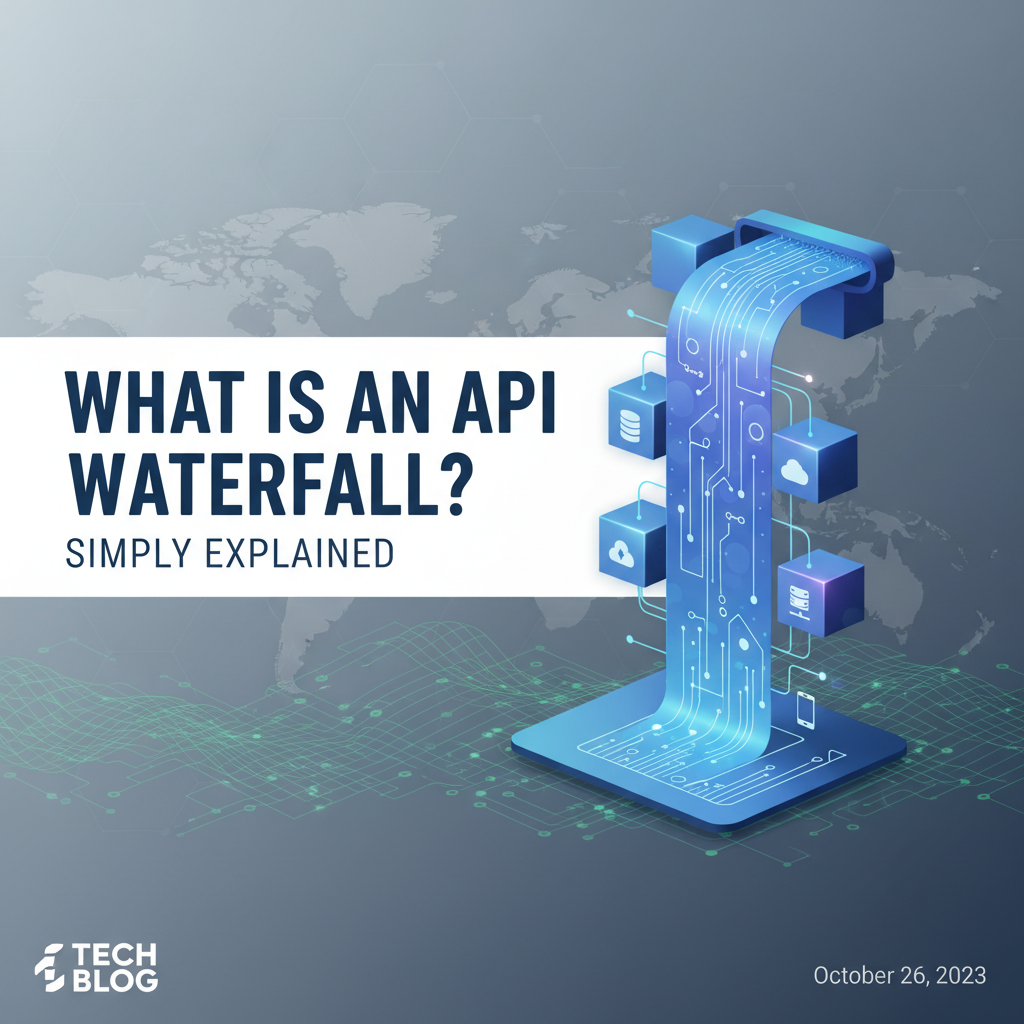
What Is An API Waterfall? Simply Explained


In the increasingly intricate tapestry of the modern digital landscape, applications rarely stand alone. Instead, they are sophisticated aggregations of interconnected services, constantly communicating, exchanging data, and orchestrating complex business processes. At the heart of this ceaseless interaction lies the Application Programming Interface (API), the fundamental building block that enables distinct software components to talk to one another. As systems grow in complexity and microservices architectures become the norm, these API interactions often don't occur in isolation. Rather, they frequently form what can be vividly described as an "API Waterfall" – a sequential cascade of API calls where the successful completion and output of one call directly influence and enable the subsequent ones.
This concept, while not a formally standardized term in computer science, serves as a powerful metaphor for understanding the intricate dependencies, performance characteristics, and potential bottlenecks inherent in multi-step API workflows. Imagine water flowing down a series of steps; each step must be traversed before the water can reach the next. Similarly, in an API waterfall, data flows, transforms, and is enriched across a chain of distinct API invocations. The performance, reliability, and security of the entire process are inherently tied to the efficiency and robustness of each individual "drop" in this digital cascade.
This comprehensive guide aims to demystify the API waterfall. We will delve into its fundamental nature, explore its various manifestations in both client-side and server-side contexts, dissect the challenges it presents, and critically examine the strategies and tools—including the pivotal role of an API gateway—that are essential for managing and optimizing these crucial, interconnected sequences of operations. By the end of this exploration, you will possess a profound understanding of API waterfalls, equipping you with the knowledge to design, implement, and maintain highly performant, resilient, and scalable API-driven systems.
The Core Concept: Unveiling the API Waterfall Metaphor
To truly grasp what an API waterfall entails, it’s beneficial to lean into the metaphor itself. Picture a literal waterfall, where water descends from a higher point, gracefully yet forcefully, over a series of ledges or steps. Each step dictates the path and momentum of the water before it reaches the next level. If one step is blocked or broken, the flow of water is inevitably disrupted or halted entirely. In the realm of APIs, this imagery translates directly to a scenario where a series of API calls are executed sequentially, with each subsequent call relying on the successful completion and often the data output of its predecessor. It’s a chain reaction, an ordered procession where dependencies are paramount.
This contrasts sharply with scenarios where API calls can be made in parallel, independently fetching data or performing actions without waiting for each other. While parallel execution is often sought after for its performance benefits, the reality of complex business logic frequently necessitates a sequential approach. For instance, you cannot process a payment before an order has been successfully placed and inventory checked. You cannot generate a personalized recommendation until a user's profile and browsing history have been retrieved. These are archetypal examples of API waterfalls in action, illustrating how real-world processes naturally dictate a step-by-step interaction pattern between different services.
The significance of this sequential execution extends far beyond mere order. It introduces cumulative effects that can dramatically impact the overall performance, reliability, and user experience of an application. Each API call in the waterfall incurs its own latency, network overhead, and potential for failure. When these individual latencies stack up, the total time required for the entire waterfall to complete can become substantial. A perfectly optimized individual API call might still contribute to a sluggish overall experience if it's merely one of many dozen calls in a deep, sprawling waterfall. Moreover, a single point of failure within this chain – be it a timeout, an unauthorized request, or a backend service error – can bring the entire cascade to a halt, preventing subsequent operations from executing and potentially leaving the user with an incomplete or erroneous response.
Understanding the API waterfall, therefore, isn't just about recognizing a sequence; it's about acknowledging a fundamental architectural pattern that underpins many modern applications. It compels developers and architects to think holistically about their API ecosystems, considering not just the individual efficiency of each service but also the collective performance, resilience, and error handling strategies across the entire interconnected flow. This holistic perspective is crucial for building systems that are not only functional but also fast, robust, and delightful for end-users.
Types of API Waterfalls: Where Do They Occur?
API waterfalls are not confined to a single layer of an application architecture; they manifest in various forms across the digital landscape, impacting client-side interactions, server-side microservice orchestrations, and even the way API gateways manage traffic. Recognizing these different types is key to effectively diagnosing issues and applying appropriate optimization strategies.
Client-Side Waterfalls: The User's Perspective
Perhaps the most common and immediately noticeable type of API waterfall occurs on the client-side, typically within a web browser or a mobile application. When you load a complex webpage or interact with a feature-rich app, your device doesn't usually make just one API call to get all the necessary data. Instead, it often initiates a series of dependent requests.
Consider, for example, loading an e-commerce product page. The process might unfold as follows:
- Initial Page Load API Call: The browser first requests the basic product information (name, price, main image).
- Inventory Check API Call: Once the product ID is known, a subsequent call fetches real-time stock availability.
- Related Products API Call: With the product category, another API call retrieves suggestions for similar items.
- User Reviews API Call: Concurrently or subsequently, another call fetches customer reviews for the product.
- Personalized Recommendation API Call: If the user is logged in, their browsing history and preferences might trigger a call to a recommendation engine.
Each of these calls, while potentially appearing fast on its own, adds to the total loading time of the page. The user experiences the cumulative latency. If the inventory check API is slow, the entire product page display might be delayed, even if other data is ready. This directly impacts user experience, leading to perceived sluggishness, frustration, and potentially abandoned sessions. Developers often use browser developer tools (like Chrome DevTools' Network tab) to visualize these network request waterfalls, identifying the sequence, dependencies, and individual timings of each API call that contributes to the page load. Optimizing client-side waterfalls often involves techniques like pre-fetching data, parallelizing independent requests, or leveraging server-side rendering to reduce the client's burden.
Server-Side Waterfalls (Orchestration): The Backend Ballet
Beyond the client, API waterfalls are a pervasive architectural pattern within the backend, especially prevalent in microservices architectures. Here, one service often needs to call another service, which in turn might call a third, and so on, to fulfill a single user request. This internal orchestration is crucial for maintaining modularity and clear separation of concerns among services.
Imagine a user placing an order in an online retail system:
- Order Service: Receives the initial request to create an order.
- Inventory Service API Call: The Order Service calls the Inventory Service to check if all requested items are in stock and to reserve them.
- Payment Service API Call: Once inventory is confirmed, the Order Service then calls the Payment Service to process the transaction.
- Shipping Service API Call: Upon successful payment, the Order Service calls the Shipping Service to initiate the delivery process and get a tracking number.
- Notification Service API Call: Finally, it might call a Notification Service to send a confirmation email or SMS to the user.
In this server-side waterfall, the Order Service acts as an orchestrator, coordinating a series of internal API calls. A failure at any stage—be it an inventory shortage, a payment processing error, or a shipping service outage—will prevent the order from being fully processed and require sophisticated error handling mechanisms, such as distributed transactions or compensation logic, to maintain data consistency across services. The performance of this backend ballet is critical, as it directly impacts the response time perceived by the client. Slow internal API calls will translate directly into a slow user experience, even if the client-side interaction is minimal.
Gateway-Managed Waterfalls: The API Gateway as the Conductor
A particularly sophisticated type of API waterfall is managed and often optimized by an API gateway. An API gateway acts as a single entry point for all API requests, sitting between the client applications and the backend services. It can, therefore, intercept, route, transform, and even orchestrate requests before they reach the ultimate destination. This capability makes API gateways incredibly powerful tools for managing complex API waterfalls.
Consider a scenario where a client application needs to display a user's profile, recent orders, and current promotions on a single dashboard. Without an API gateway, the client would typically make three separate API calls to three different backend services:
/users/{id}/orders/user/{id}/promotions/user/{id}
Each of these calls would contribute to client-side latency. An API gateway can simplify this significantly. The gateway can expose a single, aggregated endpoint, such as /dashboard/user/{id}. When the client calls this single endpoint, the gateway then internally orchestrates the waterfall:
- Gateway receives
/dashboard/user/{id}request. - Gateway internally calls
/users/{id}service. - Gateway internally calls
/orders/user/{id}service. (Potentially in parallel with step 2 if no dependency, or sequentially if user data is needed for order context). - Gateway internally calls
/promotions/user/{id}service. (Also potentially in parallel). - Gateway aggregates and transforms the responses from all three backend services into a single, cohesive JSON object.
- Gateway sends the single, aggregated response back to the client.
In this gateway-managed waterfall, the client perceives only one API call, drastically reducing network overhead and simplifying client-side logic. The gateway intelligently handles the internal dependencies, potentially parallelizing independent calls, and performing necessary data transformations. This offloads complexity from the client and centralizes the orchestration logic, providing a more robust, secure, and performant API experience. Platforms like APIPark excel at this kind of intelligent orchestration and management, offering robust features for managing complex API lifecycles, integrating AI models, and ensuring high performance for API calls, including those that form intricate waterfalls. By centralizing API management, API gateways become indispensable in taming the often-turbulent nature of these cascading API interactions.
Dissecting the Anatomy of an API Waterfall: Components and Dynamics
To effectively manage and optimize API waterfalls, it’s imperative to understand their underlying structure and the dynamic interplay of their constituent parts. Each waterfall, whether client-side, server-side, or gateway-managed, is a carefully orchestrated sequence, and a deep dive into its anatomy reveals the points of leverage for improvement.
Individual API Calls: The "Drops" in the Cascade
At its most fundamental level, an API waterfall is composed of numerous individual API calls, each representing a single interaction between a consumer and a provider. Each of these "drops" has its own characteristics:
- Request: The data sent from the consumer to the provider, including method (GET, POST, PUT, DELETE), headers (authentication, content type), and payload (body data). The complexity and size of this request can impact network latency.
- Processing: The time the API provider's server takes to receive the request, process the logic (e.g., query a database, perform a calculation, interact with another service), and prepare a response. This is often the largest component of an individual call's latency and can be influenced by CPU, memory, and I/O operations.
- Response: The data sent back from the provider to the consumer, including status codes (200 OK, 404 Not Found, 500 Internal Server Error), headers, and the response payload. The size of the response payload significantly impacts network transfer time.
- Latency: The total time elapsed from when the request is sent until the response is fully received. This includes network travel time (round-trip time), server processing time, and queueing delays. In a waterfall, cumulative latency is the sum of these individual latencies, which can quickly add up.
- Throughput: The number of requests an API can handle per unit of time. High throughput is essential for handling parallel requests within or across waterfalls without degrading performance.
- Error Rates: The frequency with which an API call fails. A high error rate in one "drop" of a waterfall can have devastating cascading effects on the entire sequence.
Dependencies: The Crucial Links
What truly defines an API waterfall is the presence of explicit or implicit dependencies between individual API calls. These dependencies dictate the order of execution and create the chain-like structure:
- Data Dependencies: This is the most common form. The output of API call A serves as a necessary input for API call B. For example, retrieving a
userIdfrom an authentication API before calling agetUserProfileAPI. Without theuserId, the profile API cannot function correctly. Data dependencies often involve parsing the response from one API and extracting specific fields to construct the request for the next. - Execution Dependencies: Sometimes, one API call must simply complete successfully before another can even begin, regardless of whether its output is directly used as input. This might be due to a state change requirement (e.g., "create order" must complete before "process payment" can start to ensure order validity).
- Logical Dependencies: More abstractly, certain business rules might dictate a sequence. For instance, a "send confirmation email" API might only be invoked after a "payment processed" API has confirmed success.
Understanding these dependencies is paramount for optimizing a waterfall. If calls are erroneously treated as dependent when they are not, opportunities for parallel execution are missed. Conversely, overlooking a critical dependency can lead to errors and inconsistent data states.
Aggregation and Transformation: Shaping the Data Flow
As data flows through an API waterfall, it often undergoes various processes of aggregation and transformation:
- Aggregation: This involves combining data from multiple API responses into a single, cohesive dataset. A common scenario is an API gateway fetching user details from one service, their order history from another, and their preferences from a third, then stitching all this information together into a unified response for the client. This reduces the number of round trips the client has to make and simplifies client-side data handling.
- Transformation: Data received from one API might not be in the exact format required by the next API in the chain, or by the final client. Transformation involves re-shaping, filtering, mapping, or enriching this data. For instance, an internal inventory API might return a raw SKU, but a public-facing product API needs to transform this into a human-readable product name and description by querying a product catalog service. An API gateway is exceptionally good at handling these transformations, providing a unified API format for AI invocation or general service consumption, as highlighted by products like APIPark. This ensures consistency and reduces the burden on individual backend services or client applications.
Concurrency vs. Sequentiality: The Balancing Act
The core challenge and optimization opportunity within an API waterfall lies in distinguishing between truly sequential steps and those that can be executed concurrently:
- Sequential Execution: This is the default for dependent calls. If B depends on A, A must complete first. This is where cumulative latency hits hardest.
- Concurrent Execution: If two API calls, B and C, are independent of each other (and both dependent only on A, or on nothing at all), they can be initiated in parallel. This significantly reduces the total time of the waterfall, as the total latency is determined by the longest-running concurrent branch, not the sum of all branches. Modern programming paradigms and tools, including event loops, asynchronous programming models (e.g.,
async/await), and dedicated orchestration engines within API gateways, are designed to facilitate this concurrency where possible.
By meticulously dissecting the individual calls, identifying strict dependencies, planning for aggregation and transformation, and strategically leveraging concurrency, developers and architects can turn a potentially sluggish and brittle API waterfall into a highly efficient, responsive, and robust data flow. The emphasis moves from simply making calls to orchestrating a symphony of interactions.
The Challenges Posed by API Waterfalls
While API waterfalls are an inevitable consequence of building interconnected systems, their inherent complexity introduces a unique set of challenges that, if not properly addressed, can severely degrade application performance, reliability, and maintainability. Understanding these hurdles is the first step toward overcoming them.
Performance Bottlenecks: The Cumulative Drag
The most immediate and often noticeable challenge of an API waterfall is its potential to create significant performance bottlenecks. Each step in the cascade contributes its own latency, and these delays are additive:
- Cumulative Latency: If an API waterfall involves
Nsequential calls, and each call has an average latency ofLmilliseconds, the minimum total time for the waterfall to complete will be approximatelyN * Lmilliseconds (ignoring network overheads and parallelization opportunities for a moment). Even if individualLvalues are small (e.g., 50ms), a waterfall of 20 calls would take a full second to complete, which is often unacceptable for user-facing interactions. - Network Overheads: Every API call involves network round trips. Each trip incurs overheads for establishing connections (TCP handshakes, TLS negotiation), transmitting data, and closing connections. While modern networks are fast, these cumulative overheads can become substantial, especially across different data centers or geographic regions. This is particularly problematic for client-side waterfalls.
- Backend Resource Contention: Each API call consumes resources on the backend servers (CPU, memory, database connections). In a deep waterfall, earlier calls might hold onto resources while waiting for later calls to complete, leading to contention and potential resource exhaustion for other incoming requests, thereby slowing down the entire system.
- Third-Party API Reliability: Many applications rely on third-party APIs for functionalities like payment processing, identity verification, or data enrichment. If a third-party API in your waterfall becomes slow or unavailable, your entire waterfall, and by extension your application's functionality, can grind to a halt. You have limited control over the performance and reliability of external services, making them significant points of vulnerability.
Error Propagation and Handling: The Domino Effect
A critical challenge within API waterfalls is the management of errors. A failure at any point in the sequence can have a cascading effect, disrupting subsequent operations and potentially leaving the system in an inconsistent state:
- Cascading Failures: If an API call fails (e.g., returns a 500 error, times out), what happens to the rest of the waterfall? Without proper error handling, the entire sequence might abort, leaving partial data or an incomplete transaction. This can lead to a poor user experience and require manual intervention to fix data inconsistencies.
- Complex Error Recovery Strategies: Implementing robust error handling in a distributed, sequential system is notoriously difficult. Strategies like retries (with exponential backoff), circuit breakers, and fallbacks become essential. However, correctly implementing these for interdependent calls, ensuring idempotency where necessary (so retrying an operation doesn't cause duplicate side effects), adds significant complexity to the system. For instance, if a payment API fails, should the order be cancelled, or should it be placed in a pending state for manual review? The decision often depends on business logic and requires careful coordination across services.
Increased Complexity: The Debugging Nightmare
API waterfalls, especially in microservices architectures, significantly increase the overall complexity of a system:
- Debugging Distributed Systems: When an issue occurs in a deep waterfall, tracing the root cause across multiple services, potentially residing on different servers, logging in different formats, and interacting through various protocols, can be a daunting task. The problem might originate in an initial service, manifest in a downstream service, and only be reported at the very end of the waterfall.
- Monitoring and Observability: Traditional monitoring tools often struggle to provide an end-to-end view of a distributed transaction. To effectively manage waterfalls, you need advanced observability solutions that offer distributed tracing (showing the journey of a request across all services), centralized logging, and comprehensive metrics for each service and the overall flow. Without these, identifying performance bottlenecks or failure points becomes largely guesswork. Platforms like APIPark address this challenge directly with features like detailed API call logging and powerful data analysis, which are crucial for quickly tracing and troubleshooting issues in complex API ecosystems.
- Version Management and Compatibility: As individual APIs within a waterfall evolve, maintaining compatibility across all dependent services becomes a significant challenge. A change in the response format of an upstream API can break multiple downstream consumers in the waterfall if not managed carefully with versioning strategies.
Scalability Issues: Under Pressure
The sequential nature of API waterfalls can also introduce scalability challenges:
- Resource Consumption: Each step in a waterfall consumes resources. If a service in the middle of a deep waterfall is not adequately scaled, it can become a bottleneck, causing backpressure that slows down or overwhelms upstream services.
- Horizontal Scaling vs. Vertical Scaling: While individual services can often be scaled horizontally by adding more instances, the dependencies in a waterfall mean that simply scaling one service might not alleviate the overall bottleneck if an upstream or downstream service cannot keep up. The weakest link in the chain dictates the overall throughput capacity of the waterfall.
- Transaction Management: Ensuring data consistency across multiple services in a waterfall often requires complex distributed transaction management or eventual consistency models, which adds to the operational burden and can be challenging to scale effectively without introducing significant latency.
In summary, while API waterfalls are an architectural necessity for many complex applications, they are also a fertile ground for performance issues, cascading failures, increased operational complexity, and scalability impediments. Addressing these challenges requires a thoughtful combination of robust API design, advanced tooling, and a deep understanding of distributed system principles.
APIPark is a high-performance AI gateway that allows you to securely access the most comprehensive LLM APIs globally on the APIPark platform, including OpenAI, Anthropic, Mistral, Llama2, Google Gemini, and more.Try APIPark now! 👇👇👇
Strategies for Managing and Optimizing API Waterfalls
Effectively managing and optimizing API waterfalls requires a multi-faceted approach, encompassing smart design choices, strategic implementation patterns, and the intelligent use of specialized tooling. The goal is to minimize latency, enhance reliability, and simplify the overall complexity of these interconnected processes.
Intelligent API Design: Building for Efficiency
The foundation of a robust API waterfall lies in how the individual APIs themselves are designed:
- Batching Requests: Instead of making multiple individual API calls for related pieces of data, design APIs that can accept multiple IDs or parameters in a single request and return a collection of results. For instance, instead of
GET /products/{id1}thenGET /products/{id2}, designGET /products?ids=id1,id2. This significantly reduces network round trips. - GraphQL or Similar Query Languages: For situations where clients need highly specific combinations of data from various sources, GraphQL allows clients to define precisely the data structure they need in a single request. The GraphQL server then orchestrates the fetching of this data from multiple backend services, effectively creating a server-side waterfall that is optimized to return only the requested fields, minimizing over-fetching and under-fetching.
- Event-Driven Architectures: For processes that don't require immediate synchronous responses, decoupling services using events can transform a synchronous waterfall into an asynchronous, more resilient flow. Instead of Service A calling Service B, Service A publishes an event (e.g., "Order Placed"), and Service B subscribes to that event, processing it independently. This removes direct dependencies and enables parallel processing, greatly enhancing scalability and fault tolerance.
- Lightweight Payloads: Design APIs to return only the data that is absolutely necessary. Large, verbose JSON payloads take longer to transmit over the network and consume more resources to parse. Consider field filtering or partial responses to allow clients to request only the specific fields they need.
Caching Mechanisms: Reducing Redundant Work
Caching is a powerful technique for intercepting requests and serving stored responses, thereby avoiding expensive repeated API calls:
- Client-Side Caching: Browsers and mobile apps can cache API responses based on HTTP cache headers (e.g.,
Cache-Control,Expires). This reduces the number of calls to the server for static or frequently accessed data. - Gateway-Level Caching: An API gateway can implement a centralized cache. When a request comes in, the gateway first checks its cache. If a valid response is found, it's served immediately, bypassing backend services entirely. This is incredibly effective for read-heavy APIs and can drastically reduce latency for common requests.
- Service-Level Caching: Individual backend services can cache their own data or the results of internal API calls they make to other services (e.g., caching frequently accessed database query results or third-party API responses).
- Distributed Caching: For large-scale systems, distributed cache solutions (like Redis or Memcached) provide a high-performance, shared cache layer accessible by multiple service instances, further improving hit rates and reducing load on backend systems.
Asynchronous Processing: Decoupling and Parallelizing
Not all steps in a business process require an immediate, synchronous response. Leveraging asynchronous patterns can break down waterfalls into more manageable, independent tasks:
- Message Queues and Brokers: For non-critical, long-running, or background tasks (e.g., sending notification emails, generating reports, processing large files), use message queues (like RabbitMQ, Kafka, AWS SQS) to decouple producers and consumers. Instead of Service A waiting for Service B to complete, Service A simply puts a message on a queue, and Service B processes it when it's ready. This allows Service A to respond immediately to the client.
- Webhooks: Instead of repeatedly polling an API to check for updates, services can register webhooks. When an event occurs, the source service sends an HTTP POST request to the registered webhook URL, notifying the subscribing service. This is an efficient way to handle notifications in an asynchronous manner, avoiding constant polling within a waterfall.
- Long-Polling and Server-Sent Events (SSE): For situations where clients need near real-time updates without the full overhead of WebSockets, long-polling or SSE can be used. These patterns allow servers to hold open connections and push updates to clients, effectively providing a more efficient "pull" mechanism that can inform clients about asynchronous waterfall completions.
Performance Monitoring and Tracing: Illuminating the Dark Spots
You cannot optimize what you cannot measure. Comprehensive observability is paramount for managing API waterfalls:
- Distributed Tracing Tools: Solutions like OpenTelemetry, Zipkin, or Jaeger allow you to trace a single request as it traverses multiple services and API calls within a waterfall. They visualize the "span" of each operation, showing its duration, dependencies, and any errors, making it incredibly easy to pinpoint the exact bottleneck or point of failure within a complex chain.
- Centralized Logging: Aggregate logs from all services into a centralized platform (e.g., ELK Stack, Splunk, Datadog). This provides a unified view of system activity and allows for correlation of events across services that comprise a waterfall. APIPark, for instance, offers detailed API call logging, making it straightforward to track and troubleshoot every step of an API interaction.
- Metrics and Alerts: Collect key performance indicators (KPIs) for each API (latency, error rate, throughput) and for the overall waterfall. Set up alerts to notify operations teams immediately when thresholds are breached, indicating a performance degradation or failure in the waterfall.
- Synthetic Monitoring: Simulate user journeys that involve API waterfalls from various geographic locations. This helps proactively identify performance issues before real users are impacted and provides a baseline for monitoring improvements.
API Gateways as the Orchestra Conductor: The Central Management Hub
The API gateway plays an absolutely pivotal role in taming the complexities of API waterfalls. It acts as a central control plane, abstracting backend complexities and implementing a wide array of optimization and management features.
- Request Aggregation: As discussed, gateways can consolidate multiple client requests into a single backend call or, conversely, receive a single client request and fan it out to multiple backend services, aggregating their responses before sending a single, unified response back to the client. This significantly reduces network round trips from the client and simplifies client-side logic.
- Response Transformation: Gateways can standardize API responses, mapping different backend service formats into a consistent, consumer-friendly format. This is crucial for maintaining a uniform API experience across disparate services in a waterfall.
- Load Balancing: For services with multiple instances, the gateway can intelligently distribute incoming requests, ensuring that no single instance is overwhelmed, which is vital for maintaining performance throughout a waterfall.
- Caching: Gateways can implement aggressive caching policies at the edge, serving cached responses directly to clients for frequently requested data, bypassing the entire backend waterfall for those specific requests.
- Security and Policy Enforcement: Authentication, authorization, rate limiting, and throttling can all be enforced at the gateway level. This offloads these concerns from individual backend services, centralizing security and ensuring consistent application of policies across all APIs in a waterfall.
- Circuit Breaking: Gateways can implement circuit breaker patterns. If a backend service in a waterfall starts failing or timing out, the gateway can "trip the circuit," preventing further requests from being sent to that failing service. Instead, it can return a fallback response or route to an alternative service, thus preventing a cascading failure that could bring down the entire waterfall.
- API Lifecycle Management: Beyond just runtime, platforms like APIPark offer end-to-end API lifecycle management, assisting with design, publication, invocation, and decommissioning. This comprehensive approach ensures that even as the APIs within a waterfall evolve, their management and orchestration remain robust and efficient. With APIPark's quick integration of 100+ AI models and unified API format for AI invocation, it simplifies complex AI-driven waterfalls by standardizing requests and reducing maintenance costs. Its performance, rivaling Nginx, ensures that even high-traffic waterfalls are handled efficiently.
By strategically implementing these strategies, organizations can transform their API waterfalls from potential liabilities into robust, performant, and manageable assets that drive seamless digital experiences.
The Role of API Gateways in Taming the Waterfall
The API gateway is arguably the most crucial architectural component when it comes to effectively managing and optimizing API waterfalls. Positioned at the forefront of your backend services, it acts as a traffic cop, a bouncer, a concierge, and an intelligent orchestrator all rolled into one. Its primary function is to serve as a single, unified entry point for all API consumers, abstracting the underlying complexity of potentially dozens or hundreds of microservices that form intricate waterfalls.
Centralized Control and Abstraction: Hiding the Complexity
One of the most significant advantages of an API gateway is its ability to provide centralized control over your API ecosystem and to abstract away the intricate details of your backend services.
- Single Entry Point: Instead of clients needing to know the individual URLs and specific endpoints for each microservice involved in a waterfall (e.g., user service, order service, payment service), they interact with a single, well-defined API exposed by the gateway. This simplifies client-side development and reduces the burden of managing multiple service connections.
- Backend Hiding: The gateway shields the internal architecture of your backend services from external consumers. This means you can refactor, update, or even completely replace backend services without impacting client applications, as long as the API exposed by the gateway remains consistent. This decoupling is essential for agile development and continuous delivery, especially when dealing with the evolving nature of services within a waterfall.
- Consistent API Experience: The gateway can enforce consistent API design patterns, versioning strategies, and error formats across all services, even if the backend services themselves use different technologies or adhere to slightly different internal conventions. This consistency is vital for developers consuming your APIs, making complex waterfalls easier to integrate with.
Request Aggregation and Fan-out: Optimizing Network Interactions
A key capability of an API gateway in the context of waterfalls is its power to optimize network interactions by either aggregating multiple client requests into one or fanning out a single client request to multiple backend services.
- Request Aggregation (Client-Side Waterfall Reduction): For scenarios where a client needs data from several backend services to populate a single view (e.g., a user dashboard displaying profile, orders, and notifications), the gateway can expose a single endpoint. When the client calls this endpoint, the gateway internally makes parallel or sequential calls to the respective backend services, aggregates their responses, and sends back a single, unified response to the client. This significantly reduces the number of network round trips between the client and the server, improving perceived performance and simplifying client logic.
- Fan-out (Backend Orchestration): Conversely, a single client request might trigger a complex process that involves multiple backend services. The gateway can act as an orchestrator, receiving the client request and then intelligently fanning out calls to various backend services, managing their dependencies and coordinating their responses. This moves complex orchestration logic away from the client or individual microservices and centralizes it within the gateway.
Response Transformation and Data Shaping: Ensuring Consistency
Within a complex API waterfall, different backend services might return data in varied formats, or they might return more data than a consumer actually needs. An API gateway can normalize and optimize these responses:
- Data Transformation: The gateway can transform the data format of backend service responses to meet the specific requirements of the API consumer. For example, it can convert XML to JSON, remap field names, filter out sensitive data, or enrich responses by combining data from multiple sources. This is particularly useful in environments with diverse backend systems.
- Data Shaping: For scenarios where backend services return large payloads, the gateway can be configured to shape the response, returning only a subset of fields or structuring the data in a way that is most efficient for the client. This minimizes the amount of data transmitted over the network, contributing to faster response times, especially for mobile clients or those with limited bandwidth. Platforms like APIPark offer powerful features for a unified API format, simplifying AI invocation and ensuring that data is consistently presented and managed, regardless of the underlying model or service.
Security and Policy Enforcement: The First Line of Defense
An API gateway serves as an indispensable first line of defense, centralizing critical security and policy enforcement mechanisms that are essential for protecting all APIs within a waterfall.
- Authentication and Authorization: The gateway can handle client authentication (e.g., API keys, OAuth tokens, JWTs) and then pass authenticated user context to backend services. It can also perform authorization checks, ensuring that only authorized clients or users can access specific APIs or resources, preventing unauthorized access to any part of your waterfall.
- Rate Limiting and Throttling: To prevent abuse, denial-of-service attacks, or excessive consumption of backend resources, the gateway can enforce rate limits, restricting the number of requests a client can make within a given time frame. Throttling mechanisms can also be applied to manage traffic spikes gracefully.
- Threat Protection: Gateways can detect and mitigate common API security threats, such as SQL injection, cross-site scripting (XSS), and XML external entity (XXE) attacks, before they reach your backend services.
- IP Whitelisting/Blacklisting: Control access to your APIs based on source IP addresses.
Performance Optimization Features: Enhancing Reliability and Speed
Beyond aggregation and transformation, API gateways are equipped with a suite of features specifically designed to boost performance and improve the reliability of API waterfalls.
- Caching at the Edge: As mentioned, gateways can cache responses, dramatically reducing the load on backend services and speeding up response times for frequently accessed, non-volatile data. This is often the most impactful optimization for read-heavy waterfalls.
- Load Balancing for Backend Services: By distributing incoming requests across multiple instances of backend services, the gateway ensures high availability and prevents any single service from becoming a bottleneck within a waterfall.
- Circuit Breakers: To prevent cascading failures, a gateway can implement a circuit breaker pattern. If a backend service starts exhibiting high error rates or slow response times, the circuit breaker "trips," preventing the gateway from sending further requests to that failing service. Instead, it can return a predefined fallback response, route to a degraded experience, or temporarily queue requests, allowing the faulty service to recover without taking down the entire waterfall.
- Service Discovery: The gateway can integrate with service discovery mechanisms (e.g., Kubernetes, Consul, Eureka) to dynamically locate and route requests to available backend service instances, even in highly dynamic microservices environments.
- Performance Monitoring and Analytics: Many API gateways, including APIPark, provide detailed logging and powerful data analysis capabilities. This allows organizations to monitor the performance of individual API calls and the entire waterfall, identify bottlenecks, track API usage, and gain insights into API health. APIPark's ability to achieve over 20,000 TPS with minimal resources demonstrates its robust performance capabilities, making it an excellent choice for managing high-volume API waterfalls. Its end-to-end API lifecycle management further ensures that these complex interactions are well-governed from design to decommissioning.
In essence, the API gateway transforms a potentially chaotic and inefficient series of API calls into a well-managed, secure, and highly performant waterfall. It is not merely a proxy but an intelligent control plane that is indispensable for any organization serious about building scalable and resilient API-driven applications.
Building Resilient API Waterfalls: Best Practices
Crafting an API waterfall that is not only functional but also resilient and robust requires a deliberate focus on anticipating and mitigating failures. In distributed systems, failure is an inevitability, not an exception. Therefore, adopting best practices for fault tolerance and observability is paramount.
Error Handling and Retries: Graceful Recovery
Effective error handling is the cornerstone of resilience in API waterfalls. When an API call fails, the system needs a strategy to respond appropriately.
- Idempotency: Design API endpoints to be idempotent whenever possible. An idempotent operation can be called multiple times without producing different results beyond the first successful call. For instance, creating an order should be idempotent so that if a retry occurs due to a network glitch, a duplicate order isn't created. This simplifies retry logic considerably.
- Exponential Backoff with Jitter: When retrying failed API calls (especially to external services or services known to be flaky), don't retry immediately. Implement an exponential backoff strategy, where the delay between retries increases exponentially (e.g., 1 second, then 2, then 4, then 8). To prevent all retrying instances from hitting the service simultaneously, introduce "jitter" – a small, random deviation to the backoff period. This reduces congestion and gives the failing service a chance to recover.
- Dead-Letter Queues (DLQ): For asynchronous API calls or messages in a queue-based waterfall, implement dead-letter queues. If a message cannot be processed successfully after a specified number of retries, it is moved to a DLQ. This prevents poison pills from endlessly blocking the main processing queue and allows for manual inspection and reprocessing of failed messages, preventing data loss.
- Fallback Mechanisms: When an API call fails, especially for non-critical functionality, provide a fallback. For example, if a personalized recommendation API fails, display popular products instead of an error message. This maintains a degraded but still functional user experience.
Circuit Breakers and Bulkheads: Preventing Cascading Failures
These patterns are critical for preventing local failures from spiraling into system-wide outages, effectively "breaking" the waterfall if a part of it becomes unstable.
- Circuit Breakers: Imagine an electrical circuit breaker. When there's an overload or fault, it trips, cutting power to prevent damage. In an API waterfall, a circuit breaker wraps an API call to a potentially failing service. If calls to that service repeatedly fail or time out, the circuit breaker "trips" (opens), preventing further calls to the unhealthy service for a predefined period. Instead, it immediately returns an error or a fallback response. This gives the failing service time to recover and prevents the calling service from wasting resources making requests that are likely to fail, thus preventing cascading failures across the waterfall.
- Bulkheads: Inspired by the compartments in a ship, bulkheads isolate failures. If one compartment fills with water, the ship doesn't sink entirely. In software, this means isolating resource pools. For example, dedicate separate thread pools or connection pools for calls to different backend services. If one service becomes slow and exhausts its dedicated pool, it won't impact the resource pools reserved for calls to other services, allowing those parts of the waterfall to continue functioning. This prevents one failing service from consuming all resources and bringing down the entire application.
Timeouts and Deadlines: Setting Clear Boundaries
Unbounded waiting is a common cause of system instability and resource exhaustion in API waterfalls.
- Connection and Read Timeouts: Configure appropriate timeouts for every API call. A connection timeout specifies how long to wait to establish a connection to the target service. A read timeout specifies how long to wait for a response after the connection has been established. Without timeouts, a slow or unresponsive service can cause upstream services to hang indefinitely, consuming resources and eventually leading to cascading failures.
- Global Deadlines: For complex, multi-service requests initiated by a client, implement a global deadline. The client might specify a total time within which it expects a response. This deadline can then be propagated through the API waterfall, allowing individual services to cancel downstream calls if it becomes clear the overall deadline cannot be met. This ensures that no part of the system is indefinitely waiting for a response that will ultimately be discarded.
Observability: Seeing Inside the Waterfall
You cannot build resilience if you don't understand how your system behaves under various conditions. Deep observability is crucial.
- Comprehensive Logging: Implement structured, contextual logging at every stage of the API waterfall. Logs should include unique request IDs (correlation IDs) that are passed through all services, allowing you to trace the entire journey of a single request. Tools like APIPark provide detailed API call logging, which records every detail of each API call, making it invaluable for tracing and troubleshooting issues.
- Distributed Tracing: As discussed, distributed tracing tools visualize the entire request flow across multiple services, showing the latency of each operation and highlighting bottlenecks or error points. This is indispensable for debugging complex waterfalls.
- Metrics and Alerts: Collect detailed metrics for each service (request rate, error rate, latency percentiles) and the overall health of the waterfall. Use these metrics to create dashboards and set up proactive alerts for anomalies or performance degradations. APIPark's powerful data analysis capabilities analyze historical call data to display long-term trends and performance changes, helping businesses with preventive maintenance before issues occur.
- Health Checks: Implement health check endpoints for all services within the waterfall. These endpoints should not only indicate if the service is up but also if its critical dependencies (e.g., database, other APIs) are also healthy. API gateways can use these health checks to dynamically remove unhealthy services from the load balancing pool.
By conscientiously applying these best practices for error handling, fault isolation, timeout management, and comprehensive observability, organizations can construct API waterfalls that are not only efficient but also remarkably resilient, capable of gracefully handling the inevitable failures of distributed systems. This resilience translates directly into higher availability, improved user satisfaction, and reduced operational overhead.
Future Trends and Evolution of API Waterfalls
The landscape of software architecture is in constant flux, driven by evolving demands for scalability, resilience, and developer velocity. As systems become more distributed and the number of interconnected APIs continues to grow, the way we perceive, manage, and optimize API waterfalls is also undergoing a significant transformation. Several emerging trends promise to reshape how these complex sequences of API calls are handled, offering new tools and paradigms for building even more robust and efficient systems.
Service Mesh: Deeper Inter-Service Communication Management
While API gateways manage external-to-internal traffic and often some initial orchestration, the service mesh extends similar capabilities to internal, service-to-service communication. A service mesh (e.g., Istio, Linkerd) provides a dedicated infrastructure layer for managing communication between microservices. It typically consists of data plane proxies (like Envoy) deployed alongside each service instance, intercepting all inbound and outbound network traffic.
For API waterfalls, a service mesh offers:
- Automated Retries and Timeouts: Configure retry policies, exponential backoff, and timeouts directly in the mesh, transparently applied to all inter-service API calls, reducing the need for developers to implement this logic in each service.
- Circuit Breaking: The mesh can automatically apply circuit breakers to internal service calls, preventing a failing service from being continuously hit by dependent services within a waterfall.
- Traffic Management: Advanced routing capabilities, including A/B testing, canary deployments, and intelligent load balancing, can be applied to individual services within a waterfall, ensuring smooth updates and controlled traffic flow.
- Enhanced Observability: A service mesh provides built-in distributed tracing, metrics, and centralized logging for all internal API calls, offering unparalleled visibility into the performance and health of complex server-side waterfalls without instrumenting individual services manually.
The service mesh effectively automates many of the resilience patterns we discussed, making the management of internal API waterfalls more declarative and less prone to individual service implementation errors.
Serverless Architectures: Event-Driven Functions and Orchestration
Serverless computing, particularly Function-as-a-Service (FaaS) like AWS Lambda, Azure Functions, or Google Cloud Functions, naturally encourages event-driven API waterfalls. In a serverless paradigm:
- Granular Services: Each function is a small, single-purpose service. A complex business process often involves a chain of these functions, where the output of one triggers the next.
- Event-Driven Triggers: Functions are often triggered by events (e.g., an HTTP request, a message on a queue, a file upload). This inherently promotes an asynchronous, decoupled approach to building waterfalls.
- Orchestration Services: Cloud providers offer dedicated orchestration services (e.g., AWS Step Functions) that allow you to visually define and manage complex serverless workflows, including sequential steps, parallel branches, error handling, and retries. These services essentially become sophisticated "waterfall managers" for serverless functions, handling state, retries, and error recovery at an infrastructure level.
While serverless reduces operational overhead, designing efficient serverless API waterfalls still requires careful consideration of cold starts, function execution times, and communication patterns between functions.
Event Sourcing & CQRS: Decoupling Read and Write Models
Event Sourcing and Command Query Responsibility Segregation (CQRS) are architectural patterns that can fundamentally alter how data flows in an API waterfall, particularly concerning data consistency and scaling.
- Event Sourcing: Instead of storing only the current state of an application, Event Sourcing stores every change to the application's state as a sequence of immutable events. These events can then be replayed to reconstruct the current state or used to build various read models. This makes the system inherently auditable and provides a rich history.
- CQRS: CQRS separates the responsibilities of reading and writing data into distinct models. The "command" (write) model processes incoming requests and generates events. The "query" (read) model consumes these events to build optimized data projections for efficient querying.
When applied to API waterfalls, these patterns can:
- Decouple Write and Read Paths: A write operation can immediately respond after persisting an event, without waiting for all downstream read model updates. This significantly reduces the synchronous latency of the initial part of a waterfall.
- Enhanced Scalability for Reads: Read models can be scaled independently and optimized for query performance, allowing high-volume reads without impacting the write path.
- Simplified Integration: Downstream services can subscribe to relevant events, processing them asynchronously to update their own read models or trigger further actions, making the waterfall more loosely coupled and resilient to individual service failures.
AI-Powered Orchestration: The Next Frontier
As AI and machine learning mature, their application to API management, including the orchestration and optimization of API waterfalls, presents an exciting future trend.
- Predictive Performance Optimization: AI can analyze historical API call data, identify patterns of degradation, and proactively recommend or even automatically implement optimization strategies (e.g., dynamic caching invalidation, adaptive rate limiting, predictive scaling of services). APIPark, an open-source AI gateway, is already at the forefront of this, offering powerful data analysis that looks at historical call data to display long-term trends and performance changes, which can be foundational for AI-driven insights.
- Intelligent Routing: AI algorithms could learn optimal routing paths within a complex service mesh or across multiple API gateways, dynamically adjusting traffic based on real-time network conditions, service health, and predicted load to ensure the fastest possible completion of API waterfalls.
- Automated Fallback and Self-Healing: AI systems could detect service failures within a waterfall and intelligently select the best fallback strategy, or even trigger self-healing actions (e.g., restarting a service, rolling back a deployment) based on learned system behavior.
- API Composition and Generation: AI could assist developers in automatically composing new APIs by intelligently combining existing services, suggesting optimal waterfall structures, and even generating the necessary orchestration code or gateway configurations. APIPark's feature allowing users to quickly combine AI models with custom prompts to create new APIs (e.g., sentiment analysis) is a practical example of AI's role in streamlining API creation and orchestration.
These future trends highlight a continuous move towards more automated, intelligent, and resilient management of API interactions. While the fundamental concept of an API waterfall – a sequence of dependent API calls – will persist, the tools and architectural paradigms available to tame its complexities are rapidly evolving, promising a future where interconnected systems are not just functional but truly adaptive and self-optimizing.
Conclusion
The digital world we inhabit is fundamentally a world of connections, and at the heart of these connections lie APIs. As applications grow in complexity, integrating myriad services and functionalities, the seemingly simple act of one API calling another often cascades into a sophisticated sequence known as an "API Waterfall." This metaphor vividly captures the essence of dependent API calls, where the successful outcome and data flow from one interaction are critical prerequisites for the next. From the loading of a complex webpage on a client's device to the intricate orchestration of microservices in a robust backend, API waterfalls are an omnipresent architectural pattern.
We have delved into the various manifestations of these waterfalls, from the visible client-side interactions that directly impact user experience to the hidden yet vital server-side orchestrations that power our applications. We dissected their anatomy, understanding how individual API calls, their dependencies, and the processes of data aggregation and transformation contribute to the overall flow. The challenges posed by API waterfalls are considerable: cumulative latency, the perilous propagation of errors, the sheer complexity of debugging distributed systems, and inherent scalability hurdles. These are not minor inconveniences but fundamental obstacles that, if neglected, can cripple an otherwise well-designed system.
However, the journey through API waterfalls is not without solutions. We explored a rich array of strategies for managing and optimizing these cascades, emphasizing the importance of intelligent API design, the judicious application of caching, the power of asynchronous processing to decouple dependencies, and the absolute necessity of robust performance monitoring and tracing. Central to many of these solutions is the API Gateway – an indispensable architectural component that acts as an intelligent conductor for the entire API orchestra. By centralizing control, abstracting backend complexity, enabling request aggregation and response transformation, and enforcing critical security and performance policies, API gateways transform potentially chaotic waterfalls into streamlined, secure, and highly performant data flows. Platforms like APIPark exemplify how modern open-source AI gateways can manage the entire API lifecycle, offering high performance, detailed logging, powerful data analysis, and seamless AI model integration, thereby empowering developers and enterprises to navigate the complexities of API waterfalls with confidence.
Building resilient API waterfalls is not merely about achieving functionality; it is about embracing best practices such as idempotent design, intelligent retry mechanisms, the strategic deployment of circuit breakers and bulkheads, and the unwavering commitment to comprehensive observability through logging, tracing, and metrics. These practices are the bulwark against the inherent unreliability of distributed systems, transforming potential points of failure into pathways for graceful recovery. Looking ahead, emerging trends like service mesh architectures, serverless event-driven functions, and the promise of AI-powered orchestration are poised to further refine and automate the management of these vital API interactions, promising an even more adaptive and self-optimizing future.
In conclusion, understanding the API waterfall is more than just appreciating a technical metaphor; it is recognizing a core architectural reality of modern software development. By adopting a holistic view, leveraging powerful tools like API gateways, and adhering to best practices for resilience and observability, developers and architects can master these complex sequences, ensuring that their interconnected systems are not only robust and scalable but also capable of delivering exceptional performance and reliability in an ever-demanding digital world. The flow of data, like water, can be harnessed and directed, creating powerful and beautiful outcomes rather than chaotic torrents.
FAQ
1. What exactly is an API Waterfall? An API Waterfall is a conceptual term used to describe a sequence of dependent API calls where the output or successful completion of one API call is required before the next API call in the chain can be initiated. It's like a cascade, where data flows from one step to the next, accumulating processing time and potential points of failure along the way. This can occur on the client-side (e.g., a browser making multiple calls to load a page) or on the server-side (e.g., microservices orchestrating a complex business process).
2. Why are API Waterfalls problematic for performance? API waterfalls inherently introduce cumulative latency. Each individual API call has its own processing time, network overhead, and potential for delays. When these are strung together sequentially, their individual latencies add up, leading to a much longer total response time for the entire workflow. A single slow API in the chain can significantly impact the overall performance, causing a sluggish user experience and potentially leading to timeouts or abandoned sessions.
3. How can an API Gateway help manage API Waterfalls? An API Gateway plays a crucial role in managing API waterfalls by acting as a central control point. It can: * Aggregate Requests: Consolidate multiple client API calls into a single gateway endpoint, reducing client-side network round trips. * Orchestrate Backend Calls: Fan out a single client request to multiple backend services, managing their dependencies and potentially parallelizing independent calls. * Transform Responses: Standardize and shape data formats from various backend services into a consistent response for the client. * Implement Caching: Cache responses at the edge, reducing the need to hit backend services for frequently requested data. * Enforce Policies: Apply rate limiting, authentication, and authorization centrally, protecting all services in the waterfall. * Enhance Resilience: Use circuit breakers and load balancing to prevent cascading failures and ensure high availability. Platforms like APIPark offer comprehensive API gateway features designed for such complex management.
4. What are some key strategies to optimize the performance of an API Waterfall? Key strategies include: * Intelligent API Design: Design APIs for batching requests or using query languages like GraphQL to minimize calls and data fetching. * Caching: Implement caching at the client, gateway, and service levels to avoid redundant API calls. * Asynchronous Processing: Decouple non-critical steps using message queues or event-driven architectures. * Concurrency: Identify independent API calls within the waterfall that can be executed in parallel. * Performance Monitoring & Tracing: Utilize distributed tracing tools and centralized logging (like APIPark's detailed logging) to pinpoint bottlenecks and visualize the entire flow. * API Gateway Optimization: Leverage your API gateway for aggregation, transformation, and policy enforcement.
5. How do concepts like Circuit Breakers and Bulkheads contribute to resilient API Waterfalls? Circuit breakers and bulkheads are fault tolerance patterns vital for building resilient API waterfalls: * Circuit Breakers: Prevent cascading failures by monitoring a service's health. If a service in the waterfall starts failing or becoming unresponsive, the circuit breaker "trips," stopping further requests to that service for a period. Instead, it returns an immediate error or fallback, allowing the unhealthy service to recover without overwhelming it or causing delays in upstream services. * Bulkheads: Isolate resource pools (e.g., thread pools, connection pools) for different services or types of calls. This ensures that a failure or slowdown in one part of the API waterfall (e.g., a problematic third-party API call consuming all resources) doesn't exhaust resources needed by other, healthy parts of the system, thus containing the impact of a failure to a specific "compartment."
🚀You can securely and efficiently call the OpenAI API on APIPark in just two steps:
Step 1: Deploy the APIPark AI gateway in 5 minutes.
APIPark is developed based on Golang, offering strong product performance and low development and maintenance costs. You can deploy APIPark with a single command line.
curl -sSO https://download.apipark.com/install/quick-start.sh; bash quick-start.sh

In my experience, you can see the successful deployment interface within 5 to 10 minutes. Then, you can log in to APIPark using your account.

Step 2: Call the OpenAI API.