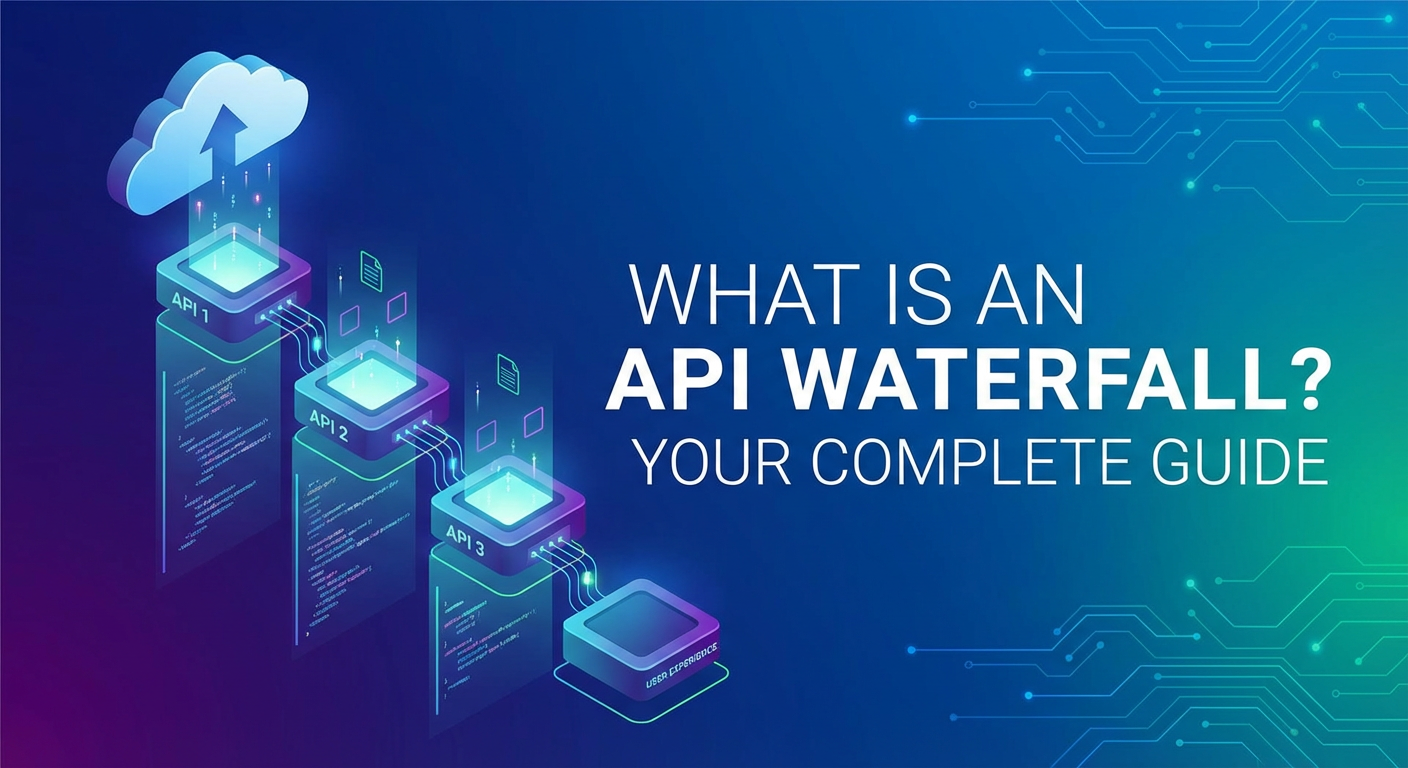
What is an API Waterfall? Your Complete Guide


In the intricate tapestry of modern software architecture, where applications are increasingly composed of a myriad of interconnected services, the concept of an API waterfall has emerged as a fundamental, albeit often challenging, aspect of system design and performance. Far from a mere technical jargon, understanding the API waterfall is crucial for developers, architects, and anyone involved in building scalable, resilient, and high-performing distributed systems. It speaks to the sequential and sometimes parallel execution of multiple Application Programming Interface (API) calls, where each call might depend on the output of a preceding one, or where several calls are aggregated to fulfill a single, overarching user request. This intricate dance of data exchange and service orchestration forms the backbone of almost every digital interaction we experience today, from loading a complex social media feed to completing an e-commerce transaction.
The proliferation of microservices, cloud-native architectures, and the increasing reliance on third-party integrations mean that a single user action can trigger a cascade of dozens, if not hundreds, of distinct API requests across various internal and external services. This complex chain of events, often visualized as a waterfall due to its sequential flow and potential for cascading effects, introduces both immense power and significant challenges. While it enables modularity, flexibility, and independent deployment, it also brings forth complexities related to latency accumulation, error propagation, and overall system observability. Managing these interwoven api calls effectively requires a deep understanding of their dependencies, performance characteristics, and the pivotal role played by tools and strategies, particularly the implementation of an API Gateway. This comprehensive guide aims to demystify the API waterfall, explore its implications, and equip you with the knowledge to optimize and manage these vital cascades within your own architectural landscapes.
Deconstructing the API Waterfall: A Conceptual Deep Dive
At its core, an API waterfall describes a scenario where a single logical operation, typically initiated by a user or another system, necessitates the execution of multiple API calls. These calls are often chained together, meaning the data or outcome of one API request is required before the subsequent request can be made. However, it's not always strictly linear; sometimes, independent API calls can be executed in parallel, with their results aggregated at a later stage to form a complete response. This metaphor of a "waterfall" vividly illustrates the cascading nature of these operations, where data flows downstream, transforming and enriching with each successive step.
Imagine a user attempting to log into an e-commerce website and view their personalized dashboard. This seemingly simple action can trigger a complex API waterfall:
- Authentication API Call: The first step involves sending the user's credentials to an authentication service. This
apivalidates the user's identity and returns an authentication token. - User Profile API Call: With the token in hand, a subsequent
apicall is made to a user profile service to retrieve the user's basic information (name, email, shipping address). This call depends on the successful completion of the authentication step. - Order History API Call (Parallel): Simultaneously, or immediately after retrieving the user profile, an
apicall might be made to an order history service to fetch past purchases. This call might not strictly depend on the profile details but requires the authenticated user context. - Recommendations API Call (Parallel): Another parallel
apicall could be dispatched to a recommendation engine, which uses the user's past purchases and browsing history (potentially retrieved from another service) to suggest new products. - Shopping Cart API Call: Yet another
apicall would fetch the current contents of the user's shopping cart. - Aggregation and Response: Finally, all these individual responses (authentication status, user profile, order history, recommendations, shopping cart) are gathered, processed, and combined into a single, comprehensive response that is then rendered on the user's dashboard.
Each of these steps represents an api request to a distinct microservice or external system, each with its own network latency, processing time, and potential for failure. The cumulative effect of these individual operations, both in terms of time and potential points of failure, defines the overall performance and reliability of the user's interaction.
Characteristics of an API Waterfall
Understanding the core characteristics of an API waterfall is key to effective management:
- Dependency Chains: The most defining feature. Many
apicalls within a waterfall are interdependent, forming a chain where the output of one call serves as the input or a prerequisite for the next. For instance, you cannot retrieve a user's order history without first authenticating that user. These explicit dependencies dictate the sequential nature of parts of the waterfall. - Latency Accumulation: Each
apicall, regardless of its speed, incurs some degree of latency due to network travel time, server processing, and database interactions. In a waterfall, these individual latencies accumulate. If five sequentialapicalls each take 100ms, the minimum total time for that part of the waterfall is 500ms, before any client-side rendering or network overhead is even considered. This cumulative delay can significantly impact the end-user experience, leading to slower application response times. - Error Propagation and Cascading Failures: A critical concern in any distributed system, error propagation is amplified in an API waterfall. If an
apicall early in the chain fails (e.g., authentication service is down), subsequent dependent calls cannot proceed, leading to a complete failure of the entire operation. This cascading effect can be devastating, turning a minor issue in one service into a major outage for the user. Robust error handling, retries, and fallback mechanisms are essential to mitigate this risk. - Concurrency and Parallelism: While some parts of a waterfall are inherently sequential due to dependencies, other parts can be executed in parallel. Identifying and leveraging these opportunities for concurrent execution is a primary optimization strategy. For example, fetching a user's order history and product recommendations can often happen simultaneously, as they typically don't depend on each other's immediate output.
- Data Transformation and Aggregation: As data flows through the waterfall, it is often transformed, filtered, or enriched by different services. The final step usually involves aggregating various pieces of information into a single, cohesive response that meets the client's specific needs. This aggregation logic can reside in the client application, a backend-for-frontend service, or an
API Gateway.
The API waterfall is not merely a theoretical construct; it is the lived reality of software operating in an interconnected world. Recognizing its patterns and understanding its inherent complexities is the first step toward building more performant and resilient systems.
The Indispensable Role of APIs in Modern Architectures
The evolution of software development has dramatically shifted towards modular, distributed systems, primarily fueled by the rise of APIs (Application Programming Interfaces). These interfaces act as contracts, defining how different software components or services can communicate and interact with each other. In essence, an API specifies the methods, data formats, and protocols that developers must adhere to when requesting information or functionality from a particular service. Without APIs, the concept of modern microservices, cloud computing, and even the internet as we know it would be fundamentally unworkable.
APIs as the Backbone of Microservices
The microservices architectural style, which advocates for building a single application as a suite of small, independently deployable services, relies almost entirely on APIs for inter-service communication. Each microservice encapsulates a specific business capability (e.g., user management, product catalog, payment processing) and exposes its functionality through well-defined APIs. When a request comes into the system, it might traverse multiple microservices, each interacting with the next via an api call. This creates a natural "API waterfall" scenario inherent to the very design philosophy of microservices.
For instance, a simple request to "add item to cart" in an e-commerce microservices architecture might involve: 1. An api call to the Product Service to validate the item's existence and availability. 2. Then an api call to the Inventory Service to reserve the item. 3. Followed by an api call to the Cart Service to update the user's shopping cart. Each of these steps is a distinct api call, and their sequence forms a specific waterfall for that user action. This modularity allows teams to develop, deploy, and scale services independently, but it also increases the number of potential network hops and points of failure, magnifying the challenges posed by API waterfalls.
Facilitating Distributed Systems
Beyond microservices, APIs are foundational to any distributed system, whether it's composed of monolithic applications interacting over a network, serverless functions, or a hybrid cloud environment. Distributed systems by definition involve components spread across different machines, networks, and geographical locations. APIs provide the standardized language and mechanism for these disparate components to exchange data and coordinate actions.
Consider a cloud-based data processing pipeline: * An ingest service receives data via an api. * It then makes an api call to a data validation service. * After validation, another api call pushes the data to a storage service. * Downstream analytics services pull processed data via their own APIs. The entire flow is a complex distributed api waterfall, where the performance and reliability of each api call directly influence the overall pipeline's efficiency. Managing these distributed dependencies is a significant undertaking, requiring robust gateway solutions and monitoring capabilities.
Powering Frontend-Backend Communication
The user interfaces we interact with daily, whether through web browsers or mobile applications, are almost entirely powered by APIs. When you scroll through your social media feed, search for a product, or book a flight, your client application (frontend) is making numerous api calls to various backend services to fetch and display dynamic content. A single screen often aggregates data from multiple api endpoints.
For example, loading a flight details page might involve: * An api call to get basic flight information (flight number, departure/arrival times). * Another api call to retrieve seat availability. * A third api call to fetch pricing details for various fare classes. * A fourth api call for baggage allowance information. Each of these could be distinct api calls to different backend services, forming a client-side API waterfall that directly impacts the perceived loading speed and responsiveness of the application. Developers must optimize these client-side waterfalls to ensure a fluid user experience, often relying on strategies like parallel fetching and intelligent caching.
Enabling Third-Party Integrations
The modern software landscape is also characterized by extensive reliance on third-party services. Applications rarely exist in isolation; they often integrate with payment gateway providers, mapping services, identity management platforms, communication tools, and various SaaS solutions. These integrations are exclusively facilitated through APIs.
When an application processes a payment: * It makes an api call to a payment gateway (e.g., Stripe, PayPal) to process the transaction. * The gateway itself might then make its own internal api calls to financial institutions. * Upon successful payment, the original application might then make another api call to a fulfillment service. This interaction chain demonstrates how an API waterfall can extend beyond an organization's internal boundaries, incorporating external services and introducing additional layers of dependency and potential latency. Managing these external api calls requires robust contracts, error handling, and often, an API Gateway that can abstract these external complexities.
In summary, APIs are not just a technical detail; they are the fundamental connective tissue of modern software. They enable the modularity of microservices, the scalability of distributed systems, the richness of user interfaces, and the extensibility through third-party integrations. However, this ubiquity also means that API waterfalls are an inescapable reality, making their careful design, management, and optimization a critical discipline for any successful software endeavor.
Performance Implications of API Waterfalls
The inherent nature of API waterfalls, with their chained and aggregated requests, brings significant performance implications that can directly impact user experience, system stability, and operational costs. While APIs provide the essential glue for distributed systems, the cumulative effect of multiple sequential or parallel calls can lead to insidious bottlenecks if not carefully managed. Understanding these implications is the first step towards mitigating them.
Latency: The Unforgiving Accumulator
Perhaps the most critical performance implication of an API waterfall is latency accumulation. Every api call, regardless of how optimized, introduces a delay. This delay comprises several components:
- Network Latency: The time it takes for a request to travel from the client to the server and for the response to travel back. This is influenced by geographical distance, network congestion, and the number of network hops.
- Processing Latency: The time the server spends executing the request, which includes application logic, database queries, and any external service calls it might make.
- Serialization/Deserialization: The time taken to convert data into a transmission format (e.g., JSON, XML) and back.
- Queueing Delays: If services are under heavy load, requests might sit in queues before being processed.
In a sequential API waterfall, the total latency for a chain of N calls is roughly the sum of individual latencies of each call. For example, if a user request triggers three sequential api calls, each taking an average of 150ms (including network and processing), the user will experience a minimum delay of 450ms before receiving the complete response. If there are 10 such calls, this quickly balloons to 1.5 seconds, which is often unacceptable for interactive applications. Even parallel calls have a "critical path" defined by the slowest of the concurrent operations. This accumulated latency directly translates to slower application response times, leading to frustrated users, higher bounce rates, and potentially lost business.
Network Overhead: The Cost of Chatty APIs
Each api call requires establishing a connection, sending headers, potentially authentication tokens, the request payload, and then receiving the response payload. Even small api calls generate a certain amount of network overhead. In an API waterfall involving many small, "chatty" requests, this overhead can become substantial.
- TCP Handshakes: For each new connection, a TCP handshake occurs, adding a few milliseconds.
- SSL/TLS Handshakes: If using HTTPS (which is standard practice), an additional SSL/TLS handshake is required, adding further latency and CPU cycles.
- Header Size: Request and response headers can add to the payload size, increasing transfer time.
While modern protocols like HTTP/2 and HTTP/3 offer improvements in multiplexing and reducing handshake overhead, a large number of api calls still means more data transferred, more connections managed, and ultimately, more network resources consumed. This can strain network infrastructure and increase data transfer costs, especially in cloud environments where egress bandwidth is often metered.
Resource Utilization: Burden on Servers and Clients
An active API waterfall consumes resources on both the server and client sides:
- Server-Side: Each
apicall keeps server connections open, consumes CPU cycles for processing, memory for data, and database connections. A large number of concurrent waterfall executions can quickly exhaust server resources, leading to degraded performance, service unavailability, or even crashes. This is particularly true for bottleneck services that are part of many waterfalls. - Client-Side: For browser-based applications, the client might be responsible for initiating multiple
apicalls, managing their state, and aggregating the responses. This consumes client-side CPU and memory, potentially leading to a sluggish user interface, especially on less powerful devices. For mobile apps, this also translates to higher battery consumption and data usage.
Efficient management of API waterfalls is therefore crucial for optimizing resource utilization, ensuring services remain responsive under load, and providing a smooth client experience.
Impact on User Experience (UX)
The sum of all these performance implications directly translates into the user's perception of the application. A slow-loading page, delayed updates, or frequent error messages due to an inefficient API waterfall can severely degrade the user experience.
- Perceived Performance: Even if the backend processes are fast, a high cumulative latency in the waterfall means users wait longer, perceiving the application as slow.
- Increased Frustration: Long waiting times lead to user frustration and may cause them to abandon the application.
- Reduced Engagement: A clunky, slow interface discourages active engagement and repeat visits.
- Negative Brand Image: Poor performance reflects negatively on the brand and can lead to customer churn.
In today's fast-paced digital world, users have zero tolerance for slow applications. Optimizing API waterfalls is not just a technical challenge; it's a business imperative for maintaining user satisfaction and competitive advantage.
Considerations for Caching and Load Balancing
While not direct implications, caching and load balancing are crucial strategies to mitigate the performance issues of API waterfalls.
- Caching: By storing frequently requested
apiresponses (or parts thereof), subsequent requests for the same data can be served much faster, bypassing the entire waterfall or parts of it. This significantly reduces latency and server load. Effective caching strategies are vital, but they also introduce complexities around data freshness and invalidation. - Load Balancing: Distributing incoming
apirequests across multiple instances of a service ensures that no single instance becomes a bottleneck. This improves throughput and resilience, especially for services that are frequently called within API waterfalls. However, load balancing alone doesn't solve sequential latency issues.
In conclusion, the performance implications of API waterfalls are multifaceted and profound. They demand a holistic approach to system design, vigilant monitoring, and continuous optimization. Ignoring these implications can lead to cascading performance degradations that compromise user experience, operational efficiency, and ultimately, business success.
APIPark is a high-performance AI gateway that allows you to securely access the most comprehensive LLM APIs globally on the APIPark platform, including OpenAI, Anthropic, Mistral, Llama2, Google Gemini, and more.Try APIPark now! 👇👇👇
Managing and Optimizing API Waterfalls: The Path to Efficiency
Effectively managing and optimizing API waterfalls is a critical discipline for building robust, scalable, and high-performing distributed systems. Given the inherent complexities of chained and aggregated api calls, a multi-faceted approach is required, leveraging architectural patterns, specialized tools, and best practices. Central to this approach is the deployment of an API Gateway.
The Indispensable API Gateway
An API Gateway acts as a single entry point for all client requests, routing them to the appropriate backend services. It sits between the client and a collection of backend services, often microservices, abstracting away the complexities of the internal architecture. While its primary role is routing, a sophisticated API Gateway provides a suite of functionalities that are particularly beneficial for managing and optimizing API waterfalls.
What an API Gateway Does for Waterfalls:
- Request Aggregation (Composition): One of the most powerful features of an
API Gatewayin the context of waterfalls is its ability to aggregate multiple downstreamapicalls into a single upstream request. Instead of the client making several individualapicalls, the client makes one call to theAPI Gateway. Thegatewaythen fans out this request to multiple backend services, gathers their responses, and composes them into a single, unified response before sending it back to the client. This significantly reduces network round trips from the client, minimizing client-side latency and network overhead.- Example: For an e-commerce dashboard, instead of the client calling
/profile,/orders, and/recommendationsseparately, it calls/dashboardon thegateway. Thegatewaythen internally orchestrates the calls to the respective backend services and combines the results.
- Example: For an e-commerce dashboard, instead of the client calling
- Protocol Translation:
API Gatewayscan handle diverse communication protocols between clients and backend services. For instance, a client might use REST over HTTP/1.1, while a backend service might communicate using gRPC or a different version of HTTP. Thegatewaycan translate between these, simplifying client logic and allowing for flexible backend service evolution. - Authentication and Authorization: Centralizing authentication and authorization at the
gatewaysimplifies security. Instead of each backend service needing to implement its own security logic, thegatewayhandles validating tokens, user roles, and permissions. If thegatewaydetermines a request is unauthorized, it can reject it before it even reaches any downstream services, saving resources and enhancing security across the entire API landscape. - Rate Limiting and Throttling: To protect backend services from being overwhelmed by excessive requests,
API Gatewayscan enforce rate limits. This is crucial in waterfall scenarios where a single client request might fan out into many internalapicalls. Throttling at thegatewayprevents cascading overload of downstream services. - Caching: By caching responses to frequently requested
apicalls, thegatewaycan serve subsequent identical requests directly from its cache, bypassing the entire waterfall or significant portions of it. This dramatically reduces latency and load on backend services, offering a substantial performance boost. - Routing:
API Gatewaysprovide dynamic routing capabilities, directing requests to the correct backend service instances based on paths, headers, query parameters, or even advanced load balancing algorithms. This enables seamless service discovery, A/B testing, and blue-green deployments. - Circuit Breaker Pattern: To prevent cascading failures, an
API Gatewaycan implement the circuit breaker pattern. If a backend service becomes unresponsive or starts returning errors, thegatewaycan "open the circuit," preventing further requests from being sent to that failing service. Instead, it can return a fallback response, reducing load on the distressed service and preventing a complete system outage. - Request/Response Transformation:
API Gatewayscan modify request and response payloads. This might involve stripping unnecessary data, adding context (e.g., user ID), or transforming data formats to meet client-specific needs without requiring changes to backend services. - Logging, Monitoring, and Analytics: As the single point of entry, an
API Gatewayis an ideal place to centralize logging, monitoring, and analytics for allapitraffic. It can provide detailed insights intoapicall patterns, latency metrics, error rates, and overall system health, which are invaluable for identifying bottlenecks within API waterfalls.
Platforms like ApiPark exemplify the robust capabilities of a modern API gateway and API management platform. APIPark, an open-source AI gateway, goes a step further by offering unified management for 100+ AI models, standardizing api formats for AI invocation, and even allowing users to encapsulate prompts into new REST apis. Its end-to-end api lifecycle management capabilities, team service sharing, independent tenant configurations, and performance rivaling Nginx (achieving over 20,000 TPS with an 8-core CPU and 8GB memory) make it a powerful tool for organizations dealing with complex api ecosystems, especially those incorporating AI services. Detailed api call logging and powerful data analysis features also provide the crucial visibility needed to understand and optimize the intricate api waterfalls that power modern applications. By providing a centralized point for managing api traffic, security, and performance, solutions like APIPark empower developers to handle the complexities of distributed systems with greater efficiency and control.
Beyond the Gateway: Additional Optimization Strategies
While an API Gateway is a cornerstone, several other strategies complement its role in optimizing API waterfalls:
- Backend for Frontend (BFF) Pattern: A BFF service is a specialized
gatewaydesigned to serve a specific client type (e.g., web, iOS, Android). It allows for tailoringapiresponses precisely to the client's needs, reducing over-fetching or under-fetching of data. A BFF can performapiaggregation and transformation specific to its client, effectively managing the waterfall for that particular frontend. - Asynchronous Processing and Event-Driven Architectures: For parts of a waterfall that don't require an immediate synchronous response, asynchronous processing can significantly improve responsiveness. Instead of blocking the client until all downstream
apicalls complete, a service can publish an event (e.g., "order placed") to a message queue. Other services then react to this event independently. This decouples services, making the system more resilient and allowing for faster initial responses. - Batching and GraphQL:
- Batching: Instead of making multiple individual
apicalls for related data, batching allows clients to send a single request containing multiple operations. TheAPI Gatewayor a dedicated batching endpoint can then execute these operations efficiently, reducing network overhead. - GraphQL: GraphQL is a query language for APIs that allows clients to request exactly the data they need and nothing more. This eliminates the problem of over-fetching data and can significantly reduce the number of
apicalls required to compose a complex view, essentially letting the client define its own waterfall by specifying data dependencies in a single request.
- Batching: Instead of making multiple individual
- Performance Monitoring and Observability Tools: You cannot optimize what you cannot measure. Robust monitoring solutions are essential to visualize
apicall sequences, identify latency bottlenecks within waterfalls, track error rates, and understand service dependencies. Tools that provide distributed tracing help pinpoint the exactapicall causing delays or failures within a complex chain. - Service Mesh: In highly distributed microservices environments, a service mesh (like Istio or Linkerd) can manage inter-service communication. While distinct from an
API Gateway(which handles edge traffic), a service mesh can manage traffic, retries, timeouts, and circuit breaking between internal services, making internal API waterfalls more resilient and observable. - API Design Best Practices: Thoughtful
apidesign can inherently mitigate waterfall issues.- Coarse-Grained APIs: Design
apis that return a comprehensive set of related data in a single call, rather than requiring multiple fine-grained calls. - Versioning: Plan for
apiversioning to allow for non-breaking changes and seamless evolution. - Idempotency: Ensure that repeated
apicalls produce the same result, making retries safer. - Pagination and Filtering: Allow clients to request only the necessary subset of data, reducing payload sizes.
- Coarse-Grained APIs: Design
In summary, managing and optimizing API waterfalls is a continuous journey that involves strategic architectural choices, judicious use of API Gateway functionalities, adoption of modern api paradigms, and an unwavering commitment to monitoring and observability. By combining these strategies, organizations can transform complex api cascades from potential liabilities into robust, high-performing components of their digital infrastructure.
Practical Strategies for Developers and Architects
Beyond the overarching architectural patterns and the capabilities of an API Gateway, individual developers and architects can employ specific, practical strategies to directly influence the performance and resilience of API waterfalls. These hands-on approaches focus on understanding dependencies, optimizing execution flow, and ensuring robust error handling.
1. Identify Critical Paths and Dependencies
Before optimizing, you must understand the current state. For any given user interaction or business process that involves an API waterfall, map out all the involved api calls. This involves:
- Visualizing the Flow: Create diagrams (sequence diagrams, flowcharts) that illustrate the exact sequence of
apicalls, identifying which calls are sequential and which can run in parallel. - Pinpointing Dependencies: Explicitly note down which
apicalls absolutely require the output of a previous call. These form the critical path, as their combined latency directly impacts the total response time. - Understanding Data Needs: Determine precisely what data each
apicall requires and what data it returns. This helps in identifying unnecessary data fetching or opportunities for data aggregation.
Tools for distributed tracing and api monitoring become invaluable here, allowing you to observe actual call sequences and timings in production environments, often revealing hidden dependencies or unexpected bottlenecks.
2. Parallelize Where Possible
Once dependencies are understood, actively look for opportunities to execute independent api calls concurrently. If two or more api calls do not rely on each other's output, they can be initiated almost simultaneously.
- Asynchronous Programming: Utilize language-specific asynchronous programming features (e.g.,
async/awaitin JavaScript/Python, Goroutines in Go,CompletableFuturein Java) to manage concurrentapirequests efficiently. - Thread Pools/Task Queues: For more complex scenarios, manage parallel execution using thread pools or task queues, ensuring that backend services have sufficient resources to handle concurrent requests without getting overwhelmed.
- Client-Side Parallelism: If the
API Gatewaydoesn't handle aggregation, front-end applications can make multipleapicalls in parallel and then combine the results.
Parallelization is often the lowest-hanging fruit for performance optimization in an API waterfall, as it directly attacks the accumulated latency problem.
3. Minimize Network Hops and Data Transfers
Every network hop and every byte transferred adds latency and consumes resources.
- Reduce
APICalls: Re-evaluate yourapidesign. Can multiple pieces of related data be fetched in a single, more comprehensiveapicall instead of many smaller ones? This is where coarse-grainedapis or GraphQL shine. - Optimize Payload Sizes:
- GZIP/Compression: Ensure
apiresponses are compressed (e.g., using GZIP) before sending them over the network. - Minimize Data: Only return the data that the client explicitly needs. Avoid sending large, unnecessary fields. GraphQL is excellent for this, as clients specify their data requirements.
- Efficient Serialization: Use efficient data serialization formats (e.g., Protocol Buffers, Avro) when performance is paramount, though JSON often offers a good balance of performance and human readability.
- GZIP/Compression: Ensure
- Leverage HTTP/2 or HTTP/3: These protocols offer features like multiplexing (sending multiple requests/responses over a single connection) and header compression, which can significantly reduce network overhead compared to HTTP/1.1, especially for applications with many parallel
apicalls.
4. Implement Robust Error Handling, Timeouts, and Retries
The weakest link in an API waterfall can bring down the entire chain. Comprehensive error handling is non-negotiable.
- Timeouts: Configure appropriate timeouts for every
apicall. An indefinitely hanging request can block resources and hold up the entire waterfall. Short, intelligent timeouts prevent services from waiting endlessly for unresponsive dependencies. - Retries: Implement retry mechanisms with exponential backoff for transient errors (e.g., network glitches, temporary service unavailability). This allows
apicalls to recover from minor issues without immediate failure. However, be cautious not to overwhelm a struggling service with excessive retries. - Circuit Breakers: As mentioned with
API Gateways, applying the circuit breaker pattern at the service level (using libraries like Hystrix or Resilience4j) prevents calls to failing downstream services, allowing them to recover and providing graceful degradation to the user. - Fallback Mechanisms: For non-critical parts of an API waterfall, implement fallback logic. If a recommendation engine
apifails, simply omit recommendations instead of failing the entire page load. This ensures that core functionality remains available.
5. Thorough Testing: Performance, Load, and Integration
Optimization is an ongoing process, and testing is its cornerstone.
- Unit and Integration Testing: Ensure individual
apis and their immediate integrations work correctly. - Performance Testing: Simulate various loads on individual services and the entire API waterfall to identify bottlenecks under stress. Use tools like JMeter, k6, or Locust.
- Load Testing: Test the system's behavior under expected and peak load conditions to ensure it remains stable and performs within acceptable parameters.
- Chaos Engineering: Deliberately inject failures into parts of your API waterfall (e.g., delay a service, make it return errors) to test the resilience of your error handling, timeouts, and circuit breakers.
6. Continuous Monitoring and Alerting
Visibility into your API waterfalls in production is paramount.
- Distributed Tracing: Tools like Jaeger, Zipkin, or AWS X-Ray allow you to visualize the entire path of a request through multiple services, showing the latency contribution of each
apicall. This is indispensable for debugging and performance tuning. - Metrics Collection: Collect key performance indicators (KPIs) for each
apicall: latency, error rates, throughput, and resource utilization. - Alerting: Set up alerts for deviations from normal behavior (e.g., increased error rates, unusual latency spikes) to quickly detect and respond to issues before they significantly impact users.
- Dashboards: Create intuitive dashboards that provide real-time insights into the health and performance of your API waterfalls, enabling proactive management.
By systematically applying these practical strategies, developers and architects can significantly improve the performance, reliability, and user experience of applications powered by complex API waterfalls, transforming potential points of weakness into pillars of system strength.
Challenges and Pitfalls
While API waterfalls are an inevitable consequence of modern distributed architectures, they come with a distinct set of challenges and potential pitfalls that demand careful attention. Failing to address these can lead to brittle systems, frustrating user experiences, and significant operational overhead.
1. Increased Complexity and Debugging Difficulties
The most immediate challenge presented by API waterfalls is the sheer increase in system complexity. When a single user request fans out to multiple services, each with its own lifecycle, deployment schedule, and potential for failure, diagnosing issues becomes significantly harder.
- Distributed Debugging: Pinpointing the root cause of an error in a long chain of
apicalls is notoriously difficult. An error message returned to the client might originate from a service many hops deep in the waterfall, making it challenging to trace back the exactapicall that failed and why. - Version Mismatches: As services evolve independently, subtle
apiversion mismatches or breaking changes can lead to unexpected behavior in dependent services, causing failures within the waterfall that are hard to identify without proper integration testing across services. - Non-Determinism: In highly concurrent waterfalls, the exact timing and order of operations can vary, leading to non-deterministic bugs that are difficult to reproduce and fix.
Without robust distributed tracing, comprehensive logging, and centralized monitoring, debugging an API waterfall can feel like searching for a needle in a haystack across multiple data centers.
2. Performance Bottlenecks and Cumulative Latency
As extensively discussed, cumulative latency is a major pitfall. A single slow api call, or a series of moderately slow calls, can easily push the total response time beyond acceptable limits. Identifying these specific bottlenecks requires constant vigilance.
- "Last Mile" Problem: Often, the problem isn't a single slow service, but the slowest
apicall in a parallel set, or the very last sequential call that pushes the total time over the edge. These can be hard to spot without detailed tracing. - Resource Exhaustion: A bottleneck service, perhaps due to inefficient database queries or CPU-intensive operations, can become a choke point for the entire waterfall, leading to resource exhaustion (e.g., connection pool starvation) and cascading failures for other services that depend on it.
- Network Congestion: While individual
apicalls might be fast, overall network congestion or bandwidth limitations can significantly slow downapiwaterfalls, especially across geographically dispersed data centers or cloud regions.
3. Security Vulnerabilities and Access Management
Each api call, especially when traversing multiple services, represents a potential attack surface. Managing security across an API waterfall becomes exponentially more complex than in a monolithic application.
- Authentication and Authorization Sprawl: Ensuring consistent authentication and authorization across every service in an
apiwaterfall is challenging. Without a centralizedAPI Gateway, each service might need to implement its own security logic, leading to inconsistencies and potential vulnerabilities. - Data Exposure: Sensitive data might be unnecessarily exposed or transformed incorrectly as it flows through the waterfall, increasing the risk of data breaches.
- Denial-of-Service (DoS) Attacks: An attack on one service in the waterfall could potentially overwhelm upstream or downstream services, leading to a system-wide DoS if not properly mitigated with rate limiting and circuit breakers.
4. Data Consistency and Transactional Integrity
In distributed systems, ensuring data consistency across multiple services involved in an API waterfall is a significant challenge. If a logical operation spans updates across several services (e.g., deducting inventory, processing payment, updating order status), and one of those updates fails, the system can end up in an inconsistent state.
- Distributed Transactions: Implementing true ACID (Atomicity, Consistency, Isolation, Durability) transactions across multiple services is extremely complex and often avoided in favor of eventual consistency.
- Eventual Consistency Challenges: While eventual consistency is often chosen for scalability, it means that at any given moment, data might be inconsistent across services. This needs to be carefully managed, and user expectations set, especially in scenarios where immediate consistency is critical (e.g., financial transactions).
- Compensating Transactions: For scenarios requiring a degree of transactional integrity, implementing compensating transactions (where failed operations are "undone" by subsequent operations) adds significant complexity to the
apiwaterfall's error handling logic.
5. Operational Overhead and Maintenance
Managing a system composed of many interconnected services and complex api waterfalls introduces substantial operational overhead.
- Deployment Coordination: Deploying updates or new features that affect multiple services in an
apiwaterfall requires careful coordination to avoid breaking changes or service outages. - Monitoring and Alerting Configuration: Setting up and maintaining comprehensive monitoring, logging, and alerting for every
apiin the waterfall is a continuous effort. - Service Level Agreements (SLAs): Ensuring that individual services meet their SLAs, and that their combined performance within a waterfall also meets the overall application's SLA, requires diligent performance management.
While API waterfalls are essential for the flexibility and scalability of modern architectures, recognizing and proactively addressing these challenges is paramount. A combination of robust architecture, intelligent tool utilization (like an API Gateway), meticulous design, and continuous operational vigilance is required to turn these complexities into manageable components of a high-performing system.
Conclusion
The journey through the intricate world of API waterfalls reveals them as both the backbone and a significant challenge in modern distributed systems. From the simple login process to the complex aggregation of data for a personalized dashboard, a series of interconnected api calls dictates the speed, reliability, and functionality of nearly every digital experience. We've explored how these cascades of api requests, where the output of one often feeds into the next or multiple requests run in parallel, are an inherent part of microservices, distributed architectures, and client-server interactions.
The performance implications of these waterfalls – particularly the relentless accumulation of latency, the insidious network overhead, and the demands on system resources – are profound. They directly impact user experience, leading to slower response times, increased frustration, and potential loss of engagement. Overlooking these aspects is not merely a technical oversight; it's a business risk in an age where speed and seamless interaction are paramount.
However, the challenges posed by API waterfalls are not insurmountable. The evolution of API Gateway technology has provided a crucial architectural pattern for centralizing the management, security, and optimization of these complex api interactions. By leveraging gateway functionalities such as request aggregation, caching, rate limiting, and robust error handling mechanisms like circuit breakers, organizations can significantly mitigate the pitfalls of distributed systems. Platforms like ApiPark, with their comprehensive api management and AI gateway capabilities, stand as exemplars of how sophisticated tooling can simplify the orchestration of diverse apis, including the burgeoning field of AI services. Beyond the gateway, strategies like the Backend for Frontend pattern, asynchronous processing, GraphQL, diligent monitoring, and adhering to api design best practices further empower developers and architects to construct more efficient and resilient systems.
Ultimately, mastering the API waterfall is about striking a delicate balance. It requires embracing the modularity and flexibility that distributed apis offer while simultaneously implementing rigorous strategies to manage their inherent complexities. Through a combination of thoughtful design, strategic tooling, continuous monitoring, and a proactive approach to optimization, organizations can transform the potential liabilities of api cascades into powerful engines for innovation and exceptional user experiences. As our digital landscapes continue to grow in complexity, the ability to effectively navigate and optimize the API waterfall will remain a defining characteristic of successful software development and operations.
Frequently Asked Questions (FAQs)
1. What is an API Waterfall? An API Waterfall refers to a sequence of multiple API calls, often triggered by a single user action or system event, where the output of one API call might serve as the input for a subsequent call, or where several independent calls are executed concurrently and their results aggregated. This cascade of requests forms a chain or parallel execution path, essential for assembling complex data or functionality in distributed systems.
2. Why is an API Gateway important for managing API Waterfalls? An API Gateway is crucial for managing API Waterfalls because it acts as a single, centralized entry point for all client requests. It can aggregate multiple downstream API calls into a single client-facing request, reducing network overhead and latency. Additionally, it centralizes authentication, authorization, rate limiting, caching, and provides crucial logging and monitoring capabilities, significantly simplifying the management and optimization of complex API cascades.
3. How does an API Waterfall affect application performance? API Waterfalls can significantly affect application performance primarily due to latency accumulation. Each individual API call incurs network and processing delays, and when multiple calls are chained, these delays sum up, leading to longer overall response times. This can result in a slower user experience, increased resource consumption on both client and server sides, and potential for cascading failures if one API in the chain becomes a bottleneck or fails.
4. What are common strategies to optimize an API Waterfall? Common strategies to optimize an API Waterfall include: * Request Aggregation: Using an API Gateway or Backend for Frontend (BFF) pattern to combine multiple downstream calls into a single client request. * Parallelization: Executing independent API calls concurrently rather than sequentially. * Caching: Storing frequently accessed API responses to reduce the need for repeated calls. * Batching/GraphQL: Reducing the number of HTTP requests by fetching multiple resources in a single call or allowing clients to specify exact data needs. * Robust Error Handling: Implementing timeouts, retries with exponential backoff, and circuit breakers to prevent cascading failures. * Minimize Network Hops: Designing API endpoints that return comprehensive data to reduce the total number of calls and optimize payload sizes.
5. Can an API Waterfall be avoided entirely in modern architectures? In most modern distributed architectures, particularly those built on microservices or relying on third-party integrations, an API Waterfall cannot be entirely avoided. The inherent modularity and separation of concerns lead to multiple services needing to communicate via APIs. The goal is not to eliminate the waterfall but to manage, optimize, and make it resilient. Strategies focus on minimizing its performance impact, ensuring its reliability, and providing clear observability rather than attempting to bypass the fundamental architectural pattern it represents.
🚀You can securely and efficiently call the OpenAI API on APIPark in just two steps:
Step 1: Deploy the APIPark AI gateway in 5 minutes.
APIPark is developed based on Golang, offering strong product performance and low development and maintenance costs. You can deploy APIPark with a single command line.
curl -sSO https://download.apipark.com/install/quick-start.sh; bash quick-start.sh

In my experience, you can see the successful deployment interface within 5 to 10 minutes. Then, you can log in to APIPark using your account.

Step 2: Call the OpenAI API.