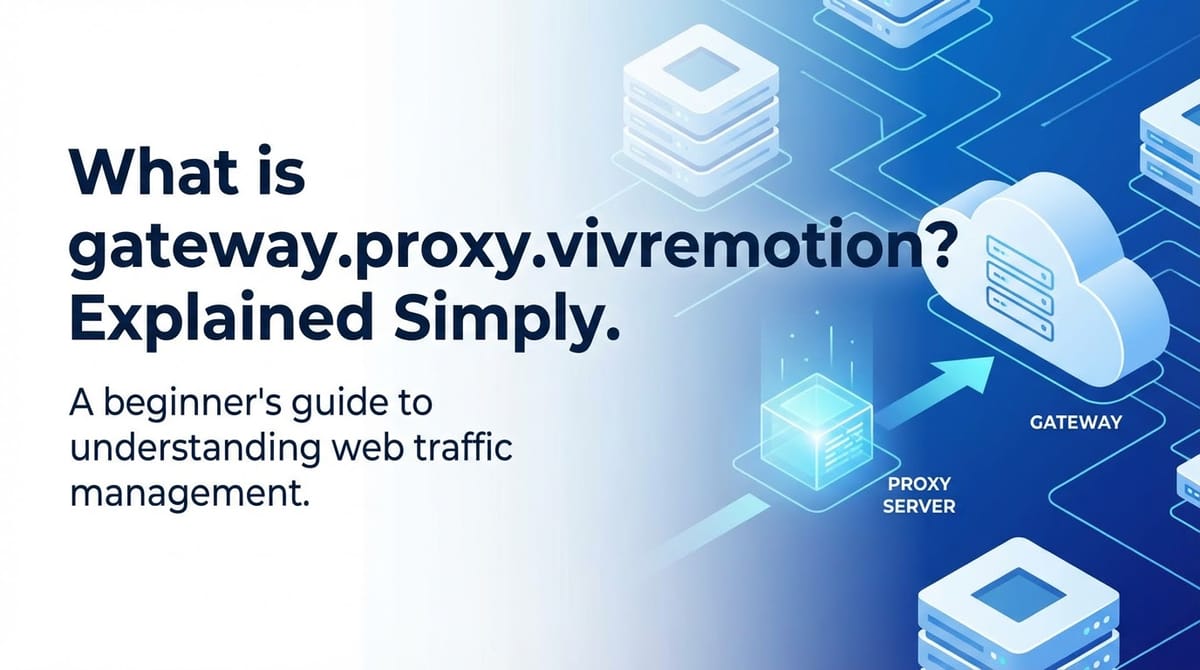
What is gateway.proxy.vivremotion? Explained Simply.


The rapid acceleration of artificial intelligence, particularly the emergence and widespread adoption of Large Language Models (LLMs), has fundamentally reshaped the technological landscape. From automating complex tasks to enabling groundbreaking new applications, AI is no longer a futuristic concept but a present-day imperative for businesses and developers alike. However, harnessing the true power of these sophisticated models often comes with a significant operational overhead. Integrating diverse AI services, managing their unique requirements, ensuring security, optimizing performance, and controlling costs can quickly become a labyrinthine challenge, even for the most seasoned engineering teams. This is where the concept of a central, intelligent intermediary becomes not just beneficial, but essential.
Enter "gateway.proxy.vivremotion" – a conceptual framework that encapsulates the critical functionalities required to navigate this complex AI ecosystem with agility and efficiency. While the name itself might sound specialized or even proprietary, it represents a composite of vital architectural patterns: acting as an AI Gateway, serving as an LLM Proxy, and crucially, implementing a sophisticated Model Context Protocol. In essence, "gateway.proxy.vivremotion" stands for the intelligent layer that abstracts away the complexities of interacting with disparate AI models, offering a unified, secure, and optimized interface. It is the silent orchestrator working behind the scenes, transforming a chaotic collection of AI endpoints into a streamlined, governable, and highly performant resource. This article will thoroughly demystify this critical conceptual entity, breaking down its constituent parts and explaining how such an architecture empowers organizations to unlock the full potential of AI without succumbing to its inherent operational challenges. We will delve into the core functions of an AI Gateway, explore the specialized requirements of an LLM Proxy, and shine a spotlight on the indispensable role of a Model Context Protocol in managing the intricate dance of conversational AI.
The AI Revolution and Its Operational Challenges
The current technological era is undeniably defined by artificial intelligence. What began as specialized algorithms for specific tasks has burgeoned into a sprawling ecosystem of diverse models, each with its unique strengths, weaknesses, and operational demands. We've seen the progression from traditional machine learning models excelling in tasks like fraud detection and recommendation systems, to computer vision models accurately identifying objects and facial features, and natural language processing (NLP) models capable of understanding and generating human language. More recently, the advent of Large Language Models (LLMs) and other generative AI models has pushed the boundaries further, offering capabilities from creative content generation and complex problem-solving to sophisticated conversational interactions. This explosion of AI capabilities brings immense potential but also introduces a new set of intricate challenges for developers and enterprises aiming to integrate these powerful tools into their applications and workflows.
One of the most immediate challenges stems from the sheer diversity of AI models and providers. Every major AI player, from OpenAI and Anthropic to Google and Meta, offers a suite of models, each with distinct APIs, authentication mechanisms, data input/output formats, rate limits, pricing structures, and update cycles. Integrating even a handful of these models directly into an application can quickly lead to a tangled web of bespoke connectors, increasing development time, maintenance burden, and the risk of errors. A change in one provider's API or a decision to switch to a different model can necessitate significant refactoring across an entire application codebase, a process that is both costly and time-consuming.
Scalability and performance present another significant hurdle. AI models, especially LLMs, can be resource-intensive, requiring robust infrastructure to handle fluctuating request volumes. Applications need to gracefully manage high traffic, ensure low latency, and maintain high availability without incurring exorbitant infrastructure costs. Direct integration often means applications are tightly coupled to the performance characteristics of individual AI providers, making it difficult to implement fine-grained load balancing, caching strategies, or intelligent failover mechanisms when an upstream service experiences degraded performance or outages. Without a sophisticated intermediary, managing concurrent requests, throttling abusive usage, or prioritizing critical operations becomes a complex task spread across various application components.
Security and compliance are paramount, particularly when dealing with sensitive data that might be processed by AI models. Organizations must ensure that data transmitted to and from AI services is encrypted, authenticated, and complies with various regulatory standards like GDPR, HIPAA, or CCPA. Directly exposing application logic to external AI APIs can create security vulnerabilities, making it harder to implement centralized access controls, perform input validation, sanitize prompts to prevent injection attacks, or monitor for anomalous behavior. Furthermore, the auditability of AI interactions becomes crucial for compliance, requiring detailed logging and tracking of every request and response, which is often difficult to achieve uniformly across disparate AI services.
Cost management and optimization are frequently underestimated challenges. The pay-per-use model prevalent in most commercial AI services means that costs can escalate rapidly with increased usage, especially with LLMs where token consumption can be high. Without a centralized mechanism to monitor, attribute, and control spending, budgets can easily be exceeded. Optimizing costs might involve routing requests to the most economical model for a given task, implementing caching for frequently requested outputs, or intelligently managing token usage—all of which are difficult to implement at the application layer without introducing significant complexity.
Finally, the dynamic nature of AI development means models are constantly being updated, improved, or even deprecated. Keeping applications aligned with the latest model versions, managing prompt engineering changes, and ensuring backward compatibility is an ongoing maintenance nightmare. Vendor lock-in also becomes a real concern; once an application is deeply integrated with a specific AI provider, switching to an alternative can be prohibitively expensive, limiting an organization's flexibility and bargaining power. These formidable challenges underscore the urgent need for a sophisticated architectural component, such as the conceptual "gateway.proxy.vivremotion," which can abstract, standardize, secure, and optimize the interaction with the ever-evolving AI landscape.
Deconstructing "gateway.proxy.vivremotion": The Role of an AI Gateway
At its core, "gateway.proxy.vivremotion" functions as a robust AI Gateway. An AI Gateway is an architectural component that acts as a single entry point for all requests interacting with various AI services. Much like an API Gateway for traditional microservices, an AI Gateway sits between client applications and the backend AI models, centralizing common functionalities and abstracting away the underlying complexities. It serves as a critical control plane, enhancing security, scalability, and manageability across the entire AI landscape within an organization. This layer is not merely a pass-through; it's an intelligent orchestrator that inspects, transforms, routes, and secures every interaction, ensuring that AI resources are utilized effectively and responsibly.
The primary function of an AI Gateway is API standardization and unification. In a world where AI providers offer distinct interfaces, an AI Gateway normalizes these disparate APIs into a single, coherent format. This means developers can interact with various AI models—be it a sentiment analysis model from one vendor, an image recognition service from another, or a custom-trained model deployed internally—through a consistent API. This abstraction dramatically reduces integration effort, accelerates development cycles, and allows applications to be largely decoupled from specific AI vendor implementations. If an organization decides to switch from one LLM provider to another, or even to deploy a fine-tuned version of an open-source model, the application only needs to know about the standardized gateway interface, not the intricate details of the new backend. This unification also simplifies client-side logic, as developers no longer need to write custom code for each unique AI endpoint.
Authentication and authorization are paramount, and an AI Gateway centralizes these critical security functions. Instead of each application managing individual API keys or tokens for every AI service, the gateway handles this at a single point. It can enforce various authentication schemes, such as OAuth, API keys, JWTs, or enterprise SSO, and then securely translate these into the credentials required by the upstream AI models. Furthermore, it can implement fine-grained authorization policies, ensuring that only authorized users or applications can access specific AI models or perform particular operations, based on roles, groups, or other contextual information. This central enforcement point significantly reduces the attack surface and simplifies security audits.
To ensure stability and fairness, an AI Gateway incorporates rate limiting and throttling. AI services often have usage quotas or performance limits. The gateway can intelligently manage and enforce these limits, preventing individual clients from overwhelming an AI model or exceeding their allocated usage. This helps protect the backend AI services from abuse, ensures equitable access for all consumers, and can prevent unexpected cost overruns by proactively limiting excessive requests. Sophisticated gateways can apply different rate limits based on user roles, subscription tiers, or even the specific AI model being invoked.
Load balancing and failover capabilities are crucial for maintaining high availability and optimal performance. An AI Gateway can distribute incoming requests across multiple instances of the same AI model, whether they are deployed on-premises or across different cloud regions, ensuring that no single instance becomes a bottleneck. In the event of an upstream AI service failure or degradation, the gateway can automatically reroute requests to healthy instances or even to alternative AI providers, minimizing downtime and impact on end-users. This intelligent traffic management enhances the resilience of AI-powered applications, making them less susceptible to the reliability issues of individual AI services.
Monitoring and logging are essential for observability and troubleshooting. The AI Gateway serves as a central point for capturing comprehensive logs of all AI interactions, including request payloads, response data, latency metrics, and error codes. This unified logging approach provides invaluable insights into the health, performance, and usage patterns of AI services, making it easier to identify performance bottlenecks, debug issues, and conduct usage analysis. Centralized metrics can be fed into monitoring dashboards, alerting operations teams to anomalies or potential problems before they impact users.
Beyond these, an AI Gateway often provides advanced security enhancements. It can perform input validation and data sanitization on prompts and data before forwarding them to AI models, mitigating risks like prompt injection or data corruption. It can also implement data masking or anonymization for sensitive information, ensuring privacy compliance. By acting as a reverse proxy, it shields the actual AI service endpoints from direct exposure to the public internet, further bolstering security posture.
The strategic placement and comprehensive capabilities of an AI Gateway, as embodied by the conceptual "gateway.proxy.vivremotion," simplify the operational complexities of AI integration, making it more secure, scalable, and manageable. For organizations seeking robust, open-source solutions that embody these principles, platforms like ApiPark offer comprehensive AI gateway and API management capabilities, simplifying the integration and governance of diverse AI models. APIPark provides features for quick integration of over 100 AI models, unified API formats, prompt encapsulation into REST APIs, and end-to-end API lifecycle management, demonstrating a real-world application of the AI Gateway concept.
Specializing for Large Language Models: The LLM Proxy
While the general functions of an AI Gateway are indispensable for managing diverse AI services, Large Language Models (LLMs) introduce a unique set of challenges that necessitate a specialized approach. These models, with their vast parameter counts and intricate internal workings, are distinct from traditional machine learning models, demanding specific considerations for optimal and cost-effective deployment. This is where "gateway.proxy.vivremotion" evolves beyond a generic AI Gateway to specifically function as a sophisticated LLM Proxy, addressing the nuances of generative AI interactions. An LLM Proxy extends the capabilities of an AI Gateway by adding layers of intelligence tailored to the peculiarities of conversational AI, token management, and contextual understanding.
One of the most prominent unique challenges with LLMs is the concept of context windows and token management. LLMs operate on sequences of tokens (words, subwords, or characters) and have a limited "context window"—the maximum number of tokens they can process in a single request, including both input and output. Managing this limit is crucial for maintaining coherent conversations, preventing errors, and optimizing costs. Different LLMs have varying context window sizes and pricing models per token. An LLM Proxy, as part of "gateway.proxy.vivremotion," intelligently handles token counting for both input prompts and anticipated output, ensuring that requests do not exceed the model's limits. It can implement strategies to shorten prompts (e.g., summarization, truncation) or split long requests into multiple calls if necessary, all transparently to the client application.
Related to context, session management for conversational AI is critical. Unlike stateless API calls, a natural conversation with an LLM often requires remembering previous turns to maintain continuity. Directly managing this "memory" at the application layer can be cumbersome. An LLM Proxy can abstract this by associating requests with ongoing sessions, intelligently compiling and managing the conversation history before sending it to the LLM. This also ties into the Model Context Protocol, which we'll delve into in more detail, ensuring that the necessary historical information is included in each prompt without overflowing the context window or redundantly sending too much data.
Vendor abstraction is amplified for LLMs. The rapidly evolving landscape means new, more powerful, or cost-effective LLMs are frequently released. An LLM Proxy allows developers to switch between different LLM providers (e.g., OpenAI's GPT series, Anthropic's Claude, Google's Gemini, or open-source models like Llama) with minimal to no changes in their application code. The proxy normalizes the request and response formats, handling the specific API idiosyncrasies of each model. This significantly reduces vendor lock-in, enabling organizations to experiment with new models, leverage the best-performing option for a given task, or negotiate better terms without extensive redevelopment.
Cost optimization becomes more granular and critical with LLMs. Token usage directly translates to cost. An LLM Proxy can implement intelligent routing decisions based not only on performance but also on cost. For example, it might route simple queries to a cheaper, smaller model and complex, creative tasks to a more expensive, larger model. It can also employ caching strategies for frequently occurring prompts or common responses, significantly reducing redundant calls to expensive LLM APIs and thereby cutting costs. Detailed cost tracking per user, application, or project becomes possible, allowing for accurate chargebacks and budget management.
Safety and moderation layers are particularly important for generative AI, which can sometimes produce biased, inappropriate, or hallucinated content. An LLM Proxy can integrate pre- and post-processing steps to enhance safety. This includes filtering input prompts for harmful content (e.g., hate speech, illegal activities) before they reach the LLM, and also filtering or redacting LLM outputs before they are returned to the user. This adds an essential layer of control and responsibility, safeguarding users and the organization from potential misuse or reputational damage.
Handling response streaming is another specialized requirement. Many LLMs now support streaming responses, where tokens are sent back as they are generated, providing a more interactive user experience. An LLM Proxy needs to be capable of efficiently managing these streaming connections, proxying the token chunks back to the client application without introducing significant latency or buffering issues. This ensures that the benefits of real-time generation are preserved across the gateway.
Finally, the LLM Proxy also facilitates prompt engineering management and versioning. As prompts are crucial for guiding LLMs, organizations often develop sophisticated prompt libraries. The proxy can store, version, and manage these prompts centrally, injecting them into requests based on application logic or configuration. This ensures consistency, allows for A/B testing of different prompts, and makes it easier to update prompt strategies without modifying application code. It can also encapsulate complex prompt chains or retrieval-augmented generation (RAG) patterns, where external data sources are used to enhance LLM responses, all within the proxy layer.
By addressing these specialized requirements, the LLM Proxy component of "gateway.proxy.vivremotion" transforms the interaction with Large Language Models from a complex, error-prone endeavor into a streamlined, secure, and highly optimized process, allowing developers to focus on application logic rather than the intricate mechanics of AI model interaction.
APIPark is a high-performance AI gateway that allows you to securely access the most comprehensive LLM APIs globally on the APIPark platform, including OpenAI, Anthropic, Mistral, Llama2, Google Gemini, and more.Try APIPark now! 👇👇👇
The Crucial Element: Model Context Protocol
One of the most intricate and fundamental aspects of interacting with Large Language Models, particularly in conversational or multi-turn scenarios, is the concept of "context." Unlike traditional APIs where each request is often self-contained, LLMs often require awareness of previous interactions or specific background information to generate coherent, relevant, and accurate responses. This necessitates a sophisticated mechanism to manage this information, which is precisely what the Model Context Protocol within "gateway.proxy.vivremotion" is designed to achieve. It defines the rules, structures, and processes for preserving, manipulating, and injecting relevant contextual data into LLM prompts, ensuring that conversations flow naturally and information isn't lost or mishandled across multiple turns.
At its core, "context" in the realm of LLMs refers to all the relevant information provided to the model in a single prompt to guide its generation. This can include:
- Conversation History: The sequence of previous user queries and the model's responses in an ongoing dialogue.
- System Prompts: Initial instructions or guiding principles given to the model to define its persona, behavior, or constraints (e.g., "You are a helpful assistant," "Always answer in Markdown").
- User-Specific Data: Information relevant to the current user or session that the model might need to reference (e.g., user preferences, profile details, recent activity).
- External Knowledge: Data retrieved from databases, search engines, or specific documents (as in Retrieval-Augmented Generation, RAG) that is dynamically inserted into the prompt to provide up-to-date or domain-specific information.
- Task-Specific Instructions: Explicit directions for the current task, such as output format requirements, desired tone, or examples of expected input/output.
Managing this context is absolutely critical for several reasons. Firstly, maintaining coherence in conversations is impossible without it. If an LLM forgets what was discussed two turns ago, its responses will quickly become disjointed and irrelevant, leading to a frustrating user experience. Secondly, it's vital for avoiding token limits. LLMs have a finite context window, and every piece of information, including context, consumes tokens. An unmanaged context can quickly lead to prompts exceeding these limits, resulting in errors or truncated responses. Thirdly, intelligent context management directly contributes to reducing costs, as sending only the most relevant information minimizes token usage per request. Finally, a well-managed context ensures improved accuracy and relevance of the LLM's outputs by providing it with all necessary background to make informed decisions and generate precise responses.
"gateway.proxy.vivremotion" implements a robust Model Context Protocol through a series of intelligent techniques and abstractions:
One fundamental distinction the protocol handles is between stateless and stateful context management. While LLM APIs themselves are often stateless (each request is independent), an application or the proxy layer needs to maintain state to simulate a continuous conversation. The Model Context Protocol tracks conversation IDs, user sessions, and associates multiple requests to build a coherent history. This state can be persisted in a temporary cache, a database, or even passed along with each request in a condensed form.
The protocol employs sophisticated techniques to manage token consumption. When conversation history grows, it can quickly exceed the LLM's context window. The protocol might apply: * Truncation: Simply cutting off the oldest parts of the conversation. While simple, it can lead to loss of important early context. * Summarization: Periodically summarizing older parts of the conversation history into a shorter, more concise form using a separate, often smaller LLM. This preserves the gist of the discussion while significantly reducing token count. * Sliding Window: Maintaining a "window" of the most recent turns, discarding older ones, or dynamically adjusting the window size based on token budget.
A key capability of the Model Context Protocol is its integration with Retrieval-Augmented Generation (RAG) patterns. Instead of stuffing all possible knowledge into the prompt, the protocol can preprocess user queries, use them to search an external knowledge base (e.g., vector database, enterprise documents), and then inject only the most relevant retrieved snippets into the LLM's prompt as additional context. This massively expands the LLM's knowledge base without increasing its context window, making responses more accurate, up-to-date, and grounded in specific organizational data. The protocol manages the entire RAG pipeline, from embedding generation for queries to similarity search and prompt construction.
The protocol also plays a crucial role in abstracting context management logic from applications. Instead of every application developer needing to implement complex logic for token counting, history summarization, or RAG, the "gateway.proxy.vivremotion" handles this centrally. Developers simply make a request to the proxy, and the Model Context Protocol ensures that the prompt sent to the backend LLM is optimally constructed with all necessary context, adhering to token limits, and leveraging intelligent summarization or retrieval strategies. This significantly reduces application complexity and development effort.
Finally, the Model Context Protocol defines standardized interfaces for context manipulation. This allows different parts of an application or different services to interact with the context layer in a consistent manner. For example, a user interface might add a new turn to a conversation, while a backend service might inject a system prompt or a piece of retrieved information, all coordinated through the protocol. This standardization fosters modularity and interoperability within the AI architecture.
In essence, the Model Context Protocol is the intelligent brain of "gateway.proxy.vivremotion" when dealing with stateful AI interactions. It ensures that LLMs always receive the optimal amount and quality of information needed to perform their tasks, thereby enhancing the user experience, improving response quality, and maintaining cost efficiency, all while abstracting away the underlying complexities from application developers.
Benefits and Use Cases of "gateway.proxy.vivremotion"
The conceptual "gateway.proxy.vivremotion," by combining the functionalities of an AI Gateway, an LLM Proxy, and a Model Context Protocol, offers a transformative approach to integrating and managing artificial intelligence within an enterprise. Its comprehensive capabilities translate into a multitude of tangible benefits, empowering organizations to deploy AI more efficiently, securely, and cost-effectively. These advantages not only streamline development and operations but also open up new possibilities for leveraging AI across various business functions.
Summarized Key Benefits:
- Simplified Integration and Development:
- Unified API: Abstracts away diverse AI vendor APIs into a single, standardized interface, drastically reducing development time and complexity. Developers write code once, interacting with the gateway, rather than tailoring code for each specific AI model.
- Reduced Boilerplate: Common concerns like authentication, rate limiting, and logging are handled by the gateway, freeing application developers to focus purely on business logic.
- Accelerated Innovation: New AI models or features can be integrated and exposed through the gateway quickly, allowing applications to leverage the latest advancements without significant refactoring.
- Enhanced Security and Compliance:
- Centralized Access Control: Enforces authentication and authorization policies at a single point, ensuring only authorized users/applications access specific AI models.
- Threat Mitigation: Performs input validation, sanitization, and potentially content moderation, protecting against prompt injection attacks, sensitive data exposure, and generation of harmful content.
- Data Governance: Facilitates data masking, anonymization, and robust logging for audit trails, helping meet regulatory compliance requirements like GDPR, HIPAA, or CCPA.
- Improved Performance and Scalability:
- Load Balancing: Distributes requests across multiple AI model instances or providers, preventing bottlenecks and ensuring high availability.
- Caching: Caches frequently requested AI responses, reducing latency and offloading load from backend AI services, especially for LLMs with common prompts.
- Intelligent Routing: Directs requests to the most performant or geographically closest AI model, optimizing response times.
- Streaming Optimization: Efficiently handles and proxies streaming responses from generative AI models, preserving real-time interaction.
- Cost Control and Optimization:
- Usage Monitoring: Provides detailed insights into AI consumption across different models, users, and applications.
- Intelligent Routing for Cost: Routes requests to the most cost-effective AI model based on task complexity or current pricing, reducing overall expenditure.
- Token Management: Optimizes token usage for LLMs through summarization, truncation, and efficient context handling, directly impacting cost savings.
- Resource Throttling: Prevents runaway costs by enforcing rate limits and quotas.
- Future-Proofing and Vendor Independence:
- Abstraction Layer: Decouples applications from specific AI vendors, making it easy to switch providers or integrate new models without modifying application code.
- Experimentation: Simplifies A/B testing of different AI models or prompt strategies to find the optimal solution without disrupting production applications.
- Agility: Allows organizations to quickly adapt to the rapidly evolving AI landscape.
- Centralized Governance and Observability:
- Unified Logging and Metrics: Gathers comprehensive data on all AI interactions, providing a single source of truth for monitoring, debugging, and analytics.
- Policy Enforcement: Centralizes and enforces policies related to usage, security, and data handling across all AI services.
- Visibility: Offers a holistic view of AI service health, performance, and consumption patterns.
Practical Use Cases:
The versatile nature of "gateway.proxy.vivremotion" makes it applicable across a wide array of scenarios, empowering diverse applications and business processes:
- Building AI-Powered Customer Service Chatbots:
- A chatbot needs to maintain conversational history (context), integrate with various LLMs for different query types (e.g., factual, creative), and potentially access a knowledge base (RAG). The gateway handles session state, token management, and retrieval of relevant support articles, ensuring the chatbot provides coherent, accurate, and personalized responses efficiently, while protecting backend LLMs from direct exposure.
- Integrating Generative AI into Internal Enterprise Tools:
- An internal application for marketing might use LLMs for content generation (headlines, social media posts) or summarization of long reports. The gateway can manage access control, ensure prompts adhere to company guidelines (moderation), and route requests to the most appropriate or cost-effective LLM for the task, abstracting the LLM complexity from the enterprise application.
- Developing Multi-Modal AI Applications:
- An application that processes both text (via LLMs) and images (via computer vision models) can use the gateway to unify access to these different AI services. The gateway ensures consistent authentication and request formats across distinct AI modalities, simplifying the development of complex multi-modal workflows.
- Data Analysis and Insights Generation:
- Businesses can leverage LLMs for natural language querying of data, generating summaries, or extracting insights from unstructured text. The gateway can manage the integration with various data sources (for RAG), handle the conversational context of the analysis, and apply appropriate rate limits to prevent over-usage during exploratory data science tasks.
- Automated Content Creation Pipelines:
- In media or publishing, pipelines might automatically generate articles, descriptions, or code snippets using LLMs. The gateway ensures these pipelines have secure, rate-limited access to multiple generative AI models, manages the prompt templates (Model Context Protocol), and provides unified logging for monitoring the content generation process.
Operational Comparison with and Without "gateway.proxy.vivremotion":
To illustrate the concrete advantages, let's look at a comparison of key operational aspects:
| Feature/Aspect | Without "gateway.proxy.vivremotion" (Direct Integration) | With "gateway.proxy.vivremotion" (Centralized AI Management) |
|---|---|---|
| API Integration | Multiple bespoke integrations for each AI model/vendor. High development & maintenance. | Single, standardized API endpoint. Low development & maintenance. |
| Authentication/Security | Distributed, application-specific authentication for each AI service. Higher risk. | Centralized authentication, authorization, and security policies. Enhanced security posture. |
| Scalability | Manual load balancing, difficult failover at the application layer. Limited resilience. | Automated load balancing, intelligent failover, caching. High availability & performance. |
| Cost Management | Difficult to track and optimize costs across diverse services. Potential for overspending. | Detailed cost monitoring, intelligent routing for cost, token optimization. Significant savings. |
| LLM Context Management | Application-level complex logic for token limits, history, RAG. Error-prone. | Centralized, robust Model Context Protocol for token management, summarization, RAG. Streamlined. |
| Vendor Lock-in | High. Switching AI providers requires significant application refactoring. | Low. Abstraction layer allows easy swapping of backend AI models without app changes. |
| Observability | Fragmented logs and metrics across different AI services. Difficult to troubleshoot. | Unified logging, metrics, and monitoring dashboards. Simplified troubleshooting & analysis. |
| Compliance | Challenging to enforce consistent data governance and audit trails. | Centralized policy enforcement, data masking, audit logs. Simplified compliance. |
| Prompt Engineering | Embedded in application code, hard to update/version. | Centralized prompt management, versioning, and A/B testing. Enhanced agility. |
This comparison clearly demonstrates how the "gateway.proxy.vivremotion" architecture streamlines AI operations, transforming a complex, fragmented landscape into a cohesive, secure, and optimized environment. It's not just an efficiency gain; it's a strategic enabler for organizations looking to fully embrace the power of AI at scale.
Conclusion
The journey through the intricate world of artificial intelligence reveals a landscape teeming with both immense potential and significant operational complexities. From the proliferation of diverse AI models to the unique demands of Large Language Models and the critical need for coherent conversational context, the challenges of integrating and managing AI at scale can be daunting. It is within this dynamic environment that the conceptual framework of "gateway.proxy.vivremotion" emerges as an indispensable architectural pattern. More than just a simple proxy, it embodies a comprehensive solution by functioning as a robust AI Gateway, a specialized LLM Proxy, and crucially, a sophisticated Model Context Protocol.
"gateway.proxy.vivremotion" represents the intelligent intermediary that transforms a chaotic collection of AI endpoints into a governable, secure, and highly efficient resource. As an AI Gateway, it provides a unified interface, centralizing authentication, authorization, rate limiting, and monitoring across all AI services. This abstraction layer dramatically simplifies integration, reduces development overhead, and fortifies the security posture of AI-powered applications. When applied to the unique requirements of generative AI, it evolves into an LLM Proxy, addressing specialized concerns such as token management, vendor abstraction, advanced cost optimization, safety moderation, and efficient handling of streaming responses. This tailored approach ensures that the specific idiosyncrasies of large language models are expertly managed, allowing developers to focus on creative application logic rather than the intricate mechanics of LLM interaction.
At the heart of its intelligence for conversational AI lies the Model Context Protocol. This protocol is the unsung hero, meticulously managing the flow of information that gives LLMs their conversational memory and analytical depth. By intelligently handling conversation history, implementing strategies for token efficiency (like summarization and RAG), and abstracting complex context management logic, it ensures that LLMs always receive the optimal input, leading to more coherent, accurate, and cost-effective responses. The sum of these parts, represented by "gateway.proxy.vivremotion," translates into profound benefits for enterprises: simplified integration, enhanced security, superior performance, stringent cost control, vendor independence, and robust centralized governance.
As AI continues its relentless march forward, integrating deeper into every facet of business and daily life, the role of such intelligent gateways will only become more pronounced. They will be the unseen orchestrators that enable organizations to not only keep pace with AI advancements but to lead with innovative, reliable, and scalable AI solutions. By embracing the principles embodied by "gateway.proxy.vivremotion," companies can demystify the complexities of the AI landscape, unlock the full potential of these transformative technologies, and build a future where AI is not just powerful, but also practical and profoundly accessible. It simplifies the intricate, empowers the developer, and secures the future of AI-driven innovation.
Frequently Asked Questions (FAQs)
1. What exactly does "gateway.proxy.vivremotion" refer to? "gateway.proxy.vivremotion" is a conceptual framework representing a sophisticated architectural layer that acts as an intermediary for AI services, particularly Large Language Models (LLMs). It combines the functionalities of an AI Gateway, an LLM Proxy, and implements a Model Context Protocol. Essentially, it's a comprehensive system designed to simplify, secure, and optimize the integration and management of diverse AI models, abstracting away their underlying complexities from client applications.
2. How does an AI Gateway differ from a regular API Gateway? While sharing core functionalities like authentication, rate limiting, and routing, an AI Gateway (like a component of "gateway.proxy.vivremotion") is specifically tailored for the unique demands of AI services. This includes handling diverse AI model APIs, potentially transforming data formats for machine learning models, and integrating with specialized AI monitoring tools. When it also acts as an LLM Proxy, it further specializes in managing LLM-specific challenges such as token limits, context windows, and advanced cost optimization, which are not typically addressed by a generic API Gateway.
3. Why is an LLM Proxy particularly important for Large Language Models? An LLM Proxy is crucial because Large Language Models present unique operational challenges beyond general AI models. These include managing fixed "context windows" (token limits for input/output), handling varying API formats and pricing models across different LLM providers, optimizing token usage for cost control, and implementing safety layers for generative content. The LLM Proxy component of "gateway.proxy.vivremotion" specifically addresses these by handling token counting, conversational context management, vendor abstraction, intelligent routing for cost/performance, and streaming responses.
4. What is the "Model Context Protocol" and why is it so important for conversational AI? The Model Context Protocol defines how conversational memory and other relevant information are managed and supplied to LLMs. "Context" refers to the entire relevant input provided to an LLM, including conversation history, system prompts, and external data. This protocol is critical for conversational AI because LLMs are often stateless; without a mechanism to remember previous turns, conversations become disjointed. The protocol ensures coherent interactions, avoids exceeding token limits (by techniques like summarization or truncation), and reduces costs by sending only necessary information. It also facilitates Retrieval-Augmented Generation (RAG) by integrating external knowledge into prompts.
5. How can implementing a solution like "gateway.proxy.vivremotion" benefit my organization? Implementing a solution embodying the principles of "gateway.proxy.vivremotion" offers numerous benefits. It simplifies AI integration by providing a unified API, enhances security through centralized access control and threat mitigation, and improves performance and scalability via load balancing and caching. Furthermore, it enables granular cost control and optimization for AI usage, ensures vendor independence by abstracting backend models, and provides centralized governance and observability for all AI interactions. Ultimately, it allows organizations to leverage AI more efficiently, securely, and cost-effectively, accelerating innovation and reducing operational complexities.
🚀You can securely and efficiently call the OpenAI API on APIPark in just two steps:
Step 1: Deploy the APIPark AI gateway in 5 minutes.
APIPark is developed based on Golang, offering strong product performance and low development and maintenance costs. You can deploy APIPark with a single command line.
curl -sSO https://download.apipark.com/install/quick-start.sh; bash quick-start.sh

In my experience, you can see the successful deployment interface within 5 to 10 minutes. Then, you can log in to APIPark using your account.

Step 2: Call the OpenAI API.