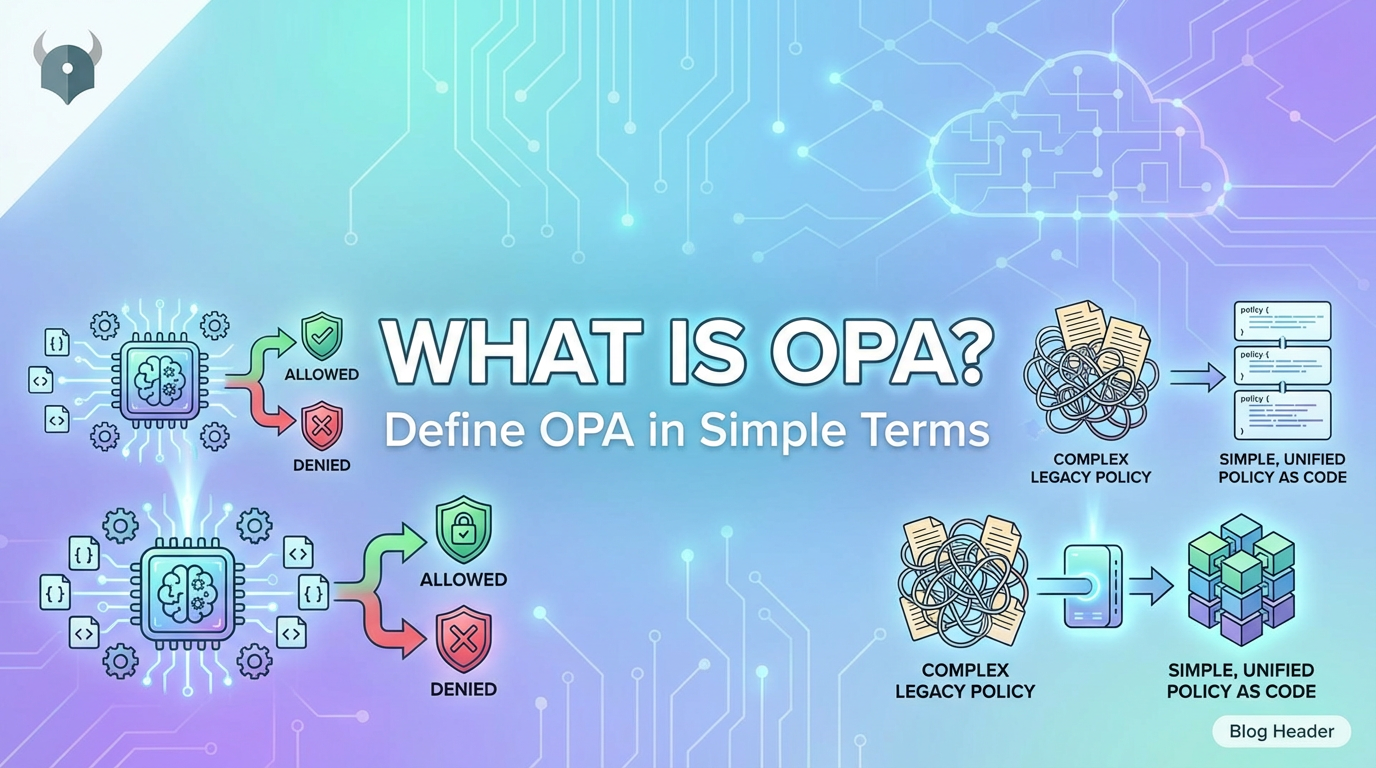
What is OPA? Define OPA in Simple Terms


The digital landscape of today is characterized by an intricate web of applications, services, and data, all interacting at unprecedented scales. Within this complex ecosystem, the need for robust, flexible, and consistent policy enforcement has become paramount. From granting access to an API endpoint to determining if a user can view a specific database record or even whether a container can be deployed in a Kubernetes cluster, policies are everywhere. Historically, these policies were often hardcoded into application logic, scattered across microservices, or managed through proprietary systems, leading to rigidity, inconsistency, and operational overhead. This is precisely the formidable challenge that the Open Policy Agent (OPA) emerges to address, offering a paradigm shift in how organizations define, manage, and enforce policies across their entire technology stack.
What is OPA? Define OPA in Simple Terms
At its core, OPA, or the Open Policy Agent, is an open-source, general-purpose policy engine that enables unified, context-aware policy enforcement across the cloud-native stack. In the simplest terms, OPA acts as a highly intelligent, external decision-maker for your software systems. Instead of embedding complex "if-then-else" logic directly into your applications, you offload all policy decisions to OPA. Your application asks OPA a question, such as "Can user Alice perform action X on resource Y?" and OPA responds with a "yes" or "no" (or a more complex decision) based on the policies it has been configured with and the data it has access to.
Think of OPA as a super-flexible bouncer at the VIP section of a club, but for your digital services. When someone tries to enter (make a request), the bouncer (your application) doesn't decide on the spot. Instead, it sends all the relevant information – who the person is, what they're trying to do, what time it is, and even who their friends are – to a central, highly knowledgeable policy expert (OPA). This expert consults a meticulously crafted rulebook (OPA policies) and various data sources (contextual data like roles, permissions, time of day) before issuing a definitive "admit" or "deny" instruction back to the bouncer. This externalization of decision-making is OPA's fundamental value proposition, providing a consistent, auditable, and scalable way to enforce policies wherever they are needed, from microservices and Kubernetes to API Gateways and CI/CD pipelines.
The power of OPA lies in its ability to decouple policy logic from application code, allowing developers to focus on core business logic while policy experts or security teams define and manage policies centrally. This separation not only streamlines development but also enhances security posture, improves auditability, and provides unparalleled flexibility to adapt to evolving compliance and business requirements without necessitating code changes and redeployments of applications themselves.
The Origin Story: Why OPA Was Created
Before OPA, managing policies was often a fragmented and inconsistent endeavor. Different services and applications within an organization would implement their own authorization logic, leading to:
- Inconsistency: Varied interpretations of policy across the organization, leading to security gaps or user frustration.
- Duplication: Developers repeatedly writing similar authorization code in different services.
- Rigidity: Policy changes required code modifications, testing, and redeployments across multiple services, slowing down innovation.
- Lack of Auditability: Difficulty in proving why a decision was made or tracking policy enforcement over time.
- Complexity at Scale: As microservices architectures proliferated, the challenge of managing authorization for hundreds or thousands of services became insurmountable.
The creators of OPA, within the cloud-native ecosystem, recognized these systemic issues. They envisioned a universal policy engine that could standardize policy enforcement, offering a single, declarative language for policies that could be applied across diverse technologies. The goal was to build a tool that could answer policy questions for any type of software, running anywhere, providing a consistent "policy layer" for the entire stack. This vision led to the development of OPA, which was later open-sourced and became a graduated project within the Cloud Native Computing Foundation (CNCF), solidifying its role as a foundational component in modern infrastructure.
Understanding OPA's Core Concepts
To truly grasp OPA's power, it's essential to delve into its foundational concepts: Policy as Code, Rego, and the Decision-Making Process. These elements combine to create a flexible, expressive, and robust policy enforcement system.
Policy as Code: The Declarative Revolution
The concept of "Policy as Code" is central to OPA's philosophy. Just as infrastructure-as-code revolutionized the provisioning of computing resources by treating infrastructure configurations as version-controlled code, Policy as Code applies the same principles to policy definitions. Instead of using GUI-based tools or disparate configuration files, policies in OPA are written in a high-level, declarative language called Rego.
Treating policies as code offers significant advantages:
- Version Control: Policies can be stored in Git repositories, allowing for versioning, change tracking, and rollbacks, just like application code. This provides a complete audit trail of policy evolution.
- Testing: Policies can be rigorously tested using automated unit and integration tests, ensuring their correctness and preventing unintended side effects before deployment. This shifts policy validation left in the development lifecycle.
- CI/CD Integration: Policies can be integrated into Continuous Integration/Continuous Delivery (CI/CD) pipelines, enabling automated deployment and enforcement alongside application deployments. This ensures that policies are always up-to-date and consistently applied.
- Collaboration: Teams can collaborate on policy development, leveraging standard development workflows like pull requests and code reviews. This fosters a shared understanding and ownership of policy definitions.
- Consistency: By defining policies in a standardized, machine-readable format, organizations ensure uniform application of rules across different services and environments, eliminating the inconsistencies that plague manual policy management.
Policy as Code transforms policy management from an ad-hoc, manual process into a structured, automated, and auditable engineering discipline, making it a critical component of modern API Governance and secure software development.
Rego: OPA's Domain-Specific Language
Rego (pronounced "ray-go") is the declarative query language specifically designed for OPA. It's not a general-purpose programming language; instead, it's optimized for expressing policies over arbitrary structured data. Rego policies are written as a set of rules that define what is allowed or denied based on the input context and external data.
Key characteristics of Rego:
- Declarative: You declare what you want to achieve (e.g., "deny access if this condition is met") rather than specifying the exact steps to achieve it.
- Data-Oriented: Rego excels at querying and transforming JSON or YAML data structures. Policies are expressed as logic over input data and predefined data within OPA.
- Logic Programming: Rego draws inspiration from logic programming languages like Datalog, using unification and backtracking to evaluate rules. This makes it powerful for complex decision-making.
- Built-in Functions: Rego includes a rich set of built-in functions for string manipulation, arithmetic, cryptographic operations, and more, allowing for sophisticated policy logic.
- Deterministic: Given the same input and policies, OPA will always produce the same decision, ensuring predictable behavior.
A simple Rego rule might look like this:
package authz

default allow = false

allow {
    input.method == "GET"
    input.path == ["users", "profile"]
    input.user == "admin"
}
In this example: * package authz: Defines the namespace for the policy. * default allow = false: Sets the default decision to deny if no other rules grant allow. * allow { ... }: Defines a rule named allow. The rule evaluates to true if all conditions within its body are met. * input.method == "GET": Checks if the HTTP method from the input request is "GET". * input.path == ["users", "profile"]: Checks if the request path is /users/profile. * input.user == "admin": Checks if the requesting user is "admin".
If all these conditions are true, the allow rule evaluates to true, and OPA would return {"allow": true}. This simple example demonstrates how Rego concisely captures complex access criteria. For API Governance, Rego can define intricate rules governing access to specific API endpoints based on roles, time, location, or even the content of the request itself.
The Decision-Making Process: How OPA Works
The decision-making process with OPA is standardized and predictable, following a clear sequence of events:
- Decision Request: An application (e.g., a microservice, an
API Gateway, or a Kubernetesapiserver) needs a policy decision. It constructs a JSON document representing the decision query, which includes all relevant information about the request (e.g., user ID, resource being accessed, action attempted, time of day). This JSON document is referred to as the "input." - OPA Evaluation: The application sends this input JSON to an OPA instance. OPA then takes this input and evaluates it against all the policies (written in Rego) that it has loaded. It also considers any external data that has been provided to it (e.g., user roles, resource ownership, environment variables).
- Policy Evaluation and Data Integration: During evaluation, Rego policies query the input JSON and the external data. Policies might look up user roles from a database extract, check an allowlist of IPs, or verify the validity of a JWT token present in the input. All this information contributes to the evaluation of the rules.
- Decision Output: Based on the evaluation of all relevant policies and data, OPA produces a JSON document as its output. This output typically contains the decision (e.g.,
trueorfalsefor authorization), along with any additional information defined by the policies (e.g., reasons for denial, allowed scopes, filtered data). - Enforcement: The requesting application receives OPA's JSON decision output. It then enforces that decision. For example, if OPA returns
{"allow": false}, the application might respond with a403 Forbiddenerror. If OPA returns filtered data, the application presents only that data to the user.
This stateless request-response model makes OPA incredibly flexible and easy to integrate into virtually any software stack. The application never needs to know how the decision was made, only what the decision is. This clean separation is fundamental to OPA's appeal.
OPA Architecture: Components and Deployment Patterns
OPA is designed to be highly flexible and can be deployed in various topologies to suit different needs and environments. Understanding its core components and common deployment patterns is crucial for effective integration.
Core Architectural Components
While OPA itself is a lightweight, single binary, its operational architecture involves several key conceptual components:
- OPA Policy Engine: This is the heart of OPA, responsible for loading policies and data, evaluating Rego queries against them, and producing decisions. It includes the Rego interpreter and an efficient data store.
- Policies (Rego Code): The set of rules written in Rego that define the desired policy behavior. These are typically loaded into the OPA engine at startup or updated dynamically.
- Data: External contextual information that OPA needs to make decisions. This can include user roles, resource attributes, configuration settings, organizational hierarchy, and more. Data can be pushed into OPA or OPA can pull it from external sources.
- Decision Requests (Input): The JSON payload sent by a client application to OPA, containing all the relevant context for a policy decision.
- Decision Responses (Output): The JSON payload returned by OPA, containing the policy decision and any other information generated by the policies.
Common Deployment Patterns
OPA's flexibility allows for several common deployment patterns, each with its own advantages and trade-offs:
- OPA as a Sidecar:
- Description: This is a prevalent pattern, especially in Kubernetes environments. An OPA instance runs as a sidecar container alongside each application service container within the same pod.
- Advantages: Ultra-low latency because OPA is co-located with the application, eliminating network hops. Policies and data can be specific to the application or shared. Simplified networking.
- Disadvantages: Increased resource consumption per pod (each pod has its own OPA instance). Policy and data synchronization across many sidecars can be complex for large-scale deployments.
- Use Cases: Microservices authorization, where each service needs fast, localized policy decisions.
- OPA as a Host-Level Daemon:
- Description: A single OPA instance runs as a daemon on each host (e.g., VM, bare metal server). Multiple applications on that host can query this central OPA instance.
- Advantages: Resource efficient (one OPA per host). Centralized policy and data management per host.
- Disadvantages: If the host-level OPA goes down, all applications on that host lose policy enforcement. Potential for slightly higher latency compared to sidecar if applications are not on the same node.
- Use Cases: Shared compute environments, host-based access control, or scenarios where applications on a host share common policy needs.
- OPA as a Centralized Service (Gateway/Service Mesh Integration):
- Description: OPA runs as a standalone service (or cluster of services) that applications query over the network. This often happens in conjunction with an
API Gatewayor a service mesh (like Istio or Linkerd). - Advantages: Highly centralized policy and data management. Reduced resource overhead per application. Ideal for enforcing consistent
API Governanceacross an entire fleet of services. - Disadvantages: Introduces network latency for each policy decision. Requires careful scaling of the OPA service to handle high query loads. Single point of failure if not properly clustered.
- Use Cases:
API Gatewayauthorization (e.g., before requests reach backend services), global policy enforcement across a service mesh, centralized access control for multiple applications. This is where products like APIPark, an open-source AI Gateway and API Management Platform, can leverage OPA for advanced, fine-grainedapiaccess control. APIPark handles the ingress and egress of AI and REST services, and OPA can provide the authorization layer for these services, ensuring that only authorized users or applications can invoke specific AI models or REST endpoints managed by APIPark.
- Description: OPA runs as a standalone service (or cluster of services) that applications query over the network. This often happens in conjunction with an
- OPA as a Library (Go SDK):
- Description: For Go applications, OPA can be embedded directly as a library, executing policies within the application's process.
- Advantages: Zero network latency, maximum performance. Simplest deployment if you only need policy enforcement within a single Go application.
- Disadvantages: Policies and data are managed per application instance. Not suitable for polyglot environments or centralized policy management across multiple services.
- Use Cases: Highly performance-sensitive Go applications that require complex internal authorization decisions.
The choice of deployment pattern depends on factors like performance requirements, architectural complexity, policy distribution needs, and existing infrastructure. Often, organizations use a hybrid approach, leveraging different patterns for different parts of their stack.
Key Benefits of Adopting OPA
The adoption of OPA brings a myriad of tangible benefits to organizations, fundamentally transforming how they approach policy enforcement and API Governance.
1. Decoupling Policy from Application Logic
This is perhaps the most significant advantage. Traditionally, authorization and other policy decisions are woven directly into application code. This entanglement creates tight coupling, making systems rigid and hard to maintain.
- Improved Maintainability: When policies change (e.g., a new role is introduced, or an access rule is updated), developers don't need to modify, re-test, and redeploy application code. They simply update the Rego policies in OPA.
- Faster Development Cycles: Developers can focus on core business logic without getting bogged down in intricate authorization rules. Security teams can manage policies independently.
- Reduced Risk of Errors: Centralized and declarative policies are less prone to subtle bugs and inconsistencies compared to distributed, imperative authorization logic across many services.
- Enhanced Agility: Organizations can respond rapidly to evolving compliance requirements, security threats, or business rule changes by adjusting policies without a full application release cycle.
2. Centralized Policy Management
OPA provides a single source of truth for policy definitions across your entire stack.
- Consistency: Ensures that the same policy logic is applied consistently across all services, platforms, and environments (e.g., staging vs. production), eliminating discrepancies and potential security vulnerabilities arising from inconsistent enforcement.
- Simplified Auditing: With policies stored as code in a version-controlled repository, it becomes straightforward to audit what policies are in effect, when they changed, and who approved the changes. This is crucial for compliance.
- Single Policy Language: Using Rego for all policy types (authorization, admission control, data filtering) reduces cognitive load for security and operations teams, promoting a unified approach.
3. Consistency and Auditability
As mentioned, OPA inherently promotes consistency by externalizing policies. Its auditability features are equally compelling.
- Decision Logging: OPA can be configured to log every policy decision it makes, including the input, the policies evaluated, and the final output. This provides a comprehensive audit trail for forensic analysis, troubleshooting, and compliance reporting.
- "Why Not?" Analysis: When a request is denied, the logged decision can include the specific rule or condition that led to the denial, providing clear insights into why access was rejected, which is invaluable for debugging and user support.
- Policy Testing: The "Policy as Code" paradigm allows for extensive unit and integration testing of policies, ensuring that they behave as expected under various scenarios, further enhancing consistency.
4. Scalability and Performance
OPA is designed for high-performance, low-latency decision-making.
- Lightweight: OPA is a single, small, static binary with minimal dependencies, making it very efficient to deploy and run.
- Optimized Evaluation: The Rego engine is highly optimized for evaluating complex policies over large datasets quickly.
- Flexible Deployment: Its diverse deployment patterns (sidecar, daemon, centralized service) allow organizations to optimize for latency or resource consumption based on specific needs. For example, a sidecar deployment offers near-zero latency, while a centralized OPA service can be scaled horizontally to handle high query volumes from many clients, much like how an
API Gatewayscales to handleapitraffic. - Incremental Updates: OPA supports incremental updates of policies and data, meaning the engine doesn't need to restart or re-evaluate everything when a small change occurs, further enhancing performance in dynamic environments.
5. Flexibility and Expressiveness
Rego's design provides unparalleled flexibility to express virtually any policy logic.
- Arbitrary Data Structures: Rego can query and make decisions based on any arbitrary JSON or YAML data structure, not just predefined schemas. This makes it adaptable to diverse applications and data models.
- Complex Logic: Rego can handle highly complex conditions, including nested queries, set operations, aggregations, and custom functions, allowing for fine-grained and sophisticated policy rules that would be cumbersome or impossible to implement with simpler access control systems.
- Multiple Decision Types: OPA is not limited to simple "allow/deny." It can return arbitrary JSON, enabling policies to filter data, transform responses, or provide context-specific configuration parameters to applications. For example, a policy might not just deny access, but instead return a filtered list of documents that a user is allowed to see, implementing data filtering at the
apilayer.
These benefits collectively empower organizations to build more secure, compliant, agile, and robust systems by providing a unified and intelligent policy enforcement layer across their entire cloud-native ecosystem.
Common Use Cases for OPA
OPA's versatility allows it to be applied across a wide spectrum of policy enforcement challenges. Its strength lies in its ability to abstract away policy decisions, making it a powerful tool for various scenarios.
1. Authorization for Microservices and APIs
This is perhaps the most canonical use case for OPA. In a microservices architecture, managing authorization for each service individually quickly becomes a nightmare. OPA provides a consistent and externalized authorization layer.
- How it works: When a client makes a request to a microservice, the service extracts relevant context (e.g., user ID, roles, requested resource, HTTP method, IP address). It then sends this context as an
inputto a local OPA instance. OPA evaluates the input against authorization policies (e.g., "only 'admin' users canPOSTto/products," or "users can only view their own data") and returns a decision. - Benefits: Decouples authorization logic from application code, ensuring consistency across services, simplifying policy updates, and improving the auditability of access decisions. This is crucial for maintaining strong
API Governancein a distributed system, ensuring everyapiadheres to defined access rules.
2. Kubernetes Admission Control
Kubernetes admission controllers intercept requests to the Kubernetes API server before objects are persisted. OPA can act as a validating or mutating admission controller.
- How it works: OPA, typically deployed as an admission controller (using
kube-mgmt), intercepts requests to the KubernetesAPIserver (e.g., trying to deploy a new pod, update a service, or create a namespace). TheAPIserver sends the entire request object (in JSON format) to OPA. OPA evaluates policies such as:- "Pods must not run as root."
- "Images must come from an approved registry."
- "All deployments must have resource limits defined."
- "Labels like
env: productionare mandatory."
- Benefits: Enforces security best practices, compliance requirements, and operational standards across all resources deployed in a Kubernetes cluster before they are created or updated. This prevents misconfigurations and enhances cluster security significantly.
3. API Gateway Authorization and API Governance
API Gateways are critical entry points for api traffic, handling routing, rate limiting, and basic authentication. OPA can extend these gateways with fine-grained, context-aware authorization.
- How it works: An
API Gateway(e.g., Kong, Envoy, Traefik, or even an AI Gateway like APIPark) receives an incomingapirequest. Before forwarding the request to a backend service, the gateway queries OPA with information about the request (e.g., request headers, URL, user identity from a JWT). OPA evaluates policies like:- "Only users with a 'premium' subscription can access the
/data/v2apiendpoint." - "Access to
/adminapis is restricted to specific IP ranges." - "Read access to
/customersapiis allowed during business hours (9-5 PM)."
- "Only users with a 'premium' subscription can access the
- Benefits: Centralizes
apiaccess policy enforcement at the edge, protecting backend services from unauthorized requests. EnhancesAPI Governanceby ensuring allapiconsumers adhere to defined access rules, improving overallapisecurity and compliance. APIPark, as an open-source AI Gateway and API Management Platform, could integrate with OPA to provide powerful, unified authorization for both traditional RESTapis and AI model invocations, streamliningapisecurity and management.
4. Data Filtering and Transformation
OPA isn't just for "allow/deny" decisions. It can also be used to filter or transform data based on policies.
- How it works: An application queries OPA with a dataset (e.g., a list of documents, database rows) and user context. OPA policies determine which parts of the data the user is authorized to see and return a filtered or transformed version of that data.
- Benefits: Enforces fine-grained data access control directly at the data layer or
apilayer, preventing sensitive information from being exposed even if an authorized user requests a broader dataset. Reduces the complexity of implementing data masking or row-level security within applications.
5. SSH/Sudo Access Control
Securing access to critical infrastructure often involves fine-grained control over SSH and sudo commands.
- How it works: OPA can integrate with
sshdorsudoto determine if a user is authorized to log in via SSH or execute a specific command withsudoprivileges. Policies might consider group membership, time of day, source IP, or specific command patterns. - Benefits: Centralizes access policies for infrastructure, enhancing security and auditability of privileged access.
6. CI/CD Pipeline Security
Automated pipelines are critical but also represent a significant attack surface. OPA can enforce security policies throughout the CI/CD process.
- How it works: OPA policies can be used to validate:
- "Only approved users can trigger deployments to production."
- "All Docker images must be scanned for vulnerabilities before deployment."
- "Configuration files for production environments must be encrypted."
- "All pull requests must be reviewed by at least two senior engineers before merge."
- Benefits: Shifts security left, catching policy violations early in the development lifecycle, preventing insecure code or configurations from reaching production, and enforcing compliance requirements for continuous delivery.
7. Network Policy Enforcement
In cloud-native environments, network policies control traffic flow between pods. OPA can dynamically generate or validate these policies.
- How it works: OPA policies define desired network connectivity rules (e.g., "frontend services can only talk to backend services," "no direct ingress from public internet to database pods"). OPA can then generate Kubernetes NetworkPolicy objects based on these high-level policies or validate existing ones.
- Benefits: Provides a more abstract and consistent way to manage network segmentation and security, ensuring that network communication adheres to organizational security posture.
This diverse range of applications underscores OPA's role as a truly universal policy engine. Its ability to externalize and standardize policy enforcement across different layers of the technology stack makes it an indispensable tool for modern, secure, and agile organizations.
Integrating OPA with Your Ecosystem
Integrating OPA effectively into your existing infrastructure is key to harnessing its full potential. The choice of integration strategy often depends on your specific needs regarding latency, scalability, and existing tooling.
OPA and API Gateways: Enhancing API Governance
API Gateways are often the first line of defense and control for an organization's apis. They handle request routing, load balancing, authentication, and often basic authorization. Integrating OPA with an API Gateway significantly enhances its authorization capabilities, moving beyond simple role-based checks to highly granular, context-aware policy enforcement.
- How it Works:
- An
apirequest arrives at theAPI Gateway. - The gateway performs initial processing (e.g., routing, rate limiting, token validation).
- Before forwarding the request to the backend service, the gateway constructs an
inputpayload containing comprehensive information about the request (HTTP method, path, headers, query parameters, user identity extracted from a JWT, client IP, etc.). - The gateway sends this
inputpayload to an OPA instance (which might be co-located or a separate service). - OPA evaluates its policies (e.g., "deny if user role is 'guest' and path is
/admin," "allow ifapikey is valid and resource owner matches user ID," "deny if request comes from a blacklisted country"). - OPA returns a decision (e.g.,
allow: trueorallow: falsewith a reason, or even a modified request). - Based on OPA's decision, the
API Gatewayeither forwards the request to the backend service or responds with an error (e.g., 403 Forbidden).
- An
- Benefits for
API Governance:- Unified Policy Enforcement: All
apis passing through the gateway are subjected to the same OPA policy engine, ensuring consistentAPI Governanceacross all controlledapis. - Fine-Grained Authorization: OPA enables highly specific authorization rules based on any attribute in the request, enhancing security far beyond what traditional gateway authorization offers.
- Dynamic Policy Updates: Policies can be updated in OPA without restarting the
API Gateway, allowing for rapid adaptation to changing security requirements. - Centralized Auditability: All authorization decisions are made by OPA, simplifying auditing and compliance reporting for
apiaccess.
- Unified Policy Enforcement: All
For platforms like APIPark, an open-source AI Gateway and API Management Platform, integrating OPA would be a powerful enhancement. APIPark already provides robust features for API lifecycle management, unified API formats, and access permissions. By leveraging OPA, APIPark could offer an even deeper level of dynamic authorization for its managed AI models and REST apis. Imagine policies like: "Only premium APIPark subscribers can invoke the high-resolution image generation AI model," or "Invocation of the sentiment analysis AI model is restricted to internal teams during peak hours." OPA would provide the declarative language and enforcement engine to implement such sophisticated API Governance rules within the APIPark ecosystem, ensuring that api usage adheres strictly to business and security policies.
OPA in Cloud-Native Environments (Kubernetes)
Kubernetes has a rich API server and extension points, making it an ideal candidate for OPA integration, especially for admission control and network policies.
- Admission Control: OPA typically runs as a validating or mutating admission webhook.
kube-mgmt, a utility provided by OPA, helps deploy OPA as a controller that watches for policy updates and pushes them to the OPA instances. When a request hits the KubernetesAPIserver, it's sent to OPA for evaluation before modifying cluster state. - Network Policies: OPA can generate Kubernetes
NetworkPolicyresources based on higher-level organizational policies, ensuring that communication between pods adheres to security best practices. - Service Mesh Integration: In service mesh environments (like Istio or Linkerd), OPA can integrate with the data plane proxies (e.g., Envoy) to enforce authorization policies for service-to-service communication. This ensures that even internal
apicalls between microservices are subject to granular authorization, strengthening the overall security posture.
APIPark is a high-performance AI gateway that allows you to securely access the most comprehensive LLM APIs globally on the APIPark platform, including OpenAI, Anthropic, Mistral, Llama2, Google Gemini, and more.Try APIPark now! 👇👇👇
Deep Dive into Rego: Advanced Concepts
While the basic Rego examples demonstrate its declarative nature, the language offers advanced constructs for expressing complex policies with precision and conciseness.
Functions and Built-ins
Rego provides a rich set of built-in functions for common operations, and you can define your own functions for reusable logic.
package example

# A custom function to check if a user is an administrator
is_admin(user) {
    user == "alice" # Alice is hardcoded as an admin for simplicity
    # In a real scenario, you'd look up roles from 'data.users'
}

# A rule that uses the custom function and a built-in function
allow {
    is_admin(input.user)
    # Built-in: Check if a string contains a substring
    contains(input.resource, "sensitive")
}
Built-in functions cover areas like: * Strings: concat, startswith, endswith, split, lower, upper. * Numbers: plus, minus, mul, div, mod, abs. * Aggregates: count, sum, max, min, avg (for iterating over collections). * Sets: intersection, union, difference. * Cryptographic: jwt.decode_verify, crypto.md5. * Networking: net.cidr_contains.
Sets and Aggregates
Rego natively supports sets, which are unordered collections of unique values. This is powerful for expressing policies involving collections of permissions, roles, or resources. Aggregates allow you to perform calculations over collections.
package users

# Data representing user roles
data.roles = {
    "alice": ["admin", "developer"],
    "bob": ["developer"],
    "charlie": ["guest"]
}

# Policy: Deny access if user is not in the required roles set
deny {
    required_roles := {"admin", "developer"}
    user_roles := data.roles[input.user]
    # Check if the intersection of required roles and user roles is empty
    count(required_roles & user_roles) == 0
}

# Policy: Allow if user has any of the allowed permissions
allow {
    allowed_permissions := {"read", "write", "execute"}
    some_permission_granted = true
    # Iterate through user's permissions and check if any are in allowed_permissions
    some permission in data.roles[input.user]
    allowed_permissions[permission]
}
The use of some keyword for iteration and the & operator for set intersection makes expressing complex collection-based logic remarkably concise.
Virtual Documents and Incremental Policy Evaluation
OPA's evaluation model is based on "virtual documents." Every rule in Rego defines a virtual document (or a part of one). When you query OPA, you're essentially asking for the value of a specific virtual document.
package example

# A virtual document representing allowed paths for admins
allowed_admin_paths = {"/techblog/en/admin/users", "/techblog/en/admin/settings"}

# A virtual document that combines access rules
allow {
    input.user == "admin"
    allowed_admin_paths[input.path] # Check if input path is in the allowed_admin_paths set
}

allow {
    input.user == "guest"
    input.path == "/techblog/en/public/info"
}
This modularity allows for incremental policy evaluation. OPA only evaluates the parts of the policy relevant to the specific query, which contributes to its performance. It also encourages breaking down complex policies into smaller, reusable virtual documents, enhancing readability and maintainability.
Rules with Multiple Heads (Partial Policies)
Rego allows rules to have multiple "heads," which is particularly useful for generating lists or sets of resources.
package policies.rbac

# Policy for what roles can access which resources
resource_access["users"] = "admin"
resource_access["products"] = "manager"
resource_access["orders"] = "sales"

# Policy that defines the resources a user can access based on their role
allowed_resources[resource] {
    user_role := data.user_roles[input.user]
    resource_access[resource] == user_role
}
If input.user is "alice" and data.user_roles.alice is "admin", then querying data.policies.rbac.allowed_resources would return {"users"}. This demonstrates how OPA can return filtered lists of resources, not just a boolean decision, making it powerful for data filtering scenarios.
These advanced features make Rego an incredibly expressive and flexible language, capable of modeling highly complex and nuanced policy requirements across diverse systems. Mastering these concepts unlocks the full potential of OPA for robust and scalable API Governance and security.
OPA vs. Traditional Authorization Approaches (RBAC, ABAC)
Before OPA, organizations typically relied on traditional authorization models like Role-Based Access Control (RBAC) and Attribute-Based Access Control (ABAC). While these models serve their purpose, OPA offers a more flexible and powerful alternative.
Role-Based Access Control (RBAC)
- Concept: Access decisions are based on the roles assigned to users. Users are assigned roles, and roles are granted permissions to resources or actions.
- Strengths: Simple to understand and implement for systems with clear, static roles. Widely adopted.
- Weaknesses:
- Role Explosion: As systems grow and become more complex, the number of roles can explode, leading to "role fatigue" and difficulty in managing them.
- Inflexibility: Struggles with fine-grained context-dependent policies (e.g., "only allow access during business hours," "only allow access from internal IPs").
- Static Nature: Roles are often coarse-grained and don't easily adapt to dynamic changes in user attributes or resource states.
Attribute-Based Access Control (ABAC)
- Concept: Access decisions are based on the attributes of the user (e.g., department, security clearance), the resource (e.g., sensitivity, owner), the environment (e.g., time of day, IP address), and the action being attempted.
- Strengths: Highly flexible and fine-grained. Can express complex, dynamic policies. Avoids role explosion.
- Weaknesses:
- Complexity: Can be difficult to design, implement, and manage due to the sheer number of attributes and potential combinations.
- Lack of Standardization: Often implemented with proprietary rule engines or custom code, leading to inconsistency and lack of portability.
- Performance: Evaluating many attributes for each request can sometimes lead to performance overhead if not carefully optimized.
OPA's Position: A Universal Policy Engine for ABAC-like Logic
OPA isn't a replacement for RBAC or ABAC; rather, it's an implementation vehicle that can enforce virtually any authorization model, including RBAC, ABAC, or even custom hybrid models. It provides the policy engine and language (Rego) to express the rules that underpin these models.
Here's how OPA compares and contrasts:
| Feature | Traditional RBAC | Traditional ABAC | OPA (Open Policy Agent) |
|---|---|---|---|
| Policy Definition | Predefined roles, static permissions | Attributes and logical rules (often custom) | Declarative Rego policies as code, external to applications. Can express any logic, including RBAC, ABAC, and hybrid models. |
| Decision Logic | Based on user's assigned roles | Based on matching attributes | Externalized, query-based evaluation against input data and loaded policies. |
| Flexibility | Low to Medium (rigid roles) | High (granular, context-aware) | Very High. Can model any context-aware logic, including time-based, location-based, content-based, and dynamic attributes. Easily adapts to evolving requirements without code changes. Ideal for complex API Governance. |
| Management | Often GUI-based, specific to application | Custom-built, fragmented | Centralized Policy as Code. Policies stored in Git, version-controlled, testable, and deployable via CI/CD. |
| Consistency | Varies across applications/systems | Often inconsistent due to custom implementations | High. Single engine, single language ensures consistent policy enforcement across the entire stack (microservices, Kubernetes, API Gateways, data layers). |
| Auditability | Depends on implementation | Difficult to audit | High. All decisions can be logged, providing clear audit trails and "why not?" explanations. Policies are version-controlled. |
| Performance | Generally good for simple checks | Can vary, may have overhead | High. Lightweight, optimized engine, supports various deployment patterns (sidecar, daemon, centralized) for latency optimization. |
| Complexity | Low for simple cases, increases with roles | High for design and implementation | Moderate. Learning Rego initially requires effort, but managing policies as code is simpler and more scalable than custom code. |
| Best Use Case | Simple applications, static roles | Highly dynamic and granular access needs | Universal. From simple RBAC to complex ABAC, and beyond. Any scenario requiring externalized, flexible, and consistent policy enforcement (e.g., microservices authorization, Kubernetes admission control, API Governance for all apis, data filtering, CI/CD policy). |
OPA essentially takes the best aspects of ABAC's flexibility and combines it with the manageability of "Policy as Code." It provides a standardized, open-source engine that can ingest any data (attributes, roles, context) and apply any logic to produce a decision, making it a superior choice for modern, complex, and distributed systems.
Getting Started with OPA: A Simple Example
To illustrate OPA's simplicity and power, let's walk through a basic "Hello, OPA!" example.
Scenario: We want to control access to a fictional api endpoint /finance/transactions. Only users in the finance group should be allowed to GET requests to this path.
Step 1: Install OPA
You can download a pre-compiled OPA binary from the official OPA GitHub releases page or use Docker. For a quick start:
# On Linux/macOS
curl -L -o opa https://openpolicyagent.org/downloads/v0.60.0/opa_darwin_amd64 # Replace with your OS and architecture
chmod 755 ./opa

# Verify installation
./opa version
Step 2: Write a Policy (Rego)
Create a file named policy.rego with the following content:
package api.authz

# By default, deny access
default allow = false

# Rule to allow access
allow {
    input.method == "GET"
    input.path == ["finance", "transactions"]
    "finance" in input.groups # Check if "finance" group is in the input groups list
}
Step 3: Define Input Data (Decision Request)
Create a file named input.json representing an incoming api request:
{
  "method": "GET",
  "path": ["finance", "transactions"],
  "user": "alice",
  "groups": ["finance", "marketing"]
}
Step 4: Query OPA for a Decision
Now, run OPA in server mode and query it.
# Start OPA in server mode, loading the policy
./opa run --server --config-file config.yaml &

# Create a config.yaml to load the policy
# config.yaml
# ---
# decision_logs:
#   console: true
# policies:
#   - path: policy.rego
#

# Query OPA with the input.json
curl -X POST -d @input.json http://localhost:8181/v1/data/api/authz/allow
Alternatively, you can query OPA directly from the command line without starting a server for quick testing:
./opa eval -i input.json -d policy.rego "data.api.authz.allow"
Step 5: Observe the Output
For the input.json provided, OPA's output will be:
{
  "result": true
}
This true indicates that access is allowed based on our policy.
What if the user is not in the finance group? Let's modify input.json:
{
  "method": "GET",
  "path": ["finance", "transactions"],
  "user": "bob",
  "groups": ["marketing"]
}
Querying again:
./opa eval -i input.json -d policy.rego "data.api.authz.allow"
Output:
{
  "result": false
}
OPA correctly denies access because "bob" is not in the finance group.
This simple example demonstrates the fundamental workflow: provide OPA with policies and input, and it returns a decision. Scaling this to thousands of policies and integrating it with complex systems like an API Gateway or Kubernetes admission controllers is where OPA truly shines. It centralizes the decision-making logic, making policy enforcement consistent, auditable, and decoupled from your application's core logic, thereby enhancing your overall API Governance strategy.
Best Practices for OPA Policies
To get the most out of OPA and ensure your policies are maintainable, performant, and secure, consider these best practices:
- Treat Policies as Code:
- Version Control: Store all Rego policies in a Git repository. This enables versioning, change tracking, and rollback capabilities.
- CI/CD Integration: Integrate policy testing and deployment into your existing CI/CD pipelines. This automates policy updates and ensures consistent enforcement.
- Code Reviews: Implement a peer review process for policy changes, just like application code, to catch errors and ensure alignment with
API Governanceand security standards.
- Modularize Policies:
- Small, Focused Files: Break down large policies into smaller, logically grouped Rego files (e.g.,
authorization.rego,admission_control.rego,data_filtering.rego). - Packages and Imports: Use Rego packages to organize rules and
importstatements to reuse common helper rules or data across different policies. - Virtual Documents for Reusability: Leverage virtual documents (rules that define data) to encapsulate reusable logic or computed values that can be referenced by multiple other rules.
- Small, Focused Files: Break down large policies into smaller, logically grouped Rego files (e.g.,
- Write Testable Policies:
- Unit Tests: Write comprehensive unit tests for your Rego policies using OPA's built-in testing framework. This ensures that policies behave as expected under various input scenarios.
- Mock Data: Use mock
inputanddatain your tests to simulate real-world conditions without relying on live systems. - Edge Cases: Test for edge cases, including valid inputs, invalid inputs, missing attributes, and scenarios that should explicitly deny access.
- Manage External Data Effectively:
- Push Data vs. Pull Data: Decide whether your application pushes data to OPA with each query or if OPA pulls data from external sources. For frequently changing or large datasets, pushing data with each query is often more efficient. For static or slowly changing data (e.g., user roles, configuration), OPA can pull data periodically.
- Data Consistency: Ensure that the data OPA relies on is consistent and up-to-date. Implement robust mechanisms for data synchronization.
- Minimize Data: Only provide OPA with the minimum necessary data to make a decision. Avoid sending entire databases.
- Secure Your OPA Deployment:
- Network Security: Restrict network access to OPA instances. Only trusted clients should be able to query OPA.
- TLS/SSL: Encrypt communication between clients and OPA using TLS/SSL.
- Decision Logging: Enable and secure OPA's decision logging to provide an immutable audit trail for compliance and forensic analysis. Ensure logs are forwarded to a secure, centralized logging system.
- Least Privilege: Configure OPA and its data sources with the principle of least privilege.
- Design for Performance:
- Efficient Rego: Write efficient Rego queries. Avoid overly broad iterations or complex joins unless absolutely necessary.
- Deployment Strategy: Choose the appropriate deployment pattern (sidecar, daemon, centralized) based on your latency requirements and resource constraints.
- Caching: Consider caching policy decisions at the application or
API Gatewaylevel for frequently requested, static decisions to reduce OPA query load.
- Clear Default Decisions:
- Always define a
default allow = falseordefault deny = trueat the package level. This ensures that if no specific rule matches, a predictable and secure default decision is made. For authorization,default denyis generally the safer choice.
- Always define a
- Provide Contextual Error Messages:
- Instead of just
true/false, enrich OPA's output with reasons for denial or specific permissions granted. This greatly helps in debugging and user experience. - Example:
deny_reason = "User not in required 'finance' group"
- Instead of just
By adhering to these best practices, organizations can build a robust, scalable, and secure policy enforcement system with OPA that effectively supports their evolving security, compliance, and API Governance requirements.
Challenges and Considerations
While OPA offers immense benefits, its adoption also comes with certain challenges and considerations that organizations should be aware of.
- Learning Curve for Rego:
- New Language: Rego is a domain-specific language (DSL) with a declarative, logic programming paradigm. Developers and security engineers unfamiliar with such languages might face an initial learning curve.
- Mindset Shift: Moving from imperative authorization logic to declarative policy definitions requires a change in thinking.
- Mitigation: Provide comprehensive training, leverage official OPA documentation and tutorials, and start with simple policies before tackling complex ones. Over time, the benefits of Rego's expressiveness outweigh the initial learning investment.
- Data Management and Synchronization:
- External Data Dependency: OPA's decisions are only as good as the data it receives. Managing and synchronizing external data (e.g., user roles, resource ownership, environment variables) can be complex, especially in large, dynamic environments.
- Data Staleness: Ensuring OPA always has the freshest data without impacting performance is a critical challenge.
- Mitigation: Implement robust data pipelines to push or pull data into OPA. Use OPA's bundle feature for distributing policies and data efficiently. For highly dynamic data, consider pushing relevant attributes directly in the
inputquery.
- Performance Tuning and Latency:
- Network Hops: When OPA runs as a centralized service, each policy decision involves a network round trip, which can introduce latency.
- Policy Complexity: Extremely complex Rego policies or those querying very large datasets can impact evaluation time.
- Mitigation: Choose appropriate deployment patterns (sidecar for low latency, centralized for scalability). Optimize Rego policies for efficiency. Leverage caching at the client application or
API Gatewaylayer for frequently accessed, static decisions. Monitor OPA's performance closely.
- Policy Governance and Lifecycle:
- Centralized vs. Decentralized Policy Ownership: Deciding who owns and maintains policies (central security team, individual service teams, or a hybrid model) can be a challenge.
- Policy Evolution: Managing policy changes, testing new versions, and rolling them out without disrupting services requires a mature
API Governanceprocess. - Mitigation: Establish clear ownership models. Implement robust CI/CD pipelines for policies. Use OPA's testing framework extensively. Consider using policy registries or management tools to help visualize and manage policy sprawl.
- Debugging and Troubleshooting:
- "Why Not?" Debugging: Understanding why a specific policy decision was made (especially a denial) can sometimes be tricky.
- Rego Trace: Debugging complex Rego logic requires understanding its evaluation model.
- Mitigation: Utilize OPA's decision logging and trace capabilities. Structure policies clearly with comments. Add explicit
denyrules withdeny_reasonto provide clear messages. Theopa eval --explaincommand is invaluable for understanding evaluation paths.
- Integration Complexity:
- Application Modifications: While OPA decouples policy logic, applications still need to be modified to query OPA for decisions. This integration effort can be significant for legacy systems.
- Ecosystem Specifics: Integrating OPA with various technologies (Kubernetes,
API Gateways, specific databases, custom applications) requires understanding the unique integration patterns for each. - Mitigation: Plan integration efforts carefully. Leverage existing OPA integrations (e.g.,
kube-mgmt, Envoyext_authz). Start with new applications or those undergoing refactoring.
Addressing these challenges proactively through careful planning, robust engineering practices, and continuous learning will enable organizations to maximize the benefits of OPA and successfully implement a unified, intelligent policy enforcement framework.
Conclusion
The Open Policy Agent (OPA) represents a pivotal advancement in how organizations manage and enforce policies across their increasingly complex and distributed digital infrastructure. By externalizing policy decision-making from application logic and consolidating it within a single, universal engine, OPA tackles the pervasive challenges of inconsistency, rigidity, and lack of auditability that have long plagued traditional authorization and governance systems.
Through its powerful declarative language, Rego, OPA empowers developers, security engineers, and operations teams to define policies as code, unlocking the benefits of version control, automated testing, and CI/CD integration. This "Policy as Code" paradigm is not merely a technical detail; it is a fundamental shift that fosters collaboration, accelerates development cycles, and significantly enhances an organization's security posture and API Governance capabilities.
Whether it's orchestrating authorization for a fleet of microservices, ensuring strict admission control in Kubernetes, providing fine-grained access to an API Gateway – such as the capabilities it could offer for APIPark, an open-source AI Gateway and API Management Platform – or filtering sensitive data at the api layer, OPA offers a flexible, scalable, and auditable solution. It bridges the gap between the static constraints of RBAC and the implementation complexities of ABAC, providing a sophisticated yet manageable framework that can enforce virtually any policy requirement across any part of your technology stack.
Adopting OPA is more than just implementing a new tool; it's embracing a philosophy of consistent, centralized, and intelligent policy enforcement. While it introduces a learning curve for Rego and requires careful consideration of data management and deployment strategies, the long-term benefits of enhanced security, improved agility, and streamlined operations make OPA an indispensable component for any organization navigating the intricacies of the modern cloud-native landscape. As applications grow more distributed and regulatory demands intensify, OPA stands as a beacon, guiding organizations towards a future where policies are no longer a hindrance but a powerful enabler of innovation and trust.
Frequently Asked Questions (FAQs)
1. What is the main problem OPA solves? OPA solves the problem of inconsistent, fragmented, and hard-to-manage policy enforcement across disparate software systems. Traditionally, authorization and other policy decisions are embedded directly into application code, leading to duplicated logic, inflexibility, and difficulty in auditing. OPA externalizes these decisions into a central, declarative policy engine, allowing policies to be defined, tested, and enforced consistently across microservices, Kubernetes, API Gateways, data layers, and more, significantly improving API Governance and security posture.
2. Is OPA an Authorization solution or something else? OPA is fundamentally a general-purpose policy engine. While its most common use case is authorization (i.e., "who can do what on which resource?"), it is not limited to authorization. OPA can be used for any policy decision, such as Kubernetes admission control, data filtering, network policy enforcement, API Governance rules, CI/CD pipeline validation, and more. It provides the mechanism to evaluate rules against any input data and return a decision, making it highly versatile for various policy types.
3. What is Rego, and why is it used instead of a more common language like Python or Java? Rego is OPA's high-level, declarative query language designed specifically for expressing policies over arbitrary structured data (like JSON or YAML). It's used instead of general-purpose languages because it's optimized for policy evaluation: * Declarative Nature: You state what the policy is, not how to implement it, which leads to more concise and readable policies. * Data-Oriented: Excels at querying and pattern matching on data structures. * Logic Programming: Its foundations in logic programming make it powerful for complex decision-making and constraint satisfaction. * Deterministic: Ensures predictable outcomes for policy evaluations. Using a DSL like Rego keeps policies separate from application code concerns, enhancing security, auditability, and testability.
4. How does OPA typically integrate with existing applications or an API Gateway? OPA integrates by acting as an external decision-maker. * For Applications/Microservices: An application sends a JSON "input" (containing request context like user, resource, action) to a running OPA instance (often as a sidecar or daemon). OPA evaluates the input against its policies and returns a JSON decision, which the application then enforces. * For API Gateways: When an api request arrives at the API Gateway (e.g., APIPark, Kong, Envoy), the gateway extracts relevant request details and sends them as input to OPA. OPA returns an allow/deny decision, or even filtered data, and the gateway acts accordingly (e.g., forwards the request or returns a 403 Forbidden). This offloads complex authorization to OPA, enhancing the gateway's API Governance capabilities.
5. What are the main benefits of using OPA over traditional RBAC or ABAC systems? OPA offers several key advantages over traditional RBAC (Role-Based Access Control) or custom ABAC (Attribute-Based Access Control) implementations: * Universal Policy Engine: OPA can enforce any policy model (RBAC, ABAC, custom) using a single, consistent language (Rego) across the entire stack. * Policy as Code: Policies are stored in version control, enabling automated testing, CI/CD deployment, and collaboration, leading to higher quality and more auditable policies. * Decoupling: Policy logic is completely externalized from application code, reducing complexity, accelerating development, and improving maintainability. * Flexibility and Granularity: Rego allows for extremely fine-grained, context-aware policy decisions based on any arbitrary attributes, far exceeding the capabilities of simple RBAC. * Consistency and Auditability: Ensures uniform policy enforcement across all services and provides detailed decision logs for compliance and debugging.
🚀You can securely and efficiently call the OpenAI API on APIPark in just two steps:
Step 1: Deploy the APIPark AI gateway in 5 minutes.
APIPark is developed based on Golang, offering strong product performance and low development and maintenance costs. You can deploy APIPark with a single command line.
curl -sSO https://download.apipark.com/install/quick-start.sh; bash quick-start.sh

In my experience, you can see the successful deployment interface within 5 to 10 minutes. Then, you can log in to APIPark using your account.

Step 2: Call the OpenAI API.