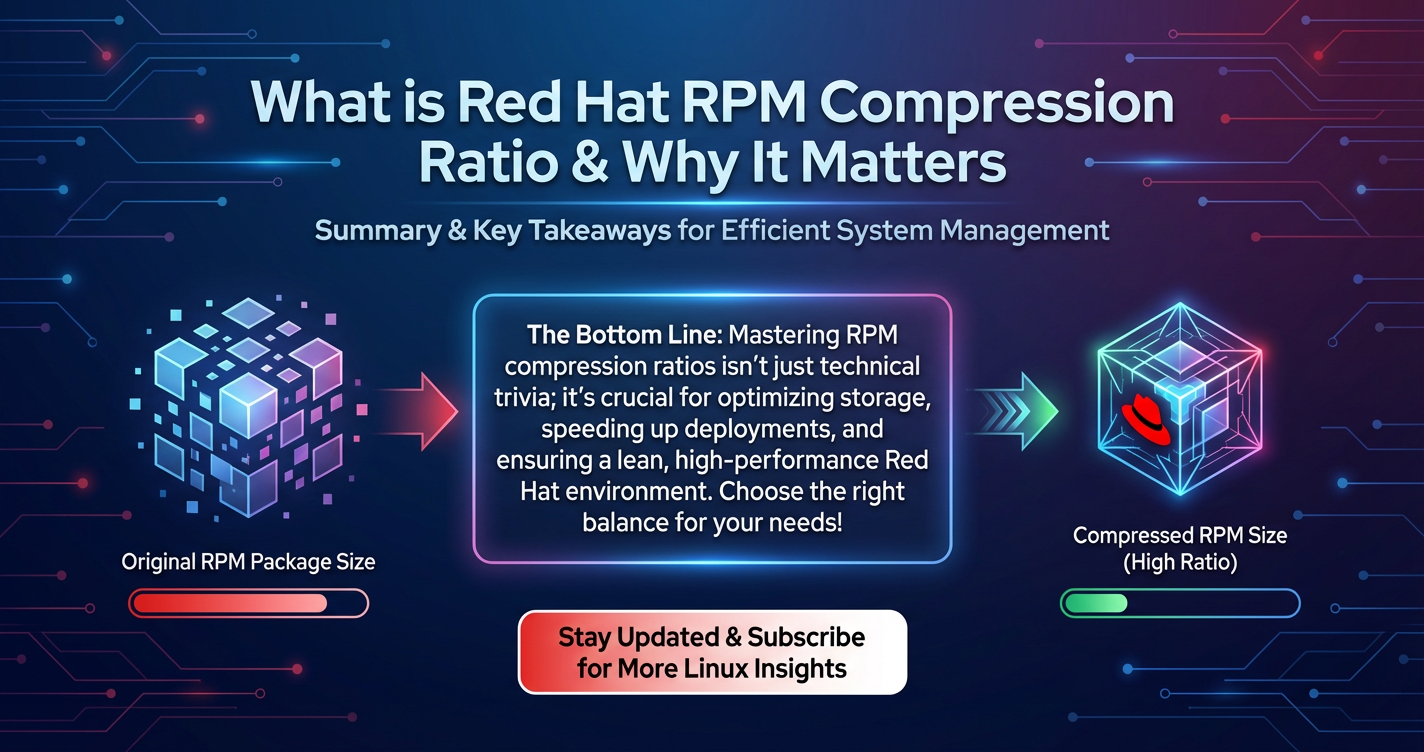
What is Red Hat RPM Compression Ratio & Why It Matters


In the intricate tapestry of modern computing, where software forms the very bedrock of our digital existence, seemingly minor technical details often hold profound implications for performance, cost, and overall operational efficiency. Among these vital yet often overlooked elements is the Red Hat RPM compression ratio. For anyone deeply involved with Red Hat Enterprise Linux (RHEL), Fedora, CentOS, or any of their derivatives – from system administrators and DevOps engineers to application developers and cloud architects – understanding the nuances of how packages are compressed is not merely an academic exercise; it is a fundamental insight into optimizing system performance, streamlining deployment pipelines, and ultimately, reducing operational expenditure.
The Red Hat Package Manager (RPM) stands as a venerable and robust pillar of software distribution within the Linux ecosystem, particularly for systems steeped in enterprise-grade stability and reliability. When software is packaged into an RPM, it’s not just bundled; it’s systematically compressed. This compression is not an arbitrary step but a deliberate engineering decision designed to address a multitude of challenges inherent in software distribution. From minimizing storage footprints on servers and client machines to accelerating download times across vast global networks, the compression ratio achieved by an RPM package directly influences a spectrum of critical factors that collectively define the efficiency and responsiveness of an entire IT infrastructure.
The core essence of compression lies in its ability to reduce the physical size of data without sacrificing its integrity. For RPMs, this means transforming gigabytes of raw files—binaries, libraries, configuration scripts, documentation, and more—into significantly smaller, more manageable units. The "compression ratio" quantifies this reduction, indicating how much original data has been shrunk. A higher ratio signifies greater space savings, but this often comes with trade-offs in terms of the computational resources (CPU and memory) required for both the compression process during package creation and the decompression process during installation. Red Hat, with its unwavering commitment to delivering reliable and performant operating systems, meticulously evaluates these trade-offs, choosing specific compression algorithms and levels that best serve the demanding needs of its diverse user base.
This comprehensive exploration will delve into the very heart of RPM compression, dissecting the underlying technologies, examining the various compression algorithms employed, and meticulously detailing why the resulting compression ratio is far more than just a technical metric. We will uncover its pervasive impact on storage costs, network bandwidth utilization, system performance, and the overarching developer and operational experience within the Red Hat ecosystem. By the end of this journey, it will become abundantly clear that the seemingly mundane technicality of RPM compression ratio is, in fact, a cornerstone of efficient, scalable, and cost-effective software deployment in today's increasingly complex and interconnected digital landscape.
The Foundation – Understanding Red Hat Package Manager (RPM)
To truly appreciate the significance of compression within the Red Hat ecosystem, one must first grasp the fundamental role and intricate workings of the Red Hat Package Manager (RPM). Far more than just a simple installer, RPM is a powerful, open-source package management system that has served as the backbone for Red Hat Enterprise Linux (RHEL), Fedora, CentOS, AlmaLinux, Rocky Linux, and numerous other distributions for decades. Its enduring presence underscores its robust design and its effectiveness in addressing the complex challenges of software distribution, installation, upgrade, and removal.
The Genesis and Purpose of RPM
RPM was initially developed by Red Hat in 1997, born out of a necessity to standardize software installation and management on Linux systems. Before RPM, installing software often involved a tedious, error-prone manual compilation from source code, a process fraught with dependency hell and configuration nightmares. RPM revolutionized this by providing a unified, coherent, and reliable mechanism for packaging and distributing software. Its primary purpose is to simplify the management of software packages, ensuring consistency, maintainability, and security across an entire system or fleet of systems.
Key Functionalities that Define RPM's Robustness
RPM’s capabilities extend far beyond mere installation. It offers a suite of functionalities that make it indispensable for system administrators and developers alike:
- Installation and Upgrade: At its core, RPM allows for the seamless installation of new software packages and the upgrading of existing ones. It intelligently handles file placement, permissions, and configuration, ensuring that software integrates correctly with the operating system. When upgrading, RPM can preserve configuration files and manage package dependencies to minimize disruption.
- Querying and Verification: RPM provides powerful tools to query detailed information about installed packages, such as their version, release, origin, and installed files. This is invaluable for auditing systems, troubleshooting, and ensuring compliance. Furthermore, it can verify the integrity of installed packages by comparing file checksums and metadata against the original package information, detecting any unauthorized modifications or corruption.
- Dependency Management: One of RPM's most critical features is its ability to manage software dependencies. Most complex applications rely on other libraries or utilities. RPM automatically identifies and resolves these dependencies, ensuring that all necessary components are present before an installation or upgrade proceeds. This prevents the frustrating "dependency hell" scenarios common in manual installations.
- Uninstallation (Erase): Just as it facilitates installation, RPM also provides a clean and complete method for removing software. It tracks all files installed by a package, allowing for their systematic removal without leaving behind orphaned files or configuration clutter that can accumulate over time.
- Building Packages: RPM is not just a consumer of packages; it's also a powerful tool for package creation. Developers can use RPM to define how their software should be built, packaged, and installed, ensuring that their applications conform to system standards and can be easily distributed. This involves creating a
.specfile that outlines metadata, build instructions, installation steps, and file lists.
The Structure of an RPM Package
An RPM package (.rpm file) is essentially an archive that encapsulates everything needed for a piece of software. It consists of two main parts:
- Metadata: This header section contains crucial information about the package, such as its name, version, release, architecture, description, dependencies (requires, provides, conflicts), and digital signature. This metadata is what
rpmcommands query and use for dependency resolution and verification. Importantly, it also specifies the compression algorithm used for the payload. - Payload: This is the actual archive containing the files that will be extracted and installed onto the system. This includes binaries, libraries, documentation, configuration files, and scripts. The payload is where the compression occurs, making the physical
.rpmfile smaller.
RPM as the Backbone of Enterprise Linux
For distributions like RHEL, RPM is more than just a utility; it's the very foundation upon which the entire operating system is built and maintained. Every component, from the kernel to the smallest utility, is distributed and managed as an RPM package. This standardized approach offers several immense benefits:
- Consistency: It ensures that software is installed in a predictable manner across all systems, which is crucial for large-scale deployments and maintaining uniform environments.
- Reliability: The dependency resolution and integrity verification mechanisms enhance system stability and reduce the likelihood of broken installations.
- Security: RPMs are digitally signed by Red Hat (or other vendors), allowing users to verify the authenticity and integrity of packages, guarding against tampering and unauthorized software. This is critical for enterprise security posture.
- Ease of Management: System administrators can manage hundreds or thousands of packages with simple commands, automating updates and deployments efficiently. This is particularly vital in cloud environments and large data centers where rapid provisioning and patching are commonplace.
The robustness and versatility of RPM have cemented its status as a critical technology. However, the sheer volume of software and its distribution across diverse network conditions necessitate efficient packaging. This is precisely where data compression enters the picture, transforming what could be unwieldy collections of files into compact, network-friendly bundles. Without effective compression, the benefits of a powerful package manager like RPM would be significantly diminished by the practical challenges of storage and bandwidth.
The Science of Compression – Principles and Algorithms
At its core, data compression is an ingenious method for reducing the number of bits required to represent information. For RPM packages, this science is not about removing data permanently but rather about efficiently re-encoding it to take up less space. This process is categorized as lossless compression, meaning that the original data can be perfectly reconstructed from the compressed version, without any loss of information—a critical requirement for executable binaries, libraries, and configuration files where even a single altered bit could render software unusable.
Basic Principles of Lossless Compression
Lossless compression algorithms primarily achieve their goal by identifying and exploiting redundancies within data. The more repetitive or predictable the data, the higher the compression ratio typically achieved. Key principles include:
- Redundancy Removal: Much of the data we encounter, especially in software packages, contains repeated patterns, sequences, or values. For example, a text file might have many occurrences of common words, or a binary file might have long stretches of zeros or repeating instruction sets. Compression algorithms detect these repetitions and replace them with shorter references.
- Statistical Encoding (Entropy Encoding): This involves assigning shorter codes to frequently occurring data elements and longer codes to less frequent ones. Huffman coding and arithmetic coding are classic examples. By leveraging the statistical properties of the data, the overall bit representation can be minimized.
- Dictionary-Based Compression: Algorithms like LZ77 and LZ78 (the basis for
gzip's DEFLATE) work by maintaining a "dictionary" of previously encountered data sequences. When a repeated sequence is found, it's replaced with a pointer to its entry in the dictionary, which is much shorter than repeating the sequence itself.
Common Compression Algorithms Relevant to RPMs
Over the years, various compression algorithms have been adopted and refined for use in package management systems. Each algorithm represents a different trade-off between compression ratio, compression speed, decompression speed, and memory usage. Red Hat, in its various distributions, has strategically shifted between these algorithms to optimize for different priorities.
1. Gzip (DEFLATE)
- History and Mechanism:
gzip(GNU zip) is one of the oldest and most widely adopted lossless data compression utilities. It uses the DEFLATE algorithm, which is a combination of LZ77 and Huffman coding. DEFLATE is renowned for its speed, both in compression and decompression, making it a general-purpose choice. - Pros:
- Fast: Very quick for both compressing and decompressing data.
- Low Memory Usage: Requires relatively little memory, making it suitable for systems with limited resources.
- Ubiquitous: Nearly universally supported across operating systems and tools.
- Cons:
- Moderate Compression Ratio: While good, it generally doesn't achieve the highest compression ratios compared to newer algorithms.
- RPM Context: Historically,
gzipwas the default compression for RPM payloads. It remains common for many packages due to its speed and widespread compatibility.
2. Bzip2 (Burrows-Wheeler Transform)
- History and Mechanism:
bzip2was developed as an improvement overgzip, specifically aiming for better compression ratios. It uses the Burrows-Wheeler transform (BWT) to rearrange the input data, making it more amenable to compression by subsequent move-to-front (MTF) transformation and Huffman coding. BWT is excellent at grouping similar characters together, thus enhancing redundancy for the entropy encoder. - Pros:
- Better Compression Ratio than Gzip: Typically achieves 10-15% better compression than
gzipfor many file types.
- Better Compression Ratio than Gzip: Typically achieves 10-15% better compression than
- Cons:
- Slower: Significantly slower than
gzipfor both compression and decompression. - Higher Memory Usage: Requires more memory, particularly during decompression.
- Slower: Significantly slower than
- RPM Context:
bzip2was adopted by some distributions and for specific RPM payloads when greater space savings were prioritized, especially for larger packages where the download time was a significant factor.
3. XZ (LZMA2)
- History and Mechanism:
xzuses the LZMA2 algorithm, which is an improved version of LZMA (Lempel–Ziv–Markov chain algorithm). LZMA2 is known for its highly sophisticated dictionary-based compression combined with range encoding. It is designed to achieve very high compression ratios, often outperformingbzip2significantly. - Pros:
- Highest Compression Ratio: Often delivers the best compression ratios among commonly used algorithms, especially for large, repetitive files.
- Good Decompression Speed (for its ratio): While compression is slow, decompression is relatively faster than compression, making it acceptable for installation on client machines.
- Cons:
- Slowest Compression: Compression can be extremely slow, making package building a lengthy process.
- Highest Memory Usage: Both compression and decompression can require substantial amounts of RAM.
- RPM Context:
xzbecame the default payload compression for Fedora and subsequently RHEL (starting with RHEL 6) due to its superior compression ratio, which dramatically reduced package sizes and download times, despite the increased CPU overhead during installation. This was a strategic choice to optimize for network bandwidth and storage.
4. Zstandard (Zstd)
- History and Mechanism:
zstdis a relatively new compression algorithm developed by Facebook (now Meta) in 2016. Its design goal was to strike an excellent balance between compression ratio and speed, often outperforminggzipandbzip2in speed while achieving compression ratios comparable to or even better thanxzat similar speed levels (or better speed at similar ratio levels). It uses a dictionary-based approach, combining state-of-the-art techniques. - Pros:
- Excellent Balance: Offers a superior balance of compression speed, decompression speed, and compression ratio. It can be tuned across a wide range of levels to prioritize speed or ratio.
- Very Fast Decompression: Often significantly faster than
gzip,bzip2, andxzfor decompression. - Good Compression Ratio: Can achieve ratios competitive with
xzat higher settings, or better thangzip/bzip2at faster settings.
- Cons:
- Newer Adoption: While gaining traction rapidly, it might not be as universally supported as
gzipin older systems or specialized environments.
- Newer Adoption: While gaining traction rapidly, it might not be as universally supported as
- RPM Context:
zstdis increasingly being adopted in newer Linux distributions like Fedora for various components (e.g., kernel modules, specific packages) due to its impressive performance characteristics. Its ability to provide excellent ratios with significantly faster decompression makes it highly attractive for modern systems where fast deployments and minimal CPU impact during installation are priorities.
Compression Levels and Their Impact
Most compression algorithms allow for different "compression levels," typically on a scale from 1 to 9 (or higher for zstd). * Lower levels (e.g., 1): Prioritize speed over compression ratio. The algorithm spends less time searching for optimal patterns. * Higher levels (e.g., 9): Prioritize a higher compression ratio over speed. The algorithm invests more computational effort to find the most efficient encoding.
Red Hat package maintainers carefully select both the algorithm and the compression level for RPMs, based on factors like the typical size of the package, how frequently it's updated, its importance, and the expected system resources of the target environment. This deliberate choice ensures that the resulting RPM compression ratio aligns with Red Hat's overall performance and distribution goals. The ongoing evolution of these choices reflects a continuous effort to squeeze out every possible efficiency from the software delivery pipeline.
Decoding the RPM Compression Ratio – What It Means
The "compression ratio" is a fundamental metric that quantifies the effectiveness of any data compression process. For Red Hat RPM packages, understanding this ratio goes beyond mere numbers; it’s about grasping the practical implications for storage, network, and computational resources. While often expressed in percentages or as a ratio, its true meaning lies in the balance it strikes between package size and the performance costs associated with achieving that size.
Defining Compression Ratio
The compression ratio can be expressed in a few ways, but conceptually it always relates the original size of the data to its compressed size:
- Ratio (Original Size / Compressed Size): If a 100MB file compresses to 25MB, the ratio is 100/25 = 4:1. This means the original file was four times larger than the compressed file. A higher number indicates better compression.
- Percentage Reduction: (1 - (Compressed Size / Original Size)) * 100%. Using the same example, (1 - (25/100)) * 100% = 75%. This indicates that the file size was reduced by 75%. A higher percentage means more reduction.
In the context of RPM, a higher compression ratio means a smaller .rpm file, which has immediate benefits for distribution and storage. However, achieving a high compression ratio usually requires more CPU time during the package build (compression) and potentially more CPU and memory during installation (decompression).
Factors Influencing the RPM Compression Ratio
The compression ratio isn't a fixed value; it's highly dependent on several dynamic factors, both intrinsic to the data and chosen by the packager:
- Nature of the Data within the Package:
- Text Files (Source Code, Documentation, Configuration Files): Text files often contain high levels of redundancy (repeated words, common phrases, whitespace, structured syntax). As a result, they typically compress very well, often achieving ratios of 70-90% reduction.
- Binary Executables and Libraries: These files also contain redundancies, such as repeated sequences of machine instructions, constant data, or padding. They generally compress well, though often slightly less efficiently than pure text, achieving reductions of 40-70%.
- Images, Audio, Video (if included in an RPM): These media types are often already compressed using specialized lossy algorithms (like JPEG, MP3, MP4). Attempting to losslessly compress them further yields very little, if any, additional reduction, and can sometimes even slightly increase file size due to the overhead of the compression format itself. RPMs typically don't include large amounts of already compressed media, but if they did, their contribution to the overall package compression ratio would be minimal.
- Archived Files within Archives: If an RPM payload contains
.tar.gz,.zip, or other compressed archives, the ability to compress these further is limited. The compression algorithm will attempt to work on the already compressed data, which is largely random-looking to a general-purpose compressor and thus offers little new redundancy to exploit. - Random Data: Purely random data (e.g., cryptographic keys, some types of generated data) is inherently incompressible by lossless algorithms, as there are no patterns or redundancies to exploit.
- Redundancy within the Package Files: The core principle of lossless compression is exploiting redundancy. If a package contains many identical or very similar files, or files with large blocks of repeated data, the compression algorithm will be highly effective. Conversely, a package composed of highly distinct, non-repetitive files will exhibit a lower compression ratio.
- Chosen Compression Algorithm: As discussed in the previous section, different algorithms have varying capabilities:
gzip: Good, general-purpose ratio, fast.bzip2: Better ratio thangzip, slower.xz: Best ratio, slowest compression, good decompression for its ratio.zstd: Excellent balance, potentially very fast decompression, competitive ratios. The choice of algorithm has the most significant impact on the theoretical maximum compression achievable for a given payload.
- Compression Level: Within each algorithm, the selected compression level directly impacts the ratio. A higher level instructs the compressor to spend more CPU cycles searching for optimal compression opportunities, leading to a smaller file size but taking longer. Red Hat typically chooses a sensible default level that balances build time, package size, and installation time.
How to Check Compression Information for an RPM
System administrators and developers can inspect the compression details of an RPM package using standard rpm commands. This is particularly useful for understanding why a package might be larger or smaller than expected, or for comparing packages from different sources.
To find out which compression algorithm was used for an RPM's payload, you can use the rpm -qp command with a specific queryformat:
rpm -qp --queryformat '%{PAYLOADCOMPRESSOR}\n' /path/to/your/package.rpm
This command will output the name of the compressor, such as xz, gzip, bzip2, or zstd. This information is crucial for understanding the performance characteristics of that particular package during download and installation.
For example: * If it outputs xz, you know the package likely has a very small file size but might take a bit longer to decompress during installation. * If it outputs gzip, it suggests a faster decompression time but potentially a larger file size.
Illustrative Examples of Compression Ratios
To put this into perspective, consider a hypothetical RPM package containing various types of files:
| File Type | Original Size | Compressed Size (e.g., with xz) |
Compression Ratio (Original/Compressed) | Percentage Reduction | Notes |
|---|---|---|---|---|---|
| Source Code (C/Python) | 50 MB | 8 MB | 6.25:1 | 84% | High redundancy in text, comments, repeated syntax. |
| Binary Executables/Libraries | 100 MB | 40 MB | 2.5:1 | 60% | Some redundancy in machine code, data sections. |
| Plain Text Documentation | 10 MB | 1.5 MB | 6.67:1 | 85% | Highly compressible, common words and structures. |
| Pre-compressed Assets (JPEG) | 20 MB | 19 MB | 1.05:1 | 5% | Already compressed, minimal further gains. |
| Configuration Files (YAML) | 5 MB | 0.8 MB | 6.25:1 | 84% | Structured text, good redundancy. |
| Total Package | 185 MB | 69.3 MB | 2.67:1 (Overall) | 62.5% | Overall ratio is an average influenced by all components. |
Note: These are illustrative figures and actual ratios vary widely based on specific content and compression levels.
Understanding these factors allows administrators to make informed decisions when managing package repositories, planning deployments, or troubleshooting performance bottlenecks. A high RPM compression ratio is a strategic advantage, minimizing the digital footprint of software and enabling more efficient operations across the entire Red Hat ecosystem.
APIPark is a high-performance AI gateway that allows you to securely access the most comprehensive LLM APIs globally on the APIPark platform, including OpenAI, Anthropic, Mistral, Llama2, Google Gemini, and more.Try APIPark now! 👇👇👇
Why Compression Ratio Matters – The Impact on the Red Hat Ecosystem
The seemingly technical detail of an RPM's compression ratio might appear distant from the day-to-day operations of an enterprise or the rapid development cycles of modern applications. However, this foundational characteristic exerts a pervasive and profound influence across virtually every layer of the Red Hat ecosystem, touching upon critical aspects like cost, performance, network efficiency, and even developer experience. Ignoring its importance would be akin to overlooking the efficiency of a supply chain in a global manufacturing operation – the cumulative impact of small efficiencies or inefficiencies quickly scales to monumental proportions.
1. Storage Efficiency: A Foundation for Cost Savings
The most immediate and tangible benefit of a high compression ratio is the reduction in storage requirements. In a world increasingly dominated by vast data centers and cloud infrastructures, storage is a significant operational expenditure.
- Local Disk Space on Servers and Workstations: Every Red Hat system, from a developer's laptop running Fedora to a production server hosting mission-critical applications on RHEL, requires disk space for its installed software. Smaller RPMs mean more applications can be installed, more data can be stored, or simply that less expensive storage tiers can be utilized. This is especially relevant for embedded devices, IoT solutions, or edge computing nodes where storage capacity is often severely constrained.
- Repository Storage (Mirror Servers, CDN Costs): Red Hat maintains extensive repositories of RPM packages that are mirrored globally. These repositories, which can contain petabytes of software, serve millions of users and automated systems. A higher compression ratio directly translates to significantly less storage required on these primary repositories and their numerous mirrors. This reduces the capital expenditure for storage hardware and the operational costs associated with maintaining such vast data volumes. Furthermore, content delivery networks (CDNs) often charge based on data stored and egress bandwidth, making smaller package sizes a direct driver for cost reduction.
- Cloud Storage Costs (S3, Object Storage): For organizations leveraging cloud platforms (AWS S3, Azure Blob Storage, Google Cloud Storage) to host their private RPM repositories or custom application packages, storage costs are often a direct function of data volume. A 20% reduction in package size through better compression could lead to a substantial 20% reduction in monthly storage bills, which, for large enterprises, can amount to tens or hundreds of thousands of dollars annually. This principle extends to container images and virtual machine snapshots, where smaller base images (often built from RPMs) contribute to overall storage efficiency.
- Impact on VM Image Sizes and Container Layers: In virtualized and containerized environments, the base operating system image often starts as a collection of RPMs. Smaller RPMs contribute to leaner base images for virtual machines and smaller layers in Docker/OCI containers. This not only saves storage but also speeds up image creation, transfer, and deployment, which directly impacts the agility of cloud-native applications.
2. Network Bandwidth & Speed: Accelerating Delivery and Reducing Costs
Perhaps even more critical than storage efficiency is the impact of compression ratio on network bandwidth and download speeds. In a distributed computing landscape, software is constantly being transferred across networks.
- Faster Downloads for Installations and Updates: Whether it's a fresh OS installation, a system upgrade, or a daily security patch, software packages need to be downloaded. Smaller RPM files mean less data needs to traverse the network, resulting in significantly faster download times. This translates to quicker system provisioning, reduced waiting times for users, and a more responsive update process across an entire infrastructure.
- Reduced Bandwidth Costs (Especially in Cloud/Data Centers): Cloud providers often charge for "egress" bandwidth – data transferred out of their data centers. For organizations deploying and updating hundreds or thousands of servers, a reduction in package size directly lowers these crucial bandwidth costs, often making a noticeable difference in monthly cloud bills. Similarly, within corporate networks, efficient package transfers free up bandwidth for other critical operations.
- Improved Experience for Users with Limited or Expensive Internet Access: For users in remote locations, those with metered connections, or developing countries where internet access is slow or costly, a smaller download size is a huge advantage. Red Hat's commitment to high compression ratios makes its software more accessible and affordable globally.
- Impact on CI/CD Pipelines (Faster Build and Deployment Times): In continuous integration/continuous deployment (CI/CD) workflows, software artifacts (including OS packages) are frequently downloaded, built, and deployed. Smaller package sizes mean faster artifact fetching, quicker container image builds (if pulling base RPMs), and accelerated deployments. This directly contributes to shorter feedback loops, faster time-to-market, and increased developer productivity.
- The Role of a Gateway in Optimizing Data Transfer: In complex network architectures, especially those involving microservices or geographically dispersed teams, network efficiency becomes paramount. An API gateway, such as APIPark, an Open Source AI
gatewayandAPImanagement platform, plays a crucial role in optimizing data transfer at the application layer. While APIPark's primary function is to manage and secureAPItraffic, its presence within an infrastructure that benefits from optimized RPM compression highlights a layered approach to efficiency. By ensuring that the foundational operating system (deployed via efficiently compressed RPMs) is lean and fast, thegatewaycan then focus on optimizing application-level communication without being hampered by underlying infrastructure bottlenecks. A robust gateway architecture can further enhance performance by caching frequently requestedapiresponses, rate limiting, and providing intelligent traffic routing, all of which complement the efficiency gained from smaller base software packages.
3. System Performance: Balancing Speed and Resources
While a high compression ratio is beneficial for storage and network, the act of compression and decompression itself consumes CPU cycles and memory. Red Hat's choice of algorithms and levels represents a careful balancing act.
- CPU Usage During Decompression (Installation Time): Every time an RPM package is installed or upgraded, its payload must be decompressed. More aggressive compression (higher ratio) typically means more CPU intensive decompression. Red Hat aims to minimize installation time without excessively burdening the system's CPU, especially during critical updates or automated deployments. For example, while
xzoffers superb compression, its decompression is slower thangziporzstd, necessitating a trade-off. - Memory Usage During Decompression: Some algorithms, particularly
xz, require significant amounts of memory during the decompression phase. This can be a concern for systems with limited RAM, such as embedded systems or older servers. Red Hat carefully considers these memory footprints to ensure broad compatibility. - Balancing Download Time vs. Decompression Time: The optimal compression strategy isn't always about the smallest file size. It's often about minimizing the total time required from initiation of download to completion of installation. For very fast networks, faster decompression might be preferred even if it means a slightly larger download. For slow networks, the savings in download time from a higher compression ratio might easily outweigh the longer decompression time. Red Hat calibrates its RPM compression ratios to find this sweet spot for its diverse user base.
- Implications for Low-Resource Environments (IoT, Edge Computing): In the rapidly expanding domains of Internet of Things (IoT) and edge computing, devices often have highly constrained CPU, memory, and storage resources. Every byte and every CPU cycle counts. A well-chosen RPM compression ratio is vital for ensuring these devices can be efficiently provisioned, updated, and maintained without exceeding their limited capabilities.
4. Security & Integrity: Enhanced Trust in Software Delivery
Compression also subtly contributes to the security and integrity of software distribution.
- Checksumming and Integrity Verification: Compression algorithms often incorporate checksums or other integrity checks. When an RPM is decompressed, these checks help ensure that the package data has not been corrupted during transfer or storage. Smaller files are also less likely to suffer from transmission errors that could lead to corruption.
- Digital Signatures: While separate from compression, the efficiency provided by compression makes it more practical to distribute digitally signed packages. Red Hat signs its RPMs, allowing users to verify that a package genuinely comes from Red Hat and has not been tampered with. The process of signing and verifying smaller files is inherently faster and less resource-intensive.
5. Developer Experience & Operational Efficiency: Streamlining Workflows
Ultimately, the technical considerations of RPM compression trickle down to directly impact the human element – the developers, system administrators, and IT operations teams.
- Faster Iterations and Quicker System Provisioning: Developers benefit from faster installation of development tools and libraries, enabling quicker setup of environments and faster build times. Operations teams can provision new servers or containers more rapidly, accelerating deployment cycles and improving organizational agility.
- Reduced Downtime for Updates: In production environments, minimizing downtime during updates is paramount. Faster package downloads and installations contribute directly to shorter maintenance windows and improved service availability.
- How Red Hat Makes These Choices: Red Hat's engineering teams constantly analyze telemetry data, run benchmarks, and engage with the community to refine their package compression strategies. Their choices are a reflection of their commitment to providing a balanced, performant, and cost-effective
Open Platformthat meets the diverse needs of enterprise customers, open-source enthusiasts, and cloud adopters. They understand that a highly optimized RPM compression ratio is a silent but powerful enabler of efficient software delivery, bolstering the stability and economic viability of the entire Red Hat ecosystem.
In summary, the Red Hat RPM compression ratio is not a mere technical footnote. It is a strategically managed aspect of software engineering that underpins the efficiency, performance, security, and cost-effectiveness of Red Hat-based systems across the globe. Its impact permeates from the deepest technical layers to the highest-level business outcomes.
Evolution of Compression in Red Hat Packages and Future Trends
The world of software and hardware is in a perpetual state of flux, and Red Hat, as a leading enterprise Linux vendor, continuously adapts its strategies to meet new demands and leverage emerging technologies. The approach to RPM compression is no exception. Over the years, Red Hat distributions have seen a deliberate evolution in their choice of compression algorithms for package payloads, reflecting changing priorities in an ever-more complex computing landscape. This evolution underscores Red Hat's commitment to optimizing the Open Platform for its users, balancing the cutting edge with stability and reliability.
Historical Shifts: From Gzip to XZ and Beyond
Historically, gzip (DEFLATE) was the workhorse for RPM payload compression across many Linux distributions, including early versions of Red Hat and Fedora. Its advantages—speed and ubiquitous support—made it a natural choice for general-purpose package management.
However, as internet bandwidth became more accessible but storage costs remained a concern, and as the size of software packages continued to grow, the need for greater storage efficiency became more pressing. This led to the adoption of bzip2 for some packages, which offered superior compression ratios, albeit at the cost of slower compression and decompression times.
The most significant shift came with the widespread adoption of xz (LZMA2). Fedora, often serving as a proving ground for technologies that later make their way into RHEL, transitioned to xz for RPM payloads. This decision was primarily driven by xz's ability to deliver significantly smaller package sizes, leading to substantial savings in download times and repository storage. This move, while increasing the CPU load during installation (due to slower decompression compared to gzip), was deemed a worthwhile trade-off, especially for large enterprise deployments where network bandwidth and storage costs are major considerations. RHEL 6 and subsequent versions largely followed suit, benefiting from these optimized package sizes.
The advent of zstd (Zstandard) marks the latest evolution. Developed by Facebook, zstd aims to overcome the primary drawback of xz – its slow compression and decompression speed – while maintaining competitive or even superior compression ratios in many scenarios. zstd offers an incredibly flexible trade-off spectrum, allowing developers to prioritize extreme speed or extreme compression, or find a sweet spot in between. For distributions like Fedora (e.g., Fedora 31+), zstd has started to be adopted for specific components, such as kernel modules, where very fast decompression during boot-up or module loading is crucial. This incremental adoption suggests a potential future where zstd could become even more prevalent for general RPM payloads, offering the best of both worlds: high compression efficiency with rapid installation.
Red Hat's Strategic Considerations When Choosing Algorithms
Red Hat's decisions regarding package compression are never arbitrary. They involve a multi-faceted analysis of several key factors:
- Licensing of Algorithms: As a proponent of
Open Platformsoftware, Red Hat prioritizes algorithms that are open-source and have permissive licenses, ensuring they can be freely used and distributed without legal encumbrances. All mentioned algorithms (gzip,bzip2,xz,zstd) adhere to this principle. - Maturity and Stability: Enterprise-grade operating systems demand extreme stability. Red Hat prefers algorithms that are well-tested, mature, and have proven track records for reliability and correctness, minimizing the risk of data corruption or unexpected behavior.
- Performance Benchmarks on Different Hardware: Extensive benchmarking is conducted across a wide range of hardware architectures (x86_64, ARM, PowerPC, s390x) and varying system resources to understand the real-world impact of compression choices on CPU, memory, and I/O. This ensures optimal performance across Red Hat's diverse deployment targets.
- Community Support and Development: Active community development around a compression algorithm ensures ongoing bug fixes, performance improvements, and long-term viability, which is essential for a critical component like package compression.
- Impact on End-User Experience and Operational Costs: Ultimately, the choice comes down to what best serves the user. This includes minimizing download times, ensuring fast installations, and reducing the total cost of ownership (TCO) for enterprises by optimizing storage and bandwidth.
Emerging Compression Technologies and Their Potential
The field of data compression is continually advancing. Researchers and engineers are always exploring new algorithms that push the boundaries of ratio-to-speed trade-offs. While zstd is currently a front-runner for its balanced performance, other algorithms and techniques are under development.
Furthermore, the rise of containerization and immutable infrastructure influences packaging strategies. While container images (like OCI images) have their own layering and compression mechanisms (often using gzip or zstd), the base layers of these images are frequently built from traditional RPM packages. Thus, efficient RPM compression still directly impacts the size and performance of containerized applications. Even in a container-native world, RPMs remain crucial for maintaining the underlying host operating system and for enterprise application delivery within Red Hat's Open Platform ecosystem.
Connecting to the Open Platform Philosophy
Red Hat's commitment to open source and its Open Platform philosophy extends to its compression strategies. By using open-source compression algorithms, Red Hat ensures transparency, auditability, and the ability for the community to contribute to and scrutinize these critical components. This open approach fosters innovation and collaboration, ensuring that the entire ecosystem benefits from the latest advancements in data efficiency. The choice of compression algorithm for RPMs is a testament to how Red Hat meticulously engineers every layer of its software stack to deliver a robust, performant, and cost-effective foundation for its users, paving the way for efficient software delivery and consumption.
API Management, Gateways, and Compression in the Modern Software Stack
While the technical details of RPM compression might seem far removed from the realm of application development and API management, there is an intrinsic and vital connection. The efficiency of the underlying operating system and its package distribution directly influences the robustness and performance of the environments where modern applications, microservices, and APIs thrive. In today's interconnected digital landscape, where services constantly communicate and exchange data, the entire software stack benefits from optimization at every layer.
Bridging Infrastructure Efficiency to Application Performance
Imagine a sophisticated web application or a suite of microservices powered by artificial intelligence. These applications are built upon an operating system, often a Red Hat-derived Linux distribution, whose core components are installed and updated via RPMs. If the RPMs themselves are bloated or inefficiently compressed, the base operating system image will be larger, taking longer to provision, consuming more storage, and requiring more bandwidth for updates. This ripple effect directly impacts:
- Deployment Speed: Slower provisioning of virtual machines or container hosts.
- Resource Utilization: More disk space and memory consumed by the base OS.
- Update Latency: Longer downtimes or degraded performance during system patches.
In essence, a highly optimized RPM compression ratio ensures that the digital "foundation" upon which all applications are built is as lean and performant as possible. This robust foundation then provides a stable and efficient platform for the complex api ecosystems that drive contemporary software.
The Crucial Role of an API Gateway
With the proliferation of microservices, cloud-native applications, and the increasing reliance on external and internal APIs, the concept of an API gateway has become central to modern architectural design. An API gateway acts as a single entry point for all clients consuming an organization's APIs. It stands between the client and a collection of backend services, performing a multitude of critical functions:
- Traffic Management: Routing requests to the appropriate backend services, load balancing, and handling traffic spikes.
- Security: Authentication, authorization, rate limiting, and threat protection, ensuring that only legitimate and authorized requests reach the backend.
- Monitoring and Analytics: Logging all
apicalls, collecting metrics, and providing insights intoapiusage and performance. - Policy Enforcement: Applying various policies like caching, transformation, and circuit breaking.
- API Lifecycle Management: Versioning APIs, enabling seamless updates, and managing their eventual deprecation.
The performance and stability of an API gateway are paramount, as it is a single point of entry and potential failure for an entire api landscape. Therefore, the operating environment of such a gateway must be meticulously optimized. This is where the efficiency gained from well-compressed RPMs contributes – providing a lean, fast-booting, and quickly updatable foundation for the gateway software itself.
APIPark: An Open Source AI Gateway & API Management Platform
In this context of modern api infrastructure, platforms like APIPark exemplify how robust API management is delivered. APIPark is an Open Source AI gateway and API management platform designed to help developers and enterprises manage, integrate, and deploy AI and REST services with ease. It offers a comprehensive solution for the entire API lifecycle, from design to decommissioning.
Consider how APIPark, while focused on the application layer, indirectly benefits from the discussions around RPM compression:
- Efficient Deployment: If APIPark (or the services it manages) runs on a Red Hat-based system, its quick deployment and updates rely on efficient RPMs. Smaller RPMs mean faster installation of APIPark's underlying dependencies, the operating system it runs on, and any additional components.
- Resource Optimization: A leaner base OS (thanks to optimized RPMs) frees up more system resources (CPU, memory, disk I/O) for APIPark's core functions – processing API requests, applying policies, and logging data. This ensures APIPark can achieve its high-performance benchmarks (e.g., "Performance Rivaling Nginx," "20,000+ TPS with an 8-core CPU").
- Scalability: When scaling APIPark instances, faster deployment of new nodes means the platform can adapt more quickly to fluctuating traffic demands, leading to more resilient and responsive
APIservice delivery. - Simplified Management: The "End-to-End API Lifecycle Management" offered by APIPark is made more reliable when the underlying infrastructure is efficient and easy to maintain. Problems at the OS level, often exacerbated by inefficient package management, can severely hinder the effectiveness of an
APImanagement platform.
APIPark’s ability to "Quick Integration of 100+ AI Models" and offer "Unified API Format for AI Invocation" underscores the need for an underlying system that is both agile and robust. The platform allows users to "Prompt Encapsulation into REST API," creating new services quickly. All these advanced functionalities operate best when the foundational layers of the software stack are highly optimized, a state significantly influenced by RPM compression ratios.
Furthermore, APIPark's Open Platform nature aligns perfectly with Red Hat's philosophy. Both leverage open-source principles to provide powerful, flexible, and cost-effective solutions. Just as Red Hat makes strategic choices for RPM compression to optimize its Open Platform operating systems, APIPark offers an open-source API gateway that empowers organizations to manage their API landscape efficiently and securely, irrespective of whether those APIs are for traditional REST services or cutting-edge AI models. By providing features like "Detailed API Call Logging" and "Powerful Data Analysis," APIPark helps monitor the health of APIs, ensuring that any issues, including those potentially stemming from underlying infrastructure, can be quickly identified and addressed.
In essence, while RPM compression operates at the packaging level of the OS, and platforms like APIPark operate at the application and api traffic level, they are symbiotically linked. The efficiencies gained from one layer contribute to the overall strength and performance of the entire modern software delivery chain. An Open Platform strategy that considers optimization from the package level right up to the API gateway is fundamental for building resilient, scalable, and high-performance digital services.
Conclusion
The journey through the intricacies of Red Hat RPM compression ratio reveals a foundational truth in software engineering: seemingly minor technical details can have monumental impacts on the entire ecosystem. From the initial bundling of software into an RPM package to its eventual deployment across a vast network of servers and devices, the chosen compression algorithm and its resulting ratio are silent architects of efficiency, performance, and cost-effectiveness.
We have explored how the Red Hat Package Manager (RPM) serves as the indispensable backbone for software distribution in the Red Hat world, providing order and reliability to the complex task of managing system components. Within this framework, data compression, particularly lossless compression, plays a critical role by reducing package sizes without sacrificing data integrity. The evolution from gzip to bzip2, then to xz, and now the increasing adoption of zstd for RPM payloads illustrates Red Hat's continuous pursuit of optimization. Each transition has represented a strategic trade-off, balancing factors like compression ratio, compression speed, decompression speed, and memory footprint to best serve the evolving needs of developers, administrators, and end-users.
The profound importance of the RPM compression ratio is multifaceted. It directly impacts storage efficiency, translating into significant cost savings for local disks, remote repositories, and cloud storage infrastructure, which is particularly relevant in an era of ever-expanding data centers and containerized deployments. It critically influences network bandwidth utilization and speed, accelerating package downloads, reducing costly egress traffic, and enhancing the experience for users regardless of their network constraints. Furthermore, the ratio affects system performance during installation, dictating the CPU and memory resources consumed during decompression, a crucial consideration for both high-end servers and resource-constrained edge devices. Beyond these tangible metrics, it subtly contributes to security and integrity through checksums and supports the developer experience by enabling faster iterations and deployments.
Red Hat's unwavering commitment to an Open Platform philosophy is evident in its meticulous engineering of these core components. By carefully selecting open-source, robust compression algorithms and continuously refining its strategies, Red Hat ensures that its distributions remain at the forefront of performance and efficiency. This foundational optimization, while often unnoticed, directly supports the agility and reliability required by modern software architectures.
In the interconnected digital landscape, where applications rely heavily on API communication, the robustness of the underlying infrastructure is paramount. Platforms like APIPark, an Open Source AI gateway and API management platform, leverage this stable and efficient foundation to deliver seamless api integration and management. The smooth operation of such sophisticated API gateway solutions is a testament to the cumulative efficiencies achieved throughout the software stack, starting from the intelligently compressed RPM packages that build the very operating system.
In conclusion, the Red Hat RPM compression ratio is far from a trivial technical detail. It is a strategically managed cornerstone of efficient, scalable, and cost-effective software deployment, deeply embedded in the Red Hat ecosystem. Its ongoing evolution reflects a dynamic response to the challenges and opportunities of modern computing, ensuring that Red Hat-based systems continue to provide a robust, performant, and economically viable Open Platform for innovation and digital transformation. Understanding this intricate balance empowers all stakeholders to build, deploy, and manage software with greater insight and efficiency.
Frequently Asked Questions (FAQs)
1. What is the primary goal of compressing RPM packages?
The primary goal of compressing RPM packages is to reduce their file size. This reduction offers multiple benefits, including saving disk space on storage devices and local systems, decreasing the amount of data transmitted over networks (which leads to faster downloads and lower bandwidth costs), and making software distribution more efficient, especially in cloud environments, for CI/CD pipelines, and for users with limited internet access. The process is always lossless, meaning the original software files can be perfectly reconstructed without any data loss.
2. Which compression algorithms are commonly used for RPMs, and what are their trade-offs?
Historically, gzip (using the DEFLATE algorithm) was common due to its speed. Later, bzip2 gained traction for its better compression ratio, albeit with slower compression and decompression. More recently, xz (using LZMA2) became dominant for its superior compression ratio, leading to the smallest package sizes, but at the cost of significantly slower compression and higher memory usage during both compression and decompression. The newest entrant, zstd (Zstandard), is rapidly gaining favor for its excellent balance, offering compression ratios comparable to xz while providing much faster compression and decompression speeds, making it highly efficient for modern systems. The trade-offs involve balancing package size reduction against the CPU and memory resources required for packaging and installation.
3. How does RPM compression ratio impact cloud computing costs?
A higher RPM compression ratio significantly impacts cloud computing costs by reducing both storage and network egress charges. Smaller RPM packages require less cloud storage space (e.g., in S3 buckets for private repositories), directly lowering monthly storage bills. Crucially, they also mean less data needs to be transferred out of the cloud data center (egress bandwidth) during deployments, updates, and scaling operations. Since cloud providers often charge substantially for egress bandwidth, optimizing RPM compression can lead to considerable cost savings for organizations managing large fleets of cloud instances.
4. Can I change the compression algorithm or level when building my own RPMs?
Yes, when building your own RPM packages, you have control over the compression algorithm and level used for the payload. This is typically specified in the ~/.rpmmacros file or via command-line options when using tools like rpmbuild. You can set environment variables like _binary_payloadcompressor and _binary_payloadcompressor_level to choose algorithms like gzip, bzip2, xz, or zstd and specify their compression levels (e.g., -9 for highest compression, -1 for fastest). This allows developers and system administrators to tailor package creation to their specific needs, prioritizing either package size or build/install speed.
5. Does a higher compression ratio always mean better performance for RPM packages?
Not necessarily. While a higher compression ratio results in smaller RPM files, which is excellent for saving storage and reducing download times, it often comes with a trade-off: increased CPU and potentially memory usage during the decompression phase (i.e., when the package is installed or updated). For systems with very fast network connections, the time saved during download by a smaller file might be negligible compared to the increased time and resources spent on decompression. Therefore, the "best performance" is a balance of download time, decompression time, and system resource consumption. Red Hat carefully selects compression strategies to achieve an optimal balance that serves its diverse user base and deployment scenarios, rather than simply aiming for the absolute highest compression ratio.
🚀You can securely and efficiently call the OpenAI API on APIPark in just two steps:
Step 1: Deploy the APIPark AI gateway in 5 minutes.
APIPark is developed based on Golang, offering strong product performance and low development and maintenance costs. You can deploy APIPark with a single command line.
curl -sSO https://download.apipark.com/install/quick-start.sh; bash quick-start.sh

In my experience, you can see the successful deployment interface within 5 to 10 minutes. Then, you can log in to APIPark using your account.

Step 2: Call the OpenAI API.