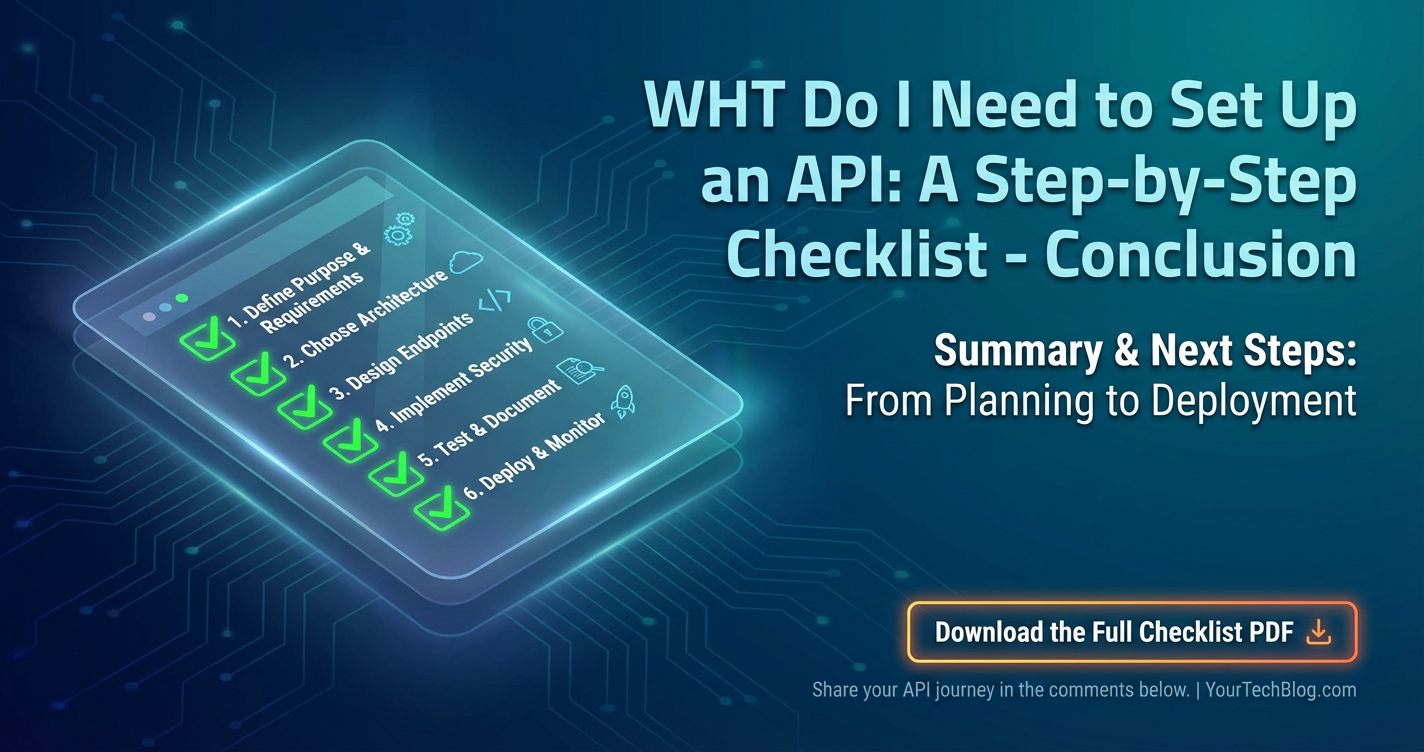
WHT Do I Need to Set Up an API: A Step-by-Step Checklist



In the intricate tapestry of modern digital infrastructure, the Application Programming Interface, or API, stands as an indispensable thread, connecting disparate systems and enabling a seamless flow of data and functionality. Far from being a mere technical detail, setting up an API is a strategic imperative for businesses of all sizes, serving as the connective tissue that allows applications to communicate, collaborate, and innovate. Whether you're building a mobile app that needs to pull data from a backend service, integrating a third-party payment gateway, or constructing a complex microservices architecture, the thoughtful design, robust implementation, and diligent management of an API are paramount.
The digital landscape is increasingly characterized by interconnectedness. Users expect real-time data, instant interactions, and a consistent experience across multiple platforms. This expectation isn't met by monolithic, isolated applications; instead, it's powered by a sophisticated network of services, each communicating through carefully crafted APIs. Neglecting the importance of a well-defined API can lead to fragmented systems, security vulnerabilities, scalability bottlenecks, and ultimately, a significant hindrance to innovation and business growth. This comprehensive guide will delve into the profound "why" behind setting up an API, navigate the foundational steps, explore best practices in design and implementation, discuss the critical role of an API gateway, and culminate in a detailed, step-by-step checklist to ensure your API endeavors are robust, secure, and future-proof. By the end, you'll understand not just the mechanics, but the strategic necessity of treating your APIs as first-class products.
Part 1: Understanding the "Why" – The Indispensable Role of APIs
The decision to set up an API is rarely an isolated technical choice; it's a strategic move driven by a host of business and technical imperatives. Understanding these underlying motivations is crucial for designing an API that truly serves its purpose and delivers long-term value.
1.1. Connectivity and Interoperability: Bridging Digital Silos
At its core, an API is a contract, a set of defined rules that allow different software applications to communicate with each other. In an ecosystem where diverse systems, platforms, and services need to interact, APIs act as universal translators. Imagine a customer relationship management (CRM) system needing to pull order details from an e-commerce platform, or a mobile application authenticating users through a social media giant like Facebook or Google. Without APIs, such interactions would be bespoke, brittle, and impossibly complex, requiring custom integrations for every pair of applications.
The advent of APIs has revolutionized how businesses operate, enabling unprecedented levels of interoperability. They allow organizations to leverage specialized services without having to build them from scratch. For example, rather than developing an in-house payment processing system, businesses integrate with established payment APIs like Stripe or PayPal. This not only saves significant development time and cost but also provides access to robust, secure, and globally compliant solutions. The modern enterprise is often a mosaic of cloud-based services, on-premise legacy systems, and external vendor platforms. APIs are the only practical means to weave this mosaic into a cohesive, functional whole, ensuring data consistency and workflow continuity across the entire digital infrastructure. They are the silent workhorses that prevent data silos and foster a truly integrated operational environment.
1.2. Fostering Innovation and Building Robust Ecosystems
Beyond mere connectivity, APIs are powerful catalysts for innovation. By exposing specific functionalities or data sets through well-documented and accessible APIs, companies can empower internal teams, partners, and even third-party developers to build new applications and services that extend the value of their core offerings. This move transforms a product or service from a standalone entity into a platform, capable of supporting an entire ecosystem of complementary solutions. Think of Salesforce's extensive AppExchange, which is fueled by its comprehensive APIs, allowing countless developers to create applications that enhance and customize the Salesforce experience.
For businesses looking to expand their reach and influence, a public API can be a game-changer. It democratizes access to valuable features, allowing others to innovate on top of your technology. This collaborative approach can lead to unexpected use cases, faster market penetration, and the creation of network effects that solidify your position in the market. Furthermore, within a microservices architecture, internal APIs are the backbone of modularity, allowing independent teams to develop, deploy, and scale services without tight coupling, accelerating the pace of internal innovation. Developers can rapidly prototype new features by combining existing services exposed via APIs, leading to faster development cycles and quicker time-to-market for new products and services. The ability to mix and match functionalities like digital Lego bricks fuels creativity and efficiency, creating a virtuous cycle of development and enhancement.
1.3. Enhancing Efficiency and Driving Automation
Manual data transfer and repetitive tasks are notorious drains on productivity and sources of human error. APIs offer a powerful antidote, enabling the automation of workflows and the seamless exchange of information between systems. Consider the process of onboarding a new customer: an API can connect the sales system, the billing system, the customer support platform, and the marketing automation tool, ensuring that all relevant data is synchronized in real-time without any manual intervention. This not only speeds up processes but also significantly reduces the likelihood of discrepancies and inconsistencies.
From synchronizing inventory levels across multiple sales channels to automatically generating reports from various data sources, APIs streamline operations and free up human resources to focus on higher-value activities that require critical thinking and creativity. In the realm of business process automation, APIs are the conduits that allow Robotic Process Automation (RPA) tools and other automation platforms to interact with diverse applications, creating end-to-end automated sequences. This drive for operational efficiency is a core reason why enterprises invest heavily in robust API strategies, viewing them as essential tools for optimizing costs and accelerating business velocity. The reduction in manual touchpoints minimizes the potential for human error, leading to more reliable and consistent outcomes across various business functions.
1.4. Ensuring Scalability and Flexibility for Future Growth
In today's dynamic business environment, applications must be able to scale rapidly to meet fluctuating demand. Monolithic architectures, where all functionalities are tightly coupled, often struggle with this. A single bottleneck can bring down the entire system, and scaling one component often means scaling everything, which is inefficient and costly. APIs, particularly in a microservices context, introduce a crucial layer of decoupling. Each service, exposing its functionality through an API, can be developed, deployed, and scaled independently. If your payment processing service experiences a surge in traffic, you can scale only that specific service without affecting your user authentication service or inventory management system.
This modularity inherent in API-driven architectures also provides immense flexibility. As technology evolves or business requirements change, individual services can be updated, replaced, or integrated with new technologies without disrupting the entire application. This adaptability is vital for future-proofing your IT infrastructure, allowing you to embrace new innovations and pivot quickly in response to market shifts. By breaking down complex systems into smaller, manageable, and independently deployable units, APIs enable a more agile and resilient IT landscape that can grow and adapt with your business. The ability to independently iterate on smaller service components means less risk during deployment and faster delivery of new features to users.
1.5. Monetization and New Revenue Streams: APIs as Products
For many forward-thinking companies, APIs are not just technical enablers but direct drivers of revenue. By exposing valuable data, services, or unique capabilities through a public API, businesses can create new products and business models. This could involve charging developers for access to premium data sets, transaction fees for using a specific service, or a subscription model for access to advanced functionalities. Companies like Twilio (communications), Stripe (payments), and Google Maps (geospatial data) have built multi-billion-dollar businesses entirely around their APIs, demonstrating the immense potential for API monetization.
Even if an API isn't directly monetized, it can still create significant indirect value. By making it easier for partners to integrate with your platform, you strengthen your partner ecosystem, drive more sales, and enhance customer loyalty. An API can transform internal capabilities into external offerings, opening up entirely new market segments and opportunities for growth. Treating an API as a product – with its own lifecycle, user experience, and value proposition – is a strategic mindset that unlocks its full potential as a revenue generator and a competitive differentiator. This shift in perspective from an internal tool to an external product demands careful attention to developer experience, documentation, and support, which are all critical for an API's commercial success.
1.6. Enhanced Security and Granular Control Over Access
While the idea of opening up your systems might raise security concerns, well-designed APIs actually enhance security by providing granular control over data access and functionality. Instead of granting direct database access or full system permissions, an API acts as a carefully controlled gateway. It allows you to specify exactly what data can be accessed, what actions can be performed, and by whom. Authentication mechanisms (like API keys, OAuth 2.0, or JSON Web Tokens) ensure that only authorized users or applications can interact with your API. Authorization policies then dictate what specific resources and actions those authenticated entities are permitted to access.
Furthermore, an API provides a crucial layer for enforcing business rules and data governance policies. All requests pass through the API, allowing you to implement validation, sanitization, and rate limiting to prevent abuse or malicious attacks. By centralizing access through an API, you can apply consistent security policies, monitor access patterns, and quickly identify and respond to potential threats. This approach is far more secure than allowing direct access to underlying services or databases, as it abstracts away the complexities of the backend while providing a clear enforcement point for all security measures. The controlled interface of an API minimizes the attack surface and allows for the application of robust security practices at the perimeter, protecting your core assets.
Part 2: The Foundational Steps – Before You Write a Single Line of Code
Before diving into coding, a significant amount of strategic planning and analysis is required. These foundational steps lay the groundwork for a successful API and prevent costly rework down the line.
2.1. Define Your API's Purpose and Scope: What Problem Are You Solving?
The very first and arguably most critical step in setting up an API is to clearly articulate its purpose. What specific problem is this API designed to solve? Who is its primary consumer? Is it intended for internal teams to integrate microservices, for partners to access your platform, or for the general public to build innovative applications? A clear understanding of the target audience will influence every subsequent design decision, from authentication methods to data formats and documentation style.
Outline the core functionalities the API will expose. What resources will it manage (e.g., users, products, orders, documents)? What actions can be performed on these resources (e.g., create, read, update, delete)? It's crucial to define the scope precisely, resisting the temptation to expose too much functionality too soon. Start with a minimum viable product (API MVP) that addresses the most critical use cases, allowing for iterative expansion based on feedback and evolving requirements. Documenting this purpose and scope in a clear, concise manner ensures alignment among all stakeholders and serves as a guiding star throughout the development process. A well-defined purpose will also aid in marketing and adoption later on, as potential consumers will immediately understand the value proposition.
2.2. Identify Your Target Audience and Their Needs: Developer Experience Matters
The success of an API is highly dependent on its usability by developers. Therefore, deeply understanding your target audience is paramount. Are they seasoned enterprise developers accustomed to complex SOAP services, or nimble startup engineers expecting simple, RESTful APIs with intuitive documentation? Their technical proficiency, preferred programming languages, and integration patterns will heavily influence your design choices.
Consider the "developer experience" (DX). What kind of documentation do they prefer? Do they need SDKs, code examples, or quickstart guides? How will they discover your API? How will they get support? If your API is for internal use, performance and deep integration capabilities might take precedence. For external public APIs, ease of onboarding, clear error messages, and robust self-service options are vital. Engaging with potential API consumers early on through surveys, interviews, or beta programs can provide invaluable insights, ensuring that your API is designed from a user-centric perspective, making it not just functional but genuinely delightful to work with. A poor developer experience can lead to low adoption rates, regardless of how powerful the underlying functionality is.
2.3. Resource Identification and Data Modeling: The Building Blocks
Once the purpose and audience are clear, the next step is to identify the core resources your API will manage and how their data will be structured. A "resource" in API terms typically represents an object or concept that can be identified, addressed, and manipulated. For an e-commerce API, resources might include Product, Order, Customer, Inventory. Each resource will have specific attributes (e.g., a Product might have id, name, description, price).
Data modeling involves defining the structure of these resources and their relationships. This step often parallels database schema design but focuses on how data will be exposed via the API, which might be a simplified or aggregated view of the underlying database. * Identify nouns: What are the main entities? * Define attributes: What data points describe each entity? * Establish relationships: How do entities relate to each other (e.g., an Order has Customer and Products)? * Choose data format: JSON is the de facto standard for web APIs due to its readability and widespread support, though XML or other formats might be used for specific integrations. * Consider field naming conventions: Consistency is key (e.g., camelCase, snake_case).
A well-thought-out data model leads to clear, intuitive API endpoints and reduces ambiguity for consumers. This stage also impacts performance and scalability, as efficient data structures lead to faster queries and smaller payloads.
2.4. Comprehensive Security Requirements: Protecting Your Assets
Security cannot be an afterthought; it must be an integral part of your API design from day one. Failing to address security adequately can lead to data breaches, reputational damage, and severe legal consequences. This step involves identifying all potential security risks and defining the mechanisms to mitigate them.
Key considerations include: * Authentication: How will callers prove their identity? Common methods include API keys (simple but less secure for public APIs), OAuth 2.0 (standard for delegated authorization), JWT (JSON Web Tokens), or mutual TLS. The choice depends on the API's audience and sensitivity of data. * Authorization: Once authenticated, what resources and actions are a user or application permitted to access? Implement role-based access control (RBAC), attribute-based access control (ABAC), or fine-grained permissions. * Data Protection: How will data be protected in transit and at rest? Use HTTPS/TLS for all communication. Consider encryption for sensitive data stored in databases. * Input Validation and Sanitization: All incoming data must be rigorously validated to prevent injection attacks (SQL injection, XSS) and ensure data integrity. * Rate Limiting: Protect against denial-of-service (DoS) attacks and abuse by limiting the number of requests an individual client can make within a certain timeframe. * Audit Logging: Keep detailed records of all API calls, including caller identity, timestamp, request details, and response status, for security monitoring and forensics. * Compliance: Adhere to relevant industry standards and regulations (e.g., GDPR, HIPAA, PCI DSS).
Developing a comprehensive security strategy requires a deep understanding of common vulnerabilities (OWASP Top 10) and proactive measures to guard against them. This is where an API Gateway often plays a crucial role, centralizing many of these security concerns.
2.5. Performance and Scalability Expectations: Planning for Growth
Understanding the anticipated usage patterns and performance requirements is crucial for designing an API that can handle demand without buckling. What is the expected peak load? What are the acceptable latency targets for different operations? How many requests per second (RPS) or transactions per second (TPS) must the API support?
Consider: * Response Times: For critical operations, users expect near-instant feedback. * Throughput: The volume of requests the API can process in a given period. * Concurrency: How many simultaneous users or applications need to interact with the API? * Resource Utilization: How efficiently does the API use CPU, memory, and network resources?
These expectations will influence architectural decisions, such as database selection (NoSQL vs. SQL), caching strategies, load balancing, choice of programming language/framework, and infrastructure provisioning. Designing for scalability from the outset, rather than trying to retrofit it later, is far more efficient and cost-effective. This involves choosing technologies that can scale horizontally (adding more instances) or vertically (beefing up existing instances) as needed. Stress testing and load testing your API before launch are essential to validate these assumptions and identify potential bottlenecks.
2.6. Monitoring and Logging Strategy: Visibility is Key
Once an API is deployed, you need to know how it's performing, who is using it, and if any issues arise. A robust monitoring and logging strategy provides the necessary visibility into your API's health and usage.
- Logging: Implement comprehensive logging for all API requests and responses. This includes request headers, body, timestamp, caller ID, response status, and any errors. Centralized logging systems (e.g., ELK stack, Splunk) are essential for efficient analysis and troubleshooting. Detailed logs are invaluable for debugging, auditing, and understanding usage patterns.
- Metrics: Collect key performance indicators (KPIs) such as response latency, error rates (HTTP 4xx/5xx), throughput, CPU/memory usage of API instances, and queue depths. These metrics can be pushed to monitoring platforms (e.g., Prometheus, Grafana, Datadog) to visualize trends and set up alerts.
- Alerting: Configure alerts for critical thresholds (e.g., high error rates, prolonged latency spikes, resource exhaustion). This ensures that your team is notified proactively about issues, allowing for quick intervention before they impact users.
- Tracing: For microservices architectures, distributed tracing (e.g., OpenTelemetry, Jaeger) helps visualize the flow of a single request across multiple services, simplifying the debugging of complex interactions.
A proactive monitoring strategy enables early detection of problems, helps identify performance bottlenecks, and provides crucial insights for continuous improvement and capacity planning. This also extends to security monitoring, where abnormal access patterns or failed authentication attempts can trigger security alerts.
Part 3: Designing Your API – Principles and Best Practices
The design phase is where the blueprint of your API takes shape. Adhering to established principles and best practices ensures your API is intuitive, consistent, and maintainable.
3.1. Choose an API Style (REST, GraphQL, gRPC)
The choice of API architectural style significantly impacts how developers interact with your service. Each style has its strengths and weaknesses, making it suitable for different use cases.
3.1.1. RESTful API Design
Representational State Transfer (REST) is the most prevalent API style for web services. It's built on a set of architectural constraints, emphasizing statelessness, client-server separation, and cacheability. * Resources and URIs: RESTful APIs are resource-oriented. Resources are identified by unique Uniform Resource Identifiers (URIs). URIs should be logical, hierarchical, and use nouns to represent resources (e.g., /users, /products/{id}/orders). Avoid verbs in URIs. * HTTP Methods: Standard HTTP methods (verbs) are used to perform actions on resources: * GET: Retrieve a resource or a collection of resources (read-only, idempotent, cacheable). * POST: Create a new resource (non-idempotent). * PUT: Update an existing resource entirely (idempotent). * PATCH: Partially update an existing resource (non-idempotent by default, but can be made idempotent). * DELETE: Remove a resource (idempotent). * Statelessness: Each request from a client to the server must contain all the information necessary to understand the request. The server should not store any client context between requests. This improves scalability and reliability. * Status Codes: Use standard HTTP status codes to indicate the outcome of an API request (e.g., 200 OK, 201 Created, 400 Bad Request, 401 Unauthorized, 404 Not Found, 500 Internal Server Error). This provides clear and consistent feedback to consumers. * Versioning: As APIs evolve, changes may introduce breaking modifications. Versioning allows you to introduce new features without breaking existing clients. Common strategies include: * URI Versioning: /v1/users, /v2/users (simplest, most visible). * Header Versioning: Accept: application/vnd.yourapi.v1+json. * Query Parameter Versioning: ?api-version=1. * URI versioning is generally preferred for its clarity. * Data Formats: JSON (JavaScript Object Notation) is the dominant data format due to its simplicity, readability, and compatibility with web technologies. XML is also supported but less common for new REST APIs. REST's simplicity and widespread adoption make it an excellent choice for public-facing APIs and most web services.
3.1.2. GraphQL
GraphQL is a query language for APIs and a runtime for fulfilling those queries with your existing data. Unlike REST, where clients typically fetch data from multiple endpoints, GraphQL allows clients to request exactly the data they need in a single request, preventing over-fetching or under-fetching. * Single Endpoint: All requests go to a single GraphQL endpoint. * Strongly Typed Schema: Defines the available data and operations, acting as a contract. * Client-Driven Data Fetching: Clients specify the structure and fields of the data they require. GraphQL is highly beneficial for complex applications with varying data requirements (e.g., mobile apps, dashboards) and microservices architectures where data from multiple sources needs to be aggregated efficiently. However, it can add complexity in caching and rate limiting compared to REST.
3.1.3. gRPC
gRPC (gRPC Remote Procedure Calls) is a high-performance, open-source universal RPC framework developed by Google. It uses Protocol Buffers (protobuf) as its interface definition language and HTTP/2 for transport. * Schema-First: Uses protobuf to define service methods and message types. * High Performance: Built on HTTP/2, enabling features like multiplexing, header compression, and server push. * Polyglot Support: Generates client and server code in multiple languages. gRPC is ideal for inter-service communication in microservices architectures, high-performance applications, and scenarios where efficiency and strict contract enforcement are critical. It's less common for public-facing web APIs due to browser limitations, though web-to-gRPC proxies are emerging.
The choice among these styles depends on your specific needs, performance requirements, and the nature of your API consumers.
3.2. API Design First Approach (Contract-First) with OpenAPI
A "design-first" approach is a cornerstone of robust API development. Instead of writing code and then documenting it, you first design the API's contract (its interface) and then implement it. This contract-first methodology fosters collaboration, ensures consistency, and allows for parallel development.
The industry standard for defining RESTful APIs is the OpenAPI Specification (OAS), formerly known as Swagger. An OpenAPI document describes your entire API, including: * Endpoints: All available paths (e.g., /users, /products/{id}). * Operations: HTTP methods supported for each path (GET, POST, PUT, DELETE). * Parameters: Inputs for each operation (query, path, header, body). * Request/Response Payloads: Data structures and examples using JSON Schema. * Authentication Methods: How clients authenticate. * Error Responses: Standardized error formats.
Benefits of OpenAPI/Design-First: * Improved Collaboration: Designers, developers, testers, and documentation writers can work from a single source of truth. * Consistency: Enforces a consistent design language across your APIs. * Code Generation: Tools can automatically generate server stubs (boilerplate code) and client SDKs in various languages, significantly speeding up development. * Automated Testing: Tests can be generated directly from the specification, ensuring the implementation matches the contract. * Interactive Documentation: Tools like Swagger UI can render the OpenAPI specification into beautiful, interactive API documentation, allowing developers to explore and test your API directly from their browser. * Early Feedback: Design reviews can happen before any code is written, catching potential issues early.
Using OpenAPI tools to create your specification upfront, then using it to drive development and documentation, is a highly effective practice for building high-quality, maintainable APIs. This standardized approach significantly reduces friction for both API providers and consumers.
3.3. Naming Conventions: Consistency for Clarity
Consistency in naming is not merely an aesthetic choice; it's a critical aspect of API usability. A predictable and consistent naming scheme makes your API easier to learn, understand, and use, reducing the cognitive load on developers. Inconsistent naming creates confusion, increases the likelihood of errors, and makes documentation harder to follow.
Key aspects of naming conventions: * Resource Naming: Use plural nouns for resource collections (e.g., /users, /products) and singular nouns for specific resource instances (e.g., /users/{id}). Avoid verbs in resource names. * Field Naming: Consistent casing (e.g., camelCase for JSON fields, snake_case for query parameters) throughout your payloads. Be descriptive but concise. * Parameter Naming: Use clear and intuitive names for query parameters (e.g., pageSize, sortBy, filterByStatus). * Enums: If your API uses enumerated types, define a consistent way to represent their values (e.g., UPPER_SNAKE_CASE or lower-kebab-case). * HTTP Headers: Stick to standard HTTP header names where applicable; for custom headers, use a consistent prefix (e.g., X-Custom-Header).
The goal is to make your API feel natural and intuitive, so developers can often guess endpoint names or field names without constantly referring to documentation. This consistency should be enforced through design reviews and automated linters where possible.
3.4. Error Handling and Messaging: Guiding Your Consumers
Even the most robust APIs encounter errors. How your API communicates these errors to consumers is vital for a good developer experience. Poor error handling leads to frustration, extended debugging times, and ultimately, developers abandoning your API.
A well-designed error handling strategy includes: * Consistent Error Structure: Return a standardized error payload that includes at least: * code: A unique, internal API error code (e.g., INVALID_INPUT, RESOURCE_NOT_FOUND). * message: A human-readable, developer-friendly message explaining the error. * details: (Optional) More specific information, such as field-level validation errors or suggested corrective actions. * traceId: (Optional) A unique identifier for the request, useful for debugging with your support team. * Appropriate HTTP Status Codes: Use the correct HTTP status code to categorize the error type: * 400 Bad Request: General client-side error, e.g., malformed request body, invalid parameters. * 401 Unauthorized: Authentication failed (e.g., invalid API key). * 403 Forbidden: Authenticated but not authorized to access the resource. * 404 Not Found: Resource does not exist at the specified URI. * 405 Method Not Allowed: HTTP method not supported for the resource. * 429 Too Many Requests: Rate limit exceeded. * 500 Internal Server Error: An unexpected server-side error. Avoid returning raw stack traces. * 503 Service Unavailable: Server is temporarily unable to handle the request. * Meaningful Messages: Error messages should be clear, concise, and actionable. Instead of "Error," provide "Invalid email format" or "Product ID 123 not found." * Documentation of Errors: All possible error codes and their meanings should be clearly documented in your OpenAPI specification and developer portal.
By providing clear, structured error responses, you equip developers with the information they need to quickly diagnose and fix issues on their end, leading to a much smoother integration experience.
3.5. Pagination, Filtering, and Sorting: Handling Large Datasets
Real-world applications often deal with large collections of data. Returning an entire dataset in a single API call is inefficient, can overload servers, and result in slow response times. Therefore, robust mechanisms for pagination, filtering, and sorting are essential.
- Pagination: Breaks down large results into smaller, manageable chunks. Common strategies:
- Offset-based (Page/Size):
GET /products?page=1&pageSize=10. Simple to implement but can be inefficient for very large datasets and prone to skipped/duplicated items if data changes during pagination. - Cursor-based (Next/Previous):
GET /products?after=cursor_value&limit=10. More robust for dynamic data, as it uses a pointer (cursor) to the last item fetched. Often involves encoding the primary key or a unique timestamp.
- Offset-based (Page/Size):
- Filtering: Allows clients to retrieve a subset of resources based on specific criteria.
GET /products?category=electronics&minPrice=100.- Support for multiple filters, potentially with logical operators (AND/OR).
- Sorting: Enables clients to specify the order in which results should be returned.
GET /products?sortBy=price:asc&sortBy=name:desc.- Support for sorting by multiple fields and specifying ascending/descending order.
Implement these features using clear and consistent query parameters. Document their usage thoroughly, including default values, supported fields, and allowed operators. This empowers API consumers to retrieve precisely the data they need, optimizing network bandwidth and improving application performance.
3.6. Rate Limiting and Throttling: Ensuring Fair Usage and Protection
To protect your API from abuse, denial-of-service attacks, and to ensure fair usage among all consumers, implementing rate limiting and throttling mechanisms is critical. Without them, a single misbehaving client or a malicious actor could consume all your server resources, affecting the availability for legitimate users.
- Rate Limiting: Restricts the number of API requests a client can make within a given time window (e.g., 100 requests per minute per IP address or per API key). Once the limit is reached, subsequent requests are rejected, typically with an
HTTP 429 Too Many Requestsstatus code. - Throttling: Similar to rate limiting but often involves delaying rather than rejecting requests, or dynamically adjusting capacity based on system load.
Implementation Considerations: * Identify By: Rate limits can be applied per IP address, per API key/token, per user, or per resource. * Granularity: Define different limits for different endpoints or types of operations (e.g., read operations might have higher limits than write operations). * Communication: Clearly communicate your rate limits and the associated headers (e.g., X-RateLimit-Limit, X-RateLimit-Remaining, X-RateLimit-Reset) in your API documentation. * Burst vs. Sustained: Consider allowing temporary bursts above the sustained rate limit to accommodate spikes.
An API gateway is often the ideal place to implement and enforce rate limiting policies centrally, offloading this concern from individual microservices and providing a unified control point. This allows for consistent application of policies across all exposed APIs.
3.7. Idempotency: Ensuring Reliability for State-Changing Operations
Idempotency is a crucial concept for the reliability of APIs, particularly for operations that change the state of resources (POST, PUT, PATCH, DELETE). An operation is idempotent if it can be called multiple times without changing the result beyond the initial call.
- GET, PUT, DELETE are inherently idempotent by HTTP specification:
- Retrieving a resource multiple times (GET) will always return the same data.
- Updating a resource with the same data (PUT) will have the same final state.
- Deleting a resource multiple times (DELETE) will result in the resource being absent after the first successful deletion.
- POST is generally NOT idempotent, as repeatedly creating a resource could lead to multiple identical entries (e.g., multiple orders for the same item).
Why is idempotency important? * Network Unreliability: If a client sends a request and doesn't receive a response (due to network timeout, server error, etc.), it might retry the request. If the original request actually succeeded, a non-idempotent retry could lead to unintended duplicate actions. * Fault Tolerance: Helps build more robust client applications that can recover gracefully from transient errors.
Implementing Idempotency for POST operations: For operations like creating an order or transferring funds, where duplicates are unacceptable, you can introduce an idempotency key (also known as a client-generated request ID). * The client generates a unique ID for each logically distinct request. * The client includes this Idempotency-Key in the request header. * The server stores this key along with the outcome of the first request. * If a subsequent request arrives with the same Idempotency-Key, the server returns the original result without re-executing the operation.
This pattern is essential for critical financial transactions or any operation where duplicate processing would have severe consequences, ensuring that "at-least-once" delivery semantics don't lead to "at-least-once-processed" behavior.
Part 4: Implementing and Deploying Your API
With a solid design in place, the next phase is implementation and deployment. This involves selecting technologies, coding the logic, thorough testing, and setting up the infrastructure.
4.1. Choose Your Technology Stack: Language, Framework, and Database
The selection of your technology stack is a practical decision that impacts development speed, performance, scalability, and maintainability. * Programming Language: Choose a language familiar to your team or suitable for the project's requirements (e.g., Python for rapid development, Node.js for high I/O, Java/Go for performance and enterprise stability, C# for .NET ecosystems). * Web Framework: Leverage a robust framework that provides common API functionalities (routing, request parsing, middleware) and security features. Examples include Express.js (Node.js), Spring Boot (Java), Django/Flask (Python), Ruby on Rails (Ruby), ASP.NET Core (C#). * Database: Select a database that aligns with your data model and performance needs. * Relational (SQL): PostgreSQL, MySQL, SQL Server for structured data, strong consistency, complex queries. * NoSQL: MongoDB, Cassandra, DynamoDB for flexible schemas, high scalability, specific data access patterns (e.g., document, key-value, column-family). * Other Tools: Consider caching layers (Redis, Memcached), message queues (RabbitMQ, Kafka), and search engines (Elasticsearch) if your API requires advanced capabilities.
The choice should balance developer productivity, performance characteristics, scalability requirements, and the existing expertise within your team. Avoid over-engineering; start with a simpler stack and introduce complexity as genuine needs arise.
4.2. Development Best Practices: Crafting Quality Code
High-quality code is fundamental to a reliable and maintainable API. Adhere to established development best practices: * Modular Code: Structure your codebase into logical, independent modules or services. This promotes separation of concerns and makes the code easier to understand, test, and maintain. * Unit Testing: Write unit tests for individual functions and components to ensure they work as expected in isolation. Aim for high code coverage. * Integration Testing: Test the interactions between different components (e.g., your API controller interacting with a service layer and a database). * End-to-End Testing: Simulate real user scenarios to verify the entire system from client to database. * Code Reviews: Implement a peer code review process to catch bugs, ensure adherence to coding standards, and share knowledge. * Continuous Integration (CI): Automate the build and test process. Every code commit should trigger an automated build and run tests, providing immediate feedback on code quality. * Meaningful Comments and Documentation: Beyond the OpenAPI spec, include clear comments within the code, especially for complex logic or non-obvious design choices. * Error Handling within Code: Implement proper try-catch blocks and error propagation to gracefully handle exceptions and ensure consistent error responses.
These practices contribute to a robust, scalable, and maintainable API, reducing the likelihood of production issues and technical debt.
4.3. Data Validation and Sanitization: Security at the Input Gate
Data validation and sanitization are critical security measures to protect your API from malicious input and ensure data integrity. Never trust input received from clients. * Validation: Check if incoming data conforms to expected types, formats, lengths, and value ranges. * Schema Validation: Use JSON Schema (often part of your OpenAPI spec) to validate request bodies against predefined structures. * Business Rule Validation: Ensure data adheres to your application's business rules (e.g., price cannot be negative, email must be unique). * Sanitization: Cleanse or escape user-provided input to neutralize potentially harmful content before it's processed or stored. This prevents attacks like SQL injection, cross-site scripting (XSS), and directory traversal. * For example, escape HTML characters if user input is displayed on a web page, or remove potentially dangerous characters from file paths. * Type Coercion: Ensure that data types are correctly converted (e.g., string to integer) and handle errors gracefully if conversion fails.
Implement validation and sanitization at the earliest possible point in your API's processing pipeline, ideally at the controller or input parsing layer. This acts as a primary defense against a wide range of common web vulnerabilities.
4.4. Authentication and Authorization Implementation: Who Can Do What?
This step involves coding the security mechanisms defined in your planning phase. * Authentication: * API Keys: Implement a mechanism to generate, store, and validate API keys. Ensure keys are hashed in the database and transmitted securely (HTTPS). * OAuth 2.0: Implement an OAuth 2.0 flow (e.g., Client Credentials, Authorization Code, Implicit, PKCE) using an OAuth provider (e.g., Auth0, Okta, or your own identity server). This involves managing tokens (access tokens, refresh tokens) and validating their signatures and expiry. * JWT: For JWT, your API will need to validate the token's signature, issuer, audience, and expiry. * Authorization: * Role-Based Access Control (RBAC): Assign users roles (e.g., admin, editor, viewer), and define permissions for each role. Your API logic then checks if the authenticated user's role has the necessary permission to perform the requested action on the target resource. * Attribute-Based Access Control (ABAC): More dynamic, where access is granted based on attributes of the user, resource, and environment. * Fine-Grained Permissions: Implement checks at the resource level (e.g., "user A can only update their own profile, not user B's").
These security measures should be applied as middleware or interceptors in your API framework, ensuring they execute before any core business logic is accessed. Regularly audit your security implementation and stay updated on best practices to counter evolving threats. An API gateway can help offload and centralize much of this authentication and authorization logic, especially for common patterns like JWT validation or OAuth token introspection.
4.5. Testing Your API Thoroughly: Quality Assurance
Testing is not a single step but a continuous process throughout development. Comprehensive testing is paramount to delivering a reliable, performant, and secure API. * Unit Tests: Focus on individual functions or methods, ensuring they behave correctly in isolation. * Integration Tests: Verify that different components or services interact correctly. This might involve testing your API's interaction with the database, external services, or other microservices. * End-to-End Tests: Simulate real-world scenarios, testing the entire flow from a client perspective through your API and backend services. * Performance and Load Testing: * Load Testing: Apply expected user loads to the API to measure response times, throughput, and resource utilization under normal conditions. * Stress Testing: Push the API beyond its normal operational capacity to identify breaking points and understand its behavior under extreme load. * Scalability Testing: Determine how the API performs when scaled up or down (e.g., adding more instances). * Tools: JMeter, LoadRunner, k6, Locust. * Security Testing: * Penetration Testing: Ethical hackers attempt to exploit vulnerabilities in your API. * Vulnerability Scanning: Automated tools scan for common security flaws (e.g., OWASP ZAP, Burp Suite). * Fuzz Testing: Send malformed or unexpected inputs to your API to uncover crashes or vulnerabilities. * Contract Testing: Using your OpenAPI specification as a contract, ensure that your API implementation adheres to the defined interface.
Automated testing should be integrated into your CI/CD pipeline, ensuring that every code change is validated before deployment. Manual exploratory testing should complement automated suites to catch subtle usability or edge-case issues.
4.6. Documentation Generation: The API's User Manual
Excellent documentation is as important as the API itself. Without clear, comprehensive, and up-to-date documentation, developers will struggle to understand and integrate with your API, regardless of how well-designed it is. * OpenAPI-driven Documentation: If you followed the design-first approach, you can leverage your OpenAPI specification to automatically generate interactive API documentation using tools like Swagger UI or Redoc. These tools allow developers to explore endpoints, view request/response schemas, and even make test calls directly from the browser. * Developer Portal: For public APIs, consider a dedicated developer portal. This goes beyond mere API reference documentation to include: * Getting Started Guides: Step-by-step instructions for new users. * Tutorials and Code Examples: Practical examples in various programming languages. * Authentication Guides: Detailed explanations of how to authenticate. * SDKs/Client Libraries: Pre-built client libraries that abstract away the raw API calls. * FAQs: Common questions and answers. * Support Channels: Information on how to get help. * Terms of Service and Pricing: Business-related information. * Markdown Readme: For simpler internal APIs, a well-structured README.md file in your repository can suffice, covering endpoints, authentication, and examples.
The documentation should be accurate, easy to navigate, and continuously updated as your API evolves. Treat your API documentation as a product itself, investing time and effort into making it exceptional.
4.7. Deployment Strategy: Getting Your API Live
Deploying your API involves making it accessible to consumers in a production environment. Your deployment strategy should align with your scalability, reliability, and security requirements. * Infrastructure Choice: * Cloud Platforms: AWS, Azure, Google Cloud Platform (GCP) offer highly scalable and managed services (e.g., EC2, Lambda, App Service, GKE, Cloud Run) that simplify deployment and operations. * On-Premise/Hybrid: For specific compliance or performance needs, you might deploy on your own servers or a combination of cloud and on-premise. * Containerization: Use Docker to package your API and its dependencies into isolated containers. This ensures consistency across different environments (development, testing, production) and simplifies deployment. * Orchestration: For managing multiple containers and scaling, use container orchestration platforms like Kubernetes (K8s), Docker Swarm, or AWS ECS. These platforms automate deployment, scaling, load balancing, and self-healing of your containerized APIs. * Continuous Delivery/Deployment (CD): Extend your CI pipeline to automatically deploy validated code changes to staging or production environments. This reduces manual errors and accelerates release cycles. * Load Balancing: Distribute incoming API traffic across multiple instances of your API to improve performance, reliability, and fault tolerance. * Monitoring Integration: Ensure your deployed API is integrated with your monitoring and logging systems from day one to gain immediate visibility into its operational health.
A robust deployment strategy ensures that your API is available, reliable, and can handle the expected load, providing a seamless experience for its consumers.
APIPark is a high-performance AI gateway that allows you to securely access the most comprehensive LLM APIs globally on the APIPark platform, including OpenAI, Anthropic, Mistral, Llama2, Google Gemini, and more.Try APIPark now! 👇👇👇
Part 5: Managing Your API with an API Gateway
As your API ecosystem grows in complexity, especially with a microservices architecture or when exposing multiple APIs to external developers, managing them individually becomes unsustainable. This is where an API gateway becomes an indispensable component.
5.1. What is an API Gateway?
An API gateway acts as a single entry point for all client requests, routing them to the appropriate backend services. It sits in front of your APIs, abstracting the complexities of your backend architecture from the client. Instead of clients making direct requests to individual microservices, they interact solely with the API gateway. This centralized control point provides a consistent and managed interface for external consumers.
5.2. Key Functions of an API Gateway
The responsibilities of an API gateway are broad and critical for efficient API management:
- Traffic Management and Routing: The gateway routes incoming requests to the correct backend service based on defined rules. It can also perform load balancing across multiple instances of a service, ensuring high availability and optimal performance. Advanced routing logic allows for A/B testing, canary deployments, and granular control over traffic flow.
- Security and Access Control: This is one of the most vital functions. An API gateway can handle:
- Authentication: Validating API keys, OAuth tokens, or JWTs, offloading this logic from individual services.
- Authorization: Enforcing access policies based on roles or permissions.
- Encryption: Managing SSL/TLS certificates for secure communication.
- Threat Protection: Implementing Web Application Firewalls (WAFs) and DDoS protection.
- IP Whitelisting/Blacklisting: Controlling access from specific IP ranges.
- Policy Enforcement (Rate Limiting, Throttling): Centralized enforcement of rate limits, quotas, and throttling policies to prevent abuse, manage costs, and ensure fair usage across all consumers.
- Monitoring, Analytics, and Logging: Collects metrics on API usage, performance, and errors. It provides a single point for centralized logging, offering insights into overall API health, traffic patterns, and potential issues. This data is invaluable for troubleshooting, capacity planning, and business intelligence.
- Request/Response Transformation: Modifies request headers, body, or query parameters before forwarding them to the backend, and similarly transforms responses before sending them back to the client. This is useful for adapting to different client or service requirements without changing the core API.
- Versioning and Lifecycle Management: Facilitates managing different versions of APIs, allowing new versions to be rolled out without immediately deprecating older ones, supporting a graceful transition for clients. It plays a role in the entire API lifecycle, from publication to retirement.
- Developer Portal and Documentation Integration: Many gateways integrate with or host developer portals, providing a self-service platform for API discovery, documentation access (often derived from OpenAPI specifications), subscription management, and API key generation.
5.3. When Do You Need an API Gateway?
While not strictly necessary for a single, simple API, an API gateway becomes increasingly essential in scenarios such as: * Microservices Architecture: When you have many small, independent services, a gateway provides a unified facade, simplifying client interactions. * Exposing Multiple APIs Externally: If you offer several APIs to partners or the public, a gateway centralizes management and security. * Strict Security Requirements: For APIs handling sensitive data, a gateway adds a crucial layer of defense and policy enforcement. * Need for Centralized Monitoring and Analytics: To get a holistic view of your API ecosystem's performance and usage. * Complex Transformation Needs: When clients require data in different formats than your backend services provide. * Rapid API Evolution: To manage versioning and non-breaking changes effectively.
5.4. Benefits of an API Gateway
The advantages of adopting an API gateway are significant: * Improved Security Posture: Centralized security policies reduce the attack surface and ensure consistent protection. * Enhanced Performance and Scalability: Load balancing, caching, and optimized routing improve response times and handle increased traffic efficiently. * Simplified Client Development: Clients interact with a single, consistent endpoint, reducing complexity. * Decoupling: Protects clients from changes in backend service architecture. * Better Monitoring and Troubleshooting: Centralized logging and metrics offer unparalleled visibility. * Faster Innovation: Developers can focus on core business logic, offloading common concerns to the gateway.
When considering an API gateway solution, it's worth exploring options that align with your technical requirements and business goals. For instance, APIPark is an excellent example of an open-source AI gateway and API management platform. It addresses many of these critical needs, offering capabilities such as quick integration of a multitude of AI models, standardizing API invocation formats for simplified AI usage and maintenance, and facilitating the encapsulation of prompts into reusable REST APIs. Furthermore, APIPark provides end-to-end API lifecycle management, robust traffic forwarding, load balancing, and versioning capabilities. Its impressive performance, rivalling Nginx, combined with detailed API call logging and powerful data analysis features, makes it a compelling choice for organizations managing both traditional and AI-driven API ecosystems. You can learn more about this versatile platform and its offerings at ApiPark. By leveraging a solution like APIPark, enterprises can significantly enhance the efficiency, security, and data optimization across their entire API governance landscape.
Part 6: Post-Deployment – Lifecycle Management and Evolution
Launching your API is just the beginning. The ongoing management and evolution of your API are crucial for its long-term success, ensuring it remains relevant, secure, and performant.
6.1. Monitoring and Alerting: The Eyes and Ears of Your API
Even with robust testing and a well-planned deployment, issues can arise in production. Continuous monitoring and a proactive alerting system are your first line of defense. * Key Metrics to Track: * Latency: Average and percentile (e.g., P95, P99) response times. * Error Rate: Percentage of failed requests (HTTP 4xx and 5xx). * Throughput/RPS: Requests per second to gauge traffic volume. * Resource Utilization: CPU, memory, disk I/O, network I/O of your API instances and underlying database. * API-Specific Metrics: Business-level metrics like successful transactions, unique users, conversion rates via API. * Centralized Logging: Ensure all API access logs, error logs, and application logs are aggregated into a centralized logging system (e.g., ELK stack, Splunk, Datadog). This facilitates quick searching and correlation of events during troubleshooting. * Alerting Configuration: Set up alerts for deviations from normal behavior (e.g., error rate above 1%, latency spikes, resource utilization exceeding 80%). Integrate alerts with your team's communication channels (Slack, PagerDuty, email) to ensure prompt notification and response. * Dashboards: Create intuitive dashboards that visualize key metrics and provide a quick overview of your API's health and performance.
Proactive monitoring allows you to identify and address issues before they significantly impact your users, ensuring high availability and reliability of your API. This also provides valuable data for capacity planning and performance optimization efforts.
6.2. Versioning and Deprecation Strategy: Evolving Gracefully
APIs are living entities; they will inevitably evolve. New features will be added, existing ones modified, and sometimes, old features will need to be retired. A clear versioning and deprecation strategy is essential to manage these changes without causing undue disruption to existing consumers. * Versioning: As discussed earlier, use a consistent versioning scheme (e.g., URI-based /v1/, /v2/). Each major version represents a set of breaking changes. Minor changes (non-breaking additions) can often be released within the same major version. * Backward Compatibility: Strive for backward compatibility whenever possible. New fields can be added to responses, and optional request parameters can be introduced without breaking existing clients. * Deprecation Process: When a feature or an entire API version needs to be retired: * Communicate Early: Announce deprecation well in advance, providing a clear timeline for removal. * Provide Migration Guides: Offer detailed instructions and tools to help developers migrate to the new version. * Grace Period: Maintain the deprecated version for a significant period (e.g., 6-12 months) to allow ample time for migration. * Warnings: Return warning headers or messages in responses from deprecated endpoints to gently nudge developers towards the newer version. * Remove Old Version: Once the grace period expires, remove the deprecated version and return an appropriate status code (e.g., 410 Gone) for requests to that version.
A thoughtful versioning and deprecation policy builds trust with your API consumers, demonstrating that you value their investments in integrating with your services.
6.3. API Documentation Maintenance: Always Up-to-Date
Outdated or inaccurate documentation is worse than no documentation at all. It misleads developers, causes frustration, and erodes trust. * Continuous Updates: As your API evolves, ensure that all changes (new endpoints, modified parameters, new error codes) are immediately reflected in your OpenAPI specification and developer portal. * Automated Generation: If your documentation is generated from your OpenAPI spec, ensure the spec itself is always the source of truth and is updated with every change. * Feedback Loop: Encourage developers to provide feedback on the documentation. Make it easy for them to report inaccuracies or areas needing clarification. * Consistency: Maintain a consistent style, tone, and structure across all documentation. * Examples and Tutorials: Regularly review and update code examples and tutorials to ensure they still work and reflect the latest API version.
Treat documentation maintenance as an integral part of your development process, not an afterthought. A well-maintained and comprehensive documentation suite is a key factor in the adoption and success of your API.
6.4. Developer Engagement and Support: Building a Community
For public APIs, engaging with your developer community and providing excellent support is crucial for fostering adoption and innovation. * Community Forums/Q&A: Provide platforms where developers can ask questions, share insights, and help each other. * Dedicated Support Channels: Offer clear channels for developers to report bugs, request features, or seek technical assistance. * Webinars and Workshops: Host events to educate developers on how to use your API effectively and showcase new features. * SDKs and Client Libraries: Provide well-maintained SDKs in popular languages to simplify integration. * Feedback Mechanisms: Actively solicit feedback from your developer community on their pain points, feature requests, and overall experience. This feedback loop is invaluable for guiding the future evolution of your API. * Newsletters/Blogs: Keep developers informed about API updates, new features, deprecations, and upcoming events.
By nurturing a vibrant developer community and providing robust support, you transform your API from a mere technical interface into a dynamic platform that attracts and retains innovators.
6.5. Security Audits and Updates: Staying Ahead of Threats
The threat landscape is constantly evolving. Regular security audits and continuous updates are non-negotiable for maintaining a secure API. * Regular Audits: Conduct periodic security assessments, including vulnerability scans and penetration testing, by independent security experts. * Dependency Updates: Keep all your libraries, frameworks, and underlying operating system components updated to their latest stable versions to patch known vulnerabilities. * Security Patches: Apply security patches promptly to your API and its infrastructure components. * Review Access Controls: Regularly review and audit user permissions and access policies to ensure they are still appropriate and not overly permissive. * Stay Informed: Monitor security news and subscribe to security advisories for your chosen tech stack to proactively address emerging threats. * Incident Response Plan: Have a clear plan in place for how to detect, respond to, and recover from security incidents.
Security is not a one-time setup but an ongoing commitment. Proactive measures and continuous vigilance are essential to protect your API and the data it handles.
6.6. Performance Optimization: Continuous Improvement
Even after initial deployment, there's always room for performance improvement. Continuous optimization based on real-world monitoring data can significantly enhance the user experience and reduce operational costs. * Analyze Monitoring Data: Use your monitoring systems to identify performance bottlenecks (e.g., slow database queries, inefficient code paths, network latency). * Caching Strategies: Implement or refine caching at various layers (client-side, CDN, API gateway, application-level, database-level) to reduce redundant computations and database calls. * Database Optimization: Optimize database queries, add appropriate indexes, and consider database scaling strategies (sharding, replication). * Code Refactoring: Refactor inefficient code segments identified during performance profiling. * Network Optimization: Compress responses (gzip), minimize payload sizes, and consider content delivery networks (CDNs) for static assets. * Load Balancing and Auto-Scaling: Ensure your load balancers are correctly configured and that your infrastructure can auto-scale efficiently to meet fluctuating demand. * Asynchronous Processing: For long-running operations, consider offloading them to asynchronous worker queues to free up your API threads and reduce response times.
Performance optimization is an iterative process. Regular reviews and adjustments based on observed performance metrics are key to maintaining a highly responsive and efficient API.
Part 7: The Step-by-Step Checklist for API Setup
Bringing together all the discussions, here is a comprehensive, step-by-step checklist to guide you through the process of setting up a robust, secure, and well-managed API. This checklist is designed to ensure you cover all critical aspects from conception to post-deployment.
Phase 1: Conception & Planning
This initial phase focuses on defining the strategic intent and foundational requirements of your API.
- Define Clear API Purpose & Business Value:
- What specific business problem will this API solve?
- What are the measurable business outcomes or opportunities (e.g., new revenue streams, efficiency gains, ecosystem growth)?
- Document the core value proposition and objectives.
- Identify Target Users & Their Use Cases:
- Who are the primary consumers (internal developers, partners, public)?
- What specific tasks or integrations will they perform with the API?
- Understand their technical proficiency and preferred tools.
- Outline Core Resources & Data Models:
- Identify the main entities the API will expose (e.g.,
User,Product,Order). - Define their attributes and relationships.
- Choose the primary data format (e.g., JSON) for request and response payloads.
- Identify the main entities the API will expose (e.g.,
- Establish Security Requirements (Authentication, Authorization, Data Protection):
- Determine the appropriate authentication mechanism (API keys, OAuth 2.0, JWT).
- Define authorization policies (RBAC, ABAC, fine-grained permissions).
- Specify data encryption needs (in transit: HTTPS/TLS; at rest: database encryption).
- Plan for input validation and sanitization.
- Set Performance & Scalability Goals:
- Estimate anticipated traffic volume (RPS/TPS, peak load).
- Define acceptable latency targets for key operations.
- Consider concurrency requirements.
- Plan Monitoring & Logging Strategy:
- Define what metrics will be collected (latency, error rates, throughput).
- Choose a centralized logging solution.
- Outline alerting thresholds and notification channels.
Phase 2: Design & Specification
This phase translates your requirements into a detailed technical blueprint for the API.
- Choose API Style (REST, GraphQL, gRPC):
- Select the most appropriate architectural style based on your use cases and consumer needs.
- Design Resource URIs & Endpoints:
- Create clear, intuitive, and hierarchical URIs using plural nouns for collections (e.g.,
/v1/products).
- Create clear, intuitive, and hierarchical URIs using plural nouns for collections (e.g.,
- Define HTTP Methods & Status Codes:
- Map HTTP methods (GET, POST, PUT, PATCH, DELETE) to operations on resources.
- Specify appropriate HTTP status codes for all success and error responses.
- Specify Request/Response Payloads (Data Formats):
- Define the structure and fields for all request bodies and response payloads, typically using JSON Schema.
- Ensure consistent naming conventions (e.g.,
camelCase).
- Document API using OpenAPI Specification:
- Create a comprehensive OpenAPI (formerly Swagger) specification that precisely describes your entire API contract.
- Include examples for all requests and responses.
- Implement Error Handling Strategy:
- Define a consistent, standardized error response format (e.g.,
code,message,details). - Ensure meaningful and actionable error messages.
- Define a consistent, standardized error response format (e.g.,
- Plan for Pagination, Filtering, Sorting:
- Choose pagination strategy (offset or cursor-based).
- Define query parameters for filtering and sorting collections.
- Design Rate Limiting & Throttling Policies:
- Specify rate limits per client, per endpoint, and how they will be enforced.
- Define the response for exceeding limits (
429 Too Many Requests).
- Ensure Idempotency for State-Changing Operations:
- Implement idempotency keys for non-idempotent operations like POST where duplicates must be prevented.
Phase 3: Development & Testing
This phase involves writing the code, implementing security, and rigorously testing the API.
- Select Technology Stack:
- Choose your preferred programming language, web framework, and database.
- Consider other tools like caching layers or message queues.
- Implement API Logic & Business Rules:
- Code the core functionalities of your API following modular design principles.
- Integrate Authentication & Authorization Mechanisms:
- Implement the chosen authentication (e.g., OAuth 2.0 token validation) and authorization (e.g., RBAC checks) logic.
- Implement Data Validation & Sanitization:
- Add robust input validation to all incoming data (e.g., schema validation, data type checks, range checks).
- Sanitize inputs to prevent security vulnerabilities like injection attacks.
- Write Unit & Integration Tests:
- Develop comprehensive unit tests for individual functions.
- Create integration tests to verify component interactions and data flows.
- Conduct Performance & Load Testing:
- Run load tests to simulate expected traffic and measure performance under normal conditions.
- Perform stress tests to identify breaking points and bottlenecks.
- Perform Security Audits & Penetration Testing:
- Conduct internal or external security audits and penetration tests to uncover vulnerabilities.
- Use automated vulnerability scanners.
- Generate Developer-Friendly Documentation:
- Generate interactive API documentation (e.g., Swagger UI) from your OpenAPI specification.
- Create getting started guides, tutorials, and code examples.
Phase 4: Deployment & Management
This final phase covers making your API live, managing its operations, and planning for its long-term evolution.
- Choose Deployment Environment (Cloud, On-Premise):
- Select your infrastructure (e.g., AWS, Azure, GCP, Kubernetes cluster).
- Set Up CI/CD Pipeline:
- Automate the build, test, and deployment process using Continuous Integration and Continuous Delivery/Deployment.
- Deploy API to Production Environment:
- Roll out your API to the chosen production infrastructure, ensuring proper configuration and environmental variables.
- Implement an API Gateway (e.g., APIPark) for Centralized Management:
- Deploy an API Gateway to handle routing, security, rate limiting, and monitoring for your APIs.
- Configure gateway policies and integrate with your backend services. APIPark provides an open-source, high-performance solution for managing AI and REST APIs, offering crucial features like unified format invocation, prompt encapsulation, and robust lifecycle management to streamline your API ecosystem. Consider integrating it for comprehensive control over your API landscape. More details can be found at ApiPark.
- Configure Monitoring, Logging & Alerting Systems:
- Integrate the deployed API with your chosen monitoring tools and centralized logging platform.
- Set up alerts for critical performance metrics and error thresholds.
- Establish Versioning & Deprecation Strategy:
- Clearly define how new API versions will be introduced and older versions will be deprecated.
- Plan for communication with consumers during transitions.
- Set Up Developer Portal (if applicable):
- Provide a self-service portal for developers to discover, subscribe to, and manage their access to your API.
- Plan for Ongoing Maintenance & Updates:
- Allocate resources for continuous development, bug fixes, and feature enhancements.
- Schedule regular reviews of performance, security, and developer feedback.
- Regularly Review Security Posture:
- Conduct periodic security audits and stay updated on vulnerability patches for all dependencies.
- Continuously Optimize Performance:
- Analyze monitoring data to identify and address performance bottlenecks, applying caching, database optimizations, and code refinements as needed.
Conclusion
Setting up an API is a journey that transcends mere technical implementation; it's a strategic decision that underpins modern digital transformation. From the initial conceptualization of its purpose and target audience, through meticulous design, robust development, and intelligent deployment, every phase demands careful consideration and adherence to best practices. A well-constructed API is a powerful asset, driving innovation, enhancing efficiency, and opening new avenues for growth and monetization. It acts as the nervous system of interconnected applications, facilitating seamless data flow and functionality.
The checklist provided serves as a comprehensive roadmap, ensuring that you navigate the complexities of API development with confidence and precision. By embracing a design-first approach, prioritizing security, fostering an exceptional developer experience, and leveraging powerful management tools like an API gateway – such as APIPark – you lay the groundwork for an API that is not only functional but also resilient, scalable, and future-proof. Remember, an API is a product, and its success hinges on continuous iteration, dedicated maintenance, and an unwavering commitment to its consumers. As the digital world continues to intertwine, the art and science of API setup will remain at the forefront of technological advancement, defining the boundaries of what's possible in an increasingly interconnected reality.
Frequently Asked Questions (FAQ)
1. What is the fundamental purpose of an API, and why is it so critical for modern businesses?
The fundamental purpose of an API (Application Programming Interface) is to define a set of rules and mechanisms that allow different software applications to communicate and interact with each other. It acts as an intermediary, enabling one application to access functionality or data from another without needing to understand its internal workings. For modern businesses, APIs are critical because they foster interoperability, allowing diverse systems (internal, partner, and third-party) to work together seamlessly. This enables automation, accelerates innovation by building new services on existing ones, supports microservices architectures for scalability, and can even create new revenue streams by exposing valuable data or services. Without APIs, businesses would face fragmented systems, significant integration challenges, and slower adaptation to market changes.
2. How does an API Gateway contribute to the security and management of APIs?
An API gateway significantly enhances the security and management of APIs by acting as a single, centralized entry point for all client requests before they reach your backend services. In terms of security, it offloads critical functions like authentication (validating API keys, OAuth tokens), authorization (enforcing access policies), SSL/TLS termination, and threat protection (DDoS, WAF) from individual backend services. For management, it provides centralized control over traffic routing, load balancing, rate limiting, and caching. It also aggregates monitoring data and logs, offering a holistic view of API performance and usage. This consolidation reduces complexity, ensures consistent policy enforcement across multiple APIs, and improves overall system resilience and observability.
3. What is OpenAPI, and why is it important in the API development lifecycle?
OpenAPI (formerly Swagger) is a language-agnostic, open standard for describing RESTful APIs. It provides a formal, machine-readable specification of an API's contract, including its endpoints, operations, parameters, request/response structures, and authentication methods. Its importance in the API development lifecycle stems from enabling a "design-first" approach. By defining the OpenAPI specification upfront, it serves as a single source of truth that facilitates better collaboration among designers, developers, and testers. It can automatically generate interactive documentation (like Swagger UI), server stubs, and client SDKs, significantly speeding up development, ensuring consistency, and reducing errors. This standardized contract makes APIs easier to understand, integrate with, and maintain.
4. What are the key considerations for ensuring the scalability and performance of an API?
Ensuring the scalability and performance of an API requires careful planning across multiple layers. Key considerations include: 1. Efficient Data Modeling: Optimized database schema and efficient data retrieval strategies. 2. Statelessness: Designing APIs to be stateless, making it easier to scale horizontally by adding more instances. 3. Caching: Implementing caching at various levels (client-side, CDN, API gateway, application, database) to reduce redundant computations and database load. 4. Load Balancing: Distributing incoming requests across multiple API instances to prevent single points of failure and optimize resource utilization. 5. Asynchronous Processing: Offloading long-running or resource-intensive tasks to message queues and background workers to free up API threads. 6. Optimized Code: Writing efficient code, optimizing database queries, and minimizing I/O operations. 7. Rate Limiting: Protecting resources from excessive requests. 8. Monitoring: Continuously tracking performance metrics (latency, throughput, error rates) to identify and address bottlenecks proactively.
5. Why is detailed API documentation crucial, and what should it typically include?
Detailed API documentation is crucial because it acts as the primary interface between your API and its consumers. Without clear, comprehensive, and up-to-date documentation, developers will struggle to understand how to use your API, leading to frustration, slow adoption, and increased support costs. Good API documentation should typically include: * Getting Started Guides/Tutorials: Step-by-step instructions for initial setup. * Authentication & Authorization Details: How to authenticate and what permissions are required. * API Reference: A complete list of endpoints, supported HTTP methods, request parameters, and response structures (often generated from an OpenAPI spec). * Error Codes: A comprehensive list of possible error responses with clear explanations and suggested solutions. * Code Examples & SDKs: Practical code snippets in various languages, and ideally, pre-built client libraries. * Rate Limits & Usage Policies: Information on restrictions and fair use. * Versioning & Deprecation Strategy: How the API evolves and how to migrate between versions. * Support & Community Resources: Where developers can get help or provide feedback.
🚀You can securely and efficiently call the OpenAI API on APIPark in just two steps:
Step 1: Deploy the APIPark AI gateway in 5 minutes.
APIPark is developed based on Golang, offering strong product performance and low development and maintenance costs. You can deploy APIPark with a single command line.
curl -sSO https://download.apipark.com/install/quick-start.sh; bash quick-start.sh

In my experience, you can see the successful deployment interface within 5 to 10 minutes. Then, you can log in to APIPark using your account.

Step 2: Call the OpenAI API.