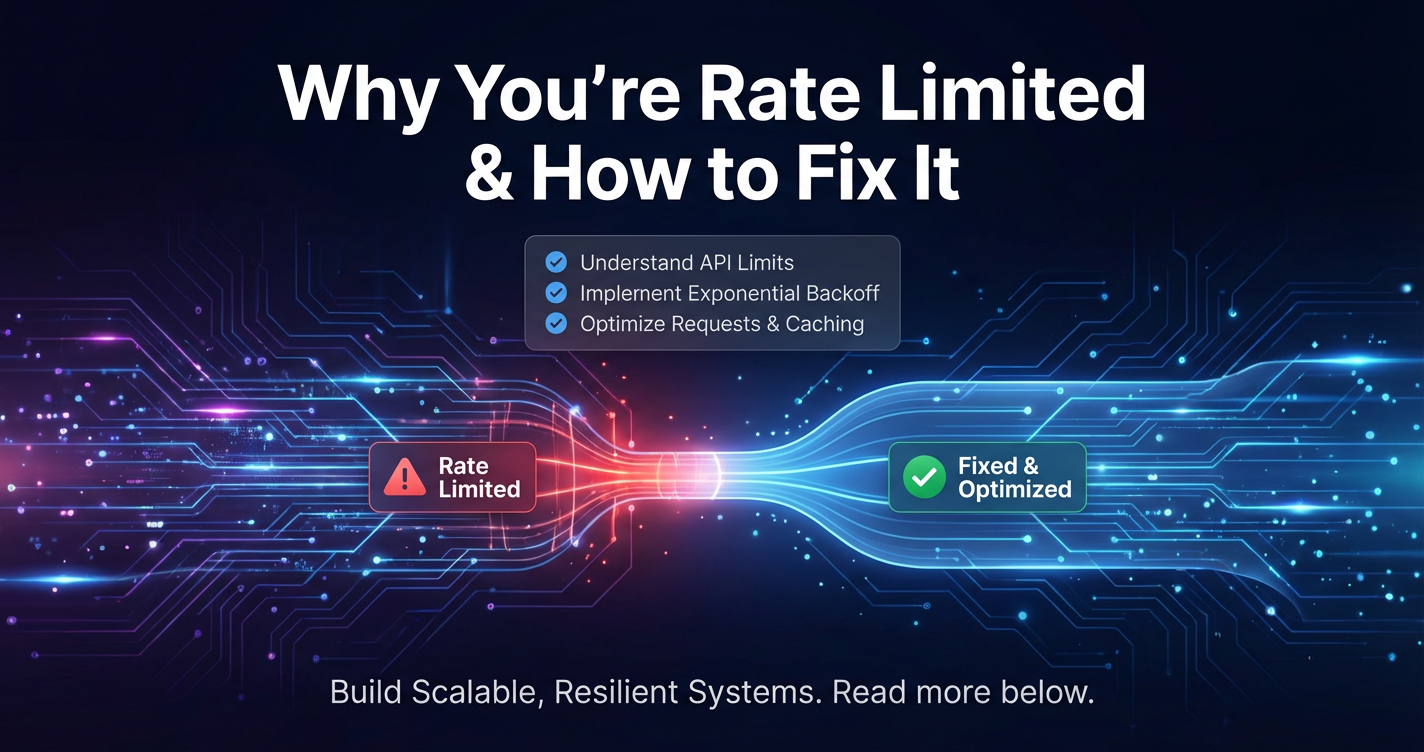
Why You're Rate Limited & How to Fix It



In the fast-paced world of digital services, Application Programming Interfaces (APIs) are the foundational bedrock upon which countless applications, services, and entire businesses are built. From integrating payment systems and fetching real-time data to powering mobile apps and AI services, APIs facilitate the seamless exchange of information that drives modern connectivity. However, anyone who has worked extensively with APIs has likely encountered a universal and often frustrating hurdle: rate limiting. The sudden halt of service, the enigmatic "429 Too Many Requests" error, or the cryptic X-RateLimit-Reset header can feel like an arbitrary barrier to progress. Yet, far from being an inconvenience designed to thwart developers, rate limiting is a critical, multi-faceted mechanism essential for maintaining the health, stability, and fairness of any robust API ecosystem.
This comprehensive guide delves into the intricate reasons behind API rate limiting, exploring the fundamental principles that necessitate its implementation. We will uncover the common scenarios that inadvertently lead developers to hit these limits, from simple misconfigurations to complex architectural oversights. A thorough understanding of the various types of rate limiting algorithms will equip you with the knowledge to anticipate and interpret different behaviors. More importantly, we will provide an exhaustive array of strategies, both for API consumers and providers, on how to effectively diagnose, prevent, and mitigate rate limit issues. Special attention will be given to the pivotal role of an API gateway in both enforcing and managing these limits, offering a centralized point of control and insight. By the end of this exploration, the seemingly arbitrary barrier of rate limiting will transform into a predictable, manageable, and even beneficial aspect of API consumption and provision, allowing you to build more resilient and efficient applications.
I. Understanding the "Why": The Fundamental Reasons Behind Rate Limiting
The implementation of rate limits on an API is not a punitive measure but rather a strategic necessity driven by a confluence of technical, economic, and security considerations. Every API provider, whether a giant tech company or a nimble startup, operates on finite resources and aims to deliver a reliable, equitable, and secure service to its users. Without proper controls, a single bad actor or an unoptimized client could easily degrade the experience for everyone else, or worse, bring down the entire system. Understanding these underlying motivations is the first step toward respecting and effectively navigating API rate limits.
Server Protection and Stability
At its core, rate limiting serves as a critical defense mechanism for the server infrastructure hosting the API. Every request made to an API consumes resources: CPU cycles for processing, memory for data manipulation, network bandwidth for transmission, and database connections for storage and retrieval. An uncontrolled influx of requests, even if legitimate, can quickly overwhelm these resources. Imagine a popular social media platform's API experiencing a sudden viral event – without rate limits, the sheer volume of requests for new posts, comments, and user profiles could lead to a cascading failure, causing slow response times, service interruptions, or even complete outages.
Rate limits act as a buffer, preventing denial-of-service (DoS) attacks, whether intentional (like a malicious DDoS attack) or unintentional (like a runaway script). By capping the number of requests a single client or IP address can make within a given timeframe, the API gateway protects the backend servers from being starved of resources. This proactive measure ensures that the API remains stable, performs predictably, and can continue to serve its legitimate users without interruption. It's akin to having a bouncer at a popular club, ensuring the venue doesn't get overcrowded, thus maintaining a pleasant and safe environment for everyone inside.
Fair Usage and Resource Allocation
Beyond mere protection, rate limiting is instrumental in ensuring fair resource allocation across all users of an API. In a shared environment, without limits, a few highly active or resource-intensive clients could monopolize the available server capacity, leaving other users with slow responses or outright service unavailability. This creates an unfair playing field and detracts from the overall user experience.
Consider a public data API that provides financial market information. If one user builds an application that constantly polls the API for every stock ticker multiple times per second, they would quickly consume a disproportionate share of the API's capacity. Rate limits ensure that all subscribers, regardless of their individual usage patterns, have a reasonable opportunity to access the data without being hampered by the excesses of others. This promotes an equitable distribution of shared resources, fostering a healthier and more sustainable ecosystem for all API consumers. It's about ensuring that everyone gets a fair turn at the well, preventing any single entity from draining it dry.
Cost Control for API Providers
Operating an API infrastructure involves significant costs. These include the financial outlay for servers, databases, network bandwidth, data storage, and the personnel required to maintain and scale these systems. Each API request, particularly those involving complex computations or extensive database queries, incurs a marginal cost. Unrestricted API access can quickly lead to an exponential increase in operational expenses for the provider.
Rate limits serve as a critical mechanism for cost control. By setting boundaries on usage, providers can better predict and manage their infrastructure expenditure. For instance, a provider might offer a free tier with very strict rate limits and then introduce higher-volume, paid tiers. This strategy directly links usage to revenue, allowing the provider to scale their infrastructure in line with their income. Without rate limiting, a provider could face exorbitant bills from cloud services due to unexpected traffic surges, making the API service economically unviable. It’s a pragmatic business decision to ensure the API service remains profitable and sustainable in the long term, preventing providers from bleeding money due to excessive free usage.
Security and Abuse Prevention
Rate limiting plays a crucial role in the overall security posture of an API. Malicious actors often employ automated scripts to perform various types of attacks, and rate limits can effectively deter or mitigate these threats.
- Brute-Force Attacks: Attempts to guess credentials (usernames and passwords) by trying many combinations in quick succession are a common form of attack. Rate limiting login endpoints, for example, can significantly slow down these attempts, making them impractical and giving security teams time to detect and respond.
- Data Scraping: Competitors or malicious bots might attempt to scrape large volumes of data from an API for competitive analysis, content duplication, or other nefarious purposes. Rate limits make it prohibitively difficult and time-consuming to extract data at scale, protecting the intellectual property and value of the data provided by the API.
- Vulnerability Scanning: While not always malicious, excessive scanning for vulnerabilities can still consume resources and trigger alerts. Rate limits can slow down these activities, too.
By acting as an early warning system and a deterrent, rate limits enhance the security of the API, protecting both the provider's infrastructure and the integrity of the data it exposes. A robust API gateway is often the first line of defense here, capable of applying these security policies before requests even reach the backend services.
Monetization and Tiered Access
For many commercial API providers, rate limiting is a fundamental component of their business model. It enables them to offer differentiated service levels, often categorized into free, basic, premium, or enterprise tiers. Each tier comes with its own set of usage quotas, including varying rate limits.
- Free Tier: Often has very restrictive rate limits, allowing users to test the API's functionality and build prototypes without incurring costs.
- Paid Tiers: Offer significantly higher rate limits, faster response times, and potentially access to advanced features, reflecting the value provided to paying customers.
This tiered approach allows providers to cater to a broad spectrum of users, from individual developers to large enterprises, while monetizing their service effectively. It encourages users whose applications require higher throughput or guaranteed performance to subscribe to more advanced plans, thereby generating revenue that supports the continued development and maintenance of the API. An effective API gateway is instrumental in enforcing these tiered access policies, dynamically applying different limits based on the client's subscription level or API key.
Data Integrity
Finally, rate limits can help protect the integrity of the data managed by the API. In scenarios where an API allows for data creation, updates, or deletions, uncontrolled rapid-fire requests could potentially lead to data corruption, inconsistencies, or race conditions. While robust backend logic should handle many of these issues, rate limiting adds an additional layer of protection. By pacing the rate at which data manipulation requests can be made, it reduces the likelihood of scenarios that could compromise the overall data quality and consistency, contributing to a more reliable and trustworthy data source for all consumers.
II. Common Scenarios Leading to Rate Limiting
Even with a clear understanding of why rate limits exist, hitting them unexpectedly can be a bewildering experience. Often, it's not due to malicious intent but rather a combination of common development pitfalls, unexpected events, or simply a lack of awareness regarding an API's operational constraints. Identifying these common scenarios is crucial for proactively designing API clients that operate harmoniously within defined limits.
Unexpected Traffic Spikes
One of the most frequent culprits behind hitting rate limits is an unforeseen surge in traffic. This could stem from a variety of sources, none of which are inherently malicious:
- Viral Content or Marketing Campaigns: A marketing email campaign might drive thousands of users to an application simultaneously, each triggering multiple API calls. A piece of content going viral on social media can have a similar effect, leading to a sudden, exponential increase in requests.
- Seasonal Events or Peak Hours: E-commerce APIs might experience spikes during Black Friday or holiday sales. Financial APIs could see surges at market open or close. Even a well-designed application can be overwhelmed if its user base experiences a synchronized surge in activity.
- Major News Events: An API providing real-time news feeds or social sentiment analysis might see an unprecedented volume of requests during a major global event, as applications and users scramble for the latest information.
In these scenarios, the application itself might be functioning as intended, but the sheer collective volume of legitimate user actions exceeds the API provider's predefined thresholds. This highlights the importance of understanding your application's potential for user concurrency and how that translates into API call volume.
Misconfigured Clients or Bots
While rate limits often protect against malicious bots, they also frequently catch unintentionally misbehaving clients or scripts. These can be particularly insidious because they might appear to be legitimate traffic until their cumulative effect triggers the limits.
- Infinite Loops: A bug in client-side code, perhaps in a
whileloop or a recursive function, could cause an application to repeatedly make the same API call without termination conditions. This can generate thousands of requests in seconds. - Accidental Recursive Calls: A poorly structured event listener or callback function might inadvertently trigger itself, leading to a rapid and uncontrolled cascade of API requests.
- Badly Written Scripts: Developers creating one-off scripts for data migration, analysis, or internal tools might neglect to include proper delays or throttling mechanisms, resulting in a barrage of requests. These scripts, often run on powerful servers, can easily overwhelm an API without a developer even realizing the impact.
- Zombie Processes: A previously running application or script that crashed but left lingering processes might continue attempting API calls in a corrupted state, consuming limits long after its intended use.
These issues are often difficult to diagnose without robust logging and monitoring on the client side, as the problem originates from within the consumer's application logic rather than external factors.
Insufficient Client-Side Caching
Many API calls retrieve data that is static, changes infrequently, or is requested repeatedly within a short timeframe. If a client application does not implement adequate caching, it will repeatedly ask the API for the same information, unnecessarily consuming rate limits.
- Configuration Data: Application settings, user preferences, or lookup tables that rarely change should be fetched once and cached locally.
- Static Content: Images, avatars, or profile information that remains constant for extended periods.
- Recently Accessed Data: If a user repeatedly navigates back and forth between screens that display the same data, refetching it every time is inefficient.
Effective client-side caching offloads the burden from the API by reducing the number of redundant requests. Without it, even a moderately active user can quickly exhaust rate limits by making unnecessary repeated calls for identical data, impacting both the user's experience and the API's performance.
Lack of Exponential Backoff/Retry Logic
When an API request fails due to a temporary server issue, network glitch, or even an initial rate limit hit, the natural instinct for a client might be to immediately retry the request. However, a naive retry strategy – repeatedly hammering the gateway with failed requests – is one of the quickest ways to exacerbate the problem and prolong the rate limit experience.
- Immediate Retries: If a client receives a 429 status code and immediately retries, it signals to the API gateway that it's still over-requesting, potentially leading to even longer lockout periods or harsher limits.
- Bursting After Failure: A client might try to "catch up" on missed requests after a temporary failure, inadvertently creating a burst that triggers new rate limits.
The absence of a sophisticated retry mechanism, particularly one incorporating exponential backoff (waiting increasingly longer periods between retries), ensures that temporary issues become prolonged rate limit events. This design flaw turns minor hiccups into significant service interruptions, both for the individual client and potentially for the API as a whole.
Batch Processing Without Consideration
Many applications need to process large volumes of data through an API, such as importing user lists, synchronizing inventory, or generating reports. If these operations are performed by making individual API calls for each item in a batch without proper pacing, rate limits will inevitably be hit.
- Looping Through Large Datasets: A common mistake is to iterate over thousands of records and make an API call for each record within a tight loop.
- Ignoring Batch Endpoints: Some APIs offer specific batch endpoints designed to process multiple items in a single request. Neglecting to use these when available can lead to significantly higher request counts.
Even when batch endpoints aren't available, a client needs to implement its own batching and throttling logic, sending requests in controlled chunks with appropriate delays between them, rather than unleashing a flood of individual calls.
Development/Testing Environments
Developers often work with APIs in development, staging, or testing environments. It's easy to overlook that these environments, even if not directly impacting production APIs, can still be subject to similar rate limits, especially if they share a common API gateway or backend.
- Automated Tests: Running extensive suites of integration or load tests against an API can quickly exhaust daily or hourly quotas.
- Rapid Iteration: During rapid development cycles, developers might make many exploratory calls, debugging requests, or accidental repeated calls, quickly accumulating against their allocated limits.
- Shared Credentials: If multiple developers or automated test pipelines share a single set of API credentials, their combined usage can collectively hit limits faster than anticipated, even if individual usage is low.
Treating development and testing usage with the same consideration as production usage, or establishing separate, higher limits for testing purposes with the API provider, is crucial to avoid disruptions during the development lifecycle.
Third-Party Integration Issues
Modern applications are rarely isolated; they often depend on multiple third-party services, each with its own API and rate limits. A problem with one of these integrated services can indirectly cause your application to hit limits on another API.
- Dependency Chain Failures: If a payment processor's API is slow, your application might retry payment attempts, indirectly increasing calls to a customer notification API.
- Third-Party Webhooks: An upstream service might send a large burst of webhooks to your application, and if your application then responds to each webhook with an API call, you could inadvertently trigger limits.
- Misconfigured Integration: A bug in a third-party plugin or integration library used in your application might cause it to make excessive calls to an API without your direct control or awareness.
Understanding the entire chain of API interactions and the potential ripple effects of issues in one part of the system is vital for preventing cascading rate limit problems across your application's dependencies.
III. Types of Rate Limits
Understanding the various algorithms API providers employ to implement rate limits is essential for both consumers and providers. Different algorithms offer trade-offs in terms of complexity, accuracy, and resource consumption, and their choice directly impacts how requests are counted and when limits are enforced. Often, an API gateway is responsible for implementing these algorithms efficiently and consistently across all managed APIs.
Fixed Window Counter
The Fixed Window Counter is perhaps the simplest rate limiting algorithm. It works by dividing time into fixed-size windows (e.g., 60 seconds) and maintaining a counter for each window. When a request arrives, the counter for the current window is incremented. If the counter exceeds the predefined limit within that window, subsequent requests are rejected until the next window begins.
- Pros: Simple to implement, low computational overhead, easy to understand.
- Cons: Prone to "burstiness" issues. If a client makes
Nrequests at the very end of a window and anotherNrequests at the very beginning of the next window, they effectively make2Nrequests in a short2 * (request_processing_time)period around the window boundary. This can bypass the intended rate and still overwhelm the backend. - Use Cases: Simple, less critical APIs where occasional bursts are tolerable, or for broad, coarse-grained limits.
Sliding Window Log
The Sliding Window Log is a more accurate but resource-intensive approach. Instead of just a counter, it stores a timestamp for every request made by a client. When a new request comes in, the gateway removes all timestamps older than the current window (e.g., the last 60 seconds). If the number of remaining timestamps (i.e., requests within the window) exceeds the limit, the new request is rejected.
- Pros: Highly accurate, effectively handles burstiness as it considers the exact timestamps of requests within the rolling window.
- Cons: Requires storing a list of timestamps for each client, which can consume a significant amount of memory, especially with high request volumes or many clients. This can be challenging for an API gateway to manage at scale.
- Use Cases: Critical APIs requiring very precise rate limiting, where memory consumption is not a primary concern, or for lower-volume APIs.
Sliding Window Counter
The Sliding Window Counter algorithm attempts to combine the efficiency of the fixed window counter with the improved accuracy of the sliding window log, offering a good balance. It works by: 1. Maintaining a counter for the current fixed window and the previous fixed window. 2. When a request comes in, it calculates an "estimated count" for the current sliding window. This estimate is typically derived by weighting the count from the previous window (based on how much of that window overlaps with the current sliding window) and adding the count from the current window.
For example, if the limit is 100 requests per 60 seconds, and 30 seconds into the current 60-second window, a request comes in: estimated_count = (previous_window_count * (overlap_percentage)) + current_window_count If the estimated count exceeds the limit, the request is rejected.
- Pros: More accurate than fixed window, less memory-intensive than sliding window log, effectively mitigates the burstiness issue.
- Cons: Still an approximation, not perfectly precise like the log method, slightly more complex to implement than fixed window.
- Use Cases: A widely adopted and practical solution for most APIs where a good balance of accuracy and performance is needed. Many API gateway solutions utilize variants of this algorithm.
Token Bucket
The Token Bucket algorithm is a very popular and flexible method for rate limiting, especially well-suited for API gateway implementations. It visualizes a "bucket" that holds "tokens." * Tokens are added to the bucket at a fixed rate (e.g., 10 tokens per second), up to a maximum capacity (the bucket size). * Each incoming request consumes one token from the bucket. * If the bucket is empty, the request is rejected or queued until a token becomes available.
- Pros:
- Allows for Bursts: The bucket's capacity means that a client can make a burst of requests (up to the bucket size) even if the sustained rate is lower, as long as there are tokens available. This is ideal for applications that occasionally need to make many calls in a short period but typically have lower average usage.
- Smooths Out Traffic: The constant refilling rate ensures that the long-term average request rate is strictly enforced.
- Easy to Reason About: Intuitive to understand the "burst capacity" and "sustained rate."
- Cons: Requires careful tuning of bucket size and refill rate.
- Use Cases: Very common for general-purpose APIs, especially when a provider wants to allow some flexibility for occasional spikes in traffic while enforcing a strict average rate. Excellent for API gateway implementations due to its flexibility.
Leaky Bucket
The Leaky Bucket algorithm is another popular choice, particularly for smoothing out bursts of traffic. It's often compared to a bucket with a hole in the bottom: * Requests (like water) are poured into the bucket. * The bucket has a fixed capacity (queue size). * Requests "leak out" (are processed) at a constant rate, regardless of how quickly they come in. * If the bucket is full, new requests are rejected or dropped.
- Pros:
- Smoothes Out Bursts: All requests are processed at a consistent rate, preventing backend services from being overwhelmed by sudden spikes.
- Guaranteed Throughput: The output rate is constant, which can be beneficial for backend systems that prefer a steady stream of requests.
- Cons: Introduces latency for requests during bursts, as they might sit in the "bucket" (queue) waiting to be processed. If the queue is full, requests are dropped.
- Use Cases: Ideal for scenarios where a constant output rate to a backend service is critical, such as database write operations or systems with limited processing capacity that cannot handle sudden increases in load.
Concurrency Limits
Unlike the other algorithms that limit requests over a period, concurrency limits focus on the number of simultaneous active requests a client or a group of clients can have with the API at any given moment.
- How it Works: When a request comes in, a counter for active requests is incremented. If this counter exceeds the limit, new requests are held or rejected. When a request completes (response is sent), the counter is decremented.
- Pros: Directly addresses resource exhaustion from long-running requests or many parallel requests from a single client. Prevents a client from hogging open connections or threads on the server.
- Cons: Can be trickier to manage state across distributed systems.
- Use Cases: For APIs with computationally intensive operations, long-polling requests, or when limiting the number of open database connections is critical. Often used in conjunction with other rate limiting types by an API gateway.
Each of these algorithms offers distinct advantages and disadvantages. API gateway solutions often provide the flexibility to implement one or more of these methods, allowing providers to tailor their rate limiting strategy to the specific needs and performance characteristics of their APIs.
Here's a quick comparison of the main rate limiting algorithms:
| Algorithm | Primary Mechanism | Key Advantage | Key Disadvantage | Burst Tolerance | Output Flow | Common Use Cases |
|---|---|---|---|---|---|---|
| Fixed Window Counter | Counter resets at fixed intervals | Simple to implement, low overhead | Susceptible to "burst" at window edges | Low | Irregular (bursty) | Simple APIs, broad limits |
| Sliding Window Log | Stores timestamps for each request | High accuracy, precise | High memory consumption, complex | High | Irregular (bursty) | Precise control where memory is not an issue, sensitive APIs |
| Sliding Window Counter | Combines current and previous window counts | Good balance of accuracy and efficiency | An approximation, not perfectly precise | Moderate | Irregular | Most general-purpose APIs, a popular gateway choice |
| Token Bucket | Refills tokens at constant rate | Allows for controlled bursts | Requires careful tuning of parameters | High (up to bucket size) | Smooths to average | Common for most APIs, flexible burst handling |
| Leaky Bucket | Processes requests at constant rate | Smooths out bursts into steady flow | Introduces latency during bursts, drops if full | Moderate | Steady (constant) | Backend systems preferring steady load, resource-constrained APIs |
| Concurrency Limits | Limits active simultaneous requests | Prevents resource hogging from parallel operations | State management can be complex | N/A | N/A | Computationally intensive APIs, long-polling |
APIPark is a high-performance AI gateway that allows you to securely access the most comprehensive LLM APIs globally on the APIPark platform, including OpenAI, Anthropic, Mistral, Llama2, Google Gemini, and more.Try APIPark now! 👇👇👇
IV. Identifying Rate Limit Issues: The Symptoms and How to Diagnose
Encountering a rate limit can be frustrating, but the initial step towards resolving the issue is accurate diagnosis. Like any good detective, you need to understand the symptoms and know where to look for clues. The clues often come in the form of HTTP status codes, response headers, and explicit error messages from the API itself or the API gateway. Furthermore, proactive monitoring and robust logging are indispensable for catching issues before they escalate.
HTTP Status Codes
The most common and definitive symptom of hitting a rate limit is the HTTP 429 status code.
- 429 Too Many Requests: This is the standard HTTP status code indicating that the user has sent too many requests in a given amount of time ("rate limiting"). The server (or more typically, the API gateway) is explicitly telling your client to slow down.
While 429 is the most direct indicator, other status codes might subtly point to an impending or indirect rate limit issue:
- 503 Service Unavailable: This might occur if the backend service is so overwhelmed (perhaps because of an uncontrolled request volume that surpassed initial rate limits or if rate limits weren't robust enough) that it cannot process your request. While not a direct rate limit, it signifies a broader overload scenario that rate limits are designed to prevent.
- Other 5xx Errors (e.g., 500 Internal Server Error, 504 Gateway Timeout): These can also sometimes be secondary symptoms. If a service is being hammered by too many requests, it might start throwing generic server errors before the dedicated rate limiting mechanism (often residing in an API gateway) can issue a 429. A 504 timeout could mean your request was queued and never processed within the allowed time due to high server load.
It's crucial to differentiate between an explicit 429 and these more general 5xx errors. A 429 is a clear instruction to back off, while 5xx errors often require deeper investigation into server health.
Response Headers
When an API (or API gateway) imposes rate limits, it often provides valuable context within the HTTP response headers, even before a 429 is hit, or alongside it. These headers are your client's best friend for dynamically adjusting its request rate.
X-RateLimit-Limit: Indicates the maximum number of requests the client is allowed to make within the designated time window. For example,X-RateLimit-Limit: 100.X-RateLimit-Remaining: Shows the number of requests remaining for the current time window. This value decrements with each request. When it hits 0, the next request will likely receive a 429. For example,X-RateLimit-Remaining: 5.X-RateLimit-Reset: Specifies the time (often in UTC epoch seconds or a date string) when the current rate limit window will reset and requests will be allowed again. This is critical for implementing effective backoff strategies. For example,X-RateLimit-Reset: 1678886400(timestamp) orX-RateLimit-Reset: Thu, 16 Mar 2023 10:00:00 GMT.Retry-After: Often sent with a 429 status code, this header explicitly tells the client how long to wait (in seconds or a date) before making another request. This is the most direct instruction on when to retry. For example,Retry-After: 60orRetry-After: Thu, 16 Mar 2023 10:01:00 GMT.
Not all APIs provide all these headers, but if they are present, they offer invaluable real-time feedback on your current usage against the limits. Your client applications should be designed to parse and respect these headers.
Error Messages
Beyond just status codes and headers, the API response body itself might contain a human-readable error message that clarifies the rate limiting situation.
- "Too Many Requests": A direct textual confirmation of the 429 status.
- "Rate limit exceeded for your API key": Specific message indicating which credential hit the limit.
- "Please wait X seconds before trying again": Reinforces the
Retry-Afterheader. - "You have exceeded your daily quota": Indicates a different type of limit (e.g., a daily hard limit vs. a per-minute rate limit).
These messages can sometimes provide additional context not available in headers, such as whether the limit is per IP, per user, per API key, or per endpoint.
Monitoring Tools
Proactive monitoring is vastly superior to reactive debugging. Both client-side and server-side (or API gateway) monitoring tools can help identify rate limit issues before they cause significant disruption.
- Client-Side Logging: Your application should log API request and response details, including status codes, headers, and timings. Analyze these logs for a high incidence of 429 errors or
Retry-Afterheaders. Look for patterns in when and why these errors occur (e.g., after a specific user action, during peak hours, or after a certain number of calls). - Server-Side Logs (API Provider/Gateway): For API providers, a robust logging system is essential. An API gateway like APIPark offers comprehensive logging capabilities, recording every detail of each API call. This feature allows businesses to quickly trace and troubleshoot issues in API calls, including identifying clients that are frequently hitting rate limits. These logs provide insights into the originating IP addresses, API keys, and endpoints involved in excessive requests.
- Performance Monitoring (APM): Application Performance Monitoring tools can track the success rate of API calls, response times, and error rates. A sudden drop in success rate coupled with an increase in 429s points directly to rate limiting.
- API Gateway Dashboards: Many API gateway solutions provide dashboards with real-time analytics on API traffic, usage, and errors. These dashboards can visualize rate limit events, showing which APIs, consumers, or keys are being limited and at what frequency. APIPark, for instance, provides powerful data analysis tools that analyze historical call data to display long-term trends and performance changes, helping businesses with preventive maintenance before issues occur. This kind of data can quickly pinpoint misbehaving clients or unexpected traffic patterns.
Performance Degradation
Before outright rate limits are enforced, you might notice a general degradation in performance, such as:
- Increased Latency: API responses take longer and longer, even for simple requests. This could indicate the backend servers are under heavy load, potentially leading to rate limits soon.
- Intermittent Failures: Sporadic 5xx errors or unexplained connection timeouts. These are often precursors to full-blown rate limiting as the system struggles to cope.
By paying attention to these subtle shifts in performance metrics, you can often intervene and adjust your API consumption strategy before hitting hard rate limits.
In summary, a combination of explicit error codes, informative response headers, clear error messages, and diligent monitoring practices provides a holistic view of your API interactions, enabling you to quickly identify, understand, and address any rate limit challenges.
V. How to Fix It: Strategies for Clients and Providers
Effectively managing API rate limits requires a dual-pronged approach, with responsibilities falling on both the API consumer (client) and the API provider. A well-designed API client is proactive and resilient, while a well-managed API provides clear limits and robust enforcement.
A. Client-Side Strategies: Building Resilient Applications
As an API consumer, your primary goal is to design your application to be a "good citizen" in the API ecosystem. This means respecting limits, handling errors gracefully, and optimizing your usage patterns.
1. Implement Exponential Backoff and Retry
This is arguably the most critical strategy for any robust API client. When an API request fails due to temporary issues (e.g., network timeout, 5xx server error, or a 429 Too Many Requests), the client should not immediately retry. Instead, it should wait for a progressively longer period before each subsequent retry attempt.
- The Algorithm:
- Make the initial API request.
- If it fails with a retriable error (e.g., 429, 5xx, or network error), wait for a small, initial duration (e.g., 0.5 seconds).
- If the retry fails, double the waiting period (e.g., 1 second).
- Continue doubling the wait time for subsequent retries, up to a maximum number of retries or a maximum wait time.
- Crucially, add a small, random "jitter" to the wait time (e.g.,
wait_time = min(max_wait_time, base_wait_time * 2^n) + random_jitter) to prevent all clients from retrying simultaneously at the exact same moment, which could create a new thundering herd problem.
- Why it Works: It gives the API server (or gateway) time to recover from overload, or for the rate limit window to reset. It prevents your client from exacerbating the problem by repeatedly hammering a struggling service.
2. Client-Side Caching
Reduce the number of unnecessary API calls by caching data that is either static or changes infrequently.
- Local Storage/Memory Cache: Store API responses in your application's memory, local storage, or a dedicated caching layer (e.g., Redis) for a defined period (TTL - Time To Live).
- Conditional Requests: Utilize HTTP headers like
If-None-Match(withETag) orIf-Modified-Since(withLast-Modified). If the resource hasn't changed on the server, the API can respond with a304 Not Modified, saving bandwidth and processing power, and often not counting against rate limits (check API documentation for specifics). - Data Aggregation: If your application makes multiple calls to fetch related pieces of data, consider if you can fetch them together, or at least cache them to avoid redundant individual calls for each piece.
3. Batching Requests
If the API supports it, combine multiple individual operations into a single batch request.
- Bulk Endpoints: Many APIs offer specific endpoints for bulk creation, updates, or deletions. Using these can drastically reduce your request count.
- Custom Batching: If batch endpoints are not available, your client can accumulate multiple operations and then send them in a single, larger request to your own backend, which then processes them through the API with proper throttling.
Always consult the API documentation to see if batching is supported and what the limits are for batch sizes.
4. Respecting Rate Limit Headers
Your application should be intelligent enough to read and interpret the X-RateLimit-Limit, X-RateLimit-Remaining, X-RateLimit-Reset, and Retry-After headers provided in API responses.
- Dynamic Throttling: Instead of hardcoding delays, your client can dynamically adjust its request rate based on the
X-RateLimit-Remainingheader. If the remaining count is low, proactively slow down requests. - Wait Until Reset: If a 429 with a
Retry-Afterheader is received, pause all further API calls for the specified duration. IfX-RateLimit-Resetis provided, calculate the wait time until that timestamp.
Ignoring these headers is a surefire way to repeatedly hit rate limits.
5. Throttling and Queuing
Implement client-side throttling and queuing mechanisms to control the rate of outgoing requests to the API.
- Rate Limiter Library: Use an existing library in your programming language that provides client-side rate limiting (e.g., a token bucket or leaky bucket implementation).
- Internal Queue: For non-time-critical operations, place API requests into an internal queue and process them at a controlled pace. This decouples the speed of your application's internal logic from the external API's limits.
6. Asynchronous Processing
For operations that don't require an immediate response (e.g., sending notifications, processing analytics, generating reports), use asynchronous processing.
- Message Queues: Send the data for the API call to a message queue (e.g., Kafka, RabbitMQ, AWS SQS). A separate worker process can then consume messages from the queue at a controlled rate, making the actual API calls without impacting the responsiveness of your main application.
7. Optimizing Request Logic
Review your application's logic to ensure you're only fetching and sending necessary data.
- Minimal Data Fetching: Request only the fields or resources you absolutely need. Avoid fetching entire objects or large arrays if only a small part is used.
- Efficient Queries: If the API allows for filtering or pagination, use these features effectively to reduce the amount of data transferred and the processing burden on the API.
8. Upgrading API Plans
If your legitimate business needs consistently exceed the limits of your current API plan, the most straightforward solution might be to upgrade to a higher tier. Most API providers offer different plans with varying rate limits and quotas. This is a sign of successful usage and a necessary investment for scaling your application.
B. Provider-Side Strategies: Building Robust and Fair APIs
For API providers, implementing effective rate limiting is about protecting infrastructure, ensuring service quality, and often, enabling a sustainable business model. The foundation for this is typically a powerful API gateway.
1. Robust Rate Limiting Mechanisms
The core of provider-side defense is a sophisticated rate limiting engine capable of implementing various algorithms. * Deploy an API Gateway: A dedicated API gateway is the industry standard for enforcing rate limits. It acts as the single entry point for all API traffic, allowing for centralized policy enforcement without burdening backend services. * Flexible Algorithms: Implement various rate limiting algorithms (Token Bucket, Leaky Bucket, Sliding Window Counter) to cater to different use cases and API endpoints. Some endpoints might tolerate bursts, while others require a smooth, constant flow. * Granular Control: Configure rate limits at different levels: per API key, per IP address, per user, per endpoint, or even per geographical region. This level of granularity prevents a single misbehaving client from affecting all others.
For API providers, implementing effective rate limiting requires robust infrastructure, often managed by an API gateway. Products like APIPark, an open-source AI gateway and API management platform, offer powerful, configurable rate limiting features. With APIPark, you can define granular rate limits, implement subscription approval, and leverage its high-performance gateway to protect your backend services, ensuring stability even under heavy loads. APIPark's ability to achieve over 20,000 TPS with modest resources highlights its efficiency in handling high-volume traffic while enforcing critical policies.
2. Clear Documentation
Transparent communication is key. Clearly document your API's rate limits in an easily accessible format.
- Specify Limits: Explicitly state the limits (e.g., 100 requests per minute, 5000 requests per day) for each tier or endpoint.
- Error Handling: Provide clear examples of
429responses, including expected headers (X-RateLimit-*,Retry-After), and guidance on how clients should handle them (e.g., implement exponential backoff). - Best Practices: Offer suggestions for optimal API consumption, such as caching strategies, batching recommendations, and advice on using webhooks instead of constant polling.
3. Monitoring and Alerting
Proactive monitoring and alerting systems are critical for identifying potential issues before they become widespread problems.
- API Usage Analytics: Track overall API usage, request patterns, and error rates. An API gateway often provides these analytics out-of-the-box.
- Rate Limit Hit Reports: Monitor how frequently rate limits are being hit, by whom, and for which endpoints.
- Alerting: Set up automated alerts for high error rates, sudden spikes in traffic, or when specific clients consistently hit limits, enabling your team to investigate and respond swiftly. APIPark's powerful data analysis and detailed API call logging capabilities are invaluable here. They allow businesses to track performance trends, quickly trace and troubleshoot issues, and gain insights into API consumption patterns, facilitating proactive maintenance and optimization.
4. Tiered API Access
As discussed earlier, use rate limits as a core component of your business model to offer different service levels.
- Differentiated Limits: Provide varying rate limits based on subscription tiers (free, basic, premium).
- Custom Limits: Offer the ability for enterprise clients to negotiate custom rate limits based on their specific needs and financial commitment.
- Subscription Approval: For sensitive APIs, implement approval processes. APIPark allows for the activation of subscription approval features, ensuring that callers must subscribe to an API and await administrator approval before they can invoke it, preventing unauthorized API calls and potential data breaches.
5. Caching at the Gateway Level
Beyond client-side caching, an API gateway can implement its own caching layer.
- Edge Caching: Cache responses for static or frequently accessed data at the gateway level. This means requests for cached data don't even reach your backend services, significantly reducing load and improving response times for clients, potentially not counting against their rate limits. This is especially effective for read-heavy APIs.
6. Scalable Backend Infrastructure
While rate limits protect your backend, ensuring your underlying services are inherently scalable is equally important.
- Horizontal Scaling: Design your backend services to scale horizontally, adding more instances as traffic increases.
- Load Balancing: Distribute incoming requests across multiple backend instances to prevent any single server from becoming a bottleneck.
- Database Optimization: Ensure your database can handle the expected query load, as database bottlenecks are common causes of API slowdowns.
7. Deprecation and Versioning Strategy
A clear strategy for API versioning and deprecation can help manage load.
- Encourage Upgrades: Promote the use of newer, more efficient API versions.
- Deprecate Old Versions: Plan for the deprecation and eventual removal of older, less efficient API versions that might consume disproportionate resources.
By combining these client-side and provider-side strategies, the challenges posed by API rate limits can be transformed into opportunities for building more resilient, efficient, and economically viable API ecosystems.
VI. The Role of an API Gateway in Rate Limiting
The discussion of rate limiting, especially from the provider's perspective, frequently highlights the critical role of an API gateway. An API gateway is not just a sophisticated proxy; it's a foundational component of modern API architecture, acting as the single entry point for all API requests, mediating between client applications and backend services. Its position at the edge of your network makes it the ideal place to enforce rate limits and a host of other policies.
Centralized Enforcement Point
The most significant advantage of an API gateway is its ability to centralize policy enforcement. Instead of implementing rate limiting logic within each individual backend service (which would be redundant, inconsistent, and error-prone), the gateway handles it uniformly for all incoming requests. This ensures that every API endpoint, regardless of the backend service it targets, adheres to the defined rate limits. This centralization simplifies management, reduces the potential for configuration drift, and provides a single point of truth for how rate limits are applied.
Abstraction from Backend Services
An API gateway abstracts the complexities of rate limiting away from your core business logic. Backend services can focus on their primary function (e.g., user management, data processing) without needing to worry about traffic control, authentication, or security policies. The gateway acts as a protective shield, allowing backend services to operate efficiently without being directly exposed to the varying demands and potential abuses from client applications. This separation of concerns leads to cleaner code, easier maintenance, and more focused development efforts.
Advanced Algorithms and Flexibility
Modern API gateway solutions often come equipped with highly optimized implementations of various rate limiting algorithms, such as Token Bucket, Leaky Bucket, and Sliding Window Counter. They can handle the complex state management required for these algorithms across distributed environments, ensuring accuracy and performance. Furthermore, gateways provide the flexibility to apply different rate limit policies based on various criteria: * Per API Key/Consumer: Granting different limits based on the client's identity. * Per IP Address: Protecting against general network-based abuse. * Per Endpoint: Allowing for stricter limits on resource-intensive or sensitive endpoints (e.g., /createuser vs. /getpublicdata). * Time-Based: Daily, hourly, or per-minute limits.
This granular control enables API providers to tailor their rate limiting strategy precisely to their operational needs and business models.
Analytics, Monitoring, and Observability
An API gateway is an invaluable source of real-time operational data. Because all API traffic flows through it, the gateway can collect extensive metrics on: * Request Volume: Total calls, calls per client, calls per endpoint. * Error Rates: Specific HTTP status codes, including the frequency of 429 Too Many Requests. * Latency: Performance metrics for how long requests take to process. * Rate Limit Hits: Detailed logs on when and why a client was rate limited.
This data is crucial for understanding API usage patterns, identifying potential bottlenecks, detecting abuse, and fine-tuning rate limit policies. Dashboards and alerting systems built into or integrated with the API gateway provide the visibility needed for proactive management and troubleshooting. Products like APIPark excel not only in their AI model integration but also as a full-fledged API gateway providing end-to-end API lifecycle management, including robust rate limiting, detailed call logging, and powerful data analysis features.
Security Features Beyond Rate Limiting
While rate limiting is a security measure in itself, an API gateway extends its capabilities to a broader range of security functions: * Authentication and Authorization: Verifying client identities and ensuring they have permission to access requested resources. * Input Validation: Protecting backend services from malformed or malicious input. * Bot Protection: Identifying and blocking automated malicious traffic. * Access Control: Defining who can access which APIs. * Threat Protection: Shielding against common web vulnerabilities like SQL injection and cross-site scripting.
By consolidating these security layers at the gateway, API providers can establish a strong, unified defense perimeter for their digital assets, enhancing the overall resilience and trustworthiness of their APIs.
Ease of Configuration and Management
Finally, API gateways simplify the configuration and ongoing management of rate limits. Instead of modifying code in multiple services, administrators can typically define and update rate limit policies through a centralized configuration interface or API. This streamlines operations, reduces the likelihood of errors, and allows for rapid adjustments in response to changing traffic patterns or business requirements. For instance, APIPark boasts quick deployment with a single command line, making it easy to set up and start managing APIs and their rate limits efficiently.
In essence, an API gateway transforms rate limiting from a fragmented, complex problem into a streamlined, highly effective solution. It stands as the vigilant guardian of your API ecosystem, ensuring stability, fairness, and security for both providers and consumers.
VII. Conclusion
The journey through the intricacies of API rate limiting reveals that this ubiquitous mechanism is far more than a mere barrier to entry; it is a meticulously engineered component critical to the health, stability, and longevity of any API ecosystem. We've explored the manifold reasons for its existence, from protecting server infrastructure and ensuring fair resource allocation to controlling costs, bolstering security, and enabling sophisticated monetization strategies. Understanding these "whys" is the first step toward building more robust and respectful API integrations.
We've also delved into the common pitfalls that lead to encountering rate limits, highlighting how unexpected traffic spikes, misconfigured clients, insufficient caching, or a lack of proper retry logic can quickly turn an otherwise functional application into a rate-limited one. By dissecting various rate limiting algorithms – from the simplicity of Fixed Window Counters to the sophistication of Token Buckets and Leaky Buckets – we've gained insight into how these limits are actually enforced, providing a framework for anticipating their behavior.
The strategies for overcoming rate limits are dual-sided, demanding proactive measures from both API consumers and providers. Clients must adopt intelligent design patterns: implementing exponential backoff, embracing client-side caching, batching requests, and critically, respecting the X-RateLimit-* headers to dynamically adjust their behavior. On the provider side, the emphasis is on deploying robust infrastructure, often centered around an API gateway like APIPark, to enforce granular limits, offer clear documentation, and leverage powerful monitoring tools for insights.
Ultimately, navigating API rate limits is a shared responsibility. By understanding the underlying principles, anticipating potential issues, and implementing smart, resilient solutions, developers can transform rate limiting from a source of frustration into a predictable and manageable aspect of their API interactions. The goal is not to eliminate limits, but to operate harmoniously within them, fostering a more stable, secure, and efficient digital landscape for everyone. Embracing these practices ensures that the invaluable connectivity provided by APIs continues to drive innovation without succumbing to the challenges of uncontrolled demand.
VIII. Frequently Asked Questions (FAQs)
1. What does "rate limited" mean and why does it happen? Being "rate limited" means your application or client has exceeded the allowed number of requests to an API within a specific timeframe. This happens for several crucial reasons: to protect the API server infrastructure from overload (preventing crashes), to ensure fair usage among all consumers, to control operational costs for the API provider, and to defend against security threats like brute-force attacks or data scraping. Essentially, it's a traffic control mechanism to maintain the API's health and accessibility for everyone.
2. How do I know if I'm being rate limited? The most common indicator is receiving an HTTP 429 Too Many Requests status code in the API response. This often comes with specific headers like X-RateLimit-Limit, X-RateLimit-Remaining, and X-RateLimit-Reset (indicating when you can retry), or a Retry-After header. Sometimes, general 5xx server errors or increased latency can also be early signs of an overloaded API before an explicit 429 is issued. Checking your application logs for these errors and the associated response headers is the primary way to diagnose.
3. What is exponential backoff and why should I use it? Exponential backoff is a strategy for clients to gracefully handle API errors, especially 429 or 5xx responses, by waiting for progressively longer periods between retry attempts. Instead of immediately retrying a failed request, the client waits for an initial small duration, then doubles that duration for the next retry, and so on, often with a small random "jitter" to avoid synchronized retries. You should use it because it prevents your application from overwhelming an already struggling API (or gateway) with repeated requests, allowing the service time to recover and increasing the likelihood of successful retries while also reducing your own resource consumption.
4. How can an API gateway help with rate limiting? An API gateway is a powerful tool for managing rate limits from the provider's perspective. It acts as a centralized entry point for all API traffic, allowing API providers to define and enforce rate limits consistently across all APIs and clients. It can implement various sophisticated rate limiting algorithms (like Token Bucket or Leaky Bucket), provide granular control (per user, per endpoint), offer real-time monitoring and analytics on usage, and abstract away the complexity of rate limiting from backend services. Products like APIPark are excellent examples of API gateways that offer these robust rate limiting and management capabilities, along with detailed logging and performance analysis.
5. What are some best practices for API consumers to avoid hitting rate limits? To avoid being rate limited, API consumers should: 1. Implement Exponential Backoff and Retry: Always for error handling. 2. Utilize Client-Side Caching: Store frequently accessed or static data locally. 3. Batch Requests: Combine multiple operations into single API calls if the API supports it. 4. Respect Rate Limit Headers: Dynamically adjust your request rate based on X-RateLimit-* and Retry-After headers. 5. Throttle Requests: Implement client-side logic to control the outgoing request rate. 6. Optimize Request Logic: Fetch only necessary data and use efficient queries. 7. Monitor Your Usage: Keep an eye on your API call volume and error rates to anticipate limits. 8. Upgrade API Plan: If legitimate usage consistently exceeds limits, consider a higher-tier subscription.
🚀You can securely and efficiently call the OpenAI API on APIPark in just two steps:
Step 1: Deploy the APIPark AI gateway in 5 minutes.
APIPark is developed based on Golang, offering strong product performance and low development and maintenance costs. You can deploy APIPark with a single command line.
curl -sSO https://download.apipark.com/install/quick-start.sh; bash quick-start.sh

In my experience, you can see the successful deployment interface within 5 to 10 minutes. Then, you can log in to APIPark using your account.

Step 2: Call the OpenAI API.